Maxim POS Setup From Start to Finish: How Kays
IT Trains Your Restaurant Team
Running a restaurant in Oman today means juggling a busy dining room, a fast-moving kitchen, and a constant flow of cash, card, and delivery orders, often within the same hour A point-of-sale system that cannot keep pace with that rhythm quickly becomes a liability rather than a tool Globally, the shift toward digital transactions shows no sign of slowing down
According to Market Growth Reports, the global Restaurant POS Software market was valued at approximately USD 13.6 billion in 2024 and is projected to reach around USD 25.5 billion by 2031, growing at a strong CAGR during the forecast period This growth reflects increasing adoption of digital restaurant management technologies worldwide.
Maxim POS has become a familiar name among restaurant owners in Oman precisely because it was built to handle that pace. Setting it up correctly, however, takes more than plugging in a terminal Kays IT manages the entire rollout, from the first site visit to the moment a server
processes their first live order, using a five-step process refined across many restaurant implementations throughout the Sultanate.
Why Restaurant Owners Are Re-Thinking Their POS Setup
Restaurant margins in Oman are tight, and the cost of an order mistake, a delayed kitchen ticket, or a billing error adds up fast over a single dinner service Many restaurant owners in Oman only start searching for POS software for restaurants in Oman after a frustrating night, when the old till freezes mid-rush or a server has to write orders on paper because the system cannot keep up Maxim POS addresses this directly by combining order taking, kitchen ticket routing, billing, and reporting into one connected system.
Hence, a dish ordered at table six reaches the kitchen printer in seconds, and the final bill reflects every modifier and discount automatically. For restaurants that also handle delivery and takeaway, the same system tracks those channels side by side with dine-in covers, instead of forcing staff to manage two separate workflows on two separate screens
What a Restaurant POS System Should Actually Handle
A restaurant POS in Oman needs to do more than print a receipt. Beyond basic billing, it should route kitchen tickets instantly, track sales by dish and by hour, apply Oman's VAT rules correctly across every order type, and keep working even when the internet connection drops, which still happens occasionally outside Muscat It should also reflect the realities of Omani dining culture, from family-style sharing platters that need split billing, to delivery orders arriving through multiple apps at the same time as walk-in guests. Maxim POS was built around these exact patterns, which is one reason it has become a common replacement for an outdated till or a system that was never designed for food service in the first place
The Hidden Cost of a Rushed or Remote-Only Installation
Restaurant owners who attempt a self-install, or who buy from a vendor offering only phone support from outside Oman, often discover the gap only once the system is already live A kitchen display screen that was never properly linked to the order terminal, a tax setting that does not match Oman's 5% VAT requirement, or a menu imported with the wrong pricing tier can quietly cost a restaurant money for weeks before anyone notices.
Kays IT avoids this by treating installation and training as one connected process rather than two separate jobs handed to different teams A Muscat-based engineer who configures the system is the same person who later trains the floor staff, so nothing gets lost in handover.
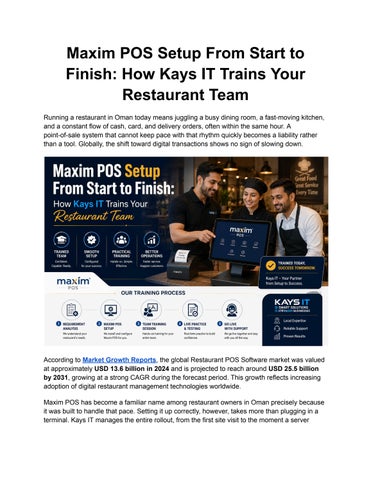
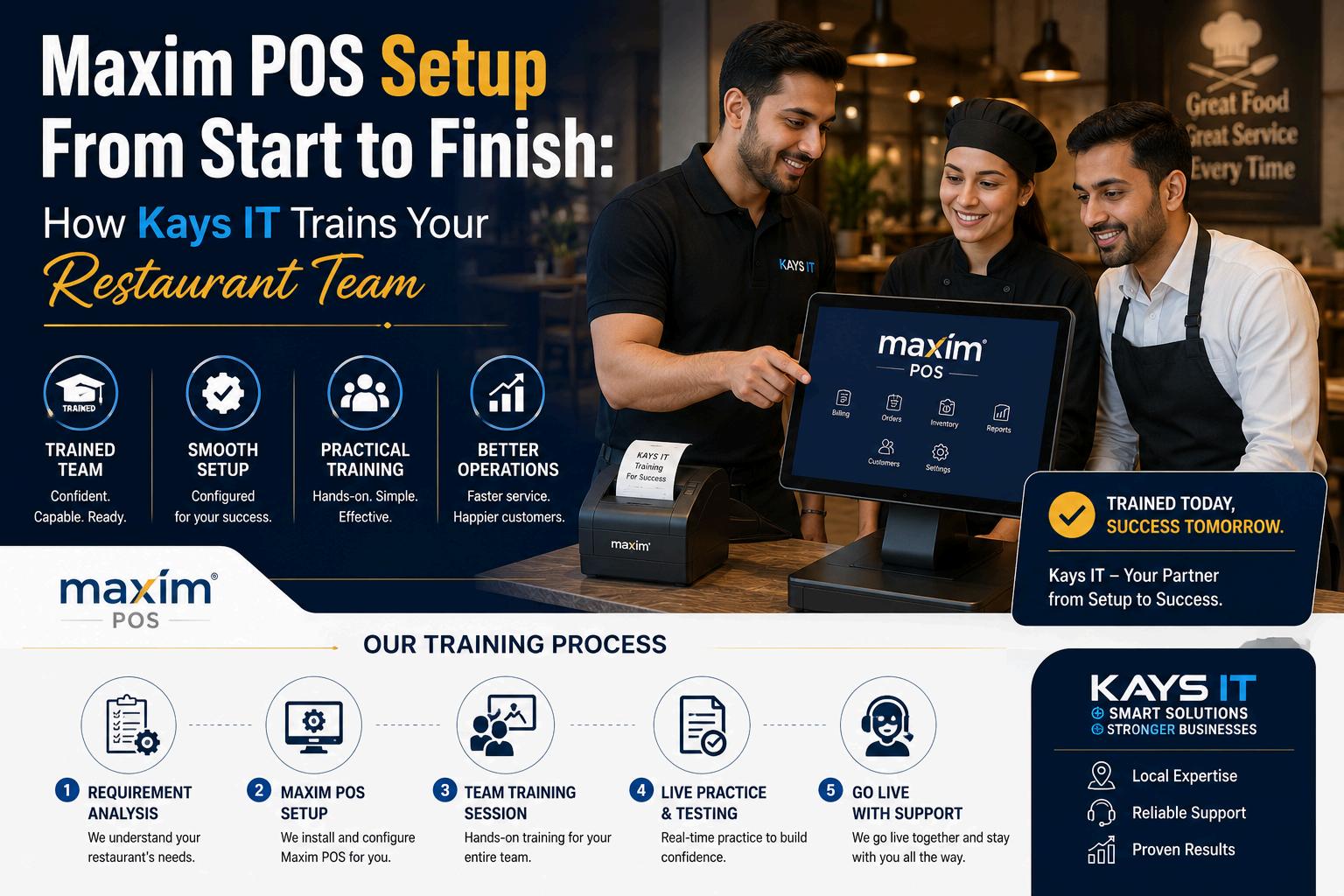
The 5-Step Maxim POS Rollout for Restaurants
Step 1: On-Site Assessment of the Restaurant's Floor and Kitchen
Every rollout begins with a visit to the restaurant itself rather than a checklist filled out over email. A Kays IT engineer walks the dining floor, counts service points, and reviews how orders currently move from table to kitchen to cashier The visit also covers the menu structure, including combos, modifiers, and seasonal dishes, along with the restaurant's VAT setup and existing hardware, such as printers, card machines, or kitchen display screens that might still be reusable This step typically takes half a day for a single outlet and a full day for a restaurant running multiple kitchen sections or floors, ending with a written plan and a confirmed go-live date
Step 2: Hardware Setup and Kitchen Display Configuration
Once the plan is approved, Kays IT installs and configures every piece of hardware the restaurant needs, from POS terminals at each service point to kitchen display screens, receipt printers, and card payment devices.
Oman's restaurant scene is following a similar trajectory, particularly among casual dining and quick-service outlets competing on speed and order accuracy Every terminal is tested with sample orders before staff ever touch it, and offline mode is activated so billing continues even during a brief connectivity drop, syncing automatically once the connection returns
Step 3: Software Configuration, Menu Build, and Tax Setup
With hardware in place, the team configures Maxim POS itself, building the restaurant's full menu inside the system, including categories, combos, modifiers, and pricing for dine-in, takeaway, and delivery. A well-configured POS system for restaurants in Oman operators to rely on should reflect exactly how the kitchen and floor already work, rather than forcing staff to adapt to a generic template.
This stage also sets up Oman's 5% VAT correctly across every menu item, configures user roles so cashiers, supervisors, and managers each see only the screens relevant to their job, and connects any third-party delivery apps the restaurant already uses. Configuration is reviewed and approved by the owner or manager before training begins, so there are no surprises once floor staff start practicing.
Step 4: Staff Training for Front-of-House, Kitchen, and Management
Training happens on-site, on the restaurant's own hardware, using the actual menu rather than a demo version. Sessions run in the language the team is most comfortable working in, including Arabic, and follow a sequence that builds confidence rather than overwhelming new users on day one.
Servers and cashiers learn how to take orders, apply discounts, split bills across multiple guests, and process card and cash payments without slowing down service during a busy seating Practice runs use real menu items and common scenarios, such as a guest requesting a last-minute modifier or a split payment between four diners, so the skills transfer directly to a live shift.
Kitchen staff are trained on how tickets arrive on the display screen, how to mark items as ready, and how to flag when an ingredient runs low so the front of house can update guests before an order is even placed This reduces the back-and-forth that usually happens when a kitchen runs out of a dish mid-service.
Step 5: Go-Live Support on the Floor
On the day the restaurant switches over, a Kays IT engineer is physically present rather than reachable only by phone. Go-live is scheduled around a quieter service, such as a weekday lunch, so the team eases into the new system instead of facing it for the first time during a packed Thursday dinner rush.
The engineer stays through the shift, watching real orders move from table to kitchen to bill, and resolves small issues, such as a missing modifier or an unfamiliar screen, before they become a pattern. Ongoing support after this point runs through a Muscat-based team reachable by phone or WhatsApp, so questions that come up days or weeks later get answered by someone who already knows the restaurant's specific setup.
Inventory Management: Where the Real Savings Show Up
Staff training and smooth order flow solve the front-of-house side of the business, but many Oman restaurant owners find the bigger financial win sits in the kitchen. Inventory management restaurants in Oman relies on inside Maxim POS, which connects every sale to stock levels automatically, so a dish sold at the counter deducts the right quantity of each ingredient from inventory in real time, rather than relying on a weekly manual count.
This matters because food cost is one of the most volatile line items on a restaurant's profit and loss statement, and small leaks, such as over-portioning, unrecorded waste, or a supplier short-delivering stock, are easy to miss without a system tracking them. Once inventory is linked to the POS, managers can see which dishes are eating into margin, which ingredients are close to running out mid-shift, and which suppliers consistently deliver less than what was ordered, all from the same dashboard used for daily sales reporting
Reordering becomes proactive rather than reactive as well When stock for a key ingredient like chicken or rice drops below a set threshold, the system can flag it automatically, so a manager places a purchase order before the kitchen runs out mid-service rather than after a guest is told a dish is unavailable.
The setup process for inventory tracking follows the same disciplined approach Kays IT uses for full Maxim POS rollouts elsewhere in Oman, including retail and supermarket implementations. Restaurant owners weighing the broader rollout, timelines, and team-readiness questions can read the full Maxim POS implementation process in Oman for a closer look at how site surveys, data migration, and go-live support are handled across a Maxim POS deployment from start to finish
How Long Does a Restaurant POS Rollout Take in Oman?
Timelines vary by restaurant size and complexity, but most single-outlet rollouts in Oman move from the first site visit to live service within a working week A casual dining restaurant with one kitchen and a handful of service points is usually ready in 4 to 6 working days. A restaurant with multiple kitchen sections, a bar, and several floors of seating typically needs 7 to 10 working days, since menu complexity and terminal count both add to the setup time
Factors that stretch a timeline include the number of POS terminals needed, whether the kitchen requires multiple display screens for different sections, and how much customization the menu needs, particularly for restaurants offering set menus, catering packages, or seasonal promotions that change frequently Restaurants opening as part of a new build sometimes prefer to run training a week before the official opening date, so staff already feel comfortable with the system before the first paying guest walks in.
Conclusion: Choosing the Right Restaurant POS Partner in Oman
Restaurants considering a switch are usually less worried about price than about disruption: will the dining room slow down, will staff struggle, will a busy Friday night turn into chaos? The order of Kays IT's five-step process exists specifically to answer those worries, since hardware, menu configuration, and tax setup are finished before staff are asked to learn anything, and an engineer remains on the floor for the first live service
For restaurant owners comparing options across Muscat and beyond, the best restaurant pos Oman has to offer combines dependable local support with a system built around how a kitchen and dining floor actually move, not just a feature checklist Maxim POS, paired with a structured rollout and training plan, gives restaurant teams a system they understand before it ever touches a live order, which is ultimately what keeps service smooth on the nights that matter most.
Frequently Asked Questions
Q1 How long does it take to set up Maxim POS in a restaurant in Oman?
Most single-outlet restaurants in Oman go from the first site visit to a live system within four to six working days. Restaurants with multiple kitchen sections or several floors of seating typically need seven to ten working days An exact timeline is confirmed in writing after the initial site assessment, so there are no surprises once installation begins
Q2 Will the restaurant need to close during installation?
No. Hardware setup, menu configuration, and tax setup are completed before the official go-live day, so the kitchen and dining room continue operating normally throughout preparation The switchover is scheduled around a quieter service, such as a weekday lunch, and an engineer stays on-site through the first live shift.
Q3 Is staff training provided in Arabic?
Yes Training sessions run on-site in the language the team is most comfortable using, including Arabic, and cover real scenarios such as split billing, order modifiers, and end-of-shift reconciliation Sessions are hands-on and use the restaurant's actual menu rather than a generic demo
Q4 Can the system track ingredient stock automatically?
Yes. Every sale recorded through the POS deducts matching ingredient quantities from stock in real time, removing the need for constant manual counts Managers can see which ingredients are running low, set automatic reorder points, and review which dishes consume the most stock relative to their selling price.
Q5 What happens if the internet goes down during service?
Maxim POS includes an offline mode that keeps order taking and billing running even without an internet connection. Transactions are stored locally and sync automatically once connectivity returns, so a brief outage does not interrupt service or cause lost orders during a busy shift