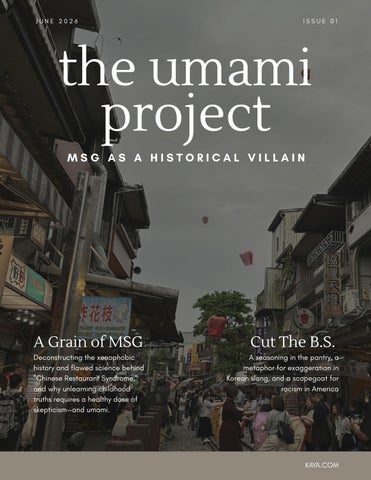
Deconstructing the xenophobic history and flawed science behind "Chinese Restaurant Syndrome," and why unlearning childhood truths requires a healthy dose of skepticism and umami.
Cut The B.S.
A seasoning in the pantry, a metaphor for exaggeration in Korean slang, and a scapegoat for racism in America
the fifth taste
AN EDITOR’S NOTE
AMELIA SU
Monosodium Glutamate (MSG) is often described as the embodiment of the “fifth taste” alongside sweet, sour, bitter and salty -- umami Often described as a rich, meaty flavor, umami is the tongue’s ability to taste an amino acid called glutamate. MSG is simply the salt form of this edible compound, found naturally in protein-rich foods like tomatoes, parmesan, mackerel, mushrooms, soy sauce and miso.
Over the years, this umami seasoning – a staple in Asian cooking –has become stigmatized, marginalized because of its Asian beginnings as a Japanese invention by Dr. Kikunae Ikeda at the Tokyo Imperial University in 1908.
In the U.S., MSG has faced particularly widespread stigmatization –thanks to a series of newspaper headlines from the late ‘60s centered around what is called “Chinese Restaurant Syndrome.”
This syndrome, which has since been disproved by a number of scientifically backed research studies, draws its inspiration from a questionable letter published in the New England Journal of Medicine in April of 1968.
The purpose of this first issue of the umami project is to dive deeper into Asian American perspectices regarding this controversial ingredient. How did you grow up viewing MSG? What are your thoughts now? Do you use MSG in your cooking today?
I invite readers to think about their own relationship with MSG as they read through this issue.
A Grain of MSG
ALYSSA CHIANG
Eventually, active avoidance of MSG became passive avoidance. It was almost second-nature to gravitate toward the “NO MSG” labels without thinking about why. After college, I continued into graduate school, which brought me up close d e o l with ie e d e e h I
claimed, was causing unexplained heart palpitations, weakness, and numbness A few possible culprits were named, with MSG a prime suspect Numerous doctors chimed in – with notably inconsistent and diverse symptoms. Many news headlines and questionable experiments later, the “Chinese Restaurant Syndrome” had generated widespread fear. Under these shaky circumstances, one can only wonder if the panic was rooted in more than blind trust in media and science...and maybe in xenophobic sentiment. In a short span of time, the long-term damage was done Fear towards an ingredient commonly used across various Asian cuisines Guilty, with no fair trial
Today, MSG is designated GRAS (“Generally Recognized as Safe”) by the FDA, after overwhelmingly inconclusive evidence of its health effects Now, I have a jar of MSG in my kitchen A part of me feels a twinge of residual guilt when I reach for it, but I do it anyway, as a tiny form of resistance I’ll add it to a chicken dish that just seems to be missing a little something, a vegetarian dish to give a bit of an umami kick, or a soup that I think could use a little more savory fullness It’s a small, constant reminder to stay critical Science, like most other media, hangs on to sensational headlines It vies for readership and citations, and it’s subject to bias As a scientist, I believe science is crucial to helping us find ground truth – but it must always be consumed with a little grain of salt or, might I suggest, MSG
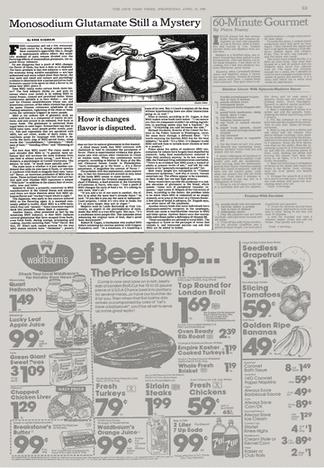
ECKHOLM, ERIC, APRIL 23, 1986, “MONOSODUIM GLUTAMATE STILL A MYSTERY,” THE NEW YORK TIMES ARCHIVES
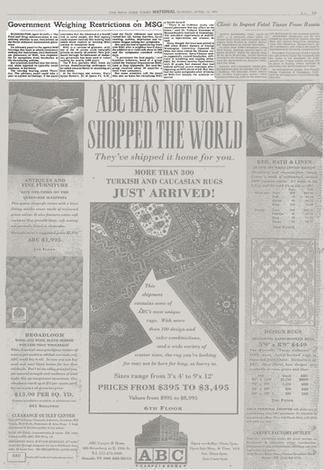
APRIL 11, 1993, “GOVERNMENT TO WEIGH RESTRICTIONS ON M S G ” THE ASSOCIATED PRESS
MOLECULAR MODEL DRAWN BY TOVYA MICHAEL
Yukkalmyun
RILEY YANG
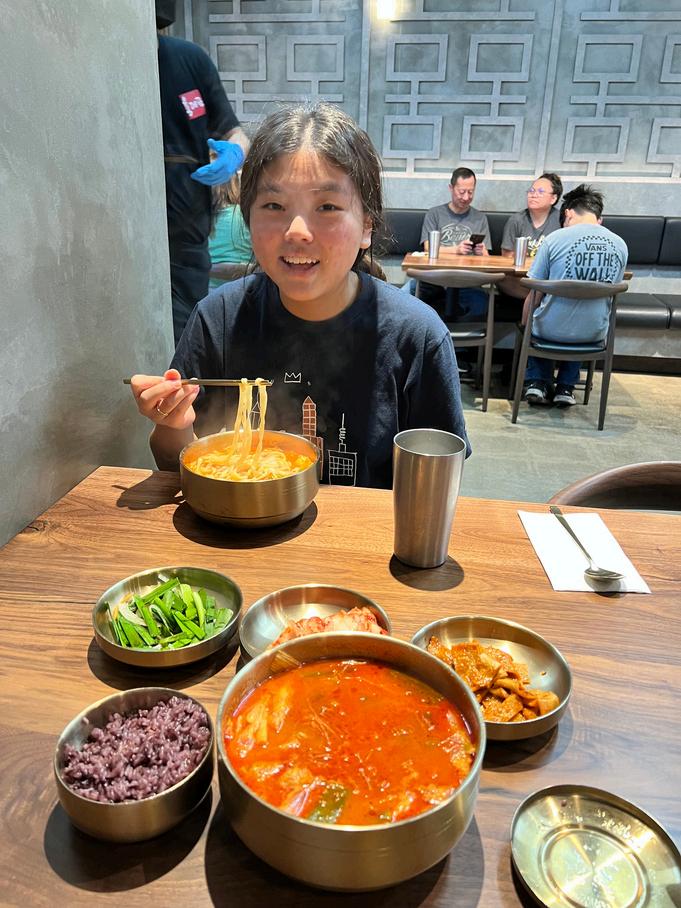
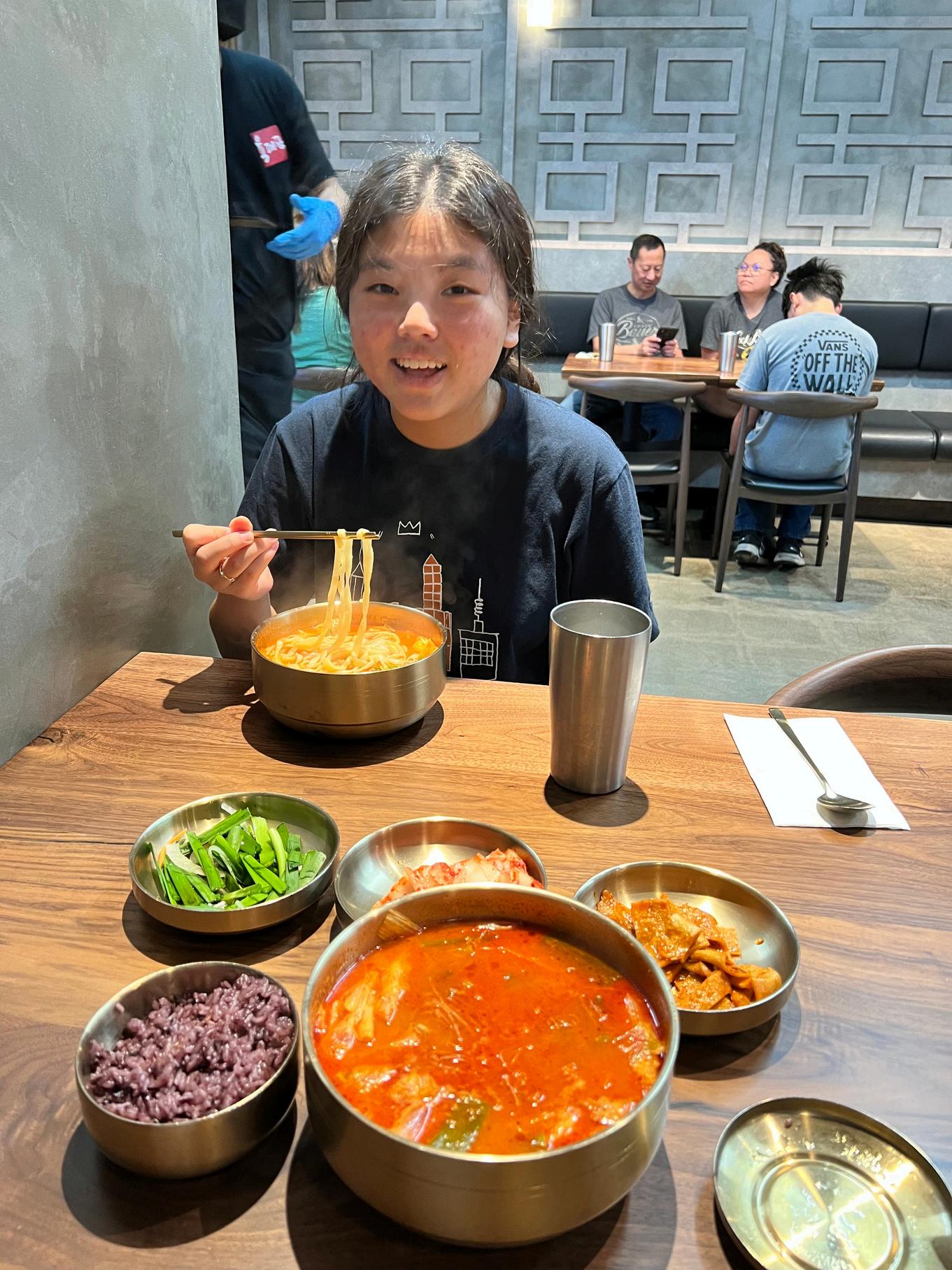
My favorite food is yukkalmyun, hand-cut noodles in a spicy beef broth with beef brisket and green onions But not all yukkalmyun is equal it must specifically be from the restaurant Yukdaejang in Convoy, San Diego. I have tried my grandma’s yukkalmyun and while it has a clean flavor profile, it cannot compare to the unhealthy MSG deliciousness that is Yukdaejang’s namesake dish. Does the MSG leave my face bloated for a day afterwards? Maybe. Do I feel thirsty for a good 10 hours after I eat said deliciousness? Yes. But I don’t care if I walk away with swollen eyelids and an unquenchable thirst.
In my eyes, this is a badge of honor signifying the necessary sacrifice that must be made for the greater good of my tastebuds I once went to Yukdaejang with my friend, Adrienne, who never drinks all the soup broth. I don’t know if this is just a healthy habit, or if she doesn’t like the high amounts of MSG in yukkalmyun, and frankly I don’t care. If she doesn’t want to drink the soup, she doesn’t have to.
However, I sip the last drops of my soup with relish and when I reach the bottom of that shiny bowl, I feel bloated but also proud. If this is incomprehensible to people who judge me for thoroughly enjoying my MSG yukkalmyun then so be it more for me!
A Family Additive
LAURIE SU
Growing up, my mom used MSG in almost all of her Asian cooking. It was a staple in the kitchen–the clear bottle of white powder with a red cap on it that she sprinkled in her dishes as she cooked away. I never thought much about it–just that it was what helped to make my moms dishes delicious to eat. But as I got older, I heard about MSG’s propensity to give one a headache and to overall not be a good additive to food. So when I moved out and began cooking for myself and eventually for my own family, I didn’t use MSG in my cooking. I even scoured the ingredient labels of packaged sauces and foods for the ingredient MSG and didn’t purchase those items which contained it.
Steamed Egg with Shrimp
One dish that I remember my mom cooking for our family was Steamed Egg with Shrimp and included in the ingredients is MSG! This is a simple, comfort food type of dish that was prepared with love by my mom for our family to enjoy.
Ingredients:
4 eggs
1 1⁄2 cups chicken stock
“IT WAS A STAPLE IN THE KITCHEN – THE CLEAR BOTTLE OF WHITE POWDER WITH A RED CAP ON IT”
For example, I purchased dashi powder that advertised “No MSG” on the packaging But after having read more in recent years about MSG and the fact that it does not cause headaches or cause negative health effects, I am more open to buying ingredients from the grocery store with MSG in it I still don’t have a bottle of MSG in my kitchen to use in my cooking, but I buy the Ajinomoto Hondashi that my mom used that has MSG as an ingredient in it and no one in my family gets a headache when I use it in our dinner!
1 t Salt
1 t Cooking wine
1⁄4 t MSG
1 t Soy sauce
10 shrimps
Parsley
Procedure:
1 Lightly beat the eggs in a bowl Add soup stock, salt, wine, MSG, and soy sauce Mix
well Pour mixture through a sieve
2 Clean shrimp with water and pat dry
3 Pour beaten egg mixture in a bowl, arrange shrimp over eggs Sprinkle with parsley
Then place bowl in a steamer
4 Steam on high heat for 2 minutes, then turn down to low heat and steam for 20 more minutes until firm and well done Serve in the bowl in which it was steamed.
Cut The B.S.
MADISON YANG
MSG in mainstream America: the “Asian” additive, artificial seasoning, an illusion of “real” flavor.
MSG in Korean conversation: slang for – don’t exaggerate, don’t tell tall tales, cut the b.s.
MSG in my life: yum.
Who knew that in a land of sugary, salty, high-fat, extensively processed and exquisitely packaged foods we would have the audacity to racialize and politicize a single chemical compound in this way.
Who knew that this attitude towards Asian foods, Asian cultures, Asian people could have transnational implications? Food for thought.
many thanks to our amazing contributors!
writers
alyssa chiang
riley yang
laurie su
madison yang
photo and illustration
amelia su tovya michael newspaper clippings from the NYT Archives