EVEN IN MUDDY WATERS, THE LOTUS BLOOMS
JUNE 2020 // ISSUE NO. 1
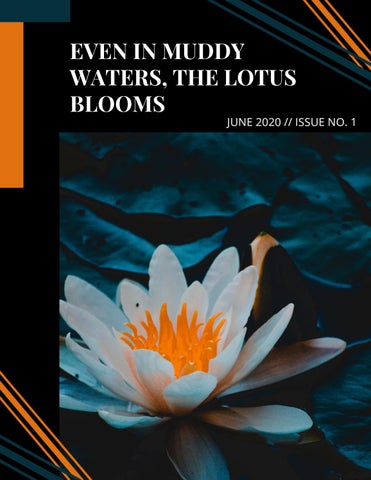
NOTES FROM THE EDITOR MARJORIE LLANERA I hope this message finds you well! "Even in Muddy Waters, the Lotus Blooms" is a symbolic representation of oneself as the lotus and one's own hardships as the muddy waters. I had intentionally used the image of the lotus since it carries meaning in Asian culture. The objective of my publication was to explore how Asian American and Asian college students and post graduates use literature and the arts as a form of resilience or as a means of gaining a better sense of their own racial/ethnic identity. The college experience on its own is difficult, as many students have trouble navigating the system, but simultaneously part of this journey includes forming their own conclusions about their racial/ethnic identities which is a difficult journey. With that in mind, resilience can happen in gradual steps or during sudden events.
Through observing and reading these pieces, I hope it imparts a sense of comfort for you, something you can relate back on. After talking to the artists and writers about their work, I could not help but feel overwhelmed with emotions. Here we have people who had stories to tell, ones that were not easy for them to simply submit. And by submitting their work, that in itself was an act of resilience. Over the years, I have come to realize one way of being kind to yourself is being kind to others. When we do that, we ask ourselves more questions, but at the same time reach new answers. I hope this publication issue creates similar realizations for you.
CONTENTS 1
POLARIS
University of California, Los Angeles
9
University of California, San Diego
RUITING JIA
3
NIGHTMAREÂ
ABANDONED ART 1
WHITNEY TSAI
11
Stanford University
ABANDONED ART 2
University of California, San Diego
SHARON TRAN
WHITNEY TSAI
5
7:08 OUTGOING CALL 43 MINUTES Stanford University
13
University of California, Los Angeles
SHARON TRAN
7
TEARS IN BED ON A THURSDAY AFTERNOON University of California, Santa Barbara VIVIEN TRUONG
8
JUST LIKE MOTHER EARTH University of California, Santa Barbara VIVIEN TRUONG
ASIAN RESILIENCE
MICHELLE NGUYEN
16
INHERITANCE
University of California, Santa Barbara FIONA ZOU
POLARIS // RUITING JIAÂ
1
1
POLARIS This painting is called “Polaris,” and it’s a portrait that I did of my best friend Pauline Comising in 2018. Polaris means the north star, the brightest star in the constellation Ursa Minor. To me, Pauline is like a small star far away from me, undiscovered and yet, shining bright. Mental health and identity are both extremely important to the both of us. Late at night, when it’d be 4am for me here in LA and 7am back home in Maryland, we often spontaneously call to just get something off of our chest. This helps me especially with my mental health, as I become constantly reminded of how much I am supported from my friends. We rely on each other, trusting that although we are almost 3,000 miles away from each other, that we’d stay together. I wanted to submit this piece as this portrait says a lot about perspectives. Many people, when they see this painting, interpret it as erasing one’s identity. Being a faceless portrait, the paint streaks seem to wipe away any hints of what Pauline’s face looks like. But to me, this painting holds both my resilience and my close bond with her. If I had just painted a portrait of Pauline, without any alterations, with her face in plain view, it would just be that - a simple portraiture of my friend. But instead, with a shaky hand, I chose to cover it with messy but carefully controlled heavy brushstrokes, something that I’ve never tried to do before for my previous paintings. Only I as the artist have seen what’s under those pink marks, and thus, only I know how much of a hidden star she is. My eyes have seen how much strength she has and how much of a support she can be to her friends, something that has grown over almost 10 years since I’ve known her. And thus, with the paint streaks splattered on her face, the simple portrait becomes so much more meaningful and complex. Polaris blooms into the artwork that I envision it to be, and instead of hiding any details, prompts curiosities to uncover what’s underneath.
2
NIGHTMARE SHARON TRAN
Grandma wasted away into small flakes of skin that trailed after her as she walked around the house. I would follow with broom and dustpan in hand to hide the evidence of another day lost. When she was hospitalized, I did not realize that would be the last she’d see of me. My parents ignored me when I asked to visit. They did not want me to learn she had forgotten my name. *** Grandfather is healthy and well, but there is a point when nightmare becomes habit, when I dream of my grandfather so often after stressful days that I enter every dream prepared:
3
Stand at the door and watch him clip another picture of something related to you out of the newspaper. Approach slowly to not frighten him. Crouch down when he looks up. Do not fret if he does not recognize you. (He won't.) Hold your breath when he flinches, as if he's been caught. Ignore the way he scrambles to push the paper under the couch. Rush to locate the scissors. Kick then out of reach if you do. (You don't.) Find his hands. Hold them together as tightly as you can. Marvel at how the ink stains transfer from his hands to yours. Prepare soft questions to ask him where he found the newspaper this time. Remember to check this place among the others every morning before school. Stuff the paper in your backpack. Throw it away in the recycling bin behind the library. Dodge the scissors that he throws at you. He will miss. Do not take it personally. Remind yourself that he does not recognize you — at least, not like this. This calm will come as it always does. Wash his hands with yours under warm water. He will fidget from being in one place for too long. He will giggle when you press the rough drying towel against his soap-softened hands.
4
7:08 OUTGOING CALL 43 MINUTES SHARON TRANÂ
i want to cry every time i call you. i get mad at you when all i want to say is I miss you and I want to come home. but the one thing i hate more than missing you is worrying you. so instead, i say, Mm.
I know.
I will.
Yes, I'll go.
In a bit.
the last time i called you i let myself cry, one of the most selfish things i've done is offer only short breaths and shorter sobs across a phone line. i've never done this before so i do not fault you for not being who i needed you to be and for saying what you've only been saying or the past twenty years. in our home, the direct translation of to overcome is to suffer. so you tell me,
5
捱过去.
suffer through it with what i know is only love and worry in your chests. and because the only thing i hate more than missing you is worrying you. when you tell me to Mm.
I know.
捱过去, i can only say, I will.
Yes, I'll go.
In a bit.
6
TEARS IN BED ON A TUESDAY AFTERNOON VIVIEN TRUONG look, i'm trying. tell me it's not enough just like you did yesterday and every day before but don't worry it's carved onto my skin so i never forget. my blood-stained clothes stick to me like your post-it notes don't worry it'll remind me (again) i can't run away from doing laundry. the sun hasn't left so don't worry i'll bring the sheets out from the dark corner of the closet hang out on the balcony so they can breathe again. you see, i'm trying. so could you do me a favor — take a look around, face the other way, and pretend to believe me?
7
JUST LIKE MOTHER EARTH VIVIEN TRUONG she is going and will keep going again and again and again and why should she ever stop she cannot breathe organs failing toxic-glued to humanity mother earth still twirls in starlight so yes she is going to whisper water into forgotten flowers to shine sun onto cowardly corners just like mother earth there she goes again said with an eye that rolls only once but she is not afraid to get dizzy she knows balance will come it is hard to breathe in space where black holes steal every noise but she is still going and will never stop
8
ABANDONED ART 1 // WHITNEY TSAI 9
ABANDONED ART 2 // WHITNEY TSAI 10
ABANDONED ART 1 & 2 In a capitalist society, it’s inevitable that what you produce is meant to be consumed, so there’s no use in separating the production of art from the act of consumption. Media, very similarly to food, is an art form designed for consumption, and at an increasingly dire rate in today’s media landscape (even this is a whole other essay). Seeing so many Asian American concerns wrapped up in media representation feels like a bad faith facade. This is why I’ve chosen to opt out of it until I can emotionally resolve where my identity fits into my art. I make the art that I make because I’ve been at odds with producing my art as a representation of my identity. In college, I realized that all the art I was making banked on the fact that it spoke to some facet of my identity: as an Asian American woman, as a queer woman, as a victim. The product I was producing was myself, and in not-so coded terms. I was upfront when it came to selling my experiences as a product. I’ve been in far too many spaces where Asian American artists produce art that’s meant to be a product of cultural identity, then immediately turn around and try to make some money off of it. I guess as a marginalized identity, though, it often feels like that’s all you have, a story to sell and ultimately everything is going to come back to that.
11
https://www.eater.com/2019/11/5/20942192/bubble-teaboba-asian-american-diaspora The article discusses how boba became a complex symbol of cultural identity, and the appeal it has as a marketable experience. That’s the key. That it was marketable. I’m still beginning to understand my relationship with my identity, but part of what hurts is the concept of making marketable content from my identity. It feels disingenuous.
How do you use art for self-fulfillment when your identity becomes the content? The product? This is why the art I make now is not so forward with my identity. It’s not that I avoid sharing personal experiences, but instead I’d like to focus on every other part of my interests and experiences. When I describe the art I make, I don’t want to claim it as “my art” just yet, I usually go with the line “girls and robots” since that sums up very nicely my genuine interests rather than an obligation to be Asian American and the story that comes with that. Of course that’s a little hypocritical since the word Asian American was used at least 50 times in this essay, but whatever. I’m trying
12
ASIAN RESILIENCE MICHELLE NGUYEN
Being comfortable in my identity was something I struggled with for many years. However, after ten years of pushing back my identity, I realized that it is something to embrace and love, as this is what makes me, me. When I was seven years old, I was bullied for bringing my own lunch to school. “What’s for lunch this time? Dogs? Cats?” I remembered getting upset and only taking out the veggies to eat because I knew that I was going to get picked on. I found out later that day that my mom packed rice, green beans, and a chicken drumstick. A chicken drumstick—yet I was nervous to eat it because of what others assumed of me. When I was thirteen years old, I was fortunate enough to participate in a medical mentorship program in my hometown. Many people applied because they wanted to look good for the future. I applied because I knew that my passion was within the health field from the start. When a few friends and I got accepted, we were told, “Maybe because you’re Chinese, most Chinese are doctors so they chose you”.
13
Keep in mind: I’m not Chinese. I’m Vietnamese, and most importantly, I am an Asian-American. When I was eighteen years old, I was accepted to all six of the colleges that I applied to, yet I was looked down upon once again. “You’re Asian, of course you’re smart, and of course you’re going to get into any college you apply to!” Again, because of who I am, I was looked down upon as if my achievements were just an expectation from my ethnicity. It wasn’t until I got to college when I noticed the love and support of different identities developed. The identity I was ashamed about was now the identity I fully embrace. My culture’s beautiful; our cultures are beautiful. How could I be so judgmental to myself just because someone else voiced their opinions at me? I was never ashamed of who I was, I was just scared of being looked down upon. During my first year in college, I explored two organizations that helped me discover my Vietnamese culture. Both clubs allowed me to be happy with my roots, my food, and my language. Both clubs allowed me to express not just who I am, but also how I came to be the way I am. During my second year in college (currently), I decided to take Vietnamese for my foreign language requirement in order to reconnect with my roots. From there, I’ve met such amazing friends and faculty who’ve all experienced similar pasts of being bullied, looked down upon, and so forth. In my Viet classes, I was able to dive deeper down into my overall identity.
14
Accepting my full identity is still something that I still struggle with, but as of right now, I’m in a happy and loving state. Like many others, what used to be a burden in my everyday life is now a spotlight in who I am, my upbringing, and my emotional strength.
15
INHERITANCE FIONA ZOU
My mom once told me that my love of reading reminded her of my grandma, Lien, whom I was proud and pleased to be compared to. As a kid, I remember my grandma pressing volumes of ESL study books into my hands, telling me to never give them away. They were so valuable that she could only entrust them to relatives. I had always thought moments like that were symptoms of a creeping dementia, but I soon realized that that’s how important reading was to her. When my grandparents fled Vietnam by boat for the United States in the 80s, my grandma had to adjust to a new life on top of all the responsibility a sometimes 10-person household could be. Still, she made time to take ESL classes at a local school. The diligent and neat notes in the margins of her ESL study books she showed me reflected her dedication. My grandma may have been too poor for schooling, but she saw that literacy would open doors to greater life opportunities than she had had, so she passed these values on to her children. My mom clearly took my grandma’s advice to heart because she encouraged my love of reading by regularly checking out books from the library until I was old enough for my own library card. When I finally received my own library card, my excitement was unparalleled. My childhood dream of winning the lottery was winning free books for life. Having a library card was pretty much the same thing, so I was ecstatic.
16
I became a small menace to my local library then, maxing out the number of books I could check out at one time and then borrowing my sister’s library card to check out some more. Books became a large amount of comfort when I had few friends in school. They helped me gain confidence in myself even as I struggled with anxiety. I learned how to think critically and empathetically, I learned the values of independence and conviction, and most of all, I learned that there is a power in the written word that many don’t realize or underestimate. When I considered how my grandma couldn’t have the opportunities she wanted in life and still made the best of what she had, it made me more determined to succeed in my major. Going into the arts and humanities—especially in English, when most seem to think the only career option after graduation is being a teacher— may not have been the typical moneymaking and prestigious STEM studies, but to me there is no less significance in it. In the same way that we can never fully comprehend the extent of the circumstances that influence us, it wasn’t until I was in college that I recognized how much my love of reading and my eventual studies in English literature were the result of a lifetime of my grandmother’s experiences. To this day, the comfort of literature reminds me of how far my family has come and how far I can still go.
17