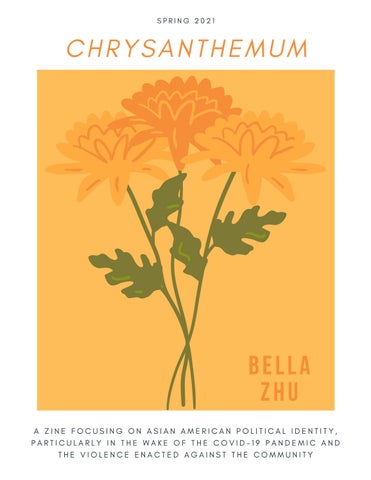
SPRING
2021
CHRYSANTHEMUM
BELLA ZHU A
ZINE
FOCUSING
PARTICULARLY THE
IN
ON
THE
VIOLENCE
ASIAN WAKE
AMERICAN
OF
ENACTED
THE
POLITICAL
COVID-19
AGAINST
THE
IDENTITY,
PANDEMIC
COMMUNITY
AND
CHRYSANTHEMUM
Special thank you to Neelanjana Banerjee, Kaya Press and all of the writers and artists who made Chrysanthemum possible!
TABLE
OF
CONTENTS
CHRYSANTHEMUM
INTRODUCTION Editor's Note with Bella Zhu
04
Explanation of Chrysanthemum
05
Conversation Starters
06
ARTWORK & WRITING Daughter Mourning
08
by Vanessa Ta
Maya Zhu
Vases
10
12
by Kathlyn Zou
Ellen Lhee
14
CHRYSANTHEMUM
PAGE 4
LETTER FROM THE EDITOR why
this
project?
Hello! Thank you so much for your interest in Chrysanthemum. My vision for this project originated initially because I noticed that so many of my friends who usually are either not as interested in or involved in politics were becoming more politically aware during the pandemic. Since many of my friends here at UCLA are Asian American I began wondering if this new interest in politics stemmed from the presence of Asian Americans in the media during the COVID-19 pandemic. I created this zine as a way for the Asian American community to explore this topic further as well as express themselves through art or writing. This period has already been incredibly challenging and the xenophobia and racism our community faces has only made it more difficult. Through Chrysanthemum, I hope to create a community where Asian American identity is celebrated.
BELLA ZHU
Thank you and enjoy! Bella
WHAT IS CHYSANTHEMUM?
Chrysanthemum aims to explore the nuances of Asian American and Pacific Islander identity specifically in the wake of the COVID-19 pandemic and the violence enacted against the community. This zine consists of writing, art, and other creative submissions on this topic. Through this zine I hope to create a piece that uplifts AANHPI writers' voices as well as one that acts as a form of support to display the strength and resilience of our community. I hope to show that we are not alone during this difficult time.
CHRYSANTHEMUM
PAGE 7
CONVERSATION STARTERS feel
free
to
reflect
on
these
questions
yourself!
How has this hyper-politicization of Asian Americans impacted or influenced your self-perception?
What have you noticed feeling when news of antiAsian hate crimes or rhetoric is recorded/reported?
Have you noticed a shift in self-perception either on a personal level or more generally/politically during this time?
How can we begin to heal ourselves and our community from the trauma of these hate incidents? How do you take care of your own mental health?
DAUGHTER MOURNING Vanessa Ta
MUMEHTNASYRHC 8 EGAP
FROM THE ARTIST:
The past year has been one of tremendous loss. I’ve attended three funerals for close family members, one of whomst passed from COVID-19. To lose someone because of the pandemic, that shit breaks you. There are no visitations, no physical comfort. You have to grieve in isolation. The loss of socialization with friends, unforgiving online classes, and lack of any real normalcy also certainly did not help.
When the news broke of the Atlanta Spa shooting, I had no real rage left in my body. I was empty and heaving with the loss of it all. Before the protests, before the media outlets mispronounced the names of the dead, I thought of the children of the victims. I know what it’s like to plan a funeral for a parent. Grief is fucking tiring, but still, I mourn with them.
MAYA ZHU
How has this hyper-politicization of Asian Americans impacted or influenced your self-perception? The hyper-politicalization of Asian Americans during this time has increased my awareness of being an Asian American and has also revealed a deeper connection to fellow Asians than I realized I had. I feel like I share in their hurt and identify with them more than before. I see this as a significant change especially because I am half Asian and my
MUMEHTNASYRHC
Asian identity has not really played a large role in my identity or experiences other than in this period of racial politicization with the recent rise in hate crimes. In terms of the response to the COVID-19 pandemic, I feel protective of the Chinese people as I see the blame repeatedly placed on Chinese (and many other Asians out of ignorance) for the spread of the virus.
What have you noticed feeling when news of anti-Asian hate crimes or rhetoric is recorded/reported? It feels incredibly strange to have Asian communities talked about so much in the media for what feels like the first time in my life. I am used to Asians not being included in dialogue, even when people try to list the main races (“White, Black, & Latino…). I feel glad that there is increased attention on this community and that people are taking action to show
01 EGAP
their solidarity and support, and at the same time horrified at the extremity of the violence we are seeing across the country.
Have you noticed a shift in self-perception either on a personal level or more more generally/politically during this time? I don’t think my perception of myself has changed much. I’m not always perceived as Asian, so I don’t worry about or experience different treatment based on my Asian identity. However, it feels different to be fighting for a racial cause that centers around my own race instead of others for the first time. I am usually advocating for marginalized communities from an outside perspective, so it is new feeling my own community “being in the spotlight” in so many different ways.
How can we begin to heal ourselves and our community from the trauma of these hate incidents? How do you take care of your own mental health? I think a lot of the healing can come from genuine recognition and understanding from non-Asian Americans. Since one of the main problems the Asian American community faces is invisibility, I personally feel that watching other communities come to recognize the very real struggles of a usually silenced group is healing in itself; it’s the first step to finding solutions as a larger community. In addition, I hope that Americans will stop blaming the Chinese for the virus soon, and recognize that the entire world has suffered from COVID-19, but it’s only still present in the US because of American problems on the governmental and individual level.
VASES
Kathlyn Zou
MUMEHTNASYRHC
21 EGAP
FROM THE ARTIST:
I did this drawing a while before I started hearing about the COVID-19 pandemic's influence on the Asian American community. Vases was just a piece of art I did, using my mom's perfume bottles as a live reference. However, as the rise in anti-Asian violence began to increase, I heard more and more stories on the news and other social media sites about hate crimes committed against members of my community. I saw a video of a middle-aged woman being shoved to the ground and an old man being beaten. As I heard more of these devastating stories, the significance of my art piece became more apparent. I thought about how that woman could have just as easily been my mother and that man could have been my grandfather. The pandemic has exposed the xenophobia and racism that was present in our communities even before the virus and it has presented itself in incredibly violent and damaging ways. I hope that through art and other methods, our community can come together in solidarity and heal from this trauma.
ELLEN LHEE
How has this hyper-politicization of Asian Americans impacted or influenced your self-perception? Before this year I never really thought much about my identity as an Asian American (Korean American more specifically) in a political sense. I knew that people saw me either in a more negative or positive light due to my race. However, this time has been incredibly eye-opening as I have begun seeing people from my community displayed in the media either as
MUMEHTNASYRHC
villains, the carriers of disease, or as victims of violent hate crimes. In turn, this experience has been incredibly difficult. While Asians are often seen as the "model minority" and in a positive light, the racism I have seen since the beginning of the pandemic proves how precarious and arbitrary this stereotype is. It has also helped me realize just how important solidarity during this time is.
How can we begin to heal ourselves and our community from the trauma of these hate incidents? How do you take care of your own mental health? I think that everyone should find a way to step back from the horrors seen in the media and on the news. While I understand the importance of staying up-to-date with the latest stories, they can be incredibly tolling to continue hearing about. I found that in the beginning, I was constantly
41 EGAP
trying to learn about each person and their story. However, I realize now how unhealthy it was for my mental health. I realized that it's okay to take time for yourself and turn the news off.
BELLA ZHU
INSTAGRAM: @BELLAJZHU EMAIL: BELLAJZHU@GMAIL.COM