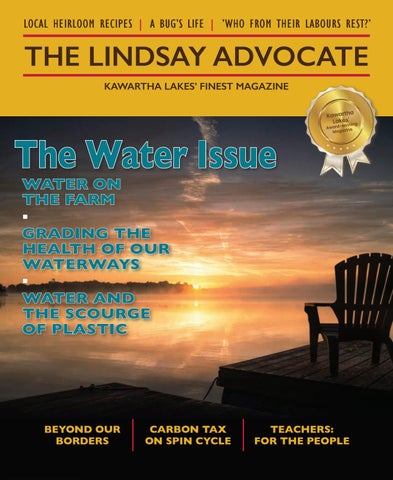
LOCAL HEIRLOOM RECIPES | A BUG’S LIFE | ’WHO FROM THEIR LABOURS REST?’
THE LINDSAY ADVOCATE KAWARTHA LAKES’ FINEST MAGAZINE
The Water Issue WATER ON THE FARM
GRADING THE HEALTH OF OUR WATERWAYS WATER AND THE SCOURGE OF PLASTIC
BEYOND OUR BORDERS
CARBON TAX ON SPIN CYCLE
TEACHERS: FOR THE PEOPLE
LINDSAY KIA The Largest KIA Dealer in the KAWARTHAS
LOOK FOR US ON MARK REID
Sales Manager
BRAD BALL
ERIC POGUE
www.lindsaykia.ca
2959 Highway 35 - just south of highway 7 - Lindsay • CALL TOLL FREE: 1 (866) 322-0675
Internet Telephone Security
www.nexicom.net
May 2019 • Vol 2 • Issue 14
PUBLISHED BY
Fireside Publishing House, a proudly Canadian company. The Lindsay Advocate is published monthly and distributed to a wide variety of businesses and locations within Kawartha Lakes, North Durham and Southern Haliburton County. We are a proud member of the Lindsay and District, Bobcaygeon, and Fenelon Falls Chambers of Commerce. TEAM ADVOCATE EDITORIAL
Publisher and Writer-at-Large: Roderick Benns Contributing Editor & Writer-at-Large: Trevor Hutchinson Research, Strategy & Development: Joli Scheidler-Benns Contributing Writers:
Sylvia Keesmaat, Jamie Morris, Judy Paul, Ian McKechnie LETTERS TO THE EDITOR SEND TO
kawarthalakespublisher@gmail.com or 151 King St, Suite One, Lindsay, ON, K9V 1E4 ADVERTISING & MARKETING
Advertising/Editorial inquiries: Roderick Benns
705-341-1496
Marketing: Bob Polan CREATIVE
Graphic Design: Barton Creative Co. Photography: Sienna Frost
John Chambers
CONTENTS 4 6 7 8 13 18 20 23 24 25 26 28 30
Letters to the Editor UpFront Benns’ Belief Water on the Farm Grading the Health of our Waterways Water in Plastic New Buzz at Lindsay Golf & Country Club City Notes Local Heirloom Recipes Beyond our Borders Friends & Neighbours with Jamie Morris Just in Time with Ian McKechnie Trevor’s Take
Visit www.lindsayadvocate.ca for many more stories FOLLOW US ON
d The Lindsay Advocate @lindsayadvocate Roderick Benns @roderickbenns
c /The Lindsay Advocate PRINTING
Printed by Maracle Inc. OUR PRIVACY POLICY The Lindsay Advocate is independently owned and operated. The opinions expressed herein are the views of the contributors and do not necessarily reflect those of this magazine. Photos, text, and art work contained in The Lindsay Advocate are copyrighted and may not be published, broadcast, or rewritten without the express permission of the Publisher. Liability for incorrectly displayed advertising is limited to publishing corrections or advertising credit for subsequent issues. The Publisher reserves the right to reject, revise, cancel, omit, discontinue or even decline to print advertising without reason or liability, and without notice. The Publisher has made every effort to ensure information contained herein was accurate at press time. The Publisher does not assume and hereby disclaims any liability to any party for damage, loss, or disruption caused by errors or omissions.
ABOUT US Even when life circumstances pulled me to other places, there was a greater part of me that always wanted to be home – in Kawartha Lakes. I’ve come back to try and make a positive difference in my community, this time with my family. My wife and I created The Lindsay Advocate to be media with a social purpose, to advocate for people over corporations, to push for a fair society where all citizens can reach their full potential. We know our institutions, non-profit sector, and small businesses are critical community partners. We thank them for their support and pledge to work together for a healthier, more prosperous Kawartha Lakes. ~ Roderick and Joli
Advertising Sales: Contact us at 705-341-1496 • kawarthalakespublisher@gmail.com
A TE
LIN
DSAY AD O C V
Homemakers matter, too
Don’t delay re-branding for City
This is in response to ‘Transportation and Child Care: Key Barriers to Work in Kawartha Lakes’. (March Lindsay Advocate issue.) When I moved to Lindsay in 2009 I had no idea what I was getting into. As my search for gainful employment dragged on I realized just how big of a mistake moving here was -- with job offers “if I had a car.” By the time I found myself pregnant in 2012 I was carpooling with four smokers all lighting up in the car. It was an awful decision to get into that car everyday because I really did have to make a living but it crushed me to know that I was already harming my unborn child with second-hand smoke. I did not find resistance in male-dominated Flight School, and only some as a factory worker, carpenter, and business owner/operator – the most disappointing response I have received is towards my work as a homemaker and mother because the unwavering expectation is that I should be working full-time outside the home regardless of the needs of the home, such as a baby who has heightened separation anxiety or a little girl that needs to be taken to medical appointments and therapies on a weekly basis. I have never regretted taking care of my family despite the associated financial hardship and I encourage any women or men who choose to do the same. - Hannah, Lindsay (name changed upon request)
A lack of good, suitable and varied job opportunities is a primary reason subsidies are essential. The municipality recently deferred a rebranding exercise for up to five years in favour of getting its ducks in order. Yet, that exercise is an essential component of market outreach and perception of our community. We must attract external investors, developers, and site locators. Residents should be asking councillors why more isn’t being done to proactively market our community. We must attract business resulting in spin-off tax base and job creation. That involves a good brand, advertising, incentives, streamlined building processes, cooperative
Personal service, from the people you trust.
THE ONLY PHARMACY IN KAWARTHA LAKES THAT PROVIDES COMPOUNDING SERVICES - A SPECIALIZED METHOD OF MAKING MEDICINES SPECIFIC TO VARIOUS NEEDS OR ALLERGIES. CERTIFIED DIABETES EDUCATOR. Come in and see us today
Wonderful publication on Kawartha Lakes women
Congratulations on your first anniversary as publishers of The Lindsay Advocate. What a wonderful publication of Women of Kawartha Lakes to celebrate this milestone. I especially enjoyed Ian McKechnie’s article on remarkable Kawartha Lakes’ women, past and present. How enlightening. Keep up the good work. I look forward to each edition. - Maria Bennett, Lindsay
ELLEN PATTERSON
CATHY PUFFER
108 Kent St W, Lindsay Ph: 705-324-0500 Fax: 705-324-6837
CLARE MILLINGTON Monday - Friday 9am to 5:30pm Saturday 9am to 1pm
We want your letters! Send us your thoughts to be featured on this page. The Lindsay Advocate welcomes your Letters to the Editor. We reserve the right to edit letters for clarity or length. Simply email thelindsayadvocate@gmail.com or mail to 151 King St., Suite 1, Lindsay, ON, K9V 1E4. Please keep your letters to 200 words or less.
4
www.lindsayadvocate.ca
programs with existing stakeholders, and a proactive team of ambassadors to seek out opportunities, speak to our positives, and earn the attention of an external audience. It’s not enough to simply declare “we’re close to the GTA and we offer healthy lifestyle opportunities.” (It took 15+ years to build decent municipal websites.) Rural municipalities across the province are fighting for a piece of the pie and we’re barely a player. The net result is decaying infrastructure and limited services (social housing, child care, transportation) and poor prospects for an increased tax base (a burden placed solely on existing businesses and residents). It has been 19 years since amalgamation and we still cannot even promote our assets effectively to help change our collective opportunities or the external perception we’re a difficult place to do business. We have the talent and desire to be a prosperous community of communities, but we don’t seem to muster the conviction and urgency to help ourselves. People need help. - Garnet Brydon, Lindsay
Democracy’s future depends on strong education
An open letter to Premier Doug Ford and MPP Laurie Scott: I am writing to express my opposition to the proposed education changes the government of Ontario is implementing. Increasing class sizes works to the detriment of students in general but particularly to students who struggle in an academic setting. Resilience is never taught by depriving people of aid. Resilience is learned by struggling with the support of educated and compassionate teachers and mentors. With this government’s learning model for resilience, one could argue for teaching swimming by throwing a person into the far end of the pool and seeing if they swim, survive, and learn. The future of any democracy is dependant on a well educated populace. Your policies are in direct opposition to achieving that goal. - Lorna Green, Lindsay
Pharmacare desirable but is it affordable?
The most recent issue of The Lindsay Advocate featured a plea for a national pharmacare plan to pay the pharmacy bills for those unfortunate citizens who are not covered by a group insurance plan which is commonly available to others through their employer, union or another organization. Of course, only the most cold-hearted person would not want every citizen to be able to cover the costs for all of their medical needs from cradle to grave. Unfortunately, there is the inconvenient truth about Ontario’s existing health care system - it is very expensive and currently represents about half of all the Ontario government annual budget allocation. To make matters more challenging, the issue of rising health care costs competes for public attention with other pressing issues such as the rising costs of housing, taxation, energy and the Ontario government’s public debt. There is another complication. Health care is a provincial jurisdiction. A “national” pharmacare program implies federal involvement which would likely focus on creating regulations and providing funding. The history of cooperation between the federal and provincial levels of government does not inspire pride or confidence in the average citizen. While advocating for a cause that will improve the lives of others is praiseworthy, I would encourage our journalists to put more thought and investigation into the “how to” rather than simple advocacy for “what to” do. - Gene Balfour, Fenelon Falls Every western nation except Canada has pharmacare coverage. The ‘how to’ can be figured out by policy experts; the ‘what to’ do is imperative -- and we need the political will to get it done.
Cindy Ray SALES REPRESENTATIVE
AFFINITY GROUP
DID YOU KNOW? The Trent Severn Waterway opens May 17
P I N N A C L E R E A LT Y LT D . B R O K E R A G E
273 Kent Street West Lindsay, ON CELL: 705-340-1188
OFFICE: 705-324-2552
www.cindyray.ca
HOME IS NOT A PLACE...IT’S A FEELING. LET ME HELP WITH YOURS.
www.lindsayadvocate.ca
5
UPFRONT
}} Kawartha Lakes Singers Celebrating10 Years
The Kawartha Lakes Singers are celebrating their 10th Anniversary at their final concerts of the Season. The choir is directed by founding director Arlene Gray, accompanist Laurel Robinson-Lachance. The “Renaissance and Romance” Concert is being held in Fenelon Falls, May 21, and in Lindsay, May 26. Everything from period instruments to Elvis featured. Tickets $20, available through choir members, on the website, and at the door. Klsingers.ca
}} Killoran Foodland supports Food Bank
Monique Renaud
GLOBUS THEATRE is thrilled to welcome Monique Renaud as the company’s first ever General Manager. Call Monique to ask about Globus’ 2019 Professional Summer Season. 1-800-304-7897 www.lakesviewartsbarn.com
Little Britain/Mariposa Community Food Bank has had a long relationship with Killoran Foodland. They have supported the food bank through various fundraisers over the years. Now, the food bank has received a substantial donation, a joint effort between Killoran Foodland and Sobeys. Bernie and Lesley Anne Killoran are retiring in May. The food bank and the community of Little Britain would like to take the opportunity to thank the Killorans for their years of support and wish them well on their retirement.
6
www.lindsayadvocate.ca
BENNS’ BELIEF
RODERICK BENNS, PUBLISHER
Teachers: For the people }}
In the mid 1990s, while working at a newspaper as a young scribe, I wrote what I thought was a great story about a teacher who was taking a sabbatical. He was going to visit an overseas country and increase his learning and experience. He would inevitably accumulate new wisdom to bring back to future students one day. Except that particular story never ran. I was told to get the ‘real’ story. How much was this going to cost? What sort of burden would this be to ‘taxpayers?’ The headline was altered, the focus shifted. In the end, the teacher and board of education were meant to feel shame for allowing such a thing to happen. I was embarrassed to see my name on that byline. I continue to see vestiges of this attitude today in our City, and it doesn’t make sense to me. Kawartha Lakes grapples with a high unemployment rate and low wages. More than 44 per cent of residents here have just their high school diploma or less education. Individual income from employment is a full 22 per cent below the provincial average. When a kid grows up in a situation where the parents do not have a high level of education, those parents may not know how to offer guidance and support. Teachers, then, can play an outsized and critical role in our kids’ development. So I am suspicious of millionaire leaders like Premier Doug Ford who see fit to wear the cloak of ‘the people’ while making cuts to public education. Increasing class sizes in high school will mean less teachers and a poorer learning environment. (The people won’t benefit.) The loss of OSAP funding will mean areas like Kawartha Lakes – where income levels are lower – will be penalized more than many other places. (The people lose out.) Universities and colleges are getting less funding and will be making cutbacks, affecting the quality of post-secondary education. (The people have less opportunity.) Meanwhile in Finland teachers are highly educated, requiring a Masters degree, and they are given great autonomy. They do not work under a microscope of mindless testing and forced evaluations. And college and university? That’s free for students, because Finland recognizes the value of a well-educated society. It’s time to stop supporting politicians who find, or make, enemies of the people who work in public education. Teachers guide and transition our kids into their careers and they help shape the kind of people they will one day become. That’s a job description that deserves investment, not cuts. And to that editor from long ago, I say that’s the ‘real’ story.
www.lindsayadvocate.ca
Dr. Jacquelyn Nicholls invites you to a new experience in healing.
PA I N
CO M F O RT
STRAIN
D I S CO M F O RT
RELIEF
R E L A X AT I O N
LET US HELP YOU MOVE FROM RED TO BLUE. CHIROPRACTIC ACUPUCTURE P R E N ATA L WEBSTER TECHNIQUE MASSAGE THERAPY CUPPING THERAPY SPORTS INJURIES
PUT YOUR BODY IN GOOD HANDS help@adelaideclinic.ca adelaideclinic.ca | 705.320.7811 1 Adelaide St N Lindsay Direct billing is available. To learn more please visit: www.adelaideclinic.ca/direct-billing
7
Water on the Farm: }} How Kawartha Lakes farmers meet
the challenge of too little, too much SYLVIA KEESMAAT Farmers have been concerned about water issues for as long as human beings have been growing crops. From the irrigation ditches of the ancient near east, to the flooding of ancient Egypt, the lack of water, or too much of it, has shaped the rhythms of farming life. As a result, farmers throughout history have developed various strategies related to water. Some of these—like the worship of ancient fertility gods and goddesses—seem a little odd to us now. Some, like tile drainage, are still practiced but are somewhat controversial. Others, such as the use of terrace farming and dams, continue to be used today. Farmers in the Kawartha Lakes who consciously practice strategies to retain and manage water, therefore, stand in a long and honoured history. And, while recent concerns about climate change have prodded some farmers to examine their practices around water retention and absorption, for most farmers these are not new issues. “Farmers have always been adaptive and prepared for change in weather patterns and the risks involved in crop production,” points out Mark Torrey, the local member service representative for the Ontario Federation of Agriculture. For Torrey, who farms on sandy loam between Woodville and Kirkfield, moisture retention has always been an important strategy to maintain fertility in the face of drought. Whereas in the past fields were often ploughed yearly, farmers are increasingly engaging in no-till practices, where seed is planted into fields that still contain the stubble of the previous year’s crops. Not only does this reduce erosion, but roots that decay in the soil add organic matter that increases moisture retention. Torrey also adds manure to his fields and chooses seed varieties that will perform well in challenging situations. In addition, he sows cover crops that increase the fertility of the soil. The use of cover crops is increasing, as farmers realize that plants such as winter rye, vetch, clover, oats, tillage radish, and buckwheat all have different roles to play in increasing soil health, says Alan Mulock, a farmer in the Oakwood area. Each cover crop, which is a crop that isn’t intended to be harvested, contributes something different to the soil.
8
www.lindsayadvocate.ca
“Some gather nutrients, some build nutrients, like nitrogen, others build organic matter as they decay. Others are green manure that is turned back into the soil.” Such crops build up the fertility and resilience of the soil so that it is able to weather different storms, whether that be too much water or too little. Mulock is also careful about the seed he uses, relying as much as possible on older seed stock that is adapted to this area. Seed that has been nurtured in the weather patterns and soil of the Kawarthas can pass on knowledge to subsequent generations of seeds. This produces plants that are resilient to the weather patterns unique to this place, both overly wet conditions and drought. We don’t generally think that the seed we choose is important for weathering flood or drought, but genetically modified seeds, or seed stock that is imported doesn’t know the climate and will find it harder to thrive. For instance, in a no-till system, Mulock points out, the soil is very cold when seeds are planted. Seed that is adapted to our area and has been saved from previous years is able to cope with those cold temperatures. While both Torrey and Mulock are growing cash crops on a fairly large scale, Julie Fleming and Andrew Flamen of Circle Organics have some of the same concerns about water on their much smaller certified organic vegetable farm. Although they also use cover crops each year to increase the resilience of the soil on some of their 60 arable acres, Fleming and Flamen employ a host of other strategies for managing water on their farm. When they began farming 11 years ago, they used drip irrigation but found that every year they were bringing a large load of plastic irrigation tape to the dump. In an effort to move away from plastic, they realized that they would need to use sprinklers of some sort on the 12 acres of vegetables that they grow outside each year for three farmers markets and 150 Community Shared Agriculture shares. Sprinklers for this amount of vegetables would need a reservoir to draw from. To meet this need, Fleming and Flamen installed a keyline dam—essentially a pond high in the landscape on their hilly terrain. The pond catches rainwater and is also fed by two swales that catch rainwater and drain it into the pond. Swales, which are similar to ditches but are intended to catch and slowly sink water rather than drain water away, are also used to slow the run of water off the hillsides. “We have done so much work to enrich our soil with cover crops,” says Fleming, “we don’t want it being washed away in a rainstorm or winter run off.” The swales slow
10 lbs
of ground chuck for $45 Every day in May! 3 Cameron Place Lindsay % 705.324.MEAT (6328)
c @farmersbutchershop f Farmers Butcher Shop
CONT’D ON PAGE 11
www.lindsayadvocate.ca
9
e Y 5 is th
MA
International Day of the Midwife.
Celebrate with us this month!
WRAPS. SMOOTHIES. SALADS. Passionate about supporting new parents and participating in the growth of healthy families. 41 RUSSELL ST. W., LINDSAY
705.324.4664
midwivesoflindsay@gmail.com www.midwivesoflindsay.ca
Bundled. Healthy. Goodness. We all need to be surrounded by Fresh, Healthy and Delicious food, in an Environment that Nurtures and Promotes Positive Energy! Fresh FueLL is that place! We want to help you save time by providing a place where you and your children can eat healthy.
Where to find us: 146 Kent St. W (Lindsay) Fuell Talk: 705-878-FUEL(3835)
www.freshfuell.com • cdf
Be A Friendly Visitor Community Care is currently recruiting volunteers to be Friendly Visitors, who have some time to keep in touch with clients through regular home visits or telephone calls. Friendly Visitor volunteers are carefully matched, screened and trained for their service. The program provides much-needed social contact and a check on individuals’ safety and wellbeing. Call us to find out how to become a Friendly Visitor!
With offices in Lindsay, Bobcaygeon and Fenelon Falls.
705.324.7323 • www.ccckl.ca Caring for the Communities of Kawartha Lakes
10
www.lindsayadvocate.ca
SWALES SLOW WATER FLOW CONT’D FROM PAGE 9
the flow of water over the land, allowing it to sink into the ground and the water table rather than running swiftly away. In addition to storing water for irrigation, the pond has other benefits: frogs have increased and hop out of the pond to catch insects in the garden. Beneficial insects have also increased. A move away from plastics has also led to another water saving measure on the farm. Whereas they previously used black plastic as a mulch to keep down weeds and warm the soil, they are now mulching more frequently with straw. While straw makes weeding trickier, it retains moisture extremely well. And it breaks down into organic matter. Cover crops on the pathways also keep the soil in place and retain moisture. Unlike the mixture of tillage radish, peas, sunflowers, spelt and winter rye that is used as a cover crop on the fields, the pathways are sown with ryegrass and spelt, which are easier to weed and don’t invade the vegetable beds. There is one place on the farm, however, that is suggesting its own use in relation to water going forward, says Fleming. That is a low area that floods every year. “Maybe that will be the site of our next irrigation pond,” she suggests. Leslie and Craig Dyment, of Crow Hill Farm in Cameron, had a similar area on their 100 acre farm, home to a 50 ewe flock of Corriedale Sheep for food CONT’D ON PAGE 19
Spring Presentations May 1 • 3pm & 6:30pm ROYAL IRISH TOURS Presentation on Ireland & Scotland with guest speaker from Royal Irish Tours, a Canadian company specializing in the British Isles. Because they have seen it all, they can give you an authentic, hand-crafted vacation experience.
MAY 14 • 3pm HOLLAND AMERICA featuring South America & Antarctica A Holland America guest speaker will explain the cruising options along the coast of South America and to Antarctica. Itineraries range from 14 to 33 days. Explore Iguazu Falls between Brazil and Argentina; Machu Picchu; towering icebergs, seals and penguins in Antarctica.
MAY 28 • 3pm & 6:30pm AMA WATERWAYS River Cruising
Join this guest presenter from AMA Waterways, founded in 2002, offering a variety of cruise options in Europe, Vietnam & Cambodia and Africa. Exceptional crew and unparalleled service; excellent food and wine, comfortable and tasteful décor; staterooms with amazing views.
JUNE 11 • 3pm & 6:30pm GOWAY TRAVEL featuring Africa Presentation by an Africa specialist. Goway is privately owned and operated and well-respected for their destination experts helping you properly explore and experience this vast, magnificent continent. 3pm: South Africa (including Zimbabwe, Zambia, Botswana, Victoria Falls, Malawi & Mozambique) 6:30pm: East Africa (including Tanzania, Kenya, Ethiopia, Uganda & Rwanda)
All Sessions Complimentary Seating is limited so please reserve your seats ASAP
Leslie Dyment of Crow Hill Farm with Her Corriedale Sheep
www.lindsayadvocate.ca
15 William Street South 705-324-3110 1-866-963-1010
11
Explore
TEACHERS, HAVE YOU BOOKED YOUR CLASSES THIS SPRING? Outdoor Education
Discover
Curriculum-Linked Hands on Activities
TO BOOK A SESSION
Investigate
420 Eldon Road, Little Britain (705) 748-3848 4075 County Road 121, Kinmount (705) 488-9963
Contact Nancy Aspden 705.328.2271 ext.218 KawarthaConserva�on.com/educa�on
Auction Barn Services
Farm • Estate • Business Closures Phone or Fax: 705-786-2183
401 Kent Street West, Lindsay (705) 324-1978 12
1241 Salem Rd. Little Britain, ON K0M 2C0
info@corneilauctions.com www.corneilauctions.com
www.lindsayadvocate.ca
Grading the health of our waterways with local experts
JAMIE MORRIS
PHOTO: JOHN CHAMBERS
Why are the City of Kawartha Lakes waterways important? The City’s “Integrated Community Sustainability Plan” asks and answers the question. Our municipality is “renowned for its 250 lakes” and is known for its “headwater streams and river systems originating on the Oak Ridges Moraine and the Canadian Shield.” Furthermore, “the Trent-Severn waterway is central to the Kawartha Lakes... linking the vibrant communities that rely on these unique water resources for tourism and commerce, recreation [and] drinking water.” “Naturally beautiful,” are the first words of the City’s Vision Statement for its Strategic Plan, which sets as one of its three major strategic goals “a healthy environment.” So, clearly, the current and future health of our lakes and the waters that feed them matter. Big topic, but fortunately some authoritative local sources of information can help us understand the big
picture. One is literally an Authority -- Kawartha Conservation Authority. Its mandate is “to help ensure the conservation, restoration and responsible management of water, land and natural habitats” and its area takes in almost 2,000 sq. km of the City of Kawartha Lakes. Another is Fleming College’s School of Environmental & Natural Resource Sciences (at the Frost Campus), one of Canada’s leading environmental education institutions. For this article the Advocate sat down with three experts: aquatic biologist Brett Tregunno and Director of Integrated Watershed Emma Collyer from Kawartha Conservation, and Barb Elliot, a professor in Fleming’s Ecosystem Management Program.
www.lindsayadvocate.ca
CONT’D ON PAGE 14
13
dered by farmland) and Pigeon Lake are Cs. Sturgeon, fed from various sources,“is almost like three different lakes,” says Tregunno. “It’s excellent in the northwest (near Fenelon), relatively poor coming out of the Scugog River.” The closest to pristine might be the Pigeon River Headwaters Conservation Area, managed by Kawartha Conservation. It’s accessed by a rockstrewn, unassumed road but those who make the effort to visit will find cold water seeps and springs, a wetland, and a river cold and clean enough to support brook trout.
PHOTO: JOHN CHAMBERS
WE HAD FIVE QUESTIONS FOR THEM 1. IF YOU WERE TO ASSIGN A REPORTCARD GRADE FOR THE CURRENT STATE OF OUR WATERWAYS WHAT WOULD IT BE? Kawartha Conservation already gives a general overview of the state of the forests, wetlands and water resources in a “Watershed Report Card,” published every five years, most recently in 2018. For Collyer the two report card measures most directly related to lake health are surface water quality and forest conditions. Levels of phosphorus are measured at sampling stations located at outlets of major tributaries or lakes; types and numbers of small aquatic animals are also checked (some are more tolerant of pollution than others). Forest cover is mapped out by aerial photography. Tregunno explains that the more natural landscape the better: “Forests filter, reduce runoff, shade and cool, and provide nutrient material (the base of the food chain).” The Kawartha Conservation grades for surface water quality of Kawartha Lakes ranging from B to D and for forest conditions from A to D. For both water quality and forest conditions, it’s mostly Cs. That’s the grade Elliot would assign as well. “Having travelled the length of the Trent-Severn waterway,” she tells us, “I’ve seen evidence of the influence of human activity. I’ve seen shoreline alterations, high nutrient inputs, excessive sedimentation and siltation, excessive plant growth, and removal of natural habitats.” All three experts say conditions vary. Lakes such as Balsam and Cameron, fed by flow off the Canadian Shield, are solid “Bs”; Lake Scugog, (which is almost self-contained and bor-
2. WHAT ARE THE GREATEST ENVIRONMENTAL THREATS? The threats identified by Elliot could be summed up in one word: humans. “The biggee is shoreline and habitat disruption,” she says. The shoreline (aka “riparian zone”) is vitally important. (A Federation of Ontario Cottagers’ Associations guide calls it a “ribbon of life . . . where 90% of all lake and river life is born, raised and fed.”) Those who put in lawns to the shoreline, fertilize them, put in concrete shore walls, or take other damaging actions, don’t do it with the intention of harming the environment. “Ecology and ecosystem dynamics are often abstract concepts, and it is not easy for people to make the connections between actions and impacts,” says Elliot. “If you pour something down a drain, fish don’t immediately go belly-up. Effects are cumulative and it takes time for complexity to express itself.” Collyer begins by noting “no two lakes are experiencing all of the same challenges,” but goes on to list the habitat loss and fragmentation Elliot spoke of: climate change, invasive species, contaminated storm-water runoff, aquatic plant proliferation, “shoreline hardening” (concrete, Armour Stone, steel sheet piling, etc. ), and extreme water levels.” Climate change should be top of mind. In late March, the City of Kawartha Lakes adopted a Healthy Environment Plan.The overall vision states, “We will be leaders in addressing our changing climate to ensure a healthy environment and a prosperous community.” Just a week later, Environment and Climate Change Canada released a report that generated
14
CONT’D ON PAGE 16
www.lindsayadvocate.ca
WELCOME to Local Biz Buzz
to
Join us for FREE VIP MEMBERSHIP EXCLUSIVE VIP OFFERS and local biz buzz... Local Business Marketing Guide
Let's be social
local-biz-buzz.mb.co
Facebook /cityofkawarthalakes Twitter @kawarthalakes
On your phone
Need help now? Call for free, professional crisis support:
705-745-6484 or toll-free at 1-866-995-9933
FOUR
Help is available 24/7.
COUNTY CRISIS
Visit www.cmhahkpr.ca to learn more.
Community Mental Health Crisis Response Program
Download our free Pingstreet mobile app for custom waste and recycling calendar, news, events and emergency notifications
Subscribe to have news sent to your inbox kawarthalakes.ca/subscribe
Online
kawarthalakes.ca
705-745-6484 • 1-866-995-9933 Fax: 705-745-5519
Tell us what you think! kawarthalakespublisher@gmail.com Kawartha Lakes’ award winning magazine
www.lindsayadvocate.ca
705-324-9411 888-822-2225
15
GLOBAL WARMING AND THE WATERSHED SYSTEM CONT’D FROM PAGE 14
headlines around the world: the key finding was that Canada is warming at twice the rate of the rest of the world. What we should expect are overall warmer temperatures, temperature extremes (both hot and cold), more frequent and intense rainfall and consequently more flooding, and longer growing seasons. All have implications for the watershed system.
3. WHAT WOULD BE THE CONSEQUENCES OF NOT ADDRESSING THE THREATS? In her answer Collyer focuses on what could change: a reliable source of drinking water; swimming, boating and other recreational opportunities; local food, and cultural heritage. Our quality of life could suffer. She also points to the economic impact: “Tourists and seasonal residents typically come from the GTA wanting to experience a natural setting and expect clean and healthy waters with abundant wildlife. If our lakes change from this current character, there is a risk they will look elsewhere.” As an ecosystem management professor, Elliot’s dystopian fear is of ecosystem disruption and collapse. She warns of the “precariousness of the food web.” If the threats aren’t addressed there would be increases in harmful algal blooms (blue green algae is a particular concern). She’s already seen “dead zones” in lakes in Haliburton and the Kawarthas with increased nutrient loading, loss of oxygen, and loss of fish; these dead zones would expand. She would expect loss of some species, and changes in plant and animal communities. Hello spiny water-fleas and Chinese Mystery Snails; goodbye brook trout. 4. WHAT IS BEING DONE? It’s the Fleming professor who talks of the role played by Kawartha Conservation. The “Report Cards” are, she feels, a smart way to translate a welter of complex data into a form the general public can understand.The Lake Management Plans, she says, are “brilliant -- a great opportunity to engage people in planning for the future of the lakes.” As part of its five-year action plan, Kawartha Conservation is undertaking projects that specifically address threats. For example, one project focuses on reducing E. coli at public beaches to make them safer for swimming, while another looks to improve techniques for preventing exposed soils at construction sites from washing into waters. The Authority enlists the public in some of its data collection through “Citizen Science” programs. A nearshore water
quality monitoring project started in 2017 with 12 volunteers on Lake Scugog and another 25 citizen scientists on Sturgeon; this year it’s being expanded to Pigeon, Cameron, and Balsam lakes. The college plays important roles. Fleming students assist with Kawartha Conservation projects and carry out research of their own. Graduates from Ecosystem Management, Fish & Wildlife, and other programs have the knowledge and skills to contribute to maintaining healthy waterways. FOCA (Federation of Ontario Cottagers’ Associations) produces useful print resources (particularly its “Shoreline Owner’s Guide to Healthy Waterfronts.”) The Blue Canoe program in the Kawartha Lakes, Lake Partner Program, and Love Your Lake in Haliburton, are all doing good work. Kawartha Field Naturalists foster an appreciation of the flora and fauna. Add in various levels of government and coordination of efforts becomes a challenge.
5. WHAT MORE SHOULD BE DONE? Government action at every level is needed. The federal and provincial governments must step in, particularly in dealing with climate change, which is not confined to one watershed boundary. What our municipal government can do is to make sure it backs up the bold words in its “Healthy Environment Plan” with equally bold actions. That’s exactly what they’ve done in 2019, according to Collyer: “The municipal government committed to funding a number of actions across our lakes to be led by Kawartha Conservation, including the Lake Management Plans and Implementation Plans.” We’re all stakeholders. Collyer says, “Locally there are many things we can do as organizations, communities and individuals.” Maybe the key is something Elliot ends our conversation with: “We need to begin from a sense of wonder for the natural world and build from there.” If everyone understood that everything is interconnected and precious -- that for example a dead log in the water is not just a dead log -that it provides cooling shade and shelter for fish, home for insects, a basking site for turtles, and nutrients as it breaks down -- we’d take the fragility seriously, and play our parts in protecting our waterways.
16
www.lindsayadvocate.ca
PHOTO: Believe in Design
THE POST COLLECTION 50% OFF DESK, CONSOLE, COFFEE TABLE AND END TABLES
3X5, 5X8, 7X10, 8X11, 9X12, AND CUSTOM 27” RUNNERS STARTING AT $159.99 (5X8)
THE POST COLLECTION 50% OFF DESK, CONSOLE, COFFEE TABLE AND END TABLES
3X5, 5X8, 7X10, 8X11, 9X12, AND CUSTOM 27” RUNNERS STARTING AT $159.99 (5X8)
SPECIALTY TEAS & TEA ACCESSORIES
CAT
SPECIALTY TEAS & TEA ACCESSORIES
CAT
148 Kent Street W, Lindsay, ON K9V 2Y4 705-878-8884
It’s the place to meet! FAIR TRADE AND ORGANIC COFFEES 148 Kent Street W, Lindsay, ON K9V 2Y4 705-878-8884
It’s the place to meet! FAIR TRADE AND ORGANIC COFFEES
IT’S THE PLACE TO MEET! Come enjoy our unique blends of coffee, micro-roasted locally & specifically for us. Add a freshly baked muffin, cookie, pastry or a light lunch in the comfy atmosphere at our downtown Lindsay location to make your day even better!
Come enjoy our unique blends of coffee that are m locally and specifically for BOCV. Add a freshly ba cookie, pastry or a light lunch in the comfy atmosp downtown Lindsay location to make your day even
WE CATER! - talk to our staff about catering your meeting or gathering! Come enjoy our unique blends of coffee that are m OPEN - 7:30 am - 9:00 pm; (SUNDAY 9:00 am locally and specifically for BOCV. Add a freshly ba cookie, pastry or a light lunch in the comfy atmosp downtown Lindsay location to make your day even
WE CATER! - talk to our staff about catering your meeting or gathering! www.lindsayadvocate.ca 17 OPEN - 7:30 am - 9:00 pm; (SUNDAY 9:00 am
Water in Plastic:
}} Who’s most responsible in the drive for endless growth?
JUDY PAUL It was a peaceful climate justice protest organized by a high school student inspired by activist Greta Thunberg. A man approached us to say he fully supported what we were doing; and in the next breath said he hoped we didn’t think the carbon tax was going to make a difference. A fellow protester asked him what approach we should take: “Reduce, reuse and recycle. Just like we’ve always done.” Our visitor then jumped into his car and drove away. These comments highlight an uncomfortable reality that people may be reluctant to accept. There are limits to recycling and thus limits to what we can do as individuals. A provincial discussion paper on reducing litter and waste states that an estimated 10,000 tonnes of plastic debris enter the Great Lakes each year. Ontario’s Blue Box recycling program recovers only about 28 per cent of all plastic packaging in the province. The carbon tax is designed to mitigate the effects of climate change, an issue that requires a collective response. Writing in The Guardian, George Monbiot urges us not to succumb to the notion that our individual behaviours alone will drive the necessary changes: “The problems we face are structural: a political system captured by commercial interests, and an economic system that seeks endless growth. Of course we should try to minimise our own impacts, but we cannot confront these forces merely by “taking responsibility” for what we consume. One-planet living means not only seeking to reduce our own consumption, but also mobilizing against the system that promotes the great tide of junk.” Frustrated by the knowledge that my efforts to consume ethically are important but insignificant, I joined a group of concerned citizens in my community. Our group is working with municipalities to ban single use plastic water bottles in all municipal offices and field operations in the County of Haliburton; encouraging local businesses to decrease their use of single use plastics and promoting the use of re-usable water bottles. Bottled water is one of the most blatant examples of the problems with single use plastic. If you have ever
been in the grocery store lineup behind someone purchasing several cases of it, you’ve probably wondered why people buy it. ‘Blue Bayfield’ and the Council of Canadians outline some of the problems with bottled water. When you purchase bottled water, for example you are paying a markup of anywhere from 200-3,000 per cent. In addition, the production and transportation of bottled water uses a significant amount of fossil fuels thereby contributing to climate change. Finally, less than 5 per cent of bottles are recycled, as so many end up in landfill sites. Before our citizen’s group had really mobilized, the municipality of Dysart proposed a ban on single use water bottles in their offices and field operations and they plan to install several water refilling stations in the community. Their leadership will likely nudge the other three municipalities in Haliburton County to take similar action. Single use plastic items must be cut off at the source and while the alternatives are not always free of environmental impacts, governments and corporations need to take greater responsibility for stemming the flow. The provincial government, through a discussion paper, asks the public whether a ban on single-use plastics would be effective. CBC’s Marketplace asked Canada’s major grocery chains what they are doing to reduce plastic waste. Loblaws produced a list of minor accomplishments and Sobeys, after stating they would consider the request, in the end offered no response. Marketplace interviewed the owner of a small British grocery store that had drastically reduced its plastic packaging, demonstrating that something indeed can be done. It’s important we strike a balance between making responsible lifestyle choices while working to change the system. A more sustainable world is possible when we join with others. It’s also more fun.
18
www.lindsayadvocate.ca
WATER RUN-OFF IS PURIFIED IN POND CONT’D FROM PAGE 11
and fibre. “This area wanted to be a wetland,” says Leslie. It flooded every year, and had turned into a boggy marshy field of shrubs. Rather than try to dry out the field using tile drainage, the Dyments decided to build a pond in the field under the Species at Risk program.This reduced flooding in the rest of the field, and enabled them to plant a variety of native plants to create a tall grass prairie around the pond, along with native plants that grow in the pond itself. Not only does the prairie provide native pollinators for the farm’s honey bees, the pond has also created habitat for other wildlife such as turtles and frogs; in addition, the wetland has become a pairing pond for ducks. The pond also functions as a settling area for water before it drains from the field to the creek, 500 feet away. Now, instead of run-off from the fields entering the creek and the lake unfiltered, the pond purifies the water before it continues to the lake. “Agricultural run-off is the largest contributor of phosphorous to our lakes,” Leslie points out. The Dyments have taken a problem field and turned it into a water purification system that addresses the challenge of run-off. Sediment ponds, but for tile drain outlets, are also a strategy that farmers are being encouraged to consider through the Alternative Land Use Services (ALUS) Peterborough program, according to Henry Bakker, the ALUS program coordinator. The ALUS Peterborough Program is a recent partnership between ALUS Canada and the Ontario Federation of Anglers and Hunters (OFAH), and is funded primarily through support from the Weston Family Foundation. Installing tiered sediment ponds at a tile drainage outlet ensures that phosphorus from the fields is captured before water reaches the watershed, especially if the ponds are planted with biomass for filtration purposes. Bakker, who pastures beef, poultry, and pork on his farm near Bobcaygeon, points out that the ALUS program funds can be used towards a number of strategies that enable farmers to manage water more effectively on the farm. One emerging technology is contour drainage, where drainage tile is installed following the contours of the land at a lower pitch
than usual. Land still drains during times of extreme moisture, but during time of drought the drainage outlets can be closed to shut off the flow so that water can be retained. As a result, water falling during a sudden intense rainstorm in a drought period will not be lost to the farmer, but can be held in a relatively dispersed way over the landscape where it is needed. It is no surprise to find out that farmers are at the forefront of efforts in Kawartha Lakes to build up the fertility of the land to improve water retention, as well as efforts to restore the wetlands that host much of the biodiversity of this area. After all, attentiveness to the land, its health and its biodiversity has characterized resilient and regenerative farming through the ages. Who better to provide leadership on these issues than the people whose daily rhythms are shaped by the land that they farm? All the farmers we spoke with emphasized that care for the land and the plants that grow on it shaped their farming. And that care means that the land becomes a place of thriving beyond itself, a place of biodiversity and health for plants, animals, the soil and further generations of farmers.
NATURE NOTES WITH SUZANNE ALDEN
FOXES
Foxes are not pack animals, are generally monogamous and only use a den when breeding, usually between March and May. They have twenty(ish) styles of vocalization, the most eerie being a very human sounding “scream”, usually heard at mating time. The Red Fox is found in every province in Canada, and is an exceptional hunter. They are mainly nocturnal but it’s not unusual to see them during the day.
www.lindsayadvocate.ca
19
2019
Season
Proshop (705) 324 5662 • Clubhouse (705) 328 2258 ext 21
READER SPOTLIGHT Courtesy of Kawartha Lakes Public Library
Catherine Cadigan
PHOTO: SIENNA FROST The book The Golden Son by Shilpi Somaya Gowda had a significant impact on me because the journey of the protagonist in discovering his identity while trying to find a balance between his personal ambitions and the expectations of his community was a concept that stayed with me long after I finished reading.
BUSINESS BEAT New directions, great traditions combine at Lindsay Golf & Country Club There’s a new buzz at the Lindsay Golf and Country Club. That’s what happens when you mix the tried and true – like great golf on a professional-grade course – along with some new blood to shake things up. General Manager Russ DaSilva says it’s going to be a banner year for the club for a number of reasons.To start, Lindsay native Nicole Haddlesey is events co-ordinator, while Ron Carter, culinary manager, has come on board with a brand new menu for diners. Both Haddlesey and Carter work together to create a seamless experience for events and managing expectations around the culinary side of things. “The space is great here, people love how bright our main room is, as well as the view of the ponds and the course. There’s so much parking...there’s a lot going for this club,” she says. Since coming on board Carter, as culinary manager, has revamped the menu and works with Haddlesey to accommodate dietary restrictions or preferences for those who want to plan their event at the club. While there’s a set menu for Murphy’s Grille (the large room that can accommodate 120 people for weddings, and up to 160 for golf events) and Murphy’s Den (the more intimate space for up to 24), Carter says he can cook in virtually any style to meet the needs of events. “If someone wants an Italian dinner, I can do that. If they want Greek, no problem.We can work with the customer.” The Grille and Den are also open to the public to drop in for dinner or lunch. Monday nights are particularly popular with 50 per cent off wings from 4 pm to close, along with $5 draft beers. Beyond event planning and dining, DaSilva is also excited to point out that Shana Kelly is now on her fifth year with the club, a PGA of Canada teacher professional. She also has a passion for junior golf and has ensured the Lindsay club is a “nationally recognized Junior Golf Development Centre.” There are only 35 such centres in Canada.
20
www.lindsayadvocate.ca
sponsored content
STEWART MORRISON INSURANCE
WATER DAMAGE COVERAGE?
HERE ARE THE BASICS
Russ DaSilva and Nicole Haddlesey That means learning the game for ages as young as three or four, all the way up to 18. The ‘Lindsay Linkster Program’ combines lessons and playing time for young people, and they supply the clubs for kids – including the small carts. To learn more about the Lindsay Golf and Country Club visit them at lindsaygolf.ca
HEIRLOOM TOMATO SEEDLING SALE May 18 - June 1, 2019
10 am to 5 pm (closed Sundays) Russet House Farm 459 Country Lane, Cameron, ON
www.russethousefarm.ca
905-410-1141
kawarthatraditionalarchery@gmail.com www.kawarthaarchery.wix.com/traditional
– in the cambridge mall – 18 Cambridge Street South, Lindsay
705.324.7574
WATER DAMAGE COVERAGE Overland water, or frequently called overland flooding, is the accumulation of water on usually dry land during heavy rainfall, spring thaw, or when freshwater rivers or lakes spill their banks. Overland water coverage was created to protect against damages caused by this water entering your home through a point at or above ground surface, such as doors and windows. You may think that if you live on the higher ground you may not need Overland Water Protection; but in the event of severe weather, such as a heavy snow load coupled by rapid melting, it could cause devastating damage. Overland Water will cover damage to your home, personal belongings and help with additional living expense should you have to temporarily relocate. FACT: Flooding accounts for 40% of Canada’s natural disasters less than 15% of homeowners have overland water coverage.
Ground Water Protection is an optional coverage for damage caused by water entering through your foundation, basement floors or walls, suddenly and accidentally from underground water sources. Sewer Backup Coverage will ensure coverage in the event water or sewage backs up from the sewer, septic, sump or drain within your home.This coverage will not protect you for damages should sewer back up occur as a result of an Overland Water event. Service Line Coverage protection extends coverage to repair and replace your water service lines and/or sewer line due to a loss resulting from a leak, break, tear, rupture or collapse of the line. This coverage includes excavation costs.
www.nesbittsmeatmarket.com
www.lindsayadvocate.ca
MARLENE MORRISON NICHOLLS is the president of Stewart Morrison Insurance.
21
HERE’S MY CARD ART • GLASSWARE • FURNITURE JEWELLERY VINTAGE/NEW GREAT SELECTION OF LPS HOME DECOR
Having a Party? Rent our tea cups 104 Lindsay St. S. Lindsay, ON
Gift certificates available for merchandise or for a class in painting furniture using FAT Chalk-Style Paint www.whitepineantiques.ca • 705-928-4356
Michele Kennedy BCIN certified 705-341-1948
Residential & Commercial Drawings info@kenwooddrafting.ca www.kenwooddrafting.ca
CANADA’S HEALTHY CHOICE FOR PETS 8 Cambridge Street South Unit 3, Lindsay, ON K9V 3B6
(705) 320-9990
senior’s day • AIR MILES • frequent buyers plan FOLLOW US ON
www.facebook.com/GlobalLindsay
370 Kent St. W., Lindsay • 705-324-9794 canadian owned. locally operated
COUNTRY SAMPLER BUY & SELL
Open Daily 10am - 5pm 954 Hwy #7, Oakwood
705-953-9855 find us on facebook
INFO@COUNTRYSAMPLERANTIQUES.COM www.countrysamplerantiques.com
Yoga Classes Teacher Training Meditation PRESENT MOMENT. STILLNESS. PEACE.
55 Farms Rd., Woodville www.fourdirectionsyoga.com
705 341 2758
Four Directions Yoga Studio
Full-service auto repair and maintenance
705-328-1954
103 McLaughlin Rd., Lindsay, ON K9V 6K5
CITY NOTES JAMIE MORRIS
THE ROAD TRIP EDITION
1 SO MUCH ROAD! The City of Kawartha Lakes has 5,400 km of roads. (Driving that distance would take you to Vancouver and half-way home.) Not surprising, maybe -- we are the sixth largest municipality in Canada in geographic size, second largest in Ontario.
2 AND SO FEW TAX-PAYERS TO PAY FOR THEM! In Toronto 80 households share the cost for each lane km; in Peterborough it’s 37; here in CKL the cost of each lane km is shared by just seven households. Cost for winter maintenance in 2018 alone amounted to $108.22 per capita (for Durham Region it was $46.85 -- less than half our costs.) Investment in roads has increased almost 90 percent in a 10 year period.
Chantel M. Lawton barrister, solicitor and notary public
“Guiding Families Forward”
Collaborative Family Law Process & Mediation 189 Kent St. W., Suite 220 Lindsay, Ontario
705-878-9949 www.chantellawton.com
3 SO MUCH TO SEE. The “Arts & Heritage Trail and Scenic Drives” pamphlet, available online or at Lindsay Town Hall, includes 20 heritage sites and 24 arts sites as well as maps for scenic routes ranging from 57.7 km to 156 km in length.
4 WANT TO GO BY BIKE?
ALL YOUR FAVOURITES ALL DAY LONG
Exploring the CKL countryside on bike is a great option. Registration for the Kawartha Classic Cycling Challenge has opened and at their website (kawarthaclassic.com) you can find routes ranging from 25-160 km to try out.There’s also a handy pocket-sized guide to cycling routes and resources produced by Kawartha Lakes Tourism and available online or at Lindsay Town Hall.
5 LET’S TALK ABOUT ROADS. Want to be part of the conversation about roads? Beginning in late summer, Deputy Mayor Doug Elmslie will be holding community roundtables in each of the eight wards. The topic will be managing our roads. “We want to hear opinions, concerns and feedback on how we’re doing and how together we can improve,” says Elmslie.
www.lindsayadvocate.ca
$5.99 Breakfast Special
2 eggs, bacon/ham or sausage. Toast and hashbrowns or pancakes & bottomless gourmet coffee. Week Days 7-11am, Week Ends 7-10am
HOME OF THE ALL DAY BREAKFAST
Fish Fridays All you can eat Fish & Chips
$11.99
Kids Eat Free! Purchase amount of $13.99 One meal from our “under 10” menu per each adult entree.
Every day after4pm Ask server for details
23
NEW PATIENTS ALWAYS WELCOME
Dr. Grover & Associates
LOCAL HEIRLOOM RECIPES Cornstarch Pudding
A Visit with US is Worth
Smiling About
40 Cambridge St. S., Lindsay (Beside the Post Office) ■
705-320-8833 horizonfamilydentistry@yahoo.ca ■
www.horizonfamilydentistry.com
Last Forever
CAPTURING MOMENTS THAT
Sandra Junkin grew up in Lindsay. In 1971, she wanted to make her ‘Bobcaygeon man’ a banana cream pie for his first married birthday. She needed a recipe for the pie filling, so she visited her mother and asked her to write down the recipe for cornstarch pudding. Her mother, Doreen McLean, wrote the recipe on the back of an envelope. Sandra still uses this paper as her reference when making coconut or banana cream pie, chocolate pudding, and pudding with whipped cream and fresh fruit. Sandra has modernized the recipe from the way her mother used to make it. She likes to use a blender to mix the milk, sugar, egg, and cornstarch and a microwave to heat the pudding in increments of three minutes, keeping a watchful eye that it does not bubble over. Butter and vanilla are added after the pudding thickens. Sandra loves that this recpe is gluten-free, can be dairyfree with lactose-free milk, and is very versatile.
Pudding 2 cups milk ½ cup w. sugar 1 egg 2 tbs. cornstarch (vanilla & dab of butter when cooked)
Frost Quality Photos Call for an estimate or availability
705-341-7444 www.frostphotos.ca
Sharon Walker is the creative director at Maryboro Lodge: The Fenelon Museum. She is documenting local, heirloom recipes for a cookbook. If you have a recipe that you would like to see featured, contact her at sharon@maryboro.ca.
24
www.lindsayadvocate.ca
Beyond
our Borders
dents now?
kes resi er Kawartha La rm fo e es th e ar Where
Mark C. Hamilton age: 50 high school: I.E. Weldon Secondary School family: Mikako (wife), Carm & Pat (parents in Lindsay), 4 siblings lives where: Sapporo, Japan occupation: Professor, Department of International Communications a favourite ckl business: Farmer’s Market name:
3 favourite ckl places:
River Road, Balsam Lake Provincial Park,
Shadow Lake great memory: growing up on a farm, sister city exchange to Nayoro in 1987 chances of moving back one day: 40% (never say never)
D N A R IN VE EW E M CO S N CO IS T’ D HA W
YOUR GUIDE TO THE
Exceptional
We bring together remarkable resources; for discovery, exploration and entertainment; across 14 branches... creating opportunities for each branch to become Millions of Opportunities. One Exceptional Library. an experience-rich resource as unique as the people they serve.
www.KawarthaLakesLibrary.ca KLPL
KAWARTHA LAKES PUBLIC LIBRARY
KLPL
Millions of Opportunities. One Exceptional Library.
www.lindsayadvocate.ca
KAWARTHA LAKES PUBLIC LIBRARY
25
FRIENDS & NEIGHBOURS
A Bug’s Life:
}} Braden Evans’ fascination with insects passed on to Fleming students
It was a pie chart he was shown as an undergraduate biology student at Guelph that convinced Braden Evans he should focus on insects. The chart showed all animal species. The tiniest of slivers represented the 5,416 species of mammals; another sliver showed the 10,000 species of birds. Most of the pie? Insects. Close to a million species. Insects, he learned, were everywhere, equipped to occupy every conceivable ecological niche by an astounding variety of adaptations. Which is the perfect segue. . . because Braden himself has found a niche for which he is perfectly adapted: teaching in Fleming College’s Ecosystems Management Program. To understand how well-adapted he is, you’d have to do what I did and sit in on a class. But before I share that experience, a little about the meandering path that led Braden to his niche. It has taken a while (he’s now 41). After completing his BSc., a dramatic detour: for close to 10 years he worked in the automotive sector. The company, Ford, paid for Braden to complete an M.B.A. part-time at York’s Schulich School of Business. He could easily have had a comfortable career in the automotive industry. But at Schulich he encountered inspiring teachers and decided to pursue further studies and maybe become a teacher himself. In 2010 he returned to Guelph to work on a doctorate in entomology, focusing on organic management of insect pest problems. A bold move. He and his wife (who teaches secondary school science in the Toronto board) had just started a family (they now have three kids, ranging in age from one to nine). Surprisingly the MBA turned out to be a real asset in his doctoral work. His fluency in the language of business allowed him to communicate effectively with vegetable
JAMIE MORRIS
growers and commercial producers of biological control agents. After finishing off his doctorate Braden worked on a Florida research project, looking at biological controls of the spider-mites that damage strawberry crops. (The idea was to use other insects -- spider-mite predators -- to remedy the problem). So at this point Braden had a few options: he could work for a commercial agricultural enterprise; he could be a university professor and continue to research (his doctoral work focused on evaluating the infectivity of entomopathogenic nematodes on swede midge in organic broccoli fields). He chose a third option. Teaching, he realized, was his niche, but teaching at the college level rather than university. At universities, the focus is on research
26
Braden Evans
www.lindsayadvocate.ca
and completing grant proposals; in colleges it’s on teaching. And for college instructors, being more of a generalist is a real asset. All of his background could be brought into play. In the fall of 2018 he shot out his resume to colleges. Josh Feltham, Program Coordinator in Fleming’s Ecosystem Management Program at Fleming was looking for someone to teach an Environmental Economics course. A doctorate in entomology with an MBA? A perfect fit, and Braden was hired. Braden is juggling a number of assignments and projects. Four days a week he teaches courses ranging from aquatic entomology to business communication at Seneca College. He’s also working with a private sector company, coordinating trials with licensed Ontario cannabis producers to control greenhouse pests. One day a week he is teaching here in Lindsay. In the future he hopes to teach full-time at Frost campus. “This is a special little campus; it flies under the radar,” he says. He talks of how completely invested the instructors are in doing more than just delivering material in a classroom. The approach is holistic: students are learning life-skills, workload management and teamwork.
THE CLASS
This is really a workshop, offered as part of the Ecohealth Conference, put on by the third-year Fleming Ecosystem Management Program. The title is “Braden’s Believe-it-or-Not: The Wonderful World of Arthropods.” The lab space is full -- students, alumni, and members of the public. An introductory screen is up and in front of pairs of stools are a microscope, tweezers, and shallow basins. (From wandering past the lab I know he’s been setting up for a couple of hours.) At the outset we’re told his goal -- to convince us of something he passionately believes: insects are cool! He begins by defining “entomology” then throws up a version of the graph that first hooked him. We’re soon into the “believe-it-or-not” portion and learning about bizarre adaptations -- parasites and parasites of parasites, insect cannibals, and Bombardier beetles that when ingested by frogs release an acid that causes the frogs to belch them up, still fully-alive. As he goes along he’s constantly checking in with his audience, teasing out answers, nodding appreciatively at contributions. There’s lots of laughter. The last portion is all hands-on. Everyone is given a goldenrod gall to dissect or take away. We’re given commercially-prepared dried nematodes (microscopic soil-dwelling worms that attack over 200 species of pest insects). We add them to water and under a microscope observe the revived nematodes wriggling. Most fun of all, we’re given a “Team Biodiversity Challenge.” Braden has collected samples from the Rouge River and as a group we work in pairs to count and identify all the insects then tabulate the results, finding over 200 caddis flies, stoneflies, and other insects. Wrapping-up, like any gifted teacher, Braden probes to find out what we students enjoyed and learned from most, and what we’ll remember. Our collective takeaway? Insects are cool! Mine, personally: Here’s someone who’s found a job that fulfills him and for which he’s perfectly adapted.
www.lindsayadvocate.ca
ARE YOU COVERED FOR
WATER DAMAGE? Lindsay|Fenelon Falls|Bobcaygeon Port Perry|Peterborough
L i n d s a y 7 0 5 . 3 2 4 . 6 6 81 stewartmorrison.ca
27
JUST IN TIME
“Who from their labours rest:”
}} Factory workers reminisce Picture it. It’s mid-May of 1919, and you’re a 12 or 13-year-old frolicking in the waters of the Scugog River at the foot of Georgian Street – not too far from where William Purdy and his sons constructed a dam some nine decades before. A little to the west, the tall stone edifice of a flour and feed mill constructed in 1869 casts a shadow over the locks. It’s one of many manufacturing facilities which have sprouted along both banks of the river and beyond in the half century that Lindsay has been called a Town. There are creameries and distilleries, foundries and tanneries, and various mills which process grain, lumber, and wool. The proximity of these smoke-spewing plants to the Scugog River doesn’t especially bother you – not when your father, uncles, older brothers and sisters are all gainfully employed by one or more of them, toiling at lathes or looms to feed their families. Life is good. Or is it? For some weeks now, you have been hearing your parents and older siblings talk gravely about the labour situation in Canada. Earlier this month, the union representing machinists presented its demands to the Boving Hydraulic & Engineering Co. Ltd., as well as the Sylvester implement factory – both among Lindsay’s larger industrial concerns, and both employing members of your own family. The machinists are asking for shorter hours and wage increases. Perhaps trying to keep ahead of the times, the Horn Bros. Woollen Mill on William Street North announces that it will be reducing working hours for its employees without a corresponding reduction in wages. The problems in Lindsay pale in comparison to what is transpiring in Winnipeg. Within a month, growing labour unrest in that prairie city over wages and working conditions has spilled over into violent clashes on the streets. Tensions between civic leaders and strikers are
IAN McKECHNIE
inflamed by unfounded suspicions based largely on cultural prejudice. A streetcar is pushed over, police make dozens of arrests, and two strikers are fatally shot in the melee. June 21, 1919 will go down in history as “Bloody Saturday.” One hundred years on, the labour landscape in Canada has by and large changed considerably. Shorter working weeks are now the norm, as are minimum wages. The physical landscape in Lindsay has also changed. The Boving and Sylvester factories are long gone, with a Tim Hortons franchise standing on the site of the latter. Many of the old factories have been repurposed; others have been reduced to ruins. While several local factories have closed up in the last generation, many of the folks who made them hum are still very much with us. Some, like Victoria Booth, began their factory careers some three quarters of a century ago, when Lindsay was still a buzzing hive of industry. Hired on at Horn Bros. in the mid-1940s, Booth remembers a whistle blowing at 6:50 each morning, signalling to employees that the work day was about to start. “The girl who lived next door to me wouldn’t get out of bed until the whistle blew!” Booth recalls. For many, their factory careers lasted for decades, often with the same firm.“Union Carbide came to Ryerson looking for employees for their engineering department,” recalls Arol Fairbairn, who began working at the plastics giant’s Lindsay plant during the summers of 1963 and 1964, while a student at Ryerson University. “There were 400 to 420 employees when I started in ‘65,” he says. Fairbairn rose through the ranks, holding a number of positions in different divisions before retiring in 1999. Other workers had jobs which took them through a succession of factories. “I lived in Omemee, and they hired every kid in town at Regal Stationary,” says Cynthia Harper, who launched her career at the sprawling plant just east of
28
www.lindsayadvocate.ca
the village half a century ago. Harper would go on to work at J.E.Thomas, Bonar Plastics, and Crayola, before retiring as a Supervisor at Mariposa Dairy in 2018. Don Chase, who today can be found working in his machine shop on Angeline Street North, was hired at John McCrea’s foundry in 1973. In short order, he became shop foreman and spent a great deal of time in the drafting room. “McCrea’s was the perfect environment for me,” Chase reminisces. “Every factory in town knew that you could get what you needed at McCrea’s.”
Barbara Doyle HaliburtonKawartha Lakes-Brock
Climate. Jobs. Justice.
Later, Chase and Harper were colleagues at Crayola, a company of which they both speak glowingly. “They took an interest in their employees, their families, and what they did on weekends,” says Harper. The company made sure employees were looked after, with coffee and doughnuts being available in the cafeteria during long overtime shifts. “We were treated like royalty,” Harper states. Chase concurs, as he and Harper nostalgically peruse an album of pictures Chase took while at Crayola. Many of the machines therein were designed or redesigned by Chase himself to improve efficiency. Alas, all good things must come to an end. Today, Lindsay’s industrial scene is a shadow of its former self. Chase, Fairbairn, and Harper all agree that employment opportunities for young people in Lindsay aren’t what they used to be. “I consider myself fortunate,” says Harper. “I never had to find work – work found me.”
www.lindsayadvocate.ca
On your side for the issues important to all Canadians. Contact me to find out more or to volunteer today!
BARBARA DOYLE CAMPAIGN info@barbaradoyle.ca www.barbaradoyle.ca Authorized by Financial Agent Barbara Doyle Campaign
29
TREVOR’S TAKE
TREVOR HUTCHINSON, CONTRIBUTING EDITOR
Putting the carbon tax through the spin cycle
In 1946 George Orwell, the writer of 1984 wrote in his seminal Politics and the English Language that, “When one watches some tired hack on the platform mechanically repeating the familiar phrases … one often has a curious feeling that one is not watching a live human being but some kind of dummy, the appropriate noises are coming out of his larynx, but his brain his not involved.” But who is this Orwell? He probably took courses at university that were not tied to ‘performance outcomes’! He merely warned generations of the dangers of totalitarianism. Clearly not a man who was ‘open for business.’ Political ‘spin’ takes many forms. In a recent article in The Discussion, a former Australian PR director outlines 19 types of spin used by political operatives, including ‘the vomit principle’: “this rule of thumb is widely referred to in political offices. The idea is that if you repeat something so often you feel like vomiting, only then is it likely to be cutting through with the public.” For instance, “Folks, the carbon tax will cause a recession!” A recent press release by our own MPP Laurie Scott on the evils of the carbon tax is a master class in spin. It doesn’t mention the existing provincial 14.7 cent/litre provincial gas tax, while ‘staying on message’: the much lower carbon tax will probably bankrupt us rural Ontarians! There is no mention that the carbon tax only exists in Ontario because the provincial government eliminated the cap and trade system. The ‘quick facts’ explain that by 2022 the carbon tax will cost the average Ontario household $648, forgetting to mention that a family of four will receive a Climate Action Incentive of $718 when they file their taxes that year. The threat to healthcare posed by the carbon tax bogeyman is detailed, but there is no mention the myriad of studies and organizations that support carbon taxes as a way to mitigate the astronomical health costs caused by climate change. Scott also repeats her government’s questionable claim that their climate plan will meet Paris Accord greenhouse reduction goals.It doesn’t mention that their targets are actually less ambitious than the previous plan, and that according to Climate Action Network, the increase in emissions from their plan is “greater than the emissions reductions Ontario experienced by shuttering all its coal plants in 2014.” But in case the vomit principle isn’t working on you, you’ll soon see stickers at that gas pump to help you through the spin cycle.
Is your loved one living with chronic or life-threatening illness? We offer a variety of free caregiver support groups • Connect with others in similar circumstances • Learn new coping skills • Share knowledge • Discover helpful tools • And much more
Support Over the Phone
Teleconference Support Group 4th Wednesday of each month
Caregiver Support Group For all caregivers 2nd Tuesday, Fenelon Falls
Caregiver Connection
For people caring for someone with serious or life-threatening illness 2nd & 4th Wednesday, Lindsay
Call 705-324-7323 for further information or to register for any of our groups
www.ccckl.ca
30
www.lindsayadvocate.ca
GRAND OPENING CELEBRATION!
Celebrating
YEARS 35 in Kawartha Lakes & Haliburton We’re celebrating this milestone by paying it forward with events and activities. We are thrilled to invite you to an Open
A big thankinyou to Kawartha House celebration of ourLakes new and Haliburton for their support all these years. Centre! It has been Youth an honour to provide services and we are humbled by the experience.
Watch for our ‘paying it forward’ events and activities in the coming weeks!
WHEN: Wednesday, August 29th TIME: 12:00pm – 3:00pm WHERE: 370 Kent Street West, Lindsay, Unit #18 Whitney Town Centre
Thank You!
Board Directors We hope seeof you there!and Staff of John Howard Society Kawartha Lakes and Haliburton ~ to
The premier employment service agency and resource centre in the City of Kawartha Lakes and surrounding area.
Looking for Work? Looking to Hire? We have you covered. Employment Counselling and Job Search Assistance Free Job Postings • Apprenticeships Free Job Fairs or employer presentations Employer Recruitment Support Mentoring Opportunities • Retraining Programs
370 Kent Street West • Whitney Town Centre Lindsay • www.vccs.work Telephone: (705) 328-0180 • Toll Free: 1-855–825–0180
Improve the taste, look & smell of your water. Iron & Sulphur Removal Systems SPECIALIZING IN:
• Bacteria Removal • Iron & Sulphur Solutions • Drinking Water Systems • Water Softeners • Hot Tubs • U-fill Water
Call us for FREE on-site water testing and estimates! MEMBERS OF THE
“Your Water Treatment Specialists” 429 Kent Street W., Lindsay • 705-878-0707 943 Clonsilla Ave. (Clonsilla & The Parkway) Peterborough • 705 876-0303 12281 Highway 35 N., Minden • 705-286-2002 TOLL FREE 1-866-381-6861
www.waterdepot.com