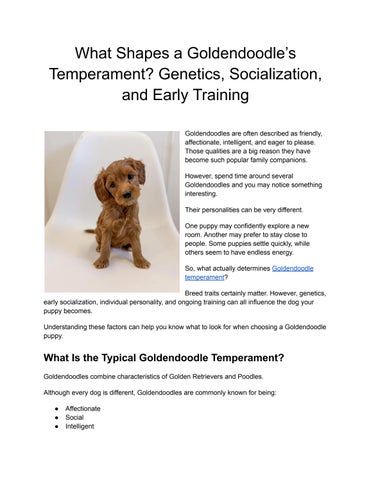
What Shapes a Goldendoodle’s Temperament? Genetics, Socialization, and Early Training Goldendoodles are often described as friendly, affectionate, intelligent, and eager to please. Those qualities are a big reason they have become such popular family companions. However, spend time around several Goldendoodles and you may notice something interesting. Their personalities can be very different. One puppy may confidently explore a new room. Another may prefer to stay close to people. Some puppies settle quickly, while others seem to have endless energy. So, what actually determines Goldendoodle temperament? Breed traits certainly matter. However, genetics, early socialization, individual personality, and ongoing training can all influence the dog your puppy becomes. Understanding these factors can help you know what to look for when choosing a Goldendoodle puppy.
What Is the Typical Goldendoodle Temperament? Goldendoodles combine characteristics of Golden Retrievers and Poodles. Although every dog is different, Goldendoodles are commonly known for being: ● Affectionate ● Social ● Intelligent
● ● ● ● ●
Playful People-oriented Adaptable Eager to learn Responsive to training
Their intelligence and willingness to work with people can make Goldendoodles especially receptive to positive, reward-based training. Still, breed alone cannot predict exactly what an individual puppy will be like.
Genetics Create the Foundation Temperament doesn't begin when a puppy arrives at its new home. Genetics provide part of the foundation. This is why responsible breeding involves more than choosing two dogs based on appearance, color, or coat type. Temperament should matter too. Parent dogs with stable and family-friendly temperaments can provide a strong starting point for future puppies. Individual variation will always exist, but thoughtful breeding decisions can influence the qualities seen in future generations. When considering a breeder, ask about the parent dogs. What are their personalities like? How do they behave around unfamiliar people? Are they confident in new environments? How trainable are they? These questions can tell you far more than simply looking at photographs of the parents.
Early Socialization Matters Genetics are only part of the story. A puppy's early environment also plays an important role in behavioral development.
Young puppies are constantly learning which sights, sounds, people, objects, and experiences are safe. Positive early experiences can help puppies become more comfortable with unfamiliar situations. Intentional socialization may include exposure to household sounds, gentle handling, different surfaces, people, and new environments. The goal isn't to overwhelm puppies with as many experiences as possible. Quality matters. Experiences should be age-appropriate, controlled, and positive.
Confidence Can Be Developed A confident puppy isn't necessarily the puppy that runs toward everything first. Confidence also involves recovery. For example, imagine a puppy hears an unfamiliar sound and becomes startled. What happens next? Does the puppy remain frightened, or does it recover and investigate? Giving puppies appropriate opportunities to experience mild challenges can help them learn how to navigate unfamiliar situations. This is one reason early puppy development deserves so much attention.
Handling Prepares Puppies for Everyday Life Regular gentle handling is another useful part of early development. Think about everything a dog will experience throughout life. Someone may need to touch their paws during a nail trim. A veterinarian may examine their ears and mouth. A groomer will handle their legs, face, tail, and body. Puppies can begin becoming familiar with these sensations early. Gentle handling can include touching the: ● Ears ● Face ● Mouth
● ● ● ● ●
Back Legs Paws Toes Nails
The goal is to create calm, positive experiences with human touch. This can make everyday care feel much more familiar later.
Temperament and Trainability Are Connected Goldendoodles are generally intelligent dogs that can learn quickly. However, intelligence isn't the only factor that affects training. A puppy's confidence, motivation, ability to focus, and relationship with its handler also matter. Positive reinforcement is especially useful because it teaches puppies which behaviors lead to something they enjoy. Rewards may include treats, toys, praise, affection, or play. Consistent, reward-based training can help strengthen communication between dogs and their owners.
Every Puppy Has an Individual Personality Even puppies from the same litter can behave differently. One may be adventurous and outgoing. Another may be affectionate and people-focused. A third might be independent and curious. These differences don't necessarily mean one puppy has a "better" temperament than another. Instead, different personalities may be better suited to different households. An active family may enjoy an adventurous puppy that wants to participate in everything. A quieter household may prefer a puppy that naturally settles more easily. The right puppy isn't always the boldest or calmest puppy.
It is often the puppy whose personality best matches the family's lifestyle.
Why Temperament Evaluation Can Be Helpful Getting to know individual puppies before they leave for their new homes can help with matching. Breeders spend far more time with a litter than prospective owners typically can. They can observe which puppies seek human interaction, which enjoy exploring, which recover quickly after new experiences, and which tend to be more relaxed. Those observations can provide useful information when helping families choose a puppy. However, puppy temperament isn't a guarantee of adult behavior. The new owner's environment and training still matter.
Your Work Begins When the Puppy Comes Home Even a puppy with a wonderful early foundation needs continued guidance. Training shouldn't stop after adoption. Continue exposing your puppy to positive, age-appropriate experiences. That may include: ● ● ● ● ● ● ● ● ●
Meeting different people Exploring new environments Walking on different surfaces Learning household routines Practicing basic commands Experiencing grooming Learning to settle Spending appropriate time alone Meeting suitable dogs
Consistency helps puppies understand what their families expect from them.
Don't Confuse Energy With a Poor Temperament Puppies are energetic.
They run, jump, chew, explore, nip, and sometimes seem determined to investigate everything they shouldn't. That doesn't automatically mean a puppy has a difficult temperament. Many of these behaviors are simply part of puppyhood. Instead of expecting a young Goldendoodle to behave like a trained adult dog, focus on creating routines and teaching appropriate behaviors. Patience and consistency matter.
What Should You Ask a Goldendoodle Breeder? If temperament is important to you, ask more than whether the puppies are "good with families." Ask specific questions. For example: How are the parent dogs selected? What are their temperaments like? How are puppies socialized? Are puppies exposed to household environments? Do they receive regular individual handling? How does the breeder evaluate each puppy's personality? Does the breeder help match puppies with families? Detailed answers can help you understand how much attention a breeder gives to behavioral development.
Look Beyond the Cute Puppy Photos Beautiful puppy photos are hard to resist. However, choosing a Goldendoodle should involve more than appearance. Look at what happens behind the scenes.
A thoughtful breeding program should consider health, temperament, genetics, early development, and the environment in which puppies are raised. Ask questions. Learn about the parents. Understand how the puppies spend their first weeks. The work that happens before a puppy goes home can create an important foundation for everything that follows.
Building a Confident Goldendoodle Takes a Team There isn't one secret ingredient that creates the perfect Goldendoodle temperament. It is a combination of factors. Genetics provide the starting point. Early socialization introduces puppies to the world. Positive handling can build trust. Training teaches expectations. Finally, owners continue developing those skills throughout the dog's life. Goldendoodles are often affectionate, social, intelligent, and highly trainable companions. But every puppy is still an individual. When thoughtful breeding is followed by intentional early development and consistent training at home, puppies have a strong foundation for becoming confident, well-mannered family companions. And when choosing your puppy, that foundation may be every bit as important as size, color, or coat.