OA BULLETIN
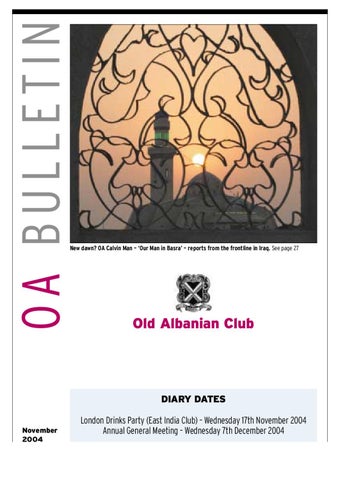
New dawn? OA Calvin Man – ‘Our Man in Basra’ – reports from the frontline in Iraq. See page 27
Old Albanian Club
DIARY DATES November 2004
London Drinks Party (East India Club) – Wednesday 17th November 2004 Annual General Meeting – Wednesday 7th December 2004
O A C O N TA C T
OA BULLETIN NOVEMBER 2004
OA CLUB www.oldalbanianclub.com President Andrew Barnes 01582 712650 andysbarnes@hotmail.com Secretary David Buxton 01727 840499 d.buxton@virgin.net Treasurer Brian Sullman 01582 460317 Membership Secretary Roger Cook 01727 836877 Rogercook@btinternet.com OA SPORTS RUGBY President
Chairman
www.oasport.com www.oarugby.com Ali Mills 01582 715983 07974 414342 (mobile) Richard Milnes 01442 262750
Chairman of Playing Committee
Tony Buchanan 01923 859324 Club Captain Richard Walker 07931 734876 (mobile) Secretary Peter Lipscombe 01727 760466 Sponsorship Secretary Adrian Tominey 01727 830226 Treasurer Chris Walker 01727 822143 Social Secretary Ed Knighton 01727 836764 Ist XV Captain John Davy 07944 371570 (mobile)
Nick Chappin – Editor Andy Chappin – Design & Production Roger Cook – Membership Mike Highstead – Gazette Printing - Herts & Beds Printing 01923 234959 2
Colts
David Hughes 01727 867075
Mini & Junior Rugby Chairman
FOOTBALL Manager
CRICKET President Chairman
1st XI Captain 2nd XI Captain
Secretary
Rory Davis 01727 843538
www.oasoccer.co.uk Simon Bates 01727 852418 / 0772 0383 600 www.oacc.org.uk John Josling 01296 632227 Andrew McCree 01727 845513 andrew@oacc.org.uk Robert Bee Julian Baines 01727 751862 julian_baines@merant.com Colin Bashford 01707 395431
OTHERS Rifle & Pistol Angling Golf
OA LODGE John Williams
Andrew Wilkie 01727 856857 Geoff Cannon 01582 792512 Royce Bryant 01727 863130
01438 715679
SCHOOL WEB SITE www.st-albans.herts.sch.uk
Address for correspondence: Nick Chappin 18 The Pleasance, Harpenden, Herts AL5 3NA Telephone: 01582 461674 (home) 07980 565645 (mobile) e-mail: nick@chappin.co.uk
OA COMMENT
OA BULLETIN NOVEMBER 2004
Editorial
The wrong trousers
ordered me to stay several yards away as he was just beginning his fourth year and had no wish to be 1968 was certainly a turbulent year: associated with a ‘New Bug’ – armed police fought to quell the particularly as the St Albans Girls student riots in Paris, Soviet tanks rumbled through the streets of Prague High School coach picked up from the same stop. So with my mother’s and the Tet Offensive signalled a bloody escalation of the Vietnam War. comforting words ringing in my ears – “Don’t be silly, there’ll be lots of Meanwhile, closer to home and boys in shorts” – I arrived at the blissfully oblivious to these epochSchool gates, and as I frantically making events, an 11 year-old boy scanned the milling crowds in the embarked upon an equally ferocious Upper Yard my worst nightmare civil rights struggle. Looking back now through adult eyes it may appear became all too real. Out of an intake of some 90 boys, there were just three a trivial argument, but at the time it of us in shorts. As our American raised fundamental issues of choice cousins would say: “You do the and conformity, of blending in with math.” the crowd rather than Sartorial issues aside, sticking out like a racing dog’s testicles. I refer, of The Sixties were a the Sixties were a period of enormous change for course, to the inalienable the world at large and right of the individual – period of for the School in and me in particular – to wear a new pair of long enormous change particular, signalling the end of the W T Marsh trousers on my first day era and ushering in a at St Albans School, for the world at new and very different rather than my brother’s regime under Frank hand-me-down grey large and the Kilvington. Out went flannel suit shorts. Needless to say, the school in particular shorts, boaters, Ancient Greek and prefects’ brutal logic of my beatings, and in came a mother’s fiscal younger generation of masters and arguments – “They’re too good to extensive renovation and rebuilding throw away and that’s that” – won of the ageing infrastructure. As you the day. Sibling support was also in will see in this issue of the Bulletin, short supply as I trailed nervously my regular raiding of the School behind my brother towards the 321 Archive’s library of The Albanian bus stop at the bottom of our road: magazine has now reached the “You should think yourself lucky – ‘Swinging Sixties’ – my thanks to when I started the dress code meant Anthony James and Mike Highstead we had to wear shorts and caps until for allowing me continued access to the end of the fourth year.” At least, this invaluable collection. I think that’s what he said; he had
3
OA COMMENT
OA BULLETIN NOVEMBER 2004
‘THE ALBANIAN’ ARCHIVE Pillars of wisdom: construction well in progress on the new hall. Picture taken from the July 1967 edition of The Albanian
Although markedly different to what had gone before, my schooldays – and those of succeeding generations – were no doubt every bit as interesting and memorable as those of our predecessors. While not for one moment decrying the sterling efforts of our older members, who put the rest of us to shame in the richness and regularity of their correspondence, I would also dearly love to hear the memories and anecdotes of more recent generations of OAs. Indeed, the attraction and retention of younger school leavers is a recurring theme in this Bulletin. In his President’s Notes, Andy Barnes announces a number of initiatives to encourage greater engagement with the Club’s activities, including the
formation of a Young Albanian Group and an invitation to all OAs registered on FriendsReunited to join the new club database. In his Membership Secretary’s Notes, Roger Cook explains the registration process in some detail, and we can all help the cause by alerting all OAs – whether current members or not – to the fact that they are all now de facto life members of the Old Albanian Club. As for me, I shall be doing my bit by rounding up the usual gang for our annual reunion at the London Drinks Party, held this year on Wednesday 17th November at the East India Club. And if one of them so much as mentions bloody shorts… Nick Chappin Editor
WHO TO CONTACT Please address your correspondence to the following people – you’ll find their contact details on page 2. OA Bulletin Nick Chappin, Editor Comments, letters, photos Subscription/membership enquiries Roger Cook, Membership Secretary Change of address, notification of deaths OA Gazette Mike Highstead, Archivist Member news, obituaries, School archive and museum
4
OA BULLETIN NOVEMBER 2004
President’s Notes
Young Albanians ■ Old Albanian Club President Andrew Barnes reports on a busy summer and sets out his plans for attracting younger OAs to the Club The Presidents’ Garden Party On Sunday 20th June members and their partners representing every element of Old Albanian club activity enjoyed a champagne reception as guests of the President of the Old Albanian club, the President of the rugby club and the President of the cricket club. As tongues were loosened, members of the OA Lodge introduced themselves to an enthusiastic group from the Old Albanian Saints Women’s RFC who in turn were encouraged to join the tennis club by some of their members as well as being invited to help with the coaching of mini and junior rugby. OA Sport fitness club members were intrigued to learn of the activities of the golfers and fishermen. It was a most friendly gathering at which many new acquaintances were forged, and where the inclusive nature of the OA club, with its increasingly varied range of activities, was re-enforced. I hope that the hardest working members of each club will be recognised for their ‘beyond the call of duty’ efforts next year and join us for the 2005 Garden Party, which will be held on Sunday 19th June. Annual Dinner Since the establishment of the Woollams sports facility over two years ago, the Founders’ Day weekend has become redefined as the focus date for Old Albanians returning to St Albans. The present formula, with the Annual Dinner on the Friday evening before Founders’ Day, has proved very popular.
This year, 100 members and guests sat down and were pleased to welcome Martin Smith (62) as our guest speaker. His address touched on a number of aspects of the management of the ENO, of which he is chairman. His informative and amusing contribution was a pleasant contrast with the stories and anecdotes from recent sports- orientated speakers. On Founders’ Day itself, many Albanians made it to the Abbey for the service. It was a refreshing experience for me, an infrequent visitor, not having previously enjoyed the Abbey nave prepared for a service in the round. Most OAs then moved on to the School to reminisce, marvel at the advances and changes, and enjoy a glass of wine at a reception in the hall. During the afternoon, this year in particular, I believe Woollams looked at its very best with multi-sport activity across the whole site from the driveway entrance to the furthest cricket square on the School playing field. After visiting the School, a pleasing crosssection of the 1964 leavers enjoyed a first reunion lunch in the 948 room in the clubhouse, with much laughter and close examination of assorted photographs. By the end of the afternoon it was resolved to reassemble on the 19th September 2007, exactly 50 years after W T Marsh welcomed us as new boys. The process of reestablishing contact with the other 76 contemporary entrants has already started but poses us quite a problem. With the assistance of the 21 people present at Woollams, I believe we may be able to make contact with nearly half the year group. In due course, we will search the School Archive for useful addresses, and will publish the list of names in the Bulletin to enlist the help of other Old Albanian Club members.
5
OA BULLETIN NOVEMBER 2004
As the club builds its database, this process will need to be duplicated for each year group. Without the help of all contactable OAs, the club Membership Secretary, Roger Cook, will be faced with an impossible task as we try to fill the many blanks. The School Archive holds all the names but in many cases no more than that. Every Old Albanian who has registered with FriendsReunited is to be contacted to invite them to enter their own details directly into the club database and pass on those of any others they may have to the Membership Secretary. There are in the region of 7,000 living OAs and the club at present has contact details for less than 25% of them. This implies that there are 75% of Old Albanians who are unaware that they are now de facto life members of the Old Albanian Club. Young Albanian Group It is a sad fact that very few young OAs renewed their membership when the prepaid five year period had expired. To a 22 year old, the club offers little that appears attractive, interesting or relevant unless they are sportsmen or women. All recent
6
OA President Andrew Barnes and his wife Rosie alongside the William Webb Ellis Trophy during its brief visit to Woollams as part of the ‘Sweet Chariot Tour’ school-leavers will be quite familiar with email communication, and most of them will use it daily. As our new interactive database management system is commissioned, we have the opportunity to offer all Albanians the use of the expanding interactive database holding their contemporaries contact details. This should be particularly attractive for the youthful OAs as it is the most obvious way to keep in touch with their year group and follow their progress. It is our intention to hold a complete record of recent school leavers’ email details. The individual, updating their own contact details in the interactive database, as and when they change, is the key element here. A number of initiatives to encourage young Albanians to become active in the club are under consideration. An informal joint sports club open day is proposed, to which all school leavers will be invited. We will actively seek young Albanians’ contributions to the Bulletin and club
OA BULLETIN NOVEMBER 2004
website, and on page 23 we feature the artistic achievements of a number of recent leavers. The Bulletin is a publication for all members of the club but I do not recall a recent contribution from or about our younger members other than sports reports. As stated above we hope to remedy this. With the School’s help and encouragement it is intended to identify a small number of younger members who will become the first organisers of a young Albanian grouping for social activities, interchange of her ideas and information. The young Albanian group could offer support for all Albanians on gap year, at university and those starting out on a career. The club can offer the use of its facilities at Woollams and the possibility of some financial support. Under the old subscription membership, after five years most young Albanians have in the past parted company with the club. A letter will be written to each of them pointing out that they are members for life, and inviting them once more to make the most of this membership. School A second application for planning permission to build a new sports hall and swimming pool in the upper part of the orchard has been lodged with St Albans Council. The application provides details of a much changed design from that which was refused last year. It is believed that each point of objection previously raised has been addressed and largely overcome and that on purely planning grounds, without political interference, the governors have high hopes of success this time. 948 Foundation Sports Bursary Robert Sparrow, the first recipient of this
bursary has taken up his place this September as a sixth-form entrant. He joins the School from Verulam, is a talented cross country runner who has already competed for Hertfordshire in the English schools’ championship. The bursary, worth £2,000 per annum for two years, has been the deciding factor in Robert’s decision to move to St Albans School. The London Drinks Party This year, once again it is to be held at the East India Club in St James, on Wednesday 17th November 2004. We encourage all OAs who work or live in London to join us, and particularly those who live south of the river and find travelling to St Albans for social gatherings too inconvenient. Sam Patten is co-ordinating bookings. Please send the enclosed booking form, with your cheque to her. Charitable Status The Old Albanian Sports Association conversion to charitable status had been outlined in the last Bulletin and Andrew Mills Baker, Chairman of OA Sport, confirms the timetable for completing this process on page 42. OA Club Annual General Meeting The structure of our club is changing. There is too little feedback from our members at large. Those of us involved in decision making and implementation, quite naturally believe that we are making desirable changes and improvements. We do need comment, encouragement or words of caution. Please make every effort to be at this year’s AGM (see page 13 for details). Your presence will make a difference. Andrew Barnes President
7
OA BULLETIN NOVEMBER 2004
Headmaster’s Notes
School ties ■ Headmaster Andrew Grant reports on an outstanding summer of academic and sporting achievement – including the first tied cricket matches for nearly 30 years! A round-up of the summer term’s news includes a very successful cricket season with the First XI winning eight matches, suffering only three defeats and, extraordinarily, recording two ties in one season, against Merchant Taylors’ and Gordonstoun. Were it not for the fact that the Gordonstoun match finished with us playing out our innings in near-darkness, it might have been different, but less interesting for the record book. You have to go back 28 years to find the last previous such result. Captain Nick Lamb, who had dashed back from a senior game for Worcestershire to bat against Gordonstoun, also captained Hertfordshire U19s and had senior matches for Hertfordshire, and Middlesex as well as Worcestershire whilst Fifth former Simon Gregory scored over 500 runs for the First XI during the season. The U14s won four of their five matches in their half-term tour of Dorset and went on to win the District Cup, whilst the U13s went one better, finishing the season undefeated and carrying off the County Cup. Our Senior athletes retained the District title for the sixth time in succession and James Newman in the Intermediate 1500m, Lois Haruna in the Senior Girls’ Shot and Elise Brock in the Senior Girls’ Long Jump went on to win County titles. Upper Sixth Formers Jamie Green and Tirthankar Datta and Fifth Former Luke
8
Stringer won prizes in national design competitions, Sajaan Chana won a silver certificate in the International Chemistry Olympiad (in a field of 854) and Upper Sixth Formers Ian Sheridan and Alex SpencerTodd continued a lengthening tradition by winning places with the National Youth Theatre. Paul Marriott, from the Lower Sixth was awarded ‘Best Cadet’ at the CCF UK Land Forces Cadet Leadership Course and an essay by Upper Sixth Former Sam Cartwright won a lucrative Sir Tenchard Cox Scholarship to study European culture. Over the holiday, the Economics department took a trip to Prague, while the CCF has Our A level and been busy not only at their usual GCSE results were camps at Wathgill and RAF the best ever. For Lyneham but also on a truly the first time at A fantastic Adventurous level, the proportion Training Exercise in Evjemoen in of A and B grades Norway including white-water exceeded 80% rafting, elg hunting (don’t ask) and various other Viking activities (certainly don’t ask). The Second and Third Form German linguists visited Rüdesheim in the Rhineland and there was a Duke of Edinburgh’s qualifying expedition in Derbyshire. At the Edinburgh Fringe, a company of current and former pupils and staff performed four shows earning some enthusiastic reviews, particularly for Danny
OA BULLETIN NOVEMBER 2004
‘THE ALBANIAN’ ARCHIVE Swanson’s one-man show, The Best Man and a late-night review called Devoid of Ears by Cambridge undergraduate duo Tom Martin and Adam Shindler. The holiday drew to an end, as ever, with a strengthened cross-country squad training at Pen Arthur, among them, the recipient of a 948 Bursary, Robert Sparrow, late of Verulam School. The Rugby squad began their training at Woollams, culminating in the Saracens Tournament. In this, the First XV came an excellent third, the only team to score against Saracens, who are, to all intents and purposes, professionals, even at school level. This was all the more impressive since, to fill a gap caused by a late drop-out, our Second XV also played, coming a creditable eighth, the overcommitment meaning that we were unable, on one of the hottest days of the year, to field rolling subs as other teams did, so all our players played all 100 minutes of the tournament. In the first regular fixture of the season, a
The masters of 1965-66 pose in the garden of School House on the retirement of Messrs Heather, Jarry and Tanner. From The Albanian of December 1966
block fixture against Verulam, which has just happened as I write, we were undefeated on the day. The First XV won 169, despite making heavy weather of it; the Seconds were more than 60 points ahead and across all age groups we had an advantage of over 200 points. Let’s hope it goes on that way. Our A level and GCSE results were the best ever. For the first time at A level, the proportion of A and B grades exceeded 80%, which put us firmly in the top 100 schools nationally in The Daily Telegraph, The Times and Financial Times tables, whilst at GCSE, more than 25% of all grades were at the notoriously demanding A* level. Third Former Adam Buckland made the national press as the youngest person to gain an A level this year (in Computing)
9
OA BULLETIN NOVEMBER 2004
and Fourth Formers Chris Fox and Robert Hayes were among the top five candidates nationally in the AQA GCSE Maths syllabus, (for which, of course, the majority of candidates are a year older, since our pupils take GCSE Maths in the Fourth Form). The have been a number of important staffing changes. Three colleagues, Senior Master David Ireson; Head of Maths Paul Legouix and linguist Louise James have all retired after giving, in each case, long and quite exceptional service to the School. Of more recent vintage, Dominic Webster has been
appointed Head of Physics at Mill Hill School while Robert Grant has been appointed to the Headship of the Classics department at Nottingham High School. By the time you read this, the fate of our planning application to build a sports hall and swimming pool will probably be known. Whatever the outcome, may I close by thanking those of you who wrote in support and/or lobbied councillors on our behalf. If and when we are successful and the new facility is built, you will be among the first – assuming we are not by then all too old and infirm – to be invited for a dip! Andrew Grant The Oxbridge 12: successful students who gained entry to Oxford and Cambridge, from the April 1960 edition of The Albanian
‘THE ALBANIAN’ ARCHIVE
10
O A U P D AT E
OA BULLETIN NOVEMBER 2004
OA Lodge
Grand charity ■ OA Lodge Secretary John Williams outlines the enormous support given by Freemasons to charities of all shapes and sizes across the country The Lodge year commences at the installation meeting in early May when the new Master is installed in the Chair by the outgoing Master, followed by the appointment of the Lodge Officers for the ensuing year. It is invariably the best attended meeting, and dinner jackets are the norm – although this is optional. This year Peter Wade-Wright was installed in the Chair as Master of the Lodge for the year 2004/05 in an exemplary manner by the outgoing Master Steve Taylor. The Provincial Grand Master of Hertfordshire Colin Harris, a member of the Lodge, attended in his official capacity to represent the Province and was very warmly welcomed. During the meeting our Charity Steward Dick Knifton reported on the 2009 ‘Festival’ Appeal in support of the Grand Charity, which Hertfordshire is hosting and is, of course, being organised by Colin Harris. Colin is at present a little coy about his target for the appeal, but it is believed to be £4 million, an average of £20,000 per Lodge in Hertfordshire. Many of the smaller Lodges cannot be expected to achieve such a sum and it is anticipated that Lodges such as the Old Albanian, which is amongst the largest of the ‘working’ Lodges in the Province will contribute a significantly greater
amount. To this end, our Charity Steward has proposed that initially we transfer a contribution of £15,000 to the Provincial fund for the 2009 Appeal at our November meeting and make further contributions at the Installation meeting each year until the Festival in 2009. The Grand Charity came into being on 1st January 1981, succeeding the ‘Board of Benevolence’, which in turn had descended from various committees formed by Grand Lodge for the relief of distressed Freemasons, the earliest having been set up in the 18th Century. The Grand Charity has three priorities: the relief of Masonic applicants, assistance for other Masonic charities and grants to national non-Masonic charities. The President of the Charity alone may approve grants of up to £100,000 for immediate national or international emergency relief. From its earliest days, Freemasonry has been concerned with the care of orphans, the sick and the aged. This concern started, as charity so often does, at home, with institutions to educate and care for the needy children of Freemasons, to support and house distressed Freemasons and their dependants and to provide for the sick – all filling the gaps that then existed in the country’s pattern of care. The charities continue, despite the fact that there is public education, healthcare and the State pension: indeed if there were no need for our charities, then by the same argument, there would be no need for many other charities. Moreover, Freemasonry is paying more and
11
O A U P D AT E
OA BULLETIN NOVEMBER 2004
4 Rollswood Road Welwyn Herts AL6 9TX Telephone: 01438 715679
12
more attention to the charitable needs of people who are not Freemasons. Just some of the many grants to nonMasonic charities proposed by the Grand Charity this year are grants to Tommy’s (the baby charity) of £70,000; to the Cystic Fibrosis Trust £52,000; to Emmaus, the charity for vulnerable people £125,000; to Age Concern £50,000; to the Multiple Sclerosis Trust £60,000; to the Mary Hare Foundation £51,160; to the RNID £50,000; to Sue Ryder Care £50,000; to Contact a Family £125,000; to the Crossroads Association (supporting carers) £125,000; the Youth Cancer Trust £10,000; to the Cruse Bereavement Care charity for the support of bereaved young people £60,000; and to the Tall Ships Youth Trust £50,000. Amongst the other Masonic Charities of which the OA Lodge is a Patron is the Royal Masonic Trust for Girls and Boys (www.rmtgb.org). The Trust is looking after about three thousand girls and boys at various schools up and down the country including the Royal Masonic School for Girls. The children attend schools that are best suited to their needs, in both the state and private sectors. Other schemes set up by the Trust include ‘lifelites’, a £7.5 million project which aims to bring the benefits of Information Technology to children who receive hospice care in England and Wales; ‘TalentAid’ which provides support for the especially gifted children of the families of Freemasons, and ‘Choral Bursaries’ which funds the education – whether or not a child of a Freemason – at cathedral schools. The latter has proved so popular that
boys have been admitted to the cathedral choirs of Bristol, Chelmsford, Chichester, Durham, Ely, Exeter, Gloucester, Hereford, Lichfield, Lincoln, Manchester, Norwich, Peterborough, Ripon, Rochester, Salisbury, Southwell Minster, Wells and Worcester, as well as St George’s Chapel, Windsor, King’s College, Cambridge, and Great Grimsby Parish Church. Another important scheme of the RMTGB is ‘Undergrad Aid’ which provides undergraduate bursaries to the children of Freemasons – and it is timely to remind to all Freemasons who have a child who is a full time student in 2004/2005 that he or she may well be eligible for a £1000 Student Bursary. It is not too late to apply for ‘Undergrad Aid’ for this academic year – bursaries are open to all subscribing members and there is no qualifying period of membership. The Lodge meets only five times a year on the second Saturdays in January, March, May and September and the first Saturday in November. All those connected with the School, including fathers of past or present pupils are welcome to apply for membership, for which purpose the first approach should be to any Lodge member, the Secretary as below, or Nigel Wood Smith or Alan Smith at the School. Members of other Lodges, be they OAs, parents of past or present pupils, staff or Governors are encouraged to visit the Lodge whenever they wish, and the Secretary will be delighted to hear from them. John Williams Lodge Secretary
OA BULLETIN NOVEMBER 2004
‘THE ALBANIAN’ ARCHIVE
NOTICE OF THE 112TH ANNUAL GENERAL MEETING OF THE OLD ALBANIAN CLUB To be held at 8:00pm on 7th December in the 948 room at Woollams ● Agenda ● Apologies ● Minutes of the previous meeting ● President’s Review of 2004 ● Social Reports ● Membership Report ● Sports Clubs Reports ● Bulletin ● Annual Accounts ● Election of Officers ● AOB
Taking shape: construction of the amphitheatre gathers pace in this image from the November 1962 edition of The Albanian
13
O A U P D AT E
OA BULLETIN NOVEMBER 2004
Membership Secretary’s Notes
Going live ■ OA Club Membership Secretary Roger Cook rounds up all the latest membership news – including important instructions for using the new OA Database New database The new OA database described in the last bulletin will, by the time you receive this bulletin, I hope be operational! All members should read carefully and then implement the actions described in the article ‘OA Database’ opposite. You will need your address label (which show when your existing subscription expires). Bulletin Distribution You will be aware that, as part of the changes to the OA communications with and between members, the bulletin will, in future, be available both in hard copy form and via the OA web site. I invited members to indicate their interest in the electronic version: of 40 replies all except 3 were in favour of electronic distribution. Some responders erroneously thought that the bulletin would be distributed by email; this is NOT so—it will be posted on the web site and members may access it from there. It is our intention to continue to produce the bulletin twice each year and to maintain the highest standards of layout and content. With immediate effect, there is no membership subscription. However, the costs of printing and distributimg
14
hard copy means that we must make a charge for those members who wish to receive hard copy via the post. This will be £6 per year. There will no longer be a reduction for those over 65. To avoid the administration of collecting this amount each year, we have decided that the minimum subscription period will be 3 years. The charge for receiving hard copy of the bulletin is £18 for 3 years. OA web site There over 100 visits each week; this must, of course, include those from net surfers. I welcome constructive comments on the web site, small items of news, photographs and any other material you believe would be of interest to visitors to the site. When the new database becomes fully operational, you will be able to communicate directly by email to anyone registered on the database. By the time this bulletin reaches you through the post, it should be accessible via the OA web site. I have changed the password for this edition to 9176. OA Directory I stated in the last bulletin that the OA Directory would be republished this year At the moment, I am awaiting the directory which will be distributed as soon as it is received. Silk ties (£12.50) and bow ties (£15.00) are still available from me. Our usual list of waifs and strays is published on page 17 – many thanks to those who have provided contact addresses; unfortunately we
OA BULLETIN NOVEMBER 2004
continually find new names to insert. Bridge If anyone is interested in an informal, friendly competitive bridge evening at Woollams, please contact me. Roger Cook
OA database ■ This article contains important information, which requires action from every member of the Club As announced in the spring bulletin, the club has decided to offer members improved electronic contact facilities both between themselves and with the OA club. A new database, run by an external company, has been constructed. This is accessible via the OA web site. As you know, from July this year, former pupils of the school may register without paying any subscription. Those registered now have a choice between: ● Continuing to receive information, including the bulletin, by post for which a charge of £18 to cover a period of three years will be made ● Receiving information from the club via email and viewing the bulletin, and other documents, via the OA web site. You should examine the address label on the envelope. The year your subscription expires precedes your name. In addition, if you have registered an email address with me, there will be a capital ‘E’ before your name. You are entitled to receive a copy of the bulletin by post until
your subscription expires: a reminder will be sent when your subscription is about to expire. However, you will appreciate that the new system will, especially in the initial years, be a significant drain on the club’s funds: if your subscription has not expired but you expect to move to electronic communication you could help by advising me that you volunteer to make the change now, before your subscription expires. If you are a life member you would help the club considerably by making a donation to cover the cost of mailing or by opting for electronic only communication – please advise me! The bulletin is already accessible via the OA web site. The password is given in “membership secretary’s notes”. A printed version of the bulletin will continue to be available. If you received this bulletin via the mail, you have been listed in the new database and your details will be on the database. Before you can utilize the new database you must register. This database is secure and all members must apply individually for a password before they will be able to access it. The information currently contained within this database is the same as that printed in the OA Directory viz: ● Your name ● Address, telephone number and email address ● Years of attending the school Your entry is set to enable other registrants of the club to read your name and school years; additionally, if your address already appears in the
1 Pondwicks Close St Albans AL1 1DG Telephone: 01727 836877
15
O A U P D AT E
OA BULLETIN NOVEMBER 2004
16
OA directory it will also be accessible to other members of the club. You will find that there are two ‘sub due years’ in your entry, which are not accessible to other members. The first is the year your current subscription expires [a date later than 2049 implies you are registered as a life member]; the second is the year that your subscription to postal communication expires [if your subscription expires in 2004 or earlier you may find the postal subscription year is random!]. There is room on the database for you to add, optionally, a lot of additional information including career path, honours, and personal history. You will find that there are facilities to hide or display your personal details from other members of the club. If you have no email address, and your subscription has expired, please send me a cheque (payable to the OA club) for £18 to cover the next three years’ bulletins. [If your subscription expired prior to 2004, a donation to cover the missed year(s) would be greatly appreciated.] You should continue to advise me of any changes in your personal data. If you have an email address and there is an ‘E’ before your name you are marked to receive all communication via electronic means. If you wish to receive the bulletin by post please send me a cheque for £18 (payable to the OA Club) for the next three years’ bulletins. If you have an email address but there is no ‘E’, please advise me of your email address so that I can provide you with a pin number for
you to continue as above. Your additional email address The database system can provide you with an additional email address, which remains yours for life. Is the system live? As soon as the system is operational, I will add an additional link, oasreunited, to the OA web site. You will then be able formally to register with the new site. Before you can use the system you must register. This requires a personal pin number which you will receive either by post or email; it is only required for the purpose of registration. Once registered you will have a personal password. To register, follow the link oasreunited on the OA web site and then follow the instructions. Once registered please check that your details are correct and make any necessary adjustments. From then on, there is no need to inform me of changes in your personal data – it is your responsibility to ensure that they are correct! Using the system. Once registered, you obtain access to the system via the link on the OA web site; you will need your password. The system has been designed for your benefit and use. You can email other registered members. You can advertise meetings, events. It is up to you to develop and use the system. Please feel free to comment and make suggestions at any time. Roger Cook
OA BULLETIN NOVEMBER 2004
Waifs and strays We have lost contact with the following OAs – can anyone help? Year
Name
38 39 41 42 43 44 54 55 55 56 57 58 59 59 60 62 65 66 67 67 68 68 70 71 71 71 71 71 72 72 72 73 74 74 74 75 75 76 76 76 76 76 77 77 77 77 77 77 77 77
Buckingham, K M Wilkinson, A D Wright, J A Powell, G H Bracewell, C M Hudson, P H F Dilley, N C Coombe, B J Knight, J V Ingram, P Bishop, S C O’Sullivan, P J Brierley, R J Mills, K J Robertson, D M Clarke, J Kirk , D Thomas, R N Ansell, Paul Marsh, A Craighead, R M Gingell, R R Martin, I G Barker, Mark Duxbury, M J Earl, G Lawrence, D J D Williams, D P L Bayley, A R J Mattingley, R J Parker, S C Thom, D K Kingham, D R Marshall, J T J Warner, I C Forbes, I A Funnell, Stephen Bulsing, J M Lavin, C N Orange, C A Turner S E Waygood-West, Kevin Bayoumi, T A Clitherow, P A Granger, Andrew Jones, A P R Lee, A P Marshall, N J Stansbury, C J Welsh, David J
Last known location Harrow Harpenden St Albans St Albans Leicester Cranbrook High Wycombe Brookmans Park Blackboys Glasgow Shefford Harpenden Totteridge Stoke-on-Trent Herts Knebworth Walthamstow Edgware Luton Borehamwood Potters Bar Bury St Edmunds Birmingham Sutton Coldfield Hitchin Newbury St Albans Harpenden Chesterfield Baldock Harpenden Stevenage East Grinstead St Albans St Albans Bristol Barnet Welwyn Garden City Attleborough London Faversham Hatfield Welwyn Garden City Harpenden London Keithley Gwynedd St Albans St Albans St Albans
78 78 78 79 79 79 79 79 79 79 79 79 80 80 80 81 81 83 83 85 85 85 85 85 85 86 86 86 86 86 87 87 89 89 91 92 92 92 92 92 92 93 93 93 93 94 94 94 95 96 97 97 99
Evans, N G Parker, P E Samuel, M G Albury, C D Armitage, Stephen Cooper, R C Dixon, C Hall, M Haysom, A J Menzie, B Riddle, J Tynan, P George, A J Warwick, Neil Woodrow, J C G Hodge, R J W Palmer, Andrew Norris, R G T Pryce, Tim Andrews, David Finlay, Laurence Gresswell, A M Smart, Adrian Somerville, D J Turner, Andrew Bladen, John Bending, Thomas Cook, Adrian Dewhirst, Martin Newman, P L Meeson, Mark W Payne, Nicholas Hollingsworth, Damian Jones, Christopher Peters, David A Carden, Richard E W Harris, Daniel S James, Jonathan Simmons, Jonathan E Moss, Radley Wheeler, Seth Brian, Andrew J Clarke, Richard P King, Caroline Ives, Simon Clayton, Thomas Lester, Miles Simmons, Matthew Topper, Marc Barclay, Mathew Morgan, Dean Summers, Paul Myers, Richard B P
Hemel Hempstead Harpenden St Albans St Albans London Luton Harpenden Rickmansworth Harpenden Wheathampstead Wakefield Cockermouth Flamstead St Albans Wheathampstead Peterborough Bracknell St Albans Notting Hill Gate High Wycombe Barnet Welwyn Brighton Hemel Hempstead Swindon Luton Cambridge London Hatfield St Albans St Albans St Albans St Albans St Albans Harpenden Southhampton Radlett Wheathampstead Totteridge Radlett Utica, USA St Albans St Albans St Albans St Albans St Albans Hadley Wood Flamstead Stanmore St Albans Watford Harpenden Barnet
17
O A U P D AT E
OA BULLETIN NOVEMBER 2004
‘THE ALBANIAN’ ARCHIVE
Girl power ■ London Drinks party organiser Sam Patten (94) encourages more ladies to attend OA functions As a lady OA, it’s always reassuring to see an ever-increasing number of lady guests at OA functions. While some of the more senior members of the club may frown upon asking nonOA guests along to events, I personally find the sight of more girl power a particular boost for morale! I was relatively apprehensive before my first London Drinks Party in November 1999. Girls had only been welcomed into the sixth form six years earlier and I was aware that I would be in the minority. Fortunately my Harrods colleague Sarah Wynne-Williams joined me to lend moral support; her charm and humour helped provide an antidote
18
to take the edge off some of the more testosterone-fuelled comments. There are times when it is enjoyable to find oneself in the minority. It is rather less pleasant, gentlemen, when we have this pointed out to us via chauvinistic or condescending remarks. Thankfully such observations are kept to a welcome minimum! As a lady who relishes nothing more than the opportunity to step out in London and enjoy the company of old and new friends, I would like to extol the virtues of the OA Club and encourage any prospective debutantes to attend their first function. I have fond memories of the beautiful environment of the School and fully appreciate the wealth of personalities it continues to bring to my life through my involvement with the OA Club. Long may it continue!
OA BULLETIN NOVEMBER 2004
‘THE ALBANIAN’ ARCHIVE
LONDON DRINKS PARTY Wednesday 17 November 2004 6.30pm-8.00pm The East India Club 16 St.James' Square, London SW1Y 4LH Drinks and canapés £15 a head Guests welcome! ● Advance payment to be made by cheque or card. ● Please make cheques payable to: ‘Old Albanian Club’ ● To confirm, please contact Samantha Patten
Mobile: 07970 510 912 E-mail: sampatten@yahoo.co.uk 8 Dexter Close, Luton Bedfordshire LU3 4DX
Bard behaviour: students in costume for Caesar and Cleopatra (left) and Henry V (above). Pictures from The Albanian issues of December and July 1966
Please confirm attendance no later than Wednesday 10 November 2004 NB Tickets will not be issued, Sam will confirm your booking by return of e-mail/post 19
OA GAZETTE
OA BULLETIN NOVEMBER 2004
De fortunis Albanorum ● Ossie Butler (41): A reunion was organised for Ossie at Woollams by Tom Furlong (41) and Don Kiff (42) to bring together the rugby team which Ossie had captained in 1941. Eight players were present together with Charles Bloxham and Mike Highstead - the latter being teaching colleagues of Ossie. I should mention that the whole of the Furlong family was mobilised to make this venture a success – see photos and report on page 24.
started work with the Office of Fair Trading in September.
● Jonathan Trigell (92) has published his first novel ‘Boy A’. It is published by Serpent’s Trail and received good reviews.
● Nigel Rawlins (01) gained a First in the Maths Tripos at Cambridge.
● Matthew Scase (96) Having gained a First in Geography in 2000, now has a PhD from Cambridge. ● R Gordon (97) not a member of the OAC, visited the school on Founders’ Day. He has good memories of a number of members of staff.
● Ross Talbot (00) gained a First Class Honours in Environmental Management at Leeds and shared the prize for the best dissertation. ● Nick Greenwood (01) gained a First in the Maths Tripos at Cambridge. ● Vanessa Hare (01) gained a First in the B.Mus at Cardiff.
● Daniel Freed (02) ran the Paris Marathon in April 2004 and raised £1800 for Barnados. ● Bob Phillips is an athletics statistician and recently did a BBC radio broadcast to celebrate Roger Bannister’s Four Minute Mile. He has now retired to the Dordogne.
Deaths ● Richard Little (99) gained a Starred First in Business Studies at Cambridge. ● Krishan Ramyead (99) gained a First Class Honours Degree in Information Sciences at Brunel. He is next taking a Masters in Chiropractic. ● William Thimbleby (99) gained a First in Computer Science at York. ● James Lambert (00) has finished his MSc at the Royal Holloway and
20
It is with great regret that the following deaths are announced: ● Bob Hunter (25) died 23rd September 2004, aged 96. ● Gordon Penhey (28). Gordon died, aged 92, in 2002 and it is most regrettable that the announcement is made so late. We apologise sincerely to his widow, Betty. Having had a thoroughly good career at the School and captained the rugby team in his last years, Gordon then became one of
OA BULLETIN NOVEMBER 2004
the staunchest and committed members of the Old Albanian Club who attended all the functions. He was always the most gentlemanly of people and will be remembered affectionately by all those who knew him.
● Davie Ashton-Davies (40s) died on the 14th June 2004, aged 76. ● John Bebb (46) died in May 2004. ● B J N Newby-Galliers (58) died in July 2004.
● Henry Farr (29) died on 8th June 2004, aged 93. His son-in-law reports that Henry had very happy memories of his time at the School.
● Paul Norman (70) has died in a tragic light aeroplane crash. See Obituary below.
● John Frederick Kitson Leggett (36) died on 8th May 2004. His son writes that he was always proud of being an OA.
● Bill Fernie, who taught Maths during the 80s has died. He was pleased that many of his pupils had kept in contact with him.
Members of the 1940-41 School 1st XV attending a recent reunion at Woollams – see page 24. (Photo courtesy of the Herts Advertiser)
21
OA GAZETTE
OA BULLETIN NOVEMBER 2004
Donations to the archive ● Tom Furlong (41): Photographs of the winning Shirley 7-a-side team of 1941 (with names), the OA Rugby Club of 1942 and OA Cricket Club of 1942. He also gave a copy of his Sixth Form Report. ● James Swinstead has given photographs of a variety of events from Oxford to Paris also with most of the names. ● Bernard Clark gave a photograph of the 1960 Rugby team and a picture of a group in the locker room. All of these items will be stored in the Archive. All contributions for the Gazette and any items you wish to be donated to the School Archive should be sent to: Mike Highstead 33 Cornwall Road Harpenden Herts AL5 4TQ
Sir Thomas Spencer Wells ■ Robin Ollington (47) has unearthed this interesting piece about an eminent OA from the Victorian age Sir Thomas Spencer Wells (OA) First Baronet, 1818-1897. Wells was a surgeon who studied at Leeds, then Trinity College, Dublin in 1836, St Thomas’ Hospital between 1839-41 and Paris in 1848. He was a naval surgeon
22
School ensemble rehearsal: from the July 1967 edition of The Albanian
at Malta 1841-47. He gained his FRCS in 1884 and was President in 1883. He became the surgeon at the Samaritan’s Free Hospital for Women 1854 and 1856 to 1878, and between 1863 and 1899 he was surgeon to Queen Victoria’s Household. Created Baronet in 1883, Wells perfected ovarianotomy, performing 1000 ovarian operations between 1858 and 1880. He published medical tracts from 1851 to 1860 and papers on ovarian diseases. The title became extinct in 1906, but he had several daughters.
OA BULLETIN NOVEMBER 2004
Dramatis personae ■ From Hogwort’s to the Edinburgh Fringe: a round-up of recent schoolleavers’ dramatic successes ● Simon Godwin (94): Simon is currently Associate Director at the Royal and Derngate Theatres in Northampton. His most recent productions there have included Habeas Corpus, Quatermaine’s Terms, Cinderella and Relatively Speaking. Future works include the Royal’s new Christmas show, Hansel and Gretel. ● Jalaal Hartley (94): Recently appeared in the film Booze Cruise on ITV (written, coincidentally, by
former SAS parent, Brian Leveson) and directed a stunning production of Someone To Look Over Me at the Edinburgh Fringe. ● Domonic Martin (96) who continues to work at, amongst other places, the RoyalOpera House, took his own company 7K to Edinburgh, holding physical theatre workshops and performing Street Theatre. ● Jon Croker (99): Currently in production as assistant to Director Mike Newell (also an OA) on the film Harry Potter and the Goblet of Fire. Also continues to work with MuseMachine – a theatre company comprised principally of staff, current and ex-pupils for whom he directed The Best Man in Edinburgh this year. ● Rachel Briscoe (01) directed a production of The Lunatic, The Secret Sportsman & The Women Next Door with fellow Cambridge students at the Edinburgh Fringe. ● Adam Shindler (02) and Tom Martin (02) took their own two-man comedy to the Edinburgh Fringe, receiving rave reviews and playing to sell-out audiences. ● Alex Grant (03) and Lottie Flintham (03) both appeared in two shows at the Edinburgh Fringe which were directed by Greg Mazloumian.
Jalaal Hartley
● Sophie Higgins (03) produced a Charity Comedy Night at the Edinburgh Fringe.
23
OA GAZETTE
OA BULLETIN NOVEMBER 2004
Sixty years on ■ Os Butler (41) writes of a joyous reunion of members of the 1940 School 1st XV recently at Woollams May I take up a small space in the Bulletin to record, before I leave again for Australia, an unusual – perhaps unique – OA happening, and also record my warmest thanks for the inspiration and organising skills of the friends who brought this happening about? This was the reunion of the very successful School 1st XV of 1940 – sixty-four years after the final whistle! The project grew out of my note in the May 2004 Bulletin, paying tribute to the standard of School rugby in those far-off days. The arrival of Charles Bloxham as coach in 1938 had triggered a revival – continued,
24
The 1940-41 School 1st XV – Back row: G K Garrett, F E Arnold, D Kiff, W Fenton; Middle row: R H Williamson, G C Jennings, K D W Saunders, P McL Colvin, K R Embleton, J S Dowdey; Front row: A G Beale, R L Beckett, O M A Butler (Captain) F L Tyler, T H Furlong when he went to war, by Mr BradleyPayne and, when he also answered the call (never to return), by Freddie Reed. All of that 1940 team joined the forces straight from school. Of the fifteen, two (Peter Colvin and Geoffrey Jennings) were killed in the war, while Bill Fenton died more recently. Four of the team (Dick Beckett, John Dowdey, Tony Beale and Ken Embleton) could not make the reunion for various reasons. Just one, R H Williamson, could not be traced (can anyone help? Like us, he would be in his 80s). Those who were
OA BULLETIN NOVEMBER 2004
there, seven in number, were Freddie Arnold, Tom Furlong, Ken Garrett, Don Kiff, Ken Saunders, Pat Tyler and myself. The reunion was a most enjoyable and informal party, held on a sunny September afternoon at Woollams, where the catering staff provided a splendid luncheon for us, our wives and our friends. Thanks to the thoughtful courtesy of the organisers, among those friends were Charles Bloxham himself, Paul Webster – son of Sam Webster of fond memory and, incidentally, best man at my wartime wedding – Peter van Horne, and Mike Highstead, former Second Master, colleague of Charles Bloxham and myself, and well-known to today’s generation of Old Boys. Very happily, several wives – Pam Furlong with son Richard, Marian Garrett, Beryl Arnold and Beryl, my
Reunited at Woollams – Back row: Mike Highstead, Beryl Butler, Pam Furlong, Beryl Arnold; Middle row: Ken Garrett, Ken Saunders, Freddie Arnold, Peter van Horne, Don Kiff, Tommy Furlong; Front row: Pat Tyler, Os Butler, Paul Webster, Charles Bloxham wife, were there to keep us in order. My wife had, in fact, met one or two of the team members as far back as primary school days, so for her, as for me, it was a happy occasion, with more than a touch of nostalgia. With, again, my thanks and congratulations to those team-mates who thought it up and made it happen, and our regards and very best wishes to all who took part and those who couldn’t.
25
OA LETTERS
OA BULLETIN NOVEMBER 2004
Coming home ■ The May Bulletin prompts Roger Seymour (52) to e-mail from Australia with news of another reunion I have just received my copy of the May Bulletin and was very pleased to see at least three items to which I could relate. Firstly, the photograph of the Drill Squad 1951, of which I was a member (page 10). Secondly, Don Higson’s communication, ‘Drum Role’ (page 30) in which he gives me a little credit for giving him the email addresses for a number of OAs, and finally the photograph ‘Top Table’ (page 13) showing a number of OAs, all of whom are my contemporaries. I am writing to let you know that a similar gathering is planned for June this year, at a lunch to be held at Woollams. At that lunch, myself, Tony Hedge and Dick Goodspeed will be those overseas members that will be making the effort to get together with a number of fellow septuagenarians.
Our Man in Basra ■ More news and views from OA Committee Member Calvin Man (91), Captain, HQ 1 Mech. Brigade, Basra, Iraq BASRA, JUNE: The highlight of my life since I last wrote was my trip to Baghdad. I went last Friday to meet with the Coalition Provisional Authority (CPA) Finance staff before the whole organisation folds on 30th June on transfer of authority to the
26
Iraqi Interim Government and to try to get them to introduce me to the Ministry of Finance people. I travelled with Captains Harry Cole WG, Arthur Pattison RHA and Matt Douglas QRL who were going to speak to the CPA Interior Ministry staff and the Interior Ministry themselves. It was an early start and the hour long flight on an RAF Hercules led us to the edge of Baghdad International Airport (formerly Saddam International Airport), one of the first key points to fall to the Coalition during the war fighting phase. We were taken to the Presidential quarter of Baghdad, known as the Green Zone, by Control Risks Group, a private security firm contracted by the CPA (full of exforces), in armoured Toyota Land Cruisers. The 5 km stretch of road between the airport and the Green Zone is the most dangerous road in Iraq despite some 130,000 US soldiers in and around Baghdad; just the previous week another security firm lost three guys in a rocket attack on their vehicles. The moment we got in the vehicles the bodyguard explained how dangerous the road is and what the vehicle could withstand and what it could not – very unreassuring! The problem is that the US Forces only patrol up and down the road in armoured vehicles and close off the road when they think the threat is increased. The threat is from rocket attacks which are not from the road but several hundred metres off to the sides. The Americans should therefore be patrolling a 1km zone
OA BULLETIN NOVEMBER 2004
Caption: Calvin Man (left) and colleague either by a mechanised infantry company as a quick reaction force. They should not close the road either because anything could happen when there are no eyes and ears on it. Their counter-insurgency skills are seriously lacking . The Green Zone is a supposedly secure area, about 5 sq km which is where all the palaces and government buildings are. It is entirely walled off and you are able to walk around inside. The CPA and military headquarters are all in the Green Zone, along with a number of cafes, shops, etc. The area does, however, get mortared quite frequently and there was a suitcase bomb whilst we were there. Saddam’s palace is home to CPA and Combined
Joint Task Force (CJTF-7), the top military HQ in Iraq. This is where Paul Bremmer and Lt. Gen. Richard Sanchez live and work. The place is full of Americans and a handful of others, all on the CPA gravy train, being paid lots of money for doing very little obvious good for Iraq – my true thoughts about CPA in my next Bulletin. The strange thing is that all the civilian staff walk around fully tooled up with pistols and ammunition hanging off their belts or assault vests (in civilian beige or khaki to match the chinos!) thinking they are Clint Eastwood. Not sure what they think will happen inside the Green Zone and what they can do about it. I doubt if any of them are trained to use the weapons and they are just a fashion accessory. I felt more at risk in the CPA building than on the streets. The trip to Baghdad was a bit of a military tourism. I can now say I have been in Saddam’s palace and swam in his pool. Unfortunately, I did not get to see the throne room where he has the murals of missiles launched against America. The palace is vast and very 1930s Mussolini architecture in style and very grand. This is where all the money went – it clearly did not make it down to Basra. I also saw Uday’s (or is may have been Qussay’s) palace where he kept his lions fed on people he did not like. The lions are still there but probably a lot thinner these days. Many of the other state buildings are quite damaged from encounters with guided missiles. Of course, the other thing to see in
27
OA LETTERS
OA BULLETIN NOVEMBER 2004
Baghdad is the parade ground with the crossed swords held in large casts of Saddam’s hands. I even got to stand on the podium from where Saddam took the salute. I joined the others on a meeting at the Ministry of Interior building which is just outside the Green Zone. Not quite sure what to expect but as usual, rifle was at the ready with a round in the chamber. I ended up having to dismount and get out onto the street to give cover by walking along beside the vehicles (vehicles stuck in traffic become easy targets) and we had to try to force through the other cars. After two and a half days of pottering around the palace meeting different people, it was time to return to Basra. Arrive back late on Sunday night hoping my bed would still be around. The Brigade HQ moved out over the weekend as we are giving the palace back to the Iraqis. I ended up being one of only three people still staying in the palace that night. I am now staying in one of the large houses on the small part of the palace grounds that we are keeping. The views across the river are not quite as good but much more comfortable. As mentioned, next time I will give my frank and honest views on CPA and the way the Americans are running the show. BASRA, JULY: It has been nearly a month since my last missive. Maybe that is a sign of how busy I am! I am making up for it by sending quite a long report today. The transaction of Authority took
28
everyone by surprise by happening two days earlier than everyone suspected on 29th June. In the run up to and immediately after the hand over, we did not know what to expect from those who would like to see the whole process disrupted. The unfortunate news was that on the same day we lost a 19 year old soldier in a roadside bomb attack less than two miles from where we are based. Apart from that very unfortunate incident, it all seems relatively quiet our locations in Basra City are still on the receiving end of the odd mortar or rocket round. Most of the mortars seem to miss and, unfortunately end up in someone’s living room. Last night, however, several mortar rounds did hit one of our locations, destroying the medical post and injuring a few of the medics. Fortunately, there were no fatalities. Most of the Brigade headquarters has withdrawn from the palace compound and the palace itself. Some of us remain on part of the compound along with the new British Consulate and US embassy office. We have given most of it back to the Iraqis and sealed it off from our side. They do not, however, know what to do with it and have installed a force of policemen (more akin to Dad’s Army) to guard the site before squatters turn up or it becomes Basra’s biggest rubbish dump. The security of the palace grounds is of particular concern to us as it is one of our flanks. At the moment, our soldiers are mentoring the palace guard but I suspect we will continue to keep a close eye.
OA BULLETIN NOVEMBER 2004
I said last time that I would give some frank opinions about the coalition provisional authority (CPA). Well, here they are. In the last week of its existence, the CPA spent some time patting itself on the back and archiving some of its work for future reference. CPA (south) in Basra even produced a short document to highlight its successes in different areas, some of it very good, for example, setting up the free trade zone at Az Zubayr Port just south of Basra, a secure 16 sq km business park to attract investment where companies can set up and be exempt from paying taxes for goods which stay inside the zone. Whilst there were a few successes, the impact of CPA has been very minor. The problems stem mainly from the fact that CPA was put together in a hurry because no one seemed to have thought about what to do when the bullets stopped flying. This is not a new observation – I have heard and seen it in print many times in the media. However, no one seems to have commented on the consequential effects on being able to govern the country.
At the beginning, the CPA was desperate to find staff due to the rush nature of its inception. Anyone who stepped forward had a very good chance of getting a job on outrageously high wages (to compensate for the ‘danger’ and ‘hostile conditions’). The result was that CPA ended up to be staffed by US military personnel (who happened to be there), twenty-something postgrads (brains but no common-sense), British TA personnel (who happened to be there and did not have much to go home to) and a few (but not enough) people who really did know what they were talking about. The first big mistake was the removal of anyone who had anything to do with the Ba’ath Party. We all agree that standing by and not doing anything about atrocities is almost as bad as perpetrating the crime itself, but the reality is that most of the senior administrators had to have an involvement in the Ba’ath Party otherwise they would have been denied promotion and they are the very people who know how the government and administrative institutions work. It was, of course,
UK troops take a break in Basra
29
OA LETTERS
OA BULLETIN NOVEMBER 2004
30
right to remove Saddam’s inner circle but if senior administrators are to be removed, they need to be replaced by people who know what they are doing. This leads to my main point, which is about the whole structure of the CPA. As the government of Iraq, the CPA instead of inserting itself into the Iraqi ministries, or creating new ones, left them in place (less the people at the top) promoted new people (many beyond their capabilities) into the senior positions and set up a parallel organisation. This parallel organisation had some influence on the ministries in Baghdad but there were no links any further down the organisations. In effect, CPA was trying to govern remotely, attempting to keep control but making it look like an Iraqi solution, but in the end achieving neither and too impotent to impose its will and force through changes. For example, the CPA Finance team in Basra had no idea what the budget for Basra Province was and was able to influence the correct allocation and distribution of the budget to the Provincial institutions. One wonders what was the point of the CPA Finance Team! Had they followed the colonial model (is it unacceptable to talk in these terms these days?) and inserted their people into the ministries to run the organisations, and, more importantly, mentor the Iraqis, many of the problems could have been solved. This, of course, would mean a longer period of involvement but we are talking about the administration and executive
components of government, not the legislative and elections for the Iraqi government could still occur within the current timeframe. It would, however, get in the way of the US election timetable in November…. There are many other failings I could mention, such as the decision to disband the Iraqi army, thereby putting thousands of young men out of jobs and, in many cases, delivering them into the hands of the more militant (and anti-Multiational Forces) religious groups. It also left the borders open for foreign insurgents (mainly from Shias from Iran) who are now believed to be responsible for much of the violence. Another is the huge waste. The amounts spent on CPA infrastructure and the creature comforts for CPA staff was ridiculous (and criminal) when compared to how much was spent on Iraq itself. Again, using the example of Basra, the area I know best, CPA spent over $60m on its compound compared to c$23m on the whole of Basra province. In summary, I would say that the CPA was ill-thought out, run by someone who danced to Bush’s tune, driven by the US election timetable, staffed by unqualified people and hugely wasteful. I hope this has enlightened you all and I would welcome your thoughts, in particular on the way CPA has been portrayed in the media. In the meantime, I hope you are enjoying the summer back at home – I nearly burnt myself picking up my rifle today after leaving it for ten minutes in the sun!
OA BULLETIN NOVEMBER 2004
‘Kong’ and ‘Little Kong’ ■ John Hartley identifies the members of the 1936 Athletics team featured in the May 2004 Bulletin – and reveals new nicknames for the Tucker brothers Congratulations to Mike Walker for his excellent memory after nearly seventy years, in identifying seven out of eleven members of the 1936 school athletics team shown in your picture on page 35 of the May Bulletin. I was only fifteen when that picture was taken. As it was the start of my athletics career I carefully wrote down in my best Bob Tanner
black Indian ink script writing, on the mounting of my copy of that picture, the names of all the team. I still intend to get it framed and hung on my study wall, when I get round to it (see names below). Mike always did have a good memory. He also had a very loud bass voice and insisted on singing Porgy and Bess, or other current musicals, all the way through to us in the Prefects’ Common Room every lunch time. He could remember most of the words and quite a lot of the notes! We put up with it, for we were all good friends and he made us laugh; also, he had large bony knuckles and was one of the best forwards in an excellent School XV; but most of all,
St Albans School Athletics Team 1936 Back row (L to R): G.F.Taylor, L.W.Druce, B.E.Tucker, F.W.Mullins, J.G.Hartley, K.W.Sheppard. Front row (L to R): R.G.T.Turner, I.S.Harrison (Vice-Captain), K.F.Brehaut (Captain), R.F.Seager, B.D.E Tucker.
31
OA LETTERS
OA BULLETIN NOVEMBER 2004
32
we had to keep in with him because he had a very attractive and vivacious sister whom he guarded like a Doberman! Mike’s recall of the gentle-giant Tucker brothers didn’t do them full credit. They seemed to double in size every year and became known as ‘Kong’, and ‘Little Kong’. Irrespective of their considerable ability on the rugby field they were each worth ten points to us even before the game began. In away matches they were always made to leave the bus first to create demoralising shock on the home side. It worked every time! I found this kind of psychological warfare very effective when I went up to Selwyn College, Cambridge in 1939. Half our side were Ordinands (as I was then), and the other half were Medicos. Before every game our captain would approach the other side and say: “Take it easy. No rough stuff. Half our side are Medicos who know the best way to break bones. Any nonsense and you’ll be overwhelmed by Medicos wanting to get in some practical experience. And remember they’re still learning. If they go too far, don’t worry. The other half of our side are Ordinands who can’t wait to practice giving the Last Rites.” We never lost a game! I was flattered by Mike’s recall of my athletic prowess. WTM had generously arranged for the School to get me special coaching by the London Athletic Club at the White City Stadium. My 10.4 seconds for the 100 yards he mentions, was in a fact a new County Junior record made at Clarence Park in St Albans.
I preferred slightly longer distances and won Silver medals for the 220 yards in the AAA National Junior Championships in 1938 and 1939. In 1939 I won the Quarter Mile for the London Public Schools in a time that was half a second faster than the equivalent event for the London v Paris Universities. In 1939 also, while still at school I narrowly missed getting the Bronze when running the Quarter Mile for Hertfordshire in the British Games Inter-County Championships at the White City. Hertfordshire came third in the Championships. After the war, when I was on The Times, one of the McWhirter twins showed me a draft of the first Guinness Book of Records which listed my time of 50.4 seconds, at that 1939 British Games (a Senior event), as being the second fastest Quarter Mile ever run by a Junior in the UK up to then. But he had me down as being at school at St Edmunds, Ware. WTM would have had a fit! Fortunately I was able to get it corrected in time. WTM’s aim was to get as much credit and publicity as possible for the school – which he did excellently. He imbued a great pride and loyalty in us for the school, but his support for me personally was conditional. I was told that he made adverse comments about me “pot-hunting” on Saturdays when I was away running in club events for the London Athletic Club ( although he had approved it ), when I should have been playing cricket for the school. (it rankled, for the only ‘pot’ I
OA BULLETIN NOVEMBER 2004
The 1959 School CCF small bore shooting XVIII, pictured from The Albanian of April 1960
‘THE ALBANIAN’ ARCHIVE ever won was a small toast rack which I won at school at the age of ten, and which we still use). He may have been partly right, however, for I was also Vice-Captain of cricket and a medium-fast opening bowler who could make the ball lift and turn. I used to bat number five or six, going in then to slog as many quick middle-innings runs as possible and get the fast bowlers taken off. We played on the very beautiful Belmont Hill field. Just inside the entrance gate there was a square of flat stones embedded in the ground, which were the top of what had once been the Holy Well that for centuries had attracted many thousands of Pilgrims, and had given the name to Holywell Hill. I used to walk three times round the well with fingers crossed, treading on the stones, and wishing to hit a six over the high wall into the neighbouring gasworks. I reckoned that if the well could cure
Prince Pendragon (AD 498-596) of a wound and enable him to go back and capture Verulam from the Saxons, it might be able to do something for me. Sadly, it didn’t. At least, I don’t think so. In fact, I think it may have let me down at a critical moment. I never hit a ball into the gasworks, but twice in one over I did hit sixes into the swimming pool. WTM was standing inside the pool fencing wire with his back to the water, watching the cricket. He had his hands behind his back in his characteristic Captain-On-The-Bridge naval posture. The first six went very close to him, but he did not move – n not even to applaud! The second one, two balls later, was even closer, but he still did not move. Afterwards, someone – it could have been Mike Walker – said to me, “To miss him with your sighting shot is understandable; but to miss him again after that, is inexcusable.”
33
OA LETTERS
OA BULLETIN NOVEMBER 2004
34
Perhaps it was, as I had my eyes shut at the time! My generation was not popular with WTM, and vice-versa. We could see a war coming that would instantly engulf us all. By 1938/39 it was very close, and our minds had become focused elsewhere. The war eventually became a watershed for those of us who survived it, and very powerfully changed our lives forever. It is not surprising that many of our generation, without being maudlin, like to recall – as Nick Chappin reported we do in the May 2004 Bulletin – the good and bad times of the past. They were not necessarily better or worse then the present, but they were often markedly different. Even so, some events that happened then, could still come as a fresh and unexpected delight if they were to occur today. For example: Bishop Michael Furse who was Bishop of St Albans in the 1930s was an immensely popular man. He was huge, as big as Kong Tucker, and with his mitre on, dwarfed everyone. He had a corresponding sense of humour, and loved a play on words. On the only occasion that I won a school prize (for English), it was presented to me at speech day by Bishop Furse. That day he earned himself a huge cheer-and an even louder groan-as he concluded his speech, saying: “Now finally, I feel as Lady Godiva must have felt at the end of her ride, ‘At last I am nearing my close!’” Which goes for me too! My brother David and I are still
living happily in Australia and send our very best wishes to any of our old friends who may read this.
Face value ■ Geoffrey Munns (38) recognises some familiar faces from previous Bulletins – including his own! I knew the wrong date had been applied to the Verulamium Lake photo on page 25 of the October 2003 Bulletin because there I am in the centre (with old black and red school scarf) with Ian Harrison third to my right and Ken Brehaut (in bomber jacket) two the other way. I left school at Christmas 1938 and the others earlier than that! Even my wife recognised me! It was also nice to see my swimming team on page 34 and as I was the ‘old’ managing director (hand in pocket), who was murdered at the end of Act 1 of ‘It Pays to Advertise’ in the picture below, I completed my hat-trick for that edition! Lastly, I can name at least one of Mike Walker’s ‘no bids’ in his ‘Big Tuckers’ item re the 1936 Athletics Team photo (pages 34/35 of the May 2004 Bulletin). The second from left back row is David Hartley, John’s younger but taller brother – the family likeness is quite striking! I can also confirm that they are very much (if any of our generation can say that!) alive as I correspond with John from time to time. He was my ViceCaptain and flying wing threequarter in the 1938 1st XV.
OA BULLETIN NOVEMBER 2004
Total recall ■ Michael Thorp (55) identifies every member of the 1954 School 1st XV featured in the last issue – with a little help! Starting from the top row, the names (left to right) are: R A Flint, S S Lazarus, D L Dromard, R D Nudds, D H C Gill, K G Hunt, Touch Judge A C Renfrew. Front Row: J W E Blackford, M B Arnold, J V Knight, P Hill (Captain), J Billington, R G Scribbins, J R Murray. Squatting: M E Thorp, H Solomon. I could say that I have a phenomenal memory! This would be untrue. The only reason I have the names is that my late father retained a copy of The Albanian, May 55, Vol XX, No 5. It reported that it was a reasonably successful season with
somewhat adverse weather conditions, Won 5, Lost 2, Drawn 1. Points for 62, against 20. Can it really be 50 years ago!
Fellow travellers ■ Rupert Thorogood (53) writes of a happy reunion of school train travellers in South Australia Just a snippet for the next issue: I saw the letter from David Gomer (circa 53) written from Adelaide last year. He and I used to travel on the train from Luton to School and I had not seen or heard from him since. I wrote to him and when I was last in Australia in February I went to stay with him. He and his wife were great hosts and showed me much of South Australia. Roger Hailstone (circa 54) used to travel with us and David had seen him in North America years ago
35
OA LETTERS
OA BULLETIN NOVEMBER 2004
but then lost contact. There are still two other lost souls from the Luton train – John (Colin) Champion (who still lives in Luton but not an OA) and Roy Potter, who went to be a chemical engineers, I think. Keep up the good work.
Beery and happy ■ The May 2004 Bulletin prompts assorted memories for John Billington (55) Thank you for the excellent May issue of the Bulletin which I greatly enjoyed browsing through. I shall make a few brief comments which may be wholly redundant. 1st XV 1954 (page 43): The captain, holding the ball, is Peter Hill. He later became a clergyman, I believe, and I last heard of him in Berkhamsted in about 1960. Seated on his left (with tilted head) is
‘THE ALBANIAN’ ARCHIVE
The Players: The School for Scandal as pictured in The Albanian of May 1962
36
myself, the senior colour of the team, having played a full season for the 1953 XV as well. On Hill’s right is John Knight (“Nox”) to his friends, with whom I shared a study in School House. He got a State Scholarship and a place at Lincoln College, Oxford, but after National Service in Nigeria he decided not to take it up so I never saw him again. On the extreme left of the seated row is J W E Blackford who had the study opposite in School House and went to Cambridge. Standing behind him is a chap called Flint who played on the opposite wing to me in the 1954 team (replacing Hailstone who played in 1953), and next to him is a chap called Lazarus. I recognise all the other faces, of course, but can’t put names to them! Odd how one remembers that generation almost entirely by surnames! Front cover: The drummer on the extreme right with dramatic flourish
OA BULLETIN NOVEMBER 2004
is a chap called Symes (Charlie?) who played scrum-half in the 1953 1st XV. He and I were the only two members of the Lower Sixth who played throughout the ’53 season. Drill Squad (page 10): The colour sergeant giving the salute is A J Milroy (Anthony?), a boarder at Woollams if I remember rightly; and the right marker looking straight ahead is Kitching, another boarder. I remember these two well as they were both in their last year at Teddy Hall, Oxford in 1955 when I arrived in my first. Both the Drill Squad and Band were first-rate in those days and regularly won competitions, thanks to the brilliance of our Scottish RSM – whose name, alas, I forget! Woollams: Geoffrey Pryke’s assistant housemaster at Woollams was Jim Retter – the name eventually came back to me (page 32). ‘Doc-a-Doc’ Coles (page 29): The soubriquet ‘Doc-a-Doc’ for A J Coles was much in use in the mid-50s. He taught Latin and “Doceo-doceredocui-doctum” – from the verb ‘to teach’ (which he regularly uttered) was thought to be the origin of the name. ‘Happy’ Heather (page 29): The soubriquet was ironic. Happy Heather was much loved and admired but he was unusually silent and grave. His grizzled steel-grey hair and beard and piercing eyes went with a silent walk that was almost a glide. Coming up the stairs of the Abbey Gatehouse he was not unlike the ghost of Old Hamlet in the
Olivier film of the same era. He had lost a young daughter which may have given him a Lear-like aura of tragedy. He taught himself Russian while on guard duty during the war and translated letters from Russia but gave it up because the degree of censorship – Stalin was in power then – depressed him. He was a deep thinker and his teaching was unusual in that there were long silences while he waited for the class to make a comment. Most English teachers (like McLellan) enthuse and pass on their enthusiasm by osmosis, but Happy made the student do the work. His own comments, when they came, were profound and illuminating and seemed to come from some deep well within. I was reading Jan Krishnamurti at the time and I think Happy was probably the only member of staff who had come across him and could talk about him. ‘Beery’ Webster (page 38-39): My only serious comment is on Mrs Antoinette Gibbon’s recollections of her father’s (alleged) visit to Beery Webster in 1976. She is mistaken, as he had died around 1952 – or possibly a year earlier or later, but certainly during my time in St Albans. I well remember the silent shock we boys felt when we heard the news. Beery was an eccentric character and boys like eccentric characters. With his red hair, bushy eyebrows and wild gesticulations he entertained and it was a shock when in mid-term such a lively character simply ceased and came to class no more. The only two other occasions of comparable drama during my own schooldays were in
37
OA LETTERS
OA BULLETIN NOVEMBER 2004
1948 when Mahatma Gandhi was assassinated, and in 1952 when King George VI died. Both of these called for special assemblies. But Beery’s death was kept quiet, as well it might, for the death of a teacher in mid-career and at his own hands is a shock, and leaves the pupils not without some tremors of guilt that their behaviour might have been a contributing factor. More anon!
Memory Lane ■ More memories from regular Bulletin contributor Anthony Lane (48), including the solution to an air accident mystery from over 40 years ago Gerald Wallington-Hayes’ news of the award to him of an MBE in the 2004 New Year’s Honours List brought home to me the rather amazing realisation that four members of Mr Jarry’s Colts XV of 1944 had featured in Honours Lists. W F (Bill) Mumford, now sadly deceased, was appointed CB for his work as a senior Civil Servant at the Ministry of Defence; Eric J Foxall was awarded an MBE for distinguished military service, Ronald M Griffiths for his work as a GP in the East End of London and his teaching of general practice as a lecturer at the Royal London Hospital; and now Gerald for his years of dedicated service in local government. Is this a record, I wonder? As one who played in that Colts pack with them, I can’t resist drawing attention to the fact that
38
they were all forwards! Could it be that the hard graft you learn as a rugby forward is the best preparation for outstanding public service, rather than the more glamorous and eyecatching disportings indulged in by those who play behind the scrum? Though, to be fair, I hasten to add that the full-back of that 1944 Colts XV, B J Newby-Galliers, eventually held down the responsibilities that fall on the shoulders of a Methodist District Chairman, roughly equivalent, I understand, to those of a Church of England bishop. (Since first putting pen to paper in July I have learnt of Brian’s sudden death early that month, after what his widow assures me was a happy retirement of ten years or so.) The one of the wingers, P M Gowen, retired from the Royal Navy as a Captain (E). And on the subject of records, can the School Choir of any other year have nurtured two future Rear-Admirals (B J Straker and G G W Marsh) as did that of 1946? I think I can contribute the final word on speculation about the date of that Shooting Team photograph which first appeared in the October 2003 Bulletin. It must have been taken in the Spring term of 1948, since that would have been when D W Potts (front row) was CQMS in the Corps. He had stepped into my shoes that term, his last at the School, when I was promoted to CSM. The ATC Flight Lieutenant in the middle of the back row is G B Stockman, whom I remember was fanatical about flying. However, his most promising career in the RAF, begun
OA BULLETIN NOVEMBER 2004
at Cranwell and then continued at the elite Test Pilot School at Farnborough, came to a grim end. He was a Squadron Leader test pilot, flying from the experimental establishment at Boscombe Down in a five crew prototype for the latest version of the Victor bomber. The general flight plan included testing the machine well beyond day-to-day flying conditions, including manoeuvres likely to induce shuddering and buffeting. It seems that in this case it led to a pitot tube out on the starboard wingtip vibrating loose and then becoming detached. As a consequence, false readings as to speed and height of the plane would have been recorded, and automatic adjustments would have occurred to the elevators and nose flaps. So it was that this plane,
flying at very high altitude and high speed, suddenly having low speed devices going into action without the pilot’s knowledge, finished up in over half a million pieces at the bottom of the Irish Sea off the coast of Wales. The accident occurred in August 1959. It was towards the end of 1960 before the whole story was pieced together after an operation involving about 1,500 men on 40 ships (both naval and civilian), and 1,367 shooting and hauling of the nets of those ships in all kinds of weather. I only know all this detail, after 45 years, courtesy of Group Captain Dennis Parratt (47). He was a good friend of mine at school, and Gerald Stockman’s immediate predecessor as Flight Sergeant in the ATC, having memories of singing jolly ditties with him as the ATC’s contribution to a
A Victor bomber, similiar to one in which G B Stockman perished
39
OA LETTERS
OA BULLETIN NOVEMBER 2004
40
Corps supper. Dennis has vivid recollections of all this as he happened to be at Farnborough himself just at the time the plane’s wreckage was being re-assembled there. So he was able to refer me to Chapter 11, ‘The Sea Gives up an Aeroplane’, of a book called ‘Air Crash’ by the air crash investigator Fred Jones, published in 1986 by Comet, with a foreword by John Cunningham. Whenever there is an air crash the question must always arise as to whether the cause might possibly have been pilot error. Many OAs, who read of the crash at the time, will be very glad to learn, as I was, that on the evidence of this book no blame could be attached to Gerald Stockman, a dedicated flyer whose memory and reputation remain untarnished. Before I sign off I must express appreciation of Gerald Batty’s kind concern, reported in the last Bulletin, about my arthritis! It’s probably no worse than that suffered by many of my contemporaries, and I’ve been very fortunate that it hasn’t become more crippling than it has. The joke of it is that it was in the same Bulletin that, in the photo of the mini OA reunion, timed when D J Higson was over from Australia, there appeared Roger T Austin FRCS (51). He it was, over 20 years ago now, when an orthopaedic consultant at Leicester General, had the embarrassment of having to break it to me, having read an X-ray, that the pain in my neck was down to “deterioration due to the ageing
process.” (Sorry about that, Roger!) I suspect it may have been all the more embarrassing for him since he would have remembered me as an older boy in his house, then at the top of the School, when he was in the Breakspeare’s Colts XV, with whom I plotted defeat of the boarders in the house matches in1948. The fact that Roger, another who became a stalwart public servant, was a hardworking forward, goes to support my earlier controversial contention – but, having come full circle, perhaps I’d better leave it there!
Let’s band together ■ Former School Drum-Major Trevor Tyson suggests a ‘virtual reunion’ of the 1950 School Band When I received the May 2004 edition of the OA Bulletin I was taken completely by surprise to see myself on the front cover, leading the School Band in 1951. Even more of a surprise was D J Higson’s letter on page 30, in which he wrote about the band “marching down St. Peter’s Street behind Titch Tyson”. Well, that was me alright, but I’d totally forgotten the nickname, which later gave way to ‘Basil’! This all brought back many memories, and I found myself doing the ‘whatever happened to old soand-so...?’ routine. The OA Bulletin has been a great asset to keep track of some of my contemporaries, but most of us have lost contact over the years. It would be a delight to hear from any of my contemporaries, especially band members, and we
OA BULLETIN NOVEMBER 2004
might be able to swap some stories and/or photos by email to help out with those ‘whatever happened to….’ questions – a sort of ‘virtual School Band reunion’. I have enclosed a photo and names of the band in 1950 should anyone be interested in following up the idea. After leaving school in 1951 and doing two years National Service, I took a Geography degree at Cambridge University, and then worked as a Land Surveyor in Africa for five years before settling in Melbourne, Australia in 1962. Now 72, I’m about to retire from a career as a university lecturer, first at the University of Melbourne, then at Swinburne University of Technology. My teaching and research area has been in group dynamics, teambuilding, and team leadership, so I guess that stint as Drum-Major out front of the Corps of Drums must
The School Band 1950 – Back row (L to R): M.R.Burr, J.B.Higham, J.J.Hollings, C.J.L.Brown, J.E.H.Brown, K.C.Hayward, W.K.Burr Middle row: B.H.Corbet, M.K.West, M.J.Clarke, D.J.Higson, M.J.C.Wood, D.W.Fomison, M.W.Bradshaw Front row: P.J.C.Harwood, T.C.Forecast, M.C.Whitby, B.T.Tyson, Capt. L.G.Walker, J.H.B.Lowick, J.B.Windsor, M.B.Wormald, C.T.R.Jones have given me a good start in that direction. Not sure what next year will hold for me as a retiree, but among other things I certainly intend to ‘write me memoirs’. Any help I can get will be welcome! My email address after the start of November will be: ttyson@ozonline.com.au
41