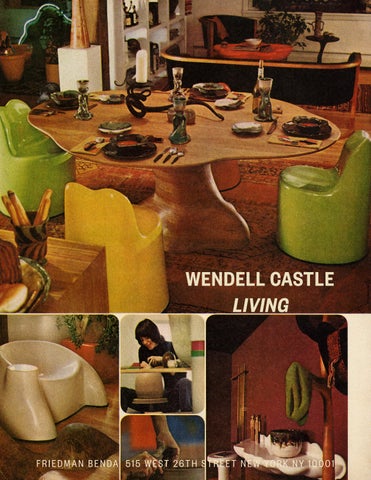
WENDELL CASTLE LIVING
F R I E D M A N B E N D A 5 1 5 W E S T 2 6 T H S T R E E T N E W YO R K N Y 1 0 0 0 1
Wendell Castle Living by Alison Castle
For the first years of my life I lived in a soaring, art-filled loft in a converted bean mill, with my father’s workshop and my mother’s ceramics studio on the floors below. It was a lovely home, full of joy and creativity and the fruits of my parents’ practices. I remember well the feeling of inhabiting the space and using and interacting with the furniture — I was especially attracted to any piece large enough to hide inside of. I didn’t know that my house was unique, but I knew that it was magical. When I was about six, the fumes and noise coming from downstairs had become too much to live with, so we moved to a house just across the village and my father’s studio, and later his woodworking school, took over the space. Today, it is used by Wendell Castle Workshop as a gallery and as lodging for instructors and residents. My parents’ work fills the space again, but it’s indelibly different than it was when I was little. Whenever I go back there, some part of my brain is reconstructing what it looked like when we lived there, aching to return to that home again. Several years ago, I came across a 1973 House Beautiful article with photos of the home that featured a variety of views in full detail. The pictures showed me, with startling clarity, what I had spent all these years trying to see through the fog of distant memory. I was, and still am, mesmerized by them. Here, I have tried to recapture the feeling of those rooms, as though they had been lifted from the old bean mill and transported directly into the gallery. I wanted, selfishly, to experience these interiors again. But more importantly, I wanted to show others what it was like to live in a home filled with art and furnished with Wendell Castle furniture. By adding in some of my dad’s pieces made in later years, I’ve tried to give a glimpse of the evolution our home went through over the years, as new entered and mixed with the old. I hope to give viewers a sense of my father’s career trajectory while steeping them in the vibe of our 1970’s interiors. Welcome to our home.
Alison Castle, 1974
Living the Dream
by Glenn Adamson Imagine that you are back in your childhood home, just as it was when you were young. All the pieces of furniture you remember are in their place. The table is set for dinner; the fireplace is lit. The only thing missing is you, but that doesn’t matter—for your own experiences come back to you now, in all their original vividness. This is what happened for Alison Castle a few years ago, when she tracked down an article in House Beautiful from 1973. “Designing Their Own Lifestyle,” runs the title, and it fairly bursts off the page, with nine color images of the home in Scottsville, New York, where she grew up — the home that her parents Wendell Castle and Nancy Jurs created together. Needless to say, this was not just any domestic interior. For young Alison, of course, it seemed completely normal to live in such an artistic environment; but only gradually, and in retrospect, would its significance become clear. Castle was the preeminent figure in the American art furniture movement, while Jurs is a prominent potter and ceramic sculptor. Add to this their wide circle of acquaintance with other craft artists like Roy Cartwright, Tommy Simpson, and Ann Sutton—whose works they did not so much strategically collect as companionably gather—and their home was unquestionably one of the most significant American interiors of its era. Its appearance was not well documented in the early ‘70s, however, and, as might be expected of two prolific artists, their environment was ever evolving. New creations from the studio constantly arrived while others achieved escape velocity. The upshot was that, until Alison found that magazine, all she had of the space in those days was a few family photos and her own memories. To encounter the pictures in House Beautiful was like stepping back into that dream.
Wendell Castle: Living is an attempt to capture this imaginative time travel. Alison has served as the curator for the project, and her recollections have given it shape. The gallery is divided into a sitting area, kitchen and dining areas, office/entryway, and bedroom enlivened with personal touches: Wendell’s guitar and some of his folk songbooks; a butcher block with Nancy’s name carved into it; and Alison’s own childhood highchair, an emblem of the past still present. Yet the exhibition is far from being only a private concern. It expands our view of Castle and his creative context in several important respects. First, and most obviously, presenting these historic objects in a quasi-domestic setting usefully dispels their mantle of authority. These days, Castle’s sculptural furniture is invariably shown in splendid isolation—on gallery and museum platforms, under perfect lighting, with explanatory labels attesting to its importance. He deserves all the attention, of course, but as with any canonical artist, it can be difficult to see the work afresh. This exhibition gets us back to the heart of the matter, in every sense of that phrase. It reconnects us with the wondrous strangeness Castle’s work had when it was new, while also metaphorically taking him off his pedestal, putting him back among his loved ones. This effect pervades the present exhibition, extending from several works that are pictured in the House Beautiful article--which remain in the family’s collection—to other key pieces of the 1960s and 70s, and a selection of later works that indicate Castle’s forward trajectory. This latter part of the exhibition traces Castle’s complex trajectory over the succeeding decades, including his magisterial neo-expressionist Dr. Caligari series, and ultimately bringing us to the masterworks of his late career. It is a story of continual reinvention, but also continuity. We see how his sinuous and massive forms, achieved using his innovative techniques of stack lamination and injection molding, served as an all-purpose vocabulary. Castle loved nothing more than posing himself a compositional problem and solving it, and that deep satisfaction is felt throughout the show. The emphasis on everyday use, however, gives us something else to think about. We might focus a little less on the formal ingenuity of his designs, a little more on their emotive qualities: all those curves gently hugging the space; the warmth of the wood and the brightness of the plastic; what they might have meant to a child, who could not have known how unconventional they were.
Jurs’ ceramics, too, played an important role in this interior landscape. She would later become known for her imposing figural sculptures, often armored, expressing a powerful sense of female emergence. In the 1960s and ‘70s, however, she was mainly concentrating on raku-fired functional pottery, in line with her training at the School for American Craftsmen in Rochester. (Jurs met Castle in 1962, when he began teaching there, and graduated with a BFA in 1963.) In House Beautiful we see her pieces in action: blooming bowls and twisting goblets on the dining table, a commanding vessel standing on one of Castle’s molded plastic shelves, with its storm of black scorch drifting down into whiteness. This conversation across mediums animated not only the house in Scottsville, but the whole of the craft movement of which Castle and Jurs were a part. Notwithstanding their eventual departures from this context— Jurs’ explorations of monumental sculpture, Castle’s crucial role in defining the 21st-century design avant garde—the craft movement was a huge presence in their artistic, professional, and social lives. And in 1973 it was at its height. The expressive possibilities of furniture, ceramics and other media were being explored like never before, especially on campuses like the one at Rochester, where faculty and students could pursue their own individual artistic inclinations rather than serving a commercial market. Meanwhile, the craft ethic was playing an important practical role in the unfolding counterculture, providing a means to escape the imperatives of consumerism. Castle and Jurs were not really hippies—they were too focused on their careers and their family for that. Nor, however, were they squares. This is quite clear in the House Beautiful article: Castle wears a flowery shirt and blue jeans, the floors are decked out with kilims, and a psychedelic note is struck by a ribbed plastic tube jokingly connecting two clay pots to look like a vacuum cleaner. The editorial slant also clearly emphasizes Castle and Jurs’ independent lifestyle, noting that “they made or designed practically everything in this house themselves.”
House Beautiful was only one of many mass-market publications to promote such ideals. A few years previously, for example, Castle had been featured in a 1966 LIFE Magazine feature called “The Old Crafts Find New Hands,” alongside other luminaries of the movement like Harvey Littleton, Lenore Tawney, and Peter Voulkos. Paging through these old issues today, it’s possible to reconstruct the impression these unusual features have made— just compare the conventional, all-floral interior on the House Beautiful cover to the images of Castle and Jurs’ home within. But at this time, as editors well knew, an enthusiasm for handcraft was widespread and they were eager to bring those stories to a wide readership. There was a gentle revolution in the making. Castle, of course, had been one of the prime protagonists of that movement. In his compound forms—chairs that merged with tables, functional forms that sprouted sculptural lighting, masses that engaged the wall or floor—he rethought furniture quite literally from the ground up, transforming the domestic interior into a space for experimentation. The 1972 Environment included here is a perfect example. The low-slung, curvaceous composition is organized around two horizontal surfaces, usable as a bed and a table, but also implying a more open-ended improvisatory situation. Two of the three torqued legs rise above the platform, one culminating in another small table, the other in a round light. The total conception of this work is akin to Castle’s Environment for Contemplation (1970), which he created for a meditation-themed exhibition at the Museum of Contemporary Crafts. (Alison remembers that extraordinary creation being in the house while she was growing up: “I would often sit inside with the door closed, playing in the light coming from the small opening at the top. It felt like being in a spaceship or a submarine.”) In the 1972 Environment, the womb-like enclosure of the earlier work has, as it were, been unfolded and laid out flat. The basic premise, though, is the same. This is not so much a defined object as a place of possibility, right in tune with the 1972 children’s song, “Free to Be… You And Me.” Something similar can be said for Castle’s experiments in molded plastic — among the first such designs to be realized in America. He was initially inspired by developments in Italy, where the new technology had been in
use for some time; the house had, among its few purchased pieces of furniture, a shelving unit by the Milanbased company Kartell, one of the leading manufacturers in this new field. Alison believes these came through George Beylerian, a retailer for Kartell in the US, who also sold Castle’s own designs in molded fiberglass. These began with his first Molar Chair and the neon-lit Benny Lamp, in 1969, and he then went on to develop a whole series of Molar furniture, including several other seating forms, tables, and wall shelves. The Scottsville residence was furnished with quite a few of these pieces — House Beautiful described “a bright scene of undulating plastic furniture” — and they brought a fantastical pop sensibility to the house. Entering the front door, one imagines, may have felt a little like stepping into a giant technicolor mouth. Unfortunately, mass production of the plastic furniture remained elusive. Castle was invariably ahead of the curve, and in this case, too much so, at least for commercial purposes. In 1973, his own home was probably the only place in the whole country where one could see so much American-made plastic design in use. This spirit of cutting-edge innovation would continue throughout the remainder of Castle’s career, even as times changed. In this respect, too, he was exemplary of his generation. The counterculture’s most extreme forms, like almost all utopian projects, quickly ran its course; the 1980s would be marked by a conservative backlash and a return to enthusiastic competitive consumerism. Yet both the counterculture and the craft movement were tremendously influential, far exceeding their relatively small demographic footprint. As Peter Coyote, the activist, actor, and founder of the neo-anarchist Diggers, has argued, “we failed in all our political agendas, but on a cultural level, we won everything.” Wherever you look in American culture today—in music, food, clothing, architecture, and yes, in the world of ideas—you can see and feel the widespread influence of the craft movement and the counterculture. It is proof that just a few people, if they are sufficiently determined to rethink their own reality, can have an outsized importance. Certainly, this is one way of viewing Castle’s later work — and perhaps a way that he himself viewed it. Witness his Forgotten Dream table, made just a couple of years before his passing, which shares its cloud-like contours with many other works in the show, whether they date to his early or later years. A thought bubble made manifest; it invites us to think, in turn, and to reconsider what an object can do and be. Like everything Castle made over the course of his long career, it shifts the space around it simply by virtue of its own extraordinary existence. If that’s not a dream worth living up to, I don’t know what would be.
Wendell Castle with Coatrack, House Beautiful, 1973
Wendell Castle sculpting Arcadia, 2010
Wendell Castle drawing Arcadia, 2010
Wendell Castle Home, 1970’s
Wendell Castle Home, 1970’s
Wendell Castle Home, 1970’s
Wendell Castle Home, 1970’s
Wendell Castle Home, 1970’s
Wendell Castle Home, 1970’s
Wendell Castle 1932-2018 1961
University of Kansas, Sculpture MFA
1958
University of Kansas, Industrial Design BFA
1932
Born in Emporia, Kansas
Museum and Public Collections Addison Gallery of American Art, Andover, MA American Express, New York, NY Art Institute of Chicago, Chicago, IL Atlanta High Museum, Atlanta, GA Bausch & Lomb, Rochester, NY Belger Arts Center, Kansas City, MO Brooklyn Museum, Brooklyn, NY Carnegie Museum of Art, Pittsburgh, PA Centre Georges Pompidou, Paris, France Cincinnati Art Museum, Cincinnati, OH Cooper Hewitt National Design Museum, New York, NY Currier Museum of Art, Manchester, NH Delaware Art Museum, Wilmington, DE Design Museum Ghent, Ghent, Belgium Detroit Institute of Arts, Detroit, MI DuPont Center, Orlando, FL Forbes Company, New York, NY Gannett Corporation, Washington D.C. Gilman Foundation, New York, NY Hunter Museum of Art, Chattanooga, TN KMAC Contemporary Art Museum, Louisville, KY Los Angeles County Museum of Art, Los Angeles, CA Manchester Art Gallery, Manchester, UK Memorial Art Gallery, Rochester, NY Metropolitan Museum of Art, New York, NY Milwaukee Art Museum, Milwaukee, WI Mint Museum of Art, Charlotte, NC Minneapolis Institute of Arts, Minneapolis, MN Monroe County-Greater Rochester International Airport, Rochester, NY Museum of Art, St. Louis, MO Museum of Art and Design, New York, NY Museum of Decorative Arts, Montreal, Canada Museum of Fine Arts, Boston, MA Museum of Fine Arts, Houston, TX Museum of Modern Art, Design Collection, New York, NY Nations Bank, Atlanta, GA Nelson Atkins Museum, Kansas City, MO Nordenfjeldske Kunstindustrimuseet, Oslo, Norway Philadelphia Museum of Art, Philadelphia, PA Racine Art Museum, Racine, WI Rochester Institute of Technology, Rochester, NY Rochester Memorial Art Gallery, Rochester, NY Smithsonian American Art Museum, Washington, D.C. Speed Museum of Art, Louisville, KY Spencer Museum of Art, Lawrence, KS Steinway Company, Long Island City, NY Sydney Bestoff, New Orleans, LA
Toledo Museum of Art, Toledo, OH The University of Rochester, Rochester Centennial Sculpture Park, Rochester, NY Victoria & Albert Museum, London, UK White House Collection of American Crafts, Washington D.C. Wichita Art Museum, Wichita, KS Wolfsonian Foundation, Miami Beach, FL Awards 2018
Wunsch Americana Foundation Award, New York, NY
2017
Inaugural Distinguished Alumni Award, The University of Kansas, KS
2014
Smithsonian Craft Show Award, Craft Council, Washington, DC
2013
Honorary Degree from Kansas University
2012
Lifetime Achievement Award, Rochester Arts and Cultural Council
2007
Lifetime Achievement Award, Brooklyn Museum of Art, Brooklyn, NY
2003
Outstanding Achievement Award. The National Association of Schools of Art & Design, Los Angeles, CA
2002
Distinguished Achievement Award. University of Kansas School of Fine Arts, Manhattan, KS
1999
Master of the Medium, The James Renwick Alliance of The National Museum of American Art, Washington, DC
1994
Visionaries of the American Craft Movement, American Craft Museum, New York, NY
1988
Visual Artists Fellowship Grant, National Endowment for the Arts
1979
Honorary Degree, Doctor of Fine Arts, Sculptor/Designer, Maryland Institute of Art, Baltimore, MD
1973, 75, 76
National Endowment for the Arts Grant(s) Louis Comfort Tiffany Foundation Grant
Select Solo Exhibitions 2026
Wendell Castle: Living, Friedman Benda, New York, NY
2019
Wendell Castle: A New Vocabulary, Friedman Benda, New York, NY
2018 – 19
Wendell Castle: Shifting Vocabularies, Nelson-Atkins Museum of Art, Kansas City, MO
2018
Wendell Castle: Progressions, Nerman Museum of Contemporary Art, Overland Park, KS
2017
Wendell Castle: Embracing Upheaval, Friedman Benda, New York, NY
2016
Wendell Castle Imagined: A Revelation of Creative Process, Rochester Institute of Technology University Gallery, Rochester, NY
2015 - 17 Wendell Castle Remastered, The Museum of Arts and Design, New York, NY; Memorial Art Gallery, Rochester, NY 2015
Gathering Momentum, Friedman Benda, New York, NY
2014
Wendell Castle: Unflinching Faith, University of Wisconsin Oshkosh, Oshkosh, WI
2013 - 14
Wendell Castle: Leap of Faith, Carpenters Workshop Gallery, London, UK
2012 - 14 Wendell Castle: A New Environment, Friedman Benda, New York, NY Wendell Castle: Volumes and Voids, Barry Friedman, New York, NY Wendell Castle: Wandering Forms – Works from 1959-79, The Aldrich Museum, Ridgefield, CT; Savannah College of Art and Design, Savannah, GA Wendell Castle: Forms within Forms, Kentucky Museum of Art and Craft, Louisville, KY 2011 - 12
Wendell Castle: Best Leg Forward, Carpenters Workshop Gallery, London, UK
2011
Wendell Castle in the 21st Century, Belger Arts Center, Kansas City, MO
2010
Wendell Castle. Rockin’, Barry Friedman, Ltd. New York, NY
2008 Wendell Castle. New Work, Barry Friedman, Ltd. New York, NY Wendell Castle: About Time, Spencer Museum of Art, University of Kansas, Lawrence, KS Wendell Castle, Carpenter’s Workshop Gallery, London, UK 2005
Wendell Castle: What Pluck!, Castellani Art Museum, Niagara, NY
2004 - 06
Wendell Castle in Rochester, Memorial Art Gallery, Rochester, NY
2004
Wendell Castle: Auto Plastic, R 20th Century, New York, NY
2003
Wendell Castle: Seeing in the Dark, Wexler Gallery, Philadelphia, PA
2001
Wendell Castle, Bausch & Lomb, Rochester, NY
2000
Furniture by Wendell Castle, Kendall College of Art & Design, Grand Rapids, MI
1996
One Man Exhibit, Savannah College of Art and Design, Savannah, GA
1995 Works by Wendell Castle, Atlantic Center for the Arts, New Smyrna Beach, FL Art Furniture by Wendell Castle, Orlando Museum of Art, Orlando, FL One-Man Exhibit, Chang Gallery, Kansas State University, Manhattan, KS Wendell Castle: Cabinets 1985 – 1995, A Retrospective Exhibition, Peter Joseph Gallery, New York, NY 1994 Ambiguous Objecthood: New Furniture and Drawings by Wendell Castle, Art Complex Museum, Duxbury, MA Wendell Castle: Coming to Grips, Morgan Gallery, Kansas City, MO New Work by Wendell Castle, Carleton Art Gallery, Carleton College, Northfield, MN 1993 Wendell Castle: Environmental Works, Peter Joseph Gallery, New York, NY Wendell Castle: Select Early Works (1971-75), Franklin Parrasch Gallery, New York, NY 1991
Angel Chairs: New Work by Wendell Castle, Peter Joseph Gallery, New York, NY
1989 - 91
Furniture of Wendell Castle. Traveling retrospective exhibit: Detroit Institute of Arts, Detroit, MI; American Craft Museum, New York, NY; Virginia Museum of Fine Arts, Richmond, VA; Delaware Art Museum, Wilmington, DE; Memorial Art Gallery, Rochester, NY
1989
Wendell Castle: New Work, Snyderman Gallery, Philadelphia, PA
1988
Wendell Castle: A Decade 1977-1987, Alexander Milliken Gallery, New York, NY
1986 Time and Defiance of Gravity: Recent Works by Wendell Castle, Mead Art Museum, Amherst College, Amherst, MA; Memorial Art Gallery, Rochester, NY Wendell Castle. Works in Plastic 1968-1970, 20th Century Gallery, Toronto, Canada Wendell Castle. Sculpture? Furniture? The Vanishing Line, Fendrick Gallery, Washington, D.C. 1985 - 86
Masterpieces of Time, The Renwick Gallery, Smithsonian American Art museum, Washington, D.C.
1985
Taft Museum, Cincinnati, OH
1980
Furniture As Art II, Fendrick Gallery, Washington, D.C.
1969 The Furniture of Wendell Castle, University of Kansas, Lawrence, KS; State University of New York, Cortland, NY 1965 - 66
Memorial Art Gallery, Rochester, NY
1962
Inaugural Show, Hopkins Center, Dartmouth College, Dartmouth, NH; Louisville Art Association, Louisville, KY; Ithaca College Museum of Art, Ithaca, NY; Scudder Gallery, University of New Hampshire, Durham, NH
Select Group Exhibitions 2026
Home of the Future, 1925-1985: Designing Domestic Utopias, Los Angeles County Museum of Art, CA
2020 Design & the Wondrous: On the Nature of Ornament, Centre Pompidou x West Bund Museum, Shanghai, China 2019 - 2020
Memphis Plastic Field, Musee des Arts Decoratifs et du Design, Bordeaux, France
2019
UConn Reads: Game of Thrones. William Benton Museum of Art, University of Connecticut, Storrs, CT
2018 - 19 When Attitudes Become Chairs, Pizzuti Collection, Columbus, OH Design et Merveilleux, Musée d’art moderne, Saint-Priest-en-Jarez, France 2017 - 19
Innovators and Activists: Celebrating Three Decades of New York State Council on the Arts/New York Foundation for the Arts Fellowships. Traveling exhibition: Dorsky Museum at SUNY New Paltz, New Paltz, NY; Dowd Gallery at SUNY Cortland, Cortland, NY; Fosdick-Nelson Gallery at Alfred University, Alfred, NY; Marion Art Gallery at SUNY Fredonia, Fredonia, NY; Burke Gallery at SUNY Plattsburgh, Plattsburgh, NY; Paul W. Zuccaire Gallery at Stony Brook University, Stony Brook, NY; Center for the Arts, Westchester Community College, Valhalla, NY
2017
dna10, Friedman Benda, New York, NY
2016 – 17
Wood, Revisited, The Center for Art in Wood, Philadelphia, PA
2016
Beyond Limits A Selling Exhibition, Sotheby’s at Chatsworth House, Derbyshire, UK
2015
NYC Makers, The Museum of Arts and Design, New York, NY
2012 - 13 Unicorn Family, The University of Rochester, Rochester Centennial Sculpture Park, Rochester, NY Against the Grain: Wood in Contemporary Art, Craft, and Design, Mint Museum, Charlotte, NC; Museum of Arts and Design, New York, NY; Fort Lauderdale Museum of Art, Fort Lauderdale, FL 2011 - 12 Crafting Modernism: Midcentury American Art and Design, Museum of Art and Design, New York, NY The Abstract Forms of Pablo Picasso and Wendell Castle, Wexler Gallery, Philadelphia, PA 2010 The Edge of Art: New York State Artists Series, Everson Museum of Art, Syracuse, NY Sotheby’s at Sudeley Castle: A Selling Exhibition, Cheltenham, UK 2007 - 09
Craft in America: Expanding Traditions, Craft in America, Los Angeles, CA
2008
New Work by Wendell Castle: Works on Paper by Chuck Close, Wexler Gallery, Philadelphia, PA
2007
Shy Boy, She Devil, and Isis: The Art of Conceptual Craft, Museum of Fine Arts, Boston, MA Not Furniture: XXI Design, Hedge Gallery, San Francisco, CA
2006
Pop Art and Its Affinities, Philadelphia Museum of Art, Philadelphia, PA
2005 Recent Acquisitions, Spencer Museum of Art, University of Kansas, Lawrence, KS Good Heart, Gerald Peters Gallery, Sante Fe, NM 2004 - 05
Black & White, Galerie von Bartha, Basel, Switzerland
2004 Outrageous Home, The Hunterdon Museum of Art, Clinton, NJ The White House Collection of American Crafts, Jimmy Carter Presidential Library, Atlanta, GA Summer Group Show, Marlborough Gallery, New York, NY Right at Home: American Studio Furniture, Renwick Gallery, Washington, D.C. The Perfect Collection: A Shared Vision of Contemporary Craft, The Fuller Museum, Brockton, MA 2003 Corporal Identity-Body Language, Museum of Arts & Design, New York, NY The Maker’s Hand: American Studio Furniture, 1940-1990. Museum of Fine Arts, Boston, MA Kanazawa World Craft Forum 2003, Kanazawa, Japan Triennial 9 Form & Contents: Corporal Identity-Body Language, Museum Für Angewandte Kunst, Frankfurt, Germany Teasing the Eye: Crafted Illusions, The Renwick Gallery, Smithsonian American Art Museum, Washington, D.C. Significant Objects from the Modern Design Collection, The Metropolitan Museum of Art, New York, NY 2002
Deceptions and Illusions: Five Centuries of Trompe L’Oeil Painting, The National Gallery of Art, Washington, D.C. Embellished with Gold, Decorative Arts Museum, Little Rock, AK
2001
Objects for Use: Handmade by Design, American Craft Museum, New York, NY Contemporary Craft in the Museum of Fine Arts, Museum of Fine Arts Houston, Houston, TX
1999
Recent Acquisitions. Decorative Arts. Traveling exhibition: Musée des Art Décoratifs, Paris, France; Die Neue Sammlung, Munich, Germany; J.B. Speed Museum, Louisville, KY; Virginia Museum of Fine Arts, Richmond, VA; Cincinnati Art Museum, Cincinnati, OH; Canadian Museum of Civilization, Quebec, Canada; Montreal Museum of Decorative Arts, Montreal, Canada
1995 - 99 The White House Collection of American Crafts. Traveling exhibition: Mint Museum, Charlotte, NC; Delaware Art Museum, Wilmington, DE; Tampa Museum of Art, Tampa, FL; Colby College Museum of Art, Waterville, ME; Art Museum of Western Virginia, Roanoke, VA; Los Angeles County Museum of Art, Los Angeles, CA; American Craft Museum, New York, NY; Rochester Memorial Art Gallery, Rochester, NY; The Renwick Gallery, Smithsonian American Art Museum, Washington, D.C. The Handmade: shifting paradigms, Singapore Art Museum, Singapore, Japan Recent Acquisitions of Furniture, The Renwick Gallery, Smithsonian American Art Museum, Washington, D.C. 1997 Renwick at 25, Renwick Gallery, Washington, D.C. Celebrating American Craft, The Danish Museum of Decorative Art, Copenhagen, Denmark Designed for Delight, Alternative aspects of twentieth-century decorative arts, Canadian Museum of Civilization, Hull, Canada; Cincinnati Art Museum, Cincinnati, OH; Montreal Museum of Decorative Arts, Montreal, Canada; Musee des Arts Decoratifs, Paris, France; Muzeum Narodowe w Krakowie, Krakow, Poland; Die Neue Sammlung, Munich, Germany; J.B. Speed Art Museum, Louisville, KY; Virginia Museum of Fine Arts, Richmond, VA 1996 – 97
Four Decades of Discovery: The 40th Anniversary of the American Craft Museum, American Craft Museum, New York, NY
1996 New Furniture: Beyond Form and Function, Herbert F. Johnson Museum of Art, Ithaca, NY Wendell Castle and Nancy Jurs: A Marriage of Life and Art, Delaware Center for the Contemporary Arts, Wilmington, DE 1995 - 96
Breaking Barriers: Recent American Craft. Traveling exhibition: American Craft Museum, New York, NY; Museum of Art, Albany, GA; Madison Art Center, Madison, WI; Portland Art Museum, Portland, OR
1995 Art for Everyday, Wharton Esherick Museum, Paoli, PA Please Be Seated: Masters of the Art of Seating, The Henry Morrison Flagler Museum, Palm Beach, FL 1994
The Object of Pop, Franklin Parrasch Gallery, New York, NY
1993
Furniture Fantasy, Susquehanna Art Museum, Harrisburg, PA
1991 - 93
Design 1935-1965: What Modern Was. Traveling exhibition: Canadian Museum of Civilization, Quebec, Canada; Montreal Museum of Fine Arts, Montreal, Canada; Baltimore Museum of Art, Baltimore, MD; Nelson-Atkins Museum of Art, Kansas, City, MO; Toledo Museum of Art, Toledo, OH; Los Angeles County Museum of Art, Los Angeles, CA
1992
Craft Today: USA, The Gulbenkian, Lisbon, Portugal
1989 - 92 Crafted Today USA. Traveling exhibition: The Renwick Gallery, Smithsonian American Art Museum, Washington D.C.; Sala Sant Jaume de la Fundacio La Caixa, Barcelona, Spain; The Grassi Museum, Leipzig, Germany; Slovak National Gallery, Bratislava, Slovakia; Eommex Cultural Center-Zapperion, Athens, Greece; American Haus, Berlin, Germany; St. Peter’s Abbey, Ghent, Belgium; The Oslo Museum of Applied Art, Oslo, Norway; Ataturk Cultural Center, Ankara, Turkey; Museum of Applied Arts, Moscow, Russia; Musée des Art Décoratifs, Lausanne, Switzerland; Zacheta Gallery, Warsaw, Poland; Museum Für Kunsthandwerk, Frankfurt, Germany; Taidetollisuusmustoi, Helsinki, Finland; Musée des Art Décoratifs, Paris, France 1991 1991 Kanazawa Gran-Prix Arts & Crafts Competition, Kanazawa Culture Hall Gallery, Kanazawa, Japan Masterworks, Peter Joseph Gallery, New York, NY 1987 – 91
The Eloquent Object: the Evolution of American Art in Craft Media since 1945. Traveling exhibition: Museum of Modern Art, Tokyo, Japan; Virginia Museum of Fine Art, Richmond, VA; Orlando Museum of Art, Orlando, FL; Museum of Fine Arts, Boston, MA; The Oakland Museum, Oakland, CA
1989
Artful Objects: Recent American Crafts, Fort Wayne Museum of Art, Fort Wayne, IN
1988 Clockwork! List Visual Arts Center, Massachusetts Institute of Technology, Boston, MA 1988: The World of Art, Today, Milwaukee Art Museum, Milwaukee, WI 1986 – 88
Craft Today: Poetry of the Physical. Traveling exhibition: Virginia Museum of Fine Arts, Richmond, VA; J.B. Speed Art Museum, Louisville, KY; Milwaukee Art Museum, Milwaukee, WI; The Denver Art Museum; American Craft Museum, Denver, CO
1987
New Work: Wendell Castle, Garry Knox Bennet, Fred Baier, Alexander Milliken Gallery, New York, NY A Gallery, Palm Desert, CA
1985 - 87
Material Evidence, New Color Techniques in Handmade Furniture, The Renwick Gallery, Smithsonian American Art Museum, Washington, D.C.
1985
High Styles: Twentieth-Century American Design, Whitney Museum of American Art, New York, NY
1983
Ornamentalism: The New Decorativeness in Architecture and Design, Hudson River Museum, Yonkers, NY
1980
Sitting in Style, The Society of Arts and Crafts, Boston, MA; The Museum of Fine Arts, Boston, MA
1979 - 80
New Handmade Furniture, Museum of Contemporary Crafts, New York, NY
1979
Paley/Castle, Wildenhain, Memorial Art Gallery, Rochester, NY
1977 American Crafts 1977/ The Philadelphia Craft Show, The Philadelphia Museum of Art, Philadelphia, PA Drawing Show, Rochester Institute of Technology, Rochester, NY 1976
American Crafts ‘76, an Aesthetic View, Museum of Contemporary Art, Chicago, IL
1975 - 76
Craft Multiplies, The Renwick Gallery, Smithsonian American Art Museum, Washington, D.C.
1973 - 74
Innovations: Contemporary Home Environs, La Jolla Museum of Contemporary Art, La Jolla, CA
1972
Woodenworks: Furniture Objects by Five Contemporary Craftsmen, The Renwick Gallery, Smithsonian
American Art Museum, Washington, D.C.; Minnesota Museum of Art, St. Paul, MN
1970 Attitudes, The Brooklyn Museum, Brooklyn, NY Contemplation Environments, Museum of Contemporary Crafts, New York, NY 1969 – 72
Objects USA: The Johnson Collection of Contemporary Crafts, Traveling exhibition: Smithsonian American Art Museum, Washington D.C.; University of Rochester, Rochester, NY; Cranbrook Academy of Art, Bloomfield Hills, MI; Cincinnati Art Museum, Cincinatti, OH; St. Paul Art Center, Saint Paul, MN; Seattle Art Museum, Seattle, WA; Los Angeles County Museum of Art, Los Angeles, CA
1966 Wendell Castle, Wharton Esherick, Sam Maloof, Marcello Grassman, Renaissance Society, University of Chicago, Chicago, IL Fantasy Furniture, Museum of Contemporary Crafts, New York, NY Internationals Kunsthandwerk, 1966, Stuttgart, Germany 1964 United States of America Section at the 13th Triennale, Milan, Italy The American Craftsman, Museum of Contemporary Crafts, New York, NY 1962
Young Americans, Museum of Contemporary Crafts, New York, NY
Castle Family, 1973
Wendell Castle Home, 1970’s
We n d e l l C a s t l e Living
Published by Friedman Benda 515 West 26th Street New York, NY 10001 Tel. + 1 212 239 8700 www.friedmanbenda.com Photography by The Estate of Wendell Castle, Izzy Leung, Kevin Rowland All content copyright of Friedman Benda and Wendell Castle Inc. Published on the occasion of the exhibition Wendell Castle: Living, September 17 - October 17, 2026