Standard The Kashmir
www.kashmirstandard.com
thekashmirstandard
@thekashmirstandard
@thekashmirstandard
TO REACH UNREACHED
Volume 1 | Issue: 1 | 12th January - 18st January 2026 | 23th Rajab - 29th Rajab, 1447 AH | 14th Year of Publication
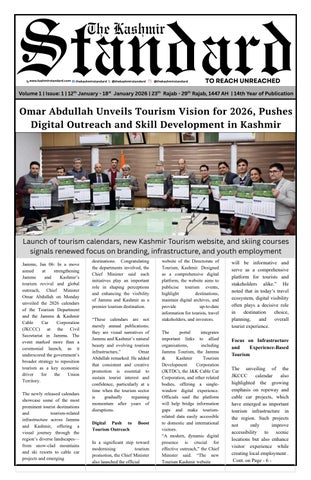
Omar Abdullah Unveils Tourism Vision for 2026, Pushes Digital Outreach and Skill Development in Kashmir
Launch of tourism calendars, new Kashmir Tourism website, and skiing courses signals renewed focus on branding, infrastructure, and youth employment Jammu, Jan 06: In a move aimed at strengthening Jammu and Kashmir’s tourism revival and global outreach, Chief Minister Omar Abdullah on Monday unveiled the 2026 calendars of the Tourism Department and the Jammu & Kashmir Cable Car Corporation (JKCCC) at the Civil Secretariat in Jammu. The event marked more than a ceremonial launch, as it underscored the government’s broader strategy to reposition tourism as a key economic driver for the Union Territory. The newly released calendars showcase some of the most prominent tourist destinations and tourism-related infrastructure across Jammu and Kashmir, offering a visual journey through the region’s diverse landscapes— from snow-clad mountains and ski resorts to cable car projects and emerging
destinations. Congratulating the departments involved, the Chief Minister said such initiatives play an important role in shaping perceptions and enhancing the visibility of Jammu and Kashmir as a premier tourism destination. “These calendars are not merely annual publications; they are visual narratives of Jammu and Kashmir’s natural beauty and evolving tourism infrastructure,” Omar Abdullah remarked. He added that consistent and creative promotion is essential to sustain tourist interest and confidence, particularly at a time when the tourism sector is gradually regaining momentum after years of disruptions. Digital Push to Tourism Outreach
Boost
In a significant step toward modernising tourism promotion, the Chief Minister also launched the official
website of the Directorate of Tourism, Kashmir. Designed as a comprehensive digital platform, the website aims to publicise tourism events, highlight destinations, maintain digital archives, and provide up-to-date information for tourists, travel stakeholders, and investors. The portal integrates important links to allied organisations, including Jammu Tourism, the Jammu & Kashmir Tourism Development Corporation (JKTDC), the J&K Cable Car Corporation, and other related bodies, offering a singlewindow digital experience. Officials said the platform will help bridge information gaps and make tourismrelated data easily accessible to domestic and international visitors. “A modern, dynamic digital presence is crucial for effective outreach,” the Chief Minister said. “The new Tourism Kashmir website
will be informative and serve as a comprehensive platform for tourists and stakeholders alike.” He noted that in today’s travel ecosystem, digital visibility often plays a decisive role in destination choice, planning, and overall tourist experience. Focus on Infrastructure and Experience-Based Tourism The unveiling of the JKCCC calendar also highlighted the growing emphasis on ropeway and cable car projects, which have emerged as important tourism infrastructure in the region. Such projects not only improve accessibility to scenic locations but also enhance visitor experience while creating local employment . Cont. on Page - 6 -
Standard
Page - 2
The Kashmir
Jammu and Kashmir
12th January - 18th January 2026
“Narcotics a Bigger Internal Threat After Terrorism”: North Kashmir Police Step cyber surveillance and crackdown on narcotics will Up All-Out War on Drugs technical monitoring have been strengthened as part of the anti-narcotics strategy. Border Sensitivity Security Measures
DIG Maqsood Ul Zamaan says sustained crackdowns, PIT NDPS bookings and community support key to eradicating drug menace from Kashmir
Baramulla, Jan 06: Reiterating that the fight against narcotics cannot be won by law enforcement alone, Deputy Inspector General of Police (DIG) North Kashmir Range, Maqsood Ul Zamaan, on Tuesday underlined the crucial role of community participation in eradicating drugs from Jammu and Kashmir. He said people must come forward and actively share information to uproot the menace from its very roots. “Eradicating drugs is not a task for police alone. Community involvement is indispensable. People must come forward and share information so that this threat can be eliminated from its roots,” the DIG said, while speaking to media persons. He described narcotics as one of the most serious internal challenges facing Jammu and Kashmir, particularly for the younger generation. According to him, drug abuse not only destroys individual lives but also weakens families, communities, and the broader social fabric of the region. Targeting the Financial Backbone of Drug Syndicates DIG Ul Zamaan said that in addition to arrests and seizures, the police are now aggressively targeting the financial infrastructure of
drug syndicates. Authorities are attaching and confiscating properties and assets acquired through proceeds of drug trafficking, with the aim of crippling the entire ecosystem that sustains the illegal trade.“ Drug trafficking is driven by money. By choking their financial lifelines, we are ensuring that these networks collapse completely,” he said, adding that financial investigations are being conducted parallel to criminal cases to ensure long-term impact. Officials say such measures send a strong deterrent message and make it difficult for traffickers to re-enter the trade after legal action. Monitoring Digital and VPN Misuse
Tools
The DIG also expressed concern over the misuse of digital tools, particularly Virtual Private Networks VPNs), which he said are increasingly being exploited to mask criminal activities. He noted that such technologies are being used by traffickers to evade detection, coordinate supply chains, and communicate discreetly. “Misuse of VPNs poses serious security concerns. These platforms are being closely monitored to prevent their exploitation for criminal and anti-social activities,” Ul Zamaan said, indicating that
and
Commenting on border security, the DIG said North Kashmir remains a sensitive zone due to its proximity to the Line of Control (LoC). However, he assured that comprehensive security arrangements, including continuous surveillance and intelligence-based operations, are firmly in place to foil any infiltration attempts or crossborder criminal activities. “North Kashmir’s geographical sensitivity demands heightened vigilance, and we are fully prepared to deal with any challenge,” he said. Protecting Youth Sustained Action
Through
Reaffirming the resolve of Jammu and Kashmir Police, DIG Ul Zamaan said the
be intensified further in the coming months. Alongside enforcement, police will continue sustained public outreach and awareness programmes to protect society—especially the youth —from the devastating impact of drugs. He urged parents, educators, religious leaders, and civil society members to work closely with law enforcement agencies. “Only a collective effort can ensure a drug-free Kashmir. Our aim is not just enforcement, but prevention, awareness, and rehabilitation,” he said. With a combination of strict legal action, financial disruption of syndicates, digital monitoring, and community cooperation, police officials believe Kashmir is moving towards a decisive phase in the fight against drugs—one aimed at safeguarding future generations and restoring social well-being.
Youth Volunteers Lead Winter Aid Drives in Remote Kashmir Villages
Youth volunteers in several parts of Kashmir have come forward to assist vulnerable families during the harsh winter months, organizing community-driven aid campaigns in remote villages. The volunteers distributed blankets, warm clothing, and essential supplies to elderly residents, widows, and low-income households. Many said the initiative was driven by a sense of social responsibility and community solidarity. Observers say these initiatives reflect a growing culture of civic engagement among Kashmiri youth, offering hope and resilience during challenging times.
Standard
Page - 3
The Kashmir
Jammu and Kashmir
12th January - 18th January 2026
Snowfall Shuts Mughal Road Again, Authorities Race Against Weather to Restore Key South Kashmir Link
Celsius, respectively. Officials said the prolonged sub-zero temperatures are contributing to the persistence of snow and ice on roads, particularly in higher reaches such as the Mughal Road corridor. Snowfall Impact
Fresh snow blocks historic route connecting Kashmir with Pir Panjal as BRO steps up clearance efforts amid harsh winter conditions Shopian, Jan 06: The historic Mughal Road, a crucial interdistrict and inter-regional link connecting south Kashmir with the Pir Panjal region, remained closed for vehicular traffic on Tuesday following fresh snowfall in the higher reaches. Officials said the latest spell of snow has led to significant accumulation along several vulnerable stretches of the road, rendering it unsafe for movement and once again disrupting connectivity during the peak winter season. According to officials, nearly four inches of fresh snow has accumulated on multiple portions of the Mughal Road overnight. The snowfall, coupled with sub-zero temperatures, has worsened already challenging winter conditions, leading to continued traffic suspension on the route. The road, which passes through high-altitude areas and steep mountain terrain, is particularly vulnerable to snow accumulation, icy patches, and reduced visibility during Chillai Kalan. A Lifeline for South Kashmir and Pir Panjal The Mughal Road holds immense strategic, economic, and social importance for the region. Stretching across the
Pir Panjal range, it serves as an alternative route connecting Shopian district of south Kashmir with Rajouri and Poonch districts. For thousands of residents, the road acts as a lifeline, facilitating the movement of essential supplies, agricultural produce, and passengers, especially when the Jammu– Srinagar National Highway faces disruptions. Local traders and transporters say the closure affects the supply chain, particularly for fruit growers, livestock traders, and small businesses that depend on smooth connectivity between Kashmir and the Pir Panjal region. “Whenever the Mughal Road shuts, our movement is restricted, and transportation costs increase,” said a Shopian-based trader. “It has become an essential route for us.” Authorities on High Alert Officials said teams of the Border Roads Organisation (BRO) have been deployed to clear snow from the affected stretches. Snow clearance machinery, including snow cutters and dozers, has been pressed into service, and operations are being carried out on a priority basis to restore connectivity as soon as weather conditions permit.
“Snow clearance work is underway, and efforts are being made to reopen the road at the earliest,” an official said, adding that safety remains the top priority. Authorities have cautioned commuters against attempting to travel on the road until it is officially declared open. Given the road’s high altitude and exposure to heavy snowfall, reopening often depends not only on clearance efforts but also on weather stability. Fresh snowfall or sudden temperature drops can quickly undo clearance progress by forming icy layers. Valley Shivers Severe Cold
Under
The closure comes amid an intense cold wave sweeping across Kashmir. Srinagar recorded a minimum temperature of minus 3.6 degrees Celsius, while Budgam dipped to minus 3.5 degrees Celsius and Awantipora to minus 3.2 degrees Celsius. Pulwama recorded a low of minus 4.2 degrees Celsius, Anantnag minus 3.2 degrees Celsius, and Pampore minus 2.5 degrees Celsius. In north Kashmir, Kupwara and Baramulla recorded minus 1.8 and minus 0.7 degrees
Brings
Mixed
While snowfall has disrupted road connectivity, it has also revived winter tourism across Kashmir. In Gulmarg, snowrelated activities have resumed following fresh snowfall, bringing relief to tourism stakeholders. Director of the Gulmarg Adventure Academy, Azhar Fayaz Lone, said activities such as snow biking, ATV rides, and snow sledge rides are now operational. “Basic ski and snowboard courses have also been launched,” he said, adding that nearly 1.5 feet of snow was recorded in the Kangdoori area. Heavy machinery has been pressed into service to remove snow and restore connectivity, but officials said that it will take some time before the road is declared fit for traffic. Authorities have advised locals and commuters to avoid attempting travel on the Mughal Road until clearance work is fully completed and an official clearance order is issued. The road is prone to frequent closures during winter due to heavy snowfall and avalanches, and reopening depends largely on weather conditions. Officials said continuous monitoring is being carried out and further updates will be shared once the situation improves and traffic movement becomes possible. [KNT]
Standard
Page - 4
The Kashmir
JAMMU AND KASHMIR
12th January - 18th January 2026
Chillai Kalan Fuels Winter Tourism in Kashmir as Fresh Snow Revives Gulmarg’s Ski Season
possibility of light snowfall at isolated higher elevations in north and central Kashmir. From January 7 to January 15, the weather is likely to remain partly cloudy, with no major weather system forecast during this period. Tourism officials say this forecast is favourable for visitors, as stable weather conditions allow outdoor activities, sightseeing, and winter sports to continue without major disruptions.
Sub-zero temperatures sustain snow cover, boost tourist arrivals, and energise winter adventure activities across the Valley Srinagar, Jan 6: As Chillai Kalan—the coldest and most intense phase of Kashmir’s winter—entered its third week, the prolonged cold spell has emerged as a boon for the region’s winter tourism, with fresh snowfall significantly improving conditions at key destinations such as Gulmarg. Despite temperatures plunging well below freezing across the Valley, tourism activity has picked up momentum, driven by renewed snowfall and stable weather forecasts. Gulmarg, Kashmir’s premier ski destination, recorded a minimum temperature of over minus 8 degrees Celsius on Monday, making it the coldest place in the Valley. The resort received fresh snowfall on Sunday afternoon, revitalising ski slopes and drawing a steady stream of tourists, skiers, and adventure enthusiasts eager to experience Kashmir’s winter charm. Stakeholders said the snowfall has restored confidence among tourists, many of whom had been waiting for improved snow
conditions. “The fresh snowfall has brought Gulmarg back into full action mode,” said a local tourism operator. “Skiers, families, and photographers are all returning in large numbers.” Adventure Activities Back in Full Swing The renewed snow cover has allowed snow-related adventure activities to resume after a brief slowdown earlier in the season. Director of the Gulmarg Adventure Academy, Azhar Fayaz Lone, said that snow biking, ATV rides, and snow sledge rides have become fully operational following the recent snowfall. “Basic ski and snowboard courses have also been launched,” Lone said, adding that the Kangdoori area alone received nearly 1.5 feet of snow on Monday. According to him, the fresh snow has led to a noticeable increase in tourist footfall, with a steady rush of visitors observed since the Christmas holidays. Hoteliers, ski instructors, pony owners, and local
guides have also reported improved business, indicating a positive outlook for the winter tourism season, which is crucial for livelihoods in the region. Sonamarg and Destinations
Other
While Sonamarg witnessed a brief spell of light snowfall late Sunday night, the accumulation was minimal. However, the continued subzero temperatures are helping preserve the existing snow cover at higher reaches, keeping the destination attractive for winter visitors. Other tourist hubs across Kashmir, including Pahalgam and the outskirts of Srinagar, have remained under freezing conditions, creating scenic winter landscapes that continue to attract domestic tourists seeking snow experiences. Weather Outlook Favourable for Tourists According to the Indian Meteorological Department (IMD), conditions are expected to remain mostly cloudy on Tuesday, with the
“The prolonged cold is actually beneficial for tourism at this stage,” an official said. “It helps maintain snow cover, especially at Gulmarg, which is essential for skiing and winter events.” Chillai Kalan and the Winter Tourism Economy Chillai Kalan, traditionally known for its extreme cold, plays a critical role in sustaining Kashmir’s winter tourism economy. The subzero temperatures ensure lasting snow cover, which is vital for winter sports, cable car operations, and adventure tourism. With improved snow conditions, rising tourist arrivals, and stable weather predictions, stakeholders remain optimistic that winter tourism will continue to gain strength in the coming weeks. As Chillai Kalan tightens its grip, Kashmir’s snowcovered destinations are once again emerging as major winter attractions—turning the harshest season into a thriving tourism opportunity for the Valley. THE KASHMIR STANDARD
ADVERTISE WITH US AND BE VISIBLE ACROSS KASHMIR FOR ADS. CONTACT 9560420800, 9149868200
Standard
Page - 5
The Kashmir
SHOPIAN
12th January - 18th January 2026
Gusoo Residents Appeal Centre to Halt Railway Project, Warn of Ecological and Livelihood Crisis
cutting of apple trees, many of which are decades old and represent years of labor, investment, and care. “The apple trees here are our only source of income,” said a local orchard owner. “These orchards cannot be replaced overnight. Even if new saplings are planted, it will take decades to reach the same level of production. Until then, how will families survive?” Employment at Risk
Shopian villagers say proposed rail alignment threatens decades-old apple orchards, local employment, and Kashmir’s fragile environment Syrier Dar: Shopian, Kashmir: Residents of Gusoo area in south Kashmir’s Shopian district have appealed to the Central Government to halt the ongoing railway line project, expressing serious concerns over its ecological, environmental, and
employment-related implications. The villagers say the proposed alignment threatens to uproot vast stretches of apple orchards— the backbone of the local economy—and could irreversibly damage both livelihoods and the fragile ecosystem of the region.
Gusoo is a predominantly horticulture-dependent area, where apple cultivation has been nurtured over generations. For the local population, apple orchards are not merely agricultural assets but a lifeline that sustains hundreds of families directly and indirectly. According to residents, the railway project would require large-scale
Keegam Residents Hold Peaceful Protest, Seek Sustainable Approach to Railway Development
Locals say infrastructure growth must balance environmental protection, livelihoods, and community consultation Syrier Dar: Shopian, Kashmir: Local residents of Tehsil Keegam on Tuesday staged a
peaceful protest against the proposed railway line project, calling on the authorities to adopt a more sustainable and inclusive approach to
development. Men, women, and youth from different villages gathered at a central location to voice their concerns in a calm,
The apple economy in Shopian is one of the largest contributors to rural employment in south Kashmir. Beyond orchard owners, it provides livelihoods to seasonal laborers, transporters, packaging workers, cold storage operators, and fruit traders. Residents fear that the loss of orchards will trigger widespread unemployment, forcing many families into economic distress. Cont. on Page - 6 disciplined, and organized manner, underscoring that they are not opposed to development but fear irreversible damage to their land, environment, and livelihoods. Carrying placards with peaceful messages and raising slogans without disrupting public order, the protesters highlighted the need for development projects to respect local realities. Community elders and local leaders repeatedly urged the gathering to maintain unity and discipline, stressing that the objective of the protest was dialogue, not confrontation. Livelihoods at the Core of Concerns Residents said that a Cont. on Page no - 7 -
Standard
Page - 6
The Kashmir
opportunities. Tourism officials present at the event said that the calendars and digital initiatives together reflect a shift toward experience-based and infrastructure-supported tourism, aimed at attracting visitors throughout the year rather than during peak seasons alone. Investing in Youth Winter Sports
and
Adding another dimension to the tourism push, the Chief Minister inaugurated the Integrated Skiing Course at Gulmarg and Sonamarg—two of Kashmir’s most iconic winter destinations. The initiative includes two batches of trainees, with 32 participants at Gulmarg and 25 at Sonamarg. The basic
Cover Story skiing course spans 14 daysand targets young trainees aged between 12 and 18 years. Officials said the programme is designed to nurture local talent, promote winter sports culture, and create a skilled workforce that can support adventure and winter tourism in the long run. Gulmarg, already known internationally for its skiing potential, is expected to benefit significantly from trained local instructors and professionals. By investing in youth skill development, the government aims to ensure that tourism growth translates into sustainable employment for local communities. “Trainin
Gusoo Residents Appeal Centre to Halt Railway Project, Local laborers, many of whom rely exclusively on horticulture-related work, say the project could deprive them of their only means of earning. “Every season, we depend on orchard work— pruning, spraying, harvesting,” said a daily wage worker. “If the orchards are destroyed, there will be no work for us.” Economists and agricultural experts have long warned that large-scale land diversion in horticulture-rich areas of Kashmir could weaken the rural economy, increase migration, and exacerbate unemployment, particularly among youth. Environmental Ecological Concerns
and
Apart from economic implications, residents and environmental observers have raised serious concerns about the ecological impact of cutting thousands of apple trees. Orchards play a crucial role in maintaining ecological
balance by preventing soil erosion, regulating local temperatures, supporting biodiversity, and contributing to carbon sequestration. “Apple orchards act as green lungs for the region,” said an environmental activist from south Kashmir. “Removing them will not only disturb the local microclimate but also increase vulnerability to soil degradation and water stress.” Shopian, already witnessing the effects of climate change in the form of erratic weather patterns, declining snowfall, and shifting apple productivity zones, may face further environmental stress if large green belts are cleared for infrastructure projects. Demand for Alternative Routes and Consultation Residents of Gusoo have emphasized that they are not opposed to development or railway connectivity, which they acknowledge is important for Kashmir’s overall progress. However,
12th January - 18th January 2026
g local youth in skiing and other tourism-related skills is essential for making tourism inclusive and communitydriven,” a senior tourism official said. Tourism as an Economic Pillar The event brought together senior government functionaries, including Advisor to the Chief Minister Nasir Aslam Wani, MLA Zadibal Tanvir Sadiq, Chief Secretary Atal Dulloo, Additional Chief Secretary Tourism Ashish Chandra Verma, Director Tourism Kashmir and MD JKCCC Syed Qamar Sajad, Director Tourism Jammu Dr Vikas Gupta, and MD JKTDC Shreya Singhal.
they insist that development should be inclusive, sustainable, and sensitive to local realities. The villagers have urged authorities to explore alternative alignments for the railway line that would minimize damage to orchards and agricultural land. They have also demanded meaningful consultation with affected communities before finalizing project decisions. “So far, no proper dialogue has taken place,” said a community representative”.
Observers say the combined focus on promotion, digital transformation, infrastructure, and skill development signals a clear intent to position tourism as one of the strongest pillars of Jammu and Kashmir’s economy. With improved branding and targeted investments, the sector is expected to generate employment, boost local businesses, and reinforce Kashmir’s image as a safe, attractive, and diverse destination. As Jammu and Kashmir looks ahead to 2026, initiatives such as these reflect an effort to move beyond seasonal tourism and build a resilient, future-ready tourism ecosystem—one that balances promotion with infrastructure, and growth with local participation.
Experts argue that large projects must undergo transparent environmental and social impact assessments, especially in ecologically sensitive and agrarian regions like south Kashmir. Local residents hope that the Central Government will take note of their concerns and adopt a more people-centric approach. “We want development, but not at the cost of our orchards, our environment, and our future,” said another villager.
Decisions are being imposed without understanding the ground situation.
As appeals continue, the situation in Gusoo underscores a critical
Development should not mean sacrificing the survival of farming communities.”
question facing Kashmir’s development path: can infrastructure growth be pursued without undermining the very communities and ecosystems that sustain the region? For the residents of Gusoo, the answer lies in dialogue, alternative planning, and a commitment to protecting both livelihoods and nature.
Balancing Development and Sustainability The issue has once again highlighted the broader debate in Kashmir over balancing infrastructure development with environmental protection and economic sustainability.
Page - 7
Standard The Kashmir
Shopian
Keegam Residents Hold Peaceful Protest significant number of families in Keegam depend on agriculture, orchards, and small businesses for their survival. They fear that land acquisition for the railway project could result in loss of fertile farmland, fruit-bearing trees, and residential areas, pushing many households into economic uncertainty. “Our fields and orchards are not just land; they are our source of food, income, and dignity,” said one protester. “We are not against progress, but progress should not come at the cost of our survival.” Local farmers said orchards take decades to develop and cannot be easily replaced. Small shop owners and service providers also expressed concern that displacement or reduced access could affect their businesses and local employment opportunities. Environmental Raises Alarm
Impact
Apart from economic implications, residents raised strong concerns over the environmental impact of the proposed railway line. Protesters warned that largescale cutting of trees, soil disturbance, and construction
activity could harm local ecosystems and wildlife habitats. Environmental activists present at the protest said the region’s green cover plays a vital role in maintaining ecological balance, preventing soil erosion, and regulating local climate conditions. “Development without environmental safeguards can cause longterm damage that affects not just this generation, but future ones as well,” an activist said. Residents emphasized that sustainable development must integrate infrastructure growth with environmental conservation, particularly in ecologically sensitive areas like south Kashmir. Demand for Consultation and Transparency A key grievance highlighted during the protest was the alleged lack of proper consultation with affected communities. Protesters said decisions were made without adequately engaging local residents, violating the principles of participatory governance. “We were never properly
DC Shopian Takes Governance to the Doorstep at Kanjiuller Block Diwas
12th January - 18th January 2026
consulted. Plans were drawn Protesters demanded transparency in project planning, access to detailed information, and a platform for meaningful dialogue with authorities. They also called for fair compensation and rehabilitation measures for any land acquired, stressing that monetary compensation alone cannot replace longterm livelihood losses. Call for Alternative Routes Local leaders addressing the gathering appealed to the government to review the project alignment and explore alternative routes that would minimize damage to homes, farmland, and orchards. They said rerouting the railway line through less populated or less fertile areas could reduce displacement and environmental harm. demonstration stayed peaceful from start to finish. Organizers ensured that traffic and public movement were not disrupted, reinforcing the residents’ commitment to lawful and democratic expression. The protest concluded peacefully, with participants pledging to continue
Report by Syrier Dar Shopian, January 7: In a strong demonstration of people-centric governance and grassroots outreach, Deputy Commissioner (DC) Shopian, Shishir Gupta, on Tuesday presided over a Block Diwas programme at Kanjiuller, reaffirming the administration’s commitment to responsive, transparent, and accountable governance at the local level.
People-centric administration on display as grievances are heard, directions issued, and accountability stressed
The Block Diwas witnessed active participation from residents across various Panchayat halqas of the
engaging with the administration through dialogue and legal channels. Residents said such peaceful protests are necessary to safeguard local rights and ensure that voices from the grassroots are heard in decision-making processes. Sustainable Development the Way Forward The Keegam protest has once again highlighted the growing demand for sustainable development in Jammu and Kashmir—development that balances infrastructure expansion with environmental protection, economic security, and social justice. Experts say large projects must incorporate environmental impact assessments, community consultations, and long-term sustainability planning to ensure inclusive growth. As the residents dispersed, their message remained clear: development is welcome, but only when it respects people, nature, and future generations. The community now awaits a response from the authorities, hoping that their peaceful appeal will lead to constructive engagement and a more sustainable path forward.
block, who turned up in large numbers to voice their concerns and highlight longpending civic and developmental issues. The initiative, aimed at bridging the gap between the administration and the public, provided a direct platform for citizens to interact with senior district officials. During the programme, DC Shishir Gupta patiently listened to the grievances raised by the public and issued on-the-spot directions to concerned departments for immediate redressal wherever possible.
Standard
Page - 8
The Kashmir
WEEK IN REVIEW
🌍
Keegam Residents Hold Peaceful INTERNATIONAL DESK Protest Global developments that matter to Kashmir and the world
UN Warns of Worsening Humanitarian Crises WorldwideCapex-led Conflicts, climate change strain aid systems
The United Nations has warned that humanitarian needs are rising sharply due to conflicts, climate disasters, and economic shocks. Aid agencies face funding shortages. UN officials urge stronger international cooperation to prevent crises from escalating further. Artificial Intelligence Regulation Gains Momentum Worldwide Governments seek balance between innovation and ethics
Africa Pushes for Greater Role in Global DecisionMaking Calls grow for reform of international institutions
African nations are seeking increased representation in global financial and political institutions. Leaders argue current structures do not reflect contemporary global realities. Analysts say reforms could strengthen global governance and address inequality. Red Sea Shipping Disruptions Impact Global Trade Security risks force rerouting of major cargo vessels
Countries across the world are moving towards regulating artificial intelligence amid concerns over privacy, bias, and job displacement. Policymakers aim to ensure responsible AI development.
Disruptions in Red Sea shipping lanes have impacted global trade flows, increasing freight costs and delivery times. Shipping companies are rerouting vessels, affecting energy and consumer goods markets.
Tech leaders support regulation but warn against stifling innovation. Workforce reskilling has emerged as a key global priority.
Economists warn prolonged disruptions could fuel inflation and supply chain instability worldwide.
Traditional Handicrafts Struggle as Winter Sales Remain Sluggish
Artisans associated with Kashmir’s have expressed concern over sluggish winter sales, attributing the slowdown to reduced footfall and limited marketing platforms.
12th January - 18th January 2026
🇮🇳 NATIONAL NEWS (INDIA) News That Matters
Government Pushes Infrastructure Spending to Sustain Economic Growth Capex-led development strategy continues to anchor India’s growth outlook
The Government of India has reaffirmed its commitment to infrastructure-led economic growth, with renewed focus on highways, railways, ports, and urban development. Officials say capital expenditure remains central to sustaining momentum amid global economic uncertainties. Over the past year, infrastructure investments have driven job creation, improved logistics efficiency, and strengthened regional connectivity. Projects such as expressways, dedicated freight corridors, and metro
rail networks are reshaping mobility and reducing transportation costs for businesses. Economists note that infrastructure spending has a multiplier effect, boosting allied sectors like steel, cement, and construction while attracting private investment. Rural connectivity projects have also helped integrate remote areas into national markets. However, experts caution that timely execution and fiscal discipline remain key challenges. The government has emphasized publicprivate partnerships and digital monitoring tools to ensure transparency and efficiency. As India positions itself as a global manufacturing hub, sustained infrastructure investment is expected to remain a cornerstone of economic policy in the coming years.
Education Sector Sees Shift Towards Skill-Based Learning New curriculum frameworks align education with employment needs India’s education system is witnessing a gradual shift towards skill-oriented learning, vocational training, and digital education. Authorities say the reforms aim to bridge the gap between education and employability. Industry-linked courses, internships, and technology integration are being expanded. Educationists say the success of reforms will depend on implementation
quality and teacher training. Healthcare Reforms Focus on Primary Care and Digital Access Telemedicine and wellness centres expand healthcare reach India continues to strengthen its healthcare system with emphasis on primary care, preventive medicine, and digital platforms. Telemedicine services are expanding access to specialists in remote areas.
Ownwe, Printer, Publisher, Editor: Mukhtiyar Ahmad Machloo, Associate Editor: Naseer Ahmad, Sub-Editor: Qazi Mudasir, Photo Editor: Sammeer Wani, Layout Designer: Ahmad Mukhtiyar, District Shopian Editor: Syrier Ahmad Dar, Printer at: Khidmat offset Press, The Bund Srinagar, Published From: Panthachowk Srinagar, RNI No.: JKENG/2013/50575, E-mail:kashmirstandard@gmail.com, Contact No’s: 9560420800, 9149868200