Austro-Hungarian Empire
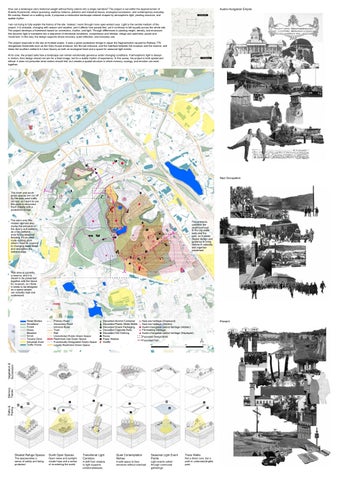
How can a landscape carry historical weight without fixing visitors into a single narrative? The project is set within the layered terrain of Kraków Krzemionki, where quarrying, wartime violence, pollution and industrial traces, ecological succession, and contemporary everyday life overlap. Based on a walking route, it proposes a restorative landscape network shaped by atmospheric light, planting structure, and spatial rhythm. I am not trying to fully explain the history of the site. Instead, I work through more open-ended cues. Light is the central medium of the project: it is unstable, changing with season and weather, and it affects how people feel, yet it continues to fall equally across the whole site. The project develops a framework based on connection, rhythm, and light. Through differences in planting height, density, and enclosure, this dynamic light is translated into a sequence of emotional conditions: compression and release, refuge and openness, pause and movement. In this way, the design supports stress recovery, quiet reflection, and everyday use. The project responds to the site at multiple scales. It uses a green pedestrian bridge to repair the fragmentation caused by Railway 776; reorganises thresholds such as the Grey House entrance, the film-set entrance, and the interface between the museum and the reserve; and treats the southern wetland in Liban Quarry as both an ecological heart and a space for seasonal light events. At its core, the project asks how a landscape can remain emotionally generous under changing conditions. If atmospheric light is always in motion, then design should not aim for a fixed image, but for a stable rhythm of experience. In this sense, the project is both spatial and ethical: it does not prescribe what visitors should feel, but creates a spatial structure in which memory, ecology, and emotion can exist together.
Nazi Occupation
The north and south green spaces are cut off by the east–west traffic corridor, so I want to use this point to reconnect them (ideally with a pedestrian bridge.
The site’s only filmrelated remnant also marks the entrance to the quarry and wetland; as a key wetland area facing seasonal flooding, it’s an ideal route starting point where I want to respond to changing water levels and strengthen the wetland edge.
This entrance connects the neighbourhood to the city water body and the park, so it needs clearer design and guidance to bring visitors in naturally and organise movement.
This area is currently a reserve, and it is meant to be presented together with the future KL museum, so I think it needs to be designed as a space people can actually read and understand.
Primary Road Secondary Road Informal Road Tram Rail Unrestricted Public Green Space Restricted Use Green Space Functionally Designated Green Space Legally Restricted Green Space
Discarded Alcohol Container Discarded Plastic Water Bottle Discarded Snack Packaging Discarded Cigarette Butts Discarded Old Clothing Feces Paper Wastes Graffiti
Nazi-era heritage (Displayed) Nazi-era heritage (Hidden) Austro-Hungarian period heritage (Hidden) Filmmaking Heritage Austro-Hungarian period heritage (Displayed) Purposed Design Area Purposed Path
Paths & Paving
Memory Traces
Vegetation & Succession
Water Bodies Woodland Forest Grass Meadow Scrub Trauma Zone Industrial Zone Traffic Points
Shaded Refuge Spaces The spaceevokes a sense of safety and being protected.
Sunlit Open Spaces
Open views and sunlight create hope and a sense of re-entering the world.
Transitional Light Corridors
A shift from shadow to light supports emotionalrelease.
Quiet Contemplation Niches
A safe space to face emotions without overload.
Seasonal Light Event Points Light events unfold through communal gatherings.
Trace Walks
Not a direct cure, but a path to understandingthe past.
Present