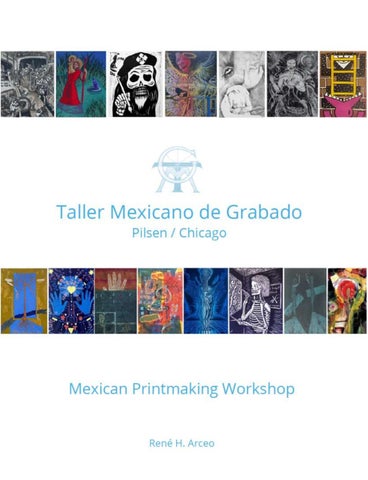
Taller Mexicano de Grabado Pilsen / Chicago
Mexican Printmaking Workshop
Copyright 2025 by Arceo Press. The book co-authors: José Agustin Andreu, John Pitman Weber, René H. Arceo, and all contributing artists, here retains sole copyright to their contributing images to this book. No part of this book may be reproduced in any form or by any electronic or mechanical means without prior permission in writing from Arceo Press. ARCEO PRESS Chicago
ISBN: 9798277997291 7100 W. Dickens Ave., Chicago IL 60707, 773/610-0429 ArceoPress.com/ Publications Catalogue design by Karen M. Gutfreund. @karengutfreundart Edited by Rosanna Mark Andreu 2
This publication is dedicated to the life and contributions of art visionary, Tomas Castro Bringas (1961 – 2015) Cofounder of the Taller Mexicano de Grabado El ángel de la gráfica duranguense (The angel of Durango’s printmaking)
3
c. 1992 | Members Héctor Duarte, Joel Rendón, Elvia Rodríguez-Ochoa and René H. Arceo | TMG workshop 2120 S. Halsted St. | Alfredo Martínez G. Archive
4
Index 7 Taller Mexicano de Grabado (TMG), The Beginnings – René H. Arceo 25 Exhibitions and Visiting Artists – René H. Arceo 48 Art Auctions 53 Activities at the TMG’s Space
61 El canto del papel, 1990 portfolio 75 12 Parallel Lives, 1992-93 Guatemalan Refugee Project 81 Chicago Migrations, 1994 Monumental Woodcut 97 Human Rights, 1994 Portfolio 119 Calaveras del taller, 1995 Project 131 Imaging Aztlan: Printmakers from Chicago’s Mexican Community – José Agustín Andreu
141 José Guerrero: Printmaker, Muralist, Worker (1938-2015) – John Pitman Weber 145 Mapping Territories: The Art of Exile in Pilsen – Chicago – Aline Hèmond, Fabienne de Pierrebourg, and Ingrid Arriaga 154 Four artists at Paris’ Atelier Clot Bramsen – René H. Arceo 163 TMG members photo gallery
José Guerrero, Carlos “Moth” Barrera, & Carlos A. Cortez during an exhibition opening at Casa Michoacán, Pilsen | René H Arceo Archive
6
Taller Mexicano de Grabado The Beginnings
Taller Mexicano de Grabado (TMG) – The Beginnings By René H. Arceo The Mexican Printmaking Workshop originated when a group of local printmakers came together to create a print portfolio featuring a set of poems by the now-acclaimed chef, Dudley Nieto. I had met Dudley through another artist, Nicolás de Jesús, who had exhibited his etchings and drawings at Dudley’s restaurant, El Rebozo, located in Oak Park Village. Dudley had mentioned that he had some poems we could possibly illustrate with prints. Another printmaker, Tomas Bringas, had already floated the idea of publishing a limited edition print portfolio. The idea of using the poems to produce a portfolio of prints emerged in a meeting we had in Pilsen with Gerardo de la Barrera, Tomas Bringas, Nicolás de Jesús, and me. We decided to invite other artists/ printmakers to create additional prints and complete a reasonable set for a portfolio. Nicolás suggested the portfolio’s title El Canto del Papel (The Song of Paper), which included the works of seven artists: Arturo Barrera, Carlos A Cortez, Nicolás de Jesús, Carlos Villanueva, Gerardo de la Barrera, Tomás Bringas, and I. Most printmakers made two prints, Cortez included three vignettes, and Villanueva did TMG early supporters, Bill Goldman and Bob Ward, making plans one. The group of artists had with Carlos A. Cortez | Héctor Duarte Archive no funds to pay for the cost of the paper needed to print the editions. So, we came up with the idea of seeking support from individuals interested in acquiring prints and supporting a handful of local artists’ dreams, in exchange for prints yet to be created. There were eleven early believers and supporters who each contributed $100: William Goldman, Lisa Berman, Judith Burochoff, Elsie Hamayan, Israel Hernández, Bruce and Jan Kreig, Dr. Antonio Martínez, Herbert Moreno, May Zindel de la Concha, Expressions Graphics in Oak Park, and El Rebozo Restaurant. To purchase all the paper for the editions, linoleum and metal plates, and inks, we needed additional funding, so we organized a benefit brunch at El Rebozo Restaurant on December 16, 1990, where we raised $500. Additionally, Rebecca D. Meyers purchased a portfolio for her husband’s birthday. One portfolio was donated to the permanent collection of the Mexican Fine Arts Center Museum (MFACM), now the National Museum of Mexican Art (NMMA), hereafter referred to as the Museum. The group of artists participating in the first portfolio included Arturo Barrera, who was born in Chicago and raised in the Pilsen neighborhood. He had studied art education, painting, and printmaking, and had just graduated from the School of the Art Institute of Chicago, where I had met him. He went on to teach art at Chicago Public Schools and eventually became an Assistant Principal. Arturo has returned to printmaking over the last decade, participating as a member of Expressions Graphics of Oak Park. 8
Nicolás de Jesús had just arrived in Chicago in 1988, and he had been working in Oak Park’s Art Works, now called Expression Graphics workshop, to produce his intricate etchings/aquatints. I met Nicolás through Dudley Nieto, who had brought him over to the Museum. Eventually, I organized and curated a solo exhibition of his prints at the Museum. While he inherited the amate painting tradition from his father, Nicolás had the opportunity to travel to Mexico City, with the recommendation of his godfather, the late artist Felipe Erenberg (1943-2017), to learn intaglio at Artegrafías Limitadas. Nicolás had always done paintings and drawings on amate paper at the same time that he did etchings and aquatints. Carlos Villanueva is an artist from Mexico City living in Little Village. I am not sure where he had learned printmaking, most likely in Mexico City. Carlos did 2007 | Nicolás de Jesús and his daughter installing his solo exhibition at Expressions Graphics | René H. Arceo Archive not get involved with the group beyond his participation in this one portfolio. Soon after that, he went back to Mexico City, where he created public murals. For several years, Gerardo de la Barrera came to Chicago to visit his friend and painter Filemon Santiago. He had studied architecture in Mexico City and had a strong interest in graphic design, as evidenced by the TMG’s logo and letterhead he designed. De la Barrera was exposed to printmaking at multiple printshops in his city of residence, Oaxaca, Mexico. He moved back to Oaxaca permanently, where he established a commercial print shop on behalf of Nancy Mayagoitia, a supporter of local artists and champion of the arts. After several years, Gerardo moved on to creating his own personal printmaking studio from which he taught printmaking, watercolor painting, using only colors produced by combining cochineal with other ingredients like lime juice, Clorox, etc. Additionally, he offered dance lessons to groups of visiting educators. Gerardo continued to participate with the TMG by exhibiting and collecting prints in his area, to support the fundraising print auctions the TMG held annually. By this time, I, René H Arceo, had been working at the Museum for four years, since September of 1986, and had studied printmaking at the School of the Art Institute. I needed a space to create my prints and access to a printing press to pull my editions, so the possibility of a printmaking studio was attractive. I have always been interested in working with collectives and enjoyed creating collaborative projects. In 1984, while still attending art school, I became interested in creating an alternative art gallery, where local artists could exhibit their artwork. The opportunity arose after a couple of conversations with Beto Barrera and Larry Garza, the owners of the progressive commercial printshop InkWorks. Located in the heart of Pilsen, on Bishop Street, just half a block south of the Jumping Bean Café, InkWorks was printing campaign posters for independent and progressive politicians in the city, including Harold Washington, Rudy Lozano, Juan M. Solis, Jesús “Chuy” García, and Danny Davis. 9
Ink Works Gallery c. 1985 | Collective ofrenda created by Sal Vega, José Guerrero, René H Arceo, and other artists | Photo Fugie Almanza The business occupied the whole second floor of the building, but it just so happened that they used only half of the space for the printing machines, the packing area, and some storage space. Printmaker and writer Inara Cedrins (1952-2015) and I approached Beto Barrera about finding a better use for the empty space by creating a community art space that would benefit local artists and the community. After initially rejecting the idea, Beto reconsidered it and endorsed our proposal. A group of artists came together and pitched in painting the walls, hanging lights (photographer Pete Rodríguez), and readying the space for action. Galeria Ink Works became a place to be in and hold an event. The gallery was most active from 1984 to 1987, when it hosted multiple exhibitions with the artworks of TMG members, both collectively and individually. Celebrations of the Day of the Dead, solo and group exhibitions, and many events in support of the people of Central America were organized by refugee solidarity committees based in Chicago. I remained involved with the TMG collective in different capacities until 1996. It was around that time that Eva Solíz and Tony Galigo decided to leave. Eva Solíz had come to study at the School of the Art Institute of Chicago, where she graduated from the master’s program in painting. She stayed in Chicago for several years and eventually moved back to her hometown of Laredo, Texas, where her parents resided. There she taught art for more than two decades at Laredo Community College. She has since retired to continue doing her art and attend to her garden. 10
Benjamín Varela connected with the TMG through Nicolás de Jesús, who met at Expressions Graphics in Oak Park (EG). He was making prints at EG and had to pay to access the studio. According to Benjamín, in a recent conversation we had in 2025, since the space was often unused, Nicolás invited him to visit and use the TMG space. The reality was that most members were busy with fulltime jobs and family responsibilities, leaving little time to work at the TMG space. Benjamín became the spirit of the workshop; he was always there pulling editions, experimenting with viscosity prints, monotypes, and framing his and his colleagues’ prints. He participated in all aspects of the Chicago Migrations monumental woodcut project in 1994, carving the blocks for weeks, and inking and printing with the steamroller in downtown Chicago. The creation of the Human Rights portfolio benefited from his experience with reduction linocut prints. He aided the project’s leader Leopoldo M. Praxedis. He left the Chicago area around 1996 when he permanently moved to Texas. He received his BFA (1999) from Texas A&M and his MFA (2005) from UT Pan Am, which allowed him to teach there until his retirement a few years ago. After purchasing a large etching press, Tony Galigo decided to create his own printshop and had several artists pull their editions there, including Carlos A. Cortez, Joel Rendón, Leopoldo M. Praxedis, Claude Villeneuve, and Mark Ernst. The Taller Gráfica Galigo published several themed portfolios, including Peace, Seven Deadly Sins, and Loteria. Tony worked full-time at his regular job while running his print shop. Within a few years, Galigo decided to stop and donated his etching press. After retiring from his full-time job, he is no longer involved in printmaking ventures. Lately, fascinated by the many possibilities AI applications offer for image generation, he identifies with this creative process. Recently, he was part of a group exhibition in Florence, Italy, including his highly detailed AI images.
Top | Tony Galigo matting at the TMG space |
Middle | Benjamín Varela at the TMG space | Right | Peace portfolio exhibition postcard | Tony Galigo Archive and Edgar López Archive 11
Tomas Castro Bringas (1961-2015) was the driving force behind multiple projects. He was the most recent arrival to Pilsen, hailing from Durango, Mexico. It was his idea to produce the first portfolio during an informal gathering with Gerardo de la Barrera, Nicolás de Jesús, and me. After the successful completion of the El Canto del Papel portfolio, Tomas suggested creating a collective of printmakers in Pilsen. The idea was to establish a space where artists could produce their prints, provide access, and expose other artists interested in learning printmaking. We all loved the idea and agreed to invite other local artists who might be interested in getting involved in this new experiment. Carlos A. Cortez had a friend who was donating a printing press to him and the TMG. So, wanting to stay in Pilsen, we established the TMG at 1803 S. Throop St. One of the members, Gerardo de la Barrera, designed the logo, and by 1991, Sheffield Press had donated printing for the group’s letterhead. Because of issues of insecurity with gangs at that location, the group decided to move, on May 31, 1992, to the 2120 S. Halsted location. Tomas left Chicago not long after the TMG was established. Back in his native city of Durango, he returned to teaching at the local university, to publishing, and to illustrating books. He established a printmakers’ collective there called “Perro Bravo” (Brave Dog), involving some of his students, including Israel Torres, who has followed in his footsteps. While in Durango, Bringas participated in TMG exhibitions and supported the collective by sending his and other printmakers’ works for the TMG annual auctions. Tomas had participated in multiple print portfolios with Arceo Press, including Santitos (popular saints) and the Centennial of the Mexican Revolution. He secured an exhibition space, organized, framed, and exhibited the Centennial portfolio in which he and one of his students participated. Tomas Bringas standing in front of Perro Bravo workshop | A dry point by Tomas | Preparing a copper plate | A dry point by Tomas | Photo El Siglo de Durango 12
Carlos Alfred Cortez (Milwaukee, 1923 – Chicago, 2005) was already in Pilsen when we started the TMG. He had arrived in Chicago in 1965, hailing from Milwaukee, where he had lived until then. I must have met him either through José G. Gonzalez when Cortez was involved with the group, and/ or during community events where he always participated, showing his poster-size prints. Community events in Pilsen included Fiesta del Sol and Casa Aztlan Community Festival, among others. My earliest recollection of meeting him is from around 1985, when the Museum commissioned me to organize a group exhibition of local artists at Galeria Ink Works. When it came time to start working with the TMG collective, specifically with the first print portfolio, El canto del papel (Song of Paper), the group naturally invited Carlos to participate. Carlos happily accepted the invitation and contributed three woodcut vignettes, to this portfolio, subsequently joining the TMG collective. Carlos, along with Benjamín Varela, was one of the two constant pillars of the collective, always physically ready to keep the TMG space doors open. Whenever groups visited or when someone needed to give a tour of the shop, or do a print demonstration, they were there ready to do it. Carlos was an active member of the group and always took on different responsibilities to represent the group in different settings. Likewise, he contributed with ideas that enriched the collective’s goals. He became a fatherly figure for the members because he was the oldest of the group, most experienced, highly ethical, and exemplified exemplary morals and convictions. His prolific graphic production was congruent with his thinking and practice. The life experiences that informed his art included working as a construction worker, factory worker, janitor, journalist, door-todoor record salesman, curator, poet, and printmaker. He was involved with the Industrial Workers of the World’s publication, the Industrial Worker, where he contributed regularly his graphics, poetry, film, and music album reviews for over twenty years. He sought to promote human rights struggles, illustrate Mexican
Carlos A. Cortez printing at the Taller Grafica Galigo in Melrose Park | Tony Galigo Archive
13
cultural traditions, and reflect on his commitment to workers’ rights in the United States. After moving to Chicago in 1965, he became involved with several organizations, including Movimiento Artistico Chicano, Mi Raza Arts Consortium, and the Taller Mexicano de Grabado. He used his poster-size prints to announce exhibitions and cultural events taking place in the barrios. His posters were available in community centers, bookstores, restaurants, libraries, record stores, and other public-accessible places. On one hand, he expressed his concerns about social, economic, and political issues of the day. On the other hand, he wanted to make fine artworks available to people who could not usually afford to buy them, and thus he sold his prints for under twenty-five dollars each. He used inexpensive papers he came across; sometimes he even used wallpaper, because to him the image and the message were the most important parts, not the use of fine printmaking paper for editioning his prints. The Museum of Modern Art in New York purchased several of his prints for its collection and sold them at the same prices he charged at community festivals.
Carlos A. Cortez’s linocuts Top | Las 2 Esperanzas, 1963 | (The 2 hopes) Middle left | 3rd Shift, ND | Middle right | Carcel (Jail), 1961 Left |Economic equity, 1963 Beata & René H. Arceo Collection
Carlos asked me to pull about a dozen prints from each of these small blocks. I did so and in return he signed and gifted me one of each. 14
Nicolás De Jesús (b. 1960, Amelyatepec, Guerrero, México) was born in a Nahuatl-speaking town where he learned his first language. As a child, he watched his father paint elaborate designs on amate paper and clay pots made by his mother. Nicolas is, by experience, self-taught and, by heritage, an artist. During visits to study in the city of Iguala and ventures into Acapulco to sell the family’s paintings, he was exposed to his second language, Spanish. In Acapulco, he experienced the first of many abuses by the authorities as they took away his merchandise by force. While in his late teens, his family moved to Cuernavaca City to distance themselves from these abuses and to seek a better life painting amates and selling other folk art. In 1982, he traveled to Mexico City to study printmaking with Alex Ehrenberg at Artegrafías Limitadas, a print shop in Naucalpan, State of Mexico. There, he contributed to a print portfolio. This experience proved to be a cornerstone in his artistic formation, providing him with a new medium that captured his creative spirit. He found the combination of etchings and aquatints to be a powerful means of eloquently illustrating his messages. In 1988, in search of new markets and art collectors, De Jesus moved to Chicago after a brief stop in San Francisco, CA. In 1990, he became one of the original founders of the Taller Mexicano de Grabado. He moved back to Mexico permanently in 1993. Nicolás continued to support the TMG collective from Mexico, sending prints for exhibitions and contributing to the annual auction. Nicolas has exhibited in France, Japan & Indonesia through the support of the L'Association pour l’Estampe et l’Art populaire. Two books about his art have been published: Nicolás de Jesús: A Mexican Artist for Global Justice, co-published by Purchase College - State University of New York, and Hirmer Publishers. The second book, Nicolás de Jesús: Painter & Printmaker, was published in Germany by Harmut Zantke in Nahuatl, German, English, and Spanish.
Top | Nicolás with Carol Friddle, founder of Expressions Graphics | Left | Nicolas’s 18th Street to Michigan Ave. | Etching and aquatint | Right | Nicolás’ 2022 exhibition catalog | Nicolás de Jesús Archive 15
Héctor Duarte (b. 1952, Caurio, Michoacan, México) was part of the second wave of artists to join the TMG after the initial print portfolio of El canto del papel. He was a co-founder of the Taller Julio Ruelas in Zacatecas, Mexico, which gave him experience working with printmakers’ collectives. His experience working on large-scale murals was instrumental in defining a functional composition for the 200-foot-long woodcut Chicago Migration in 1994 (see page 81). Héctor’s personality and inclusive decision-making process help guide the collective’s vision. Héctor, after several members left the TMG collective, including myself, together with other remaining members, opted to move to the APO (Association Pro-Workers Rights) building and change the name of the group to Taller de Multimedia y Grafica (and later Taller Mestizarte and finally to Casa de Cultura Carlos A. Cortez). Within a handful of years, both Héctor and Elvia Rodriguez had left the group, while Carlos A. Cortez, José Guerrero, and Margaret Guerrero remained involved for a few more years. Héctor has produced prints alongside his easel and mural paintings. That includes monotypes made using the silkscreen process, linoleum, and woodcuts. He often leads demonstrations and conducts workshops using tortillas to create prints as well as Styrofoam plates. He participates in the annual printmaking festival Grabadolandia and, most recently, has ventured into producing large woodcuts, 4x4 feet and 120 x 40 inches, which he handprinted (see images on this page). Héctor studied mural painting in Cuernavaca at the workshop of David Alfaro Siqueiros in 1977. Since moving to Chicago in 1985, he has been involved as the lead muralist or collaborator in the creation of more than 50 murals. Héctor has exhibited his paintings and prints in solo and group shows at venues such as the National Museum of Mexican Art, the School of the Art Institute Betty Rymer Gallery, the State of Illinois Gallery, and Casa Estudio Museo Diego Rivera in Mexico. His awards include a 2008 Artist Fellowship Award from the Illinois Arts Council, 2005 and 2007 Artistic Production Awards from the Secretary of Culture of the state of Michoacán, a 1995 Chicago Bar Association Award for best work of public art, and a 1994 NEA project grant. In 2006, he participated in the Smithsonian Folklife Festival on the National Mall in Washington, D.C., as an invited muralist. Duarte is a co-founder of the La Casa de la Cultura in Zamora, Mexico.
Héctor Duarte working in his studio hand printing a 12 x 4 feet woodcut | Photos by the artist
16
Benjamín P. Varela (b. 1955, Brooklyn, NY) was born to Puerto Rican parents. He lived in Brooklyn and Puerto Rico during his early years. By 1976, he had moved to Madison, Wisconsin, with his older brother, Frank Varela, who was a university professor. That same year, he competed in Greco-Roman wrestling at the Pan American Olympic Games in Mexico City. While in Madison, he attended a technical school (1979-1980), where he studied commercial art and design, printmaking, including reduction linocut process he later used at the TMG. He moved with his brother to Oak Park, IL, where he eventually joined the Oak Park Art League and the group Art Works (now Expressions Graphics). From 1991 to 1992, he attended Triton College in River Grove, IL, where he studied monotype techniques (painting on a plate to be printed). He wrote about that experience: “This was a new medium for me and it opened me to abstract expressionism, the abstract formation and the dynamic composition came about through the very nature of intaglio inks.” He further added, “The ink forces one to see this technique through a cause–and–effect process on the printed paper for many possibilities.” Benjamín was briefly associated with the TMG from 1994 to 1996, and soon after, he moved to Texas, where he continues to reside. He exhibited in Texas, Wisconsin, and Illinois, Chicago, Los Angeles, New York, Puerto Rico, and Mexico. In addition, his work is included in public collections with the Guadalupe Cultural Arts Center, the Romo Collection of Mexican American Art Prints at UT Austin, the Museum of South Texas in Corpus Christi, and the Bronx Museum in New York.
Benjamín Varela’s monotypes City in Red, 1995 | Upward Movement, 1994 | Living Color, 1996 | Notion, 1993 | Photos by the artist 17
René H. Arceo (b. 1959, Cojumatlán, Michoacán, Mexico) was inspired early on by prints I had seen as a child, as illustrations in my elementary school textbooks. Later, I realized the illustrations I had seen were relief prints made by many prominent printmakers from the Taller de Gráfica Popular (TGP). These artists included Alberto Beltrán, Alfredo Zalce, Sarah Jiménez, Leopoldo Méndez, Elizabeth Catlett, and Adolfo Mexiac. Already in Chicago, I founded Galeria Ink Works with Inara Cedrins in 1984. By 1990, inspired by the TGP, I participated in the founding of the Taller Mexicano de Grabado while working for the Mexican Fine Arts Center (National Museum of Mexican Art) from 1986 to 1999 in different capacities. From 2000 to 2007, I worked as Visual Arts Coordinator for Chicago Public Schools’ Central Office. From 2007 to 2020, I was an art instructor at Monroe Elementary School (now Logan Square Elementary). I was
simultaneously making prints and exhibiting. I am committed to creating, sharing, and teaching about prints by producing, exhibiting, curating, touring, and publishing my own prints, as well as those of fellow printmakers. In 2005, I founded Arceo Press to promote international printmaking collaborations and exchanges with printmakers from Mexico, the United States, and sometimes from Canada, France, Spain, Puerto Rico, and Costa Rica. I have published 17 print portfolios thus far. I have exhibited my work individually and collectively in Poland, Mexico, Spain, Canada, France, Italy, Argentina, Nicaragua, and across the USA. Awards include the Chicago Artists Abroad grant to exhibit in and travel to Mexico (1990), the Illinois Arts Council’s Governor’s International Exchange Program to exhibit in Lublin, Poland (2002), and in Paris, France (2006). The Lucerne – Chicago Sister City’s Art Residency in Lucerne, Switzerland (2018). Since 2023, I have been publishing art catalogues through Amazon’s Kindle Desktop Publishing as an alternative option to printing books. I am interested in creating a written record of the art experiences in Pilsen and Chicago’s Mexican artists' communities. In 2024, I published the trilingual (English, French, Spanish) Mapping Territories: Art of Exile in Pilsen – Chicago. Publications and print portfolios can be viewed at his website: www.ArceoPress.com. I am a current member of Consejo Gráfico Nacional and the Chicago Society of Artists. René H. Arceo’s prints | Top | Nuevo mundo: Woman Lead, 2024 | Wood & linocut Middle| Untitled, 2023 | Linocut | Bottom | Constructores de ciudades (City Builders), 2025 | Linocut 18
Mark Ernst (b. 1969, Denver, Colorado), on one lucky day, was visiting La Cocina Restaurant, located near the TMG printshop, when, serendipitously, he met Benjamin Varela. As they realized they were both artists, Benjamín volunteered to show him the shop and give him a tour. After Mark visited the shop, he became so interested that he signed up as a member, and he took monotype classes from Benjamín. Mark was briefly involved with the TMG, producing monotypes and working on graphic design, and at times, for the TMG's needs as well. He has exhibited in Cordoba, Spain; Mexico City, México; Montreal, Canada; Chicago, Illinois; Atlanta, Georgia; and Tucson, Arizona. He stated that “my work is an exploration of connections, a source of healing, and a vision for us to recall an ancient wisdom deep within.” He has now lived in Columbus, Ohio, for several years.
Mark Ernst’s monotypes Entrance to the door | 1996 | Walking in yellow | 1997 | Rising | 1997 | Her colored essence | 1997 | Photos by the artist
19
Jesús Acuña (b. Jerez, Zacatecas, Mexico) was briefly involved with TMG, especially early on, participating with a reduction print for the Human Rights portfolio. He has always been interested in further exploring the realm of painting, drawing, and sculpture, sometimes including mural painting. He studied art at the San Carlos Academy of the National Autonomous University of Mexico, the School of the Art Institute of Chicago, and Lill Street Gallery in Chicago. Jesús’s murals can be seen in several Chicago schools and parks, while his paintings found their way into private collections and have been exhibited in both the United States and Mexico. Jesús trained in sculpture and ceramics at Lill Street Gallery in Chicago, and his artwork now integrates organic shapes with architectural volumes. He explores two main themes through different media in his work: issues of migration and his concern for the environment. Acuña’s desire to connect with people in the spaces they travel through led him to public art. “Public art is always awaiting its audience,” he says. Above | Jesús Acuña | Los 3 sombreros (The 3 hats), 2023 Serigraph | From the portfolio Carlos A. Cortez Centennial, Arceo Press Right | Jesús Acuña | De todos los fuegos el fuego, (From all fires, the fire) 1994 | Linocut
Arturo Barrera (b. 1962, Chicago, Illinois) is a printmaker and painter who received his Bachelor of Arts Education from the School of the Art Institute of Chicago in 1986 and, as a recipient of the R. Smith scholarship, received his Master of Arts degree in painting and printmaking from Northern Illinois University in 1997. He recently retired from the Chicago Public Schools after more than three decades as an administrator and an art instructor. He has continued to produce etchings, screenprints, and linocuts, as well as public murals. Arturo has exhibited in the Chicago area and abroad. He is currently a member of Expressions Graphics in Oak Park, IL.
Arturo Barrera | Scaping death | 2008 | Linocut | From the portfolio Dia de los Muertos: Comon Ground, Arceo Press 20
Gerardo De la Barrera Escamilla (b. 1954, Mexico City, Mexico) has lived in Oaxaca City since 1967. Gerardo received his bachelor’s in architecture from the Universidad Regional del Sureste de Oaxaca, where he also studied fine arts. He is a founding member of the Taller de Artes Plásticas Rufino Tamayo (1974-1980) and a founding member of the Taller Mexicano de Grabado in Chicago (1990). In 1993, he presented the exhibition Gerardo de la Barrera Obra Reciente: Paisaje mixteco at the then Mexican Fine Arts Center. While in Chicago, he also exhibited at the School of the Art Institute’s Betty Rymer Gallery, Artworks of Oak Park, and the South Shore Cultural Center. Nationally, he showed at the Richmond Art Center in Richmond, CA; Missoula Art Museum, MT; Center for Book Arts, NY; Artists Space Gallery, NY; and Janalyn Hanson White Gallery (Cedar Rapids, IA). In Mexico he has shown at Galeria Arte de Oaxaca, Galeria Mano Magica, Alianza Francesa de Oaxaca, Galeria Rodolfo Morales, Galeria del Estado (Xalapa, Ver.), Instituto de Estudios Superiores (Monterrey, NL), Centro de Arte Moderno de Guadalajara (Jal.), and Centro Cultural Antiguo Colegio Jesuita (Patzcuaro, Mich.).
Gerardo de la Barrera | Agudizo los sentidos (I sharpen my senses) | 2005| Etching | From the portfolio Mnemonic: To aid the memory, Arceo Press
Guillermo Delgado (b. Chicago, Illinois) is a self-taught visual artist who has spent over 35 years creating art and engaging communities in projects based on arts-infused learning and empowerment through creative expression. His life as an artist emerged from personal experiences growing up in Chicago’s Little Village neighborhood and spending summers in Mexico. His art is inspired by nature, daydreams, the spirit world, literature, music, indigenous art, and graphic design. Negotiating multiple cultural crossings has informed his art, both internally focused and externally dedicated. He was involved with TMG in their early years and participated in the Human Rights portfolio published by TMG in 1994. His paintings, monoprints, and mixed-media installations have been exhibited nationally, including the National Museum of Mexican Art, Museum of Science and Industry, The Heard Museum in Phoenix, Mexican Museum in San Francisco, Minneapolis Institute of Arts, The School of the Art Institute’s Betty Rymer Gallery, Chicago History Museum, Noyes Cultural Arts Center, Garrett Evangelical School of Northwestern University, Elmhurst College, Oak Park Public Library, Columbia College in Chicago, and Michigan State University. In 2013, he earned a Master of Fine Arts in Interdisciplinary Arts from Goddard College. He went on to become an Academic Specialist in Community & Socially Engaged Arts at the Residential College in the Arts and Humanities at Michigan State University - teaching creativity, contemplative practices, and community engagement. In 2014, Guillermo began facilitating art, yoga, and poetry events in Michigan prisons, including the juvenile detention center in Lansing, MI.
“I am not saying art will save you, but as humans, we need hope to survive and thrive. Art is hope. And hope allows us to imagine something better for ourselves and the world.”
21
Tony Galigo (b. 1953, Oak Park, Illinois), after meeting Rene Arceo in Oak Park in the early 1990s, was invited to participate in the Human Rights portfolio (1994). Tony was an active member of the TMG until about 1996, when he bought his own etching press and set up his print studio at home. As Taller Grafica Galigo (TGG), he invited printmakers from Mexico and Canada to work and reside for 2-week periods. With those guest artists, he created the Peace, Seven Deadly Sins, and the Loteria portfolios in addition to producing a series of aquatints of his own. In 1999, Tony had two printmaker friends teach him new techniques: Gerado de la Barrera taught him etching, and Tomas Bringas taught him sugar lift. Tony worked with Carlos A. Cortez to pull his prints at the TGG. In addition to the visiting artists, other Pilsen artists worked at the TGG space and participated in the group exhibitions Tony organized. He has been creating digital art since June 2022 and has participated in exhibitions across the USA and Europe. Tony lives and creates in Melrose Park, Illinois.
Tony Galigo’s reduction linocuts La luz de amor | 1994 | La Pieta | 1995 | Photos Tony Gaigo Archive
Edgar López (b. Guatemala City, Guatemala) is part of the second generation of artists who joined the TMG collective after the publication of the portfolio El canto del papel. He was born right in the middle of the only democratic spring his country experienced, from 1944 to 1954. In 1975, he enrolled at the National School of Fine Arts, where he studied painting, drawing, and printmaking. He was a member of the artistic group Dimensión. Edgar exhibited at the American Institute, the Comptroller's Office, Inguat, La Cúpula, the Paiz Art Biennials, the First Watercolor Salon, and the Mini Print International in Cadaqués, Spain. In 1990, for reasons beyond his control, he was forced to leave his homeland and settle in Chicago. There, he came in contact with Mexican artists joining the Mexican Printmaking Workshop. Edgar participated in exhibitions at Truman College, Fiesta del Sol, Daley Center, Prospectus Gallery, South Shore, RC Gallery, and in the creation and design of the monumental woodcut Chicago Migrations. 22
Alfredo Martínez’s drypoints | Yugo (yoke) | Conquista infinita (infinite conquest) | Torture Alfredo Martínez Galván (b. Venado, San Luis Potosí, México) joined the TMG collective soon after the completion of the portfolio El canto del papel. He has called Chicago home since 1965. During the 1970s, he joined a group of artists at the Old Triangle Art Association for figure drawing sessions. He attended the American Academy of Art for part-time classes and later enrolled at the School of the Art Institute of Chicago, where he received his BFA degree in 1987. Alfredo exhibits in the Chicago area, regionally and nationally. He was a member of the Taller Mexicano de Grabado, La Grange Art League, and Colored Pencil Society of America. Eufemio Pulido (b. La Piedad, Michoacán, Mexico) moved to Chicago in 1974, where he attended the School of the Art Institute of Chicago, taking classes about the study of the human figure. He was an active member of the Taller Mexicano de Grabado, where he learned the linoleum cutting technique. He has exhibited in dozens of group exhibitions in the United States and Mexico. Exhibitions include Galería Arte de México, the Mexican Institute of Culture and Education in Chicago, Betty Rymer Gallery, the Field Museum, and Hope College in Michigan. He has presented half a dozen solo exhibitions, including at Prospectus Art Gallery and Jumping Bean Café in Chicago.
Left | Eufemio Pulido | La noche del nahual (Night of the nahual) | 2007 | Linocut | From the portfolio Bestiary & Nahuals, Arceo Press Right | Eufemio Pulido | Entre dos mundos (Between two worlds) | 2003 | Linocut | From the portfolio Bajo un mismo cielo (under the same sky), FEDECMI & Arceo Press 23
Elvia Rodríguez Ochoa (b. Mexico) is an interdisciplinary artist living and working in Chicago. For 30 years, they have participated in a variety of actions and exhibitions to remind us that the arts are vital to everyday life. Their print work has been exhibited in Canada, Mexico, Australia, and Spain. María Evangelina Solíz (b. 1965, Laredo, Texas) joined the TMG collective soon after the completion of the portfolio El canto del papel. She studied art at The University of Texas at Austin, where she received a BFA in studio art with an emphasis in painting, ceramics, and intaglio printmaking. During the summer of 1989, Eva attended Skowhegan School of Painting and Sculpture, an artist residency program in Skowhegan, Maine.
Chicago later became her home, where she attained an MFA in painting from The School of the Art Institute of Chicago. Her work has been exhibited in Texas, Chicago, and Mexico. Currently, she resides in her hometown of Laredo, Texas, where she has been employed by Laredo Community College as an art instructor since 1999, from where she recently retired. Eva continues to create and exhibit her art. Eva Solíz | Game piece portrait of Saint Christopher | 2011 | Serigraph | From the portfolio Santitos, Arceo Press Mirtes Zwierzynski (b. Brazil) is a visual artist, muralist, and teaching artist. She was briefly involved with the TMG and has maintained contact with and/or collaborated with several TMG printmakers over the decades. She was born in Brazil and has lived in Chicago since 1980. Her studio work has been exhibited throughout Chicago, and in national and international venues. Mirtes left Brazil for Paris as a political refugee, and her artwork reflects her lifelong concern with social justice and political discourse at both the public and private levels. She firmly believes that art has the capacity to challenge conventions and the status quo. She has worked as an arts educator with numerous arts organizations and produced over 70 mosaic and painted murals throughout Chicago and suburban schools. Mirtes Zwierzynski | Absent / Present | 2023 | Linocut | From the portfolio Carlos A. Cortez Centennial, Arceo Press 24
Exhibitions & Visiting Artists
Exhibitions Some of the group’s early exhibitions included one at Art Works in Oak Park (1990). This group later changed its name to Expressions Graphics, and like TMG, they focused on the production, education, and promotion of printmaking. Several TMG members were involved with Expression Graphics and/or were member of it, including Nicolas de Jesus, Benjamin Varela, and me. For the annual Fiesta del Sol (1991), the Pilsen Neighbors Community Council provided us with four stands to display, sell, and promote printmaking to visitors. At the time, it was something new for an audience expecting only freebies from all festival participants, so they were not ready for that. The company Ameritech in Leslie, IL (1991) was interested in exposing its staff to locally produced printmaking. A selection of prints by all its members was presented there.
Top | 1992 La Casa Cultural Latina flyer of TMG exhibition at the Natural History Museum in Urbana, IL | Image in the flyer is by Luis Montenegro | René H Arceo Archive Bottom | TMG exhibition in Tlaxcala, Mexico | Image detail in the invitation is by Nicolás de Jesús | René H Arceo Archive
Chicago’s Daley Civic Center (1992) invited us to exhibit larger pieces, including paintings. There, the challenge was how to hang artworks on a solid stone wall. I believe the artworks were set on easels 26
brought over by the Department of Cultural Affairs. During the run of that exhibition, we received an invitation to meet at the site because a famous actor was visiting Chicago and city officials were taking her to see the exhibition. It turned out to be the famous Loretta Swit (1937-2025), who played the role of Head Nurse in the historic television series MASH. Pictures were taken with the artists and Ms. Swit. Other spaces in the area included Truman College (1991), the South Shore Cultural Center (1992), and Oak Park Library (1993). The Oak Park Area Arts Council staff supported our print exhibitions throughout various locations in the village. They were interested in diverse artworks from different ethnic groups. The library was the site where we were invited to exhibit multiple times in subsequent years.
1992, announcement for the annual Dia de los Muertos exhibition | Image in the invitation is by Nicolás de Jesús | The event coincided with the visit of the theater group Zopilote to Chicago. Zopilote performed one of their skits during the opening | René H Arceo Archive
27
TMG members donated fiftysix prints to the Museo Nacional de la Estampa and the Museo Carrillo Gil, both in Mexico City. In 1993, the TMG presented the exhibition 12 Parallel Lives, which included a series of prints created by TMG members. For this project, the testimonies of Guatemalan survivors of torture inspired artists to express their own solidarity through these prints. See pages 75-80. The same year, the group exhibited at the Suburban Fine Arts, and TMG member Elvia Rodríguez Ochoa had her solo exhibition at the TMG space. The group exhibited as part of the annual Dia de los Muertos exhibition, Calaveras del Taller at the TMG space. Outside the TMG space, artist members participated in numerous exhibitions in the city, regionally, nationally, and at times abroad. In 1993, the exhibition Taller Mexicano de Grabado Printmakers took place at the University of Wisconsin Union Art Gallery in Milwaukee, WI.
Left & top | 1993 Invitation announcement for Benjamín Varela’s solo exhibition Recent Works: Monotypes and Linocuts | Alfredo Martínez G. Archive
28
Early in 1993, someone visited the TMG to talk about the legal situation of a young Mexican artist who was unjustly imprisoned. The group felt the cause and call for justice merit the collective’s support by exhibiting Salazar’s artworks. The exhibition was touring to different art spaces to raise awareness of this artist’s situation | René H Arceo Archive In 1994, Columbia College Chicago hosted two exhibitions: Taller de Gráfica Mexicano and Latino Graphics. Annually, the TMG organized a Members Anniversary show and an annual Day of the Dead exhibition. TMG gallery presented the exhibition Gráfica Oaxaqueña II (Oaxacan Prints II), which included primarily prints by artists from Oaxaca, México. Exhibitors included Modesto Bernardo, Enrique Flores, Eddie Martínez, Leovigildo Martínez, Filemón Santiago, and Fernando Olivera.
1994 Invitation announcement for the Taller de Grafica Mexicano exhibition at the 10th Floor Gallery of Columbia College Chicago | René H Arceo Archive 29
1994 Invitation announcement for Gráfica Oaxaqueña II. The exhibition included prints by seven Oaxaca artists and five other guest artists | The TMG members had a good relationship with printmakers in Oaxaca who have continually donated their prints for TMG auctions. In return, the TMG organized exhibitions of those artists in the TMG space | René H Arceo Archive
30
1994 was a particularly busy year with exhibitions like ! Zapata Vive! Taller de Gráfica Popular, Mexico City. TMG member, Leopoldo Praxedis helped with borrowing this TGP exhibition. He had been a member of the TGP collective in earlier years. And as such, he had a good relationship with Jesús Álvarez Amaya, the current director of the TGP, secured the loan of this exhibition. The exhibition included works by twenty-two TGP members, including Alberto Beltrán, Mariana Yampolski, José Castro Pacheco, Sarah Jiménez, Alfredo Zalce, Leopoldo Méndez, Francisco Mora, Ángel Bracho, Pablo O’Higgins, Jesús Escobedo, and Leopoldo M. Praxedis, among others. In 1994, a solo exhibition of Leopoldo M. Praxedis was held, showcasing his elaborate, detailed linocut prints and several collages. Leopoldo had made multiple trips to Montreal and had started a print collective there together with artist Claude Amiee Villeneuve. An exhibition of prints by the Montreal Artists group was shown at the TMG Gallery.
1994 Invitation announcement for the exhibition !Zapata Vive! Taller de Gráfica Popular, Mexico City. | René H Arceo Archive
31
In Memoriam: Héctor Gómez included twelve TMG members paying homage to this young artist who suddenly passed away. He was the brother of painter/ muralist Dulce Pulido, whom I had met while she was studying painting with muralist Marcos Raya at Casa Aztlan in the 1980s. Héctor was briefly associated with the TMG, participating in the Human Rights portfolio, see pages 97-117.
Right & right bottom 1995 Exhibition announcement for Héctor Gómez René H Arceo Archive
Top | 1994 | Exhibition postcard invitation with Carlos A. Cortez woodcut image | Notice the name of La Cocina Restaurant, which often donated food for the TMG receptions | Dudley Nieto Archive 32
Early on, our new friends, Linda M. García and José “Chato” García visited the TMG space on Halsted Street. By 1994 they had taken, TMG members prints, and organized a group exhibition in their home town of Omaha, Nebraska. In 2025 they continue to organize events and support their local artists | René H Arceo Archive
The exhibition Printmakers from the Taller Mexicano de Grabado was shown in 1994 at the Randall Shapiro Gallery in Oak Park, IL. The same year, the Suburban Fine Arts Gallery from Highland Park, IL., organized a Dia de los Muertos exhibition with TMG members. Members participated in the exhibition Latino Art, organized at the South Suburban College of Art Gallery in Holland, IL, and Expresiones Latinas at the Columbia College’s Art Department Gallery in Chicago. The year 1995 welcomed several solo and group exhibitions at the TMG Gallery space. The Carlos Cortez solo exhibition featured large and smaller woodcuts and linocuts. Carlos joined the collective
33
with his participation in the first print portfolio, from1990 (Song of Paper). Carlos and Benjamín Varela were the two members we could always count on being at the TMG space: to meet visitors, give tours, and lead print demonstrations. The rest of us were busy holding full-time jobs. All members looked up to Carlos as the most senior and experienced member of the group. He was always an exemplary individual in matters of morals, justice, and following through on his commitments, a revered role model. A two-person exhibition was hosted featuring two local Brazilian artists: Mirtes Zwierzynski, an educator and muralist, and Marcelo Limas, an educator and writer. Both Mirtes and Marcelo were involved with the collective for a short time. Following was Edgar López's solo show, including prints and watercolors. And, René H. Arceo's solo show, including recent linocut and woodcut prints.
34
In 1995, the set of prints 12 Parallel Lives was exhibited at the University of Chicago during the Human Rights Colloquium. In November of this year, I was invited to curate a Dia de los Muertos exhibition at the Oak Park Art League, which included TMG members. 1996 TMG members Tony Galigo and René H. Arceo presented the exhibition El Corazón al Grabado (the heart to the print) at the Oak Park Area Arts Council Gallery, Oak Park, IL. Mi Casa Su Casa Mexican restaurant, on the north side of Chicago, expressed interest in TMG members’ art and invited us to participate in the Tequila Show and a Day of the Dead exhibition. In 1997, three TMG members exhibited under the title Carriers of Light: Arceo, Cortez & Galigo at Expressions Graphics. TMG members participated in the Peace portfolio published by Taller de Grafica Galigo. This portfolio was exhibited at Galerie du Conseil Québécois de l’estampe in Toronto, Canada. The portfolio was also shown at the Peace Museum, the Jumping Bean Café, DePaul University’s Cultural Center, and Galeria Sin Fronteras in Austin, TX. In 1998, the portfolio, which included TMG members, La Loteria, published by Taller de Grafica Galigo, was exhibited at Casa de los Tres Mundos in Granada, Nicaragua.
1996 exhibition opening at Mi Casa Su Casa Mexican Restaurant, located at 2524 N. Southport Ave, Chicago. Top | René H. Arceo and Carlos A. Cortez Middle | Poet Susana Sandoval, Tony Galigo, & his mother Lower middle | René H. Arceo and Guillermo Delgado Bottom | Carlos A. Cortez reciting his poetry. Photos Tony Galigo Archive
35
1997 | Contact was made with Gilberto Cárdenas through Leopoldo M. Praxedis, to show the TMG’s two portfolios at Galeria Sin Fronteras in Austin, TX. Gilberto was the owner and director of the gallery | Tony Galigo Archive
36
1995 | Carmen and Pilar Bordes, from Guadalajara, Mexico, brought an exhibition of their etchings to the TMG space. This exhibition, was part of multiple site collaboration the sisters did. It included an art residency at the School of the Art Institute with professor Doug Houston, exhibition at TMG, and other venues in the states of Illinois. The MFACM supported the collaboration | Héctor Duarte Archive
Right | A meeting of artists in front of Nava’s woodcut | Standing: Alejandro Nava, unknown, Robert Valadez, Jesús Acuña, Filemon Santiago. Seated: Fred Arroyo, and Héctor Duarte Bottom | Artists: Edgar López, John P. Weber, José Guerrero, Margaret Guerrero, Héctor Duarte, and Luis Montenegro Héctor Duarte Archive
37
2006 | Benjamín Varela co-curated this exhibition, focusing on TMG members from 1990 to 1997, at The Narciso Martínez Cultural Center in San Benito, TX. Benjamín had been living in Texas for about a decade, and had developed contact with different cultural organizations, including this Center | René H. Arceo Archive
38
2009 | Exhibition of Latino/a printmakers at Casa Michoacan gallery | Included in the photo are (standing) John P. Weber, Roberto Ferreyra, Francisco G. Mendoza, Montserrat Alsina, José Andreu, Dolores Mercado, René Arceo, Rosanna Andreu, Mark Nelson, Efren Beltran. (Front) Gabriel Villa, Héctor Duarte, and Juan Chawuk | René Arceo Archive 39
Promotional brochure | The TMG published several brochures to attract supporters, print collectors, students, and potential members | This brochure includes a print example by Joel Rendon | René Arceo Archive
40
Promotional brochure | The TMG published several brochures to attract supporters, print collectors, students, and potential members | This brochure includes examples prints by René Arceo, Edgar Lopez, and Joel Rendon | René Arceo Archive
41
Visiting Artists The visiting artists’ program at the TMG was not pre-planned. It was not a formal program, established with a structure and purpose; it instead happened organically. The TMG had several visiting artists in the 1990s, including Leopoldo Morales Praxedis. He had been in Chicago a few years before, and had exhibited at the Mexican Fine Arts Center in the early 1990s. Whenever he came into town, he contributed to the TMG collective in various ways: donating artwork, providing instruction, offering exhibition ideas, and implementing print projects. In 1994, he led the TMG collective in creating the second print portfolio Derechos Humanos (Human Rights), dedicated to the cry for justice following the uprising of the EZLN (Ejército Zapatista de Liberación Nacional) in Chiapas, Mexico. For this portfolio, Praxedis taught many of the active members, including me, how to do large multicolor reduction linocuts. Praxedis brought with him the experience of having been a member of the Taller de Gráfica Popular in Mexico City, and for decades, he had been involved in multiple print collectives in Tlaxcala, Mexico; Granada, Nicaragua; Montreal, Canada; and Cordoba, Spain. In 2015, Praxedis and I worked to organize a traveling exhibition titled La Hermana Muerte/The Sister Death, including the prints of Francisco Plancarte, Praxedis, and my own. He participated in multiple print portfolios published by Arceo Press over the years. Praxedis continues to organize print-centered projects and travel between Mexico City, Mexico; Managua, Nicaragua; Montreal, Canada; and Chicago. Leopoldo M. Praxedis (b. 1953 in Apizaco, Tlaxcala, Mexico) was an active member of the Taller de Gráfica Popular (Popular Graphics Workshop) from 1974 to 1981. In addition to his artistic work, Leopoldo also dedicated himself to teaching in the creative field, being a part of the Artistic Education Top | Leopoldo M. Praxedis & Tony Galigo | Photo Tony Galigo archive | Bottom | 2015 | Leopoldo M. Praxedis and Elvia Rodríguez Ochoa during the opening of the exhibition Sister Death: Arceo, Praxedis, Plancarte at Casa Michoacán, Pilsen | Photo René H. Arceo Archive 42
Section of the National Institute of Fine Arts (INBA). In 1989, this institution awarded him the Lifetime Fellow for his artistic work, highlighting his commitment and contributions to the world of art and allowing him to be free of teaching responsibilities. He was compensated solely for creating and exhibiting new work each year. He engages this through an international cultural exchange network that he has established on his own initiative. His works are in the collection of the National Institute of Fine Arts (INBA), the National Museum of Mexican Art in Chicago, the Mexic-Arte Museum of Austin, the Institute of Tlaxcala Culture, and the Autonomous University of Tlaxcala, and some universities in the United States, among others. In 1991, I curated the solo exhibition Leopoldo Morales Praxedis: Prints and Mixed Media Works at the National Museum of Mexican Art. In 1994, Leopoldo cofounded the art collective Grupo de Vagoni in Granada, Nicaragua. The collective's efforts to promote Mexican printmaking attracted international printmakers. Leopoldo also participated in cultural exchange projects, such as “Chuee-Taxua,” which fostered collaboration between the Amuzga community and visual and textile artists from Mexico, Canada, the United States, and Spain.
Above | Leopoldo M. Praxedis | Coyoxauqui | 1979 | Linocut Right | Leopoldo M Praxedis holding his Chimalli print collage he created in 1994 while visiting the TMG | Photo Jesus Aguilar
43
Above | 1992 | Joel Rendón printing at the TMG space | Left | 1994 | Five prints Joel Rendón created for the portfolio La exhumación de Babel (The Exhumation of Babel) | Photos by artist Another visiting artist, Joel Rendón, was in the city in 1992 when he came across the TMG. He first made prints at the collective’s space, experiencing carving and printing linoleum blocks. As he traveled around the city on buses, he sketched his ideas directly onto blocks of linoleum, which he later carved. Joel received a Mexican Cultural Ambassador residency in 1994 to travel and work in New York City. He produced a print portfolio named La Exhumación de Babel (The Exhumation of Babel), which emphasized how cultural diversity shapes communities in the United States. After his time in New York, Joel returned to Chicago to present the portfolio and to work with the National Museum of Mexican Art’s Yollocalli Youth Museum. There, he published a student’s print portfolio. Upon his return to Mexico City, he secured several print commissions, including a portfolio of linocuts for Artes de Mexico, about the tequila-making process. Other commissions followed, including book covers, collaborations with writer and editor Alberto Ruy Sánchez, and a twenty-year-long TV run of Estampa al minuto (Prints in one minute). In a 2025 email I received from Joel, he explains how important his visit to Pilsen/Chicago was for him: “I hold that stage of my life in such high regard that I consider my experience in Chicago to be an “artistic epiphany,” since it was there that I discovered, as a young man, what my art as a Mexican had to be. This is within a historical continuity with what the Mexican school of art was, reiterating and affirming my identity to then share it in my subsequent work.” 44
He continued, “The Pilsen neighborhood is the cell of cultural leadership that Rockefeller pursued to the point of extermination during the Cold War causing generational confusion in art schools across Latin America during the 20th century. I suffered it, trying to separate youth from their Mexican heritage in exchange for a purely absurd art with a spiritual purpose. That art lacked social or political meaning and did not question capitalist savagery. It imposed and programmed the progress of their art. I stick with the organic nature of art, and I reason about it every time I make one of my pieces.” Joel Rendón (b. Puebla, Mexico) studied in different educational institutions prior to his enrollment in the UNAM’s Academia de San Carlos, where he received his BFA from the Escuela Nacional de Pintura, Escultura y Grabado “La Esmerlda.” Joel’s interest was in the art of Mexico itself, particularly that of Mesoamerica, for which he didn’t find academic support to address it. He migrated to Chicago, where he found an artistic community focused on Mexican art and from which he learned. His work has been exhibited in Mexico’s galleries as well as in Argentina, Colombia, Cuba, Spain, the United States, Puerto Rico, and India, among others. In 2002, Joel linked his daily artistic work to television broadcasting by creating one-minute capsules in Mexico City’s Channel 11. He showed how to create a homemade print in one minute. Joel has, for the last few years, been teaching at the Centro Cultural Los Pinos, located at the Mexican version of the “White House.”
Two other artists visiting the TMG, to pull prints and exhibit were: Top | Nacho Alfonso, a friend of Leopoldo Praxedis, hailed from Mexico City. Below | Alfonso López Moreal (b. 1953 Zacatecas, Mexico) while living in Belfast, Northern Ireland, came to visit Héctor Duarte in Chicago. He exhibited at TMG and gave a workshop for TMG members.
45
Gilberto Aceves Navarro (1931-2019) In 1992, the Mexican Fine Arts Center presented the exhibition Four Decades After the Muralists, which included works by Aceves. Maestro Aceves came to Chicago during the exhibition's run. While in Chicago, we extended him an invitation to visit the TMG space, which he gladly accepted. During his visit to the TMG, he created a quick drypoint print on plexiglass. In these photographs, we see him posing with TMG members and testing the plexiglass plate. He signed the fifty-print edition in advance. Top | Aceves posing with TMG members René Arceo, Nicolás de Jesús, Héctor Duarte, Rita Marquez, Carlos Cortez, Joel Rendón, and Alfredo Martinez G. Middle | Maestro Aceves with Edgar Lopez, Nicolás, and René. Bottom | Nicolás test printing Bottom right | René, maestro Aceves, and Joel.
Photos Héctor Duarte Archive
46
Right | 1992 | Maestro Gilberto Aceves Navarro creating an image on a plexiglass plate at the TMG. He donated the whole edition and, within the image, he included a dedication: para el taller mexicano de grabado en Chicago. There was a personal connection to the TMG, member, Joel Rendón, had been his student in Mexico City. Below | The finished, editioned drypoint print | Collection of, and photo by Alfredo Martínez G. Archive
47
Art Auctions The TMG's annual print auctions became essential to its survival, quickly establishing themselves as the group's primary source of income. These auctions generated revenue to cover major expenses, including rent and heating for the workshop. Hosted in a variety of spaces—including El Rebozo Restaurant, the Wild Onion Restaurant, Aldo Castillo Art Gallery, Decima Musa Restaurant, and the home of supporter and collector Bob Ward—the locations were secured through members' networks. Venues offered space either to attract new audiences, to support a not-for-profit artists' group, or out of personal commitment to the arts. All members of the collective were involved in gathering donations from other printmakers and groups. Each year, we collected donated prints in advance from printmakers we knew in Chicago, the surrounding suburbs, across the country, and from various locations in Mexico. Some members moved back to their hometowns. For example, Tomas Bringas returned to Durango City, Gerardo de la Barrera to Oaxaca City, and Nicolas de Jesus to Cuernavaca City. Each of them became responsible for gathering donations in their area, collecting prints, and mailing them to Chicago before the auction. Each auction became a significant project. We prepared a detailed list of all the donated prints, label information, and a bidders’ list with assigned numbers. Most of the prints were sold at prices far below their actual market value. For promotional materials such as posters and postcards, the group collectively selected an image created by one of the members to reproduce.
Top | TMG’s 6th anniversary auction reservation card. Auction took place at Dudley Nieto’s Chapulin Restaurant | Dudley Nieto Archive Below | TMG business card with the names of 12 members. Right | Nicolás de Jesús, and Dudley Nieto at his restaurant, El Rebozo, where the TMG held multiple events, including fundraisers and exhibitions | Dudley Nieto Archive. 48
Bottom | Art auction benefit in 1991 at the Wild Onion Restaurant | Photo René H. Arceo Archive 49
Mark Rogovin (1946-2019) was a true friend of the arts. He was an accomplished muralist, known for collaborating on the mural "The March of Humanity" alongside David Alfaro Siqueiros. Mark cofounded the Chicago Public Art Group, founded the Peace Museum, and authored the mural manual How to Paint Murals. He was also a print supporter and collected prints by members of the Taller de Grafica Popular in Mexico City. Mark contributed to the TMG fundraising efforts by giving lectures about Mexican Muralists, including this one at the MFACM. | Postcard image by Carlos A. Cortez | René Arceo Archive 50
Right | 1990 | TMG statement requesting support for the first print portfolio | Alfredo Martínez G. Archive. Below | El Rebozo, Dudley Nieto’s restaurant, was the site of multiple TMG events | In the photo, Israel Hernandez, Judith Burochoff, and Silvia (Alejandro Nava’s wife) appear standing. Food historian Dr. Bruce Kraig walks in from the background | Dudley Nieto Archive.
51
Top | 1992 Art Auction announcement listing participating artists | Notice the live musical performance by Pablo Helguera and Ernesto Vazquez | René H Arceo Archive. Left | Cover for the 1992 Art Auction announcement Showing Joel Rendon print | René H Arceo Archive
52
Activities at the TMG Space
While living in Northern Ireland Alfonso Lopez Monreal, came to visit Chicago. During his visit, an exhibition of his intaglio prints was organized at the TMG. Along with his exhibition, Alfonso gave a talk about his prints, and a demonstration of his process | Hector Duarte Archive
54
Top | Leopoldo M. Praxedis working to finalize the design and carving of the linocut print Gráfica Popular en Chicago (Popular Graphics in Chicago) at the TMG space. Bottom | René H. Arceo printing the Gráfica Popular en Chicago print edition | Alfredo Martínez G. Archive 55
1993 | Leopoldo M. Praxedis spent several weeks working on the design and carving of this linocut | He donated the edition of this print to the TMG as a gesture of solidarity and as a source of income to benefit the collective | Photo & collection of Alfredo Martinez G.
56
Monoprint demonstration led by Héctor Duarte and José Guerrero at the TMG space | Alfredo Martínez G. Archive
57
Top | Benjamín P. Varela matting his prints | Alfredo Martínez G. Archive Right | 1995 | Benjamín Varela, Royal Palm | woodcut produced at TMG | Benjamín Varela Archive Left | Alfredo Martínez G. working on a screen print monotype while observed by Edgar López | Héctor Duarte Archive.
58
Carlos Cortez and René H. Arceo printing Cortez’s linocut, Viva la Huelga! in the TMG space | Alfredo Martínez G. Archive
59
Top | Alfredo Martínez G., Benjamín Varela, and Joel Rendon socializing at the TMG | Alfredo Martínez G. Archive Middle | Event at the TMG space with Edgar López, Carlos A. Cortez and others in the audience | Héctor Duarte Archive. Bottom | Carlos A. Cortez reciting his poetry at a the TMG event while Chilean poet Lito Barraza, in blue pants, listens | Tony Galigo Archive
60
El
Canto del Papel 1990 Portfolio
62
Arturo Barrera | Untitled | 1990 | Etching & aquatint
63
Tomas Bringas | Lágrimas entre sollozos, (Tears between sobs) | 1990 | Drypoint
64
Tomas Bringas | Homus Rarus | Etching & aquatint
65
Carlos A. Cortez | Untitled | Linocut
66
Carlos Villanueva | Untitled (Female’s torso) | Etching & aquatint
67
René H. Arceo | Untitled (Couple kissing) | Reduction linocut
68
René H. Arceo | Untitled (Standing woman) | Linocut
69
Gerardo de la Barrera | Crepúsculo I (Twightlight I) | Etching & aquatint
70
Gerardo de la Barrera | Crepúsculo II (Twightlight II) | Etching & aquatint
71
Nicolás de Jesús (b.1960, Ameyaltepec, Guerrero), Crucifixión (Crucifixion [from The Song of Paper portfolio]), 1990, etching and aquatint 17/100, 11 3/8” x 15 1/8” (paper size), National Museum of Mexican Art Permanent Collection, 1991.1 F, Gift of the Taller Mexicano de Grabado
72
Nicolás de Jesús (b.1960, Ameyaltepec, Guerrero), Manifestación (Manifestation [from The Song of Paper portfolio]), 1990, etching and aquatint / 17/100, 11 3/8” x 15 1/8' (paper size), National Museum of Mexican Art Permanent Collection, 1991.1 G, Gift of the Taller Mexicano de Grabado
73
Nicolás de Jesús (b.1960, Ameyaltepec, Guerrero), (Untitled [from The Song of Paper portfolio]), 1990, etching and aquatint, 17/100, 11 3/8” x 15 1/8” (paper size), National Museum of Mexican Art Permanent Collection, 1991.1 H, Gift of the Taller Mexicano de Grabado
74
12 Parallel Lives 1992-93 Guatemalan Refugee Project
76
Carlos A. Cortez | Before the Disappearance | 1993 | Woodcut | Collection of Beata & René H. Arceo
77
Edgar López | Secuestro urbano (Urban Kidnapping) | 1992 | Etching | Photo Edgar López Archive
78
René H. Arceo | Guatemala in the 80’s | 1992 | Linocut
79
René H. Arceo | Guatemala in the 80’s II, 1992 | Linocut
80
Chicago Migrations 1994 Monumental Woodcut
Chicago Migrations – Monumental Woodcut Print By René H. Arceo In 1994, the Taller Mexicano de Grabado (TMG) created an enormous woodcut, 4 x 200 feet, titled Chicago Migrations. The theme was chosen by the collective because of Chicago’s relevance and it’s long experience of waves of migration throughout its history, which shaped the city’s character. As it turned out, a printmaker and muralist, Alejandro Nava from Zacatecas, Mexico, had floated the idea of making a large woodcut and printing it with a steamroller on the street. Nava had visited Chicago in 1985 to collaborate with local muralists Héctor Duarte and Aurelio Díaz. Together, they repaint and modify the composition of a mural painted years earlier by Díaz. Located on 26th Street in Little Village, the repainted mural was titled: Nuestras raíces, nuevos horizontes (our roots, new horizons). A TMG member, Héctor Duarte, had known Nava from their years together at the Siqueiros Mural Painting Workshop in Cuernavaca, México, where they studied. The idea of the enormous woodcut had been simmering for a few years, until the TMG collective formed in 1990. In 1994, the idea was brought back and endorsed by all members. The project was massive and the group had never done anything close to that scale. Because of its proportions, the project required specialized logistics, financial support, electrical carving tools, a large workspace, planning, scheduling, and of course, member participants and volunteers. Since I was working at the Mexican Fine Arts Center, I approached the director, Carlos Tortolero, to see if he and the Museum would be willing to help the group of Pilsen printmakers. He immediately liked the idea and proposed requesting help from the Department of Cultural Affairs, the city’s artistic arm. It might have been Tortolero’s idea, I don’t recall now, who took the initiative to find a location in the downtown area. The fact is that; Tortolero convinced the city’s first Commissioner of Cultural Affairs, Lois Weisberg, to support the project and lend a hand with its implementation. Weisberg was so supportive that she made the summer tents, at Gallery 37 block, Above | TMG members: Elvia Rodríguez Ochoa and Angela Coleman, use an electrical gouge on one of the wood panels. Below | Carlos A. Cortez takes a break while Alfredo Martínez G. uses an electrical router | Photos Roberto Arredondo 82
available for us to work there, carving the last details on the woodblocks. At that time, Gallery 37 was the flagship of the city’s summer youth program where young people got jobs creating art across different visual art disciplines. Additionally, the city financially supported the purchase of materials and electrical tools. TMG members and friend artists initially worked at the TMG’s workshop on 2120 S. Halsted Street for several weeks (June – August) and later moved operations to the Gallery 37 block for the last week. The group worked there until the 3rd of September. TMG member Tony Galigo diligently worked out all the details with the city’s bureaucracy to obtain the necessary permit to close Randolph Street in front of Marshall Field’s store and to allow us to drive a steamroller for public printing on Saturday, September 3, 1994. That afternoon the downtown annual Mexico’s Independence Parade was taking place, thus ensuring a public audience for the project.
Top | TMG member, Benjamín Varela, using the electrical carver on one of the wood panels. Bottom | View of the Gallery 37 tent, as it was set for the 1994 summer youth program run by the city. 83
Some of the preparatory drawing for the twenty-five plywood blocks | Héctor Duarte Archive 84
Top | Héctor Duarte, Tony Galigo, Benjamín Varela, and Edgar López carving the plywood sheets | Photo Edgar López Archive Left | José Guerrero drawing | Photo Roberto Arredondo While the group worked for several weeks at the TMG space on 2120 S. South Halsted, after securing permission from the city, work continued at the Gallery 37 block site until printing day: September 3, 1994
85
Top | Héctor Duarte sharing advice with a volunteer | Photo Roberto Arredondo Bottom | Alfredo Martínez G., José Guerrero, Tony Galigo, and Edgar López working at Gallery 37 site | Photo Roberto Arredondo 86
TMG members were onboard for inking, and printing, in front of Marshall Field’s building, on Randoph Street | There were many friends of the collective who joined forces at different stages of the process Upper left | Francisco G. Mendoza with René H. Arceo Top right | Eva Solíz and Eufemio Pulido Middle right | Héctor Duarte and Eva Solíz Bottom left | Eufemio Pulido & Eva Soliz Photos Héctor Duarte Archive 87
Multiple inking stations were necessary along the 200 feet length Top left | René H. Arceo and Jesús Acuña Top right | Eufemio Pulido Middle left | Benjamín Varela Bottom | José Guerrero Photos Edgar López and Tony Galigo Archives
88
Top | Tony Galigo drives the steamroller while Héctor Duarte, in white smack and hat, guides him Right | Leopoldo M. Prexedis discusses printing strategies with Héctor Duarte | Photos Edgar López Archive
89
Top | One 4 x 8 feet woodblock section of Chicago Migrations | Photo Héctor Duarte Archive Bottom | Edgar López driving steamroller over padded woodblocks | Photo Edgar López Archive
90
Top | Chicago Migrations print | A bird’s eye-view from the 10th floor, showing a section of the print | Bottom | A bird’s eye-view of inking tables, and padded way for the steamroller | Photos Héctor Duarte Archive 91
The completed Chicago Migrations woodcut print.
92
Chicago Migrations woodcut | printed 4 x 8 feet sections | Photo Héctor Duarte Archive 93
Chicago Migrations woodcut | printed 4 x 8 feet sections | Photo Héctor Duarte Archive 94
Chicago Migrations | Printed sections, 4 x 8 feet | Photos Héctor Duarte Archive
95
Brochure for the monumental woodcut reprinting | Photo Alfredo Martínez G. Archive
96
Human Rights 1994 Portfolio
Top | Margaret Guerero and Edgar López printing Edgar’s print edition for the Human Rights portfolio Bottom | Edgar López and Héctor Duarte printing René H. Arceo’s edition for the Human Rights portfolio. | Photos Edgar López Archive
98
Benjamín P. Varela | Help | 1994 | Reduction linocut
99
Elvia Rodríguez Ochoa | Manifestación (Protest) | 1994 | Reduction linocut
100
Guillermo Delgado | Unshattered Spirit | 1994 | Reduction linocut
101
Eva Solíz | Colección nocturna (Nocturnal harvest) | 1994 | Reduction linocut
102
Héctor Gómez (1963-1995) | Aflicción (Afliction) | 1994 Reduction linocut
103
José Guerrero | It is Right to Rebel | 1994 | Reduction linocut
104
Mario E. Castillo, San Cristobal el cazador (Saint Christopher the hunter) | 1994 | Linocut
105
Leopoldo M. Praxedis, El otro México (The other Mexico) | 1994 | Reduction linocut
106
Tony Galigo | The reality of life | 1994 | Reduction linocut
107
René H. Arceo, Chiapas, 1ro de enero (Chiapas, January 1st) |1994 | Reduction linocut
108
Héctor Duarte | Honor a la raza adormecida por extraños (Honor to the people put to sleep by strangers) | 1994 | Reduction linocut
109
Eufemio Pulido, La Paloma de la Paz (Peace dove) | 1994 Reduction linocut
110
Alfredo Martínez G., Llamado de Chiapas (Chiapas’ calling) | 1994 | Reduction linocut
111
Marcelo Lima | Recuerdo del Futuro (Memory of the Future) | 1994 | Reduction linocut
112
Mirtes Zwierzynski | Cuando tenga la tierra (When I have the land) | 1994 | Reduction linocut
113
Angela Coleman | To Find in my culture | 1994 | Reduction linocut
114
Dulce Pulido, La gente del maíz (People of corn) | 1994 | Reduction linocut
115
Edgar López | La magia de desaparecer (The magic of disappearing) | 1994 | Reduction linocut | Edgar López Archive
116
Edgar López | La magia de desaparecer (The magic of disappearing) | 1994 | Reduction linocut | Edgar López Archive
117
118
Calaveras del Taller 1994-95 Project TMG members made calavera poems and portraits of each other
TONY GALIGO (por René H. Arceo) Si como pinta cortara pelo Sería el peluquero de la Catrina Pero ella lo ha mandado A darse baños de harina.
René H. Arceo | Tony (Galigo) | 1995 | Linocut | Photo René H. Arceo Archive
120
CARLOS A. CORTEZ (por Eufemio Pulido)
Aullando como un lobo Las luchas del porvenir A los héroes grabo Ni calavera lo hicieron reír.
El muy ufano y Cortez Al encuentro con la Catrina El verso olvido en Ingles Y en castellano no rima.
Eufemio Pulido | A Carlos Cortez | 1995 | Linocut | Photo Eufemio Pulido Archive
121
EUFEMIO PULIDO (por Alfredo Martínez) Puliendo su calavera Para su nombre grabar Dibujando se la pasa Y pintando en el más allá. Eufemio Pulido estaba En su otra área de trabajo Esta era para él, Mucho más que un agasajo. Trabaja piezas de metal Con mucha destreza Y los viernes con mucha certeza Saliendo se va a chupar cerveza.
Alfredo Martínez G. | En torno al torno (Eufemio) | 1994 | Linocut | Photo Alfredo Martínez G. Archive 122
BENJAMIN VARELA (por Héctor Duarte)
Benja en el panteón Haciendo marcos y monotipos Necesita un buen sillón Que le arrulle los huesitos.
Con cara de yo no fui Benja esta por ahí, Benja, Benja, Benjamín,
El muy calavera un buen tipo Vendiendo tacos de aserrín Pero es el campeón del monotipo.
Héctor Duarte | Benja Benjamín haciendo marcos de aserrín (Benja Benjamin making sawdust frames) | 1995 | Linocut | Photo Héctor Duarte Archive 123
ELVIA RODRÍGUEZ (por Eva Solíz)
La que se fue y se vino Y se vino se fue Ya pasaron nueve meses ¡Y nadie sabe por qué!
Dicen: Que en Minneapolis becada esta Que pinta dibuja y graba
Cuentan: Que en Chicago cual fantasma aparece Llamando voces del viento, No empiecen, no empiecen,
Al Taller Mexicano una esquela llego Pero no decía de cual panteón la mando.
124
EDGAR LÓPEZ (de Carlos A. Cortez)
Aquí viene Con su beret y chaleco El más talentoso
Guatemalteco.
Carlos A. Cortez | Calavera de Edgar |1994 | Linocut | Photo Edgar López Archive
125
ALFREDO MARTÍNEZ G. (por Benjamín Varela)
Aquí esta nuestro tesorero
Pero le falta un sombrero Cuando la lana trae Dice ¡a caray! Se gastaron los miembros el dinero.
Soy tesorero Las cuentas hay que pagar,
Pero estas calaveras No tienen ni pa’ tragar.
Benjamín Varela | El tesorero (the treasuer) | 1996 | Reduction linocut
126
EVA SOLÍZ (por Tony Galigo)
Eva, pero no la de Adán Se trago del jardín la manzana Y como buena tejana Ahora velándola están
Tony Galigo | The Gardener | 1994 | Linocut | Photo Tony Galigo Archive
127
RENÉ H. ARCEO (por Edgar López)
Imprimiendo en el panteón esta Renegando ser disque presidente Pero cuando la prensa calavera llega Siempre se pone enfrente.
La muy parca y ladina Se lo llevo de repente Solo por echarse una copa Aunque lo viera la gente.
Edgar López | Calavera de René | 1994 | Linocut | Photo Edgar López Archive
128
Héctor Duarte | El grabadote de las calaveras del taller | 1995 | Reduction linocut | Photo Héctor Duarte Archive 129
130
Imaging Aztlan Printmakers from Chicago’s Mexican Community Curated by José Agustín Andreu
By José Agustín Andreu Betty Rymer Gallery, School of the Art Institute of Chicago December 15, 1995 – January 31, 1996 Imaging Aztlan presents the work of thirty-three artists from Chicago's Mexican community. The exhibit is a collective perspective of an American community seen through various printmaking techniques and styles. Each of the works in this exhibit presents a personal attitude within the struggle for cultural authenticity of the Mexican Diaspora. The prints reflect the lives, concerns, and hopes of this vital cultural community and showcase the variety and complexity in the definitions of what it means to be Mexican. What does it mean to be Mexican? Politically, its most literal definition refers to someone born within the territory of the United States of Mexico. Yet, how is someone born within the United States of Mexico different from a Mexican born within the United States of America? Is the definition of a Mexican political, racial, ethnic, cultural, religious, or historical? Moreover, if your ancestors lived on land that was Mexico for four hundred years and now is part of the United States of America, and those ancestors had lived there before The United States of Mexico existed, how much of a Mexican are you? What happens to that rich heritage when a Mexican is born within the territory of The United States of America, a nation culturally dominated by northern European Protestants? These questions are the underlying text of this exhibition and their answers may confront our experience and disturb our preconceptions. Perhaps then we can begin to answer the fundamental question arising from this exhibit; What is intrinsically Mexican about this art? To help us get to an answer, it is important to know some history and context.
Exhibition brochure | Tony Galigo Archive
The term Mexican is an amalgamation of definitions, a synthesis that is neither hermetic nor monolithic. It is perhaps the best anchor to a series of relationships and terms that have important contextual currency. Terms such as Mexican, Spanish American, Latin American, Chicano, Tejano, American Indian, and Mestizo are designations that may refer to the same people and represent a difference in self-identification developed over a period of four hundred years. Some are a response to the experience of the Mexican born in the United States of America as distinct to the Mexican born in the United States of Mexico. Chicanos and Tejanos are part of a dominant culture in the United States of America yet isolated from it. Their culture has been subjected to an all-encompassing racism in schools, in advertising, and in 132
television, which urges them to reject their language and culture and become “American,” yet constantly makes them aware of their “otherness”. At the base of that “otherness” is the concept of the mestizo, where one is part European and part indigenous. That concept expands when considering states such as Veracruz or Guerrero which have had significant African influences. But mestizo must be understood culturally rather than merely racially. Mexico is mestizo. So are the terms Tejano and Chicano. Within this context the Rio Bravo, which the United States of America calls Rio Grande, is not a border that separates North (Anglo) from South (Mexican) but a scar that runs down the middle of a people who were here before the term “pre-Columbian” was installed by Europeans; a people who are the base of subsequent cultural definitions and whose roots can be traced to legendary Aztlan, the indigenous name given to the North American Midwest, the land north of modern day Mexico within whose legendary borders lies the City of Chicago. It is no coincidence that the Cahokia Mounds in Southern Illinois are similar to the pyramids of Teotihuacan. It is from Aztlan that the Aztecs, one of the Nahuatlacas migratory tribes, migrated south and established Tenochtitlan, today called Mexico City. It is to Aztlan where the Mexican laborer returned.
How did the term “Mexico” come about? It is part of the legacy of colonialism. Imagine a visitor landing in Europe and asking the first person he runs into, say a Swiss, the name of his land. The Swiss says Switzerland and from then on, all subsequent maps label all of Europe, Switzerland. That in fact is what happened in Mexico. Many indigenous groups such as the Olmecs, the Toltecs, the Xochimilcas, the P'urepechas, the Teotihuacanos, the Chichimecas, the Tlaxcaltecas, had through the centuries migrated from the north. Many other indigenous groups such as the Tepanecas, the Acolhuas and Tlahuicas lived in the central valley that came to be dominated by the Aztecs. By the time the European arrived, the Aztecs had homogeneity over a federation of kingdoms in the valley. The name of that federation was Mexico. However, many cultures in modern Mexico such as the P’urepechas, the Maya, the Totonacs and the Mixteco-Zapotecas were never conquered by the Aztecs. In fact, fifty-seven distinct languages are still spoken in Mexico today reflecting its rich and complex indigenous heritage. The true indigenous name of the land we call Mexico is Anahuac, which means the land between two waters: and, the name for the land north or Anahuac, Aztlan. 133
Today, Aztlan is a term that in the United States of America stands for cultural awareness of the preColumbian roots of Mexican culture in North America. This is a relationship of the people to the land that is alive and endures. Mexico is a history of definitions. That identity includes its preColumbian past, historical and mythical; its colonial experience; and its modern sense of nationhood. Mexican national history is an epic. Communities in the north are affected by that national identity and express that connection through the rituals and celebrations they keep, which also reflect the experience of living in the United States of America. Many of those rituals extend to pre-Columbian times such as the tribute to maize and the feast of the dead. Religious festivals in general have been transformed by the colonial experience and adapted to Catholic traditions. Some traditions, such as the Quinceañera and Mariachis, have evolved as unique expressions of the post-colonial era. National expressions of identity are relatively new in the long and complex history of Mexico. They usually are expressed through public celebrations. The most important are September 16, Independence from Spain in 1821; and May 5, the Battle of Puebla in 1862, in which a national consciousness emerged to defeat the French invasion by Napoleon Ill; and, to a lesser extent, November 20, the Revolution of 1910, which was an attempt at indigenous empowerment and against corrupt federalism. Outside of the United States of Mexico, national celebrations take on a special meaning. It is a national identity affected by its political relationship with its northern neighbor. It is no wonder that when commemorated within a culture of alienation these observances take on added significance. In Chicago, May 5th has been magnified into an affirmation of identity. Migration has had effects, both positive and negative, on communities in Mexico as well as on communities here. One of the effects is the creation of a Mexico as image. In the realm of culture, between the historical and the mythic, the mythic becomes perhaps more important in the daily cultural life of a people.
Above | Salvador Vega | Volador (Soaring man) | 1993 | Serigraph | Collection of Beata & René H. Arceo Right | Arturo Barrera | Solitude | Etching & oil | Photo by artist
134
A Mexican artist born in the United States of America is aware of the injustices and indignities that Mexicans in the United States of America have gone through. This can lead to adversarial attitudes and cultural independence from technologically oriented cultures and their pretensions to uniformity. Yet, no Mexican artist will ever feel other than as an American. This ambiguity of identity when one straddles the two countries has been a topic dealt with by such artists as Luis Jimenez Jr. It is because of this ambiguity of identity that celebrations of May 5th and Independence are significant for Chicago's Mexican community. That significance is similar to an artist's struggle for authenticity. Nobel laureate writer Octavio Paz said “We are condemned to look in our land for another land; in another land for our own”. May 5th came out of a national struggle for self-determination and authenticity, much like the civil war in the United States of America. It has functioned socially, in communities north of the Rio Bravo, as an affirmation of identity transcending nationalism. The closest to a celebration of identity the United States of America has is the Fourth of July. They both encourage participation in a macro community, a greater good. Carlos A. Cortez ¡Fuera! ¡No necesitamos más tropas! (Out! We don’t need any more troops!), 1984 | Linocut | Beata & René H. Arceo Collection One of the strongest influences on the artists of this exhibition has been the artistic developments of modern Mexico. Those modern traditions reach back, to before the introduction or Modernism and its existentialist philosophies, into the nineteenth century, when artists began to look beyond colonial models and to the Mexican scene. They were inspired by the folklore and customs of the people. Up to that time, much official art had been academic exercises of European themes. The new artists of the “Mexican scene” such as Saturnino Herran, Francisco Goita, and Gerardo Murillo, known as Dr. Atl, were not merely repeating Western European means or expression with superficial involvement in style. They adapted stylistic influences towards modes of expression that correspond to the real imperatives of communication with the community. The most important artist of this new awareness was the printmaker Jose Guadalupe Posada. In the nineteenth century, he synthesized the various popular traditions into a uniquely Mexican voice of the spiritual and the social. It took another generation before the full impact of Posada's art was felt 135
in academic circles. By 1920, a true national art style had evolved and artists were defining its aesthetics. It is an art that oscillates with secure tranquility between loyal description and moderate folk fantasy, true to the symbolism of the Mexican cultural essence, an art in which it is acceptable, to better fulfill its social role, to be didactic in its content. It is within these tendencies that the art of “The Big Three” Siqueiros, Orozco, and Rivera, developed. Though their names are usually grouped together and each had strong socialist concerns, it is a mistake to assume that their work has the same meaning. There were strong stylistic and ideological differences among them. The ideological differences between Siqueiros and Rivera not only had a strong effect on the mural movement but influenced academic instruction. Their differences echoed the ideological conflict within world communism at large. Orozco on the other hand was more concerned with the idea of the mestizo as a new race. David Alfaro Siqueiros, Diego Rivera, and Jose Clemente Orozco's didactic concerns were in contrast to the more formal aesthetic concerns of Rufino Tamayo, Jesús Acuña | Cielo herido (Wounded sky) | 1994 Linocut Carlos Merida, and Jean Charlot. One of | Photo by the artist the ironic realities that Mexico shares with the rest of Latin America is that sometimes the “revolutionary left” can be the conservative political establishment. In that context, the formalist exercises of Rufino Tamayo were imbued with political significance. It would take another generation for Rufino Tamayo's achievements to be fully recognized. In the 1930s many artists did work in response to the fascist governments then surging. They believed that art should be at the service of the life of the community and should reflect popular concerns and interest in the workers and peasants. The most significant institution in the development of Mexican printmaking was the “Taller de Grafica Popular”, a printmaking workshop collective. The TGP was founded in Mexico City in 1937 by Leopoldo Mendez; Alfredo Zalce, Luis Arenal, and Pablo O'Higgins, a U.S. born artist who became a Mexican citizen in 1968. The TGP was part of a printmaking surge in the '30s and 40s that saw the establishment of printing workshops across the country. The TGP was instrumental in the development dissemination and popularization of a modern Mexican printmaking tradition. Many or Mexico's finest printmakers worked and collaborated at the presses of TGP and participated in its exhibitions. The Taller de Grafica Popular became an art mecca for many international artists. From Chicago, artists such as Mariana Yampolsky, Charles White, and Margaret Borroughs, traveled to Mexico City to work and exhibit with the TGP and exhibited in TGP exhibitions held in the United States of America. The first exhibition of Mexican printmakers in Chicago was held at the Gallery of the Chicago Artists Union Group in 1938. It included the work of Alfredo Zalce and Leopoldo Mendez, 136
the latter one of the most accomplished printmakers in Mexico. Today, not much acknowledgement is given to the great influence Mexican art had in the United States of America in the 1930s. At that time much of the dialogue on contemporary art in the United States of America was dominated by developments in Mexican art. It became fashionable among rich patrons of the United States of America to commission a work by a Mexican muralist. Among the young artists influenced were Philip Guston, who went to Mexico to paint murals in 1934, and Jackson Pollock, who was influenced by Siqueiros's mural experiments in dynamic design at the New School of Social Research in New York. Even Isamu Noguchi worked on murals in Mexico City in 1935. More importantly for the cultural life of the United States of America, the establishment of the Federal Art Project within the Works Progress Administration, which commissioned more than 2,500 murals, was a direct result of the Mexican government's example of sponsoring muralists during the 1920s. This populist model influenced the work of Thomas Hart Benton, Ben Shahn, and other New Deal muralists. In 1946, the second exhibition of Mexican printmakers was held in Chicago. It was organized by the Women's Association of the Theodore Roosevelt Memorial in Philadelphia and called “From Market Place to Museum” when it opened in San Francisco. The exhibit sojourned at
Aldredo Zalce (1908 – 2003) Desembarco de 42 trabajadores mexicanos que enloquecen por hambre en el sur de los Estados Unidos – Puerto de Manzanillo (Landing of 42 Mexican workers who went crazy of hunger in southern USA – Manzanillo Port) | 1937 | Lithograph | Mizraim Cárdenas Collection.
The Art Institute of Chicago from September through November 1946. Due to that exhibit's popularity, an exhibit of Jose Guadalupe Posada's prints was held in 1948 at the Art Institute. After the World War Il victory, the United States of America’s interest in Latin American art waned as the Good Neighbor Policy was dismantled. It would be another generation before Mexican printmaking would be shown in Chicago again.
137
In the 1950s, the new Mexican art headed by Rufino Tamayo shifted its focus from the nationalist, socialist, descriptive, denouncing style and fell to the seduction of abstract formalism. This atmosphere of relativism encouraged experimentation with content and criticism of the aesthetics of the establishment. By the 1960s, both the aesthetics of realism and of abstraction were established. The revolutionary artists of the 1920s and 1930s had become the establishment and what the young artist Jose Luis Cuevas called “the Nopal (cactus) Curtain,” arbiters of taste in defining the national style. This led to what is now called “the Rupture,” an artistic break by young artists with the traditions of the muralists and the formalists. It was supported by ideas coming from Pan Americanism, Internationalism, and Modernism. The movement's nomina head was Jose Luis Cuevas, who promoted a style of internal realities. The tension created between the expression of social issues and formal experimentation was ruptured by the imperatives of personal expression. The period following “the Rupture” was marked by many artistic influences, it led Octavio Paz to declare “Our art exists in confusion.” That apparent confusion stems from the tension between cosmopolitanism and authenticity. The first is defined by expressive pluralism and a diversity of styles from a variety of sources. The second is motivated consciously or not by conflicts of identity, though not necessarily by issues of nationality but rather by concern with the Latin American character. Paz declared that modern Mexican art is revealed in many tendencies and contradictory personalities, whose difficulty in definition doesn't come from the absence of style but from the presence of many. That tension has had a lasting effect on contemporary artists in Mexico and consequently on the artists of Chicago's Mexican community. All this is to say that the artists in this exhibition follow in the complex artistic tradition of a dynamic culture. Each has an individual response to that tradition. Perhaps the concerns of these Top | Alberto Beltrán | Ricardo Flores Magon | ND | Linocut | Beata & René H. Arceo artists are not much different from many other Collection contemporary artists. They work towards a visual language and are under siege by the critical Bottom | Mark Ernst | Coyotes souls of the world | 2023 | Serigraph & linocut | From the aesthetics of a culture of alienation. They seek to portfolio Carlos A. Cortez Centennial, Arceo conciliate modernism and identity. Yet, the large Press majority of the artists here insist in the Mexican roots of their art. What is Mexican about this art? That question is compounded when one considers that many or Mexico illustrious artists migrated to Mexico. Carlos Merida, Leonora Carrington, Pedro Friedeberg, and Remedios Varo were all born outside Mexico. Artists such as Elizabeth Catlett 138
Nicolás de Jesús | Chicago | Etching & aquatint | Beata & René H. Arceo Collection
sought a nurturing culture and came to belong. More than race, Mexico is a concept of culture, a concept that embraces its indigenous past rather than ostracize it. This is an art that emanates from an unequivocal identity of the artists with their own earth, America, from Tierra del Fuego to Aztlan and Alaska. Here are prints representing the hopes and fears of a community as well as any art can represent a community. In it you see humanity and, despite some of the current political rhetoric, it is not an alien art, but an American art. It is an art connected to a region of the country whose experience was colonization by Spain rather than England and whose roots on the land grow from its indigenous past. These are the people of Aztlan, a term wrought with irony and hope. It speaks to the tragicomic strain in the Mexican character and to the depth of its passion and perseverance. It is the assurance of myriad spiritual connections to the land and the irony of being called an alien in the land of your great ancestors. Life is a tragedy and a comedy. What is Aztlan? Today, in a world where the mythic becomes more important than the historical, the term is more than the label of some territory. Aztlan is in the heart. It is a place where one belongs, home. It is musical laughter and tears, the aroma of cooking coming from the kitchen, children playing, the Virgen de Guadalupe on the wall, the spirits of ancestors honored with a candle. It is a powerful idea, to belong, to have a passionate heart. What is Mexican art? One definition assert that it is precisely what is produced by a Mexican, from acts in substance with their being. What is Mexican? To answer that, one must ask, what is American? The answer to the one is intimately connected to the definition of the other. José Agustín Andreu October 1995
139
Imagining Aztlan: Printmakers from Chicago’s Mexican Community
Views with some of the attending artists at the opening reception: December 15, 1994 Tony Galigo Archive 140
José Guerrero Printmaker, Muralist, Worker (1938-2015) By John Pitman Weber
José Guerrero - Printmaker, Muralist, Worker (19382015) John Pitman Weber Excerpt from the article originally published in the Reader newspaper on October 13, 2015 A hand-lettered sign on the front of the historic APO (Asociacion Pro-Derechos Obreros /Association Pro-Workers Rights) building in Pilsen offers free printmaking classes—just call Jose Guerrero. For local residents, Mexican-American artists, and scores of students and teachers across the region, Jose Guerrero was an ever-present force in Pilsen, painting some of the neighborhood’s murals and, for more than three decades, leading well-known mural tours. Jose was born in San Antonio, Texas, in 1938 and came to Chicago in 1964. He worked at the Sunbeam appliance plant and later spent nearly two decades working for the Chicago Park District. But Jose was always an artist. He joined the mural movement in the early 1970s, and later became a printmaker, eventually one with his own press, workshop, and classes. When I met Jose in the summer of 1973, he was painting a small mural at 18th and Racine, kitty-corner from the murals of Casa Aztlan. Jose was still working at the old Sunbeam appliance factory; in his spare time, he drew cartoons for People Get Ready, a left-wing rank-and-file newspaper distributed to a handful of factories on the far west side.
Si Se Puede—as Jose titled the mural—was rough but dynamic, inscribed with the United Farm Workers’ slogan in red letters. For the next year and a half, we worked together on murals inside the United Electrical Workers’ union hall on South Ashland. The UE was one of the few independent, progressive, and democratic unions, and our murals reflected its worldview. 142
Guerrero started leading tours of Pilsen murals in 1980, introducing this work to students from around the Midwest. Teachers and students returned year after year to see their favorite murals and hear Jose’s commentary, a unique blend of Mexican and Chicago history, accounts of class struggle, and wry humor. Jose continued leading tours weekly until last year, when he became too ill to continue. “Jose spoke and listened, and he really wanted to instill an appreciation for what these murals are all about,” noted Art Olson, a teacher whose students attended the mural tours and helped paint some of the murals. He remembered that Jose was always quick with “a corny joke, or humbly subtle. He was a profound teacher to me.” Jose also applied his efforts and energy to printmaking—the other art form that has historically given ordinary people access to images—as early as the mid- to late-70s. He was first introduced to the medium by Carlos Cortez, a beloved artist, activist, and poet who mentored and inspired many artists. Jose immersed himself in linocut printmaking at Taller Mexicano de Grabado, the Mexican Print Workshop, which was later renamed Taller Mestizarte, and then renamed again in honor of Carlos Cortez. Jose became especially interested in two-color block printing, occasionally adding a third or fourth color by hand-inking other parts of the print. His style favored a kind of chiaroscuro with many fragments of black, rather than large solid areas. His blocks have an overall angular spikiness; he filled up whole compositions with insistent, swirling textures. Among the Mexican masters he had closer affinity to the twisting energy storms of Jose Clemente Orozco than the calmer, plumper structures of Diego Rivera. Jose eventually established his own taller in the same building as the Casa de la Cultura Carlos Cortez. He named his workshop Obrero Press— Worker Press—and gathered around him his own circle of students and disciples. His wife, Margaret, became increasingly involved with the workshop’s management, and often made her own prints.
Guerrero in a self-published brochure from the early 90s. Credit: (Isaura González)
In 1995 Jose participated in a portfolio organized by fellow Pilsen muralist Hector Duarte. (Portfolios gather together prints by multiple artists on a common theme, with each participant getting a full set, and with at least one set reserved for exhibition.)
This portfolio honored the 100th birthday of Mexican painter David Alfaro Siqueiros and a visit to Chicago by renowned Siqueiros scholar Alberto Hijar. Jose began to organize his own portfolios in the early 2000s, starting with one on the theme of “Cantinas and Honky-Tonks.”
143
In 2014 Jose organized what proved to be his last portfolio. Entitled “From Where We Stand, We See No Borders,” it included 20 prints by as many artists around the theme of borders and immigration. It was shown twice in Chicago that year. In May, Israel Hernandez organized a retrospective of Jose’s prints at Prospectus Art Gallery in Pilsen. In a review of the show for In These Times, reporter Kari Lydersen described the crowd of viewers at the opening—almost all had been touched by Jose’s prints or tours. She highlighted how Jose’s prints placed the local struggles of regular people in a larger global context, and how they conveyed a confidence in human dignity and “ebullience.” That last word, ebullience, points to one of the unusual touchstones of Guerrero’s character: “While Guerrero’s politics are bold and radical, his demeanor is softspoken and full of mischievous, sometimes endearing corny humor,” Lydersen wrote. Jose was “brave, funny, humble, generous, brilliantly talented,” she added. Jose was a fully political artist; none of his work could be said to be only personal. He presented ordinary people in their quotidian comedy and heroism. His work commented on both Chicago and world events, but always with the human presence. He was unique, and he is already missed. John Pitman Weber is a muralist, printmaker, and founder of the Chicago Public Art Group
José Guerrero with his wife Margaret, and artist Eva Solíz, signing print editions for the Peace portfolio, published by Taller Gráfica Galigo in Melrose Park, IL, Photo Tony Galigo Archive.
144
Mapping Territories The Art of Exile in Pilsen – Chicago
Aline Hèmond, Fabienne de Pierrebourg, and Ingrid Arriaga
2024 Exhibition in Paris, France
Introduction The following text and images related to this exhibition project were included because of their relevance to the focus of this publication. The relevance lies in the fact that the exhibition is drawn from the print portfolios Arceo Press has published over the last twenty years. In addition to being about prints connected to Pilsen and the stories they share, many of the artists in this exhibition were involved or associated with the Taller Mexicano de Grabado in some way. Thus, this exhibition provides an opportunity to appreciate other prints by those artists created decades after the TMG. Anthropology professor at the Université Paris Nanterre, Aline Hémond, lead proposal and negotiations to present this exhibition at the Mexican Cultural Institute in Paris. Its complementary conference, with all curators and artists in attendance, took place at the Musee du quai Branley – Jacques Chirac. Co–curator of this exhibition, Fabienne de Pierrebourg, is a curator of the Americas at that museum. Aline had been coming to research Pilsen and its history, art, and culture, of this Mexican enclave in Chicago. Over that decade she met with directors of community centers, social service agencies, writers, visual artists, art centers, and the National Museum of Mexican Art. Nicolás de Jesús had met Aline years earlier and he felt it was relevant for Aline to get to know this vibrant community. So, Nicolás traveled to Chicago to show Aline the neighborhood where he lived for a few years, and introduce Aline to many of us, involved in different levels, with cultural work in artistic community.
146
Mapping Territories: The Art of Exile in Pilsen Curated by Aline Hémond, Fabienne de Pierrebourg, and Ingrid Arriaga In Pilsen, Chicago's emblematic neighborhood, the plural face of the city, enriched by Latin American immigration, is fully revealed. Through their work, Mexican artists were protagonists of the civil struggles of the 1960s and inspired the Chicano muralist movement of the 1970s and 1980s. This exhibition is an artistic exploration of the turbulent path of compelled migration, celebrating the will to forge one's own destiny. Through prints and multimedia resources, it illustrates the dissemination of images and ideas that still resonate today in issues of social and environmental justice. In collaboration with Arceo Press, the Mexican Cultural Institute in France presents a selection of 59 prints by 32 Chicano artists, mainly of Mexican origin. These artists, long-time partners of Arceo Press, are also active in the vibrant cultural life of Chicago's Pilsen neighborhood, under the impulse of its founder, René Arceo. Through techniques such as engraving, linocut, relief with acrylic relief with watercolor, woodcut, digital printing, dry point, silkscreen, etching and aquatint, this exhibition offers a glimpse of the artists' technical diversity, allowing for a rich and varied expression that addresses crucial social issues such as migration and civic protest. The prints, which bear the imprint of the migratory living conditions of their creators and the impetus of the people who inspire them, have also crossed the Atlantic to offer poignant testimony of collective struggles, stories of exodus and a real and plural community. With more than 10 million Mexican citizens in the United States, the Mexican-origin population, often referred to as “Chicanos,” wields significant economic, political, artistic and emotional influence, particularly through monthly remittances to Mexico and the maintenance of strong cultural ties.
147
Official exhibition invitation from the Ambassador of Mexico in France and Monaco, Blanca Jiménez Cisneros Often marginalized from the spheres of high culture, engraving retains a political and popular weight that transcends national borders. Rebellious, contentious, frank and direct, it is also hopeful and poetic. Beyond borders, engraving a territory means overcoming obstacles and trials, while taking one's past with one and building a future in a new environment. In Pilsen, artists have used mural art and printmaking to forge bonds within the community, which is predominantly of Mexican origin. Printmaking, by its very nature, is a collective activity, which becomes a space for shared reflection. Presenting these Chicano prints in France is tantamount to exhibiting a unifying art form that gives a new dimension to migration, using other words and images to evoke universal experiences. Migration, seen not only as a separation, but also as a process of creating new territories and new hybrid identities, is at the heart of this exhibition. Printmaking attracts many young Mexican-American adults to Pilsen, eager to reconnect with their roots and revisit the history of their family migration through personal projects and learning linocut, an inexpensive technique similar to woodcut. This “art of memory, of roots” is sometimes combined with an ornamental aesthetic, like the scrolls of psychedelic drawing. Divided into three main sections - “THE JOURNEY”, “INHABIT THE CITY” and “MEMORY, IDENTITY, DISJUNCTION” - this exhibition offers an introspective journey through the migratory experience. From uncertain departures to struggles for territorial property, it illustrates the multiple facets of migrant identity, always in motion, sometimes strong, sometimes fragile.
148
Divided into three main sections - “THE JOURNEY”, “INHABIT THE CITY” and “MEMORY, IDENTITY, DISJUNCTION” - this exhibition offers an introspective journey through the migratory experience. From uncertain departures to struggles for territorial property, it illustrates the multiple facets of migrant identity, always in motion, sometimes strong, sometimes fragile.
List of participating artists: • • • • • • • • • • • • • • • • • • • • • • • • • • • • • • •
José Antonio Aguirre José Agustín Andreu René H. Arceo Carlos Barberena Arturo Barrera Mizraim Cárdenas Mario E. Castillo Sam Coronado Carlos A. Cortéz Nicolás de Jesús Luis de la Torre Celeste de Luna Amy Díaz-Infante Héctor Duarte Roberto Ferreyra Juan R. Fuentes Esperanza Gama Sal García Mariana Garibay Salvador Jiménez-Flores Fulgencio Lazo Juan Pablo Luna Poli Marichal Dolores Mercado Óscar Moya Eufemio Pulido Elvia Rodríguez-Ochoa Ramiro Rodríguez Marianne Sadowski Eva Solíz Rubén Trejo
Curators and attending artists during the opening reception: René Arceo, Dolores Mercado, Fabienne de Pierrebourg, Aline Hémond, Ingrid Arriaga, Marion Dellys, José Antonio Aguirre, and Fulgencio Lazo.
149
150
Top | Round table discussion with artists: Héctor Duarte, José Antonio Aguirre, Dolores Mercado, René Arceo, Dolores Mercado, and Fulgencio Lazo Bottom | Exhibition view
151
Opening reception of Mapping Territories: Art of Exile in Pilsen – Chicago | April 25, 2024
152
Top | Opening reception for Mapping Territories: Art of Exile in Pilsen – Chicago exhibition | April 25, 2024. Middle | Exhibition view Right | Mexican Cultural Institute facade
153
Four Artists at Paris’ Atelier Clot Bramsen By René H. Arceo Since several artists were planning to attend the April 2024 opening reception of Mapping Territories: Art of Exile in Pilsen – Chicago at the Mexican Cultural Institute in Paris, I conceived the idea of doing lithographs while the artists were there. I approached Ingrid Arriaga, from the Mexican Cultural Institute, for support. She was instrumental in securing three days for the four artists to work. I had heard stories about this printshop during Francisco Toledo,’s visit and how, under the support of writer Octavio Paz, he ended up at the Atelier Clot Bramsen and produced several lithographs over the years. Eventually, Toledo developed a close friendship when both, Peter and Christian Bramsen travelled to Mexico to establish a lithographic printshop in Oaxaca.
For us in Chicago, the question remained: how to subsidize the print editions? I approached Carlos Tortolero, founder and director emeritus of the National Museum of Mexican Art (NMMA), seeking double support. On one hand, to provide partial support to publish the exhibition catalog of Mapping Territories: Art of Exile in Pilsen – Chicago, and, on the other hand, to cover the cost of editioning my lithograph. Tortolero was most supportive as he was already familiar with the exhibition project in Paris. I was able to persuade two other individuals: Israel Hernández, Prospectus Art Gallery owner, who liked the idea of supporting the lithographic edition of Héctor Duarte, while Debra Yates, a local art connoisseur and art collector, supported the edition of Dolores Mercado. The agreement with each of the funders was that they would receive a set of three lithographs, one by each of the three artists. In the case of the NMMA, four lithographs, as a fourth artist from Seattle, WA, Fulgencio Lazo, decided to donate a piece to the museum. The description Atelier Clot Bramsen shares in their website about their history: “Paris oldest lithography workshop with a proud history dating back to 1896. The workshop was founded by Auguste Clot, one of Paris most talented lithographers at the time. His pioneering work in the use of color attracted the attention of the young artists group “Nabis” and the art dealer Ambroise Vollard, who commissioned works for his famous printmaker albums. Since its founding, Atelier Clot became home to the production of the most beautiful masterpieces of color lithography, bearing the signatures of great artists such as Degas, Cezanne, Renoir, Sisley, Redon, Bonnard, Vuillard, Signac, Munch, Rodin and many more. In the late 1950s, a young, newly qualified lithographer, Peter Bramsen, came to Paris to further his education. In 1963, he became a partner in the old workshop. In 1965 Clot, Bramsen & Georges was founded and Bramsen became artistic and professional leader. The workshop moved to the Marais neighborhood where a host of artists worked on stone prints including Wilfredo Lam, Francisco Toledo, Alexander Calder, Asger Jorn, Alechinsky and many others. Under the leadership of Peter Bramson’s son, Christian Bramsen, the collaboration with artists from all over the world continues today.” Above | Christian Bramsen and his assistant preparing Dolores Mercado’s second color. Below | Christian preparing René H Arceo’s stone 154
Above | Dolores Mercado working on her lithographic design. Right | Finished three- color lithograph | Origin | 2024 | Photo Atelier Clot Bramsen
155
Top | Héctor Duarte finalizing design details on the lithographic stone Left | Finished twocolor lithograph | Soy puro corazón | (I’m nothing but heart) | 2024 | Photo Photo Atelier Clot Bramsen
156
Top | Assistant to master printer preparing René H. Arceo’s design for a second color Right | René H. Arceo beginning to draw his design on the lithographic stone
157
René H. Arceo | Chíspa Cósmica (Cosmic spark) | 2024 | Lithograph | Photo Photo Atelier Clot Bramsen
158
Top | Fulgencio Lazo drawing on the lithographic stone Right | Fulgencio with his finished design
159
Fulgencio Lazo | Sonidos Infantiles (Children’s sounds) | 2024 | Lithograph Photo | Photo Atelier Clot Bramsen
160
Views capturing some of the activity around the printshop. Drawing and preparing the stones, sharing lunch with master printer, assistants, spouses, and friends. Top left | Héctor Duarte and Dolores Mercado signing their editions.
161
162
TMG Photo Gallery
Above | Mark Ernst at Tony Galigo’s studio | Tony Galigo Archive Middle | Eva Soliz and José Guerrero at the Taller Grafica Galigo, signing their print editions | Tony Galigo Archive Below | Dudley Nieto with Carlos A. Cortez and wife, Mariana Drogitis | Dudley Nieto Archive
164
TMG members posing: Jesús Acuña, Elvia Rodríguez Ochoa, Héctor Duarte, Alfredo Martínez G., Tony Galigo, and Mark Ernst | Héctor Duarte Archive
Early 1990s, Nicolás de Jesús, José Guerrero, and Carlos “Moth” Barrera, during an opening at Casa Michoacan Pilsen | René H. Arceo Archive
165
1990s | Gathering at Dudley Nieto’s home with TMG members: Alfredo Martínez G., Héctor Duarte, Edgar López, Elvia Rodríguez Ochoa, Carlos A. Cortez, and his wife Mariana Drogitis, Alfonso López Monreal, and Roberto Ferreyra | Dudley Nieto Archive
166
c. 1992 | TMG members: Héctor Duarte, René H. Arceo, Joel Rendón, Alfredo Martínez and Elvia Rodríguez | Alfredo Martínez G. Archive.
TMG members Elvia Rodríguez Ochoa, José Guerrero, Carlos A. Cortez, and Edgar López meeting at the TMG space | Tony Galigo Archive.
167
In 1996, the TMG moved to the APO building under a new name: Taller Mestizarte. Carlos A. Cortez blessed the new site for the collective. Héctor Duarte Archive.
168