1
Copyright 2026 by Latinos Organizing for Understanding and Development (LOUD) and Oscar Mireles The book author and each artist here retains sole copyright to their contributions to this book. No part of this book may be reproduced in any form or by any electronic or mechanical means without prior permission in writing from Latinos Organizing for Understanding and Development (LOUD), Oscar Mireles and the individual artists.
ISBN: 9798163451678 Catalog Designed by Karen M. Gutfreund, www.KarenGutfreund.com, @karengutfreundart LOUD Logo: from the mural by Reynaldo Hernandez 2
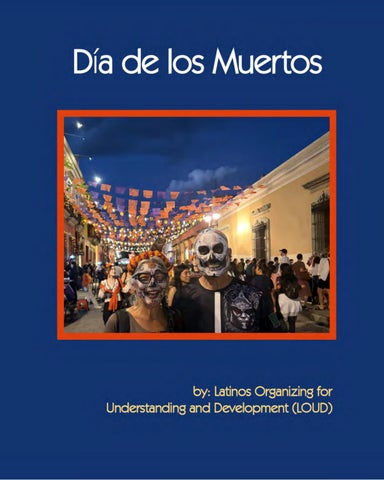
Día de los Muertos
Latinos Organizing for Understanding and Development (LOUD) Common Wealth Gallery / Madison Enterprise Center November 6, 2026 3
LOUD’s 2026 Día de los Muertos Exhibition Remembering Our Past, Celebrating Our Present, Inspiring Our Future Día de los Muertos, or Day of the Dead, is a powerful tradition of remembrance, love, and celebration. Rooted in Mexican cultural practices and embraced by communities across the Americas and beyond, this annual observance honors the lives of those who have passed while affirming the enduring connections between the living and the dead. Through photographs, flowers, candles, offerings, altars, and art, we create spaces where memories become present and the stories of our loved ones continue to live. LOUD’s 2026 Día de los Muertos exhibition brings together a diverse group of artists whose work invites us to reflect on memory, family, identity, loss, and the enduring power of cultural traditions. Through their individual perspectives and creative expressions, these artists demonstrate how art can preserve our histories, communicate our deepest emotions, and connect us to the people and places that have shaped our lives. At the heart of Día de los Muertos is the belief that remembering is an act of love. The tradition encourages us to recall the voices, experiences, and contributions of those who came before us—not simply with sadness, but with gratitude and celebration. It allows families to share stories across generations, introduces younger people to their cultural heritage, and reminds us that our personal histories are part of a much larger collective story. The artists in this exhibition approach these themes from their own unique perspectives and artistic
experiences. Together, their work reflects the evolving relationship between tradition and contemporary artistic expression. Familiar cultural symbols may take on new meanings, personal memories may become shared experiences, and individual interpretations may open doors to conversations about heritage, belonging, and the universal human experience of loss and renewal. For Latinos Organizing for Understanding and Development (LOUD), this exhibition represents more than an annual celebration. It is part of our ongoing commitment to creating opportunities for Latino artists, expanding the visibility of Latino arts and culture, and building the next generation of artists and cultural workers throughout Wisconsin and the Midwest. By bringing artists and audiences together, LOUD helps cultivate spaces where creativity flourishes, cultural traditions are honored, and meaningful connections can develop across communities. We believe that supporting artists also means creating opportunities for people to encounter different perspectives, discover shared experiences, and better understand one another. Día de los Muertos 4
offers a particularly meaningful opportunity to do this. While the tradition has deep cultural roots, its themes of love, remembrance, family, and legacy resonate with people from many backgrounds. We extend our sincere appreciation to the participating artists for sharing their talents, perspectives, and creative visions with our community. Their contributions remind us that culture is not something we simply inherit and preserve unchanged. It is something we continually renew through our stories, our relationships, our artistic expressions, and our commitment to future generations. As you experience LOUD’s 2026 Día de los Muertos exhibition, we invite you to pause and remember someone who has made a difference in your life. Reflect on the traditions that connect you to your family and community. Consider the stories that deserve to be remembered and the legacies we hope to leave for those who will follow us. Through art, we remember. Through culture, we honor our roots. Through community, we ensure that our stories live on.
— Oscar Mireles Founder and Director LOUD: Latinos Organizing for Understanding and Development
5
6
FEATURING: Angelica Alvarez Valenciano René H. Arceo Eric Baillies Thalia Carmona Reyli Cerda-Martinez Beatriz Cervantes Yesica Coria Patricio Crooker Anika Derby Gabriela Diéguez Hurtado Jessica M. Gutiérrez Higgs (Matthew Braunginn) Kim Hunter-Schaedle Vanesa Knutson Karen Laudon Aaron Laux Samantha Lezama Seso Marentes Paola Mayorga Carlos R. Mireles Chele Ramos Mario Rico Victor Rodriguez Emily Larson Rodriguez Erika Rosales Vanessa Tejeda Alice Y. Traore Sophia Voelker
7
Angelica Alvarez Valenciano Madison, WI Facebook: Angelica Alvarez
BIO: Angelica Alvarez Valenciano is an artist, writer, and poet born in Aguascalientes, Mexico, and raised in Madison, Wisconsin. As a student at UW Odyssey and Madison College, her work explores themes of identity, culture, resilience, and transformation. Influenced by a journey of personal growth and sobriety, she uses art and writing to explore healing, connection, and the experiences that shape the human spirit. ARTIST STATEMENT: El Dia de Los Muertos, is a cherishment of moments and a reminder, to dance with
the living, with the humble perfume of death. El Dia de Los Muertos sings the harmony of the dearly departed, in a poetic form; the Cempasuchil flower colors the bridge to the living and forms a connection with the scent of relatives still breathing, to guide the restful dead back home. I have one single memory of El Dia de Los Muertos in Mexico. I remember holding a pink and blue Calavera, it felt like I was holding a piece of magical art and it tasted like a sweet farewell. I remember laughter and the feeling of being safe, which was a precious feeling as a five-year-old living a silenced life. So, that is what I decided this painting to represent, the perfume of life and the essence it leaves along the way. I shed tears of joy, sorrow, anger and fear while painting this piece; and I hope it pierces us with a reminder that death is a precious reflection of our existence that we should be honored and acknowledge.
8
Angelica Alvarez Valenciano
El Espejo de La Muerte, 2026, Acrylic on fiberglass, 24 x 48 inches 9
René H. Arceo Chicago, IL @rharceo arceopress.com
BIO: René H. Arceo was born and raised in Mexico, he graduated from SAIC. He worked for the National Museum of Mexican Art and as an art instructor at CPS. Rene received the Governor’s International Exchange Program to exhibit in Lublin, Poland (2002) and in Paris, France (2006). He received the Chicago-Lucerne Art Residency Grant to travel to Lucerne, Switzerland (2018). René has exhibited in dozens of solo and group exhibitions in Poland, Mexico, Spain, Nicaragua, Puerto Rico, Canada, Argentina, Norway, Estonia, France, Italy, Japan, and the United States. René founded Arceo Press in 2005 to create international print collaborations. www.ArceoPress.com ARTIST STATEMENT: Many of the influences and sources of inspiration for my work come from the artists of the Mexican School of Art like Alfredo Zalce, Sara Jimenez, Alberto Beltran and Leopoldo Mendez. Other European masters as well like Kathe Kollwitz and Francisco Goya. Human, social, and sometimes political commentaries are the common themes addressed in my prints. I feel that as a member of a given society the artist should artistically respond to social, economic or even political events taking place in our world today. My feeling is that artists reflect, in lesser or larger
commitments, their own time and place.
,
10
René H. Arceo
Calaca Embelleciendose, 2015, Linocut print, 22 x 30 inches (top) Cycle of Life, 2008, Linocut and watercolor, 30 x 22 inches (bottom) 11
Eric Baillies
Madison, WI @photochemist_wi photochemist.net
BIO: Eric Baillies is a photographic artist working with nineteenth-century photographic processes. After a decade as a commercial photographer, he turned to historical techniques to explore photography as both image and object. Trained by world renowned process historian Mark Osterman at the George Eastman Museum, Baillies works with collodion, gelatin, tintypes, and historic printing methods in his
natural-light studio in Madison, WI. His work examines time, materiality, permanence, and the relationship between contemporary life and photographic history. His photographs have been exhibited at museums and galleries throughout the Midwest, including MOWA, MMOCA, Chazen Museum of Art, Art Fair on the Square and Overture Center. ARTIST STATEMENT: This image shows life and death as part of the whole. We are all going to die and noticing that death is quite literally upon us at any moment, makes the present ever more powerful.
12
Eric Baillies
The Doctor, 2016, Tintype, 20 X 24 X 1.5 inches 13
Thalia Carmona Madison, WI @tbc.tattoos
BIO: I’m a Mexican-American Graphic Designer, Illustrator, and Tattooist born and raised in Madison, WI. I work across a range of mediums, from markers, charcoal to watercolor and acrylic to tattooing people! Creating and collaborating are a big part of my day-to-day practice. Outside of creating, I enjoy photography and collecting and collaging references to fuel inspiration for future projects. My favorite part of the creative process will always be the primitive stages of design. I love exploring concepts through rough, messy sketches and often find myself drawn to those early stages more than the final piece. ARTIST STATEMENT: This piece explores the connection between life and death. The woman represents death, while the flowers, leaves, and butterfly surrounding her symbolize life, growth, transformation, and the continuation of the natural cycle. The vibrant colors and traditional Día de los Muertos-inspired imagery celebrate death not as an ending, but as a part of life to be remembered and honored. Through this contrast of beauty and mortality, the piece connects to the exhibition theme by embracing the idea that even in death, there is still color, life, and beauty.
14
Thalia Carmona
La Muerte Florece, 2026, Acrylic, 24 x 18 x .5 inches 15
Reyli Cerda-Martinez Milwaukee, WI @reyli_martinez29
BIO: Reyli is a Mexican American Artist born and raised in Milwaukee, WI and attends the University of Wisconsin-Madison. Her art primarily discusses themes of growing up in the U.S. as a woman of color, daughter of immigrants, mental health, and being queer. Inspired by the stories of women around her and the heritage she prides herself in. Nonetheless, making any sort of art whether 3D or 2D that incorporates these topics and further educating people but also making it always about “Por mi Dios, mi gente, y mi tierra” “For my God, my people, and my home.” ARTIST STATEMENT: In Cruz de Olvido and Falda de Recuerdos I took great inspiration from Mexican songs that I grew up listening to; many of which were about death, love, and heartbreak. Songs like “Puño de Tierra”, “Entierrenme Cantando”, “No hay Novedad”, and “Amor Eterno” which were all songs that remind me of the beauty of life and enjoying every second we have on this earth. Although, having to let go of a future we can't control and finding peace in the uncertain. Nonetheless, I wanted to capture the beauty that the Mexican culture has of death as it feels like it is a living culture; making leaving this earth a bit less scary. I added figures like la Virgin de Guadalupe, el Chavo de Ocho, quotes from my favorite artist Juan Gabriel, details from my childhood home, and foods that we normally eat together. Growing up in the U.S. the way we celebrated Dia de los Muertos was so different to how it was for my parents growing up in Mexico. Therefore, I wanted to capture the way we celebrated here with the
feeling that is expressed through the music, food, color, and icons of Mexico.
16
Reyli Cerda-Martinez
Falda de Recuerdos, 2026, Acrylic paint on cotton fabric, 32 x 64 inches (top) Cruz de Olvido, 2026, Acrylic on canvas and mixed media, 31 x 40 x 1 inches (bottom) 17
Beatriz Cervantes Chicago, IL @bcervantes427
BIO: I was born on Chicago’s south side in 1957 to Mexican immigrant parents. My recent work has focused on assemblage with found objects, including dolls, plastic body parts, toys, dried plants and insects. I create through a kind of stream-of-consciousness; I gather and work images and objects until they form clear (or not so clear) compositions. Death is a recurring motif. I welcome its benign presence in my life. La muerte is always with us – dancing at our fiestas, joining us for dinner, praying with us at mass, holding our hands as we grieve the loss of a loved one.... ARTIST STATEMENT: Beyond papel picado, calaveras and cempasuchil, the Day of the Dead
commemorates loss, mourning and the fragility of life in the context of a greater cultural belief that our dead remain with us and are accessible to us. Each piece here contemplates the many small deaths we experience as we journey towards our destiny. Childhood Elegy, an early and deeply personal piece, laments the loss of innocence—due to poverty, disease, the death of a parent, war that uses children as fodder, enforced separation by ICE—and sometimes simply the passage of time. Each vignette offers a collection of images and objects for the viewer to consider. For the Living and the Dead is a meditation on the connections between the living and the dead, the heart-blood that flows from one to the other, the desire to reconcile the irreconcilable, and the pain when a loved one dies and leaves their partner. This piece was inspired by the suicide of a family friend and includes a heart and a tiny gun hidden in the hollow of the ribcage.
Viva La Mort was originally intended as an exhortation to live happier, but mutated into a reflection on how difficult it is to endure pain and the temptation to find relief and oblivion and perhaps forestall death by using drugs. It is also an indictment of a pharmaceutical industry that urges us to find a pill for every ill, profiting while moving us further away from our own healing roots. 18
Beatriz Cervantes
Childhood Elegy, 2023, Assemblage with dolls, 15 x 15 x 3.5 inches (top) For The Living and the Dead, 2025, Assemblage in box, 5 x 5 x 1.5 inches (bottom) 19
Yesica Coria
Milwaukee, WI @coriagraphicarts
BIO: Yesica Coria Zavaleta is a visual artist and a graduate of the Universidad Veracruzana, Xalapa, Veracruz, México with a specialization in Graphic Design. She has been working with art, and specifically with corn husk as a material, since 2012, 14 years of dedicated practice. Her work with this material began as a way to reconnect with her roots and cultural heritage after living in the United States for 19 years. Over the years, Yesica has explored a variety of expressions with corn husk: from dolls and flowers to
sculptures, functional objects, and textured pieces, developing a personal language that blends tradition, research, and contemporary creativity. Her work focuses on the transformation of the material as a bridge between memory, migration, and cultural identity. ARTIST STATEMENT: This body of work explores corn husk as a living material shaped by migration, memory, and human contact. Originating in Mesoamerica, corn has traveled across borders and generations, constantly reinterpreted through different cultures and everyday uses. Through sculptural forms, textures, and utilitarian objects, this work creates an ongoing dialogue between the ancestral and the contemporary. Each piece acknowledges the history of the material while also allowing it to transform, reminding us that tradition is not static, but a living form that evolves through those who
practice it. Beyond its artisanal function, corn husk becomes a language of memory, adaptation, and continuity; a material capable of connecting stories, territories, and processes of human transformation.
20
Yesica Coria
Mujer en Rosas, 2026, Corn husk and wire, 16 x 5 inches 21
Patricio Crooker
Madison, WI @patriciocrooker patriciocrookerphoto.com
BIO: Patricio Crooker (b. February 25, 1975, La Paz, Bolivia) graduated with a degree in Journalism from Texas Christian University and then moved back to Bolivia where he worked as a documentary photographer for more than 25 years before moving to Oregon, Wisconsin with his wife and two kids. He is the author of more than five photography books, and also taught photography at the university level in Bolivia. Crooker is had many solo and group photo exhibits in different countries. ARTIST STATEMENT: The “Ñatitas” festival in Bolivia is a celebration of human skulls that are adopted regular people and given human names. Each first week in November, the owners of the skulls take them to the General Cemetery in the City of La Paz, in the Bolivian Andes to celebrate and to share a ceremony. Many visitors bring them flowers and cigarettes, becoming a good symbol of syncretism in the contemporary culture. This festival is growing every year becoming more and more popular. I had been documenting it for many years.
22
Patricio Crooker
ÑATITA 01, 2026, Digital print, 8 x 11 inches (top) ÑATITA 02, 2026, Digital print, 8 x 11 inches (bottom) 23
Anika Derby Madison, WI
BIO: Anika Derby is a senior at the University of Wisconsin-Madison. She is majoring in Biochemistry with certificates in Global Health and Middle East Studies. She hopes to work in humanitarian or community medicine. She co-founded People's Shabbat, an organization of anti-Zionist Jewish students and community members in Madison. Last spring, she studied Refugee Health and Humanitarian Action in Amman, Jordan, and Sevilla, Spain. She currently works as a student assistant in Gynecology and Sexual Health at University Health Services. ARTIST STATEMENT: I’ve always had an appreciation for old family photos and a special tendency toward incorporating them into altar-collages of postcards, drawings, textiles, and ephemera. This practice began in my childhood bedrooms and has followed me to every room I have rented since. I'm mortified imagining a time-lapse of the installation process. I shuffle the mementos for hours, into endless permutations, until I can finally stand to look at them. By that time I am dizzy, agitated, and breaking into a sweat. Some of my favorite photos, and the ones displayed here, were collected by my late uncle, Alex Kalk. He shared my love of family photos, along with whatever neurosis causes me to arrange and rearrange them so carefully. He encouraged me to make art, and always entertained my questions about grief and mortality with sincere and abstract reflection. The hands were originally conceived of as serving utensils, which still sounds like a very nice use for them. When I brought them home, however, they were natural altar pieces. Latin American tradition has defined the altar in our collective imaginations. While I’m not Latin American,
my altars embody a reverence and celebration no doubt informed by the ofrendas of Día de los Muertos. Latin American and Indigenous culture has influenced every aspect of American life. I feel this influence, personally, in the way I adorn my living space, appreciate beauty, relate to the death of loved ones, and place myself among generations of relatives. 24
Anika Derby
Hands, 2026, Glazed ceramic, 2x4x14 25
Gabriela Diéguez Hurtado Milwaukee, WI
BIO: Gabriela Diéguez Hurtado earned her Masters in Social Work at UW-Milwaukee. She has worked as a bilingual therapist using art from assessment to intervention for 21 years in Milwaukee's Southside. She has collaborated in two research projects with Latines and pushes herself to do public speaking representing her community. Gabriela spends her free time as a volunteer community organizer, her church and enjoying the arts scene in the city while creating her own art and cultivating her community. Gabriela experiments with watercolors, acrylics and fibers. ARTIST STATEMENT: I am originally from Guatemala and come from a family of artists that have admired the work of indigenous artists. In my work with fibers I am recovering indigenous patterns of bags that are no longer made to create new objects. I am honoring my ancestors with a new creation using the ancestral methods of crochet to create a celebration for Day of the Dead in a pattern of butterflies.
26
Gabriela Diéguez
Mariposas, 2026, Acrylic fiber, 16.5 x 17 inches 27
Jessica M. Gutiérrez Madison, WI jessicamgutierrez.com @inspiritartist
BIO: Jessica M. Gutiérrez is a self-taught Nicaraguan-American Visual Artist residing in Madison, WI. The daughter of a
Nicaraguan immigrant and born in Central Wisconsin, she works as a psychotherapist who integrates her visual and creative nature into her practice and her healing focus into her art practice. Gutierrez’s colorful watercolors and collaged mixed media images are emotional, enchanting, magical and vibrant. Jessica has shown her work throughout the Midwest for the past 15 years. She was a finalist for the 2023 Women Artists Forward Fund Art Prize and a 2023-25 Art Lit Lab Bridgework Program Artist in Madison, WI. ARTIST STATEMENT: We Are Always Here 5 and We Are Always Here 6 are part of an ongoing series of mixed media collages exploring the resilience of Indigenous womxn across generations—their survival held in memory, their presence always with us. Though I didn't grow up with Día de los Muertos, its spirit—vibrant colors, magical energy, joyful celebration, and honoring of ancestors—resonates deeply. My work is rooted in visual storytelling and ancestral connection, exploring identity, generational wounds, reclamation, and healing through my personal experiences and family history. As I created this work, I felt my ancestors beside me. These collages honor the matriarchs—Indigenous women of the Americas, those who migrated and those who have always been here. They honor those who guide us in spirit and those who walk beside us in body. They're a tribute to the womxn resisting oppression across this country. Their steady gazes and radiant forms carry memory and survival. The glowing colors and flowers reflect our sacred connection to the divine and illuminate the presence of our ancestors. In a time of antiimmigrant rhetoric and systemic violence, this work centers resistance, community power, and ancestral pride. It's a reminder: we are beautiful, sacred, divine souls—more powerful than any force meant to diminish us. I hope that you see yourself in these collages and that they can be a reminder that your ancestors are always near, lending their wisdom, strength, and infinite love. And most of all, that you are never alone. 28
Jessica M. Gutierrez
We are Always Here 5, 2026, Watercolor, marker, gel pen original collage on paper, 14 x 11 x .25 inches (top) We Are Always Here 6, 2026, Mixed media collage on black paper, 18 x 24 inches (bottom) 29
Higgs (Matthew Braunginn) Madison, WI @thehiggstape braunginn.com
BIO: Matthew Braunginn (Higgs) is a self-taught artist from Madison, Wisconsin. His work falls within a nonobjective, contextual approach to abstract expressionism, utilizing oils and acrylics. He is driven to create and express with weighty emotional expression; he found freedom in structural abstractions that visually represent how his mind analyzes and structures the world around him. His study of history lays the foundation for seeing the layers of the world through what came before and for understanding that the possibilities of the future lie within the choices we make today—applying a similar compositional approach to his artwork.
He presents a reflection of the context in which the works creation exists, forcing the world and those observing it to see the world, themselves, and the context in which they exist, including both the good and the bad. Each piece is created with music—Jazz, R&B, Soul, Funk, Hip-Hop, and more woven into its DNA and infused with the emotionally expressive weight of his subjective interactions and observations of our shared existence. ARTIST STATEMENT: Higgs's work explores what might be called Contextual expressionism—responding to the context in which you exist in the present. His work is a meeting point between his internal world and the external, an expression of pure creation. This piece, Gods Piper, is about the liminal spaces, the in-between spaces of existence. The meeting space of life and death, as we work within it to spread the light of life as we journey into the divine.
30
Higgs (Matthew Braunginn)
Gods Piper, 2024, Acrylic on wood, 40 x 40 inches 31
Kim Hunter-Schaedle aka Miss Boobychops
Montreal, WI @missboobychops sites.google.com/view/missboobychops
BIO: I am a scientist by training, but have knitted since childhood. Since 2006 as Miss Boobychops I have knitted and sold 600+ handbags. I taught myself intarsia, designing my own patterns of ordinary, weird and wonderful things. After a brief knitting hiatus and relocating from the east coast to Wisconsin in 2024. I have been re-energized by the welcoming environment for untrained artists here. I have been advancing my intarsia technique to sights and sites of Wisconsin, images of science and human life, and words. My
bags are lined for actual use and vectors for messages and stories. ARTIST STATEMENT: I am submitting a knitted bag featuring a Day of the Dead skull created in intarsia. A brief history—in 2013 I was asked to knit bags with a Day of the Dead skull. I was concerned as this was a highly complex image for the simple intarsia patterns I was doing at that time. However, I did my research and created a design, and successfully completed this assignment. Over the next few years I knitted one or two others. However I never duplicate bags exactly; every one is unique, which is Miss Boobychops tagline. Many years later, I took a knitting hiatus before relocating to the Midwest in 2024, as I had lost my inspiration. When I started again, one of the first I knitted was this actual bag. The Day of the Dead seemed like a good place to start—I had resurrected my interest in creating. I selected bright orange as it is vibrant like the celebration itself.
32
Kim Hunter-Schaedle aka Miss Boobychops
Skully (#698), 2025, Acrylic yarns, cotton fabric, nylon thread, plastic button. 18 x 12 x 1.5 inches 33
Vanesa Knutson Middleton, WI @vanesitakfr
BIO: Vanesa Knutson is a self-taught Mexican mixed-media artist based in the Madison area, where she has lived for six years. With a background in biochemistry and microbiology, she is particularly drawn to small and intricate forms. Her work combines beadwork, embroidery-inspired texture, painting, and playful color (especially pink!) to explore beauty, science, heritage, and mythology. Inspired by Mexican history, Aztec mythology, family traditions, classical art, and pop art, she creates tactile pieces filled with detail, color, and joy. ARTIST STATEMENT: When I think of Día de Muertos, the first image that comes to mind is a brightly decorated sugar skull. The celebration is deeply nostalgic for me because it brings back memories of
visiting the Feria del Alfeñique in Toluca, in the State of Mexico, with my family and friends. I remember the enormous paper-mache catrinas, the crowded stalls filled with chocolate, and the joy of exchanging (and eating!) calaveritas. Calaveritas are also essential elements of many family ofrendas. I approached this exhibition through those memories, as well as my love of and interest in pre-Hispanic mythology.
Tzompantli de calaveritas de azúcar reimagines a tzompantli, a Mesoamerican wooden structure used to display skulls. My tzompantli presents twenty colorful calaveritas as a tribute to joy, individuality, and life.
Reinterpretación del Disco de la Muerte is inspired by one of my favorite ancient Mexican sculptures, the Teotihuacan Disk of Death. Día de Muertos did not exist in its present form in pre-Hispanic Mexico. However, this piece reflects an understanding of death as part of a natural cycle rather than only a source of sorrow. Las manos de mi abuela is the most personal piece. It is based on a photograph I took of my
grandmother in 2008 while visiting my great-grandmother’s grave for Día de Muertos. She was 91 at the time, yet she still honored her mother’s life by cleaning the grave and decorating it with cempasúchil garlands. 34
Vanesa Knutson
Reinterpretación del Disco de la Muerte, 2026, Mixed media, 10 (diameter) x 2 inches (top) Tzompantli de calaveritas de azúcar, 2026, Mixed media, 40 x 40 x 2 inches (bottom) 35
Karen Laudon
Madison, WI @karenlaudon karenlaudon.com karenlaudonportfolio.com
BIO: Karen Laudon was born and raised in Wisconsin, where a childhood divided between Milwaukee, a nearby lake cabin, and her grandparents' dairy farm afforded formative experiences for her work. She completed her BFA and MFA at the San Francisco Art Institute, working and exhibiting in the Bay Area for sixteen years. Now living and working in Madison, where she raised her daughters, Laudon has exhibited at regional galleries and colleges, as well as nationally. Laudon's work is rooted in nature, the figure, and poetry, for both inspiration and structure. ARTIST STATEMENT: Painting is an alchemical process for me, largely intuitive, and akin to visual poetry. My work in the studio involves pouring, pooling, building up and scraping down paint until surface, image, and meaning coalesce. Brewing, weaving, deconstructing and reconstructing, birthing and dying; my process is all of these things, and is a reflection of natural processes. Recent paintings are rooted in my experiences as a gardener and observer of nature and the processes of growth and decay. For the past couple of decades, my paintings have developed alongside related works on paper and three dimensional objects, all of which inform each other. Mortality is an undercurrent in my most recent series of paintings, drawings titled Fertile Ground. The related three dimensional Homegrown Objects are composed of decayed elements from my garden and frequented natural areas, as well as found objects,
and include reliquary elements.
36
Karen Laudon
Fertile Ground #11, 2025, Oil on canvas, 24 x 18 inches (top) Homegrown Object #6, 2026, limestone, bird nest, found glass, sumac seed pod, beeswax, gold leaf, 7.5 x 5.5 x 5 inches (bottom) 37
Aaron Laux
Madison, WI @aaronlauxdesign aaronlauxdesign.com
BIO: Aaron Laux is a sculptor whose work explores the relationship between human experience and the living world through material, process, and deep time. Working primarily with wood, stone, bark, and found natural elements, his practice is rooted in direct engagement with the land and the physical act of making. Laux’s path developed outside traditional academic structures. After studying at the University of Wisconsin–Madison, he apprenticed with artist Steven Spiro, refining his woodworking and sculptural techniques over nearly a decade. In his twenties and early thirties, he lived off-grid in a self-built yurt, immersing himself in ancestral skills such as stone tool making and fire-making. His sculptures draw from patterns in nature—flowing water, shifting geology, plant growth, and erosion—creating forms that feel
both ancient and immediate. His work exists in conversation with the natural world rather than representing it. Laux’s practice spans sculptural installations, public art, and architectural commissions, with recent projects for healthcare and corporate environments. His work is guided by the idea that humans are part of an interconnected system spanning past, present, and future. ARTIST STATEMENT: I am an outsider artist. I applied to this call for art because this past year we have had a death in the community and it has shifted my relationship to this experience. Many of us, myself included were able to participate in various stages of the dying. This wove meaning and a sense of beauty into the difficult feelings of confusion, loss and grief. I was grateful to have been a part of this. This artwork that expresses some of this feeling.
38
Aaron Laux
Wild in Nature, 2021, Maple, cherry, walnut, birch bark, glass, paint, 52 x 52 x 2.5 inches 39
Samantha Lezama Madison, WI @Lezama.arts
BIO: Samantha Lezama is a Chicago-born Chicana artist and entrepreneur whose creative journey began in community mural-making under the mentorship of Bel. Committed to bridging creativity with business she launched an Etsy shop and print-on-demand brand at sixteen. Sam earned an associate degree from DeVry University while still in high school before graduating from UW–Madison in May 2026 with a bachelor's degree in management and a studio art certificate. Grounded in the Mayan philosophy In Lak'ech Ala K'in (“I am another you”), her work invites viewers to recognize the sacred within one another through story, symbol, and remembrance. ARTIST STATEMENT: Día de los Muertos is fundamentally about remembering the people whose labor,
love, and sacrifices continue to sustain us long after they are gone. My paintings honor those whose work is often invisible, suggesting that remembrance begins before someone passes. Rather than depicting death directly, I celebrate the living legacies created through everyday acts of care, labor, and community, an approach that feels deeply rooted in the spirit of Día de los Muertos while offering a perspective beyond its familiar skeleton-and-marigold imagery.
Don Edmundo portrays an 83-year-old flower vendor from South Los Angeles. His red roses evoke offerings of love, while the white flowers symbolize remembrance. Flowers have long served as gifts of honor, memory, and connection across generations. Julio the Paletero is a portrait of my hardworking grandfather and I, an archetype found throughout many Mexican communities. His story speaks to childhood, resilience, and the shared memories carried by the familiar sound of the neighborhood
paletero's bells. Together, these works honor ordinary people whose quiet contributions become woven into the memories of others. They remind us that the cycle of life is sustained through gratitude, remembrance, and our enduring connections to one another. 40
Samantha Lezama
Don Edmundo, 2026, Water-soluble oil on wood, 30 x 24 x 1.5 inches (top) Julio, 2026, Water-soluble oil on wood, 24 X 18 X 1 inches (bottom) 41
Seso Marentes Des Moines, IA @sesomarentes sesomarentes.com
BIO: Seso is a Midwest-based Chicano multimedia artist with over a decade dedicated to the art of relief printmaking. Rooted in Iowa, where his family has lived for over a century, his work explores the delicate space between Mexican ancestry and life in the American heartland. Through intricate linework, sacred iconography, and agricultural symbolism, his relief carvings and large-scale murals bridge these two worlds, capturing a deeply personal narrative of dual identity, history, and community resilience. ARTIST STATEMENT: My practice as a Chicano multimedia artist centers on relief printmaking to explore
identity, lineage, and the cyclical connection between generations. Rooted in Iowa, where my family has lived for 112 years, my work views memory and heritage not as distant history, but as an ongoing dialogue between the living and those who came before us. In alignment with Día de los Muertos, a celebration rooted in Indigenous tradition where death is embraced as a natural continuation of life this piece honors the spiritual mantle passed down through generations of agricultural labor and quiet resilience. By integrating iconic cultural iconography like La Virgen de Guadalupe with el maíz (corn), the artwork transforms the traditional offering into a bridge between Mesoamerican roots and the Midwest soil that has sustained my ancestors for over a century. The rhythmic, hand-carved linework creates a vibrant halo of energy surrounding the figure, embodying the belief that the spirits of our loved ones remain woven into the fabric of our daily lives and
landscapes. Through relief printmaking a medium reliant on impression and memory left upon the page this work pays homage to ancestors who paved the way, offering a reflective space to honor their legacy without fear, grounded in deep cultural pride and community endurance. 42
Seso Marentes
Mothering the Heartland, 2026, Lino-print, 16 x 20 inches (top) Helmet and Marigolds, 2026, Lino-Print 16 x 20 inches (bottom) 43
Paola Mayorga Madison, WI @paolamayorgaa
BIO: I’m a self-taught artist from Puebla, Mexico, working primarily with acrylic painting and murals. My artistic journey began as a way to explore emotions and personal experiences, eventually becoming a language of movement, color, and honesty. Inspired by my roots, memories, and the world around me, I create intuitive works that reflect vulnerability and transformation. As a muralist, I enjoy bringing large-scale spaces to life with vibrant colors, flowers, and organic forms. Whether on canvas or walls, my work celebrates nature, emotion, and human connection while inviting viewers to discover their own stories within each piece. ARTIST STATEMENT: My paintings are shaped by memories, dreams, desires, and the thoughts that linger just beneath the surface. I paint to understand what I feel, to let go of what weighs on me, and to give form to what words often fail to express. Each piece becomes a space where past and future can meet—where longing, hope, and reflection exist together in motion. My visual language is a soft bur emotionally charged, with brushstrokes that suggest movement—like everything is gently shifting, always on its way somewhere. My work often explores nature, the human figure, and cultural elements—rooted in my Mexican heritage but also inspired by the beauty I find in other traditions or things. I approach each painting intuitively, allowing emotion to shape composition, palette and form. I see my art as a quiet kind of storytelling—not linear, but emotional. I want each piece to feel like a moment you’ve lived before, or a memory you didn’t know you had. There’s a space in the work for others to bring their own meaning— to feel seen, to feel understood. I paint to share my deepest emotions, my love for where I come from, and the way I see the world around me. My art is a space for connections, for vulnerability, and for finding comfort in life’s constant movement. 44
Paola Mayorga
Danza, 2025, Acrylic paint, 19.7 x 15.7 inches 45
Carlos R. Mireles Madison, WI @coachcarlosm
BIO: Carlos R. Mireles attended UW-Oshkosh for art. Mireles started drawing and painting most of his life, using many types of media. His favorite artists are Dali, Picasso, and the three great Muralist painters from Mexico: Rivera, Orozco and Siquieros. He graduation from Gateway Technical college with a degree in Nursing and is an advocate for disability rights in 1977 and is a Registered Nurse in an S.C. care setting in an ICU Stepdown unit for 30 years. ARTIST STATEMENT: I attended UW Oshkosh as an Art Major in 1970 and I graduated from Gateway Technical College with a RN degree in Nursing in 1984. I’m a retired RN that enjoys painting in oil , acrylics and alcohol inks. My artwork is done spontaneously with vivid colors and my designs are original. I’ve enjoyed painting since my youth, living in a two bedroom house with my 12 brothers and sisters my father built rooms in the basement, drywalling the walls and painted white—he gave me magic markers and paint brushes to create whatever I wanted. The independence he gave me helped my confidence in my art. My inspiration comes from the 3 great Mexican mural artists Diego Rivera, Clemente Orozco and David Siquieros. I credit my parents Micaela and Felix Mireles for their guidance, my wife Mary Mireles for giving me four beautiful children Genevieve, Katherine, Carlos and Alicia, and seven grandkids Makenzie, Kaden, Liana, Lucia , Bronson, Carlos and Benjamin.
46
Carlos R. Mireles
Micaela and Felix, Ink on paper, 11 x 15 inches Zapata Ink on paper, 11 x 16 inches 47
Chele Ramos Sun Prairie, WI @chele.ramos.7 facebook.com/cheleramos.art cheleramos.com
BIO: Chele Ramos is a self-taught Madison-based visual artist whose work explores human emotion, identity, and mental health through expressive realism. Since 2016, her practice has evolved from representational portraiture into symbolic and introspective painting, integrating acrylic, charcoal, pastel, watercolor, and oil. Her recent body of work, Shades of the Mind, uses self-portraiture, journaling, and visual experimentation to examine tension, clarity, grief, and renewal.
ARTIST STATEMENT: My work explores the emotional and psychological landscape of the human experience through expressive self-portraiture. I am drawn to moments of vulnerability, tension, resilience, and transformation, the quiet emotional shifts that shape identity and inner life. While rooted in portraiture, my work has moved beyond representation toward emotional truth, using the figure as a vessel for internal states and lived experience. My process is intuitive and reflective, guided by color, gesture, posture, and atmosphere. Mental health is a recurring thread throughout my work, often approached through metaphor. In my ongoing series Shades of the Mind, self-portraiture becomes a way of mapping emotional terrain: overwhelm, clarity, grief, grounding, and renewal. My diptych titled So Far Not
Forgotten reflects on the idea of love and memory. It touches on how remembrance shapes us, comforts us and pulls us through dark times. It reflects on keeping our memories alive as much as they keep us alive
and on grief as a necessary step in the process of healing. Ultimately, my work is an invitation for viewers to reflect on their own emotional complexity and inner lives with curiosity and compassion.
48
Chele Ramos
So Far Not Forgotten (part 1 & 2), 2025, Oil on canvas, 24 x 30 x 1.5 inches each 49
Mario Rico
Fitchburg, WI @marioricoart
BIO: Mario is an artist trained in Graphic Design, Illustration and 3D Sculpting. Originally from Mexico City, he has lived in the Madison area for over 20 years, where he attended Madison College. His art features themes heavily influenced by indigenous cultures from Mexico, mainly those from the Nahua peoples. ARTIST STATEMENT: The work I create has always been deeply rooted in the native cultures of my home country. Since I was a child, I always found them fascinating because I knew very little about them, with time, that fascination turned into admiration and respect and a personal pride to know that I come from such creative imaginative and resourceful people. In this exhibition I hope to honor the ancient tradition of remembering the dead, a tradition that has survived invasions, cultural and religious syncretism.
50
Mario Rico
Guerra Florida, 2026, Acrylic on canvas, 12 x 36 inches 51
Victor Rodriguez
Madison, WI facebook.com/vick.rodz#
BIO: Victor Rodriguez travels across the USA and beyond its borders to create exhibits and habitats for museums, zoos, and aquariums. His work can be seen in permanent exhibits at the Shedd Aquarium in Chicago, the Smithsonian Zoo in Washington, DC, the National Aquarium in Baltimore Harbor, and the
California Academy of Sciences in San Francisco’s Golden Gate Park. Victor is also a passionate photographer, painter, and salsa dancer. He and his wife Emily have a home base in Madison. ARTIST STATEMENT: This photographic series was shot on location within a historic cemetery in Galveston, Texas. It explores the theme and tradition of Día de los Muertos.
52
Victor Rodriguez
Bride/Novia, 2015, Photograph, 8 x 10 inches (left) Lady/Señorita, 2015, Photograph, 8 x 10 inches (right) 53
Emily Larson Rodriguez
Madison, WI @emlrodriguez facebook.com/DaneArtsMuralArts daneartsmuralarts.org
BIO: Emily Larson Rodriguez is the lead artist and director of murals at DAMA (Developing Artists, Murals and Alliances). Her earliest memories are of waking up early, fixing a bowl of cereal, then spending hours drawing while everyone else was still asleep. Drawing and painting have always been her way to seek understanding of the world around, to discover and express something essential about a subject. Emily specializes in creating portraits and murals. She and her husband Victor have one child and one cat. ARTIST STATEMENT: Día de los Muertos imagery is a vibrant, profound exploration of soft beauty, sharp decay, lost love, and the mystery of what lies beyond our realm. This series of drawings and prints was inspired by photos taken by Victor Rodriguez.
54
Emily Larson Rodriguez
Couple de los Muertos #1, 2024, Ink on wood panel, 10 x 10 inches 55
Erika Rosales Madison, WI erikarosales.art @erika___luna
BIO: Originally from Temascalcingo, Estado de Mexico, Mexico, Erika Rosales is a self-taught multidisciplinary artist based in Madison, Wisconsin. As an undocumented immigrant in the U.S. with DACA, her work is inspired by the exploration of reconnection, liberation, spirituality, and coming back to self. Erika has explored art through her life in multiple ways such as cultural dance and painting. Her visual art includes abstract paintings through different mediums, such as alcohol and mixed media on canvas. Erika is currently exploring creating her own paint through rocks and earth materials. Her work is part of private and public collections. ARTIST STATEMENT: Through my work, I extend an invitation to the viewer to embark on a spiritual journey
with self, the world, and the universe. The work presented reflects an important aspect of this journey in which I share the meaning of ancestral connection as a guiding force. This work honors my homeland of Mexico, and the ancestral wisdom that has been passed down generationally. Over the years, ancestral healing and reconnection has become a guiding light in my life. It is my intention for the viewer to create a reciprocal relationship with the pieces by connecting to their energetic essence. I represent visuals from the physical to non-physical through form and abstraction. In my acrylic paintings, I use unconventional materials such as dried foods to create texture that enhances the emotional aspects of the paintings. Employing gilding and metallic paints allows me to provide a sense of mysticism and connection to the divine. I also integrate earth materials using rocks and charcoal I gathered from a fire to honor mother earth. Considering my lived experience in a complex world as an undocumented woman, I am inspired by the idea of transcending our limited human condition. I believe tending to the wounds of
our lineage and reconnecting to ancestral wisdom allows us to heal the past and the future. In a world often marked by disconnection and confusion, the goal of my work is to create a portal to the larger meaning of life, existence, and our role in it.
56
Erika Rosales
Desde la Vision (left) and Compartiendo Sabiduria (right) Both: 2026, Studio-made pigments, acrylic, corn, and imitation gold leaf, 36 x 24 inches 57
Vanessa Tejeda Madison, WI @nessesito_pintar
BIO: Vanessa Tejeda is a Madison-based artist primarily working in oil paints, though her practice extends to ceramics,
acrylics, and textiles. Her work explores the complexities of the Midwestern Mexican-American experience, examining how community identity is both self-constructed and perceived by others. As a self-taught artist with a background in Biology, Tejeda’s practice is uniquely informed by a deep appreciation for the intersection of science and nature. Rooted in childhood memories of watching her mother paint to the sounds of Alejandro Fernandez, Tejeda has pursued creative expression since winning her first art competition at age eight. Her artistic perspective was further sharpened by her experiences as a Latina student in a predominantly white university setting and by her upbringing within a vibrant, close-knit family. These foundational experiences motivate her current work, which serves as a critical response to the political marginalization and dehumanization of the Latino/a community. Through her art, she utilizes her position to provide a nuanced window into her culture, fostering empathy and understanding. Tejeda recently debuted her work at Madison’s “Gallery Night” at 100State and has since attended multiple art events within the vibrant Madison Art community. Dedicated to immersing herself in the regional Latino/a art scene, she continues to use her platform to highlight the beauty and resilience of her community. ARTIST STATEMENT: My works support the rich tradition of Día de los Muertos, further focusing on the enduring vibrancy of memory. These pieces represent my connection to this unique celebration of life, emphasizing how we in the living world sustain the presence of those who have passed by keeping their legacies alive through our memories. My inspiration stems from embracing the vibrant culture that defines this holiday. It is rooted in the daily celebrations of life that honor our ancestors and ensure their spirits remain a vital part of our present. Furthermore, I explore the historical depth of Día de los Muertos, a
tradition that predates the Spanish conquest of Mexico. It was preserved as a profound act of rebellion by those who faced annexation and erasure, serving as a testament to their strength and resilience. My art aims to portray this enduring power, reflecting the courage of our ancestors and the persistence of our collective spirit. 58
Vanessa Tejeda
intocable, 2026, Oil and acrylic on canvas, 17 x 7 inches, 8 x 8 inches, 17 x 7 inches (top) Cempaxochitl, 2024, Oil and acrylic on canvas, 12 x 12 inches (bottom) 59
Alice Y. Traore Madison, WI @ayjay09
BIO: Alice Y. Traore was raised in a household where expression through art, literature, and music was ever-present. Though she minored in art, painting now plays a major role in her life. Alice’s work appears in numerous places: a city-wide public art project; Umoja magazine and Stonecoast Review magazine covers; Madison College’s permanent collection; a commissioned piece for YWCA’s 2021 Racial Justice Summit. Her work appears on the cover of poet teri elam’s book, Digging Beneath Bones. Alice is a 2021 recipient of Madison’s Forward Art Prize. To date, she has exhibited in numerous group and solo shows through Wisconsin and Illinois. ARTIST STATEMENT: I am a visual artist whose work explores the human pursuit of liberation, rejuvenation, and celebration. Through these particular pieces, I explore an individual’s relationship with death as an ancestral journey, hoping to evoke the notion that, in spite of whatever, our ancestors lift us up and have our backs. In the wake of current increased violence committed against Black and Brown bodies, my work is also an acknowledgement of the toll that grief takes on the body when the motivation for threat, harm, and death is race based. My paintings represent an individual’s personal journey towards emotional, physical and spiritual healing in a society that frequently challenges peace and wholeness. In creating each of these pieces, the phrase “...and yet and still, we are here…” rang in my head like a mantra, and I intentionally used deep rich colors to evoke a certain type of heaviness that also reads as irrepressible. In these pieces, like others, I center storytelling, reckoning, and the interior life of an individual who cherishes not only who they are but also, who they were.
60
Alice Y. Traore
The Day Washed Over Me, 2026, Acrylic on canvas, 20 x 16 inches (top) Mourning in the Garden of Low Hanging Fruit, 2026, Acrylic on canvas, 24 x 18 inches (bottom) 61
Sophia Voelker
Madison, WI @Theblackbutterflystudio linktr.ee/blackbutterflystudio blackbutterflystudio.com
BIO: Sophia Voelker is a self-taught artist born in San Jose, California. Throughout her art career, she focused on creating purposeful and thought-provoking work using an aesthetically designed approach, whether humorous or introspective. Her artwork covers some events in her life in a way that resonates with her. Sophia uses various media in her pieces, such as acrylic on canvas, driftwood, dense air-dry clay, and drywall mud (joint compound). These materials allow her to express a specific topic better. ARTIST STATEMENT: I sell and exhibit my artwork in Cambridge and Madison, Wisconsin. My artwork reflects whimsy, thought-provoking moments, and introspection found in my daily experiences. It is my wish to see art used as a continued form of support for daring concepts and reflection of society and one’s community, through an artistic lens. It is important to note that while times can be trying, laughter should not be shamed if the artwork's purpose is to bring joy. It is also this artist's wish that admiration, contemplation, and understanding are felt when observers view her art.
62
Sophia Voelker
Kiss My Fire, 2026, Acrylic on canvas panel, 7 x 5 inches , 17 x 14 inches framed (top) My Three Souls, 2026, Acrylic on canvas, 30 x 24 inches (bottom) 63
64
Thank You for the Generous Support to Make the Exhibition Possible!
and to:
Karin Wolf Arts & Culture Administrator, City of Madison Department of Planning & Community & Economic Development
Mark J. Fraire, MBA Director of Dane County Arts and Cultural Affairs, Dane Arts
65
THANK YOU TO: Ava Albelo Christian & Miriah Albouras Melissa Alexander Shalina Ali Sara and Carlos Alvarado Marina Alvarez American Players Theater Eli Asnein Jesse Ayala Jr. Tony and Madeline Ayala Clara Barbosa Javier Barbosa Herman Baumann Antonio “Luis” Baez Diane Ballweg Samantha Becker Crownover Bang Data Dr. Edith Beltran Minehan Bob’s Copy Shop Paula Bonner Matthew Braunginn Sally & Mark Buffett Allison Burns Ferro Gabriel Burns-Gonzalez Jerry Butler Sharon Byjrd Rick & Diane Broughman Amira Caire Kaleem Caire Lisa Peyton Caire Emmet Campos Grupo Candela Paloma Ciles Carbajal Capital City Hues Leah Caple Rodrigo Carapia Denis Carey Carminia Carmona Justice Castañeda Tony Castañeda Denise Oyuki Castillo Gloria Castillo Posada Center for Community Stewardship Centro Hispano of Dane County Lalo Cervantes Jerry Chapa
Charango Agoza Rowan Childs Common Wealth Development Angelica Contreras Zeus Corona Patrico Crooker Rolando Cruz Pina Gina Chavez Jovan Chavez Nora Cruz Rolando Cruz Carlos Cumpian Cumbia Cachaca Eduardo Castro Tim & Amy Daley Dave Dahmer Dulce Damel Dane Arts Dane Dances Developing Artists, Murals and Alliances (DAMA) James Danky Angela Davis Cristina Daza Raoul Deal Dr. Marlene De la Cruz-Guzmán Gene Delcourt Theresa Delgadillo Benito De Leon William Del Moral Eric de los Santos Gabriela Dieguez James & Jessica Doyle Lisa Dugdale Stevie Dunk Maurice “Bo” Ellis Natalie Ergas Natalie Erdman Micha Espinoza Areli Estrada Julie Evert Evjue Foundation Toni Fay Manny Fernandez Peter Jay Fernandez Heidi Figueroa-Velez 66
Veronica Figueroa-Velez J.H. Findorff Alan Fish Stephen Fleischman Sergio Fornes Nute Mark Fraire Ambassador Claudia Franco Hijuelos Chris & Sara Fortune Jess Gallegos Johan Ricardo Galindo Rojas Kai Yael Luanda Gardner Deirdre Garton Pamela Gates Alice Good Coffee Silvia Gomez de Soriano Susan Goodwin Goodman Jewelers Anna Gonzalez Brenda Gonzalez Diana Gonzalez Ricardo Gonzalez Jon Gramling Bryan Grau Carmen Guerrero Gilbert Guerrero Javier Guerrero Zarco Guerrero Gerri Gurman Karen M. Gutfreund Jessica Gutierrez Carl Hampton Peter Haney Joe Hankey John Hayes Linda Harfst Patty Heaston Jimmy & Gabrielle Hernandez Reynaldo Hernandez Edgar Hernandez Sandy Hills-Sorenson Steve Hingle John Hitchcock Joan Hoyer Frances Huntley-Cooper Armando & Veronica Ibarra Reyna Jarquin
Martin & Kim Jenich Michael Johnson Jerry & Nyra Jordan Frank Juarez Carolyn Smythe Kallenborn Claire Kannapell Erika Monroe Kane Nancy Kathman Anne Katz Valerie Kazamias Fatima Khan Darcy Kind Carol Koby Willie Lanier Stuart Lee Stacy Levins Karen & Roberto Michel Gloria Ladson-Billings Lapiztola Latino Arts Strings Program Institute for Latino Arts Tom Linfield Susan & Jon Lipp Joe Loehnis Janet & Jay Loewi Richard Lopez-Hernandez Nicholus Loveland Anne Lucke Issis Macias Jose Madera Norma & Doug Madsen Madison Arts Commission Madison Area Technical College Madison Museum of Contemporary Arts (MMOCA) Madison Reading Project Madison Symphony Orchestra Madison Textile Museum Oscar Magallanes Dan Malacara Seso Marentes Dinorah Marquez Isabel Martinez MG&E Foundation Roberto Torres Mata Adriana Mateus Sara McKinnon Leigh Mills Noel Miranda Alex Miranda Cruz Elaine & Nick Mischler Mariachi San Jose
Dana Maya Dinorah Marquez Abiadano Paola Mayorga Mari & Dan McCarty Rhoda McKinney Karen Menendez–Coller Mexican Consulate of Milwaukee Nicholas & Elaine Mischler Megan Miller Carlos Mireles Jesse Mireles Ernesto Mireles Richie Morales Luis & Lupita Montoto Carmen Murguia National Association of Latino Arts and Culture (NALAC) Kirby Nelson Next Wave Studios Willy Ney Frank Nicotera Glenda Noel Network for Good Oasis Legal Group Susan O’Brien Augie Olvera One City Learning Ben Orozco Lori Orum Overture Center for the Arts Park Bank Geraldine Paredes-Vasquez Victor Patterson PBS Wisconsin Melisa Pereya Benny Pekela Kari Peterson Amy Piggott Eugenia Podesta Johanne Preciado Alina Puente - Oby Angela Puerta Pump House Regional Art Center Alexander Punguil Bravo Bob Queen Chele Ramos Sergio Mata’u Rapu Robert Reed Mike Reyes Tony Reyes Roberto Rivera 67
Ashley Rodriguez Tiffany Rodriguez Ramona & Francisco Rosales Erika Rosales Garcia Marisa Rushing Leo Salazar Jay Salinas Amber Samdahl Pablo Sanchez Mario Rico Sandoval Nicole Sandoval Jorge Luis Santana Kim Santiago Sam Santiago Majid Sarmadi Carolina Sarmiento Walter Sava Romelia & John Schlueter Kay Schwictenberg Jordan Siegler Maria Amalia Sierra Charlie Sepulveda Laura Serrato Sara Serrato Alex Shade Ann Shaffer Ivonne Simmons Fals Revel Sims Rozalia Singh Noami Smith Bob Sorge Brianna Stehling Santacruz Ralph Stern Joe & Rosanne Strohl Carol Stotlar Jan Sternbach Patricia Swann Mayra Tepepa Tomy Tepepa Vanessa Tejeda Theran Creative Christie Tirado Angela Titus Alice Traore Nick & Judy Topitizes Angela Trudell-Vasquez Elizabeth Tucker Charles & Cynthia Tubbs Center for Latin American and Iberian Studies, UW-Madison Chicanx/e & Latinx/e Studies, UW-Madison
Chicana/o & Latinx Studies, UW-Oshkosh School for Workers, UW Madison Eder Valle Brendan Vandenburg-Carroll Vic Villacrez Marc Vitale Gary Vargas Richard Vargas Carina Vargas-Nuñez Johanny Vasquez-Paz Nuria Vega Moffat Adam Villegas Marc Vitale Sophia Voelker Edward Wade Omar Waheed Mark Weller Patricia & George Whitely Wisconsin Arts Board Wisconsin Public Radio Wisconsin Humanities Committee Karin Wolf Gary Wolter Noble Wray Natalie Yahr Jeniffer Zamora Andrea Zarate Catherine Zdeblick Mary & Mike Zinn Dora Zúñiga
68
69