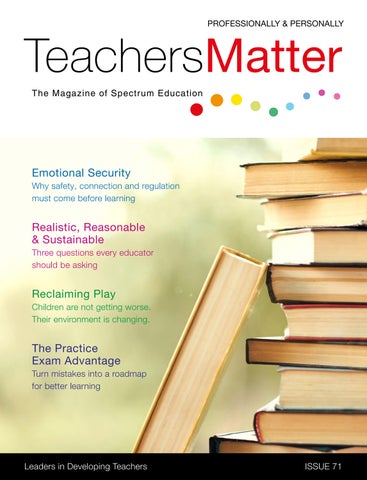
Why safety, connection and regulation must come before learning
Realistic, Reasonable & Sustainable
Three questions every educator should be asking
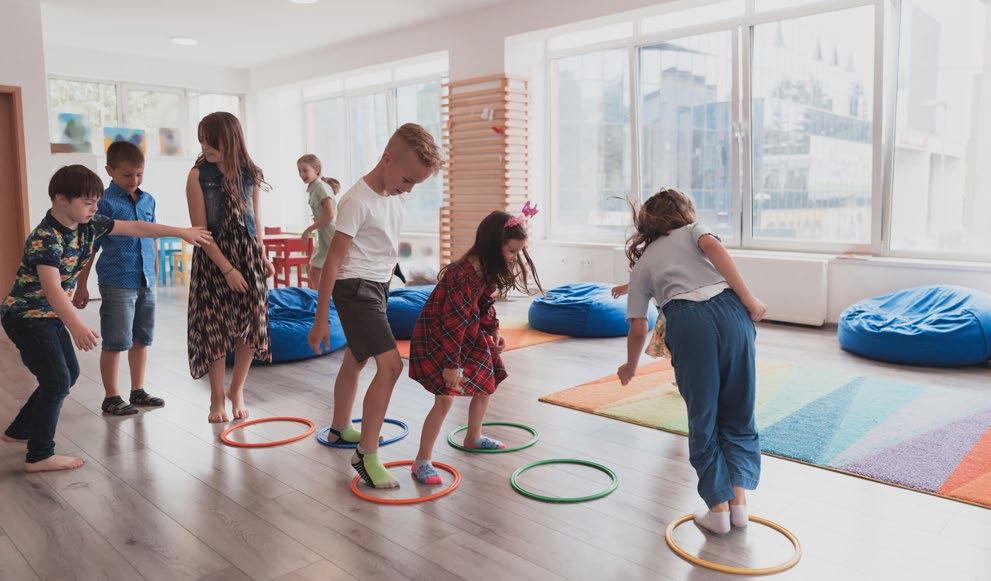
Reclaiming Play
Children are not getting worse. Their environment is changing.
The Practice
Exam Advantage
Turn mistakes into a roadmap for better learning
Almost everything will work again if you unplug it for a few minutes, including you.
ANNE LAMOTT
Quote
Hello Readers,
There are times in education when it feels as though the answer to every challenge is more. More programmes. More interventions. More technology. More meetings. More documentation. More expectations. Yet, as I read through the articles in this issue of Teachers Matter, I found myself wondering: What if more is not always the answer? What if, sometimes, the most powerful thing we can do is pause?
Vanessa McHardy shares a wonderful lesson from a helicopter pilot. When something goes wrong in the air, the first instruction is to sit on your hands. Pause. Observe. Assess. Then act. I love this. In a profession that is constantly moving, changing and responding, pausing can almost feel irresponsible. Yet perhaps it is one of the most responsible things we can do.
Because when we pause, we can ask better questions.
Andrew Oberthur offers three particularly useful ones in this issue: Is it realistic? Is it reasonable? Is it sustainable? Imagine if we applied these three questions more often in education. To our workloads. To new initiatives. To meetings. To expectations of teachers. And, importantly, to what we ask of children.
Throughout this issue, our contributors invite us to look beneath what we see on the surface. A child who is struggling to concentrate may not need to be told to try harder. They may need movement, play, connection or a calmer environment. A student who performs poorly on a practice exam has not failed. They have been given valuable information about what they need to learn next. A teacher who says, “I can’t take on one more thing,” may not lack commitment. They may simply be recognising that the load is no longer realistic, reasonable or sustainable. A child whose behaviour has changed may not be “getting worse”. As Therese Hoyle reminds us, their environment is changing.
These distinctions matter. One of the strongest threads running through this issue is the importance of creating the conditions in which people can thrive. Learning does not happen simply because information has been presented.
Children need to feel safe enough to be curious.
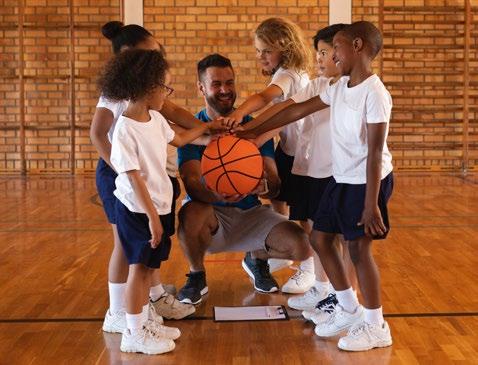
They need opportunities to move, talk and play.
They need environments that recognise their sensory and emotional needs.
They need adults who understand that regulation often comes before reasoning.
And educators need many of these same things. We cannot continually talk about student wellbeing while ignoring teacher wellbeing. We cannot create calm, connected classrooms with adults who are exhausted and overwhelmed. We cannot ask teachers to help children regulate while expecting those same teachers to operate permanently in survival mode.
Perhaps one of the most important questions we can ask ourselves is not: “What else should we be doing?” but rather: “What matters most?”
Sometimes progress comes from adding something new. And sometimes it comes from removing the noise. Creating space. Going for a walk. Letting children play. Learning from a mistake. Saying no to something that is not sustainable. Or simply sitting on our hands for long enough to see the situation more clearly.
Education will continue to change. Technology will evolve. New research will emerge. New challenges will appear. And the fundamentals of being human remain remarkably constant.
My hope is that, as you read this issue, you find ideas that make you think, strategies you can use, and perhaps permission to pause and reconsider something you have always done.
You may not need to do more. You may simply need to become clearer about what matters most.
Rainbows and sunshine,
Karen Tui Boyes Editor-in-Chief
p9 Conditions for Teacher Work
To
Teachers Matter Magazine Team
Publisher, Sales and Advertising
Karen Tui Boyes
karen@spectrumeducation.com
Editor Karen Tui Boyes
Graphic
Magazine Co-ordinator hello@spectrumeducation.com
Subscriptions
Email: info@spectrumeducation.com
Thanks to the educators, speakers and authors who contributed interviews, articles, photographs and letters.
Teachers Matter magazine is registered with the National Library:
Parts of this publication may be reproduced for use within a school environment. To reproduce any part within another publication (or in any other format) permission from the publisher must be obtained.
75
MICHELLE
The opinions expressed in Teachers Matter are those of the contributors and we love them!
Spectrum Education Ltd
Address: 70 Woodman Drive
New Zealand
KAREN
p61 School Taught me What to Think. Final Fantasy Taught me How to Think.
p73 How Marketing Matters
Dear IHOM Community,
It is with profound sadness that we share the passing of our beloved friend, colleague, mentor, and co-founder, Dr. Art Costa.
Terry Thoren writes: “When I was at the Habits of Mind Conference in Vista, California with organizers Bena and Allison Zmuda, I had the good fortune to find a quiet moment with Art. I had the feeling it might be my last in person moment with him. So I used the opportunity to pull out my cell phone and record his answer to my question “What is the meaning of life?” This is what he told me:
“What is the meaning of life?”
“I think that the reason why we're here on Earth is to experience a lot of emotions.
One of them is joy, One of them is humour, One of them is awe, One of them is friendship, and so all of those and a lot more are what compose a life. But it's not just a life. It's a good life.
How do you know the difference between a life and a good life?
Because the more you've experienced the earth and all its beauty… the more you experience friends and all of their contributions… the more you've experienced love and all that it means to you… and the more you've made a contribution to make this place a better place, that's what life is all about.”
In the coming days, we will share opportunities for our community to honour and celebrate Art's life and legacy together.
For now, we invite you to reflect on the impact Art had on your thinking, your teaching, your leadership, or your life. If you would like to share a memory, story, photograph, or reflection, we would be honoured to hear from you.
As Art often reminded us, a life well lived is measured not only by what we accomplish, but by the contributions we make and the lives we touch. By that measure, Art's legacy will endure for generations.
With gratitude and remembrance,
Bena Kallick and Allison Zmuda
95 years of a remarkable life and an enduring legacy.
Honouring the
life of Dr. Art Costa, the Co-Founder of the 16 Habits of Mind
November 20, 1931 - June 13, 2026
The Easiest Way to Stop AI Plagiarising
Shifting the focus from authorship to understanding
This is the EASIEST way to see if a student used AI to do the entire assignment and didn’t think or create for themselves. The only thing easier is knowing your students’ work and comparing it (that’s the best “AI detector”).
The Five-Question Fix: A Better Way to Check if Students Actually Did the Work
We all know AI plagiarism detectors don’t work. Universities are moving away from them. Schools across the country are dropping them. The false positive problem alone (flagging real student writing as AI-generated) has made the whole thing more trouble than it’s worth.
So what do we do instead?
I’ve been doing something this year that a lot of teachers are picking up, and it’s so simple it almost feels too obvious. Shout out to Mrs G, a teacher in New York who’s been running a version of this too. She saw it first on Twitter/X, so if you have that post, please share!
Here’s what you can do. When students turn in a writing assignment, I take their paper (long, short, doesn’t matter) and send it to Claude or ChatGPT with a simple prompt: Take this paper and create a five-question knowledge comprehension quiz based on the information in it.
The next day, every student gets a quiz on their own paper. The one they supposedly wrote.
That’s it.
Here’s why this works
If you actually did the work, which means you researched the topic, brainstormed, outlined, drafted, revised, etc., then you’re going to crush that quiz. You lived in that content. You made choices about what to include and what to leave out. Five comprehension questions on material you genuinely wrote? Easy 5 out of 5.
But if you just copied and pasted something from ChatGPT, slapped your name on it, and hit submit? Good luck getting a 1 out of 5 on that thing. You don’t know what’s in the paper (or any assignment) because you were never part of the process.
This works no matter what your AI policy is. Whether students can use AI for part of the assignment, all of it, or none of it, the short formative quiz still tells you what you need to know. The quiz rewards being part of the process, not avoiding tools.
A.J. JULIANI
Two more options if quizzes aren’t your thing
The quiz is the easiest version of this, but it’s not the only one. Here are two other ways to get at the same thing.
Have them teach it.
Pull a student aside (or do it in front of the whole class if you want) and say, “Teach me the main argument of your paper in two minutes.” If they wrote it, they can do this without blinking. They’ll riff on it, go off script, answer your follow-up questions. If they didn’t, you’ll see it immediately. The stammering, the vague hand-waving, the “I mean, it’s basically about...” without ever getting specific. Teaching requires ownership of the material in a way that copy-pasting never gives you.
Have them defend it.
We’re just asking: did the learning happen? That’s what we actually care about.
And there’s something kind of perfect about using AI on the teacher’s side to make this work. You’re not fighting the technology. You’re using it to quickly generate targeted comprehension questions so you can spend your time on the stuff that matters, like figuring out what your students actually understand and where they need help.
Stop chasing whether AI wrote the paper. Start finding out whether the student can talk about, teach, or defend their thinking and understanding.
This one’s my favourite for older students. Sit down with them one-on-one or in a small group and ask them to defend a claim they made in the paper. Push back a little. Ask why they chose that evidence over something else. Ask what the strongest counterargument would be. A student who was part of the process has opinions about their paper. They’ll push back on your pushback. A student who outsourced the whole thing to AI will fold in about 30 seconds because they don’t actually have a position… they have a document.
All three of these require you to also know your students. The quiz, the teach, and the defend are doing the same thing. They’re creating a moment where understanding is either visible or it isn’t. No detector needed. Just a conversation.
Some students will defer to one of the three options, and you’ll know which is best for each kid.
The real shift in my practice
The old question was: Did the student write this?
The better question is: Does the student know this?
It means I’m not playing detective anymore, trying to run papers through some sketchy detector and hoping it gets the call right. It also means I’m not trying to play “I gotcha” games. I’ll let the students know this is going to happen. Better be prepared.
What do you think?
Stop chasing whether AI wrote the paper. Start finding out whether the student can talk about, teach, or defend their thinking and understanding. Five questions. At the start of one class period. No detector required.
The best assessment strategies right now aren’t about catching cheaters. They’re about designing situations where you can’t fake understanding.
What do you think? What are you doing in The real shift in my practice this moment that is working?
A.J. Juliani
A.J. Juliani is the Wall Street Journal and USA Today Bestselling author of Adaptable. He serves as an Instructor for the University of Pennsylvania Graduate School of Education (PLN) and former Director of Learning and Innovation for Centennial School District. As a Curriculum Coordinator, Tech Director, English teacher, football coach, and K-12 Instructional Coach, A.J. has worked towards innovative learning experiences for schools in various roles. A.J. is also an award-winning blogger, speaker, and author of multiple other books, including the best-sellers Empower, Launch, and The PBL Playbook. His favorite role is Dad to five kids! He can be contacted at: aj@ajjuliani.com
ANDREW OBERTHUR
Conditions for Teacher Work
A practical framework for protecting teacher wellbeing
Every time a teacher listens to a request from a colleague, a parent or even a member of the school leadership team, BEFORE they respond they should stop and measure their response against three conditions and ask themselves these questions:
Is it REALISTIC?
Is it REASONABLE?
Is it SUSTAINABLE?
And if it, whatever it is, doesn’t meet all three conditions, the teacher should consider their response very carefully. If the request meets all three conditions, then proceed and move forward. Let’s apply this theory to the real world of education.
Firstly, here is a simple definition for each of these three terms.
REALISTIC – Can it be done? Is it physically and mentally possible to fulfil or complete the task as requested?
REASONABLE – Should it be done? In legal jargon, “reasonable” is an objective standard of what an average, fair and sensible person would do or expect in similar
circumstances. It is a flexible benchmark used by courts to prevent extremes and is heavily dependent on context. The common vernacular would ask: does it pass the ‘pub test’? How would the request be viewed by the common person, i.e. would they consider it reasonable?
SUSTAINABLE – Can it be repeated and sustained, if required, on multiple occasions?
In schools, teachers are often pulled in different directions by various people seeking the teacher’s time and energy. If teachers are to maintain a degree of personal and professional wellbeing, it is time that these three conditions be analysed and applied to their work. When a teacher wants to be of service to their students, collaborative with their colleagues, supportive of the parents and agreeable to the Leadership Team, then their professional and personal values may be in contestation, especially when their values and the requested behaviours don’t align.
Reflecting on some of the requests that teachers may get asked by their colleagues, identify some that are almost inconsequential, some that are borderline taking liberties, and many levels in between.
ANDREW OBERTHUR
“Would you mind doing this photocopying for me please?” – relatively inconsequential until it becomes a habit and your time and copying budget are being exhausted. Is this a reasonable request? As a one-off or an occasional request, possibly. It is realistic – physically a very simple task. Is this a sustainable practice? Not without jeopardising the goodwill of the colleague.
“Any chance I can get a copy of the assessment task please?” –this may be in the best interests of the students for a consistent assessment task across classes in the same year level... until it becomes an expectation!
precedent); or sustainable (highly unlikely – this will exhaust the teacher)? Hence the response should be: What do you need? And the likely answer is regular feedback, which is realistic, reasonable and sustainable and, in fact, an expectation of the job of teaching.
Teachers should ask: Is it realistic, reasonable and sustainable?
It’s about now the well-meaning teacher is thinking about how they can politely and respectfully decline their colleague’s request. Learning how to say “no” in a polite, professional manner is a skill in itself.
“Do you mind if we meet before or after school hours to collaborate on our year-level planning? How about 7am as I’m a morning person and I leave straight after school?” “Well, I have a young family and a FIFO husband, so after school works better for me.” What is realistic, reasonable and sustainable?
What about the adjustments made for students with disabilities? Are they realistic, reasonable and sustainable? Often allied health experts may suggest adjustments in the best interests of a student’s education and wellbeing. However, when the implementation of these suggestions is reviewed by the classroom expert, the teacher, the reality may be different from the desired proposal. At this point the teacher, ideally in collaboration with the parents, will review the suggestions, draw on the expertise of other staff, and determine if the strategies are realistic, reasonable and sustainable in the classroom and the variety of settings in the school, e.g. library, playground and specialist lessons.
What about when allied health experts offer suggestions to support a student’s behaviour? It could be a psychologist, an OT, a physio or any one of a number of stakeholders who have the student’s best interests at heart. These experts most likely do not know the class dynamics that the teacher manages every day and hence the teacher is invited to review the suggestions against these criteria: realistic, reasonable and sustainable.
Consider all parent requests with the same criteria. When a parent asks for daily written feedback on all subjects (true story), ask yourself: is that realistic (physically –most likely); reasonable (unlikely and sets a dangerous
What about when initiatives from ‘head office’ around teaching practices are suggested, for example, tracking and monitoring student progress by using standardised tests for public consumption? Firstly, the question as to whether or not this practice enhances teaching and learning should be asked. Then the realistic, reasonable and sustainable criteria should be applied. If all three criteria cannot be achieved, then feedback to ‘head office’ should be professional and rational.
When the principal or deputy asks a teacher to do extra duties of any description, then the same criteria should be considered. On occasions, the same teachers carry additional workloads and responsibilities, with little regard for their professional and personal wellbeing. Schools may introduce staff committees to address a range of activities, for example: curriculum, extra-curricular, social, union matters, wellbeing and performing arts, and ask (read,
expect) that staff will carry this additional load on top of their teaching responsibilities. Are the expectations on staff who form and join such committees realistic, reasonable and sustainable? Are some of these requests outside normal teacher work hours, or does the preparation extend well beyond work hours?
For example, preparing for an excursion or taking students on a camp or school trip, possibly interstate or even overseas – are the expectations realistic, reasonable and sustainable? Many teachers work above and beyond their hours of duty and work in the best interests of their students and families. In the current educational climate, are these expectations realistic, reasonable and sustainable? On some occasions the answer is simply NO!
It is long overdue that we ask ourselves whether the extra tasks are enhancing teaching and learning and whether they are, in fact, realistic, reasonable and sustainable.
Teachers also need to reflect on their own commitments, especially when trying to build rapport with parents. Meeting regularly with parents of some students who require close monitoring and collaboration is a highly desirable practice. However, is it realistic, reasonable and sustainable?
An experienced teacher once advised me, as her principal, of her plans to meet every Friday afternoon with a parent
to keep them informed of their child’s weekly progress. I asked how long they intended to maintain this practice.
“For as long as it takes.”
While indicative of a committed teacher, I asked them whether the practice was realistic, reasonable and sustainable. Sometimes teachers need a mirror held up to their practices with the words: realistic, reasonable and sustainable.
These three words form critical criteria for teachers’ work. By reflecting on teacher practices against these criteria, the wellbeing of teachers can be enhanced as they can legitimately regulate their commitments. The message is clear: if requests do not meet all three criteria, then be very cautious about committing to an affirmative response.
Andrew Oberthur
Andrew Oberthur is the father of two young adults and a former primary school principal with over 35 years’ experience teaching and leading primary schools in Brisbane. He currently works as an educational consultant and tutor at Australian Catholic University and is available for consultation.
Andrew is the author of three books: Are You Ready for School? Building a Culture of TRUST, COLLABORATION and ENQUIRY between Teachers and Parents.
Balance: Building Positive Relationships within Educational Protocols.
The School Leadership Juggle: Managing the Expectations with the Reality of School Life
He has been on ABC Brisbane radio a dozen times over recent years and has contributed to podcasts for various groups. He is a regular contributor to Teachers Matter, Kiddipedia, Parent TV, and Education Today.
Andrew’s passion is creating positive relationships between teachers and parents, recognising that together they can have a profound impact on children’s learning. He believes parents and teachers must work in partnership.
He also supports school leaders in maintaining wellbeing by managing workload and expectations. The responsibilities associated with teaching and leadership can easily become all-consuming, and Andrew is committed to helping ensure the longevity of educators through practical, sustainable wellbeing strategies.
He can be contacted at: andrew@oberthur.org
CRISTA A. HOPP, MA
Why We’re Teaching Executive Function Backwards
Building the foundations before teaching the strategies
More often than not, when educators think about executive functions, we jump straight to time management, organisation, and planning. But consider this: professional organisers, wedding planners, and executive assistants have built entire careers on those exact skills. Which means something important: these are advanced executive functions.
So what are executive functions? Executive functions are the brain-based skills that help us manage ourselves in order to achieve a goal. They allow us to start tasks, stay with them, adjust when needed, and follow through. They include skills like attention, working memory, regulation, and cognitive flexibility. And here is the part we often miss: not all executive functions are created equal. Some are foundational, and some are advanced. When we skip the foundation, the advanced skills do not stick.
The Foundational Executive Functions
1. Attention
Attention is the entry point. If a student cannot attend to information, they cannot process it, store it, or act on it. Attention allows students to take in directions, notice important details, and stay engaged long enough to begin. Without attention, nothing else activates.
2. Working Memory
Working memory is often described as “memory in action”. Cognitive scientist Nelson Cowan’s research has been instrumental in establishing working memory’s central role in learning and performance, demonstrating how deeply it shapes a student’s ability to follow directions, retain steps, and apply information in real time. In the classroom, this shows up constantly: following multi-step directions,
remembering what to do next, and holding onto key information during a lesson. A student may remember the first step but lose the last one along the way.
3. Regulation
Regulation is not just behaviour. It is the ability to manage thoughts, emotions, and actions. When students become overwhelmed, frustrated, or fatigued, their ability to access executive functions decreases. The brain shifts away from the prefrontal cortex, and everything becomes harder to manage. This is why a capable student can suddenly appear off task or unmotivated.
4. Cognitive Flexibility
Most people think of cognitive flexibility as all-or-nothing thinking, and while that is part of it, cognitive flexibility goes much deeper. It is the ability to shift thinking, adapt strategies, and approach tasks in different ways, especially when something is not working. In the classroom, this shows up in subtle but important ways. In maths, a student can solve a problem one way but struggles when asked to try a different strategy. In reading, a student interprets a word one way and has difficulty adjusting meaning based on context. In writing, a student resists revising because they are stuck on their original idea. What can look like resistance is often rigidity, and what can look like not trying is often a brain that does not yet know how to shift.
From Foundation to Application
students to manage complex tasks independently, we need to look at the supports, structures, and demands we are placing around them. So where do we begin? Not with planners or colour-coded binders, but by looking at what the environment is asking of the student and whether the foundational systems are in place to meet that demand.
To reduce the working memory load, give one to two steps at a time both verbally and in writing, keep directions visible, and ask “What is your first step?” rather than “Do you understand?” To support regulation, build in pause moments by saying “Take a moment to think” before students are expected to respond. To build cognitive flexibility, ask “Is there another way to approach this?” and normalise having an A plan and a B plan.
Executive function is not a checklist of skills. It is a system.
Before intervening, observe what is actually happening. Did the student lose the steps? Did they shut down? Did they get stuck?
Each of those points to a different foundational system, and when we understand what is driving the behaviour, our responses become far more targeted and effective.
A Final Thought
Executive function is not a checklist of skills. It is a system. When we understand that system, we move from reacting to student behaviour to responding with intention.
Once these foundational systems are in place, students are far more able to engage in advanced executive functions like planning, organisation, and time management. Without the foundation, these advanced skills break down, not because students are unwilling, but because the system cannot yet support them. As author and educator Eric Jensen has emphasised, the brain must be ready for learning before it can effectively manage complex tasks.
Cognitive flexibility is what allows students to move forward when things don’t go as planned.
What This Means for Your Classroom
As executive function researchers Peg Dawson and Richard Guare have consistently argued, meaningful change in executive function begins with the environment long before it shows up in the student. Before we expect
Crista A. Hopp, MA
Crista A. Hopp, MA, is the founder of Connected Pathways Coaching and Connected Pathways Academy. With over 30 years of experience, she specializes in executive function, helping educators, parents, and students understand how the brain drives learning, behavior, and performance.
She can be contacted at: E: crista@connectedpathwayscoaching.com W: connectedpathwayscoaching.com
Leadership Lessons from Isaac
What Newton’s laws can teach us about leadership
We are both educators, Stakeholder Centered Coaching® (SCC) leadership coaches, science teachers, and lifelong learners. We read educational and business literature to gain models for fresh ideas.
It occurred to us, as science teachers, that there are some lessons to be applied to organisations. Following are three of Sir Isaac Newton’s laws that seem to fit coaching, learning, and leadership cultures in both profit and nonprofit organisations.
Newton’s First Law – Inertia
A body remains at rest or moving in the same direction unless acted upon by an external force.
Many people have said, in various ways, “If you always do what you did, you always get what you got.” So, is the organisation moving in the right direction, is the status quo working, or are new approaches warranted?
Application
If leaders want the same thing, they usually get the same results. If leaders are pleased with their behaviour, they keep doing it. As the environment changes and some practices are not getting the intended results, consider adapting or changing the direction of current practice. Marshall Goldsmith (2007), in What Got You Here Won’t Get You There, wrote that what worked in the past may not
be working as well now or in the future. If a leader wants different results, we look at behaviours that can move or change direction.
SCC focuses on FeedForward. We can’t change the past, and we can change the future. So, what will we do in the future that might get better outcomes?
If leaders want different results, we look at behaviours that can move or change direction.
Newton’s Second Law – Force = Mass x Acceleration
The larger the mass, the more force will be needed to get individuals and/or systems moving.
Application
One new behaviour change by a leader can change the results and outcomes. A change of behaviour in one area can affect other areas, making them more effective and efficient. Feedback from stakeholders, those who report to the leader, can change direction and build trust. Those who are impacted by the leadership change are in the best position to tell whether a new behaviour is getting the intended results.
The size of the organisation does matter. The larger the system, the more leadership is needed to initiate and sustain desired change. More leaders who can model and initiate change will be necessary at all levels. Keith Ferrazzi (2024) wrote in Never Lead Alone: our experience tells us no leader makes changes alone. Success is a collaborative process requiring good thinking and leaders at all levels.
Small changes can have large effects.
“If you think you’re too small to make a difference, try spending the night in a closed room with a mosquito.”
- West African Proverb
Newton’s Third Law – Any action can expect an equal and opposite reaction
Application
People and organisations get used to how things work. Most learning comes from watching the system, not from handbooks and policies. When a leader changes behaviours, a couple of things result. First, is this change going to stick? There is usually a grace period where colleagues will wait a while before believing a change will be for the good. Second, sometimes colleagues will want the old behaviours to return because they have become comfortable with the system and how it operates. Changed behaviour usually means others might also change, or they wait for the emotional neurotransmitter, TTSP, to keep things the same. TTSP equals: This Too Shall Pass.
Many times, the organisational immune system fights back. I know how to work within the current system. If the system changes, I might have to change. First, I will wait it out. Second, I might find other colleagues who do not want the changes. Finally, as a group, there may be covert or overt sabotage. A wise leader knows these stages might happen and prepares for them by building leadership at all levels.
Expect resistance to returning to the way things were and a belief that a new behaviour might be short term.
Scott Combs
Scott Combs is a 6th-grade middle school science teacher in Memphis, Tennessee.
He can be contacted at: smcombs2@gmail.com
Dr. William Sommers
Bill has been an administrator at the middle school, high school, central office, and at the university level working in leadership preparation programs and doctoral faculties. As a teacher, he worked with self-paced physics, math, and chemistry teaching methods.
With over forty years of experience in teaching and leading schools, he has actively extended his learning from education to include business models. He has been a consultant with Cognitive Coaching, Adaptive Schools, Brain Research, Poverty Issues, Leadership Development, and Conflict to Consensus models.
He can be contacted at: sommersb4@gmail.com
Making Learning Visible in Health and Physical Education
Helping ākonga connect movement, purpose and growth
Have you ever noticed ākonga (students) dragging their feet during laps, going through the motions in a game, or appearing disengaged and wondered if they truly understand what they are learning?
For many of us, HPE is synonymous with activity: running, throwing, catching and playing games. Any passionate kaiako (teacher) will tell you there’s so much more happening beneath the surface. Each of your lessons is an opportunity for ākonga to grow physically, socially, emotionally and cognitively. The key is making learning visible, ensuring ākonga understand what they are learning, why it matters and how they can improve.
Visible Learning, a concept that emphasises clarity, feedback, student ownership and shared responsibility, reminds us that ākonga flourish when they are active cocreators of their learning. Together, these approaches offer opportunities in HPE to transform activity into intentional, meaningful learning, supporting all aspects of well-being.
Why Making Learning Visible Matters
Research shows that ākonga achieve more when they understand what they are learning, why it matters and how they can improve. It’s not just the activity itself that drives progress; it’s how ākonga see, reflect on and influence their own learning. The most effective learning happens when ākonga are empowered to make decisions, solve problems and track their growth.
In practice, this might look like a class where ākonga aren’t just running laps, they’re:
• Reflecting on their personal endurance and physical progress.
• Setting achievable goals, such as improving the number of ball passes or completing a set fitness circuit.
• Learning how teamwork, positioning and strategy make their performance stronger.
That’s visible learning in action, where movement is connected to purpose, reflection and growth.
Turning Movement into Meaning
So how do we make learning visible in HPE? It starts with a simple mindset shift: ākonga are not just participants, they are learners, active in every step of their learning journey.
One practical approach is the Context + Concept = Learning Intention formula. For example, in a team-based game:
Context: Playing a cooperative movement game.
Concept: Understanding teamwork, communication and spatial awareness.
Learning Intention: Learn how collaboration and positioning strategies help your team succeed.
Making this connection explicit helps ākonga see the purpose behind every movement, decision and strategy. It’s no longer just “running around”; it’s learning with intention, linking physical skills to problem-solving, critical thinking and social development.
Practical examples for kaiako:
• During fitness circuits, ask ākonga to track their reps or distance and reflect on improvement strategies.
• In team games, pause mid-activity to ask: “What strategy worked for your team? How could you adjust for the next round?”
It’s not just the activity itself that drives progress; it’s how ākonga see, reflect on and influence their own learning.
• During warm-ups, integrate brain breaks or quick mindfulness moments to focus attention and emotional regulation.
• For skill drills, pair ākonga to give peer feedback, reinforcing communication and social skills.
Ākonga as Co-Creators
Visible Learning encourages kaiako to hand over the reins, at least partially. Ākonga can:
• Set their own learning goals and decide what “success” looks like.
• Engage in self and peer assessment using checklists, rubrics or peer feedback.
• Reflect on progress through journals, learning logs or video recordings.
• Participate in feedback discussions, asking questions and planning next steps.
When ākonga take ownership, they become more engaged, self-aware and motivated. They don’t just “do”; they think, adapt and improve, developing problem-solving, decisionmaking and self-regulation skills.
Examples of co-creation in HPE:
• In a dance or movement unit, ask ākonga to create a sequence and define what success looks like (e.g. balance, rhythm, teamwork).
• During athletics, let ākonga choose their personal or group targets for distance, time or accuracy.
• In invasion games like netball or basketball, allow teams to set rules for scoring or defensive strategies before playing.
Feedback That Actually Works
Feedback is at the heart of making learning visible. The most effective feedback in HPE goes beyond technical corrections; it helps ākonga understand their learning journey and next steps.
Strategies kaiako can use:
Feed-Up: Clarify the learning goal so ākonga know the “why” behind the activity.
Feed-Back: Give timely, specific feedback on how ākonga are progressing relative to the goal.
Feed-Forward: Suggest concrete strategies to improve next time.
ERIN STEEL
Other approaches include:
• Two Stars and a Wish: Ask ākonga to identify two strengths and one area to improve.
• Peer Coaching: Assign partners to observe and give feedback on strategy, technique or teamwork.
Reflection and Growth
Reflection is essential for visible learning. Ask ākonga questions like:
• What challenged you today and how did you work through it?
• Which strategies helped you succeed and how could you use them in other activities?
• What feedback did you receive, and how did you act on it?
This process builds resilience, self-awareness, problemsolving skills and agency, helping ākonga become lifelong learners.
Linking Te Whare Tapa Whā to HPE:
• Taha Tinana (Physical): Fuelling our bodies (nutrition), skills, coordination, fitness and movement habits.
• Taha Hinengaro (Mental/Emotional): Reflection, goal-setting, self-regulation and perseverance.
• Taha Whānau (Social): Collaboration, communication, empathy and teamwork.
• Taha Wairua (Spiritual): Sense of purpose, belonging and connection to self and peers.
When we frame learning experiences and activities within Te Whare Tapa Whā, kaiako ensure that HPE develops the whole ākonga, not just physical skills.
Why It Matters
When learning is visible, HPE becomes more than physical activity. Ākonga develop self-confidence, agency and a love of learning that extends beyond the gymnasium or field. Kaiako gain clarity about their teaching impact and can guide ākonga with purpose, intention and insight.
The next time your class steps onto the playground or court, ask yourself: Are my ākonga just moving, or are they truly learning and developing in all aspects of well-being?
Making learning visible isn’t just a technique in your kete, it’s a philosophy. One that shifts HPE from simply doing activity to truly understanding learning. Ākonga begin to see their own progress, recognise their strengths and understand how effort, strategy and reflection help them grow.
In this way, HPE becomes far more than movement; it becomes a powerful space where confidence, capability and lifelong learners are developed across Te Whare Tapa Whā.
Erin Steel
Erin Steel is an educator with over 20 years of experience and now works as a Healthy Active Learning Facilitator. Passionate about the wellbeing of children, young people and teachers, Erin partners with schools to enhance Health and Physical Education through play, active recreation and sport.
Born and raised in Auckland, Erin now calls Whangārei home and is deeply connected to her community. She is a proud mum, football player and coach, half marathon walker, cricket sideline supporter and advocate for teacher wellbeing. Erin believes in the power of connection, hauora (wellbeing) and storytelling to create meaningful change in education.
She can be contacted at: whaea.erin.steel@gmail.com
The opposite of play is not work — the opposite of play is depression.
BRIAN
SUTTON-SMITH
The Textbook Is Not the Curriculum.
The Teacher Is Not a Technician.
Let’s not get confused
Technician
1. a specialist in the technical details of a subject or occupation, e.g. a computer technician
2. one who has acquired the technique of an art or other area of specialisation
Iama teacher, not a technician.
On the surface, teaching is technical. Teaching requires techniques, teaching happens in systems and uses systems, teaching involves problem identification and solution finding, and teaching requires a range of tools, some of which are specialised. But teaching cannot be reduced to technique alone. It is specialised, nuanced, practical,
philosophical, influenced by a huge range of variables, and ever-evolving. It is pedagogical.
Pedagogy is more than teaching practice. Pedagogy is the art and science of teaching; it is the how and why of teaching, bringing together theory and practice, drawing from a variety of disciplines, understanding the unique needs of the students in your care, and making nuanced decisions about what to do and how to do it. Teaching practice is the “what you do” bit, the actions taken, the way you use the tools of the trade, the technical part, if you will. Our students deserve pedagogical practitioners who are empowered to be at their best in the classroom.
You can’t do the practice well without the pedagogy.
Textbooks are tools, as are the numerous strategies we can draw from, the equipment we use, the resources we access, the books we read, the stories we tell, the images we view, the environment we create, the routines we embed, the experts we bring into the classroom, and the trips we take. As Grant Wiggins says, textbooks are not the curriculum;
they do not dictate what we teach nor how we teach it. Textbooks are generic by necessity. They do not know your students, their interests, their prior knowledge, nor their specific next steps or needs. They are merely one of the resources that teachers can access.
Grant Wiggins also describes teachers as architects of learning. As architects, we design curriculum by referring
When teachers are treated as technicians, their role becomes one of delivery rather than design.
to user needs, researching best practice, addressing standards and codes, and creating environments where those who live and work in them can thrive. The national curriculum gives the standards and codes, but it is teachers who must interpret and enact the curriculum so that students can learn what is required. Some of our students might already know some of the content, so there’s no point teaching what they already know. Some may not have developed key skills and knowledge earlier, so we need to find ways to help them access the learning. Some may not have the prior knowledge to make sense of new content, so we need to construct learning opportunities to help them make connections.
All of this is part of our pedagogical practice.
When teachers are treated as technicians, their role becomes one of delivery rather than design. The focus shifts from understanding learners to implementing programmes. Professional judgement is replaced by compliance. Our students stop being our purpose and simply become products.
Teaching is human work. Teaching is pedagogical practice. Teaching is complex, nuanced, demanding, and important.
This is beyond technique.
I am a teacher.
Megan Gallagher
Megan is a committed learner. She is a teacher and has been an educational leader who has specialised in health education for a number of years. She is an avid promoter of building resilience in our students and selves. Find out more at: www.meggallagher.nz
She can be contacted at: meggallagher@xtra.co.nz
Leadership RadioNavigating the Noise
Filtering competing voices while staying true to purpose
Imagine hopping in the car and turning on every radio station at the same time. Country music on one frequency. Heavy metal on another. Talkback radio. Weather updates. Sports commentary. Advertisements for half-price tyres. Absolute chaos!
And while some of that feedback is valuable, not all of it deserves equal weighting. The problem begins, of course, when leaders unconsciously start treating every opinion as equally urgent. I can understand this totally - I tried to do it. I thought it was this thing called “leadership”.
Sometimes leadership isn’t about finding a better answer. It’s about finding a quieter place to hear the right one.
Congratulations! You’ve arrived at modern educational leadership!
One of the great challenges of leading schools in 2026 isn’t a lack of information. It’s drowning in it.
Interestingly, leaders of previous generations had plenty of pressures too, but today’s environment has added a new ingredient: immediate and constant commentary.
Opinions no longer arrive once a term at a Board meeting or parent evening. They arrive instantly, continuously, and publicly. Ouch!
The thing is, though, human brains aren’t particularly good at this. Not the leadership part - the treating every opinion as equally urgent part.
Research into cognitive load suggests that when people process too much competing information, decision quality decreases and stress increases. People become reactive instead of thoughtful.
You might recognise the feeling:
You finish reading an email. You open social media. You have a conversation in the staffroom.
Suddenly you find yourself mentally carrying fifteen different concerns at once. None individually overwhelming.
But when you put them all together - well, they’re collectively exhausting.
The temptation is to solve everything. To respond to everyone. And maybe even to smooth out every ripple. But that’s where leadership often becomes unsustainable.
Leadership shouldn’t be “crowd-sourced decision making.” Leadership should be the opposite - a process of thoughtful filtering.
Of course, this doesn’t mean becoming dismissive.
Far from it. Listening matters enormously. Communities want to feel heard. Staff want to feel valued. Families want reassurance that they matter.
So it’s important to understand that selective listening isn’t selective caring. They’re completely different things. Strong leaders ask different questions:
• What values sit underneath this concern?
• Is this issue affecting children?
• Is this a loud concern or a widespread concern?
• Is this feedback, or is it anxiety speaking?
That last one in particular matters heaps. People often express fear as certainty. Someone worried about curriculum change might sound angry. Someone uncertain about AI might sound resistant. Someone overwhelmed by change may sound critical. Underneath many of those opinions sits care.
So I guess the real challenge for leaders is hearing the emotion underneath the words.
And another useful question is: “What evidence am I using here?”
Because schools can unintentionally become places where rumours travel faster than reality. One conversation becomes: “People are unhappy.” Three conversations become: “Everyone is unhappy.”
Suddenly you’ve built a narrative that might not even exist.
This is where leaders need anchors. Start with your values. Values are incredibly important.
When you know what you stand for, decisions become steadier.
Not necessarily easier. Just steadier.
The noise doesn’t disappear. But it becomes easier to recognise which station deserves the volume turned up.
Perhaps the most important thing leaders can do is occasionally leave the noise entirely. Walk through classrooms. Sit with students. Watch a lunchtime football game. Listen to children reading.
Because schools themselves usually tell a much more hopeful story than the commentary around them.
Children still laugh. Teachers still care. Relationships still matter. Progress still happens.
You know what? Sometimes leadership isn’t about finding a better answer.
It’s about finding a quieter place to hear the right one.
Steve Zonnevylle
Steve Zonnevylle is a New Zealand educator, author, leadership coach, and co-founder of the Forty Hour Principal Project and Thrive Leadership - two initiatives that have sparked national conversations about principal wellbeing and what sustainable leadership actually looks like in Aotearoa’s schools. With 35 years in education and 28 of those in principalship roles, Steve brings a rare mix of wisdom, humour and unapologetic humanity to every stage he steps onto.
Outside of education, Steve is a musician, photographer, creator, and dog-dad to Daisy the Cocker Spaniel - who famously graced the cover of Be Slacker Better as a reminder that joy, curiosity, and living fully in the moment are not optional extras, but essential leadership tools. He lives in Oamaru with his wonderfully supportive partner, Isabel.
Today, Steve works with leaders across Aotearoa helping them create healthier cultures, rediscover the meaning in their work, and lead with courage, clarity, and a bit more fun. His message is simple: leadership is part of your life, not your whole life - and if you’re willing to rethink what “professionalism” really means, you might just find a way to thrive.
He can be contacted at: stevezonnevylle@gmail.com
When Being Gifted Stops Being Easy
Understanding why gifted students sometimes disengage and how teachers can support them
It often comes as a surprise.
A gifted student who has always been enthusiastic, helpful, and highly capable suddenly starts pushing back. They stop volunteering answers. They no longer want leadership opportunities. They refuse to help classmates. They become critical of tasks, appear disengaged, or start acting out.
Teachers often wonder what has happened.
The reality is that, in many cases, nothing has gone wrong at all.
Instead, the student may have reached an important stage in their learning journey. They may have reached the current limits of their giftedness and, for the first time, are facing genuine challenge.
1. The Hidden Cost of Being “The Smart Kid”
Gifted students often spend years receiving praise for being clever.
They are the students who finish quickly, know the answers, and seem to learn effortlessly. Adults frequently comment on how smart they are, how talented they are, and how easily they succeed.
While this praise is well intentioned, it can create an unintended consequence. The child begins to see intelligence as part of their identity. Rather than thinking, “I work hard,” they begin thinking, “I am smart.”
This becomes problematic when they eventually encounter something difficult. If being smart is who they are, then struggling can feel threatening. Difficulty becomes evidence that perhaps they are not as capable as everyone thought.
Many gifted students have not had enough opportunities to experience productive struggle. While other students have been developing resilience, persistence, and coping strategies through challenge, gifted students may have continued succeeding through natural ability alone.
Being gifted does not automatically teach a child how to learn.
2. When Giftedness Reaches Its Current Limit
Every learner eventually encounters work that stretches them beyond what comes naturally. For gifted students, this moment often arrives later than it does for their peers. When it does arrive, the experience can be unsettling.
For the first time, they may not immediately understand a concept. They may have to revise their work, ask for help, or invest significant effort to achieve success. Many gifted students interpret this discomfort as failure.
Instead of seeing challenge as part of learning, they see it as evidence that something is wrong. As a result, some students avoid challenge altogether. Others become frustrated, withdrawn, or resistant.
The student who once embraced every opportunity may suddenly refuse to participate. The issue is not a lack of ability. The issue is that they are finally encountering something that requires them to develop new learning muscles.
3. The Burden of Being the Classroom Expert
Gifted students are often given additional responsibilities. They become the helper. The tutor. The peer coach. The student leader. The one who is asked to explain concepts to others. While many enjoy these opportunities initially, it can become exhausting over time.
These students are often expected to support everyone else’s learning while receiving little support themselves. Imagine being the person everyone turns to for help, yet rarely being given opportunities to struggle, ask questions, or simply be a learner. Some gifted students eventually become tired of carrying this role.
When they stop volunteering to help others or turn down leadership opportunities, teachers can interpret this as a loss of motivation. In reality, they may simply want permission to focus on their own learning and growth. Gifted children deserve challenge and support, not just responsibility.
4. Why Some Gifted Students Suddenly Become Difficult
Many teachers describe a gifted student’s change in behaviour as happening “overnight.” Often, the change has been building beneath the surface for some time. The student may begin procrastinating, refusing to complete work, criticising tasks, avoiding challenge, or withdrawing from activities they once loved. Comments such as “This is dumb,” “This is boring,” or “What’s the point?” become increasingly common. These behaviours are often forms of self-protection.
Being gifted does not automatically teach a child how to learn.
If a student dismisses a task as boring, they don’t have to risk failing at it. If they refuse to try, they can preserve the image of being capable. What appears to be arrogance is often anxiety. What appears to be laziness is often fear. Underneath the behaviour may be a child wondering, “What happens if I’m not the smartest person in the room anymore?”
Behaviour is communication. Before addressing the behaviour itself, it is important to understand what the student may be trying to communicate.
5. What Gifted Students Need Most
One of the biggest myths about gifted learners is that they simply need harder work. What they often need most are the skills that support learning when things become difficult.
• They need to learn how to persist.
• How to manage frustration.
• How to seek feedback.
• How to cope with mistakes.
• How to think flexibly when their first approach does not work.
KAREN TUI BOYES
• How to break large tasks into manageable steps.
• How to reflect on their own thinking and learning processes.
These skills do not magically develop simply because a student is intelligent.
In fact, many gifted students have had fewer opportunities to practise these skills because school has been relatively easy for them. The goal is not simply to challenge gifted students academically. The goal is to help them become capable learners who can thrive when challenge inevitably arrives.
6. Practical Ways Teachers Can Help
One of the most powerful shifts teachers can make is moving praise away from intelligence and towards effort, strategy, and growth. Rather than saying, “You’re so smart,” try saying, “I noticed you kept trying different approaches until you solved that problem.”
Normalise challenge and struggle within your classroom. Talk openly about mistakes and learning from them. Share examples of times when you found something difficult and how you worked through it. Provide opportunities for gifted students to experience challenge
in a supportive environment where mistakes are expected rather than feared. Allow them to step away from being the helper all the time. Give them permission to focus on their own learning.
Teach explicit learning skills such as goal setting, selfreflection, study strategies, persistence, and problemsolving. Most importantly, help gifted students understand that their value is not linked to being the smartest person in the room. Their worth is not determined by how quickly they learn, how many answers they know, or how often they succeed. Their value comes from who they are as people and their willingness to keep learning and growing.
Final Thoughts
Some of the most challenging moments for gifted students occur when they discover that intelligence alone is no longer enough. Yet these moments can also become some of their most important learning experiences. The student who has always relied on natural ability now has the opportunity to develop resilience. The student who has always succeeded easily now has the opportunity to develop persistence. The student who has always been known as “the smart one” now has the opportunity to become something even more powerful.
A learner. And that is a gift that will serve them for the rest of their lives.
Karen Tui Boyes is a champion for LifeLong Learning and is on a mission to transform education globally. Described as an educational alchemist, a conscious creator and a playful priestess, she grounds the research into practical strategies which positively impact teaching and learning.
A multi-award-winning speaker, educator and businesswoman, she is the CEO of Spectrum Education, Principal of Spectrum Online Academy and the author of 14 books.
Find out more at: www.spectrumeducation.com
Karen Tui Boyes
The Quiet Damage of a Life Pointed the Wrong Way
What happens to a student when the system never gives them the tools to understand who they are.
There is a kind of loss that does not show up in any data. It does not appear in school reports or wellbeing surveys. It takes years to become visible, and by the time it does, the people carrying it have usually stopped expecting anyone to notice.
It is the loss that comes from spending a decade building a life in the wrong direction.
In my work across career guidance and aptitude profiling, I have met people in their thirties and forties who have everything they were told to want and still feel, quietly and persistently, that they are living someone else’s life. Their words are almost always the same. I fell into it. I never really thought about it. I did not know what else to do.
This is not a story about anyone failing them. It is a story about a gap that has existed in our education system for a very long time. A gap between what we teach young people and what we help them understand about themselves.
The cost is rarely dramatic. That is what makes it so easy to miss. Sometimes it looks like the high achiever who climbs steadily and joylessly. Sometimes it looks like the person who changes career three times in a decade, not from ambition but from a persistent sense that they have not yet found where they belong. And sometimes it looks like serious, grinding burnout in people who are technically doing everything right.
BRIAN NOBLE
Teachers see the early signs of this every single day. The student who drifts through subjects they have no real connection to. The one who is bright but somewhere else entirely. The one who performs well on paper while something quieter and more important goes unmet. Teachers notice. They have always noticed. What they have rarely been given is the time, the tools, or the framework to do much about it.
That is the gap. And it is a structural one, not a personal one.
Natural aptitude is not the same as academic ability. It is the way a person’s mind moves effortlessly through certain kinds of thinking. The student who instinctively spots the flaw in a system before anyone else. The one whose mind generates ideas constantly. The one who reads people with extraordinary accuracy. These are not quirks to be managed. They are architectures to be understood. And when a young person finally has language for how they are genuinely wired, something shifts that no amount of motivation or academic pressure could produce.
At Achievement Discoveries, this is the work we exist to do. Through aptitude profiling and career alignment, we sit alongside teachers and schools in New Zealand to help fill that gap. Not to replace the teacher’s instinct, which is already extraordinary, but to give it language, structure, and something concrete to work with. When a student understands their natural aptitude and can see how it
connects to real pathways, the change in direction and energy is often immediate.
The most powerful question we can help a young person answer is not what do you want to be, but who are you actually? Those two questions sound similar. The distance between them, in terms of what they unlock, can be the difference between a life that fits and one that never quite does.
A student pointed the wrong way does not always look like a student who is struggling. Sometimes they look like a student who is succeeding at something that will quietly cost them everything.
The quiet damage of a life pointed the wrong way is real. But so is the quiet power of a young person who finally, clearly, understands who they are. Teachers have always known this. Now there are tools to match that knowing. And that changes everything.
Brian Noble, founder of Achievement Discoveries and Careersure in New Zealand, has over 20 years of experience in career guidance, corporate productivity, and business performance. He specialises in aptitude testing and profiling, helping young people, adults, and organisations unlock their potential by aligning natural abilities with suitable career paths. A former senior executive at Canon and Xerox, Brian now works with teachers, students, organisations, and professionals across New Zealand to help them understand and harness their natural strengths in practical, powerful ways.
He can be contacted at: brian@ad.org.nz
Brian Noble
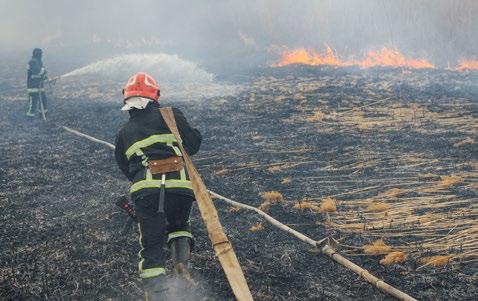
Fire Smart
Navigating conflict to build stronger school cultures
Fire can be used for good and it can be destructive. Fire can provide heat for warmth and cooking, or it can burn down buildings, injuring and killing humans and animals. I was inspired by an article Larry Cuban, emeritus professor at Stanford, wrote in 1985 about superintendents in schools.
Many times, humans are in the middle of firestorms and conflicts that don’t seem to have an end in sight. Left to burn, these events can ignite other fires, spreading to multiple areas of our life. There are organisations that are on fire with toxic work environments, including abusive leaders, expanding demands, shrinking resources, or political adversaries.
Chemical change, on the other hand, is not reversible. If fire burns something, the chemicals might not change, but the structure is changed forever. Change can be positive when the results involve making things easier, cheaper, or quicker. When making organisational change, the results can be destructive or constructive.
When ignorance ends, reponsbility begins.
Chemistry identifies two kinds of change: physical and chemical. An example of physical change is water freezing and turning into ice. Ice melts and turns into water. Physical change can be reversed, and the makeup of H₂O doesn’t change. It is reversible.
I will use the metaphor of fire as a model for positive change from a negative environment. My experience has resulted in leading schools to a positive culture and unleashing the potential that currently exists. No matter the test scores, reputation, or community, there are star performers in schools. Good staff members, behind closed classroom doors, may be doing great things for students without being noticed. This has been called isolated pockets of excellence existing in difficult places.
Remember: fires can divert energy, cost money, waste time, and cause emotional stress, all leading to reduced productivity.
Three Phases of Fire to Reignite Positive Cultures
Phase 1: Fire Fighting
When coming into an existing organisation where there are fires, the first job of the leader is to find others who will help put out the fires. The fires could be fighting among students; emotional drama among staff, students, and parents; and even school disagreements with district leaders. The first order of business is to create physical safety for those inhabiting the school.
The second priority is to make sure there is emotional safety. Amy Edmondson (2019), in her book The Fearless Organization, provides extensive research on creating safety for knowledge workers, reducing the fear of honest conversations, and providing the basis for innovative practices. She includes a survey that can be used to assess teams and organisations relative to emotional safety. It is difficult, if not impossible, to put out fires that a leader doesn’t know about or other covert issues.
Phase 2: Fire Prevention
When ignorance ends, responsibility begins. Once physical and emotional safety exists, issues are overt. When problems become known, leaders and staff can start addressing these issues, developing systems to be put into effect to reduce the number and intensity of fires. A reminder: not knowing about fires doesn’t make them go away. They go into hiding, making it even more difficult to ferret out the real dysfunction. Transparency is key to identifying what changes need to occur so fires don’t smoulder or start.
This step requires identifying an extensive degree of possibilities, an understanding of systems thinking, and scenario planning to move towards a preferred future, rather than letting the system stagnate. Left alone, the system remains the same or may continue in the wrong direction.
Phase 3: Starting Fires
Once safety has been established and systems are in place to ensure more consistency and accountability, where do you start fires? Fires of ongoing learning for all... fires of collaboration and community... fires of shared leadership including colleagues and students. Organisational development does not happen without individual development. Growing and attracting talent is an ongoing imperative in schools.
Attracting, retaining, and sustaining the best requires a culture that honours knowledgeable workers and their contributions. It is not about only one best practice. It is about acquiring multiple best practices for an ever-diverse and changing population. It is about professional growth that can generate many creative processes for learning together.
I encourage a process called the ‘Reverse Las Vegas Effect’. Whatever works, tell everybody. Whatever doesn’t work, tell everybody. People should not have to learn everything alone. A collaborative environment accelerates everyone’s learning. Share it.
In closing, I quote Angeles Arrien, who said:
“If your job is waking up the dead GET UP, TODAY IS A WORKDAY”
Dr. William Sommers
Bill has been an administrator at the middle school, high school, central office, and at the university level working in leadership preparation programs and doctoral faculties. As a teacher, he worked with self-paced physics, math, and chemistry teaching methods.
With over forty years of experience in teaching and leading schools, he has actively extended his learning from education to include business models. He has been a consultant with Cognitive Coaching, Adaptive Schools, Brain Research, Poverty Issues, Leadership Development, and Conflict to Consensus models.
He can be contacted at: sommersb4@gmail.com
Experience is not what happens to you; it is what you do with what happens to you.
ALDOUS HUXLEY
Developing Problem Solvers in the Classroom
Preparing students for life
In today’s rapidly changing world, students need more than memorisation and test-taking skills to succeed. They must learn how to think critically, adapt to challenges, and solve problems with confidence. Classrooms should be places where students are encouraged to ask questions, explore solutions, and learn from mistakes. When teachers intentionally develop problem solvers, they prepare students not only for academic success, but for life beyond school.
One powerful approach is becoming a W.I.S.E. teacher. A W.I.S.E. teacher is someone who is Whole, Inspiring, Selfreflecting and Engaged in the classroom. These educators create learning environments where students feel safe to think independently, collaborate with others, and take risks in their learning. W.I.S.E. teachers understand that problem solving is not developed overnight. It requires intentional habits, strong relationships, and meaningful learning experiences.
There are three important keys teachers can bring to the table when developing problem solvers in the classroom.
1. Consistent Modelling
Students learn by watching the adults around them. Teachers who consistently model problem-solving behaviours show students how to approach challenges calmly and thoughtfully. This includes thinking aloud during lessons, demonstrating perseverance, and showing how mistakes can lead to growth.
When teachers model problem solving, students begin to understand that challenges are opportunities rather than obstacles. They learn how to analyse situations, reflect on solutions, and remain persistent when things become difficult.
Question teachers should ask: “What steps can we take to solve this problem together?”
2. Critical Thinking
Critical thinking encourages students to go deeper than surface-level answers. Instead of simply giving students information, teachers should ask open-ended questions that require analysis, reasoning, and creativity. Students who think critically become more confident decisionmakers and independent learners.
Classroom discussions, project-based learning, and collaborative activities are excellent ways to strengthen critical thinking skills. Students learn to evaluate evidence, consider multiple perspectives, and explain their reasoning clearly.
Question teachers should ask: “Why do you think this solution would work best?”
3. Emotional Intelligence
Problem solvers must also understand and manage emotions. Emotional intelligence helps students communicate effectively, work with others, and remain resilient during challenges. When students can recognise their emotions and empathise with others, they are better equipped to navigate conflicts and difficult situations.
Teachers can develop emotional intelligence by building strong relationships, encouraging reflection, and creating classrooms where every student feels valued and heard.
Question teachers should ask: “How do you think your actions affect others in this situation?”
Through consistent modelling, critical thinking, and emotional intelligence, teachers can equip students with the skills they need to succeed in school and in life.
Conclusion
Developing problem solvers in the classroom is one of the most important responsibilities educators have today. Through consistent modelling, critical thinking, and emotional intelligence, teachers can equip students with the skills they need to succeed in school and in life. W.I.S.E. teachers inspire students daily by creating classrooms where challenges become opportunities for growth, collaboration, and innovation. When educators focus on these key areas, they help shape confident learners who are ready to solve the problems of tomorrow.
Helen Verroux, also known as The W.I.S.E Educational Consultant, is an international speaker, John Maxwell certified transformational leadership coach, author, and founder of “The Wise Educational Leader” global movement. With more than 12 years in education, she is passionate about equipping educators and school leaders to build cutting-edge school communities focused on W.H.O.L.Eness, engagement, empowerment, collaboration, and diversity. Through masterclasses, workshops, books, and podcasts, Helen empowers faithbased educators and leaders to develop transformational leadership skills, build online educational businesses, and create lasting impact in education.
She can be contacted at: thekeysforsuccesscoach@gmail.com
Helen Verroux
Interrupting Harm: Strategies for Reducing Bullying and Cyberbullying in Schools
Understanding bullying, cyberbullying, and the role of educators.
Iwasshocked when I saw my friend’s nine-year-old daughter, Betsy, after a year; she was alarmingly thin. Her parents explained that she had stopped eating, and neither her physician nor a psychologist was able to identify the cause. In conversation with her, I mentioned that the school year was almost over. She immediately replied, “Thank goodness.” That moment revealed what the adults around her had missed: she was struggling with bullying at school.
Bullying has never been a simple matter of “kids being kids”. In today’s classrooms, it is a complex social, emotional, and neurological phenomenon, one that can shape a child’s identity, sense of safety, and long-term well-being. With the rise of the digital world, boundaries are stretched: conflicts that once ended at the dismissal bell now follow students home through group chats, social media, and anonymous platforms. Cyberbullying has become a contemporary amplification of longstanding abuse, increasing its reach, speed, and emotional impact. Because of its anonymous nature, cyberbullying can intensify feelings of helplessness and isolation.
For teachers, this reality is not theoretical, and understanding that both forms are interconnected can
guide more effective prevention and intervention. Teachers see subtle shifts in a student’s posture, sudden withdrawal from peers, and unexplained decline in participation. They hear whispered comments, nervous laughter, and stories that surface only when a student finally feels safe enough to speak. Teachers are often the first adults to notice, and sometimes the only ones positioned to intervene early enough to change the trajectory.
This article entreats educators to look deeply at bullying and cyberbullying: to understand the brain states that drive aggression, the social dynamics that sustain it, and the practical strategies that help students move from fear to connection. It is about what every child deserves: restoring a sense of belonging strong enough to withstand the pressures of both the physical and digital worlds.
Impact on the Brain
The impact of bullying on the developing brain is profound. During childhood and adolescence, neural circuits responsible for threat detection, emotional regulation, and identity formation are still under construction. Repeated exposure to bullying activates the
brain’s stress-response system, particularly the amygdala, which becomes hyper-attuned to signs of danger. When this system is repeatedly triggered, cortisol levels remain chronically elevated. Over time, this biochemical “flooding” can disrupt the maturation of the prefrontal cortex, the region responsible for planning, decisionmaking, impulse control, and the ability to regulate strong emotions. Students may appear distracted, reactive, withdrawn, or academically unmotivated because their neural resources are being diverted towards survival rather than learning.
Cyberbullying compounds these effects. Unlike face-toface aggression, digital harassment is unpredictable and boundaryless. A student never knows when the next message, post, or group-chat screenshot will appear. This uncertainty keeps the brain in a state of hypervigilance, with the nervous system alternating between fear and anticipation. Sleep becomes disrupted, attention narrows, and the student’s sense of safety erodes. The brain begins to encode the world as threatening, even in neutral situations, which can lead to anxiety, depression, and a diminished capacity to trust peers or adults.
Bullying, Cyberbullying, and Hatred
Hatred plays a crucial role in both bullying and cyberbullying, often rooted in fear, insecurity, learned prejudice, or a desire for control and belonging. When students adopt “us versus them” thinking, the brain’s threat-detection systems become more reactive, making exclusion or cruelty feel justified. Digital spaces can intensify this dynamic by creating echo chambers where negative attitudes are reinforced and amplified.
Teachers are often the first adult to notice, and sometimes the only one positioned to intervene.
These neurological shifts do not occur in isolation; they shape a student’s emerging sense of self. Prolonged bullying can distort self-esteem by reinforcing feelings of inadequacy or unworthiness. When the brain repeatedly pairs social experiences with fear or humiliation, students begin to believe that the problem lies within them rather than in the behaviour directed at them. This can alter identity formation, reduce agency, and weaken the motivational systems that support curiosity, risk-taking, and academic engagement. In adolescence, a period when the social brain is exquisitely sensitive to belonging and peer evaluation, the effects can be especially persistent.
Neuroscience helps explain why these patterns can become so entrenched in those who bully. Social-reward pathways, especially dopamine circuits, can make harmful behaviour feel gratifying when it earns laughter, attention, or elevated social status. Each approving peer reaction strengthens the neural association between aggression and reward. At the same time, reduced activation in regions tied to empathy and moral reasoning, including parts of the prefrontal cortex, can make it harder for some students to recognise or care about the harm they inflict. Online environments further weaken empathy cues: without seeing a target’s facial expressions or emotional responses, the brain receives fewer signals that typically inhibit cruelty, making dehumanisation easier.
For educators, addressing hatred means helping students build empathy, perspective-taking, and respect for difference, skills that counteract these neural and social patterns. Teachers play a pivotal role in modelling inclusive language, challenging harmful stereotypes, and shaping classroom climates where dignity, connection, and compassion become the norm rather than the exception.
Teacher Interventions
Teachers can mitigate bullying and cyberbullying most effectively when they approach it as architects of the brain’s social-emotional environment. A neuro-socially attuned classroom climate is built on respect, accountability, and psychological safety; it features explicit norms for how students treat one another, specifies dignified behaviours, and addresses even subtle forms of exclusion, sarcasm, or social manipulation. When teachers consistently stop “micro-aggressions”, they prevent them from becoming the social currency of the classroom. Equally important is designing learning experiences that strengthen empathy: structured discussions, reflective writing, literature that
DR. SUSAN NEIMAND
surfaces multiple perspectives, and collaborative tasks that require students to practise perspective-taking and shared problem-solving.
In a digital age, teaching responsible online behaviour is mandatory. Digital citizenship must be framed as an extension of ethical communication. Students need explicit instruction on how to navigate online spaces, recognise harmful patterns, understand the permanence and reach of digital actions, and appreciate the real-world consequences of what may feel like “just a post”. When students comprehend that online behaviour is inseparable from their identity and relationships, they are more likely to pause, reflect, and choose wisely.
When bullying does occur, intervention must be timely, consistent, and developmentally attuned. Students who have been targeted need to feel believed, protected, and supported in rebuilding a sense of safety. They benefit from adults who listen without judgement, validate their emotional experience, and help them re-establish agency. Students who engage in bullying require firm boundaries, guided reflection, and support in transforming and reshaping their behaviour. They must understand the impact of their actions, recognise the social dynamics that reinforced their conduct, and develop positive strategies for seeking connection, status, or belonging.
Peer dynamics are equally powerful. When teachers cultivate student-led initiatives such as peer mentoring, restorative circles, or bystander-intervention training, they shift the social norms that allow bullying to thrive. When students understand how to intervene safely, how to support a peer, and how to disrupt harmful group behaviour, the culture changes. These peer systems are especially effective because they leverage the adolescent brain’s heightened sensitivity to social belonging and approval.
Finally, effective mitigation requires a coordinated, multi-layered approach. Collaboration with families ensures that students receive consistent messages and support across environments. Partnerships with counsellors, psychologists, and administrators allow for deeper assessment, targeted interventions, and sustained follow-through. When teachers integrate an understanding of brain development with intentional social-emotional learning, they do more than reduce bullying; they create classrooms where students experience safety, connection, and the conditions necessary for healthy neural and emotional growth. In this way, educators become architects of the compassionate communities in which young people learn to thrive.
Betsy attended a summer camp that brought together children from outside her school community. She later transferred to the school those campers attended, and the change in environment made an immediate difference. She began eating again, regained weight, and is now a healthy, engaged, and thriving student.
Dr. Susan Neimand
Dr. Susan Neimand is a professional educator with more than 50 years of experience. She is the retired dean of the Miami Dade College School of Education, a position she held for 14 years. Dr. Neimand was a P-8 school principal for 20 years and has taught students ranging from preschool to doctoral candidates. She also taught preservice and in-service teachers for 15 years at two higher education institutions, assisted doctoral students as a dissertation editor, and developed cognitive neuroscience-based baccalaureate and alternative certification programs. She has obtained and managed grants for her institutions, organized workshops and presentations, published academic articles and book chapters, and served as an evaluator for the Southern Association of Colleges and Schools and the Florida Department of Education. Additionally, Dr. Neimand has participated in local, state, and national committees. Currently, Dr. Neimand is an Education Consultant specializing in curriculum and instruction, cognitive neuroscience, and Artificial Intelligence in education. She contributes regularly to teachers’ magazines, conducts webinars, podcasts, and workshops, and reviews manuscripts for several refereed journals.
She can be contacted at: drsnei@aol.com
The Teacher is the Why
Why every breakthrough still begins with a teacher
the swimmer’s eyes closed.
It happened in Beijing, August 13, 2008, during the 200-metre butterfly final. Twenty-five metres into the race, Michael Phelps’ goggles began to fill with water. By the first turn, he was blind. The line at the bottom of the pool disappeared. The wall was somewhere ahead in the dark. His competitors might as well not have existed. He swam 175 metres of an Olympic final without sight, hit the wall first, and posted a world record of 1:52.03.
How did he do it? He counted strokes the entire way. Behind that count was his coach, Bob Bowman. Years before Beijing, during a routine practice, Bowman had stepped on Phelps’ goggles, cracked them, and said nothing. The goggles flooded, and Phelps panicked. Bowman taught him to count instead. Then Bowman did it again at the next practice. And the next one. He drilled the muscle memory of swimming blind into a teenager who would one day need it on the largest stage in sport.
That is the part most people miss. Phelps did not save the gold. The teacher did. Try to find an Olympic medallist in the modern era who reached the podium without one. The list is empty.
The Greeks had a name for the role nearly two and a half thousand years ago: paidotribes, who knew how to best develop particular muscles, the best diet, and the correct number of exercises to perform. The pairing of athlete and coach predates the printing press, the stethoscope, the wheel of the modern bicycle, and many modern inventions you know. We have refined every other element of high performance over the centuries. The thing we have not been able to remove is the human standing on the deck.
There is a reason for that. A human, left to her own devices, can only reach as far as her own imagination. Her ceiling is the height of her own previous experience. Drop her in a pool and tell her to break the world record, and she will reach the time she swam yesterday. The teacher’s job is to know that the ceiling exists, and then to break it. She sees what the swimmer cannot yet see. The problem the teacher introduces is one the swimmer would never have thought to solve.
Without that intervention, every learner is a closed system. This is the part that explains a strange feature of the present moment. The most powerful technology in human history sits on every desk, and almost no one uses it well.
The greatest swim in modern Olympic history happened with
The numbers tell a striking story. Eighty-eight per cent of organisations now use AI in at least one business function. Roughly 300 billion dollars will be spent globally on AI systems this year. The capabilities, by every benchmark we have, are extraordinary. And yet, in the same McKinsey research, only about six per cent of organisations are classified as high AI performers, the ones realising meaningful financial value from their investments. Roughly one in a hundred executives considers their AI rollout mature. The productivity gains, despite the promises, remain elusive at the macro level. The growth curve is flatter than the press releases.
This is not a technology problem. The technology is right there. It is a teaching problem.
conversation between teacher and student is a version of Bowman cracking the goggles in practice so the student can swim blind in the moment that matters.
Become that teacher. Stay in the profession. Encourage the young person hesitating at the door of education to walk through it. Whatever AI ends up doing for the world, it will do because someone, somewhere, finally decided to teach it. The teaching profession will not survive in spite of the AI era. It is the only thing that lets the AI era arrive.
The teaching profession is not optional. It is the limiting step in every form of human progress.
There is no Bowman for AI. Most people were handed a chatbot and a vague instruction to use it more. Most leaders were sold a platform and told to expect transformation. There is no curriculum, no apprenticeship, no patient hand on the shoulder showing how to ask the right question, when to challenge the answer, where the system fails, what to do when the goggles fill. The technology moves at the speed of computing. The understanding moves at the speed of human practice without anyone teaching the practice.
The breakthrough will arrive the way it has always arrived. Someone will figure out how to teach this. Someone will sit down and turn intuition into a method. They will name the steps and write the units of study. They will train the second teacher, and the third, and the hundredth. Then the curve will bend, the way it always has.
Until that happens, the productivity revolution will keep being announced and keep failing to show up in the data.
The lesson for every parent, educator, student, and leader is the same one the ancient Greeks already knew. The teaching profession is not optional. It is the limiting step in every form of human progress. Take the teacher out of the system, and athletes never break records, AI does not deliver on its promise, and the next generation inherits the same ceiling its parents had. Keep the teacher, and the ceiling moves.
Students are not empty vessels waiting for content. They are athletes waiting for a coach who will see what they cannot yet see, who will introduce the problem they would not have thought to solve, who will demand the count. That coach is the teacher. Every framework or individual
In my book Becoming Einstein’s Teacher I share the manual for that work. The Relational Learning Framework gives any educator the same tools Bowman used with Phelps: a way to see what the swimmer cannot yet see, to drill the count, and to prepare the student for the moment the goggles fill. The same six steps that ignite a child’s potential are the same six steps that ignite anyone’s potential, in any pursuit, including the one currently sitting at every desk waiting to be understood.
If you teach, your work has never mattered more. If you lead, your most important hire of the next decade is the person who can teach your team the thing nobody yet knows how to teach. And whoever you are, when you write the policy, fund the school, or sit on the board, and decide whether the next generation will reach further than this one, the answer is in the Greek: Paidotribes
Erika Twani is a globally recognized innovator, bestselling author, TEDx speaker, and Fortune 100 veteran advancing human potential. As CEO of the Learning One to One Foundation, she pioneered the Relational Learning system, integrating neuroscience and technology to foster learning autonomy. She advises leaders on the next frontier in education: the development of human consciousness, where AI lifts the burden of routine tasks, making space for uniquely human gifts.
She can be contacted at: et@erikatwani.com
Erika Twani
Bored!
A common refrain but why and what can we do about it?!
“Cause
I was bored”.
I am a teacher and this phrase, or something akin to it, pops up from time to time. It always gives me pause. Is it really boring? Who’s responsible for things being boring? And is boring a matter of opinion?
Are you really bored or is this the easy option?
Have you ever found yourself staring into the open fridge wondering why you don’t want to eat anything in there at all, but you feel like eating something even though you can’t honestly say you feel hungry? It feels frustrating but that is better than the empty feeling of boredom, eh? I know for me I will often eat to give me something to do… I say that I feel bored but actually there are dozens of things I could do if I wanted to. It’s just easier
to say I am bored rather than acknowledge the feeling of dissatisfaction with a task I need to do, or knowing that I have something to do but it is hard or has come to a sticky spot and I’m looking for an out from this frustration, or feeling overwhelmed at not knowing where to start. I’m looking for a distraction and avoidance of discomfort but facing that is hard; it’s easier to say I’m bored.
I think our students do this too.
Feeling bored can be a doorway to discovery and creativity.
There’s a level of discomfort but perhaps they don’t have the language to communicate this. The work they are doing might be too hard, too easy, offer too much choice, or be too restrictive. They might struggle with knowing how to get started. They might struggle with maintaining motivation to finish things off well (I totally get this!). Bored is a quick and easy way to describe this discomfort but in this case it is inaccurate.
MEGAN GALLAGHER
Many things become boring when we lack purpose
Purpose is powerful, having a why is wonderful.
I love to crochet, I am not very good at it but enjoy doing it. However I don’t crochet regularly. Without a specific project I simply don’t feel motivated, but once I have a project that I am committed to then there is no stopping me. A project gives me a sense of purpose and that keeps me going… even when it gets tough and I stop enjoying it for a bit. This is the power of knowing the why behind what we do!
In our schools there are many things that our students have to do that may not in and of themselves be particularly motivating or enjoyable. Developing skills takes effort, time and energy… that often doesn’t feel good. Without a why a lot of these tasks feel pointless, endless, and ultimately boring. When we know the why it doesn’t stop the skill development process from being laborious, taxing or hard, but it does give us a sense of purpose. Something to work towards can help hugely.
Boring is an opinion
Boring is as boring does. I don’t know who originally said this, I have a vague memory that it might be in Forrest Gump but I am not sure. Wherever it comes from, I think it holds some truth.
My first paid employment was a holiday job cleaning tulip bulbs, you read that right, cleaning tulip bulbs. There were six of us standing along a conveyor belt cleaning off the ends of tulip bulbs. Every hour or so we would change positions a bit. There were piles of boxes of bulbs coming in from the paddocks and for a few weeks it would feel like we were barely making a dent in the piles. It could have been truly horrid and boring, for some people it was
and they didn’t stay, I returned for several seasons. We just found ways to make it less boring; setting up little targets to work towards, chatting to the person beside you, occasionally leaving a rotten bulb in the mix to see who would get it and giggling (knowing that sometimes it was going to happen to me too!), hearing stories from a grandmother who supervised us. And knowing that the pay would help me afford Christmas gifts and go towards uni fees helped too.
Not all students find the same tasks boring. Not all students who find tasks boring struggle to do the tasks. Some of them naturally find ways to get on with the job. Some might need support. There are many ways students can find to make a task less boring… we just need to help them find ways that don’t distract themselves or others from doing what is needed!
Boredom can be a great thing
Boredom does get a bad rap but it can also be the seat of creativity. For a short time we lived on a farm when I was growing up. This is back in the days of limited choice with TV where it didn’t dominate the room, no internet and no computer in our house, and the only phone was on a party line! I was far away from my friends and weekends felt interminably long… but this is where the magic happened. I would go for walks in the bush behind the house and scope out tracks and great places for huts that my friends and I could build when they were able to visit, I would act out songs, stories and speeches to an audience of bemused sheep, I would play games with my little sister, and I would read a variety of books and write stories.
Our kids live in a world where there is less real and genuine boredom. Flashing screens offer something to do every time we feel uncomfortable, when we don’t know what to do, when we have nothing to do. It makes us feel busy, like we are doing something. Too many of our students are used to this overstimulation and therefore effortful tasks without the speed of a screen feel ‘boring’. Unconscious consuming is not an antidote to boredom, it is the crushing of creativity. Feeling bored can be a doorway to discovery and creativity.
Breaking up with the lie that learning should be fun
As a young teacher I used to try to make learning ‘fun’, I now try to make learning engaging - there is a difference. I start the year by promising my students that sometimes they’ll find things fun, interesting and exciting at school but they’ll also find things hard, frustrating, annoying,
even boring. This is not because I want people to have a bad time, but learning takes effort, energy and time and I feel it is important that we are honest about this. We need to normalise the learning process and all the emotions that come with it… and then we need to be ready to support our learners through the journey so they don’t give up at the first sign of discomfort (or the second or the third!). We want them to experience the joy that comes from achievement, but rarely does this happen instantly.
What can we do?
For the Teachers Matter Bookclub we are currently reading Punished By Rewards by Alfie Kohn, in Chapter 5 he mentions boredom and the impact that boredom can have on motivation. This is important for us as educators to acknowledge and there are things we can do.
1. Talk to your students about how they are feeling and identify what lies beneath ‘I’m bored’ as more often than not there is something else underneath.
2. Work out what is actually important for our students to do and then explain why it is important - helping them to identify places that these skills are relevant is even more empowering.
3. Teach the students about the learning process (The Learning Pit is a great metaphor), about metacognition, and about ways that they can regulate their emotions (remember modelling all of this is powerful).
4. Look at how you can engage learners - consider their interests and strengths, use humour, vary resources you use, offer choice. Get excited about what you are teaching - enthusiasm can be infectious. Accept that some people will find some things boring and that your job is to help them connect with the learning process.
5. The antidote to apathy is action. Some students struggle with getting started on a task, it might be re-engaging with a task they need to finish or a new task altogether. We can help them with breaking the task down into specific steps, we can give them a framework to use to begin, we can work alongside them as they kick off.
This is not an exhaustive list of course. What else would you add?
We all feel bored from time to time. It’s normal. We need to help our students understand their emotions and learn to manage discomfort so they can thrive as lifelong learnersand one of these emotions is boredom.
What do you think?
Megan Gallagher
Megan is a committed learner. She is a teacher and has been an educational leader who has specialised in health education for a number of years. She is an avid promoter of building resilience in our students and selves.
Find out more at: www.meggallagher.nz
DR. JUDY WILLIS, M.D.
From Negative to Positive Feelings About Maths
From maths anxiety to maths agency
Negative
feelings about maths rarely appear overnight. For many students, maths anxiety begins in childhood and grows from a mix of repeated frustrations and powerful cultural myths. Over time, these experiences shape not only performance, but identity: “I’m just not a maths person.”
From a neuroscience perspective, this belief is particularly damaging. When students anticipate failure, the brain’s stress response activates. The amygdala - the brain’s emotional filter - can divert activity away from the prefrontal cortex, where reasoning and problem-solving occur. In that state, students are not accessing their full cognitive capacity. The result is a cycle: anxiety lowers performance, which reinforces negative expectations, which increases anxiety again.
Understanding this cycle gives educators and families a powerful opportunity. If negative emotions can inhibit learning, positive emotional connections can strengthen it.
Challenging the myths
One of the most persistent myths is that maths ability is inherited and fixed. Students often believe that if their parents “weren’t good at maths”, their own genetic makeup will limit their potential. Closely linked is the stereotype that boys are naturally stronger in maths than girls.
Research on stereotype threat demonstrates how these beliefs influence outcomes. In studies where students were told that a test would examine gender differences in maths ability, girls’ scores declined compared with boys’. When the same assessment was described neutrally, the gap disappeared. The difference was not ability - it was anxiety triggered by stereotype.
Other myths reinforce negativity:
• You must be exceptionally intelligent to succeed in maths.
• It is acceptable to be “bad at maths” because many people are.
• Maths is rarely useful outside specialised careers.
Each of these messages chips away at motivation. When students believe effort will not change outcomes, they disengage. Yet neuroscience consistently shows that the brain changes structurally with practice. New neural pathways form and strengthen through repeated use. Mathematical understanding is built - not inherited. Helping students understand that their brains grow with effort reframes challenge as opportunity rather than threat.
Making maths personally relevant
The brain is most receptive to learning when new information connects to something meaningful. Relevance activates attention networks and increases dopamine release, supporting motivation and memory consolidation.
If maths is presented as isolated procedures on worksheets, students struggle to see its purpose. When maths becomes a tool for achieving goals they value, engagement rises.
Teachers (and the parents they advise) can embed maths into everyday contexts:
• Estimating how long until a favourite event begins.
• Comparing prices to determine best value at the supermarket.
• Calculating discounts across different stores.
• Budgeting for a desired purchase.
• Measuring ingredients when cooking.
• Tracking sports statistics or game scores.
These tasks move maths from abstraction to application. Students begin to recognise that mathematics helps them make informed decisions. The shift from “Why do I need this?” to “This helps me” is powerful. Relevance also supports perseverance. When students see a personally meaningful purpose, they are more willing to persist through difficulty.
Bringing movement into mathematics
Physical movement can deepen conceptual understanding, particularly in the early and middle years. A simple floor number line, created with tape or butcher paper, transforms abstract symbols into embodied experience.
Young learners can step forward from zero to five while counting aloud, placing sticky notes as visual markers. They can jump in twos or threes to explore patterns. Older students can begin on four and take three steps forward to discover they land on seven, articulating the action: “I added three.”
Eventually, students become curious about stepping backwards below zero. Exploring this physical “negative space” builds intuition for subtraction and negative numbers long before formal symbolic instruction. Instead of memorising rules, students construct meaning.
Movement supports memory by contributing to multiple neural storage systems (along with tactile, visual and auditory experiences). The more pathways activated during learning, the stronger and more retrievable the memory trace becomes.
Reducing fear of mistakes
For many students, the greatest barrier to participation is not a lack of knowledge but a fear of being wrong in front of peers. When mistake anxiety rises, cognitive resources are diverted to self-protection rather than reasoning. Creating a classroom culture where errors are expected and examined lowers this threat response.
Estimation activities are particularly effective. When students are asked to predict whether an object weighs closer to 8 or 16 ounces, there is space for discussion, comparison and revision. The emphasis shifts from a single correct answer to reasoning and refinement. Encouraging students to explain their thinking further strengthens neural connections. When they articulate, “It feels heavier than the 8-ounce can but lighter than the 16-ounce one”, they are building number sense and relational understanding.
Over time, students internalise a healthier understanding of mistakes as information, stepping stones in the learning process, not verdicts on ability.
The role of emotional safety
Neuroscience underscores the importance of emotional climate. When students feel safe, valued and capable, the brain allocates more resources to critical executive functions such as attention control, working memory and flexible thinking. When they feel judged or threatened, stress responses interfere with these processes.
DR. JUDY WILLIS, M.D. M.ED.
Teachers can foster safety by:
• Modelling curiosity rather than perfection.
• Praising effort, strategies and persistence.
• Providing opportunities for collaborative problemsolving.
• Allowing multiple solution pathways.
• Celebrating growth over time.
Even brief affirmations can interrupt negative self-talk. When a student says, “I’m bad at maths”, reframing to, “You’re learning maths”, reinforces a growth-oriented identity.
Mathematical understanding is built - not inherited.
Student voices
Students themselves often describe the transformation that occurs when anxiety decreases. A 13-year-old student reflected, “When I stopped worrying about looking dumb, I could actually listen. I remembered what the teacher explained.” A 10-year-old learner shared, “I learned that when I practise, my brain makes stronger connections. Now I don’t give up so fast.”
These comments illustrate a shift from helplessness to agency. Once stress subsides, attention improves. Once effort feels worthwhile, resilience grows.
Long-term consequences and possibilities
Unchecked maths anxiety can cascade. Students may avoid higher-level courses, narrowing future study and career options. Anxiety can also generalise, reinforcing a broader sense of academic insecurity.
Yet the reverse cascade is equally possible. When students experience success in emotionally supportive environments, confidence builds. Positive emotions release neurotransmitters that enhance memory and motivation. Engagement increases, which strengthens skill, which builds further confidence.
The transformation is not merely academic; it is neurological. Neural circuits once associated with threat can be reshaped through repeated positive experiences.
From captive to captain
Maths negativity may begin with stereotypes, early struggles or fear of mistakes. But it does not have to define a learner’s future.
When educators and families intentionally build positive emotional connections to mathematics through relevance, movement, safe participation and growth-focused language, students begin to see themselves differently. Their brains shift from passively holding fragile fragments of memorised facts to actively constructing understanding. They become more willing to take risks, more persistent when challenged, and more curious about patterns and possibilities.
In this transformation, students move from being captives of maths negativity to captains of their maths minds. They become confident navigators equipped with strategies, resilience and belief in their capacity to grow.
And that belief may be the most powerful equation of all.
Dr. Judy Willis, M.D. M.Ed.
Dr. Judy Willis combined her 15 years as a board-certified practicing neurologist with ten subsequent years as a classroom teacher to become a leading authority in the neuroscience of learning.
Dr. Willis has written nine books and more than 200 articles for professional journals applying neuroscience research to successful teaching strategies. She is on the adjunct faculty of Williams College.
Dr. Willis travels nationally and internationally giving presentations, workshops, and consulting while continuing to write books. She has been selected by Edutopia as one of their “Big Thinkers on Education” and featured on their website as well as being a staff expert blogger for NBC News Education Nation, Edutopia, Psychology Today, and The Guardian.
Good Beats Perfect
Why sustainable leadership matters more than flawless performance
Hmmmm, perfectionism sounds pretty noble in education, doesn’t it? It has a very nice ring to it even.
That’s partly why it survives.
After all, who’s going to argue against high standards? Against professionalism? Against wanting the very best for young people?
The problem, however, begins when “doing your best” quietly mutates into “never being allowed to stop”.
And that’s where I reckon many educational leaders currently find themselves.
They’re stuck in this cycle where every email feels urgent, every initiative feels critical, every conversation feels loaded, and every mistake feels deeply personal.
Perfectionism has become normalised in schools. (And it’s not a new thing either.)
You can see it everywhere:
• Leaders over-preparing for meetings.
• Teachers spending unsustainable hours planning.
• Principals responding to emails late into the evening.
• Staff feeling guilty for resting during weekends or holidays.
• Schools trying to appear endlessly polished while many people inside are quietly exhausted.
Ironically, perfectionism often creates the opposite of excellence.
Research from psychologist Thomas Curran suggests that perfectionism is rising globally, particularly in helping professions like education. The outcomes are deeply concerning: increased burnout, anxiety, procrastination, fear of failure, and reduced creativity. That last point matters enormously because I believe schools desperately need creativity right now.
They need leaders willing to try new things, rethink systems, and respond flexibly to rapidly changing demands.
Yet perfectionism tends to create caution instead of innovation. People become afraid to experiment.
They’re afraid to get things wrong, or to look imperfect.
And that fear slows everything down.
The courage to stop measuring your worth by how exhausted you are.
One of the great ironies of leadership is that waiting for certainty often creates more problems than imperfect action ever would.
But if you think about it, most meaningful progress in schools doesn’t emerge fully formed anyway... and definitely not in the real world.
It grows through trial, adjustment, conversation, reflection, and learning.
In other words: through movement.
I often think back to moments in my own leadership where I delayed decisions because I wanted the “perfect” answer.
Usually, all that happened was:
• stress increased,
• energy drained,
• confidence shrank,
• and the issue still needed solving anyway.
Meanwhile, some of the most successful initiatives I ever introduced began in a gloriously imperfect way.
It wasn’t necessarily reckless. Or careless even. Just unfinished.
And perhaps that’s an important distinction.
“Good beats perfect” doesn’t mean lowering standards. It means recognising the difference between excellence and emotional self-destruction.
Great leadership is rarely polished in real time.
Real leadership is:
• having the difficult conversation,
• trying the new approach,
• admitting uncertainty,
• responding calmly when things wobble,
• and continuing forward even when conditions are messy.
I think too often we forget that schools are human places. And these human places are naturally imperfect.
There will always be: misunderstandings, changing priorities, staffing pressures, emotional moments, incomplete information, and days where everything seems to happen before morning tea.
Of course, perfectionism struggles to cope with this reality because it wants control.
Good leadership accepts movement instead.
All the good leaders I have come across are also sustainable leaders who focus less on appearing flawless and more on creating healthy cultures.
They understand:
• people remember tone more than polish,
• relationships matter more than optics,
• and trust grows through consistency, not perfection.
These leaders who sustain themselves long-term are usually not the ones trying to prove themselves every minute of the day.
Instead, they:
• prioritise clarity,
• make thoughtful decisions,
• let go of unnecessary guilt,
• and allow themselves permission to be human.
That permission matters enormously because educational leaders model culture whether they realise it or not. If leaders model exhaustion, guilt, and impossible standards, staff absorb those signals quickly. But when leaders model balance, self-awareness, adaptability, humour, and healthy boundaries, permission spreads outward too.
That changes schools.
In many ways, “good beats perfect” is really about courage.
The courage to:
• send the draft,
• try the idea,
• stop overthinking,
• trust your judgement,
• and move forward without needing absolute certainty.
And perhaps most importantly:
• the courage to stop measuring your worth by how exhausted you are.
Education doesn’t really need perfect leaders at all. It needs sustainable ones. It needs thoughtful people who still have enough emotional energy left to care deeply about others. That’s where the real work lives.
And strangely enough, when leaders stop chasing impossible perfection, they often become far more effective anyway.
Steve Zonnevylle
Steve Zonnevylle is a New Zealand educator, author, leadership coach, and co-founder of the Forty Hour Principal Project and Thrive Leadership - two initiatives that have sparked national conversations about principal wellbeing and what sustainable leadership actually looks like in Aotearoa’s schools. With 35 years in education and 28 of those in principalship roles, Steve brings a rare mix of wisdom, humour and unapologetic humanity to every stage he steps onto.
Outside of education, Steve is a musician, photographer, creator, and dog-dad to Daisy the Cocker Spaniel - who famously graced the cover of Be Slacker Better as a reminder that joy, curiosity, and living fully in the moment are not optional extras, but essential leadership tools. He lives in Oamaru with his wonderfully supportive partner, Isabel.
Today, Steve works with leaders across Aotearoa helping them create healthier cultures, rediscover the meaning in their work, and lead with courage, clarity, and a bit more fun. His message is simple: leadership is part of your life, not your whole life - and if you’re willing to rethink what “professionalism” really means, you might just find a way to thrive.
He can be contacted at: stevezonnevylle@gmail.com
The Halfway Gift: Re-Energising for the Second Half of the Year
Reflection, renewal, and practical strategies to sustain wellbeing and momentum through to the end of the school year
At the midpoint of the school year, when the initial energy of new beginnings has been spent and the finish line remains just out of sight, it is a perfect time for the practice of beginning again, softly. Take time for a genuine pause to look back and reflect on what has been built, and consciously and compassionately recommit to what matters.
The Midyear Moment: Why This Pause Matters
The midpoint is a valuable opportunity to take stock while the story is still being written by celebrating what is working, acknowledging what has been hard, and choosing next steps with the wisdom of lived experience rather than hopeful projection. Educators carry the weight of caring, the complexity of relationships, and the accumulated joys and sorrows of everything since the year began. Renewal that honours this humanity starts with honestly naming where we are before asking where we want to go.
The same is true for our students. The midpoint is when the belonging work of the opening weeks has either taken root or revealed its fragility in friendships formed and fractured, uneven motivation, and energy spent. Reenergising learners at this stage is about reconnection to each other, the purpose of the work, and the evidence that growth is still possible.
Reflection as a Renewable Resource
In a profession that prizes productivity and visible progress, reflection can feel like a luxury when, in fact, it is the essential tool for development and resilience. Weekly prompts like “When did I feel most alive in my work this term?” or “What have I been avoiding, and what might it be protecting?” become emotional checkpoints that help educators return to their deeper “why” before the demands of the day crowd it out.
The same principle applies with students: inviting learners to reflect on who they were at the start of the year versus who they are now, not in terms of grades, but in terms of growth, relationships, and resilience, gives them evidence for why the second half of the year is worth the effort.
Practical Strategies That Re-Energise and Sustain
Below are four evidence-informed strategies drawn from the School Seasons xSELeratED framework that educators and school leaders can use right now.
1. The Joy Map
During a staff meeting, a professional development session, or a shared lunch break, invite staff to spend 30 minutes creating a visual map of where they find joy in their work. The guiding questions are deceptively simple: When in your work do you feel most alive? Who or what brings you joy in small, ordinary ways? What daily practices sustain your spirit?
These maps can be created with coloured pens, magazine cut-outs, or digital tools. They are not just decorative; they are diagnostic. When themes emerge across a staff team (“we all find joy in collaboration but never make time for it” or “our creative work has disappeared under compliance tasks”), those themes become the basis for genuine, co-designed wellbeing initiatives. Joy breaks, buddy systems, shared playlists, celebration walls: the specifics matter less than the signal they send that the people in this building are seen and valued.
2. Process Goals, Not Just Outcome Goals
One of the most common contributors to midyear depletion is the gap between setting ambitious outcome goals and achieving them. So consider a deliberate shift towards process goals: daily or weekly actions within our control, rather than destinations that depend on many variables beyond us.
For teachers, this might mean “I will do one intentional check-in with a student I’m concerned about each day,” rather than “All my students will be on track by the end of term.” For students, it might mean “I will spend 20 minutes on my project before I check my phone” rather than “I will get an A.”
Process goals restore agency. They make success accessible and frequent, which is exactly what flagging motivation needs. And when teachers model this shift openly and share their own process goals with their class, they normalise the idea that growth is about effort and practice, not just results.
3. Curiosity as a Midyear Energiser
Harness the transformational power of curiosity and reengage with genuine questions, ones that we don’t already know the answer to and that truly matter to us personally and professionally. In doing this, we access something that performance culture tends to suppress: the experience of being genuinely interested.
• Wonder Wall: Create a shared space where staff and students post real questions they’re wrestling with. It is one of the simplest and most powerful tools for shifting the culture of a staffroom or a classroom. The questions don’t need to be polished and they don’t need answers. The practice of making curiosity visible and public sends a message that not knowing is not shameful; we are a community of learners.
• Curiosity Journals: Create a dedicated notebook or page where students begin with the prompt “I wonder…” at the start of a session. This can break through the midyear flatness that often settles in when the novelty of the year has worn off. Share that this is about exploring what motivates them and makes learning worth doing.
HEATHER LAGEMAN
4. Celebrate the “We”: Making Collective Growth Visible
Perhaps the most underused strategy for sustaining momentum through the second half of the year is collective celebration. While performances and assemblies can be positive and uplifting, plan for the ongoing, deliberate practice of making shared growth visible throughout the year.
• Collective Wins Wall: Create a designated space where students, staff, or both can add brief stories of shared accomplishments, small breakthroughs, and unexpected joys. This turns the invisible labour of collaboration into visible evidence of a community in motion.
• We Made It Joy Collage: Invite teams to gather photos, quotes, and student work samples under categories like “We Grew,” “We Connected,” and “We Persevered.”
These are practices for this midpoint of the school year when the community needs to see its own reflection and to understand that something meaningful has been built together that is worth protecting and continuing.
Give yourself the gift of beginning again, softly.
The SEL Competencies Beneath the Strategies
What makes these strategies more than good professional development is that each of them develops specific socialemotional competencies in both educators and learners. The xSELeratED Schools Framework organises these competencies around five core practices: Understanding Myself, Nurturing Myself, Understanding Others, Nurturing Others, and Building a Better World.
Re-energising at the year’s midpoint primarily draws on the first two. Understanding Myself means being honest about the full spectrum of where we are: what is depleting us, what still lights us up, and what needs to change. Nurturing Myself means acting on that honesty with compassion rather than criticism: adjusting our goals, seeking connection, and protecting our energy rather than grinding through depletion and calling it resilience.
The strategies above also develop Understanding Others In building Wonder Walls and Collective Wins spaces, we create the conditions for staff and students to genuinely see each other’s contributions and struggles, weaving the social fabric that allows a school community to sustain itself across an entire year and beyond.
A Gift for the Halfway Point
The second half of the year can be full of sustainable momentum that comes from belonging and collective purpose. It means understanding that teachers who feel seen and valued will pour that seeing and valuing into their students. It means recognising that students who understand their own growth and who can point to evidence that they have changed since the year began will carry that self-knowledge into the challenges that still lie ahead.
As you move into the second half of your school year, celebrate it with specificity and sincerity. Ask one genuine question you don’t already know the answer to. Set one process goal that is within reach. Give yourself the gift of beginning again, softly.
Heather Lageman
Heather Lageman is a certified life and engagement coach, administrator, and English teacher dedicated to empowering students, educators, and leaders. She co-authored School Seasons xSELeratED, xSELeratED Schools Framework, and the forthcoming The HopeCentered Educator (May 2026). Her work focuses on social-emotional learning, core values exploration, cultivation of curiosity, and professional renewal.
She can be contacted at: heather.lageman@gmail.com
Why Practice Exams Matter More Than You Think
Turning practice exam feedback into exam success
Many students think the real pressure starts in Term 4 when exams arrive.
They’re wrong.
Term 3 is often the most important study term of the entire year.
Across New Zealand and Australia, many secondary schools run practice exams, prelims, mocks, or derived grade examinations during Term 3. While students often see these exams as something to survive, their real purpose is much more valuable. Practice exams are not designed to prove what you know. They are designed to reveal what you don’t know.
Think of them as a diagnostic tool. A mechanic doesn’t inspect your car because they expect it to be perfect. They inspect it to find the problems before they become serious. Practice exams do exactly the same thing for learning.
The students who use Term 3 wisely often walk into Term 4 feeling confident and prepared. The students who ignore the feedback often spend the final weeks before exams feeling stressed and overwhelmed.
The good news? There is still plenty of time.
1. Start With the End in Mind
Before you open a textbook, take time to understand what success looks like.
Ask yourself:
• What exams do I have this year?
• What topics will be assessed?
• What grades am I aiming for?
• What do I need to know and be able to do?
Many students spend hours studying without knowing exactly what they are preparing for. It’s like setting off on a road trip without a destination. Take a few minutes to look at assessment schedules, past papers, achievement standards, or exam outlines. Knowing where you are heading makes it much easier to plan the journey.
2. Turn Your Weaknesses Into a To-Do List
After your practice exams, avoid the temptation to simply look at the grade. The grade is not the most valuable information. The mistakes are.
Every incorrect answer tells you something important. It highlights a gap in your understanding that can be fixed before the real exam.
KAREN TUI BOYES
Create a simple table with three columns:
What I Got Wrong
Why I Got It Wrong
What I Need To Learn
You may discover:
• You forgot key vocabulary.
• You misunderstood a concept.
• You ran out of time.
• You misread the question.
• You didn’t know enough examples.
This becomes your study roadmap for the rest of the term.
3. Stop Rereading and Start Retrieving
One of the biggest mistakes students make is spending hours rereading notes and highlighting textbooks. It feels productive. Unfortunately, it is often one of the least effective ways to study.
Your brain strengthens memory when it has to retrieve information, not when it simply sees it again. Active recall is one of the most powerful study techniques available.
4. Use the Three-Box Flashcard Method
Flashcards remain one of the best tools for learning factual information, definitions, formulas, dates, and key concepts. Try this simple system:
Box 1: Don’t know yet
Box 2: Starting to remember
Box 3: Know well
Each day, move cards forward when you answer correctly. If you get one wrong, move it back. Over time, you spend less time on information you know and more time on the information you still need to learn. This process of spaced repetition significantly improves long-term memory.
Practice exams are not designed to prove what you know. They are designed to reveal what you don’t know.
Instead of rereading:
• Cover your notes and explain the topic aloud.
• Create flashcards and test yourself.
• Answer practice questions.
• Teach the concept to someone else.
• Write everything you can remember before checking your notes.
The more effort your brain puts into recalling information, the stronger the memory becomes. This aligns closely with the importance of effort in learning and achievement.
5. Study Little and Often
Your brain prefers regular exercise over occasional marathons. Many students leave study until the weekend and then attempt six-hour study sessions. Unfortunately, much of that learning is quickly forgotten.
Instead, aim for:
• 20–30 minutes per subject
• Several times a week
• Regular review of previous learning
Even ten focused sessions are better than one massive cramming session. Consistency beats intensity almost every time.
6. Learn From Your Successes
Practice exams are not only useful for identifying weaknesses. They also reveal your strengths. Look carefully at the questions you answered well.
Ask yourself:
• What study strategies worked?
• How did I prepare for that topic?
• What helped me remember the information?
Success leaves clues. When you understand why something worked, you can repeat that process in other subjects.
7. Manage the Distractions
Modern students face more distractions than any previous generation. Notifications. Social media. Gaming. Streaming platforms. Group chats. Every interruption breaks concentration.
Try creating focused study blocks:
• Put your phone in another room.
• Turn off notifications.
• Study one subject at a time.
• Take a short break every 20–30 minutes.
Learning to manage distractions is a skill that will benefit you long after school ends.
8. Build Confidence Through Action
Many students tell themselves: “I’m bad at maths.” “I’m terrible at science.” “I’ll never remember all this.” Confidence doesn’t usually come before action. Confidence comes from action.
Every flashcard reviewed. Every practice question completed. Every concept understood. Small wins create momentum. Remember, everything is hard before it is easy.
9. Don’t Study Alone
One of the fastest ways to discover whether you really understand something is to explain it to someone else. Find a study buddy.
Quiz each other. Teach each other. Discuss difficult concepts. Compare answers.
When you have to explain an idea clearly, your brain identifies any gaps in your understanding.
10. Remember the Purpose
Term 3 practice exams are not there to judge you. They are there to help you. A disappointing result now is far more useful than a disappointing result in the final exam.
Practice exams give you something incredibly valuable: feedback. The students who improve the most are not always the smartest students. They are often the students who use feedback wisely, identify their learning gaps, and take action.
Term 3 is your opportunity to find out what you don’t know so you can learn it before it truly counts. The goal isn’t perfection. The goal is progress.
Use the next few weeks to learn from your mistakes, strengthen your understanding, and build confidence one study session at a time. Future-you will be incredibly grateful.
Karen Tui Boyes
Karen Tui Boyes is a champion for LifeLong Learning and is on a mission to transform education globally. Described as an educational alchemist, a conscious creator and a playful priestess, she grounds the research into practical strategies which positively impact teaching and learning.
A multi-award-winning speaker, educator and businesswoman, she is the CEO of Spectrum Education, Principal of Spectrum Online Academy and the author of 14 books.
Find out more at: www.spectrumeducation.com
Emotional Security: The Foundation of Learning Success
Why safety, connection and regulation must come first
Ilearnta valuable lesson this month while preparing for an interview with Spectrum Education Director Karen Tui Boyes. We were going to be discussing EdTech, and I was feeling nervous. While my professional background is in children’s mental health and wellbeing, I was stepping into a conversation about learning, pedagogy and technology. The more I prepared, the more I felt I needed to prepare.
Then my dogs reminded me otherwise.
Reluctantly, I stopped working and went for a walk. Within ten minutes, I could feel my body relaxing and my mind processing what I had been reading. By the time I arrived at the interview, I no longer needed the notes stuck to my window. The information had moved from something I had studied to something I genuinely understood.
In my stress, I had forgotten the basics. Sometimes the most productive thing we can do is stop.
When the opportunity to contribute to this issue of Teachers Matter arose, I found myself reflecting on that experience. From what we see, hear and experience, it is clear that being a teacher or principal right now can feel overwhelming. The pace of change across education is relentless. One of the hardest things to do when we are in the midst of constant change is to pause, step back and ask ourselves what matters most.
A helicopter pilot recently shared with me that when something goes wrong in the air, the first instruction is simple: sit on your hands. Pause. Observe. Assess. Then act.
I believe education needs a similar moment.
Before we rush towards the next initiative, programme or technological solution, perhaps we need to revisit some fundamental truths about how children learn and thrive. For me, it starts with something remarkably simple: helping children feel safe within themselves.
What continues to surprise me is that something we have known for decades in psychotherapy, and which is increasingly supported by neuroscience, is still not considered foundational in every school. Too often, emotional safety is viewed as an additional wellbeing initiative rather than the bedrock upon which learning is built.
If you do not feel safe, your threat system is on and your thinking system is off.
When children feel threatened, stressed or overwhelmed, their ability to think, focus, remember and learn is compromised. No effective learning occurs when a child is operating in survival mode.
Emotional safety is not separate from academic achievement; it is a prerequisite for it. When children feel safe, they are more able to concentrate, solve problems, persevere through challenges and engage fully in learning. If we want better outcomes, we must first create the conditions that make those outcomes possible.
Children who are struggling have clear options available to help them regulate before learning begins. They might attend to a physical need, spend a few quiet moments in a calm space, express what they are feeling through drawing or writing, or seek support from a trusted adult. The important thing is that children learn to recognise what they need and develop the confidence to access appropriate support.
Throughout the day, opportunities for regulation are built into the rhythm of school life. Following break times, children pause briefly to reconnect with themselves before returning to learning. Short moments of breathing, movement or grounding become part of the daily routine rather than something that only happens when behaviour becomes challenging.
Emotional safety is not separate from academic achievement; it is a prerequisite for it.
How do we help children feel emotionally safe? We connect with them. We meet them where they are. We help them understand the expectations, routines and rhythms of the classroom. I often hear people say this is impossible with thirty children in a classroom. Yet it only feels impossible when we imagine connection has to be complicated. Often, it is the small, consistent interactions that matter most.
If I could wave a magic wand and design a school optimised for human thriving, it would look something like this.
You arrive at school and all the school leaders and teachers are milling about, chatting to parents and children. The music starts and everyone, including parents, does a 10-minute exercise session, with singing to the lyrics encouraged. Laughter and joy fill the grounds. Those children who arrive late have the grace to simply join in with the exercise, reducing stress and shame.
Once inside the classroom, the children begin with a simple check-in. In a quick, non-verbal way, they indicate how they are feeling and then take part in a short breathing exercise. A few minutes later, they check in again. This allows both the children and the adults to notice whether their emotional state has shifted.
At regular points during lessons, the whole class engages in simple selfregulation practices. These might involve a breathing exercise, a brief movement activity, or another calming strategy that helps children reconnect with their bodies and attention. When practised consistently, these small moments help reduce stress and strengthen students’ ability to access a calm and focused state when they need it most.
These routines benefit adults as much as children. Teachers have regular opportunities to model self-regulation and, in doing so, become the emotional anchors of the classroom. We know that stress is contagious, but so is calm. A regulated teacher helps create a regulated classroom, and a regulated classroom creates the conditions in which learning can thrive.
There are no personal devices in this primary school. In secondary school, technology is used purposefully when it genuinely adds value, rather than becoming the default medium for learning. Students still learn through reading, writing, discussion, creativity and human interaction. Technology remains a tool, not the environment in which learning takes place.
The last 45 minutes of the day are spent with board games or outdoor play. Board games are great for learning life skills such as dealing with frustration, disappointment, winning and losing. The day ends with group singing as a class or as a school, all shown to be enormously beneficial to physical and mental health.
VANESSA MCHARDY
Devices are never used as rewards. Instead, rewards involve experiences, movement, creativity and connection with others.
Fifteen minutes before the end of the day, school leaders are at the gates talking with families, and teachers are visible and available for conversation. Relationships are built through these small interactions, day after day. When challenges arise, trust already exists.
In my dream school, children leave each day seeing adults talking, laughing and connecting with one another, with a no-phones-in-the-playground policy. They leave knowing they belong to a community.
All of these things create the physical and emotional conditions that help keep the threat system quiet and the calm system engaged. They give children the greatest opportunity to thrive.
None of this requires an expensive rollout. Much of it costs very little. What it does require is an understanding that emotional safety is not a luxury or an optional extra. It is one of the most important foundations for effective teaching and learning.
Over the years, I have developed practical tools to support this approach, but the principle matters more than any programme: children learn best when they feel safe, connected and regulated.
No one said working in education would be easy. But perhaps it can be simpler than we sometimes make it. Routine, regulation, connection, care and belonging create the conditions in which learning can flourish.
When a plant is not thriving, we do not blame the plant. We look at the environment. Does it have enough sunlight? Water? Nutrients? Is the soil healthy?
We change the conditions.
Schools are no different. If we want children to thrive, we must pay attention to the emotional and physical environment in which they spend their days. We must create routines, relationships and cultures that help children feel safe enough to learn.
Fix the environment, and the children will thrive.
The outcomes will follow.
Vanessa McHardy
Vanessa McHardy is a leading Integrative Child & Adolescent Psychotherapist (MA), with over 20 years of experience and a speciality in bringing life skills for mental health and wellbeing programmes to school communities. Vanessa has returned to New Zealand after 30 years in the UK. She has a wealth of experience delivering these services and works globally, providing online support to Europe, America, Hong Kong, and Australasia. Her latest work is as a digital health coach, offering workshops for schools and workplaces, including Reclaim Your Family with a Digital Reset.
If you would like to book professional development for your school, please visit www.thereclaimproject.co.nz
Our purpose is to support schools in understanding the latest evidence and applying it in practical ways—at little to no cost, and with maximum impact on students’ holistic wellbeing: physical, cognitive, mental, and social. She can be contacted at: www.lighteducationtraining.com www.springscreenbreak.com
I’m Drowning in Stimulus Overload: Sensory Issues in Education
How sensory environments shape learning, behaviour, and well-being
You may have taught a student like Andy. Andy, a 14-year-old eighth grader, was exceptionally sensitive to loud noises and bright lights, sensory triggers that produced constant anxiety and made it difficult for him to focus or perform at his true academic level. Although he fit in socially and earned strong grades, school itself was an ongoing challenge because of his sensory exceptionality.
Fire drills were his greatest source of fear. The piercing alarm, flashing lights, and chaotic rush of students evacuating the building overwhelmed his nervous system. Every morning, the first thing he asked his teachers was whether a fire drill was scheduled that day. The fact that this question surfaced before anything else reveals the level of stress he carried simply walking through the school doors.
What may look like ‘behaviour’ is often a student’s attempt to regulate sensory input.
Students like Andy, whose anxiety is rooted in sensory processing differences, often struggle to fully engage in learning or enjoy the school experience. Their cognitive energy is spent anticipating the next sensory shock rather than exploring ideas, connecting with peers, or feeling safe enough to learn.
Senses, the way students see, hear, touch, taste, and smell their environment, can profoundly influence their learning experiences. In educational settings, the impact of the senses is rarely touched upon; rather, a blind eye is often turned to them.
This article hopes to sniff out curiosity, spice up interest, and provide music to your ears on the role of senses in
the classroom. We will shed light on the brain’s perspective of sensory issues, perk up your ears and sniff around sensory issues in the classroom, and offer some spicy, hands-on recommendations and solutions on how to improve academic performance, classroom behaviour, and overall well-being related to sensory issues.
Understanding Sensory Issues: A Neuroscientific Perspective
Sensory issues arise when the brain struggles to process information received from the senses. Signals from our eyes, ears, nose, tongue, and skin travel to specialised regions of the brain: the visual cortex, auditory cortex, olfactory bulb, gustatory cortex, and somatosensory cortex. The brain must rapidly interpret and organise this data so it can be used for learning and action. When these pathways are hypersensitive or not working in harmony, students may find everyday classroom stimuli, like bright lights or background noise, overwhelming. This can affect memory, attention, and emotional regulation.
How the Brain Filters and Integrates Sensory Input
Once sensory signals reach their primary cortices, they are routed to association areas, critical integration hubs where the brain blends information across modalities. The parietal lobe merges visual and tactile input, while the temporal lobe synchronises auditory and visual cues.
DR. SUSAN NEIMAND & DR. THOMAS UHLE, JR
This multisensory integration activates everyday classroom tasks such as reading aloud, interpreting facial expressions, and following complex discussions; when it falters, students may struggle with comprehension or social interaction. These integrated signals are then filtered by the prefrontal cortex, responsible for planning, decisionmaking, and impulse regulation.
When sensory input becomes too intense, this system can be overwhelmed, making it difficult for students to focus or engage. At the same time, heightened sensory load increases activation in the amygdala, the brain’s emotional centre, triggering stress or discomfort. In such moments, students may withdraw, shut down, or act out as a protective response to a nervous system pushed beyond its capacity.
Long-Term Impact: Neuroplasticity
Recent research in neuroplasticity shows that repeated exposure to overwhelming sensory input can, over time, alter the way the brain processes information. A persistently noisy or visually chaotic classroom may heighten sensitivity in the auditory cortex, making everyday sounds feel intrusive. Conversely, understimulation can weaken neural pathways, reducing responsiveness to important cues. These changes highlight how classroom environments can shape not only immediate comfort but also long-term learning patterns.
Takeaway for Educators
Sensory processing is essentially the brain’s way of taking in information, organising it, and deciding what deserves attention. Different regions help with this: some absorb sights and sounds, others blend that information together,
and others help students stay calm and focused. When these systems become overwhelmed, the brain shifts into “protect first, learn second”, which means students may struggle to concentrate, remember instructions, or manage emotions. The takeaway for teachers is simple but powerful: the environment matters. Classrooms that balance stimulation with predictable routines and moments of calm help students stay regulated so their brains are ready for learning.
Understanding patterns of sensory sensitivity helps teachers interpret behaviour and create environments that support sustained attention for all learners. Students differ in how they respond to sensory input: highly sensitive students may be overwhelmed by noise, movement, or bright lights, while lower-sensitivity students often need more input to stay engaged, which can look like fidgeting or frequent movement.
When sensory input is intense or unpredictable, the brain diverts resources to managing that input rather than to learning; for highly sensitive students, even minor stimuli can increase cognitive demands, while insufficient stimulation can leave lower-sensitivity students bored or disengaged.
These sensory differences also shape emotional responses: over-stimulated students may show stress, anxiety, irritability, or withdrawal, whereas under-stimulated students may seek stimulation in ways that appear off-task. Because students learn best when their sensory environment aligns with their comfort zone, calm and predictable settings help sensitive students process information more effectively, while movement- or tactile-seeking students often benefit from hands-on or kinaesthetic learning. What may look like “behaviour”, covering ears, fidgeting, pacing, doodling, checking out, or talking out of turn, is often a student’s attempt to regulate sensory input.
Sniffing Out Solutions: Strategies for Educators
Teachers can support students more effectively by tuning into the sensory and neurological landscape of their classrooms and making intentional adjustments that promote comfort and focus. This begins with surveying the environment, using sight, sound, and even smell to identify potential sources of sensory overload and viewing the space from a student’s perspective to understand how the brain is constantly working to process competing signals.
Offering flexible seating options, such as quiet corners, standing desks, cushions, or fidgets, allows students to
DR. SUSAN NEIMAND & DR. THOMAS UHLE,
choose what helps their bodies and brains regulate input. Thoughtful control of sensory elements, like incorporating quiet zones, using natural lighting, reducing visual clutter, and providing noise-cancelling headphones or soft background music, can further ease sensory stress. Open communication is equally essential; inviting students to share their preferences and providing simple check-ins or self-assessment tools helps them articulate what supports their learning.
Integrating mindful, sensory-friendly activities such as gentle music, calming scents, breathing exercises, or textured manipulatives also nurtures self-regulation and emotional balance. Together, these practices create an inclusive environment where sensory needs are recognised, respected, and aligned with healthy brain development.
Conclusion
By sniffing out sensory issues and attending to the needs of all students, while recognising the complex work of the brain, educators can foster a learning environment where everyone feels comfortable, focused, and ready to succeed. Sensory challenges should not be invisible in discussions about education; let’s keep our senses tuned and our minds open to this important aspect of classroom and cognitive life.
With this in mind, Andy’s teachers approached each day with intentional awareness of his sensitivity to loud noises and bright lights. The school worked collaboratively to reduce situations that could overwhelm him, especially during fire drills. Once administrators understood the level of stress these events caused, they notified teachers of the exact drill time so Andy could receive advance warning and step outside with a counsellor before the alarm sounded. In the classroom, his teachers created a calm, predictable environment and minimised sensory triggers that could disrupt his learning.
Supporting students like Andy requires this kind of thoughtful planning, anticipating challenges, adjusting the environment, and ensuring every learner has the conditions they need to succeed.
Dr. Thomas Uhle, Jr
Dr. Thomas Uhle, Jr. is currently a professor in Miami Dade College School of Education training preservice teachers. He has been an educator for 25 years and has wide range of experiences that include working with individuals with exceptionalities, emotional and behavioral disabilities and gifted, educating preservice teachers at the college level, and providing professional development sessions for veteran teachers. Dr. Uhle graduated from the University of Florida with bachelor’s and master’s degrees in Exceptional Student Education and earned his doctorate in Urban Special Education Leadership from the University of Central Florida. Dr. Uhle has presented at national conferences across the United States. He is passionate about spreading positive messages about unity and inclusion for all people.
He can be contacted at: drtomuhle@gmail.com
Dr. Susan Neimand has been a professional educator for almost 50 years. She is the retired dean of Miami-Dade College School of Education, which she led for 14 years. Dr. Neimand served as a P-12 school principal for 20 years, taught every grade level from 4-year-olds through doctoral students, instructed preservice and in-service teachers for 15 years at two institutions of higher education, guided more than 25 doctoral students as a dissertation editor, and developed significant and extensive curriculum, including a complete baccalaureate program in teacher preparation and an alternative certification program framed by cognitive neuroscience.
She has written and been awarded millions of dollars in grants to support the work of her institutions, conducted numerous workshops and presentations, and served as an evaluator for the Southern Association of Colleges and Schools (SACS) and the Florida Department of Education (FLDOE). Dr. Neimand has published articles and has served on local, statewide, and national committees, including Miami’s Children Trust, for over eight years.
Her areas of interest are cognitive neuroscience and learning, transformative pedagogy, and transformational leadership. She partners with Erika Twani at Learning One to One Foundation to serve school districts as a consultant.
She can be contacted at: drsnei@aol.com
Dr. Susan Neimand
Quote
The curious paradox is that when I accept myself just as I am, then I can change.
CARL ROGERS
School Taught Me What to Think. Final Fantasy Taught Me How to Think.
How games can deepen learning, empathy, and critical thinking
Icredit much of my teaching ‘success’ to video games –I grew up with them.
In kindergarten, my dad introduced me to Megaman 2 and Final Fantasy 3. Each day, I’d wait outside for his big blue ‘Willard’ van to pull up. Then, we’d run inside together and play on our old Nintendo. To this day, those are still some of my core memories; I wouldn’t be the teacher I am today without them and my father’s positive influence. And I wouldn’t feel so comfortable bringing games into my classroom.
Back then, in the early 1990s, I mostly enjoyed spending time with my dad and playing games. By 1st grade, I had a large vocabulary and a depth of knowledge connecting storytelling, mythology, and human history – all through video games. The language within games like Final Fantasy was sophisticated for a five-year-old. I loved learning about figures like Gilgamesh (a support figure in the game) and weapons like the Murasame (and the subsequent deep dive into Japanese weaponry and warfare). These topics, among others, intensified my love of learning. I even grappled with the realities – and atrocities – of warfare. Inevitably, my passion for storytelling came about due to games like Final Fantasy.
Incorporating games into my classes, I’ve shifted how my coworkers and the educational world as a whole recognise and understand games. Nowadays, I’m often asked how other teachers can bring games – video, tabletop, card, or others – into the classroom. So, how does this work?
From day one, I’ve been intentional about bringing games into the classroom. I start each class off with a groupbuilding, community-focused storytelling game called Dialect. In Dialect, students are provided archetypes to design and build characters from. For some classes, this
can lead into a creative writing assignment. I typically have students journal as they build the story, highlighting moments they could dive deeper into. Depending on the storyline, other classes may choose to explore the choices further. In one Mars-Outpost storyline, a group of STEM students were so invested in the physics they ended up running real calculations on rocket propulsion systems – something that wouldn’t happen in a traditional unit. Other students worked with biology and art teachers, designing creatures while mapping their complex internal systems. With Dialect, the possibilities are only as limited as the teacher’s willingness and curiosity.
While playing through Dialect can be time-consuming, outcomes for the students and the community are incredible. Dialect allows students to see one another through a new lens, and the language they build together becomes an endless font of jokes and bonding moments.
On a more academic level, using video games with the Transcendentalists became foundational. What is typically an abstract, dense topic about nature and the human spirit can be made easily accessible through, oddly enough, video games. Right away, I introduce Transcendentalism while offering access to a video game aptly called Walden. In Walden, the player is Thoreau. Players build cabins, venture into Walden Forest, fish, and much more. The studio behind the game intended to have the game feel as authentic as possible. As a result, the player reads Thoreau’s writings as they encounter various plants, animals, and people. This is a game that could only come about through a labour of love, which this studio poured ten years of care into creating. And, for students, that love and care is definitely present.
Once, after hearing about the game, two Minecraftobsessed students downloaded it at home. Together, they played for an entire weekend. Individually, their final
projects showed such breadth of understanding that would not have been possible without the Walden video game. They read and experienced Walden
As a result of Walden – both game and text –Transcendentalism became a fast-beloved unit for my students.1
When reading The Crucible, we focus on themes of ‘othering’, fear, and social psychology. An ideal game to emphasise the Puritan experience of the era is Among Us The game centres around wondering who can and cannot be trusted, alongside group discussion and deduction. Students love connecting the paranoia of Salem, MA, to the text while experiencing the social stress. They genuinely feel the struggle behind questioning peers and friends alike, knowing the outcome. To make this even better, we use names from the text and language of the era. In this way, the game becomes an interactive murder mystery – one where students experience paranoia rather than read about it.
emphasise moral philosophy as students discuss absurd trolley-problem dilemmas. No matter what game is used, at the core of it all, there are games out there for every single type of student and teacher.
They didn’t just read Walden. They experienced it.
While these are some possibilities, there are countless others. Various deck-building games can help students better understand statistics and chance. The Pokemon Trading Card Game, with its endless array of deck design, can teach a lot about statistics, strategy, and psychology. This has led to endless theorycrafting in class, notably around how to make ‘bad cards’ feel like ‘good cards’. Similarly, Slay the Spire leans into aspects of chance and strategy, which can even be explored collaboratively. Through its on-the-fly deck-building approach, this game helps students work through ‘analysis paralysis’ since every round is completely different. Slay the Spire can also be paired with Balatro as a statistics- and chance-oriented game. This one has students learn the rules of poker while allowing them to include the deck-building aspects from other games.
For students struggling with emotions and challenges, games like Celeste, To the Moon, and Braid can help scaffold their emotional growth. All of these encourage new perspectives as students work to overcome mountains – quite literally in Celeste. Each of these has a distinct emotional core: Celeste works on anxiety and self-doubt, To the Moon centres its narrative on grief and regret, and Braid explores obsession and its consequences. At the same time, card games like Trial by Trolley can help teach and
Today, one of my most successful classes is Civilization Building, which leans heavily into games. Students work together to design an in-depth civilisation from the beginning, focusing on what brings people together and what fractures them. Through discussion, the students then create their society in a myriad of mediums, many deciding on Minecraft. Throughout the course, the students endure chance encounters, weather shifts, disasters, and countless others, while trying to make the best choices to help their civilisation survive. By the end, students craft entire, complex societies while forming tight friendships with one another along the way. The essence of this class lies in gaming, and students enthusiastically embrace that –even if their civilisation ‘dies’ in the end. I’ve had students mourn their civilisation’s destruction after creating literal sculptures of their society’s various deities. At the same time, I’ve also had students take the class further, meeting up with one another after the course ended to continue building their civilisation together.
So, the next time you’re thinking about how to incorporate games into the classroom, consider leaning into some of these options. Or even encourage students to play some older, story-driven games. After all, I wouldn’t be the teacher I am today without Final Fantasy 3.
Jake Noonan
Jake Noonan is an academic coach and consultant for the Neurodiversity Collective. There, Jake utilises a decade of experience teaching and supporting neurodiverse and twice-exceptional students. Jake is a specialist within the humanities field and its influence on the neurodiverse and gifted populations. Jake encourages students to embody their authentic selves while supporting them along their academic journey.
He can be contacted at: jake@theneurodiversitycollective.com
Why Joy Matters: Restoring Hope in the Classroom
Protecting wellbeing through connection, laughter, and belonging
Teaching is hard. In amongst curriculum changes, workload pressures, emotional demands, stress, and increasing behavioural challenges, joy can become squeezed out. But joy matters.
Joy is not extra. It is not fluff, reward, or avoidance of hard things. This is not toxic positivity. It is not pretending everything is okay. It is intentionally creating moments of humanity, laughter, connection, creativity, and celebration. It is understanding the science behind dopamine, and the role that positive emotions play in wellbeing, motivation, and connection. In such a significantly high-stress vocation, these tiny moments of joy may matter more than we realise.
Why Joy is Protective
One emerging area of wellbeing research highlights the importance of positive emotions such as joy, humour, connection, gratitude, and playfulness as protective factors for emotional wellbeing. Psychologist Barbara Fredrickson
explains through her “Broaden-and-Build Theory” that positive emotions help people think more flexibly, recover from stress more effectively, strengthen relationships, and build long-term resilience. In school settings, this matters.
Teaching is emotionally hard work. While research suggests positive emotions do not remove stress, articles published as recently as April 2026 explain that, over time, positive emotions can strengthen our resilience, relationships, and overall mental health and help us cope with pressure more effectively. Fredrickson does not suggest schools should ignore stress or difficulty, but instead encourage moments of joy, humour, connection, and gratitude to act as protective factors that help Kaiako recover from stress and maintain wellbeing over time.
When stress levels are high, both children and adults can shift into survival mode. Research around stress and regulation suggests that overwhelmed brains tend to narrow their focus towards perceived threat, making it harder to access flexible thinking, humour, problem-
MARYANNE MANUYAG
MARYANNE MANUYAG
solving, and emotional regulation. In classrooms, this can look like irritability, shutdown, conflict, anxiety, or increased behaviour responses. In contrast, emotionally safe and connected environments help nervous systems settle. When people feel calm, connected, and regulated, they are more able to laugh, engage socially, think creatively, and respond thoughtfully rather than react impulsively.
Expanding this idea, laughter is more powerful than we sometimes realise. Research suggests that laughter can lower cortisol, our body’s stress hormone, by as much as 32%. Shared laughter can also help nervous systems feel safer and more regulated. In fact, studies have found that even anticipating laughter can significantly reduce cortisol levels and support the emotional conditions in a classroom that learning and wellbeing depend on.
Try this: Introduce
• deliberately making teacher mistakes
• using funny voices during reading aloud
• participating in ridiculous writing prompt exercises
• “worst example ever” modelling
• embracing meme-inspired learning
• classroom inside jokes
Tiny Joyful Moments Matter More Than Big Events
Teachers often don’t have the capacity for huge wellbeing initiatives. But small moments are achievable. Tiny moments repeated consistently shape classroom culture. Connection is often what creates joy. Teaching and learning are emotionally demanding, and while moments of joy do not remove stress or challenge, they can help create emotionally safe environments where both Kaiako and ākonga feel more connected, regulated, and able to cope. A shared laugh, a classroom celebration, a silly transition song, or a teacher taking two minutes to genuinely connect with a learner may seem small, but these moments can have a powerful cumulative impact over time.
I have vivid memories of Friday dance breaks in my Year 5 classroom, dancing around the tables and students singing “Let it Go” in an operatic voice. These moments would often turn into hilarious interpretive dance battles between myself and the students.
The connection, sense of belonging, humour, and pure joy these moments create cost nothing, but support the release of dopamine and other “feel-good” neurochemicals in the brain. Dopamine plays an important role in motivation, attention, learning, and feelings of reward. In times where
stress and emotional fatigue are common in education, these moments are not distractions from learning; they can help support the emotional conditions that learning depends on.
Try this: Introduce one predictable “joy ritual” into your week.
• A Friday dance break
• A joke of the day
• A celebration circle
• A class song
• A funny class ritual
• A silly sticker
• A kind note
• A colleague bringing tea/coffee
• Partner walks
• Collaborative art
• Teacher participation in games
Keep it simple and sustainable. The goal is not to constantly entertain; it is to intentionally create small moments of connection, lightness, and belonging within the school day.
Sharing the Ups and Downs
Of course, embracing joy does not mean avoiding hard things or pretending everything is okay. Schools and classrooms can hold challenges, stress, grief, dysregulation, and exhaustion alongside laughter, connection, and hope. Joy is not about ignoring difficulty. It is intentionally creating moments that remind students and educators that they are human, connected, and supported within the hard things.
Celebration also does not need to be large or formal. In many classrooms, the most meaningful celebrations are the small, everyday acknowledgements that help students feel seen and valued. Educators can celebrate effort, kindness, bravery, persistence, teamwork, humour, and growth. Sometimes this looks like a celebration wall displaying student successes, “caught being kind” moments, postcards home, class cheers, or recognising mini milestones that might otherwise go unnoticed. Calling whānau to celebrate the achievements of their children in front of the whole class was not only a huge source of pride for the student but also gave our whole class a sense of authentic joy and meaningful connection.
Sometimes the greatest achievement is simply making it through a difficult day together. A class surviving a challenging afternoon, a student attempting something hard, or a group showing compassion towards one another can all be worthy of recognition. These moments communicate to students that success is not only measured by academic outcomes, but also by resilience, connection, courage, and humanity.
Joy cannot become another expectation placed onto overwhelmed teachers.
Creating small rituals of joy within the classroom can also have a powerful impact on wellbeing and belonging. Predictable, positive moments help students feel safe and connected, while giving them something to look forward to within the school day. These rituals do not need to take long. A three-minute routine can become a meaningful anchor within a busy or stressful environment.
Try this:
• “Song of the Day”
• Friday celebrations
• Joke of the morning
• Mystery object talks
• Gratitude circles
• Class mascot adventures
• Birthday crowns or cards
• Dance transitions
• Surprise compliment days
• Silly themed roll calls
These small rituals can strengthen connection, belonging, emotional safety, and shared joy within the classroom. They give students predictable positive moments to look forward to and help build strong classroom relationships. Importantly, students often remember these moments long after lessons are forgotten. Small moments of laughter, celebration, and silliness can help students feel safe, valued, and connected, while also supporting wellbeing and learning.
Joy for Adults as well as Children
A strong conversation about joy in education must also include Kaiako wellbeing. Teachers are often expected to create calm, connection, regulation, and joy for others while
MARYANNE MANUYAG
managing exhaustion, increasing demands, emotional pressure, and their own stress. Many educators spend their days co-regulating students, supporting wellbeing, adapting to diverse needs, and carrying significant emotional stress, often with little time to pause themselves.
Joy cannot become another expectation placed on overwhelmed teachers. Instead, schools must recognise that educator wellbeing matters too. When completing my Masters and exploring Kaiako wellbeing, I often heard that Kaiako had been told that their wellbeing was their responsibility. However, after interviewing Kaiako, I repeatedly heard that when they feel valued, supported, connected, and emotionally safe, they are more able to create environments where students can also thrive. Supporting teachers’ wellbeing is not separate from supporting student wellbeing; the two are deeply connected.
Schools also need to create space for Kaiako wellbeing in realistic and sustainable ways. This may begin with simply asking staff, “What is one tiny thing that helps you reset?” and then genuinely making space for it within the school day. Supporting wellbeing does not always require large self-care programmes. Sometimes it is about giving educators permission to enjoy teaching again, reducing guilt around fun and laughter, recognising humour as a form of survival, and prioritising relational staff cultures where adults also feel connected, supported, and valued. Small moments of pause, connection, and joy for teachers matter too.
Try this:
• sunlight breaks
• staffroom chocolate jars
• breathing pauses between classes
• “good things” staff check-ins
• music before students enter
• shared lunch traditions
• staff shout-out boards
• protected quiet spaces
In a profession that often feels fast, demanding, and emotionally heavy, joy can become easy to overlook. Yet joy is not a distraction from learning or wellbeing; it is part of what helps sustain both. Importantly, joy does not need to be complicated, expensive, or a tick box to check off. Often, it is found in the smallest moments: a shared joke, a silly classroom ritual, a kind interaction, a teacher dancing alongside students, or a colleague quietly bringing someone a cup of tea. These moments may seem insignificant, but over time they help shape classroom culture, strengthen relationships, and remind people that they matter.
Perhaps joy in education is not about adding more to already full plates, but about intentionally noticing and protecting the moments that help people feel human, connected, and hopeful within the hard work of teaching and learning. Because joy does not remove the challenges of education, but it can help carry people through them.
Maryanne Manuyag
Maryanne Manuyag is an RTLB based in Cluster 8 Ngā Manu Āwhina, Auckland, New Zealand. With over 20 years of classroom experience, she completed her Masters of Education with a focus on teacher wellbeing—a passion she continues to explore and advocate for in her current role.
She can be contacted at: maryannem@rtlbcluster8.ac.nz
Tired But Wired –Know the Feeling?
Struggling to get to sleep, stay asleep, or get back to sleep? You may be surprised by what sits underneath it.
Sleep quality issues don’t always look the same. Some people struggle to switch off and fall asleep. Others wake up during the night and lie awake for hours trying to get back to sleep. Many experience both. Whatever form it takes, it can quickly begin to affect your quality of life, your ability to show up at your best, and become something you worry about as evening approaches.
This is the experience I often see with my clients.
You’ve finally made it to bed after a long day. The workday has officially ended, but your mind is still replaying conversations, thinking about tomorrow, and running through everything that still needs to be done.
2am hits and you’re awake with a busy brain. Tomorrow’s to-do list is already running through your head. You replay conversations, think about what still needs to be done, and wonder why you’re awake AGAIN. Before long, you’re calculating how many hours remain until your alarm and wondering how you’ll get through the next day.
Rinse and repeat several times a week for weeks or months on end. Not just affecting your nights but impacting your days too.
Sleep researcher Matthew Walker has highlighted how ongoing sleep deprivation can affect emotional regulation, concentration, and cognitive performance, often more than people realise.
Many people adapt to functioning on insufficient sleep and don’t fully recognise the impact it may have because the change happens gradually. Brain fog, lower tolerance, having to dig deeper to achieve the same results, and feeling a lot less joy can all be signs that your mind and body are feeling the effects.
You may be more affected by poor sleep than you realise if...
• You feel tired but still struggle to switch off.
• You wake during the night with a busy mind.
• You feel more emotionally reactive or less patient than you used to.
• Small stresses affect you more than they once did.
• You rely heavily on caffeine or sugar to get through the day.
• You find yourself worrying about whether you’ll sleep before bedtime even begins.
• You finally get time to rest but struggle to fully relax.
• You need to dig deeper to get the results you once found simple.
If several of these sound familiar, it may be worth looking beyond sleep itself.
MICHELLE DOMENGHINI
Sleep is often lost long before bedtime
Teachers carry significant emotional and mental load throughout the day. There are lessons to prepare, students to support, meetings to attend, behaviour challenges to navigate, and the constant responsibility of helping others learn and grow. Add family responsibilities, household tasks, and everyday life, and it’s easy to move from one demand to the next without ever truly slowing down.
Sleep is often lost long before bedtime.
Over time, pushing through can become normal. We become so focused on what needs to be done that we stop paying attention to what our mind and body might be telling us.
In many ways, sleep success starts when you wake up.
Getting some morning light, moving your body, eating regularly, managing caffeine, sugar, and alcohol intake, and creating boundaries around work-life balance all help set the foundation for better sleep later.
Even something as simple as spending one or two minutes lying quietly when you first wake up can help. Rather than launching immediately into the day’s demands, give yourself a moment to arrive in the day before switching into go mode.
At the other end of the day, creating some transition time between activity and sleep can make a significant difference. Many people move directly from work, planning, television, or scrolling straight into bed, only to lie awake struggling to fall asleep.
If you wake during the night with thoughts racing, keeping a notebook nearby can help. Writing thoughts down signals to the mind that you’ve taken action and don’t need to keep revisiting them until morning.
Most importantly, we need to stop glorifying pushing through exhaustion as though it is the same thing as resilience.
One analogy I often use with clients is the oxygen mask instruction on a plane: put your own mask on first. Not because other people matter less, but because if you don’t look after yourself, eventually you won’t have the capacity to keep looking after everyone else.
For many people in helping professions, self-care can feel selfish. But if you aren’t at your best, you cannot do your best. Looking after yourself properly allows you to continue showing up for your students, your family, your colleagues, and yourself.
Sometimes the answer isn’t pushing harder.
Sometimes it’s recognising that your mind and body may have been carrying too much for too long.
Michelle Domenghini
Michelle Domenghini is the founder of Mind Your Mind, where she helps people rewire how their mind responds to life's challenges. As a Certified RTT® Practitioner and Certified Hypnotherapist, she works with business owners, professionals and individuals experiencing stress, confidence challenges, unhelpful habits and performance blocks.
Her approach combines Rapid Transformational Therapy® with practical mindset tools to help create meaningful, lasting change and support people to show up at their best in both work and life.
She can be contacted at: michelle@futurebound.co.nz
Stay the Night…
An immersive overnight learning experience in native Aotearoa
SanctuaryMountain Maungatautari is the largest fenced eco-sanctuary in the world. A 47 km pest-proof fence protects 3,363 hectares of native forest. Without predation from the likes of rats, stoats and feral cats, or browsing from species such as goats, deer and possums, the native flora and fauna in the sanctuary – amounting to over 730 species – is thriving.
We welcome around 22,000 visitors a year from all over the globe. Last year, over 4,200 of these visitors were students taking part in our Education Programme. During their visit, we provide a tangible experience of what Aotearoa/ New Zealand once looked like and what the achievement of predator-free status could look like for the whole country in years to come.
Our students range from preschoolers all the way up to tertiary students, and our programmes are flexible to allow us to align with the needs of groups. In the past, we have run days where learning focused on maths, literacy, art, wellbeing, mātauranga Māori, health and fitness, geography, social studies, and of course science.
Most of our groups join us for a day visit, but we do also offer virtual sessions and night tours. For a while, we’ve been wanting to extend these night tours and be able to host groups overnight. This year we’ve crossed the line and are delighted to now be able to offer this overnight option.
Designed to deepen connection with nature and create unforgettable memories, groups of up to 27 students and adults can now stay overnight, with exclusive access to basic kitchen facilities, crockery and a BBQ for cooking and cleaning. Just bring your own sleeping mats, sleeping bags and pillows.
Students can now fall asleep in our Education Centre to the calls of ruru and maybe even kiwi! Then wake up to breakfast with the dawn chorus. As part of any overnight booking, groups who stay with us have access to Te Tui a Tāne (our showcase area of the sanctuary) during daylight hours. For those more ambitious, the Over The Mountain track allows students to reach the peaks of the mountain during a five-hour one-way walk.
But we think the real magic comes when groups add on a guided tour to their booking. Overnight guests can add on a tour of Te Tui a Tāne, the Tautari Wetland or a Night Tour to their basic overnight stay.
On a tour of Te Tui a Tāne, our educators will facilitate a memorable experience for students, sharing knowledge and stories of our unique flora and fauna, as well as the history of the sanctuary. But the main purpose is allowing students to connect with nature. For example, the simple act of getting a group to lie on the ground and see what they notice while looking up at the canopy can be an inspirational experience for students and adults.
Photo credit: Kids Greening Taupō.
Photo credit: Kids Greening Taupō.
The Tautari Wetland tour provides the incredible opportunity to see takahē and tuatara. On a Night Tour we will look for pekapeka/bats on the way in and then try our luck at seeing wētā, kōura/crayfish and titiwai/ glowworms, all while listening for the call of one of the 3,000 kiwi located on the maunga.
Students can now fall asleep to the calls of ruru and maybe even kiwi, then wake up to breakfast with the dawn chorus.
At the time of writing, we have had a number of different groups stay overnight in the Education Centre. Here’s what they had to say about their experiences...
“Our overnight stay at Sanctuary Mountain was an absolute highlight! The youth are still buzzing. The experience is truly immersive - from the daytime beauty of the native birds to the magic of the mountain after dark. The night tour was a standout; getting to see bats and hearing the call of kiwis echoing through the trees was surreal. We even spotted a massive eel in the mountain pond!”
– Te Awamutu Scout Group
Phil Margetts
Phil Margetts gained a degree in Zoology from the University of Nottingham before becoming a primary school teacher. He moved to Aotearoa in 2009 and taught in Auckland for over a decade. After volunteering on various conservation projects he decided to combine his passions for education and conservation and apply for the Education Team Leader job at Sanctuary Mountain® Maungatautari. The rest, as they say, is history.
He can be contacted at: PhilM@maungatrust.org
We were delighted to welcome a group of student leaders from Kids Greening Taupō. They certainly made the most of their time and explored every part of the sanctuary that they possibly could.
This is a unique opportunity to immerse your students in the overnight wonders of Sanctuary Mountain Maungatautari, where learning meets eco-adventure and conservation comes to life.
If you are interested in an overnight stay or would like to find out more, head to our website:
Education Centre Overnight Stay Kids Greening Taupō experience
Photo credit: Kids Greening Taupō.
Why Play Matters: The Hidden Cost of Screens and a Play-Poor Childhood
Reclaiming childhood through movement, imagination and connection
In recent years, schools and families have been voicing growing concerns about children’s behaviour, wellbeing, learning readiness and social skills. Alongside this, we’ve seen a significant rise in screen use and a sharp decline in unstructured, active and imaginative play. The evidence is now loud and clear: when play disappears, children’s development suffers.
The Rise of Screen Time – and Why It Matters
Most children now spend more time on screens than outdoors. While technology can enrich learning, excessive screen exposure can cause harm, especially when it replaces play, movement and interaction.
Key impacts of too much screen time:
• Reduced attention and concentration
• Weaker emotional regulation
• Sleep disruption
• Lower physical activity
• Social isolation
The Decline in Play – What Children Are Losing
Play is the engine of healthy childhood development. When children don’t play enough, they miss out on core opportunities to build movement, imagination, resilience and social understanding.
Impact on Speech and Language Development
Reduced play and increased screen time contribute to:
• Delayed speech and limited vocabulary
• Difficulty following instructions
• Fewer conversational skills
• Reduced listening skills
• Challenges with phonics and early reading
Consequences for Behaviour and Wellbeing
When children don’t move, talk or play enough, behaviour often reflects this:
• Higher frustration
• Difficulties with conflict
• Reliance on adults
• Friendship issues
• Sensory overwhelm
• Increased behavioural incidents
• Poor learning readiness
The Impact on Learning
Play supports:
• Memory and attention
• Executive function
• Fine motor development
• Language-rich interactions
• Teamwork and emotional intelligence
Children are not getting worse. Their environment is changing.
What Schools Can Do
Schools can create environments where play is prioritised:
• Purposeful play zones
• Training for lunchtime supervisors
• Craze of the Week initiatives
• Pupil leadership such as Playground PALS
• Play sufficiency reviews
Final Thought
Children are not getting worse. Their environment is changing. Screens are louder, play has been pushed aside, and children are telling us, through behaviour, speech, friendships and wellbeing, that something must shift.
By reclaiming play, we restore childhood and reawaken learning, confidence and joy.
Therese Hoyle
Therese is the best-selling author of 101 Playground Games 2nd Edition, 101 Wet Playtime Games and Activities and The Big Books of Whole School Wellbeing
She runs Positive Playtime, How to be a Lunchtime Superhero and Circle Time programmes in person and online, nationally and internationally. Therese will be returning to New Zealand and Australia in November and December 2026 and is currently booking workshops and keynote sessions for her tour.
You may contact her at: Web: www.theresehoyle.com E: support@theresehoyle.com
JUDITH YEABSLEY
How Marketing Matters
Using marketing principles to support selective eaters
Marketing is a huge part of our world. Even if you don’t feel influenced by it, you are still surrounded by 1,000 messages telling you what to buy, how to feel, and what’s important, particularly in the era of social media. However, although it may be a negative influence on children in the food sphere, you can also use it to your advantage.
How can you serve a food to create a positive association?
A child looking at a food does an initial analysis based on the way it looks and any discernible smell. These two parameters are important, but their perception of its taste is also based on branding, labelling, packaging, and other variables, like when and where the food is served and their previous experience. A dive into these may present opportunities:
1. ‘Selling’ to children
Food manufacturers focus on building recognition for products. Colour and imagery often play a big role. It’s easy for more food-hesitant children to become fixated on a brand, as eating that keeps them ‘safe’. Even as toddlers, they identify that they like a specific food, packaged in recognisable pots, with distinct colours and/or imagery.
Prevention is generally better than cure, so to ensure foods are not associated with only one brand, remove foods from the packaging and do not have the jar on the table, for example. If a child is already fixated on a particular brand, it can take time and effort to move away from this, but it can be done. The first step is often to de-brand it by serving it out of the packaging, where possible.
2. ‘Selling’ to parents
Manufacturers also focus on making food sound like something you must feed to a child (even if not entirely true). Older children, who do find food more challenging, can also start looking at labels and either accepting or rejecting foods based on what is listed. Being aware this is happening is step one.
3. Using icons
Famous people or popular characters are frequently used to both catch the eye and encourage shoppers to choose one brand over another. Many foods aimed at children have Disney characters or the latest TV star on the
JUDITH YEABSLEY
packaging, which works to build brand loyalty. However, it can also work for you. Use the same concept to make foods more appealing, such as a Spiderman sticker on an apple or a Bluey picture on a pottle for raisins. Research backs up how effective this can be.
Peers or hosts on YouTube, or characters on TV or in a book, can positively influence a child. For example, vegetable-eating cartoon characters or cooking shows may plant ideas and start a child thinking differently.
4. Situational factors
Food is often eaten because of how, when, or with whom it is served. There are many children who eat better at crèche or kindy. There are others who will eat something with Nanna but not with Mum or Dad. Sometimes a child is willing to eat new foods with friends that they would not tackle at home. If a child does eat better somewhere else, it is a great sign. Yes, it is frustrating, but it means they can do more than they show you.
Also, think carefully about what is happening away from home that supports them to eat more widely. Is it because Nanna always bakes with them? Is it because the kindy teacher sits with a child when they are having their snack? What, if anything, can you replicate?
Studies show how food is served makes a big difference to the way we perceive it. For example, a blue drink in a plastic cup screams ‘mouthwash’, whereas the same blue drink in a cocktail glass suggests ‘sweet’. How can you serve a food to create a positive association, for example using an ice cream cone or a fancy bowl?
5. Parent marketing
There are many ways to both support a child to eat well or inadvertently shoot oneself in the foot without realising it. For example, if you ask a child, “Do you want to try this?” when offering them a new food, it often elicits a no. Many food-hesitant children are pre-programmed to say no, and the more anxious or stubborn they are around food, the more likely they are to reject something new without even considering it. Which is why asking if they would like to try it is almost inviting the ‘no’ response.
Instead, support them to get gradually and gently used to a new food in a low-pressure environment and then set it up so tasting is almost a natural progression, which often works well. An example of this may be baking or making something they are excited about with them, but without the expectation to eat the resulting food. At the end, they may just be a little more willing to have a taste.
How marketing matters to selective eaters may be more important, both positively and negatively, than you’ve considered, but there are ways to make it work in your favour!
Judith is an AOTA accredited picky eating advisor and internationally recognized nutritional therapist. She works with hundreds of families every year resolving fussy eating and returning pleasure and joy to the meal table.
She is also a mother to two boys and the author of Creating Confident Eaters and Winner, Winner I Eat Dinner. Her dream is that every child is able to approach food from a place of safety and joy, not fear.
She can be contacted at: Judith@theconfidenteater.com
Judith Yeabsley
Are We Fracking Our Teachers?
Why sustainable education requires more than resilient educators
Irecently interviewed wellbeing researcher Dr Denise Quinlan, and she shared a metaphor that stopped me in my tracks. She suggested that many organisations are “fracking” their human resources.
Fracking is a process used to extract oil and gas from deep underground. Huge amounts of pressure are applied to the earth to force out resources that are difficult to access. While effective in the short term, it raises important questions about long-term sustainability and environmental impact.
As Denise explained the concept, I couldn’t help but think about education. Have we become so focused on extracting more from teachers that we have forgotten the importance of replenishing them?
Many educators feel as though they are being asked to do more with less. More administration. More reporting. More initiatives. More meetings. More communication. More pastoral care. More accountability. More change. The list keeps growing.
At the same time, many schools are facing staffing shortages, increasing student needs, rising levels of anxiety and mental health concerns, and growing expectations from families and communities. The pressure is immense.
The Hidden Cost of Constant Extraction
Most teachers enter the profession because they care deeply about young people. They are generous with their time, energy, creativity, and emotional support. The challenge is that caring professions often attract people who are willing to keep giving long after their energy reserves are depleted.
Teachers regularly arrive early, stay late, work through breaks, answer emails in the evening, spend weekends planning lessons, and worry about students long after the school day has ended. Many do this willingly because they want to make a difference. However, there is a significant difference between commitment and over-extraction. Just as the earth cannot endlessly produce resources without recovery, neither can people. Eventually, depletion occurs.
KAREN TUI BOYES
What Does Human Fracking Look Like?
Burnout rarely happens overnight. More often, it arrives quietly.
It may look like:
• Feeling exhausted before the day begins.
• Losing enthusiasm for teaching.
• Becoming less patient with students or colleagues.
• Struggling to concentrate or make decisions.
• Feeling cynical about initiatives that once felt exciting.
• Experiencing frequent illness or fatigue.
• Wondering whether you can continue in the profession.
These are not signs of weakness. They are signs that the system may be demanding more than people can sustainably provide. The irony is that the very qualities that make teachers exceptional, their passion, compassion, and commitment, can make them vulnerable to overextension.
Resilience Is Important, But It Is Not Enough
Over the past decade, schools have increasingly focused on resilience, mindfulness, wellbeing programmes, and self-care. These initiatives have value. Learning how to manage stress, maintain perspective, and care for our wellbeing is important.
teachers become more resilient?” It is: “How can schools become more sustainable?”
Moving from Extraction to Regeneration
The challenge for educational leaders is not how much more we can extract from our people.
However, there is a danger when resilience becomes the primary solution. If a teacher is drowning under an unsustainable workload, suggesting they practise more mindfulness is a bit like asking someone to swim harder while continuing to add weight to their backpack.
Individual wellbeing strategies matter. System design matters more. The real question is not simply: “How can
What if we viewed schools as ecosystems rather than production lines? Healthy ecosystems do not simply extract resources. They replenish them.
Regenerative schools recognise that people perform at their best when they have opportunities to recover, reflect, collaborate, and grow. This might mean:
• Protecting planning and preparation time.
• Reducing unnecessary administration.
• Being more selective about new initiatives.
• Creating opportunities for meaningful professional learning.
KAREN TUI BOYES
• Building cultures of trust rather than compliance.
• Encouraging connection and collaboration among staff.
• Giving teachers greater autonomy and professional agency.
Perhaps most importantly, it means asking a powerful question: “What can we stop doing?” In education, we are often experts at adding things. Sometimes the greatest act of leadership is deciding what no longer serves students or staff.
Sustainable Schools Create Sustainable Learning
Research consistently shows that relationships matter. Students thrive when they feel connected, supported, and understood. The same is true for adults.
When teachers feel valued, trusted, and supported, they bring more energy, creativity, and optimism into
their classrooms. They are better able to build positive relationships with students and contribute to a thriving school culture.
Teacher wellbeing is not separate from student success. It is one of the foundations of it. If we want engaged learners, innovative teaching, and positive school cultures, we must pay attention to the people making those outcomes possible.
A Final Thought
We would never expect a farmer to continually harvest a field without allowing the soil time to recover. We understand that sustainable growth requires cycles of renewal. Perhaps it is time we applied the same thinking to education.
Teachers are not an unlimited resource. They are human beings with finite energy, emotions, and capacity. The challenge for educational leaders is not how much more we can extract from our people.
The challenge is how intentionally we can restore, renew, and regenerate them. Because when teachers flourish, students flourish too.
Karen Tui Boyes
Karen Tui Boyes is a champion for LifeLong Learning and is on a mission to transform education globally. Described as an educational alchemist, a conscious creator and a playful priestess, she grounds the research into practical strategies which positively impact teaching and learning.
A multi-award-winning speaker, educator and businesswoman, she is the CEO of Spectrum Education, Principal of Spectrum Online Academy and the author of 14 books.