dnejnejnejnjnejn3:
Current Analysis 1
Water Flow at Existing Site
Water Inundation
894
896
3
Current Vegetation Density
898 900
898 896
894 892
6
8 89 94 2
89
890
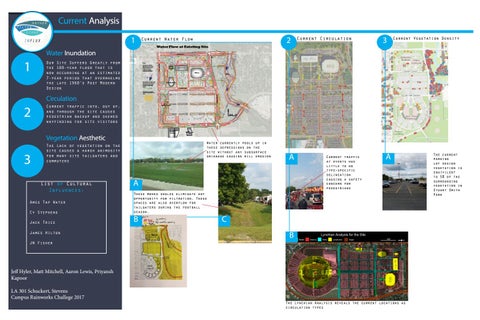
Our Site Suffers Greatly from the 100-year flood that is now occurring at an estimated 7-year period that overwhelms the late 1960’s Post Modern Design
896
890
892
LINCOLN WAY
890
8
Aarows indicate direction of water flow. Darker and larger arrows indicate grater volume of water.
BEACH AVENUE
8
Key:
Fisher Theater
890
Scheman
892 894
Hilton
Green lines represent storm drains. Green triangles indicate where a pipe day lights.
Squaw Creek
C.Y. Stephans
CENTER DRIVE
Current traffic into, out of, and through the site causes pedestrian backup and skewed wayfinding for site visitors
UNIVERSITY BLVD
The tan area indicates low points on site.
Circulation
2
894
Current Circulation
8
1
2
Current Water Flow
Alumni Hall
S 4TH ST
Bergstrum Sports Facility
Vegetation Aesthetic
3
Water currently pools up in these depressions on the site without any subsurface drianage causing rill erosion
The Lack of vegetation on the site causes a harsh animosity for many site tailgaters and commuters
List of Cultural Influences: Ames Tap Water Cy Stephens Jack Trice James Hilton JW Fisher
Jack Trice
A
A
Current traffic at events has little to no type-specific delineation causing a safety concern for pedestrians
A
These mowed swales eliminate any opportunity for filtration. These spaces are also overflow for tailgaters during the football season.
B
C B
Jeff Hyler, Matt Mitchell, Aaron Lewis, Priyansh Kapoor LA 301 Schuckert, Stevens Campus Rainworks Challege 2017
The Lynchian Analysis reveals the current locations as circulation types
The current parking lot design vegetation is equivilent to 5% of the surrounding vegetation in Stuart Smith Park
Gathering
The stage of Gathering is the accumulation of parking lot runoff, the incoming city storm water drain, and the building stormwater drains. The collective swale bodies fan out to catch as much water from these three sources as possible.
Filtering
The stage of Filtering is the intake of flow to a system of pollutant-filtering serves to filter out certain pollutants phosphorus. All of this is accomplished native prairie plantings.
all concentrated swales. Each swale such as nitrogen and through integration of
Storing
The stage of Storing is the final residence for the water on the site. Here is where all site water remains except in the event of extreme flooding, where overflow transitions into Squaw Creek.
Proposed Water Flow
THE BASIN A-A’ Section
The exploded view to the left reveals how the yellow forms (the gathering bodies) collect water to pass it onto the filtering swale system.
CyLine Access
Segmented Swale System
RV Parking with Permeable Pavement
10’
Bioretention Basin
Section Elevation of The Retention Basin
THE BASIN RV Lot with permeable University Boulevard
Cyline
20’
Retenion Basin
A
A’ 20’
The ‘Node’ Plan
Plan View of the Retention (Storage) Basins
AA
Influx Redesign
Master Plan of Influx
1
Scanned by CamScanner
PERSPECTIVE VIEW FACING ALUMNI CENTER
Section Elevation of the ‘Node’
PERSPECTIVE VIEW FACING THE HILTON PLAZA
Through our GFS system, water is stored on site and intercepts potential backfilling from squaw creek
2
The CyLine
3
Education Rain Garden
PERSPECTIVE VIEW THE NODE FROM HILTON AND SCHEMAN PLAZA
20’
Water Filtration, Distribution, and Direction
A proposed elevated concourse allows for quick transport of visitors, a viewshed over the entire landscape, and dilineated traffic lanes.
The ‘Floodable’ Rain Garden is a system of segmented swales that merge native planting aesthetic with education of stormwater Management