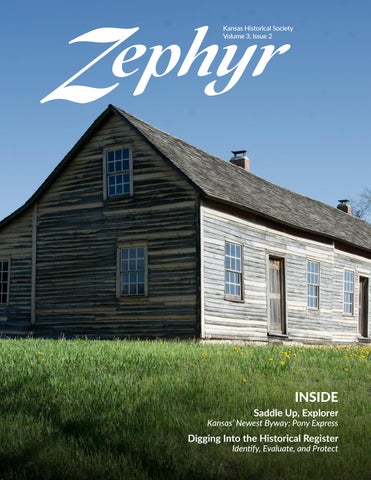
Z
ephyr
Kansas Historical Society Volume 3, Issue 2
INSIDE
Saddle Up, Explorer
Kansas’ Newest Byway: Pony Express
Digging Into the Historical Register Identify, Evaluate, and Protect
Zephyr From the Executive Director Reflecting on Our 150-Year History: 1976-1999 Per Aspera: What the Declaration Promised Foundation Updates Lasting Impression in History Digging Into the Historic Register NAGPRA Update: Repatriation Boxes Historic Fund Sustains Preservation Identity, Honor, and Protect Kansas 1776: A Dynamic Landscape New and Notable Return of Archival Documents to Wyandotte Nation Saddle Up Explorer Newest State Historic Site On this Day in Kansas History
FROM THE EXECUTIVE DIRECTOR 2 4 6 7 8 10 12 13 14 16 17 18 20 21 22
Volume 3, Issue 2 2026 EXECUTIVE DIRECTOR, STATE HISTORIC PRESERVATION OFFICER Patrick Zollner EDITOR IN CHIEF Caryn Kramer MANAGING EDITOR Sarah Bell ASSOCIATE EDITOR Keller Welton CREATIVE DIRECTOR/DESIGNER Laura Paige
Historical Society
Published by the Kansas Historical Society 6425 SW 6th Avenue Topeka KS 66615-1099 Please send change of address information to the above address, email kshs.zephyr@ks.gov, or call 785-272-8681, ext. 243. kansashistory.gov Partial funding provided by the National Park Service, Department of the Interior. The contents and opinions do not necessarily reflect the views or policies of the Department of the Interior, nor does the mention of trade names or commercial products constitute an endorsement or recommendation by the Department of the Interior. This program receives federal funds from the National Park Service. Regulations of the U.S. Department of the Interior strictly prohibit unlawful discrimination in departmental federally assisted programs on the basis of race, color, national origin, age, or handicap. Any person who believes he or she has been discriminated against in any program activity or facility operated by a recipient of federal assistance should write to: Office of Equal Opportunity, National Park Service 1849 C Street NW, Washington DC 20240.
2©2026
LEGISLATIVE UPDATE As we enter the state fiscal year 2027, we are very grateful that the state legislature approved additional funding and staffing for the new museum gallery as well as the Charles Curtis House State Historic Site (more on page 21). In addition, we received $50,000 to re-surface the deteriorated parking lot at Grinter Place State Historic Site. Perhaps the biggest news of the session, as it relates to our agency, was legislation approving the transfer of the Fort Dodge Junior Officers’ Quarters in Ford County from the Kansas Office of Veterans Services to the Kansas Historical Society effective July 1, 2026, (more on page 21).
$2 MILLION GRANT RECEIVED! At the federal level, we were excited to receive a $2 million grant from the Department of Housing and Urban Development towards a new visitor center at the John Brown Museum State Historic Site in Osawatomie! We want to especially thank Senator Jerry Moran and Representative Sharice Davids who worked through their respective committees to secure the funding. In addition, the City of Osawatomie received $250,000 for street and infrastructure improvements in John Brown Memorial Park, which is owned by the Kansas Historical Society but leased to the city in a long-term agreement. The John Brown Museum State Historic Site in Osawatomie had its beginnings in 1910 when the State of Kansas accepted a gift from the Woman’s Relief Corps of 22.5 acres of land that was the site of the Battle of Osawatomie on August 30, 1856. Renamed John Brown Memorial Park, the new park was dedicated by President Theodore Roosevelt in 1910 on the anniversary of the battle. In 1912, the original Adair Family Cabin, where John Brown called home during his Kansas abolitionist activities in the pivotal Bleeding Kansas years of 185556, was disassembled and relocated to the park. By 1928, the cabin was deteriorating, and the Kansas legislature
Kansas Historical Society Zephyr
appropriated funds to erect the current stone pavilion around the cabin to protect it from the elements. In 1996, we signed an agreement to partner with the City of Osawatomie to operate the site. The city is responsible for the day-to-day operational costs, and the Kansas Historical Society remains responsible for capital improvements as well as exhibit and artifact care. Almost four years ago, City of Osawatomie officials and interested parties met with us to discuss ways to improve the visitor experience at the site and to better tell the story of the Adairs and John Brown. The cabin, which was placed in the National Register of Historic Places on March 24, 1971, is a unique historic site because of its association with John Brown and Bleeding Kansas in the events leading to the Civil War, and for it being located on the site of the Battle of Osawatomie, the largest confrontation between anti and proslavery forces in Kansas Territory. A 2008 study of the site identified several drawbacks including the intrusion of the office, restroom, and gift shop within the pavilion housing the cabin. The report recommended working with the city to obtain a visitor center for the site, and our recent discussions with the city led to the same conclusion. To that end, we contracted with Treanor Architects to provide an initial plan and conceptual renderings. The current proposal to construct a new 3,000-square-foot visitor center to the west of the stone pavilion and cabin will address the issues noted above and greatly enhance the visitor experience. Full circulation around the Adair Cabin will once again be possible in the original pavilion, and the visitor center will provide ample space for the office, restrooms, and gift shop as well as expanded exhibits, film/video screenings, and a staging area for school and tour groups. The new visitor center is expected to cost approximately $6 million, and we are working with the City of Osawatomie and the John Brown Foundation to raise the balance. Stay tuned for future announcements on how you can assist with this effort.
family Bible. This was the Geis family Bible printed in Cologne, Germany, in the year 1564! Weighing 14 pounds, the Bible has wood covers and is bound in wild boar’s skin with red and black type and dramatic woodcut illustrations. The Geis family brought the Bible with them to the United States in 1841 and to Salina, Kansas, in 1871. In 1876, the Bible was displayed in Philadelphia as part of the nation’s Centennial commemorations. If the story had ended there, the Bible would still be an amazing artifact to accept and would likely be the oldest non-archeological artifact in our collection. But in 1929, Representative James Strong offered the Bible, then owned by Ed Geis of Salina, to Senator Charles Curtis to be used to take the oath as Vice President. Curtis accepted, and it was the first time a Bible was utilized in the Senate chamber ceremony. The New York Times covered the story in a February 27, 1929, article. The Bible is inscribed: “Washington, D.C., March 4th, 1929. On this Bible, I have this day taken the oath of office as Vice President of the United States. Charles Curtis”. On May 7 in Dodge City, I had the distinct pleasure of accepting this most generous donation from the current owner and family steward of the Bible, James Geis. The Bible will be the featured artifact on display at the Charles Curtis House State Historic House when it opens to the public later this fall. A special reception showing the Bible and honoring Mr. Geis will be held at that time.
GEIS FAMILY BIBLE DONATION It’s not often that opening a Monday morning email produces anything approaching anticipation, but that was the case on April 13 when I received one from Tim Wenzl, Archivist Emeritus for the Catholic Diocese of Dodge City, that tantalized with the possibility of a donation of an “extraordinary artifact.” Turns out the artifact was a family Bible…but not just any
Patrick Zollner EXECUTIVE DIRECTOR, STATE HISTORIC PRESERVATION OFFICER
3
Zephyr Kansas Historical Society
REFLECTING ON OUR 150-YEAR HISTORY:
1976-1999 Bobbie Athon, MS, Contributing Writer
Kansas Preservation launched in Autumn 1978 to help Kansans preserve historic resources by providing “information on techniques, planning programs, projects, and related subjects.” The first issue highlighted an upcoming grants workshop and introduced membersof the newly appointed Kansas Historic Sites Boardof Review. Groups and individuals were invited to submit their preservation activities to share with readers.
After years of planning, construction, and moving, the new Kansas Museum of History opened in 1984 with activities at the groundbreaking ceremonies with Governor John Carlin and Senator Ross Doyen in attendance. Edward Asner, born on the Missouri side of Kansas City in 1929, grew up on the Kansas side. This celebrated actor portrayed Lou Grant in both a comedy and a dramatic television series from 1970 to 1982. This clock and his desk, important props on the set, were donated to the museum collection in 1991.
Constitution Hall in Lecompton was presented to the State of Kansas in 1986, to be operated as a state historic site by the Kansas Historical Society. Here, delegates drafted the 1857 proslavery constitution that spurred violent debate in the U.S. Congress. 4
Kansas Historical Society Zephyr
The Potawatomi Baptist Mission, built in 1849, originally taught trade skills and basic school subjects to Indigenous children to replace their Tribal traditions. The mission closed in 1861. The state purchased the land in 1973 to locate the new museum. An archeological survey guided interpretation and historic photographs informed the restoration. The educational center opened in 1995. The spacious research room in the new Center for Historical Research adjoining the museum opened in 1995. The building housed the remaining Historical Society offices—administrative, preservation, historic sites—and archeology, archives, manuscript, and photograph collections. Vacating the Memorial Building for other state agencies.
Frank Wiziarde portrayed Whizzo the Clown on Kansas City television in the 1960s, and ended his TV career in Topeka in 1987. Born in Westmoreland in 1916, Frank was part of his family's traveling circus. He sprinkled double-entendres for adults, and enthused his young audience with items in his suitcase, donated to the museum in 1990.
5
Zephyr Kansas Historical Society
PER ASPERA: WHAT THE DECLARATION PROMISED — AND WHAT KANSAS MADE OF IT Kara L. Heitz, Owner Clio’s Scroll Productions
As the nation recognizes the 250th anniversary of American independence, the Kansas 250th Commission has launched “Per Aspera: A Kansas History Podcast,” an audio documentary series examining how Kansans have wrestled with the promises of the Declaration of Independence, and what those promises have meant in practice. The series takes its name from the state motto, Ad Astra per Aspera (“To the stars through difficulty”.) For this project, particular emphasis is placed on the word “per,” meaning “through.” The podcast examines how Kansans have worked through disagreement over consent, conflicts between liberty and equality, laws that upheld injustice, and the movements that challenged them.
The series takes its name from the state motto, Ad Astra per Aspera –“To the stars through difficulty”. Released biweekly from March through November 2026, each episode presents a focused, narrative-driven story drawn from pivotal moments in Kansas history. The first episode revisits Dwight D. Eisenhower’s 1961 Farewell Address and his warning about the “militaryindustrial complex,” framing it as a reflection on democratic vigilance and the responsibilities of citizenship in a selfgoverning nation. Other episodes reach further back into the territorial era. One explores the dispersal of the Topeka Legislature in 1856, when competing governments claimed legitimacy, and federal troops intervened to restore order. Another examines the 1893 Legislative War, when rival Houses barricaded themselves inside the Kansas Statehouse, each asserting its claim to represent the will of the people. Discussions of equality and liberty occur throughout the season. One episode follows John Brown’s final journey escorting freedom seekers north along the Underground Railroad. Another examines a 1925 desegregation dispute involving Mexican students in Argentine, Kansas - an international diplomatic controversy that broadened the story of school equality beyond the Brown v. Board of Education decision. The series also explores divisions within the Black community in Topeka during the struggle over school 6
desegregation, revealing the complex debates about equality, autonomy, and consent that surrounded the 1954 case. Several episodes focus on economic liberty and democratic participation. One follows Kansas farmers who drove their tractors to Washington, D.C., in 1979 to demand representation during a deep agricultural crisis. Another examines Governor Henry Allen’s controversial Court of Industrial Relations in the 1920s, an ambitious effort to regulate labor conflict that raised enduring questions about free speech and the limits of state authority. Additional episodes explore women-led city councils in the 1880s, Native students from Haskell Institute who served in the U.S. military before receiving full citizenship, German immigrants navigating wartime suspicion during World War I, and the multicultural communities that shaped Dodge City. Together, these stories illustrate how the principles articulated in 1776 have been interpreted, contested, and reshaped across generations in Kansas. In conjunction with the series, the Kansas 250 Commission is developing educator resources aligned with each episode, including primary sources, discussion guides, and classroom materials designed to support grade level instruction. The aim is not only commemoration but sustained civic engagement. “Per Aspera” is hosted and researched by historian Kara Heitz and produced by audio engineer Emily Milner, consulting historian Jay Price, and curriculum design specialist Casey Meier. The podcast is a project of the Kansas 250th Commission and is made possible through generous support from America 250, Walmart, and Creative One. Episodes are available on major podcast platforms, broadcast on Kansas Public Radio, and accessible at www.perasperapodcast.com, where listeners can find credits, resources, and additional information. Information about the Kansas 250 Commission and other 250th activities in the state can be found at america250ks.com. Two and a half centuries after independence, the American experiment remains unfinished. “Per Aspera” examines what the Declaration promised - and how Kansans have worked through the challenges of realizing those ideals.
Kansas Historical Society Zephyr
OUR PIONEERS THOUGHT OF THEIR WILLS.
HAVE YOU?
Planned gifts provide you as the donor with a way to leave a legacy of support for Kansas history. There are several ways to propose a planned gift. Consult with a financial advisor or estate planning professional to select a planned gift that meets your individual needs. The Kansas Historical Foundation can be named as the beneficiary of a portion of your IRA, 401(k), or other retirement plan, or the beneficiary of an existing life insurance policy. Make lasting charitable gifts by naming the Kansas Historical Foundation in your will. Bequests may be in the form of a stated dollar amount, percentage of estate, designated property, or residual of the estate. Your bequest of any amount makes a difference in Kansas history. Join others, like Mary Manusos and Diane Kantas, whose forethought and generosity are enriching the lives of Kansans. To make an impact on Kansas history now, the OBBBA (officially known as the One Big, Beautiful Bill Act; Public Law 119-21) adds a new deduction for charitable donations for taxpayers who use the standard deduction beginning in 2026. Single tax filers can claim the deduction for up to $1,000 of charitable donations and up to $2,000 for married, filing jointly taxpayers. The donations must be made directly to the charity. Ready to create a planned gift or a charitable donation today that can serve as your legacy to Kansas history? Please call the Kansas Historical Foundation at 785-272-8681, ext. 201. The Kansas State Historical Society, Inc., dba Kansas Historical Foundation, is an IRS determined 501(c)(3) non-profit organization.
SENATOR PAT ROBERTSʼ PORTRAIT UNVEILED Patrick Zollner, Kansas Historical Society Executive Director, and Caryn Kramer, Kansas Historical Foundation Director of Operations, were invited to attend Senator Pat Roberts’ official Senate Agriculture Committee portrait unveiling at the U.S. Capitol in Washington, D.C., on April 27, 2026. Roberts is the only person in modern history to have chaired both the House and Senate Agriculture Committees. Roberts served as Representative for Kansas’ 1st district from 1981 to 1997 and as Senator from 1997 until 2021. Commissioned by the Kansas Historical Foundation and the Kansas Historical Society, his official portrait currently hangs in the Senate Agriculture Committee hearing room.
WITH APPRECIATION: Terry Marmet, Interim CEO We want to express our appreciation to Terry Marmet who briefly served as interim CEO for the Kansas Historical Foundation (KHF). Over the span of a 38-year career at the Kansas Historical Society (KSHS), Terry was devoted to the preservation and interpretation of significant Kansas historic buildings and properties. After Terry retired from KSHS, he began work with KHF as the director of operations before retiring from his position in 2016. Ten years later, Terry returned to KHF and graciously agreed to serve in this capacity during the search for a new director. We thank Terry for his dedication to both organizations and for sharing his talents with us once again.
7
Zephyr Kansas Historical Society
LASTING IMPRESSION I N
H I S TO RY
Bobbie Athon, MS, Contributing Writer
For more that 150 years, the Kansas Historical Society has collected and preserved records and objects that tell the stories of this place. Only on rare occasions is the impact of that work later revealed.
Mary Manusos grew up in Topeka, a member of the small Greek immigrant community. She was a teenager when her family arranged a marriage to Frank Kantas at Saint John’s Greek Orthodox Church in Omaha, Nebraska, in 1926, where she lived her adult life. The daughter of James and Mary (Floros) Dountas Manusos, young Mary’s family operated a busy confectionary in Topeka. She and her siblings attended Lincoln school, which opened in 1917, from first grade through junior high. A Topeka newspaper’s school column included a note from Mary, “A Story About Myself,” in 1920, expressing her interests. As a student, she enjoyed activities like the Society’s spinning wheel demonstrations, pictured; exhibit tours, and library visits. Secretary William Connelley and staff members had been welcoming visitors with musical events, films, and performances since the move to the Memorial Building in 1914.
My father and “I am in the 5-B grade. a, Greece. part my mother came from S eks and their re I like to read about the G e greatest th lives, as Greece was once country in the world. am a Greek, I at th d ou pr y er v am I much. America but I love America very in the world. y is now the greatest countr out the Pilgrims ab I like to read the stories and the Indians, too. ” —Mary Manusos, 5-B 8
Kansas Historical Society Zephyr
Mary was one of five Lincoln students to advance to the district-wide school music memory contest in 1922. She graduated from Lincoln Junior High in 1925. Her married life in Omaha was quite different. Mary’s husband, Frank Kantas, pictured with the straw hat, and his brother, Jerry Kantas, behind the wheel, operated a small grocery store in South Omaha. Immigrants from Greece as well, they supplied local restaurants and families with their butchery—beef, lamb, and goat meat. Their daughter, Diane Kantas, was born in Omaha in 1931. Mary purchased a Steinway piano so she could teach Diane to play. She encouraged other creative pursuits, like dancing lessons, pictured below left. She filled the house with thousands of books and sheet music. Diane attended Omaha public schools and earned a degree with honors at the University of Omaha in 1954. Diane, pictured below right, worked as a bookkeeper for the family grocery store. Her father’s successful business provided for her needs, and she worked no other jobs. Mary refused to force Diane into an arranged marriage. Frank closed the business in 1969 and died in 1979. Mary and Diane rarely left the house. Their pets were important to them; Diane was extremely devoted to the dogs she rescued. Although she protected her privacy, Diane was intensely interested in current events. Before Mary died in 1995, she confirmed her intentions to Diane for the distribution of the family estate that would reflect just how important the Historical Society had been in her life. Diane Kantas died in 2025. The Kansas Historical Foundation was soon notified about this generous bequest in her will to be divided 37.5 percent to the State Archives Division, 37.5 percent to the Kansas Museum of History, and 25 percent for children’s workshops and programs.
This bequest, the largest gift in the 150-year history of the Kansas Historical Society and Kansas Historical Foundation, at more than $5 million, will make a profound difference for future generations of Kansans. Discover how you can support Kansas history at www.kansashistory.gov/15849 Photographs of the Manusos and Kantas family courtesy of the Diane Kantas estate, with special assistance from Dr. Robert Swerczek, executor.
9
Zephyr Kansas Historical Society
DIGGING INTO THE
HISTORIC REGISTER The national and state level historic registers define archeological properties as “the place or places where the remnants of a past culture survive in a physical context that allows for the interpretation of these remains.” These properties can be listed as a building, structure, or object, but most archeological properties are listed as sites or districts. Nominating archeological properties to a register is essential for acknowledging all parts of history, whether buried or above ground. Archeological properties often reveal how a culture or community lived or worked in a different period and help us understand the evolution of America. When properties are listed, they may belong to one or more precontact, post contact, or historic periods. Determining these periods helps identify the time when the property fits into the history of what is now the United States. When an archeological property, or any property, is listed on a register, its context 10
Paige Bump, MA, Project and Outreach Coordinator Jamee Fiore Krivenko, MA, National Register Coordinator
helps frame our understanding of the property’s role in American history and deepens our appreciation of it. The goal of register programs is to identify, evaluate, and protect places that have contributed to America’s history. However, to do this, these places, including archeological sites, need to be listed in the register(s). Currently, as part of an initiative to ensure the full story is captured in nominations, all nominations in Kansas are being reviewed by the State Historic Preservation Office Archeologist, Doug Kressly. During the reviews, Doug is evaluating whether the property may contain archeological components that could be considered important. A good nomination in the register with multiple components, elements, periods, and areas of significance is the Mount Mitchell Heritage Prairie Historic District. The 166-acre site has several properties with five major
Kansas Historical Society Zephyr
Recovered from Ruins
opens at Mulvane Art Museum Laura Murphy and Emily Dame
components. These components are the Heritage Prairie, the Mount Mitchell archeological site, the Fort Riley Road-Mount Mitchell Trail Segment, several memorial monuments, and the Captain William Mitchell Farmstead. Four buildings, three structures, and three sites in this district are contributing elements to this nomination, while four buildings, one structure, and two objects are non-contributing elements. Periods of significance include c. 1 CE to 1,000 CE, c. 1843 to 1957, and 1953 to the present. The areas of significance included are exploration/settlement, politics/government, agriculture, conservation, archeology/prehistoric, and archeology/historic-nonaboriginal. See the Mount Mitchell Heritage Prairie Historic District nomination form and more on our website! To see a step-by-step guide on listing your property in the Register of Historic Places, visit us here bit.ly/4a9ne0w
The Mulvane Art Museum on Washburn University’s campus welcomed nearly 200 guests for the opening exhibition of Recovered from Ruins: Telling Kansas Stories through Household Objects on April 3, 2026. The exhibition showcases artifacts recovered from excavations of a former mansion built in 1857 for Acting Territorial Governor Frederick P. Stanton (site 14DO375) near Lecompton, Kansas. Excavations took place during the 50th annual Kansas Archeological Training Program (KATP) in collaboration with Dr. Laura Murphy as the Project Investigator and Washburn University Archaeological Field School students in June 2025. The exhibition is guest-curated by Dr. Murphy, associate professor of anthropology at Washburn, and eight students in her Spring 2026 Applied Anthropology class who worked throughout the spring semester to research the artifacts and prepare them for display. Objects such as buttons, medicine bottles, cookware, food remnants, and other everyday personal items continue to reveal the layered lives of the mansion’s residents throughout its history. Visitors to the Mulvane Art Museum can view these artifacts, which are on loan from the Kansas State Historical Society, until August 1, 2026. For more information about Recovered from Ruins, please visit: bit.ly/4dMBONO 11
Zephyr Kansas Historical Society
NAGPRA Update:
REPATRIATION BOXES Nikki Klarmann, PhD, State Archeologist
Over the last few years, the Kansas Historical Society has been working with our Indigenous partners on identifying and repatriating ancestors and funerary objects to comply with the Federal Native American Graves Protection and Repatriation Act (NAGPRA). Through these compliance efforts, many of the ancestors and objects in our care are ready to be physically returned to their affiliated Indigenous nations. Many nations we work with request cedar boxes with limited or no metal finishes for the return of ancestors and objects. Through a 2024 NAGPRA Repatriation Grant and additional Society funds, we have been able to purchase handmade boxes from woodworkers in Kansas and Oklahoma. We would like to acknowledge the craftspeople that have created these cedar boxes, which are now available for repatriation. First, Jack and Nanette Stafford and Shawn Anderson, who run Cedar Creations in Muskogee, Oklahoma. Jack is a member of the Muscogee (Creek) Nation and started Cedar Creations with his wife Nanette, which is now being run by Jack’s apprentice, Shawn Anderson. Second, Jamakee Blackburn, who is a woodworker living in Lawrence, Kansas, creates wooden products with locally sourced and rescued wood from the Lawrence area. Jamakee is a member of the Northern Arapaho Tribe of the Wind River Reservation of Wyoming. Third, Tim Vincent, who owns Community Woodworking Co. in Topeka, Kansas. Tim has become known around the community for his handcrafted furniture. We look forward to continuing to work with these small businesses as we continue our NAGPRA compliance efforts and return the ancestors and objects in our care. While we acknowledge that the ancestors and objects in our care should never have been taken from their final resting places, we are glad to be working to return them to their affiliated nations. 12
Photographs, above, by Tim Vincent, Community Woodworking Co.
Kansas Historical Society Zephyr
Historic Fund
Jamee Fiore Krivenko, MHP, National Register Coordinator
Sustains Preservation
This year marks the 50th anniversary of the Historic Preservation Fund (HPF), a program that assists preservation efforts nationwide. Funding for the program is collected by the federal government from Outer Continental Shelf oil and gas lease revenues, not tax dollars. An annual allocation, approved by Congress, aids state and Tribal preservation offices each year. These funds are awarded to help expand their historic preservation activities. Federal regulations require that a portion of these funds be passed through to local communities and preservation organizations to assist with their preservation activities as well. To meet those federal requirements, each year applications are accepted by the Kansas State Historic Preservation Office (SHPO) as part of a competitive grant round. Grants are used to fund projects such as historic property surveys, National Register nominations, preservation
plans, design-review guidelines, and educational activities such as brochures, conferences, and workshops. For the Kansas SHPO, this federal funding supports over 60 percent of the staffing and daily operations of the office, including travel to visit historic properties and to present information to community groups. The funding allows us to process nominations to the National Register of Historic Places and applications for federal historic tax credits. Under state and federal preservation laws, staff review around 300 projects per month where government agency actions impact cultural resources in Kansas. Continuing support for the Historic Preservation Fund is a critical goal for preservation advocates nationwide. In the photo above, SHPO staff assess preservation needs for a historic barn in Crawford County. Learn more at bit.ly/4uEV0C5 13
Zephyr Kansas Historical Society
IDENTIFY, HONOR, and PROTECT Megan Maize, MS, Survey and Outreach Coordinator
The National Register of Historic Places is the official list of the nation’s historic places worthy of preservation. Authorized by the National Historic Preservation Act of 1966, the National Park Service’s National Register of Historic Places is part of a national program to coordinate and support public and private efforts to identify, evaluate, and protect America’s historic and archeological resources. These Kansas properties were recently evaluated by the Office of the Keeper in Washington, D.C., and approved for listing in the National Register of Historic Places.
Minisa Bridge Wichita, Sedgwick County listed, 2/17/2026
Immanuel Baptist Church
Kansas City, Wyandotte County
Listed, 11/17/2025
Battey House
Florence, Marion County
Listed, 12/22/2025
Verschelden Funeral Home
St Marys, Pottawatomie County
Listed, 12/19/2025
Genn Hospital
Wamego, Pottawatomie County
Listed, 12/23/2025
Marjoy Apartments, Residential Resources Of Wichita Sedgwick County, Kansas, 1870-1957, Multiple Property Document
Wichita, Sedgwick County
Listed, 12/19/2025
Lane Street Church Of God, African American Resources In Topeka, Shawnee County, Multiple Property Document
Topeka, Shawnee County
Listed, 12/19/2025
Brown-Blachly House
Kansas City, Wyandotte County
Listed, 12/23/2025
Park, Anna & Richard Avery, Mansion
Atchison, Atchison County
Listed, 8/12/2025
Atchison’s Black Business District
Atchison, Atchison County
Listed, 8/12/2025
First Presbyterian Church
Winfield, Cowley County
Listed, 8/12/2025
Akers House, Historic Resources of Lawrence, Douglas County, Kansas, Multiple Property Document
Lawrence, Douglas County
Listed, 8/12/2025
First Methodist Episcopal Church
Baldwin City, Douglas County
Listed, 8/12/2025
Hotel Bunyan
Fowler, Meade County
Listed, 8/12/2025
First Presbyterian Church Of Paola
Paola, Miami County
Listed, 8/12/2025
Pinkney I Historic District (Additional Documentation), Historic Resources of Lawrence, Douglas County, Kansas, Multiple Property Document Lawrence, Douglas County
Additional Documentation Approved, 8/20/2025
Lakeside Park Band Shell, New Deal-Era Resources of Kansas, Multiple Property Document
McPherson, McPherson County
Listed, 8/20/2025
Corbin Education Center, Wichita State University
Wichita, Sedgwick County
Listed, 8/21/2025
Interdale Apartments, Residential Resources of Wichita, Sedgwick County, Kansas, 1870-1957, Multiple Property Document
Wichita, Sedgwick County
Listed, 8/18/2025
McAfee Pool Complex
Wichita, Sedgwick County
Listed, 8/18/2025
J E George Building
Liberal, Seward County
Listed, 8/21/2025
Athol Community Hall
Athol, Smith County
Listed, 8/21/2025
14
Kansas Historical Society Zephyr
Left to right: Rex Arms Apartments, Late 19th And Early 20th Century Residential Resources In Manhattan, Multiple Property Document Manhattan, Riley County, Listed, 12/19/2025 Todd, Lucinda And Alvin, House, African American Resources in Topeka, Shawnee Co, Kansas, Multiple Property Document Topeka, Shawnee County, Listed, 4/1/2025
Brook, Hugh M. And Rachel A., House
Blue Mound, Linn County
Listed, 4/1/2025
Ursuline Academy – Auditorium
Paola, Miami County
Listed, 4/1/2025
Bertrand House
Oakley, Logan County
Listed, 4/7/2025
Fowler And Baehr Buildings
Paola, Miami County
Listed, 4/7/2025
Waggoner, John, House
Sabetha, Nemaha County
Listed, 4/4/2025
Pospishil Building, Post Rock, Limestone Properties in Kansas, 1870-1948, Multiple Property Document
Luray, Russell County
Listed, 4/8/2025
Paul Laurence Dunbar School, Historic Public Schools of Kansas, Multiple Property Document
Salina, Saline County
Listed, 4/8/2025
Price Elementary School, Historic Agriculture Related Resources of Kansas, Multiple Property Document
Hope, Dickinson County
Listed, 4/18/2025
Pray Farmstead(s), Limestone Properties in Kansas, 1870-1948, Multiple Property Document
Luray, Russell County
Listed, 4/8/2025
Mccarty, W.T. And Olivia, House
Emporia, Lyon County
Listed, 4/18/2025
JG Edwards Building
Larned, Pawnee County
Listed, 4/18/2025
Clay Center Downtown Historic District Clay Center, Clay County (Additional Documentation)
Additional Documentation Approved, 4/28/2025
Bank Of Powhattan
Powhattan, Brown County
Listed, 6/3/2025
Swanson Gardner House
Topeka, Shawnee County
Listed, 6/11/2025
Alten-Peak House
Manhattan, Riley County
Listed, 3/17/2025
Methodist Episcopal Church Of Oskaloosa
Oskaloosa, Jefferson County
Listed, 3/28/2025
Broadmoor Ranch House Historic District Overland Park, Johnson County (Additional Documentation)
Additional Documentation Approved, 3/28/2025
Save the Date KANSAS HISTORIC PRESERVATION CONFERENCE
THE SKY IS THE LIMIT Wichita, KS more info at
October 8-9, 2026 kansashistory.gov/14644
15
Zephyr Kansas Historical Society
Kansas1776: A Dynamic Landscape Sarah Bell, PhD, Museum and Education Division Director
The place we now know as Kansas has changed greatly over the last 250 years. Both environmentally and culturally, it was a vastly different place in 1776 than it is today. In honor of our country’s 250th anniversary, the Kansas Museum of History is opening a new special exhibit in July called Kansas 1776: A Dynamic Landscape. While not yet a state, Kansas was not a land waiting for something to happen. It was a dynamic landscape that had already changed greatly over the course of millennia, and it would continue to change over the next 250 years.
|
Before 1776
To understand Kansas in 1776, the exhibit begins thousands of years ago, when this land was inhabited by mammoths, giant bison, and other megafauna. The earliest peoples, known as Clovis and Folsom, learned how to hunt these large animals. Their distinctive stone tools and points have been excavated in Kansas.
Kansas in 1776
The heart of the exhibit focuses on who lived here in 1776 and what Kansas looked like during this time. Kansas was home to Indigenous peoples, including the Arapaho, Cheyenne, Comanche, Kanza, Kiowa, Osage, Pawnee, Siouan, and Wichita. The land was technically owned by Spain, but there was little European presence in Kansas at that time. Environmentally, Kansas was covered by a sea of prairie grasses, ranging from tallgrasses in the east to shortgrasses in the west. Millions of bison, elk and wolves grazed on those grasses.
Since 1776
The final section of the exhibit looks at Kansas since 1776 and the many differences that have occurred, both environmentally and culturally. None of the original Indigenous peoples who called this land home still live here today. The millions of bison that used to inhabit this land were hunted almost to extinction. Many of the grasslands have been plowed into farmlands, leading to one of Kansas’ most famous monikers: America’s Breadbasket. Reservoirs dot the landscape because of the need for flood control; windmills and wind turbines harness one of Kansas’ most consistent resources: the wind. Exhibit highlights include mastodon teeth, life-size graphics of megafauna, loaned items from the Sternberg Museum (including a Tylosaurus skull!), a tree section from the Revolutionary War era, an Angell plow, and a solar panel from the first utilityscale solar farm in Kansas.
16
New and Notable
Kansas Historical Society Zephyr
Nikaela Zimmerman, MA, Museum Collections Manager
For 150 years, the Kansas Museum of History has collected a plethora of fascinating artifacts we use to interpret Kansas history. Museum staff continue that tradition, adding new artifacts to the collection each month. Two recent donations help to tell the story of art and music in Kansas. Margaret Whittemore was a talented graphic artist, author, and illustrator. Born in Topeka in 1897, Whittemore studied English at Washburn College (now university), graphic art at the Art Institute of Chicago, and the Taos Colony in New Mexico. Around 1930, newspapers and magazines began publishing her illustrations of historic Kansas landmarks. During the Great Depression, Whittemore worked as an artist in the Museum Extension Program, part of the Works Progress Administration (WPA). She wrote and illustrated the Sketchbook of Kansas Landmarks and Historic Kansas: A Centenary Sketchbook. The Museum recently received a donation of the plates used to print the illustrations for Historic Kansas, as well as a series of insect prints created for the WPA by an unknown artist. Melissa Etheridge is a two-time Grammy Award-winning musician. Born and raised in Leavenworth, Etheridge played the guitar at age 8, took up songwriting and piano at age 12, and played in local bands as a teen. She released her first album in 1988, but her big break came in 1993 with Yes I Am, an album that contained hits like Come to My Window and I’m the Only One. A staple of the rock scene for four decades, Etheridge released her most recent album in March 2026 and was a nominee for induction to the Rock and Roll Hall of Fame in 2026. She recently donated an Ovation 12-string acoustic guitar and a collection of gold records to the Museum. 17
Zephyr Kansas Historical Society
RETURN OF ARCHIVAL DOCUMENTS TO WYANDOTTE NATION Megan Burton, State Archivist
New regulations for the Native American Graves Protection and Repatriation Act (NAGPRA) have increased our consultation with various Tribal partners on the return of ancestors and cultural objects in our care. To help facilitate this work, our State Archeology office hosted a NAGPRA summit in April of 2025, which was attended by representatives of 13 Indigenous nations. In preparation for that meeting, Dr. Adam Hodge, Archives Reference Supervisor, prepared research guides highlighting the collection materials related to each nation in attendance. While attending the summit, Heather Miller, NAGPRA Coordinator for Wyandotte Nation of Oklahoma, joined archives staff for a one-on-one discussion of those resources related to the Wyandotte Nation. It was through this discussion, and subsequent visits to the State Archives that Heather identified materials within the collections that were uniquely Wyandotte and asked for Historical Society staff to consider returning them. The State Archives staff are allowed to remove items from the collections through a legal and thorough process called deaccessioning. The process requires a review committee of professionals who are not on staff at the Kansas Historical Society (KSHS). Those members include an archivist, a historian, an archeologist, a museum professional, a librarian, and a genealogist. The review committee is chaired by the Executive Director of the Historical Society. Collections Archivists at the Historical Society review collections that meet the criteria for deaccessioning. They perform thorough research on the donor, the condition of the item or collection, the research value, and possible candidates for housing once removed from KSHS collections. Once that process is complete, a ballot for deaccession consideration is sent to the committee for discussion and voting. In January of 2026, the deaccession committee voted to return two items to the Wyandotte Nation. With the support of Wyandotte Nation, digital copies of these items are still available on KansasMemory.gov:
18
The “Wyandotte Indian council records” (UID 219798) include a list of orphans, pensioners, statements from Department of Interior officials, records of the executive council, and other information on the Wyandotte Nation between 1855-1871. “Wyandotte Nation to the American Congress” (UID 219795) is a letter to the United States Congress from the Wyandotte Nation written in October of 1848. In this letter, the Wyandotte explain that African American slavery had been introduced into their territory west of the State of Missouri contrary to "the law which you have heretofore made." The State Archives staff are glad to have been a part of the process of returning these items to Wyandotte Nation. Heather provided the following statement that details why the transfer of these items was so important for their Tribe:
Kansas Historical Society Zephyr
Wyandotte Nation is a Federally Recognized Tribal Nation with a long history in and relationship with the State of Kansas. In July 1843, citizens of our Nation landed on the banks of the Missouri River after being forcibly removed from our Ohio homelands. We wasted no time making Kansas our new home. Members of our community surveyed the land and created the town now known as Kansas City. We built houses and families in Kansas in the hope that we would stay permanently. The Federal government did not share the same ideas as the Wyandotte Nation, and in 1855, terminated our status as a Tribal Nation with many families moving to current homelands in Oklahoma to remain Indian. Tribal status was ultimately renewed, and the Nation has been rebuilding itself and providing for its citizens. Because of this history of disruption, removal, and displacement, most of the material culture from Wyandotte Nation is not in our control. Original manuscripts, record books, and letters can be found in archives, while artifacts, arts and crafts can be found in museum collections. As Wyandotte Nation grows and rebuilds, we want to house our material culture within our spaces. Stewarding our material culture deepens our cultural sovereignty. We want to provide access to artifacts, documents, manuscripts, and arts and crafts to our citizens and allies. In addition, we want to support and work with institutions who have cared for and protected our material culture. Wyandotte Nation encourages engagement with our history while also building a relationship with our current community. The return of this document to Wyandotte Nation occurred because of relationships built through the Native American Graves Protection and Repatriation Act (NAGPRA) process. Building these relationships has created opportunities to tell richer stories of Kansas history by incorporating more voices and perspectives. Wyandotte Nation encourages anyone interested in these documents to build their own relationship with our Nation. Our Cultural Center encourages visits, and our museum rotates exhibits regularly but always features an element of Wyandotte history. Our archives is growing and scheduling time to view source documents can be done through the Cultural Center staff. We look forward to welcoming you to our community.
19
Zephyr Kansas Historical Society
SaddleUp, E xplorer Thirteen. Although the number is seen by many as unlucky and ominous, not so for the State of Kansas and Hollenberg Pony Express Station State Historic Site. On April 7, Hollenberg Pony Express Station became the end point for the new Pony Express Historic Byway, becoming the Sunflower State’s 13th official historic byway. A crisp and partly cloudy spring day greeted all who attended the ceremony. The reading of Governor Laura Kelly’s proclamation by Lieutenant Governor David Toland was followed by remarks by Secretary of Transportation Calvin Reed, KSHS Executive Director Patrick Zollner, and Director of Kansas Tourism Bridgette Jobe. The Pony Express Historic Byway follows much of the Pony Express National Historic Trail. It begins just east of Troy in northeast Kansas, then winds its way through towns like Everest, Horton, Fairview, Seneca, and Marysville before terminating at Hollenberg Station outside of Hanover. Pieces of Pony Express history can be found along the route and in many of the byway towns. The historic byway designation is a testament to the rural Kansas communities that have embraced this short-lived, yet important mail delivery history. Though the enterprise only lasted 18 months, its history resonates with tourists and residents today. We encourage you to saddle up and experience the Pony Express Historic Byway this year as a day or weekend trip. Even better, scan the QR code to order or access a Kansas byways guide from the Travel Kansas website to experience all the state’s byways. Hollenberg Pony Express station is open to the public Wednesday – Saturday 10 a.m. - 5 p.m. and 1 - 5 p.m. Sunday. Admission is free and closed on state holidays.
20
Fred Goss, MA, State Historic Sites Director
Kansas Historical Society Zephyr
Newest State Historic Site
Patrick Zollner, Executive Director, State Historic Preservation Officer
FORT DODGE JUNIOR OFFICERS’ QUARTERS TO BE THE 18TH STATE HISTORIC SITE The 2026 legislature also passed legislation to transfer the c. 1870 Fort Dodge Junior Officers’ Quarters to the Kansas Historical Society from the Kansas Office of Veterans Services, the culmination of over a decade of efforts by local citizens and interested parties to preserve this unique historic property. Among the most important Kansas frontier outposts, Fort Dodge was established in 1865 to keep the peace between traders on the Santa Fe Trail, settlers moving west, and Native American Tribes. The fort closed in 1882, and ownership of the fort was transferred to the State of Kansas in 1889 for use as a soldiers’ home, providing care and residence for retired Kansas veterans. After years of vacancy and deterioration, the Junior Officers’ Quarters building was placed on the demolition list in 2017. In 2019, KSHS provided a Historic Preservation Fund grant to the Ford County Historical Society to prepare a condition assessment report and alternative use feasibility study. The building was listed in the National Register of Historic Places in August 2024. Recent collaboration between the Kansas Office of Veterans Services, the Ford County Historical Society, local representatives, and our agency has resulted in a plan to preserve the building without negatively impacting the mission of the Kansas Soldiers’ Home. Once restored, the property will become the first State Historic Site in southwest Kansas and will be operated under a partnership agreement with the Ford County Historical
Society. KSHS will develop engaging educational exhibits and programming for student and adult audiences. This site will allow KSHS to better tell the rich history of the Santa Fe Trail and the role Fort Dodge played in the development of southwest Kansas. From Shawnee Indian Mission near the Missouri border, to Kaw Mission and Last Chance Store in Council Grove, to Pawnee Rock in Barton County, and now Fort Dodge in Ford County, visitors will be able to experience Santa Fe Trail history in authentic buildings that existed during the years the trail was in active operation. This project will result in a great asset to the State of Kansas..
CHARLES CURTIS HOUSE STATE HISTORIC SITE UPDATE The 2026 legislature approved additional funds to the Kansas Historical Society to operate and staff the Charles Curtis House State Historic Site with one full-time site administrator and one half-time staff person. An ADA accessible ramp will be constructed later this summer to enable the house to be open to the public in October 2026. This will be a soft opening to provide basic house tours to the public; however, our staff is currently in the process of researching and designing all new interpretive and interactive exhibits for the house. The timeline for their completion has yet to be finalized. 21
Zephyr Kansas Historical Society
ON THIS DAY IN
Kansas History Brenda Kipp, Content Creator
7–28 6–8 On this day in 1918, a total eclipse crossed over the continental United States from Washington State to Florida, including the southwest corner of Kansas. Residents of Dodge City reported totality lasted about 30 seconds. The sky turned black, stars were clearly visible, and the temperature dropped 28 degrees. Solar eclipse glasses were not invented until the 1970s, so people had to use smoked glass or paper to view the solar phenomenon. Drifting clouds in Wichita and Salina made it difficult for the public to see the eclipse, but it allowed them to observe the spectacle without eye protection. The clouds parted in Chanute just in time for the residents to experience 93 percent totality. The eclipse created crescent shapes on the ground as partial light passed through the trees.
6–22
22
On this day in 1944, President Franklin D. Roosevelt signed the Serviceman’s Readjustment Act of 1944, more commonly known as the G. I. Bill of Rights, into law. The law provided benefits to returning World War II veterans and was drafted by Harry Colmery, a lawyer in Topeka. A veteran of World War I, he advocated for World War II veterans who were returning to civilian life. When the G. I. Bill of Rights was introduced in Congress, Colmery supported its adoption. The veteran’s hospital in Topeka is named after Colmery and Ralph O’Neil, a Kansan who served as the 13th American Legion commander.
The Kansas-Nebraska Act was passed in 1854 and opened these new territories for settlement. It was up to the residents of those territories to decide whether to permit slavery or not, and while this Act was still being debated in Congress, Northerners were afraid Missourians would cross over into Kansas Territory and shift the balance in favor of slavery. A plan was devised to tip the scales in favor of making Kansas free from slavery. The New England Emigrant Aid Society was formed by free-state supporters, and the Society sent their first members to Kansas on this day in 1854. The members settled just north of the Wakarusa River and founded the town of Lawrence. Other free-state emigrants founded the towns of Osawatomie, Manhattan, and Topeka. Newspaper editor Daniel Read Anthony, brother of Susan B. Anthony, and suffragist Clarina Nichols were members of the New England Emigrant Aid Society.
Kansas Historical Society Zephyr
After three attempts at a state constitution, the Wyandotte Constitution was adopted on this day in 1859. The free-state faction was in control of the territorial legislature that year. For the most part, the question of slavery in the territory had already been decided, so it was expected that Kansas would be admitted as a free state. In October 1859, the proposed constitution was sent to Washington, D.C., and a bill was introduced to Congress. Both the House and the Senate voted to admit Kansas into the Union under the Wyandotte Constitution in early 1860. However, William H. Seward of New York, a free-state supporter, introduced a separate bill in the Senate on February 21, 1860. The admission bill was carried over to the next session. In January 1861, the amended bill passed and President James Buchanan signed it into law, making Kansas the 34th state on January 29, 1861.
7–29
Prior to the Civil Rights Act of 1964, African Americans organized sit-ins at establishments that refused to serve them. In 1958, a group of African American students took part in a sit-in at Dockum Drug Store in Wichita. The eatery’s policy was to refuse service to African Americans at the counter. If they wanted to order food, they had to do so at the end of the counter and take it to go. Every day the students filled the seats at the counter and ordered a soft drink. They were not only refused service, but they were also cursed at and sometimes threatened. Finally, on this day in 1958, after the month-long peaceful protest, the owner gave in and agreed to serve the students at the counter.
8–16 The Battle of Fort Titus was just one of the many conflicts between proslavery and free-state men. Built by Colonel Henry Titus, the fort was a proslavery stronghold two miles south of Lecompton. After free-state men had destroyed Fort Saunders, another proslavery stronghold, they turned their attention to Fort Titus. Approximately 400 free-state men, under the command of Captain Samuel Walker, attacked the fort on this day in 1856. After a brief exchange, the fort’s 34 defenders surrendered. One proslavery man was killed and six, including Colonel Titus, were wounded. Six free-state men were injured, and Captain Henry Shombre was mortally wounded. Prisoners were taken to Lawrence, and the fort was burned to the ground. This painting of the Battle of Fort Titus by Ellen Duncan is displayed in the Territorial Capitol Museum in Lecompton. Photo courtesy of Lecompton.com.
8–11
23
Kansas State Archives
Schedule your curated student tour today!
CONNECT WITH US!
Kansas Historical Society 6425 SW 6th Avenue Topeka, KS 66615-1099
Visit linktr.ee/kansashistory or scan this QR code for easy access to all of our social media and more!