KANELAND


KANELAND
April 16, 2026
Learning to embrace mistakes and our imperfections

Everyone has things that they hide from others, like physical traits or elements of our personality. But imperfections are what makes us human. Without imperfections, we are inauthentic, generic and stagnant. Acknowledging our imperfections allows us to be vulnerable and make meaningful changes within ourselves. Taking off the mask or the filters reveals our true selves, and embracing that truth helps strengthen our personal happiness and deepens connections with others.



BY NOAH WITZ Editor and Photographer
As Kaneland School District #302 prepares to move forward with construction tied to the voter-approved referendum, district leaders say the changes will go beyond classrooms and athletics, extending into transportation, facilities and daily operations.
While much of the progress so far has taken place behind the scenes, officials say the district is now entering a phase where students and the community will begin to see visible changes.
“We spent the summer getting things in line financially,” Superintendent Dr. Kurt Rohlwing said. “We had to sell bonds to essentially get startup money for the projects.”
Rohlwing explained that bonds function in a manner similar to a longterm loan, giving the district access to funds upfront while paying them back over time. From there, the district moved into months of planning, including visits to other schools, meetings with staff and collecting input from community groups.
“There’s been a lot of activity in terms of fleshing out the designs,” Director of Buildings and Grounds Mark Payton said. He noted that while the overall scope of the referendum cannot change, the details within it have been carefully developed through those conversations.
That planning has now transitioned into bidding and preparation for construction. The first rounds of bids have already been approved, covering projects scheduled to begin this summer.
With permitting still being finalized, Rohlwing said the district expects to begin breaking ground in May or June on some major projects, including a new transportation center and maintenance facility. Interior work will begin once students leave for summer break.
By the end of 2026, Payton said the district expects to complete several noticeable upgrades, including renovated classrooms, updated restrooms, new playgrounds and the new transportation and maintenance buildings.
“A lot of classrooms will be remodeled here in the high school…a lot of restrooms…new playgrounds,” Payton said, describing what the community can expect to see in the near term.
Much of this summer’s work will focus on cosmetic updates such as lighting, flooring and paint, while more intensive renovations and structural
changes are planned for the summer of 2027.
The construction of one of the largest projects, a new fieldhouse, will begin this summer but is expected to open in the fall of 2027.
“To build something that big takes time,” Rohlwing said, noting the size and complexity of the facility.
While construction will be ongoing, Rohlwing said the impact on students during the school year should remain minimal. Work areas will be fenced off and monitored, and projects will be carefully scheduled to avoid peak traffic times.
“We’ll have fencing, signage and additional security measures in place,” Payton said.
Transportation staff is also expected to benefit from the referendum, particularly with the addition of a new centralized facility near Harter Middle School.

said, adding that routes are constantly adjusted using software and driver feedback.
The new transportation facility is expected to improve efficiency by centralizing operations and providing more space for maintenance and repairs.
“The referendum allows us to be more proactive instead of reactive,” Espe said. He explained that the upgraded facility will lead to faster repairs, better preventative maintenance and more consistent service.
Maintaining the district’s fleet is an ongoing effort, especially with challenges like extreme weather and aging equipment.
“Our mechanics are critical,” Espe said. “They allow us to respond quickly to issues and maintain a high standard of care across the fleet.”
When staffing is limited, he said the district prioritizes ensuring that students can get to and from school, even if it means adjusting schedules for other activities.
“Routes are the number one priority,” Espe said.
Across all areas of the referendum, safety and accountability remain central focuses. Rohlwing emphasized that all spending is reviewed and approved by the Kaneland Board of Education.
“Any penny that we spend is approved by the board,” Rohlwing said. Payton added that construction projects are carefully managed and vetted through a formal bidding process and ongoing oversight.
Looking ahead, district leaders say the full impact of the referendum will take several years to complete, with the most significant changes occurring by the fall of 2027.
According to transportation director Davis Espe, the district’s current fleet includes 47 full-size buses, five special education buses and two activity vehicles, which he said aligns well with current needs.
However, Espe noted that the district’s size presents ongoing challenges.
“The biggest challenge would be balancing distance with consistency,” Espe said, explaining that Kaneland spans 142 square miles across nine towns, requiring careful coordination across both suburban and rural areas.
Keeping student ride times reasonable remains a key priority.
“Our goal is to not have students on the bus for more than one hour,” Espe
In the meantime, they acknowledge that construction may bring some inconvenience.
“Be patient with us,” Rohlwing said. “Construction is a challenge…but we’re doing our best to make everything as smooth as possible.”
Espe said he hopes families will begin to notice improvements in everyday operations, especially in transportation.
“I hope families notice buses arriving on time, clear communication and a dependable system they can trust and rely on,” Espe said.
Together, district leaders say the goal of the referendum is not just to update buildings, but to improve the overall experience for students across every part of the district.
BY OLIVIA COTTER Co-Copy Editor and Production Executive
On March 17, 2026, thousands of Illinois voters went to the polls to cast their ballots in federal, state and local primary races. Lieutenant Governor Juliana Stratton defeated Illinois eighth district Representative Raja Krishnamoorthi to win the Democratic nomination for Dick Durbin’s senate seat. Elburn mayor and retired U.S. Navy Master Chief Petty Officer Jeff Walter won the Republican nomination for Illinois’ 11th district in Congress.
Kaneland staff and students alike participated in this election, with some even working as election judges.
“It was like a game because it was just clicking stuff and searching up people to make sure that people haven’t already voted somewhere else or aren’t registered to vote by mail,” junior Chris Ruiz said.
Ruiz worked at the Sugar Grove Township Community Building.
“I thought it was going to be like a maximum of 400 [voters], but it ended up being like 600 and it was pretty busy,” Ruiz said.
In the senate race, Stratton won the primary with 40.1% of the vote, compared to Krishnamoorthi’s 33.2% and Robin Kelly’s 18.1%. According to her website, Stratton ran her campaign on expanding economic opportunity, increasing affordability and protecting rights.
“We have demonstrated what’s possible when you stay true to your values, fight for what you believe in, and never take anything for granted,” Stratton said in her victory speech. “We will fight for


Medicare for all. We will fight to abolish ICE. We’ll fight for a real living wage, not just the bare minimum. We’ll fight to defend our rights and claw our democracy back from the brink.”
She will face Republican Don Tracy in the general election for the vacated senate seat.
Walter, with 42.6% of the vote, defeated Michael Pierce and Charlie Kim, with 38.9% and 12.9% of the vote, respectively, for the Republican nomination for Illinois’ 11th District. Walter’s campaign focused on rebuilding the economy and securing the border.
“As a Navy veteran, a mayor and a businessman, I’ve spent my life leading, serving and getting things done,” Walter said in his victory statement. “That is exactly the kind of leadership people are looking for right now. We’re going to carry this momentum forward, take our message to every corner of the district and give voters a real choice in November.”
He will face the incumbent representative, Democrat Bill Foster, for the Illinois District 11 seat in the House of Representatives.
One of the major talking points during this election cycle was the unprecedented amount of money spent in the races. According to the Associated Press, over $125 million was spent across five races: one U.S. Senate seat and four U.S. House seats (two, seven, eight and nine). Out of the 125 million, 70 million was spent by outside groups, like the American Israel Public Affairs Committee (AIPAC), the Illinois Future

PAC and artificial intelligence-backed PACs. The Illinois Future PAC, which is funded by Illinois Governor JB Pritzker, contributed $5 million to aid Stratton in her campaign against Krishnamoorthi.
In the House, the large number of campaigns in this primary contributed to the high spending, with more than one quarter of the Illinois seats open, the most in seven decades. AIPAC-affiliated groups like Affordable Chicago Now and Chicago Progressive Partnership invested heavily in House races with varying degrees of success. They saw two wins with Donna Miller in district two and Melissa Bean in district eight. In district 9, the Chicago Progressive Partnership spent 1.2 million to oppose Kat Abughazaleh, and other groups spent millions to support her opponent, Senator Laura Fine, but Evanston Mayor Daniel Biss won instead.
The origin of a campaign’s funding is a deciding factor to some voters, with websites and social media accounts dedicated to tracking the source of campaign donations.
“A big thing for me is where a candidate sources their money during an election,” senior Alex Christakes, who is a first-time voter, said. “I think big donations from big corporate PACs impact policymaking negatively, so I didn’t want to vote for a candidate who got their money this way.”
All eyes will look ahead to Nov. 3, 2026, to see what the future of Illinois politics looks like, both on the state and federal level.
BY EMMA WEINTRAUB Editor-in-Chief of Print and Business Executive
On Feb. 28, the United States and Israel carried out a series of airstrikes on Iran after weeks of contention between the three nations. This has developed into a number of direct military conflicts and has been termed a war by the Associated Press, but never officially declared a war by the American government.
The initial airstrikes killed dozens of significant Iranian political and military leaders, including the Iranian Supreme Leader Ayatollah Ali Khamenei. According to the Iranian government, one of these airstrikes also hit a girls’ elementary school, killing 168 people.
“We will be especially sensitive regarding the blood of our children,” new Iranian Supreme Leader Ayatollah Mojtaba Khamenei said in his first public statement, according to the Washington Post. “Therefore, the crime the enemy deliberately committed against the Shajareh-Tayyebeh school in Minab, and some similar cases, holds a special status in this process of accountability.”
In retaliation for these air strikes, Iran issued missile and drone strikes against Israel, United States bases and Mid dle Eastern allies. Reuters reported that Israel has con tinued to attack Lebanon, targeting Hezbollah.
Per a Jan. 12 article written by NPR, United States President Donald Trump threatened military action after Iranian security at tacked citizens protesting the country’s economic crisis, resulting in the death of up to 30,000 Iranians. Additionally,





Israeli Defense Minister Israel Katz and United States Secretary of State Marco Rubio defended the initial strikes on as a precautionary defense.
The Trump administration has provided additional reasoning for the attacks, which includes weakening Iran’s nuclear and military capability, securing oil resources and generating a regime change.
Both Israel and the United States have had a long, turbulent history with Iran.
In 1953, the United States backed the overthrow of Iranian Prime Minister Mohammad Mosaddegh. In the Iran-Iraq war spanning the 1980s, the United

support to Iraq, and Iran attacked a United States warship. Since this war, various minor conflicts have occurred between the three countries, and these have continued to build tensions. More recently, Iran and Israel carried out mutual attacks in 2024, and the United States launched airstrikes in June of 2025.
The war in Iran caused the closing of the Strait of Hormuz, which is responsible for 50% of global urea and sulfur and 20% of natural gas, according to the Fertilizer Institute. Further, there have been direct attacks on major oil and gas hubs throughout Iran, causing some of the largest global oil producers to suspend production and spiking gas prices for consumers.
Trump took to social media to threaten Iran if they did not allow commercial shipping to pass through the Strait of Hormuz within a certain deadline.
“A whole civilization will die tonight, never to be brought back again,” Trump wrote on Truth Social on the morning of April 7. “I don’t want that to happen, but it probably will.”
The Associated Press reported on April 7 that Iran, the United States and Israel agreed to a two-week long ceasefire deal to allow for oil, gas and other goods to pass through the Strait of Hormuz without interference. This deal faced complications in the early aftermath of its agreement.
All information in this story is updated as of our press deadline of April 8.
BY OLLIE FAIR Editor
The Kaneland High School theatre department’s production of “Mamma Mia!” premiered on Friday, April 10, with the final show occurring on Sunday, April 12.
“Mamma Mia!” is a comedic musical set on an imaginary island in Greece where the main character (Sophie Sheridan) attempts to uncover the identity of her biological father by inviting three prospects (Bill Anderson, Harry Bright and Sam Carmichael) from her mother’s (Donna Sheridan) past relationships to her wedding.
Sophie was played by senior Kailey Kunstman, and Donna was played by senior Anna Gatz. Bill was played by senior Dino Piemonte, Harry was played by junior John Thill and Sam was played by senior Idrees Ali.
“Mamma Mia!” is popular for its incredible scenery and unique soundtrack consisting of Europop group ABBA’s hits.
Although “Mamma Mia!” is a very well-known musical and has been requested in the past by Kaneland theatre department alumni, according to director and English teacher Rachel Giles-Bachman, “Mamma Mia!” was chosen after other preferred options for this spring musical became unsuitable.
“It wasn’t a bad choice, but we had plans for other shows,” Giles-Bachman said. “And for a variety of circumstances, those didn’t come to be.”
Despite the complications that led “Mamma Mia!” to be chosen as the spring musical, the fun nature of the show was a positive change of pace in comparison to the musicals of the past years.
“We haven’t done a pop show since I’ve taken over, so at least 10 years, and even before that there were a couple more classic shows,” Giles-Bachman said. “So it was just mixing it up, making it different.”
In order to produce a musical, the cast, crew and pit musician members must collaborate, as well as the director, conductor and choreographer. Many moving parts are happening at once, and a musical requires long rehearsals to perfect the show.
Casting is the first step in the process of producing a musical, and this
requires a lot of effort from auditioning students. Students must perform a cold read, sing songs from the musical and perform choreography that they have spent time learning in advance.
After cast members are assigned to roles, they have vocal rehearsals while also rehearsing choreography. After vocals and choreography, they move onto blocking and characterization on stage.
During this process, cast members embody their characters and ultimately become them through the repetition of lines and dances.
“Sometimes we lock in and forget who we are,” Ali said. “We embrace the
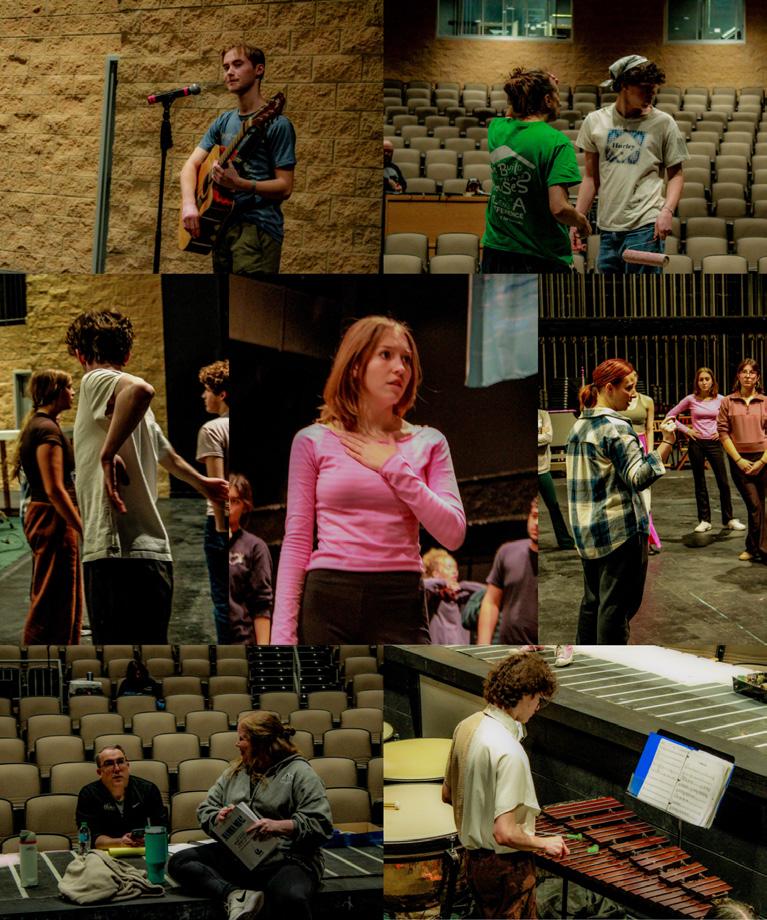
left to right
John Thill as Harry; set designer Emily VanDelinder-Birchfield with junior stage hand Cooper Marler; sophomore Jack Bicker as Sky; senior Kailey Kunstman as Sophie; choreographer Catie Deitz-Griffith; music director Bryan Kunstman with director Rachel Giles-Bachman; and senior percussionist Daniel Somerlot. “Mamma Mia!” ran from April 10-12, 2026, featuring 52 students as actors, musicians, stage crew and technicians.
vibe and energy around our characters, and I forget what Idrees is thinking. I’m thinking about what Sam would think.”
Although cast members try to make their acting look natural, it takes practice and sometimes even pre-performance rituals to become a character. For a role like Kunstman’s that required her to be on stage so consistently, she
had to take precautionary measures to ensure a perfect performance.
“I’ve run and sang at the same time because I needed the core muscles to be able to sing and dance for four numbers before the intermission, and it was demanding on my body,” Kunstman said. “I also mentally prepared for it by jumping up and down thirty times to get my blood running. I run and I actually slap my face because I have to emote a lot, and if my facial muscles aren’t awake, I will not be awake as a character either.”
During tech week, pit and stage crew work alongside the cast and learn their roles for the show. Although many people describe tech week as chaotic, others find the beauty behind the turmoil.
“I like tech week,” sophomore and co-student director Jo Ramsey said. “I know a lot of people think it’s crazy, but when I’m doing crew, I like watching it all come together and seeing the set we’ve been working on and watching the blocking. It all works together.”
Kunstman has been a part of the theatre department for four years and has played a variety of characters. In her role as Sophie, she found the character development to be interesting but also a factor she had to pay special attention to.
“At the beginning of the show she is very spunky, but once she figures out she’s screwed it all up, she changes and she’s a moody brat,” Kunstman said.
“So figuring out how to be that spunky character and being big enough to see that change at the end is a thing I’ve had to work on.”
The popularity of “Mamma Mia!” may have made it seem like it was a simple show that was easy to perform, but the pop style music was different from what the performers typically learn in choir. Ali believes the complexity of the characters and the plot required an open mind to understand the emotional highs and lows of the show.
“You can really see everyone’s personalities and everyone having fun,” Ramsey said. “People put their own elements of their personalities into their characters to make it different. They’re not playing Meryl Streep; they’re playing themselves.”

BY ANSLEY RUH Editor and Podcaster
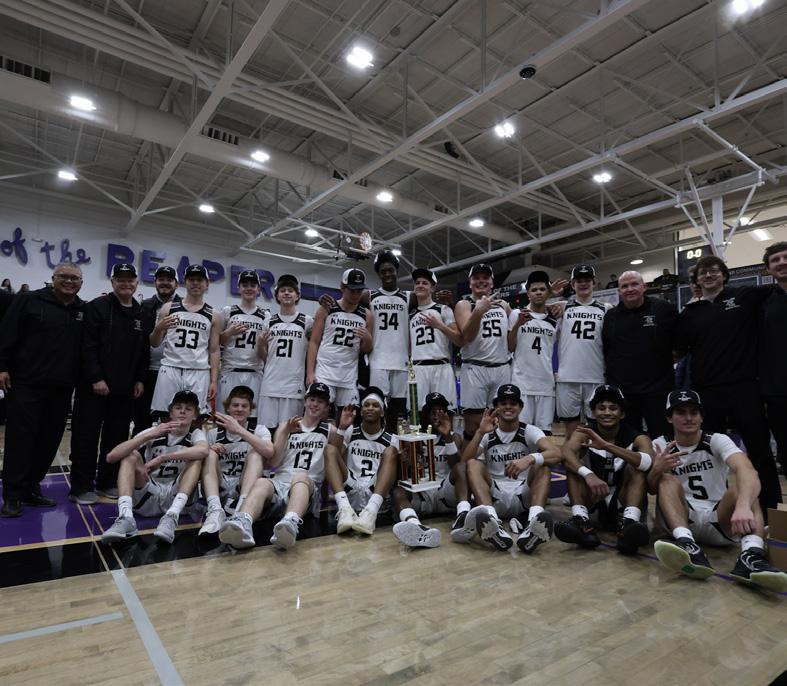
Over the past two seasons, the Kaneland varsity boys basketball program has turned consistency into dominance. After finishing last year with a 32-2 record and a conference title, the team did not slow down. Instead, they came back even stronger with a 36-1 record this season and made a deep run to the State semifinals. With a fourth consecutive first place finish in the Interstate 8, a third straight Regional championship, a second Sectional championship in a row and their first Supersectional championship since 1982, they have established themselves as one of the toughest teams in the state.
The team’s success did not happen by accident. Rather, it was built on months of hard work, strong team chemistry and the shared goal of going further than the year before. For senior Connor Kimme, one of the biggest changes when comparing the 2024-25 season to this year was the team’s style of play.
“The biggest difference was our ability to run the court,” Kimme said. “We were a lot more guard heavy this year, so we were able to push the ball fast on offense.”
The style of play wasn’t the only thing that changed this season. Senior Evan Frieders, who is a four-year varsity player and the winningest player in program history, said the team’s close relationship played just as big of a role in their success.
“I think the biggest difference is our team bonding,” Frieders said. “It made us want to win even more.”
That connection showed in the way the Knights handled adversity throughout the season. After falling short of State last year, their motivation carried over.
“Losing in that Supersectional last season, that stuck with me forever,” Frieders said. “We knew we didn’t want to be in that situation again, and we changed it.”
After falling to DePaul College Prep in the Supersectionals to end the 202425 season, the team knew there needed to be a change. The team’s determination was clear in big moments. A few times when the Knights gave up a lead or got down early, they could have accepted defeat, but they did the opposite.
by Ansley Ruh
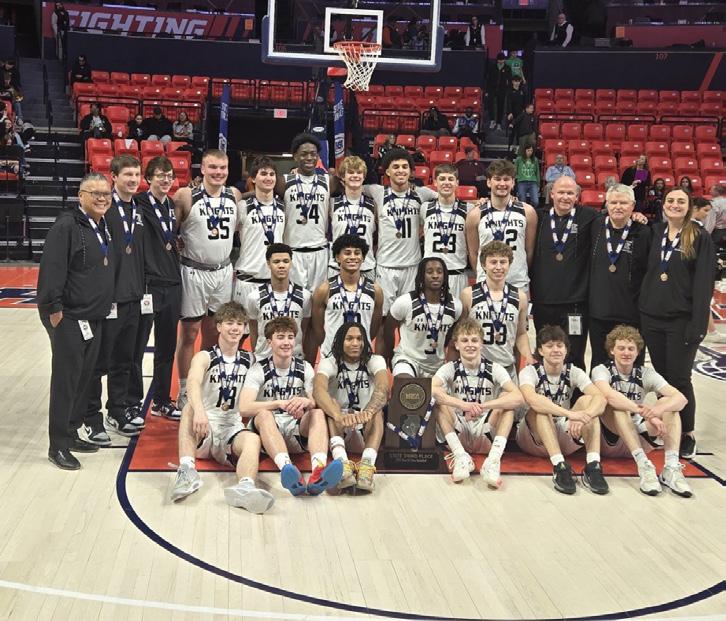
Players and staff members gather on the State Farm Center court at the University of Illinois to celebrate their third-place finish to the 2025-26 season. The Knights (36-1) lost their semifinal game to Deerfield 49-48 before winning the third-place game 35-32 over Leo.
“One step at a time, but we kept on pushing,” Frieders said.
That determination and resilience led to the Knights defeating Morton High School at the Northern Illinois University Supersectional on a game-winning shot by junior Jeffrey Hassan. Ernie Colombe, a seven-year head coach for the boys varsity team, said the success came down to the players’ commitment
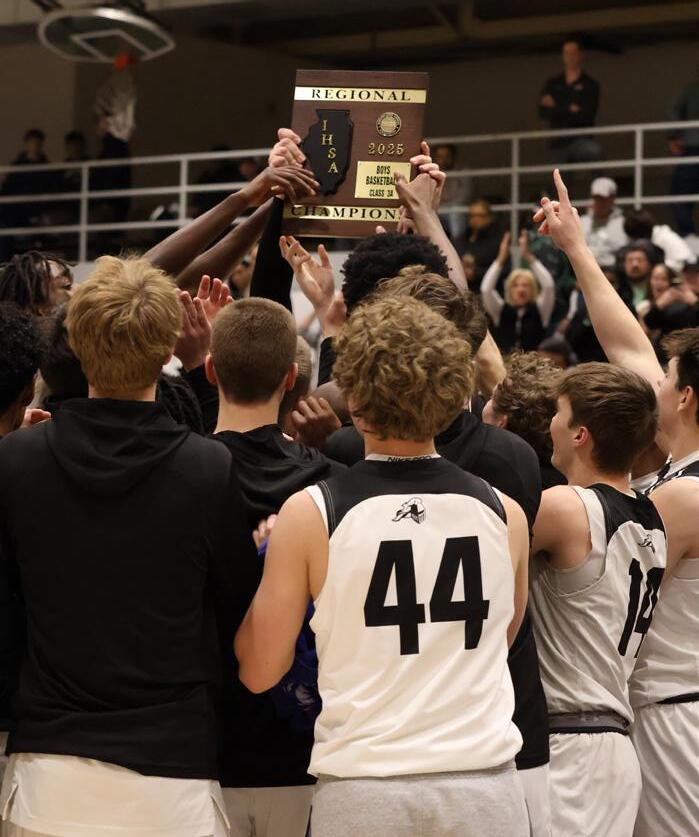
Players from the 2024-25 team (32-2) celebrate their 66-56 Regional championship win over Wheaton Academy. The Knights went on to defeat Crystal Lake South 49-37 to win their Sectional championship before losing to DePaul College Prep in the Supersectional round.
long before the season even began.
“It’s all about the players and finding guys who are willing to put the time in and get better,” Colombe said.
The team practices throughout June at their summer camp, in addition to playing in various summer leagues and participating in shootouts and tournaments. During the fall, they have weight lifting and conditioning each Monday through Thursday after Labor Day.
“We also play AAU and do personal training and strength training,” Kimme said. “We get together before games and put up shots.”
Many see the results on the court but don’t see the process of getting there. Colombe also pointed out the consistency over the past several years.
“People have been talking about the past two years, but we’ve either tied or broken the school record in wins the past four years,” Colombe said.
To Colombe, improvement is what truly matters. Every year, there are different players that step up and continue to develop.
“Guys just got better, which is supposed to happen,” Colombe said.
Even with high expectations, the team stayed focused on growth. Nobody saw the team staying undefeated throughout the regular season, but the players and coaches found a way in each game they played.
“It’s a credit to [the players],” Colombe said. “They put in the work.”
While the wins stand out, the relationships built off the court mean just as much.
“My favorite memories would be the times off the court,” Colombe said. “We have a pool party at my house each summer. We barbecue.”
Other players agree that, while the winning is nice, it is the relationships that really last. Now that the season has ended with third place in the state, the team hopes their success will leave a lasting impact. Kimme wants the team to be remembered as the best in Kaneland history, and he hopes to inspire upcoming Kaneland athletes. Frieders left a bit of advice for future Knights athletes.
“Put in the work like we did this past year, and just embrace your role,” Frieders said. “Just work hard, and it will show.”
BY ALEENA ALRIFAEE & MORGAN OLSON Editors and Social Media Assistants
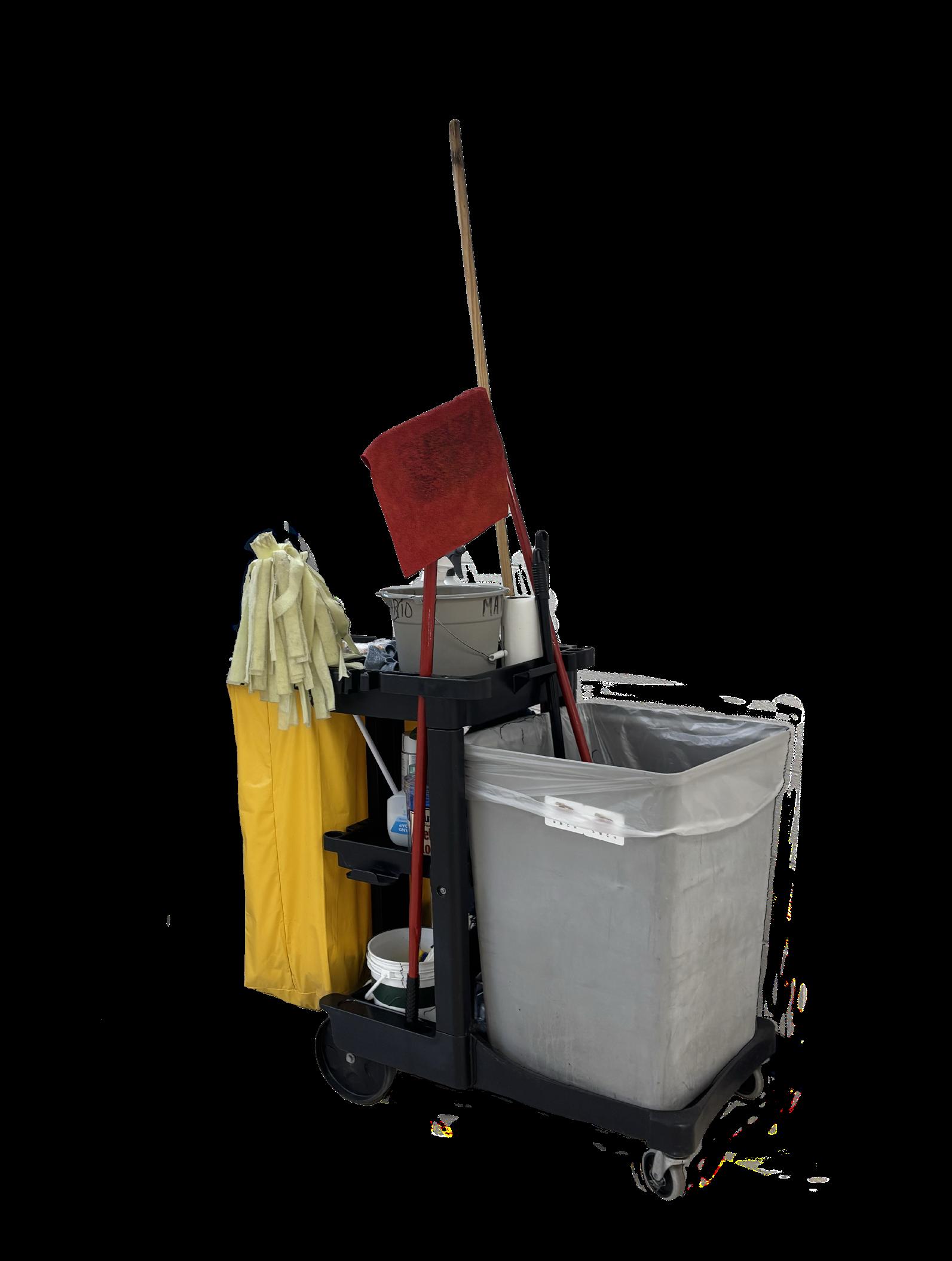
In a busy high school, students and staff members may not always notice the daily efforts being made by essen tial people behind the scenes. Often, staff members who receive little atten tion play a key role in our school oper ations. Recognizing their efforts builds a strong school community and shows respect for all they do.
Janitors, lunch staff and attendance secretaries help create a safe and or ganized learning environment. Their work supports students throughout the school day. They complete work that students may not even know has to get done, yet each one supports the school itself along with the students. Taking


BY ELLIE OLP Editor and Podcaster
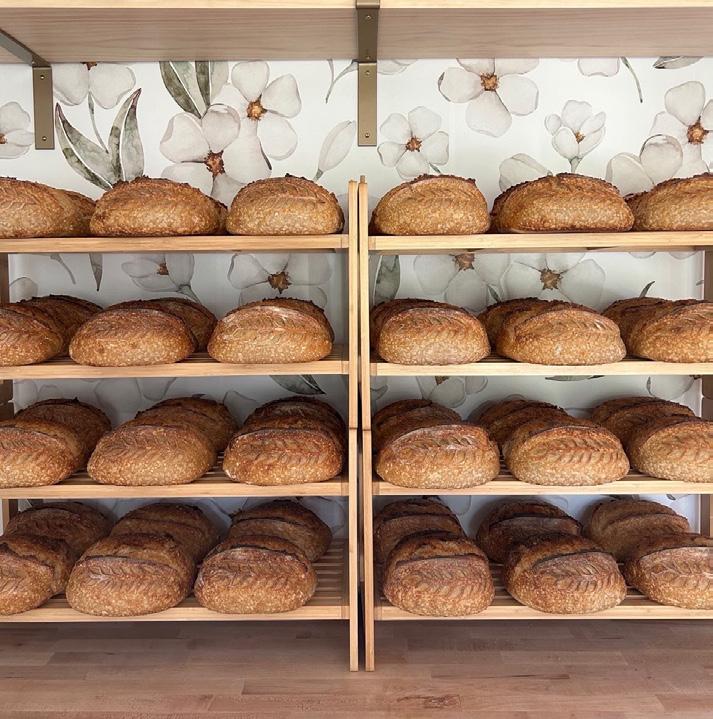
On a typical day, people purchase cookies, pick up fresh bread, book photo sessions or grab a quick drink at their local store. Each purchase adds up to something bigger in the community.
Not only do small businesses give customers a better sense of funding and profits, but they also provide memories and experiences for the owners who work with local residents.
place to support a business, but it can also present people with unexpected opportunities that can be rewarding for owners.



A popular small local business is Hill’s Country Store in Kaneville, which was operated by the late Pat Hill and is now run by her daughter, Alexa Hill. panies.”
“The best thing about my business is customer service and knowing the clients,” photographer and science teacher Joanna Edelman said. “I’ve had clients that have been coming to me for up to 12 years. I’ve seen them grow up from little toddlers to high schoolers, which is something that I can remember that a big company won’t.”
These relationships often go beyond regular customer interactions. Many small businesses also host events

for the community. Hill’s Country Store demonstrates this with things like outdoor movie nights, Easter egg hunts, donation collections and more.
“We’re always really big on giving back to the community,” Hill said. “It’s just a place to make a lot of memories, especially for the kids when they come after school to pick up candy or come by with their parents to get ice cream.”
Social media has played a key role for small business owners. For some owners like Macey Merlak, a bakery owner from Sugar Grove, social media provided a great platform for her to grow and promote her businesses.
“I have scaled my bakery back quite a bit, and social media is now my main form of income,” Merlak said. “I am a natural entrepreneur, and social media has given me the space to pursue lots of exciting and fulfilling avenues as my business has grown and evolved.”
Not only is social media a great
“Because of social media, I am publishing three books with a major publishing house,” Merlak said. “I have also had the privilege of working with amazing brands on socials, as well as traveling. I hosted a group trip to Italy in 2025, and I will be hosting another trip to Ireland in March of 2027.”
The people who are brave enough to make their idea or hobby into an occupation often go through a lot of trouble to create their own business and earn their own profits.
“There have been a lot of challenges with photography, like the costs, the research and the liabilities,” Edelman said. “It also just takes a lot of research and digging into the legality of starting your own business.”
Time management can also be an obstacle for small business owners when they are also handling all of their other responsibilities.
“I have other things to do, like teaching, being a mom, helping the theater program and working on my second master’s right now,” Staker said. “I really just tend to stretch myself too thin.”
Although these challenges may overwhelm and stress them out, it is critical for business owners to keep up with their own well-being on top of everything else.
“There are busy seasons like fall and Christmas where it’s a lot for me,” Edelman said. “I really just have to make sure that I’m balancing everything.”



BY PREMA WEICHUN Editor and Social Media Assistant
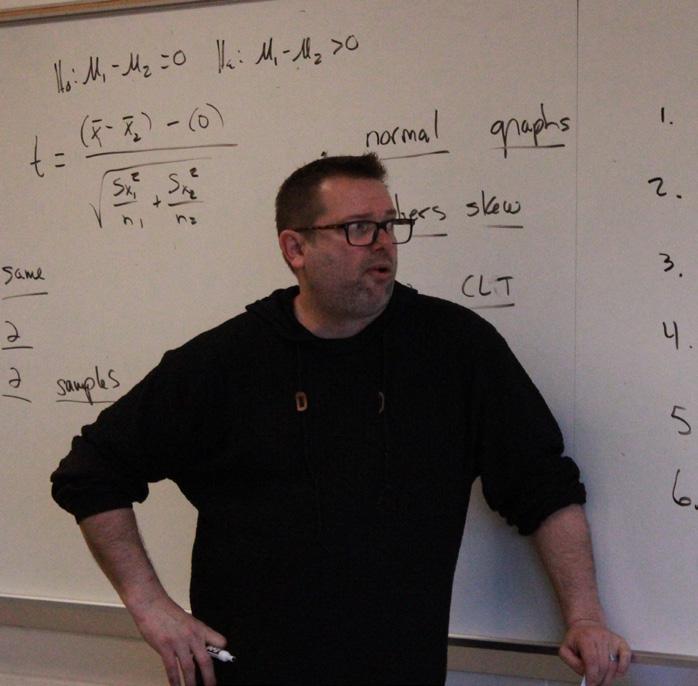
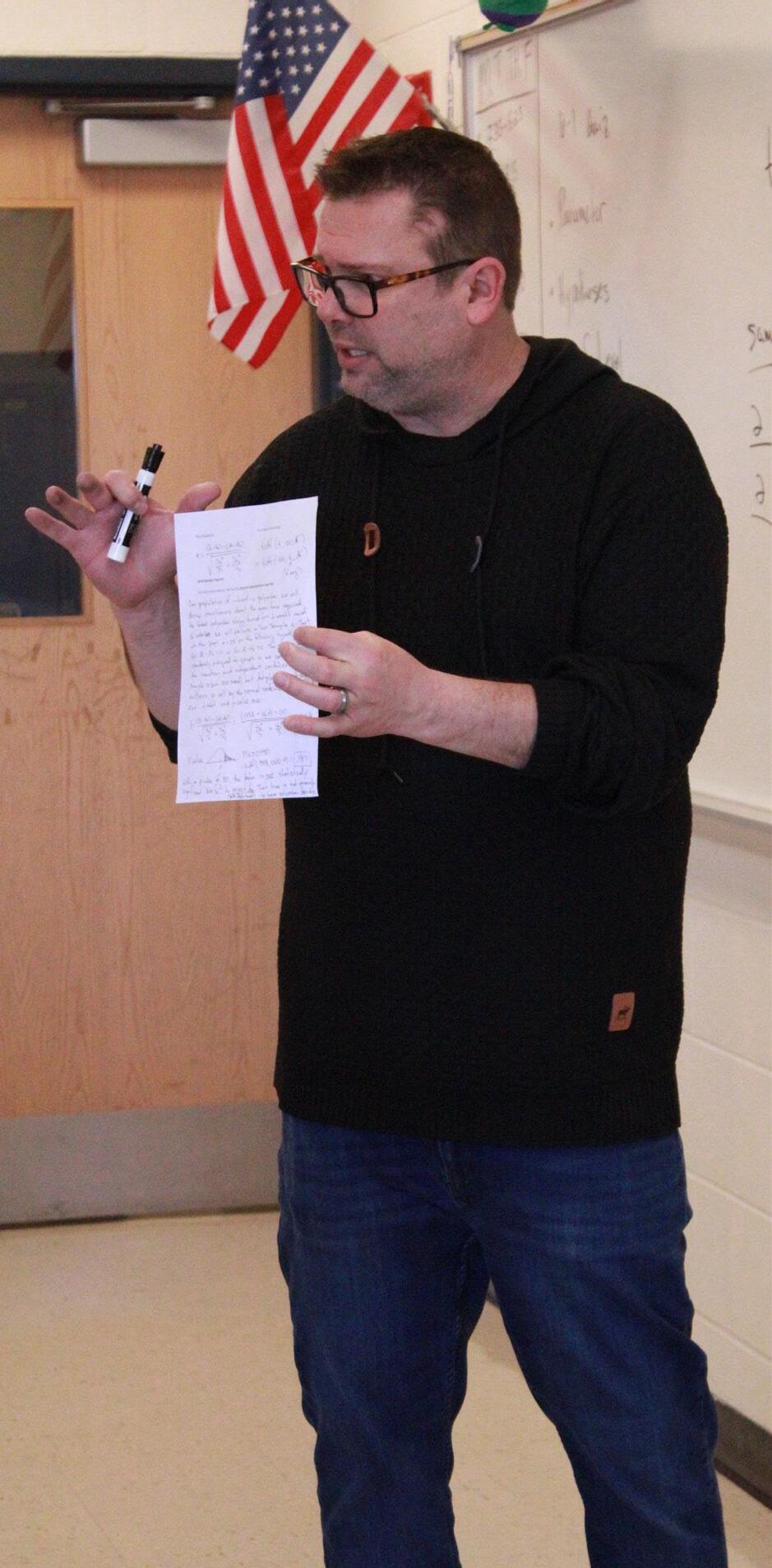
Most students have a teacher who stands out to them or changes their life. After all, being an inspiration to students is one of the benefits of the job. Throughout a school day, students are met with different challenges, workloads and stressors. The people they are surrounded by matter. Having someone in their life who can brighten their day can significantly change their high school experience. A person like math teacher Timothy Larsen is a shining example of what it means to be a great educator.
Not many students actually look forward to school every day. School involves early mornings and a building filled with people they may not always get along with. When students see Larsen, he often has a positive impact on their day. His students are the highest priority for him and give him the drive to get up and work.
“My favorite thing is the students,” Larsen said. “I love being in the classroom and messing around with them.”
Every day, he strives to create a better classroom environment for his students. As an AP Statistics teacher, Larsen teaches a college-level class. The coursework is rarely easy, but his dedication to his students helps them leave his classroom feeling confident about what they just learned. He cares about his work and what he is teaching, which relates to his students’ success. Having a dedicated and enthusiastic teacher helps them stay interested in what they are learning and engaged throughout class.
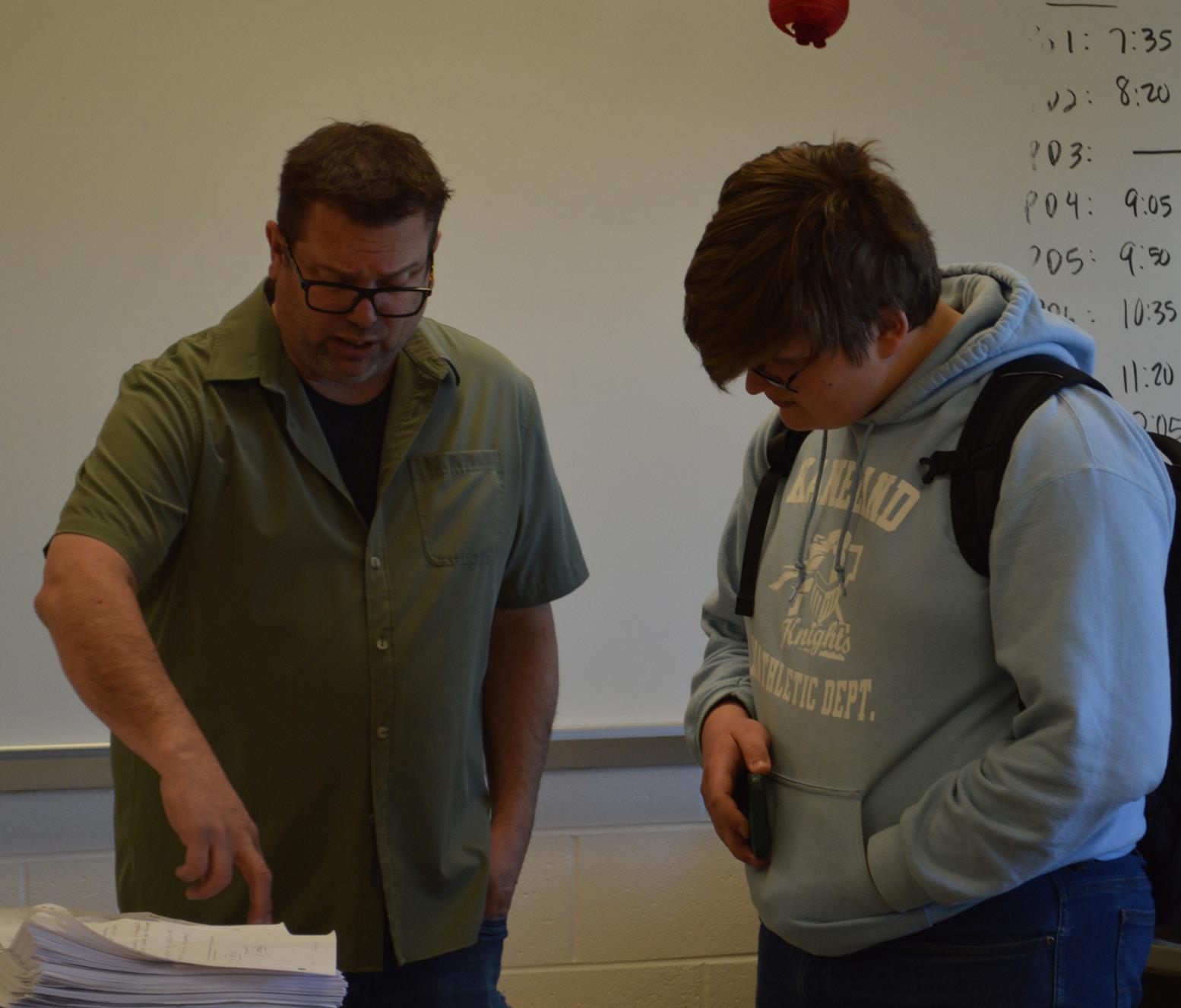
Larsen’s teaching style is unique, and it thrives on participation from his students. He works hard to make every student feel seen and understood. Larsen makes it a point to work with students one-on-one, and he consistently checks in with every individual student in his classes.
“I try to get where students are coming from while also doing my job,” Larsen said. “I blend having fun with making sure people are doing what they are supposed to do.”
Larsen was raised in a blue collar family, where he was one of the three out of 20 cousins who went to college. When he started to teach, he knew that he did not want to be traditional or boring. He prioritizes keeping an engaging
classroom for his students.
Senior Nathan Foss is currently in Larsen’s AP Statistics class. It is one of his favorite classes led by one of his favorite teachers. He has only known him since the beginning of the school year, but he can admire Larsen’s dedication and devotion to his job.
“You can tell he really cares about teaching, and he’ll call you out if you’re not trying your hardest,” Foss said. “His enthusiasm and drive to help us understand the material is what makes him a great teacher.”
In addition to excelling at his job, Larsen is the lead singer in his band, The Bare Hambones. They practice once a week and sometimes more if they have a concert coming up.
“You can tell he really cares about teaching, and he’ll call you out if you’re not trying your hardest. His enthusiasm and drive to help us understand the material is what makes him a great teacher.”
-senior Nathan Foss
Currently, they are working on their third album, which Larsen estimated will be released by the end of this year.
Larsen started his band on his 40th birthday in 2012. His friends and the music they make together are some of his biggest passions, and he works hard to maintain a healthy balance between his band and his professional responsibilities at school. He has been a part of multiple bands before his current group, but he wanted to try something different as he approached 40.
“Instead of having a ‘Let’s call Tim old party,’ I wanted to start another band,” Larsen said. “I wanted to sing this time, so I invited some former bandmates and we started playing.”
In addition to being the lead singer, Larsen also plays the piano. His band has played at numerous venues, including the main stage at Elburn Days this past summer. Foss is one of the many students who has listened to their music and thoroughly enjoyed it.
“I love how his band contrasts,”
Foss said. “At the start of a song, it will be very short and then explode into a passionate tale about whatever they are describing.”
Larsen’s dedication to a successful band and school career is admired by so many of the people around him, as it is not an easy balance.
Larsen met his wife, Nikki, in 1992. They taught together at DeKalb High School before moving to Kaneland. She has been with him through his successes and struggles, and she is part of the reason he is who he is today. Nikki, Kaneland’s graphics communications teacher, sees her husband’s passion and dedication in everything he does and pushes him to be the best version of himself.
“My favorite thing is his undying love and support,” Nikki Larsen said. “He will stay up as late as it takes and get stuff done.”
His dedication is shown in many different ways. At home, Nikki sees Tim get fixated on all of his interests. From writing song lyrics and practicing with his band to staying up late to plan lessons and grade homework, he finds time to balance it all.
“He loves playing music and writing and being creative,” Nikki said. “He also genuinely cares about his students. He is always prepared and expects the best from them.”
Larsen pushes his students in ways that balance expectations with compassion. He wants them to be successful in everything that life has to offer.
“He gets up and makes sure everybody really understands the material,” Foss said. “If you go into his homeroom, he’ll sit down and really make sure you understand in any way that you learn best.”
His dedication to every aspect of his life helps him excel in everything he does. People around him admire him, whether as a person, a teacher or a bandmate.
Chemistry teacher Casey Komel has had the unique experience of having Larsen as both a teacher and then later as a co-worker.
“I always looked forward to having his class,” Komel said. “He made me feel accepted, warm and happy. I can go to him for a lot of advice or ideas on how to handle certain situations.”

Many people choose to hide their authentic self so they can build a certain identity to blend in with their peers. There is a lot more behind the mask than the eye can see.
BY AUDREY NORING Editor and Social Media Assistant
At first glance, senior Jake Buckley is hard to miss. His tall stature can be intimidating to opponents on the field or classmates passing him in the hallway. Buckley fits the mold of a stereotypical high school football star: tall, muscular and imposing. As Buckley walks through the halls, he notices how people move aside as he passes. His broad shoulders and height make him stand out. Classmates gawk in the halls, wowed by his intimidating look.
But that’s not how he sees himself. There is so much more to Buckley than his physical appearance.
“People say I’m terrifying just to look at because being a taller, bigger guy, people think of me as this big scary athlete that nobody wants to go against,” Buckley said. “That doesn’t make me feel good because they don’t really know my true personality, and I want more people to know that.”
Many people don’t know that Buckley trades the shoulder pads for a piano in his free time. They don’t know he sets down his basketball to write songs. He trades the locker room bench for his piano bench. After an hour of a competitive practice, he’ll let his creative side out by crafting lyrics to a new song. He is in his own world, letting the lyrics fill his head. The music drowns out the squeaking of shoes, the blowing of whistles and the yelling of opponents. He feels at home. But this is a home nobody knows about.
This is the side many of Buckley’s peers don’t see due to his fear of feeling judged. But he is beginning to realize that hiding his interests to fit a stereotype is not worth it. Those who accept his passions, he said, are the people
worth keeping around.
“Those who accept your personality, your thoughts, your hobbies, you’ll be able to build a greater relationship with,” Buckley said.
The fear of being judged and shap ing your personality to meet the expec tations of others is extremely common. The desire to fit in isn’t new. Humans have always relied on social groups for safety and survival. Psychology teach er Daniel Ferrel mentioned that those who weren’t a part of a social group in prehistoric times were not likely to sur vive. They needed the safety and num bers of a group. Now, it’s ingrained into our minds to conform to being a part of a group for survival, regardless of the culture you were born into.
“From evolutionary history, we want to be part of a tribe, or a part of a group for safety and comfort,” Ferrel said. “It’s so embedded into the recess es of our mind to want to be liked by others, to want to have lots of friends, to want to have support systems around us. We will change our attitudes.”
Changing oneself for the approval of their peers is called conformity. For example, people engage in things that go against their beliefs just for the sake of earning social ap proval. For Buckley, he once hid the artistic side of himself. Oth er than not sharing his musical journey, Buckley tries to remain true to himself. Having different per sonalities in different social settings is normal, but that often leads to compli cations in the long run.
dents spend hours observing what their peers wear, do and post online. Students will do anything to not stand out. And for some, blending in feels safer than risking judgment.
“I’m trying to be me and have one personality instead of different personalities, because it’s confusing for people to know who I really am as a person,” Buckley said.
Buckley said that he tries to remain true to himself by expressing his authentic personality. That way, everyone can see his personality the same way and he never has to mask who he truly is.
For others, blending in seems less optional. Sophomore Melyssa Caravantes feels the need to conform so she can be accepted by her peers in each aspect of her life. Caravantes feels compelled to alter her personality so she is liked by everyone. Besides confusing people with more than one personality, like Buckley said, there are even more
“empathetic” “sincere”
“kind”
High school intensifies the pressure to conform. Students spend nearly ev ery day surrounded by peers, constantly comparing themselves to others. Stu

filled with highlight reels including photos with friends, TikTok dances and aesthetic meals. While the highlight reels fill screens, the ordinary or difficult moments of life are hidden behind smiles and laughter.
“Nobody posts about the mundane aspects of their life,” Ferrel said. “Nobody really posts excessively negative things about their life or personality. “
Many students, including Caravantes, carefully choose what parts of their lives they would like to share online. Caravantes feels like she must share her highlight reels so she can craft a version of herself that people can admire.
“I feel like a lot of the stuff I post is the fun stuff that I do, not really the basic stuff,” Caravantes said. “[I do this] out of fear of judgement and people not accepting my hobbies.”
For Buckley, he tries his hardest to set an example for his peers. Walking through the halls, Buckley knows how
“It’s all about being yourself and expressing how you feel,” Buckley said. “I see a lot of people wearing hoods around school, and I can tell they don’t feel the way they should. I really want to set the example of, ‘It’s okay to be yourself around other people.’”
It can be hard expressing yourself when you open your phone to a post about your classmates having a fun time in the city while you’re at home in your pajamas. That is when low self-esteem creeps in, when you’re not doing the same things as your peers. According to psychologytoday.com, 85% of people worldwide have low self-esteem.
Ferrel recalls a time when he shifted who he was just to fit in. He made sure to conform to social groups so he did not stand out. All he wanted was to be a part of a group, and he cared too much about maintaining a certain identity.
“I was very focused on being in all the right classes and hanging out with
eryone to try something new and do what they enjoy. He wishes he would’ve had that mindset when he was in school. “Just be yourself,” Ferrel said. “Don’t worry about it. Right now, it seems like a lot of people are always looking at you in a fishbowl, and that’s not always the case. Enjoy what you want to enjoy now.”
As Buckley’s high school chapter is coming to a close, he has learned the same lesson as Ferrel. Buckley starts each school morning with an enthusiastic, “Good morning, Kaneland High,” whether it’s a Monday or a Friday. Many students couldn’t fathom doing the announcements each morning, especially with the entire school as their audience. Buckley doesn’t mind. He’s being himself and not letting anyone get in his way. He has learned to embrace who he truly is as a person, while picking up others along the way.
“I’m just doing what I enjoy,” Buckley said. “I wouldn’t have done the announcements if I didn’t love it.”
As Buckley prepares to graduate, he hopes more students begin to realize that it’s okay to be yourself. Fitting in isn’t as important as being authentic. Whether Buckley is blocking an opponent on the football field, dunking the ball on a fast break, creating a new song or greeting the school over the announcements, Buckley said the most important thing is to stay true to who you are.
“perfect”
“generous”
“driven” “relentless” “lucky” “intelligent” “practical”
“The fear of being judged is overused,” Buckley said. “If they judge you for doing something, then that’s not the right person to be around.”




BY GRACE BRUNSCHEEN & KATE HOMCO Editors and Columnist and Podcaster





While walking down the narrow halls of Kaneland High School, you will see people passing with brightly colored, squishy objects in their hands. Some conversations from nearby students also consist of plans to go search for these gratifying shapes of goo after school.
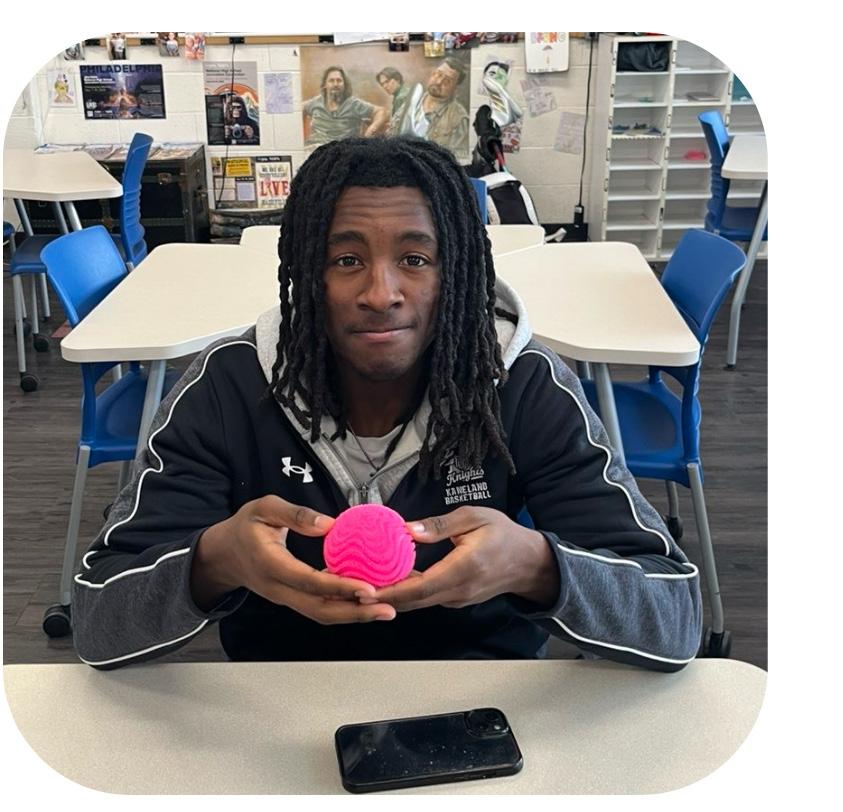


“The color, and it feels better than the other ones.”



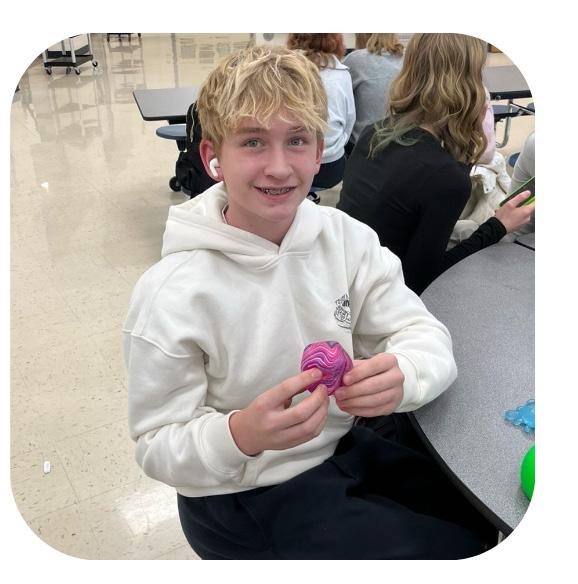


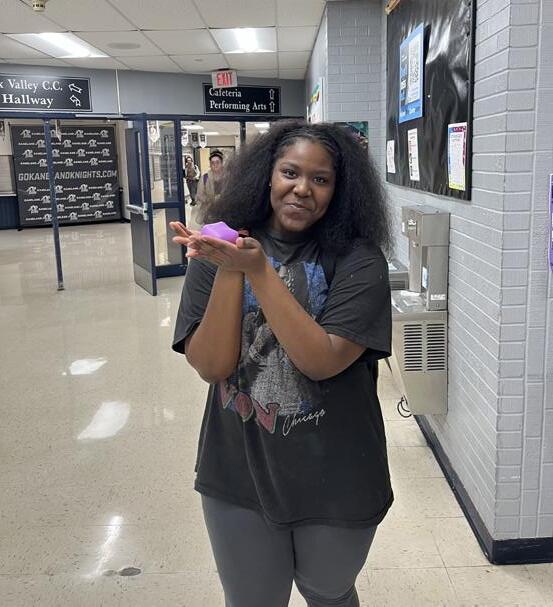

“It has a good texture.”

The popularity of NeeDohs have been on the rise for the past few months, with many people hunting for the newest ones to add to their collections. Although squishy toys have been trendy in past years, the classic NeeDoh, produced by Schylling, has skyrocketed in popularity. NeeDoh’s website consists of dozens of different types. Each offers a different color, texture and shape for people to love.
“The harder ones release more stress than the softer ones, in my opinion. I like all the colors.”




In today’s world, we often focus heavily on the destination. Students think about what college they want to attend, athletes aim for championships and most people measure success by the final result rather than the process it took to get there. While setting goals and reaching milestones is important, focusing solely on the destination can cause us to overlook something that has equal value: the journey itself.
getting somewhere can completely change how we experience life. When people begin to value growth instead of perfection, challenges feel less intimidating. Instead of seeing obstacles as failures, they become part of the journey towards improvement. Having this mindset encourages people to keep trying, even when progress feels slow.

Kaneland High School 47W326 Keslinger Rd. Maple Park, IL 60151 (630) 365-5100 www.kanelandkrier.com Member of IJEA, Quill & Scroll, NSPA, NISPA IHSA State Finalists 2013 - 2025
EXECUTIVE
of
and Business Executive
Evan Whildin Co-Sports & Activities Executive and Co-Broadcast Manager
Executive, Design Executive, and Social Media
MANAGING EDITOR STAFF
Faith Maschman Review Manager Clara Saros Column Manager
Hadley Springer Web Assistant

The path towards any goal is rarely perfect. Along the way, we will make mistakes, face challenges and experience setbacks that will feel discouraging. However, these moments are not simply obstacles; they are opportunities to learn. The mistakes we make along the way are how we grow as people. When something doesn’t go the way we planned, we have the chance to reflect on what happened and try again with more knowledge than we had before.

The journey also helps people develop important qualities that success alone cannot teach. Patience, determination and confidence are built through experience. These qualities develop when we continue to work towards a goal, even when things become difficult. If success came instantly, we would miss out on the lessons that shape our character and prepare us for future challenges.
Unfortunately, many of us grow up believing mistakes should be avoided at all costs. In school, students are often praised for succeeding on assignments and tests, so then they may feel embarrassed after getting something wrong. This can create the idea that mistakes are failures instead of opportunities to learn. When we become too focused on the idea of being perfect, we may begin to avoid taking risks or put off pursuing new experiences because we are afraid of making an error.
In reality, mistakes are an essential part of improvement. No matter what, any process involves trial and error. Athletes miss shots, musicians play wrong notes and writers misspell words. Each mistake provides a valuable experience that helps people improve their skills over time. Without these experiences, progress would be much slower.
Learning to enjoy the process of
Think about any major accomplishment people celebrate. Whether that is graduating from school, finishing a long project or achieving a goal you set for yourself, the sense of pride usually comes not only from the result, but also everything you did to get to that point. There are the nights you stayed up late studying, the practice sessions and the moments of doubt. These all become meaningful parts of the experience. In many ways, life itself is a collection of journeys.
By learning to value the journey, we can approach life and experiences with a healthier mindset. Progress becomes something to appreciate, even if the final goal is still far away. Every step forward, every lesson learned and every challenge overcome contributes to personal growth.
In the end, success is not just about where you end up. It is about the experiences, lessons and growth that happened along the way. When we learn to enjoy the journey, life becomes more meaningful and the destination becomes even more rewarding.
STAFF
Giovanni Gino Bartolone, Jack Bicker, Jazmin Bosque, Ethan Butler, Kelyn Christiansen, Brooklyn Converse, Ava Corbett, Yahaira Delgado, Joe DiGuglielmo, Rowan Eubanks, Liam Flesher, Gabby Gutierrez, Raquel Hayes, Gianna Hough, Rebecca Johnson, Caden Kaiser, Devin Kapadia, Narmeen Kattoum, Casey Krohn, Chloe Larrison, Maley Love, Kaiden Lycan, Jay Maisonet, Carter Miller, Marissa Olson, Joe Placzek, Ciara Puett, Grace Rusev, Natalie Sanagustin, Logan Schroll, Miles Sizemore, Michael Spallasso, Alex Tobin, Veronica Van Dusen, Z.A.B, Mabel Zielke, Avery Zwick
ADVISORS Print Production

Nicole Larsen Print advisor Dominic Bruno Krier advisor
Editorials represent a majority opinion of the Editorial Board and are not necessarily the opinion of Kaneland administration, staff, students or parents. The Krier Editorial Board consists of designated Advanced Journalism students: Aleena Alrifaee, Grace Brunscheen, Olivia Cotter, Ollie Fair, Anna Gatz, Kate Homco, Olivia Krasuski, Charlize Landa, Bobby Leavey, Faith Maschman, Audrey Noring, Ellie Olp, Morgan Olson, Ally Reilly, Ansley Ruh, Savana Sanchez, Clara Saros, Sophia Schroll, Hadley Springer, Gavin Vaughn, Prema Weichun, Emma Weintraub, Evan Whildin, and Noah Witz. Students make all publication decisions.
Letters can be sent to the address above or e-mailed to krier@ kaneland.org. Letters must be signed (names may be withheld under extraordinary circumstances as deemed necessary by the editorial staff) and must be under 300 words. The Editorial Board has the right to work with writers to edit for clarity and length. Any material that is potentially libelous, obscene or disruptive will not be published at the discretion of the Editorial Board. All decisions to publish or not publish letters are made by executive editors. The Krier has been an open forum since 1974. As an open forum, we restrict editing to staff members only; prior review and editing are prohibited by people outside the staff.
BY CHARLIZE LANDA & SAVANA SANCHEZ Co-Copy Editor and Broadcast Manager and Editor
As high schoolers discover who they are becoming, their values and beliefs may change and they may begin to question their surroundings. Their developing knowledge about important topics, along with their Constitutional rights, allows for self-expression and freedom of speech.
The answer to whether or not First Amendment protections should apply in schools differs depending on whom you ask. Many argue that those rights should not be restricted, while others argue that certain topics have no place in classrooms and hallways.
Although students do have a right to freedom of speech and expression, the school environment creates a unique policy for what can be said, worn, displayed and done. The Supreme Court decision in Tinker v. Des Moines (1969) that protected students wearing an anti-war arm bands created the standard that an act or speech which does not impede teaching or harm others is protected under the First Amendment.
When student voices protected by the First Amendment are silenced, it brings up the question of censorship.
It can be argued that censorship is important in order to protect vulnerable groups and control hate speech. However, censorship is illegal in the United States when the government attempts to restrict protected speech.
In early February, AP United States Government and Politics students were asked to create a polling project to learn optimal polling practices. In order to collect answers for their polls, students sent them to administration in order to have someone in a position of authority share the polls with all students.
Junior Henry Nguyen created a poll to ask students if they preferred last school year’s administration or this school year’s administration because there have been new staff members and changes in policy. His poll was never sent to students, and the administration did not give him an explanation.
“The only way this kind of situation improves is by communication,” Nguyen said. “Any attempt of action or change falls flat immediately. I do understand that everyone has their own duties and responsibilities, but to be left in the dark for multiple days while relying on the front office to do a summative project is
borderline unacceptable.”
This situation caused Nguyen to question whether it was a circumstance that lacked communication or rather represented an act of censorship.
On Friday, Feb. 20, senior Janel Gutierrez was told by administration that her skateboard art project could not be displayed in the hallway alongside her

classmates’ projects. Gutierrez’s skateboard brought awareness to the names of people killed by Immigration and Customs Enforcement (ICE) during ICE operations, along with a situation with ICE involving young child Liam Ramos. The skateboard also featured sayings like “ICE OUT,” “No one is illegal on stolen land,” and a statement in Spanish that included profanity.
Initially, art teacher Emily VanDelinder-Birchfield suggested censoring the profane word in order to avoid conflict, and Gutierrez covered the first two letters of the word. The art piece was displayed halfway through ninth period, but administration facilitated its removal by the end of the school day.
“Once I got frustrated that I wasn’t getting answers, I felt that [the issue] was personal,” Gutierrez said.
To Gutierrez, the reasoning behind the removal is unclear, given that
the profanity was censored before her skateboard was displayed, and it is even further clouded when assessing the projects alongside it. Gutierrez’s project was not the only piece that represented personal values, as multiple skateboards which were not removed involved religion, such as angels and crosses.
“To me, that only leaves the question, ‘Why censor the voices of students unless it’s something you’re scared of students thinking about?’” Nguyen said.
Although immigration has been a very controversial topic, silencing student voices does not avoid conflict. Rather, it makes students feel targeted and underrepresented. During times of intense conflict and abuse, any and every voice is essential to creating change and deserves to be heard.
"Administration went straight to the school handbook on innapropriate language," VanDelinder-Birchfield said. "Their stance was it's the same as if the student was wearing a shirt that has a bad word on it, they'll have you change into a different shirt, not just block that word off."
School should be a safe environment, where diverse ideas and opinions are welcomed, not solely the ones some agree with. Unfortunately, this is not the reality of our society, and we are not usually accepting of ideas that do not align with collective values.
Senior Gabriella Monteleone used to support the Trump administration at the beginning of President Donald Trump’s second candidacy and has worn a sweater with Trump’s name on it, causing her to receive negative comments from her peers and feel targeted by her entire class.
“It was so bad to the point that I had to take the name off the sweatshirt because throughout the entire day I just did not feel safe expressing that I was a Trump supporter,” Monteleone said.
Although Monteleone’s opinion on the administration has changed, she felt uncomfortable expressing her First Amendment right at school.
The First Amendment has allowed us to fight for civil rights, demand change and express our concerns. Although we may be young, we should not be intimidated by others when it comes to fighting for our liberties, advocating for others and defending our values.
BY CLARA SAROS
Column Manager
For many years, the Kaneland student body has complained about the lunch prices in the cafeteria, with hot lunch now sitting at $3.85 each day. The expensive a la carte options are also financially inconvenient to many people. Are lower prices a realistic possibility? Or are they a pleasant dream we are simply entertaining ourselves with? Based on what I found from research and the lunch prices in nearby schools, it certainly seems possible that our prices could be lowered.
With inflation happening on a national level, it is only natural that local prices must go up as well. However, the current prices seem unrealistic. A sandwich or a la carte main dish costs $4.00 or $4.50, a cup of fruit is $3.00 and chips are $1.50 for a side option. If you have a sandwich and fruit each day, that’s about $7.00 a day. If you multiply this by five days a week and four weeks a month, that is $140 on lunch each month. The Illinois State Board of Education requires a minimum of 185 days of attendance in the school year, which comes out to $1,295 on lunch for a year. This is only an example, as most people do not buy the same exact thing every day.
A la carte prices were last increased at the beginning of second semester during the 2024-25 school year. The district’s J-5 approval of a la carte service programming project pricing update indicated the approval of an increase in the prices of all packaged snacks by $0.25, $0.50 or $0.75. The Board of Education hoped to both generate more revenue from the lunch line and to encourage students to purchase healthier options. While that sounds like a good idea, the healthier food is still more expensive. Instead of buying healthier things, people are just buying less.
I was curious what the difference would be if you bought lunch items at the store versus in the lunch line, so I went to Woodman’s in North Aurora to find out. The first thing I looked at was the cost of chips. Depending on which brand and type of bulk package you choose, the cost per bag of chips is $0.40 to $0.67. In the cafeteria, any choice of chips is listed as $1.50. Similarly, the large muffins are $0.73 in bulk,
$1.19 singularly and $2.25 in the cafeteria. Uncrustables are $0.80 in a large bulk pack and $1.75 in the lunch line.
I bet if you break down the ingredients needed to make the sandwiches, yogurt and other options, you would see a similar trend. While I agree that the school needs to sell above the store’s sales price to help cover other food-related costs, an entire dollar or more seems unnecessary.
“I think [the prices] are reasonable, because the school still needs to make money, but I do think they should be at least a little bit lower,” sophomore Evie Shinofield said.
One could argue that the current prices are the minimum that the school needs to charge to provide food. However, other schools in our area do not have these same prices. Batavia’s website states that they charge $3.35 for hot lunch, Sycamore’s website states that their hot lunch costs $2.70 and West Aurora’s website states that they charge $2.75. Geneva’s website states that they, like Kaneland, charge $3.85 for hot lunch. Their a la carte is similar to ours as well. Their chips are $1.50, and fruit is $3.00. Geneva junior Penny McCutcheon agrees that the prices are too high.
“I feel like everything in [the lunch line] is kind of a ridiculous price,” McCutcheon said.
Sycamore’s a la carte prices are lower than ours as well. They sell a sandwich for $3.30, chips for $1.35 and fruit for $1.00. At Kaneland, a sandwich is $4.00 or $4.50, chips are $1.50 and fruit is $3.00. Batavia’s a la carte prices include $2.00 for chips, and all entrees are $5.75. Each entree comes with a choice of fruit or vegetable and beverage. At Kaneland, an entree and fruit would be $7.50 or $6.50 depending on the option of the day. At Sycamore, the same sandwich and fruit combo that is $140 a month at Kaneland is only $86. While their system is a little different, it would be $115 at Batavia.
While I am sure there is a rationale for lunch room prices, there are different ways to determine how much to charge students. If the district wants to encourage healthier choices, they could lower the cost of fruit and raise the cost of other items to make up for it. However, continuing to raise prices that are already higher than schools around us is not the answer. If they can do it, so can we.
BY ALLY REILLEY Editor and Columnist

Sophomore Grant Caston stands next to his Labrador Retriever, Odin. They enjoy going on hikes and walks together.
Senior Hudson Warfel poses with one of his six goats, Pebbles. One-year-old Pebbles and her brother are the first goats his family got.

In a heartwarming moment, senior Jade Lee cuddles up to her cat, Poopie. Poopie is a ragdoll, and he is approximately five years old. Lee adopted him in 2021, and she notes that he is incredibly lazy and enjoys sleeping on computers to prevent her from getting tasks done.




Standing in her farm’s field, junior Addie Volkmar feeds a carrot to her donkey, Lenny. Volkmar’s family adopted Lenny in June of 2025, and Volkmar lovingly says Lenny is both “lazy and feisty.” He often plays with his ball out in the field.
Cuddling her Mini Rex rabbit, Nibbles, junior Anya Szumny spends time with the pet she got after joining 4H, a youth program where students learn about raising and caring for animals. Nibbles is now two or three years old and loves spending time with Szumny and her other pets.
In her backyard, junior Haley Swim holds her leopard gecko, Kringle. Swim received Kringle three years ago as a Christmas present after her old gecko passed away that same year. Kringle often sits on Swim’s shoulder as a loyal companion.












Unscramble the letters to make a word that is included in the Krier!

H E D E O N S N U S I E S B S E M E R N E D U E R F







N E R S O C Y M R I A R P A S S S A T I I T C

































“My job is noticeable, and you can see the difference. I like my job here at this school. I’m happy with what I do, and we all work here comfortably.”
- janitorial supervisor Efrain Aguilar (page 8)
“Those who accept your personality, your thoughts, your hobbies, you’ll be able to build a greater relationship with.”
- senior Jake Buckley (page 12)