KANELAND
KR ER
January 15, 2026
KANELAND
KR ER
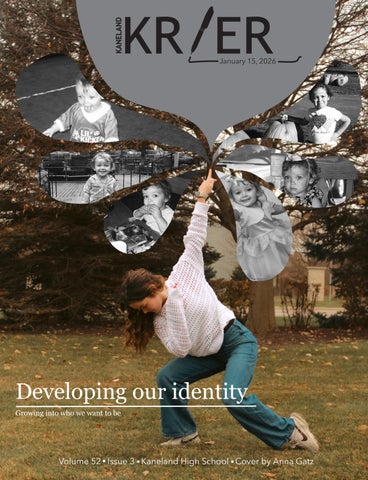
Developing our identity Growing into who we want to be
Volume 52 • Issue 3 • Kaneland High School • Cover by Anna Gatz
TABLE OF CONTENTS
4
5
18
3
News
6
Sports and Activities
8
Feature
10
Profile
14
Advice & Review
15
Editorial
16
Opinion
18
Photos & Voices
LETTER FROM THE EXECS The start of 2026 brings plenty of opportunities for introspection, goal-setting and personal development. Examining all elements of ourselves - our fears, thoughts, feelings, beliefs and motivations - will lead to self-discovery and a thorough understanding of our authentic selves. A strong sense of self can help us recognize and achieve our goals for this year and beyond. Being cognizant of ourselves and our aspirations will bring about a fruitful and fulfilling life.
Olivia Cotter
Bobby Leavey
Anna Gatz
Olivia Krasuski
Sophia Schroll
Emma Weintraub
Charlize Landa
Evan Whildin
News|January 15, 2026
Kaneland locks down on behavior BY ALEENA ALRIFAEE
T
Editor and Social Media Assistant
his year, Kaneland High School has not added new rules or regulations. Instead, administrators are enforcing existing ones more efficiently to strengthen the safety, responsibility and well-being of students. With both new and returning administrators, students now face more consistent consequences. Many are being held accountable for parking violations, skipping class, vaping or frequent tardiness. Steven Lucas, the new Dean of Students, began the year with a clear goal: strengthen accountability while staying fair. Within his first semester, he increased consequences for students who repeatedly violated rules. Lucas and Principal Melinda Cattell work together to determine punishments and suspensions. Repeat offenses lead to harsher outcomes. "Everything is consistent across the board,” Lucas said. “One student doesn't have a different consequence than another." Lucas believes fairness and consistency build trust and respect between students and administrators. Some violations, such as parking issues, build on an escalating system. The first step is an email home, followed by stricter actions if the behavior continues. Other cases, like vaping, possession of nicotine or THC, and fighting, result in automatic consequences that any other student would receive for the same violation. For a THC violation, a student will be out for three days, while students caught vaping will have a one-day inschool suspension. A fighting suspension depends on the severity, but they never go beyond 10 days, as that would involve expulsion. "If a student is caught vaping or having nicotine or THC, or if they are fighting, there is no initial discussion with students,” Lucas said. “Parents are contacted immediately." Despite Lucas being focused on discipline, he aims to approach each student with understanding. "If students are seen having a rough time, I try to be understanding and do what it takes to help the student in the long run," Lucas said. Lucas values communication with both students and parents, offering second chances when possible. Still, he
Page design by Aleena Alrifaee
knows that some students may struggle to want that change. "Consequences don't always work for kids if they don't care,” Lucas said. One of Lucas's main goals is to reduce the number of tardies by half. He has made progress by emphasizing the importance of attending class. "Students are coming to school, so they should be in class," Lucas said. Lucas believes that accountability starts with showing up and students respecting instructional time. "There are no new rules, just more enforcement and accountability for students," Lucas said. "That’s it. [We are] just holding kids accountable for their actions."
Graphic by Aleena Alrifaee
Lucas also aims to create a safer school environment by reducing vaping and drug use. "I want to get the drugs and nicotine out because I know peer pressure happens," Lucas said. Cattell shares his focus on fairness and consistency but also stresses student growth. She believes high school is a time for learning, both academically and socially. "When you're a high school student, this is the time where you're learning," Cattell said. "You're going to make mistakes." Cattell emphasized that discipline is not about judgement. "Mr. Lucas and I don't judge kids when they make mistakes," Cattell said. "We all make mistakes, and we just hope you don't do it again. That's why those consequences build up harder. We call it progressive discipline."
Cattell explained that the goals of these consequences are to help students reflect and improve while keeping the school safe. "The main goal is for a safe place," Cattell said. "We want students to make mistakes or poor choices and then learn from them, but still get [their] education." Cattell views vaping as a health issue as well as a rule violation. "If a student gets caught vaping and they have an in-school suspension, they have the option to watch videos to learn about the harms and consequences vaping has, " Cattell said. "So we can have these kids watch these videos about the effects of vaping and how to help yourself, but it's not going to work unless they want to. We've had quite a few kids who have actually been very open to it. They are stuck in this habit of addiction, and they want out of it." Cattell said this approach focuses on reinforcement and care. "It's just reinforcement because that's the whole point," Cattell said. "It's enforcing these kids, not making new rules for them to follow." Cattell added that the purpose behind this system is simple. "The reason why we do this is because school is important, and we want kids in the classroom as much as possible," Cattell said. On Monday, Nov. 10, some students received two lunch detentions for continued tardiness or absences, which surprised many since this rarely happened last year. The system assigned the detentions automatically. Students who had valid reasons or documentation could appeal. Senior Allie Curth, who has medical issues causing absences and tardiness, received one of these detentions. After the nurses explained her situation, it was cleared. "I was just confused,” Curth said. “I knew there had to be some kind of mistake because I'm a good kid." For others, the detentions served as accountability for unexcused absences or skipped classes. Together, Lucas and Cattell aim to make Kaneland safer and more supportive. Through consistent enforcement and fair treatment, they hope students learn responsibility and self-control while still feeling valued and understood.
News
3
News|January 15, 2026
The effects that federal laws have
BY CHARLIZE LANDA
Co-Copy Editor and Broadcast Manager
A
s high school students, it can be difficult to pay attention to politics. Even if you don’t watch television news or are not subscribed to a newspaper, social media highlights current events through mutual reposts, memes and propaganda. Often, people choose to ignore policies and global affairs because they do not feel personally impacted. But as President Donald Trump and his administration frequently enforce new policies that make a notable impact on local communities, turning a blind eye is nearly impossible. Being involved in one’s community is not a requirement to notice the impacts of Trump’s policies. At the beginning of Trump’s presidency, he enforced tariffs on U.S. trading partners. His objective in terms of tariffs, according to the official White House government website, is to reprioritize U.S. manufacturing. Tariffs impact the costs of goods being imported into the U.S., which can cause economic strains for small businesses. According to the U.S. Chamber of Commerce, “Tariff increases can force [small businesses] to either raise prices on consumers, absorb the additional costs and reduce their profits, or even cut back on inventory or operations.” Due to the competitive nature of businesses, it can be difficult for small, local businesses to survive the implementation of tariffs. “[Small businesses] don’t buy in bulk, so it’s going to hurt them more,” economics teacher Renee Grisch said. “For a lot of them, it’s going to hurt them a lot.” Although tariffs have mostly impacted small businesses and the automotive industry so far, other businesses have also been hurt by the implications of tariffs. This is apparent in local businesses in the Aurora area. “Some of our local manufacturing sites have seen material increases of up to 40% depending on what country they have sourced their raw materials from,” city of Aurora Alderman Jonathan Nùñez said. “In most industries, the increased cost of goods has been spread out between the importer, supplier and finally the consumer. In the end, increased tariffs impact everyone’s wallets.” Additionally, many larger and more
News
4
popular companies impacted by tariffs have raised their prices, so consumers have become responsible for the additional cost. The increase of prices in essential goods can cause hardships for families nationwide. Although tariffs may add costs for both consumers and businesses, other federal policies have impacted families’ abilities to afford basic necessities. “I don’t think it’s all about tariffs,” Grisch said. “The overall cost of living is going up.” Many families that relied on the Supplemental Nutrition Assistance Pro-
Photo by Charlize Landa
Aurora Mutual Aid established two stocked community fridges to ensure families in need have access to food. These are located at Jo-Ana’s Salon and Fresh Start City Church.
gram (SNAP) did not receive their benefits at the beginning of November due to the longest government shutdown in U.S. history. The U.S. Department of Agriculture (USDA) claimed that there were not enough funds to deliver to SNAP recipients
due to the government shutdown. According to the Illinois Department of Human Services (IDHS), in the Kane County Aurora Family Community Resource Center office (FCRC), 20,768 households require SNAP benefits, as well as 41,296 individuals. Many families who rely on SNAP have had to find alternative ways to purchase or receive food. “SNAP cuts and U.S. Immigration and Customs Enforcement (ICE) deployment have become a tag team of sorts that have led our community to grow in hunger without an immediate solution except food pantries,” Nùñez said. “When you create an environment of food uncertainty and fear of leaving one’s home, you are left with countless families that grow hopeless.” Families who are eligible for SNAP are low-income and need the assistance. Since many families did not receive SNAP benefits, lack of funds to purchase food without government assistance caused them to go to food pantries. Food pantries must adapt to the inflation in the number of families that require food. Many food pantries are non-profits, including the Interfaith Food Pantry and Marie Wilkinson Food Pantry in Aurora. This means that they rely on volunteers and donations to provide food to families. With the sudden demand that food pantries are receiving, they may struggle to supply everyone. “They will have to give more Graphic by Ellie Olp
Page design by Ellie Olp
News|January 15, 2026
on Kaneland’s local communities than they normally give, and we could really see a shortage of food,” government teacher Jessica McNally said. Now that the government shutdown has come to an end and families are receiving their benefits, new regulations have implemented new eligibility requirements for the program. According to the official city of Chicago government website, as of Dec. 1, SNAP program participants must have a job or volunteer more than 80 hours per month unless they qualify for a specific exception, and they must have lawful residence or be a Cuban or Haitian entrant. This means that refugees, asylum seekers, victims of human trafficking, certain victims of violence and torture and other historically qualified statuses will not be eligible for SNAP benefits. Low-income families that were previously eligible for SNAP will now have to find an alternative way to purchase and receive food. With the increase of demand for food pantries from non-eligible individuals, people missing SNAP funds and those dealing with increases in cost of living, the city of Aurora has partnered with local food pantries in order to ensure everyone receives their necessities. “I specifically am working on a volunteer drive to increase the numbers of drivers to help with food deliveries from the pantries,” Nùñez said. As Aurora makes efforts to
Page design by Ellie Olp
assist homebound individuals receive bled community members. As a result, their pantry items, other collectives, the city of Aurora ensures the safety of such as Aurora Mutual Aid (AMA), have members by not collaborating with ICE. volunteered their time to provide edu“We will not engage with federcation, mutual aid and advocacy for the al operations regarding immigration,” community. Nùñez said. “This is also in alignment AMA has installed two community with the Illinois TRUST Act.” fridges, the Scout Fridge and the OG In collaboration with different Fridge, in the city of Aurora that organizations, Aurora is are a community-led initiative, providing a supportive open to everyone. Although community to undocuthey are not a solution to mented immigrants by food poverty, they allow educating citizens and community members providing resources to take what they like presentations, need. In addition to detailed step-byrefrigerated items, step information they accept pantry cards regarding items, toiletries, hats, ICE situations, gloves and socks whistle kits to infor the winter. form community Undocumentmembers of ICE presed immigrants ence nearby and who are low-incommunity watch come are not elgroupchats. igible for SNAP, A d d i t i o n al l y, so they may IWA has providrely on commued signs for local nity projects and businesses to disnon-profits to receive play on their doors necessities. With the to prevent ICE from growing appearances of entering. ter O by livia Cot ICE and an escalating numDespite the safeguards oto Ph ber of deportations, many fear put in place to protect community leaving their homes to shop or get members, ICE altercations have ocgoods. cured. ICE officials have entered workAdditionally, Illinois Workers in Ac- places and waited outside schools and tion (IWA) has helped provide education private homes. and advocacy for community members “Locally, people have been a litto address the growing ICE involvement tle more afraid or on edge about what in nearby cities. could happen to their friends or their “The city of Aurora has worked with neighbors,” McNally said. several chambers, non-profits and othIn order to prevent run-ins with ICE, er local organizations in order to host members of the Aurora community have Know Your Rights training and best formed several ways to inform others on practice presentations for businesses, their whereabouts. The Aurora Rapid and we have played as a liaison to oth- Response Team (ARRT) has built a comer business resources from local to state munity based on reporting ICE sightand even federal ings. They make sure the community is where avail- informed of their location, record ICE able,” Nùñez interactions and ask detainees for their said. contact information to alert relatives. W i t h If community members have conAurora’s large cerns about their safety or needs, Auroi m m i g r a n t ra officials advise contacting your alderp o p u l a t i o n , man. All contacting information can be growing con- found on the city of Aurora website. cerns over “It is our responsibility to connect ICE’s pres- you with services or organizations put in ence has trou- place to help,” Nùñez said.
News
5
Sports & Activities|January 15, 2026
IMPACT OF THE BY FAITH MASCHMAN
T
Review Manager
oday’s society is one that constantly overlooks the value of art. Schools all over the world target arts education with budget cuts, claiming that they must prioritize the more practical or traditional courses. What these schools don’t realize is the lessons and passion that is generated from art, allowing it to be just as important as any other subject. The arts have many practical benefits for growing minds. Involvement in art can foster creativity, confidence and collaboration. There are many crucial life skills that can be refined through involvement in the arts, some of which include critical thinking, communication, motor skills and emotional expression. Participation in art can give a student an outlet to express themselves in a healthy, productive manner. The American Academy of Arts & Sciences claims that arts education builds well-rounded individuals, allows for an understanding and appreciation of other cultures and histories, supports social/emotional development, builds empathy and acceptance, improves school engagement and strengthens communities. Arts education encourages students to channel their own perspectives and use their voice, as well as always strive towards growth. Not only can the arts encourage students to recognize their own perspectives, but they also push them to confront the perspectives of others. “A r t is a
Sports & Activities
6
community,” photography teacher Taylor Wyeth said. “It’s not just a one-person show.” Being involved in the arts allows for more social-emotional development and maturity. Wyeth explained how art can be both frustrating and exciting, and students can learn how to regulate their emotions as they are creating. This is a skill that becomes crucial to life outside of the classroom. A foundation of art is sharing thoughts and projects with others; this is what creates social development. In arts education, the culture in the classroom is what allows students to socially mature. By seeing the work of their classmates and receiving constructive feedback, students are taught collaboration and to strive for improvement. Additionally, it teaches students
Graphic by Audrey Noring
h o w to both give and receive criticism. Art classes foster creativity and growth, allowing students to carry these qualities into adulthood. “If you have ever thrown clay on a wheel, then you know it is extremely difficult and it builds a lot of character,” Wyeth said. “You watch someone do it and it looks super easy, but then when you get on the wheel it takes a lot [of ef-
fort].” It is these lessons that students learn to problem-solve and allow them to be open to learning new or difficult skills. This will help them with future careers, as employers value individuals who are able to think outside the box. Not only does art provide students with crucial life skills, but it also benefits their mental health and world view. Sophomore Jo Ramsey expressed how art has improved their life and has become integral to who they are. “I can’t be apart from art,” Ramsey said. “It’s always going to be a part of who I am.” Ramsey explained that art is very multi-dimensional. They feel that art has allowed them to think in different and unique ways, giving them new reference points and options for expression and inspiration. Ramsey described how art has made them less rigid and helped them realize that they benefit from taking mental breaks when faced with stress. Ramsey also explained how art has altered their perception of life, allowing them to look at the world through a different lens. “Art has definitely helped me see all the details and the small, beautiful things about [the world],” Ramsey said. They described how art has also made them less of a perfectionist. Since there are no rules, Ramsey has learned to value creativity over analytics, letting their brain wander and explore this different kind of thinking instead of stressing over details. Art can benefit students in many ways, like improving their mental health and building skills that they will employ throughout their entire lives. Arts education builds well-rounded students who are ready to face a difficult future and who know how to problem solve in any difficult situation they may find themselves in, not just those pertaining to art. The arts provide students with countless practical benefits and have an essential role in education. In Ramsey’s words, “Art, to me, means being myself. If art can be anything, then you can be anything.”
Page design by Audrey Noring
Sports & Activities|January 15, 2026
Spotlighting less popular sports BY KATE HOMCO
E
Editor and Podcaster
very school has its stars - the football quarterback, the basketball point guard, the baseball or softball pitcher - but behind the scenes are other athletes who are just as dedicated, competing in sports that rarely have the same kind of crowd. From bowlers to swimmers to gymnasts, these athletes train, sweat and represent Kaneland with the same pride but without the spotlight. Most people aren’t aware that Kaneland even has gymnastics or swimming teams. There may only be a few people on each team, making it hard for the individuals involved to be noticed. But there are benefits. “Since the coaches are my sisters, it’s helpful because they keep motivating me the whole time, and it’s very focused on me,” said junior Ella Kerrins, who is in her 11th year as a competitive gymnast. She has been on the team since her freshman year, and the most teammates she has had at a time was seven. Now it is down to herself and freshman Bry-
an’ah Carter. Kaneland’s swimming team is also dealing with a dwindiling numbers of participants. Competitors in both of these sports have accomplished great things, but a lot of this remains unknown by students.
Photo by Sophia Schroll
Freshman Ty Wiedel rolls the ball during their match against Sycamore at Mardi Gras Lanes in DeKalb. The Knights lost all three of the games in this match, rolling 2,681 pins to Sycamore’s 3,474.
Kerrins went to Sectionals last year, and senior swimGraphic mer Kiersten Anby Ansl ey Ruh drae competed at Regionals. One benefit, however, is that a smaller team may foster closer relatioships, however. This is helpful for improving teamwork and fostering overall success. Another small team at Kaneland is the boys bowling team. This team has been around for six years and only has seven players, just enough for a varsity team. “I understand a lot of people overlook it, but it is also kind of frustrating because it’s like they’re kind of only looking at it from one perspective,” varsity bowling coach Sarah Ray said. This season, Ray had to go out and recruit some boys for her team. Many of these athletes hope that, over time, more and more students will show interest in participating and helping the programs grow.
Girls wrestling works to continue their success BY MORGAN OLSON & EVAN WHILDIN
Editor and Co-Sports & Activities Executive
F
ollowing last year’s third place finish at the IHSA girls wrestling State meet, the Knights have set a high bar this season. Though they lost some valuable contributors, they return a very competitive team. The Knights return with a two-time State champion in junior Angelina Gochis. Head coach Joshua West has ambitious goals for the team and for individuals, as he looks to help Gochis earn another State title. “Last year was great, but it’s past us,” West said. “We have a target on our backs now. We aren’t going to re-invent the wheel. Just work hard day in and day out.” By facing strong competition throughout the year, they aim to be prepared to make a strong performance at the State level. As a team, their goal is to bring home another trophy, as well as place as many girls on the podium as possible. “We return [Gochis], and our expec-
Page design by Ansley Ruh
tation this year is to win another one,” West said. “[Sophomore] Caitlyn Manier and [junior] Sadie Kinsella qualified for State last year. I think some of our other
Photo by Aleena Alrifaee
Sophomores Reygan Behrends and Bella Gruber wrestle at practice. Their next meet is on Jan. 16, at Northern Illinois University.
girls can create some noise and make it down [to] State.” Kinsella is one member of the team
with State-level experience who could help propel the team to their goal of a trophy. “As a team over the summer, I feel like a lot of us have been doing workouts or just going to club practices and national tournaments,” Kinsella said. The girls have worked hard during the offseason in hopes of finding success during the season. While the pressure on them has increased as a result of their success, they look to respond by ramping up the intensity of their practices to elevate their performances and continue to improve. Senior Kara Colles is another athlete who has experienced and contributed to the strong culture that has allowed for the success of this program. “We have kind of been pushing each other harder than we have before,” Colles said. “[We have been] teaching each other and working on our strengths and weaknesses.” Being the tight-knit, talented group that the girls wrestling team is will allow them to compete towards the goals that they have set for themselves.
Sports & Activities
7
Feature|January 15, 2026
The cost of financial responsibility BY OLIVIA COTTER
Co-Copy Editor and Production Executive
B
etween DoorDash, TikTok shop, purchases and build healthy spending Amazon dupes and Afterpay, it is habits. easy for people, especially teenag“I’m heavily influenced by trends ers and young adults, to prioritize their on social media and buy things I material wants over know are popular,” sophomore Kinsfinancial responsiley Garcia said. bility. Millions of Social media’s sometimes Americans fall ambiguous and lax advertis“The proportion of into this trap those who spend more than ing rules can lead consumers every year to believe that an influencer their income jumped from and get into or public figure’s material 19 percent to 26 percent, an thousands wealth and lifestyle are attainall-time high for the Nationof dollars in able for them, without knowal Financial Capability Study debt while ing the content is sponsored (NFCS).” trying to or that the influencer has a - Financial Industry Regulatory balance their brand deal. Consumers could Authority bills and exthen put themselves in extreme penses as they financial strain or even debt to chase the newest emulate that lifestyle or appearance viral product. of wealth. According to the Financial Industry The Money and Mental Regulatory Authority, “The proportion Health Policy Institute ran a of those who spend more than their study on social media’s impact income jumped from 19 percent to 26 on financial habits and found percent, an all-time high for the Nation- that “nearly a third (29%) of people had al Financial Capability Study (NFCS).” fallen into financial difficulty from overJoseph Conroy, a personal finance spending as a result of advertisements teacher, gave an example of how to or sponsored content on social media.” combat overspending. He recommends Besides promoting a fabricated the cash envelope method, which en- lifestyle, social media is also known for tails dividing a paycheck into different speeding up trend cycles and promotenvelopes: one for necessities like bills ing overconsumption. The limited edior food and one for spending mon- tion Starbucks Bearista cup was origiey. Once the money in the envelope is nally priced at $29.95, but after going gone, you cannot dip into another en- viral on social media, the cup was quickvelope or your savings account to pay ly sold out and resellers began listing for it. it for more than quadruple its original “You’ve got to get the money some- price. where it’s untouchable, and that’s the Scrolling away from ads or sponfirst mistake that most people make,” sored content, leaving items in your cart Conroy said. “They leave it where it’s ac- and deleting your saved cessible, and then they rationalize why card information are it’s okay to spend it.” some ways to avoid Although this method helps with getting spending within your means, it’s important to instill self-discipline and learn from previous experiences. “Then you learn through hard knocks later in the month when there’s something you need or something you want, then the money’s not there and you don’t get to have that thing,” Conroy explained. “That’s how people really learn how to budget, and that’s how they learn how to save.” Along with gaining discipline, learning to ignore social pressure and influence will help you stop making impulse
Feature
8
Ph oto sb
yK ate Ho mc o
an dN oa hW itz
swept up in the craze and convenience of online shopping. Also, thinking critically about a purchase by listing multiple reasons why you need it or coming up with multiple uses for it can help you make smart purchases and budget effectively. But budgeting is not the only skill you need to be financially responsible. You should also learn to keep track of your money to catch billing or paycheck errors. Before becoming a teacher, Conroy worked as a bank manager and saw common banking mistakes firsthand. “I don’t think the general population realizes how much money banks put into marketing and selling services that we believe will take care of our financial worries,” Conroy said. “No one knows where you spend your money except for you, yet a bank will try to convince you that their app will track your money for you. It’s impossible.” Instead of relying on an app, keeping your own register or spreadsheet of outgoing and incoming payments and cross-referencing it with your bank statement can help you clear up any irregularities before they cause bigger problems, like overdrafting your account or missing part of your paycheck. “Understanding the ins and outs of the banking world really motivates me to help students understand [banking] so they can take advantage of what banks offer and not be taken advantage of by the banks,” Conroy explained. While the years of budgeting, banking and tracking your income may seem far away, the reality is that these skills are necessary now more than ever. Being financially responsible as a teenager and a young adult will help set you up for success in the future. “It’s more helping students understand that what we’re learning in class is either happening now or that it will happen very soon after graduation, and just emphasizing the urgency of putting these skills into place,” Conroy said.
Page design by Kate Homco
Feature|January 15, 2026
SEASONAL DEPRESSION BY ELLIE OLP & GAVIN VAUGHN Editors, Podcaster and Broadcaster
A
s winter sets in with its earlier sunsets, colder weather and quieter mornings, many students start to notice a shift in motivation, attitude and mood. While some people presume they just have winter blues, it can be something more serious, like a case of Seasonal Affective Disorder (SAD). SAD is a mental health condition caused by many factors that come with the winter months. Since winter conditions are so cold and difficult to adapt to, it’s normal to recognize a gradual change in your own attitude and emotions. Usually, these changes start around October and are common occurrences for a lot of people, students and adults alike. Students must adjust to shorter days, colder temperatures and the overall change in routines that come with the season. These moods mostly stem from the changing weather. When we notice the weather getting worse and more trees starting to wither, it can really bring down people’s spirits. “I know for me personally, even waking up and seeing snow on the ground or bad weather can really affect me,” guidance counselor Matthew Brodhead said. “When students leave school, or when they get home after practices, it’s a lot darker outside. This can really affect them because sunlight has a direct correlation to happiness.” This type of reaction to the weather and earlier sunsets can affect people of all ages, as shifts in daylight and routine impact individuals differently, regardless of their generation. “There are no statistics that show that certain age groups suffer from seasonal depression more,” psychology teacher Daniel Ferrel said. “People of all age groups can struggle with seasonal depression.” As the outside environment becomes more severe and draining, the body responds in its own ways to adapt to it. Winter light tendencies directly alter students’ internal clocks, influencing their sleep patterns and causing drowsiness. “As the sun goes down, the body will naturally secrete more melatonin earlier in the day, which makes you want to go to bed earlier,” Ferrel explained. “This reduces your energy and bodily
Page design by Grace Brunscheen
functions, causing you to be more lethargic.” As our bodies adapt psychologically and physically, the emotional environment inside of the school shifts as well. Students often find themselves more overwhelmed and less patient, especially as their work piles up while they are fighting to keep up in classes. This collective stress among many students can build up quickly.
Photo by Grace Brunscheen
“It can be intense for students because the majority of them are feeling this pressure all at the same time,” social worker Calista Sarabia said. “Naturally, tensions are going to rise, even for adults.” Not all kids handle this pressure in the same way, though. Usually, it can differ based on their grade level and their experiences. More experience and higher grade levels can often mean a bit more maturity, as well as higher emotional intelligence levels. “I think juniors and seniors have a little bit more emotional intelligence when it comes to their emotions around this time of the year,” Brodhead said. “This is mostly because they’ve been
through a couple years of high school and have more experience dealing with it.” Since this type of depression is common in teens, most schools aim to have resources available for students, so they have a structured and accessible place to talk about their feelings. “I think most schools have made a big effort to make social and emotional learning a big part of their curriculum conversations,” Ferrel said. “I think we are moving in the right direction, and students are learning how to manage those emotions a little bit better. But we are definitely doing quite a bit.” Although the increasing efforts from teachers and staff to help inform students on the matter can be effective, there is still a stigma around seasonal depression. This can arise from social norms and expectations set by peers, teachers or parents. “I think people don’t see it as a real mental condition, even though it’s literally in the DSM-5 (Diagnostic and Statistical Manual of Mental Disorders),” Sarabia said. “People just dismiss it because they think you can’t be depressed for a season, despite there being so many contributing factors that they don’t recognize.” It’s important that we continue to talk about and raise awareness in regard to this condition so people can acknowledge it and know that it is completely normal to deal with. “Breaking down the stigma and really exposing kids to how prevalent it is across a wide number of students and people across the country helps them recognize the reality and validity of seasonal depression,” Brodhead said. “It’s important for students to know that it’s okay to talk about their feelings and it’s okay to not be okay.” As weather patterns change and daylight decreases, many students experience changes in mood and energy that align with seasonal depression. There are still studies on how factors like sunlight, temperature and disruptions in your routine contribute to these symptoms. By documenting these patterns and the experiences of those affected, these reports highlight the connection between seasonal changes and mental health during the winter months.
Feature
9
Profile|January 15, 2026
Profile
10
Photo by Noah Witz
Profile|January 15, 2026
CARSON KAISER
THE WORLD
hen sophomore Carson Kaiser steps up to a starting line, he doesn’t just look like someone ready to race. He looks ready to attack. Beneath the calm focus, the Belgian waffle pre-race rituals and the playlists full of house, rap and ‘90s rock, Kaiser carries an intensity that has helped make him one of Kaneland’s fastest rising distance stars. Kaiser’s path to becoming a top runner wasn’t a childhood dream or a family tradition; it was an obligation. Before running became a passion, it was simply an expectation placed on him. Kaiser remembers that moment clearly, standing at a crossroads where he had to select a sport, not out of excitement, but necessity. What began as reluctant participation slowly shifted as he discovered structure, improvement and the satisfaction of pushing himself. That first nudge from his parents ended up setting the foundation for a journey that would reshape his identity. “I wasn’t doing a sport at the time, and my parents said I needed to,” Kaiser said. “Cross country was the pick over tennis.” Born in Oregon, raised in Oklahoma and St. Louis, and now settled in Sugar Grove with his parents, twin brother and dog, Kaiser has learned to adapt to change. New schools, new teammates and new expectations forced Kaiser to adjust quickly, and he now treats challenges on the course the same way. Despite the changes, his family remained the grounding force, the people who reminded him to stay humble, focused and accountable. “My dad has always just asked me to try my best,” he said. “If I don’t do that, then I’m wasting the gift that I do have.” That mindset has fueled a rapid rise. His cross country head coach, Chad Clarey, said that after a strong freshman year spent “surviving” the mileage, Kaiser took a major step forward as a sophomore. Clarey said Kaiser became noticeably more analytical about his training this year. Instead of simply completing workouts, he began studying them, asking about pacing windows, effort zones and tactical execution. That deeper understanding, according to Clarey, al-
him grounded when his nerves spike. He repeats them quietly on the walk away from his team and to the starting box, using them as reminders to stay calm, trust his preparation and focus solely on the race ahead. Over time, those phrases have become anchors, guiding him through some of the biggest moments of his career. “When we feed our brain the positives in a hard situation, we can succeed,” Clarey said. Kaiser embraces failure rather than fearing it. He believes setbacks are valuable tools, not roadblocks. After every race, good or bad, Kaiser revisits what happened, breaking down his pacing, effort and execution. The tougher the race, he said, the more opportunity it gives him to grow. That willingness to confront imperfections is one of the reasons he continues to progress. “I use all the bad stuff that’s happened to me as part of my arsenal going into training and races,” Kaiser said. That approach became crucial during last spring when knee tendonitis threatened to derail his season right before Nationals. For the first time, he worried that he might not make it to the starting line. The fear of missing a major opportunity forced him to confront his limits, both physically and emotionally. Clarey believes the next few years hold almost limitless potential. He said that Kaiser’s combination of talent and values333 sets him apart from most runners his age. If he continues to grow at this pace, Clarey believes Kaiser has the potential not only to break records, but to redefine what’s possible for a Kaneland distance runner. “There’s no telling what he’ll accomplish,” Clarey said. “He wants to become the best distance runner in Kaneland’s history. That’s meaningful, given the history this school has had.” Kaiser knows that story is just beginning. He says the moment that best captures who he is happens during workouts, when he encourages his teammates after a tough rep or race. “Everyone needs someone to say what’s up and keep them going,” Kaiser said. Sixteen years in, Kaiser says he’s still writing his story. And if he had to title it? “Carson Kaiser vs. the World.”
BY NOAH WITZ
Editor and Photographer
W
Page design by Ollie Fair
lowed Kaiser to train with purpose and consistency that set him apart from most athletes his age. “He’s running workout times we’ve not had before as coaches,” Clarey said. “He’s ultra-aware of his paces and how his body is responding. He’s eager to push his limits because he wants to improve and chase his goals.” His teammates witness that drive every day. Training with Kaiser, junior teammate Nolan Reutimann said, is like stepping into a moving stream: you either stay with him or get left behind. Reutimann said that even on the hardest days, Kaiser brings an energy that makes others follow. He mixes intensity with levity, often sharing stories or jokes during runs that help the miles pass faster. Those moments, teammates say, are a part of what makes him a lead-
“
“There’s no telling what he’ll accomplish. He wants to become the best distance runner in Kaneland’s history.” -head coach Chad Clarey
“
er. Kaiser knows when to push, but he also knows when the team needs to laugh. Reutimann describes Kaiser as “funny, dedicated, encouraging and slightly eccentric,” someone who makes even the longest runs enjoyable. Off the course, Kaiser looks different from the intense racer people see. He draws nearly every day, a hobby he’s had since age eight. “My drawings are inspired by music, shows, movies…pretty much pop culture,” Kaiser said. He has even built a small following on TikTok and runs a YouTube channel, Carson X Kaiser, which he jokes that most people don’t know about. Despite his success, the pressure still gets to him. He admits that he gets anxious before big races, especially in the postseason. Clarey helps him create short “power phrases,” such as “be strong” and “attack” to center his mindset. Kaiser said the phrases help keep
Profile
11
Centerspread|January 15, 2026
Roots & Wings
How the Kaneland community balances where we come from and where we’re headed BY AUDREY NORING
Editor and Social Media Assistant
R
oots dig deep into the soil, holding trees steady, while wings lift birds to new heights. Both are essential for people, too. Our roots remind us of who we are and where we come from, while our wings carry us to new opportunities. Within the Kaneland community, roots and wings connect generations of teachers and students who have explored, grown and stood tall. Whether it’s a student studying abroad or a teacher returning to teach in a place they once studied, Kaneland students and staff have always found their own balance between staying grounded and soaring beyond. R o o t s provide nourishment and support to their plants. Without their roots, plants’ survival isn’t possible. In the same way, people rely on their own roots, like their upbringing, what keeps them down-to-earth and the people and communities who keep them stable. Roots aren’t just about staying in one place; they’re about carrying your sense of belonging with you. Kaneland alumni and English teacher Jacob Robitske, whose roots have stayed firmly planted in the same soil that helped him grow, has lived in Elburn all his life. Elburn and Kaneland are
Centerspread
12
parts of who he is, which has helped him branch off into other aspects of his life. “My roots are my origins and where I come from,” Robitske said. While growing up, Robitske’s mom was a paraprofessional in the Kaneland district and he admired his high school and middle school English teachers, influencing him to stick to his origins and teach in the same hallways that he once
rushed through on the way to his next class. He wanted to return to Kaneland to help build the generations to come. “I like the sense of community and belonging at Kaneland,” Robitske said. “It anchors me and gives me a sense of purpose and belonging.” The community is how Robitske stays grounded when life throws curve balls, especially ones involving change. Change happens one way or another, for good and for bad. Large or even subtle changes can make moving forward extremely difficult. By having a strong support system and origin, change can be a little less scary. Having a firm foundation one way or the other allows change to happen while permitting someone to stay at ease.
Page design by Ally Reilley
Centerspread|January 15, 2026
According to Mental Health America, the nation’s leading community-based mental health organization, having strong support systems following major life events seriously lessens the chance of depression in teens. It also has a lasting positive effect in helping people deal with life challenges and changes in the future. For Robitske, his strong support system is the Kaneland community. The community has helped him navigate change and remind himself of who he is. “My roots give me strength as life changes,” Robitske said. “Change can always be scary. I know who I am because I know where I’m from.” Roots not only dig downward; they also dig in sideways. The further you spread your wings and fly, the more the roots move horizontally and grow in the most unexpected places, even overseas.
Wings are delicate but mighty. They’re a necessity for growth and exploration. Wings bring birds to new heights. Without wings, they’re stuck on the same level with no room to grow. Just like birds, people need wings too. Wings are the confidence, motivation and strength that propel people forward. It’s easy for people to stay in their comfort zones. Everything is familiar and predictable. While roots are important to know in relation to your origins and the reasoning behind your actions, wings are essential too. 2025 Kaneland graduate Kiara Lopez understands how essential stepping out of your comfort zone is. Lopez’s roots hold firmly in Aurora, her hometown, where she lives with her family. While her roots held her steady, she
Page design by Ally Reilley
took the opportunity to study abroad in Paris, where she is currently working her way to a bachelor’s degree in International Management. “My parents have always allowed me to have a more interesting approach to things,” Lopez said. “Especially when it came to schooling.” Prior to deciding to study in Paris, Lopez considered attending a university in Mexico. Along with her home in Aurora, Lopez’s roots spread into Mexico. Her parents grew up there, so she has always been surrounded by diversity and a global perspective. Living near Chicago has also helped shape her study abroad experience because Lopez says that Chicago is very diverse, which helped her become accustomed to new cultures. The sense of diversity she gets from visiting Mexico often was one of the main reasons she decided to study abroad. It wasn’t easy for Lopez at first, but now she is thoroughly enjoying her time overseas. “Spreading my wings for the first time was fun and exhilarating, but it was also scary,” Lopez said. “It was my first time grocery shopping alone or even being alone.” Along with her family, the Kaneland community and teachers were other driving factors that led to her studying abroad. Like Lopez, French teacher Cristian Hernandez’s roots are dug deep between Kaneland, Mexico and Spain, as he also studied abroad. Hernandez completed his master’s degree in Teaching Spanish Language and Culture in Spain over the past two summers at the University of Salamanca. His study abroad opportunity in college was canceled due to COVID, but he has been traveling internationally since he was eight and going overseas since high school. He encourages everyone to have that experience as well. “It’s better to have lived and
experienced it than to realize, ‘Dang, I wish I would’ve done that,’” Hernandez said. Hernandez was intimidated by the thought of studying abroad at first, but he went for it. “A big part of getting out of your comfort zone is just doing things,” Hernandez said. “Just do it. If you’re afraid to mess up and look stupid, then you’re not doing it right.” Hernandez is a huge believer in traveling and leaving your comfort zone. He was able to take his past experiences and beliefs into his classroom to inspire students like Lopez. He believes that no matter your circumstances, you should always try to take a step outwards. “Regardless of where you are and what you’re doing, you’re going to be nervous,” Hernandez said. “You’re going to be scared to do things.” Alongside many positives, there are downsides to leaving the sphere of ease. Homesickness is common for those who study abroad or even for those who leave their family or community for long periods of time. “I definitely had a hard time going to Paris for the first time,” Lopez said. “I had a hard time finding that Mexican aspect of me here. There are few Mexican restaurants here. I feel homesick a lot. I miss my mom and someone to speak Spanish to.” Flying can be hard yet rewarding. Branching out of familiar territory into the unknown not only creates new experiences, but it can even deepen roots and connections. “I think that being away can help you maintain those deep connections,” Hernandez said. “One thing is proximity. You’re physically close, but another thing is putting in continuous effort to spend time with people. It’s something you value more when you go away.” Without roots, it can be easy to lose a sense of direction. Without wings, people may never grow and meet their potential. Together, they create balance, which helps people stay connected while also continuing to move and evolve. It is impossible to grow branches towards the sky without roots deep in the ground. Once roots are anchored, anything is possible.
Centerspread
13
Advice & Review|January 15, 2026 Advice & Review|January 15, 2025
Recharging after burnout BY ALLY REILLEY & ANSLEY RUH
B
Editor and Columnist
etween classes, homework and extracurriculars, many students find themselves running out of energy long before the week ends. Burnout the mix of physical and mental exhaustion - has become very common in many teens’ lives. Burnout is a feeling that makes simple tasks feel overwhelming and impossible to accomplish. However, there are many ways to cope with or prevent the feeling of burnout. When the pressure from school or sports or life in general becomes too much, it can feel difficult to be mindfully present and recharged. What starts as a busy schedule can quickly turn into something much harder to deal with and recover from. For some, burnout causes a disinterest in different aspects of life. It’s important to have skills to recover from feeling burnt out and to understand how to prevent the feeling in the first place. “It’s just a lot of pressure on your shoulders,” senior Marbie Concepcion said. “Depending on your mindset, it dictates how you can deal with that pressure.”
To show how common this feeling is among students, sophomore Gavin Steuer shared his experience. Steuer is in different advanced classes, and he experiences burnout due to the workload in those classes. “[It feels like] having no motivation to do anything and just being overloaded with things to do,” Steuer said.
Graphic by Sophia Schroll
When there is too much on students’ plates and they don’t know where to start, it can feel impossible to find the energy to do anything. Students might give up on their assignments, which can lead to poor grades. “They’ve been turning in work all along and they just get to a point where
they can’t anymore,” English teacher Jennifer Sayasane said. One of the ways students can handle burnout is by communicating to their teachers about their struggles. Trying to come up with a compromise between a student and a teacher is a helpful way to preempt burnout. Teachers understand that burnout happens, especially when students are busy. Communicating to a teacher early on can help you to succeed in the future. “I try to meet them where they are, and if we need to make adjustments to due dates, then we do,” Sayasane said. Although burnout feels severe in the moment, there is a light at the end of the tunnel. If you take your day one step at a time and are gentle with yourself, things will start to improve. “Just know that it’s not permanent and the feeling can be strong, but you just have to power through it and it’ll get better,” Concepcion said. If you ever experience the feeling of burnout, reach out to peers and teachers to get the help you need. It’s important to remember that this feeling is temporary, and you have peers who experience the same thing.
Stranger Things: a divisive ending BY GRACE BRUNSCHEEN
S
Editor and Columnist
tranger Things has remained one of Netflix’s most popular series since its debut on July 15, 2016. Ever since it hit our screens long ago, fans have been eagerly waiting for the final season to come out and answer all of their questions and address their many theories. With all three parts now available, reactions to the conclusion have been notably mixed. Season five opens with Hawkins under heavy military control, attempting to contain the damage left behind from the previous seasons. As uncertainty remains over Vecna’s fate, the core group reunites once again to confront the lingering threat and prevent the town’s complete destruction. The season has a lot of high-stakes moments while also trying to provide narrative closure for all the characters. Despite high expectations and strong anticipation, the final season did not fully satisfy all viewers. Critics generally left positive feedback on the Duffer Brothers’ ambition and commitment to end the season, but audience reactions were more
14 14
Advice & Review Advice & Review
split. The Rotten Tomatoes audience score dropped to around 56-57% as of late December, making it the lowest rated season of the show. Much of the backlash followed episode seven, “The Bridge,” which includes Will Byers’ coming-out scene. While some viewers appreciated the emotional depth and character focus, others criticized the writing and pacing of the moment. The controversy contributed to the episode becoming the lowest rated of the series, with a 5.4/10 on IMDb. While the finale of Stranger Things delivered emotional moments and long awaited character closure, it didn’t fully meet my expectations in terms of storytelling and payoff. After years of build up and discovering how powerful Vecna is as a villain in the series, his defeat felt surprisingly brief and less challenging than I anticipated. The absence of familiar creatures like demogorgons and demodogs during the final battle also made the climax feel oddly scaled down, when it should’ve been
overwhelming and a little more challenging. Throughout the season, there were many examples of small continuity errors, such as inconsistencies in set details or dialogue choices that conflicted with established characters’ histories, which further pulled me out of the moment. While some of the details may seem pretty small, the show has built its reputation on careful storytelling and strong attention to detail, setting a pretty high bar and making such mistakes slightly disappointing to me and other viewers. Despite the mishaps, the season was still able to capture the heart of Stranger Things: its characters. The emotional weight of the finale was elevated by the thoughtful use of music, including tracks by Prince and Fleetwood Mac’s “Landslide,” which perfectly enhanced the themes of nostalgia, growth and letting go. Even with its flaws, the series ends as a powerful reflection on friendship, sacrifice and coming of age. Stranger Things might not have delivered a flawless ending to some, but it remains a bold and heartfelt show that left a lasting impact on its audience.
Page design by Prema Weichun Page design by Prema Weichun
Editorial|January 15, 2026 Kaneland High School 47W326 Keslinger Rd. Maple Park, IL 60151 (630) 365-5100 www.kanelandkrier.com
Member of IJEA, Quill & Scroll, NSPA, NISPA IHSA State Finalists 2013 - 2025 IHSA Sectional Champions 2024 - 2025 IJEA First Place for Best Hybrid Publication 2021 - 2024 IJEA First Place for Best Overall Publication 2021 - 2024 Subscription rates: Five issues, three supplements School-delivered, $25; Home-delivered, $35
Photo by Sophia Schroll
Committing to our resolutions
M
ost of us have felt that spark to want to dramatically change our lives, often at the start of a new year. We make the list of everything we plan to do, watch the YouTube videos and read the books. We may even actually take the initiative to start some of the habits we wanted to commit to, but eventually the spark fizzles out and we realize that nothing has actually stuck. In fact, making New Year’s resolutions and abandoning them a few weeks into the year is so common it has become a cliché. Avoiding this pitfall begins with the actual goals that we create. Often, when we get the inspiration to change, we are inspired to transform our entire lives, and in turn we create an abundance of goals to implement in every area of our lives. But when we instead start with smaller goals that are baby steps to the larger things we want to achieve, it is much more likely that we complete them. Completing these baby steps gives our brain the dopamine it needs to want to keep following through with our plans, allowing us to keep building on the goals that will eventually bring us to the larger end point we had in mind originally. Changing your life also requires discipline, and having a strong understanding of how to become disciplined is integral to becoming who we want to be. Essentially, discipline is the idea of doing things anyways. It is doing it when you are tired. It is doing it when you are unmotivated. It is doing it when you don’t want to. This requires the understanding of completing tasks for their long-term benefits towards your goals, and not necessarily complying with the
24
Page design by Sophia Schroll
instant gratification that comes with giving into your immediate desires. Change also requires compassion and forgiveness towards yourself. As humans, we are obviously going to slip up from time to time. Letting this ruin our progress or set us back, though, is demotivating and hard to come back from. Instead, you should recognize the mistake you made and reflect on ways to avoid making the same mistake in the future, and just move on. Dwelling on the workouts you skipped or homework assignments you missed will likely lead to a spiral of feeling bad about yourself and feeling more inclined to simply quit rather than to keep going. Change that stems from contempt is bound to eventually fall apart. When our goals come from self-respect instead of self-hatred, it is much easier to move on from the hiccups and want to keep going. Change and habits that will stick in our lives come from hundreds of small decisions we make every single day. Focusing on making the right choices in these small moments and taking the baby steps towards our goals is more likely to lead to actual progress than making huge promises to ourselves that we are likely to give up on within a few weeks. So the next time you get that random feeling at 3 a.m. to change your entire life, or if you have made New Year’s resolutions for 2026, make sure it’s out of a true desire to be better for yourself. And while it is easy to make a list of all the goals you want to accomplish, just take it a step further and break them down into smaller, everyday tasks that you are more likely to complete.
0
EXECUTIVE STAFF
Olivia Cotter Co-Copy Editor and Production Executive
Charlize Landa Emma Weintraub Editor-in-Chief of Print and Co-Copy Editor and Co-Broadcast Manager Business Executive
Evan Whildin Bobby Leavey Co-Sports & Activities Co-Sports & Activities Executive and Co-Broadcast Executive and Co-Broadcast Manager Manager Sophia Schroll Anna Gatz Olivia Krasuski Advertising Executive, Design Editor-in-Chief of Editor-in-Chief of Web Executive, and Social Media Multimedia Executive
MANAGING EDITOR STAFF
Faith Maschman Review Manager
Clara Saros Column Manager
Hadley Springer Web Assistant
EDITORIAL STAFF News 1 Aleena Alrifaee
News Spread Ellie Olp
Sports & Activities 1 Audrey Noring
Sports & Activities 2 Ansley Ruh
Feature 2 Grace Brunscheen
Profile Ollie Fair
Centerspread Ally Reilley
Advice & Review Prema Weichun
Editorial Sophia Schroll
Opinion 1 Gavin Vaughn
Photos & Voices Noah Witz
Games Morgan Olson
Opinion 2 Savana Sanchez
Feature 1 Kate Homco
STAFF
Giovanni Gino Bartolone, Jack Bicker, Jazmin Bosque, Ethan Butler, Kelyn Christiansen, Brooklyn Converse, Ava Corbett, Yahaira Delgado, Joe DiGuglielmo, Rowan Eubanks, Liam Flesher, Gabby Gutierrez, Raquel Hayes, Gianna Hough, Rebecca Johnson, Caden Kaiser, Devin Kapadia, Narmeen Kattoum, Casey Krohn, Chloe Larrison, Maley Love, Kaiden Lycan, Jay Maisonet, Carter Miller, Marissa Olson, Joe Placzek, Ciara Puett, Grace Rusev, Natalie Sanagustin, Logan Schroll, Miles Sizemore, Michael Spallasso, Alex Tobin, Veronica Van Dusen, Z.A.B, Mabel Zielke, Avery Zwick
Print Production Cora McGava
Jaycee Brunner
ADVISORS
Dominic Bruno Nicole Larsen Krier advisor Print advisor
EDITORIAL POLICY
Editorials represent a majority opinion of the Editorial Board and are not necessarily the opinion of Kaneland administration, staff, students or parents. The Krier Editorial Board consists of designated Advanced Journalism students: Aleena Alrifaee, Grace Brunscheen, Olivia Cotter, Ollie Fair, Anna Gatz, Kate Homco, Olivia Krasuski, Charlize Landa, Bobby Leavey, Faith Maschman, Audrey Noring, Ellie Olp, Morgan Olson, Ally Reilly, Ansley Ruh, Savana Sanchez, Clara Saros, Sophia Schroll, Hadley Springer, Gavin Vaughn, Prema Weichun, Emma Weintraub, Evan Whildin, and Noah Witz. Students make all publication decisions. Letters can be sent to the address above or e-mailed to krier@ kaneland.org. Letters must be signed (names may be withheld under extraordinary circumstances as deemed necessary by the editorial staff) and must be under 300 words. The Editorial Board has the right to work with writers to edit for clarity and length. Any material that is potentially libelous, obscene or disruptive will not be published at the discretion of the Editorial Board. All decisions to publish or not publish letters are made by executive editors. The Krier has been an open forum since 1974. As an open forum, we restrict editing to staff members only; prior review and editing are prohibited by people outside the staff.
Editorial
15
Opinion|January 15, 2026
Lockdowns demand transparency BY PREMA WEICHUN
Editor and Social Media Assistant
Opinion
16
school first hand and takes action. “Any crime has to be validated,” Perkins said. “We respond appropriately depending on the context and nature of what’s happening. There have been times where I have had to thoroughly investigate possible threats in the school to ensure all of the students’ safety.” Perkins understands the gravity of his role as SRO, and he wants to ensure students that his number one priority is keeping students as safe as he possibily can. It is important that students themselves feel protected and safe coming into school each day. The school must be better at communicating and be more transparent during active threats. It is also our responsibility as students that we remain educated on what to do and what not to do in the event that anything dangerous were to happen. We need to do our parts to avoid any possible harm to someone else, but we also need to be better informed on proper and realistic safety precautions.
Fair
cautions are being taken can ease anxiety and make students feel more protected. “Last school year, there was a lockdown that was two or three periods long,” Marler said. “I was stuck in my gym class, and no one knew what was going on. Everyone was scared.” People other than students are affected by threats as well, from parents to teachers to administrators. If there is a danger to a school’s safety that is disrupting the day, we all deserve to know what is going on. If we remain uninformed, it can cause rumors. Further, students who are new to this district and aren’t familiar with Kaneland’s lockdown procedures may feel even more confused. Senior Nazha Kattoum is at her third high school in four years. Throughout her diverse experiences, she has noticed a variety of approaches to safety. “At my old schools, we were more instructed on where to go during an emergency,” Kattoum said. “We had assigned classrooms and spaces so we would know where to go immediately. I think we should focus more on shooter drills because you never really know what to do in those situations.” Being sufficiently prepared is essential for the protection of students during a threat. Having more realistic drills more often would provide students with more of an understanding on what to do during a scary situation, which might save lives. One of the best things anyone can do is listen to officials and not create any further danger. Deputy Police Officer Eric Perkins is Kaneland’s School Resource Officer (SRO). He oversees the safety of students and tries to build strong connections with each individual. He is in his second year of working here, but he has worked at the Kane County sheriff’s office for the past six years. He is involved in any possible threat made to the
Cartoon by Ollie
R
emain quiet. Find the assigned safe spot. If necessary, run or fight back. These are the same simple procedures that have been drilled into students’ brains since the beginning of their education at Kaneland. The safety of students and staff is one of Kaneland’s top priorities, but with the national rise of school-related violence rates, safety procedures can inevitably be questioned. A day of school has the opportunity to create a unique experience for each student. For some, they come to school every day to learn. Others use it to escape their house and see their friends. No matter what school means to them, no child should have to question their own safety in their place of learning, but that is the unfortunate reality that students in all schools have had to adapt to. In 2025, there were 75 school shootings, according to the CNN crime and justice website. That means 75 schools full of students eager to learn and interact with their peers, undeserving of the trauma they experienced. Kaneland High School is filled with security guards who are trained and ready to do their jobs. Additionally, when there is a threat to students’ safety, administration announces a hold-in-place to keep everyone safe and contained. However, are these measures enough for students to truly be and feel protected? Junior Cooper Marler has been a student in this district his whole life, starting at Blackberry Creek Elementary School and now at the high school. Kaneland rules are the only rules he has ever known, and he has grown familiar with them. Despite knowing the safety plans well, they don’t bring him much comfort. “I don’t always feel safe here,” Marler said. “I feel like lately there have been a lot of lockdowns, and we don’t really get the context. As students, we are primarily affected, and when we don’t know what is happening, it’s hard not to be scared.” With the increase of gun violence throughout the country, including in schools, it is important that students are informed about what is happening so we do not have to worry unnecessarily about our safety. Information on why a lockdown was put in place or other pre-
Page design by Gavin Vaughn
Opinion|January 15, 2026
BY ANNA GATZ & SAVANA SANCHEZ
Editor-in-Chief of Multimedia, Editor and Broadcaster
hav ea
jo
help, not the other way around. When you have a job, you have to be there on time, use your time wisely and be careful and thorough with your work. Baron thinks working “prepares you to be an adult a little bit sooner” because of the weight of responsibility. Working also helps you develop practical skills. “Getting along with other people and social skills are huge,” Baron said. “If you’re polite - smile, wave, talk to people - those things are going to get you far.” One of the biggest reasons people don’t get a job is the amount of time involved. Jobs are a time commitment that can be hard to make work with most after-school activities and sports. This problem can be solved by choosing the right job. “You need to be on top of things, and you need to schedule yourself really well,” Baron said. Independent jobs like babysitting, yard work or tutoring are great ways to have flexible hours that work with your time. Other people have industry jobs but choose their hours by working as a shift cover and picking up shifts when they can. But for those with less busy schedules, retail and service jobs are great for high school stu-
To work or not to work?
dents. They teach you how to interact with a range of different people while keeping your emotions in check. Learning how to be professional is a skill that should be required no matter where you are headed in life. It’s important to make the job work for you, not the other way around. “Right now, I have all the time in the world,” Salamon said. “I won’t have nearly the same amount of free time when I go to college. I’m trying to save up as much as possible before I leave.” Jobs and finances are realities that everyone will face at some point in their lives. Facing these realities head on while still in a controlled environment prepares students for their independence later on. “I believe almost every student should have a job,” Salamon said. “It’s a great learning experience for students and helps them understand money management at a young age.”
b
i wh
n hig le i
Yes
h s c h o ol ?
67.2%
Do you
F
rom babysitting to lifeguarding to food service, teenagers understand the hustle. According to research from the Bureau of Labor Statistics, 53.1% of 16-24 year olds had jobs in July of 2025. Senior Nate Salamon is among those with jobs; he works 30 hours a week as a sales adviser at Best Buy in Geneva. Salamon has found, like many others, that working has great financial benefits. As a student, relying on parents for recreational money can make you feel greedy or like a burden. Being able to pay for your own things allows you to indulge and have more financial freedom. Since starting his job a year and a half ago, Salamon said that his “bank account has never looked better.” Besides obvious financial benefits, there are mental and social advantages. “[Working] gives you a sense of accomplishment,” Career and Technical Education (CTE) teacher Eric Baron said. By having a job, your hard work is literally paying off. Being able to have tangible proof that your time is well spent can give you a feeling of pride when your shift ends. In addition, work gives you valuable life skills that are difficult to learn anywhere else. Work teaches you discipline because, unlike school, you are there to
BY CLARA SAROS
Page design by Savana Sanchez
aS an ch e
Sa va n
32.8%
by
and other activities take up. “I think [a job] greatly affects performance in school,” Rybski said. “You don’t have time for homework, [and] you don’t have the mental time and space to relax from the school day.” Our normal school days are seven and a half hours long. According to the U.S. Bureau of Labor Statistics, an average shift at work across all types of employment is about eight hours, plus a lunch break. Adding extracurricular activities on top of a job does not leave much time for teens to enjoy high school and their teenage years. High school is one of the most weird but wonderful times of a person’s life. Everyone is somewhere between a kid and an adult and is trying to figure out life. Teenagers get to taste the freedom of making their own choices without having to worry about also living independently. Students should be
hi c
F
rom homework to sports practices to extracurricular activities, teenagers understand the hustle. High school is a really complicated and busy time for teens. We are figuring out who we are and what we want to do, while also trying to fit in, get good grades, have fun and prepare for whatever is coming next in our lives. Without a job, you have more time to focus on school. Going to school, doing homework and participating in extracurriculars take up a lot of time. In high school, you develop skills like critical thinking and how to learn, which will help you with your next steps after high school. If you are going to college, doing well in high school can get you scholarships, which will save you money. Some teens, like sophomore Anna Rybski, are hesitant to get a job due to how it would affect them academically, due to the amount of time homework
z
Column Manager
ap Gr This data comes from 250 voluntary respondents at Kaneland High School.
trying new things, enjoying old ones and spending time with the people who matter to them. Teenagers should not have to be worried about the difficult struggle of balancing a job with everything else that is going on in their lives. You get to live as an adult for most of your life. You are only in high school for four years. That is hardly any time at all in the grand scheme. There is no need to rush and try to skip ahead to the adult part or stress yourself out the whole time. Instead, focus on enjoying this unique experience of being a teenager while it lasts.
No
Opinion
17
Photos & Voices|January 15, 2026
What should students consider about teachers?
BY OLLIE FAIR
BY SOPHIA SCHROLL
Silent
Advertising, Design and Social Media Executive
Editor
“This is considered our job. So [students] can’t expect us to do our work outside of our job. You don’t expect someone to flip burgers when they go home from their work, so don’t expect us to grade papers when we’re at home on our own time.” Special education teacher Beth Miller
“There are constantly things that I remember about my students for years down the line. Kids will stick with me for a lot of different reasons, and I always look back fondly on those memories. ” Social studies teacher James Fuller
“Teachers are normal people with normal problems just like students. At the heart of being a teacher or a staff member here, we just want to make our students feel included, loved and cared for.” Social worker Amber Citro
What should teachers consider about students? “Some teachers don’t know that students have a hard time focusing.” Freshman Colin Murphy
“We don’t do things out of ill intent. We have a reason for the things that we do, even if you don’t understand it. ” Junior Taylor Smith
“It takes time for some students to process problems, especially when it comes to math. It takes time for kids to understand things.” Sophomore Liza Burke
Photos & Voices
18
S
E X P R E S S I O N S
elf-expression is the process of communicating who you are through your thoughts, feelings and desires. It is how we translate what’s inside of us into something tangible. For many of us, self-expression is an outlet, where we feel comfortable wearing unique outfits, changing the look of our hair, writing music, creating digital content or developing ourselves through creative hobbies. For young people especially, self-expression often evolves as they move through different stages of growth and self-discovery. Change is a natural and powerful part of this process. Every new interest, look or creative idea can reflect who you’re becoming. Understanding that you are in control of your own expression helps build confidence, and this is key for you becoming who you are meant to be.
Page design by Noah Witz
Games|January 15, 2026
Page design by Morgan Olson
Games
19
Advertisements|January 15, 2026
PROUD to be a Knight, 630-365-6266 10% JRHerra.com PROUD to keep your family safe & comfortable.
Sm
Fr e
ef
ro m dair
y & eg g s !
CHECK US OUT!
all
b at
c h , sc
de r at c h m a
119 S. Batavia Ave Batavia, IL
t re
at
s.
when you mention
“Kaneland Krier”
www.newmoonvegan.net
Expires 5/2026
www.knowtheirworth.com
Ka
ne
la n
ds
tu d e
nts ge t 1 0 % o f f i f I D
Advertisements
is s
20
ho
wn
Page design by Sophia Schroll
Advertisements|January 15, 2026
LICENSED PLUMBERS Pipes
Sinks
Rodding
Toilets
Restoration
Remodels
Sump Pumps
Hydro Jetting
Ejector Pumps
Water/Waste
Code Violations
Water Heaters
Sewer Inspections
Backflow/RPZ’s
(630) 761-3168 555 S. Kirk Rd. Unit C ~ St. Charles,IL 60174
KANELAND COMMUNITY
ROOTS FOR OVER 100 YEARS G R A D UAT E • L I V E • S E R V E
team
LEARN HOW MUCH EQUITY YOUR HOME HAS SCHEDULE YOUR FREE CONSULTATION TODAY
REALTOR® BROKERS
630.677.2406 2430 W. Indian Trail Road • Ste. 203 • Aurora, IL 60506 Each office is independently owned and operated.
Page design by Sophia Schroll
CATHY & MIKE
www.valleyfire.com
Private, Group & Team Lessons 300 W. Lincoln Highway, Suite 4 Cortland, IL Jessicadavispitching@gmail.com
Advertisements
21
Advertisements|January 15, 2026
Antiques 401 N. Main Street Elburn, Illinois 60119 630-365-2006 Mon.- Sat., 10am-5pm
20% off one item!
SADIE’S ON MAIN A Collective of Local Artisans
303 N. Main St. Elburn, IL 60119 Check us out online! SadiesOnMain.com Instagram: @SadiesOnMain Facebook: Faebook.com/sadiesonmain/
Advertisements
22
$2.00 off purchases of a small pizza Locations:
98 S. Main Street, Sugar Grove......630-277-8782 106 N. Main Street, Elburn.............630-365-9477
Visit www.paisanospizzagrill.com for more!
Page design by Sophia Schroll
Advertisements|January 15, 2026
More from the Kaneland Krier! 30
1N
.R
an
d al
l Ro
Website
a d B a t a v ia , I L .
Scan QR to visit golfunderground.net where you can rent simulators and book lessons.
hen booking for 10% er” w i r off K e“ d co e h et s U
Tik Tok
X 4 indoor golf simulators
X
Golf lessons provided by PGA golf professional
SLICK CITY ACTION PARK (8) Giant Slides
(3) Sport Air Courts
(3) Junior Attractions
Acrobat Alley
Birthday Parties & More
Slick City North Aurora, IL 1830 Towne Center Dr. North Aurora, IL 60542 (331) 244-6090
Page design by Sophia Schroll
Advertisements
23
“Just know that it’s not permanent and the feeling can be strong, but you just have to power through it and it’ll get better.”
“I can’t be apart from art. It’s always going to be a part of who I am.” - sophomore Jo Ramsey (page 6)
- senior Marbie Concepcion (page 14)
www.kanelandkrier.com
47W326 Keslinger Rd. Maple Park, IL 60151