imua PUBLISHED FOR THE KAMEHAMEHA SCHOOLS ‘OHANA
ISSUE 2 • 2026
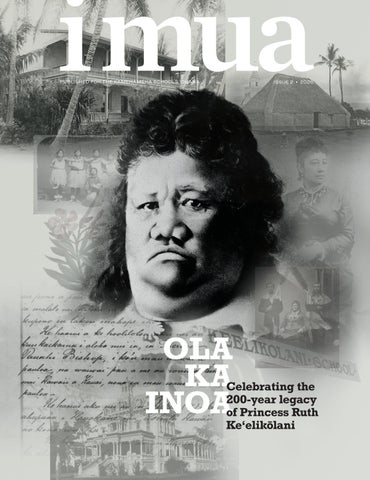
OLA KA INOA
Celebrating the 200-year legacy of Princess Ruth Ke‘elikōlani
ka mana‘o mua opening thoughts
Ua hilo ‘ia i ke aho a ke aloha. “Braided with the cords of love.”
‘ŌLELO NO‘EAU #2786
2
I MUA
ka mana‘o o ka luna ‘oihana nui a message from the ceo
The legacies of our ali‘i live on in each of us by Livingston “Jack” Wong Chief Executive Officer
Board of Trustees Crystal Kauilani Rose KSK’75 Chair
Jennifer Noelani Goodyear-Ka‘ōpua, Ph.D., KSK’92 Vice Chair
Michelle Ka‘uhane KSK’86 Secretary/Treasurer
Eric K. Yeaman Elliot Kawaiho‘olana Mills Chief Executive Officer Livingston “Jack” Wong Executive Leadership Team M. Kāhealani Nae‘ole-Wong KSK’87 Po‘o Kula – Ke Kula ‘o Kamehameha Hawai‘i
Scott Parker, Ph.D.
Po‘o Kula – Ke Kula ‘o Kamehameha Maui
Kaiwipunikauikawēkiu Punihei Lipe, Ph.D., KSK’01
Po‘o Kula – Ke Kula ‘o Kamehameha Kapālama
Wai‘ale‘ale Arroyo, Ph.D. Vice President of Hi‘ialo
Ben Salazar
Vice President of Finance and Chief Financial Officer
Darrel R. Hoke
Chief Operating Officer
Kā‘eo Duarte, Ph.D.
Vice President of ‘Āina Pauahi
Kēhaunani Abad, Ph.D., KSK’82 Vice President of Uluhiwa
Nālani Fujimori Kaina KSK’90 General Counsel and Vice President
Tim Donohue
Chief Investment Officer
Internal Audit Mia Okinaga
Vice President of Internal Audit
Advancement/Pauahi Foundation Pono Ma‘a KSK’82 Director of Advancement and Executive Director of the Pauahi Foundation
I Mua Staff Justin Barfield Editor
Edwin Subia Design
Jacob Chinn Photography
Contributors Brian “Kaunaloa” Boshard KSK’77 Peter Daniels KSK’85 Kyle Galdeira KSK’03 Ku‘ualoha Kauanoe-Luda Kaipo Kī‘aha KSM’08 Lisa Kubota Brandon Ledward Miala Leong KSK’02 Pono Ma‘a KSK’82 Alice Malepeai Silbanuz Jacqui Sovde Chris Sugidono Dancine Baker Takahashi KSK’79 Chad Takatsugi KSK’95 Joann Yang
Aloha kākou, E ‘ōpū ali‘i. Have the heart of a chief. ‘Ōlelo No‘eau #369
This ‘ōlelo no‘eau speaks to the deep pilina between our ali‘i and the lāhui they served. It reminds us that leadership is not defined by title or position, but by how we care for and serve others with humility and aloha. It also asks something of each of us: What does it mean to carry the heart of a chief today? At Ke Kula ‘o Kamehameha, we are blessed to stand upon a foundation set by Ke Ali‘i Pauahi. Her vision, faith, and profound aloha for her people remain a guiding force for us today. Through E Ola!, we seek to develop ‘ōiwi leaders who are grounded in who they are, driven by ea, and committed to serving their communities and lāhui. In this issue of I Mua, we honor our ali‘i not as distant figures from our past, but as enduring examples of leadership, faith, courage, aloha, and kuleana. We honor them not only by remembering them, but by how we live today, fulfilling our kuleana and carrying their legacies forward. From the mele composed by our haumāna and alumni in honor of Ke Ali‘i Pauahi, to the remarkable life and legacy of Ke Ali‘i Ruth Ke‘elikōlani, to the spiritual foundation that has sustained Ke Kula ‘o Kamehameha for nearly 140 years, these stories remind us that the work of our ali‘i lives on through each of us. The future our ali‘i envisioned is now ours to shape. Their legacies live on when our haumāna, kumu, alumni, and ‘ohana add their collective mana to the work of caring for one another, serving their communities, and nurturing the pilina that has sustained the lāhui for generations. In doing so, we move closer to the vision of a thriving and self-determined lāhui. May we each strive to carry the heart of a chief and remain faithful stewards of the legacy entrusted to us. E ola nā ali‘i. E ola Pauahi. E ola Hawai‘i. I mua Kamehameha, Jack Wong
ISSU E 2 • 2026
3
ka papa kuhikuhi table of contents
2
12
3
14
Ka mana‘o mua Opening thoughts
Kāu makana. Kāu ho‘oilina. Your gift. Your legacy.
Ka mana‘o o ka luna ‘oihana nui A message from the CEO
5
Composing a legacy
18
Ola ka inoa: Celebrating the 200-year legacy of Princess Ruth Ke‘elikōlani
Ka hunahuna mea hou News briefs
26
9
I ola nā keiki Caring for the whole child
10
Carrying the legacy forward
33
Nā helu ko‘iko‘i Data matters
Ke ki‘i nui The big picture
34
Ka nūhou o Nā Kula ‘o Kamehameha Campus and preschool news
38
Nā ki‘i o ko Ke Kula ‘o Kamehameha KS snapshots
46
Keeping it pono A message from the Director of Advancement and Executive Director of the Pauahi Foundation Ka nūhou o nā papa Class news
52
Nā hali‘a aloha Obituaries
59
Ko kākou mana‘o‘i‘o Our faith
I Mua Published for the Kamehameha Schools ‘ohana. 2026, Issue 2 I Mua is published by Uluwelo o Ke Kula ‘o Kamehameha, 567 S. King St., 4th floor, Honolulu, HI 96813. I Mua magazine connects, informs and inspires through storytelling that engages alumni and other important members of the donor community by framing the breadth and impact of Kamehameha Schools and its mission of strengthening the capability and well-being of Ke Ali‘i Pauahi’s people through education. I Mua is committed to being a catalyst in establishing the thriving lāhui envisioned by the KS Board of Trustees. Share your stories! Do you have a story idea or class news item to share? Please email AlumniNews@ksbe.edu. Join the KS alumni community by visiting ksbe.edu/alumni. I Mua magazine online Current and past issues of I Mua magazine can be found at ksbe.edu/ imua/archives.
26 14 38 4
I MUA
ka hunahuna mea hou news briefs
Community kāko‘o brings Ka Malu site to life in Lahaina
O
“
ne step at a time, one plant at a time, one person at a time.” This mana‘o from Mililani Browning KSK’02, natural resources manager with Kamehameha Schools’ ‘Āina Pauahi Group, is reflective of the community-focused, transformative work happening at Ku‘ia, Lahaina, Maui. Ke Kula ‘o Kamehameha stewards nearly 1,100 acres here — ‘āina bequeathed to Ke Ali‘i Bernice Pauahi Pākī Bishop by her cousin, Princess Ruth Ke‘elikōlani. In 2024, Kamehameha took a small but important step in an unprecedented effort to restore this ‘āina when it planted native and Polynesian-introduced trees on a one-acre parcel dubbed Ka Malu. Since then, numerous types of lā‘au such as ‘ulu, kou, kamani, hao, milo and ‘a‘ali‘i have grown and flourished — thanks in no small part to a groundswell of kāko‘o from the community. Taryn Cabingas is a kupa of this place. Having grown up near Ka Malu, she long dreamt of seeing the transformation of an area turned harsh and dry by water diversions and invasive grasses caused by the rise and collapse of the sugar cane industry. When staffers from the ‘Āina Pauahi Group knocked on her door to get input on the reshaping of Ku‘ia, Cabingas offered more than mana‘o; she decided to get involved. “I’ve noticed the problems here for many years, and now I finally get to do something about them. It’s a full-circle moment getting to be here and contribute.” Cabingas now helps with day-today upkeep at Ka Malu and organizes community volunteer events. One such gathering in May 2026 drew dozens of volunteers, including Lahaina residents and also Ke Kula ‘o Kamehameha Maui haumāna from the volunteer-focused Just Serve Club. The ‘ōpio dug out invasive haole koa and planted dozens of ‘a‘ali‘i, ma‘o and wiliwili raised in a greenhouse on campus. Lilia Davis KSM’20 also pitched in that day and at several other community days. She’s a conservationist and intern with the ‘Āina Pauahi natural and cultural stewardship team. “As a Pua a Pauahi, it’s so meaningful to come back and plant pua on her ‘āina. Back when I was a high school
Haumāna from Ke Kula ‘o Kamehameha Maui’s Just Serve Club take part in community planting effort at Ka Malu.
‘Āina Pauahi Group intern and conservationist Lilia Davis KSM’20 pitches in at a Ka Malu community day.
student, I had no idea the amount of work that went into Kamehameha Schools as a whole. So, I’m really mind blown at how much Ke Ali‘i Pauahi and her legacy provides for the entire pae ‘āina,” said Davis. Since before the first plants went into the ground at Ka Malu, stewards with ‘Āina Pauahi have overseen the establishment of crucial infrastructure including irrigation, terracing and erosion controls. Now they’re in the development stages of phase two which could see the addition of Indigenous medicinal gardens and flowering native trees for lei makers. There are also discussions about
wayfinding signage that would provide historical perspectives of what the native forest ma uka used to look like. Signage in the ma kai direction could share mana‘o about life before, during and after the plantation era. As those plans continue to grow and evolve, community input and involvement remain a top priority. “So many times we’ve had people come to us in tears, just thanking us for this little kīpuka that’s planted along the highway. It really seems to be a source of hope,” said Browning. For more information on the vision for restoring Lahaina ma uka to ma kai, visit: ksbe.edu/lahaina. ISSU E 2 • 2026
5
ka hunahuna mea hou news briefs
Kamehameha haumāna connect with culture and each other at ‘Aha ‘Ōpio
F
or the thousands of people who attended, the 25th annual Native Hawaiian Convention was a chance to connect with culture — and each other. That also proved true for hundreds of ‘ōpio, including a large contingent of haumāna from all three Ke Kula ‘o Kamehameha campuses who took part in the ‘Aha ‘Ōpio, a stylized youth experience. In contrast to the mākua, whose home base was the Blaisdell Center, ‘Aha ‘Ōpio participants had opportunities to venture out to various locations on O‘ahu, with their home base located across from the Blaisdell at the new Lili‘uokalani Center. “I think it’s very beneficial that the ‘ōpio have a designated space for just them because it can be intimidating to go into places with a bunch of adults, or really experienced professionals,” said Lexi Carlos, a senior from Ke Kula ‘o Kamehameha Maui. Even before the convention’s official kickoff, ‘ōpio had already been out on the ‘āina. A day-long huaka‘i to Kāko‘o ‘Ōiwi in He‘eia provided haumāna a hands-on experience in ‘ai pono. They had opportunities to work in a lo‘i kalo, process cooked kalo in Kāko‘o ‘Ōiwi’s poi mill and learn about the ahupua‘a restoration taking place there. Their ‘aina awakea was almost entirely mea ‘ai grown there. The next day, the youth took part in the opening ceremonies with their mākua counterparts, which included a memorable plenary panel. Afterward, haumāna explored a wide array of breakout sessions of their choosing, covering topics
Kamehameha haumāna from all three campuses had a chance to process cooked kalo in the poi mill at Kāko‘o ‘Ōiwi in He‘eia, O‘ahu.
6
I M UA
Haumāna gather in a circle for a wehena to begin a day of hands-on learning at Kāko‘o ‘Ōiwi.
like Hawaiian fashion, creative expression through mo‘olelo, and a huaka‘i to the John A. Burns School of Medicine for those interested in kānakarooted medical careers. One breakout session, titled “Hawaiian is my Superpower,” featured a top-notch panel of ‘Ōiwi leaders, consisting of Kaina Makua (mahi‘ai and star of “Chief of War”), Chardonnay (musician and mahi‘ai), Raiatea Helm (vocalist and multiple Nā Hōkū Hanohano award winner), Dr. Marcus Iwane KSK’02 (Kaiser Permanente’s Physician in Charge for Leeward O‘ahu) and Punihei
Lipe KSK’01 (Ke Kula ‘o Kamehameha Kapālama Po‘o Kula). The ‘ōpio listened intently as the panelists shared mana‘o about their unique life experiences that helped develop their strong Hawaiian identity. Dr. Iwane shared a touching memory from his childhood. “When I was a keiki, I remember spending time with my kupuna. He was a farmer in his māla. I could see him. I could hear him. He would actually sing mele to his plants. He would speak ‘ōlelo Hawai‘i to his plants. I never understood why at that time, until later, and realized
“Hawaiian is My Superpower” panelists (from left): Chardonnay, Kaina Makua, Dr. Marcus Iwane KSK’02, Punihei Lipe KSK’01, Raiatea Helm and moderator Maui ‘Iokepa-Guerrero. .
Haumāna from Ke Kula ‘o Kamehameha Hawai‘i debut a role-playing game rooted in Hawaiian mo‘olelo at an ‘Aha ‘Ōpio breakout session.
E Ola: From a school store to a store that’s a different kind of school
what he was actually trying to do. He was teaching me about aloha ‘āina by showing me, not just by telling me. I could observe, I could see aloha ‘āina in what he was doing. He was teaching me about the importance of ‘ōlelo Hawai‘i. He was teaching me about the importance of connecting to culture.” Another breakout session put on by haumāna from Ke Kula ‘o Kamehameha Hawai‘i was so well-received, they were asked to hana hou and presented a second time at the ‘aha. “Educational Ea Through Indigenous Game Design” was the interactive debut of a Dungeons & Dragons-like role playing game created by the haumāna and rooted in traditional Hawaiian mo‘olelo. The haumāna rolled dice and moved their characters on a large game board they created, and ‘ōpio seated in the theater could easily see all the action thanks to a specially placed camera that projected onto a big screen. Their kumu, Nathan Yocum, served as the dungeon master, weaving intrigue and mo‘olelo flawlessly. “They were so involved and passionate about it,” Kamalei Dwight KSK’26 said. “It was really so cool to see,” The ‘ōpio in the crowd even got to take on a character’s role, and made group decisions on whether that character, Ka‘ena, should run away or fight when he encountered mysterious creatures. For Kawai Akimseu, a Kamehameha Maui rising senior, one particular music-focused session provided a great life lesson. “We had this mele breakout session, and in the song, there were parts where the kāne and the wāhine would split. But they would all come together at one point, and we became stronger. Like we were strong separately, but when we came together, it was even stronger. We’re better united,” Akimseu said. The ‘Aha ‘Ōpio was a great way to wrap up summer break and prepare for the start of the new school year. Lexi Carlos, who serves as ‘elele, the Hawaiian cultural campus representative for the Associated Students of Kamehameha Schools Maui offered this heartfelt mahalo for being selected to attend the ‘aha: “Makemake au e mahalo i ke kamali‘i wahine ‘o Bernice Pauahi Bishop no ka mea ua aloha ‘o ia iā mākou Nā Pua a Pauahi no laila ua hele mākou i kēia Native Hawaiian Conference a laila mahalo wau iā ia,” Carlos said.
P
eople who stopped by a bustling pop-up at either the Alumni Week Mākeke or the 25th Annual Native Hawaiian Convention got an early look at a new Ke Kula ‘o Kamehameha initiative. More than a store, E Ola is designed as a place where products, stories, people and learning come together to strengthen Hawaiian identity and build community. Operating under Kamehameha’s Theory of Change, a key concept of Strategic Plan 2030, E Ola represents the next evolution of the campus store experience following the closure of the KS Kapālama bookstore. Though currently available through pop-up experiences, E Ola will eventually operate online and as a brick-and-mortar in Kamehameha Center Kapālama beginning in 2027. Native Hawaiian Convention attendees get a taste People can expect to find lole that of the E Ola experience at an onsite pop-up event. celebrate the broader lāhui and Ke Kula ‘o Kamehameha’s traditions and other mea that point to where we’re headed. “One hundred percent of our offerings will activate kuana‘ike Hawai‘i, ‘ike kūpuna and ea Hawai‘i,” said Ka‘imina‘auao Wong KSK’08, E Ola alaka‘i ho‘okipa.
More than a store
The team behind E Ola includes Wong and fellow alumni Mikaila CravalhoMeyers Long KSK’15, Kawena Lei Carvalho-Mattos Apao KSK’10, Tina Kinimaka KSK’02, Tevai Worthington Lopez KSK’97, Kēhaunani Cachola Abad KSK’82 and Ryan “Gonzo” Gonzalez KSK’96. Alongside other teammates, they’re intentionally challenging what people expect from a retail space. “We’re trying to fundamentally redefine what a store can be,” Wong said. “Rather than focusing on transactions, we’re creating a place centered on relationships, learning and ‘ike.” That vision was already taking shape at E Ola’s first pop-up experiences, where conversations about Hawaiian history, identity and community were just as common as conversations about products. Every item has a story. Whether inspired by historical moments, resources from the waihona or contemporary expressions of Hawaiian identity, the goal is for each product to become an invitation to continue learning long after someone leaves. As E Ola grows, those experiences will expand beyond merchandise. Workshops, guest speakers, cultural demonstrations, storytelling and community gatherings will become part of the experience, creating opportunities for po‘e to engage more deeply with Hawaiian knowledge and with one another. People can also expect to have a chance to deepen pilina with ‘āina Pauahi, with products grown and made on KS ‘āina offered in the online and brick-and-mortar space.
Ea-conomics
Another way E Ola disrupts the transactional model revolves around where sales proceeds will go. “The monies go towards funding community programs and events, whether it’s events like Ola Ka ‘Ī, as well as scholarships and grants; from Ea A‘e, to future initiatives through the Pauahi Foundation, it’s all about activating our SP2030 Theory of Change,” Wong said. Another lāhui-boosting component involves forging partnerships with other Native Hawaiian-serving organizations, including the Hawaiian Council, which handles warehousing and fulfillment for the online store. You can find out much more about E Ola and where it’s headed through the eola.live website. ISSU E 2 • 2026
7
Every purchase and act of kōkua helps strengthen the lāhui through community grants and scholarships. OLA HAWAI‘I. EA HAWAI‘I
E MALIU MAI EOLA.LIVE
i ola nā keiki
caring for the whole child
KS Maui RN Melissa Manzano reflects on olakino, ‘ohana
I
n this edition of I Ola Nā Keiki, we kūkākūkā with Melissa Manzano, a lead registered nurse at Ke Kula ‘o Kamehameha Maui. Manzano has enhanced the ola pono of haumāna and staff for seven years now, beginning as an on-call RN and moving up to her current lead role at the ‘A‘apueo campus. She offers up some heartfelt mana‘o about Kamehameha’s commitment to health, safety and ‘ohana. I Mua: How did you begin your career in nursing? Melissa: I wanted to become a nurse from as far back as I can remember. After high school graduation, I was fortunate to have been awarded a merit scholarship at Hawai‘i Pacific University and went directly into the Bachelor of Science nursing program there. Due in large part to Ke Ali‘i Pauahi’s generosity, I was able to complete the program in four years and advance my career in health care from being a clinical assistant in the medical-surgical department at Pali Momi to a new graduate RN and, shortly thereafter, one of the charge nurses in the department for 10 years before I moved on to different nursing focuses — like care management, service coordination, oncology, home health and hospice — before working here. I Mua: What drew you to work for Kamehameha Schools, and what makes you stay? Melissa: I was drawn to Kamehameha Schools because I wanted the opportunity to contribute to the vision of Princess Bernice Pauahi Bishop and give back to a community that invests so deeply
Warrior mindset moment: Melissa Manzano’s daughter, Jolie Ibrao, walked the KS Maui graduation stage in spring 2025, a major recovery milestone from a serious personal injury.
in its haumāna. As someone who sees pieces of my own journey reflected in the students we serve, I am passionate about making a positive difference in their lives and supporting their ability to succeed. I stay because every day brings the opportunity to care for students, including my own keiki and those that I am closely connected with through community, during important moments, help them feel safe and supported, and be part of an organization that is committed to their well-being and future.
her senior year in 2025 at KS Maui, was able to walk across the stage to receive her diploma after being hospitalized, having multiple surgeries and being bed-bound for 6 months was a testament to the kind of warrior mindset that is fostered here. She and I had so much support from the very team that I am a part of during her recovery, and I will forever remember all her hoa papa and much of the kumu, limahana and ‘ohana in attendance standing with tears streaming to cheer her on.
I Mua: What aspect of your work is the most satisfying? Melissa: Here on Maui, we are beginning to see more alumni return to work here at ‘A‘apueo, and that is such a fulfilling moment: to see their growth and progress through what can often be tumultuous and challenging years. All of the keiki have stories of what they have had to overcome — not just at school, but in their home lives as well. When we can partner with them and their ‘ohana to support them through those times to help them reach their personal, educational and professional goals, this is what drives myself and my Mālama Ola colleagues to do our daily work.
I Mua: What do you do in your spare time? Melissa: We have a cute and crazy merle, blue-eyed corgi that takes up a lot of our time in the best ways. I paddle canoe recreationally with Nā Kai ‘Ewalu, and also dance hula with Hālau Kekuaokalā‘au‘ala‘iliahi.
I Mua: What is your most memorable moment to date at Kamehameha? Melissa: The moment my daughter, who suffered a serious personal injury during
I Mua: Words or a quote you try to live by? Melissa: E hana ‘ia ko ‘oukou mea a pau me ke aloha. Let all that you do be done in love. 1 Corinthians 16:14 I Mua: What is one safety tip you can offer to our readers, appropriate for all ages? Melissa: Ola i ka wai! Water is life!!! Drink water!
ISSU E 2 • 2026
9
ke ki‘i nui the big picture
10
I M UA
The Protect Kaho‘olawe ‘Ohana celebrates 50 years of aloha ‘āina. At first light on the shore of Hakioawa Bay, with Haleakalā off in the distance, several aloha ‘āina gathered to chant “E Ala Ē”, an oli composed for and first chanted at a ceremony of healing for Kanaloa Kaho‘olawe back in 1992. Throughout 2026, the Protect Kaho‘olawe ‘Ohana is celebrating the courageous acts of the “Kaho‘olawe Nine,” whose efforts 50 years ago launched a movement, and eventually led to the U.S. military ending its target practice bombing of Kaho‘olawe. Since then, PKO has worked tirelessly to restore native lā‘au — and cultural connection to this sacred place.
Kaho‘olawe
ISSU E 2 • 2026
11
kāu makana. kāu ho‘oilina. your gift. your legacy.
Alaka‘ina Foundation honors milestone reunion with planned Pauahi Foundation donation Mea kākau: Kyle Galdeira KSK’03 Mea pa‘i ki‘i: Joann Yang
C
ontinuing its longstanding tradition of giving back, the Alaka‘ina Foundation is planning a landmark $440,000 donation to the Pauahi Foundation later this year in recognition of several meaningful milestones. This year marks the Alaka‘ina Foundation’s 10th anniversary of establishing scholarships with the Pauahi Foundation. Five of the six Alaka‘ina Foundation board members are Kamehameha Schools Kapālama graduates who recently celebrated their 55th class reunion. As part of the gift, four of the six board members will dedicate $55,000 to their existing scholarships with the Pauahi Foundation. Two board members will direct their $55,000 gifts toward the corpus of the newly endowed scholarship in honor of the Alaka‘ina Foundation. In addition, $55,000 will be contributed The Alaka‘ina Foundation is planning a landmark $440,000 donation to the Pauahi Foundation later this year in recognition of several meaningful milestones. Mahalo to board members, from left, Craig to the KS Class of 1971 “Get Chance” Floro, James “Kimo” Bacon KSK’71, Michael “Kimo” Wong KSK’71, Teresa Makuakāne-Drechsel KSK’71, Scholarship. William “Bill” Villa KSK’71 and David Mortensen KSK’71 for making this generous gift possible. Ten years ago, the Alaka‘ina Foundation made its first gift of $150,000 to establish three scholarMakuakāne-Drechsel KSK’71 and her husband, Emanuel ships in honor of board members James “Kimo” Bacon KSK’71, “Manny;” Board Member Craig Floro; and Treasurer Mortensen William “Bill” Villa KSK’71 and David Mortensen KSK’71 in and his wife, Elaine “Dollie.” celebration of their 45th class reunion. Then in August 2020, “Through the Alaka‘ina Foundation, we’ve invested more they made a $1 million donation to establish six new endowed than $20 million into local communities,” Wong said. “We trust scholarship funds and expanded the four existing scholarship the Pauahi Foundation because they are exceptional stewards funds. of these resources and know how to maximize their impact. They currently have 10 established scholarships through Whether a gift is large or small, donors can have confidence in the Pauahi Foundation, each honoring past and current Alaka‘ina the foundation’s investment expertise and its understanding of Foundation board members, their wives and their ‘ohana. They how these funds can best support Native Hawaiian students.” include the Vaughn G.A. Vasconcellos KS’71 Scholarship; the “There’s just so much need out there, and when it comes to Sanborn ‘Ohana Ho‘omau Scholarship; the Floro and McCarthy helping the next generation achieve their educational goals, it’s Family “Big Blue and White K” Scholarship; the M. Kimo Wong important to give ’til it hurts!” Mortensen said. KS’71, Shelley Wong and Noe Noe Wong-Wilson KS’68 ‘Ohana “The reason I have for giving back is a bit different from Scholarship; the M.E. Bacon KS’72 Uncle Herb & Kupuna the others in the group,” Floro said. “I’m not Native Hawaiian, Lehua Lee-Loy Weatherwax Aloha ‘Āina Scholarship; the Elaine and I grew up in Kentucky, but when I came to Hawai‘i through “Dollie” Mortensen KS’71 Kaumuali‘i Mālama ‘Āina Scholarship; the military in 1983, I was welcomed by Native Hawaiians who the James Bacon “Little Bacon Urban Achievers” Scholarship; shared their culture, values and aloha with me. Through those the Villa ‘Ohana Ho‘iho‘i Scholarship; the David A. Mortensen experiences, I realized I wanted to make a difference in a way D.A.M. Scholarship; and the Emma Kailikapuolono Metcalf that would benefit Native Hawaiian students and their futures. Beckley Nakuina Aloha ‘Āina Patriot Scholarship. Investing in education gives students knowledge, opportunity During their recent gathering at Pearl at Kalauao on and the ability to create better lives for themselves, their fami‘āina Pauahi, the board members shared the mana‘o behind lies and their communities.” their upcoming planned gift. Representing the Alaka‘ina “The scholarship our ‘ohana established provides opporFoundation were President Michael “Kimo” Wong KSK’71 and tunities for students from the Wai‘anae Coast to further their his wife, Shelley; Executive Director & Vice President Bacon; education,” Villa said. “We hope others will be inspired to give Secretary Villa and his wife, Renae; Board Member Teresa
12
I M UA
back and pay it forward. Education is a bridge to improving your life.” The Alaka‘ina Foundation has also contributed to the Nanea Scholarship, and Kamehameha Schools programs and initiatives, with additional gifts already being planned. The Pauahi Foundation raises funds to support scholarships, Kamehameha Schools programs and initiatives, KS Kaiāulu and ‘āina Pauahi, helping create educational and cultural opportunities that benefit generations of Native Hawaiian learners. “As we celebrate our 55th class reunion, we’re reminded that none of us reached this point alone,” Makuakāne-Drechsel said. “We are all beneficiaries of the generosity, sacrifice and vision of those who came before us. Today, many Native Hawaiian families still face financial barriers to higher education and career advancement, so supporting scholarships is one way we can kōkua and help create opportunities for the next generation. It’s about honoring the blessings we’ve received by paying them forward.” “Everything I’ve been able to accomplish started with the foundation laid by Kamehameha Schools and the vision of Princess Bernice Pauahi Bishop,” Bacon said. “Her commitment
to education and uplifting Native Hawaiian people continues to inspire all of us. Supporting the Pauahi Foundation is one way we can carry that legacy forward and ensure future generations have the same opportunities to learn, grow and succeed.” That spirit of giving and responsibility to future generations is also reflected in the mission of the Alaka‘ina Foundation and the values its board members strive to uphold. “All current Alaka‘ina Foundation board members follow our motto: ‘Kahiau philanthropy is our legacy; a thriving lāhui is our destiny,’” Bacon says of the Hawaiian term for giving selflessly. “I encourage everyone to donate to the Pauahi Foundation to continue the legacy of our beloved Princess Pauahi.”
By establishing an endowed scholarship, including the Pauahi Foundation in a will or trust, or making a planned gift, donors can create a legacy that supports generations of learners to come. For more information about partnering with the Pauahi Foundation, contact Natalie Arrell at narrell@ksbe.edu or (808) 534-3902.
During their recent gathering at Pearl at Kalauao on ‘āina Pauahi, the Alaka‘ina Foundation board members shared the mana‘o behind their upcoming planned gift. Joining them to recognize the momentous donation were Kamehameha Schools CEO Jack Wong and Pauahi Foundation Executive Director Pono Ma‘a KSK’82.
ISSU E 2 • 2026
13
14
I M UA
O‘ahu
There’s a part of the juniors’ winning Song Contest mele that gave their mentor Ānuenue Pūnua KSK’94 chicken skin, from the moment students wrote it.
“‘O ke ea ho‘i kākou.” The line translates simply: We are the sovereignty.
What some might consider a contentious statement, the haku mele sees as a declaration of identity.
Mea kākau: Ku‘ualoha Kauanoe-Luda Mea pa‘i ki‘i: Jacob Chinn ISSU E 2 • 2026
15
“I think we’ve been too nice, too gracious but now we’re going to claim it,” Pūnua said. “With mele, you must choose your words wisely because once it’s out there, you can’t take it back and it will always live on. We are the sovereign because we are.” That sense of ownership shaped this year’s 106th annual Kamehameha Schools Song Contest, the first in the tradition’s history to completely center Ke Ali‘i Bernice Pauahi Pākī Bishop. To mark the occasion, more than 100 haumāna participated in a special haku mele cohort, spending weeks studying Pauahi’s life and vision before gathering in intensive composition workshops to
16
I M UA
create four original songs for the co-ed competition. The result was a collection of mele that honored the founder of Ke Kula ‘o Kamehameha and highlighted the enduring kuleana entrusted to future generations. For junior Timoteo Esene, that dominating lyric echoes the charge left by Pauahi and the leaders of the Hawaiian Kingdom to empower the lāhui. “It’s a call to action for anybody listening to the mele,” Esene said. “It really is up to us to continue Pauahi’s wishes in the founding of this school to perpetuate Hawaiian culture through whatever we might face.” The message grew out of weeks
of research and discussion as students worked to understand Pauahi beyond the familiar stories often taught in school. For the Class of 2027, that meant examining her leadership, the choices she made and the values that shaped her life. “What makes a good ali‘i?” Pūnua remembered asking students. “She gave up the throne for this. This is her legacy.” Across campus, similar conversations were unfolding. For haku mele and Kumu Jeremy Kama Hopkins KSK’91, the goal was to chaperone the students in discovering their own relationship with Pauahi and put it into words. “The students are so akamai,” Hopkins said. “The knowledge of
“It’s a call to action for anybody listening to the mele”
different stories or places that they could pull from — ideas, lines of music, words, descriptions — it was far more than what I know.” Students arrived with ‘ike and perspectives of their own, but rather than simply retelling familiar stories, the groups sought to create something new. For Hopkins’ senior hui, that meant composing a new name for Pauahi: Ka‘iwakīkahalani, comparing her to the soaring frigate bird. “The ‘iwa was so essential to our monarchy,” Hopkins said. “And so we think of her as that ‘iwa out there trying to help those who maybe have lost their way — to find a path home or a path forward.”
That relationship became especially meaningful against the backdrop of ongoing legal challenges to Kamehameha Schools’ admissions policy, a reality that surfaced throughout the seminars. “It was an honor to be asked to help students haku mele, especially for Pauahi and especially with all the things that we’re going through,” Pūnua said. On competition night, the songs paid tribute to Pauahi, but they also revealed something about the students themselves. More than a century after Pauahi signed her will, young people are still studying her words, carrying forward her wishes and finding their own place within the story she set in motion.
TIMOTEO ESENE
“Whether or not you go to (Kamehameha) Schools, we are all pua a Pauahi. We are all the pua of the ali‘i who came before us,” freshman Aria Beazley said. “I just want everyone to feel that reminder of the kuleana that we have as Hawaiians to continue to perpetuate their legacy and … be proud to be Hawaiian.” As thousands gathered in the Blaisdell Arena and many more watched from home and online, the voices on stage carried a message throughout Hawai‘i and beyond: Pauahi’s legacy is still being written. This generation is simply adding its own verse.
ISSU E 2 • 2026
17
OLA KA INOA
Celebrating the 200-year legacy of Princess Ruth
1826.
Ke‘elikōlani
200 years ago. The Hawaiian Kingdom, under Kuhina Nui Ka‘ahumanu and a young Kamehameha III, Kauikeaouli, was asserting its sovereignty internationally while grappling with the influence of missionaries and merchants at home. Amid this turbulent push and pull, Princess Ruth Keanolani Kanāhoahoa Ke‘elikōlani was born, an ali‘i kūpa‘a, whose legacy is forever linked to the foundation of Ke Kula ‘o Kamehameha.
Mea kākau: Justin Barfield, Ku‘ualoha Kauanoe-Luda Mea pa‘i ki‘i: Jacob Chinn
18
I M UA
ISSU E 2 • 2026
19
P
rincess Ruth, also known as Ruta or Luka, and her first cousin Ke Ali‘i Bernice Pauahi Pākī Bishop, shared a close bond and a passion to see their people endure and thrive. This pilina would see Luka bequeath her estate — including approximately 353,000 acres — to Ke Ali‘i Pauahi. Those lands became part of the kahua supporting what Kamehameha offers haumāna and kaiāulu today. But Ke Ali‘i Ke‘elikōlani’s future-forward gift is only part of what made her such a dynamic force then — and now. Her legacy also includes steadfast resistance to cultural erasure and dedication to traditional Hawaiian ways. She wholeheartedly supported practitioners of mele, oli and hula and insisted on ‘ōlelo Hawai‘i in her presence. These are just some of the ways Luka went against the grain of Westernized elites whose growing influence seeped into nearly every corner of the Kingdom’s consciousness. Luka’s service to her people included numerous kingdom roles: governor of Hawai‘i Island and member of the House of Nobles and Privy Council. She built Keōua Hale, a Victorian-style mansion bigger than ‘Iolani Palace, and later inherited Hulihe‘e Palace on Hawai‘i Island. Yet she opted to live in a humble hale pili on both palace grounds. At the same time, Luka also wore regal Western dresses befitting a princess and held soirees for high society. She often adorned herself with beautiful lei made of oleander flowers — from an introduced and highly poisonous plant. Many written accounts refer to her as the richest woman in the kingdom during her lifetime, when in reality, she was almost certainly the wealthiest person — man or woman. Hiapo K. Perreira KSK’92, an associate professor of ‘ōlelo Hawai‘i at UH Hilo’s Ka Haka ‘Ula o Ke‘elikōlani, says straddling Western and traditional Hawaiian ways reflects Luka being her authentic self. “I really want people to know about how real she was, doing the best that she could with what she knew, with what she had,” Perreira said. 200 years later, that “realness” is being celebrated and amplified by a great number of people, including four Kamehameha alumni who are doing so in very different but important ways.
20
I M UA
“As I reflect on Ke‘elikōlani’s life, I see a love that does not fade,” Faith Kealohapau‘ole Paredes KSM’23
Ke Ali‘i Ke‘elikōlani celebrated on Merrie Monarch Stage On hula’s biggest stage, the Merrie Monarch Festival, Ke Ali‘i Ke‘elikōlani was celebrated by Miss Aloha Hula. Faith Kealohapau‘ole Paredes KSM’23, earned top honors for her grace and precision, including the Hawaiian Language Award for her powerful rendition of the oli “Hulihe‘e.” Drawn from the private collection of Hawaiian scholar Mary Kawena Pukui, the chant celebrates the tranquility and beauty of Luka’s seaside royal residence in Kailua-Kona. The performance carried an even deeper connection for Paredes because her ‘ohana traces its lineage to Ke Ali‘i Ke‘elikōlani through an ancestor, who served in Luka’s royal court. “As I reflect on Ke‘elikōlani’s life, I see a love that does not fade,” Paredes said in her Merrie Monarch introduction. “It is a love expressed through the protection of her culture, her dedication to her people, and her commitment to live in a way that, at the time, was not looked fondly upon.”
Caretakers of Luka’s legacy at Hulihe‘e The example she set as a powerful ali‘i wahine continues to guide those caring for Hulihe‘e today. “People come here and they’re like, ‘Gosh, there’s such a good feeling about this house and the grounds,’” said Jolee “Sunshine” Chip KSK’98, a longtime docent at Hulihe‘e Palace. “I tell them that’s because you’re feeling the mana that was set down centuries ago.” For 15 years, Chip has welcomed visitors through the palace doors, sharing the stories of the ali‘i who once gathered there. After years away from Hawai‘i Island, she returned home to care for her grandmother and found herself drawn to Hulihe‘e. A part-time opportunity became a calling. She hopes more people will see Hulihe‘e as a place where they can learn, reconnect and contribute. “If someone wants to volunteer, they will,” Chip said. “But now we’re focusing on drumming up that desire in them to come and help us.” That desire, she believes, starts with helping people feel welcome. Once
“there’s a good feeling about this house (Hulihe‘e Palace), … you’re feeling the mana that was set centuries ago.” Jolee “Sunshine” Chip KSK’98 Docent, Hulihe‘e Palace
ISSU E 2 • 2026
21
viewed by some as a reserved space, Hulihe‘e today hosts cultural workshops, volunteer projects and community events. Through tours, classes and conversations with visitors, Chip sees her role as helping people reconnect with a fuller understanding of Hawaiian history and the legacy of ali‘i like Ke‘elikōlani. Whether she is explaining the significance of a kāhili or sharing stories about the Hawaiian Kingdom, each interaction can challenge misconceptions and deepen appreciation for Hawaiian culture. “I’ve had numerous jobs before, but it never gave me the satisfaction that this job does,” Chip said. “It’s this feeling of pride — just being proud of our own people.” That pride is evident throughout Hulihe‘e, where Ke‘elikōlani’s legacy lives on in the artifacts preserved within its walls and the people who continue to share her story.
Restoring Ke‘elikōlani’s inoa
Ke‘elikōlani’s legacy lives on in the artifacts preserved within Hulihe‘e Palace and the people who continue to share her story.
22
I M UA
On O‘ahu, colonizing forces nearly erased the legacy of Keōua Hale, along with Luka’s inoa and ties to that ‘āina. But those tides have turned in recent years. After her death in 1883, Luka bequeathed Keōua Hale to Ke Ali‘i Pauahi, who lived there until her death in October 1884. After Pauahi’s passing, the hale fell into disrepair and was eventually sold to the Hawai‘i Department of Education, which used the property for Honolulu High School and later Central Grammar School. The mansion was demolished in stages as new classrooms were built. Around this same time, the school’s inoa experienced a tug-of-war between Ke‘elikōlani School and Central Grammar School, with the latter eventually prevailing. A local newspaper article explained that the Ke‘elikōlani name fell out of favor because it “... proved too difficult for the Anglo-Saxon and Oriental tongues.” For decades, Ke‘elikōlani’s name all but disappeared from this place. But a school custodian, his ‘ohana and, later, a librarian would help change that. In the late 1990s, Central Middle School was practically a second home to Kamakana Aquino KSK’07; his dad, Rogelio, was the school custodian. “After school, I would help my dad clean rooms, help lock up and help him
set up things. Sometimes we’d be there on weekends and even over the summer,” Aquino said. Rogelio Aquino found historical documents related to the school and Ke Ali‘i Ke‘elikōlani. His principal asked him to organize them, but he went further. “It’s interesting because he’s a custodian, so that’s really not his role. But he took it upon himself to learn more about Princess Ruth, the impact she has made,” Kamakana Aquino said. Aided by the genealogical knowledge of his wife, Marbeth, Rogelio began to grasp Luka’s importance. With support from administrators, he organized assemblies educating haumāna about her. Kumu from Ke Kula ‘o Kamehameha pitched in to share mana‘o. After Rogelio retired, another champion of Luka stepped forward. In 2016, educator Holly Gates began working as the school’s librarian. She found the historic artifacts Rogelio and others had preserved, and after months of study and organizing, reached the same conclusion Rogelio had: Luka’s name and legacy needed to return to this place. “And I thought, ‘Uh-uh, she cannot be forgotten. This lady was far too intelligent and far too powerful.’ I’m kind of one of those people that once I get something in my head, I will not stop until it’s completed,” Gates said. That “something” she got into her head was the idea of getting the school’s name changed back to Ke‘elikōlani. But there was no precedent, so with support from the school’s principal, she enlisted the help of English teacher Brandon Galarita and historian Ann Marie Kirk. The years-long effort involved rallying support within the kula and the greater kaiāulu, and even weathered a pandemic-related delay. Finally, in September 2021, the Board of Education approved the name Princess Ruth Ke‘elikōlani Middle School. Gates says it helped that Ke‘elikōlani’s name was still emblazoned on one of the buildings — physical proof supporting its restoration. Gates also believes there was another force at play. “We all felt like Princess Ruth was opening doors for us and getting things to move to get all the way to the end,” Gates said. On February 9, 2022, her 196th birthday, Ke‘elikōlani’s inoa was officially restored during a dedication ceremony
Keōua Hale
The discovery of historical documents by Rogelio Aquino (aided by his wife Marbeth and son, Kamakana Aquino KSK’07) began the restoration process of Princess Ruth’s inoa to Ke‘elikōlani School.
Kamakana Aquino KSK’07 with Marbeth Aquino.
ISSU E 2 • 2026
23
that also saw the unveiling of a new mural in her honor. Kamakana Aquino and his mom, Marbeth, attended. Sadly, Rogelio passed away a few years earlier. Kamakana, now a Native Hawaiian coordinator at UH Mānoa’s College of Social Sciences, knows his dad would have been ecstatic. Aquino has also grown to understand the mana that is lost when a name is erased and regained when it’s restored. “With this change, we reclaim Ruth’s name, her mana, which helps us all to better understand who she was. I also think about the agency — of the administrators, teachers and students. I feel like that is a form of ea,” Aquino said. In the few years since the name change, kumu say they’ve seen a positive change on campus. “Not just has the name changed, the feeling of the school has too. The kids have so much pride for Ruth. They’ve come to identify with the values she had,” Galarita said. Aquino and others who are working to restore Ke Ali‘i Ke‘elikōlani’s rightful place in history remain hopeful. “I don’t know what the future holds, but I think this name change is a nice stepping-stone into something that will flourish more,” Aquino said.
Holly Gates (right), with Brandon Galarita (left) and Anne Marie Kirk (not pictured), continued the work in restoring Ke Ali‘i Ke‘elikōlani’s inoa.
An academic approach to discovering Ruth’s ‘ano Being a haumāna in one of Hiapo Perreira’s advanced ‘ōlelo Hawai‘i classes means delving far deeper than reading comprehension and basic conversation. Through traditional mo‘olelo like “Hi‘iakaikapoliopele,” he teaches students to deepen their language skills by examining word choices and what they reveal about the author. “Paying attention to constitution of literature can inform the way we speak Hawaiian by leaps and bounds. The Hawaiian in these literary pieces, that’s full-blown Hawaiian. It’s teaching us a way to come into consciousness with a living language,” Perreira said. That same analytical method was used when renowned kumu ‘ōlelo Hawai‘i Puakea Nogelmeier handed him hundreds of nūpepa clippings mentioning Luka and asked him to pore over them. Perreira concluded that the writings leave gaps in our understanding of Ke‘elikōlani but also reveal aspects of her
24
I M UA
Kamakana Aquino KSK’07 views a newspaper clipping featuring his father, Rogelio, commemorating the designation of Ke‘elikōlani School on the National Register of Historic Places.
life that are often unheralded. For instance, Luka loved — and was loved by — her people. When lava from Mauna Loa approached Hilo town in 1881, it was Luka whom the people called upon. She traveled to the lava’s edge and offered mele, oli and ho‘okupu to Tūtū Pele — and then went to sleep somewhere not far from the flow. Oral tradition says when she woke up the lava flow had stopped. Hilo was spared and the people venerated Ke‘elikōlani, who they called Ka Mea Ki‘eki‘e — Highness. Perreira says written details about this encounter are scant, but the historical record sheds light in other ways. “Pele stopped, I feel, because of the enduring connection that she [Luka] had with the akua, which was an ‘aumakua for her actually.” There are also unheralded stories of her generosity. “I remember reading an article where she found out that the people from Moloka‘i were suffering through a drought,” Perreira said. “She ordered right away numerous barrels of poi, put it on a barge and sent it to Moloka‘i right away. It’s that kind of thing you don’t readily hear about.” Perreira also says the will she drew up bequeathing her vast lands to Ke Ali‘i Pauahi offers clues about her personality. The actual document is quite brief. “I like to think of her as being very pragmatic. She didn’t need any superfluous type of presentation. It’s ‘This is what I have, and I give it to you, and you do with it as you see fit,’ and that’s it.” Perreira would like to see further study of Luka through newspapers, legal documents and mele composed by and for the princess. “It would be beneficial to learn more about Ke‘elikōlani, period. The less we know, the more of a godlike figure she becomes, and I think takes away from the natural Ke‘elikōlani that she just was being at the time,” Perreira said. Ke Ali‘i Pauahi signed her will just five months after Luka’s passing. Though there is much more to discover, Ke Ali‘i Ke‘elikōlani’s legacy is alive and well 200 years after her birth, thanks to the choices she made and the tireless dedication of those who uplift this ali‘i kūpa‘a today. E ola mau ka inoa o Ke‘elikōlani!
Ke‘elikōlani’s name was already emblazoned on one of the historic school buildings, physical proof that supported its restoration.
Hiapo K. Perreira KSK’92 with the binder of nupepa clippings mentioning Ke Ali‘i Ke‘elikōlani.
ISSU E 2 • 2026
25
Carrying the legacy
26
I M UA
g e y
forward For nearly 80 years, Kamehameha’s Deputation Teams have carried Pauahi’s Christian commitment beyond campus — serving churches across Hawai‘i while discovering their own calling. Mea kākau: Justin Barfield Mea pa‘i ki‘i: Kaipo Kī‘aha KSM'08, Justin Barfield
ISSU E 2 • 2026
27
K
e Ali‘i Bernice Pauahi Pākī Bishop’s unwavering Christian faith was ever-present in her life’s work. That legacy carries on today as we continue to uphold her kauoha that Ke Kula ‘o Kamehameha be both a Hawaiian and Christian institution. “We are here because this faith-filled ali‘i decides to change the trajectory of the lāhui, and she changes it through education, and education included her faith, and her faith was important enough for her to put it into her will,” Kahu Kaunaloa Boshard KSK’77 said. This faith commitment manifests in many ways across our organization and on campus. From chapel services, pule, daily morning piko and Christian instruction — mana‘o‘i‘o surrounds our work and learning. It’s also demonstrated in the work of a group of haumāna, kahu and kumu at all three campuses who serve as ambassadors of Christ through the Kamehameha Deputation Team. At first glance, the term “deputation” might seem to be an odd inoa for a faith-based team, but that term becomes clear when you know its origin. Kahu and class of 1903 alumnus Stephen Desha Jr. founded the program in 1949 to minister to neighbor island churches. “The term Deputation Team actually comes from the idea of deputies. So what he (Kahu Desha Jr.) did was he took students, developed them and got them ready to go out into these local churches to do service. They were like his little deputies,” said current Ke Kula ‘o Kamehameha Kapālama Kahu Manu Nae‘ole KSK’96. Nearly 80 years later, that mission continues and expands with Deputation Teams from Kea‘au, ‘A‘apueo and Kapālama now providing pulpit supply and musical support to Hawaiian churches across the pae ‘āina. Each Deputation Team is unique, adapting to the needs of their respective campuses and kaiāulu. But twice a year, they all come together to build pilina and minister to the faith community. In May 2026, they met up on Maui to reflect on their spiritual growth during the concluding school year. The weekend’s activities included a robust youth leader discussion meant to get haumāna to think about the possibility of becoming kahu themselves. Haumāna also had devotional time to reflect on the school year’s spiritual theme: E mau ke ola i ke Kumuola — Life endures by the Source of Life. The weekend culminated with the tri-campus hui leading worship at an unassuming hale pule in Wailuku linked to a legendary Hawaiian Kingdom patriot. Ekalesia o Kupaianaha was founded by John Henry Wise, a member of the 1887 Kamehameha inaugural class. Wise’s long list of accomplishments included being the first Hawaiian to play college football,
•
Kapālama
‘A‘apueo
•
• Kea‘au
28
I M UA
Kahu Stephen Desha Jr. KS1903 founded the deputation team program in 1949 to minister to neighbor island churches.
Ekalesia o Kupaianaha was founded by John Henry Wise, a member of Kamehameha’s inaugural class of 1887.
The history of Kaumakapili Church (founded in 1838) is intertwined with Kamehameha Schools.
“I find fulfillment and true joy in being able to share His saving grace, this life-saving anchor with people.” – Gabriel Patelesio KSK’26 Kapālama Keiki Kahu
ISSU E 2 • 2026
29
while also studying to be a kahu at Oberlin College. He returned to Hawai‘i after the illegal overthrow of the Hawaiian nation. Despite being funded by the Hawaiian Evangelical Association, which supported the overthrow, Wise remained a loyalist to Queen Lili‘uokalani. He spent three years in jail for participating in the Wilcox Rebellion. Wise later served in the Hawai‘i Territorial Legislature and taught ‘ōlelo Hawai‘i at Ke Kula ‘o Kamehameha. Today, the hale pule is led by KS Maui Kahu Kanani Kepani Franco KSK’91, who serves as Kahu Kīhāpai. It’s also the home church for Deputation Team member Laylah Apolo, a descendant of Papa Wise. “I’m proud to be ‘ohana to him, because not only did he open Hawaiian churches, he also put his love for God out into the community. So it shows me that I could do the same thing,” Apolo said. The tri-campus Deputation Team offered pule, rousing mele and heartfelt mana‘o, followed by fellowship and mea ‘ai ‘ono with the congregation. “It all goes back to Him. For me, it was just a blessed, rewarding day to see these young ‘ōpio and then to hear them say, ‘Wow, this was life-changing,’” Franco said. The Deputation Team’s church visit capped a memorable school year that saw haumāna and kahu ministering to hale pule across the pae ‘āina. For the Kapālama Deputation Team, that includes services at Kaumakapili Church, whose history is intertwined with Kamehameha Schools. Founded in 1838 as a place of worship for the maka‘āinana, Kaumakapili’s original location at Smith and Beretania streets was built on ‘āina granted by Chief Abner Pākī and Chiefess Laura Konia, the parents of Ke Ali‘i Pauahi. Haumāna were also regulars there during the first ten years of Kamehameha Schools’ existence. Boys dressed in heavy military-style uniforms and, later, girls in white dresses made the mile-long journey from Kaiwi‘ula to Kaumakapili for Sunday service up until the opening of Bishop Memorial Chapel on campus in 1897. Nearly 140 years later, the pilina remains strong today. In March 2026, Kahu Nae‘ole and his Deputation Team haumāna made their second visit of the school year to Kaumakapili. The haumāna shared music and mana‘o about their faith journey. The congregation, which includes numerous KS alumni, appreciated what the ‘ōpio shared and the continued pilina between Kamehameha and Kaumakapili.
KS Kapālama Deputation Team at Kaumakapili Church (l to r): Haumāna Keli‘i Parker-Bruno, Kimie Sanches, Kyra Nāleo Sanches, Kahu Manu Nae‘ole KSK’96, Kahu Heather Barfield, Kiakona Trevor Maunakea KSK’87.
30
I M UA
From left: Kahu Kaunaloa Boshard KSK’77, Kahu Kanani Kepani Franco KSK’91, Kahu Manu Nae‘ole KSK’96.
“Knowing that our princess, Ke Ali‘i Pauahi, was able to balance that relationship between her religion and her culture and her history, I think that continues to carry on in what we do with ministry today.” – ‘Auli‘i Paleka KS Hawai‘i junior
ISSU E 2 • 2026
31
Members of the tri-campus Deputation Team, consisting of haumāna, kahu, and kumu gather to conduct a Sunday service at Ekalesia o Kupaianaha in Wailuku, Maui.
“Not only are they giving to the congregation in their message, Kaumakapili is providing for them an opportunity to better their skills as a public speaker for Christ. Most of them don’t realize that they are standing behind a sacred desk that have seen the likes of graduates such as Kahu David Kaupu KSK’51, Kahu William Kaina KSK’51, Kahu Kimo Mersberg KSK’51, Kahu Ken Makuakāne KSK’73, Kahu Manu Nae‘ole KSK’96, Kahu Kordell Kekoa KSK’80, Kahu Richard Kamanu KSK’75, Kahu Curt Kekuna KSK’66 and Kahu Sherman Thompson KSK’74. The space carries the lineage of Christ and with the lineage of Pauahi,” Trevor Maunakea KSK’87 said. Kamehameha’s Christian commitment is thriving today like it has since the very beginning. The Deputation Teams at all three campuses are an outward expression of that commitment as they minister to the kaiāulu while also deepening their faith. “I find fulfillment and true joy in being able to share His saving grace, this life-saving anchor with people,” Kapālama Keiki Kahu Gabriel Patelesio KSK’26 said. KS Hawai‘i junior ‘Auli‘i Paleka, who has been on the Deputation Team since fifth grade, offered this insightful mana‘o: “At Kamehameha Schools, we’re very rooted in our culture, our people, our history. But knowing that our princess, Ke Ali‘i Pauahi, was able to balance that relationship between her religion and her culture and her history, I think that continues to carry on in what we do with ministry today.”
32
I M UA
nā helu ko‘iko‘i data matters
How is the lāhui changing?
What population trends mean for our future by Brandon Ledward Director, Kilo Uluhiwa Ke Kula ‘o Kamehameha
N
ew findings from the Native Hawaiian Population Projections study1 offer insight into how the lāhui is evolving — and what that may mean for the years ahead. The data tell a clear story: The future growth of the lāhui will be increasingly continental, while Hawai‘i faces fewer Native Hawaiian births and a growing kupuna population. Today, there are more than 770,000 Native Hawaiians across the United States, and that number is
expected to continue rising over the next two decades. But the story is not just about growth — it’s about change. More Native Hawaiians now live on the continent than in Hawai‘i, and by 2045, nearly three out of five are projected to reside beyond the islands. At the same time, The Native Hawaiian population in Hawai‘i is expected to see fewer births, a shrinking school-age population and a growing number of kūpuna. A changing population story At the core of these projections are three key forces: birth, life expectancy and migration. Native Hawaiians in Hawai‘i are having fewer babies. Meanwhile, longer life expectancy rates have resulted in larger numbers of senior citizens. On top of this, many families continue to move — often to the continent in search of opportunity and affordability. These forces are not new, but taken together, they are accelerating a shift in the size, age and location of the lāhui.
This means that in the years ahead: • A larger share of Native Hawaiians will live outside Hawai‘i. • Fewer keiki will be entering Hawai‘i schools.
• More kūpuna will shape the needs of our island communities. Looking ahead These trends don’t point to a single path forward — but they do invite us to consider what they may mean for the lāhui and the work ahead. As such, we may need to revisit our understanding of impact, connection and how members of the lāhui support one another across generations and places. Maintaining connection in a changing world As the ways Native Hawaiians learn, work and connect continue to evolve, we may rely more on digital tools, learning platforms, partnerships and relationships that keep the lāhui connected, engaged and moving forward together — regardless of where people live. Strengthening pathways for staying, returning and reconnecting. At the same time, these trends invite reflection on what it takes for Native Hawaiians to remain in Hawai‘i — and what might support those living away to return home or stay meaningfully connected. This includes thinking about belonging, opportunity and the ties that keep our po‘e rooted to place and to each other. Rethinking how learning happens. With fewer school-age keiki in Hawai‘i,
we may begin to explore new ways of reaching and supporting learners — both in the islands and beyond — while continuing to uphold strong, culturally grounded education. Caring for the lāhui across generations. An aging population also invites deeper reflection on how we support kūpuna while continuing to invest in keiki and ‘ōpio. Supporting well-being across the life course remains essential to a thriving and self-determined lāhui. Ultimately, these shifts invite ongoing dialogue. As we continue learning from this data, there is an opportunity to listen, reflect and collectively shape how we respond in ways that align with our values and aspirations. Why it matters These projections do not prescribe a particular course of action, but they do highlight important demographic shifts that deserve attention. Declining births, an aging population and changing migration patterns raise questions about how best to support Native Hawaiian well-being for future generations. At the same time, the data reinforce the ongoing need to invest in Native Hawaiians in Hawai‘i, where many of the opportunities and challenges shaping the future of the lāhui will continue to emerge.
1 The Native Hawaiian Population Projections study is the latest in a series of population projections commissioned by Ke Kula ‘o Kamehameha since 2005 to determine the growth of Native Hawaiians.
ISSU E 2 • 2026
33
ka nūhou o nā kula ‘o kamehameha campus and preschool news
KE KULA ‘O KAMEHAMEHA KAPĀLAMA
Indigenous innovation: UH researcher mentors former KS student from Honolulu lab to Yale Medical School Mea kākau: Peter Daniels KSK’85
I
n the rapidly evolving field of biomedical research, Dr. Alika Maunakea KSK’97 and his team at Maunakea Labs are redefining how scientists understand human health, blending cutting-edge epigenetics with a deep commitment to mentorship. Now, that dedication to training the next generation of Indigenous scientists is yielding Ivy League results while inspiring local high school students to envision a future where science and Hawaiian culture mutually strengthen each other. Connor Slavens KSK’19, a research assistant who trained under Maunakea, has earned admission to the prestigious Yale School of Medicine for the fall of 2026. For Maunakea Labs, located in the Isabella Aiona Abbott Life Sciences Building at the University of Hawai‘i at Mānoa, Slavens’ milestone is both a celebration of individual excellence and a testament to the lab’s mission of nurturing local talent. “Connor represents the exact synergy of innovation and dedication we strive for,” said Maunakea, an associate professor whose research focuses on how environmental, socio-ecological, and cultural factors influence gene expression. “His journey from a curious trainee to a future physician-scientist embodies the impact of hands-on mentorship.” Slavens’ contributions to the lab extend well beyond data analysis. Merging his passion for science with a keen eye for visual storytelling, Slavens also served as the designer of the official Maunakea Labs logo. The emblem visually bridges traditional Hawaiian concepts of place and community with microscopic cellular concepts.
Inspiring the next generation of haumāna
The impact of Maunakea Labs’ mission was on full display on April 14, 2026, when a cohort of 18 Kamehameha Schools Kapālama students visited the UH Mānoa campus for a handson huaka‘i. The visit bridged the gap between theoretical science and community impact, giving students a firsthand look at university research life.
Maunakea warmly welcomed the haumāna into his facility, sharing that being able to connect with future leaders of the lāhui is his favorite part of his job. During the immersive tour of the beautiful new facility, the students stepped into the role of working scientists, executing a protocol to achieve successful completions of DNA extractions using their own saliva. With the guidance of Dr. Maunakea, Kumu Connor Slavens and the lab tech assistants, the experience transformed how the high schoolers viewed the biological sciences. “The most valuable thing I took away from this experience was the chance to work in a lab environment to see what it is like to work as a scientist,” one student reflected. Another noted that the hands-on activity was “beneficial to our understanding and usage of scientific equipment.” The huaka‘i also opened students’ eyes to the diversity of scientific pathways, proving that biology heavily relies on data, research and evolving personal goals. Beyond the laboratory equipment, the haumāna were captivated by Maunakea’s personal journey. In what students described as a relaxed, “talk story” version of a brilliant TED Talk, Maunakea shared how he was initially inspired by his grandmother’s lā‘au lapa‘au practices. That cultural foundation led him to scientifically uncover the healing properties of noni and investigate how environment, stress and life experiences can affect cells and health across lifetimes and generations. Many noted the profound impact of seeing a researcher who remains deeply rooted in his Hawaiian heritage while operating at the forefront of global medical research. “One of the most valuable takeaways that I got from the huaka‘i was seeing how Kumu Maunakea was able to connect his current life to his Hawaiian roots through his job,” a student shared. “In a world where Hawaiian culture was suppressed for so long, to see a scientist who is deeply rooted in his Hawaiian side was very eye-opening.” Dr. Maunakea’s address to the students emphasized a critical message: Hawai‘i urgently needs leaders in all fields, and scientific progress is vital to lifting the community and protecting the health of its keiki.
Next stops: From Mānoa to New Haven
It is this exact philosophy of community-minded science that Slavens will carry with him from Honolulu to New Haven, Connecticut. Slavens will join one of the nation’s most competitive medical programs at the Yale School of Medicine. Yale’s unique curriculum emphasizes independent study and research — an environment for which Slavens is uniquely prepared after years in the Maunakea cohort. As Slavens prepares to trade the Pacific for the Northeast, his permanent mark remains on the lab in Honolulu. The logo he designed will continue to represent the lab’s work long after he begins his medical rotations, serving as a visual beacon for future Kamehameha students looking to follow in his footsteps. “It’s bittersweet to see our brightest minds leave, but that is the goal,” Maunakea said. “Connor is going to make an incredible physician. He leaves behind a legacy here, not just in our data, but in our identity.” A cohort of KS Kapālama haumāna met with Dr. Alika Maunakea KSK’97 (front left) and research assistant Connor Slavens KSK’19 (back right) at U.H. Mānoa’s Life Sciences Center.
34
I M UA
KE KULA ‘O KAMEHAMEHA MAUI
KS Maui haumāna explore mālama ‘āina at conservation camp Mea kākau/pa‘i ki‘i: Chris Sugidono
K
e Kula ‘o Kamehameha Maui haumāna are discovering more than rare ecosystems and endangered species across the island as part of its new conservation camp program. Through community partners, industry professionals and cultural practitioners, Kū Kilakila camp Kamehameha Maui’s Kū Kilakila spring camp haumāna pose for a photo with Pu‘u Kukui offers once-in-a-lifetime experiences for haumāna Watershed Preserve staff after working to clear downed trees and debris in West Maui following the Kona low storms. to connect with ‘āina and work alongside kānaka dedicated to environmental and wildlife stewardship. that protect them. They worked with The Nature Conservancy’s “After the camp experience, there was no question that terrestrial and marine teams in Kapunakea and Māla, seeking I wanted to keep doing this,” said senior Hīnano Cua, who was knowledge in the practice of uka to kai restoration. A visit to among about 10 haumāna who made the trip. “Without this Ku‘ia Agricultural Education Center taught them about work program, there would have been no way of me knowing about in wao akua and culturally based food practices. Finally, they conservation this well. Being able to be this passionate about it learned about aquifer recharge and sedimentation checks at the now and meeting other people, too, helped me so much. lo‘i with Kīpuka Olowalu. “Seeing other people in this career made me see it like a real The camps led Cua to apply for a three-week internship opportunity.” with The Nature Conservancy over the summer, which included The new camp launched during the fall and spring breaks of camping on Lāna‘i to install deer fencing and traps. He thanked last school year is run by Hālau ‘o Kapikohānaiāmālama’s Ho‘ōla Kumu Nāone and Kanakaokai for helping to mentor him. ‘Āina program. The program is led by director Sarah Nāone and “Uncle Keoki was telling me that Hawaiians weren’t really, restoration technician Daniel Tanaka. Their kuleana involves like, thought of in filling these jobs,” Cua said. “But I would 100% developing and implementing engaging, ‘āina-based learning do it too. If I have the opportunity, I’m gonna try.” experiences that promote environmental stewardship and the Junior Jubilee Pali-Kaneakua, who attended both camps, restoration of native species and ecosystems. admitted she did not know what to expect from the new pro“The future of a healthy Hawai‘i relies on Hawaiians staying gram, but it has led her to researching similar career paths. She home in the islands and bettering it,” said Nāone, who has spent said she would like to major in marine biology and work in the her career working in conservation in Hawai‘i. “Conservation and Ma‘alaea area or Pu‘u Kukui Watershed. natural resource management, especially through a Hawaiian “I really enjoyed the ma kai because it helped me actually lens, is just one really cool path to meet those goals. It is reconwant to be a marine biologist, and it was like a push forward to nection to lands, it’s food and water security, it’s recognition of help me become it,” Pali-Kaneakua said. “The people we met our kūpuna and akua providing ecosystem services that allow us also inspired me because they really loved doing their job. I’m to thrive in these islands. always at the beach, and that’s what made me realize that ke “It’s hard work, but there aren’t many things that are more akua and the people who encouraged me knew this was my fulfilling than growing your pilina to ‘āina.” calling.” In the fall, haumāna explored rare ecosystems in ‘ĀhihiJunior Jace Planesi, who also attended both camps, said he Kīna‘u and endangered plants in the Fleming Arboretum hopes to participate in future camps and programs, even though at Pu‘u Māhoe, and learned about wildlife care of critically he was soaked one night in his tent from stormy weather. endangered birds at the Maui Bird Conservation Center. A “Some nights were better than others,” Planesi joked. “But morning visit to the Olinda Rare Plant facility, an ex-situ facility waking up in the morning was really nice because you get to see under the Department of Land and Natural Resources, gained the beautiful sunrise over the mountain and it shines down on them access to some of Hawai‘i’s most critically endangered the rest of the island. It made a huge difference compared to native plants. There, experts from the state’s Snail Extinction sitting in a classroom because I was able to see and experience Prevention Program also shared their work in protecting everything firsthand. these rarely seen gems of the forest, showcasing an incredible “Kumu Sarah and Kumu Daniel made a lasting impression collection of different species of native snails. Haumāna had on me, and their passion for ‘āina has inspired me to continue the opportunity to hear from The Nature Conservancy Maui following my love for the land and to make a positive impact Terrestrial’s natural resource manager, Keoki Kanakaokai through conservation.” KSK’00, on how their team combats invasive species and preWhether haumāna pursue future jobs in conservation or serves native plant/wildlife in Waikamoi Preserve. The huaka‘i not, the haumāna agreed that the experience helped shape how concluded with haumāna and kumu hiking up to Haleakalā and they view their kuleana to their home. reflecting on their journey atop the summit. “I feel like with this type of work I can help my people, In the spring, haumāna explored Maui Komohana and because if you don’t have these native rainforests, if you don’t worked with Pu‘u Kukui Watershed Preserve to clear downed have all of these things, then our island will die — just like our trees and debris from roads as a result of recent storms. lāhui,” Cua said. “I feel like that’s my duty.” Haumāna also learned about iwi kūpuna and the regulations
ISSU E 2 • 2026
35
ka nūhou o nā kula ‘o kamehameha campus and preschool news
KE KULA ‘O KAMEHAMEHA HAWAI‘I
KS Hawai‘i haumāna advance ‘ōlelo Hawai‘i on the airwaves Mea kākau: Ku‘ualoha Kauanoe-Luda
H
āwelelani Camara’s hands were shaking as she leaned toward the microphone. Speaking ‘ōlelo Hawai‘i in class at Kamehameha Schools Hawai‘i was one thing. Sharing a mo‘olelo on the radio — knowing anyone in the community could be listening — was another. “It was kind of scary going in. I was feeling so nervous,” Camara said. “But having kumu and my mom there helped me get into the groove and feel more comfortable.” Camara is one of several Kea‘au campus haumāna who lent their leo to “Alana I Kai Hikina,” a long-running KWXX radio program that brings ‘ōlelo Hawai‘i and mo‘olelo to listeners across the pae ‘āina. For advanced ‘ōlelo Hawai‘i learners, the opportunity opened a door that few classrooms can offer: stepping into the wider Hawaiian-speaking community and taking part in organic back-and-forth conversations. “Providing an authentic experience for them to engage with other Hawaiian speakers outside of the classroom is super important to their growth,” said Maikalani Glendon-Baclig, the kumu ‘ōlelo Hawai‘i coordinating the collaboration. For the program, haumāna selected traditional Hawaiian stories and adapted them into shorter versions for broadcast. Camara’s team shared No Ke Ali‘i Ha‘anui o Puna, a mo‘olelo about a Puna chief known for constantly boasting, while Kilolanipōwehiwehiamoana Smith and her partner chose a mo‘olelo about ‘Īwaha‘ou‘ou, a Kona farmer who could transform into a shark. The broadcast required quick thinking as well as preparation. “Alana i Kai Hikina” hosts Kaimana Barcarse and Kawehi Hayes asked spontaneous questions, pushing participants to respond in ‘ōlelo Hawai‘i on the spot. “That helped us learn how to have conversations instead of just going script to script,” Smith said. “We could just talk with each other in Hawaiian.” The radio program traces its roots to the early 1990s, when it was created through a seminar class at the University of Hawai‘i at Hilo. From college students to longtime practitioners, the show continues as a space to share mele, stories, ideas and insights with the lāhui.
“Language isn’t just a class requirement. It’s a kuleana to the lāhui.” – Maikalani Glendon-Baclig
For many learners at non-immersion schools, opportunities to hear and speak ‘ōlelo Hawai‘i regularly can be limited. As a former kaiapuni student, Smith was accustomed to using the language throughout the entire school day. Recording the program allowed her a chance to return to that kind of conversation.
36
I M UA
Top: Advanced ‘ōlelo Hawai‘i students, including Hāwelelani Camara (far left), from Kamehameha Schools Hawai‘i lend their leo to “Alana I Kai Hikina” with host Kaimana Barcarse (middle). Above: Kilolani Smith prepares to record a mo‘olelo in ‘ōlelo Hawai‘i at KWXX in Hilo.
“English is not a dying language,” Smith said. “As Hawaiians, it should be our kuleana to keep our (own) language alive.” That understanding is why Glendon-Baclig requires her classes not only to participate in the program but also to listen to the broadcast each week and keep using ‘ōlelo Hawai‘i beyond school. But keeping that momentum can be challenging as haumāna balance academics, athletics and family life. Still, she believes experiences like the radio program help them see ‘ōlelo Hawai‘i as part of who they are. For Glendon-Baclig, that realization came through her own journey. Back when she was an ‘ōpio, she had to seek out the language herself, long after earlier generations in her ‘ohana had lost it. “Language isn’t just a class requirement,” she said. “It’s a kuleana to the lāhui. Our language is precious, and it’s a privilege to speak it.” Through partnerships like this, she hopes haumāna begin to see ‘ōlelo Hawai‘i not simply as something learned in school but something they can carry forward for their ‘ohana, their communities and the future of the language itself.
KAMEHAMEHA SCHOOLS PRESCHOOLS
Kōkua for the North Shore: Preschool ‘ohana hui put values in action Mea kākau: Alice Malepeai Silbanuz
W
hen heavy rains swept across O‘ahu’s North Shore in spring 2026, the impact was immediate and overwhelming. Floodwaters tore through homes, farms and roadways, leaving behind thick mud and uncertainty. While KS Preschools-Hale‘iwa was spared major damage, nearby communities faced significant flooding. For Kumu Trisha Sellesin, the crisis was deeply personal. Born and raised in Waialua, she has spent her entire life rooted in the community now struggling to recover. “It all started with parents asking how my house fared,” Sellesin shared. “I told them we were okay but many of my neighbors lost everything … their homes, their cars. My husband and son spent the weekend helping clear mud and debris, and I cooked meals for the volunteers.” That conversation sparked something bigger. In the midst of this devastation, the response of the KSP Ko‘olau ‘Ohana Hui became a powerful, real-life example of what it means to live our core values of aloha, mālama and kuleana. What began as concern quickly grew into a coordinated relief effort rooted in care and responsibility. In less than 24 hours, more than $1,000 was raised through the generosity of staff, ‘ohana, and community members. Essential supplies — such as waterproof bins, buckets, construction-grade trash bags and cleaning supplies — were quickly purchased to support families beginning the long road to recovery. “I was very humbled and grateful,” Sellesin reflected. “So many parents helped, both physically and monetarily.” This was mālama in action — caring for people, places and community in a time of need. At the heart of the effort was a shared goal: bring comfort to those reeling from the storm. KSP parent Brittany Egnew and her daughter Paisley, a 4-year-old haumāna at the Hale‘iwa preschool, generously provided access to their commercial kitchen and cooked a spaghetti lunch for affected ‘ohana. Funds raised were used to buy the ingredients, and within hours, volunteers came together to distribute over 150 hot meals. It was a simple meal, but it carried the warmth of aloha. What made this moment especially meaningful was the presence of our preschool keiki. Rather than standing on the
Preschoolers Paisley and Aliyah Rose carefully rolled utensils for distribution.
sidelines, keiki stepped up to their kuleana, putting into practice the values they learn each day. Preschoolers Paisley and Aliyah Rose carefully rolled utensils for distribution, while young helpers Ka‘imilani and Healani eagerly packed the food for delivery. Through these acts, keiki experienced firsthand that their contributions, no matter how small, can make a meaningful difference. This was kuleana in motion — understanding that we all have a responsibility to care for one another. KS Preschool Ko‘olau ‘Ohana Hui loaded their two trucks and caravanned into impacted areas. They reached 15 homes and two farms that were otherwise inaccessible without fourwheel drive. They delivered meals and recovery supplies. For many ‘ohana, the timing was critical. Some were still in shock, unsure of where to begin. When approached by the hui, a father stood quietly, dazed, not yet able to take inventory of the loss. In that moment, a warm meal and a caring presence became first steps toward healing and recovery. Their final stop in Mokulē‘ia brought them to farm lots where farmers had lost not only their homes but their livelihoods. Crops had been wiped out. The hui distributed everything they had, then returned to a local distribution hub to gather more: water, food, pet food, cleaning supplies, even propane tanks. The entire effort offered folks physical support, but also maybe more importantly pilina and reassurance that the storm survivors were not alone. “The farmers were so grateful,” Sellesin shared. “But it was humbling, because what we brought was small compared to what they lost.” For those who served, the experience left a lasting impression. “I was covered in mud by the end of the day, but also filled with gratitude,” shared Andrea Waia‘u, hope po‘o kumu for KSP Ko‘olau II Region. “Seeing everyone come together reminded me what community really means.” For Sellesin, the experience also revealed the deeper, ongoing impact of the disaster. “This kind of flooding was unexpected and traumatizing,” Sellesin said. “Many people are now dealing with PTSD, especially when it rains or the river rises. It’s going to take time for Waialua to heal.” Every day at KS Preschools, we teach our keiki about aloha, mālama and kuleana. We nurture these values through handson learning, modeling and strong relationships with ‘ohana and community. But in this moment, our keiki had the opportunity to see and feel those values come to life in a real-world setting. They learned that leadership is not defined by age, but by action. They saw that helping others — whether through preparing a meal, offering a smile or simply showing up — has the power to uplift those around them. This is how we empower our keiki to become the ‘Ōiwi leaders of tomorrow, grounded in culture, guided by values and ready to serve. While recovery continues across the North Shore, the actions of the KS Preschools Ko‘olau ‘Ohana Hui stand as a testament to who we are as a Kamehameha Schools ‘ohana. In times of need, we lead with aloha, act with kuleana and care deeply for one another through mālama. And as our keiki showed us, even the smallest hands can have the greatest impact.
ISSU E 2 • 2026
37
nā ki‘i o ko ke kula ‘o kamehameha ks snapshots
May 28-30
Kamehameha Schools Hawai‘i reached
Brownies! Emcee Kū‘ehu Mauga kept the crowd engaged
its 20th Reunion! A weekend of activities kicked off on
and laughing, and attendees enjoyed the musical talents
May 28 with a mālama ‘āina day on campus where Nā
of Jet‘aime Coloma-Nakano KSH’24, Pāke Power (Pōki‘i
Hiapo spent time with the campus operations team identi-
Seto KSK’00, Ti Chun KSK’00, Dillon Pāke and Grant
fying and removing invasive plants and connecting with the
Baclig), and Hālana (Jacob Bernabe, Jeremiah Kailiuli,
‘āina where it all started, followed by a lunch with former
Genesis Pua-Kaipo KSH‘06, and Nathan Dutro).
kumu and campus leadership to discuss the changes to the campus over the last 25 years. KSAA East Hawai‘i Region hosted its 3rd Annual Warrior Alliance Alumni Golf Tournament at Volcano Golf Course on May 29 with KS Alumni golfers representing two of the three campuses. The popular Lū‘au on May 30 was held at the Middle School Hā‘aeamahi Dining Hall, complete with mākeke,
awesome entertainment!
38
silent auction, a great mele line-up, and KS Famous
another milestone this year as Nā Hiapo class celebrated
I M UA
mālama ‘Āina day
Hawai‘i Island
Huuuiiii!
Long time no see!!
Alumni lū‘au
I Mua! ISSU ISSUEE 21 • 2026
39
nā ki‘i o ko ke kula ‘o kamehameha ks snapshots
Aloha!
Golf at Pearl at Kalauao
Visiting Mauna‘ala
I Mua Marketplace
40
I M UA
ISSU E 3 • 2025
40
O‘ahu
June 1-6
Celebrations continued on O‘ahu with the
campus bookstore closeout sale! Kūpuna Pā‘ina, which
1887 Golf Tournament at Pearl at Kalauao, a fundraiser
has grown from less than 100 guests nine years ago to
for the 1887 Fund in support of Kamehameha Kapālama
almost 800 guests, with over 150 volunteers from classes
Athletics. All classes from 1956 to 2021 were represent-
giving of their time, for what has quickly become one of
ed at Mauna‘ala to share ho‘okupu with Ke Ali‘i Bernice
our favorite events, as these amazing kūpuna come back
Pauahi Bishop—one of the best turnouts in quite a few
year after year. The Class of 2021 enjoyed a special gath-
years. After their presentations, alumni were stewarded
ering during the Sunset at Kalauao gathering, while alumni
through the stations at Mauna‘ala learning the history of
from all classes gathered to nanea i ka ‘olu o Kalauao
this wahi pana. I Mua Marketplace featured a gathering
(enjoy the pleasantness of Kalauao)! Lū‘au at Kapālama
of alumni, staff, and community with an assortment
closed out the week, hosted by the Class of 1997. Their
of alumni-owned and local businesses, as well as the
theme, “Simpler Times; Nā Wā Nōhie,” was brought to life with strolling musicians as guests gathered to enter Kekūhaupi‘o Gym, and closed with two memorable performances by the Class of 1971, and the Alumni Glee Club.
Smile! Kūpuna PĀ‘ina
ISSU E 2 • 2026
41
nā ki‘i o ko ke kula ‘o kamehameha ks snapshots
Good times!
42
I M UA
Lū‘AU at kapālama
Once a warrior, always a warrior!
Sunset at Kalauao
ISSU E 2 • 2026
43
nā ki‘i o ko ke kula ‘o kamehameha ks snapshots
June 13 Rounding out the Alumni Reunion Celebration was a doubleheader of gatherings on Maui. Starting with Lū‘au returning to campus, hosted by KSAA Maui, emcee Alaka‘i Paleka KSK’74 worked the crowd that enjoyed mele by Kū‘ikawā (Joshua Kulhavy-Sutherland, James “Koakāne” Mattos KSM’10, and Lukela Kanae KSM’16), and Kamehameha Schools Maui Ensemble led by Kumu Kalei Aarona-Lorenzo KSK’85, along with Ikaika Mendez KSM’19 (former ensemble member/emcee) brought the house down with their musical and hula performances. The after party held at Lahaina Brewing Company at Kulamalu capped off the evening with a lively hula tag and performances by Anthony “Keaka” Sardine KSK’01 and Ikaika Texeira KSK’01.
the after party
Aurite!
44
I M UA
Maui
Alumni lŪ‘au
A hui hou! ISSU E 2 • 2026
45
1950s
Keeping it Pono
by Pono Ma‘a KSK’82 Director of Advancement and Executive Director of the Pauahi Foundation
‘Ohana gathered for the 90th birthday celebration of Elmer K. KaNa‘iAupuni KSK’53!
Aloha mai e nā koa o Kamehameha, As the new school year gets underway, we continue to embrace our kahua of kuleana to uplift our people through education guided by E Ola! and rooted in Ke Ali‘i Pauahi’s vision of learners rooted in responsibility, purpose and aloha for the lāhui. While enjoying this edition of I Mua, look back at the images from our Alumni Reunion Celebration 2026 in the “Snapshots” photo gallery starting on page 38. Recalling the memories and stories shared by Kamehameha Alumni, I’m reminded of the tremendous legacy and vision of Ke Ali‘i Pauahi — and why we must never lose sight of our gratitude to her and honor her generosity!
Elmer K. KaNa‘iAupuni
Our team was honored to work with and celebrate the classes ending in 1s and 6s during the Alumni Reunion Celebration, and is already hard at work planning the next series of gatherings for those representing classes ending in 2s and 7s. We continue to create opportunities to engage with and honor our alumni across the pae ‘āina and on the continent through exciting reunion celebrations and special gatherings. As we continue to share stories of our generous donors through the “Kāu makana. Kāu ho‘oilina,” “Your gift. Your legacy,” feature on page 12, I’m reminded that Ke Ali‘i Pauahi’s legacy is perpetuated by you, our donors! The Alaka‘ina Foundation is an excellent example of a longstanding commitment to giving back as the board of directors, which features five proud Kamehameha Alumni, recently pledged a landmark $440,000 donation to the Pauahi Foundation! We aim to serve even more E Ola! learners in the upcoming scholarship application and award cycle that opens Oct. 1, and continue to support early learning, K-12 education, post-secondary education and ‘āina community programming. Help us start the new fiscal year on a high note by joining us with a gift at Pauahi.org, or follow the QR code below with your digital device. Stay tuned to our monthly Kahiau e-newsletter for the latest news and updates, and join us on our KS Alumni (@kamehamehaalumni) and Pauahi Foundation (@pauahifoundation) social media channels for opportunities to get involved and give back.
Elmer K. KaNa‘iAupuni with daughters Kori KaNa‘iAupuni Gibson KSK’77; Liana KaNa‘iAupuni Aveiro KSK’79; Kim KaNa‘iAupuni KSK’81; and son Kapena KaNa‘iAupuni KSK’83
Elmer with grandson Keola KaNa‘iAupuni Gibson KSK’14 and granddaughter Makana KaNa‘iAupuni KSK’19
Please take good care of yourselves and one another, and I look forward to seeing you soon at our upcoming events! Me ka ha‘aha‘a, Pono Ma‘a Use your digital device to scan the QR code and support the Pauahi Foundation!
46
I M UA
Elmer with son-in-law Shannon Aveiro KSK’81 and son Kapena
ka nūhou o nā papa class news
Class of 1956 L-R around the table: Ernie Wilson, (guest), Glenn Kukahiko, Sylvia Duncan White, Simeon Akaka, Stanley Contrades, Earl Kaina, Rapplee Fitzsimmons, Alvin Pau‘ole, Claudette Kapahua Naauao, Hali‘imaile Chu Goo, Oliver Crowell
Celebrating their 70th reunion, the class of 1956 and guests attended several events during Alumni Reunion in June 2026. First gathering was at Kūpuna Pā‘ina on June 4, then on June 5, lunch in Waimānalo, where classmates have been gathering every Friday for years for kanikapila, and then at Lū‘au on Saturday. Led by Ollie Crowell, who remains their classes’ ‘ukulele leader, instructor, provider of sheet music and mele, and
Kanoho Koko KSK’96, Claire Loo Nakatsuka KSK’76, and Rodney Arias KSK’90 at Kaimukī Christian Church. Koko is the director of Media Technology, Nakatsuka volunteers operating the Propresenter computer software for the church worship and sermons, and Arias is a visiting worship leader.
From left: Kanoho Koko, Claire Loo Nakatsuka and Rodney Arias
Class of 1956’s Glenn Kukahiko, Alvin Pau‘ole, Ollie Crowell and Ernie Wilson
keeper of mo‘olelo, Glenn Kukahiko, Alvin Pau‘ole and Ernie Wilson honored the Kūpuna Pā‘ina gathering with their kanikapila as the event got started. Jacqueline “Jackie” Mahi Erickson KSK’58 was honored in June 2026 as the Hawai‘i Chamber Music Festival’s inaugural Gala Honoree, as a Native Hawaiian trailblazer whose distinguished legal career, philanthropic spirit and immense generosity to HCMF have made an enduring mark on community and organization.
(Left to right) Co-curator Richard Heirakuji, Cocurator Stephanie Sky Yim, Robert Cazimero and Co-curator Martin Heirakuji
1960s
Gallery ‘Iolani and Wāhea Foundation proudly presented Ke Kilo Lani, an exhibition honoring the life, legacy and enduring impact of Robert Uluwehionāpuaikawēkiuokalani Cazimero KSK’67, renowned musician, composer, kumu hula and cultural ambassador whose work has profoundly shaped Hawaiian cultural expression for over five decades. The exhibit was on display from Jan. 23 to May 15, 2026, at the Windward Community College gallery. The exhibit was co-curated by Richard Heirakuji KSK’77, Stephanie Sky Yim and Martin Heirakuji KSK’81. Submitted by A. Kapulani Landgraf KSK’84, director, Gallery ‘Iolani. A master of hula and Hawaiian music whose influence spans generations, Robert Uluwehionāpuaikawēkiuokalani Cazimero KSK’67 will be awarded an Honorary Doctorate of Humane Letters from the University of Hawai‘i. The
Gallery ‘Iolani and Wāhea Foundation proudly presented Ke Kilo Lani, an exhibition honoring the life, legacy and enduring impact of Robert Uluwehionāpuaikawēkiuokalani Cazimero KSK’67
ISSU E 2 • 2026
47
ka nūhou o nā papa class news
Class of ’71 from left: Janice Branigan Spencer, Guy Bello, Roberta “Bobbi” Von Arnswaldt Kikuchi, Duncan “Kaohu” Seto and wife Lei Seto, SuiSin Poy Coloma, Kerry Yen, Maria Elia, Vanessa “Pi‘ilani” Janicki and Alexander “Alika” Akana, chanter Kim Kalama at the edge of ka lua o Pele.
Board of Regents approved the honor at its April 16 meeting at Kapi‘olani Community College, following a request from Leeward Community College Chancellor Carlos Peñaloza. The degree will be formally conferred during LCC’s fall convocation.
1970s
On Sept. 6, 2025, to honor the memory of our dearly departed KS’71 warriors, 100 koa seedlings were planted by approximately 40 members of the class of 1971 and their ‘ohana. This planting contributed to the reforestation of former pasture lands on Kamehameha Schools lands in the Keauhou ahupua‘a on the eastern slopes of Mauna Loa, in the area adjacent to the Volcano Winery and Golf Course. This project was another testament to our remembrance of our departed classmates, which we have done as a class every five years for the past 25 years. Previous huaka‘i came in the form of sunrise memorial services at Kailua and Wāwāmalu Beaches, and a miniature double-hulled canoe launching with fallen classmates’ names attached to the canoe, off the Southern California coast in May 2013. The canoe launch was a collaboration between classmates John Kaulukukui and Guy Bello when they lived in Southern California and gave impetus for the planting of koa seedlings upon their return to Hawai‘i. A steering committee made up John Kaulukukui, Guy Bello, Leona Wong Seto-Mook, George Gomes Jr. and Roy Spencer Jr. contacted and worked with Three Mountain Alliance environmental educational specialist Lahela Burgess
48
I M UA
Kamalani Hurley KSK’73 and Kaho‘olawe: The True Story of an Island and Her People
Camara in early March 2025. Of the 100 koa seedlings planted, 60 were planted in the memory of those classmates that had departed us. Our thoughts were that of giving back in a sustainable manner not only to honor our classmates, but also of reforestation, to create a thriving watershed for the future, and a mahalo to our benefactor Princess Pauahi Bishop. Our planting huaka‘i culminated in an inspirational and memorable gathering
of classmates and ‘ohana at the edge of ka lua o Pele, the chanting of oli lead by classmates Kim Kalama, Vanessa “Pi‘ilani” Janicki and Alexander “Alika” Akana, and the offering of ho‘okupu to pay homage to Pele. “Kaho‘olawe: The True Story of an Island and Her People” (Millbrook Press) written by P. Kamalani Cafferty Hurley KSK’73. was recently spotlighted on
Trenton Fong KSK’92 and Dr. Matthew Ebia KSK’07, a medical oncologist, are involved in the newly offered, High-Risk Pancreatic Cancer Screening program at The Queen’s Medical Center, led by
L-R: Trenton Fong, Dr. Jared Acoba, Dr. Matthew Ebia
Dr. Jared Acoba. Hawai‘i has one of the highest rates of pancreatic cancer in the United States. Native Hawaiians, especially those with a family history of pancreatic cancer, are at a particularly high risk. For more information about the screening program, reach out to pancreaticcancer@queens.org.
several prestigious awards and honors lists, including: NCTE 2026 Orbis Pictus Award Recommended Book; School Library Journal Best Books 2025 (Nonfiction); New York Public Library Best Books 2025 (Nonfiction); Notable Books for a Global Society 2025; Center for the Study of Multicultural Children’s Literature Best Books 2025; Betsy Bird’s 31 Days, 31 Lists 2025 American History Books for Kids; A Junior Library Guild Selection; School Library Journal Starred Review; and Kirkus Starred Review. In her author’s note, Hurley says, “Like many Native Hawaiians of my generation, I had heard that Kaho‘olawe was a barren rock, and for a long time I believed those stories. The Hawaiian Renaissance of the 1970s opened our eyes to the history, language, and cultural traditions that had been taken from us. When my youngest daughter went on a science huaka‘i — a trip — to Kaho‘olawe, she returned filled with a renewed pride in being Hawaiian that continues to inspire our ‘ohana.” Hurley has pledged 100% of her proceeds from sales of the book to the Protect Kaho‘olawe ‘Ohana (http:// www.protectkahoolaweohana.org/), whose mission is “to perpetuate aloha ‘āina throughout our islands through cultural, educational and spiritual activities that heal and revitalize the cultural and natural resources on Kaho‘olawe.” Illustrations for the book were done by Harinani Orme, a Native Hawaiian artist who was born and raised in Honolulu. In preparation for creating her illustrations, she spent several days as a volunteer on Kaho‘olawe. John K. Tsukayama KSK’78 recently published a memoir, “Lived With Purpose: A Grandfather’s Guide to Living with Honor, Heart, and Humor.” The book is written as a group of anecdotes that range across his experiences of family life, career as a federal and private investigator (which included a leadership role in the Attorney General investigation of the KSBE trustees 1997-99), and his transition to academic researcher in counter-terrorism and abusive violence.
1980s
Dr. Helen Kaleleonalani BlaisdellBrennan KSK’80 was recently honored by the American Psychiatric Association as a Distinguished Fellow and Mental Health Equity Champion and was subsequently recognized with the 2026 William Richards Rural Psychiatry Award
Nā koa in the cockpit! Alaska/Hawaiian Airlines pilots, from left: Captain Roger Imaikalani Cabral KSK’91, First Officer Ryan Kamuela Wong KSK’02, and First Officer Alan Maika‘i Miller KSK’06 flew together on an early March 2026 flight.
for her work serving rural and underserved communities on the Wai‘anae Coast. Her achievements were also featured by the University of Hawai‘i John A. Burns School Dr. Helen of Medicine. A psychi- Kaleleonalani Blaisdell-Brennan atrist who served for KSK’80 17 years at Wai‘anae Coast Comprehensive Health Center, she continues her family’s legacy of promoting Native Hawaiian health by mentoring young physicians and funding scholarships for future Native Hawaiian kauka through the Pauahi Foundation and the John A. Burns School of Medicine. Dr. D. Noelani Arista KSK’86 is an Indigenous historian, an associate professor in the History and Classical Studies Department, and director of the new Faculty of Arts Institute for Indigenous Research and Knowledges at McGill University in Montreal, Canada, a
permanent institutional and academic home for the Indigenous Studies program and Indigenous language reclamation. Arista is the author of The Kingdom and the Dr. D. Noelani Republic: Sovereign Arista KSK’86 Hawai‘i and the Early United States (2019), which was awarded the Native American and Indigenous Studies Best First Book Award. Arista is a Tier 2 Canada Research Chair (CRC program) in Indigenous Land, Governance and Language, Canada’s most prestigious academic honor from the Faculty of Arts, given to exceptional emerging researchers acknowledged by their peers as having the potential to lead in their field. Her research focuses on the organization of Hawaiian traditional knowledge; intellectual, legal and religious history; and the ethical rules and norms governing relationships to ‘ike.
ISSU E 2 • 2026
49
ka nūhou o nā papa class news
2000s
Deacon John Jacob Akau KSK’04 and Deacon Taylor K. Mitchell KSK’09, were ordained as Catholic priests by Bishop Larry Silva on May 22, 2026, at the Co-Cathedral of St. Theresa in Honolulu before ‘ohana and parishioners. During
From left: Father Taylor Mitchell, Bishop Larry Silva, Father Michael Thomas Tupou Castori, S.J., bishop-elect of Honolulu, Father John Akau. Photo Credit: Celia K. Downes / Hawaii Catholic Herald
the investiture, which incorporated ‘ōlelo Hawai‘i, the first reading was delivered in ‘ōlelo Hawai‘i by Karen Victor of St. Rita Church in Nānākuli, and Mitchell and Akau responded in ‘ōlelo Hawai‘i during the election of the candidate. Some hymns were also sung in ‘ōlelo Hawai‘i. Father Mitchell wore a chasuble bearing a vibrant blue palaka print, a reference to Hawai‘i’s plantation past. On May 23, Father Akau, a native of Pāhala on Hawai‘i island, celebrated his first Mass at Sacred Heart Church in Honolulu to accommodate family and friends from the continent. Father Mitchell celebrated his first Mass at his home parish, St. John Apostle and Evangelist Church in Mililani. Effective July 1, Father Akau will serve as parochial vicar at the co-cathedral and Father Mitchell will serve as parochial vicar at St. Anthony Church in Wailuku.
2010s
Kahiau Cockett-Nagamine KSK’18, graduated on May 17, 2026, from Georgetown University School of Medicine. He matched into the Internal Medicine Residency program at MedStar Georgetown University Hospital in Washington, D.C. He previously attended Creighton University (class of 2022), where he received his Bachelor of Science in biology.
2020s
Kolby Cockett-Nagamine KSK’22, graduated on May 30, 2026, from Rose-Hulman Institute of Technology. He received a Bachelor of Science in mechanical engineering with a concentration in aerospace engineering. He was an active member of both the Triangle Fraternity and the American Society of Mechanical Engineers.
Kahiau Cockett-Nagamine KSK’18
From left: Makana Reilly, Crystal Rose, Charmaine Hauanio-Kuewa, Lindsay Ah Loo
Four Kamehameha Schools alumnae were honored at the 2026 Pacific Business News Women Who Mean Business Awards on March 12 at the Royal Hawaiian Hotel. Honorees are nominated by their peers and colleagues and each year one honoree is selected for
Kolby Cockett-Nagamine KSK’22
a Career Achievement designation. The 2026 Career Achievement Honoree was Crystal Rose KSK’75, founding partner, Lung Rose Voss & Wagnild. Three additional 2026 Women Who Mean Business Honorees were Lindsay Ah Loo KSK’00, executive director, The Nakupuna Foundation; Charmaine Hauanio-Kuewa KSK’85, divisional director of development, The Salvation Army Hawaiian & Pacific Islands Division; and Makana Tocman Reilly KSK’01, director of advancement & communications, Hawaiian Community Assets
50
I M UA
Raeshalyn Respicio with her parents, Shanessa and Rex Respicio.
Ku‘umakalehiwaonalani Kuloloio Ruidas KSM’22
Raeshalyn Kuliaikau‘ioke‘alohilani Respicio KSH’22 graduated from Grand Canyon University with a Bachelor of Science in biology pre-medicine on Apr. 23, 2026. She will continue her education in the medical field. Ku‘umakalehiwaonalani Kuloloio Ruidas KSM’22 graduated on Dec. 12, 2025, with honors from Montana State University, Bozeman with a B.A. in history and two minors in museum studies and Native American studies.
From left: Kiki King, Kiana Cayabyab, Dre Kalili, Devin Oishi, Chad Mahoe, Makana Kana‘iaupuni, Justin Roque, Alika Vasper, Paul Dunlap Jr., Uakea Sasaki Egami
‘Ewa Makai Middle School’s 2026 Career Day took place on March 4, 2026, and included several Kamehameha Schools alumni. The event hosted over 120 individuals from 61 different careers, from various occupations, for 1,200+ students. Alumni in attendance included: C. Kiki Crowell King KSK’99, real estate agent and Mrs. Hawai‘i America 2025; Kiana Cayabyab KSK’14, host, spokesperson, digital marketing; Dre Kalili KSK’99, deputy director of transportation, Harbors Division, Hawaii Department of Transportation; Devin Oishi KSK’87, artist; Chad Mahoe KSK’99, career day coordinator at ‘Ewa Makai; Makana Kana‘iaupuni KSK’19, educational assistant at ‘Ewa Makai, freelance graphic designer; Justin Roque KSK’99, engineer
Kala‘i Rees (left) and Brandi Kahanu
n Brandi Kahanu KSK’14 and Kala‘i Rees KSK’25 completed Air Force basic military training at Lackland Air Force Base in San Antonio, Texas, on March 26, 2026. In attendance were Kahanu’s
at Pearl Harbor Naval Shipyard; Alika Vasper KSK’96, engineer at Pearl Harbor Naval Shipyard; Paul Dunlap Jr. KSK’99, musician and health physicist at Pearl Harbor Naval Shipyard; Uakea Sasaki Egami KSK’02, professional photographer; Kelli Lee Ponce KSK’99, attorney; Ihilani Yeaman Szmodis KSK’98, teacher at ‘Ewa Makai; Keao Cockett KSK’98, teacher at ‘Ewa Makai; Michiko-Hi‘ilani
parents, Jeni and David
Detwiler KSK’14, teacher at ‘Ewa Makai; and Jamie Kutara
Kahanu KSK’84, and brother
Letreta KSK’03, teacher at ‘Ewa Makai.
Deuce Kahanu KSK’24; and Rees’ parents, Erin and Reid Hashiro.
ISSU E 2 • 2026
51
nā hali‘a aloha obituaries
Benedicto Manuel Jr. KSK’55, went home to Akua on May 6, 2026. Born and raised in Kalihi, he was the first in his family to attend private school, graduate high school and follow up with enlistment in the U.S. Air Force. He was stationed in Washington, D.C., where he met his wife, Jacqueline Sator. He continued his education in both histology and pathology, returning home in 1968 to become the first in his family to successfully achieve graduate-level education with an emphasis on histo-pathology. Manuel spent all his time devoted to his children, Keane and Kalani Manuel KSK’77. Coaching both football and basketball, Benedicto participated in a number of adult leagues: softball, flag football and basketball. He was very proud of his two-generation Kamehameha Schools ‘ohana. Kalani followed in Benedicto’s footsteps by earning a Ph.D. in social and behavioral sciences. Keane Manuel went on to establish himself in construction and construction management. Maydel Maluihi Kawahigashi Louie KSK’56 passed on Nov. 26, 2025, in Salt Lake City. She was born on Jan. 26, 1938, in Kahuku, Hawai‘i, to Toyoichi Kawahigashi and Viola Kehau Peterson. After graduation, she attended LDS Church College in Lā‘ie, Hawai‘i, and then LDS Business College in Salt Lake City. She married Edward Wing Louie on July 1, 1961, in Salt Lake City. She and Edward had two children, daughter Maile
of Florida, and son Ryune of Cleveland. Maydel worked for Deseret Book Company in sales and as a secretary; Walker Bank as a secretary and cashier; and Zion’s Bank as a secretary, in marketing, and finally as a corporate officer, taking early retirement in 1994. She enjoyed doing nothing as retirees can do, visiting Hawai‘i yearly to spend time with classmates from Kamehameha, and travel to Las Vegas. For many years, she was involved in some humanitarian service at the Deseret Industries. Maydel is predeceased by her husband, Edward. Alvin “Al” Hualani Vierra Sr. KSK’56, 87, of Honolulu, an Air Force veteran and retired electrician for Hawaiian Electric, passed away on March 29, 2026, at Lunalilo Home. He was born in Honolulu and was a proud Kamehameha graduate. He is survived by sons Alvin, Jr. (Teather) and Alan Hanohano Vierra; daughters Dana (Wendell) Miranda and Dina (Steven) Kaniho; sister Josie Satterfield; 10 grandchildren and 15 great-grandchildren. Ransom “Randy” Arthur Kaha‘Awinui Piltz KSK’57 passed on Jan. 14, 2026. He was born in Wailuku, Maui, on Feb. 20, 1939, to Adolph and Hattie Piltz. He attended the University of Dayton in Ohio. In 1973, Piltz took on operations at Piltz Electric Service, Inc. with his father. He remained President of Piltz Electric until it closed in 2007. Randy went on to work for the County of Maui as an executive assistant with the Office of the Mayor for both the Arakawa and Victorino administrations before retiring in 2020. Piltz loved being involved with the community. He was active every election cycle and volunteered on various boards over the years: Rotary Club of Maui, Maui Contractor’s Association, Women Helping Women, St. Anthony Schools, Maui Economic Opportunity, Maui County Planning Commission, and Hawai‘i State Land Use Commission. He loved golf, traveling, a fine meal, a quality Manhattan and talking and laughing with family and friends. He loved hearing other people’s stories more than telling his own. He was a loving husband (widower, 2008), father and partner. His smile and laughter will be remembered and treasured. Mathan “Sam” Ronald Naniweolani Kaula KSK’57 passed away on April
52
I M UA
10, 2026. He joins his beloved wife Nancy Kaula, who passed in 2023. He is survived by sons Mathan Jr. (Buck), and Kevin (Shelly); and grandchildren. Myrtle “Mickie” Kaiama Ceberano KSK’61, 82, of ‘Ewa, died in Honolulu on Jan. 6, 2026. She was born on O‘ahu. James Kanoelani Sylva KSK’63 passed away on Oct. 2, 2025, at the age of 79. He was born on Nov. 25, 1945. He was a proud graduate of Kamehameha Schools. He is survived by his wife, Lorraine Sylva, and sons Jareus A. Sylva KSK’94 and James K. Sylva Jr. KSK’92, and daughter Jamielyn K. Sylva Hobbs KSK’90. Burnett Vincent Akiu Jr. KSK’64 passed away on Oct. 6, 2025. Ben Benito Makahanohano Bautista KSK’65 of Hacienda Heights, California, passed away on Dec. 30, 2025, in Sydney while on vacation with his wife of more than 50 years, Carol, and their family. Bautista was a retiree of Southern California Edison Company. He was a proud alumnus of Kamehameha Schools Class of 1965, Imua; Los Angeles City College; California State University, Los Angeles; and California Polytechnic State University, Pomona. He was a member of the National Association of Corrosion Engineers, and held electrical industry licenses, certifications and accreditations. He is survived by his wife of more than 50 years, Carol Stoney Bautista; his son; his daughter, son-in-law, and grandchildren; two sisters and their husbands; a brother-in-law; a sister-inlaw, and many beloved nephews, nieces, grandchildren and great-grandchildren. Bautista was preceded in death by his father, Pio Bautista; his mother, Alice Kaululaau Bautista; brothers Antonio Makahanohano Pascua, Andres Kuke Pascua, Brick Orelando Bautista KSK’64, and LeRoy Rodrigo Bautista KSK’69; and sister Kathleen Bautista Ledford KSK’62. Harry James Kawaipiolani Auld KSK’66, 77, of Kāne‘ohe, passed away on Oct. 9, 2025. Born on Apr. 23, 1948, in Kaunakakai, Moloka‘i, he was the son of Kenneth William Auld and Ellen Hatsuko Hamamoto. Harry was a dedicated 29-year veteran of the Honolulu Police Department. He was preceded in death
by his wife, Patricia Auld, and is survived by his daughters, Katie Auld Solidum KSK’03 (Jared), and Brandi Stringfield (Keoni), and five grandchildren. Lucille Marie Kalauokaaea-Kahele KSK’66, 77, of Waimānalo, passed away peacefully on Jan. 3, 2026. She was born on Oct. 9, 1948 in Waiāhole Valley. She is survived by her children, Danni Soares Kunesh KSK’90, Kahealani Zsanee Soares Lakalo KSK’93, Keli‘i‘ike‘ole Irvin Soares Kalauokaaea-Kahele and Dallas Soares Kalauokaaea-Kahele KSK’97; 15 mo‘opuna and three great mo‘opuna. Karen Wilhelmina Peleaumoku Ludloff Coon KSK’67 passed away peacefully in Edmonds, Washington, on Sept. 6, 2025. She was born on Nov. 13, 1949, in Honolulu, at Kapi‘olani Hospital. A proud graduate of the Kamehameha School for Girls, Coon excelled in music and was said to have the voice of an angel. She went on to attend Seattle University, graduating in 1971 with a degree in education. For Coon, teaching was more than a career — it was her calling, and she poured her heart into every classroom she led. Her principal at Martin Luther King Elementary, Searetha Smith, recognized this and encouraged her to work toward becoming a head teacher. Over the years, Coon taught at West Queen Ann, Wedgwood and finally Bryant Elementary, where she retired as head teacher. Along the way, she built lifelong friendships and left a lasting impression on students and families who adored her. What they remembered most was her warm smile. A longtime Edmonds resident, Coon cherished her wide circle of friends and neighbors. She was passionate about the Seahawks, musicals and her pets. “Phantom of the Opera” and “The King and I” were her favorite musicals, and she could sing any tune from those productions. Fun-loving and gregarious, Coon was loved by all who knew her. She will be dearly missed and will remain forever in our hearts. She is survived by her husband, Chuck; stepchildren Tina and Charlie; sisters Cathy Ludloff Craft KSK’65 and Mary Ludloff KSK’79; and nephew Ethan Kapuaikahikinaheala Craft. Theo Lani Bell KSK’68, age 75, of Waimea, Hawai‘i, peacefully passed away on Jan. 26, 2026. She was born on Sept. 16, 1950, in Hilo and was the beloved daughter of Theodore “Teddy” Bell Sr. and Pi‘ilani Ke‘ala Matsu. Known
Clarence Fook Tam Kukauakahi “Ku” Ching KSK’54 (1936-2025) Clarence Fook Tam Kukauakahi “Ku” Ching KSK’54, passed on Sept. 16, 2025, at the age of 89. He was a father of four, grandfather of seven and great-grandfather of one. Born on June 27, 1936, in Pauoa, O‘ahu, Ching was a lawyer, plaintiff, activist, teacher, businessman, father, grandfather and friend, affectionately known as Uncle Ku, and also sometimes known as “Goat.” In his later years, Ching spent most of his time walking Maunakea, tracing the traditional trails on the mauna and leading huaka‘i for his friends and family — earning him the nickname “Goat” from his grandchildren. He also acknowledged that he was referred to by some as “Ku: the old man of the mountain.” After high school, Ching attended Brigham Young University in Utah, where he studied chemistry, and later earned his juris doctorate from the University of Idaho. Before becoming a private attorney in Honolulu from 1976 to 1992, he worked as a stockbroker, a radiochemist, a clerk and a lifeguard. His steadfast advocacy for the protection of the ‘āina and Native Hawaiian culture dates to the 1980s, eventually bringing him to serve as a trustee of the Office of Hawaiian Affairs for one term, from 1986 to 1990. Ching was involved in many cultural organizations over the years and was also part of the construction crew for the voyaging canoe Hawai‘i Loa from 1990 to 1993. He also served on the Cultural Advisory Committee for the Pōhakuloa Training Area from 2000 to 2013. In 2002, he led Huaka‘i i nā ‘Āina Mauna, which focused on learning about Maunakea landscapes by hiking from the Hāmākua Coast, starting at sea level, to Maunakea’s summit, then back down to swim in Luahinewai at Kīholo on the Kona coast. In 2014, Ching and friend Mary Maxine Kahaulelio filed a lawsuit against the State of Hawai‘i and the Department of Land and Natural Resources over the state’s mismanagement of public trust lands at the Pōhakuloa Training Area. The land, part of the ceded lands trust, has been leased to the U.S. military for training purposes since 1964. The lawsuit, Ching v. Case, resulted in a 2019 Hawai‘i Supreme Court decision affirming the state’s obligation to actively oversee third-party use of public trust lands.
ISSU E 2 • 2026
53
nā hali‘a aloha obituaries
affectionately to family and friends as Lani and Puna, she was a woman deeply rooted in love for her ‘ohana. Bell expressed that love most often through her kitchen, where she joyfully cooked and baked for all, becoming especially well known for her remarkable pies and ‘ono. Her home was a place of warmth, nourishment and welcome. She also had a deep compassion for animals and took great care in tending to them, whether on the ranch or at her home. Bell carried that same gentleness and devotion into her family life, doting lovingly on her sons and grandchildren, who were the pride and joy of her life. She is survived by her sons, Thomas Phillips (Bobbie Jo) and Matthew Phillips (Ka‘aka Swain); her sister, Thoedora “Tootsie” Bell Timm KSK’70; and her brothers, Theodore “Teddy” Bell Jr. KSK’71 (Rosie), Rodney “Butch” Bell KSK’73 (Doreen), and Keith “Jumbo” Bell (Sandra). She is also survived by her cherished grandchildren, Emma, Malachi, Cody, Kailea, Tyler, Pi‘ilani, Matthew, Ho‘omalu, and Uli‘i, and her great-grandchild, Daniel. She will be deeply missed by her many nieces, nephews, cousins, and friends. Theo Lani Bell will be remembered for her kindness, generosity and unwavering love for family. Her legacy of care, comfort and devotion will live on in the hearts of all who knew and loved her. Bert Pi‘ilehua Kauhane KSK’68, 75, of Nāpili, Maui, passed away at UMC Las Vegas on Oct. 21, 2025. Born in Lahaina on Feb. 25, 1950, to James Enoka and Dorothy “Lady Moon” Kauhane, he was known by many loved ones as “Pi Boy.” Kauhane attended Kamehameha III Elementary and later Kamehameha Schools Kapālama on O‘ahu in seventh grade. He served in the U.S. Air Force and Air National Guard and earned a degree in architectural drafting from Maui Community College. He was a land surveyor for Brock and Associates before
54
I M UA
joining Maui Electric for 31 years, first as a lineman, then as a troubleshooter for West Maui until retiring in 2010. Kauhane will be remembered for his warm ability to connect with others and bring a smile to people’s faces. Generous and humble, he quietly helped people and cared for animals. Kauhane loved West Maui, especially Lahaina, and loved to stay active through golfing, surfing, diving, fishing and cooking. He also cherished trips to Las Vegas with his family and friends. Kauhane is survived by his loving wife, Leona Ann “Lee” Shimabukuro Kauhane; daughter Jamie Lehua Kauhane-Reinhardt KSK’04; son-in-law Nathan Reinhardt KSK’04; stepson Chad Tamanaha; and 3-year-old Yorkie, Jack. He is also survived by his sisters Alma “Honey Girl” Vaughn, June “Mokihana” Shipe and Kapi‘olani “Kappy” Masusako; brothers Noble “Mauna Kea,” Keith “Kitty” and Lincoln. Kauhane was survived at the time of his passing by his brother, Gary “Ka‘aina,” who passed away shortly thereafter. Kauhane was predeceased by his parents, James Enoka and Dorothy Kauhane; brothers James “Moon,” Victor and Glen; and sisters Rudybelle Garcia and Fay “Pua” Flores. DeEtte Pi‘ikeaOPi‘ilani Stevens Loa KSK’68, 75, of Kona, died on Sept. 15, 2025, in Kona. A retired preschool teacher and a proud alumna of Kamehameha Schools, she left a lasting impact on the lives of many children. She is survived by her sons, Kenneth “Skip” Loa of Kalaoa, Jason Loa of Kailua-Kona and David (Leinani) Loa of Hōnaunau; daughter, Kea Loa of Kalaoa; brother, Richard Stevens of Hilo; brother-in-law, John Loa of Kāne‘ohe, O‘ahu; sisters-in-law, Doris McFadzen of Auckland, New Zealand, Jerileah Loa and Willa Loa of Honolulu; 19 grandchildren and 19 great-grandchildren, along with hānai brothers, sisters, nieces, nephews, children and grandchildren. LeRoy Rodrigo Bautista KSK’69, 74, of ‘Aiea, Hawai‘i, passed away on Oct. 29, 2025, at Pali Momi Medical Center. He was born on May 10, 1951, in Wahiawā, and grew up in Hale‘iwa. LeRoy was a retiree of Alakona Corporation in Honolulu and was a proud alumnus of Kamehameha Schools. He is survived by daughter Katherine Bautista; sisters Agnes (Glenn) Kaaiawaawa and Shirleen (Randall) Castro; brother-in-law Terry Ledford; sister-in-law Lani Pascua; and
many beloved nieces and nephews. Bautista was preceded in death by his father, Pio Bautista; his mother, Alice Kaululaau Bautista; brothers Antonio Makahanohano Pascua, Andres Kuke Pascua and Brick Orelando Bautista; and his sister, Kathleen Bautista Ledford. Pallbearers included Moki Abrigo, Scott Abrigo KSK’89, Daniel Sanford, Kainoa Sanford, Keanu Sanford and Randon Tuitama. Honorary pallbearers included: Randall Castro, Glenn Kaaiawawa, and Terry Ledford. Ministers Carol Stoney Bautista and Kainoa Faustino Sanford officiated. Music was provided by Randall Castro. Bautista was survived at the time of his passing by his brother Ben Bautista KSK’65 (Carol), who served as an honorary pallbearer at his funeral and passed away shortly thereafter. Retired Honolulu Fire captain Byron Kaiu Akiona KSK’70 passed away on Dec. 25, 2025. Franklin Ray Johnson KSK’70, born on June 14, 1951, in Honolulu, passed away on Oct. 8, 2025, at the age of 74. He is survived by his sister, Edna Johnson Bowlby KSK’70 Lucy Elizabeth Say Olmos KSK’70, 73, of Wahiawā, died on Nov. 5, 2025 in Wahiawā. She was born on Nov. 5, 1952 in Wahiawā. She is survived by her husband, Rob Olmos; children and mo‘opuna. Michael Kaleo Taitano KSK’70, passed away from cancer on Jan. 21, 2026. He was born Oct. 25, 1952, to Maydell and Magnus Kaleo Taitano KSK’48 and proudly graduated from Kamehameha Schools Kapālama and Arizona State University (1974). Taitano was preceded in death by both of his parents and his daughter Rachael. He is survived by his daughter Keana and his granddaughter, Kalena. Lorene Kauilani Hatsuko Uehara Ashimine KSK’71, 72, of Mililani, died on Feb. 9, 2026, in Kailua. Ashimine was born on Oct. 10, 1953, in Honolulu and was raised in Kāne‘ohe and North Kohala. She was a boarder on the Kamehameha Schools Kapālama campus from seventh through 12th grades. After graduation she went on to work for First Hawaiian Bank for 47 years and retired in October 2018. Lorene is survived by her children, Hi‘ilei (Conrad) Nicolas, and Michael Uehara KSK’08; mo‘opuna La‘akea Malczon and Hāli‘ilehua Nicolas (Class of
2037); siblings Michael Ashimine, Kyle Ashimine, Robin (Leslie) Ashimine and Kimberly Ashimine.
Phyllis Francis Miner Lonokapu KSK’55 (1937-2026) We celebrate the life and legacy of Phyllis Francis Miner Lonokapu KSK’55, whose journey was marked by dedication, creativity and deep connections to her community and family. Born Aug. 11, 1937, in Hilo, Hawai‘i, Lonokapu passed away in Honolulu on Feb. 4, 2026 at the age of 88. Lonokapu valued education and was an entrepreneur. She was a proud graduate of Kamehameha Schools, serving as long-time class representative. She began her college studies at UH Hilo, where she met her beloved husband, George “Doi” Lonokapu, and went on to earn both her bachelor’s and master’s degrees in education from UH Mānoa, persevering through 10 years of night school while working at Ramsey’s selling appliances. Her teaching career spanned more than 35 years at Waimānalo Elementary, where she touched countless lives. Even after semi-retiring in 2001, she continued to substitute for teachers until fully retiring in 2004. Lonokapu also ran a catering business, Kekea Enterprises, sharing her love of food and cooking. Even after she stopped the business, she was known for her amazing cooking, such as her famous ake recipe. Lonokapu enjoyed being active and involved. She was a member of the Kamehameha Alumni Concert Glee Club. She was selected for and participated in NASA Space Camp, and upon her return, taught students about science and exploration, encouraging their interest in these subjects. Lonokapu enjoyed golfing, and while she wasn’t part of a formal club,
Barbara Mikiala Brand KSK’71, 72, a dear sister, aunt, cousin, classmate and friend, died on Oct. 19, 2025, at home in Waimea, Hawai‘i. Born in Kohala, daughter to William Krauth Brand and Frances Kaipoleimanu Long Brand, Mikiala, as she was known to her ‘ohana and friends, grew up in the ‘Āinakoa, Wai‘alae area of Honolulu. She attended Kaimukī Intermediate School with many of her future Kamehameha classmates from the Kaimukī and Pālolo neighborhoods. Mikiala’s time at Kamehameha was filled with great times and school activities. She was also a carefree person, a lover of the ocean. She was often out and about with classmates. Brand attended Santa Rosa College, and upon graduating, returned to Honolulu, where she went to work for Young Brothers Ltd. In the accounting and payroll department for many years. In 2005, Brand and her ‘ohana were awarded agricultural and pastoral land in Waimea, Hawai‘i island, through the Department of Hawaiian Homes Lands. Upon moving to Waimea, Mikiala found employment with the W.K. Keck Observatory Headquarters in accounting and payroll and worked many years at Keck until her retirement. It was during these years that Brand made new friends, renewed acquaintances with Hawai‘i island classmates, participated in many community projects, and found her Hawaiian roots. Brand loved life, loved being Hawaiian, had a deep reverence for Ke Akua and the ‘āina where she
her family’s connection to the Hawaiian Telephone Company Golf group was a source of fond memories. She was an active member of the Alu Like Kūpuna Program at Papakōlea and Waimānalo. Lonokapu was a gifted craftsperson, skilled in lauhala weaving, feather lei making, ukulele making, sewing, haku lei making and Hawaiian quilt making. She enjoyed creating things with her hands, and her artistry enriched the lives of those around her and preserved cherished Hawaiian traditions. Above all, she was a devoted mother and grandmother, always prioritizing her family’s well-being. Her dedication to service, creativity and caring for others helped her build lasting connections and leave a meaningful legacy of aloha.
ISSU E 2 • 2026
55
nā hali‘a aloha obituaries
Kawika Charles Rose KSK’82 (1964-2026) Kawika Charles Rose KSK’82, 61, of Hilo, died March 21, 2026. Born March 27, 1964, in Hilo, he was a beloved mathematics teacher at Kamehameha Schools Hawai‘i campus in Kea‘au. A proud doctoral graduate of USC, Rose had a deep passion for mathematics and education, which he shared lovingly with his students throughout his career by providing motivation to challenge themselves and discover confidence in their abilities. Known for his dedication and genuine care, he made a lasting impact on the many students he taught and mentored. Rose was a dedicated and committed educator whose love for teaching was evident in every lesson he created and every student he supported. He had a special gift for making mathematics meaningful and accessible, inspiring confidence, curiosity and perseverance in haumāna. While he truly loved teaching, he loved his haumāna even more — always leading with kindness, patience and an unwavering belief in their ability to succeed. He is survived by his wife, Nikki Rose; daughter, Tatum Rose KSH’20; mother, Rose Marie Rose; sister, Crystal Rose KSK’75 (Rick Towill); nephews Mark and Ian Towill; aunts, uncles and cousins.
lived. She is survived by her older sister Marjorie Ulumahiehie Sniffin White KSK’57, younger brother Krauth (Theresa) Brand, and numerous nieces and nephews. Francis Kekuamanoha “Kekoa” Burgess KSK’71, 72, passed on Dec. 13, 2025 at his home in Hilo. He was born on Oct. 5, 1953, on O‘ahu and grew up in Kaimukī. While attending Kamehameha Schools, he grew his love for the ocean by frequenting the east-side surf breaks. He worked as a baker, in a bike shop, as a beach boy, and as a boat builder. He began working with HECO in 1980 in Honolulu, and in 1981 he and his family moved to Hilo, where he worked for HELCO, until he retired in 2006. Throughout his life the ocean was his playground. He was a skilled waterman and enjoyed riding waves as a surfer,
56
I M UA
sailor and paddler. Whether in Hawai‘i’s shores and channels, or throughout Moananuiākea, he felt both excitement and peace on the water. Known for his lei tiare, he enjoyed growing the plants, picking the flowers, making lei and most of all giving lei. He would often show up to the shop, the beach or a pā‘ina, with multiple lei tiare, giving them simply for the joy and aloha they would bring. He was a kind adventurer. The kind that would carry your pack, share a snack or give you a lei, just because. He was dedicated to the creation of things, with wood, plants and paint. These are and will forever be mea makamae that we will always hold close. We miss him dearly but know he is always with us. He is preceded in death by his parents, William Simon Kamaloaokalani Burgess and Verdie Kaoliwakukahakaioululani
Lota, and younger brother Gary Kekuawailani Burgess KSK’73. He is survived by his wife, Judy N. Smith; son Jeremy Kekuamanoha Burgess (Anela); daughter Jessie Lahela Burgess Camara (Kualii); 10 mo‘opuna who knew him lovingly as “Papi,” eldest brother William Kamaloaokalani Burgess (Pam); and younger sister Ululani BurgessMatsumoto (Calvin). Rachel Emma Leinani Bartels Ching KSK’71, age 71, of Honolulu, passed away March 5, 2026. She was born and raised in Honolulu. Ching retired as Central Pacific Bank Mō‘ili‘ili branch manager. She began her 35-year banking career at American Security Bank, with many years served as a branch manager at First Federal and American Savings Bank. She is survived by daughter Tanya Pfeiffer (Earl Jr.), son Ross Ching KSK’05 (Russell Romano-Kelly), granddaughter Julia Pfeiffer (Jorge Sanchez), sister Catherine Bartels, niece Anela Bartels and cousins. William Francis Ho‘opai III KSK’71, affectionately known as “Unko Bill,” passed away on Dec. 6, 2025, due to a sudden heart attack. He was 72 years old. Ho‘opai’s passing leaves a deep void in the hearts of his family, friends and the many lives he touched throughout the Mountain View community and beyond. Born on May 21, 1953, in Makaua, Ka‘a‘awa, Hawai‘i, he grew up with strong values of family, culture and aloha. He proudly graduated from Kamehameha Schools, carrying the traditions and spirit of Hawai‘i with him wherever life took him. Ho‘opai was a man of deep love and loyalty. He is survived by his brothers, Kendall Ho‘opai and Roland Ho‘opai; and sisters Charlene Goeas, Wilma (Joseph) Sparacio, Lorilei Ho‘opai and Babette Black. He was welcomed home by his sisters Madeline Green, Jo-Ann Ku‘uleina‘ala Bell and Henrietta Ho‘opai-Phillips. Though he had no biological children, Ho‘opai lovingly embraced Jonas Patterson, Venise Lono and Taua Ahdar as his own, guiding and supporting them with pride and devotion. A vegan by choice, Ho‘opai became a beloved figure in the local food scene as a combined co-founder of Hula Hands restaurant now 25 years and owner of West Berlin restaurant for 11 years that became iconic in the Mountain View area. More than just places to eat, his establishments were gathering spaces
filled with laughter, connection and community. Ho‘opai was known not only for his entrepreneurial spirit, but for his generosity, authenticity and ability to make everyone feel welcome. Known for his warmth, humor and unmistakable presence, Ho‘opai lived a life rooted in culture, kindness and connection. His legacy will live on through the people he mentored, the community he built, and the countless memories shared around his tables. Mona Jean Lauli‘i Neill KSK’72, 71 of Honolulu, was born on Aug. 29, 1954, and passed away on Nov. 11, 2025. She is survived by her devoted husband of 40 years, John “Moku” Neill; 7 children including Catherine Neill Oshiro KSK’03; 17 grandchildren; 42 great-grandchildren; 6 great-great-grandchildren; one sister; and three brothers. Mona lived a life of quiet strength and endless love. She worked hard and led by example, breaking barriers as the first female power plant operator at Hawaiian Electric, later working at Slim’s Power Tools, and retiring as a 911 operator with the Honolulu Police Department. In 1994, she was selected as Mo‘i Wahine of Aloha Festivals Royal Court, a role that reflected her pride in her heritage. A proud graduate of Kamehameha Schools, Mona carried the values of aloha and community throughout her life. She was the heart and soul of her family. Her laughter could fill a room, her love knew no limits, and her presence brought comfort and joy to everyone around her. Mona touched generations with her kindness, strength, and aloha, and her memory will live on in every smile, every song, and every gathering of those who loved her. Arthur Lewis Simpson Jr. KSK’78 known affectionately to all as “Butch,” peacefully began his next journey on March. 1, 2026. He passed unexpectedly wrapped in the warmth and comfort of the “village” that loved him so dearly. Simpson was born on Feb. 10, 1960, and his heart was always rooted in family. Raised from his early days on Halekou Road in Kāne‘ohe to his eventual return to Wilhelmina Rise, he lived a life that brought him back to his mother’s family’s foundations. As the youngest of six, Simpson now reunites with those who went before him: his parents, Arthur Sr. and Mary Josephine Keali‘iaukai Akau;
and his siblings, Margo, Mern, Philibert, and Herman Jr. His memory and spirit live on through his sister, Mary Kay Kealaonalani (Stephanie); his beloved wife, Rene Kulialani; and his cherished four-legged family, Pe‘a and Cupid. He leaves behind a legacy of quiet strength, a laugh anyone could recognize. We are all better for having known him. His journey was one of deep joy, rooted in humility, simplicity and a tireless work ethic. A proud son of the islands, he grew up attending King Intermediate before graduating from Kamehameha Schools Kapālama. After continuing his studies at DeVry University, he began a long and dedicated career at Hawaiian Telephone in 1980 — a milestone made even more special as it was there that he met his beloved wife, Rene. His commitment to his colleagues was evident through his devoted service to IBEW 1357. By rising to the E-Board and lending his voice to the contract negotiations team, he earned the profound respect of his peers, ultimately being honored with the Trustworthy Award — a true testament to the integrity and heart he brought to everything he did. Todd James Condon KSK’84, age 60, of Kāne‘ohe, passed away on April 25, 2026 in San Diego. He was born on Apr. 1, 1966, in Honolulu. Upon graduation, he continued his education at the University of Portland, where he earned a Bachelor of Science in administration of justice. He devoted more than three decades of his professional life to safety and security within the hospitality and retail industries. Most recently, he served as director of safety and security at the Manchester Grand Hyatt San Diego, the second-largest hotel in California. Above all, Condon was a devoted husband, father, son, brother and uncle. He is survived by his wife, Erica Condon; his children, Cole and Olivia Condon; and his daughter-in-law, Mia Condon. He is also survived by his mother, Audrey Condon, and his brother, Keith Condon KSK’91. He was preceded in death by his father, Stanislaus Condon, and his brother, Stanislaus Condon Jr. Todd will be remembered for his humor, kindness, leadership and remarkable ability to make others feel safe and valued. His impact on family, friends, colleagues and all who knew him will not be forgotten.
at The Queen’s Medical Center in Honolulu, surrounded by family and friends. Heely was born on Oct. 31, 1966, in Honolulu to Daniel and Patricia Heely. In 1970, the family moved to Minnesota so that his father could attend law school. They returned to Hawai‘i after three years and later moved back to Minnesota for another two years for his father’s job. Throughout his youth, Heely enjoyed many exciting activities, such as camping, fishing, ice skating and snowboarding, as well as Kailua Father and Son Y-Indian Guides camping, crafting and parade-marching (Heely and his dad were known as Little Owl and Big Owl — Pals Forever). Heely also played Kailua Little League baseball and Kalāheo Mustang football. Upon returning to Hawai‘i for the second time, Heely attended St. Anthony’s School in Kailua and then transferred to Kamehameha Schools, where he ran track as a sprinter and played football primarily as a defensive back. After graduation, he went on to the University of Oregon, where he earned his Bachelor of Science in sociology. Sean had always enjoyed working with and helping youngsters, he served several summers as a junior leader for the Summer Fun program at Kailua District Park. After college, Sean continued working with youngsters at the Juvenile Detention Home for 10 years. He then worked at Matson for the past 25 years. While at Matson, he held various positions, including a stevedore superintendent, assistant manager of the vehicle processing center, and facilities
Sean Kalani Yuk Lun Heely KSK’85, age 59, passed away on Nov. 4, 2025,
ISSU E 2 • 2026
57
nā hali‘a aloha obituaries
and maintenance supervisor. Heely was also one of the main union organizers and helped with the first union contract when he and his coworkers became part of the ILWU Local 100. Most recently, Heely held the office of secretary for his group. He had a keen love of sports, especially football, which led him to coach for many years at various places, including Kamehameha Schools, Castle High School and Pālama Settlement. While Las Vegas was Heely’s favorite place to vacation, he and his wife, Suzette, traveled to the Mediterranean, visiting Greece, Italy, Spain, Monaco and Malta. As a family, with son Ty and daughter Lauren, they traveled extensively for sporting events. Other family trips included Vancouver, London, Spain, Japan, Vietnam, South Korea and Disneyland. Heely also traveled to many of the ILWU conventions or meetings in Australia (twice), Vancouver, Portland and Long Beach, Calif. He truly and proudly embodied the aloha spirit! He was very generous and kind and had a gentle strength that reached out to everyone who knew him. Known for his warm heart and easy sense of humor, Heely had a rare gift for making others feel welcome and valued. He approached life with humility, compassion and gratitude, leaving an everlasting impact on his family and friends. Heely is survived by his wife, Suzette; his children, Ty and Lauren; his mother-in-law, Abbie; his parents, Daniel and Patricia Heely; his sisters, Patricia-Ann Heely KSK’83 (Sandy), Dee-Ann Heely KSK’86, Dr. Lee-Ann Heely KSK’91, Adrianne Heely Caires KSK’91 (Leo), and Erin Heely Jackson KSK’92 (Jason); along with many aunts, uncles, cousins, nieces and nephews.
58
I M UA
William Kaimana McWayne Ahue KSK’01, 42, passed away on Feb. 1, 2026. He was known for his joyful spirit, warm and welcoming smile, positive outlook and steadfast willingness to support others. He valued family, friendship and service, and he brought energy and generosity to all who knew him. William was a proud graduate of Kamehameha Schools Kapālama. He completed the Naval Academy Preparatory School, followed by the Naval Academy from 2002 to 2004. He earned a B.S. in meteorology from UH Mānoa in 2008 and an M.S. in meteorology from the University of Wisconsin, Madison in 2010. He was a certified Incident Meteorologist with the National Weather Service, supporting wildfire operations. At the time of his passing, he was employed as a forecaster with the National Weather Service, Honolulu. He was preceded in death by his father, Jerry Kaimana Ahue Jr. KSK’75; his grandparents, Frederick “Mackie” McWayne and Naomi Young McWayne KSK’47; and Jerry Ahue Sr. KSK’52, and Elizabeth Ululani Hoomalu Ahue KSK’52. He is survived by his mother, Heather “Cissie” McWayne Ahue KSK’76; his brother, Darrell John “Keahi” Ahue KSK’04; aunt Rowena “Kala” McWayne Ahue KSK’75 and Jordan Ahue; his hānai brother, Maika McWayne (Claudia); his hānai sister, Lindsey Ho‘omalu; his hānai grandparents, Mark Sr. and Ruby Ho‘omalu; his nephews, Orion (Kamakana) McWayne (Class of 2033) and Onipa‘a McWayne, Kala‘i and Kaimana Ebalaroza; his nieces, Ka‘ena McWayne, Kalani Neal and Allisa Ann Neal; and many beloved aunties, uncles and cousins. With deepest sorrow we share the passing of our beloved son, husband, father, brother and friend. Kālena Kawaiola Pelekai-Wai KSK’08 of Sparks, Nevada, went on his next huaka‘i on Sept. 15, 2025. There to greet him was Ke Akua and all his ancestors. Born on March 20, 1990, in Honolulu, he was raised on Hawaiian Homestead in Nānākuli. Our hearts are broken and our lives are forever changed. Kālena’s light, laughter and aloha touched everyone around him. He was a devoted husband to Aranzazu and incredible father to their son, Alesso; Pelekai-Wai was a loving son, supportive brother, cherished grandson, nephew, cousin and loyal friend. He was proud of his Hawaiian roots and academic journey—from
Pūnana Leo o Wai‘anae, to Kula Kaiapuni ‘o Nānākuli, then on to Kamehameha Schools Kapālama, and the University of Nevada, Reno (Class of 2012). At UNR, he began his career in tech, rising to senior manager of web development and receiving the Innovative Impact Award in 2019. A new career path led him to the Nevada State Legislative Counsel Bureau as a software engineer, with a passion for creating functional, accessible and delightful user experiences. His work spans desktop applications, database management, informational websites, interactive web applications, compliance and web governance. Pelekai-Wai also followed his entrepreneurial passion as the founder of the Hawaiian Dueler, creating a space filled with joy, connection and community. His legacy of aloha, kindness, creativity and love for culture and ohana will forever live on in all of us. Pelekai-Wai is survived by his parents, Daniel and Helen Pelekai Wai; sister Naleisha Kauionalani Pelekai-Wai Lucrisia KSK’03; brother Kūle‘a Kawekiu Pelekai-Wai KSK’15; and nieces ‘Aulani Pelekai-Wai Lucrisia (Class of 2027), and Mālie Pelekai-Wai Lucrisia (Class of 2033). Fullerton “Hopena” Pokipala KSK’12 was born on Dec. 20, 1994, and raised in Kailua, Oahu. He passed away on Sept. 20, 2025. After graduation, he earned his bachelor’s degree in international business and marketing from the Shidler School of Business at the University of Hawai‘i at Mānoa. He was a longshoreman for Hawai‘i Stevedores Inc., and he co-founded Oysters Hawai‘i with his partner, Allison Chu. Pokipala was a well-known canoe paddler and paddle shaper who built his canoe Hōkū Alaka‘i (Guiding Star). He was featured in a (Reyn) “Spooner Spotlight” in February 2021, which highlighted his successes as a member of the Kailua Canoe Club, including guiding his team to seven consecutive junior state championships, and as a member of the first team of juniors to complete the Pa‘a ‘Eono Hoe race, a 32-mile course that starts at Pāpōhaku, Moloka‘i and finishes at Maunalua Bay. Pokipala’s loved ones describe him as the embodiment of aloha. He is survived by his wife, Allison Chu.
ko kākou mana‘o‘i‘o our faith
An unfailing love that trusts!
by Kahu Brian “Kaunaloa” Boshard KSK’77 Ke Kula ‘o Kamehameha Hawai‘i
A
s we celebrate the 200th anniversary of our precious Ke Ali‘i Ruth Ke‘elikōlani, my thoughts are fixed on her deep love for our beloved Ke Ali‘i Pauahi. That aloha is reflected in Ke‘elikōlani’s own words. At her death, her will stated: “I give and bequeath forever to my beloved younger sister (cousin), Bernice Pauahi Bishop, all of my property, the real property and personal property from Hawai‘i to Kaua‘i, all of said property to be hers.” What kind of person does this? And who do you have to be for someone to give you the bulk of their personal estate upon death? Ke Ali‘i Ke‘elikōlani based her decision on a steadfast belief that her beloved hoahānau would be wise and discerning when investing the value of Princess Ruth’s immense land holdings to promote a thriving lāhui. This kind of trusting love opened the pathway for the Kamehameha Schools to be created and sustained, becoming a bright shining light on the hill for all to see and witness God’s glory and truth unfold. Hānau i ka hiki! Their trusting love brought what was possible into being. Do you have that special someone in your life whom you trust with everything, your loved ones, and even your life’s work? Learning to trust others is part of the journey in every relationship. It starts with believing in the kind of LOVE that God speaks about and teaches throughout the Holy Bible. The Apostle Paul focuses on the endearing attributes of this divine virtue when he writes that love is patient, kind, never rude, never demanding, honorable, truthful, faithful, hopeful, benevolent and eternal. Love is the greatest and forever. This year’s Spiritual Theme, “Ua Mau Loa Ke Aloha Awaiāulu o Ke Akua” (The Binding Love of God is Eternal), speaks of this kind of love that trusts and lives forever! Aloha ke Akua — God is love, and God’s love is to be trusted more than understood. By leaning into your own knowledge of love we fix our eyes on what we think we know or feel. However, by learning to love the way Paul describes God’s love language, we begin to grow in integrity and honor. We build relational bridges of trust and invest in those we care for and choose to protect and those whom God puts in our lives. As Nā Pua o Pauahi we are so blessed to know that our legacy is built on an everlasting and faithful love!
PAUKŪ BAIBALA HEMOLELE:
“E hā‘awi mai ‘oe ia‘u i ka ho‘olohe i kou lokomaika‘i i ke kakahiaka, no ka mea, ke hilina‘i aku nei au iā ‘oe: E hō‘ike mai ‘oe ia‘u i ke ala āu e hele ai, no ka mea, ke hāpai aku nei au i ko‘u ‘uhane iā ‘oe.” Nā Halelū 143:8 Holy Bible Verse: “Let the morning bring me word of your unfailing love, for I have put my trust in you. Show me the way I should go, for to you I entrust my life.” Psalms 143:8
ISSU ISSUEE 21 • 2026
59
NONPROFIT U.S. POSTAGE
PAID
PERMIT NO. 1449 HONOLULU, HI
Uluwelo 567 S. King Street, Suite 400 Honolulu, Hawai‘i 96813
NE
EL R W
v
30
% OFF
v
ES EAS
Return Service Requested
MAHALO E NĀ KUMU! Visit our website and use discount code IMUA2026 at checkout to save 30% on all books, games, art, & more. Code valid through 12/31/2026. Not to be combined with other discounts.
Browse our full range of products at:
v
kamehamehapublishing.org.