KALPA PHARMACEUTICALS SCIENTIFIC PUBLICATIONS / VOL. 01
UNDERSTANDING
PHARMACEUTICAL LABORATORY REPORTS A practical guide to certificates of analysis, identity testing, purity, potency and responsible interpretation of laboratory data.
EDUCATIONAL REFERENCE • NOVEMBER 2026
kalpapharma.to
KALPA / SCIENTIFIC PUBLICATIONS
INTRODUCTION
Why laboratory reports matter Analytical reports can help explain what was tested, how it was measured, and what conclusions the available data can support.
What this guide covers This publication introduces the core elements of a laboratory report and Certificate of Analysis (CoA). It distinguishes identity, assay, purity, and other quality attributes, and explains why a single numerical result cannot establish overall product quality.
What a report can - and cannot - establish A laboratory result applies to the particular sample, method, and testing conditions described. It does not automatically prove that every unit in a batch is identical, that a manufacturing facility meets a regulatory standard, or that a product is safe or suitable for human use.
A useful reading sequence First verify the sample and batch identification. Next examine the analytical method and result units. Then review the acceptance criteria, supporting evidence, signatures, and any stated limitations.
Editorial note This is general educational material, not a product-specific certification, medical recommendation, or substitute for qualified laboratory and regulatory review. Any examples in this guide are illustrative and do not represent test results for Kalpa products.
KALPA PHARMACEUTICALS • EDUCATIONAL SERIES
02 / 10
KALPA / SCIENTIFIC PUBLICATIONS
CORE DOCUMENT
What is a Certificate of Analysis? A CoA summarizes selected analytical results for a defined material or sample, often against predefined specifications.
Typical components A useful CoA identifies the material, batch or lot, sampling information, test method, result, units, specification or acceptance criteria, test date, and the laboratory responsible for the analysis. The exact fields vary by product type, jurisdiction, and laboratory practice.
Identity + result + specification Example (illustrative only): Test: assay; result: 98.7%; specification: 98.0-102.0%. This comparison is meaningful only if the method, calculation basis, sample identity, and specification are appropriate and documented.
Questions worth asking Does the document identify the tested sample unambiguously? Are the test method and numerical units clear? Is there a documented specification? Are the report date, laboratory identity, and authorization visible? Does the report state whether the sample was supplied by the manufacturer or independently collected?
Do not confuse documents A CoA is not the same as a certificate of Good Manufacturing Practice (GMP) compliance, a regulatory marketing authorization, a full validation report, or an independent audit. Each addresses different evidence.
KALPA PHARMACEUTICALS • EDUCATIONAL SERIES
03 / 10
KALPA / SCIENTIFIC PUBLICATIONS
ANALYTICAL FUNDAMENTALS
Identity testing Identity testing asks whether the sample contains the chemical substance or material it is claimed to contain.
What identity means Analytical identity may be established using methods such as mass spectrometry, infrared spectroscopy, chromatographic retention characteristics, or combinations of complementary techniques. Method suitability depends on the material and the risk of confusing closely related compounds.
Why a single signal is not enough A chromatographic peak at an expected retention time can be supportive, but retention time alone may not uniquely identify a compound. Orthogonal evidence - information from a different analytical principle - can increase confidence.
Identity is not quantity A method can support identification without providing a validated measurement of concentration. Likewise, a strong assay result does not by itself exclude misidentification if the method lacks adequate specificity.
What to look for in the report Check whether the report names the identity method, the reference standard or comparison basis, and the decision rule. For more complex samples, ask whether the method distinguishes relevant analogues, impurities, and co-eluting components.
KALPA PHARMACEUTICALS • EDUCATIONAL SERIES
04 / 10
KALPA / SCIENTIFIC PUBLICATIONS
ANALYTICAL FUNDAMENTALS
Purity versus potency These terms are related, but they answer different questions and should not be used interchangeably.
Purity Purity generally describes the proportion of the measured material attributable to the intended component under a stated analytical definition. A chromatographic area percentage is not automatically the same as mass fraction or chemical purity.
Potency / assay An assay measures the amount or concentration of a specified component, often relative to a label claim or reference standard. Its result depends on the validated method, calibration, and stated calculation basis.
Why the distinction matters A sample could show a high relative chromatographic peak area while still having a lower-than-expected amount of active substance because of water, residual solvents, excipients, or other factors. Conversely, a measured assay does not establish the absence of harmful contaminants.
Read the units Percent area, percent by mass, mg per tablet, mg per mL, and mg per vial describe different quantities. Do not compare them directly without a defensible conversion and knowledge of the analytical basis.
KALPA PHARMACEUTICALS • EDUCATIONAL SERIES
05 / 10
KALPA / SCIENTIFIC PUBLICATIONS
ANALYTICAL METHODS
HPLC and complementary techniques High-performance liquid chromatography (HPLC) separates components under controlled conditions and produces signals that can be evaluated analytically.
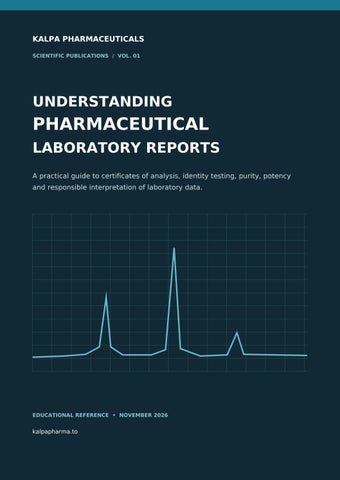
How a chromatogram is used A chromatogram plots detector response against time. Peaks may correspond to compounds eluting from the column. Analysts interpret peak identity and quantity using standards, calibration, system suitability, and validated processing rules.
Illustrative chromatogram - not experimental data
Other analytical tools Mass spectrometry can provide molecular information; spectroscopy can support structural identification; titration and other assays can quantify selected properties. Microbiological and contamination tests address different quality risks. No one method answers every question.
Validation and suitability Method validation considers properties such as specificity, accuracy, precision, range, and robustness as appropriate to the analytical purpose. A method suitable for one sample matrix may not be suitable for another.
KALPA PHARMACEUTICALS • EDUCATIONAL SERIES
06 / 10
KALPA / SCIENTIFIC PUBLICATIONS
READING RESULTS
How to interpret reported numbers A number is only as informative as its context: analyte, method, units, uncertainty, and specification.
Start with the denominator A reported 99% chromatographic area is not necessarily equivalent to 99 mg of active ingredient in a 100 mg sample. Determine exactly what is being measured and how the result was calculated.
Compare like with like An assay of 9.8 mg/tablet can be compared with a 10 mg/tablet label claim only if the analytical method and sample preparation support that comparison. The percentage of label claim would then be 98%, but acceptability depends on the relevant predefined specification.
Illustrative calculation Measured amount / label claim × 100 = percent of label claim. Example: 9.8 mg / 10.0 mg × 100 = 98%. This arithmetic does not independently establish compliance, safety, or method validity.
Uncertainty and significant figures Results are measurements, not exact truths. Repeatability, sample preparation, instrument calibration, and uncertainty can affect interpretation. Extra decimal places do not necessarily mean greater accuracy.
KALPA PHARMACEUTICALS • EDUCATIONAL SERIES
07 / 10
KALPA / SCIENTIFIC PUBLICATIONS
TRACEABILITY
Batch numbers and sample provenance Traceability connects a result to the specific sample and documented chain of handling.
Batch or lot identifiers A batch number helps connect records to a manufacturing lot, but the identifier alone does not establish that the tested sample was representative of all units. Sampling procedures, selection, and documentation matter.
Who collected the sample? Manufacturer-supplied samples, distributor-supplied samples, and independently acquired samples may provide different levels of assurance about market representation. Reports should not be described as independently sampled unless that is supported by evidence.
Practical traceability checklist Look for a sample identifier, batch/lot number, sample description, receipt date, test date, laboratory name, report identifier, method reference, and an authorized result. Check whether any amendments or retests are documented.
Authenticity checks When a report is used to support a public claim, verify it through the issuing laboratory where possible. An image of a report can be altered, misattributed, or detached from its original context.
KALPA PHARMACEUTICALS • EDUCATIONAL SERIES
08 / 10
KALPA / SCIENTIFIC PUBLICATIONS
CRITICAL INTERPRETATION
Limitations and common misconceptions Good interpretation considers both what the data show and what remains unknown.
“Lab-tested” does not mean “fully evaluated” A report may cover only one analyte or a limited panel. It may not include microbiological quality, residual solvents, elemental impurities, sterility, endotoxins, stability, or other attributes relevant to a particular dosage form.
A pass result is conditional “Pass” means the reported result met the specified criterion under the stated method and sample conditions. It does not establish universal regulatory approval or clinical safety.
Third-party testing requires context An external laboratory can provide independent analytical measurement, but independence of testing is not identical to independence of sampling, comprehensive audit, or regulator oversight.
Five questions before sharing a report What was tested? Which batch and sample? What method and specification were used? Who performed and authorized the work? What quality attributes were not assessed?
KALPA PHARMACEUTICALS • EDUCATIONAL SERIES
09 / 10
KALPA / SCIENTIFIC PUBLICATIONS
FURTHER READING
References and publication information Selected authoritative resources for analytical-method and quality-documentation concepts.
ICH Q2(R2) - Validation of Analytical Procedures https://www.ich.org/page/quality-guidelines
ICH Q14 - Analytical Procedure Development https://www.ich.org/page/quality-guidelines
U.S. FDA - Data Integrity and Compliance With Drug CGMP https://www.fda.gov/drugs/pharmaceutical-quality-resources/data-integrity-and-compliance-drug-cgmp-questionsand-answers
U.S. FDA - Pharmaceutical Quality Resources https://www.fda.gov/drugs/pharmaceutical-quality-resources
About this publication Published by Kalpa Pharmaceuticals as general scientific education. It does not reproduce or authenticate any product-specific laboratory report, imply regulatory approval, or make claims of manufacturing certification.
Publisher website kalpapharma.to
Use and interpretation Readers should consult original standards, qualified laboratory professionals, and applicable regulatory requirements before making technical or compliance determinations. Links are provided as starting points for further reading.
KALPA PHARMACEUTICALS • EDUCATIONAL SERIES
10 / 10