Between Calling and Survival: Where Passion and Practicality Struggle to Coexist
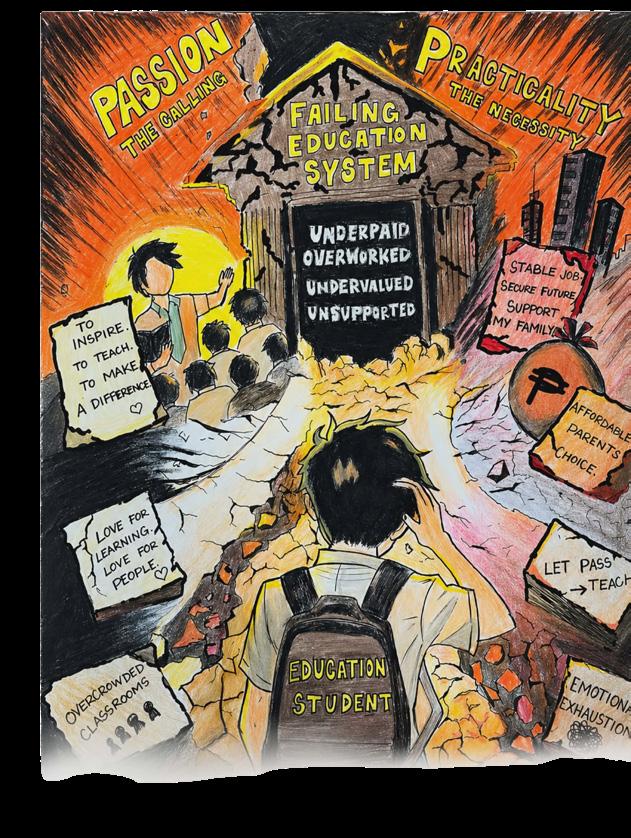
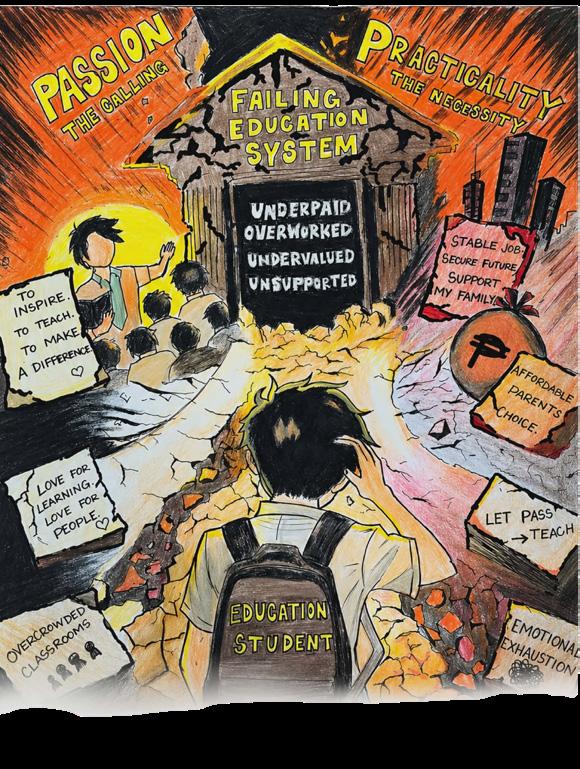
ilipino education students are often forced to choose between passion and practicality, while a broken system denies them both—leaving teachers either unfulfilled or unsupported.
Every year, students enter education programs for different reasons. Some are driven by passion or inspired by teachers who changed their lives. Others choose it for affordability, family advice, or job security. Many are left with a lingering question: did I choose this because I wanted to, or because it was the most practical option?
In a country that glorifies teaching but undervalues it financially, this question rings even more loudly. Teachers are supposed to mold the future amidst overcrowded classrooms, endless paperwork, and the loss of weekends spent completing the incomplete.
NEWS 02 NEWS 03
SMMC Gears Up Pre-Service Teachers for Demo Teaching Success
2025 LET
San Mateo Municipal College (SMMC) held a seminar-workshop on February 21 at Guinayang Campus for BEED and BSED 4th-year students to strengthen their preparation for demonstration teaching. The program ran from 9:00 a.m. to 12:00 noon, with students in OJT uniforms.
BEED Coordinator Mrs. Pacita J. Verdadero served as Master of Ceremony. The program opened with a prayer and national songs.
Dr. Delia P. Jadaone, Dean of ITED, delivered an inspiring message encouraging students to develop essential teaching skills, professionalism, and classroom authority.
Mrs. Yolanda L. Patio discussed “Effective Grammar and Language Instruction in Demo Teaching.” She explained inductive and deductive approaches and the PPP technique, emphasizing contextual grammar teaching and practical demo tips.
An icebreaker, “Tap, Tap, Play, and Catch,” energized participants before Mrs. Maria Teresa S. Bonggot discussed DLP components, demo strategies, real-life application, and PPST-based management. The event ended with certificate awarding, mentoring sessions, and students leaving motivated for demo teaching.
Achievers
Shine
in Arts
Month Quiz Bee and Poster Contest
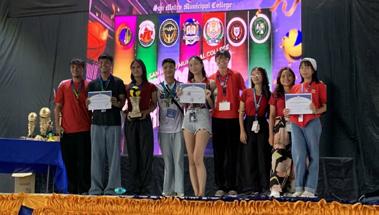
San Mateo Municipal College celebrated Arts Month on February 18 at San Mateo Municipal Stadium with the theme, “Ani ng Sining: Katotohanan at Giting” (Harvest of the Arts: Truth and Valor).
In particular, the highlight of the celebration featured the Quiz Bee and the On-the-Spot Poster Making Contest, where students exhibited excellence in knowledge, analytical thinking, artistic expression, creativity, and confidence.
Furthermore, Teatro Hiraya and the Sinag Dance Troupe added energy to the program with their singing and dancing performances.
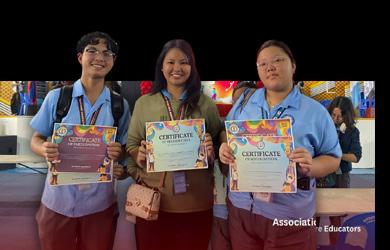
Afterward, the winners of the competition were announced. The Institute of Teacher Education secured awards during the contests, with the team composed of Lucia Bianca S. Camposano (BSED 1-A), Lester Temonio (BSED 2-B), and Cherryl Devonne Caacbay (BSED 3-C) earning third place in the Quiz Bee. Meanwhile, Xyrene Mae Taupo (BSED 1-C) claimed second place in the On-the-Spot Poster Making Contest.
The celebration aimed to showcase students’ talents while fostering creativity, skills, and confidence in artistic expression.
SMMC Logs 89.47%, 60% Passing Rates in September-November 2025 LET
San Mateo Municipal College (SMMC) recorded remarkable results in the September-November 2025 Licensure Examination for Teachers (LET), with the Bachelor of Secondary Education (BSED) program achieving an 89.47 percent passing rate and the Bachelor of Elementary Education (BEED) program recording 60 percent, according to results released by the Professional Regulation Commission (PRC).
Administered by the Board for Professional Teachers, the licensure examination assesses the competence of aspiring professional teachers nationwide.
The results reflect SMMC’s continuing efforts to prepare future educators for the teaching profession and highlight the dedication of its students and faculty.
In 2024, a total of 30 BSED graduates and 16 BEED graduates passed the Licensure Examination for Teachers, reflecting the institution’s continued commitment to producing competent educators.
School officials congratulated the successful examinees and encouraged future graduates to continue striving for excellence in education.
% 89.47%
A Roaring Celebration Launches SMMC Intramurals 2026
San Mateo Municipal College (SMMC) officially opened its Intramurals 2025–2026 on April 23, 2026, celebrating school spirit, unity, and student athleticism through a vibrant program.
The event showcased a parade of delegates, ramp presentations, energetic performances, the awarding of Mr. and Ms. SMMC Intramurals 2026, and a modern hip-hop dance competition, alongside formal ceremonies highlighting patriotism and teamwork.
The Sinag Dance Troupe performed, followed by the introduction of judges Mr. Fidel T. Reyes, Ms. Angelita Vallerito, and Ms. Nerriza Lopez, while a ramp segment of muses and escorts added excitement to the celebration. Students from different programs proudly represented their respective departments during the parade of delegates.
Municipal Administrator Jose Enrique Desiderio, on behalf of Mayor Omie Rivera, delivered a message of support, saying, “Mabuhay ang mga atleta, mabuhay ang SMMC, the home of achievers,” energizing the crowd.
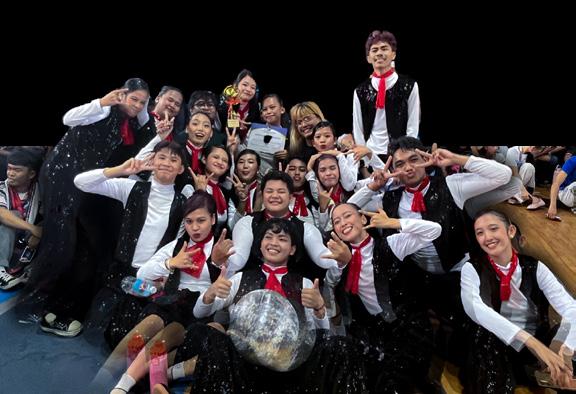
The hip-hop competition featured ABELS as champion and BSBA-MM in second place. ITED powered through with a strong and energetic performance, securing third place and standing out with confidence and flair. Contestants impressed the audience with synchronized movements, confidence, and stage presence throughout the competition.
The event concluded with a final performance from ABELS, marking a successful and spirited opening of Intramurals 2025–2026.
Students from different programs filled the venue with cheers and enthusiasm, creating a lively and competitive atmosphere throughout the program. The opening ceremony reflected SMMC’s commitment to promoting discipline, and excellence among its students.
ITED ACES GROOVE TO THIRD PLACE IN SMMC
The ITED Aces, representing the Education program, placed third in the modern hip-hop dance competition during the opening program of the San Mateo Municipal College (SMMC) Intramurals 2026 on April 23, 2026, held at the San Mateo Municipal Stadium, where ABELS emerged as champion and BSBA-MM secured second place.
Competing alongside six other programs, the ITED Aces delivered a five-minute “Birthday Disco Karaoke” performance featuring a festive mashup of popular songs. The routine was choreographed by head coach Kobe Padua Malaluan and student choreographer Jacob Bulalacao, a third-year BSED student.
The hip-hop dance contest featured entries from BSA, BSOA, ITED, BSBA-MM, BSBA-FM, BSP, and ABELS, showcasing creativity, teamwork, and school spirit across all participating programs. The ITED Aces delivered a creative and well-executed performance, standing out as one of the top-performing programs in the hip-hop competition and earning a strong third-place finish.
ITED Secures 5th Overall, Garners
Multiple Awards at Intramurals 2026
Intramurals 2026 concluded on a high note, celebrating the teamwork, and competitive spirit of student participants. The ITED program delivered a strong performance, finishing 5th overall among all participating programs.
The program earned notable victories across several events. ITED secured 2nd place in Badminton Men’s Doubles and Scrabble, and 3rd place in the Modern Hip-Hop Dance Contest.
In Men’s Volleyball, ITED claimed 3rd place. Jacob Monis stood out as a key player, earning a spot in the Mythical Six and receiving the Best Opposite Spiker award. John Daniel Ambida was also recognized for his performance, taking home the Best Setter award.
In the Women’s Volleyball division, Karen Armas was named to the Mythical Six.
Rachelle Mutya earned the Best Libero award for her outstanding defensive play.
The event not only highlighted competitive achievements but also underscored the importance of sportsmanship, unity, and the diverse talents of students beyond the classroom, making Intramurals 2026 a memorable celebration of excellence.
BY SHANNE F. VILLANUEVA
BY ERICH A. RAMILO
BY MECAILA S. ABAYON
BY MECAILA S. ABAYON
BY FARAH G. ABRENICA
BY SHANNE F. VILLANUEVA
PHOTO BY: METAMORPHOSIS
PHOTO BY: AFE
PHOTO BY: MARY ANN GRACE TEPACE
PHOTO BY: ZAILEEN TEODOROE
United
EdITOrIaL BOard
Academic Year 2025-2026
EDITOR IN-CHIEF:
John Carlo L. Rebojo
MANAGING EDITOR:
Angeline F. Dimacali
ASSOCIATE
Aljean S. Mabini
COPY EDITOR:
Farah G. Abrenica
LAYOUT ARTIST:
John Carlo L. Rebojo
PHOTOJOURNALIST:
Mary Ann Grace D. Tepace
Zaileen G. Teodoro
Veronical B. Tabia
Erich A. Ramilo
EDITORIAL CARTOONIST: John Erron F. Sison
NEWS EDITOR:
Mecaila S. Abayon
Farah G. Abrenica
Shanne F. Villlanueva
Erich A. Ramilo PRODUCTION
Mary
“I Think, Therefore I Am” — René Descartes, But Who Thinks Now?
“What happens when the mind begins to forget how to struggle?” In a time where answers appear in seconds, answers generated with only a few prompts. In Philippine education, more and more students turn to AI, raising a deeper and more unsettling question: Is curiosity still ours… or have we surrendered it to software machines?
This shift becomes more visible in everyday learning. Essay done quickly, almost effortlessly. But beneath those perfectly and logically arranged paragraphs lies a silent loss. When everything becomes easy, something important may disappear. Creativity that only humanity can offer. And what is lost is not just effort, but ownership of thought.
This growing dependence is not just a possibility; it is already happening. A report from Manila Bulletin states that 83% of students now use AI tools for their studies, and more than half depend on them regularly in the Philippines while three out of four students rely on it for paraphrasing.
Endless Revisions, Limited Results: The Flawed Education Cycle
These numbers reveal a quiet truth: AI is no longer approaching. It is already here, deeply rooted into how students learn.
With this reality in mind, the question is no longer whether AI should exist in education, but how it should be used. So where do we draw the line between help and harm? Students must also ask themselves, “Is this my thought, or just borrowed intelligence?” AI should remain a tool in the hands of learners and not the mind that leads them. Because in the end, education is not just about answers, but about becoming someone who knows how to find them.
We no longer question the state of Filipinos’ education. The evidence is clear, yet it remains unclear why the government’s response continues to fall short.
Between Calling and Survival: Where Passion and Practicality Struggle to Coexist
Filipino education students are often forced to choose between passion and practicality, while a broken system denies them both—leaving teachers either unfulfilled or unsupported.
Every year, students enter education programs for different reasons. Some are driven by passion or inspired by teachers who changed their lives. Others choose it for affordability, family advice, or job security. Many are left with a lingering question: did I choose this because I wanted to, or because it was the most practical option?
In a country that glorifies teaching but undervalues it financially, this question rings even more loudly. Teachers are supposed to mold the future amidst overcrowded classrooms, endless paperwork, and the loss of weekends spent completing the incomplete.
It is evident from the figures. For example, in the 20242025 academic year, 62% of teachers in public secondary schools were teaching subjects that were not in their specialization, meaning that many are teaching subjects that they have never studied nor intended to study. PBEd 2025 report that nine out of ten students are not reading at a level of comprehension; only seven percent finish their education from Grade 1 to college; and almost 40% of college students drop out. This is not just data; it is evidence of a failed education system where the wrong people are teaching in the wrong classes.
Choosing Education for practical reasons cannot be condemned, as teaching can be a surefire choice in an unpredictable environment, whereby one finishes schooling, takes the LET, then becomes a teacher. The problem with pragmatic motivations is that they are poor motivators.
According to PBEd, the skills shortage persists because there is always a gap between what is taught and employment opportunities. Education majors also run the risk of experiencing burnout since their passion may come much later than expected
Hanibal Camua stated that the situation at hand is more than just unemployment. It is frustrating for a student to prepare for so long for a certain career, but after discovering that his or her education was wasted on something useless, the person starts losing interest.
Passion and practicality are not opposites—students should never be forced to choose between purpose and stability. A strong education system must let teachers serve with heart while ensuring they have a future worth staying for, because without both, it will keep producing trained but unfulfilled educators.
Curriculum in education is meant to evolve, but change without direction is not progress. How can we expect better outcomes when reforms are implemented without proper monitoring and evaluation? When changes are made hastily and without clear evidence of their effectiveness, the system risks becoming a cycle of revision rather than genuine improvement. Too often, reforms are introduced to align with international standards rather than to respond to the actual needs of learners, creating a disconnect between policy goals and classroom realities. This raises an important question: are we truly improving education, or simply changing it for the sake of appearing progressive?
This disconnect becomes more evident when looking at global assessments like PISA, which measures how well students apply knowledge in real-life situations. Despite continuous reforms, the Philippines continues to perform below the global average, suggesting that frequent curriculum changes alone do not lead to better outcomes. The issue goes beyond policy–it reflects deeper systemic challenges such as limited resources, lack of teacher support, and unequal learning conditions. When these problems remain unaddressed, even well-intended reforms struggle to succeed, leaving both students and teachers caught in a system that demands constant adjustment but offers little stability.
A strong education system is built on consistency, evidence-based reforms, and real support for teachers—not constant change. It is ironic that while 21st-century skills are promoted, many learners still struggle with basic competencies. True progress should not be measured by how often reforms are introduced, but by how effectively they improve learning. What the system needs now is not more revisions, but thoughtful and sustained change—grounded in evidence, responsive to classroom realities, and supported by adequate resources. Only then can we move beyond this cycle and achieve lasting improvement in education.
The Hidden Reality of Public College Education
Is college education really “free” if students still struggle just to stay in school?
While many students have benefited from the Universal Access to Quality Tertiary Education Act (RA 10931), which provides free tuition in public colleges, it does not remove the financial burdens of pursuing a degree. In reality, “free tuition” does not mean “free education”; rather, it gives an illusion of accessibility and convenience while students still face everyday expenses just to survive and study. Although enrollment in college may be free, many Filipino students still find it difficult to get by.
Education goes beyond tuition. Even without tuition fees, students still spend on transportation, food, school supplies, projects, and medical needs. These everyday and unexpected expenses add up and become a major challenge, especially for low-income students.
Studies from the Philippine Institute for Development Studies (PIDS), the Philippine Daily Inquirer, and the IBON Foundation show that free tuition does not remove these costs, forcing many students to work or rely on limited financial aid. As a result, some are unable to continue their studies, proving that free tuition alone does not guarantee equal opportunity.
In conclusion, while free tuition in public colleges improve access to education, it does not remove students’ financial struggles. Hidden costs like daily, health, and academic expenses still create barriers to true accessibility. Therefore, achieving real educational equity requires support beyond tuition that addresses students’ full financial needs. Only then can “free education” truly be free in both principle and reality.
The Philippines is currently facing a classroom shortage of 165,443 units—a figure that continues to weaken the quality of education experienced by Filipino learners nationwide, forcing students into overcrowded spaces, staggered class schedules, and poor learning environments. In some cases, even when classrooms are completed, they remain unusable—abandoned due to poor construction and mismanagement. This is not a lack of space; it is a failure of execution.
Despite ambitious government plans and a proposed education allocation of over 700 billion in the 2025 national budget, funding still falls short of UNESCO standards and remains insufficient to address the country’s massive classroom backlog and infrastructure needs. Moreover, delivery remains slow.
Education continues to struggle not because of a lack of funding, but because of how those funds are managed. Delays in construction, poor execution, and incomplete projects point to deeper systemic issues. Without proper prioritization of infrastructure and more efficient use of resources, these problems will persist.
The Crisis in Education is a Crisis of Execution
BY ANGELIE F. DIMACALI
BY ALJEAN S. MABINI
BY ERICH A. RAMILO
BY JOHN CARLO L. REBOJO
For Those Who
Carry
More
BY ALJEAN S. MABINI
ot all who learn are free of weight, some balance more than time and fate, they come with stories, quiet and deep, and dreams they choose not to let sleep.
There are hands that have done more than write, that have worked through day and into night, yet turn each page with steady care, as if no burden lingers there.
Some walk with time already known, with stories lived and fully grown, yet sit once more, prepared to see that learning has no boundary.
There are those who give before they take, who bend but never truly break, who move through days both full and long, yet carry on, enduring, strong.
Not all journeys are light and clear, some paths are paved with quiet fear, yet step by step, they make their way— choosing to grow, choosing to stay.
And though no words may loudly say the weight they bear from day to day, their presence speaks in ways so true— of strength that quietly pulls them through.
In an all-girls school, I entered the classroom with a smile and a book, ready to meet my new students. Upon entering, they greeted me uneagerly; despite that, I continued to smile
I was surprised, as I had never encountered students like this before. I proceeded with my lesson on feminism with enthusiasm; however, after every word and sentence I de livered, the girls paid no attention—indifferent and unfazed. Emotionless expressions were plastered across their faces as the PowerPoint slides transitioned one after another, like statues witnessing the world go by day and night, allowing life to unfold before them yet remaining unmoved, as if nothing truly mattered. It was then that I realized why my students were behaving
I turned off the projector and placed it back in its case. No one noticed. I remained calm and composed, scanning the room as I took two deep
I called on a girl in a pink floral blouse with a ribbon on her head and directed her to stand. I asked her what it meant, for her, to be a woman. The once silent room slowly filled with whispers and mur murs. She expressed that being a woman meant keeping the house clean. I then called another girl, one in a purple dress with braided hair, and asked her the same question. She stood and conveyed, with hesitation, that being a woman
SHE WHO LEARNED TO DREAM
Hearing their answers saddened me. I took a deep breath, concern evident within me. I reminded them that women have become doctors, lawyers, and even presidents. I emphasized that they are more than what they believe themselves to be, that they have the power to mold and
I mentioned Gabriela Silang—who is not just a wife, but a revolutionary who fought for our country against colonizers—and Melchora Aquino, who aided and provided
As a teacher standing before them, I rejected the roles that society had long imposed on us. I urged them not to settle for less and to recognize that they could be whatever they chose to be. I made it clear that I was not there to decide
Silence entirely engulfed the classroom. My words lingered—unseen, yet deeply present. Something stirred within the minds of the students; a quiet shift, almost imperceptible, began to take
One girl stared at her notebook for a long moment, as if searching for something beyond what she had been taught. Slowly, she began to write—something of her own, something she believed in. She paused, uncertainty lingering in her hand.
At that moment, I held on to a quiet hope—that my dream would come true, and that my students would learn to follow their own dreams, not the ones that
BY VERONICA B. TABIA
hey enter the classroom carrying more than they hold.
Within them are dreams— some clear, some unsure. There are quiet expectations, unseen pressure, and hopes they seldom speak aloud. Yet each day, they choose to be present.
Learning is not always easy. It asks them to rise early despite fatigue, to listen even when their thoughts feel heavy, and to begin again after failing. It asks them to continue, even when stopping seems easier.
Each one walks a different path. Some move forward for a better future. Others persist for those who depend on them. Some are guided by purpose, while others are still searching for it.
Yet they share something in common—the will to keep going.
Education is not only about reaching a goal. It is about enduring the journey. It teaches not just lessons from pages, but lessons of patience, strength, and purpose.
And in every quiet review, every mistake, and every small step forward, they are slowly becoming who they are meant to be.
For learning is not only the pursuit of knowledge— it is the steady pursuit of a better self.
A Mother’s Second Chance
BY ZAILEEN G. TEODORO
ook at the bright side. Life is always difficult, but we overcome it every day. With a little sacrifice and determination, you can achieve your goals not just for yourself, but for your family.
At 32 years old, Ms. Roslyn Balon, a Bachelor of Elementary Education student at San Mateo Municipal College, proves that determination can overcome even the most difficult circumstances. More than just a student, she is also a devoted mother who continues to pursue her dream of finishing college despite the many challenges she faces every day. For Ms. Balon, returning to school was not simply a choice—it was a promise she made to herself. Years ago, she had to stop studying due to financial difficulties and family responsibilities. The disappointment stayed with her for a long time.
She recalled herself that no matter what happens, she would go to school if given another chance.
However, the path back to education was not easy. Shortly after enrolling in college again, she discovered that she was pregnant. Because there was no one else to take care of her child at home, she had to pause her studies once more until her baby grew stronger.
Despite the setbacks, Ms. Balon found strength in her family, especially in her mother’s belief that she had the potential to finish college. In their family, no one had yet graduated from college, and her mother believed she was the one who could break that cycle.
Today, balancing motherhood and academic responsibilities remain one of her greatest challenges. She admits that managing her time is often overwhelming. There are moments when her child’s school schedule conflicts with her own classes, leaving her unsure how she can make it on time. Sometimes, the pressure becomes so intense that she breaks down in tears, wondering how she can manage everything at once.
Still, she remains grateful for the support she receives from San Mateo Municipal College. According to her, the school
Pursuing her degree also comes with many sacrifices. Ms. Balon shared that studying means she sometimes has less time for her family. There are days when exhaustion prevents her from cooking dinner or helping her child with assignments.
“The hardest part is dividing my time,” she explained. Between schoolwork, household responsibilities, and motherhood, she often feels physically and emotionally drained. At times, she survives on only two or three hours of sleep just to meet deadlines.
Despite the exhaustion, her child remains her greatest motivation. Seeing her mother study has also influenced her child positively, helping the young learner become more confident and communicative.
For Ms. Balon, her journey is not only about personal success—it is about creating a better future for her family.
She also remembers the struggles of her earlier college years in Bicol, when poverty forced her to stop studying. With only 30 pesos for daily transportation and no money for meals, she eventually decided to sacrifice her education so that her family could survive.
Those experiences continue to fuel her determination today. Having already reached her third year in college again, she refuses to give up.
“I’m already close,” she said. “If I stop now, this might be my last chance”.
Looking back at her progress, Ms. Balon realizes that every sacrifice has been worth it. Through hard work and careful planning, she and her partner were able to build a stable home and even purchased a motorcycle before she returned to school. Step by step, she is moving closer to achieving her dream.
More importantly, she hopes her journey will inspire her child to value education. Instead of pressuring her child to always rank at the top, she simply wants him to enjoy learning and grow independently. Through resilience, sacrifice, and love for her family, Ms. Roslyn Balon continues to prove that it is never too late to pursue one’s dreams. Her story reminds us that education is not defined by age or circumstance, but by the courage to keep moving forward.
WHEN PASSION REFUSES TO SIT STILL
BY MARY ANN GRACE D. TEPACE
here are students who follow schedules—and then there are those who move through them. Sir Rufon was the latter. Before he became a teacher, before the paperwork, before the classrooms, he was simply a freshman chasing rhythm. While others were still figuring out where they belonged, he already knew where to look—the dance floor.
Every opportunity to move, to perform, to belong to a group that understood his passion— he took it. It wasn’t long before he found himself auditioning for “Sikat Dance Troupe” under Sir Alexander Ramos, with Dr. Robina Noble as their advisor. He was accepted, and the group performed dance covers together. Dance was never new to him– It was his home.
College, however, had other plans. His first year brought the usual adjustments—new subjects, shifting demands, and the sudden transition to online learning. But while many were still trying to adapt, Sir Rufon found himself leaning deeper into dance. At one point, he admitted that studying became a “side quest,” while dancing took the lead role in his college life.
Just do something. Don’t overthink. Start where you are. Take opportunities as they come, and figure things
out
along the way
Then came Sinag. As one of the pioneer members of Sinag Dance Troupe, his college journey became even more intense. Practices turned into performances, performances turned into projects, and projects turned into a lifestyle which demanded not just passion, but also endurance.
By his third year, his days were no longer simple routines— they were constant motion: field study in San Mateo, tutoring in Ampid, dance rehearsals in different locations, then back again.
In the middle of all these responsibilities, he also stepped into bigger opportunities—becoming an official backup dancer for Imelda Papin. What started as a passion had now grown into something more demanding, more professional, and more real. His days blurred into one another— balancing academics, rehearsal spaces, long travels, and performances that often ended late at night. It was exhausting, chaotic, and overwhelming at times. But it was also meaningful.
Eventually, the weight of responsibilities forced a decision many student-performers struggle with—where to draw the line between passion and academics. Sir Rufon made a choice not to abandon his passion, but to protect its future by prioritizing his studies.
He explained: “Actually, hindi ko naman totally iniwanan yung passion ko. It’s just that for me to continue with my passion sa pagsasayaw, I need to finish my study. So that when I finish my study, I can now focus doon sa passion ngayon.” For him, studying was never separate from passion—it was part of it. What helped him survive the pressure was a simple mindset: focus on what you can do now, not everything at once.
He shared: “When there is an opportunity, grab it, then now think what will you do next. Kapag nakuha mo na yung particular thing na meron ka ngayon, doon mo na lang muna isipin kung ano yung susunod. Do not overthink kung ano na mangyayari pagka nakuha mo ang isang bagay. Just do something first before you think sa next.” That mindset became his rhythm—steady, practical, and grounded.
Today, Sir Rufon carries those lessons into his life as a teacher. The workload, paperwork, and multiple responsibilities no longer feel unfamiliar. After all, he has lived a life of constant movement—balancing academics, performances, and personal growth all at once. Among his proudest moments was the production of a dance cover that took an entire day to shoot. Exhausting as it was, the experience became lasting proof of dedication, teamwork, and passion. When asked to describe his journey in one word, he chose: Sinag. A source of light. A reminder to rise. A symbol of energy that keeps one moving forward, no matter how exhausting the journey becomes.
And today, that journey continues beyond borders. After completing his degree in BSED English, he was accepted to teach in Indonesia as a Physical Education teacher—proving that passion, discipline, and persistence can open doors far beyond what was once imagined.
Every Student Deserves a Chance, No Matter What Section They Belong To
his belief drives Ms. Yasser Bolante, a Bachelor of Secondary Education major in English, who is now deployed into the real world of teaching. For her, teaching goes beyond lesson plans and requirements. “I want to change lives,” firm in her purpose. She enters the classroom not just to teach content, but to reach students who are often overlooked.
Her program demands her to have more patience and effort than other professions do. “It’s challenging because I have to think of a lot of strategies to engage them.” The experience overwhelmed her. Facing a real classroom showed her that teaching is not simple and never routine.
Her journey as a student teacher brings real challenges. She handles five sections, most of which are labeled as the lowest. “Kahit section 1 pa ‘yan or kahit lowest section pa, it has strengthened my belief that every student deserves an equal chance,” emphasizing that labels should never define a learner’s worth and that students are more than just numbers.
Despite the pressure, she finds meaning in small yet powerful moments. A simple “I understand” from a student becomes a reward greater than any recognition. These moments remind her why she chose this path. Through these experiences, she develops adaptability and resilience, skills that shape her not only as a teacher but also as a person. She learns that teaching is not one-size-fitsall; it requires meeting students where they are.
More importantly, her journey strengthens her belief in equity in education. She emphasizes that every learner, regardless of their section or ability, deserves attention, care, and opportunity. Teaching, for her, is about connection, understanding students’ needs, making them feel valued, and creating a space where they feel seen and valued.
In the end, her story shows what teaching requires. It calls for patience, commitment, and the will to keep going. A real teacher does not walk away from struggling students; instead, a teacher stays, works, and believes until the student begins to believe too.
BY ANGELINE F. DIMACALI T
The Inspiring Journey of Ms. Roslyn Balon
PHOTO BY: JOHN MICHAEL RUFON
PHOTO BY: YASSER BOlAnTE
PHOTO BY: ROSlYnBAlOn
1O SPORTS
SHARP MINDS ITED WINS BIG RESULTS!
BY
SAN MATEO, RIZAL— The ITED department capped a productive day at the SMMC Intramurals 2026 on April 23 at the Guinayang Campus with two strong board game performances — winning the Scrabble competition outright and advancing to the chess semifinals through the efforts of Ariola Jhenelle.
ITED’s Scrabble team had an uneven start but found its footing when it counted most, finishing the three-round tournament in first place overall. In Round 1, Manuel defeated Sismundo of FM, 231–204, and Galarroza dominated Dagasdas of IA, 366–193. However, Malaboco lost to Fajardo of MM, 131–364, and Trespecio fell to a representative of ABELS, 277–344.
Round 2 was the team’s most difficult stretch. Only Malaboco managed a victory, defeating Dagasdas of IA, 293–235. Galarroza lost narrowly to De Leon of BSP, 269–288, while Manuel fell to Sabater of ABELS, 166–317, and Trespecio was defeated by Patulot of FM, 215–296.
ITED regrouped and delivered its best performance in Round 3. Galarroza defeated Taganahan of ABELS, 343–240, Trespecio beat Elacion of FM, 276–254, and Malaboco topped Gomez of BSOA, 309–254. Manuel suffered a loss to Garses of BSOA, 191–291, but the team had already done enough. The three wins in the final round proved decisive, propelling ITED to the overall championship.
In the Chess Competition, Ariola Jhenelle represented ITED with distinction, advancing to the semifinals before falling in a closely contested three-game series.
In the elimination round against Marketing Management, Ariola won both games via checkmate. She took Game 1 through controlled bishop play that kept her opponent on the defensive throughout, then closed out Game 2 in under two minutes by capturing her opponent’s knight, queen, and pawn in quick succession. The sweep earned her a place in the semifinals.
Facing BS Psychology in the semis, Ariola split the first two games, losing Game 1 before bouncing back with a decisive checkmate in Game 2. Game 3, however, was decided by the clock, as Ariola ran out of time before she could convert her position, ending her tournament run at the final four.
Teammate Dionisio Patrick competed in the round-robin stage and finished with a 1–5 record. He showed promise in his opening match against BSOA, capturing multiple pieces before losing on time, and secured his only win against Marketing Management through careful and disciplined defensive play. He struggled against the remaining opponents, with time management proving to be a consistent challenge throughout his matches.
Despite the chess team’s mixed results, ITED left the Guinayang Campus with a Scrabble champi-
ITED Smashes Through with Strong Badminton Performances
BY SOFIA JOYCE E. SERRANO
SAN MATEO, RIZAL — The ITED badminton team delivered a competitive performance in the SMMC Intramurals 2026 held on April 21 at Geronimo Badminton Court, securing multiple victories in tightly contested matches across different divisions. ITED opened its campaign with dominant wins over BSBA Marketing Management in the men’s doubles category, 30–22 and 30–20. The team established early control through consistent rallies, accurate placement shots, and effective net play that helped them dictate the pace of the match.
The squad maintained its momentum in the succeeding rounds, earning hard-fought victories against Psychology (31–27), FM (31–20), and BSOA (31–29). The match against BSOA proved to be one of the most intense encounters, as both teams exchanged points in extended rallies before ITED secured the narrow win in the closing moments.
Despite its strong run, ITED also absorbed close defeats in other matches. The women’s doubles team fell to BSBA MM, 31–27, in a tightly contested match that remained within reach until the final points. Meanwhile, the men’s doubles pair was defeated by ABELS in straight but closely fought sets, 31–29 and 31–22, with both teams engaging in long rallies and minimal scoring separation throughout the match.
ITED finished its campaign with a balanced performance highlighted by resilience, discipline, and consistency under pressure. The team’s ability to stay competitive in close matches underscored its growth and potential in future intramural
“Tatag sa Isa’t Isa”: EDUC Show Heart in Semifinal Battle Against ABELS
BY DENISE LORIN B. AQUINO
“Tatag sa isa’t isa, tiwala sa isa’t isa, at gawin ang best para sa team na ’to.” Despite their strong effort and teamwork, the ITED Eagles failed to reach the finals after losing in straight sets to the ABELS Archers, 23–25, 20–25, in the SMMC Women’s Volleyball Intramurals on April 23, 2026, at JFD Stadium, Guitnang Bayan 1. The Eagles’ semifinals exit was largely attributed to communication breakdowns and the injury of
“Tinignan namin yung mga lapses namin nung first quarter.
Since ’yon nga, hindi kami nagkaroon ng good communication nung first set—salang usap-usap, nagkakapaan pa,” Armas said.
“No’ng second set and third set, nakuha na namin ’yong momentum at nagkaroon na kami ng good communication. Nag-uusap na kami sa court at nakita na namin ’yong mga butas namin sa bawat hulog ng bola.”
In the opening set, ITED kept the game close through a service ace from Renalyn Cruz, strong defensive plays from Mutya, and attacking efforts from Armas and Ashley Trinidad. However, ABELS managed to edge ahead and take the set, 25–23. The second set saw ITED attempt a comeback behind a spike and service ace from Junwill Diane Dumaging, but ABELS maintained control and closed the match at 25–20. Ar-
On their preparation, Armas added, “Actually marami sa amin may research defense. Pero I think more on pahinga talaga muna tsaka pray lang.”
The Eagles entered the semifinals after a dramatic reverse sweep against IA Owls in the quarterfinals, 22–25, 25–20, 15–10, showcasing their resilience and ability to adjust under pressure. Despite the loss, ITED gles end their campaignence, highlighting the-work moving
ITED Eagles Leads First Half but Lose Grip Late
BY ANGELINE F. DIMACALI
AMPID I – The ITED Eagles played well in the first half but BS Psychology turned things around late to claim a 60-41 victory on April 21 at Ampid Uno Covered Court as part of the SMMC Intramurals. The Eagles made use of excellent defensive plays and fast break strategies to earn a 13-9 lead after the first quarter, led by No. 1 Sabangan who had a good start for them.
The Eagles kept their lead going into halftime with a 26–21 ad vantage, showing discipline on both ends of the floor and strong team work in the first half. Their early control gave them hope of securing another win in the tournament. However, the momentum shifted in the third quarter. BS Psychology slowly closed the gap and eventually took the lead, finishing the quarter ahead, 39–36. ITED tried to respond, but they struggled to match the pace and scoring runs of their opponents.
In the fourth quarter, BS Psychology fully took control of the game. ITED managed only five points, while BS Psychol ogy added 21 more points to pull away. The game ended with a 60–41 score, giving BS Psychology a strong comeback win.
Despite the loss, ITED showed a sharp start and strong effort in the first half, but could not maintain their pace until the final buzz
SOFIA JOYCE E. SERRANO & JOHN ERRON F. SISON
PHOTO BY: MARY ANN GRACE TEPACE
PHOTO BY: ZAIlEEn TEODORO
SPORTS
Eagles Soar with Grit in Intense Semifinal Showdown
BY DEN FRANK D. REYES
Despite a strong comeback in the second set, the Eagles missed a finals berth due to late-game floor defense lapses that allowed the Ravens to escape with the victory.
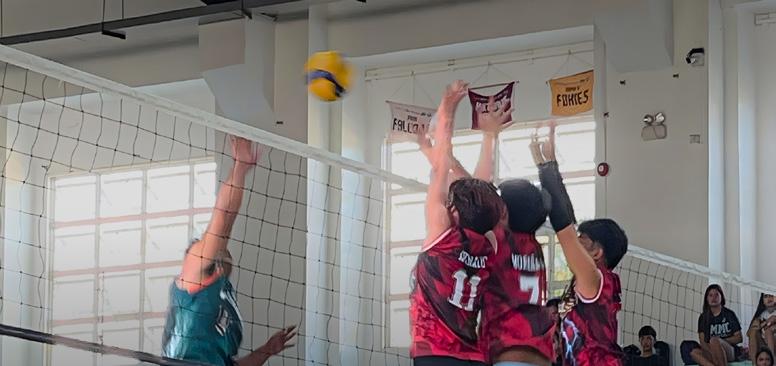
Marketing took control early in the opening set behind strong attacks from Monis and wellplaced drop balls from De Lara. ITED answered with a powerful spike from Avinado and a solid three-man block that energized the Eagles’ side.
The set remained close for most of the frame, but the Ravens stayed steady in the closing moments and claimed the first set, 25–21.
The Eagles responded strongly in the second set with better blocking, sharper floor defense, and more aggressive attacks. Ambida and Moraña led the front line with several key blocks that slowed down the Ravens’ hitters. Avinado added a service ace, while Tejol converted important scoring chances to keep ITED in control. A hitting error by Marketing handed the Eagles the set, 25–20, tying the match at one set apiece.
ITED Battles Hard in Thrilling Esports Competition
BY JOHN ERRON F. SISON
ITED had a rollercoaster two-day performance, showing flashes of real potential but ultimately being held back by inconsistency. Soterio was the standout player, delivering MVP-level performances using Yi Sun-Shin and Nolan that carried the team to their best moments, including a comeback win over the Institute of Accountancy.
However, the team struggled to maintain momentum, suffering heavy losses to ABELS and BSOA, and further defeats to FM and MM on Day 2, with poor drafting, weak rotations, and communication breakdowns consistently unraveling their efforts against more organized opponents. While ITED clearly has the individual talent to compete, turning that potential into consistent results will require better draft preparation, improved adaptability, and stronger coordination as a unit moving forward.
A hitting error by Marketing handed the Eagles the set, 25–20, tying the match at one set apiece.
With a finals berth on the line, both teams traded points in the deciding third set. ITED grabbed a narrow 9–8 lead after Ambida won a joust at the net and Avinado delivered a down-the-line attack. The Eagles continued to fight behind the strong presence of Ambida and Moraña at the net, but the Ravens answered with timely cross-court hits and consistent offense.
WHAT’S INSIDE?
In the closing stretch, Marketing stayed composed and capitalized on key opportunities to pull ahead. The Ravens then sealed the third set, 25–21, ending the Eagles’ finals bid.
Despite the loss, the ITED Eagles displayed teamwork, resilience, and strong net defense throughout the match. They left the tournament with heads held high after pushing the Ravens to the limit in one of the closest and most competitive semifinal matches of the season.
SAN MATEO, RIZAL — No finals for the Eagles. The Marketing Ravens sent ITED packing in a three-set semifinal battle, 21–25, 25–20, 21–25, at the SMMC Men’s Volleyball Intramurals on April 23, 2026, at JFD Stadium, Guitnang Bayan 1.
Sharp Minds, Big Results: ITED Wins
“Tatag sa Isa’t Isa”: EDUC Show Heart in Semifinal Battle Against