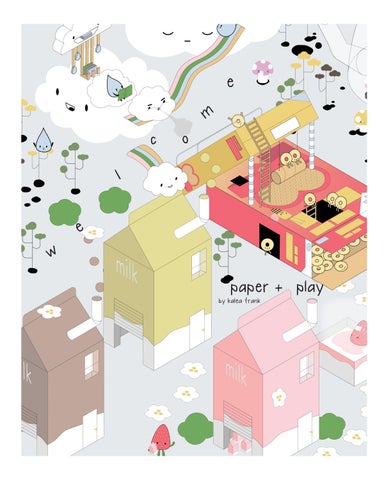
e
m c
o
l e w paper play + by kalea frank
TABLE chapter one paper + purpose chapter 3 paper + possibility
TS
N O C FO TEN
paper + play purpose 4D animation ch. 1
2D + 3D cereal box
How-to: toilet paper roll
paper + possibility, paper precedents 4D animation ch. 3
2D + 3D toilet paper swing
paper pulp How-to: Happy Cloud
bibliography
chapter layout chapter two paper + crisis chapter four paper + story
textual story + 4D animations
paper + crisis story 4D animation ch. 2
philosophy + animsim 4D animation full paper + play characters
2D graphics and 3D renders
experimental 3D pages
2D + 3D strawberry milk carton
3D toilet paper planters
How-to: strawberry milk carton and jacuzzi
How-to: fonts How-to: graphic design principles
CHAPTER one Introduction + Purpose Our landfills are overpopulated with paper, yet Paper + Play reimagines our single-use conception of paper. This book plays with paper in the 2D, digital & physical 3D, and the 4D. It hopes to inspire joy, creativity, and making of recycled paper products for all humans at all ages.
Methods + Organization The book is divided into four chapters each with a similar overlying framework and an animation. This framework is noted in the table of contents. Education + Accessibility The goal of this book is to provide education about a story of paper in a graphic language that is widely accessible. The book discusses the paper crisis, how to play with paper, and lastly some insight on how to produce some of these graphic images.
ANIMATION Central to Paper + Play is an animation discussing paper and its possibilities for a circular life in a circular economy. We follow a toilet roll, a very disposable object, who wakes up in a landfill after being used. How-To: 1. On a smart device, download the free app Artivive on an app store. 2. Use your device to view the animation. With Artivive downloaded, use the camera to view the image to the right. Enjoy! note: if you see this symbol Artivive to see it come to life.
next to an image use
scan image below for the first chapter
Cereal Box Playground
Paper products and packaging are fun! Utilize a used cereal box and your creativity to open a whole lot of possibility!
Paper Cut-Outs
These Cut-Outs provide the “Dreamy Herbal Bedtime Cereal” a new playful use and a second life.
Cereal Box Designs
d i y tp
p a p e r ro l l
How-To: 1. pop out the facial expressions from the perforations 2. take a used toilet paper roll and give it a new life, literally! You can also add cuts to give the toilet paper legs and arms. 3. glue a facial expression on the toilet paper roll and enjoy your new friend.
CHAPTER two:
Paper + Crisis
The pulp and paper industry is one of the largest emitters of global warming pollution in industrialized nations and is overpopulated in landfills. According to the EPA, “In 2018, paper and paperboard (cardboard) materials comprised the largest component of municipal solid waste”. Paper’s life cycle has extensive negative impacts on ecosystems, forests, water quality and groundwater availability, air quality, and on local communities. The paper crisis hits hard for many indigenous groups in pulpwood producing regions where they continue to have their land and cultural rights disrespected and abused. Despite the more prevalent use of the digital world and space, paper consumption steadily rises at a global level and it now exceeds 400 million tons per year. According to The State Of The Global Paper Industry by Environmental Paper Network, paper usage in North America is declining, but in Asia and South America, the industry is expanding. However, North Americans still use more than the global average per capita and must decrease paper consumption. The entire continent of Africa accounts for 2% of paper use. Currently, the paper and pulp industry faces unfair access and use. The problem is exasperated by the fact that since the pandemic, there has been a paper shortage. There are not enough workers to work paper mills and not enough paper pulp.
Images (from left to right): Negative impacts on ecosystems, forests, and air quali-
Creating a circular lifecycle for paper will help mitigate the resource intensity and negative offset impacts of paper use. Globally we have a recycling rate of about ~60%. The main paper uses are as follows: 55% of paper is used for wrapping and packaging, while 26% is used for newsprint (Haggith 5). Newsprint and packaging fall behind corrugated paper in recycling and there is more potential for more recyclability here. Recycled paper saves significant amounts of trees, energy, greenhouse gas emissions, water, ocean acidification, air pollutants, and mercury admissions.
The Pulp and Paper Industry negatively impact wildlife and ecosystems
Recycled pulp and paper can be more optimized in design. It is more easily accessible and affordable than most materials and can be utilized to help achieve a more playful, joyful world.
ANIMATION In Chapter 2, our toilet paper roll learns how paper is made and what its detrimental effects are.
Strawberry Milk Carton
SLURRRPPP...! Where does your strawberry milk carton come from? What stories does it hold?
d i y s t r a wb e rr y m i l k c ar t o n + jacuzzi How-To: note: you can also send either as a postcard AND you can use this to model the strawberry milk scene with the book cover. 1. pop out the milk carton, jacuzzi, and ladder from the perforations 2. fold the dotted lines to form the carton and jacuzzi 3. use the tabs to connect the edges 4. glue, tape, or staple the top of the carton edge together
strawberry milk
CHAPTER three: Circular Life
Paper + Possibility, a
Paper has been used as a building material before but is not optimized. Architect Shigeru Ban is one of the most popular known paper architects, expanding the status quo on how paper can help bring architecture to life. Shigeru Ban has used corrugated paper in the form of tubes to make sturdy disaster relief houses, partitions, bridges, log houses, churches, and pavilions! Dratz&Dratz Architekten uses paper in a different way - in bales. To create their office they used 550 bales of compressed recycled paper from supermarkets in the area. This process uses minimal amounts of wood and provides sound and heat insulation. I explore using paper as both structure and “skin” (Cook 50) with the idea that using “material itself [can provide] an incentive for discovery of new things” (Cook 30). These new things, products or ideas, I hope can generate a playful spirit that give streets, homes, and cities identity and joy.
When we are children we imagine new worlds, but what happens to those worlds when we become adults?
There is a uniqueness to the material because of its prevalence in use in everyday life, its ability to record, tell stories, but also to fold, hold memory, and diffuse life. All of us have used paper whether that is this book, food packaging, a letter, or a drawing. Paper holds story in its ink and its material. These lost papers give us a glimpse of nostalgia into our past and into our memories.
ANIMATION In Chapter 3, our toilet paper roll discovers many ways it can live a new life and meets new friends!
scan image with Artivive for the third chapter
Toilet Paper Swing
a toilet paper roll found a new life as a swing. Paper cups are used to recreate water features and paper flowers decorate the water and lily pads.
d i y p a p e r
p u l p
Paper can be remade with water, recycled paper, organic fibers, a bin, mold and deckle, and a blender. First pulp is made. The strength in paper depends on the pulp: the thickness of pulp, the amount of time dried, the way in which the pulp grain is laid, and the strength of the pulp fibers. As the pulp is thickened, less light will be transmitted, but the paper will be more sturdy. Pulp thickness also increases dry time. However, the longer the pulp is dried or “cured” the stronger it becomes. Even after 3 months of curing the pulp can become more rigid and hard. The strength of materials of pulp helps determine the strength of the paper that will be created. For instance, scraps from bristol paper will be stronger than recycled newsprint. Recycled newsprint will be softer and have more variability in color because of variations in ink. With the desired recycled paper scraps water is added in a blender. Blending longer will create a finer pulp. A finer pulp creates a more even result in the paper, and more variety in pulp size creates more texture. Other material such as coffee grounds or colored recycled papers can be added as well to create various results. Once the pulp is made, it is usually remade into sheets. This is done by pouring pulp into a bin of water and using a mold and deckle. A mold and deckle can be made with two wooden picture frames and some mesh fabric. The size of mesh and shape creates different textures.
The pulp can also be made into other products using 3D molds. For instance,
HAPPY CLOUD a reading lamp
Cloud Bookstore
your old newspaper, old sketches, and old packaging can be made into a reading lamp!
Happy Cloud uses a 3D printed mold to create a recycled paper lampshade. The most productive way to create this lamp shade is to use a mold and deckle and slightly dry the sheets, then use these sheets and cut them into the 3D mold. To increase strength, add water and extra pulp at seams or sharp corners. The process can be finicky but it is important to maintain patience to ensure craft. Happy Cloud has two versions, but more are possible: one with both bristol board scraps and another with newsprint. Newsprint is much softer and takes longer to cure. With light, it is darker and similar to a thundercloud. The bristol board creates a stronger cloud. To further increase the strength or the lampshades 3D printed structure is inserted. This structure or insert says “HAPPY CLOUD” which is readable when the lamp is used for light. The cloud also has a face with two eyes and a smile. The smile is large enough to hold reading glasses. Happy Cloud is a part of the Cloud Bookstore world and uses paper to bring this fantastical magical world and spirit to life.
d i y h a p p y
cl oud
How-To: note: creating a happy cloud takes an investment of a mold and deckle with a screen, a blender, and some sort of cloud mold. If you have these materials then proceed! 1. collect your recycled paper and soak overnight. 2. blend until your pulp is at your desired thickness. 3. put the pulp in water and submerge your mold and deckle under water and then straight out to create a paper sheet. Take off and let dry until only slightly damp. 4. place these sheets into the cloud mold, adding extra pulp at the corners of the mold. Let dry until it easily comes out of the mold. 5. Purchase a light and hang your light and new happy cloud lampshade on your wall. Enjoy!
examples of recycled paper pulp, touch here!
e
m c
l e w
o
CHAPTER four:
Paper + Story
Philosophy + Animism Paper + Play uses animism to bring the “inanimate” to life. It gives disposable objects in our everyday life a spirit. It hopes to inspire more empathy and care to our everyday “things” and by extension to the environment. The characters and worlds in Paper + Play use animsim to tell a story about the paper in our everyday life. It makes the story of paper accessible and fun. This story strives to inspire a more joyous, caring, playful relationship with paper.
scan image above with Artivive for the entire animation
Toilet Paper Planters
Some toilet rolls became planters finding and simultaneously giving new life. paper is used to make the other elements in this scene.
How-To: Graphic Design Principles
fonts
This book has a collection of fonts, two of which I designed. The fonts are used to help visually separate the various sections in each chapter. The first font is inspired by packaging fonts and typewriters. The second font is made from my handwriting. I used the website calligraphr to make them for free. Here you can download a template and write out your characters.
typewriter packaging
abcdefghijklmnopqrstuvwxyz 12345789 Handwritten Font abcdefghijklmnopqrstuvwxyz ABCDEFGHIJKLMNOPQRSTUVWXYZ 123456789
How-To: Graphic Design Principles
2D isometric paper representation tools: digital illustrator software or a print out 1. Create the concept for your paper project. 2. Find an isometric grid on the internet. Use this by either inputting in your digital illustrator software or printing it out. 3. Sketch out your concept using the lines of the grid as a guide. Visualize the items as if they were in 3D. 4. Use trace paper or your software to create a new layer and refine your drawing. Use a darker swatch of color on one side of the drawing to create shadow.
Characters in Paper + Play
frog buddies
strawberry man
favorite things: thrifting, playgrounds, lily pads message: have a hoppy day!
favorite things: an adrenaline rush, jacuzzis, biking message: go drink some strawberry milk
happy cloud
toilet paper roll
favorite things: brightening your day, reading message: do you wanna have a book club?
favorite things: helping out friends, strawberries message: i love not being in the landfill!
bibliography
Ban, Shi g eru, and Tomoharu Makabe. Shigeru Ban: Material, Structure and Space. Toto, 2017. Cook, Peter. Archigram. Princeton Architectural Press, 1999. Cook, Peter. Experimental Architecture. Universe Books, 1970. Fujimoto , Sou. Sou Fujimoto: Architecture Works 1995-2015. TOTO, 2015. Haggith , Mandy, and Joshua Martin. Environmental Paper Network, Global, 2018, pp. 1–36, The State of the Global Paper Industry. Luna, Ia n, et al. We Are Friends with You: With Pharrell Williams, Alejandro Jodorowsky & Peter Doroshenko. Rizzoli, 2014. United S tates Environmental Protection Agnecy. “Facts and Figures about Materials, Waste and Recycling, Paper and Paperboard: Material-Specific Data.” EPA, Environmental Protection Agency, 2019, https://www.epa. gov/facts-and-figures-about-materials-waste-and-recycling/paper-and-paperboard-material-specific-data.