A Magazine for the Production Industry
report
2/26
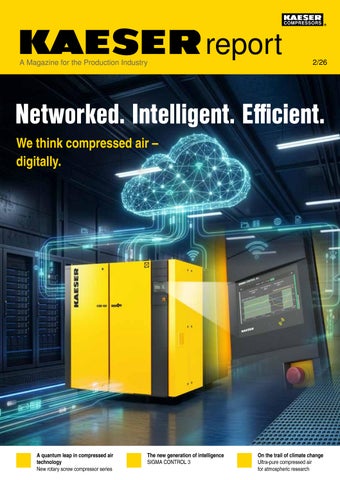
Networked. Intelligent. Efficient. We think compressed air – digitally.
A quantum leap in compressed air technology New rotary screw compressor series
The new generation of intelligence SIGMA CONTROL 3
On the trail of climate change Ultra-pure compressed air for atmospheric research
Contents Issue 2/26
8-9
12-13
16-17
3
Editorial
4
KAESER autumn trade fairs Innovations you can touch
6
Compressed air management, intuitive like never before The new generation of intelligence: SIGMA CONTROL 3
7
A quantum leap in compressed air technology KAESER redefines the future of compressed air
8
Energy transition – rethought Energy in nature’s cycle
10
The precision weavers from Hesse Technical creativity meets world-class engineering
12
The invisible crisis High-tech sewer rehabilitation from Bochum
14
From bandoneon to machine tool The evolution of machine and personnel protection
16
On the trail of climate change Ultra-pure compressed air for atmospheric research
18
Golden, crispy, efficient SIGMA FLEX: The recipe for success at Farm Frites
20
Save money and the environment Reduce costs through compressed air station optimisation
22
Glass made to measure Romanian glass manufacturer on the road to success
22-23
Published by: Editorial office: Layout: Photography: Printed by: Changes of address/ subscription cancellations:
KAESER KOMPRESSOREN SE, 96450 Coburg, Germany, Carl-Kaeser-Str. 26 Tel. +49 (0)9561 640-0, Fax +49 (0)9561 640-130, www.kaeser.com, E-mail: productinfo@kaeser.com Petra Gaudiello (Editor), E-mail: report@kaeser.com Sabine Deinhart, Theresa Götz, Martin Vollmer Marcel Hunger Schneider Printmedien GmbH, Weidhausen customer.data@kaeser.com
The editorial office cannot accept liability for any unsolicited manuscripts and photographs. Reproduction, including excerpts, only with written authorisation. VAT ID no.: DE 132460321 Register of companies: Coburg, HRB 5382
Your personal data will be used and stored by us for marketing purposes. For detailed information, see www.kaeser.com/int-en/privacy-marketing.aspx. You can refuse the use and storage of your data for marketing purposes at any time at: customer.data@kaeser.com.
2 | KAESER report
Editorial
AI drives progress, efficiency, and job growth AI will change all of our lives, just as every far-reaching innovation before it has done. Yet it is not the machines that decide whether this development is a force for good or ill; people must make that decision, and ultimately, they will. The right approach is to engage with AI curiously, inquisitively, critically, and responsibly – for the benefit of us all. AI will help us solve urgent, complex problems, democratize knowledge, and make it accessible to everyone. In so doing, it provides us with the opportunity to become even more constructive and creative. The labor market will also change significantly. However, this will not lead to a dystopian future of mass unemployment, where technology becomes an instrument of power; rather, it will serve as a means of improving life for everyone. An example: A fascinating phenomenon known as the Jevons paradox demonstrates how this works. Historically, when a technology makes the use of a resource more efficient, the total consumption of that resource does not fall, it rises. Today, that valuable resource is often human working time or computing power. Within a business, AI delivers a massive leap in efficiency, completing tasks that once took hours in seconds. The direct effect is that producing a single unit becomes drastically cheaper. Efficiency drives down costs.
Mr. Frank Mueller, President of Kaeser Compressors, Inc.
boosts competitiveness and makes products or services far more attractive. This reduction in cost triggers a significant increase in demand. Entirely new applications emerge, because delivering the same output requires fewer resources. As demand for these products and services surges, an entirely new need for workers arises. More people are required to meet this additional demand, and more still are needed to manage, verify, and fine-tune the AI systems themselves. The sheer volume of new projects demands the kind of coordination, strategic planning, and creative input that AI cannot deliver on its own. In other words, although AI makes work more efficient per unit of time – and therefore cheaper – the enormous increase in demand ultimately means that employment in this sector rises rather than falls. The Jevons paradox shows that AI is not taking our work away by leaving us with less to do. Instead, it lowers costs so dramatically that we are both willing and able to achieve a great deal more – so much more that, in the end, it will create even more jobs. This is welcome news for any labor market pessimist.
When AI significantly lowers production expenses, it KAESER report | 3
KAESER autum glasstec 2026: 20 to 23 October in Düsseldorf
Forward-looking solutions for the glass industry High energy prices have made maximum efficiency non-negotiable in the glass industry. Whether used for transport, forming or cooling, compressed air generation must be cost-effective and completely reliable. At glasstec in Düsseldorf, we will show you how to make your supply sustainable and future-proof.
You’ll find us here Hall 15 | Stand 15C49
Key functions of compressed air in glass processing: Forming: Precision blowing and pressing of glass blanks. Combustion: Process support in melting tanks. Handling and cooling: Safe transportation and targeted temperature control. Quality: Cleaning and finishing of surfaces.
EuroTier 2026: 10 to 13 November in Hanover
Efficiency on the farm and in the field In modern animal husbandry, compressed air holds the key to both animal welfare and process efficiency, precisely controlling automated systems from feeding to climate control. At EuroTier in Hanover, KAESER will be showcasing tailored solutions designed to meet the highest standards of reliability and hygiene.
You’ll find us here Hall 13 | Stand D18
Compressed air applications in animal husbandry: Feeding: Dust-free pneumatic conveying of pellets and grain; control of feed hatches. Milking technology: Gentle operation of milking robots (AMS) and automated teat cleaning. Slurry management: Precision control of sluice gates and valves in biogas plants. Barn climate control: Pneumatic control of ventilation flaps and curtains for optimised fresh air supply. Hygiene: Effective cleaning of pipes and filters using compressed air.
mn trade fairs BrauBeviale 2026: 10 to 12 November in Nuremberg
Purity and efficiency for the beverage industry From 10 to 12 November 2026, Nuremberg will bring together breweries, mineral-water bottlers and juice producers for BrauBeviale. Where quality and hygiene are paramount, choosing the right compressed air system is a strategic decision – at this trade fair, KAESER will be demonstrating how process reliability and cost-effectiveness work in perfect harmony. Because compressed air often comes into direct contact with the final product, air quality requirements are exceptionally stringent. Crucially, energy-saving systems and recovered compressor exhaust heat can sustainably lower the production cost per hectolitre. Compressed air applications in the beverage industry: Wort aeration: Targeted supply of sterile air for yeast activity. PET stretch blow moulding: Precision high-pressure bottle forming. Filling and capping: Pneumatic control for exact fill quantities. Nitrogen generation: On-site generation for tank inerting. Cleaning and drying: Bottle blow-off prior to labelling. Conveying: Transport of crown caps, labels and empties.
We look forward to seeing you!
You’ll find us here Hall 10, Stand 218
The new generation of intelligence: SIGMA CONTROL 3
Compressed air management, intuitive like never before
TOUCH
In a networked industry, compressed air is more than just energy – it is a stream of data. With the latest generation of our SIGMA CONTROL controller, we set new standards in connectivity, ease of operation, and transparency. Discover how we bridge proven hardware and the digital future.
KAESER Connect: Your compressed air station in your pocket
6.6 bar Operating state
LOAD
57°C 11: 22 Next maintenance 966 h
Network pressure pNloc 6.6 bar
Operating hours 1201 h Airend/block discharge temperature 57 °C
7.00
60.0
6.50
55.0
6.00
50.0
5.50 11:12:26
11:14:26
11:16:26
11:18:26
11:20:26
45.0 11:22:26
Why wait until you are on site to check your system’s status? The KAESER Connect app brings complete visibility directly to your mobile device: • Real-time insights: Scan the QR code to view all relevant operating data on your smartphone within seconds. • Proactive oversight: Instant push notifications alert you the moment a status changes or maintenance becomes due. • Transparency on demand: Generate detailed machine reports and track your key performance indicators (KPIs) at any time – whether you’re on the shop floor or travelling on business. The bottom line: the new SIGMA CONTROL 3 is far more than a controller. It is your partner for an efficient, transparent and digital compressed air supply. Welcome to the era of smart compressed air. Maximize your efficiency – ask your KAESER specialist about upgrade options for your facility.
Complete control – right at the machine Forget complicated menus and rigid keypads. The new SIGMA CONTROL 3 makes operating your system effortless: • Innovative touch control: A high-resolution touchscreen replaces conventional buttons, allowing you to navigate as smoothly and intuitively as you do on your smartphone. • Everything at a glance: Machine status, operating data and maintenance intervals are displayed with crystal clarity. No searching, no scrolling – just the information you need. • A perfect fit for every system: Available in three sizes (S, M and L) to provide the ideal interface for any requirement, whether compact or large-scale.
Limitless connectivity: The heart of your smart factory The new controller is no soloist – it is the ultimate team player. Thanks to flexible, interchangeable communications interfaces, the SIGMA CONTROL 3 fits seamlessly into your existing infrastructure: • Maximum compatibility: Full support for standard SCADA systems and the latest IoT communication protocols. • Future-proof and backward-compatible: The proven IOM concept ensures your system remains fully expandable. Existing installations integrate effortlessly, delivering reliable investment protection.
6 | KAESER report
App download via QR code Apple and iPhone are trademarks of Apple Inc. Google is a trademark of Google LLC
or search for ‘KAESER Connect’ in the App Store or Google Play Store Download from
App Store
Download from
Google Play
KAESER redefines the future of compressed air
A quantum leap in compressed air technology
Made in Germany
KAESER KOMPRESSOREN pushes the boundaries of engineering with a double première: the new DSG series, along with the fully revised ASD/BSD series, redefines cost-effectiveness and operational reliability. Both model ranges share a single objective – to deliver maximum performance at minimum operating cost, backed by the technical reliability needed to pave the way into a digital future. Future-proofing and digital excellence underpin both series. Built from the ground up to ensure absolute system integrity, the DSG series’ new SIGMA CONTROL 3 controller delivers robust technical reliability. Furthermore, thanks to its compliance with the EU Cyber Resilience Act, it already satisfies the stringent, EU-wide security standards that networked industrial products will be legally required to meet.
The new DSG: Certified purity for food and pharmaceuticals Meticulous fluid dynamics optimization delivers a significant performance boost, with the DSG providing a full 10 percent higher flow rate than its predecessor. Its specific power consumption has also been radically improved, resetting the bar for energy efficiency rather than merely keeping pace with the competition. The air-cooled DSG A variant achieves an average efficiency gain of 10 percent, while the water-cooled DSG W delivers a 7 percent increase. Figures like these leave competitor products behind, establishing a new industry benchmark.
In hygiene-sensitive sectors such as food and pharmaceuticals, trust is the foundation of every successful project. As an ISO 22000-certified company, KAESER guarantees that only materials fully certified for these demanding applications ever come into contact with the process airflow. To support validation in GMP-regulated processes, the DSG series is supplied with comprehensive certification packages for seamless compliance documentation. This includes detailed material certificates, along with proof of successful Factory Acceptance Testing (FAT) conducted in our state-of-the-art test facilities.
The new ASD/BSD series: The efficiency champion of everyday industry The new ASD/BSD series carries forward the successful design principles of our CSD/CSDX models. Available in six pressure ratings, it integrates perfectly into any system, delivering a significantly higher flow rate with minimal energy consumption. At its heart lie state-of-the-art drive systems:
fixed-speed models run on IE4-compliant asynchronous motors, while variable-speed models feature permanent magnet motors that achieve the highest performance levels of IE5 and IES5. Meticulous attention to detail is what tips the energy balance. An innovative cooling concept, built around a variable-speed, maintenance-free fan motor, delivers only as much cooling air as is actually required. An integrated centrifugal separator reliably removes condensate from the aftercooler with minimal pressure drop, while the renowned ECO-DRAIN condensate drain discharges it without compressed air loss. Even the optional heat recovery system has been refined, utilizing an internal stainless-steel water circuit to ensure it remains entirely maintenance-free. Furthermore, with identical connection points for power, air and cooling, swapping out an existing installation via plug-and-play could not be simpler.
KAESER report | 7
Energy in nature’s cycle
ENERGY TRANSITION – rethought
8 | KAESER report
Back in 1982, while building his house, Robert Bloos Sr searched for an automated system that could feed wood chips into his heating system as conveniently as an oil or gas central-heating boiler. Finding nothing suitable on the market, he invented one himself. That breakthrough marked the beginning of Heizomat’s success story. Today, those automated feed systems (the Heizomat discharge unit) form part of an extensive product portfolio spanning the entire wood-energy value chain: fully automatic wood-chip and biomass boilers, wood
Image: AdobeStock
Heizomat is a renowned German manufacturer of renewable energy systems. Its “Green Smart Factory” is the company’s latest flagship project and a pioneering model for carbon-neutral industrial production. At its new site in Heidenheim, Bavaria, the company demonstrates how energy self-sufficient, networked manufacturing works in practice, proving that a family firm in rural Bavaria can do more than just support the global energy transition – it can lead it.
chippers (Heizohack), industrial pallet shredders, and specialized transport vehicles (Heizotruck). The founder’s son, Robert Bloos Jr, now leads the company, and his latest project demonstrates just how radically a medium-sized enterprise can rethink energy.
The vision of the Green Smart Factory With the Green Smart Factory – officially opened in September 2025 on the site of a former military barracks in Heidenheim – Heizomat has rethought manufacturing from the ground up, setting completely new standards in the process. Managing Director Robert Bloos Jr captures the revolutionary thinking behind the facility in a single phrase: “energy-led production”. This ethos rests on an overarching concept of multimodal self-sufficiency – the coordinated interplay between variable and predictable energy sources. On-site solar photovoltaic (PV) and wind power systems generate electricity according to the weather, making them variable. Meanwhile, the in-house wood gasifier (Heizo E-Power) produces electricity and heat from wood chips on demand, acting as a predictable base load. Climate-friendly solar and wind energy take priority during manufacturing. When these resources fall short – particularly during the dark, cold autumn and winter months – the wood gasifier steps in. It generates electricity and heat from wood chips with precise, highly efficient control, feeding both into a large thermal buffer storage. This digitally managed blend of variable and predictable sources transforms Heizomat’s energy supply into a dependable, cohesive system. Reliable, carbon-neutral heat is supplied by the fully automatic Heizomat wood-chip heating system, which effortlessly covers both base and peak loads.
Compressed air as part of the energy concept One key resource runs through every manufacturing process: compressed air. As in any industrial operation, it powers the pneumatic drives across all production systems and machinery. However, its role goes much further – it also drives nitrogen generation, which is a cornerstone of the facility’s energy-led manufacturing strategy. Nitrogen is required in large volumes as a cooling medium for the laser cutting systems. Consequently, on bright days, when the solar photovoltaic systems produce more electricity than the factory can consume, Heizomat channels that carbon-neutral power into generating nitrogen from the ambient air, utilizing compressed air to drive the process. The nitrogen is then stored in high-pressure receivers. In effect, Heizomat transforms variable solar energy into a storable industrial resource. The compressed air station was planned with maximum efficiency in mind and was precisely dimensioned with built-in redundancy. The compressed air required for the applications – at a required pressure of115 psi and a flow rate of up to1059 cfm – is supplied by one frequency-controlled CSD 130 rotary screw compressor, which handles occasional peak loads, and two fixed-speed BSD 83 rotary screw compressors, which carry the base load. Together, they perfectly align compressed air generation with the fluctuating supply of renewable energy. Another key component of this efficient set-up is the SIGMA AIR MANAGER 4.0 master controller. It monitors and coordinates the three rotary screw compressors, the two energy-saving SECOTEC TF 230 refrigeration dryers, and every air treatment component, ensuring that the entire station operates at optimum performance at all times. Finally, the station features one last clever innovation: thanks to plate-type heat exchangers integrated into the compressors, the heat of compression does not escape unused. Instead, it is recovered and fed directly into the thermal buffer storage, where all of the factory’s energy sources
Top image: The in-house wood gasifier (Heizo E-Power) generates electricity and heat from wood chips on demand. Bottom image: The compressed air station is located on a mezzanine gallery overlooking the production area in the new hall.
Compressed air is an integral part of the Green Smart Factory’s overall energy concept. Robert Bloos Jr, Managing Director
converge. In this way, the compressed air generation process forms a core component of the infrastructure at Heizomat, making it an integral part of the Green Smart Factory’s overall energy concept.
Image: AdobeStock
KAESER report | 9
Technical creativity meets world-class engineering
THE PRECISION WEAVERS FROM HESSE The PACO Group, based in Steinau an der Straße, is renowned worldwide for its premium-class woven metal mesh. Whether in space technology, pharmaceuticals or high-precision screen printing, PACO delivers where standard solutions fail. Yet behind the gleaming stainless-steel mesh stands a manufacturing operation that relies completely on a reliable and efficient supply of quality compressed air. manding for conventional plastics, woven metal mesh provides the answer. An absolute specialist in this area of technology is Paul GmbH & Co. KG, or PACO for short. Its roots lie in a single, core expertise: weaving the finest metal wires into high-quality mesh. What began with a handful of weaving machines has grown into extensive weaving halls filled with hundreds of automated looms. The company remains family-owned, now led by the founder’s grandson in the third generation. PACO develops and manufactures high-precision woven metal mesh – together with the specialist machinery required for making it – to enable the most exacting sieving and filtration processes in industry. It also integrates this mesh with its own plant engineering to deliver complete, turnkey system solutions for sectors ranging from automotive, chemicals and energy to aerospace, pharmaceuticals, food and hydrogen technology. What sets the company apart is its extraordinary depth of manufacturing: it processes the widest range of metals, including stainless steel, aluminum, copper, nickel, titanium and even precious metals, with wire diameters ranging from an ultra-fine 13 µm to a robust 1.6 mm. Furthermore, through its subsidiary HETA Verfahrenstechnik, the group supplies complete, and in some cases fully automated, filtration systems.
Finer than a human hair
Top image: The manufacture of woven metal mesh requires a fascinating blend of traditional weaving craftsmanship and the latest high-precision technology. Bottom image: Shown here with Technical Director Dr Lars Heckmann, the recently modernized compressed air station features full redundancy.
Woven metal wire mesh underpins almost every aspect of modern life. As a classic “enabling technology product”, its extremely fine filter mesh is indispensable; without it, we could not refine modern fuels, manufacture sterile medicines or produce microchips, since the gases and liquids these processes rely upon must meet the strictest standards of purity. Wherever materials need to beimages: sorted, or protected under conditions too deAll KAESERfiltered COMPRESSORI Italia
10 | KAESER report
The manufacture of woven metal mesh requires a fascinating blend of traditional weaving craftsmanship and the latest high-precision technology – and compressed air plays several fundamental roles throughout the process. One critical task in particular is vital to the smooth operation and quality of the complex weaving process: applying lubricant to the wires. Because metal is far more unyielding than cotton thread, the mechanical demands on the machinery are immense. Before weaving can begin, the wire must be prepared to the exact quality and thickness required. Just like traditional textile weaving, the process utilizes a warp (the longitudinal wires) and a weft (the transverse wires). During the “beaming” stage, hundreds or even thousands of warp wires are wound in parallel onto a warp beam. The tension must remain perfectly uniform, as even the slightest deviation would subsequently manifest as a defect in the mesh pattern – an absolute deal-breaker in the manufacture of precision metal mesh. At the heart of the operation lies the loom, where heddles raise and lower the warp wires as the weft wire shoots between them. Unlike textiles, metal is completely unforgiving when it comes to errors; once a wire has been bent out of shape, it cannot simply be straightened out again. To keep the process running seamlessly, every loom is equipped with a spray
system featuring compressed-air-driven pumps that distribute lubricant, minimizing friction and preventing the wire from snapping. Compressed air also actuates the pneumatic cylinders in the fully automated manufacture of filter elements, alongside playing a key role in cleaning, automation and quality assurance throughout the PACO facility.
Redundancy and reliability Given its importance, compressed air must be reliably available across both the weaving and finishing departments at a pressure of 116 psi and a flow rate of 106 cfm. Consequently, the recently modernized compressed air station was designed with full redundancy. Two variable-speed KAESER ASD 35 SFC rotary screw compressors operate alternately, sharing the running hours equally between them. Should one unit require maintenance or repair, the other can comfortably shoulder the entire compressed air demand on its own. The compressed air treatment line is duplicated as well, featuring two energy-saving SECOTEC TD 67 refrigeration dryers which, alongside an AQUAMAT oil-water separator, guarantee the required compressed air quality. The station also includes a264 gallon air receiver and a timer-controlled DHS 4.0 series air-main charging system, which reduces energy consumption and safeguards the infrastructure. Following a pause in supply – such as overnight or during the weekend – sudden re-pressurizationof the network could cause flow velocities to spike. The KAESER DHS 4.0 system builds up pressure gradually, protecting the delicate pneumatic sensors and valves of the production machinery in the process. Technical Director Dr Lars Heckmann and Mathias Ruppel, Team Leader for Automation Technology and Plant Engineering, are delighted with the new station and the operational dependability it delivers. “Weaving metal mesh on our looms is a highly complex, sensitive process. We are very glad to have a capable partner like KAESER at our side,” emphasises Mathias Ruppel.
In some areas, the metal wires can be thinner than a human hair.
KAESER’s air-main charging system gives our sensitive machinery the best possible protection. Dr Lars Heckmann, Technical Director KAESER report | 11
A time bomb is ticking beneath our towns and cities: the world’s wastewater infrastructure is aging. Yet even as the need for network rehabilitation grows worldwide, tomorrow’s solutions are already taking shape in Bochum. Here, Trelleborg develops highly specialized rehabilitation vehicles that restore decaying sewers to full working order in record time, utlizing the latest UV-curing technology and reliable compressed air from KAESER. Whether in Europe, Asia or the Americas, the problem is the same: much of the global sewer network was laid in the mid-20th century and is now reaching the end of its service life. The consequences are severe – leaking pipes contaminate groundwater or overload wastewater treatment plants with infiltrating water. Germany’s public sewer network alone spans almost 373,000 miles and represents one of the country’s largest infrastructure assets. Yet according to the DWA (German Association for Water Management) and the Federal Statistics Office, some 18 to 20 percent of it requires urgent rehabilitation. Traditional “open-cut” excavation would cost a fortune and prove practically impossible from a logistics perspective in densely built-up urban areas. New solutions, and new thinking, are therefore vital. One outstanding name in pipe and sewer rehabilitation is Trelleborg, based in Bochum. The company treats the sewer network as a complex ecosystem, offering specialized processes for various types of damage, in which component quality dictates long-term success. One such technique is the UV liner method. To support this, the Bochum specialists equip civil engineering firms with highend, self-contained rehabilitation vehicles that carry all the neces-
sary equipment on board. The result is a rehabilitation process that is fast, cost-effective, and minimally disruptive to the surrounding infrastructure.
The UV liner method: Precision under pressure The UV liner method is a technological masterstroke, creating a “pipe within a pipe” without a single spade hitting the ground. First, a sealing bladder closes off the pipe to prevent any further water ingress. A milling robot then strips away deposits until the internal pipe wall is completely smooth. The sewer is cleaned using high-pressure water jets, and a remote-controlled CCTV camera trolley inspects the line to confirm there are no obstructions. Next, a glide foil is lowered through a manhole to protect the liner from damage. A glass-fibre liner – pre-impregnated with light-curing resin at the factory – is then pulled through the defective pipe section from one manhole to the next using a winch. Special packers seal both ends of the liner airtight, allowing precisely controlled compressed air to be introduced into the liner. The liner inflates, pressing firmly against the wall of the host pipe. Production Manager Chamseddine Korbi explains why rock-steady pressure is so
High-tech sewer rehabilitation from Bochum
The invisible crisis Photo: AdobeStock, generated with AI
Since a sudden drop in pressure could compromise the entire rehabilitation project, a reliable supply of quality compressed air is non-negotiable for us. Chamseddine Korbi, Production Manager
toinitiators within the resin, causing the li quid material to cure in a matter of minutes. To complete the rehabilitation process, a remote-controlled milling robot reopens the lateral connections covered by the liner from the inside.
Preserving value through quality Each rehabilitation vehicle is an engineering masterpiece in which every component is perfectly matched to ensure seamless interplay. The compressed air required to inflate the liner prior to curing is supplied by a BB or CB series rotary lobe blower from KAESER’s COMPACT range, with a variety of models available to suit different site requirements (pressure up to 14.5 psig and flow rate up to 392 cfm). KAESER blowers featuring the world-renowned OMEGA PROFILE are robust, durable and built for reliable on-site operation. The SIGMA CONTROL 2 controller ensures highly efficient, fully monitored blower operation, while versatile interfaces offer flexibility and seamless integration with existing control systems. As Chamseddine Korbi explains: “Our UV system runs on a Siemens PLC system that communicates directly with the
blower controller. This makes coordination of the various components exceptionally straightforward, which is of great importance to our process. Since a sudden drop in pressure could compromise the entire rehabilitation project, a reliable supply of quality compressed air is non-negotiable for us. We have certainly chosen the right partner in KAESER.”
Image above: The high-end, self-contained rehabilitation vehicles carry all the equipment required for the innovative UV liner method. Image below: An interior view of the specialized rehabilitation vehicle.
All images: : © Trelleborg Water Infrastructure
critical at this stage: “If the pressure is too low, folds will form; if it is too high, the liner can burst, compromising the entire rehabilitation project. That is why our vehicles are equipped with dependable blowers from KAESER.” With the liner fully pressurized, a light train equipped with powerful UV emitters is inserted into the inflated liner. The emitters then fire and are drawn back through the pipe at a precisely calibrated speed. The UV radiation activates the pho-
KAESER report | 13
Image: Arno Arnold GmbH
The tango set the initial tempo for the company’s success story.
The evolution of machine and personnel protection
FROM BANDONEON TO MACHINE TOOL Who would have thought that the DNA of the tango now protects the world’s high-precision laser cutting systems? What began in the mid-19th century with the delicate folds of a musical instrument has, at Arno Arnold in Obertshausen, evolved into an engineering art form that keeps modern industry moving.
Today’s high-tech bellows protect both personnel and machinery.
The history of modern industrial technology often begins in unexpected places – and Arno Arnold’s story is inextricably linked with the tango. This Argentine dance craze swept through the bars of the world’s great cities at the end of the 19th century, and one instrument captured its music like no other: the bandoneon, the supple, handheld instrument whose bellows provided the air for every note. A bandoneon is made up of hundreds of intricate components, but the bellows are its heart. To give the sound its brilliant resonance, these had to be supremely flexible, durable, and perfectly airtight under high pressure. The
Virtually every stage of production at Arnold relies on a dependable, high-quality compressed air supply.
Simone Weinmann-Mang (General Representative) with her daughter, Managing Director Isabelle Himbert.
great-great-great-grandfather of today’s young Managing Director, Isabelle Himbert, helped develop that innovative folding instrument in the 1860s. This mastery of leather, textiles and precision folding laid the foundation for a strategic reinvention that would carry the company successfully through the decades.
From tango nights to high-speed machining As demand for traditional instruments faded and the metalworking industry surged in the 1930s, Arnold recognized an opportunity to transfer this specialist expertise into the industrial sector. The shift from musical instruments to industrial bellows proved to be an inspired choice. Where air had once been channelled to shape musical notes, the objective was now to shield the highly sensitive guideways, spindles and shafts of machine tools from swarf, coolant and dust. Consequently, the modern bellows became an indispensable protective shield in automated manufacturing. Today, the Arnold Group’s portfolio extends far beyond simple covers, ranging from complex telescopic steel covers and complete machine enclosures to specialized protection systems for laser and medical technology. Within the industry, the company has established itself as the definitive problem-solver. Wherever standard solutions reach their physical limits – whether due to high movement speeds or restricted installation space – bespoke concepts from Obertshausen come into their own.
In modern manufacturing, resource efficiency provides a decisive competitive edge. Alongside electricity, compressed air has become an essential source of power. Virtually every stage of production at Arnold relies on a dependable, high-quality compressed air supply – from cutting specialized fabrics on the laser systems to driving pneumatic controls, powering hand tools, and operating lifting tables. Compressed air is the bedrock of smooth production. As General Representative Simone Weinmann-Mang puts it with a smile: “Without compressed air, the only things working here would be the computers.” To meet its strict requirements for reliability and energy efficiency, Arnold relies on a state-of-the-art solution from KAESER KOMPRESSOREN. At the heart of the supply lie two powerful KAESER AIRCENTER SM 12 rotary screw compressors. These compact, turnkey systems occupy less than one square meter of floor space, yet house everything a compressed air station requires: a rotary screw compressor featuring the highly efficient SIGMA PROFILE, an energy- efficient refrigeration dryer for air treatment, and an integrated 72 gallon air receiver. These complete systems combine a high flow
Every workstation relies on a dependable supply of compressed air. Isabelle Himbert, Managing Director
rate with exceptionally low power consumption. A key factor behind this efficiency is the inclusion of advanced Super Premium Efficiency motors. To guarantee a seamless compressed air supply, the system architecture features full redundancy via two identical KAESER AIRCENTER SM 12 units. Opting for this duplex configuration delivers a decisive strategic advantage in operational reliability. Running these two compact, all-in-one systems in parallel virtually eliminates the risk of downtime. If one unit requires scheduled servicing or encounters an unexpected issue, the second AIRCENTER seamlessly maintains the air supply to downstream consumers.
Compressed air is also used by the laser cutting machines.
KAESER report | 15
The system may be compact, but the demands placed on it are exceptionally high. Manuel Granzin, Scientist
The atmosphere is our planet’s life-support system – a vastly complex chemical laboratory that shields the Earth from solar radiation and regulates the global climate. In an age of environmental change, modern atmospheric research serves as an essential health check on a world in flux. To construct precise forecasting models and verify the effectiveness of environmental protection measures, science requires data that remain fully comparable and completely error-free over decades. Often, this demands the detection of trace gases and the tiniest particulate matter at concentrations so low that conventional analytical methods simply fail. A key anchor for this global scientific effort is situated in the heart of Germany, on the summit of the Kleiner Feldberg in the Taunus mountains. Here, the Institute for Atmospheric and Environmental Sciences at Goethe University Frankfurt operates an observatory
The SX 3 rotary screw compressor is accompanied by sophisticated treatment and a66 gallon air receiver.
Ultra-pure compressed air
ON THE T CLIMATE
Atmospheric research serves as a vital health c tells us whether to pack an umbrella tomorrow deeper, exploring how the Earth’s protec
Manuel Granzin keeps a close eye on the measurement results.
with a history spanning more than a century. Founded in 1913 by the Physikalischer Verein Frankfurt (Frankfurt Physical Society), the site has evolved from a traditional meteorological station into an internationally renowned research facility. Its exposed, high-altitude position allows researchers to take baseline measurements in the free troposphere – largely above the boundary inversion layer – making its data highly representative of Central Europe’s background atmospheric pollution.
What is ACTRIS? Today, the station is one of the national sites of the European ACTRIS network (Aerosol, Clouds and Trace Gases Research In-
16 | KAESER report
frastructure). ACTRIS delivers high-precision, standardized data on aerosols, clouds and short-lived trace gases across Europe, making their effects on climate change and air quality reliably predictable. The observatory operates 19 different measuring instruments in total. To identify individual chemical compounds and complex molecules, it uses a state-of-the-art mass spectrometer. This device converts molecules into electrically charged particles and sorts them precisely by mass within an electric field, pinpointing a sample’s exact chemical composition like a “chemical fingerprint”. Compressed air plays two critical roles for this high-precision instrument: calibration and continuous validation. Both are subject to exceptionally strict air quality demands to ensure the measured data remain internationally comparable. For zero-point calibration, the instrument is flushed with ultra-pure compressed air that must be completely free of organic compounds and particulate matter to establish the baseline zero value. Only when the instruments display a stable signal against this reference air can subsequent measurements of the actual atmosphere be accurately quantified. Compressed air also enables constant verification during opera-
compressed air
The summit of the Kleiner Feldberg provides ideal conditions for conducting free-troposphere measurements.
r for atmospheric research
TRAIL OF CHANGE
The highly sensitive instruments require ultra-pure compressed air.
TROL 2 controller enables precise operational monitoring. The real engineering masterstroke, though, is the downstream treatment chain: a KAESER DC 3.7 desiccant dryer followed by multi-stage filtration. This set-up maintains the compressed air at an exceptionally low pressure dew point of below -40 °F and meets purity class 1:2:1 in accordance with ISO 8573-1, allowing the highly sensitive instruments to operate flawlessly. Manuel Granzin is delighted with the results: “The new compressor represents a major technical upgrade. By supplying ultra-pure compressed air with absolute reliability, it safeguards the precision of our mass spectrometry and directly assures the quality of the climate data we collect.” In this way, the observatory perfectly bridges its long, proud history with a future where technical precision is our most vital asset in the fight against climate change.
check for our planet. While meteorology simply w, atmospheric physics and chemistry look far ctive shell is changing over the long term. tion, allowing researchers to validate data reliability without interruption. The ultra-pure compressed air for the instruments used to arrive in 13 gallon high-pressure cylinders. Given the observatory’s exposed location and harsh summit weather, this logistical process was often awkward and hazardous. Since a modern compressed air station was installed in 2022, however, the reference air has been generated entirely on site. For Manuel Granzin, who maintains the measuring systems at the Taunus Observatory, the investment was a logical step for quality assurance: “In modern trace-gas analysis, the peripheral equipment matters just as much as the measuring instrument itself.” At the heart of the station lies a KAESER SX 3 rotary screw compressor (working pressure 115 psi, flow rate 11 cfm) featuring the energy-saving SIGMA PROFILE. Advanced compressed air treatment and a 66 gallon air receiver complete the system. SX series rotary screw compressors combine exceptional reliability and efficiency with whisper-quiet operation on a compact footprint, while the integrated SIGMA CONImage: AdobeStock
SIGMA FLEX: The recipe for success at Farm Frites
GOLDEN, CRISPY, EFFICIENT Everyone knows the irresistible aroma of freshly cooked chips, but few realize that perfecting them requires one invisible, critical ingredient: ultra-pure, efficient compressed air. To achieve this, family- owned Farm Frites has built a partnership that saves five percent in energy while guaranteeing maximum operational reliability. For 55 years, Farm Frites has supplied caterers worldwide with high-quality potato products, ranging from chilled and frozen chips to premium snacks. With a customer base spanning local restaurants and large-scale contract caterers, operational reliability and product quality are paramount. The company’s slogan, “To grow a better future together, serving happiness from field to plate”, captures a corporate sustainability ethos that led directly to its collaboration with KAESER.
Three variable-speed DSD 240 T SFC rotary screw compressors with integrated dryers ensure a reliable supply of compressed air at the plant.
18 | KAESER report
From Dutch farm to global player
Image: AdobeStock
What started in 1968 as a regional family business in Oudenhoorn, the Netherlands, grew rapidly under Gerrit de Bruijne into a leading global group. Today, Farm Frites operates state-of-the-art manufacturing sites stretching from Poland to Egypt, with new facilities in Australia and Saudi Arabia in the pipeline – yet for all its scale, it has never lost its authentic family character. Following its expansion into Belgium with plants in Lommel (1984) and Sint-Truiden (1993), Farm Frites is now active in more than 100 countries, backed by 1,600 employees, 43 sales offices, and six production sites worldwide. The Sint-Truiden facility alone, run by a skilled team of 110, processes an impressive 60,000 tonnes of finished product a year. Its unwavering commitment to quality and sustainability is verified by numerous international certifications, including ISO 14001 for environmental management, alongside strict global food safety standards such as IFS and BRCGS. In 2023, Farm Frites Sint-Truiden launched a major investment program covering a new product-coating line and expanded packaging capacity, with an advanced KAESER compressed air station serving as its technological heart. The ultimate goal is to double processing capacity to 20 tonnes per hour over the next decade.
Redundancy guarantees reliability In the food industry, hygiene is everything: any contamination of the final product must be prevented at all costs. “Without compressed air, everything comes to a standstill,” explains Peter Claes, Project, Safety and Energy Manager at Farm Frites Sint-Truiden. Compressed air drives every key process – from actuating packaging machinery and switching valves on the production lines to managing the plant’s sustainable water infrastructure. To ensure uninterrupted operations, the facility invested in three variable-speed KAESER DSD 240 T SFC rotary screw compressors (working pressure 125 psi featuring integrated dryers. “This configuration gives us absolute reliability,” Peter Claes stresses. “If one compressor is offline for maintenance, the other two handle the plant’s full operational load with ease.” The result is a facility technically equipped to meet today’s requirements and sustain the next decade of ambitious growth. As the food sector demands, the compressed air must be exceptionally pure, complying with quality class 1:4:1 in accord-
SIGMA complet our ope
Peter Claes, Pro
FLEX has delivered te transparency of erating costs.
oject, Safety and Energy Manager
ance with ISO 8573-1:2010. To achieve a Class 1 residual oil content and ensure maximum process reliability, an ACT activated carbon adsorber was integrated into the system. Because the entire piping network runs indoors, the 37 °F pressure dew point delivered by the integrated refrigeration dryers is ideal. Finally, an AQUAMAT oil-water separator guarantees compliance with strict VLAREM regulations (Flemish environmental legislation), ensuring treated condensate water can be safely discharged.
xxxxx xxxxx
Efficiency and a partnership of equals The partnership between Farm Frites and KAESER officially began in 2024, following an intensive selection process. Peter Claes prioritized the total cost of ownership (TCO) – encompassing energy consumption and maintenance over the entire equipment life cycle – ahead of the initial purchase price. “Technically, there are no inferior machines among the leading brands today,” he reImage above: An ACT activated carbon adsorber is integrated into the system to marks. “It all comes down to achieve Class 1 purity. service quality and, above all, the commitment of the people and the expertise of the service technicians.” KAESER secured the contract thanks to its energy-efficient SIGMA PROFILE and the SIGMA AIR MANAGER 4.0 master controller, which continuously optimizes the system for maximum efficiency. Rounding off the solution is a five-year, full-service SIGMA FLEX contracting agreement. Under this comprehensive model, KAESER supplies the infrastructure and covers all ongoing servicing, providing total financial certainty. This frees the Sint-Truiden team to focus entirely on what they do best: producing perfect, golden chips. An AQUAMAT oil-water separator forms a key component of the high- performance compressed air treatment system.
All images: Farm Frites Sint-Truiden BV
KAESER report | 19
Reduce costs through compr
Save money and
Compressed air powers a vast range of equipment and processes in many industrial operations, making it one of the most versatile and indispensable energy sources in the production sector. It is therefore often referred to as the fourth utility, alongside electricity, gas and water. For this reason, energy consumption is a decisive factor when it comes to compressed air systems – and a key lever formaximizing both efficiency and sustainability.
We’ve achieved substantial annual energy cost savings and now benefit from a highly reliable compressed air supply. Tyler Henry, Maintenance General Supervisor
The frequency-controlled rotary screw compressor covers peak demand, while the three fixed-speed rotary screw compressors cover the base load.
Efficiency and sustainability are central to the work of Efficiency Manitoba. As a provincial crown corporation, it promotes energy efficiency in private households, commercial enterprises and industrial operations across the province of Manitoba. All initiatives share a common goal: to reduce energy consumption while enabling reduced associated greenhouse gas emissions.
20 | KAESER report
In a manufacturing company, questions regarding energy consumption and cost control inevitably bring the compressed air supply into sharp focus. Optimizing compressors and compressed air treatment systems is a worthwhile investment that can reduce energy consumption by an average of 30 percent, depending on the age and condition of the existing compressed air station. Efficiency Manitoba provides
expert advice to help companies identify the energy- saving potential of their compressed air supply and implement optimization measures that sustainably reduce energy consumption and environmental impact. impact. They work closely with qualified compressed air specialists, such as KAESER COMPRESSORS Canada Inc.
A success story from the food sector One company that has successfully delivered a major energy-saving project with the support and expertise of Efficiency Manitoba is Canada Packers Inc. This publicly listed company is a spin-off from the internationally active Maple Leaf Foods Group, headquartered in Toronto, Canada, and became a newly independent company in October 2025. A comprehensive modernization project was recently undertaken at the company’s site in Brandon, Manitoba. Every such project opens with long-term measurement using ADA and KESS. ADA (Air Demand Analysis) gathers the raw data to create a snapshot of current conditions. Meanwhile, KESS (the KAESER Energy Saving System) – K AESER’s sophisticated planning and simulation software – determines the most efficient and cost-effective compressor configuration for the station. This analysis revealed significant saving potential by combining three fixed-speed compressors with one variable-speed unit. Accordingly, a core element of the modernization project was installation of a KAESER ESD 445 SFC rotary screw compressor with frequency control. This unit handles peak demand with exceptional flexibility, backed by three new fixed-speed KAESER rotary screw compressors – two DSD 250 units and one ESD 250 – to cover the base load. The existing dryer made way for a highly efficient, heat-regenerated CALOSEC desiccant dryer, which is utilized whenever exceptionally dry compressed air
ressed air station optimization
the environment is required, achieving a pressure dew point down to -40 °F. Unlike heatless-regenerated dryers, which consume a portion of the compressed air to dry the desiccant, CALOSEC dryers use heat for regeneration via a blower and an electric heater, delivering substantial savings in operating costs. To ensure that the four new rotary screw compressors operate in perfect coordination and meet Canada Packers Inc.’s compressed air requirements with optimum performance, a SIGMA AIR
ANAGER 4.0 Master Controller was also installed. This advanced M compressed air management system intelligently orchestrates and optimizes the operation of multiple compressors, delivering outstanding cost and energy efficiency across the entire system.
Canada Packers’ headquarters is located just outside Toronto in Mississauga, Ontario.
All images: Canada Packers Inc.
Image: AdobeStock
CALOSEC is a highly efficient, heat-regenerated desiccant dryer.
Impressive savings With its newly optimized compressed air system, Canada Packers is now reaping benefits on multiple levels. One immediate advantage was receiving an incentive of more than CAD 256,000 through Efficiency Manitoba’s Custom Energy Solutions Program (CESP). “The sizable incentive from Efficiency Manitoba made the decision to modernizean easy one for us,” Tyler Henry, Maintenance General Supervisor, explains. The benefits, however, extend well beyond the incentive. The company is expected to reduce its electricity consumption by more than 1.7 million kWh per year, translating into annual energy cost savings of almost CAD 99,000. Additional gains include lower energy-related taxes, reduced maintenance costs and significantly improved system reliability. Based on a straightforward payback calculation, the investment will be recouped in just 2.6 years.
KAESER report | 21
Romanian glass manufacturer Transparent Design SRL on the road to success
Tailored glass solutions In recent years, glass has become one of the most sought-after design elements in interior fit-out, valued for both its aesthetics and versatility. Elegant and light-transmitting, it is the ideal material not only for residential spaces, but also for commercial and office buildings, adding style and sophistication to contemporary interiors. One of the key players in this market is Transparent Design SRL, Romania’s largest flat-glass processing company.
Transparent Design SRL offers an extensive range of products and services. Its broad portfolio includes highly specialized glass products as well as complete glass solutions for construction projects, both indoors and outdoors. The company has long since established a strong presence beyond Romania and exports its products worldwide. With cutting-edge production facilities, including the capability to process oversized glass panes of up to30 feet, and strict adherence to the most demanding technical standards, Transparent Design SRL has become a leading player on the European and international stage. Founded in 2005, the company has achieved impressive growth. What began as a small business has, over two decades, expanded into a large-scale production operation. Today, its headquarters in Popești-Leordeni cover almost 10 acres², with around 5.5 acres dedicated to production alone. The facility now processes around 19,00 sq. feet of glass per shift - up to58,000 sq. feet per day at full capacity - making Transparent Design SRL the largest flat-glass processor in Romania.
Efficient and sustainable Compressed air is an indispensable energy source in modern high-precision glass processing, such as that practiced at Transparent Design. Without a powerful - and above all extremely clean compressed air supply, it would be impossible to achieve the cutting accuracy required or the high quality demanded of safety glass. Even the slightest contamination in the air would compromise the glass’s optical properties. For owner Marian Nechifor, choosing the right partner to meet growing compressed air needs reliably and with responsible use of resources was therefore crucial. As he puts it: “From the outset, KAESER was on board not merely as a supplier, but as a trusted solutions partner”.
Energy-efficient KAESER systems support Transparent Design’s sustainability goals and help reduce its carbon footprint. Mr. Marian Nechifor, Owner
22 | KAESER report
To identify the most energy-efficient and sustainable compressed air solution, the project began with a comprehensive analysis of actual demand at each individual production machine. Production is spread across three halls, and in some cases pressure levels and flow-rate requirements vary significantly. For this reason, a dedicated compressed air station was designed for each hall, ensuring that all requirements are met reliably, with maximum energy efficiency and the appropriate compressed air quality. In Hall 1, compressed air for a broad range of pneumatic applications is supplied by a CSD 125 rotary screw compressor featuring an integrated add-on dryer. Operating at a pressure of 101-116 psi with a flow rate of 247-353 cfm the system powers critical processes such as the hardening furnace drives, where compressed air ensures uniform heat distribution across the entire glass surface. Within the ceramic printer, the air keeps the ink in constant motion and provides instantaneous drying post-print. It also feeds the convection systems of the LandGlass UltraJet hardening furnaces, which transform standard glass into high-durability safety glass. As a testament to their exacting standards, Transparent Design was officially certified in 2025 by the German manufacturer Schott as an approved processor for the thermal toughening and further treatment of PYRAN® S fire-resistant glass. Station 2, serving Hall 2, is equipped with a BSD 75 rotary screw compressor featuring an add-on dryer. This unit delivers a flow rate of 141-211 cfm at 101-116 psi to the LandGlass bending furnaces. This new system can process oversized sheets up to 355 x 126 in, with production fully compliant as per EN 12150 (thermally toughened glass) and EN 1863 (heat-strengthened glass) standards. For Hall 3, where a significantly higher pressure of 203-217 psi is required, a CSD 130 T with an add-on dryer is used. Here, the system maintains the precise internal pressure within the autoclave (175-203 psi) essential both for the manufacture of laminated safety glass and the insulating glass production line for double and triple-glazed thermal insulation glass. To manage peak loads effectively, each station features a 800 gallonair receiver. This buffer stabilizes system pressure and optimizes compressor runtimes by reducing frequent cycling. Furthermore, an integrated coalescence filter guarantees the high level of air purity necessary for high-end glass production.
Image above: Compressed air is an indispensable energy source in modern glass processing. Images below: LandGlass fornace for glass bending (HALL2). Autoclave for glass laminating with dimensions of 9000 x 3210 mm (HALL3).
When asked about his satisfaction with the new compressed air supply, owner Marian Nechifor is clear: “The system has become a model of efficiency. With the KAESER solution, Transparent Design has not only achieved a stable compressed air supply, but has also significantly reduced energy costs. And when it comes to servicing the KAESER systems, the support is professional, reliable, efficient, clean and fast”.
KAESER report | 23
KAESER KOMPRESSOREN SE P.O. Box 946 Fredericksburg, VA 22404 Tel.: 540-898-5500 us.kaeser.com – E-mail: info.usa@kaeser.com.
Introducing: The All New DSG Oil-free Screw Compressor Series
For food, pharma, electronics, chemical and other industries where quality is crucial • • • • • • • • •
Five sizes from 125 to 250 hp Flows from 300 to 1200 cfm Pressures up to 160 psig Best-in-class energy efficiency (kW/100cfm) Available both fixed and variable speed Integrated dryer options Food safe PEEK coating Certified Class 0 and silicone-free Available both air and water-cooled See our oil-free line from 50 to 450 hp at us.kaeser.com/oilfree