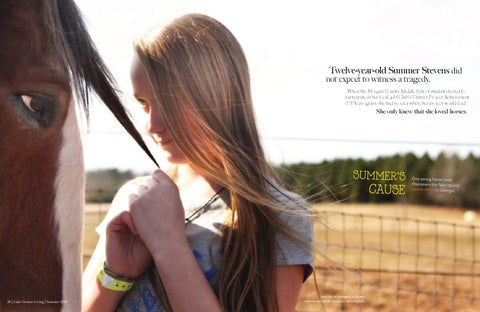
Twelve-year-old Summer Stevens did
not expect to witness a tragedy.
When the Morgan County Middle School student elected to participate in her local 4-H Club’s District Project Achievement (DPA) program, she had no idea where her project would lead.
She only knew that she loved horses.
Summer’s
Cause
written by kathryn schiliro
36 | Lake Oconee Living | Summer 2010
photographed by angelina bellebuono
One young horse lover champions the fight against equine abuse in Georgia.
Inside the impound barn,
visible ribs and sunken faces spoke of starvation and
dehydration. Summer came face-to-face with Twiggy, who shook its long, shaggy mane.
Summer bonded with the abused and neglected horses at the state equine impound barn in Mansfield.
But that conviction led to an unexpected discovery, which started
Summer on a journey from the stables of Morgan County to the steps of the state
capitol. That journey would ultimately change her life and legal discourse in Georgia. Her story illustrates the power of concerned and committed citizenship: that if you fight for what you believe, there are no limits to what you might achieve. Summer is a studious sixth-grader. She plays trumpet in her school band and often practices in the back room of the Morgan County Citizen newspaBelieve in the per office, where her mother, Sherry, works. Much to her mother’s chagrin, example set by this Summer performs impromptu concerts for her co-workers. Her musical selections range from “Jingle Bells” to the “Star Wars” theme song. Her bold twelve year old? deliveries often make up for any technical imprecision. Compelled to support Caring and considerate, Summer uses her considerable artistic talents to this cause? Contact brighten others’ days. On any given holiday, she spruces up the newspaper the Georgia Equine office with decorations she creates out of found materials. Last Halloween Rescue League (GERL) she built a ghost out of copy paper and Scotch tape. She animated her at 404.656.3713 or larger-than-life-size paper phantom from inside its core, spooking and de1.800.282.5852, or lighting anyone who crossed her path. online at gerlltd.org. This is all to say that Summer takes a creative approach to life. Rather than sensing limitations, she envisions possibilities. This approach serves her well, even in the face of dire circumstances. Late last year, following a 4-H Club meeting, Summer decided to participate in the organization’s DPA competition, which requires participants to research a topic of their choice and present their findings to an audience and a judge. The decision to participate was easy, but Summer carefully chose her topic. “I decided to do horse abuse, because I thought it was something that should be brought up, not hidden under the carpet,” says Summer. With her mother’s encouragement, she sought the help of Laura Rolader, Morgan County 4-H program assistant. Rolader steered Summer to the state equine impound barn in Mansfield, less than 30 minutes from Madison. And that is where Summer’s journey began.
Summer 2010 | Lake Oconee Living | 39
After a round of applause, acceptance, and photographs,
Summer’s mind returned to the horses.
“When I sat
down and started looking at my blue ribbon, I was thinking, ‘I should give this back to Twiggy at the impound barn.”
From left: Summer speaks with Gary Black, candidate for Georgia Agriculture Commissioner, at the Georgia Department of Agriculture Equine Impound Auction, which her 4-H Club helped bring to Morgan County. Little Britches was one of the many horses who found a home during the auction, which raised more than $10,000 for the impound barn. Morgan County Middle School’s students and faculty gathered for a surprise assembly in Summer’s honor.
Summer’s family waits in the wings to surprise her at her school’s assembly.
Pulling into the driveway that leads to the impound barn, a field of
at the impound barn,’” Summer says. Weeks later, Summer pinned her blue ribbon to Twiggy’s bridle, the one happy moment during her second trip to the impound barn, this time with other 4-H members. The group also met Emma, Britches, and the Clydesdales. Emma hung in a sling, her back legs busted and her spine sticking out. She wouldn’t eat the food in front of her. Because Emma’s was the facility’s only sling, Britches hung suspended in a makeshift sling of ropes. Several Clydesdales, once used to pull carriages, were also living in the impound barn. The owner had profited by hiring out his horses, while he failed to maintain them properly, denying them sufficient food and water. The owner got away with the neglect until a wedding guest reported him. She noticed the animals’ poor state as they pulled a wedding party carriage. The horses wound up at the Mansfield facility, where one of them, called Dwarf, was being treated for thrush, a condition that renders horses’ feet soft. After witnessing the barn, the 4-H Club
horses came into view. From a distance, Sherry and Summer thought the animals looked okay, but they hadn’t seen anything yet. The most pathetic cases were hidden inside the barn. Robin Easley, Georgia Department of Agriculture field supervisor at the Mansfield facility, met Sherry and Summer outside. She explained the difference between horse abuse and neglect, how interventions work, and the role the impound barn plays in different cases. Vet visits and vaccines cost money, she said, and that’s money the facility doesn’t have. Easley shared some of the animals’ stories. Unable to halter-train his mule, one owner decided to teach the animal a lesson. He tied its halter to the back of his vehicle and dragged the mule down a dirt road, skinning him alive. Another owner loved her horse so much that she ignored its terminal cancer diagnosis and her vets’ recommendation to put the animal out of its misery. Instead, she let the cancer spread from its mouth to its eye. “She just let it suffer like that,” Summer says, recounting the story. Inside the impound barn, visible ribs and sunken faces spoke of starvation and dehydration. Summer came faceto-face with Twiggy, who shook its long, shaggy mane. “I
40 | Lake Oconee Living | Summer 2010
thought it was a girl at first, that she had long hair, but it was a he,” Summer says. “He was skinny. In the back around his butt, he didn’t have enough muscle. Between the eye and the ear, there’s a dent. His was way down because of dehydration. I think he had riding marks like where he has been ridden when he was not strong enough to be. He was an old horse, but he had a lot of spunk to him.” Moved by her experience, Summer further researched and prepared for her DPA speech. She practiced it in front of her parents and her friend, Lilly, who advised her to look up from her notes more often. When the day of the speech arrived, the 4-H Club members rode a bus to Rock Eagle, singing camp songs along the way. Standing before an audience, Summer felt nervous, but emboldened by what she had witnessed at the impound barn. She spoke clearly and with conviction about horse abuse and neglect, about the state’s weak laws against these crimes, the lack of attention paid to the victims, and the devastating results. She looked the judge in the eye and spoke with confidence. After a lunch break, the entry judge announced the competition results. Summer realized she’d won when hers was the last name spoken. After a round of applause, acceptance, and photographs, Summer’s mind returned to the horses. “When I sat down and started looking at my blue ribbon, I was thinking, ‘I should give this back to Twiggy
Summer’s Journey October 2009 Summer chooses horse abuse as the focus for her 4-H District Project Achievement entry and visits the state equine impound barn in Mansfield, Ga. December 2009 DPA is held at Rock Eagle, a 4-H camp in Eatonton, Ga. Summer wins first place. February 3, 2010 Summer pages at the state capitol for Representative Doug Holt (R-Social Circle). Each time she and her mother, Sherry, visit the capitol they advocate for change in horse abuse and neglect legislation. February 18, 2010 Summer pages at the state capitol for Senator Johnny Grant (R-Milledgeville). February 27, 2010 Through a partnership with the Morgan County 4-H program and Morgan County Ag Center, a Georgia Department of Agriculture Equine Impound Auction is held in Morgan County. Hundreds attend, including representatives of state government, and $10,000-plus is raised. Friday, April 16, 2010 Summer discovers, through a surprise assembly at her school, that she is the winner of Great American’s (a company that manages fund-raisers for schools throughout the country) HERO Contest. She receives $500, which she promptly donates to the Georgia Department of Agriculture. She’ll soon be featured in the company’s nationwide ad campaign. May 7, 2010 Summer speaks to members of the State Bar of Georgia, at a seminar for lawmakers about animal cruelty, about the current law regarding horse abuse and neglect and meets Victoria Stillwell, of Animal Planet’s “It’s Me or the Dog.” May 15, 2010 Summer applies for an ASPCA Animal Action Grant to fund efforts to improve the Mansfield barn. June 19, 2010 Another state Department of Agriculture Equine Impound Auction will be held at the Mansfield barn. Summer and her family work to raise funds and get donations for the auction. Summer 2010 Summer will continue meeting with legislators, with potential legislators, as well as with gubernatorial candidates. January 2011 The Georgia General Assembly will open for business.
42 | Lake Oconee Living | Summer 2010
members wanted to do more. When they heard that the Georgia Department of Agriculture was having trouble securing a place to hold their February equine auction, the girls suggested the Morgan County Ag Center. At such auctions, buyers bid on recently rehabilitated horses, and the money raised goes back to the Mansfield facility. The Ag Center’s board agreed to host, and the 4-H Club members promised to clean its many stalls in preparation. Inspired, Sherry embarked on a phone campaign. “Mama’s trying to get state representatives to come to the auction. We want big people there to see the horses who were abused and neglected,” Summer reported in February. Hundreds of supporters turned out at the auction on February 27, and more than $10,000 was raised. Accepting Sherry’s invitations, current Georgia Agriculture Commissioner Tommy Irvin and commissioner candidate Gary Black both showed up. As Summer’s story and word of the Morgan County auction got around the capitol, her foray into politics began.
Ultimately, Summer wants to change the legislation regarding
equine abuse in Georgia. Currently, willful neglect is charged as a misdemeanor, only becoming a felony if death of the animal results. Similarly, animal torture only becomes a felony if the animal dies, is disfigured, or rendered useless. Summer and her strongwilled mother want to elevate those misdemeanor charges to felony. Sherry explains what she’s learned about the laws currently on the books. “Most [negligent or abusive horse owners] are repeat offenders. They get a slap on the hand from the judge, they get their horses back, they starve again, and they come right back [to the impound barn]. We wanted to make a change. We can turn our backs on it, or we can be the voices of the horses.” So Sherry and Summer put their lobbying shoes on and headed for the capitol. While Summer paged for legislators and Sherry lobbied, they began to accomplish what they’d set out to do. On one of their days at the capitol, Representative Tom McCall (RElberton), chairman of the Agriculture and Consumer Affairs Committee, listened to the mother and daughter and directed them to a lawyer who was working on a bill relating to animal cruelty, sponsored by Representative
Kevin Levitas (D-DeKalb County). “Prosecutors approached me about the difficulty that they were having prosecuting cases of abuse because of certain inadequacies in the current law,” Levitas explained in e-mail correspondence. “The original bill was aimed at two things: clarifying the definition of neglect and adding torture as another element of aggravated animal cruelty.” With the budget crisis consuming what seemed to be the entire session, time was not on Sherry and Summer’s side. When the legislative session concluded in April, the bill, HB 1153, had not made it out of the House. Provided he is re-elected in the fall, Levitas pledges to reintroduce the bill in the next legislative session. In the meantime, the mother-daughter team will not rest; instead, they are advocating for Levitas’ bill and are working with at-
torneys and other equine advocates to draft a new bill that would make harsher the penalties for horse abuse and neglect. Summer hopes this bill will include language to prevent abused and neglected horses from going back to their former owners. “We’re fighting,” Sherry says. Summer’s journey from 4-H Club to the General Assembly, the barn to the state capitol, muck boots to dress shoes, is not over yet. She and her mother will continue to do what so many citizens cannot seem to find it in themselves to do: to nobly and fiercely take a stand for what they believe in, to fight through the mud that is politics to make a difference. Kathryn Schiliro is the managing editor of the Morgan County Citizen.
Above: Summer spends time with the once-neglected Clydesdales at the impound barn. Below: At a surprise assembly at Morgan County Middle School, Summer is presented with a Great American Hero Award. She promptly donated her $500 award to the Georgia Department of Agriculture. Summer 2010 | Lake Oconee Living | 43