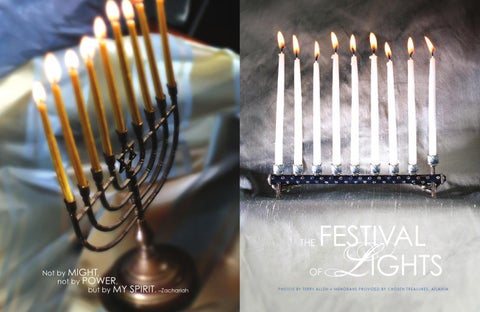
THE Not by MIGHT, not by POWER, but by MY
SPIRIT. –Zachariah
L
FESTIVAL IGHTS
OF
P H O T O S B Y T E R RY A L L E N • M E N O R A H S P R O V I D E D B Y C H O S E N T R E A S U R E S , AT L A N TA
F
or ye were sometimes
106 | Lake Oconee Living
DARKNESS, but now are ye LIGHT
in the
LORD: Walk as CHILDREN OF LIGHT. –Ephesians 5:8
T
HE LORD shall be unto thee an EVERLASTING LIGHT,
and thy
GOD THY GLORY. 窶的saiah 60:20
Holiday 0 7 | Lake Oco nee Li ving | 1 09
B Y K AT H R Y N P U R C E L L • P H O T O S B Y D E A N N A P I E N I A S Z E K
P
FESTIVAL LIGHTS
celebration and tradition THE
Presents wrapped in blue and silver, speedily spinning dreidels, and brightly polished menorahs– Hanukkah is a time of celebration and tradition. It is a time for togetherness and reflection. Families gather to commemorate a special event that fortified their religion and provided hope to Jewish people and to all people who would later fight for religious freedoms. Popular knowledge of Hanukkah tells us that Jewish people light candles on an eight-branched candleholder, the menorah, to celebrate an event that occurred more than 2,000 years ago, when a one-day supply of oil in the Temple burned for eight days. While this miraculous event is an important aspect of the festival, the story behind it is more significant. “Hanukkah is most important for the historic event it commemorates,” says Rabbi Ronald Gerson of the Congregation Children of Israel in Athens, Ga. According to literature provided by the Rabbi, in the second century B.C., King Antiochus began spreading the idea throughout Jerusalem that he was God. The Jewish people refused the idea, maintaining that theirs was the 110 | L ak e Oc on e e Liv i n g | Ho l id a y 0 7
OF
one, true God. Antiochus and the Greek Syrians, in an effort to suppress the Jews, invaded the holy city of Jerusalem on the Sabbath and proceeded to destroy the Books of Law, desecrate the Temple’s altar, and kill or make slaves of those who dared resist. The Jewish priest Mattathias led a revolt against Antiochus and the Greek Syrians from the village of Modin until his death in 166 B.C., at which time his son, Judah the Maccabee, succeeded him. Judah and his followers, the Maccabees, were able to defeat the Greek Syrians, regain control of Jerusalem, and purify and rededicate the Temple and the city. The very word “Hanukkah,” in Hebrew, means “rededication.” The Temple was rededicated to God on the 25th day of the Hebrew month of Kislev, and the celebration lasted for eight days, despite the shortage of oil; it should have only lasted for one. This is why the “Festival of Lights” is celebrated for eight days. The most enduring aspect of the celebration, however, is the historic victory over the Greek Syrians. “As far as we know, it was the first time that a
group thought that religious freedom was so important. They fought for it– the right to worship,” Gerson says. “It was the first fight for religious freedom and we feel that it inspired other great struggles as well, including the Revolutionary War in this country.” “You get presents for eight days!” –Benjamin Waltman, 4
T
he lighting of the menorah is Hanukkah’s central tradition. A candle is lit for every evening of the festival until all eight burn on the final night. As families recite a different prayer for each night, they use the tallest candle, the “shammas,” to light the others. The candles cannot be blown out; they must be allowed to burn out. In a show of faith, many Jewish families display their lighted menorahs in the windows of their homes. The Waltman family of Athens believes that the lighting of the menorah is a family affair, and they make time for everyone to participate. “We make sure that we light the candles in the evening,” says Seth Waltman, father of the family
Clockwise from top left: Fouryear-old
Benjamin
Waltman
places the “shammas,” or the tallest candle, in his family’s
menorah. He plays the dreidel
game while waiting for the
candles to burn down. Gifts are wrapped in silver and blue, and
chocolate coins are wrapped in foil, to represent the coins minted
during
Maccabean
times. The yarmulke is a rounded cloth cap worn by observant Jews.
The LIGHTING of the menorah is Hanukkah’s central tradition. A CANDLE IS LIT FOR every evening of the HOLIDAY until all eight burn on the FINAL NIGHT.
The Waltman family of Athens believes that the lighting of the menorah is a family affair, and they make time for everyone to participate.
of four. “Every night we take time out of what we are doing to light the candles,” Seth’s wife Becky says. Along with the menorah, the dreidel is another recognizable symbol of Hanukkah. A dreidel is a four-sided top with Hebrew letters on each side, which provide the basis for a game. Each of the letters is actually an initial, a representation of the phrase “A Great Miracle Happened There,” a reference to the history of the Hanukkah story. However, the history of the dreidel goes back even further than Hanukkah. The Jews used the dreidel in the second century B.C. to thwart the oppression of the Greek Syrians. “In those days, when the Greeks were persecuting the Jews, they forbade the study of the Torah, the study of Judaism,” Gerson explains. “So, it was a way to deflect the Greeks, like when they would come to the houses and say, ‘Hey, we heard you were studying’ and
112 | L ak e Oc on e e Liv i n g | Ho l id a y 0 7
they [the Jews] would say ‘No we weren’t. We were just playing this game.’” The dreidel game is resurrected every year for Hanukkah. A group of players sits around a pile of goodies and takes turns spinning the dreidel. Game winnings typically include candies, nuts, or “gelt,” chocolate coins covered in foil, a reference to the coins minted during the Maccabean times. The letters on the dreidel’s sides read: “Nun,” “Gimmel,” “Hay,” and “Shin.” If the spinning top lands on “Nun,” the player takes nothing; with “Gimmel,” the player takes all; with “Hay,” the player takes half; and, with “Shin,” the player must actually move a portion of his winnings back to the center of the table. “The letters on it are important,” Gerson says, in reference to the greater lesson of Hanukkah. “But it occupies the children while the candles are burning down. It takes about a halfhour for the candles to burn down, and
you’re not supposed to do any work by the light of the candles.” Another symbol of Hanukkah is the latke, or potato pancake. Latkes are fairly simple to make– potatoes are ground up, onions are typically added, and they are fried in oil. In the United States and Europe, latkes are the staple food of the holiday. However, in Israel, Jews also eat jelly doughnuts fried in oil, or sufganiot. Both require the use of oil, a nod to the story of the rededication of the Temple. “The big thing about latkes is what you put on them,” Becky says. “Some people put sour cream, applesauce, or cinnamon and sugar on them. Really, it’s what you put on them, not how you make them.” “I wouldn’t say it’s the healthiest food,” Gerson says. “But they are very tasty.” Finally, Hanukkah is also a time for exchanging gifts– one for each of the eight nights. While the tradition has
been a part of Hanukkah for some time, it seems that the size of the presents has grown throughout the years. Gerson attributes this change to the festive climate of the holiday season and to commercialization. “There were always little presents given, historically, like the gelt, but the idea of giving big presents, I think, was more or less taken over from the general society,” Gerson says. “It [Hanukkah] has given Jewish children something of their own,” Gerson maintains. “Children get gifts every night for eight nights. Humorously, I think most Jewish children know that on the first few nights you get more big presents and, by the end, you’re getting socks and handkerchiefs, things like that.” The commercialization, however, might not be a bad thing. “I’ve noticed that families are making Hanukkah a much bigger holiday than it ever was,” Gerson says. “My feeling, personally, as the rabbi, is that this is a good thing, because whenever we can make any religious holiday bigger, more important, more colorful, it’s a good thing.” “One thing that never changes is spending time with family.” –Seth Waltman
S
ince its inception 2,171 years ago, Hanukkah has grown and evolved. Early in its history, Hanukkah was not a major holiday; it was celebrated simply. The consistency of the celebration lies in its symbols and traditions, and in spending time with loved ones. “I think the important thing about Hanukkah for us is the time with family,” Seth says. Moreover, the story behind the holiday greatly transformed history and deserves to be honored. Hanukkah teaches us that our beliefs and convictions are worth fighting for and that, if we are so lucky, will never be forgotten. Kathryn Purcell is the managing editor of The Morgan County Citizen in Madison, Ga. Holiday 0 7 | Lake Oco nee Li ving | 1 13