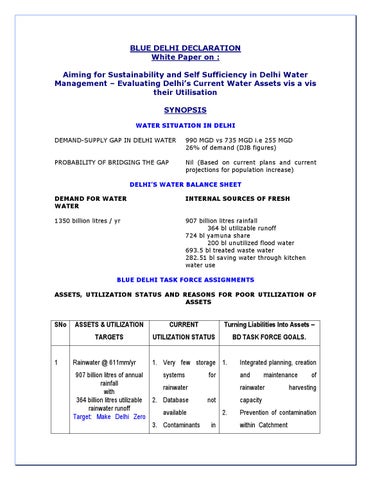
BLUE DELHI DECLARATION White Paper on : Aiming for Sustainability and Self Sufficiency in Delhi Water Management – Evaluating Delhi’s Current Water Assets vis a vis their Utilisation SYNOPSIS WATER SITUATION IN DELHI DEMAND-SUPPLY GAP IN DELHI WATER
990 MGD vs 735 MGD i.e 255 MGD 26% of demand (DJB figures)
PROBABILITY OF BRIDGING THE GAP
Nil (Based on current plans and current projections for population increase)
DELHI’S WATER BALANCE SHEET DEMAND FOR WATER WATER
INTERNAL SOURCES OF FRESH
1350 billion litres / yr
907 billion litres rainfall 364 bl utilizable runoff 724 bl yamuna share 200 bl unutilized flood water 693.5 bl treated waste water 282.51 bl saving water through kitchen water use
BLUE DELHI TASK FORCE ASSIGNMENTS ASSETS, UTILIZATION STATUS AND REASONS FOR POOR UTILIZATION OF ASSETS
SNo
1
ASSETS & UTILIZATION
CURRENT
Turning Liabilities Into Assets –
TARGETS
UTILIZATION STATUS
BD TASK FORCE GOALS.
Rainwater @ 611mm/yr
1. Very few storage 1.
907 billion litres of annual systems rainfall rainwater with 364 billion litres utilizable 2. Database rainwater runoff available Target: Make Delhi Zero 3. Contaminants
Integrated planning, creation and
for
maintenance
rainwater not
harvesting
capacity 2.
in
of
Prevention of contamination within Catchment
rainfall outflow city
catchment
3.
Enforcement of RWH and environmental
protection
laws 4.
Creating and Maintaining a dynamic database with GIS mapping of RWH in the city
2
900 water bodies – more 1. 629
given
legal 1. Protect and revive capacity of
being counted
protection
Storage capacity approx
‘Water Bodies’ by 2. Artifical
216,00,000 cu.m. or 2160
Delhi High Court.
crore litre storage capacity TARGET All water bodies
as
water bodies re-alignment
of
catchment with water body
2. In poor state of 3. Diversion of sewage away from maintenance
catchment / in-situ treatment of
to be filled with fresh water 3. Catchments
sewage
and
subsequent
/ treated waste water /
disturbed - so rain
discharge into water body
flood water
does not always 4. Channelising Yamuna flood waters
flow into them 4. Widely
used
for
into
nearby
water
bodies
sewage disposal
3
Treated MLD
sewage:
2048 1. Quality not always 1.
from 23 STPs of
as per norms
DJB. Plus 133 MLD from 2. Not
available
treatment to
CETPs in 15 industrial
public – discharged
areas and ETP water from
straight into river
1200 industrial units (693.5 3. Distribution billion litres / yr)
TARGET: Horticulture and
Government to improve
capacities
technologies, and
location
choices. 2.
Local re-use of waste
of
water by communities before
treated water – cost
discharge into sewage trunk
and logistics
system 3.
Implementation of court
construction needs to be
order – STP and use of treated
satisfied with treated waste
water in premises mandatory
water
for units generating more than 10,000
litres
of
sewage
everyday
4
Yamuna river
1. Zero flow in non- 1. Reduce tubewell extraction in
4.6 % of flow or 808
rainy periods
cusecs / yr or 724 Billion 2. Heavily and
litres per yr. TARGET:
Significant
reduction every year in the contaminant
load
and around floodplain to allow
polluted
recipient
basal flow
of 2. Government
continuous sewage
to
plan
for
floodwater storage
discharge
3. PPP for making the Interceptor
from 3. Floodplain
Sewage Drain project and
water flowing into the
disturbed
Yamuna from Delhi.
construction
YAP-III a success
by
4. Community mobilization and monitoring to prevent direct inflow of contaminated water into river / nullahs. 5. Enforce court order giving protection from constructions to floodplain.
5 Educated population 1.6
crores
–
all
1. Only 27% live in 1. are
potential Jal Rakshaks.
Rakshak’
an
active
‘Jal
i..e. one who
adopts and helps adopt Water Wise Behaviours
in
place
from each community unit 2. Not be
on
WATSAN providing adequate infrastructure
infrastructure
to
thrust
planned areas – regularizing unplanned areas and with
TARGET: Atleast 1 person
Government
2. In-situ Sanitation and waste adequately disposal solution for unplanned
sensitized to water areas issues
and
community living 3. Water
4.
Inspire, inform, incentivize
Scarcity
and form teams of Delhites to
Mindset - hence
be a part of the Blue Delhi
focus is on stocking for
self
–
sharing with all.
not
program
BLUE DELHI DECLARATION DETAILS OBJECTIVE OF THE PAPER •
To chart out the plan of action for Multi-Stakeholder Task Forces aiming to make Delhi Water Secure by 2016. o o
To evaluate the current Water Assets of Delhi and their utilization status To identify reasons for the current under-utilization of Delhi’s current Water Assets (if any) and to suggest guidelines for the Blue Delhi Task Forces to help maximize utilization of those assets. BACKGROUND INFORMATION
1. ABOUT DELHI - GENERAL STATISTICS
The National Capital Territory of Delhi (NCTD) has an area of 1483 km2and comprises of three constituents MCD (1297.29 km2), NDMC (42.74 km2)and DCB (42.97 km2) respectively. TABLE 1.1 Population of Delhi – As per Census 2001 1 Total Population Persons Male Female 2 SC Population Persons Male Female Others 4 Density (Per Sq. K.M.) 5 Area sq. K.M. 6 Sex Ratio (per 1000 Males) 7 Literacy Rate (%) Persons 8 Literacy Rate (%) Males 9 Literacy Rate (%) Female 10 Birth Rate (per 1000) ,2001 11 Death Rate (per 1000),2001 12 Infant Mortality Rate (per 1000),2001 13 PER CAPITA INCOME AT CURRENT PRICES FOR THE YEAR 2000-01(QUICK ESTIMATES)
1,38,50,507 76,07,234 62,43,273 23,43,255 12,65,182 10,78,073 9340 1483 821 81.67 87.37 74.71 21.24 5.81 23.93 RS.38864
Annual Average Growth Rate of Population in Delhi The annual average exponential growth rate of population of Delhi was the highest (6.42%) during 1941-1951 due to large scale migration from Pakistan to India after partition in 1947. Since then the annual growth has been 4.22 % during 1951-1961, 4.25% during 1961-1971, 4.25% during 1971-1981 and 4.15% during 1981-1991. The annual growth rate of population of Delhi during 1991-2001 has been 3.81% and it is almost double the national average. (Source: Economic Survey of India) As per 1991 Census, the average family size was 5.06 persons. The highest number of families i.e. 50% are in the category of 3-5 persons and the lowest 9% in the category of 9 & more persons. The family size in urban areas is 4.99 persons in comparison with rural family size of 5.90 persons. 2. CURRENT AND PROJECTED WATER DEMAND IN DELHI Separate estimations for Water demand in 2011 have been made by Delhi Jal Board and Delhi Development Authority. DJB estimates demand at 1140 MGD (@60GPCD) and DDA as 1520 MGD (@ 80GPCD). The raw water requirement is 110% of the figures shown above. Delhi Jal Board is not able to fulfill the current water demand. By 2021 the situation is likely to get much worse because of a further rise in water demand as shown in the tables below. TABLE 2.1 – CURRENT & PROJECTED DEMAND BY USAGE CATEGORY
Category of demand
Water demand (1000 MLT) 2011 2021
Drinking and domestic water Commercial & Insttnla
2544
3080
171
308
Industrial
858
1871
TOTAL
3573
5259
Source:- Delhi Water Supply & Sewerage Project – Project Preparation Study Report
TABLE 2.2 - PROJECTIONS FOR DOMESTIC WATER (BY SETTLEMENT TYPE) S No
Type of settlement
1 2 3 4 5 6 7 8
Upgraded J.J . Clusters Upgraded Slums Upgraded Regularised Resettlement Colonies Rural villages Regularised Colonies Urban villages Planned Colonies
Approx . present Population in Million 3.2 7 4.2 0 1.17 2.79 1.17 2.79 1.39 5.22
DEMAND IN
Norm of Supply (lpcd)
2021
Total requirement (MLD)
150 150 150 200 150 200 200 225
490.5 630.0 175.5 558.0 175.5 558.0 278.0 1174.5
Total
4040.0
(b) Fire Demand based on 100 Ö p = 14.83 MLD (c) Non Domestic Demand (Category - II) Non domestic demand is based on present supply increased in the same proportion as population increase. Therefore non domestic demand (cat - II ) = 120 X 1.64 = 196.8 MLD (d) Non Domestic Demand (Category - III ) Based on the same principle non domestic demand ( cat - III ) = 70.20 MLD (e) Leakages and line losses (10 %) It is assumed that with use of better materials, technology up-gradation and strict quality control during construction, replacement of old pipes and fittings, rehabilitation of WTP and BPS, Ground Reservoir and OHT. Leakage and the line losses will be restricted to 10% = 430.80 MLD
Total Future Demand
= 4752.63 MLD
Source: Delhi Urban Environment and Infrastructure Improvement project, GOI and MOEF
In order to meet the future demand, DDA in the draft Master Plan for Delhi 2021 has split the water requirement in two parts Potable and Non Potable as 35 & 45 GPCD respectively, with the proviso that “In the existing areas till the arrangement of non potable water is made, potable water shall be supplied. For urban extensions and areas under development schemes, these norms are recommended with necessary provisions. Water requirement of the urban poor – upgraded JJ clusters, upgraded slums, resettlement colonies, upgraded regularized = 1853.5 = 46%. If you add to this, 40% of water requirement of urban villages – assuming that those are the number of urban poor households living on rent in shacks made in these villages – and 25% of the regularized colonies – assuming that 25% colonies are those of the urban poor – their demand comes to 2104.5 -52% of total water demand. It must be emphasized that these figures are hugely understated – because they do not include those unauthorized slum settlements that do not show in any government records. There are millions of poor living and working in such settlements – with no authorized water / tubewell connections. Delhi is also the greenest city in the country today – with a green cover of more than 19% - 283 sq km (107 sq km of tree cover and 176 sq.km. of forests). This also (probably) includes approx 50 sq km of government owned parks (15000 nos). This does not include household gardens, potted plants and other minor plantations with no tree cover. Water is also required to maintain this greenery. Assuming a requirement of 1 litre per sq.m., (half of the norm of 2 l/sq m) approx 300 MLD (of artificially provided water or naturally taken water) is required to maintain the green cover.
3. WATER SUPPLY IN DELHI Delhi’s water and wastewater management is controlled by the Delhi Jal Board (DJB). DJB is equipped to treat 790 MGD of water inclusive of about 100 MGD of ground water abstraction. However the actual production is 735 MGD with a short fall of 990 - 735 = 255 MGD at production point.
TABLE 3.1 TRANSMISSION AND DISTRIBUTION NETWORK IN DELHI S. No. 1. 2. 3. 4. 5. 6.
Item
During 2001
Length of Water mains(kms) No. of Water connections No. of Water Stand Posts (Public Water hydrants) No. of Water Tankers No. of Private Tube wells Capacity of Existing Underground Reservoirs
As on 01.04.2005
8363 13,33,833 11,533
More than 9,000 About 15.52 lakhs
493
1100 as per revised budget estimate 2005-06 2,00,000 (Estimated)
175 MG corresponding to 6-7 hours of production
Proposed to build 35 % of average demand as storage capacity.
Source: Department of Urban Development, New Delhi WATER SUPPLY TO JJ / SLUM CLUSTERS Around 20 lakh people are settled in JJ cluster with water requirement of 270 MLD. Water Supply is provided through public water hydrants, tankers and hand pumps. So far Slum & JJ Deptt. had undertaken four Projects of in-situ up gradation of JJ Clusters as at Ekta Vihar (414families), Proyog Vihar (260families), Shanti Vihar (113 families)and Shahbad Daulat Pur (4800families). DJB is able to meet around 60-65% of the water requirement of slum dwellers. The other sources such as hand pumps, tankers and water trolley contributes to 25-30% of water demand. Please also refer to the comment on page above regarding non-inclusion of unauthorized slum settlements in the calculated data. TABLE 3.2 – SUPPLY SHORTFALL FOR DELHI’S POOR SNo
1
2 3
Settlement type JJ Cluster, Designated Slum Area and unauthorised colony (I) JJ Cluster, Designated Slum Area and unauthorized colony (II) Planned Area (H.C) (MCD)
Population lakhs 13.96
in
Demand in MLD 59.33
Supply in MLD No piped supply
Shortfall
40.80
173.40
20.43
(-) 88%
75.50
1698.75
990
(-) 42%
(-) 100%
Source: Status Report for Delhi 21: Delhi Urban Environment and Infrastructure Improvement Project (DUEIIP)2001 UNACCOUNTED FOR WATER Unaccounted for water is in the range of 40 - 45 %. Water losses through unaccounted flow comprises of: (i) Unbilled Un-metered Consumption @2%, (ii) Leakage in Transmission mains @ 16% and (iii) Leakages in Distribution mains @24%.
* [Source: World Bank funded Study report by Pricewater House Coopers]
However, there are differing views on the above estimates for leakages. As the media report in Annexure 2 shows, the view is that the leakages are simply unreported tapping into the water supply system by the poor.
4. SOURCES OF WATER FOR DELHI River Yamuna, Western Jamuna Canal a carrier of Yamuna waters as also Bhakra waters) and the Upper Ganga Canal, are surface water sources for Delhi. Around 446 tube wells drilled in Yamuna bed and areas within city to meet the water requirement.
Table 4.1: Treatment Capacity indicating Source of Raw Water Source of Raw Water
Name of Water Plant Treatment
Installed Capacity MGD
Production by Optimisation MGD
River Yamuna River Yamuna Bhakra storage / Yamuna Bhakra storage River Yamuna Upper Ganga Canal Upper Ganga Canal Ground Water Total
Chandrawal I &II Wazirabad I II & III Haiderpur I & II
90 120 200
105 124 210
Nangloi Bawana Bhagirathi Sonia Vihar Ranney Wells & Tube wells
402 202 100 140 100 790
21 Nil 110 653 100 735
Source: Chapter – 8 City Water Supply System; Dept. of Urban Development, Govt. of Delhi
A. Surface Water: 86% of Delhi's total water supply comes from surface water, mostly from the Yamuna River, which equals 4.6% of this resource through interstate agreements. B. Sub-surface water: Ranney wells and tubewells. This source, which is met through rainfall (approx. 611.8 mm in 27 rainy days), and unutilized rainwater runoff, is 193 MCM (million cubic meters). C. Other unplanned Resources: Mainly groundwater, its current withdrawal is estimated at 312 MCM. Salinity and over exploitation has contributed to depletion and drastically effected the availability of water in different parts of the city. Because of this, Delhi’s ground-water level has gone down by about eight meters in the last 20 years at the rate of about a foot a year.
5.FUTURE WATER SUPPLY - AUGMENTATION SCHEMES BY DELHI JAL BOARD With the demand-supply gap projections for water set to increase in the next ten years, DJB has identified new raw water sources including, Renuka , Kishau Lahawar dams. Plans also center on the construction of new and existing sewage treatment
plants (STPs), which will enable an increase in treatment capacity. Rainwater harvesting is another option that DJB is considering. However, in the absence of any immediate sources of fresh water for Delhi, DJB has planned some Supply Augmentation schemes for Delhi. Some of these have already been implemented. These include: 1. Recycling of waste water of existing Water Treatment Plants: Delhi Jal Board will be able to recycle the waste water of Haiderpur, Wazirabad, and Bhagirathi Water Treatment Plants by which addition in the capacity by 37 MGD will be achieved. 2. Schemes of setting up new WTPs of 20 MGD at Okhla and 40 MGD at Dwarka are proposed to be taken up subject to availability of raw water. 3. Boring of 110 tube wells along with re-boring of 446 is proposed. 4. In addition to 100 tubewells bored in the flood plains of river Yamuna, 30 tubewells are proposed to be bored.
5. Installation of 625 deep bore handpumps On completion of augmentation works, the DJB will be equipped to produce 919MGD of water. The estimated demand @ 60 GPCD for a population of 230 lakhs will be 1380 by 2021. Thus there will be a shortfall of 1380 – 919 = 461 MGD (source: CDP for JNNURM ) (News item on DJB Water Supply Augmentation : Annexure 3)
SUMMARY OF CURRENT WATER SITUATION The figures above highlight the following issues: 1. Population of Delhi as per 2001 census was 1.38 crores. Current estimated population is 1.8 crores. 2. Annual rate of growth of population in 1991-2001 was 3.81% - almost double the national rate of growth of population 3. A shortfall of at-least 26% in water supply exists at the production point in Delhi. 4. At-least 88% shortfall of water supply exists in the poor settlements of Delhi. 5. Shortfall is projected to increase both in quantity and % of total demand terms. 6. Substantial raw water supply augmentation through new dams is not likely to happen soon since the projects have not received all legal / environmental clearances yet. Construction has not started. 7. Dependence on Yamuna river for raw water is very high
(86%)
8. However, owing to global warming and increased water needs of upstream states, Delhi has not been receiving its full share of Yamuna Water despite disputes being taken to court and political heads of states. 7. Yamuna is highly polluted. Increasing incidents of water supply curbs due to additional pollution load in raw water flowing in from other states. 8. Groundwater resources are also depleting – in quantity and quality. 9. Though official figures of groundwater dependence are only 14%, actual dependence is anywhere between 30-42% (figures unknown) since groundwater is used to cover supply shortfalls or augment DJB supply all over Delhi.
THE WATER SECURITY PLAN FOR DELHI To celebrate World Water Day 2011, FORCE, in partnership with government and leading civil society NGOs and institutions organized the ‘Walk for Water – 2011’ at Rajpath, New Delhi. The Walk for Water was to express symbolic empathy with those in many parts of the world, who still have to walk atleast 6 km to get their daily requirement of water. The Blue Delhi Declaration – a 5 year plan to make Delhi Water Secure - was also announced on this occasion. The Delhi Pledge was administered to all participants by the Honble Minister of Water Resources – Sh Salman Khurshid. Other dignitaries present were Sh Ramesh Negi – DJB , CEO; Kiran Mehra Kerpelman – UNIC Director, Jyoti Sharma – President , FORCE; Lourdes Baptista – Director, WaterAid; Dr. Ranjana Pant - WWF, Director; Dr. Aidan Cronin - WATSAN specialist UNICEF, Dr. SC Jain – Program head, AFPRO, Dr. AD Rao – Delhi State Unit Head, Central Groundwater Board, Dr. Rajaram Purohit – Scientist, Central Groundwater Board, Smt Sanjam Chima – Advisor PR, DJB
The philosophy behind the Blue Delhi Declaration is that if every city, town and village in the country was to plan for self –sustainability in its water resource management, it would be possible Water Security based on the premise that Delhi’s existing Water assets, if managed well, can be enough to make Delhi Water Secure. BLUE DELHI DECLARATION
I pledge to make Delhi ‘Water Secure’, through my actions as a responsible citizen of this heritage city. I pledge to think of Water as a priceless Gift from god Almighty. I pledge to use it judiciously, to remind myself and spread awareness about its value, and to support efforts directed to conserve it. I pledge to do all I can to add to the ground water in Delhi and prevent its contamination. I Ialso promise to protect & preserve lakes and other water COUNTING DELHI’S TENSION POINTS bodies that have generously bestowed on our city. II- been COUNTING DELHI’S ASSETS I acknowledge and promise to play my role in ensuring a clean river DELHI Yamuna that has been theRAINFALL life line ofIN people in the city for centuries. I pledge to act, and to act now.
6.WATER ASSETS The primary source of fresh water, anywhere on earth, is precipitation – rain, snow, hail, sleet. Once precipitation occurs, it moves into a precipitation storage system like a stream, river, groundwater, pond, air/soil moisture, sea water, sub-surface aquifers or simply the surface it has fallen on (as it happens when it snows). Water once used, becomes Waste Water which, in natural environment, gets back into the Water Cycle to evaporate and come back in due course of time, as the primary source i.e precipitation. However, it is possible to artificially replicate the Water regeneration process of the Water Cycle. By artificially recycling waste water, we can re-create fresh water over and above the amount created by the natural Water Cycle. Hence Water Assets may be classified into three types: 1) Primary Fresh Water Source i.e. precipitation 2) Fresh Water holding natural and man-made structures in the target area. 3) Artificially generated water i.e. recycled water
7. DELHI’S CURRENT WATER ASSETS
7.1 PRIMARY FRESHWATER – Precipitation as rainfall or hail Table 7.1a [hide]Climate data for Delhi Month
Jan Feb Mar Apr May Jun Jul Aug Sep Oct Nov Dec Year
Record high °C (°F)
(84) (90) (102.6) (111) (117) (117) (109) (108) (100) (99) (95) (90) (117)
Average high °C (°F)
(64) (73)
Average low °C (°F)
(45) (52)
Record low °C (°F)
(30) (32)
29
18
7
-1
32
23
11
0
39.2
28 (82)
44
36
47
39
47
43
37
(97) (102) (99)
42
34
33
(93)
(91)
15
22
26
27
27
26
(59)
(72)
(79)
(81)
(81)
(79)
38
33
37
31
35
27
32
21
(91) (88) (81) (70) 24
19
13
8
47
30 (86) 18.5
(75) (66) (55) (46) (65.3)
6
12
16
21
21
20
(43)
(54)
(61)
(70)
(70)
(68)
(68) (55) (45) (36)
(30)
10
15
71
236
236
112
714
Precipitation mm 23 20 15 (inches) (0.9) (0.8) (0.6)
20
13
18
7
10
2
10
-1
(0.4) (0.6) (2.8) (9.3) (9.3) (4.4) (0.7) (0.4) (0.4) (28.1)
Source: wunderground.com[56
Total 714 mm
However, most estimates take the annual average rainfall as 611 mm. Rainfall in Delhi is extremely variable, with the lowest recorded since 1864 being 261mm (10.27 inches) and the highest 1,583mm (62.3 inches). The average date of the advent of monsoon winds in Delhi is 29 June. Delhi has a total area of 1483 sq.km. Hence, with an average rainfall of 611 mm. the total rainfall we get in Delhi is 906 billion litres of annual rainfall. The Major portion of rainfall occurs in rainy season (July to September) due to south west monsoon. The average number of rainy days is 27 days. RAINWATER RUNOFF Of all the rainwater that falls in an area, some gets absorbed in the soil / vegetation, some percolates to underground aquifers, some evaporates and the remaining flows over the surface as ‘Rainwater Runoff’. It is this runoff which flows into streams, lakes, rivers, drains or stagnates and causes water logging. The quantitative magnitude of rainwater runoff depends upon several parameters such as basin characteristics, soil type, land use pattern, vegetation cover, drainage pattern etc. It is estimated that surface rainwater runoff from forested and non-cultivable lands are smaller than surface runoff from the cultivable lands. During the monsoon season, the rainwater runoff) from non-forest area is estimated to vary from 105.6 MCM/ year to 744.6 MCM/ year whereas its variation over the non-cultivable , forest portion of the land is estimated to be between 16.78 MCM/ year and 266.9 MCM/ year. Based on the above, during this period the surface runoff from non-built up areas of NCT of Delhi is estimated as 84.1 MCM/ year whereas surface runoff from built-up areas of NCT Delhi as 189.3 MCM/ year. Similarly, the distribution of surface runoff due to non-monsoon rains from cultivable and non-cultivable land varies from 35.2 MCM/ year to 248.19 MCM/ year whereas surface runoff variation from non-cultivable land varies from 5.59 MCM/ year to 88.98 MCM/ year over the NCR. Based on the above, during this period the rainwater runoff from non built up areas of NCT of Delhi is estimated to be 40.206 MCM/ year whereas rainwater runoff from built-up areas of NCT Delhi is estimated to be 63.09 MCM/ year.
Source: NCR Planning Board Report GROUNDWATER SCENARIO OF DELHI A summary of the groundwater resources and related statistics for Delhi as per Central Groundwater Board is listed below in table
Dynamic Ground Water Resources
Annual Replenishable Ground water Resource 0.30 BCM Net Annual Ground Water Availability 0.28 BCM Annual Ground Water Draft 0.48 BCM Stage of Ground Water Development 170 % Ground Water Development & Management Over Exploited 7 blocks Critical NIL Semi- critical NIL Ground Water User Maps 9 districts Ground Water Quality Problems Contaminants Districts affected (in part) North West, West, South West Salinity (EC > 3000 ¾S/cm at 25 ° C) East Delhi, North West Delhi, South Delhi, Fluoride (>1.5 mg/l) South West Delhi, West Delhi North West, West, South West Chloride (> 1000 mg/l) Central Delhi, New Delhi, North Delhi, Nitrate (>45 mg/l) North West Delhi, South Delhi, South West Delhi, West Delhi According to Central Ground Water Board net annual ground water availability of nine districts of NCT Delhi sub-region is 0.28 BCM. The total annual estimated ground water extraction is of the order of 0.48 BCM. The stage of ground water development is 170%. As per a recent NASA report and other government reports the water table of some parts of Delhi is going down by an average 1 m every year because of over extraction and no recharge to groundwater. This can spell disaster for a city dependent upto 45% on groundwater despite being the capital of the nation. To prevent further depletion, the Government has tried to introduce certain legislations: Notification of over-exploited zones In 200The Central Groundwater Authority, had notified South, South West districts and Yamuna Flood Plain in Delhi for groundwater extraction i.e. no tubewells could be made in these areas without permission. In a subsequent order, the honble Lt Governor of Delhi further notified all other districts of Delhi too. An advisory committee comprised of Delhi Jal board, CGWB, Deptt of Environment, Municipal corporation of Delhi, Irrigation and Flood Control Department, Delhi Police and NGOs has been formulated under the chairmanship of each Deputy Commissioner to advise the competent authority i.e. DJB on permissions for sanctions for new tubewells. Enactment of Ground Water Bill to regulate and control the development of ground water: The Delhi Water Board (Amendment) Bill, 2005 had been placed before the Assembly after which it was referred to a Select Committee of the Assembly. The Select
Committee has rejected the amendment Bill and the report was adopted by the Assembly on 06.03.2006. Inclusion of Roof Top Rain Water Harvesting (RTRWH) in building by laws and support for rainwater harvesting by communties Modified Building Bye-laws, 1983 to incorporate mandatory provision of roof top RWH in new building on plots of 100 sq.Mt or above. through storage of rain water runoff to recharge underground aquifer in NCT, Delhi exist. To encourage rain water harvesting by Resident Welfare Associations/Group Housing Societies, the Govt. of NCT Delhi has launched a scheme for financial assistance in the Bhagidari concept, where 50% of the total cost of the project subject to a maximum of Rs. 1,00,000/- is being given to the RWAs as a grant if they adopt rain water harvesting. 7.2 WATER BODIES There are 900 water bodies in Delhi of which 629 have been recognized by the Delhi High Court for protection and maintenance as Water Bodies. As per the court mandate and the subsequent decision of the Delhi government, encroachments on these water bodies will be remove, their boundaries will be clearly demarcated (with wall), they will be cleaned (dredging), plantation will be done around them and walkways may also be created. Lakes and water bodies are very important for maintaining the Water Health of Delhi. They act as decentralized natural storage tanks for rainwater runoff. Their porous base acts a source of groundwater recharge as the stored rainwater percolates into the subsurface strata. They also help maintain the soil moisture in an area and hence promote greening and reduction of pollutants in the air. A lake attracts birds and insects which create an ecological balance in an area. Government of NCT of Delhi has developed and deepened about 70 ponds/johars in rural villages to ensure better rainwater harvesting and percolation of water to the ground water aquifers. As a result, about 170 million gallons storage (70 crore litres or 700 million l)capacity has been created. There are several more ponds that need to be developed and revived. The challenge lies in effectively utilizing the available capacity of these surface ponds and storages. Creation of new water bodies as flood water surface storages: The abandoned course of Bawana Escape near village Hiranki has been developed into a Water Body by Irrigation & Flood Control Department, with a surface area of about 37,700 sq. meters to impound waters of River Yamuna. During high floods the water of river Yamuna was also diverted into Bhalswa lake through supplementary drain. This can be done every year to fill up the lake. For proper restoration and maintenance of water bodies in the city, the Water Bodies Authority has been formed. The Lake Development Authority is an autonomous regulatory, planning and policy body for protection, conservation, regeneration and integrated development of lakes. Similar to the Lake Development Authority of
Bangalore, this will carry out the work of restitution and upkeep. Also for the revival of the water bodies, a team of inter-disciplinary experts from the areas of civil, horticulture and forests has been set up. One of the major problems faced in water body restoration is the mixing of sewage with water that flows into them. Directing the agencies involved and educating people to prevent this should be one of the priority areas of the government. The Delhi Parks and Gardens Society has been asked to work on the development of each water body on a public-private partnership model. In the Ridge Area, water bodies will be maintained by the Forest Department. Geographic Information System will be used to mark each water body, so that their boundaries can be defined and areas used as greens. Less concrete and cement will be used in the revival process and more stress will be placed on greening. Also the DJB and the Municipal Corporation of Delhi have been asked to ensure that only water from rain water harvesting be used to revive water bodies, and sewage water be treated before being released into them,�
(Source: Article in The Hindu dated March 27, 2011)
7.3 GREY WATER SEWAGE TREATMENT PLANTS (STPS) OF DELHI JAL BOARD About 70% of fresh water supplied to domestic units is released back as sewage. If treated, this recycled sewage can be a valuable source of new, man-made, fresh water to augment the fresh water naturally available. Delhi Jal Board has set up seventeen Sewage Treatment Plants at different places ( see table to partially treat the sewage of Delhi. Table 7.3a S.No. Name of Plant Capacity in MGD 1 Okhla 140 2 Kondli 45 3 Yamuna Vihar 20 4 Coronation Pillar 40 5 Oxidation Ponds 06 6 Rithala 80 7 Rohini 15 8 Nilothi 40 9 Najafgarh 05 10 Narela 10 11 Papankala 20 12 Keshopur 72 13 Vasanat Kunj 5 14 Mehrauli 5 15 Delhi Gate 2.2 16 Sen Nursing Home 2.2. 17 Ghitroni 5
Total
512.4 MGD
The output water from STPs is expected to have the following as per DPCC norms :Table 7.3b S.No. 1 2 3 4 5 6 7 8
Particulars pH TSS COD BOD Oil & Grease Ammonia Phosphate Nitrate Nitrogen
Parameters 5.5-9.0 50 mg/l 250 mg/I 30 mg/I 10 mg/1 50 mg/I 5 mg/I 10 mg/I
The output of the WTPs stated above are based on the designed capacity. However, this does not reflect the reality. These plants have been progressively constructed over the last 50 years or more and recent studies show that there is a mismatch between heavy sewage production points and location of high capacity STPs. As a result, untreated sewage floes into nullahs or STPs work below their designed capacity. Also losses in treatment of water have not been correctly ascertained. Table 7.3c SEWERAGE FACILITIES IN DIFFERENT TYPES OF SETTLEMENTS IN DELHI s.No
. Type of settlement
Total No. of settlements
Sewerage facilities in the
in the year
settlements in the year (Cumulative) 2001 2002 2003
2001
2002
2003
1
Urban Villages
135
135
135
93
93
93
2
Regularised Unauthorised Colonies JJ Resettlement Colonies
567
567
567
402
427
458
44
44
44
39
40
44
3
As can be seen from table 7.3c, the JJ Resettlement colonies and urban villages – which are the most densely populated parts of Delhi, have the least sewerage facilities. This is the main reason why untreated sewage continuously flows into the nullahs and Yamuna. The Yamuna Action Plan cannot be made a success unless insitu treatment options for sewage are considered and implemented.
8. YAMUNA AND ITS FEEDER NULLAHS/ DRAINS Delhi depends largely on river Yamuna1 and partially on river Ganga for its share of water. The flow of the river is regulated at Tajewala Barrage (subsequently by Hathinikund barrage) and the dry weather flow is entirely diverted into Eastern Yamuna Canal for UP and the Western Jamuna Canal (WJC) for Haryana, UP,Rajasthan and partly for Delhi. Whatever flow appears at Wazirabad, the intake works for Delhi Water Works, is out of regeneration of sub surface drainage. As per MOU on sharing of Yamuna waters between Haryana, UP, Rajasthan & NCTD signed on 12.05.1994, share is 0.724 BCM (consumptive). This is subject to construction of Renuka dam, Kishau dam, Lakhwar Vyasi Project, etc. To meet future water requirements it is necessary to initiate these works on Top Priority Table 8.1a Seasonal allocation July to Oct : Nov to Feb : Mar to June Total :
0.580 BCM (1926 cusec) 0.068 BCM (231 cusec) : 0.076 BCM (255 cusec) 0.724 BCM (808 cusec)
Yamuna enters into Delhi near Palla village and leaves near Jaitpur, with approx. length of 50 km. The flood plain is 1.00 - 4.50 km. wide, while water way width of river between Wazirabad to Okhla during dry season remains confined to 450 to 800mt. At Tajewala, 250km. upstream of Wazirabad, barrage is there for diversion of river water into Western Yamuna Canal (WYC) and Eastern Yamuna Canal (EYC). Because of the construction of barrage and diversion of water in E.Y.C. & W.Y.C., the Yamuna, is now converted into a seasonal river. During most of the time, it remains dry and W.Y.C. water is diverted into the natural course of Yamuna upstream of Palla in Delhi, to provide Delhi’s share of water. Additional water is fed into river Yamuna by Hindon cut canal near Chilla village to ensure water availability into Agra Canal by U.P. Irrigation Department, through Okhla Head Works. Water is fed into river during most of the time except few days where flood water level is sufficient enough to maintain level at Okhla Barrage.
The waters of Yamuna were distinguishable as "clear blue" as compared to silt-ridden yellow of the Ganges.However, due to high density population growth, rapid industrialization, today Yamuna is one of the most polluted rivers in the world, especially around Delhi, which dumps about 58% - 3,296 MLD -of sewage in the river. Though numerous attempts have been made to clean it, the efforts have proven to be futile. Although the government of India has spent nearly $500 million to clean up the river, the river continues to be polluted with garbage while most sewage treatment facilities are underfunded or malfunctioning. In addition, the water in this river remains stagnant for almost 9 months in a year aggravating the situation. The government of India over the next five years has prepared plans to rebuild and repair the sewage system and the drains that empty into the river. In August 2009, he Delhi Jal Board (DJB) initiated its plan for resuscitating the Yamuna’s 22 km stretch in Delhi by constructing interceptor sewers, at the cost of about Rs 1,800 crore. To address river pollution, certain measures of cleaning river have been taken by the Ministry of Environment and Forests (MoEF) of the Government of India (GOI) in 12 towns of Haryana, 8 towns of Uttar Pradesh, and Delhi under an action plan (Yamuna Action Plan-YAP) which is being implemented since 1993 by the National River Conservation Directorate (NRCD) of the Ministry of Environment and Forests. The Japan Bank for International Cooperation (JBIC) is participating in the Yamuna Action Plan in 15 of the above 21 towns (excluding 6 towns of Haryana included later on the direction of Supreme Court of India) with soft loan assistance of 17.773 billion Japanese Yen (equivalent to about Rs. 700 crore INR) while GOI is providing the funds for the remaining 6 towns added later. However in 2009, the Union government admitted the failure of the Ganga Action Plan (GAP) and the Yamuna Action Plan (YAP), saying that "rivers Ganga and Yamuna are no cleaner now than two decades ago" despite spending over Rs 1,700 crore to control pollution. According to experts, these plans adopted the Thames model, which based on a centralized sewage treatment system, this meant that huge sum of money and a 24-hr power supply were needed to manage the treatment plants, while only 8-hr power supply was available, contributing to their failure. Drainage Basins of Yamuna Sahibi River was a main tributary along others like Chambal, and Ken. Sabibi river used to pass through Delhi and terminated into river Yamuna at Wazirabad. Due to unplanned development Sahibi river was converted into Najafgarh Drain. The flood prone areas of Delhi are adjacent to these two rivers. (source I&FC department ) From drainage point of view Delhi can be divided into six drainage basins as follows:• Alipur Block North Delhi -17 Major Drains i.e.Supplementary Drain, Jahangir puri Outfall Drain, New Drain, Bawana Escape and Drain No. 6 • Kanjhawala Block West Delhi-16 Major Drains i.e.MungespurDrain, Bawana Drain, Nangloi Drain, Madanpur Drain and Karari Suleman Nagar Drain.
• Najafgarh Block South West Delhi -13 Major Drains i.e. NajafgarhDrain, Palam Drain, Nasirpur Drain, Pankha Road Drain, MundelaDrain. • Mehrauli Block South Delhi-4 Major Drains i.e. Ali Drain, SaritaVihar Drain, Asola Drain. • Trans Yanuma AreaNorth East and East Delhi-11Major Drains i.e. Trunk Drain No.1, Trunk Drain No.II, Gazipur Drain, Karawal NagarDrain, Shahdara Link Drain, Shahdara Outfall Drain. • Sanctuary Area-Water flows towards Haryana due to Natural Topography •
In Trans Yamuna Area, interconnected drain flow in N-S direction and have only one outfall into River Yamuna, down stream of Okhla Barrage, in form of Shahdara Outfall Drain. Source for Yamuna flood and drainage basin related information : NIDM Rainwater Storage / Harvesting Potential of Drains
Apart from lakes, nullahs and drains can also be managed to harness rainwater. Some initiatives taken by the Delhi government are: Check dams at Drains : Rainwater is being impounded in 30 km length of Najafgarh Drain from Dhansa Regulator to Kakrola Regulator by Irrigation & Flood Control Department, by closing the gates of Kakrola Regulators. Additional storage capacity has been created in this channel by deepening of Najafgarh Drain in a length of about 6.5 kms. About 155 million gallons of water is impounded in this drain for use by cultivators of the adjoining areas. The impounded water of this drain is also diverted into Mundela Drain which has also been impounded in a length of 12.5 kms. From both these drains the villagers of Dhansa, Rawta, Galibpur, Sarangpur, Gummanhera, Jhuljhuli, Kanganheri, Chhawala, Paprawat, Pindwala, Kalan Goela, Kharkari Rondh and Khera Debar are benefited. Seasonal Streams in Mehrauli block : A total of 23 Check Dams have been constructed in Asola Wild Life Sanctuary by Irrigation & Flood Control Department, for harvesting the rainwater from hilly streams in Mehrauli block. These Check Dams have proved to be very effective in inducing ground water recharge and reviving the water bodies for meeting the water requirement in the sanctuary. (source I&FC department ) Yamuna Flood Plain The Yamuna flood Plain is a Water Asset of Delhi that is grossly misused. According to calculations by experts, it offers a sub-surface storage potential of 900 billion litres of flood water every year. Not only will this recharge the aquifers surrounding the river in Delhi, in the dry season, this excess groundwater will flow back into the river, giving it a base flow that will help the river in its self cleansing process.
The Yamuna floodplain has been highly encroached upon by all – government, religious trusts, private builders and the poor. Encroachment of Yamuna flood plain in form of pacca structures like Metro station, Akshardham temple, Sports complex and 400 KV sub station are the examples of short sight ness and are invitation to disasters. In a belated effort to save the floodplains, a large numbers of JJ Colonies have been removed from flood plain by coordinated efforts of various Departments of central and state Governments, under persuasive monitoring of “Yamuna - Removal of Encroachment Committee”. All construction works within 300 mtrs. has been banned by Hon’ble Delhi High Court and large numbers of trees are being planted along all major drains and roads by the I&FC department to reduce soil erosion Several flood prevention measures by the I&FC department have such as those listed below. Some of these measures also offer enabling recharge to groundwater. In the context of maximizing flood waters, these flood prevention measures need to be demolished, if necessary.
also been taken the potential of storage of Delhi reassessed and
(A)Structural Measures - Construction of Flood Protection Structures:• Construction of Marginal Bund along left bank and right bank, upstream of Wazirabad. These acts as barrier for flooding. • Regulators are provided on Najafgarh Drain to over come back flow. • After 1978 Flood, level of embankment raised and large number of spurs, bed bars and Left Forward Bund have been constructed for safety of embankments. • Regulators are provided on drains out falling into Yamuna. • Supplementary drain is constructed and discharge carrying capacity of Supplementary drain is being improved in phased manner by lining and channelisation. • Construction of Ajmeripura Dam on Sahibi river in Rajasthan and Masani Barrage in Haryana have reduced the danger of flood in Delhi due to Sahibi river to a great extent. Flood Control Reservoirs
• Storage during flood and then gradual release at safe rate when flood reduces. • An abandoned portion of Bawana Escape Drain at Hiranki (near Yamuna) is developed as retention basis in approximate 58000 sqm. area for Yamuna flood water. • Yamuna Flood water can also be diverted to Bhalaswa Lake. Rain water harvesting with Yamuna floodwater and in Drains
• Impounding is being carried out in Najafgarh Drain between Dhansa and Kakrola in approximate 30 kms. Stretch by closing regulator at Kakrola.
• Artificial Recharge trenches are provided in Mugeshpur Drain, Khera Khurd Storm water drain, borrow area of Mondela Bund and in abandoned reach of Burari Escape. • In Asola Wild Life Sanctuary area, check dams are constructed for flood protection and ground recharge. • Development and deepening of ponds/Johars are being carried out by I&FC Department, under “Development of Water Bodies Programme” of Govt. of N.C.T. of Delhi. (B)Non-Structural Measures- Regular desilting of Drains and cleaning of road Inlets:• Smooth flow is maintained by removing obstructions and floating materials and it is ensured that flow of drain remain at or near design bed level. • The common tendency of road and gully sweepers is pushing the sweeps into road inlets resulted in blockage of road inlets road gully chambers and connecting pipes. Cleaning of inlets, road gully chambers and connecting pipe is carried out annually before onset of monsoon by respective road owning agencies. • Drainage system within colonies is maintained by MCD, NDMC, Cantonment Boards or DDA according to their jurisdiction including connecting drains. • I&FC Department have total 63 major drainage for which departmental draglines (18 Nos.), Hydraulic excavators (4 Nos), dozers are available. • Where deployment of dragline machine is not possible due to space or approach constraints, desilting is carried out manually by contracts
THE BLUE DELHI DECLARATION TASK FORCES To ensure that the BLUE DELHI DECLARATION succeeds in its objective to make Delhi Water Secure by filling up the gaps in utilization of Delhi’s Water Assets, five BDD task forces are being made. Each will have participants from citizens, civil society groups, technical experts and government departments. Each task force will take charge of one aspect of sustainable Water Planning for the city. It will help the government plan and also bridge the gap between planning and implementation of that aspect. The 5 task forces are: 1. BDD Water Bodies Revival Task FORCE – Help protect, revive & maintain the 629 water bodies of Delhi as a reservoir and a source of ground water. To ensure that rainwater runoff from the surrounding catchment or flood waters from rivers and drains flows into the Water Bodies for surface collection and groundwater recharge. This has the potential to harvest more than 15-20 billion litres of water every year.
2. BDD Yamuna Revival Task FORCE – Help revitalize the 48 km stretch of the river Yamuna that flows in Delhi and Delhi’s share of 4.6% of total Yamuna river water (724 billon litres) by monitoring and co-operating with government efforts to clean the river, preventing future pollution of the river and ensuring required flow of Yamuna, through its course in the city. Also to help ensure that the potential of the Yamuna floodplain – 900 billion litres for storing rainwater runoff / floodwaters is utilized.
3. BDD Groundwater Management Task FORCE – Help harvest the 906 billion litres of rainwater for artificial recharge to groundwater to improve the quality and level of groundwater in Delhi. Also help ensure adherence to groundwater regulations and implementation of rainwater harvesting laws. Efforts will also have to be made to make rainwater harvesting sustainable by creating a dynamic database and financial support to maintain them.
4. BDD Water demand Management Task FORCE - Help reduce the current demand for fresh water from 220lpcd to 135 lpcd by eliminating water wastages, reusing used water, recycling of waste water & its use. a. Water Recycling – Delhi generates close to 512 MGD of sewage water which is a potential of 693.5 billion litres of water each year. b. Reuse Water – eg. Kitchen water recycling. A normal urban household utilises close to 300 litres of water only in kitchen. This water can be easily treated and can be used for greening of parks and gardens help reduce the fresh water demand and utilisation. Implementing it in all Delhi household complex and other residential areas of about 25.88 lakh will help reuse 774 million litres of water. c. Reduce water wastages – Simply by eliiminating wasteful usage, each household can easily save atleast 20% of the water it uses. The task force will aim for a 10% reduction in each household usage
d. 282.51 billion litres per year
5. BDD Water Awareness Task FORCE - Help make the 1.8 crore citizens of Delhi (of which 82% are literate) active participants in Water Conservation-
by
encouraging,
capacity
building
and
supporting
citizen
led
water
conservation events and campaigns. Also to make them aware of Water Friendly laws and regulations and make them partners in enforcement.
Annexure1 Media clip Issue white paper on water availability in Delhi: BJP New Delhi, Feb 10 : Delhi BJP chief Vijender Gupta said the Sheila Dikshit government should issue a white paper on the availability of water in the city. Mr Gupta claimed that the DelhiGovernment has sent water bills costing five times higher than usual in JJ colonies. ''Exorbitant water charges are being levied upon the people without ensuring its availability to them,'' he alleged. The BJP leader demanded that in such circumstance, the government must issue a white paper on availability of water in Delhi. Mr Gupta blamed Ms Dikshit, who is also the chairperson of Delhi Jal Board for privatising water supply in the Capital leading to a rise in its prices by ten to twenty times. 'DJB supplies water to only 111 lakh residents of Delhi, which is not drinkable,'' he alleged. Mr Gupta elaborated that there were firm court orders that any Delhi resident can install ISI marked water meter as liked by him. ''Even after this, the Jal Board has issued tender for purchase of 2.5 lakh water meters,'' the Delhi BJP president said. He questioned when meters were installed in 11,24,040 lakh houses, why four to five times higher water bills were sent to residents, ignoring their actual water usage as per their meter readings. Referring to water theft, he claimed that the DJB was wrong in terming it as only leakage. ''The Chief Minister will have to explain that when she cannot provide adequate water in authorised colonies, how will she manage to provide drinking water to 40 lakh residents in unauthorised colonies?'' he asked.
Annexure 2 News Items To treat wastewater, DJB recycling plant inaugurated at Wazirpur Express News ServiceTags : Delhi Jal Board, delhiPosted: Wed Jan 20 2010, 00:54 hrsNew Delhi: In an initiative that is the first of its kind in India, the Delhi Jal Board (DJB) inaugurated its second wastewater recycling unit at the Wazirabad Water Works on Tuesday. One of Delhi’s oldest water treatment plants, the Wazirabad Water Works now has a new recycling unit inside its complex to produce 11 million gallons of water (MGD) every day. The fully integrated recycling plant was inaugurated by Chief Minister Sheila Dikshit. Delhi is now the only city in the country to reuse processed wastewater at its water treatment plants, which will result in a net gain of 45 million litres of water every day for a city struggling to meet the growing demand.
The new unit, which promises a marked improvement in the quality of distributed water, proposes to ease the water supply situation for about five lakh residents in North Delhi. Built at a cost of Rs 27.8 crore, the Wazirabad plant has been designed in a way so that no additional wastewater is generated during the treatment process. Jal Board clears water schemes
Staff reporter Bid to reduce use of potable water for non-potable purposes Water treatment plant at Okhla Effluent pumping station at Rithala NEW DELHI: The Delhi Jal Board has approved several water and sewerage schemes besides welfare measures for its employees. At the 92nd meeting of the Board chaired by Chief Minister Sheila Dikshit earlier this week, one of the major schemes approved was the design and construction of a 10 MLD (millions of litres per day) tertiary treatment plant at Okhla along with a tertiary water pumping station and distribution network on a design-build-operate basis for 10 years at a total cost of about Rs.2,086 lakh. The plant is being set up as a part of Jal Board’s initiatives to reduce use of potable water for non-potable purposes. According to the Jal Board, construction of this plant will allow sewage from the existing 16 MGD sewage treatment plant to be treated to the tertiary level. “And since the tertiary treated water is of good quality, it can be supplied to the Okhla Industrial Estate and nearby Delhi Transport Corporation depots for washing of buses and other bulk consumers so that precious potable water can be saved,” the Board said. The Board also gave its approval for a 25 MGD effluent pumping station at Rithala sewage treatment plant for carrying 33.34 MGD of treated effluent to the Pragati Power Corporation Limited at Bawana. The project is being set up on design-build-operate basis and will cost a little over Rs.77 crore. “In order to meet the requirements of power in Delhi for the Games, Pragati Power Corporation will produce 1,500 MW of power for which the Rithala sewage treatment plant will supply 25 MGD treated effluent,” the DJB said. Award of work for a distribution system from the Dwarka water treatment plant, which will supply potable water to the airport was also approved by the Board.
Annexure 1 Rank
in
District
2001
Population
% to total
Population
in 2001
Population
in 1991
% to total Population of State
of State 1
North-West
2,847,395
20.66
1,778,268
18.88
2
South
2,258,367
16.38
1,502,878
15.95
3
West
2,119,641
15.38
1,434,008
15.22
4
North-East
1,763,712
12.80
1,085,250
11.52
5
South-West
1,749,492
12.69
1,084,705
11.51
6
East
1,448,770
10.51
1,023,078
10.86
7
North
779,788
5.66
688,252
7.31
8
Central
644,005
4.67
656,533
6.97
9
New Delhi
171,806
1.25
167,672
1.78
TOTAL
13782976
100.00
9420644
100.00
Note: The population of nine districts for 1991 is derived by recasting the Census data of 1991 Census according to the present jurisdiction of the districts