Policy
Technology
Plus
On Street to On Screen Hero Dharmender
Bacchon ka Mantri Mandal
Making Toilets Eco-San(e)
Photo Gallery
P6-7
P5
FORCE News
P8
Achievers
P2, 11 P8 P10
Forum for Organised Resource Conservation and Enhancement (FORCE)
www.force.org.in
Volume 2 | December 2011
Highlight
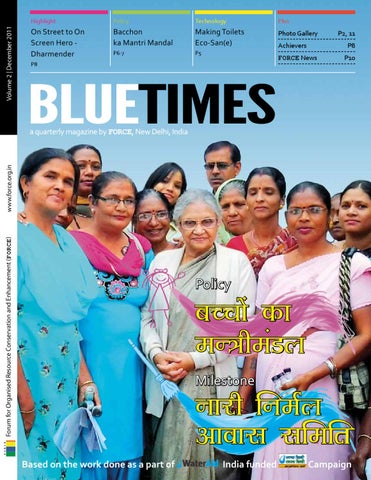
Policy
baccaaoM ka manHaImaMDla Milestone
naarI inama-la Aavaasa saimait Based on the work done as a part of
India funded
Campaign
Founder Editor & President, FORCE Ms Jyoti Sharma
2
Feature Editor Mr Abhishek Kaul
Creative Editor Mr Arun Raj
Reporting Team Ms Akansha Dwivedi, Ms Darshan Anand, Ms Jasvinder Kaur, Mr Krishna Kumar Tiwari
Printed by Adroit Printers
BLUETIMES
a quarterly magazine by FORCE
President’s Note
C OV ER
STORY
Namaskar Did you know that the road to dreaming big goes through the toilet seat of your house? Did you notice that the horizons of your views are a function of the distance of the water point from your house? Or that your notion of heaven is linked to the quantum of garbage around your house?
Black & White
All these stark truths, and more, I discovered while working as a member of the Swatch Delhi Swasth Delhi campaign with Water Aid India.
Ever wondered how Black would feel when he sees the brightness of White; or how White would react to the invisible depths of Black?
Those of us who work on Water, Sanitation and Hygiene (WASH) for the poor, worry about the health impact of not having basic facilities. Or we worry about the number of working days or school days lost because of these. We find it heart-rending to see people living in such horrible conditions and curse the government for not taking better care of the poor. But, to me, the real concern of the lack of basic amenities should be for its effect on Nation building. A child growing up in a city slum dreams only of a toilet or a water faucet in his home, not of a strong and morally upright nation that leads the world. Can we really expect a child, desensitized to the filth all around him or her, to create a clean, green nation? A child who clambers on top of a water tanker every morning to suck water out through his hose pipe and then stands in a long queue of very irritated people in a very dirty toilet to answer nature’s call cannot be expected to learn eclectic notions of respect for individual space, privacy, dignity and courtesy. So, the real loss is of Dreams, Vision and Social Fabric. In a recent Painting Competition, we asked one set of children from a slum and another from a private school to draw on ‘Water and Sanitation’. The difference was an eyeopener. The rich kids could not even conceptualise what to draw on ‘Sanitation’. They thought at a global level, not personal. So we got paintings on Global Water issues, water conservation, water wastage, water pollution etc. On the other hand, the slum children understood Sanitation perfectly and personalized everything; they drew drains, open defecation, water tankers, Community Toilets & garbage heaps.
….Opposites, and yet – perhaps-two sides of the same coin.
I’m sure, each would see in the other, aspects that they would not even notice in themselves. This fascination for the ‘View from the Opposite End’ led us to try a small exercise. We asked two children – one from a slum and one from an upper class colony, to spend time in each other’s neighbourhood. Then, we asked them to just write the thoughts that crossed their mind as they were walking around. The result is these articles – by Arun and Bhavna – expressing their feelings in Black and White….. Arun’s thoughts reflect a fear – of grim realities that he had never noticed before. Bhavna’s article is sad – it has the hopelessness of a child with dreams shackled by circumstances.
What hit me the most was the totally different worlds the rich and the poor – especially the children - live in. This issue of BlueTIMES is an attempt to bridge the divide somewhat. Let the rich understand the reality of poverty. Let the poor see that the route to prosperity is through a higher order Vision and raising internal bars. Hopefully, each of us will become strong advocates for the other’s needs to create a nation where … “Where the mind is without fear and the head is held high Into that heaven of Freedom, My Father, let my country awake.” Happy New Era!
Jyoti Sharma President, FORCE Volum 2 | December 2011 | www.force.org.in
3
A Walk to Remember
Arun Raj
I live in Vasant Kunj - a fairly prosperous locality in Delhi. I lead a fairly comfortable life and have always taken basic facility for granted. I have enough clean water from I don’t know where, further purified in our RO, multiple nice toilets with the muck going somewhere I cant see, and 24 hour electricity. I’ve never really had to crib about these things. Krishna ji from FORCE asked me to try to walk through a jhuggi colony. He took me to a place, in west Delhi called ‘Raakhi Market’; this settlement apparently gets its name from the common occupation of its women who physically filter (channi) the ore (Raakh): tossing the hard gravels & tiny rocks on one side, collecting the refined ore-dust on the other & releasing even finer by-products in the air. The men mostly work as daily wage construction labourers. In spite of several attempts to manage a clean breath, I could feel the obvious heaviness in the air. Other than the ore products there were large quantities of human faecal matter, surrounded by other waste all around, that I had no intensions of exploring.
not signify affluence but are necessities for a healthy life.
baccao doSa ka BaivaYya
In this jhuggi, luxury means a toilet complex without a waiting line, an open shower under a tube-well, a water tanker around which there is no ever-going war for water. Now that I think about it, I realise that they live all around us yet the squalor of their lives is invisible to our eyes.
“baccao doSa ka BaivaYya hOM” yah sauBaaYa cand` baaosa nao kha qaa AaOr Saayad yah sa%ya BaI hO‚ prntu @yaa yah sa%ya Aaja saurixat hOÆ jaba Apnao Aasa pasa doKtI hUÐ tao lagata hO ik yah Aba sa%ya nahIM hO. magar jaba vasant kunja kI saD,kaoM pr doKtI hUÐ tao lagata hO ik saca maoM baccao doSa ka BaivaYya hOM. hma bastI ko baccao ikna ikna pirisqaityaaoM sao gauja,rto hOM. hmaaro mammaI DODI hmaoM saubah fTafT ]znao kao khto hOM“jaldI kr nahIM tao SaaOcaalaya kI laa[-na bahut lambaI hao jaaegaI. fTafT bat-na pkD, kr saD,k pr jaa TOMkr Aata hI haogaa.” idna kI SauÉAat laD,to hue haotI hO @yaaoMik TOMkr idna maoM ek hI baar Aata hO AaOr mammaI ko saaqa idnaBar ka panaI Barnaa haota hO. magar saD,k par ko baccao jaba ]zto haoMgao tao ]nako mammaI papa ]nhoM pucakar kr‚ dUQa ka igalaasa pkDa, kr ]zato haoMgao. ]nhoM Pyaar sao tOyaar kr skUla Baojato haoMgao“baoTa pZ,a[- pr Qyaana dao baaik saba caIja,aoM kI icanta mat krao.” hmaaro mammaI papa BaI hmaoM ]tnaa hI Pyaar krto hOM magar halaat sao majabaUr hOM. kla barsaat hu[- qaI. jaba barsaat haotI hO AaOr AmaIr GaraoM ko baccao barsaat ka maja,a lao rho haoto hOM tba garIba baccao Apnao GaraoM maoM bat-na ilae KD,o haoto hOM @yaaoMik ]nako GaraoM maoM panaI Aata hO AaOr ]nako GaraoM maoM panaI bar BaI jaata hO. faosa- kI dIdI ko saaqa jaba maOM ]nako Gar ga[- tao saaoca rhI qaI ik yah iktnaI la@kI hOM. Gar maoM caar laaogaaoM ko ilae tIna baaqaÉma‚ [tnao saaro nala ik maO ka]nT BaI nahIM kr pa[-‚ baccaaoM ko ilae Alaga kmara‚ khIM kao[- KulaI naalaI nahIM‚ khIM kvara nahIM AaOr hr caIja, ApnaI inaQaa-irt jagah pr imala jaanaa. yah saba baatoM ]nako ilae ibalkula saamaanya hOM pr maoro ilae ibalkula na[-. maOM BaI AcCo skUla maoM jaatI hUÐ magar jaba tk Gar AaOr Aasa pasa ka maahaOla zIk nahIM haogaa tao mauJao nahIM lagata ik maoM kuC baD,a kr pa}ÐgaI. yahaÐ tao hr dUsaro idna maar–ipTa[-‚ gaalaI–galaaOca haota hO. tao eosao maoM AcCo ivacaar kOsao AaeM² mauJao lagata hO ik doSa maoM j,yaada baccao garIba haoMgao Agar hma saba kI isqait yah hO tao kOsaa haogaa Baart ka BaivaYya Æ
As I continued exploring this grim reality, I noticed some women giving me un-welcoming looks, as they guarded other women while they defecated in the open. Previously I had noticed kids squatting at will to tend to natures call & men taking to corners of the wall. I could not help but wonder that in spite of a community toilet why did they still preferred to tend such business in the open! The view of the complex explained why! A large queue was waiting for their turn while a distinctive smell with all its might repelled everyone.
My first feeling was of claustrophobia; walking in between the tiny lanes with barely an arms distance between two Jhopdi’s on either side, saturated with a variety of filth releasing toxic impressions on the ground, air, water & on its inhabitants made me feel stifled and dirty. It was difficult to imagine people just like us living in such areas.
The complex was jointly maintained by a government authority, an NGO & the local community group empowered for the task. Other than the sanitation facilities, they had access to several other aids to improve & maintain their condition. I observed that there is enough & more support available by the government, civil societies & citizens for them and that they could lead a healthier lifestyle if they made a choice. But their perception of hygiene, health, privacy & need etc inhibits them from attaining those. As much as the brick roads, taller walls, efficient drainage, they require a change in their mindset.
The irony was not in the present condition of the place, but in the mentality of its inhabitants. To me, what looked like a hazardous, lethal environment to live in was a perfectly suited accommodation for its people. Men slept next to the refined ore-dust, children played on/ with the waste piles, some defecating next to water sources. I realised that they do understand poverty because they live in it. But they are blatantly unaware of the fact that hygiene and cleanliness do
It seemed to me that the inhabitants have accepted their poverty as an inescapable truth to their lives. I think it is not really poverty that makes them poor but a lack of the feeling to grow out of it. Krishna ji told me about the struggles of the SDSD team, aiming to bring about a change in attitudes. Change in itself is resisted & bringing about a change in attitude is a far bigger challenge that needs to be addressed by all who aim to support people in slums.
kumaarI Baavanaa caÝ(ana
CAN WE DO SOMETHING TO BRIDGE THE BLACK & WHITE GAP??? BLUETIMES a quarterly magazine by FORCE
T E C H NOLO G Y
Making Toilets Eco-san(e) Did you know that you break the nutrient cycle every time you go to the washroom? Did you know that the amount of water you use in the toilet is far more than what you use for drinking and cooking on an average day? Did you ever think of fecal matter and Urine as Resources? That’s where ECOSAN comes into picture. ECOSAN is short for Ecological Sanitation. ECOSAN toilets are being increasingly seen as the answer to the sanitation problems in urban poor settlements. Their technology is simple; they have different pots for different purposes. The older Ecosan toilets had two pots; one for urine and the other for waste and wash water. The newer designs have an extra pot for wash water. In these toilets, excreta is collected in the chamber constructed below the toilet seat and is allowed to decompose for a period of 6-9 months after a chamber gets filled up. After every use, saw dust or ash must
be sprayed into the chamber to absorb the smell, remove any lingering odours, and facilitate the decomposition process. The wastes can then be collected with the help of a pumping machine. Places where ash/saw dust has been sprayed after every use report no smell in the toilets. Ecosan is not just a technology, it is an alternate philosophy altogether. It is based on the systematic implementation of reuse and recycle of nutrients and water as a hygienically safe, closed-loop alternative The Indian Institute of Technology, New Delhi and NGO SCOPE have established Urine bank in Musiri town in Tiruchirapalli district in Tamil Nadu. The proposed urine bank will help extraction of struvite, which can then be used in fertilizers, from urine, taking advantage of the availability of processed urine in the Ecosan Community Compost Toilet (ECCT) and individual ecosan toilets in Musiri. Ecosan toilets have also solved the problem of open defecation in the area. to conventional sanitation solutions. According to the nutrient cycle, nutrients taken from the Earth must be returned to the Earth. In the current system, however, the nutrients, through sewage pipelines, finally flow into the rivers.
Ecosan addresses this problem. It is traditionally well known that our feces and urea (from urine) have nutritional value for plants as fertilizers. Ecosan toilets, by collecting both separately, offer a chance to use these resources. Waste and urine collected in pits can be converted to useful fertilizer after treatment. The problems of water demand, too, are resolved as these toilets reduce water usage by up to 15 liters per toilet trip! If we were to add the economic benefits to the local community from urea and fertilizers, then their use looks even better. They also represent a decentralized sanitation system and are easier to operate. It is also noteworthy that city planners now feel that the sewer and pipe system incurs unsustainably high costs to put in place and maintain. The use of Ecosan toilets is not without its own challenges. The foremost is the taboos traditionally attached to the handling of waste. The scavenging act too is a deterrent though dry vacuum pumps can hopefully solve this problem in future. Use of Ecosan toilets is also restricted by demands of people for ‘Modern flush toilets’. It is also seen as an indicator of poverty and is therefore unpopular among the urban masses. Also, the proper use of these toilets is dependent on the individual using it, although the human plumbing system does support the design. The success of the model in the Guangxi province of China, where 685,000 toilets units (!!) have been constructed, proves that it is do-able on a larger scale. Though a lot of pilot projects have been undertaken, and mainly in rural or urban poor areas, and are at various stages of completion, India is yet to take Ecosan seriously unlike China, where the model is being replicated, and perfected, by practical use in millions of rural households. Though a ‘toilet revolution’ seems a distant future, Ecosan holds hope in face of poor sanitation facilities, the need for a simpler sanitation infrastructure and dying national rivers.
Volum 2 | December 2011 | www.force.org.in
5
Kooda Mantri
ao. aoga A a z la ] M o a m a , o UD O. eosa aoÆ k o a l rhta h @yaa haoMg h p ao a haota ao AaOr s a b a s a, [@T\z M haoMgao t kUD ahI n r ibamaa
A Walk Around Arjun Camp Though I have been to a slum cluster before, my visit to Arjun camp today still generated enough excitement. After all, I was going to talk to kids of the area who were going to pose as Mantris and tell us, me and three of my colleagues, the changes they wanted to see in their area. The area animator had given them their respective roles a day before; all the seven mantrisKooda, Naala, Shauchalaya, Paani, Bore, Health and Sewerwere therefore ready and bursting with their views. As we walked towards the camp, a huge dump of garbage welcomed us, giving off a wonderful smell! The dump covered a small playground; something we were told the kids wanted as a playground indeed. The naalis we saw saw as we actually entered the camp seemed small but were fairly clean. Kids were playing around without a care in the world. As we walked towards our meeting place, I saw small plastic tanks, covered with plates or plastic covers, outside homes filled with water. The kids were very excited to see us. They had clearly done their homework; all of them were clear with what they wanted to see in their areas.They had demands, suggestions, complaints and solutions for us. As we set out with our young friends to see things for ourselves,
Pani o. Mantri a d I a an a n S a @ o p a k na o a l h oM p an aI k p o a s ma aa ihe . a b r a a s r ek G h aonaa c h
6
Policy vs Practice – A child’s eye view
Contrary to what most people think, Indian government has some good policy / public welfare statements. Policies are made by an elected ‘MANTRIMANDAL planners with, hopefully, good intentions and long term vision. But do these policies
National Urban Sanitation Policy Vision: All Indian cities and towns become totally sanitized, healthy and livable, ensure and sustain public health and environmental outcomes for all their citizens. Milestones for 100% Sanitation Goal
Milestone
Creation of open defecation free cities(100% OD Free)
Totally free from open defecation; Sanitary collection and treatment of 100 percent human excreta and waste water.
Sanitary and safe disposal of all human and liquid wastes (100% sewage free)
All grey water collected and disposed off safely; All storm water is properly managed.
Solid Waste collected and disposed off fully, safely and regularly (including reuse) (100% garbage free)
100 percent of solid waste is collected and and disposed safely & regularly (including reuse).
Services to the poor and systems for sustainable results
Robust processes and systems in place in the city for the sustenance of results. Special attention to the un‐served and urban poor.
Improved Public Health Outcomes and Improved environmental standards
The city shows sustained improvements in public health indicators and environmental Standards
There is no National Urban Drinking Water Program. So policy pointers are being taken from the Rural Drinking Water Program
National Rural Drinking Water Program National Goal To provide every rural person with adequate safe water for drinking, cooking and other domestic basic needs on a sustainable basis and conveniently accessible at all times.
BLUETIMES
a quarterly magazine by FORCE
translate into reality? Do the intended beneficiaries experience or appreciate the policy vision? Abhishek Kaul, takes a walk around Arjun Camp (a slum in South Delhi) and talks to a BACHCHON KA MANTRIMANDAL to find out….
Objective: To ensure permanent Household level drinking water security in rural India. Delivery of services by the system for its entire design period of quality of water in conformity with the prescribed standards at both the supply and consumption points. Issue of potability, reliability, sustainability,convenience, equity and consumers preference to be the guiding principles while planning for a community based water supply system. To enable communities to monitor and maintain surveillance on their drinking water sources. To provide enabling environment for Panchayat Raj Institutions and local communities to manage their own drinking water sources and systems. To provide access to information through online reporting mechanism with information placed in public domain to bring in transparency, accountability and informed decision making. Norms: 1) Quantity of Water : 40 litres per capita per day (lpcd) of potable water within 500 mts from the household from either a public or a community source under the ARWSP guideline (1972). 2) Ease of Availability : Coverage of population is to be calculated on the following criterion: – Percentage of people within habitation getting basic minimum quantity of potable water within a distance of 500 mts from the household from either a public or a community source. 3) Parameters of Potability - Water is defined as safe if it is free from biological contamination (guinea worm, cholera, typhoid etc.) and within permissible limits of chemical contamination (excess fluoride, brackishness, iron, arsenic, nitrates,etc.) as per IS-10500 standard of BIS. Norms by National Capital Region Planning Board Norms and standards in NCT-Delhi specify a minimum of 225 lpcd. For Spot sources and rural areas, where water is provided through public standposts, it is 40 lpcd and otherwise, 70 lpcd. In urban villages rate of water supply should be similar to the town with which it is surrounded. Reality bytes: About 50 million people in urban India resort to open defecation. 26 percent do not have any household sanitation arrangements. As high as 82 percent of urban households dispose human wastes in an unsafe manner. 70 percent wastewater from sewerage systems not treated and let out unsafely. 80 percent of surface water pollution is due to municipal sewage alone. Volum 2 | December 2011 | www.force.org.in
Naali Mantri sabasao phlao saIvar dao. hmaaro skUla maoM saIvar hO pr yahaÐ nahIM. naailayaaÐ BaI
hmaaro skUla maoM saIvar hO pr yahaÐ nahIM. naailayaaÐ BaI gahrI nahIM hOM. baairSa maoM GaraoM maoM BaI panaI Gausa jaata hO. skUla jaOsaa yahaÐ BaI haonaa caaihe. we could see why the kids had been so vocal and with such conviction. There were just two running bores, a DJB’s and one run by the village. I wondered how just two bores could satisfy the need of 7000 people. They clearly needed more water! The number of toilets shocked me even further. Twenty toilets for a 1000 plus households! The fact that there were 225 toilets in individual houses, as I was told later, did dilute the shock a bit but the figures still hounded me. No surprises therefore that open defecation was rampant. The last on our list, but not the least (as they say!), was the khan. It was where all the muck from the toilets and the naalas flowed. It was a unique sight; a pond in the city with all slopes leading to it and with only waste water. I tried not to think of what this pond did to the ground water, the only source of water for the camp. I felt much better after we left and entered the noisy Gurgaon highway, even with its polluted air. But the question of the conditions of existence of the camp people didn’t leave. The research we had done, on norms and objectives of the govt, seemed like a useless piece of paper, a distant dream, compared to the living reality of the slum. But the noice of the highway soon eased the pain to a blur before I got lost in the melee completely.
Shauchalaya Mantri
sabasao phlao SaaOcaalaya dao. ek saamaudaiyak SaaOcaalaya AaOr hja,ar sao j,yaada Gar² kuC GaraoM maoM SaaOcaalaya hO pr baakI laaogaaoM ka @yaaÆ
7
AC H I EV E R S
On Street to On Screen Hero Dharmender
After joining FORCE in May 2008, Dharmendra continued to work on site in the SDSD project. He was instrumental in designing FORCE’s first Biogas plant and installed the first batch of biogas projects himself. He introduced several innovations in the design and till date has the most efficient biogas plant in his home in the Amar Park slum cluster in Zakheera. Dharmendra, because of his vast site experience, has now also become the SOS
I remember the time Chandrakaanta, Captain Planet, and Batman were the ones I admired and wanted to emulate. Having stepped into the real world now, the life of chocolate boy’s hero’s, seems like a weekend escape. Away from the comfortable couches, people battle every day in the heart of our cities. Some either lose their fight or make their peace. Others fight on, grinding their way to what their sense of life is, and what they expect from it. They are our working class hero’s. My colleague Dharmendra is one such hero. At a time when it may have been easier for him to be a junkie, he showed the grit to dig deeper. After failing in Our Hero - Dharmendra his class X board exams in 1995, he wasn’t involved in productive work for years. His father’s death in 2001 also proved to be a major setback. Now, after turning the page, he is a senior member of the SDSD project (Swach Delhi Swasth Delhi), funded by Water Aid, and in charge of Bio-Gas plant installation and Rain Water Harvesting (RWH) maintenance. After a couple of odd, short stints, Dharmendra joined the Water Aid project with INDCARE in 2007. It was here that he began his journey into the social sector. He worked on their projects in urban poor settlements, travelling to Bhopal and Chennai for work. 8
Dharmendra: On Education
pZ,a[- ila#aa[- kI kao[- saImaa nahIM haotI. [tnaa pZ,aila#aa haonaa caaihe kI Gar va naaOkrI ko kama AasaanaI sao hao jaayaoM. On Life
mana kI idSaa hI pkD,I hO ABaI tk tao. pZ,a[- CaoD,I‚ ifr Apnaa kama ikyaa‚ ifr ]sao BaI CaoD, kr naaOkrI krI. Pirvaar ka sahyaaoga hmaoSaa maoro saaqa rha. On Working In The Social Sector
ena•jaI•Aao• ko kama sao jauD,naa caaihe‚ laaogaaoM kI madd krnaI caaihe‚ saaf safa[- AaOr Apnao raoja, mara- ko kamaaoM kI jaagaÉ@ta baD,anaa AavaSyak hO. On His Journey With Force
faosa- maoM kama krnaa AcCa lagata hO. kaibailayat hO yahaÐ laaogaaoM maoM. saba ko saaqa AcCa irSta rha hO phlao BaI AaOr ABaI BaI. DaOlaI jaI AaOr dSa-na jaI nao BaI kafI maaga-dSa-na ikyaa maora. samaudaya ko kama maoM hmaoSaa [na daonaao nao hI mauJao rah idKa[-. Jasvinder ji: On Dharmendra
Qamao-nd` samaudaya maoM rhnao vaalaaoM maoM sao hI hO. ]sako eiryaa maoM jaba maoOM ]sasao phlaI baar imalaI tao ]sako ]%saah kao doKkr bahut KuSa hu[- qaI. tba ]sanao j,yaada kama nahIM ikyaa qaa pr Aaja vah ek tknaIkI laIDr hO‚ baayaaogaOsa va roona vaa^Tr hava-oisTMga ka.
Dharmendra, with Darshan ji, installing a Bio-gas plant
call for the FORCE office! He has also established himself as the leading RWH expert and shoulders the load of design and maintenance of RWH structures. Dharmendra was also recommended by the MCD councilor to oversee the laying of new sewage line in his area. The news of his accomplishments, in fact, prompted Pragya TV Channel to run a half hour show exclusively on him, thus turning him to an on-screen hero and showing him as a role model for kids in the city. Dharmendra thanks Mrs Darshan Aanand, or Darshan ji, and Mrs Jasvinder Kaur, or Dolly ji as she is fondly called, for guidance and support. Both have been working since the project first started, and were primarily responsible for encouraging people and getting the initial set of orders for biogas plants. Their experience and guidance has been an inspiration for Dharmendra. Always polite, co-operative and friendly, Dharmendra has established himself as an indispensable part of the FORCE team. His knowledge and management of work on site is exemplary. He is also happily married and lives with his mother and wife. The word role model does get thrown around a lot these days, but it would be easy to say that children can learn from him and even follow his example. Now, wouldn’t you call him a hero??
BLUETIMES
a quarterly magazine by FORCE
C OM M U N I T Y
PAG E
naarI inama-la Aavaasa saimait Transition from a housewife to a Community leader FORCE, in partnership with WaterAid India, has been working with urban poor settlements to improve their water, sanitation & hygiene conditions for over three years now. FORCE began work with the idea of empowering local community leaders to actively engage & lead the change. And so, the ‘Swatch Delhi Swasth Delhi’ campaign was conceptualized to make the community demand and lead development on these issues. In every ward, the communities formulated teams with FORCE acting as a guiding facilitator. Women leaders came forward and took the lead in a short span of time. They succeeded in their tasks, thanks to their seriousness & dedication.
With this growing gender dynamics, the community group formed to facilitate improvement in the prevailing condition soon restructured itself into a Women’s self help groups devoted & committed to the cause, called the ‘Naari Nirmal Awaas Samiti’.
Chief Minister Smt. Sheila Dikshit in a meeting and demanded safe drinking water. A follow-up meeting on solutions to this problem is also due. The NNAS teams have chosen to install decentralized solutions to solve water problems in the mean time.
naarI inama-la nao zanaa hO‚ ibamaarI mau@t xaoHa banaanaa hO..
They have also taken leadership in spreading awareness in their respective areas. With FORCE’s support, they organised an exhibition on healthy and hygienic water and sanitation practices. They also held a painting and drawing competition for children to encourage them to think on these issues. In this process, they, as active agents of social change, are improving the community’s present condition.
These women work with great zeal and zest. The NNAS teams organize community meetings regularly to discuss problems in their areas. With training & support, they carried out water quality testing for their drinking & domestic water supplies. In fact, the NNAS teams presented the report of these tests to
Partners in Progress
Community Toilet Complex Monitoring One major thrust of the Swatch Delhi Swasth Delhi Campaign (SDSD is on open defecation & its repercussions on communities. For any progress on this front, it was critical to improve the prevailing sanitation facilities. Majority of the urban poor settlements have a Community Toilet Complex (CTC), typically consisting of 20 to 40 toilet seats, bathing areas & hand wash points. A major problem, other than the shortage of toilets, is the maintenance of the existing CTC’s. In Delhi, MCD has outsourced toilet complex management to a service provider provides through a legally binding contract, which includes detailed guidelines of the responsibilities, revenue streams & feedback mechanisms. However, on-ground implementation of
the contract is very poor. To enable execution as per guidelines, FORCE conceptualized a monitoring system to report services available on ground. This was the genesis of the CTC monitoring committee; 2 women from within the community made a status report every fortnight on 15 monitoring parameters that were a part of the contract. Training programs were held to equip teams on ‘why’ and ‘how’ to monitor. Mass awareness programs were also organized to empower the community by building a better understanding about their rights. FORCE started the monitoring process with modest support, & understanding, in two communities in 2009. It later escalated to 14 communities by 2010
and now we work in 75 communities in 12 MCD & NDMC zones. The feedback mechanism ensures reports are updated on a centralized database & sent to relevant govt. authorities. Quarterly review meetings are held between relevant Deputy Commissioners (DC) of the district, the CTC monitoring committee & the service provider. The outcomes of the vigilant monitoring committees are stark & outstanding. They are visible in the condition of the toilets, frequency of users & the significant reduction in previously recorded open defecation. This tripartite execution, monitoring & feedback between a private organization, a community group & the govt is proving to be an excellent model for a functional partnership.
Sunita Ji led the NNAS of Zakhira, Rakhi Market & stood against the toilet complex caretaker. She lodged an official complaint, regularly updated the status & dedicatedly followed up on her complaint for more than eight months. Her complaints were against the maintenance facility, water & electricity provision in the complex. Users had to physically carry water with them to use the toilet complex. Now the complex has its own metered electricity & water points. The bill is jointly shared by the community.
Volum 2 | December 2011 | www.force.org.in
9
FORCE NEWS Developments in Swach Delhi Swasth Delhi campaign: The Swach Delhi Swasth Delhi (SDSD) campaign, which is being run in partnership and funding support of Water Aid India, saw a lot of productive activity. Other than the achievements of NNAS and CTC monitoring teams (as mentioned in the previous page), awareness activities for children included exhibition in a number of schools in Delhi. A workshop on Grass Root comics, an interactive way of expressing thoughts on a single comic page, also engaged children and revealed deeper information about their aspirations and their surrounding environment. Latest development work also included laying of sewer drains in Dalit Ekta Camp and Harijan Basti, both in Vasant Kunj, with the help of the local councilor and the MLA. One water point each, managed by NNAS, was constructed in Harijan Basti and Naala camp. The water point ensures that every household gets 20 liters of drinking water every day. Development work- which includes construction of Community centers, New Community Toilet Complexes, and 3 new borewells- has also started in Vivekanand Camp in Chankyapuri. Blue Delhi Campaign: The Blue Delhi campaign, which was flagged off by the former Minister of Water Resources, Sh. Salman Khurshid, at Rajpath, has been generating tremendous interest in the media as well among the civil society organizations. A core strategic planning panel comprising of leading civil society and govt experts has been formed and work has started towards achievement of the Blue Delhi goals. The committee is chaired by the DJB CEO Mr. Ramesh Negi. The good work carried on with a meeting with the Honourable Minister of Water Resources Mr. Pawan Kumar Bansal. The minister has asked FORCE to convene a National seminar on water conservation with leading experts from the sector. The Blue Delhi campaign has also managed to garner fund support under various task forces through corporates, PSU’s & aid organizations like HSBC, MMTC and Water Aid respectively. An interactive game, Watch your Water Footprint (WOF) was also organised with students from Sri Ram College of Commerce (SRCC). It aimed at making students aware about their indirect water consumption. Delhi- Water Wise Greening Kitchen waste water greening system with a modified design, which was first installed in a block in Vasant Kunj, has now been made operational in Mandakini Enclave in Alaknanda in South Delhi. The system aims at providing treated kitchen grey water for greening of plants in the society. The project is being supported by Delhi Parks and Gardens Society (DPGS), which is under the State Government. UN-Habitat-CAF - Support My School Campaign FORCE is the NGO Partner in the National - Support my school campaign in Maharashtra. This campaign is a partnership between CAF-India, UN-Habitat, Coca-Cola India, NDTV and other corporates. FORCE is responsible for providing Safe Water and Healthy living infrastructure in 6 government schools in Mumbai and Pune. In September 2011, we finished work in Adarsh Vidhalaya in Thane. The facilities added in the school include a Rain water harvesting structure, toilet facilities, UV Filters and a Badminton court for the children. FORCE also supported the celebrity studded 12 hour NDTV Telethon held on September 18, 2011 to raise additional funds for the project. Developments in Rain Water Harvesting: A total of 5.6 crore liters of water was recharged to the ground water aquifers through Rain water harvesting. FORCE, in partnership with communities, corporate donors like Coca-Cola India and KPMG, and government bodies has implemented 7 projects in Delhi/ NCR region. These include colleges under Delhi University (Gargi & SRCC), TV channel premises (Pragya TV in Noida) and a stadium in Ghaziabad (Mahamaya stadium). The lake revival plan in Roshanara lake was also carried out successfully. The plan to revive the lake was based on surrounding catchment and Rain water channelisation. The lake itself is a part of the centuries old Roshanara Bagh in North Delhi. Water Guardians International Water Guardians International (WGI) has taken off with clubs in Alaknanda and Gurgaon. These clubs have also taken up water related work and activities. The WGI is a platform and forum for all water wise and environment conscious people to take up the cause of water.
10
BLUETIMES
a quarterly magazine by FORCE
Ms Neeta Ambani interacting with school kids from Kandivili Mumbai as a part of Support My School Campaign
Rainwater Harvesting Dedication Ceremony at Om Shanti Retreat Centre - Bramhakumaris
Filmstar Govinda at School for Deaf & Dumb at Kandivili Mumbai, as a part of Support My School Campaign
Inauguration of Water Wise Greening Project at Mandakini Enclave, Alaknanda
Water Wise Greening work in progress at Mandakini Enclave, Alaknanda
NNAS team organized an awareness drive on Safety Measures for the Monsoon
Blue Delhi Campaign Meeting with the Honble. Minister of Water Resources, Sh. Pawan Bansal
NNAS team with the Chief Minister of Delhi, Smt. Sheila Dikshit, discussing about Right To Water
WOF - Watch your Water Footprint at Sri Ram College of Commerce
Water Testing training program for NNAS
NNAS in partnership with Slum Department facilitated road restoration work at Israel Camp, Rangpuri Pahadi
All paintings and drawings are part of Water Aid supported SDSD campaign Volum 2 | December 2011 | www.force.org.in
11
Swatch Delhi Swasth Delhi Special Issue
p`aqa-naa
ho [-Svar Ñ Aapnao hmaoM ApnaI Civa maoM banaayaa magar yah baat hma samaJa na Paayao . hmaoM &ana dao AaOr Sai@t dao ik hma Aap kI Civa pr pD,I maOla kao dUr BagaayaoM Kud kao AaOr [sa QartI kao svaga- banaayaoM.
(Recipient of National Urban Water Award 2009)
Forum For Organised Resource Conservation and Enhancement C-8/8035, Vasant Kunj, New Delhi – 110070, India, Ph: 91 11 46018754, Telefax: 91 11 26893502, Email: force@force.org.in, Web: www.force.org.in BLUETIMES is a Water Wisdom Quarterly Magazine published by Forum for Organized Resource Conservation and Enhancement (FORCE). The views expressed are those of the authors and Editorial Desk and may not necessarily conform to those of FORCE.
12
BLUETIMES
a quarterly magazine by FORCE