CONTRIBUTORS Bob Abelman, Ruth Marris Macaulay, Sarah Greenleaf, Robert Isenberg
COLUMNISTS Michael Fink, George M. Goodwin, Patricia Raskin, Rabbi James Rosenberg, Daniel Stieglitz
VOLUME XXXIII, ISSUE VI
JEWISH RHODE ISLAND (ISSN number 1539-2104, USPS #465-710) is published monthly except twice in May, August and September.
PERIODICALS POSTAGE PAID at Providence, R.I
POSTMASTER Send address changes to: Jewish Rhode Island, 401 Elmgrove Ave., Providence, RI 02906.
PUBLISHER
The Jewish Alliance of Greater Rhode Island, Interim President/CEO Harris Chorney, Chair Marisa Garber, 401 Elmgrove Ave., Providence, RI 02906. 401-421-4111; Fax 401-331-7961
MEMBER of the Rhode Island Press Association.
COPY DEADLINES: All news releases, photographs, etc., must be received on the Wednesday 10 days prior to publication. Submissions may be sent to: editor@jewishallianceri.org.
ADVERTISING: We do not accept advertisements for pork or shellfish. We do not attest to the kashrut of any product or the legitimacy of advertisers’ claims.
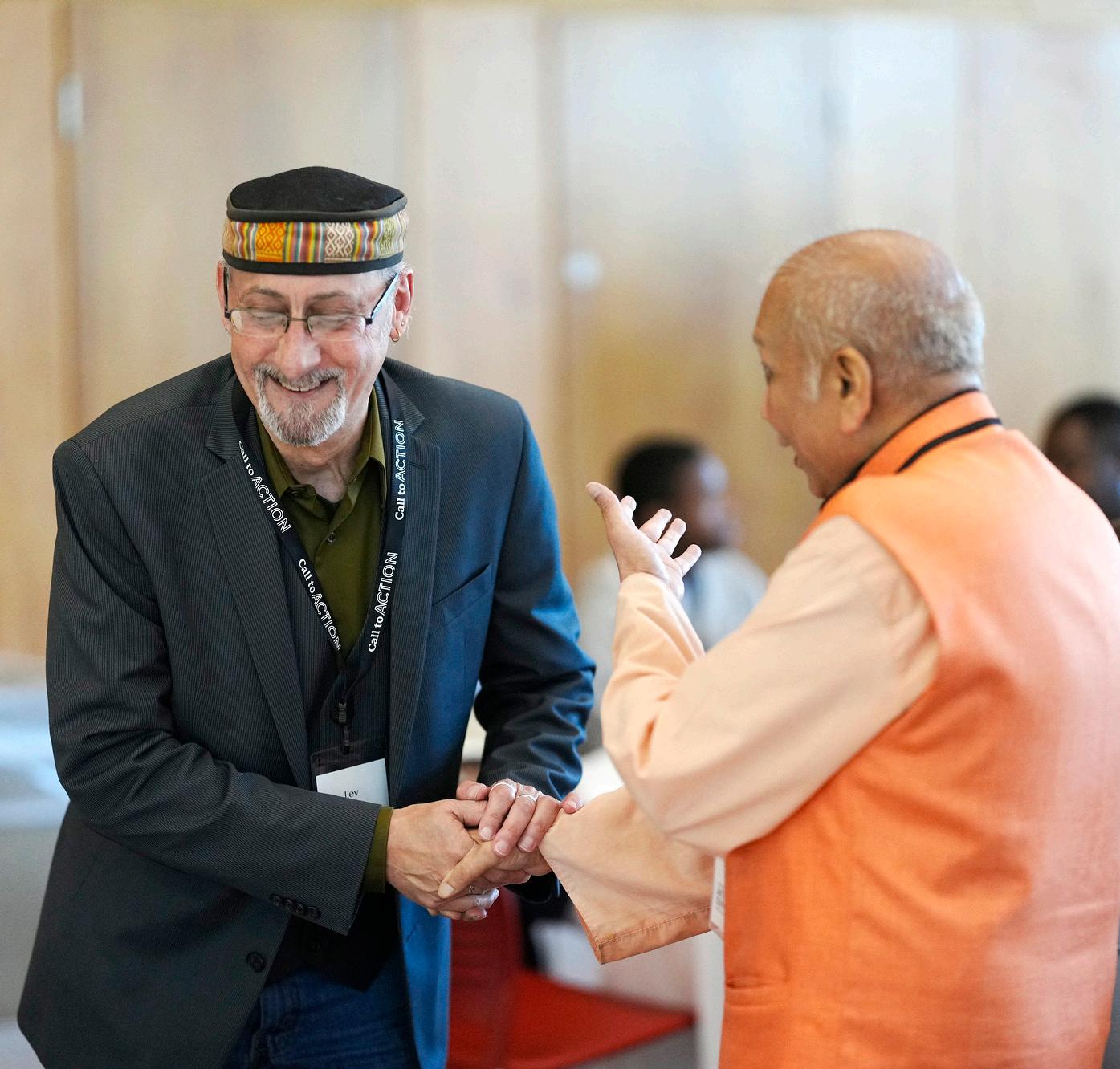
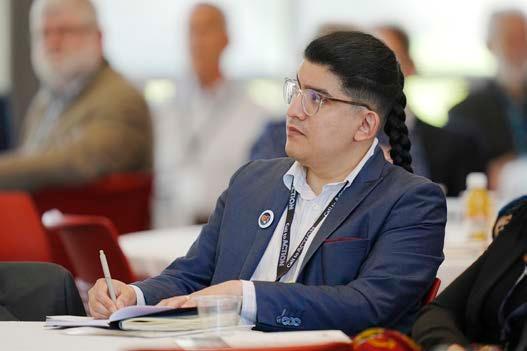
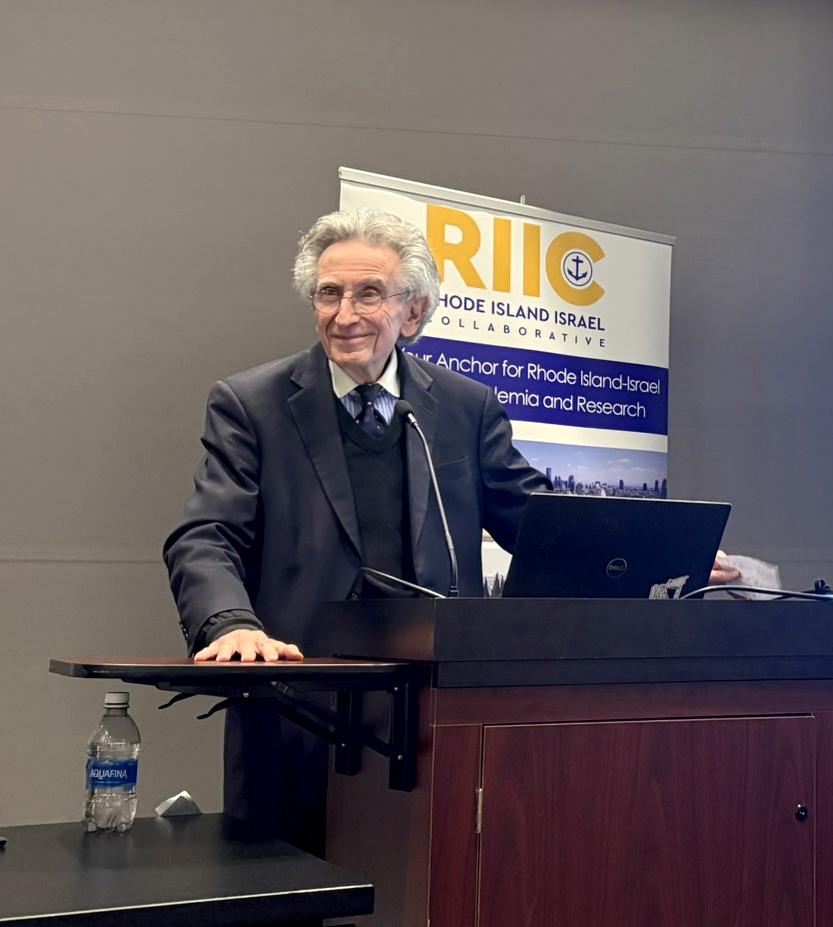
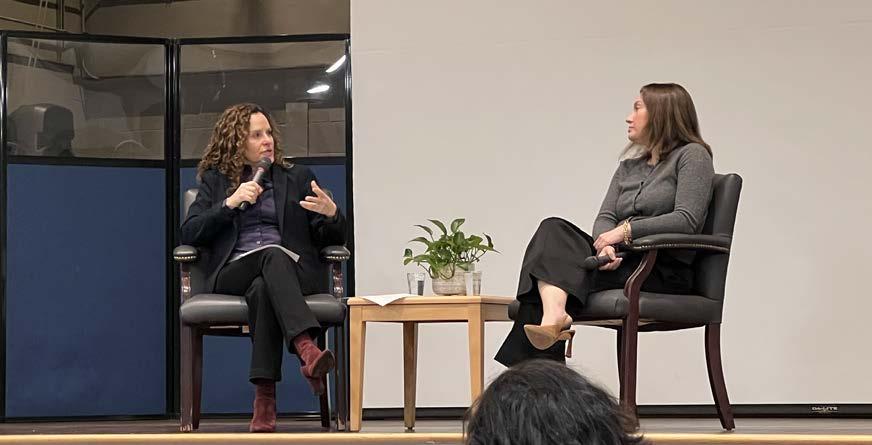
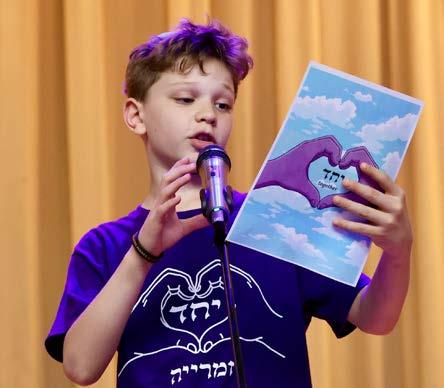
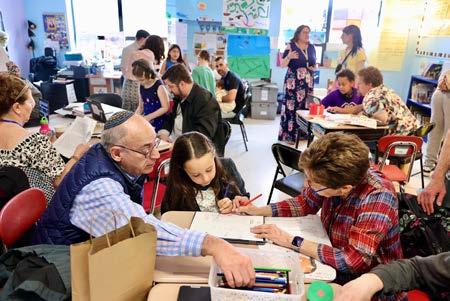
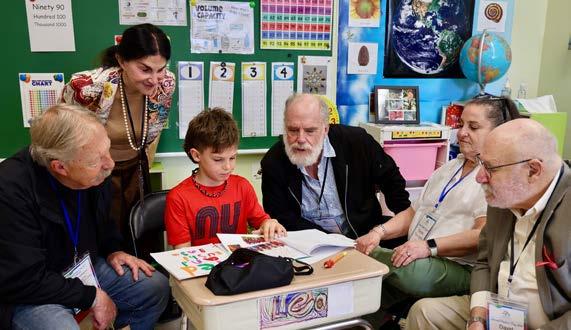
ON THE COVER : PHOTO | GLENN OSMUNDSON Lev Poplow with Swami Yogatmananda at the Anti-Hate Summit on May 28, 2026, at Rhode Island College in Providence, R.I.
How to show your support for the paper and new editor
WHEN I WROTE A COLUMN in March and headlined it “The Long Goodbye,” I had no idea how prescient that really was. Honestly, it was supposed to encapsulate my years as a journalist before retiring.
Instead, lots of my friends and co-workers have chuckled as I’ve continued in an interim capacity during a search for a new editor.
I am happy to report that the search has been successful. Jewish Rhode Island will soon have a new editor.
Our new editor is a New England native who has editorial, communications and journalism experience inside and outside the Jewish world. And I think you will find that he has the skills and personality to continue the paper on its trajectory to cover the entire Rhode Island Jewish community and build on the foundation of many previous editors. I couldn’t be more excited to see where Jewish Rhode Island goes from here.
Look for Dan Margolis to introduce himself in the July editor’s note.
I hope you will welcome him to the Rhode Island Jewish community. I’ll be helping him with the July issue and then, hopefully, can begin to experience the retirement I anticipated in April. That long goodbye only took five months.
As we all consider what we would like to see for the future of the newspaper, perhaps consider a gift to the annual Patron Campaign. Fundraising is tough in the current economic climate. Prices for everyday goods and services are rising and so are the costs of putting out a newspaper. Even a digital paper is not without its costs.
A gift to Jewish Rhode Island’s Patron Campaign goes straight to the paper’s operating fund. It is not funneled through any other fundraising campaign. It shows that you support the work of Jewish Rhode Island in communicating local information about the Jewish community to others throughout the state.
We are so fortunate that more than 100 people have donated to the campaign thus far this year. We hope you will join them before our campaign closes at the end of June. You can use the envelope inside the paper or go to jewishrhody.com and click on the donate button at the top of the homepage. Your donation joins a generous grant from the Jewish Federation Foundation and support from our advertisers to bring you the print newspaper and its digital website.
Changing hats from editor back to longtime member of the Jewish community of greater Rhode Island, I can tell you that your gift, no matter its amount, is money well spent on sustaining an important way of connecting the Jewish community – and you with your Jewish friends and neighbors.
Fran Ostendorf Interim Editor
D'VAR TORAH 5 | CALENDAR
communicate Jewish news, ideas and ideals by connecting and giving voice to the diverse views of the Jewish community in Rhode Island and Southeastern Massachusetts, while adhering to Jewish values and the professional standards of journalism. ALL SUBMITTED CONTENT becomes the property of Jewish Rhode Island. Announcements and opinions contained in these pages are published as a service to the community and do not necessarily represent the views of Jewish Rhode Island or its publisher, the Jewish Alliance of Greater Rhode Island. We reserve the right to refuse publication and edit submitted content
UP FRONT The ‘Jewish Geography’ of Major League Baseball
BY DOUGLAS STARK
When Major League Baseball (MLB) teams made their final roster decisions prior to the start of the 2026 season, seven Jewish players earned opening day assignments. This included Max Fried (New York Yankees), Alex Bregman (Chicago Cubs), Harrison Bader (San Francisco Giants), Spencer Horwitz (Pittsburgh Pirates), Joc Pederson (Texas Rangers), Jake Bird (New York Yankees) and Max Lazar (Philadelphia Phillies).
THIS IN CONTRAST to the 18 Jewish players who played MLB ball in 2025.
Each year, learning which Jewish players make the majors has become a ritual for Jewish sports fans. Sometimes referred to as “Jewish Geography,” this tradition leads fans to identify, track and celebrate these players who give Jewish pride to fans across the country.
Fans recall the earlier generation of Hank Greenberg and Sandy Koufax, both of whom became symbols for the Jewish community by refusing to play on the High Holidays. In more recent years, and in Red Sox Nation, players such as Kevin Youkilis and Gabe Kapler, and front office personnel like Theo Epstein, Chaim Bloom and Craig Breslow bestow a certain pride in the Jewish community.
Concurrent with the start
of a new season is often the publication of a new book about Jews and baseball.
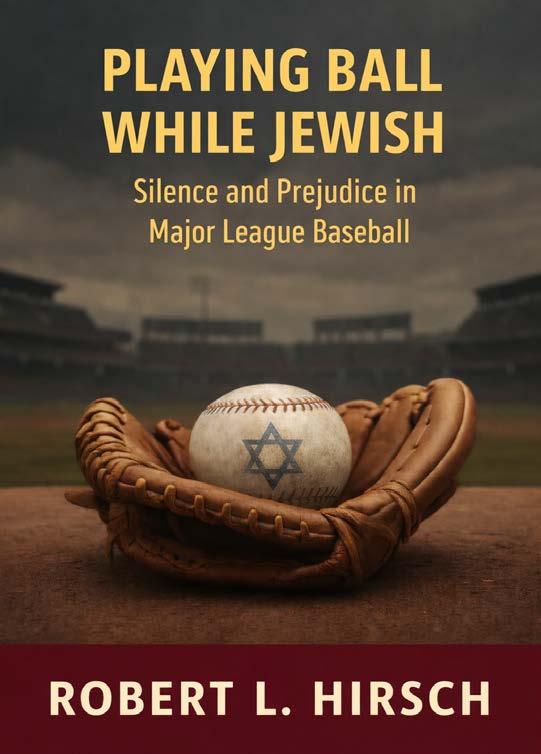
Robert L. Hirsch, PhD. offers us a Jewish baseball story with his recent publication, “Playing Ball While Jewish: Silence and Prejudice in Major League Baseball.” In it, he takes a sweeping view of Jewish baseball players and antisemitism and how this has shaped America’s national pastime.
Most books about Jews and baseball (and there have been quite a few in the last decade) are either biographical in nature or compilations of oral histories that provide first-person narratives about these players, their careers and their upbringing as American Jews.
What is both refreshing and insightful about “Playing Ball While Jewish” is the historical arc it takes and how that overlaps with
twentieth century America in terms of immigration, assimilation, democratization, the evolution of antisemitism and the rise of the social media age.
The book traces this history from the early 20th century, when Jewish players faced overt hostility. Players navigated ethnic slurs and physical fights, causing pressure to change their names, in an era when antisemitism was widely tolerated in American society. It then follows the gradual shift in the postwar period, as opportunities expanded, but expectations of assimilation remained strong. Jewish identity was often muted, and public expressions of religious or cultural affiliation were approached with caution.
In more recent decades, Jewish players have become more visible, yet the nature of prejudice has changed rather than disappeared.
Overt discrimination has largely receded from the public arena, replaced by subtler forms of bias, including stereotypes, private pressures and, more recently, online hostil-
ity. The book argues that the experience of Jewish players reflects a broader pattern in which acceptance is often conditional, and vis -
CONTINUED ON PAGE 5
The front cover of the book.
What we can learn from Miriam
In this week’s Torah reading, Beha’alotcha, we find that Miriam speaks badly about her brother Moses and is therefore stricken with leprosy. As a result, she is quarantined outside the Israelite camp for seven days, after which she is healed and returns to the camp.
THERE IS NOT MUCH that we know about Miriam, and here is what we do know.
The Torah refers to her as “Miriam the Prophetess” and the Talmud names her as one of the seven major female prophets of Israel. Scripture describes her alongside of Moses and Aaron as delivering the Jews from exile in Egypt: “For I brought you up out of the land of Egypt and redeemed you from the house of slavery, and I sent before you Moses, Aaron and Miriam.”
(Micah 6:4)
We recall that when the Jews were slaves in Egypt, the Pharaoh decreed that all Jewish newborn males were to be cast into the Nile River. Personally, I doubt that any mom or dad would actually do this. Now be that as it may, we read that Moses’ mother could no longer hide her baby – Moses – and instead placed him in a basket of reeds, and sent him off on the Nile, hoping someone would find him and take care of him. And to help assure his safety, Moses’ older sister, Miriam, was assigned to watch over him. As it turned out, Miriam was the oldest child of the family, six years older than Moses - so she was just 6 years old when she was guarding her baby brother Moses. Thus, Jewish tradition holds her in high regard, as a brave and courageous soul.
ibility can carry both pride and risk.
Hirsch charts this within three distinct eras—open hostility, mid-century with the decline of Jewish players and the social media era.
According to Hirsch, “Ultimately, “Playing Ball While Jewish” is both a historical study and a cultural analysis. It demonstrates that antisemitism in baseball did not simply disappear over time, but evolved in form, moving from overt exclusion to quieter, less visible pressures that continue to shape the experience of Jewish players today.”
Some of the stories are well known and others are long forgotten but no less important. For Hirsch, learning about Marge Schott, the for-
We next find Miriam, many years later, when the Israelites are finally released from Egyptian bondage, cross the Red Sea and begin their travels towards the Promised Land. Moses leads the Israelites in song – in what is known as the Song of the Sea. Then, Miriam herself leads the women in a similar song, which indicates that she has achieved at least some stature in her own right, aside from being Moses’ sister.
Then, we find Miriam, along with her brother Aaron, questioning the authority of Moses, basically proclaiming – Hey, Moses – who/what makes you more special than us – does not God also speak with us as well? The actual text is: “Has the Lord spoken only to Moses? Hasn’t He spoken to us too?” (Numbers 12:2)
So, the question is: why did Miriam and Aaron challenge Moses’ authority? Well, from a negative perspective, we can surmise that she and Aaron were jealous that he was the ultimate leader and not them. And we can certainly understand that sentiment, although we may not agree with it.
On the other hand, this came shortly after Moses realized that he had too many arguments and disputes to solve among the complain-
mer owner of the Cincinnati Reds, was a revelation. By reports a racist and a white nationalist supporter, Schott allegedly had a Nazi swastika
armband in her home. She also reportedly kicked out a Jewish vendor working in the stadium. She even tried to have a Jewish shop owner kicked out of a local hotel.
“I did not know how bad she was,” stated Hirsch. Antisemitism in baseball continues to exist. Hirsch argues that unless Major League Baseball develops an
ing Israelites, so he set up a system of courts and spent much of the day judging. From this perspective, Miriam and Aaron could simply have tried to ease Moses’ burdens by claiming that since God speaks to them as well, they can help him out – he does not need to take full responsibility for everything. But, since Miriam was punished, we can assume that God did not see this in a positive way.
Later in the Torah, we are told that Miriam died, and the people cried unto the Lord for there was no water and they were parched.
From this, the Rabbis learned that because of the merit of Miriam, a ‘well’ accompanied the Israelites when they were wandering in the dessert. The rabbis explained that when she died, the well dried up; and hence, there was no water for the Israelites. Thus, Jewish tradition holds her as a woman of great worth and esteem.
But wait, there’s more: here is a little-known fact about Miriam. Although there are various opinions throughout Talmudic sources regarding Miriam’s spouse, the most commonly accepted opinion is that she was the wife of Caleb, one of the spies sent to scout the land of Canaan, who expressed trust in Gd’s powers. And as far as we know, she had no children. (We are told about the children of Moses and Aaron.)
And, it has become customary in many families to place Miriam’s cup on the Seder table, much as we do with Elijah’s cup.
Perhaps her very name bespeaks of her life. “Miriam” has been associated with the word “Mar” meaning ‘bitter’, and with the word “Rahm” meaning ‘uplifted’. Modern interpreters look at Miriam
educational program, this problem will not go away. He commends many of the individual franchises that offer Jewish Heritage Nights (including the Boston Red Sox) as a way of celebrating and inspiring pride in Jewish culture. Usually, paying customers receive themed merchandise (examples include Hebrew-lettered jerseys), kosher food, cultural-based performances and recognition of community members.
These are important gestures but do not go far enough in addressing some of the issues that continue to plague the game.
The book is greatly enhanced by the research Hirsch did into learning more about the relationship between the Red Sox and Jewish players. While the team has featured many Jewish players this century, that
as someone who has faced a bitter life –i.e. slavery in Egypt, playing second or third fiddle to her younger brother, not having children … yet, she found a way to ‘uplift’ herself by saving her little brother, becoming a leader of the women and being recognized by God providing water for the Israelites on her behalf. So, perhaps, the lesson for us is to find ways to remain positive even in the face of adversity.
ETHAN ADLER is the rabbi at Congregation Beth David, in Narragansett.
June 5 7:57pm
June 12 8:01pm
June 19 8:03pm
June 26 8:04pm July 3 8:04pm
was not always the case when Tom and Jean Yawkey owned the team. In the nearly six decades that they oversaw the franchise, the team signed only four Jewish players. (This is the same franchise that passed on signing Jackie Robinson and Willie Mays).
The book ends with an enjoyable chapter on a fictional Jewish World Series between the Red Sox and
Yankees replete with rosters, game-by-game action and box scores. Spoiler alert: It is no contest as the Red Sox sweep the Yankees.
DOUGLAS STARK , of Barrington, is a writer, museum consultant and sports historian. If you have any Rhode Island Jewish athletes you’d like to see us interview, contact editor@jewishallianceri.org
RABBI ETHAN ADLER
CALENDAR HIGHLIGHTS
Ongoing
Kosher Senior Café and Programming. 11 a.m.-1 p.m.
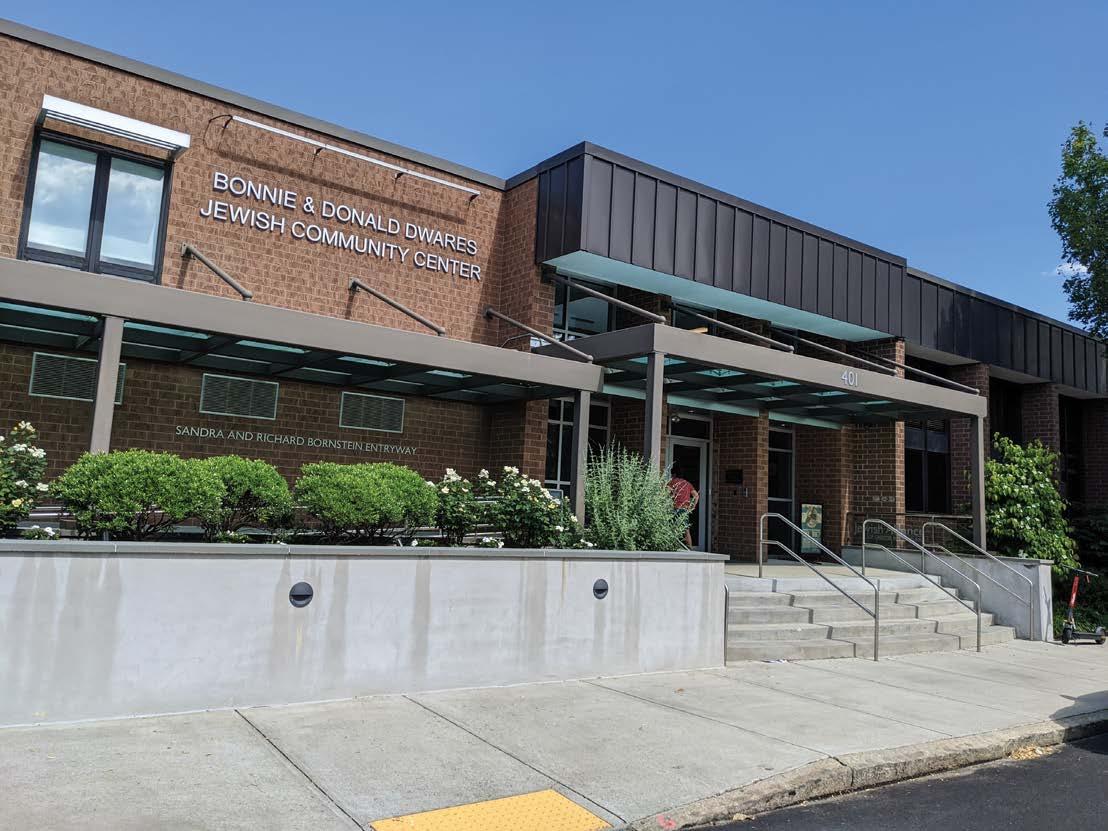
Monday – Thursday at the Bonnie & Donald Dwares JCC, 401 Elmgrove Ave., Providence; Fridays* at Temple Sinai, 30 Hagen Ave., Cranston. In-person (and usually on Zoom Monday –Thursday) programming 11 a.m.-noon followed by lunch and discussion noon-1 p.m. On Wednesdays, programming is chair yoga. For seniors aged 60 and older as well as younger adults with a disability; all faiths and backgrounds are welcome. Suggested donation: $3 per lunch. The Kosher Senior Café is a program of Jewish Collaborative Services, supported by the Jewish Alliance of Greater RI and Blackstone Health. Information and RSVP, Neal at neal@jcsri.org or 401-421-4111, ext. 114.
Mahjong at Torat Yisrael. Tuesdays 11 a.m.-1 p.m. starting 6/16. 1251 Middle Road, East Greenwich. Drop in and play Mahjong at Torat Yisrael every Tuesday. Beginners and experienced welcome. Free. Information, Michelle Birman at michelle@toratyisrael.org or 401885-6600.
Hebrew Classes. Tuesdays twice per month thru 8/18. Introduction to Prayerbook Hebrew 5-5:45 p.m. Other levels 6-7 p.m. Temple Emanu-El, 99 Taft Ave., Providence. Classes offered: Introduction to Prayerbook Hebrew, Advanced Beginners for Spoken Hebrew, Intermediate and Advanced. Offered jointly with the Jewish Alliance of Greater RI. Upcoming dates: 6/9, 6/16, 7/14, 7/21, 8/11, 8/18. Information, Toby Liebowitz at tobyaane@gmail.com.
Temple Sinai presents Judaism and Social Policy. Tuesdays 7-8
“GERMAN
MOTORS OVER THE YEARS”
“I may have the longest record at German Motors. I arrived in RI in 1974 with a BMW 2002 and used GM for repairs during that time and for all the German cars I have owned since. I have felt they were an honest and capable firm.”
– CharlesB.,Rumford, Mercedes-Benz E320
p.m. thru 6/30. 30 Hagen Ave., Cranston. Adult education program meets in the Chapel. Information, Templesinairi.org, admin@ templesinairi.org or 401-942-8350.
Cape Cod Synagogue Family Shabbat Services and Dinner. Second Friday of the month 5:30 p.m. 145 Winter St., Hyannis, Mass. In-person and livestreamed services on website, Facebook, Cape Media, YouTube and Community Television Comcast channel 99. Followed by Community Shabbat dinner. Information, 508775-2988 or capecodsynagogue. org.
Temple Torat Yisrael Kabbalat Shabbat Service. Most Fridays 5:45-6:15 p.m. Via Zoom only. On 6/5, there will be a special Beach Shabbat. See separate listing for more information. Information and Zoom link, temple office at 401-8856600.
Temple Beth-El Kabbalat Shabbat Service. Most Fridays 5:45-6:45 p.m. 70 Orchard Ave., Providence. In the Sanctuary. On 6/5, there will be a special Pride Shabbat service. See separate listing for more information. Information, Jude Weinstein at jweinstein@templebeth-el.org or 401-331-6070.
Temple Sinai Evening Service. Most Fridays 6-7 p.m. 30 Hagen Ave., Cranston. In person or on Zoom. On 6/12, there will be a special Broadway Shabbat. See separate listing for more information. Information, Templesinairi.org, admin@ templesinairi.org or 401-942-8350.
United Brothers Synagogue Shabbat Services. 7 p.m. 205 High St., Bristol. Shabbat services first Friday evening of every month. Information, Bradford Louison at bradlouison@gmail.com or 617-5121978.
Cape Cod Synagogue Shabbat Services. Fridays 7 p.m. 145 Winter St., Hyannis, Mass. With Rabbi David Freelund. In-person and livestreamed on website, Facebook, Cape Media, YouTube and Community Television Comcast channel 99. Information, 508-775-2988 or capecodsynagogue.org.
Temple Beth-El Torah Study. Saturdays 9-10:30 a.m. 70 Orchard Ave., Providence. In the library. Information, Jude Weinstein at jweinstein@ temple-beth-el.org or 401-3316070.
with Zoom available. Information, Michelle Birman at michelle@ toratyisrael.org or 401-885-6600.
Temple Sinai Breakfast and Torah Study. Saturdays 9:15-11 a.m. 30 Hagen Ave., Cranston. Breakfast followed by weekly Torah study (also on Zoom) at 10 a.m. Information, Templesinairi.org, admin@templesinairi.org or 401942-8350.
Temple Habonim Torah Study. Some Saturdays 10-11 a.m. When Shabbat morning services are not scheduled, Torah study (currently online) is usually held. Information, Adina Davies at office@ templehabonim.org or 401-2456536.
Cape Cod Synagogue Shabbat Services. Saturdays 10:30 a.m. 145 Winter St., Hyannis, Mass. With Rabbi David Freelund. In-person and livestreamed on website, Facebook and YouTube. Information, Cape Cod Synagogue at 508-7752988 or capecodsynagogue.org.
Temple Sinai Morning Shabbat Service. Saturdays 11 a.m.-noon. 30 Hagen Ave., Cranston. In the Chapel or on Zoom. Information, Templesinairi.org, admin@ templesinairi.org or 401-942-8350.
Friday | June 5
Jewish Alliance Hosts Blood Drive. 8:30 a.m.-12:30 p.m. Bonnie & Donald Dwares JCC, 401 Elmgrove Ave., Providence. Donations by appointment. (Use sponsor code 1528.) Walk-ins welcome if availability permits at time of arrival. Eat, drink and bring your photo ID. All donors will receive a Pride t-shirt in recognition of Pride month and $10 gift card. Information, ribc.org or 401-4538383.
Temple Torat Yisrael Beach Shabbat at Goddard Park. 5:30 p.m. Goddard Memorial State Park, 1095 Ives Road, Warwick. Rabbi Ari Saks leads Beach Shabbat. Come experience Kabbalat Shabbat with an informal, interactive family service. Meet under pavilion porch. Service will be followed by a potluck dairy picnic. Information, Michelle Birman at michelle@toratyisrael.org or 401-885-6600.
“From check-in to check-out, this establishment prides itself with customer service and excellent pricing. I've been a customer for 4 years and very happy to see Tracy and Gerry on my visits.”
– Richard L.,Providence, Porsche Macan
Temple Torat Yisrael Adult Education with Rabbi Saks. 10-11 a.m. 1251 Middle Road, East Greenwich. Adult education classes. Information, Michelle Birman at michelle@toratyisrael.org or 401885-6600.
Monday | June 8
Richard Bornstein Memorial Dwares JCC 40th Anniversary Golf Classic. 10:30 a.m. Warwick Country Club, 394 Narragansett Bay Ave., Warwick. A fun-filled day on the course and courts celebrating the 40th anniversary of the annual Golf Tournament. The day will conclude with a cocktail hour featuring light bites, drinks and live music. Information, Brigitte Baum at bbaum@jewishallianceri. org.
Wednesday | June 10
Jewish Alliance of Greater Rhode Island's 15th Annual Meeting. 7-8:30 p.m. Bonnie & Donald Dwares JCC, 401 Elmgrove Ave., Providence. Join us as we connect, reflect and look ahead. The evening will include guest speaker Nanette Fridman, Founder, Effect Collective; the presentation of leadership awards; and board installations. Reception to follow. Information, Gail Putnam at gputnam@ jewishallianceri.org or 401-4214111, ext. 158.
Thursday | June 11
Temple Beth-El Rear Gardening and Planting. 9 a.m.-2 p.m. 70 Orchard Ave., Providence. Help plant and keep up our new garden. Tools, materials and nosh to be provided. All are welcome to join regardless of skillset. Information, Jude Weinstein at jweinstein@ temple-beth-el.org or 401-3316070.
Friday | June 12
Temple Sinai Broadway Shabbat. 6-7:30 p.m. 30 Hagen Ave., Cranston. Led by Cantor Joel Gluck, Shireinu will be performing a Broadway Shabbat. Join in-person or on Zoom. Following the service, there will be an Oneg in the social hall. Information, admin@ templesinairi.org.
Gay Men’s Chorus. 2-4 p.m. 30 Hagen Ave., Cranston. Directed by Kim Kuda, this enthusiastic group comes from various backgrounds and experiences. Come hear them sing followed by refreshments and a chance to win one (or more) of many raffle baskets. Cost: $25 by 6/7 or $30 at the door. Information, admin@templesinairi.org.
PHDS Amudim Dinner. 4:30 p.m. 450 Elmgrove Ave., Providence. Dinner celebrating 80 years of Jewish education. Cost: $150 per couple. Information, Rabbi Scheinerman at pscheinerman@ phdschool.org or 401-331-5327.
Monday | June 15
Temple Beth-El Sisterhood Reading Circle. 7-8 p.m. 70 Orchard Ave., Providence. Information and RSVP, tbesisterhood70@gmail.com.
Tuesday | June 16
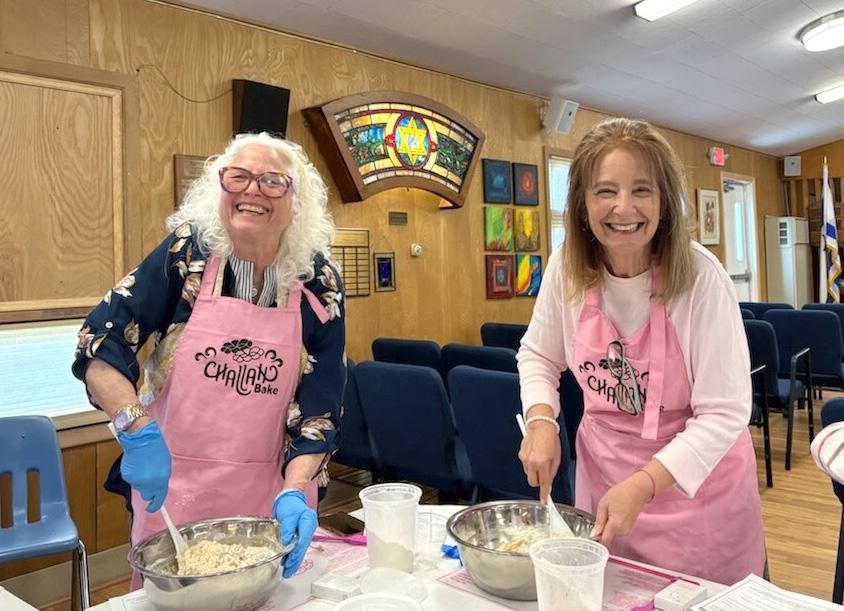
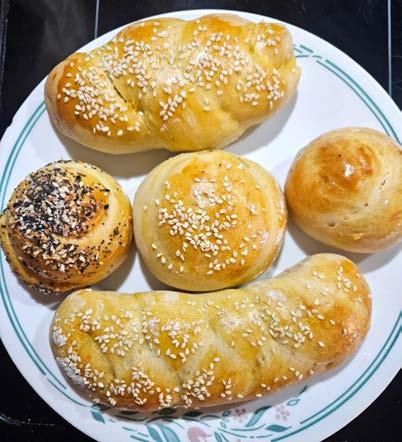
Temple Torat Yisrael Challah Bake with Shoshana. 6:308:30 p.m. 1251 Middle Road, East Greenwich. A joyful hands-on challah bake. Come mix, braid and share in this beautiful tradition together. All welcome. Participants must bring 4 cups flour in zip lock bag, apron, mixing bowl and spoon. Cost: $36. Information and RSVP (by 6/11), Michelle Birman at michelle@toratyisrael.org or 401885-6600.
Wednesday | June 17
Taste of Mussar at Temple Habonim. 7-8:30 p.m. 165 New Meadow Road, Barrington. Join us for a two-session introduction and explore the Jewish practice of Mussar through text study, reflection and discussion focused on personal growth and character traits such as patience, gratitude and compassion. Upcoming date: 6/24. Open to all. Information, www.templehabonim.org, office@ templehabonim.org or 401-2456536.
Friday | June 19
“A TALE OF A QUARTER CENTURY”
G
Temple Torat Yisrael Shabbat Service. Saturdays 9:3010:30 a.m. 1251 Middle Road, East Greenwich. Shabbat service with Torah Reading and Kaddish. In-person service
Temple Beth-El Pride Shabbat Service. 5:45-7:15 p.m. 70 Orchard Ave., Providence. Celebrate community, identity and belonging at our annual Pride Shabbat. The evening will include music, prayer and reflection honoring the intersection of LGBTQ+ identity and Jewish tradition. All are welcome. Information, Jude Weinstein at jweinstein@temple-beth-el.org or 401-331-6070.
Sunday | June 7
“As is a tradition at German Motors, Gerry, Tracy and the team are superb, treating us like family. I have a 2002 BMW that really is like new because of the TLC they provide. I used to make jokes towards my father keeping his ‘69 Ford Fairlane for over a decade and here I am with the same car for 25 years. Thank you German Motors!” –A. B., Barrington, BMW X5
Temple Habonim Pride Shabbat. 6:15 p.m. 165 New Meadow Road, Barrington. Join us for a special Pride Shabbat celebrating the value of b’tzelem Elohim, that every person is created in the image of the Divine. The service will feature LGBTQ+ congregants and conclude with a rainbow-themed Oneg. Information, pride@templehabonim. org.
Sunday | June 14
Temple Sinai Welcomes the RI
Temple Habonim Shabbat by the Sea. 6:15 p.m. Barrington Town Beach, 87 Bay Road, Barrington. Bring your own chair or blanket and welcome Shabbat on the beach. In case of inclement weather, the services will be moved inside to Temple Habonim. Information, office@templehabonim.org.
Tuesday | June 23
G ERMAN M OTORS INC
Temple Beth-El Brotherhood Board Meeting. 6-8 p.m. 70 Orchard Ave., Providence. Please join us in the Meeting Hall. Information, Jude Weinstein at jweinstein@temple-beth-el.org or 401-331-6070.
CALENDAR
Wednesday | June 24
Taste of Mussar at Temple Habonim. 7-8:30 p.m. 165 New Meadow Road, Barrington. Join us for a two-session introduction and explore the Jewish practice of Mussar through text study, reflection and discussion focused on personal growth and character traits such as patience, gratitude and compassion. Open to all. Information, www.templehabonim. org, office@templehabonim.org or 401-245-6536.
Saturday | June 27
Temple Torat Yisrael Torah Study Session. 10:30-11:30 a.m. 1251 Middle Road, East Greenwich. Torah study session with Rabbi Saks followed by a kiddush. Open to all. Information Michelle Birman at michelle@ toratyisrael.org or 401-885-6600.
Sunday | June 28
"Eleanor the Great" Movie Talk Back. 10 a.m. Bonnie & Donald Dwares JCC, 401 Elmgrove Ave., Providence. Join the Jewish Alliance and the Sandra Bornstein Holocaust Education Center for this funny and deeply moving film that explores Holocaust memory and
the complicated ways we carry the past. Immediately following the film, acclaimed actress and Holocaust survivor Rita Zohar will join us live via Zoom. Zohar stars as Holocaust survivor Bessie Stern in "Eleanor the Great" and will share reflections on her own experiences, the film and the importance of preserving Holocaust memory. Free. RSVP requested. Information, Samantah Kaufman at skaufman@ jewishallianceri.org.
Temple Torat Yisrael Adult Education with Rabbi Saks. 10-11 a.m. 1251 Middle Road, East Greenwich. Adult education classes. Information, Michelle Birman at michelle@toratyisrael. org or 401-885-6600.
Temple Sinai People of the Book. 2-3:30 p.m. 30 Hagen Ave., Cranston. We will discuss “Becoming Eve.” Born Yisrael Avrom Ben Menachem Mendel, "Becoming Eve" is Abby Stein’s memoir about her journey from an ultra-orthodox rabbi to a transgender woman, from an acidic upbringing to her true identity. Information, Templesinairi. org, admin@templesinairi.org or 401-942-8350.
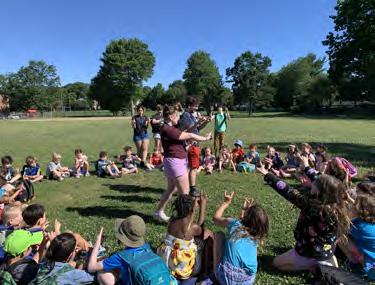
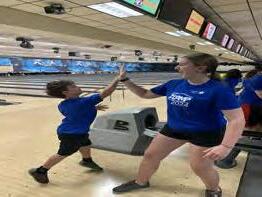
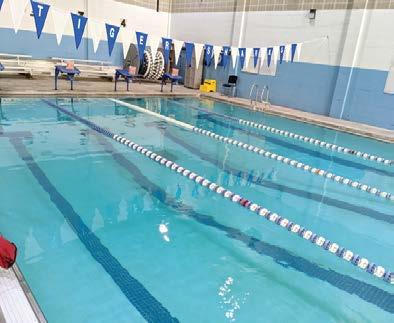
We’ve created the best Summer J-Camp experience at the Bonnie & Donald Dwares JCC!
We provide a diverse and welcoming environment for all our campers with a new theme and corresponding activities every week. J-Camp is built on four pillars of JAMS: Judaism, Arts, Movement (athletics), and STEM
In addition to our on-site programs, we have weekly field trips and specials guests! In the past, field trips included the zoo, local parks, museums and more.
FOOD Food insecurity affects all Rhode Island communities
BY SARAH GREENLEAF
Do you know where your next meal is coming from? Are your pantry and refrigerator stocked? Not everyone can answer those questions positively. Food insecurity impacts people of all backgrounds and is on the rise in Rhode Island, impacting 34% of households in Rhode Island according to 2025 survey data from RI Life Index.
“LIKE ALL COMMUNITIES, the Jewish community is struggling with a decrease in federal funding including federal budget cuts, for a while the complete cessation of SNAP and also an increase in the cost of living,” said Emily Gaudreau, director, Community Advocacy and Engagement at the Jewish Alliance. “We’re just squishing the middle.” Add into the mix the rising fuel and prescription drug prices and people’s budgets are taking an enormous hit. Food-at-home prices are predicted to increase 3.2%, according to the Economic Research Service of the U.S. Department of Agriculture.
“At Jewish Collaborative Services (JCS), we are here to help everybody, and through our food insecurity programs, we serve people of all backgrounds, all denominations,” said Kristina Contreras Fox, donor steward, at Jewish Collaborative Services. “We are also the only social service agency to directly serve the Jewish community.”
JCS runs two food pantries, one that is open to the public at its headquarters at 1165 North Main St., Providence. There is also one in Warwick at Shalom Apartments, a housing development it manages. It also manages the state’s only kosher meal site and delivery program, partnering with Meals on Wheels to do so.
Food insecurity is defined as not knowing where your
IF YOU NEED HELP
Kosher Food Pantry
401-331-1244
Rhode Island Community Food Bank 401-942-6325
next meal is coming from.
“You don’t have consistent access to fresh, healthy, nutritious food and you’re hungry!” explained Contreras Fox. “Something like 80% of the people we serve through the pantry and meal sites keep kosher. For folks who keep halal, our pantry also meets those standards. If you’re not familiar with these traditions, or if it’s not your tradition, people might think, ‘alright, well, you’re hungry, like, does it matter?’ Yes, it does! Very, very, very, very much.” Of the 15 unique programs run by JCS, one-third of those are related to food insecurity and hunger.
“The gulf between what people are bringing home, and what it costs to just live keeps widening and widening while all of the programs and federal funding are being taken away,” said Contreras Fox. “This is just a recipe for more and more people needing to go to pantries.”
That’s just what Cindy Montoya, deputy director at Progreso Latino, is seeing – a larger than average influx of new clients to the food pantry. “On average, we would get maybe 10 to 12 new clients per week, and now we’re seeing 25 to 30 new clients per week,” Montoya explained. “We’re also seeing an uptick in numbers of clients that maybe haven’t been here for months or haven’t used our food pantry services in over a year; they’re returning and that
MORE WAYS TO HELP
number is 30 to 40.”
The Progresso Latino food pantry really expanded during COVID, from a “closet-sized room” to a whole operation of 20 to 25 people, that rents space in a nearby hall, according to Montoya. The food pantry doesn’t require any documents or proof of income, just an ID. The pantry is stocked with culturally appropriate food like cassava and plantains to ensure it is meeting the needs of the families the agency serves.
Progresso Latino also offers nutrition classes and a food pantry support group that meets at 9 a.m., an hour before the pantry opens. “We use this as a point of community for different clients to be able to meet together and . . . know they’re not alone,” said Montoya. “It’s also that servant leadership and that community piece of where, you know, maybe there’s someone in that support group that may have an answer or a resource.”
The Jewish community faces unique barriers when it comes to accessing resources. “Like all communities, we’re economically diverse . . . there are lots of low-income, middle-income Jews,” said Gaudreau. “There’s still the perception that all Jews are very affluent and all Jews are very educated and . . . very successful. Which I think sometimes means that the community does not get the same amount of attention
around their food insecurity.”
The Kosher Food Pantry is a small but welcoming space, with the typical canned foods, a variety of matzah, numerous Manischewitz products for baking, seed packets for people to bring home and plant, even a toddler shopping cart. People make an appointment for the Kosher Food Pantry. “People don’t feel rushed, there’s some privacy,” said Contreras Fox, “They can shop at their leisure and pick what they want.”
Contreras Fox pointed out how dire the need is: “Last year when SNAP and WIC went offline during the government shutdown, there
were folks who came to the pantry, at that point we were open every day, and there were people who shared that they hadn’t eaten for four days.”
There are several bills currently under consideration that would combat food insecurity in Rhode Island. From Gov. Dan McKee’s website, the Governor’s proposal would increase that State’s support from $1 million to $2 million. Of this funding, $250,000 will support community food organizations across Rhode Island, helping expand the reach of efforts to address food insecurity. There’s also a bill, H7401 (Joint Resolution LC004262), to allocate
ON PAGE 9
Tours of the JCS Full Plate Kosher Food Pantry are available for people interested in learning about the food insecurity programs and how they can support. To schedule a tour, contact Kristina Contreras Fox kristina@jcsri.org | 401-415-8226. Attend Progresso Latino’s Annual Gala — www.zeffy.com/en-US/ticketing/ progreso-latino-49th-annual-gala Go gleaning with Hope’s Harvest — farmfreshri.org/programs/hopes-harvest/ Volunteer — rifoodbank.org/volunteer/ Host a Food Drive — rifoodbank.org/donate-food/
Kristina Contreras Fox in the Kosher Food Pantry.
PHOTO | SARAH GREENLEAF
Braiding Time
Shmita in the garden
BY SARAH GREENLEAF
This year, I let my garden go. Partially because I assumed (correctly) I’d be moving over the summer and partly due to energy and time. This year I planted nothing. And yet. This year my garden is filled with green. I have lettuce literally bursting out of my garden beds growing giant heads. Cosmo flowers and lettuce both jumped my garden to seed themselves into the cracks in the sidewalk and are pushing up into the world, growing strong.
I HAD HEARD of letting the land lie fallow as part of Jewish tradition before, as part of Shmita, a way of letting the earth rest and trusting in God to provide. It hadn’t occurred to me, until I let my own garden lie fallow, that the earth would not rest by doing nothing, but by growing in its own way according to its own desires. Resting did not equal unproductive by any means. It just meant productive in a way that was outside of my desires and control.
As my daughter moves further into toddlerhood and closer to childhood I have practiced this very idea in my parenting more and more. Parenting sounds so active – teaching, directing, talking, correcting. But I have found so many moments in which doing less was the best course of action. Just as the land needs time to rest, so do children. They need time to integrate all the things they’ve learned and
to practice the ones that are important to them, not just to their caregivers. Sure, I could coach my toddler through every step of getting dressed. Or I could make breakfast while she does it herself and find that the backward pants and inside out shirt are very minor compared to her sense of pride.
There’s often the desire to make things happen faster, go exactly right or look a certain way. When I was a teacher, I would sometimes have to hold my own hands clasped behind my back to keep myself from fixing something. I could have made the change in a second, but that would have robbed my students of their own thought process, their own experimentation and their own learning. It also robs them of their own sense of capability and pride.
I wonder if part of the reason the lettuces are doing so well this year is that they have been allowed the
time and space for their own experimentation and change. Perhaps part of being a caretaker of gardens or people is holding your own hand while watching the change happen before your very eyes. So much of care is making space so that others may bloom in their own way.
In “The Gardener and the Carpenter,” Alison Gopnik a professor of psychology and affiliate professor of philosophy at the University of California at Berkeley writes, “Being a parent is
like making a garden. It’s about providing a rich, stable, safe environment that allows many different kinds of flowers to bloom.” And sometimes, I would argue, it is about letting the garden plant itself, letting some plants go to seed at the end of their life cycles to see what they might do next. Letting the garden get messy and wild so that it can create another iteration of itself in the next year.
The carpenter Gopnik refers to is the parent who tries to build their child into what they want while the gardener creates the conditions for becoming. Both are creative acts, building something new out of the sum of the parts, but gardening is working with life itself, the living, growing earth, while carpentry is building out of inert matter. Both have value and create important things. One with rulers and precision
Gregg’s has what you’ll need
$75,000 to JCS.
“Reach out to your local state rep and state senator,” urged Contreras Fox. “We have such power as voters in Rhode Island because of how small the state is and how small the voting districts are. It really, really makes an impact. The one thing every single elected official is doing every day, no matter their ideology, is they’re all running for re-election. Terms are only two years. When you reach out, people pay attention.”
and one with observation and trial and error.
As I watch my garden grow itself this year, I am delighted by its resilience and its desire to exist in all the spaces it can find for itself to flourish. This is what I want for my daughter too, a sense that the world is bigger than the place she first grew and that she has the ability and creativity to grow in the unlikeliest of places, in the moments of abundance. I want her to know that some of the most important things in her life will happen when it’s quiet and calm and that though the fields may lie fallow that doesn’t mean they are empty of life.
SARAH GREENLEAF (sgreenleaf@jewishallianceri. org) is the digital marketing manager for the Jewish Alliance of Greater Rhode Island and writes for Jewish Rhode Island.
SARAH GREENLEAF (sgreenleaf@jewishallianceri. org) is the digital marketing manager for the Jewish Alliance of Greater Rhode Island and writes for Jewish Rhode Island. CONTINUED FROM PAGE 8
For those struggling with food insecurity, the first place to look is Rhode Island Community Food Bank where people can find a list of food pantries and find one
in their neighborhood or that matches their schedule or dietary preferences. There’s also an interactive map on its website and answers to frequently asked questions. “There’s enough food, and there’s enough money,” said Contreras Fox, “The biggest lie in politics is that there’s not enough money. There’s absolutely enough money. It depends on the will to spend it, and how those in charge want to spend it.”
Gone but not forgotten: Jewish delis, bakeries and Benny’s
EDITOR'S NOTE: This article originally ran in March 2020. Many of the places and people mentioned in the article are no longer with us, but we thought that it might bring back memories for many of our readers.
BY GERALDINE FOSTER
The conversation began with the red sticker on the box containing a hand mixer. Printed on the sticker was the price and the name of the store – Benny’s. Seeing the familiar sticker led to a lament for our favorite store from days gone by, where you could always find what you needed (and sometimes did not even know you needed until you found it there)
THE CONVERSATION then shifted to some of the many conveniences once taken for granted, but now gone from our lives: sending your child to the nearby A&P for a few items, shopping for children’s clothes at Susan’s and shoes at Lad & Lassie on Hope Street, buying meat at a Kosher butcher shop, knowing that sissel bread was always available at a nearby Jewish bakery.
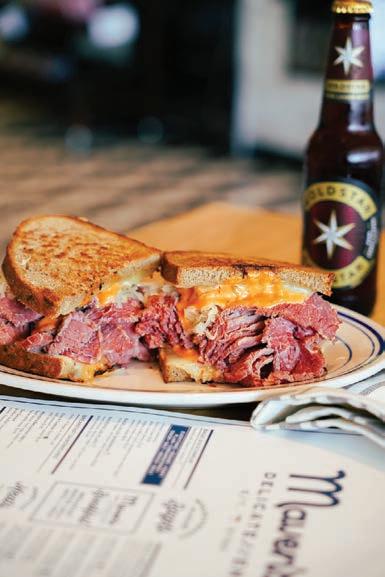
Sadly, today we can no longer buy a rolled beef sandwich on sissel and a bottle of Dr. Brown’s CelRay tonic to go with it.
Ah, rolled beef! In my youth, that epicurean delight had a place in just about every Jewish deli. Although akin to pastrami, it differed in important ways. The cut of beef was usually the same, as were the basic spices, but after it was cured and spiced, it was rolled and smoked – and each deli’s chef had his own secret addition. (Rolled beef also differed from Montreal smoked meat. The Montreal delicacy uses a different cut of meat and can be heated. Rolled beef is never served hot.)
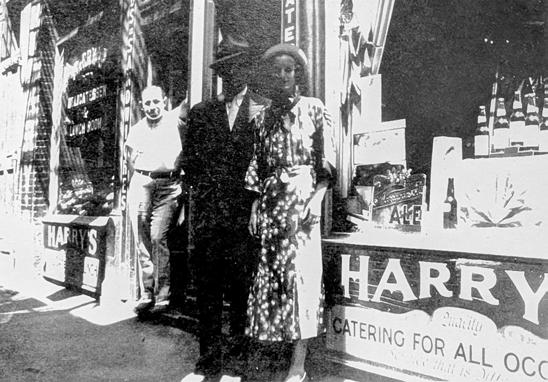
All the delis made wonderful sandwiches for takeout. But if you wanted to sit at a table and leisurely enjoy your choice, perhaps with a side of potato salad or a knish and a pickle from the barrel in the backroom, you went to a deli/restaurant like Cohen’s, a popular, pleasant gathering place in Providence’s North End, or Harry’s in “Pie Alley,” as
Clemence Street was known at the time, perhaps because of its many restaurants.
Harry’s, at 90 Clemence St., though lacking in curb appeal, attracted business people and shoppers. It was also a place to go at night, after a movie or a sports event, since it was open late. The décor was best described as utilitarian, with nondescript white tables and wooden chairs.
If I were just writing about food and ambience, this article would end here, but my research assistants (my daughter Judith and Jaime Walden at the Rhode Island Jewish Historical Association) found this related bit of World War II history, an individual’s war effort and a bygone era.
During the war years, Harry’s became a “downcity” mecca for soldiers and sailors on leave. What made Harry’s special for them was not Kosher deli, whose delicacies were unknown to most of them. The attraction was the proprietor, Harry Mincoff, whose generosity extended far beyond a free meal. From his own service in the Navy during World War I, Mincoff knew what it meant to be lonely and without funds in a strange city.
Mincoff was a colorful character. He had a round ruddy face, with a cigar usually in the corner of his mouth. He was “A balding Mr. Five-by-Five … with a cluster of three big diamonds on one hand [and], say Dallas ex-servicemen,
gold in his heart,” according to an article printed in The Dallas News and reprinted in The Jewish Herald in March 1946.
None of the servicepeople who came to Harry’s ever went away hungry or broke if Mincoff could help it. If he noticed a soldier or a sailor who seemed lonely or troubled, Mincoff sidled over, eased into a chair and began to chat. An avid sports fan, Mincoff could speak knowledgeably about a whole range of sports topics. He engaged his companion in seemingly casual conversation. Once he knew the nature of the problem, Mincoff would open his wallet or find a way to ease the loneliness or other problem.
Mincoff invited his patrons to put their spare change or a donation of any amount into a special jar near the cash register. He also added large sums of his own. The money was then made available as loans to servicepeople in need of emergency funds – no questions asked nor repayment requested; it was all on the honor system, with no records kept.
The news about Harry Mincoff and his jar soon spread among the soldiers and sailors stationed nearby. Mincoff would later say, with pride, that almost all the loans were repaid.
After the war’s end, Mincoff went on a coast-tocoast trip to reconnect with the many service members he had hosted at his restaurant. Texas was one of the many places welcoming him.
Now, what about that wonderful sissel bread
Memories of a bygone era and a toast to patriotism I
of yesteryear? In Rhode Island, our sissel story began in 1891, when Samuel Schechter opened the first Jewish bakery in our state, in the North End of Providence. From that date until 2000, 21 Jewish bakeries were established in Rhode Island, mostly in Providence, but also in Woonsocket, Central Falls and Cranston.
In the early years of the previous century, many bakers, after they had finished their own baking for Shabbat, allowed neighborhood women to use the big ovens to bake their own challah, and to even sell any extra loaves. This was a carry-over from a European tradition.
Only one Jewish bakery is left to make the delicious Jewish rye breads we remember, the Rainbow Bakery in Cranston. On my behalf, Gerald Sherman asked Murray Kaplan about the bakery’s unusual name. In 1954, Murray Kaplan’s father and his partner, Al Brody, purchased the bakery. They could not decide which family would get to name the shop. Since the movie “The Wizard of Oz” was very popular then, they compromised by choosing the name Rainbow.
remember with regret the cannon and the brick weapon, and my boyhood when they loomed at the bottom of my hillside home and steep hill between the Armory and the frequent patriotic events during the “duration” of my boyhood, and beyond.
I LIVE THERE yet among my souvenirs galore. And I miss those memories and time gone by. I would watch the parades on special patriotic occasions when veterans would join and link yesterday/ yesteryear/past war. And I miss the building and bricks even as well! I had two uncles who fought in World War II, both, and each, heroically. One in the Battle of the Bulge, returned on crutches, and the other as a medic, and the letters and stars in the windows, gave dignity to my boyhood. These are long, long ago by now, and the building itself is no longer there in any form, not even a memorial photograph. I miss my patriotism! I cherish the photographs of the uniforms and even the image of the statues and structures…and the lost virtues of belief and loyalty. So, here’s my toast to yesteryear!
GERALDINE S. FOSTER is a past president of the R.I. Jewish Historical Association. To comment about this or any RIJHA article, contact the RIJHA office at info@rijha.org or 401-331-1360.
MIKE FINK (mfink33@aol.com) is a professor emeritus at the Rhode Island School of Design.
MIKE FINK
KETCHB OOK
COMMUNITY VOICES
The world on a Jewish table
Food has always played an important role in Jewish life because it connects daily eating with identity, memory and community. Jewish food is not a single cuisine, but a family of cuisines shaped by religion, history, migration and local culture. Across centuries, Jewish communities have carried recipes from one country to another, adapting them to new ingredients while keeping familiar rituals and meanings alive.
IN THE ARTICLE “What is Jewish Cuisine?,” the writers at Aish.com give an overview of the diverse, multicultural world of Jewish food, including recipes. They discuss the significant Jewish Diaspora communities and their foods.
EALTHY LIVING
Ashkenazi Jews are the descendants of Jewish people who settled in and around the Rhineland Valley, in what is today Germany and France, about 1,100 years ago. Large populations later centered in places like Poland, Lithuania, Ukraine and Russia. Classic Ashkenazi dishes include stuffed cabbage, kreplach, gefilte fish and cholent, a hearty, Ashkenazi one-pot dish comprising beef (often brisket), potatoes, beans and barley, usually seasoned with salt and pepper.
My grandparents came from Russia, which could have been Ukraine at that time. One of my fondest memories is my grandmother making tayglach during Rosh Hashanah.
PATRICIA RASKIN H
Tayglach are small, knotted dough balls or nuggets that are boiled in a thick honey syrup, often containing nuts or ginger. I remember how my family devoured that special dish and looked forward to it every year.
Mizrahi or “Eastern” Jews are Jews from North Africa and the Middle East and are usually what most people mean when speaking about Sephardic Jews. Sephardic cooking represents the Jewish experience in places as disparate as Morocco, Iraq,
India and Iran. Mizrahi and Sephardic cuisine (North Africa, Middle East, India) is defined by vibrant spices, fresh herbs, slow-cooked stews and olive oil, heavily influencing modern Israeli cuisine. Key staples include shakshuka, a popular dish of eggs poached in a vibrant, savory sauce of tomatoes, olive oil, bell peppers, onion and garlic; haraimi, spicy fish; kubbeh soup, dumplings made from semolina, bulgur or rice filled with minced meat; bourekas, flaky pastries stuffed with various fillings; and fragrant rice dishes, often featuring dried fruits and nuts.
Ethiopian Jews for centuries lived in the Lake Tana region of northern Ethiopia. The community’s origins are uncertain although travelers, scholars and others mention them in accounts dating back as early as the ninth century. Injera is a sour Ethiopian flatbread. Ethiopian Jew-
ish (Beta Israel) cuisine is defined by flavorful, slowcooked stews (wots) served on injera bread, featuring spice mixes like berbere and mitmita. Key staples include sanbat wat, Sabbath chicken stew; and dabo bread, a traditional, lightly sweet Ethiopian wheat bread, often perfumed with spices like korarima (a sweeter Ethiopian cardamom), turmeric and nigella seeds, central to Ethiopian Jewish (Beta Israel) Shabbat and holiday celebrations.
Yemenite Jews trace their roots to Biblical times although much of the population immigrated to Israel on Operation Magic Carpet between 1949 and 1950. This article in Aish.com has recipes for Yemeni foods like malawach, a flaky, buttery flatbread that resembles a flattened croissant; jachnun, a cylinder-shaped pastry; kubaneh, a rich, pull-apart Sabbath bread; hilbeh; a thick, savory condiment made from ground fenugreek seeds. and zhug, a Yemenite hot sauce made from chili peppers, cilantro, garlic and spices like cumin.
Israeli Jews came to Israel as migrant Jews and entered the new State of Israel between 1948 and 1950 more
than in any other equivalent period since. Israeli cuisine is a vibrant mix of Middle Eastern and Mediterranean influences, featuring fresh ingredients and bold flavors. It’s high in fresh seasonal fruits and vegetables, whole grains, beans, nuts, seafood; and lots of extra virgin olive oil. The most iconic dishes include hummus, creamy crispy falafel; shakshuka, the popular egg dish described above in the Mizrahi and Sephardic cuisine; and the fried eggplant sandwich known as sabich
Through exploring Jewish food, I learned how incredibly diverse and varied the cuisine is, encompassing everything from Ashkenazi comfort foods to vibrant Sephardic and Mizrahi flavors. Jewish food tells a story much larger than the plate, reflecting culture, traditions and change.
PATRICIA RASKIN , owner of Raskin Resources Productions, is an award-winning radio producer, business owner and leader. She has served on the board of directors of Temple Emanu-El, in Providence. Her “Positive Living with Patricia Raskin” podcast can be heard on voiceamerica.com.
R.I. Jewish Historical Association’s
75th Anniversary
Iwas privileged to deliver the following address on Sunday, May 3 at a large gathering at the Dwares Jewish Community Center. The principal speaker was Keith Stokes, who portrayed “The World that Made Judah Touro.” Not only is he Rhode Island’s Historian Laureate, but Stokes is also a Newport native who descends from the colonial Touro family.
SEN. JACK REED also gave a highly evocative presentation about his deep bonds with many of the Ocean State’s Jewish leaders, especially the late Robert A. Riesman. Reed also presented the Asso -
ciation with a celebratory proclamation, as did many other state and local elected officials. The Association was also pleased to receive heartwarming messages from Rabbi Leslie Y. Gutterman,
who has inspired so many of our leaders and members, and Dr. C. Morgan Grefe, the executive director of the Rhode Island Historical Society, which has mentored and continues to collaborate with the Association. I probably spoke too long, but I did not want to miss cov ering many of the Jewish Historical Association’s distin guished accomplishments. Thank you, friends, for helping celebrate our Associ ation’s extraordinary mile -
stone. We are now 75 years young.
More than two decades ago, I was delighted to serve as our 14th president. Having worked with nine of my predecessors, I felt especially close to three: Stan Abrams, Bob Kotlen and Gene Weinberg. Fortunately, seven wonderful presidents have followedww me, and now we welcome our eighth, David Bazar, whom I have known for at least 20 years.
Not merely a loyal alumnus of Providence Country Day School, he became its longest-serving and one of its most effective presidents. Our Association, which was our country’s first state or local Jewish historical organization, has achieved so much. Thanks largely to Eleanor Horvitz’s three decades of leadership and continuing efforts by Anne Sherman, Kate-Lynne Laroche, Sam Turco and Jaime Walden, we have built and catalogued an extraordinary resource, the Beryl and Chaya Segal Archives, which were named in memory of
ANNUAL MEETING
Jewish Alliance of Greater Rhode Island 15th Annual Meeting
June 10, 2026 at 7:00pm
Bonnie & Donald Dwares JCC 401 Elmgrove Avenue, Providence
Presentation of Leadership Awards:
Melvin G. Alperin Award for Excellence in Jewish Communal Leadership, presented to Ralph Posner
The Riesman Leadership Development Award, presented to Abigail Anthony
The Gail A. Putnam Award, presented to Eunice Tavares
Guest Speaker, Nanette Fridman
Board Installations:
Jewish Alliance of Greater Rhode Island
Jewish Federation Foundation
Alliance Realty, Inc.
Installing Officer: Cantor Judith Seplowin
Introduction of Incoming President & CEO
Reception to follow
2026-2027 Proposed Slate of Jewish Alliance of Greater Rhode Island Board of Directors
“EVERY CONTROVERSY which is for the sake of heaven is destined to be of lasting significance, but any controversy which is not for the sake of heaven will not be of lasting significance.” (from Pirkey Avot, chapter 5)
It is no secret that for many years now, our diaspora Jewish community here in the United States has been engaged in an increasingly heated controversy regarding our relationship with the State of Israel and the evolving and often competing meanings of Zionism. It remains to be seen whether or not this controversy is for the sake of heaven.
fewer American Jewish liberals are Zionists; fewer and fewer American Jewish Zionists are liberals.” And
“For several decades the Jewish establishment has asked American Jews to check their liberalism at Zionism’s door, and now, to their horror, they are finding that many young Jews have checked their Zionism instead.”
I T SEEMS TOME
RABBI JAMES ROSENBERG
As I wrote in one of my columns about a year ago (May 2, 2025), it was way back on June 10, 2010, that Peter Beinart, then a young journalism teacher at the City University of New York, published an article in “The New York Review of Books” titled “The Failure of the American Jewish Establishment”; at that time, Beinart urged us to look at the growing rift between liberal American Jews and the kind of Zionism which underpins the Jewish State of Israel.
Both bitter critics of Beinart and his diehard supporters have pointed to the same two cogent sentences in his essay: “Particularly in the younger generations, fewer and
For the sake of heaven? Decoding radical political rhetoric in R.I.
BY HOWARD BROWN
IN DECEMBER 2025, state representative and declared candidate for Providence Mayor, David Morales, released this statement:
“If you pass by Providence City Hall, don’t expect to see Mayor Smiley. He’s currently in Louisiana at a conference funded by Trump donors in an effort to suppress dissent around the genocide still happening in Gaza. Hope he enjoys his time in New Orleans!” … “Right-wing mega-donors are flying mayors to an all-expenses-paid summit in New Orleans where they’ll push a policy framework that codifies mainstream criticism of Israel as ‘antisemitic.’ “
In fact, the conference that Smiley attended was the 2025 North American Mayors Summit Against Antisemi-
Fifteen years have passed since Beinart wrote his controversial essay. For some, he has initiated a profoundly constructive controversy for the sake of heaven; others have gone so far as to call Beinart a self-hating Jew, to be excluded from the community of self-respecting (and self-righteous) Jews.
Early this spring, the editorin-chief and CEO of Moment magazine, Nadine Epstein, published her own essay with the explosive title “The Word ZIONISM is Dead.” As she elaborates in her second paragraph: “It is beyond time to strike the words Zionist and Zionism from modern political discourse and relegate them to history, where they belong. They have outlived their usefulness both as concepts and as terms. This means we must immediately cease labeling ourselves as Zionists and anti-Zionists and use the word
tism, described in the invitation as follows:
“Antisemitism is not an abstract problem. It’s a daily reality, showing up in classrooms, campuses, community spaces and city streets. The frontlines of this fight are not in Washington, but in City Hall, and mayors are on the front lines.
“That’s why more than 300 mayors and municipal leaders from across North America will gather in New Orleans this December for the 2025 North American Mayors Summit Against Antisemitism , hosted by the Combat Antisemitism Movement (CAM) and the City of New Orleans… mayors and city officials will come together to share strategies, forge partnerships, and chart a path forward for cities to confront antisemitism with clarity and purpose.”
Zionism only when referring to the historical political movement.”
Having taught courses on Zionism at Connecticut College in New London during the 1980s, I was not at all shocked by Epstein’s essay, nor even surprised. The primary text we used during each of the two or three semesters I had the opportunity to offer the course was “The Zionist Idea: A Historical Analysis and Reader” (1959) by Rabbi Arthur Hertzberg (1921-2006); this thick volume is a collection of writings of leading Zionist thinkers, together with a lengthy and penetrating intellectual history of the Zionist movement. During our class discussions, it became clear that there have been almost more versions and variations of the Zionist idea than we could count.
Further on in her essay, Epstein includes a provocative quotation from David Ben-Gurion (1886-1973), Israel’s first Prime Minister. During a Zionist conference in Jerusalem in August 1957, he said: “There seems to be a general agreement that a Jew can live in America, speak and read English and bring up his children in America and still call himself a Zionist. If that is Zionism, I want no part of it.”
Ben-Gurion saw no place for Zionism in the diaspora; all Zionists in the diaspora should make aliyah and become citizens of the State of Israel. The one and only time that I witnessed Ben-Gurion speaking to
Jew-hatred is growing in our city and state, and the Jewish community is rightfully worried. It is the responsibility of every leader to ensure that residents feel safe walking down the street, attending school, worshiping freely and living openly as who they are. Trying to deny that protection to our community by tying it to Israel’s self-defense against Hamas (the “genocide” blood libel) is not only divisive but morally repugnant.
There is a history going back to at least 2018 of anti-Israel statements and actions by candidate Morales which can reasonably be seen as antisemitic. As recently as February of this year former US representative Jamaal Bowman of New York (loser of a 2024 primary after being censured by the House) was recruited by the
a group was during the late 1960s, when he addressed the faculty and my fellow rabbinical students at the New York School of the Hebrew Union College-Jewish Institute of Religion. His Zionism was an absolute negation of the diaspora; from his perspective, it was not possible for us to live out our lives in these United States and yet call ourselves Zionists.
With increasing urgency, I have been writing in this space that I still consider myself a liberal Zionist; yet I utterly reject all forms of Zionism which embrace the notion of shililat hagolah, the negation of the diaspora. To the contrary, I affirm my complex identity as both an American Jew and a Jewish American. I am forever adjusting the balance between my Jewish and my American selves, and I am convinced that my need as a diaspora Jew to constantly negotiate my multiple identities makes me a better American, a better Jew and, yes, a better person.
It should be clear that I am not asking any of my readers to agree with my pro-Israel/pro-diaspora form of Zionism; but let me assure you that I offer you my perspective l’shem shamayim, for the sake of Heaven.
JAMES B. ROSENBERG is a rabbi emeritus at Temple Habonim in Barrington. Contact him at rabbiemeritus@templehabonim.org.
Morales campaign to travel to Providence and deliver his endorsement. Even the progressive Nation magazine in June 2024 understood Bowman’s problems with his former Jewish constituency, to wit:
“A non-exhaustive list: describing the war in Gaza as a “genocide,” a term that Bernie Sanders has explicitly resisted; disputing that the attack was unprovoked; using the settler colonialism framework that posits Jews as non-Indigenous interlopers in a land they have no claim to; praising well-known Jewish provocateur Norman Finkelstein, whose book “The Holocaust Industry” accuses Jews of exploiting the Holocaust and promotes conspiracy theories (he later apologized); generally promoting or aligning with groups and people
who celebrated October 7 as “resistance”; characterizing Jewish settlement patterns in Westchester as segregated; using “Zionist” as a pejorative.” (“Jamaal Bowman Didn’t Lose Because of AIPAC,” Alexis Grenell, The Nation, June 2024). Personally, I follow the thinking of one of the rabbis our community is blessed to have, which is to say, “People attack Israel as an excuse to go after the Jews”. Or as Ruth Wisse, the deep-thinking author of “Jews and Power” puts it, “Antisemitism is the organization of politics against the Jews.”
My own caveat to Providence voters is, “if you’re wearing rose-colored glasses, it’s time to take them off.”
HOWARD BROWN lives in North Kingstown.
Jewish Rhode Island publishes thoughtful and informative contributors’ columns (op-eds of 500 – 800 words) and letters to the editor (300 words, maximum) on issues of interest to our Jewish community. At our discretion, we may edit pieces for publication or refuse publication. Letters and columns, whether from our regular contributors or from guest columnists, represent the views of the authors; they do not represent the views of Jewish Rhode Island or the Alliance.
OPINION
Friendship and responsibility: addressing tough statements with follow-up questions
BY GARY DORFMAN
I READ THE EDITORIAL written by Louis Keene originally published in The Forward but reprinted in the April 2026 issue of Jewish Rhode Island as an editorial by the Interim Editor, Fran Ostendorf, titled “We were instant friends. Then came the Israel question.” I must admit, I was mystified as to the point of the editorial upon reading it and remain so even now. To summarize, the author encountered two previous strangers, now instant friends, and was confronted by at least one of them who posed two troubling personal concerns. First, the author’s new acquaintance “volunteered his sense of horror about Gaza,” and second, he “related his shock about the circumstances of Israel’s establishment.” The author
CONTINUED FROM PAGE 13
Jerry Foster’s parents and Harold’s grandparents. The collection consists of a vast number of original and published documents, hundreds of photographs, scores of oral history interviews and several artifacts. The Association has also assembled a key reference library, and we have provided significant assistance to researchers in Rhode Island, elsewhere in New England and beyond.
Over the decades, we have also expanded our educational impact through numerous programs, including lectures, panel discussions, field trips and online resources. Just last year, thanks to Judge J. Jerome Hahn’s legacy, we celebrated the 60th anniversary of the Roger Williams National Memorial with the National Parks Foundation and we also helped create a children’s book.
In 1954, our Association had played a key role in celebrating the American Jewish Tercentenary. We have also participated in many regional meetings of Jewish historical groups, and in 1988, we hosted the national conference of the American Jewish Historical Society. A decade later, through the initial
admits to not understanding the exact nature of his new “friend’s” horror and shock, but he could tell that he “was being tested.” Indeed. And I would make the case that the author failed the test.
The author somehow was unable to engage his new “friend” in meaningful discussion upon their initial meeting at a bar and thereafter also failed to engage his new “friend” the following day at brunch or the beach; I suppose that these are the contemporary three “Bs” of new friendship – bar, brunch and beach! No matter the setting, Mr. Keene was unable to find the moment to further the discussion –supposedly with someone he considered a newly found “friend.”
The editorial’s concluding paragraph finds the author contemplating that “Amer-
leadership of Albert Klyberg and the Rhode Island Historical Society, our Association became one of three founders of the never completed Heritage Harbor Museum, now a grant-awarding entity as the Heritage Harbor Foundation, where we hoped to establish a far larger presence.
Since 1975, thanks largely to the efforts of Mel Zurier, our board member for a half-century, the Association has been a rent-free tenant of the Jewish Federation. And we have continued to feel profound gratitude to its successor, the Jewish Alliance, for its generosity.
In 2017, a highly successful fundraising campaign led us to move to far larger and more comfortable quarters, the Fred, Gertrude & Henry Regensteiner Offices, within the Dwares JCC. And thanks to numerous gifts, we have also been fortunate to strengthen our endowment.
ican Jews should expect to field uncomfortable questions from strangers about Israel and Gaza for the foreseeable future.” If this is an example of an American Jew “fielding uncomfortable questions,” let us all admit that in this case, Mr. Keene dropped the ball. At the very least, he should have inquired exactly what his new-found friend found shocking about an indigenous people exercising self-determination in their ancestral homeland in which they have lived continuously for millennia and facing forces whose admitted primary purpose is exterminating not only the Jews living in their homeland but all Jews worldwide. Or perhaps inquiring what part of the defensive war that Israel is fighting against Hamas creates the sense of horror that he feels - is it the unnecessary
leged to collaborate with two wonderful graphic designers, Bobbie Friedman and Steve Logowitz, each for 11 issues. The three of us have also enjoyed a wonderful partnership with Signature Press in East Providence, and I hope that it continues.
Since 2012, thanks to its trustees, especially Norman Jay Bolotow, the Harold A. Winstead Charitable Foundation has quite generously
deaths of so many innocents all because terrorists refuse to stop the carnage and will not release hostages taken during a rampage of killing and rape?
Perhaps Mr. Keene could have imparted a bit of knowledge to his friend so as to ease his horror and shock by countering the falsehoods and misconceptions that are held by so many now days. What’s the worst that could have happened? Maybe the author would have determined that this new friend was not as friendly as he at first seemed to be. Or maybe, just maybe, this new friend might have decided that it would be worthwhile to reassess his position, to gather additional factual information and perhaps even change his mind – maybe he would turn out to be a real, new friend and not merely an acquaintance that
grown. The results have been more than 11,000 pages of inquiries and insights. Fortunately, every issue has also been carefully indexed and posted online through our website.
I’m still enormously proud of another publication, “The Jews of Rhode Island,” an anthology of important articles from The Notes, which was published by the University Press of New England, Brandeis University Press and our Association in 2004 to celebrate our journal’s 50th anniversary. I happily served as the volume’s coeditor.
‘These pioneers used words and images to perpetuate their profound gratitude for America’s and Little Rhody’s extraordinary freedoms, challenges, opportunities and blessings.’
underwritten the publication of The Notes. I think that Norman’s Uncle Harold would be quite proud of what we have so steadily accomplished.
As the eighth editor of The Notes, I have been responsible for 22 issues, five more than my longest-serving predecessor, Dr. Seebert Goldowsky. I have felt privi-
In 1954, when our leaders launched our visionary journal, there were a few issues per year. Since becoming an annual journal two years later, The Notes’ length and depth have continually
In 1951, during the Korean War and the McCarthy era, how could our seven founders have ever imagined our astonishing success?
Unfortunately, I never knew them, but I would please like to remind you who these pioneers were: David C. Adelman, Alter Boyman, Rabbi William G. Braude, Prof. Israel J. Kapstein, Arthur J. Levy, Matilda Pincus and Beryl Segal. Three of the founders were born in Europe, but only one in Little Rhody, and this was David Adelman, the founding presi-
Louis Keene is so quick to deem a “friend.”
Why didn’t Mr. Keene field the questions? Why didn’t he stand up against misinformation? Why didn’t he accept the role God granted to him? Why did he instead just drop the ball; prioritize the bar, brunch and beach over taking a stand for his heritage? Why didn’t he go the extra step to determine the nature of this instantaneous friendship and instead why did he just decide to go along, to get along? A very sad commentary about the concept of friendship and how one should deal with uncomfortable questions indeed.
GARY S. DORFMAN, MD, lives in Saunderstown.
dent and editor of The Notes. I’d like to think that there are several basic reasons why our Association has been able to achieve so much. Essentially, the founders and their followers were optimists. Having come up with a wonderful idea, they ran with it. The founders and their followers were also thoughtful, caring and imaginative people. Some were religiously observant, but all loved learning, research and books. These pioneers used words and images to perpetuate their profound gratitude for America’s and Little Rhody’s extraordinary freedoms, challenges, opportunities and blessings. Whatever their political affiliations, our predecessors were deeply patriotic. I also truly believe that our Association has said and done so much to honor Judaism and the Jewish people.
Dear friends and colleagues, I look forward to celebrating many more milestones together. Meanwhile, thanks again for your unwavering enthusiasm, pride, strength and support.
GEORGE M. GOODWIN , of Providence, is the editor of Rhode Island Jewish Historical Notes.
Toward Belonging: Anti-Hate Summit, Building a Future Without Hate
BY SARAH GREENLEAF
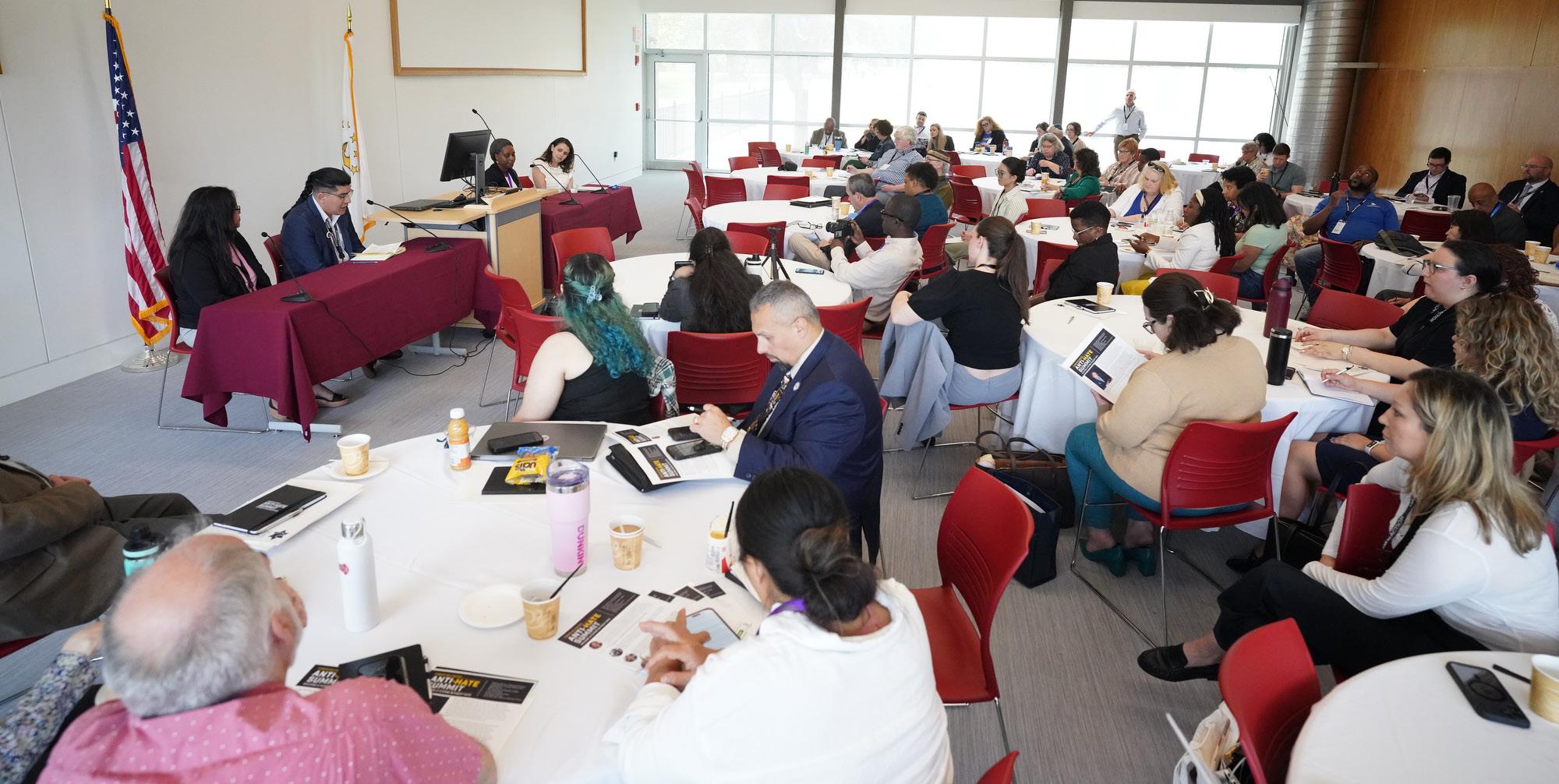
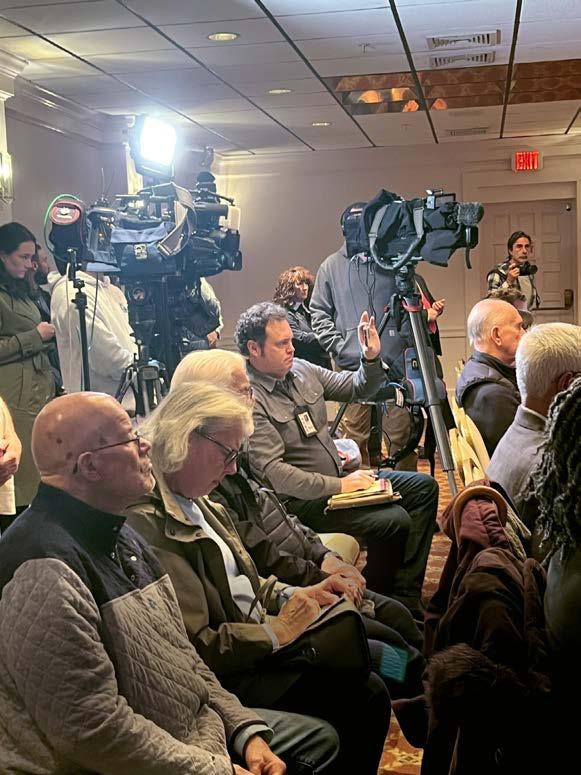
PROVIDENCE – On May 28, approximately 100 people from across Rhode Island gathered at Rhode Island College to discuss the state of hate nationally and locally. Over the course of more than six hours, members from a wide range of communities shared their experiences, their hopes for the future, their struggles and their wins.
THE MORNING BEGAN with a welcome from Emily Gaudreau, director, Community Advocacy and Engagement at the Jewish Alliance of Greater Rhode Island: “We are all here today because we recognize that what we are seeing in Rhode Island and across the nation is unacceptable. People are being targeted because of who they are, how they pray, who they love. Language that dehumanizes gives rise to hatred which grows when it is ignored or minimized. None of our communities exist in
isolation. The safety of one community depends on the safety of all.”
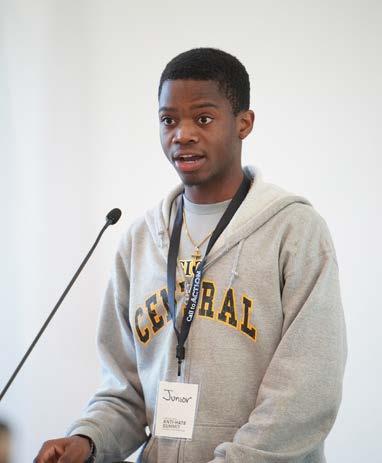
Junior, 19, was the student speaker from the Refugee Dream Center. He left Ivory Coast in 2024 and was resettled in Rhode Island. His speech focused on ways to combat hate at a personal level, “It doesn’t happen with one big speech . . . it happens with small choices,” he said. He advocated for speaking up, “you don’t have to be loud or perfect,” when being a friend to the person hurting, “we are capable
and brave enough to do this,” noting the importance of being kind and learning about people who are different. He finished, “It starts with us right here, right now, choosing kindness every day, even when no one is watching.”
Taylor Dumpson, from the Rhode Island Attorney General’s office, a lineal descendent of the Narragansett tribe, led the land acknowledgement and gave a brief history of hate in Rhode Island, noting that “hate is not new to these shores.” She also shared her story of being a hate crime survivor. While a student at American University, she was the first Black woman elected president of the student government. She became the target of a racially and gender-motivated hate campaign that moved from symbols on campus to online harassment. Alerted by the ADL that she was being doxxed by Neo-Nazis and white supremacists online, Dump -
son brought a case against her attackers and won.
Dumpson gave a presentation on “What is a Hate Crime?” and pointed out that, “hate crimes are messaging crimes, they are small ‘t’ terrorism.” These crimes normalize hate and, when unchecked, embolden perpetrators to push to the extremes. “Something that happens in one state doesn’t stay there,” Dumpson said, “It’s all connected.”
The keynote speaker, Eric K. Ward, executive vice president of Race Forward and senior fellow with the Southern Poverty Law Center, gave a passionate talk about his work linking antisemitism and antiBlack racism and creating “relational infrastructure” between marginalized communities. He urged people to “choose relationships before crisis” and pointed to the people in the room as “a potential covenant.”
He spoke about how fear has become a faster organizing motivation than trust,
and that fear tells communities to shrink their circles of concern. “People stop seeing neighbors and start seeing categories,” Ward said.
“Today interrupts isolation. Isolation is where extremist violence grows.”
‘Today interrupts isolation. Isolation is where extremist violence grows.’
He talked about learning how extremist movements begin by changing stories. “The fight we are in is not political,” he told those gathered, “It is moral.” He pointed out that people no longer know how to disagree and maintain the dignity and safety of those they disagree with.
He discussed the oldest, more powerful story used to break community apart – antisemitism. “Most
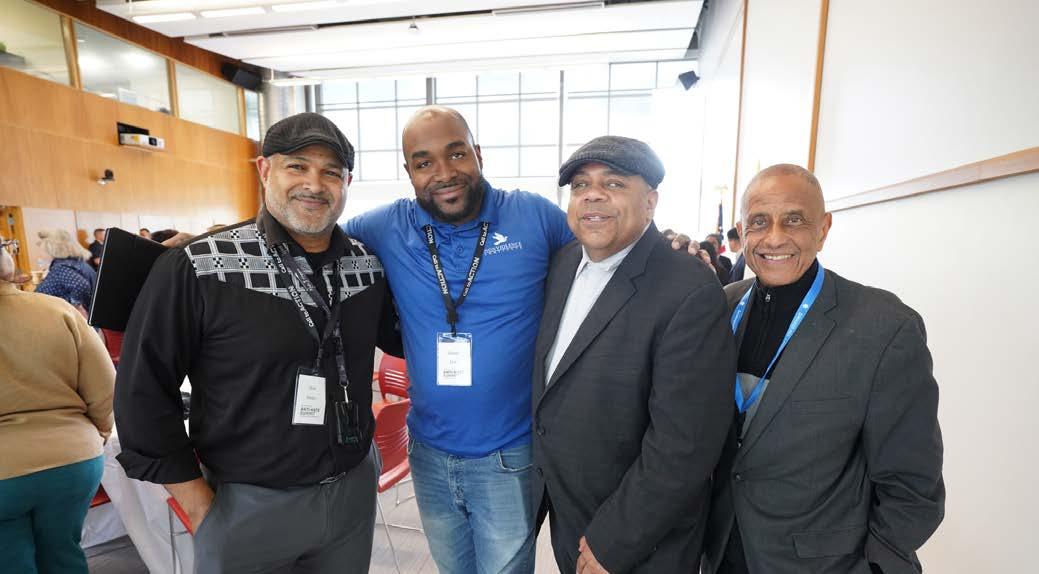
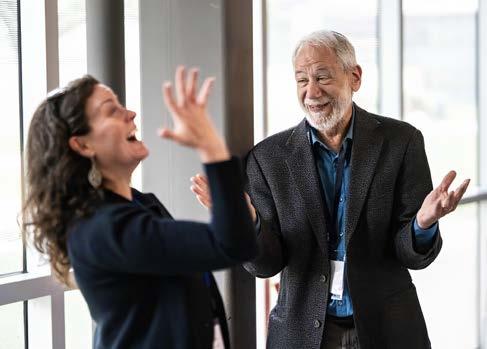
PROVIDENCE, RI—Anti-Hate Summit at Rhode Island College, May 28, 2026.
PHOTOS GLENN OSMUNDSON
prejudice works by pushing a group out of society,” Ward explained. “Antisemitism works by telling the story that Jews are at the center, controlling things.”
Ward said that antisemitism is dangerous to democratic life and that the atmosphere eventually affects everyone. He said that “spaces that spoke fluently about inclusion have become unsafe for Jews. Jewish belonging has become conditional in spaces that think of themselves as moral.”
Discussing the spread of hate and misinformation online, he pointed out that “outrage travels faster than reflection. Certainty travels faster than wisdom.”
His speech really shone when he discussed the Black radical tradition and the relationships between Black and Jewish communities. “What made it powerful was not perfection,” Ward emphasized.
“It was persistence.” He spoke of 1960s rabbis, marching in dangerous territory and 1930s Black journalists speaking out against antisemitism.
“I refuse to believe that hatred is the deepest feeling of ordinary humans. People keep reaching for each other;
it means something healthy is still alive. Protect the habit that allows strangers to become neighbors,” he said.
“Connection slows hatred down.”
Three panels followed a break. Immigrant Communities: The State of Hate and Bias; LGBTQ+ Communities: Experiences in the Current Climate; and Advocacy in Action: Responding to Hate and Injustice.
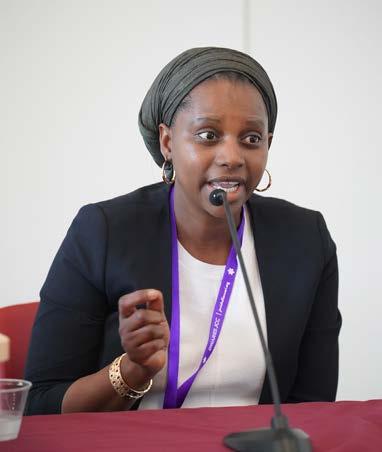
Moderated by Marcela Betancur of the Latino Policy Institute, the Immigrant Communities panel included Juan Pablo Ocampo of the Immigrant Coalition of Rhode Island, Teddi Jallow of the Refugee Dream Center and Kannyka Pouk of the Center for Southeast Asians.
communities.
Panelists urged people to get involved on a personal level by volunteering, mentoring and donating, and on a political level by contacting representatives to urge them to support these communities.
‘Sometimes we connect not through the struggle, but through what makes us happy’
“Sometimes we connect not through the struggle, but through what makes us happy,” Ocampo said.
According to the panelists, immigrant and refugee families are living in fear, unable to access food, medical care or justice. “The fear is the biggest problem,” Pouk said.
“Our own staff is scared,” said Jallow.
“Families are retreating into isolation,” Ocampo said.
Hopelessness and anxiety are rampant as are scams targeting immigrant and refugee
The panel on LGBTQ+ communities was moderated by Rev. Donnie Anderson of Pilgrim United Church of Christ and included Janson Wu of The Trevor Project, Rush Frazier of Youth Pride Inc. and Lynn Faria, of SAGE. The panel identified the current climate as “incredibly volatile,” according to Faria, who also mentioned that since 2024 about 400,000 trans people have moved states.
Wu added that in The Trevor Project’s 2025 survey
they found that “40 percent of LGBTQ+ youth considered suicide in the past year and 10 percent attempted it. 90 percent said recently passed legislation had negative impacts on their mental health.”
Frazier of Youth Pride Inc.
added that the most meaningful support they are seeing is from parents of LGBTQ youth and that there has been an almost complete rollback of corporate support. The panelists also pointed out that having even one affirming adult in a young person’s life significantly reduces the risk of suicide.
The Advocacy in Action panel was moderated by Rabbi Jeffery Goldwasser of Temple Sinai, and included Rose Albert of Rhode Island for Community and Justice, Jessica Vega of Rhode Island KIDS COUNT and Lisa Pina-Warren, of the Nonviolence Institute. The panel discussed what works in advocacy and described it as shared power, responding and showing up, and amplifying the voices of the youth.
“Too often legislation is created for people instead of with them,” said Vega. “The people closest to the problem are often closest to the
solution,” added Pina-Warren. Albert finds hope in “seeing young people shaping change.” Panelists also discussed effective tools for persuasion; real human stories, lived experience, knowing what resonates with different audiences – stories, data or money – and often-overlooked moral persuasion.
What is at stake, according to Ward’s speech earlier that day, is whether we can still recognize ourselves in one another before fear tears apart this country entirely.
“This is how democracy survives,” Ward said. “When we choose love, dignity and shared humanity even when fear would be easier.”
The summit was hosted by the Jewish Alliance in partnership with Youth Pride Inc., RI Commission on Prejudice & Bias, City of Providence, Center for Southeast Asians, Nonviolence Institute, and Sandra Bornstein Holocaust Education Center.
SARAH GREENLEAF (sgreenleaf@ jewishallianceri.org) is the digital marketing manager for the Jewish Alliance of Greater Rhode Island and writes for Jewish Rhode Island
Teddi Jallow speaks at the Anti-Hate Summit.
Junior, from Ivory Coast, speaks at the AntiHate Summit.
Silas Pinto, Shane Lee, Eric Ward and Jim Vincent at the Anti-Hate Summit.
Angela McParlange with Rabbi Howard Voss-Altman. Juan Pablo Ocampo at the Anti-Hate Summit.
BUSINESS 28 | OBITUARIES 30
Rogers Park Band brings joyous Lag
B’Omer
celebration to Jewish Providence
BY CHABAD OF PROVIDENCE
Under a beautiful blue sky dotted with colorful banners, Jewish Providence celebrated the holy day of Lag B’Omer in a collaboration between Chabad of Providence and Congregation Beth Sholom. Over 150 community members gathered at Chabad of Providence for a vibrant and uplifting celebration featuring an unforgettable concert by the acclaimed Jewish folk duo Rogers Park.
THE EVENT drew families and community members of all ages into an atmosphere filled with music, laughter and connection. Children enjoyed live music along with cotton candy, bubbles and outdoor activities that added a playful and festive energy to the gathering. Guests were also treated to a delicious barbecue that contributed to the warm and welcoming spirit of the evening.
Known for their unique blend of folk music infused with Hasidic warmth and spirit, Rogers Park was the perfect soundtrack for the
celebration. The duo has performed in Jewish communities across the country, earning recognition for their original compositions that weave together heartfelt storytelling, rich harmonies and a distinctly spiritual sensibility. Their music carries both contemporary folk influences and deep Jewish emotional resonance, creating an experience that is both engaging and uplifting.
Throughout the evening, Rogers Park’s performance inspired attendees to sing,
clap and dance together. Their music served as a unifying force, drawing people of all ages into a shared experience of joy and connection. The energy in the
‘By the end of the evening, attendees left inspired and uplifted...’
crowd reflected a deep sense of community pride and togetherness, as the music transformed the gathering into a celebration of Jewish spirit and unity.
As the sun set and the
music filled the air, the celebration captured the essence of Lag B’Omer — a day marked by Jewish unity, joy and the enduring legacy of Rabbi Shimon Bar Yochai. The combination of live music, dancing and shared community experience created an atmosphere filled with warmth, meaning and spiritual energy.
Lag B'Omer is a long-standing holiday in Judaism with deep historical and spiritual meaning. The day is understood as having a dual significance. It marks a pause in the mourning period of the Omer, which commemorates a tragic time in Jewish history when the students of Rabbi Akiva were struck by a plague. Jewish tradition teaches that the tragedy was linked to a lack of mutual respect among the students, and Lag B’Omer is therefore also a reminder of the importance of kindness, unity and honor between people.
At the same time, Lag B’Omer is also the yahrzeit of Rabbi Shimon Bar Yochai, one of the great sages of the Talmud and a central figure in Jewish mystical tradition. Rabbi Shimon Bar Yochai is traditionally associated with spiritual illumination and the teachings of the Zohar. His passing is not observed with sadness, but rather with joy and celebration, reflecting his request that the day be marked as one of light, unity and spiritual elevation.
The event, hosted at Chabad of Providence in collaboration with Congregation Beth Sholom, reflected the vibrancy of the local Jewish community. By the end of the evening, attendees left inspired and uplifted, carrying with them a renewed sense of connection, joy and Jewish pride from a Lag B’Omer celebration that brought the community together in a truly meaningful way.
Grants serve Jewish women in R.I. and Israel
Members confer on grant funding.
Women’s Alliance Endowment Fund (WAEF) members convened on May 18 to consider submitted grant proposals to be awarded for the next fiscal year. Formed in 1993, WAEF has allocated more than $165,700 to diverse organizations serving Jewish women and children in Rhode Island and overseas communities. Special attention is put on benefiting the Afula-Gilboa area, the Jewish Alliance’s partner region in Israel.
THIS YEAR, the group, co-chaired by the mother-daughter pair of Susan Leach DeBlasio and Amy DeBlasio, awarded grants totaling $11,700 to the following worthwhile programs:
LOCAL:
Camp JORI – $1,000 for camp scholarships for refugee girls
Chabad of Northern RI –$250 for a women’s event
Chabad of Southern RI
– $250 for monthly family shabbat and holiday dinners
Community Beit Midrash of RI – $500 for quarterly Intergenerational Learning
Congregation Sha’arei
Tefilla – $250 for a Women’s Day of Connection
Hattie Ide Chaffee Home – $1,200 for Jewish programming for residents/community
Jewish Community Day School – $750 for Social-Emotional Learning lunch bunches
Sandra Bornstein Holocaust Education Center
– $1,000 for honoring and engaging with Russian Jewish Holocaust survivors
Temple Emanu-El – $500 for Women’s History Month speaker series
ISRAEL:
Beit Ruth for Young Women & Girls at Risk –
$1,000 for “Promoting Physical and Emotional Health for At-Risk Girls Through Sports” in Afula-Gilboa
Emunah – $1,200 for DBT (Dialectical Behavior Therapy) training at Afula-Gilboa facility
Ethiopian National Project – $1,000 for leadership program for girls in Afula-Gilboa
Feuerstein Institute –$500 for academic integration of Ultra-Orthodox women in nursing school
Jerusalem Hills Therapeutic Centers – $250 for “Healthy Eating and Body Awareness Education” for at-risk girls
Leket Israel – $250 for providing produce for women in Afula-Gilboa
Ruca’s Farm – $900 for support for partners of veterans with PTSD
ZAKA – $900 for support for families of ZAKA volunteers in Afula-Gilboa
WAEF has more than 100 living members. Each one contributed $1,000 to the fund to join. The fund is invested with the Jewish Alliance’s endowment and relies on donations from new members to increase the income available to distribute each year.
A gift of WAEF membership is a meaningful
way to introduce adult children and grandchildren to community philanthropy, and several WAEF mem-
bers have included the next generation in membership. Membership to the WAEF allows our community’s women to directly impact women and youth around the globe in meaningful and critical ways, through programs and services necessary for a strong Jewish future.
If you are interested in becoming a member of the WAEF yourself, or gifting a
membership to a daughter, granddaughter, another family member or a friend, or would like to discuss giving to your Jewish future, contact the Jewish Federation Foundation at 401.421.4111 or endowment@jewishallianceri.org.
Submitted by the Women’s Alliance Endowment Fund
WAEF
A legacy that runs deep.
Every gift tells a story. Yours can tell one of hope, connection, and community — a story that continues long after today.
A planned gift or bequest to the Jewish Alliance ensures that future generations inherit not only our traditions but a strong commitment to one another.
Because when we invest in the future, we honor the past — and we keep our community anchored in what truly matters.
COMMUNITY
Local Israeli American physicians honored
For more information on ways to leave your Jewish legacy, please contact Endowment@JewishAllianceRI.org visit JewishAllianceRI.org/JFF or scan the QR Code
BY LARRY KATZ
At Brown University Health headquarters at the end of April, three local Israeli American physicians and a former American-born board chair of The Miriam Hospital were honored by Rhode Island Israel Collaborative (RIIC). The honorees, along with descriptions of collaborative programs between Israeli and Rhode Island institutions, highlighted the significant influence of Israeli-trained physicians on Rhode Island healthcare.
AMONG THE ATTENDEES were Mayor Brett Smiley, R.I. State Rep. Mia Ackerman, Dr. Jerry Larkin (director, Rhode Island Department of Health), Deputy Consul General of Israel to New England Liron Finkelstein, John Fernandez (president and CEO of Brown University Health) and Professor Mukesh K. Jain (current Dean of Brown University’s
Warren Alpert Medical School).
The evening opened with Avi Nevel, founder and CEO of RIIC, who also emceed the event, highlighting the organization’s past, present and future activities.
Professor Eli Adashi, Brown University’s former (5th) dean of Medicine and
Former Dean Eli Adashi.
PHOTO | RIIC
COMMUNITY
RICI reports many activities in May
Biological Sciences, was the first to be honored. He is a graduate of the very first class of Tel Aviv University School of Medicine (MD, 1973) and of the Harvard T.H. Chan School of Public Health program in Health Care Management (MS,2005). He is respected nationally for his work in reproductive endocrinology and gynecological and obstetrical research.
Professor Jeffrey M. Borkan serves as the assistant dean for Primary Care at the medical school and directs a program aimed at producing the next generation of leaders in primary care. He has been the chair of Family Medicine for more than two decades and is engaged in advocacy and education at multiple levels. Earlier in the program, he had discussed the Miriam Hospital - Brown University Leadership Fellowship for Mid-Career Israeli Family Physicians.
Professor Rami Kantor is a physician-scientist who directs the Drug Resistance Laboratory at the Providence-Boston Center for AIDS Research (CFAR). Dr. Kantor’s lab focuses on multidisciplinary clinical and basic science research on HIV drug resistance in children, adolescents and adults, HIV treatment monitoring, and HIV transmission through networks. Earlier that evening, he presented the Brown University Technion Exchange Program and other collaborations with the Israeli Medical Ecosystem.
All three honoree physicians earned their medical degrees at the Gray Faculty of Medical and Health Sciences at Tel Aviv University.
Jeffrey M. Brier was also honored. He is a past board chair of The Miriam Hospital and The Miriam Hospital Foundation. Over the past 45 years he has held many leadership positions in the Rhode Island Jewish community including having served as presi-
BY JEWISH RHODE ISLAND STAFF
For the third year in a row, the Rhode Island Coalition for Israel (RICI) in collaboration with Brown Alumni for Israel, reports that it held a “peaceful presence” during Brown University’s commencement activities on May 24. Despite the rain, the group showed support for Jewish students, families and alumni during both the procession and the graduation ceremony. Many students and families thanked the participants and were appreciative of the efforts, according to reports.
IN COLLABORATION with Temple Torat Yisrael, RICI held a presentation on May 31 by David Litman, US media manager for CAMERA (Committee for Accuracy in Middle East Reporting and Analysis). “Anti Israel Bias in the Media” provided critical information on how anti-Israel bias in the media manifests across the US, and how this specifically manifests locally. For a copy of the recording, please email maria@ricoalitionforisrael.org
RICI is looking for volunteers to support its efforts to oppose a BDS initiative in the City of Providence. If you would like to get involved, please email kenschneider33@ gmail.com
dent of the Jewish Community Center and Camp JORI. Professionally he is president of Brier & Brier, an insurance and employee benefit agency. He also made a presentation earlier in the program, about the nearly 30-year history of collaborations between The Miriam Hospital and HaEmek Medical Center in Afula, Israel. Another presenter was Professor Adam Levine, assistant dean of Biology and Medicine at Brown Medical School, who spoke about the new student exchange agreement between Brown and Tel Aviv University medical schools. Professor Karen Avraham, Dean of the Gray Faculty of Medical and Health Sciences at Tel Aviv University, delivered remarks by video. Dr. May-Tal Sauerbrun Cutler presented on RI–Israel healthcare collaboration, including joint research with an Israeli startup company on AI and infertility, as well
as additional collaborations between the Rhode Island and Israel medical ecosystems.
Dr. May-Tal Sauerbrun Cutler also noted that the RIIC hopes to organize another healthcare mission to Israel, similar to the one conducted in 2013 under the leadership of Dr. Michael Fine.
Dr. Mukesh K. Jain, current dean of Brown’s Medical School, concluded the program, with additional remarks about his predecessor, Professor Adashi, and addressed the value of Israeli-Rhode Island collaborations.
The evening was hosted by the RIIC, with the assistance of Brown University Health, The Miriam Hospital and the Consulate General of Israel to New England. It was organized by the RIIC’s Healthcare & Life Sciences Committee, whose co-chairs are Dr. Alex Cutler & Dr. May-Tal Sauerbrun Cutler. The organizing
committee also included Dr. Rami Kantor and Limor Nevel. Avi Nevel serves as the CEO of the RIIC.
The RIIC is a nonprofit organization dedicated to fostering economic, academic, scientific and cultural partnerships between Rhode Island and Israel. It promotes mutual growth and innovation by developing programs that link entrepreneurs, investors, educators and policymakers across both regions. Through its committees, initiatives and global network, RIIC continues to strengthen the economic and scientific connections that benefit both communities. For more information, visit Rhode Island–Israel Collaborative at www.TheRIIC. org.
LARRY KATZ is a board member of the Rhode Island Israel Collaborative
From left to right – Liron Finkelstein, Jeff Breyer, Avi Nevel, Dean Mukesh Jain, Alex Cutler, May-Tal Sauerbrun Cutler, Eli Adashi, Jeff Borkan, and Rami Kantor.
PHOTO | RIIC
RICI members at Brown commencement.
PHOTO RICI
Books on the Beach raises funds for Hadassah projects in the US and Israel
BY SUE MAYES
Members of the “original” Newport Chapter of Hadassah planned a unique fundraiser years ago, and the event named Books on the Beach was created. Now in its 11th year, that wonderful event has grown and is now hosted by Hadassah Rhode Island and Hadassah Southern New England Region, drawing both men and women to a beautiful summer beach-side location on Aquidneck Island.
THE ORIGINAL LUNCHEON, held at a restaurant, featured local authors, and it gave birth to this most important fundraiser for Hadassah. Judy Shefshick-Karll, the coordinator of the Aug. 5, 2026, event has said, “The importance of our Books on the Beach fundraiser is that it brings
together like-minded men and women from all of New England to share in Hadassah’s mission and values, and to enjoy a beautiful location with authors who have meaning to us. And in this time of great need for the State of Israel, Hadassah’s needs are greater than ever.”
Hadassah, the Women’s Zionist Organization of America, was founded in 1912 before the State of Israel was founded, and before American women could vote. Across today’s generations, and across the globe, Hadassah has over 300,000 members, associ-
ates and supporters who work productively to find and implement solutions to some of our most pressing challenges. Hadassah works to advance women’s health, to fight hate and antisemitism, to support a strong and healthy nation for all the citizens of Israel and to instill Jewish values in future generations.
The highlight of this season’s most anticipated event is our featured guest speaker Carol Ann Schwartz, the 28th National President of Hadassah.
(The first president was Henrietta Szold, Hadassah’s founder, who served from 1912 to 1926.) Schwartz is a native of Cincinnati, Ohio, where she and her family have been involved in civic, religious and Zionist life for generations. She will bring us the latest updates and information about the status of Hadassah’s Jerusalem hospitals – Ein Kerem and Mt. Scopus – and about our Youth Aliyah villages –Neurim and Meir Shfeyah - where at-risk children receive the support that they need to become productive members of Israeli society.
It is particularly exciting that Schwartz will be our guest speaker at Books on the Beach, the format of which began here in Rhode Island and has been emulated throughout the nation by other Hadassah chapters and regions. Schwartz will share the most up-to-date news on how our fund-raising efforts are being used today both to help to heal Israeli society and to empower Jewish women in the United States through
education and advocacy. Our featured authors at Books on the Beach 2026 are B.A. Shapiro and Jenna Blum.
B.A. Shapiro is the author of more than 10 books. Her books have won many awards, and she was featured throughout the country in Community Reads. Her work includes literary thrillers, some involving the world of art (including the yet-unsolved 1990 heist at the Isabella Stewart Gardner Art Museum). Shapiro considers herself to be a “voracious” reader; in her books she explores topics such as family secrets, betrayal, love, history, reincarnation, revenge and politics. Her most recent novel is “The Lost Masterpiece,” considered to be “an exquisite feat of storytelling.”
With only four novels published, Jenna Blum is one of Oprah’s Top 30 Women Writers, and is the CEO of A Mighty Blaze, an online author interview company. Her parents both loved to read and shared their encouragement and talents when she was growing up. Blum’s first novel was written after she worked with Steven Spielberg interviewing Holocaust survivors for the Shoah Visual History Foundation. She has written both historical and contemporary fiction. “Murder Your Darlings” is her fifth book and her first psychological thriller.
Members and friends of Hadassah are encouraged to become sponsors of the 2026 Books on the Beach event;
B.A. Shapiro
Carol Ann Schwartz
Jenna Blum
This Month in History
An Erstwhile Oasis
A WOMAN holds up a melon grown in the Negev Desert in June of 1986. Today, plenty of kibbutzniks have witnessed dry-climate agriculture in Israel, but this seemed all the more miraculous in the '80s. The nation's most remarkable invention was the "liman," an earthen damming system that started consolidating Negev water supplies in the 1960s. Cultivation helped Israel produce and send 220 tons of food (and other emergency supplies) to Ethiopia during the famine in 1985.
State-of-the-art Rehab wing Best rated by U.S. News & World Report
Private Rooms and Bathrooms
Arts Academy | Kosher Cuisine RI Federation Garden Club
Newspaper courtesy Rhode Island Jewish Historical Association
Stronger communities and coalitions give JCPA CEO hope
BY FRAN OSTENDORF
If you feel as if antisemitism is coming at the Jewish community from all directions, Amy Spitalnick wants you to know that it is.
“IT UNIQUELY OPERATES in conspiracy theories rooted in Jewish power,” said Spitalnick, CEO of the Jewish Council for Public Affairs (JCPA). “It pits us against each other.”
And people are exploiting our fears, she said.
Spitalnick appeared May 12 in conversation with Cara Mitnick, Jewish Alliance of Greater Rhode Island board member. More than 50 people listened carefully to Spitalnick’s reflections.
The event took place in the Baxt Social Hall at the Bonnie & Donald Dwares Jewish Community Center.
The JCPA is the national convener of Jewish coalitions working across communities to build a just and inclusive American democracy. Spitalnick has extensive experience in government and policy advocacy as well as working to counter hate such as that from the groups responsible for the 2017 Unite the Right Charlottesville rally that resulted in violence and death.
“The core tactic of extremism is to make you feel isolated.”
The JCPA is working with groups around the country to counter that. “We work
closely with Community Relations Councils around the country. It is important to support local communities,” she said. [In Rhode Island,
the Community Relations Council is part of the Jewish Alliance and works on social justice issues, government advocacy, antisemitism and anti-hate and Israel dialog.]
The JCPA is also involved in a partnership with teach-
At Wingate Residences on the East Side, experience Providence’s scenic Seekonk River and the renowned East Bay bike path right from your patio. Our curated selection of monthly programs and events cater to those with elevated taste, while our newly renovated heated pool and fitness center keep you lively for years to come. Providing Independent Living, Assisted Living, and an innovative Memory Care program, The Neighborhood, we make it easy for our residents to access all the East Side has to offer.
Cara Mitnick, left and Amy Spitalnick.
Red Sox Jewish Heritage Night 2026
BY BRAD SWARTZ
BOSTON, MASS. – On May 27, the Boston Red Sox hosted their annual Jewish Heritage Night at Fenway Park in recognition of Jewish American Heritage Month. The Jewish Alliance of Greater Rhode Island was proud to organize a group outing for the event, selling more than 100 tickets to community members, many of whom sat together in bleacher section 43.
EACH ATTENDEE received a special commemorative jersey featuring “Red Sox” written in Hebrew, designed in the style of the team’s City Connect uniforms inspired by Fenway Park’s iconic Green Monster.
This marked the second consecutive year that the Alliance organized a group for Jewish Heritage Night. As in the past, transportation to and from Fenway was provided by bus, which played an important role in making the
event accessible and appealing for many attendees. The shared experience of traveling together and cheering side by side at the game helped foster a strong sense of community throughout the evening.
Fans created a vibrant sea of green as they proudly wore their jerseys across the stadium. The night began with a meaningful on-field acknowledgment of Jewish Heritage Night, followed by a moving performance of the
Holding heritage through music
ON MAY 7, the Jewish Federation Foundation of Greater Rhode Island (JFF) honored the Dor L’Dor Society and other dedicated community members with a special event featuring David J. Perolman, education director and songleader of Temple Habonim in Barrington. Through remarks and music, Perolman shared his thoughts on how Jewish music is adapting and evolving to be accessible, meaningful and enjoyable to all generations.
The Dor L’Dor Society is a special group of donors who have established ways of supporting the Rhode Island Jewish community in perpetuity. A legacy gift is such a meaningful way to live into Jewish values and
the Atlanta
(bswartz@jewishallianceri.org) is Partnerships and Fundraising Manager at the Jewish Alliance of Greater Rhode Island.
ensure sustained funding for what matters most to donors and their fam ilies. For more information or planned giving options, contact the Development team: endowment@jewishallianceri.org or 401-421-4111.
Submitted by the Jewish Alliance Development Team
National Anthem by a Jewish musical group. The game itself remained competitive before the Red Sox ultimately secured an impressive 8–0 victory over
David Perolman
Three happy community members at the Red Sox game.
Joyful learning at JCDSRI
IT WAS A BUSY and beautiful week recently at Jewish Community Day School of Rhode Island (JCDSRI) with both Zimriyah and Special Visitors Day, two celebrations that offered such meaningful glimpses into the heart of the school community.
There is something incredibly moving about watching young children sing and dance with their whole selves in front of hundreds of people who are there for the sole purpose of loving and supporting them. Zimriyah never fails to leave us feeling hopeful in a world that can so often feel broken.
On Special Visitors Day, nearly 200 guests were welcomed into the school to experience the learning, joy and relationships that help students grow and thrive.
Visitors had the opportunity to learn with and from 5th graders as they shared words of Torah at breakfast, spend time in classrooms seeing students proudly share projects, writing pieces, and new math concepts, and join in the kinnus (assembly), where everyone sang, celebrated, chanted, learned, and danced together with so much joy and ruach (spirit).
Moments like these reflect what makes JCDSRI so special: a community rooted in joyful Jewish learning, deep relationships and the belief that every child should be known, valued and inspired to grow.
Submitted by the Jewish Community Day School of Rhode Island
PHOTOS | JCDSRI
COMMUNITY
Alliance welcomes new president and CEO
BY JEWISH RHODE ISLAND STAFF
PROVIDENCE – The Jewish Alliance of Greater Rhode Island announced Monday that it has hired Steven A. Baker as the next President & CEO. Baker, who was selected after a national search, will begin his tenure on July 1.
ACCORDING TO the news release, Baker is an accomplished nonprofit executive with 19 years of leadership experience in philanthropy, community programming, and organizational development. He has a proven track record of building high-performing teams, driving transformational fundraising results, and advancing impact across both the Jewish and broader nonprofit sectors.
“We are thrilled to welcome Steven to Rhode Island,” said Marisa Garber, board chair of the Alliance. “His visionary leadership, deep commitment to Jewish values, and proven record of strengthening communities make him the ideal person to guide the Alliance into its next chapter.”
Baker will relocate to Rhode Island from Minneapolis, where he served as chief philanthropy officer for the Minneapolis Jewish
CONTINUED FROM PAGE 22
sponsors will be invited to a special reception to be held at 11 a.m., hosted by Lorraine Rappoport of Cranston and Sue Mayes of Middletown. Both are current members of the Board of Hadassah Southern New England and have held various leadership positions in Hadassah Rhode
CONTINUED FROM PAGE 24
ers’ unions. “We need to do more to educate people as to who Jews are.”
“The only way to address antisemitism is to stay at the table and talk to people with whom we disagree,” Spitalnick said.
pion the Alliance’s mission of supporting and cultivating a connected, strong, and inclusive Jewish community while helping to shape its future growth and impact.”
Federation and Minnesota Jewish Community Foundation. His work in the Jewish community began in 2007 as regional director for BBYO in Phoenix, Arizona, before he went on to serve as a program officer at the Jewish Community Foundation of Southern Arizona. He then went to Colorado, working with education and environmental nonprofits before finding his way back to Jewish communal leadership at JEWISHcolorado, the statewide Jewish Federation there.
‘Jewish community is where I have found meaning and belonging’
Baker earned a Master of Business Administration from Indiana University’s Kelley School of Business, with a specialization in nonprofit management. He is a fellow of the Jack, Joseph and Morton Mandel Foundation’s Executive Leadership Program and a Certified 21/64 Family Philanthropy Advisor, reflecting his deep commitment to leadership development and philanthropic excellence.
“This is an enormous opportunity for the Alliance and the greater Rhode Island Jewish community,” said Harris Chorney, interim CEO. “Steven will cham-
Island. Sponsors will have the opportunity to meet and hear from Schwartz and the two guest authors.
The event itself begins at noon and includes lunch and the speakers.
Hadassah Rhode Island’s president is Roberta Schneider, and the president of Hadassah Southern New
“My commitment to Jewish life, peoplehood, and Israel is both professional and deeply personal,” Baker said. “Jewish community is where I have found meaning and belonging—from BBYO, summer camp, and Israel experiences to a career devoted to strengthening Jewish life locally, nationally, and globally.
I am honored by the opportunity
England Region is Sheri Barnett.
Groups for table seating may be pre-arranged, and book clubs are encouraged to attend and register to be seated together. Members and friends of Hadassah are encouraged to become sponsors of the 2026 Books on the Beach event. Tickets
to partner with the Board, professional team, and community to guide the organization into its next chapter of growth while honoring its values, legacy, and central role in Jewish life in Rhode Island.”
for the event are $85 and can be obtained at http://events. hadassah.org/bob26, by emailing chapri@hadassah. org or by calling 857-404-0599 no later than July 20. The location will be sent to guests after registration.
Books will be available for purchase and signing by the authors.
alnick said, but “religious freedom gives Jews a right to practice religion.”
‘We have no other choice but to do this work.’
This is true across a wide spectrum of situations.
In politics we need to explain what Zionist really means, she said. “Zionism is not support for Israel politics. Zionism is a belief in self-determination.”
We can disagree about the Israeli government, Spit-
In education, “We are working now to get to the point where teachers can report antisemitism, and the union is more inclusive.”
Despite it all, Spitalnick said she is hopeful. “A tactic of extremism is to make you feel hopeless. But Jews are building stronger communities and coalitions,” she said.
“We have no other choice but to do this work. Protecting Jewish safety matters,” she said.
Earlier in the evening, the Alliance hosted its annual Lion of Judah reception, bringing together community Lions – women philanthropists recognized for their leadership, generosity and commitment to strengthening Jewish life through charitable giving. The Lion of Judah program is an important symbol of women’s philanthropy and leadership within the Jewish community, honoring those whose support helps sustain vital
programs, responds to challenges and ensures a strong future for Jewish organizations locally and around the world. The reception preceded remarks by Amy Spitalnick, whose national leadership in combating extremism and advancing democracy has helped shape important national conversations around community safety and inclusion.
Fran Denerstein, board chair of the Sandra Bornstein Holocaust Education Center, spoke to attendees, emphasizing the importance of collective action in doing what’s right for the world. Wendy
Joering, executive director of the Bornstein Center, highlighted the ongoing collaboration between the Alliance and the Center in addressing critical issues surrounding antisemitism across the state.
FRAN OSTENDORF is the interim editor of Jewish Rhode Island.
Steven Baker PHOTO | LUCAS BOTZ
Scan to register for Books on the Beach
Business & Professional Direc tory
It was an adventure in challah for bakers at Congregation Beth David
BY SHELLEY PARNESS
Congregation Beth David (CBD) of Narragansett hosted a Challah Bake with Lieba Reinitz, co-director of Chabad Southern RI, on Sunday, April 26. Men and women, ages 8 to 78, wearing pink challah aprons, were eager to learn and bake up a storm!
ALL WHO ATTENDED were excited. The multiple stations were equipped with premeasured ingredients, baking utensils and the ritual significance explanations of each step on the challah adventure.
For example, yeast, in Hebrew is shmarim, which comes from the root word of shomor, which means protection. Adding the yeast represented our prayers for protection
Happy challah bakers Finished challahs
over ourselves, our families, all the Jewish people and the world!
The rest of the six ingredients also had fascinating symbolism. (Noteworthy, there were seven in
SUMMER INSTITUTE
Holocaust by Bullets
Presented with trainers from Yahad In Unum
www.yiu.ngo/en
REGISTER HERE:
all.)
If you want to experience being in a room full of smiles, laughter and proud feelings, let Congregation Beth David and Chabad South-
PROGRAM DETAILS
ern RI know so you can attend the next Challah Bake!
SHELLEY PARNESS is a member of Congregation Beth David.
Wednesday, July 29: 9:00 am - 12:00 pm Thursday, July 30 & Friday, July 31: 8:30 am - 5:00 pm
IMPORTANT INFORMATION
- $500 stipend upon completion (attendance all three days required)
- Breakfast and lunch provided
- Earn 25 PDPs
- Limited to 30 participants
REGISTRATION
Limited to 30 participants
Contact: Raquel Poole - raquel.poole@bristolcc.edu
OBITUARIES
Arlene Goldstein, 79 PAWTUCKET, R.I. – Arlene Goldstein died on May 21, 2026, at the Roger Williams Medical Center in Providence. Born in Providence, a daughter of the late Harry and Goldie (Slefkin) Goldstein, she lived in Pawtucket her entire life.
She was an elementary school teacher in the Barrington school district for over 30 years, retiring in 2001. Following her time in Barrington schools, she volunteered at the Providence Performing Arts Center, becoming a head usher, and she remained there for nearly two decades. She was a life member of the Pawtucket Chapter of Hadassah and the
former B’nai Brith Women. Arlene was well-traveled and an avid golfer; she was a member of Grist Mill Pool Club and loved to play canasta and mahjong. Arlene was raised and actively involved in Congregation Ohawe Sholam of Pawtucket for many years.
Arlene is survived by her numerous cousins and friends. Her forever smile, infectious laugh, love and support are already missed. She truly represented the best of humans and was a shining star to those in her light. She is now reunited with her best friend Abby –and we are sure they have dozens of tennis balls and are in a long game of fetch. Contributions may be made
to Providence Performing Arts Center, 220 Weybosset St., Providence, RI 02903 or your favorite charity.
Rose Grossman, 100 SARASOTA, FLA. – Rose “Bib” Grossman, nee Salk, was always a family person.
Born in Providence and growing up as the youngest of four in a family of immigrants from Czarist Russia, she was always surrounded by extended family.
Her father, Benjamin Salk, made his way to America as a young man from St. Petersburg, Russia, to Providence, followed by the rest of his family. Her mother, Lillian Cohen, and family also made their way from St. Petersburg to Providence. Both families came in small groups, and finally all, in both families, were in Providence by 1910. In 1911, another child was born. One by one they married and began families, and the majority stayed in Providence. Family gatherings were the norm and not at all unusual for their close-knit, extended family.
Bib totally supported her husband, Alvin Grossman, in his pursuits. His service as the first Jewish US Marshal gave her an amazing opportunity to get close to Ethel Kennedy and others and be a part of the Washington, DC, political scene. Following that wonderful period, Al took on the security of the indoor shopping mall in downtown Rochester –the Midtown Mall. When approaching retirement age, they began looking for a community that they could adopt as their new home. They chose Sarasota because of the magical waterline, the pristine sand beaches and the cultural opportunities.
Following their move to Sarasota, Bib took up creative writing. She also enjoyed concerts, lectures, temple, other activities and ice cream socials.
Bib was predeceased by her parents, Benjamin and Lillian Salk; her brothers, Albert, Morty and Harvey; her cherished daughter, Jodie; and Bib’s husband of 69 years, Alvin. She leaves behind her loving daughter, Garri (Uri) Regev; grandchildren, Yoni (Lara) Regev and Liron (Daniel) Regev; and five great-grandsons.
Bib was buried together with Al at the Sarasota National Cemetery. She was
loved and will be missed by many.
To reach out to the family or for information regarding donations please write to: garrir@gmail.com.
Beverly Hahn, 89 DELRAY BEACH, FLA. –Beverly Lee Hahn, formerly known as Beverly Coleman (nee Pavlow), died on May 21, 2025 in Delray Beach, Florida, at the age of 89. She was born in Providence, in November of 1935, and lived in Rhode Island until moving to Florida with her late husband, Murray Hahn, in 1994.
Beverly is survived by her children, Janet Coleman and Steven Coleman and Jeffrey Dean, as well as her granddaughter, Caroline Lewis, and a host of cousins and friends. Beverly was known for her sense of style and loved bright colors, music, dancing, traveling, dogs and being in the company of family and friends.
Donations may be made to your favorite animal rescue organization in Beverly’s honor.
Florence Katz, 104 WARWICK, R.I. – Florence Robinson Fox Katz died peacefully on April 30, 2026, in Warwick after a spirited life that spanned 104 years. She was holding hands with loved ones and enjoying foot rubs when she passed.
Florence was born in 1922 in the Bronx, New York to Rose and Max Robinson. She was among the first classes of women admitted to City College of New York, where she studied business. She was thrilled to work at Alexander’s Department Stores as a buyer in the millinery, sportswear and dress departments upon graduation. After a move to Rhode Island with a young family, she taught business at Cranston High School East.
Florence was crazy about her husband Sidney Fox, a pilot and CPA, and adored their three children, David, Judy and Robin. After Sid’s too-early death, she married the wonderful Hymen Katz, an aerospace engineer, and welcomed his children Joan and Ed into a beautiful, blended family.
Florence was predeceased
by her brother, Micky; sister, Adele; and both husbands Sid and Hy. She will be sorely missed by her five children, 12 grandchildren and 13 great-grandchildren. David (Annette), Judy (Michael), Robin (Michael), Joan, Ed (Pat), Jordan (Melissa), Amy (Daniel), Lia (John), Rachel, Andrew (Robyn), Daniel, Ben (Chelsea), Mark (Dorell), Jess (Phil), Ali (Donal), Chrissy (Jason), Sarah (Logan), Henry, Lily, Cora, Wesley, Zoe, Sunny, Eva, Colette, Rita, Fiadh, Willa, Wyatt and Harper will cherish their time with Florence.
A true matriarch, she made sure to share her well-earned wisdom with all around her. She attributed her long and healthy life to lots of sleep, healthy eating and daily exercise, which she maintained right until her passing. Her choices were guided by connection, wisdom and a firm belief in nature and love. Among her other deeply-held (and frequently-professed) beliefs: everyone in her family is very attractive; a well-made classic garment is always worth the money (but also, definitely try to get a deal); and when you get good service you should give positive feedback to the manager. Florence took great joy in her social connections and thrived on the love others gave her. She was tenderly cared for over the years by the Tamarisk staff and at the end of her life they were joined by nurses from the Visiting Nurse Home and Hospice of Rhode Island. Florence and her family are deeply grateful for the way they took care of her.
Florence was a practical woman who was always on the go, with a great sense of humor and ability to deliver a punchline. Both characteristics can be seen in how she described plans for after her passing. With pleasure, she’d anticipate future doctors and researchers learning about longevity through her participation in Brown University’s anatomical gift program. With a sly grin, she’d brag, “I got into Brown Medical School!”
Donations may be made to Tamarisk Senior Living at https://tamariskri.org/.
Jeffrey Keir, 74 FOXBORO, MASS. – Jeffrey Bruce Keir, of Foxboro, died on May 29, 2026. Born in Washington D.C., he was the son of the
OBITUARIES SIMCHA
late Herman Keir and Harriet (Cutler) Keir-Klein. Jeffrey received an associates degree from Nassau Community College, a bachelor’s degree from Stony Brook University and a master’s degree in labor relations from UMass Amherst.
His career began with the United States Federal Labor Relations Authority at the Washington, D.C., headquarters. He represented government workers in labor disputes all over the USA. When he moved to Foxboro, he worked from the Boston regional office of the same government agency. Making a major career change after leaving his government position, Jeff bought a dry-cleaning franchise, which he ran until retiring in 2010. Throughout his life, Jeffrey was a devoted leader with Big Brothers of America and proudly coached youth baseball.
He was the dear brother of Michele Lois Keir and her husband, Richard S. Blackman, of Warwick, and the late Wendy Jeanne Keir. He was the loving uncle of Rachael Keir Blackman of Maryland and Benjamin Keir Blackman of California.
Contributions in his memory may be made to a charity of your choice. Suggestions include:
American Parkinson Disease Association, PO Box 61420, Staten Island, NY 10306; Jewish Big Brothers Big Sisters 1430 Main St., Waltham, MA 02451; American Cancer Society, P.O. Box 6704, Hagerstown, MD 21741
Arlene Mellion, 80 LAKEWOOD RANCH, FLA. – Arlene C. Mellion passed away peacefully on May 19, 2026, in Lakewood Ranch, surrounded by her loving family. Born on Feb. 8, 1946, in Providence, she was the beloved daughter of Harry and Beverly Cohen.
Arlene shared nearly 59 wonderful years of marriage with her husband, Dr. Douglas Mellion. She was a loving mother to Bradd Mellion and Rebecca Blake, a cherished mother-inlaw to Jared Blake, and a proud and adoring grandmother to Ian Mellion.
She graduated from Hope High School and attended Boston University.
Arlene was a member of Ledgemont Country Club, Indian Ridge Country Club and Lakewood Ranch Country Club. An avid golfer, she achieved an impressive low handicap of 10 and cele -
brated the remarkable accomplishment of five holes-in-one throughout her golfing life.
For 33 years, Arlene made her home in Cranston, where she raised her family, and was an active member of Temple Beth-El. She and Doug shared a passion for travel and explored the world together, creating countless treasured memories along the way.
Arlene had a special love for bulldogs and proudly supported the ASPCA. While living in Palm Desert, she served as CFO of her husband Doug’s endodontic practice. She especially cherished summers spent at Canochet Beach Club and Bonnet Shores Beach Club in Narragansett.
Contributions may be made in Arlene’s memory to the ASPCA.
Steven Pollack, 79 WARWICK, R.I. – Steven L. Pollack died on May 20, 2026, at Kent Regency Center in Warwick. He was the beloved husband of the late Beverly (Neudel) Pollack for 53 years. Born in Meriden, Connecticut, son of the late Henry and Sylvia (Sugarman) Pollack, he had lived in New Rochelle, New York, for most of his life before retiring and moving to Warwick in 2013. Steven attended Boston State College, where he received his master’s degree. He was console operator with PepsiCo for 18 years, retiring in 2012. Steve was a member of Temple Sinai for 13 years and a Toastmaster.
Steven was a devoted family man. He was the proud father of Edward Pollack and his wife, Theresa, of Albany, and the late Michelle Pollack. He was the dear brother of the late Clinton Pollack. He was the loving grandfather to Nolan and Oliver. His patience and ever-present sense of humor kept his friends and family smiling throughout his life, through both good times and bad.
Contributions may be made to the Parkinson’s Foundation: 5757 Waterford District Drive, Suite 310, Miami, FL 33126 or https://www.parkinson.org.
Saul Thomashow, 91
Saul Leonard Thomashow died on May 16, 2026. Born in Worcester, Massachusetts, he was the beloved husband for 67 years of Judith (nee Levine) who passed away May 23; cherished father of Andrew (Blythe) Thomashow, Nancy (Jeffrey) Lichten and Kathianne Smith (Steven Stoller); loving grandfather of Francine (Michael) Kowalczyk, Robert Thomashow (Dr. Maggie Bennett), Sydney (Jordan) Marks, Rachel Thom-
ashow, the late Russell Isaac Thomashow and great-grandchild Cameron; dear brother of Phyllis (the late Arthur) Solod, Irwin (Debbie) Thomashow and the late Harriet (Burt) Leider; fond uncle of many nieces and nephews.
Contributions in Saul’s name to Congregation Beth Judea of Long Grove, Illinois, www.bethjudea.org (Thomashow Family Fund), would be appreciated.
Barbara Weisman, 91 CRANSTON, R.I. – Barbara S. Weisman died on May 27, 2026, at the Lakeside Nursing and Rehab Center in North Kingstown. She was the beloved wife of the late Jacob “Jack” Weisman. Together they traveled the country, and while they were separated at a young age, she never remarried after his passing in 1976, saying that he was the love of her life and no one would be close to filling the hole left by his loss. Born and raised in Providence, a daughter of the late George and Esther (Hyman) Mandell, she was a lifelong resident of Cranston.
Barbara was a crossing guard with the City of Cranston for over 25 years, but her most treasured line of work was that of a foster grandparent for over 10 years. She oversaw dozens of children in need of a loving family and offered her heart to each of them. Barbara was known for her kindness and great sense of humor; her infectious laugh filled every room she entered. She was also an incredibly sly gambler; she mastered the bingo tables and played penny slots like they were going out of style. When she was able to, she enjoyed ceramic arts and frequenting Salty Brine State Beach.
She was the devoted mother of David Weisman and his wife, Lisa, of Coventry; and Frances DiFiore, of North Kingstown. She was the loving grandmother of Joey and a cherished aunt of Candace and Leslie. She is reunited with her late brother, Herbert “Mendy” Mandell, and her late niece, Pamela Mandell.
Contributions may be made to HopeHealth Hulitar Hospice, 1085 North Main St., Providence, RI 02904.
Anniversary celebration
MAZEL TOV – Ida and Tom Brown of Hopatcong, New Jersey (Ida is formerly from Rhode Island) just celebrated their 35th wedding anniversary on the Celebrity Silhouette seven-day cruise to Bermuda. Wherever they travel so does Jewish Rhode Island.
Certified by the Board of Rabbis of Greater Rhode Island Jacquelyn Aubuchon, Funeral Director
Jewish Rhode Island is the only source for Jewish community news in Rhode Island and southeastern Massachusetts. To continue to provide a vibrant window to everything Jewish in our area, we need your help. Our annual Patron Campaign is now underway. Your donation, large or small, helps us bring you our monthly publication, newsletter and our website.
To keep your data secure, we no longer accept credit card information by mail. To make a gift by credit card, visit JewishRhody.com and click the DONATE box at the top of the page, or you can call 401.421.4111 ext. 165. To make a gift by check, fill out the information below and return it, with an enclosed check, to:
names will be published in an upcoming issue unless you previously indicated otherwise or do so here: Please do not list my name.