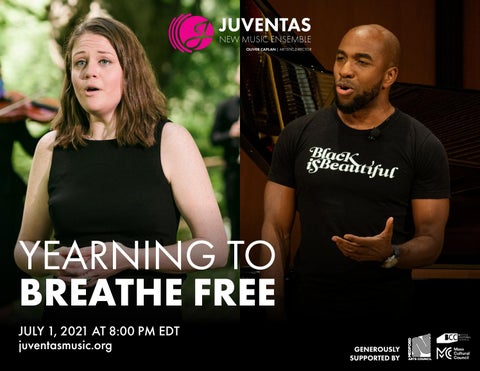
YEARNING TO BREATHE FREE
JULY 1, 2021 AT 8:00 PM EDT juventasmusic.org
GENEROUSLY SUPPORTED BY
STAFF Oliver Caplan Artistic Director
Jackie Dentino
Director of Audience Development
Joe Sedarski
Marketing Coordinator
Chris Petre-Baumer Graphic Designer
Rozime Lindsey
Arts Administration Intern
Aaron Wong
Arts Administration Intern
ABOUT JUVENTAS Juventas’s 2020-21 season “Now More Than Ever” is generously sponsored by John A. Carey. Juventas New Music Ensemble is a contemporary chamber group with a special focus on emerging voices. Juventas shares classical music as a vibrant, living art form. We bring audiences music from a diverse array of composers that live in today’s world and respond to our time. Since its founding in 2005, Juventas has performed the music of over 200 living composers. The ensemble has earned a reputation as a curator with a keen eye for new talent. It opens doors for composers with top-notch professional performances that present their work in the best possible light. Recognition for the ensemble’s work includes the American Prize Ernst Bacon Award for Performance of American Music and support from the National Endowment for the Arts, Massachusetts Cultural Council, and Boston Foundation. Juventas is featured on albums by Innova Recordings, Parma Records and New Dynamic Records, and has held residencies at Boston Conservatory, Harvard University, Longy School of Music, Middlebury College, and Worcester Polytechnic Institute. Juventas has a storied history of dynamic collaboration with artists in other media, including dancers, painters, scientists, poets, puppeteers and robotics engineers. A leader in the field, Juventas also facilitates the Boston New Music Festival, a weeklong showcase of Boston’s contemporary music scene.
Saskia Den Boon
Arts Administration Intern
BOARD OF DIRECTORS John Carey President
Cashman Kerr Prince Treasurer
Alvin B. Carter III Carson Cooman Meghan Guidry Leslie Jacobson Kaye Rachel M. Rivkind Karen Ruymann Oliver Caplan ex officio
FROM THE ARTISTIC DIRECTOR Our country was founded on principles of freedom and equality, but hasn’t always afforded these rights to all its people. “Great nations don’t ignore their most painful moments,” said President Joe Biden this June 17, at the signing of the Juneteenth National Independence Day Act. And so, tonight’s concert probes complicated aspects of our nation’s story, from past to present. Collectively, we hope these works inspire us all to redouble our efforts to form a “more perfect union,” one that is truly welcoming of all.
Oliver Caplan Artistic Director
YEARNING TO BREATHE FREE July 1, 2021 at 8:00 PM EDT
Broadcast Live on YouTube
William Grant Still (arr. Julia Scott Carey) Julia Scott Carey, piano
Fanfare for American Heroes (1944)
My Country (2021) Shawn Okpebholo Kelley Hollis, soprano; James Dargan, baritone; Julia Scott Carey, piano J. Rosamond Johnson (arr. James Dargan) James Dargan, baritone; Julia Scott Carey, piano
Lift Every Voice and Sing (1905)
The New Colossus (2018) Oliver Caplan Kelley Hollis, soprano; Julia Scott Carey, piano INTERMISSION Let America Be America Again (2011) Gwyneth Walker James Dargan, baritone; Julia Scott Carey, piano Frederick Douglass (2008) Tom Cipullo James Dargan, baritone; Julia Scott Carey, piano
Oh, Freedom Traditional What, to the American Slave, Is Your Fourth of July? James Dargan James Dargan, baritone James Dargan, baritone; Julia Scott Carey, piano I, Too, Sing America (1959) Margaret Bonds On Mount Nebo (2021) Maria Corley James Dargan, baritone; Julia Scott Carey, piano Kelley Hollis, soprano; James Dargan, baritone; Julia Scott Carey, piano Amerika braucht Liebe, süße Liebe (2021) Julia Scott Carey, piano
Marek Harris I Hear America Singing (1993) André Thomas Kelley Hollis, soprano; James Dargan, baritone; Julia Scott Carey, piano
The Mightier Word of Peace (2021) Christopher Wicks I Dream a World (2002) André Thomas Kelley Hollis, soprano; Julia Scott Carey, piano Kelley Hollis, soprano; James Dargan, baritone; Julia Scott Carey, piano The War Prayer (2013) Steven Mark Kohn Kelley Hollis, soprano; Julia Scott Carey, piano
Juventas’s 2020-21 Season “Now More Than Ever” is generously sponsored by John A. Carey.
This program is supported in part by grants from the Boston Cultural Council and Medford Arts Council, local commissions that are supported by the Mass Cultural Council.
PROGRAM NOTES William Grant Still Fanfare for American Heroes This brief but glorious fanfare was composed by William Grant still, who was known as the “Dean of African-American composers.” It was commissioned by the Cincinnati Symphony Orchestra in 1944 as part of their Fanfare Project, in which the orchestra commissioned and performed eighteen fanfares to show their support of American troops in World War II. The most famous of these works, of course, was Aaron Copland’s “Fanfare for the Common Man.” Most of the other fanfares have disappeared from the standard repertoire, but hopefully William Grant Still’s fanfare will see a resurgence of performances, because it’s an exhilaratingly patriotic concert opener that’s also a great reminder of how some of the most triumphant music has been written during the most difficult times in history. Still stated that his piece was written “in memorial of the colored soldiers who died for democracy.”
Shawn Okpebholo My Country Shawn Okpebholo describes his piece “My Country” as a “Reimagining of ‘My Country ’Tis of Thee.’” It was commissioned for and premiered at a 2021 Inauguration concert produced by the Washington National Opera. The new words to this piece were written by Marcus Amaker, poet laureate of Charleston, South Carolina. Marcus’ words reflect the darker side of American history, referencing slavery and division, and questioning if we can claim liberty, but ultimately ending with hope. Speaking of the meaning behind poetry as an art form, Marcus says: “Poetry is the great truth-teller. For centuries, poets have been offering people the
opportunity to wake up. But we can only do so much. Real change, in the way this society is set up, has to come from a change in power structure.”
J. Rosamund Johnson Lift Every Voice and Sing The Johnson Brothers (James Weldon, 1871-1938, and John Rosamund, 1873-1954), were taught to love literature and music by their mother (who was a teacher and musician), and together, they produced operettas, musicals, and, including Lift Every Voice And Sing, also known as the Negro National Anthem. James, a poet, wrote the words, and John, a singer and composer, wrote the music. My aim in arranging this great hymn was to acknowledge all of the great arrangements I’ve heard of it throughout my life, while also painting the drama inherent in the words with a harmonic vocabulary that owes much to the Black sacred music tradition in which I grew up.
Margaret Bonds I, Too, Sing America Margaret Bonds and Langston Hughes were close friends and artistic collaborators throughout their adult lives, but Margaret Bonds came to know Langston Hughes through his poetry before the two had ever met in person. Describing her discovery of Hughes’ poetry while she was in college at Northwestern University, Bonds said: “I was in this prejudiced university, this terribly prejudiced place…I was looking in the basement of the Evanston Public Library where they had the poetry. I came in contact with this wonderful poem, ‘The Negro Speaks of Rivers,’ and I’m sure it helped my feelings of security. Because in that poem he tells how great the black man is. And if I had any misgivings, which I would have to have here you are in a setup where the restaurants won’t serve you and you’re going to college, you’re sacrificing, trying to get through school - and I know that poem helped save me.”
“I, Too” is the final movement of Bonds’ cycle of three songs on poems by Langston Hughes, called “Three Dream Portraits.” Margaret Bonds captures the dramatic range of emotion in the poem, beginning with an emphatic fanfare-like rising fifth in the voice on the words “I, Too,” and ending with a more introspective stepwise passage on “beautiful I am.” The piano part begins with an introduction that is strong and menacing, while it ends with the same music as a postlude but transformed into a quiet and tentative color, like the looming threat of oppression which has lost its forcefulness through the singer’s increased vehemence.
Marek Harris Amerika braucht Liebe, süße Liebe While witnessing the awful drama that was the January 6th 2021 insurrection unfolding at our nation’s Capitol, I searched my stacks for a piano version of “America The Beautiful”, finding only one arrangement, composed for a beginning piano student. Immediately I decided a more advanced arrangement was called for. Initially I decided to create a “legit” rendition. The events on January 6th were very upsetting; I was quite rattled by what I saw, and I played some wrong notes. Then I struck a couple more wrong notes. Not so surprisingly, a cascade of unexpected sonorities began to emerge, mirroring my mood. It was at that moment blindingly clear to me how rule of law, and democracy itself, were under prolonged attack. So then I allowed these complex emotions to guide the direction this work was taking, exploring feelings of horror, shock, and disbelief at the frenzied hatred, the perverse violence, and the selfish mass insanity, on parade, before the eyes of the world. It was chilling. This Prélude is my musical outcry for a divided America, a call for peace and sanity to prevail in the nation I once knew. Composed on January 6th and 7th 2021, Prélude #2 in D-flat, subtitled “America Needs Love, Sweet Love”, is not only my response to the events of the day, but also a prayerful hope that there will eventually be
calm discourse and rational behavior across our nation. May we heal and move forward, united once again.
Oliver Caplan The New Colossus
Christopher Wicks The Mightier Word of Peace
America was founded in 1776, a nation of immigrants. Now, we talk about walls, about here versus there, about fear, about sharing, about keeping, and keeping out. But over a century ago, in 1883, author Emma Lazarus penned a sonnet so powerful it would come to symbolize our nation’s place in the world for generations. “Keep, ancient lands, your storied pomp,” she wrote. “Give me your tired, your poor.” What could be more patriotic then this poem inscribed on one of our greatest national icons, the Statue of Liberty? I set Lazarus’s words to music in honor of those who’ve found a home in America and those who wait yet “beside the golden door.”
After the insurrection of January 6, I was terribly shaken, and briefly nearly despairing about the USA. Somewhat to my surprise, over the following two weeks my thoughts coalesced into a poem, and then into a musical setting of it. Early on the morning of Tuesday the 19th, I emailed the piece to a friend, Bostonian pianist and composer Julia Scott Carey, and by that evening, she and her soprano colleague Kelley Hollis had enthusiastically created a video of my music. My poem is printed below, and also is available in the notes on the YouTube video.
Steven Mark Kohn The War Prayer Mark Twain wrote The War Prayer in 1904-05 to protest America’s involvement in the Spanish-American War. His family convinced him to keep it from publication, fearing it was too controversial. It was published after his death. Twain made the case that if God causes all things to happen and blesses select people, then He must also, willingly, deny others his blessing. It is the other side of prayer, the unspoken side, which Twain so brilliantly characterized in The War Prayer. It is not my goal to demean anyone’s faith or enter into a theological debate. I see Twain’s essay not as an indictment of religion, but as an impassioned anti-war statement, the kind of which will always have resonance. Those familiar with this work will recognize the astonishing liberties taken in adopting it. Whole passages were cut, phrases were moved around and words were deleted or replaced with my own, all in the interest of concision, storytelling and the considerations one makes when fitting words to music. But the essence of Twain’s tone and message has not been altered.
Gwyneth Walker Let America Be America Again Let America Be America Again is a powerful poem by African-American poet/playwright, Langston Hughes (1902-1967). The strength of the message and language are well-suited to presentation by narrator and orchestra. This is a dramatic and varied text, ranging from peaceful (dreamlike) passages to angry explosions. The author begins by speaking of the dream of America, a land where pioneers sought their freedom. Hughes then acknowledges that, as a black American, “America never was America to me.” There is the hope for liberty and equality. Yet for black Americans, and the downtrodden of all races, the American experience has all too often been one of persecution. Speaking now in the first person, the author identifies with all struggling Americans. “I am the farmer... the worker...the Negro...I am the people.” “Yet I’m the one who dreamt the basic dream...to build a homeland of the free.” Despite their labors, these Americans have nothing except “the dream that’s almost dead today.” With the strength of enduring hope, the author exhorts “We, the people, must reclaim the land...and make America again!”
The musical expression, which has thus far essentially provided a background and commentary to the reading, now comes forth with a closing hymn titled “Let America Be America Again!” The theme, which enters after a 12-measure introduction, is stated in low octaves, with a rhythm aligned with the words “Let America be America.” The theme returns several times, including in the closing section, where the ascending pitches are held through. This gathering of many notes expresses a “land for all!”
Tom Cipullo Frederick Douglass For some time, I have wanted to create a piece about 1968. To think back on that year today is to be flooded with powerful images: two assassinations, the Democratic National Convention in Chicago, the Tet Offensive in Vietnam, Apollo 8 orbiting the moon, the Black Power salute of John Carlos and Tommie Smith on the medal-stand of the Mexico City Olympics. The particular vision of our nation expressed in America 1968 may seem, to some, a bit unusual. It is, at times, disturbing; at times even violent. Still, it is a true, if difficult, view of our country during a volatile time. Ultimately, the vision is positive and encouraging, but the journey to that positive conclusion is harrowing - or at least I hope it is. I found in Robert Hayden’s eloquent poetry a bridge to my memories of the time - and to my own ambivalence about the era. In Hayden’s poems, the redemptive powers of art and nature can assuage the reader even when “the news from Selma and Saigon poison the air like fallout.” But the rhythms and cadences of urban violence can be heard in Lord Riot, and the casual, misdirected cruelty of those who have themselves been victims finds its expression in The Whipping. Those Winter Sundays is perhaps Hayden’s most famous poem. In it, one feels, belatedly, an appreciation for the sacrifices of another, as one does, perhaps even more viscerally, in Frederick Douglass. To me, Hayden is at his most moving in The Point, celebrating a transcendent meeting of light and water, a moment when people are “held in shining, like memories in the mind of God.”
America 1968 was premiered by baritone Andrew Garland and pianist Donna Loewy at Weill Recital on November 21, 2008 at a concert sponsored by Carnegie Hall and the Marilyn Horne Foundation. Two of the songs in the cycle were composed several years earlier. A version of Monet’s Waterlilies for chamber ensemble and baritone was written in 2004 for the new-music group Sequitur, and The Point was originally part of my song-cycle Climbing: 7 Songs on 8 Poems by African-Americans. I would like to express my deep appreciation to the Virginia Center for the Creative Arts, Yaddo, and Copland House - the sites where America 1968 was composed.
James Dargan What, to the American Slave, Is Your Fourth of July? Frederick Douglass was a brilliant complication of a man, and so his most well known speech is a thicket of tactical quotation and allusion, redolent with shades of Pope and Dryden, buzzing with Douglass’ own quick intelligence, and it was difficult to figure out how to prune it into a song. What I finally settled on was a scena, in which moods and textures change drastically with little warning, but with a rising melodic motif that, too me, signifies the main question around which the speech revolves: what, to an enslaved person, does July fourth mean? One can immediately see how that question can be extrapolated to the larger one of: what does American pomp mean to those Black people, whose bodies and ancestors have been fed to this American machine?
Maria Thompson Corley On Mount Nebo “On Mount Nebo” was commissioned by Julia Scott Carey. I wrote the poem “Moses on Mount Nebo” (which incorporates verses from Deuteronomy) at the suggestion of my mother, Eva Thompson. Dr. Martin Luther King Jr.’s “I’ve Been to the Mountaintop” speech alluded to Moses’s farewell to the nation of Israel after
40 years in the wilderness, delivered from the summit of the titular mountain as he looked over a promised land God only allowed him to see from a distance. Upon re-reading the words at the outset of the Battle Hymn, I imagined that watching the Lord unleash “the fateful lightning of His terrible, swift sword” would be both disorienting and terrifying. As a result, I wrote a dissonant accompaniment and avoided the well-known melody usually associated with those words. Building on the idea of lightning, a stormy piano interlude follows, interrupted by the baritone (Moses) begging the heavens to let him speak. His encouraging message to his people—in 5/4 with hints of the spiritual, “Go Down Moses” in the bass—yields to more dissonance when he mentions his “pungent fear” and the “thunder of pursuing chariots” that still “invades his dreams of Canaan.” The soprano soon reminds him that the Lord’s trumpet never calls retreat; to me, this evokes Dr. King’s steadfast obedience to his calling, even in the face of death. The baritone again urges his people to be “strong and courageous,” in music that is more triumphant and tonal. This leads to a portion of the text in which Moses reflects on being denied entry to Canaan, which is combined with the verse of the “Battle Hymn” that references Christ’s birth (“in the beauty of the lilies...”) and how He transforms us. I changed a lyric from Julia Ward Howe to ask that, rather than dying, we “strive till all are free.” “Glory, Glory, Hallelujah” is sung only once, in consonant harmony, to portray Dr. King’s dedication to his faith and reliance on God, regardless of life’s trajectory. Overall, I tried to create a piece that would honor all people who have dedicated themselves to the cause of equality.
André J. Thomas I Hear America Singing I Hear America Singing is a joyful, exuberant piece. It quotes the first line of Walt Whitman’s poem “I Hear America Singing,” combining the imagery of America’s song with the spiritual “Walk Together, Children.”
André J. Thomas I Dream a World This is a beautiful, hopeful duet expressing a dream for a world of freedom and peace.
TEXTS My Country Text by Marcus Amaker
Lift Every Voice and Sing Text by James Weldon Johnson
My country, ’tis of thee, Sweet land of liberty, Of thee I sing; Land where our fathers died, Land of the pilgrim’s pride, From every mountainside, Let freedom ring.
Lift every voice and sing Till earth and heaven ring Ring with the harmonies of Liberty Let our rejoicing rise High as the listening skies Let it resound loud as the rolling sea
My country, ’tis of thee, Echoes of slavery, Of thee I sing; Land where our mothers died, Land of the strong divide, Our voices amplified, Let freedom ring! Let music swell the breeze, We sing from bended knee, Sweet freedom’s song; Let every mind awake; Let all that breathe partake; Heal racist wounds that ache; Let freedom ring! My country, ’tis of thee, Can we claim liberty? To thee we sing; Long may our land be bright, With freedom’s holy light, Protect us by thy might, Let freedom ring!
Sing a song full of the faith that the dark past has taught us Sing a song full of the hope that the present has brought us Facing the rising sun of our new day begun Let us march on till victory is won Stony the road we trod Bitter the chastening rod Felt in the days when hope unborn had died Yet with a steady beat Have not our weary feet Come to the place for which our fathers sighed? We have come over a way that with tears has been watered We have come, treading our path through the blood of the slaughtered Out from the gloomy past Till now we stand at last Where the white gleam of our bright star is cast
God of our weary years God of our silent tears Thou who has brought us thus far on the way Thou who has by Thy might Led us into the light Keep us forever in the path, we pray Lest our feet stray from the places, our God, where we met Thee Lest, our hearts drunk with the wine of the world, we forget Thee Shadowed beneath Thy hand May we forever stand True to our God True to our native land Our native land
Oh, Freedom Traditional Oh, freedom, Oh, freedom, Oh, freedom over me! And before I’ll be a slave I’ll be buried in my grave, To go home to my Lord, and be free! No more weeping, No more weeping, No more weeping over me! And before I’ll be a slave I’ll be buried in my grave, To go home to my Lord, and be free! There will be music, There will be music, There will be music over me! And before I’ll be a slave I’ll be buried in my grave, To go home to my Lord, and be free!
I, Too, Sing America Text by Langston Hughes I, too, sing America. I am the darker brother. They send me to eat in the kitchen When company comes, But I laugh, And eat well, And grow strong. Tomorrow, I’ll be at the table When company comes. Nobody’ll dare Say to me, “Eat in the kitchen,” Then. Besides, They’ll see how beautiful I am And be ashamed.
The Mightier Word of Peace Text by Christopher Wicks How can a word of peace be spoken To men and women who behave Like beasts in rage? How does one speak The word of peace? How can a word of peace be spoken When glass is broken And lives are taken And sanity itself has been forsaken? Within these walls we once did nullify Outmoded laws debasing women and men, But ugly symbols of those laws are now unfurled again, And cowards, for convenience sake, would idly stand by,
While reason is uprooted, And a reckless tyrant yells lie after lie.
Sunday morning came. The church was filled.
We will speak of peace, but not of yielding! We will sing, we will shout it to the sky! No, we will not leave the glass lying shattered! We will work as those who remember that which mattered! Without accountability, no one is free! Let us sing, Let freedom ring!
The minister delivered a prayer such as none had ever heard before. He beseeched the ever merciful loving father of us all to watch over our noble soldiers and aid, comfort and encourage them in their just and righteous cause. Bless them and shield them in the day of battle and hour of peril! Bear them in his mighty hand! Make them invincible! Grant honor and glory to their country and flag! Amen.
The War Prayer Text by Mark Twain It was a time of great excitement! The country was up in arms and every breast burned with the holy fire of patriotism! Drums were beating, bands were playing, and all down the street as far as the eye could see, a fluttering of flags flashed in the sun! Every day the young volunteers marched down the wide avenue gay and fine in their new uniforms! The proud mothers and proud fathers, proud sisters and sweethearts, cheering them with voices choked with happy emotion as they swung by! Every night the packed meeting houses echoed with the sound of patriotic oratory, which stirred them deep in their hearts, and was greeted with waves of applause, bringing tears to their eager shining eyes! It was a grand and glorious time!
A reverent pause came over the whole congregation. In the silence, a strange old man entered, and with slow and noiseless step moved up the aisle. Taking his place at the altar, he turned and spoke to the congregation. “I come as a messenger from the throne of God. He has heard your prayer and is prepared to grant it. But He wants you to know your prayer has two parts. We have heard the first part as uttered by your servant in this hall. I shall now tell you what you have silently asked for. Oh, Lord, our Father, our brave young men go forth to battle. Be with them, Lord. Be thou with them,
as they stray from the sweet peace of our beloved firesides. Help us, Lord, to drown the thunder of their guns with the shrieks of their wounded. Help us cover their smiling fields with the pale forms of their dead. Help us lay waste to their homes. Help us wring the hearts of their grieving widows! Turn out their orphaned children to wander the wastes of their ruined land in rags and hunger and pain! May they be broken in spirit, imploring Thee for mercy and denied it! Blight them! Help us destroy them! We ask Thee, in the name of love! Ye have prayed it. HE has heard you. If ye still desire it, speak. HE is waiting…”
The New Colossus Text by Emma Lazarus Not like the brazen giant of Greek fame, With conquering limbs astride from land to land; Here at our sea-washed, sunset gates shall stand A mighty woman with a torch, whose flame Is the imprisoned lightning, and her name Mother of Exiles. From her beacon-hand Glows world-wide welcome; her mild eyes command The air-bridged harbor that twin cities frame.
“Keep, ancient lands, your storied pomp!” cries she With silent lips. “Give me your tired, your poor, Your huddled masses yearning to breathe free, The wretched refuse of your teeming shore. Send these, the homeless, tempest-tost to vme, I lift my lamp beside the golden door!”
Let America Be America Again Text by Langston Hughes Let America be America again. Let it be the dream it used to be. Let it be the pioneer on the plain Seeking a home where he himself is free. (America never was America to me.) Let America be the dream the dreamers dreamed— Let it be that great strong land of love Where never kings connive nor tyrants vscheme That any man be crushed by one above. O, let my land be a land where Liberty Is crowned with no false patriotic wreath, But opportunity is real, and life is free, Equality is in the air we breathe. (There’s never been equality for me, Nor freedom in this “homeland of the free.”) Say, who are you that mumbles in the dark? And who are you that draws your veil across the stars?
I am the poor white, fooled and pushed apart, I am the Negro bearing slavery’s scars. I am the red man driven from the land, I am the immigrant clutching the hope I seek— And finding only the same old stupid plan Of dog eat dog, of mighty crush the weak. I am the young man, full of strength and hope, Tangled in that ancient endless chain Of profit, power, gain, of grab the land! Of grab the gold! Of grab the ways of satisfying need! Of work the men! Of take the pay! Of owning everything for one’s own greed! I am the farmer, bondsman to the soil. I am the worker sold to the machine. I am the Negro, servant to you all. I am the people, humble, hungry, mean— Hungry yet today despite the dream. Beaten yet today—O, Pioneers! I am the man who never got ahead, The poorest worker bartered through the years. Yet I’m the one who dreamt our basic dream In the Old World while still a serf of kings, Who dreamt a dream so strong, so brave, so true, That even yet its mighty daring sings In every brick and stone, in every furrow turned That’s made America the land it has become. O, I’m the man who sailed those early seas In search of what I meant to be my home—
For I’m the one who left dark Ireland’s shore, And Poland’s plain, and England’s grassy lea, And torn from Black Africa’s strand I came To build a “homeland of the free.” The free? Who said the free? Not me? Surely not me? The millions on relief today? The millions shot down when we strike? The millions who have nothing for our pay? For all the dreams we’ve dreamed And all the songs we’ve sung And all the hopes we’ve held And all the flags we’ve hung, The millions who have nothing for our pay— Except the dream that’s almost dead today. O, let America be America again— The land that never has been yet— And yet must be—the land where every man is free. The land that’s mine—the poor man’s, Indian’s, Negro’s, ME— Who made America, Whose sweat and blood, whose faith and pain, Whose hand at the foundry, whose plow in the rain, Must bring back our mighty dream again. Sure, call me any ugly name you choose— The steel of freedom does not stain. From those who live like leeches on the people’s lives, We must take back our land again, America!
O, yes, I say it plain, America never was America to me, And yet I swear this oath— America will be! Out of the rack and ruin of our gangster death, The rape and rot of graft, and stealth, and lies, We, the people, must redeem The land, the mines, the plants, the rivers. The mountains and the endless plain— All, all the stretch of these great green states— And make America again!
Frederick Douglass Text by Robert Hayden When it is finally ours, this freedom, this liberty, this beautiful and terrible thing, needful to man as air, usable as earth; when it belongs at last to all, when it is truly instinct, brain matter, diastole, systole, reflex action; when it is finally won; when it is more than the gaudy mumbo jumbo of politicians: this man, this Douglass, this former slave, this Negro beaten to his knees, exiled, visioning a world where none is lonely, none hunted, alien, this man, superb in love and logic, this man shall be remembered. Oh, not with statues’ rhetoric, not with legends and poems and wreaths of bronze alone, but with the lives grown out of his life, the lives
fleshing his dream of the beautiful, needful thing.
What, to the American Slave, Is Your Fourth of July? Text by Frederick Douglass What to the American slave is your Fourth of July? What to the slave is the Fourth of July? A day that reveals that your celebration is a sham. Your national greatness, your sounds of rejoicing, your denouncing of tyrants, your shouts of liberty and equality, your prayers and hymns, sermons and thanksgivings, a mere fraud. A thin veil to cover up crimes that would disgrace a nation of savages. There is no nation on earth guilty of practices more shocking and bloody than are the people of the United States at this very hour. This Fourth of July is yours, not mine. You may rejoice, I must mourn. “By the rivers, by the waters of Babylon, we sat down. We wept when we remembered Zion. For they that carried us away captive required, required of us a song, saying ‘sing us the songs of Zion.’ But how can we sing the Lord’s song in a strange land?” Would you have me argue that man is entitled to liberty? That he is rightful owner of his own body? How should I look, dividing and subdividing a discourse, to show that men have a natural right to freedom? Speaking of it relatively and positively, negatively and affirmatively, to do so would be to make myself ridiculous: there is no one beneath the canopy of
heaven who does not know slavery is wrong. So I say, and let every heart join in saying it, “God speed the hour, the glorious hour when none on earth shall exercise a lordly pow’r, Until that day, year, hour arrive with head and heart and hand I’ll strive to break the rod and rend the gyve, the spoiler of his prey deprive. And never from my chosen post whate’er the peril or the cost Be driven.
I had no words, Lord, but those you gave me. No hope but the assurance of Your covenant to restore Your people from captivity, and to have compassion, and to gather an outcast nation from the ends of the earth.
Give ear, O heavens, and let me speak! Let my teaching drop as the rain, My speech distill as the dew. Be Strong and Courageous, my people.
In the beauty of the lilies Christ was born across the sea With a glory in his bosom that transfigures you and me As he died to make us holy let us strive till all are free.
Be Strong and Courageous, my people. Mine eyes have seen where the Lord has ordained that I cannot go: Gilead, as far as Dan, Napthali and Ephraim, Manasseh, and all of Judah, as far as the Western Sea.
I Hear America Singing Text by André J. Thomas and Traditional, alt.
Walk on, my people! The eternal God is a dwelling place, And underneath are the everlasting arms.
I hear America singing of its greatness. I hear America singing strong. I hear America singing of its beauty. I hear America singing today.
Battle Hymn of the Republic Text by Julia Ward Howe
Oh, walk together, children. Don’t you get weary. There’s a great camp meeting in the Promised Land. Sing together, children. Don’t you get weary. There’s a great camp meeting in the Promised Land.
So witness heav’n!
Moses on Mount Nebo Text by Maria Thompson Corley
I have seen him in the watch-fires of a hundred circling camps They have builded him an altar in the evening dews and damps I have read his righteous sentence by the dim and flaring lamps His day is marching on
I led you through the perilous wastes, trusting the provisions and promises of God.
Mine eyes have seen the glory of the coming of the Lord He is trapling out the vintage where the grapes of wrath are stored He have loosed the fateful lightening of his terrible swift sword His truth is marching on
I swallowed manna, quail and my own pungent fear. Many were the nights when the thunder of pursuing chariots invaded my dreams of Canaan.
He has sounded form the trumpet that shall never call retreat He is sifting out the hearts of men before His judgment-seat Oh, be swift, my soul to answer, oh be jubilant, my feet Our God is marching on
Glory! Glory! Halleluhja!
Great camp meeting, America’s singing. We’re going to sing of truth and love. Walk together hand in hand, together in peace. We’re going to sing and never tire. There’s a great camp meeting, and America’s singing! There’s a great camp meeting in the Promised Land!
I Dream a World Text by Langston Hughes, alt. I dream a world where man No other man will scorn, Where love will bless the earth And peace its paths adorn I dream a world where all Will know sweet freedom’s way, Where greed no longer saps the soul Nor avarice blights our day. A world I dream where black or white, Whatever race you be, Will share the bounties of the earth And every man is free, Where wretchedness will hang its head And joy, like a pearl, Attends the needs of all mankindOf such I dream, my world!
COMPOSERS MARIA CORLEY
a series of concerts for people with special needs, or other challenges to strictly observing concert protocols. Dr. Corley has recorded CD’s for Naxos, Albany, and independent labels. Excerpts from her discs have been featured on radio, nationally and internationally. Her recording of Margaret Bonds’s “Troubled Water” was included in the HBO special, “Kabreeyah’s Salad Days” and her recording of Leslie Adams’s “Etude in C Sharp Minor” was included in award-winning director Timothy Greenfield-Sanders’s documentary, Toni Morrison: The Pieces I Am.
also the peace that comes from recognizing that there is good sense in unmasking fantasies. He is increasingly interested in how this applies to composer’s craft, as well as to how we choose to live our daily lives,whether in solitary choices or in small or large communities.
OLIVER CAPLAN
CHRISTOPHER WICKS
b. 1966 Maria Thompson Corley (MM, DMA, The Juilliard School) has appeared as a solo and collaborative pianist on radio, television, and concert stages in Canada, the United States, Central America, the Caribbean, Bermuda and Europe, including performances in Budapest at the Liszt Academy, and in Carnegie Recital Hall, Aaron Davis Hall and Alice Tully Hall, all in New York City. She has collaborated with such artists as Metropolitan Opera soprano Priscilla Baskerville, internationally renowned clarinetist James Campbell, Peter Kenote, a violist in the New York Philharmonic, and Dara Morales, principal second violinist in the Philadelphia Orchestra. Her engagements as a soloist with orchestra include the Tallahassee Symphony Orchestra under the baton of Gunther Schuller, the Lancaster Symphony Orchestra, and the Allegro Chamber Orchestra. She has also performed with the Philadelphia-based Black Pearl Chamber Orchestra. Maria Thompson Corley and cellist Sara Male formed Duo Chiaroscuro in 2011; the group has recently begun
b. 1982
Christopher M. Wicks was born in Silverton, one of the fairest towns of “the People’s Republic of Oregon,” in 1975, when the counterculture was expecting the world to come to an end, but found that it did not. He has lived for almost all of his life in Silverton, leaving only for educational purposes: a year at the Universityof Redlands near Los Angeles, two years at the Eastman School of Music in Rochester, NY, and two years of a master’s degree in composition at the Universitéde Montréal. His bachelor’s degree is actually from the now-defunct Marylhurst College near Portland, Oregon, and he also holds a master’s in Organ Performance from the University of Oregon, and is a Fellow of the American Guild of Organists. What preoccupies him in middle life is the challenge of reconciling one’s dreams and pragmatic reality, but
Award-winning American composer Oliver Caplan writes melodies that nourish our souls, offering a voice of hope in an uncertain world. Inspired by the resiliency of the human spirit and beauty of the natural world, his music celebrates stories of social justice, conservation and community. Mr. Caplan’s works have been performed in over 175 performances nationwide. He has been commissioned by the Atlanta Chamber Players, Bella Piano Trio, Bronx Arts Ensemble, Brookline Symphony Orchestra, Columbia University Wind Ensemble and New Hampshire Master Chorale, among others. Winner of a Special Citation for the American Prize in Orchestral Composition, additional recognitions include two Veridian Symphony Competition Wins, the Fifth House Ensemble Competition Grand Prize, eight ASCAP Awards, and fellowships at Ragdale, VCCA and the Brush Creek Foundation. Recordings of Mr.
Caplan’s music include his 2017 release You Are Not Alone, which has been featured on Apple Music’s Classical A-list and streamed over 200,000 times; 2012 debut album Illuminations; and tracks on Trio Siciliano’s Exploring Music (2018, U07 Records) and the Sinfonietta of Riverdale’s New World Serenade (2016, Albany Records). A leader in the field of contemporary classical music, Mr. Caplan is the Artistic Director of Juventas New Music Ensemble. Mr. Caplan holds degrees from Dartmouth College and the Boston Conservatory, is a voting member of the Recording Academy, and resides in Medford, Massachusetts.
MUSICIANS JULIA SCOTT CAREY piano
Jon Saxton and Barbara Fox have generously sponsored Julia Scott Carey for the 2020-21 concert season. Julia Scott Carey began her music training at the New England Conservatory Preparatory School, where she received the Lanier Prize for Most Outstanding Graduating Senior. She was one of the first students admitted to the Harvard-NEC joint degree program, through which she received a master’s degree in composition. She received a second
master’s degree in collaborative piano from Boston University. Julia is the Minister of Music at the Central Square Congregational Church in Bridgewater, where she leads the adult and children’s choirs from the keyboard. She is one of the accompanists for the Tanglewood Festival Chorus and the Boston Symphony Children’s Choir. She also serves as the accompanist for the Metropolitan Chorale of Brookline, the Dedham Choral Society, the Boston College University Chorale, and the Boston Saengerfest Men’s Chorus. She previously served as the pianist for the Handel and Haydn Society’s Educational Vocal Quartet, the Wellesley College Chamber Singers, and the Boston Children’s Chorus. She is also a founder and core ensemble member of Juventas New Music Ensemble. As a composer, her orchestral works have been performed by numerous orchestras, including the BSO and the Boston Pops, and her works have been broadcast on national TV and radio in the United States and in Russia. She was the youngest
composer ever published by the Theodore Presser Company. She was also chosen to arrange a folk song for Yo-Yo Ma and Lynn Chang to play at Deval Patrick’s inaugural ball. She has served as a music director or accompanist for over forty opera and musical theater productions. Productions for which Julia was the music director include Cy Coleman’s City of Angels with the Longwood Players and Alexander Zemlinsky’s Der Zwerg with OperaHub. Reviewing a performance Julia conducted of Puccini’s Gianni Schicchi with the Hubbard Hall Opera Company, the Berkshire Hudson Arts Review said “the players and singers were not just led, but were energized. Schicchi is a tough score, and Julia stood the test.” Also passionate about early music, Julia music directed a staged performance of four of Louis-Nicolas Clérambault’s Cantatas with the Harvard Early Music Society, which was taken on tour to Versailles. She also music directed a performance of John Eccles’ Semele with the same organization. Speaking of her performance as a harpsichordist in the Boston Opera Collaborative’s production of Le nozze di Figaro, the Boston Musical Intelligencer
said, “The unwavering harpsichord accompaniment of Julia Carey richly and expressively textured the recitatives.” Julia currently works as a musicianship teacher and department coordinator at the Suzuki School in Newton. She also taught an undergraduate music theory class at Boston College, served as a keyboard harmony teaching fellow at NEC, and worked as a musical theatre teacher at the Belvoir Terrace Arts Camp and the Boston Children’s Theatre. Julia lives in Winchester with her husband and her daughter. In addition to music, she loves cooking, running, and spending time on Cape Cod.
KELLEY HOLLIS
soprano
Karen and Fred Ruymann have generously sponsored Kelley Hollis for the 2020-21 concert season. Kelley Hollis is a classically trained soprano known for her interpretations of new and lesser known works. Last year Kelley was featured on the album Arnold Rosner’s Requiem (Toccata Records), recorded with the London Philharmonic Orchestra at Abbey Road Studios. In 2018 she performed a concert at the Prague Castle in the Czech Republic, along with a series of recitals in cities throughout the country, as a featured artist with the Americké jaro festival. In addition to singing with Juventas, Kelley performs with and serves on the board of Opera on Tap Boston. In 2019 she sang the role
of Rosalinda in MassOpera’s critically acclaimed production of Die Fledermaus, and premiered the role of Juana in the Omar Najmi’s En el ardiente oscuridad. Her other opera roles include Mimi in Puccini’s La femme boheme, Beth in Adamo’s Little Women (Metrowest Opera), Eliza in Muhly’s Dark Sisters (Third Eye Theater Ensemble); Florencia Grimaldi in Catan’s Florencia en el Amazonas, Donna Anna in Mozart’s Don Giovanni, Micaela in Le Tragedie de Carmen, Harper in Eötvös’ Angels in America (BU Opera Institute) and Nina in Pasatieri’s The Seagull (Opera del West). Ms. Hollis has performed twice at Boston Symphony Hall: In 2016 she appeared as the First Orphan in The Boston Symphony Orchestra’s concert production of Strauss’ Der Rosenkavalier alongside Renee Fleming and Susan Graham, and in 2015 she was the soprano soloist for Mahler’s 2nd Symphony, performing with the BU Symphony Orchestra. Her most recent concert repertoire includes Vaughan Williams’ Dona Nobis Pacem, Handel’s Messiah, and Faure’s Requiem. In 2014, Ms. Hollis was a finalist for Lyric Opera Chicago’s Ryan Opera Center and in 2011 Kelley received an encouragement award at the
district level from the Metropolitan Opera National Council. Kelley Hollis received both her Master’s and Bachelor’s degrees from Northwestern University and is a graduate of the Boston University Opera Institute. Kelley is also a graduate of A.W. Dreyfoos School of the Arts.
JAMES DARGAN baritone
b. 1984 James Dargan is a polymath creative artist, athlete, polyglot, musician and writer, raised in the Deep South and--after a childhood spent at the Duke University String School and NC School of the Arts--educated in New and Old England. James is based in New York, where he sings in the choir of All Souls UU church, freelances around
Manhattan (most recently with Musica Sacra, the choir of St John The Divine, and the Bard Festival Chorus) and continues to pursue social justice through the arts; in 2016, he taught composition at 4 different schools, that summer, he made his debut at Bard College’s Summerfest. Recent artistic milestones include his first Schubert’s Winterreise; numerous performances (past and upcoming) of his social justice-oriented recital “Oh, Glory!”; his Manhattan solo debut as the baritone soloist for Musica Viva NY’s April 8th 2018 concert, “Infinite Hope”; several NYC premieres of songs for which James was lyricist, composer, and performer; and the in-progress writing of his first two operas: “His Name Is John”, and “Spirit In The Vine”. James was the artist-in-residence at Phillips Academy in Andover, MA for the MLK Day weekend, 2019, recently completed a tour of Chicago in which he sang 6 recitals in 5 days, and was the 2019-2020 Visiting Artist at Phillips Academy. James is a founding member of the Black musical consortium, Ring Shout.
MAKE A DONATION
MAKE A PLANNED GIFT
OUR BENEFACTORS
Juventas needs your support now more than ever! We’re busier than ever and offering our entire 2020-21 concert season for FREE, meaning we have completely lost ticket sales as a source of revenue. Your support helps us keep innovating and sharing music in the COVID era.
Bequests and planned gifts are simple, mutually beneficial ways for you to support Juventas New Music Ensemble beyond your lifetime. You can create your own legacy and keep supporting emerging composers for years to come by leaving a bequest in your will, life insurance policy, retirement plan, or other assets in your estate plan to Juventas New Music Ensemble, while at the same time reaping tax benefits for yourself and your descendents.
Juventas New Music Ensemble is deeply grateful to benefactors whose generous gifts support our artistic programs. Juventas received the following individual gifts from April 1, 2020 to May 1, 2021. Please visit www.juventasmusic.org/donate-now to learn about making a tax-deductible gift. Please visit www.juventasmusic.org/ donate-now to learn about making a tax-deductible gift.
Juventas New Music Ensemble is a 501(c)(3) non-profit organization. Your fully taxdeductible contributions are essential for us to present new music. To make a donation, visit www.juventasmusic. org/donate-now, or mail a check to Juventas New Music Ensemble, P.O. Box 230015, Boston, MA 02123.
SHOP WITH AMAZON SMILE Click through www.smile.amazon.com on your way to shop and select Juventas New Music Ensemble. The Amazon Smile Foundation will donate 0.5% of your eligible Amazon Smile purchases to Juventas New Music Ensemble. It doesn’t cost you a thing, and it helps us a lot!
If you would like more information about making a bequest to Juventas New Music Ensemble or if you’ve already included us in your estate plans, please contact our Artistic Director Oliver Caplan at oliver.caplan@juventasmusic.org. Juventas New Music Ensemble is a nonprofit corporation, organized and existing under the laws of the Commonwealth of Massachusetts, with a principal business address of: Juventas New Music Ensemble P.O. Box 230015 Boston, MA 02123 Our tax identification number is 26-2583870.
$2,000–$4,999 Jonathan Aibel and Julie Rohwein Boston Cultural Council Boston Mayor’s Office of Arts and Culture Jon Saxton and Barbara Fox Passim Iguana Fund $1,000–$1,999 ArtsAlive Medford Foundation Inc. Bill and Paula Luria Caplan Oliver Caplan and Chris Beagan Carson Cooman Leslie Jacobson Kaye and Richard Kaye Kevin Mathieu Karen and Fred Ruymann Medford Arts Council $300–$999 CACHE in Medford Casey Elia Michael Emanuel and Christie Gibson Denys Kotskyy Alexandra Bowers and James Liu May Marquebreuck Mark and Jody Raider Rachel M. Rivkind Theodor Weinberg and Eric Hyett Michelle Wells Emma Wine $200–$299 Margie Coffin Brown Margaret Cain Eric Darling
Lauren Downing and Roseanne Luvisi Isadel Eddy Ann Ferentz Michael Gandolfi Margaret Hastings Maureen Hollis Kenneth Krause and Maura McEnaney Matthew Kusulas Nagesh Mahanthappa MaryBeth Manca Ketty Nez Linda Ng The Record Co. Drew Wilkins $100–$199 Ed and Mary Amabile Charles Anderson Lawrence Banks Robert Beagan Lauren Bilello Lee Binnig Michele Caniato Rachel Ciprotti Larry Cohen and Susan Worst Oliver Davis Jaclyn Dentino Christine DiBlasi Jerry and Joanne Dreher BJ Dunn Keren Faling Andy Foery Moriah Freeman Lorna Gibson Nancy Goodwin Meghan Guidry Steven and Jennifer Guthrie Evangelia Hatzis Donald Hess Barbara Hughey Catherine Hyson Laurie Jacobs and Steven Levine Mari Kotskyy Nancy Kurtz Steven Lewis Tammy Lynch Annie MacDonald
Carol McCarthy Mona McKindley Reeva Meyer Jason Newman Robert Page Richard Pasquarelli Dan Perkins Christopher Porter Cashman Kerr Prince and Bryan Burns Kathryn Ritcheske Lori K. Sanders Gordon Shannon Liz Smith Catherine Smith Joe Sodroski and Alice Noble Liza Stearns Arlene Stevens Tina Strunk Sharon Daniels Sullivan Tina Summerlin Ann Teixeira Daniel VanHassel Betty & Joseph Walters Eric Wei Brent Whelan Howard Wine Beverly Woodward and Paul Monsky Murray and Susan Woolf $50–$99 Monica Barton Kenneth Bigley Anne Bilder Timothy Borchers Bruce Brolsma Elizabeth Bukey Bryce Denney Andrew Elliott Lynn Eustis Shaun Eyring David and Ellen Fries Susie Hoglund Mary and David Howarth Joseph Hutcheson Betsy Igleheart Beth Jacob Jim Kane and Sharon Williams Roger Klorese
Victoria Korsos Jane Parkin Kullmann Ian Lai Ludmilla Leibman Joshua Levit Ben Levy Harold Lichtin Melodie Linhart Xiomara Lorenzo Linda Markarian Honor McClellan Justin Mog Herbert Motley Andrew Pease Rachel Pinsky Katie Remesch Joan and Howard Rothman Mallory Ruymann Jonathan Sachs Melanie Sanders Andrew and Margot Schmolka Lorne Schweitzer Mary Kathryn Smith Roger Southwick Ingrid Stolzel Imogene Stulken Barbara Turen Michael Vanderheyden Elise Viebeck and Andrew Caplan Elaine Walsh Kristina Watts Catherine Wee Up to $49 Susan Altman Tatev Amiryan Chandler Anderson Bozo Banovic Mary Barton Robert Bassett Olga Bell Vivian Best Martha Bewick Amy Bracewell Anna Bradford Julianna Braun Stefan Bucher Julia Scott Carey and Richard Mitrano
Alvin and Stefanie Carter Trudy Chan Delia Clark Carrie Cleary Charles Coe Nell Cohen Katie Cornog Karen Courtney Sam D’Antonio Laura Davidson Brooke Davis Ashi Day Stephen Deets Rebecca Entel Marisa Jo Erskine Elizabeth Eschen Ellen Feingold David Feltner Ben Fox Lisa Geoghegan Lyudmila German Kendra Goodwin Al Gray Sai Srujan Gudibandi Andy Hanson-Dvoracek Alex Hargus Kiyoshi Hayashi Mark Heinzelman Karilyn Heisen Kelley Hollis Anne Howarth and Frederick Frank Jr. Wolcott Humphrey Howard and Frances Jacobson Ruth Kessler Justin Kim Helene Kisch Bruce Kozuma Abigail Krawson Aaron Larget-Caplan Linda Ciesielski Anna Leahy Estelle Lee Dayna Li Shayna Liu Allegra Martin Massachusetts Rivers Allaince John McDonald Libby Meyer Donna Migdal
Carrie Miller Krystal Morin Shadwa Mussad Susan Hall Mygatt Roxanna Myhrum Jonathan Newmark Cornelia Nichols Heather O’Brien Carolyn Oberting Sarah Peck Katie Reimer Ian Reiss Ginny Remedi-Brown Patricia Roos Mary Beth Saffo Antonio Santos David Schober Ose Schwab Matt Scinto Joseph Sedarski Dennis Shafer Chuck Sheketoff Benjamin Sherman Moshe Shulman Kyle Simpson Jorge Sosa Jan Swafford Julie Tittler Francine Trester Marc Vilain Patrick Walker Joni Wardell Dalit Warshaw Susan Welby William Williams Laura Yoo We are also extremely grateful to the dedicated volunteers who gave their time and talents to Juventas in the 2019-20 concert season: Michelle Locke Annie MacDonald Mona McKindley Rachel Walker Elaine Walsh Leo Walsh
THANK YOU THANK YOU THANK YOU THANK YOU THANK YOU THANK YOU THANK YOU
$5,000 and Above John A. Carey Mary Humphrey Massachusetts Cultural Council The Ripley-Steinemann Family Fund
Proud supporter of the Juventas New Proud supporter of Proud supporter of the Juventas New Music Ensemble. Proud supporter of Music Ensemble. the Juventas New the Juventas New Music Ensemble. Music Ensemble. REALTOR® 978.758.2693 Helping you find your way home. deb.smith@compass.com Deb Smith ® with Compass, a licensed real estate broker Deborah Smith is a real estate broker affiliated REALTOR and abides by Equal Housing Opportunity laws.
978.758.2693 deb.smith@compass.com
Helping you find your way home.
Deborah Smith is a real estate broker affiliated with Compass, a licensed real estate broker and abides by Equal Housing Opportunity laws.
compass.com
Deb Smith
compass.com
Helping you find your way home.
Get better at feeling good. What would it feel like if you were 10% happier? Meditation has the power to get you there. And that seemingly-modest 10% adds up over time.
LEADINGEDGE For over two decades, Leading Edge has been a force in the Greater Boston real estate market. We’ve grown to become a leading full-service real estate company offering residential real estate and global relocation services to buyers and sellers.
CASEY ELIA Realtor™ Realtor™
From start to finish, Casey listens to your goals, needs & desires. This is her focus. She brings whatever resources you need to get the job done in the best way possible. Your success is her priority and to please you is her greatest desire. Expect the best!
781.640.8880
RealtorCaseyElia@comcast.net
www.leadingedgeagents.com
The Surrealtors are pleased to support Juventas New Music Ensemble in presenting contemporary classical music for Boston area audiences.
Trisha Solio Artful and Heartful Real Estate www.TheSurrealtors.com 617.293.8070 Trisha.Solio@unlimitedsir.com Unlimited Sotheby’s International Realty
Suffering from Back Pain? We can help!
Back Pain Disc Alignment Joint Pain Headaches Hip Pain Carpal Tunnel Sports Injuries Car Accidents Radiating Pain in Arms & Legs
unionsqchiro.com (617) 440-1699
Get rid of your pain - Call (617) 440-1699 for a free consultation.
Watershed
ALBUM RELEASE CONCERT
JULY 31, 2021, 4:00 PM Outdoor performance at a historic private home in Lincoln, MA TICKETS | juventasmusic.org
SUMMER SERIES