Plus, newcomers get two years of no monthly fees.*
Rohit Sharma BMO Global Cricket Ambassador
*Terms and conditions apply. To see full details, visit bmo.com/tbd
JULY/AUGUST 2026
Publisher
Nawal Tandon
Editor
J.M.Lee
Health Editorial
Arun Garg
Advisor
Anil Sharma
Sales & Marketing
Nawal Tandon
Graphic Designer
Jatinder T, Jose L
Writers
Dr. Arun Garg
J.M.Lee
Pooja Valeja
Veeno Dewan
Zara Durrani
Raymond Chou
Ryan Shaw
Saad Patel
Vineel Rajan
Angela Arora
Pankaj Bhaskar
Dear Readers,
As the year moves forward at what feels like a whirlwind pace, it’s hard to believe we’re already in the second half of the year. Let this be a gentle reminder to stay immersed, keep aspiring, and trust both the process and the purpose. Of course, the long summer weekends give many of us a much-needed opportunity to pause, reconnect, and spend quality time with family and friends, something we often sacrifice in the pursuit of building our businesses. Drishti Magazine stands as a benchmark for connecting the DOTS, believing in Diversity and Inclusion. Our success is not built on shortcuts but on perseverance, resilience, and the willingness to keep going even when results are not yet visible. Building strong relationships and earning trust within our network are invaluable, and the rewards often come back in the form of powerful word-of-mouth referrals. The editorial concept of Drishti is to spotlight the most successful individuals across various industry segments and to profile them in depth. In this issue, the cover story shines a spotlight on the journey of Inspector Jag Khosa with Surrey Police, who looks toward Surrey’s future and envisions meaningful pathways for young people toward belonging and opportunity. Other spotlights include Ishaan Kohli, Anjali Dhaliwal, Nita Sengupta, Brad Merritt, Jasmine Sehra, and Angela Arora. These personalities have shared their insights and advice with us about the adversities and business challenges they've faced and overcome. Moreover, we love to let them share with us the highlights of both their personal and professional achievements. Additionally, there is a special feature on a 3-year-old child, Gurmoh, who has been diagnosed with a severe form of a rare disease called Spastic Paraplegia Type 4. We appeal to the community to join hands and make donations to save Gurmoh.
We invite you to experience Drishti Magazine and its exciting stories and engaging content across Lifestyle, Health & Wellness, Beauty, Fashion, Hollywood, Auto, Food, Technology, Travel, Horoscope, and Community events. I want to remind you that our mega event of the year, the 12th Drishti Awards Gala, is on Friday, November 13, and the nominations are open.
Visit www.drishtimagazine.com and submit nominations. Enjoy reading DRISHTI and look forward to your continued interest.
Nathan Cullen
Davinder Bir-Bhatti
Capt. Sukhbir Mangat
Zara
Silvester
Drishti Magazine is published by Drishti Media Group Ltd. The views expressed and images used in the articles of this Magazine are solely of their writers. It is not mandatory or complusary for the Publisher and/or the Editor of this publication to be in agreement with these views. The whole matter in this magazine has been taken from approved and accepted sources, and while publishing the same, every care has been taken, but even in case there is any flaw or error, the Publisher and/or the Editor will not be responsible for it. The readers are advised to get all information from the sources directly and not through this magazine. Any reproduction of this magazine, editorial content, images or advertisement cannot be reproduced or reprinted in any other form, without prior written permission from the Publisher.
Contact
Tel: 604-572-9600
info@drishtionline.ca
#205 8556 120 St.
Surrey BC V3W 3N5
Connecting the DotsBuilding a Healthy Society
Arun K Garg PhD, MD, FRCPC
Medical Lead, South Asian Health Institute, Fraser Health (www.fraserhealth.ca), Clinical Professor, Faculty of Medicine. e University of British Columbia, and Simon Fraser University, Visiting Professor, Swami Vivekananda Yoga Anusandhana Samsthana (S-VYASA), Executive Member: Global Association of Physicians of India Origin (www.gapio.in), and founding Chair, Canada India Network Society (www.thecins.org)
Your Health, and the GAP CINI 2026 (Part 4)
is is the last in this series of my editorials describing CINI 2026. In the previous 3, we discussed the conference's program and purpose. is summarizes the event and our vision for next steps. is is also my last solo op-ed for Drishti Media. We are transforming. Instead of a solo e ort, we are forming a formal editorial board with distinguished physicians to bring state-of-the-art commentaries on health. My sincere thanks and appreciation to Nawal Tandon and his team for giving me editorial privilege since July 2020. I hope you enjoyed reading them and found them useful.
Returning to CINI 2026, the program theme was South Asian health - Global perspective-Integrative inking and Synergy of Science, technology, and Culture. Although we focus on South Asian health, the principles are universal and applicable to the total population. ere is also a transformative emphasis on cultural precision as part of the intervention for sustainable health solutions.
e program began with a focus on science and the rigorous study of pathobiology and health. Dr. Sonia Anand, an eminent clinician and Order of Canada recipient, set the foundation for the science of illness and the need to translate this knowledge to engage and educate people about their health. Her latest book, reclaiming our Hearts, written in collaboration with Dr. Sujane Kandasamy, was the book of CINI 2026, along with memoirs by Dr. Karen Trallope Kumar, book Cloud Messenger. Both books are available through Amazon if of interest.
e next session laid the foundation for Integrative thinking as a tool for transformative and innovative change in sustainable health care, under the overall direction of 2 scienti c co-chairs, Drs. Arina Garg and Ravneet Jaura, the session was led by former CEO of Fraser Health, Dr. Victoria Lee. Drs. Chinmaya Pandya and Satya Prakash, along with Chief Phil Lane, shared their experience and wisdom on Integrative thinking, focusing on the interplay between Western and yogic science and its application in modern health. e session also featured a signature panel on practical experience and opportunities in the practice of Integrative health and medicine by practicing clinicians. It also covered education and curriculum for Integrative modalities in Canadian health academic programs. e panelists included Drs. BAL Pawa, Ravneet Jaura, Maryam Zeineddin,
Ramneek Dosanjh, and Dean Sharmen Vigouret-Lee.
e next several sessions presented practical examples of the joint and collaborative projects the Canada India Network Society has carried out with its partners since its inception in 2010. ey highlighted the depth and focus of the projects that are making a true impact in building a healthy society. e speakers included Drs. Nitya Prakash, Brenden Byran, Anurag Saxena, Anosha Afaq, Laurence Sauve, Hannah Nette, and Tansi Nayak. Dr. Sunil Khetarpal, co-chair and medical leader from India, provided the session summary. e Royal Columbian Hospital Foundation, under its president, Je rey Norris, and Board member Hema Bhatt, has been a supporter of the Canada India Network Society and its path of community-based work with the South Asian population. e foundation has established a unique 50-year legacy South Asian Fund to support community projects. A unique fund in Canada, the signature banquet at Empress Banquet Hall recognizes the fund and the foundation.
CINI 2026 also facilitated collaboration with global leaders and hosted a mid-year joint meeting with the Global Association of Physicians of Indian Origin (GAPIO). CINI has entered into formal agreements with BAPIO, GAPIO, TIE Vancouver, and the World Federation of NCD, India, for future work in Integrative Health. e theme and depth of Integrative Health and Medicine were further discussed on Sunday in sessions led by Drs. Anupam Sibal, JS akur, and V K Raju, as well as Camille Peters. e jewel of the conference was the introduction of the session Artist and Art as Healer. e session moderated by Joslyn Young, featured experiences and projects led by Puneet Singh, Yogacharini Maitreyi, and Kathryn Ricketts.
e summary session was the event that made CINI stand out—with next steps and recommendations. e full report will be available by September 2026, and work is already underway to plan CINI 2030. e doctors’ experience and insights further informed the next steps. Bal Pawa, Shimi Kang, Ingrid Tyler, and Jessie Lehail. e next steps will be led by the Board of Directors: Anosha Afaq, Maneesh Nanda, Kapil Bhagirath, and Arun Garg.
SPOTLIGHTS
16 Ishaan Kohli
18 Anjali Dhaliwal
22 Nita Sengupta
24 Brad Merritt
28 Jasmine Sehra FEATURES
30 Angela Arora
32 Gurmoh: A ray of hope CURRENT AFFAIRS
38 Why teens are vulnerable to big tech social media platforms
36 Plant-based products: Affordabilty and accessibility issues
40 Floor-crossing reveals-Character flaws in our politics and makes us all a little more cynical HEALTH
42 Heart health under 40
44 Mental health
46 Fertility after 35 SPORTS
56 Canadian Hockey leaders bring NHL expertise to India
58 The world came to Vancouver: How FIFA World Cup 2026 united a city FASHION
60 Jigar and Nikita’s collection
66 The summer Soirée REAL ESTATE
70 Builders’ Lien 72 COMMUNITY EVENTS 74 HOLLYWOOD MOVIES
76 RECIPE
H ISHAAN KOHLI GROWING THE FUTURE
BY DAVINDER BIR-BHATTI
ow one failed invention, a devastating ood, and a bold idea led Ishaan Kohli to reimagine the way we grow food.
When Ishaan Kohli began his career, farming was nowhere on his radar.
Vertical farming should be a tool, not a replacement,” Kohli says. “We’re helping farmers put their existing spaces to good use, keep farms afloat, and grow food locally.”
His original goal was science. Following in his father’s footsteps, Kohli entered the world of research, studying physics at the University of Toronto and later working on biomedical technology. One of his early projects was a medical device that converted medicine and oxygen into a ne mist to improve treatment delivery.
e invention had promise, but the funding stopped. What seemed like a setback would later become the foundation for something completely unexpected.
Growing up in Abbotsford, Kohli was always surrounded by agriculture. His friends and extended family worked in blueberry farming, and farms were a familiar part of his childhood. When devastating
oods hit the Fraser Valley in 2021, he witnessed the impact on farmers rsthand. Crops were destroyed, but one thing stood out to him: many barns and agricultural buildings had survived.
at moment sparked a question that changed his career trajectory.
If the buildings were still standing, could they be used to grow food?
“I started looking into growing food inside barns, but a lot of the companies I researched had gone bankrupt because the costs were so high,” Kohli explains. “I didn’t have millions of dollars, but I had a barn, and we built a prototype.”
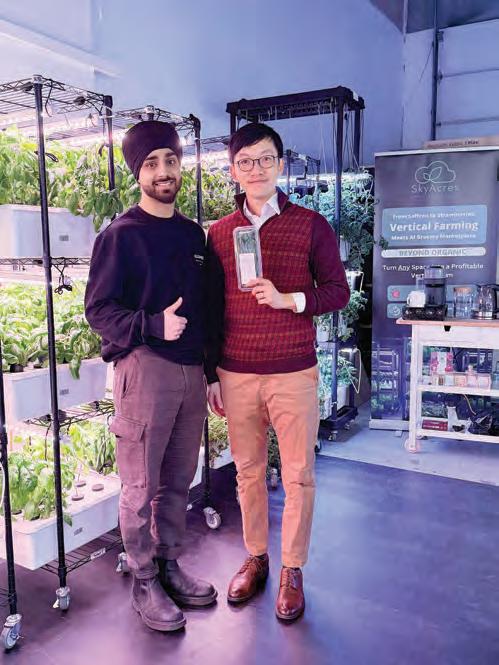
e same misting technology he originally developed for medicine was adapted into an irrigation system for indoor farming. at experiment became SkyAcres, a company that helps farmers transform unused agricultural land into productive indoor farms.
Kohli sees indoor farming as a tool to help farmers adapt to a changing world. Farmers face increasing challenges from climate change, and many farming buildings sit unused or underutilized. SkyAcres helps farmers use those spaces to grow food closer to local communities.
“Vertical farming should be a tool, not a replacement,” Kohli says. “We’re helping farmers put their existing spaces to good use, keep farms a oat, and grow food locally.”
Kohli appeared on Dragon’s Den in January 2026 and failed to secure an investment deal. But it created opportunities far beyond what he expected. More than a thousand farmers, customers, and potential partners reached out a er the episode aired, and he secured a venture capital investment deal.
Not getting a deal with the Dragon’s Den worked in his favor.
Today, SkyAcres has received more than $2 million in government research funding, allowing Kohli to dedicate himself fully to the company. e business now serves customers across Canada, the United States, and Hong Kong, with its largest facility in Kelowna growing basil for Pattison Food Group.
Some people think indoor farming is an expensive proposition, but Kohli says SkyAcres’ technology is much less expensive, and food grown indoors is not less nutritious.
viable career path. When you’re young is the best time to take risks. Parents should allow their kids to think of entrepreneurship as an option.”
In one experiment, SkyAcres compared tomatoes grown through their system against organic cherry tomatoes purchased from a grocery store. SkyAcres’ tomatoes showed signi cantly higher vitamin C levels.
Many tomatoes sold in Canada travel long distances and are picked before they are fully ripe, while locally grown produce is harvested closer to its peak.
Beyond technology, Kohli’s mission is also about changing how people view farming.
Many younger generations are moving away from agriculture. Kohli hopes technology can make farming exciting again by combining it with innovation, data science, and entrepreneurship. “I want to make farming cool again,” he says. “When I ask kids where their food comes from, many say the grocery store. ey don’t realize everything that happens before food reaches the shelves.”
Kohli credits much of his entrepreneurial mindset to his family. His mother built a health supplement business with formulations designed by his father that grew from products prototyped in their kitchen to nationwide distribution.
Entrepreneurship could be a legitimate
For Kohli, success has never been about reaching a nal destination. It is about learning, adapting, and having the courage to pursue problems worth solving.
A failed medical invention, a devastating ood, and a simple question about empty barns became the foundation of a company determined to grow more than food; it is growing a new vision for the future.
THE NEXT GENERATION OF
A ANJALI DHALIWAL OUTBOUND SALES TECHNOLOGY
Finding prospects is no longer the hardest part. The real challenge is understanding who has a reason to buy right now and reaching them at the exact moment they need you.”
BYJ.M. LEE
t 24 years old, Anjali Dhaliwal has already built companies, scaled communities, navigated venturebacked entrepreneurship, and learned one lesson that has shaped everything she does: e hardest part of building a great company is not always creating something people need. It is nding the right people at the right time. at insight is now driving her most ambitious company yet: Gelee AI.
Gelee is building the next generation of outbound sales technology, helping companies nd potential customers, understand when they are ready to buy, and start meaningful conversations
automatically. In simple terms, Gelee helps businesses discover their next customers without relying on the slow, manual process that has de ned sales for decades.
e company was born from Dhaliwal’s own experience as a founder. While building previous startups, she repeatedly saw the same challenge: founders could create exceptional products, but nding and reaching the right buyers was o en the biggest barrier to growth.
Sales teams traditionally spend countless hours researching prospects, writing outreach messages, and trying to determine who might actually be interested. Dhaliwal saw an opportunity to rebuild that process from the ground up using arti cial intelligence.
“Finding prospects is no longer the hardest part,” Dhaliwal says. “ e real challenge is understanding who has a reason to buy right now and reaching them at the exact moment they need you.” at became the foundation for Gelee. O en described as the Instantly for LinkedIn outbound, Gelee uses AI agents to identify high-intent buyers, personalize outreach, and turn conversations into measurable business opportunities. Starting with LinkedIn as its rst platform, the company is transforming one of the most important channels for modern business relationships into a scalable growth engine.
e opportunity is enormous. Every company, from early-stage startups to established enterprises, must overcome one fundamental challenge: nding customers. As arti cial intelligence reshapes how businesses operate, Dhaliwal believes sales is one of the industries most ready for reinvention.
Within its rst year, Gelee has generated millions of dollars in customer pipeline. One customer generated $50,000 in monthly recurring revenue from pipeline sourced through Gelee, another founder their lead investor for a $10M round.
But this is not Dhaliwal’s rst time building from scratch.
Her entrepreneurial journey began at 16, when she founded Youth Helping Youth, a nonpro t focused on connecting young people with mentorship and opportunities. at same instinct,
“Every company, from early-stage startups to established enterprises, must overcome one fundamental challenge: finding customers. As artificial intelligence reshapes how businesses operate, l believe sales is one of the industries most ready for reinvention.
connecting people to the resources they need to succeed, has followed her throughout her career. is experience shaped her belief that access and opportunity are o en determined by whom you can reach and whom can nd you.
Gelee is her attempt to solve that problem at a global scale. Dhaliwal sees arti cial intelligence not as a replacement for human connection, but as a tool that can make meaningful relationships easier to create. Her vision is a future where companies no longer need large sales teams spending hours searching for opportunities. Instead, intelligent systems
can help businesses identify where opportunity already exists and create connections that bene t both sides.
For Dhaliwal, the mission has remained consistent across every company she has built: closing the gap between people and opportunities.
With Gelee, she is applying that mission to one of the largest markets in business.
e next generation of companies will not just win because they build better products. ey will win because they can nd the right customers faster. And Dhaliwal intends to build the technology that helps them do it.
NITA SENGUPTA’S
A JOURNEY OF COURAGE, COMPASSION, AND SERVICE FROM BURMA TO THE GOLDEN APPLE:
True courage is not simply surviving the storm but daring to build a future while it is still raging."
BY PANKAJ BHASKAR
ome inherit land. Some inherit wealth. Some inherit a family name. Nita Sengupta inherited stories. Stories of a grandfather who fought for freedom. Stories of another who healed the poor. Stories carried from Burma to India to Canada, across borders and generations, long before a girl born in Mandalay could understand that one day she too would be called to serve. In 2026, that girl—now a mathematics teacher in Chicago—received the Golden Apple Award for Excellence in Teaching, one of the U.S.’s most prestigious honors for educators. But her journey began generations earlier.
Sengupta’s paternal grandfather was a freedom ghter during India’s struggle for independence.
Wanted by British colonial authorities, he and his comrades sought refuge in Burma, risking everything for freedom. Her maternal grandfather, a respected physician, treated those unable to a ord medical care. To him, healing was not merely a profession, but a moral responsibility. One grandfather fought. e other healed. Decades later, their granddaughter would teach. Perhaps purpose travels through families in ways we do not immediately recognize.
Years earlier, in Kolkata, there had been a clue to the life awaiting her. As a little girl, Sengupta gathered neighborhood children and played “teacher.” e family’s front door became her chalkboard. But childhood ended. Life moved forward. She earned a bachelor’s degree from the University of Victoria and pursued another professional path. Teaching disappeared from the plan. Or so she thought. Because perhaps some dreams do not disappear. Perhaps they wait.
Decades later, during one of life's most di cult chapters, Sengupta attended an orientation at Loyola University Chicago. Registered in a di erent program, she watched School of Education representatives invite prospective teachers to follow them. Teaching was not on her mind. Yet when the group stood, she stood. When they walked out, she followed. Even today, she struggles to explain that moment. It felt almost spiritual—as though life had reached across the years and returned her to the little girl in Kolkata, standing before a door and believing she was a teacher. Perhaps Sengupta had not found teaching. Perhaps teaching had nally found her.
But nding purpose did not mean escaping pain. During a deeply painful period in her personal life, Sengupta found herself ghting for justice through two legal battles while attempting to rebuild the life she had worked so hard to create. ere are chapters of a person's life that can silence them. is could have been hers. Instead, while the storm continued, Sengupta kept building. She worked. She studied. She returned to school. She earned advanced degrees and professional endorsements. She completed second bachelor's and a master's degree in education and undertook the rigorous journey of becoming a National Board Certi ed Teacher. True courage is
“I believe the greatest inheritance isn't wealth or status— it's courage, compassion, and service. If my journey has taught me anything, it's that the dreams we leave behind are never truly lost. They wait for us until we're ready to become who we were always meant to be."
not simply surviving the storm but daring to build a future while it is still raging.
For almost two decades, Sengupta has lived by one teaching philosophy: “Relationships come before rigor”—because before a child can believe in an answer, they must rst believe in themselves. Perhaps because she once searched for belonging, she built a classroom where mathematics meets humanity, di erences are celebrated, and every child's culture, voice and story have a place. In her classroom, achievement mattered, but so did joy, connection and the quiet assurance that no child had to
earn the right to fully belong. Beyond academics, Sengupta turned compassion into action—raising funds for cle lip surgeries for children in South America, ood relief in Bangladesh and students unable to a ord school activities and helping provide hundreds of winter jackets and gloves. She taught her students that education is not only a path to success, but a responsibility to humanity.
In South Asian families, we proudly celebrate the child who becomes a doctor, engineer, lawyer or entrepreneur. ese dreams have crossed oceans in suitcases, carried by sacri ce and prayer. But every doctor was once a student. Every engineer was once a student. Every leader was once a student. And somewhere in their story, there was a teacher.
e Golden Apple carries Nita Sengupta's name. But her journey carries the ngerprints of generations. Di erent generations. Di erent callings. Perhaps the same inheritance. Courage. Compassion. Service. Ms. Sengupta's journey reminds us that pain does not have to write the nal chapter, and the distance between where we begin and who we become cannot always be measured in miles. Sometimes the dream we leave behind is not lost. Sometimes, it waits. Across countries. Across cultures. Across storms. Until one day, we stand. We follow. And we become who we were always meant to be.
BRAD MERRITT TO ART & SURVIVAL THE
Each song is a tale unto itself. A lot of it is deeply personal. Who knows what will happen in the future? This could be our last, but I don’t think it will be. It’s the nature of art to take what’s inside you and pull it out.”
BY DAVINDER BIR-BHATTI
f you are looking for a standard lesson in rock ’n’ roll posturing, don’t ask Brad Merritt. e co-founder and bassist of Vancouver’s legendary alt-rock juggernaut 54-40 isn’t particularly interested in the mythology of stardom, retro music-video nostalgia, short-lived social media clout, or in looking back on four decades of Canadian music history through rose-colored glasses. When asked what advice he would o er the next generation of aspiring young musicians, his response is un ltered: “Don’t do it. Go do something else. And if they say, ‘I don’t care, I’m going to do it anyway,’ then I say, ‘Good for you.’ You have to be compelled. Doing what you do has to be its own reward.”
at stubborn, uncompromising ethos is precisely why 54-40 is still here forty- ve years later. While countless bands from the 1980s DIY boom succumbed to burnout, internal drama, or shi ing commercial trends, Merritt and frontman Neil Osborne have devotedly built one of the most enduring legacies in Canadian music. e band continues to chase the muse, recently releasing an 11-track record recorded in Portugal. Despite the proliferation of AI-composed songs and singers, Merritt’s philosophy remains steadfast: Art isn’t a transactional outcome; it is a lifelong process.
To understand how 54-40 survived, go back to Vancouver in 1981. e underground scene was an explosive, chaotic arena fuelled by raw expression, punk rock, and total independence. Merritt, with a background in piano, joined the fray because the band needed a bass player. At Long & McQuade, he gured everything else out on the y.
A er the intense adrenaline high of a gig faded into an emotional crash, Merritt asked Osborne and made a wild, life-altering proposal: Why don’t we just decide right now to make 10 records?
“Once you make that decision, it frees you up... come hell or high water. We were going to do it, alongside our day jobs.” at single pact shi ed their focus from short-term fame to mastering their cra . Pooling their money for studio time and quitting their family businesses, they committed unconditionally to the road. at relentless drive carried them around the world, from gruelling tour vans in North America and 28-show European runs to lming music videos across Hong Kong, ailand, Kenya, and Morocco. rough decades of raining pterodactyls and dinosaurs, with labels crumbling overnight, Osborne and Merritt sat on a bench outside Toronto City Hall, guring out their next move. 54-40 refused to let even a deluge stop them from mapping their future. Inspired by Rush drummer Neil Peart’s mantra, “First you have to last,” they adopted it, regrouped, and kept creating.
e band maintains its relevance a er forty- ve years; Merritt’s perspective is radical for its simplicity: “No one can make you irrelevant without your permission. We’re still relevant because we create, play shows, and people show up.”
No one can make you irrelevant without your permission. We’re still relevant because we create, play shows, and people show up.” “
For Merritt, relevance isn’t about tting into the modern cultural zeitgeist or competing with viral in uencers. It’s standing behind work that has genuine value. When fans write letters explaining how timeless tracks like “I Go Blind" or "One Day In Your Life” saved them during di cult teenage years, Merritt accepts the compliment with deep gratitude, even if he tries not to let the pressure of that legacy enter the room when writing new material.
When 54-40 rst stepped onto garage stages in the early 1980s, every show felt like an urgent crusade, a raw push to deliver what Merritt calls “ ree Chords and e Truth” to whoever was listening. Today, stepping onto a stage carries a di erent, beautiful frequency.
"Now, it’s like a celebration, creating a sense of community: we’ve gone from mission to celebration."
When the lights dim and the ampli ers hum, Brad Merritt isn’t re ecting on music-industry shi s, streaming charts, or decades of travel. He is looking out at a
room full of people connected by a shared frequency, anchored by songs that have outlasted the era in which they were written.
When you strip away 45 years of road stories, industry noise, and rock 'n' roll lore, Merritt’s focus remains anchored in the present. e band recently released an 11-track record recorded in Portugal, proving that the creative well is far from running dry. e journey isn't about wrapping up a career or taking a bow; it’s simply about letting the art express whatever needs to come out next.
"Each song is a tale unto itself. A lot of it is deeply personal. Who knows what will happen in the future? is could be our last, but I don’t think it will be. It’s the nature of art to take what’s inside you and pull it out.” At the end of the day, whether performing to packed auditoriums or sitting down with a new set of chords, Brad Merritt’s verdict on 45 years in Canadian rock comes down to one absolute truth: “Just the songs. I don’t care about the show or videos or TV appearances. Just the songs.”
JASMINE SEHRA
THE BUTTERFLY EFFECT
LThe biggest journey wasn’t around the world; it was finding the courage to change the direction of my life.”
BY DAVINDER BIR-BHATTI
eaving the expected timeline behind to see how far she could y on her own terms. Picture this: You are a successful South Asian woman with an enviable 18-year banking career. Having moved from India to the mountain town of Squamish, B.C., at age ten, you have checked every societal box. You climbed the corporate ladder, rung by rung, and are o cially next in line for a major management promotion. Your life looks awless. But what happens when the view from the top no longer satis es your soul? What happens when the success you were taught to chase begins to feel incomplete?
For Jasmine Sehra, that shi began during the pandemic. Working from home gave her the space
to slow down and re ect. As she continued her personal growth journey, she became increasingly drawn to understanding people and helping them in more meaningful ways, leading her toward psychology and counselling. Around the same time, the loss of a couple of young banking colleagues to mental health struggles reinforced the importance of emotional wellbeing. Together, these experiences made her question whether her career still aligned with the person she was becoming. While deeply grateful for everything banking had given her, she realized she was being called toward work that felt more personally meaningful. In January 2024, she resigned from her job and set o on a 15-month solo journey through 40 countries, intentionally giving herself the space to re ect before deciding what the next chapter of her life would look like.
Re ecting on that decision, Jasmine points out a simple, sobering reality: “Most people know they want to make a change, but following through is the hardest part because it’s scary.” But for her, the risk of standing still was far greater. “I don’t want to be 80 years old regretting that I didn’t travel or change my career,” she says. Rather than following a rigid ve-year plan, she embraced the freedom of an open canvas, allowing life to unfold one experience at a time.
Facing the anxiety of solo travel, Jasmine trusted a simple internal compass: “ is is something that makes me very scared and very excited at the same time, and that usually means you should do it.” Without her corporate title, she began peeling back psychological layers and discovering overwhelming kindness along the way. In Mostar, Bosnia, a town still scarred by war, a stranger drove her 45 minutes to a trail, asking for nothing in return. In Ubud, Bali, a homestay family surprised her on her birthday with a hand-drawn butter y cake.
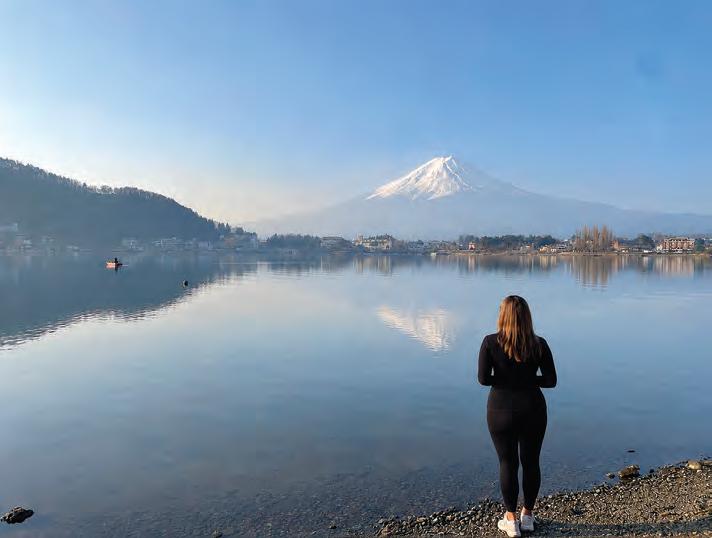
In Japan, she found absolute peace cycling at the base of Mount Fuji. rough these moments, Jasmine realized that waiting for ideal conditions was a trap, noting that, “When you get a chance to do something, you should take it rather than waiting for the perfect moment.” is perspective proved true in Hiroshima, when a family-run restaurant trusted her to nd an ATM and return to pay. Of course, the road wasn’t always a glamorous
Real growth begins when you stop living by others’ expectations and start creating a life that feels true to you.”
reel. True resilience was forged in vulnerability, as when she battled a stomach bug in Vietnam and was cared for by a Korean traveller who became a lifelong friend. Months later, she welcomed Jasmine into her home in Seoul, held her hand, and told her she wished she had a daughter like her. roughout her travels, Jasmine captured her experiences through daily re ections that gradually evolved into a memoir, now a work in progress inspired by the people, places, and experiences that transformed her life.
Returning to Canada marked Jasmine’s most signi cant transformation. She embraced a simpler way of living, selling many of her possessions before moving abroad. In a community where success is o en associated with milestones such as marriage and career achievement, Jasmine chose a di erent path, one de ned by personal ful lment rather than external expectations. “My life is deeply unconventional for a South Asian woman,” she says with pride. “Success means something
entirely di erent to me now. I have deep respect for my culture, but I also have the right to design a life on my own terms.”
Soon, Jasmine heads to Australia to begin her Master’s degree in Counselling and Psychotherapy, hoping to help others navigate the same questions of identity, purpose, and change that reshaped her own life.
“So many of us spend our lives making decisions based on what other people expect of us rather than what truly feels right for ourselves. Taking this leap was the rst time I did something completely for myself. If my story can inspire even one person to trust themselves enough to choose a life that feels authentic to them, then sharing my journey has ful lled its purpose. And if it gives even one woman permission to stop putting herself last, that would mean even more.” For anyone standing at a major crossroads in life, Jasmine’s journey is a powerful reminder: “ e biggest journey wasn’t around the world; it was nding the courage to change the direction of my life.”
WINNER OF GOLF CLOVER CUP 2023
Speaks about
O ANGELA ARORA:
Women's Golf Networking Event
Reflecting Diversity & Inclusion
n July 9, I sat in a room with other women who had each, in their own way, broken through barriers. ey had led movements. ey had changed how an entire industry thought about who belongs in it. And I was proud to be part of that group.
DRISHTI Magazine hosted the event to celebrate women in sports and to loudly and unapologetically push for greater diversity and inclusion in an industry that has historically made room for very few of us. I was named one of the “In uential Women of 2026,” an honor I am very proud of.
I started playing golf at age ve. I loved the game, the quiet of a course early in the morning, and the discipline of trying to do one small thing a little better each round. But it wasn't until years later, competing at the NCAA Division I level for the University of Arizona and representing Team Canada for ve years, that I began to understand what it meant to be one of the few women in the room. Winning the Clover Cup individually in 2023 was one of the proudest moments of my career. But days like the Drishti event remind me that the wins on a scorecard are only part of the story.
What struck me most about the event was its message. Every speaker returned to the same idea: that advancing women isn't a favor we do for them; it's a correction to something that was broken for a long time. Representation matters. Visibility matters. A young girl who sees a woman on the golf course, in the boardroom, or on the podium understands something about her own possibilities
that no amount of encouragement from adults can replace.
Being surrounded by other accomplished women that day was, honestly, a delight. ere's a particular energy in a room where everyone has fought for their seat at the table in di erent ways but somehow arrived at the same understanding that the ght is easier and more meaningful when you're not doing it alone. We swapped stories. We laughed. We compared notes on the strange, speci c loneliness of being "the only one" in a room and the relief of, for one day, not being that anymore.
I’ve spent most of my life chasing something measurable, a lower score, a bigger tournament, a spot on a leaderboard. is award measured something di erent. It recognized a kind of contribution that doesn't show up on a stat sheet: the act of simply being visible, of staying in a sport, and of trying to leave a
wider door open behind you than the one you walked through.
at’s what I want to carry forward from this. I’m going to keep chasing my goals, and I don't intend to slow down. But this award means more to me than a line on a resume. It means I was counted among a group of women actively changing what's possible for the next generation. And I want to earn that, not just once but continuously, by mentoring younger girls who pick up a club for the rst time, by speaking out about the barriers that still exist, and by making sure that when I do eventually leave this game, it's easier for the next woman to walk in than it was for me.
Golf changed my life. If receiving this award from Drishti Magazine does anything, I hope it's a reminder to myself, as much as to anyone, that the responsibility now runs in both directions. Someone inspired me. Now it’s my turn to inspire others.
THANK YOU SPONSORS
When Navpreet and Stalin Gill learned that their three-year-old son, Gurmoh had been diagnosed with a rare and progressive neurological disorder, their world changed forever. Gurmoh has Hereditary Spastic Paraplegia Type 4 (SPG4) caused by the SPAST p.Arg499His (R499H) mutation, a devastat ing genetic condition that gradually weakens the nervous system. Although he currently attends preschool and enjoys life like any other child, he has begun experi encing di culty walking. Without treatment, the disease could eventually rob him of his ability to walk, speak, eat and, ultimately, a ect his cognition.
Doctors delivered heartbreaking news to the family: there was no approved treatment. Determined to nd hope, Navpreet Gill reached out to researchers across the globe, sending more than 1,500 emails to scientists, physicians and universi ties working in the eld of rare neurological diseases. One email reached Dr. Ziv Gan-Or at e Neuro (Montreal Neurological Institute-Hospital) at McGill University.
A RAY OF HOPE: GURMOH’S FIGHT
Dr. Gan-Or and his team committed to developing a personalized gene-editing therapy for Gurmoh in collaboration with
would require approximately $8 million, funding that is not covered under Canada's public healthcare system.
On April 9, 2026, the Gill family
launched a GoFundMe campaign. Within days, donations poured in from across Canada and around the world. Today, approximately $2.5 million has been raised, a remarkable achievement made possible through the generosity of more than 40,000 donors. Community support has become the heart of Gurmoh's journey. From fundraising events at Surrey Nagar Kirtan to community gatherings in Squamish, Victoria, Kelowna, Calgary and Edmonton, thousands have stepped forward to help. A community Radiothon alone raised hundreds of thousands of dollars in a single day, demonstrating how deeply Gurmoh's story has resonated.
e family's determination has extended far beyond fundraising. Accompanied by relatives, friends and well - wishers, Gurmoh's parents completed a 120-kilometre walk from Canada Place in Vancouver to the British Columbia Legislature in Victoria. ey remained outside the Legislature for two days, meeting with the provincial Minister of Health to seek government support for the groundbreaking therapy. ey also met the Premier of British Columbia during Surrey Nagar Kirtan, continuing their appeal for provincial
helped raise awareness, the family is still waiting for meaningful government support.
eir advocacy has also reached the nation's capital. e Gills travelled to Ottawa with family, supporters and Dr. Ziv Gan-Or, accompanied by four Members of Parliament, to meet with the federal Minister of Health. eir mission extended beyond funding. ey urged Health Canada to establish a faster regulatory pathway for individualized gene-editing therapies, similar to the accelerated processes available through the U.S. FDA. Such a pathway could help Canadian researchers bring life-saving treatments to patients with ultra-rare diseases more quickly while maintaining rigorous safety standards.
ose discussions have already begun. Health Canada has initiated conversations with McGill University regarding the project, an encouraging rst step toward
creating a more responsive framework for personalized therapies.
Meanwhile, research continues. Scientists have successfully grown Gurmoh's own neurons and nerve cells, allowing researchers to test the personalized medicine directly on his cells before moving to animal studies. Once the gene-editing tool is nalized at Berkeley, it will be transferred to McGill University for further development and testing. If funding and regulatory approvals continue to move forward, Gurmoh could receive the therapy as early as next year.
extends far beyond one child. Scientists from McGill University, the University of California, Berkeley, Drexel University and leading children's hospitals believe Gurmoh's case has the potential to establish an innovative Canadian pathway for developing individualized therapies for rare genetic diseases. With more than 300 million people worldwide living with rare diseases—most of them genetic—the lessons learned through this project could bene t countless families in the future.
e Gill family and media outlets covering their story have received hundreds of calls from parents of children living with rare diseases. Many shared that when doctors told them there was no treatment, they believed there was nothing le to do. Watching Gurmoh's family refuse to accept that answer has given them renewed optimism.
Researchers agree that this e ort
For the Gill family, every fundraiser, every meeting and every kilometre walked has been about more than saving their son. Gurmoh's story is ultimately one of courage, community and compassion. It reminds us that while a rare disease may a ect one child, the response can unite thousands. In choosing hope over despair, one little boy has inspired a movement that could help shape the future of rare disease treatment in Canada—and perhaps around the world.
Sushi Cafe Madang
WHY TEENS ARE TO BIG TECH SOCIAL MEDIA PLATFORMS VULNERABLE
BY VEENO DEWAN
Studies around the world have shown that heavy social media use among teenagers is becoming a serious problem, linked to mental health issues and poor physical health outcomes, including shorter sleep and higher rates of obesity. Research involving more than 9,000 adolescents across eight countries found a strong association between problematic social media use and higher rates of depression and anxiety. A recent 2025 Pew Research Social study on Media, Technology and Teenagers found that teenagers use the internet “almost constantly,” and 9 in 10 teens use social media daily through platforms such as TikTok, Snapchat, Instagram, WhatsApp, YouTube, and Facebook. Although most social media platforms have a required minimum age of 13, almost 40% of children between the ages of 8 and 12 use social media. Why are teens hooked on social media?
Neuroscience researchers around the world have identi ed key explanations for why teenagers are hooked on social
media. e research shows a direct correlation between the teenage brain's reward center (the mesocorticolimbic circuit, or mesolimbic pathway) and the way social media platforms display Likes, Comments, and Shares, which deliver instant grati cation and a rush of dopamine (the pleasure hormone) to a teenager's prefrontal cortex (responsible for impulse control), which is still developing. Because impulse control is still developing in teenagers’ brains, they naturally struggle to resist these compulsive, pleasure-seeking cycles. Dopamine is hard to resist, and developmental imbalances make it fundamentally harder for teenagers to put their phones down on their own.
Here are the primary reasons social media algorithms and features successfully capture and retain teenagers’ attention:
1. Dopamine-Driven Reward System
Social media functions like a digital slot machine. Every noti cation, like, or positive comment triggers the release of dopamine in the brain, the same neurotransmitter associated with pleasure
A 2025 study on Media, Technology, and Teenagers found that teenagers use the internet “almost constantly,” and 9 in 10 teens use social media daily on platforms such as TikTok, Snapchat, Instagram, WhatsApp, YouTube, and Facebook. Almost 40% of children between the ages of 8 and 12 use social media.
and build long-term habitual screen time.
4. Identity Building and Community
Social media is a major outlet for teenagers to express themselves, form their personal identities, and build communities. For teens who may feel isolated or marginalized o ine, online networks can provide vital support, validation, and connections with like-minded individuals.
Some experts believe that mental health concerns may be an unexpected side e ect of increased social media use. While the link between the two is still
and reward. e unpredictability of when these rewards will arrive makes the behavior incredibly hard to stop, creating an ongoing loop of craving and reinforcement
2. e Fear of Missing Out (FOMO)
Adolescents have a fundamental need to belong and t in with their peers. Social media o ers an immediate window into what friends are doing, fueling compulsive checking. e fear of being le out or missing a trending topic pushes teens to stay constantly connected to the internet.
3. In nite Content and Algorithms
Platforms like TikTok, Instagram, and YouTube use personalized algorithms that feed teens highly engaging content tailored to their interests. Features like in nite scrolling remove natural stopping points, making it easy to lose track of time
In early 2026, a Los Angeles jury found that social media company
Meta and video streaming service YouTube harmed a young user through addictive design features that led to mental health distress. The verdict has escalated calls for more regulation of social media platforms.
being researched, it’s becoming more important to monitor how children and teens use social media and the e ects it has. Jennifer Katzenstein, Ph.D., co-director of the Center for Behavioral Health at Johns Hopkins All Children’s Hospital, discusses what is known about social media’s e ects on mental health in children and teens. “Research has demonstrated that there are high rates of depression with very low social media use and very high social media use, demonstrating that there is a ‘sweet spot’ of use for each child that is o en speci c to their own developmental level and protective factors,” Katzenstein says.
Teaching Children and Teens to Have a Healthy Relationship with Social Media Neuroscientists have recommendations to help parents work with their children to create healthy digital habits and encourage moderation in its use. Discussing the negative e ects with children and teens to
raise awareness can help mitigate them. Parents may want to consider and research the following strategies:
• Delaying smartphone purchases until the child is ready.
• Take regular breaks from digital devices.
• Turn o noti cations.
• Establish phone-free hours and spaces.
• Discuss appropriate boundaries and behaviors when interacting online.
In March 2026, in a landmark decision, a Los Angeles jury found that social media company Meta and video streaming service YouTube harmed a young user with addictive design features that led to mental health distress, including body dysmorphia, depression and suicidal thoughts. e verdict has escalated calls for more regulation of social media platforms across jurisdictions. Countries like Australia, France, the U.K., and Spain have already introduced age restrictions for social media use
Meanwhile, Canada has also taken steps to address social media addiction among children and teens. e new Digital Safety Commission of Canada is being established to oversee compliance and other measures under the Safe Social Media Act, introduced in June 2026. e new Act includes provisions such as the Under-16 Account Ban, which restricts individuals under 16 from having social media accounts. Other initiatives and restrictions include safety standards, age veri cation, and harsh penalties for social media companies that fail to comply, which can be ned.
Sources: Government of Canada, Digital Safety Commission of Canada, StatsCan, Canada Safe Social Media Act, John Hopkins Medicine research, Carol Vidal, MD, PhD, MPH, Jennifer Margaret Katzenstein, PhD, 2025 Pew Research study, Digital Media Safety initiatives.
As food prices increase, many consumers are returning to cheaper, familiar options—especially in North America and Europe, where concerns about the cost of plant-based foods are greatest (48% and 46%, respectively). The cost of turning to a purely plant-based diet is often considered higher. Is this true, and why?
ACCESSIBILITY ISSUES AFFORDABILITY AND PLANT-BASED PRODUCTS:
BY VEENO DEWAN
Vegetarian, plant-based diets may be growing in popularity each year, but some still claim they are an expensive lifestyle to follow. Is this diet as expensive as some people say? And why is it o en so hard to nd compared to non-vegetarian products such as meat, poultry, and seafood? For decades, a plant-based diet has been widely considered better for the environment and human health than a meat-based one. However, global adoption of these diets remains limited. e 2024 EAT GlobeScan Grains of Truth report, based on a representative sample of 30,216 people across 31 countries, reveals several obstacles to adopting a plant-based diet, including economic
pressures, limited availability, concerns about taste, and regional di erences in food culture and availability. e report also nds that as food prices rise, many consumers are returning to cheaper, familiar options—especially in North America and Europe, where concerns about the cost of plant-based foods are greatest (48% and 46%, respectively). A similar pattern appeared in grocery data from more than 58,000 consumers in Canada. e results pointed in the same direction: price matters di erently depending on the food category and the consumer. A recent nationally representative survey found that 77% of people feel grocery prices are too high. At the same time, many assume that eating
plant-based would only make things worse—with 61% of respondents saying they believe a plant-based diet is inherently more expensive than one that includes meat and dairy. One of the most striking ndings from the survey is that 70% of people say meat is the item they spend the most money on.
Why can a plant-based diet be expensive?
Processed items such as plant-based burgers, vegan cheeses, and dairy-free milks are niche specialty products. ey are generally much more expensive than animal products because of the costs of product development and limited production scale. Additionally, to protect certain food-producing industries, traditional animal agriculture receives signi cant government subsidies, keeping meat and dairy prices arti cially low compared to plant-based foods.
e hidden costs of convenience can sometimes make relying on pre-made vegan meals or out-of-season fresh produce hike up grocery bills. ere are also supply chain and production costs that can make fresh produce expensive due to special transportation and refrigerated storage needs. (For example, many seasonal vegetables and fruit are imported to Canada from the United States and Mexico.) Also, some plant-based foods cannot be grown in Canada due to the climate and need to be imported.
Products designed to imitate meat (such as “Beyond Meat” plant-based
burgers or sausages) require expensive research, testing, and specialty ingredients, o en making them more expensive than animal meats.
Products like vegan nuggets, specialty yogurts, and meat alternatives serve a purpose, but some can be priced like premium items.
Organic plant-based produce is also more expensive and good for health, but dietitians point out that cheaper frozen, canned, and conventional fruits and vegetables still provide important nutrients and are o en more a ordable. Most vegetarians report that buying staples in bulk, shopping around, and careful meal preparation actually result in much cheaper grocery bills than meat eaters.
According to a 2024 study published in JAMA Network Open, people following a low-fat vegan diet cut grocery costs by 19% compared with a Standard American Diet and by 25% compared with a Mediterranean diet. Ultimately, scale also plays a part – processed foods containing meat are produced at a massive scale and at a much faster pace, cutting out the time needed for plant maturation. As a result, processed meat products, much of it considered unhealthy, are cheaper to produce and more accessible, according to data.
“The struggle to consistently find satisfying plant-based options stems from a few key factors: Menu Prioritization—in Western societies, meat-based fast food is engineered for convenience and is highly ubiquitous. Strict vegetarians are wary of eating where meat products are also prepared.“
e Availability of Plant-Based Foods e struggle to consistently nd satisfying plant-based options stems from a few key factors: Menu Prioritization. In Western societies, meat-based fast food is engineered for convenience and is highly ubiquitous. According to industry analysts, many major food outlet chains still lack even a single true plant-based menu item. Meat is still considered a vital part of many people's diets and is found everywhere in eating establishments. Vegetarian restaurants, unlike meat-based fast food, are rare and more di cult to nd. Also, although many fast-food outlets and restaurants do o er vegetarian, plant-based food options, some strict vegetarians are wary of eating where meat products are also prepared.
can pick your own vegetables for a fraction of standard grocery store prices. In recent years, the availability of plant-based food options has changed signi cantly. Big-name retailers and grocery outlets now o er numerous vegan items, including more a ordable, own-brand ranges. Despite this transformation, veganism’s history as a more niche diet has likely led to the continued belief that it will still cost a little extra to follow.
e JAMA Network Open survey also reveals that while health remains the top reason for eating less meat (41%), nancial concerns (17%) now matter more to people
If you are looking to easily locate plant-based options in your local area, you can use online tools to nd highly rated vegan and vegetarian restaurants. Consumers can also use vegetarian food websites and other resources to nd a ordable, hidden vegan and plant-based food – especially at mainstream, nationwide fast-food chains.
Other good sources of easily accessible, less expensive vegetarian produce include: Strict Vegetarian-only food outlets, local Farmers' Markets, Specialty Grocers, and Ethnic Grocers. One great seasonal alternative is All-you-can-pick farms, where you
Ultimately, this report shows that many people would like to switch to plant-based diets, but factors such as price, habits, convenience, taste, and trust are holding them back. Despite these obstacles, a strong majority of consumers (69%) believe the world would be better with less meat. If governments, companies, advocates, and consumers work together to solve these problems, plant-based diets could help tackle climate change and food insecurity on a large scale.
Sources: Canadian vegansociety.com/aunalytics.org, Original Study By: EAT, & GlobeScan. (2025). JAMA Network Open report 2024, PCRM.org, vegandirectory.ca, vegansupply.ca, plant- based foods of Canada, government of Canada dietary guidelines.
I’ve always believed that politics, like sports, doesn’t build character. It reveals it. ere’s a fantasy shared by many of those who seek elected o ce. A comforting story that is an obvious self-delusion—it was them, their intelligence, hard work, determination, that is the sole reason for their electoral success. It’s simply not true. And when a politician has fallen out of favour with their party and wishes to join another party, they should be required to step down and run in a byelection or sit as an independent until the next election. It’s the only way to respect the voters and the tenuous hold we have on what faith remains in our politics and politicians.
Winning an election is not a solo sport. It’s the di erence between nishing your morning Wordle versus winning the Stanley Cup. One was done alone, the other is only accomplished with others. How an elected person treats their victory says a great deal about their character. While this may be true of anyone who has
FLOOR-CROSSING REVEALS MAKES US ALL A LITTLE MORE CYNICAL CHARACTER FLAWS IN OUR POLITICS
AND
some measure of success (a delusion that their wins were won entirely by themselves—that circumstance, the support of others, had little to do with it). But in the hands of the elected class, it’s a dangerous self-delusion from which a whole series of bad decisions and disconnected thinking is born.
When a Member of Parliament decides to leave the party, leader and platform they were elected on to join another party, the arguments are familiar. “I’m not leaving my party, it le me,” or “the times/country/current crisis demands this of me.”
ese rationalizations are not as weak as the “spending more time with the family” when a politician is ejected from public life due to a scandal. But they rhyme.
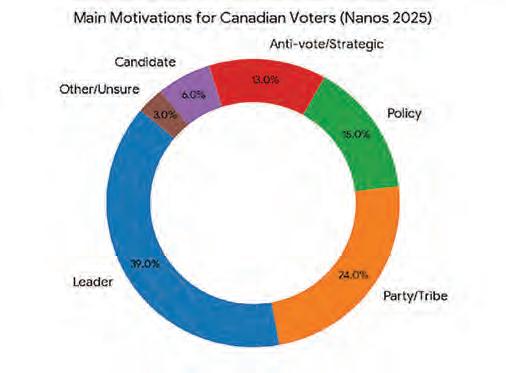
Let’s put truth to this lie. e overwhelming reason anyone is elected to provincial or federal o ce is largely due to party a liation, the party leader, an issue or a voter’s e ort to stop someone else from winning. What percentage of voters decide their vote on the candidate? 6 per cent. Ouch.
We ask for a lot from those who we elect. Humble, con dent, hard working, and that they don’t lie, cheat or steal. Admittedly, this is a diverse and unrealized character set
in most. But it’s good to have goals. Again, anyone seeking to leave the party, platform and/or leader that got them elected should sit as independent until the next election or resign their seat and run in a byelection.
is has been the situation in New Zealand for several years. e so-called “Waka (canoe) jumping” model. And is very popular in Canada when Canadians are asked. A strong majority (62 per cent) according to a 2025 Ipsos Reid poll said that MPs should not be able to cross at all and a higher number (69 per cent) wanted an immediate byelection if it happened in their riding.
It’s hard to read the label from inside the pill bottle. Politicians who live in a world of threats and opportunities, a social media sea of misinformation and a steady erosion of public trust must try and remember their rst thoughts of running for public o ce—to serve. Not their own ambitions solely but those of the communities they live in. If they want to fundamentally change the o er they made to those Canadians, they should go back to their bosses and con rm their mandate. In a time of deepening cynicism, such principle and integrity would be a breath of fresh air.
Nathan Cullen is a vice-president with Strategy Corp, former Member of Parliament and former Member of the Legislative Assembly for the NDP in British Columbia.
Cardiovascular health is no longer a concern limited to the elderly. Times have changed, and so has the pattern of medical issues a ecting the human body. Today, heart-related concerns are increasingly being seen in younger adults, including people in their 30s and early 40s. Gone are the days when heart conditions were primarily associated with old age.
Modern cyclic lifestyles, unhealthy eating habits, irregular sleep patterns, and excessive screen exposure have become silent contributors to physical and mental stress. e encouraging part is that recognizing the importance of a healthy lifestyle early on can help build a strong foundation for long-term well-being and a physically t future.
However, the most crucial aspect lies in understanding this need and developing the willingness to act on it. It may feel challenging at the beginning, but when health-conscious choices become a consistent part of daily life, they gradually evolve into habits that sustain themselves naturally. Interestingly, even highly successful individuals running global companies o en manage to maintain
BY POOJA VALEJA
structured routines around food, sleep, and exercise despite demanding schedules. is raises a simple but powerful question—do you choose to prioritize your health?
Heart disease continues to be one of the leading causes of death globally. According to health authorities such as the World Health Organization, risk factors including obesity, sedentary lifestyles, poor diet, smoking, and chronic stress are increasingly a ecting younger adults.
Even more concerning is the rise of underlying risk factors at a young age, such as:
• High blood pressure, increasingly seen in individuals in their 20s and 30s, o en linked to stress and long working hours
• Sedentary work environments and screen-heavy routines reducing daily physical movement
• Poor sleep habits becoming normalized due to lifestyle and digital dependency
Heart damage o en develops silently over years without noticeable symptoms, making early awareness especially important.
Keeping a Check on Your Health
In your 20s and 30s, visiting a physician is o en delayed until symptoms appear. However, most insurance plans include annual health check-ups for a reason—they are designed for prevention, not just treatment. Regular screenings help detect early warning signs and maintain long-term health. Paying attention to key indicators can signi cantly reduce future risks:
• High Blood Pressure (Hypertension)
O en called the “silent killer,” high blood pressure may not show obvious symptoms. Regular monitoring becomes essential, especially for individuals with stressful work schedules and irregular eating patterns.
• High Cholesterol
Elevated LDL (“bad” cholesterol) can damage arteries over time, increasing the risk of heart attacks and strokes. A simple blood test can help track cholesterol levels and guide preventive action.
• Smoking and Vaping
Both habits contribute signi cantly to blood vessel damage, increased heart rate, and elevated blood pressure. Quitting remains one of the most impactful steps for heart protection.
• Physical Inactivity
Post-pandemic work culture has led many people toward sedentary routines, with long hours of sitting in remote or hybrid work settings. is reduces metabolism and a ects overall cardiovascular health if not balanced with movement.
• Chronic Stress
In today’s fast-paced world, stress is o en worn like a badge of productivity. However, long-term stress can lead to in ammation, elevated blood pressure, and both mental and physical strain. Mindfulness practices, hobbies, and strong social connections can play a supportive role in managing stress levels. Listening to your body consistently is one of the most important habits you can develop. Symptoms such as unexplained aches, persistent fatigue, nausea, poor sleep, or breathing discomfort should not be ignored. e body o en signals imbalance long before a condition becomes serious.
While heart disease is less common under the age of 40, it can still occur, especially in individuals with genetic predispositions. Seeking medical attention is important if you experience:
• Chest pressure or tightness
• Shortness of breath
• Unexplained fatigue
• Irregular heartbeat
• Dizziness or fainting
It is also important to discuss family medical history with your healthcare provider, as it plays a signi cant role in
assessing risk factors early.
Heart-Healthy Habits to Start Now
1. Eat Healthy
Your daily diet plays a central role in heart health. Focus on fresh vegetables, fruits, salads, whole grains, and lean proteins. At the same time, try to limit processed and packaged foods that o en contain preservatives, excess sodium, and unhealthy fats.
2. Stay Physically Active and Prioritize Mobility
Regular physical activity improves cholesterol levels, enhances insulin sensitivity, and supports better sleep quality. Even simple habits like brisk walking, yoga, or structured workouts can make a meaningful di erence. Alongside movement, prioritize sleep—aiming for 7–9 hours per night. Poor sleep is strongly linked to obesity, hypertension, and metabolic disorders.
3. Manage Stress Proactively
Stress management is one of the most important pillars of heart health.
Techniques such as meditation, journaling, therapy, spending time outdoors, or engaging in hobbies can signi cantly reduce stress levels and improve emotional well-being.
4. Avoid Smoking and Limit Harmful Substances
Reducing or eliminating smoking and vaping can greatly improve cardiovascular health. ese habits directly impact blood vessels, heart rate, and long-term heart function.
5. Regular Health Check-Ups
Routine screenings help identify risks before they develop into serious conditions. Even in the absence of symptoms, annual check-ups provide a clear picture of overall health. If any warning signs appear, consulting a primary care physician promptly is essential.
To conclude, while life is unpredictable and not entirely in our control, maintaining heart health is something we can actively in uence through consistent lifestyle choices. A mindful approach to diet, movement, stress, and preventive care can go a long way in protecting cardiovascular health, especially in younger adults navigating the demands of modern life.
· CULTURE · COMMUNITY · MENTAL WELLNESS
Breaking the Silence: Moving Forward Family Services Normalizes Mental Health Conversations at the Surrey Walkathon.
BY RAYMOND CHOU
Mental health rarely announces itself plainly. For many in South Asian and other diasporic communities, it arrives disguised as fatigue, back pain, or a headache that never quite fades. It is spoken around, not
spoken about. On May 30, 2026, Moving Forward Family Services (MFFS) brought hundreds of community members to Newton Athletic Park to change that.
e national Defeat Depression Walkathon, now in its 15th year, served as both a fundraiser and a platform for a conversation many have long been reluctant to have. Co-hosts Sharan and Jason guided the morning program, weaving together research, personal narrative, and community celebration into a morning that felt as much like a gathering as a march.
A Space for Stories
e event drew civic support from Surrey-Panorama MLA Bryan Tepper of the BC Conservative Party, who joined participants and organizers in front of the campaign displays and used his provincial platform to amplify the message of mental health advocacy. MFFS, a previous recipient of the DRISHTI Community Service Award, continues to earn that recognition for its commitment to
culturally responsive care.
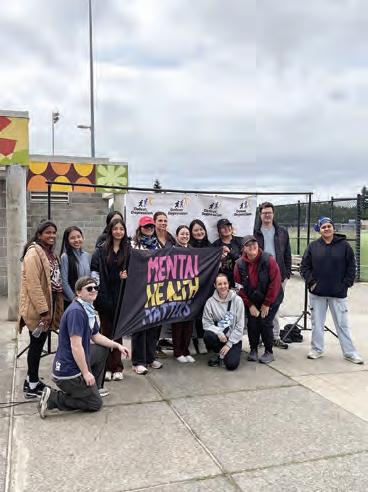
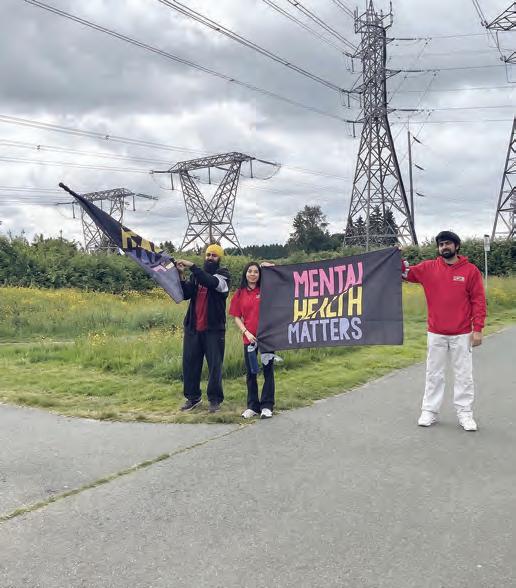
An advocate proudly displays the “Mental Health Matters” ag at Newton Athletic Park, a powerful visual reminder of the community’s e ort to break down cultural stigma.
But the most powerful moments of the morning came from within the community itself. Co-host Sharan opened a frank conversation about the cultural dimensions of mental health, dimensions that o en go unspoken.
“Growing up, I o en saw mental health struggles expressed as physical symptoms, such as headaches, back pain, or fatigue, without recognizing that mental health could be an underlying factor. Mental health was also o en stigmatized and viewed as a sign of weakness, leading to hiding emotions and putting on a tough exterior rather than seeking support.”
— Sharan, Event Co-host
Her words resonated throughout the crowd. Sharan went on to emphasize that experiencing vulnerable moments is a
normal, human part of life, and that those struggles do not de ne who a person is.
Care Without Barriers
MFFS has built its entire model around dismantling the barriers that keep people from accessing support. e organization provides individual, couples, family, and group therapy programs delivered in more than 20 languages, meeting clients where they are, both linguistically and culturally. Over the past two years, the organization has delivered more than 40,000 multilingual sessions across British Columbia.
Community advocates, volunteers, and Moving Forward Family Services organizers gather to champion low-barrier mental health resources.
Fi een thousand sessions in the past year were provided at no cost to clients. Remaining sessions were o ered on a sliding scale, averaging $5 to $7, ensuring that a lack of nancial means is never a reason someone goes without support.
A Young Voice on the Trail
e event also spotlighted inspiring youth
perspectives. Community member Seva stepped forward to share a story many in the crowd recognized, about tness, anxiety, and the quiet battle of living in a body you struggle to accept.
“As someone who has struggled with depression, the gym became an outlet for really taking on the depression physically.” — Seva, Community Member
He closed his remarks with a lyric from the late artist Nipsey Hussle that lingered long a er the crowd began to move: “When it rains, it starts pouring, but how we grind makes the weather change for us.”
Community members lead the way along the walkathon route, taking literal and gurative steps to normalize vulnerable conversations about mental wellness.
A Movement, Not Just a Moment
Founder and Executive Director Gary andi, MSW, RSW, received a standing ovation at the conclusion of the program. Under his leadership, MFFS completed more than 20,700 intern-delivered sessions in 2024 alone, demonstrating that the organization’s model is not only compas
sionate but also deeply e ective.
For the communities MFFS serves, many of whom have kept mental health a secret for generations, the walkathon was more than a fundraiser. It was an invitation. To speak. To seek help. To walk forward together.
Fertility After 35: A Defining Factor in the Mental Health of Modern Couples
BY POOJA VALEJA
Gone are the times when youngsters married at a very early age. If you happen to ask your parents or grandparents, you would notice that your grandparents got married at an even earlier age than your parents, and this benchmark has been steadily rising. ere was a time when young boys and girls wanted to settle in their early 20s to start a family soon, whereas current trends show people choosing their late 20s, early 30s, and for some even their late 30s. Relationships today carry a whole new meaning, and with changing mindsets, there is no single number that de nes the “right time.”
In today’s world of global opportunities, higher education, and digital growth, many individuals prefer to focus on building their careers rst and establishing a certain lifestyle before considering marriage. For some, marriage itself is not the ultimate goal—the desire to have children stands independent of it. Ultimately, these decisions are deeply personal and shaped by individual values and choices.
However, what o en comes as a surprise to many couples is the reality of
fertility and infertility challenges. Modern lifestyles—irregular routines, unhealthy eating habits, compromised sleep, and habits such as smoking and drinking—can accelerate biological aging. Alongside this, the stress of maintaining career aspirations and lifestyle expectations adds further pressure. While medical advancements today o er multiple options such as IUI, IVF, and ovulation induction, these processes can be emotionally intense and demanding for couples.
is brings up a crucial question: should one consider marrying earlier to plan a family sooner? Should individuals explore options like egg freezing or adoption? e answer varies for everyone. It depends on factors such as upbringing, emotional readiness, personal experiences, career goals, family in uence, and mental preparedness. ere is no one-size- ts-all approach—only what aligns best with an individual’s life journey.
Fertility
in
Biological and Scienti c Terms
Fertility is o en discussed in biological terms, focusing on aspects such as egg quality, sperm count, and hormonal balance. However, for couples over 35, it becomes far more complex. It is not just a medical issue—it is an emotional, psychological, and relational experience
that can deeply impact mental health. As more people delay parenthood for personal or professional reasons, the connection between fertility challenges and mental well-being becomes increasingly signi cant.
e Biological Clock Keeps Ticking Science shows that fertility is at its peak at a younger age, particularly in the 20s. By the age of 35, fertility naturally begins to decline, especially for women. What once felt like a exible choice can suddenly feel like a race against time. is shi o en brings anxiety, urgency, and a sense of losing control.
For men, fertility declines more gradually, but it still remains an important factor. When challenges arise, couples may nd themselves navigating unexpected medical evaluations, lifestyle changes, and decisions about assisted reproductive technologies. What is o en imagined as a joyful and spontaneous experience can become structured and clinical, sometimes taking away from the emotional intimacy of the journey.
An Emotional Toll
Trying to conceive over 35 can become an all-consuming process. Month a er month of hope followed by disappointment can lead to chronic stress, sadness, and even symptoms of depression. Many couples describe this phase as a repeating cycle of hope and grief, which can feel emotionally exhausting over time.
Impact on the Mind
During this period, the mind can become highly vulnerable. Couples o en nd themselves seeking multiple medical opinions, exploring di erent treatments, and constantly searching for solutions. ose undergoing reproductive treatments like IVF or IUI may experience
intense emotional uctuations due to hormonal changes, medications, and the uncertainty of outcomes. e constant anticipation and fear of failure can create a sense of mental turmoil.
Impact on Relationships
Fertility struggles can either strengthen or strain a relationship. For some couples, facing these challenges together fosters deeper communication, empathy, and emotional bonding. For others, external pressures—whether from family expectations or societal compari-
which can lead to feelings of isolation. While some individuals may feel supported and encouraged by their environment, others may struggle silently without a safe space to express their emotions. In such situations, it becomes essential to explore supportive approaches that can help navigate this journey in a healthier and more positive way:
• erapy: Seeking guidance from a counselor or therapist can help individuals process emotions, manage stress, and gain clarity during challenging times.
• Support Groups: In today’s connected world, support groups—both online and o ine—o er a safe platform where individuals can share experiences, learn from others, and feel less alone in their journey.
A More Compassionate Perspective
Fertility a er 35 is not just a biological
e Need for Mental Support
Research indicates that individuals experiencing infertility are at a higher risk of anxiety, depression, and relationship distress. Despite this, mental health o en takes a back seat during fertility treatments. Many couples hesitate to share their journey due to fear of judgment, stigma, or misunderstanding,
milestone; it is an emotional and deeply personal journey that a ects both individuals and couples. By bringing compassion, openness, and mental health awareness into the conversation, we can begin to understand fertility not only as a medical condition but as a profoundly human experience—one that deserves empathy, support, and thoughtful care.
Roger Bhajan General Manager
Hassan Al-Zayyat Sales Manager
Dave Jassar Sales Manager
INSPECTOR
BEYOND THE BADGE: JAG KHOSA
REDEFINING PUBLIC SAFETY
WITH TRUST AND COMPASSION
As he looks toward Surrey’s future, he envisions a city where effective and compassionate policing walk hand in hand. A city where families seek help before a crisis. Where young people have meaningful pathways to belonging and opportunity. Where victims feel supported. Where newcomers understand the systems around them. Where police are seen not only as responders, but as partners in prevention.
There is a heavy, distinct silence that lls the living room when a parent realizes they are losing their child to gang life.
It is not just fear. It is grief, shame, confusion and love all sitting in the same room. For Inspector Jag Khosa, Executive O cer to the Chief Constable of the Surrey Police Service, that silence is where some of the most meaningful work begins.
He has sat with families who were su ering in silence, afraid to call police, scared of community judgment, and concerned that reaching out might make things worse. He has also seen that when a
BY DAVINDER BIR-BHATTI
young person is lost to gang life, the pain does not stay within family walls. It follows siblings to school, parents to work, and even the police o cers and support members who attend those moments and carry them long a er the call is over.
For Khosa, public safety has never been only about enforcement. It is about trust, prevention, intervention and seeing the human story before it becomes another statistic.
Long before he was shaping public safety strategies or advising police leaders, Jag Khosa was a 17-year-old stepping o a plane in Canada. He had no friends here,
no support system, no roadmap, and no clear idea of what lay ahead. Like thousands of immigrants in the South Asian diaspora, he took public-facing jobs, worked long hours, faced loneliness, and felt the quiet pressure to survive, adapt and belong.
at journey did not harden him. It gave him empathy.
He eventually began volunteering with Surrey RCMP Victim Services, sitting with families as they faced some of the worst days of their lives. In those quiet rooms, watching ordinary people cope with sudden trauma and fear, he realized that
Trust is not created by the uniform. Sometimes the uniform is exactly what a person fears. The work begins when they can finally see the human being behind it.”
law enforcement was not only about authority. It was about presence, dignity and whether people felt supported when they were most vulnerable.
“What stayed with me was that people o en remember less about the authority you carry and more about how you made them feel when they were vulnerable.”
Fast-forward to 2026, and Surrey is in the midst of a historic transition in policing. But as the city grows, community expectations have also shi ed dramatically. e days of blind institutional respect are over. People are no longer satis ed with the old-school idea of “trust us because we wear a badge.” Globally, today, people want transparency, equity, accountability and a police service that re ects, understands and listens to the neighbourhoods it serves.
Khosa champions this shi . As a leader who has worked extensively in Equity, Diversity, Inclusion and Human Rights, he knows that trust is not a checkbox on an organizational memo. In a multicultural city, the same police interaction can be experienced in very di erent ways depending on a person’s life history. A newcomer might come from a country where the police are feared; a teenager might feel the system has already written them o . A victim may carry trauma that a ects how they respond in a moment of crisis.
“Trust is not created by the uniform. Sometimes the uniform is exactly what a person fears. e work begins when they can nally see the human being behind it.”
For Khosa, true trust is not built during a press conference or an emergency. It is built when the cameras are o and the room has emptied. A er delivering hundreds of parent workshops on gang prevention, he has seen the same moment repeat itself: someone waits behind, o en long a er everyone else has le , carrying a pain they were not ready to say out loud in public. A mother asks how to pull her son back from gang life. A father shares the fear and shame his family has been hiding. A family reaches out because they do not know where else to turn. Trust begins in those quiet conversations, when people feel safe enough to stop su ering in silence and believe the person in uniform will listen before judging. at journey, from fearing the uniform to seeing the human being behind it, is what Khosa nds most meaningful.
For years, critics outside the South Asian community o en cited a supposed “code
“Rank gives you responsibility. It does not give you credibility. Credibility comes from how you treat people when there is nothing to gain from the interaction."
of silence” when investigations hit a wall. But Khosa calls it out for what it really is: an oversimpli cation of deep cultural pain.
When people migrate to a new country, they do not leave their past at the airport. ey bring their language, culture, traditions and values, but they also bring their good and bad experiences with institutions, authority and police. ose lived experiences can shape how they view the uniform here in Canada.
For some South Asian families, silence has not meant indi erence. It has been fear. It has been stigma. It has been mistrust of the system, concern about family reputation, language barriers, and sometimes simply not knowing which door to knock for help.
“ ey were not silent because they did not care. Many were silent because they cared so deeply that fear, stigma and uncertainty le them frozen.”
Khosa’s message to these households is both direct and compassionate: reaching out for help is an act of ultimate protection, not a betrayal. But he also throws the challenge back onto law enforcement. Police cannot simply wonder why people won’t come forward; they must work to
make people feel safe enough to take that rst terrifying step.
When we talk about youth gangs, the public imagination immediately conjures images of ashy luxury cars, designer clothes, and quick cash. But through his years of intense gang intervention work, Khosa has peeled back the layers of that manufactured illusion.
e reality in the Lower Mainland is far more complicated. Many young people who become involved in gangs do not come from poverty or visibly troubled homes. Some come from stable, middle-class and uppermiddle-class families. Some are doing well in school or sports. Some appear, from the outside, to have every reason to stay on track.
But when you sit in their living rooms and listen, another picture o en appears.
“No child is born wanting to become a gangster. Somewhere along the way, pain, disconnection, trauma or the wrong sense of belonging begins to ll a space that should have been protected.”
Beneath the tough external persona, o en lies a history of unaddressed childhood trauma, exposure to domestic violence, severe bullying, untreated mental health struggles, loneliness or emotional
disconnection. Sometimes young people are not only chasing money, cars or status. Sometimes they are trying to escape pain in their life.
When a young person feels unseen, unsafe or disconnected, the wrong people can step into that gap and o er a dangerous version of belonging.
Social media has only accelerated that process. It allows harmful in uences to bypass the front door entirely, entering a teenager’s bedroom through a smartphone screen. It can glamorize instant status, edit out consequences, and make a destructive lifestyle look powerful or desirable.
“Social media does not just show young people a lifestyle. It can normalize it, glamorize it and place dangerous in uences directly into their hands before a parent even knows there is a concern.” at is why Khosa tells parents that
good grades and sports achievements are positive, but they are not the ultimate armour. “A report card tells you how a child is doing in school. It does not tell you who has their attention, what they are carrying inside, or whether they still feel safe enough to tell the truth at home.”
e warning signs, he says, are o en gradual. A new peer group. Unexplained cash. Expensive items with no clear source of income. Multiple phones. Empty baggies. Long unexplained absences from home. Sudden secrecy. Hanging around people much older than their age. Carrying weapons, or even replicas. But sometimes the earliest warning sign is not physical evidence.
“Sometimes the earliest warning sign is not what a child brings home. It is the part of them that slowly stops coming home emotionally.”
e ultimate antidote to this grooming is not only a stronger police response. It is a stronger relationship at home and a stronger network around the child. Khosa’s practical advice to families is simple but powerful: build the relationship before you need the relationship.
In a fast-paced world, many parents work long hours to provide material comfort, but an emotional gap can quietly emerge. Young people may use the cover of late-night jobs, security shi s or delivery work to explain absences and cash. Parents may see the luxury items but not fully understand what is funding them.
Khosa urges parents to look beyond grades and become deeply involved in their children’s lives. Know their friends. Know who they admire. Know what they are watching online. Pay attention when long-standing interests disappear or when a new peer group begins pulling them away from the person they used to be.
Boundaries matter. But emotional safety matters too.
If a child believes that one mistake will lead to total shame or rejection, they may hide the very vulnerabilities that need support. But if they know home remains a place where the truth can be told, even when the truth is di cult, they have a way back.
“Gang prevention does not begin when police nd a weapon, drugs or cash. It begins much earlier, when a relationship starts to disappear.”
True public safety, Khosa believes, is an entire ecosystem. It requires teachers who notice a student withdrawing, coaches who
“No child is born wanting to become a gangster. Somewhere along the way, pain, disconnection, trauma or the wrong sense of belonging begins to fill a space that should have been protected.”
notice a shi in attitude, faith leaders who hear about family con ict early, community organizations that understand cultural barriers, and parents who are willing to become involved in schools, PAC committees, sports, mentorship and civic life. It belongs to all of us.
“Enforcement matters, but enforcement alone cannot heal a family, rebuild trust, or give a young person a reason to choose a di erent life.”
For Inspector Khosa, real leadership is not about the rank you carry. His leadership style was shaped by his parents, who dedicated their lives to teaching and community service. From them, he learned that true leadership is o en quiet. It is not always about recognition. It is about consistency, sacri ce and the willingness to
“If a child believes that one mistake will lead to total shame or rejection, they may hide the very vulnerabilities that need support. But if they know home remains a place where the truth can be told, even when the truth is difficult, they have a way back.”
families who carried sacri ce silently, community volunteers who had no title but enormous credibility, police leaders who demonstrated integrity under pressure, and young people honest enough to tell him when systems were failing them.
His own children have also taught him. ey have made him a better parent, a better listener and, in many ways, a better leader. ey remind him that listening is not simply waiting for your turn to speak. It is understanding how your words, decisions and actions are experienced by others.
“Rank gives you responsibility. It does not give you credibility. Credibility comes from how you treat people when there is nothing to gain from the interaction.”
Policing is a career that requires o cers to witness grief, fear, violence and trauma, and then return home to be present as spouses, parents, children, neighbours and community members. While Khosa believes deeply in police accountability, he also asks the community to remember the human being behind the uniform.
As he looks toward Surrey’s future, he envisions a city where e ective and compassionate policing walk hand in hand. A city where families seek help before a crisis. Where young people have meaningful pathways to belonging and opportunity. Where victims feel supported. Where newcomers understand the systems around them. Where police are seen not only as responders, but as partners in prevention.
When his time in uniform eventually ends, Khosa does not care whether people remember his rank or professional achievements. He hopes they remember that he showed up: a er the meetings ended, a er the speeches were over, when families were scared, when youth were at a crossroads, and when trust had to be rebuilt one conversation at a time.
“I arrived in Canada at 17 without a support system and had to learn a new country through perseverance. Surrey became the place where I found my footing, my family and my purpose. is country welcomed me with open arms, and the moment I truly began calling it home, something changed in me. I stopped seeing myself only as someone building a life here and began feeling responsible for helping strengthen the place that gave me the chance to belong.”
NHL broadcaster and Hockey Night in Canada
Punjabi host Randip Janda and Abbotsford Canucks Assistant Coach Harry Mahesh will lead the inaugural India Hockey 360 Festival, taking place July 31–August 2 in Chandigarh, India.
Co-organized by Janda and Tulsea Sports Marketing (TSM), a multicultural sports marketing rm that connects North American sports organizations with South Asian communities worldwide, the festival will bring together global hockey organizations, coaches, and community leaders through player development, coaching education, and grassroots programming. e festival has received support from some of hockey’s most respected organizations, including the National Hockey League (NHL), the Vancouver Canucks, and Bauer Hockey, as well as additional NHL organizations, the Ice Hockey Association of India (IHAI), hockey partners, and community supporters committed to growing the game globally. e initiative re ects Canada’s leadership in sharing hockey expertise and strengthening partnerships with emerging hockey communities worldwide.
For Janda, recognized as the NHL’s rst full-time South Asian color commentator in league history, the festival o ers an opportunity to give back to the game by sharing his experience with the next generation of players and coaches in India.
“Hockey has given me incredible opportunities throughout my career, and this festival is about sharing that passion and creating opportunities for the next generation of players and coaches in India,” Janda said. Mahesh will lead player development sessions and share professional coaching insights during the Coaches Summit.
“ e growth of hockey starts at the grassroots level,”
said Mahesh. “By sharing knowledge and expanding access to the sport, we can help inspire more players and coaches in India. Creating partnerships with schools to introduce hockey programs can further engage young athletes. Organizing local tournaments and providing scholarships for talented players can also motivate them to pursue the sport seriously.”
e India Hockey 360 Festival schedule is as follows: August 1 — Coaching & Player Development Day
In partnership with the Ice Hockey Association of India Sector 10 Rink, Chandigarh Coaches Summit: 9:30 AM–12:00 PM | Roller Hockey Clinic: 1:30 PM–4:30 PM August 2 — Try Hockey Activation
Nexus Elante Chandigarh
3:30 PM–9:00 PM | Players of all ages welcome e India Hockey 360 Festival aims to create long-term pathways for hockey development in India through international partnerships and community engagement.
For a few unforgettable weeks, Vancouver wasn’t simply hosting the FIFA World Cup; it became part of its story.
e city’s streets came alive with supporters draped in national colors, chants echoed through downtown, and BC Place welcomed fans from around the globe for seven FIFA World Cup 2026 matches. Whether gathering inside the stadium, at the fan festival, or at viewing parties throughout the city, people
BY ZARA DURRANI
THE WORLD CAME TO HOW FIFA UNITED A CITY WORLD CUP 2026 VANCOUVER:
from di erent countries and cultures came together through a shared love of the beautiful game
As I covered the tournament for my Road to FIFA series, I attended several matches, including Colombia versus Switzerland and Switzerland versus
Algeria, and spoke with players, supporters and football legends.
What stood out wasn’t just the action on the pitch; it was the people. Fans had traveled thousands of kilometers, following their national teams from city to city and country to country. Witnessing that level of dedication and passion rsthand was truly remarkable.
Long before the opening whistle, excitement was building across Vancouver. e city was named by Sports Illustrated as the top-ranked FIFA World Cup host city, celebrated for its walkability, vibrant downtown, accessibility, and breathtaking natural beauty. It was an opportunity for Vancouver to showcase itself on the world stage while welcoming visitors from every corner of the globe.
At the start of the tournament, I sat
Jay DeMerit USMNT World Cup defender
Benjamin Fisk - Vancouver FC
down with former Canadian national team striker Toussaint Ricketts, who con dently predicted that Canada would surprise the world. His words proved prophetic. Team Canada captured the attention of football fans everywhere with its fearless performances, determination, and belief, inspiring a nation and demonstrating how far Canadian soccer has come.
Another group whose passion le a lasting impression was the Voyageurs, Canada’s o cial supporters’ group. I spoke with members who had traveled to Los Angeles and across North America to cheer on Team Canada. eir unwavering dedication re ected years of supporting Canadian soccer through every high and low, and their energy became an unforgettable part of the World Cup atmosphere.
Vancouver FC’s Benjamin Fisk shared how surreal it was to see football’s biggest tournament arrive in his hometown, admitting he never imagined, even in his wildest dreams, that Vancouver would one day host the FIFA World Cup. His words re ected what many local players and fans felt as they witnessed a once-in-a-generation moment for Canadian soccer.
Former Vancouver Whitecaps captain and FIFA World Cup defender Jay DeMerit also re ected on the importance of bringing the tournament to Vancouver.
Having experienced the World Cup as a player, he spoke about the passion and culture that make football unlike any other sport, and about how special it was to witness that same energy embraced by this city. Everywhere you looked, there
part of the global football family. What I will remember most, however, are the people. Families creating lifelong memories together. Children waving ags with pride. Supporters from rival nations sharing laughs before kicko and celebrating the game together a er the nal whistle. Football has a unique ability to connect people across languages, cultures, and borders, and nowhere was that more evident than in Vancouver this summer. e FIFA World Cup le behind more than just memorable matches. It inspired young athletes, elevated Canada’s standing on the international
football stage, and showcased Vancouver as a welcoming, world-class destination capable of hosting one of the planet’s biggest sporting events.
Covering the tournament was an incredible privilege. Beyond the goals and nal scores, it was the stories, the people, and the shared moments of joy that made this summer unforgettable. e beautiful game came to Vancouver, and its legacy will endure for years to come.
Lance Cardinal
Sushi Cafe Madang
Carling Jackson
Tosaint Ricketts Canadian former pro soccer player
Taleeb Noormohamed Member of Parliament
DRISHTI FASHION
JIGAR & NIKITA COLLECTION
BY POOJA VALEJA
Timeless intrigue with a perfect blend of cultural depth and contemporary
Elevate celebrations with contemporary styles and elegance
Modern traditional design to accentuate a sharp, masculine silhouette
Chic, quirky, and unapologetically glamorous
A royal silhouette tailored to perfection to accentuate structure and poise
Runway looks to glam you on your big day
ASOIRÉE
BY POOJA VALEJA
er a season of fashionable layering and winter chills, summer arrives like a gentle breeze, ushering in ease, vibrancy, and renewed self-expression. Summer 2026 is all about embracing bold individuality through brighter colors, striking prints, lightweight fabrics, and e ortlessly chic silhouettes.
Every year, summer collections re ect not only the changing weather but also evolving color palettes and fabric choices. Designers transform these seasonal elements into stylish silhouettes that make fashion feel both fresh and personal. From business attire to resort wear, and from casual brunches to elegant evening events, summer fashion o ers endless opportunities to refresh your wardrobe. Here's what this season has in store.
1. Sun-Kissed Colors
When we think of summer, the rst shades that come to mind are those inspired by sunshine. Yellow, tangerine, orange, peach, mustard, and beige are taking center stage this season. ese warm tones mirror clear skies, blooming
owers, and long golden days. ey pair beautifully with lightweight fabrics for lunches, co ee dates, and casual outings. For professional meetings or formal occasions, combine them with rich contrasting shades such as maroon, brown, or navy blue to create a polished yet vibrant look. Bright monochrome out ts are also trending, o ering a clean, con dent style with minimal e ort.
2. So Pastels
Not every summer look has to make a bold statement. Sometimes, color is all about mood and occasion. Pastels bring a so er, romantic charm to the season. Mint green, lavender, baby blue, and blush pink are perfect choices for summer weddings, garden parties, and poolside celebrations.
ese delicate hues o er a refreshing alternative to vibrant colors and work beautifully in breathable fabrics such as linen, cotton, and chi on. Whether styled as a owing dress, a breezy skirt, or a lightweight scarf, pastels capture the relaxed elegance of summer while remaining timelessly chic.
3. e Eternal Classic: White
White continues to reign as the ultimate summer essential. It re ects heat, looks e ortlessly sophisticated, and pairs seamlessly with almost every color. What makes white especially appealing is its ability to reinvent itself each season through new textures and fabrics. From crisp cotton shirts and embroidered tops to linen dresses and relaxed rayon trousers, white remains endlessly versatile. It creates the perfect canvas for both minimalist and statement styling. Whether you're dressing for a morning stroll, a business lunch, or an evening gathering, white never disappoints. Complete the look with tailored shorts, co-ord sets, skirts, wide-leg trousers, hats, or even white footwear for an e ortlessly fresh appearance.
4. Tropical and Botanical Prints
Nothing captures the spirit of summer quite like tropical and botanical prints. Palm leaves, hibiscus owers, and lush foliage dominate resort wear and casual collections, creating an instant vacation mood. Vibrant shades of green, yellow, blue, and pink appear across dresses, shirts, skirts, swimwear, and loungewear. ese lively prints evoke a sense of escape, even if you're simply heading out for brunch or a weekend getaway. e trend extends beyond clothing, with accessories featuring tropical motifs, including earrings, bracelets, anklets, handbags, and scarves. It's the perfect way to bring holiday vibes into everyday dressing.
5. Florals with a Modern Twist
Florals remain a perennial summer favourite, but this season they return with a contemporary update. Instead of delicate blossoms, expect oversized blooms, abstract oral patterns, and unexpected colour combinations that resemble wearable works of art. ese statement orals add personality and creativity to any wardrobe. Pair them with metallic accessories in gold, silver, rose gold, or copper to enhance the overall look without overpowering the print. e result is elegant, modern, and e ortlessly stylish.
6. Playful Geometry and Abstract Prints
For those who prefer structured designs, geometric prints o er the perfect alternative to orals. Bold stripes, classic checks, and colour-blocked patterns create clean, eye-catching looks. Vertical stripes remain especially popular for their ability to elongate the silhouette while maintaining a fresh summer aesthetic. Abstract prints are also making a strong statement this season. Artistic splashes of colour, uid swirls, and expressive shapes allow fashion to become a form of personal creativity. ese playful patterns are ideal for summer brunches, garden parties, poolside gatherings, and outdoor
contemporary feel to every out t.
7.
Nautical Inspirations
O en understated but always timeless, nautical-inspired fashion continues to be a summer favourite. Classic combinations of navy, white, and red, paired with sailor stripes, rope detailing, and anchor motifs, create a sophisticated coastal aesthetic. Modern interpretations introduce updated silhouettes, subtle frills, and contemporary tailoring while preserving the elegance of traditional maritime style. Whether you're spending a weekend by the sea or simply embracing coastal-inspired fashion, nautical prints remain e ortlessly chic season a er season.
Summer Tip
Fashion is constantly evolving, with trends returning in fresh interpretations through new silhouettes, colours, and styling. Summer 2026 celebrates individuality, encouraging you to embrace bold prints while staying true to your personal style. e secret lies in balancing statement pieces with comfort. Let breathable fabrics, easy silhouettes, and thoughtful accessories do the talking. Keep your makeup fresh and minimal, add your favourite jewellery with con dence, and remember that the best summer look is one that makes you feel comfortable and authentic.
is season, celebrate colour, experiment with prints, and let your wardrobe re ect the warmth, energy, and optimism of summer. Make Summer 2026 your most stylish season yet.
BUILDERS’ LIENS: WHAT
PROPERTY OWNERS AND CONTRACTORS NEED TO KNOW
BEFORE A PAYMENT DISPUTE ARISES
Whether a simple home renova tion or a complex commercial build, construction projects o en lead to payment disputes. Multiple parties, tight timelines, and contractual obligations make payment disputes common. When disputes arise, the appropriate ling of a builders’ lien can be the di erence between a secured claim or an unsecured loss.
Understanding how builders’ liens work in British Columbia can help avoid costly surprises and protect your rights. What is a Builders’ Lien?
A builders’ lien is a legal claim registered against a property by someone who has supplied work or materials to a construction project, but has not been paid. In British Columbia, the Builders Lien Act, SBC. 1997, c. 45, gives contractors, subcontractors, workers, and material suppliers the
right to claim a lien against the land for the unpaid price of that work or material. Once registered, a lien attaches to the property’s title and can prevent the owner from selling the property, re nancing, or accessing further construction draws until removal. For these reasons, liens o en put signi cant strain on property owners and are an e ective tool used by contractors as leverage in a payment dispute. When can a Builders’ Lien be used? Lien rights arise when payment for work or materials remains outstanding, but strict deadlines apply. In most cases, a claim of lien must be led within 45 days of the issuance of a certi cate of completion. If no certi cate is issued, then a claim of lien must be led within 45 days of key events, such as completion, termination, or abandonment of the head contract between the owner and general contractor,
Builders’ liens are a powerful legal tool, but they are also a frequent source of confusion and conflict. Whether you are building a family home, investing in property, or managing a development project, a clear understanding of lien rights can help prevent costly delays and drawn-out disputes.
or completion of the project if no head contract exists.
Filing the lien is just the rst step. To maintain it, the claimant must commence a court action in the Supreme Court of British Columbia within one year, though that timeline can be shortened.
Accuracy is critical. A lien claim must re ect the actual unpaid value of work or materials provided. Improper or in ated claims can expose the claimant to legal risk, including liability for damages where an owner incurs costs to remove a lien later found by the court to be invalid. How can a Builders’ Lien be removed? Because a builders’ lien can disrupt nancing and delay transactions, its removal from title is o en an urgent priority. ere are several ways to remove a lien from title, and the appropriate approach will depend on the circumstances
and the urgency required.
e most common approach is to post security in place of the lien. is may involve paying funds into court or a law rm’s trust account or providing alternative forms of security such as a lien bond. Once security is posted, the lien is removed from title, allowing the owner to proceed with a sale, re nancing, or construction nancing, while the underly ing dispute continues separately against the security rather than the land.
In limited circumstances, a lien may be removed through a court application where it has expired, the underlying claim has been resolved, or the lien is otherwise defective or improperly led. Courts also have the authority to cancel liens that are frivolous, abusive, or led against the wrong property, though such relief is granted sparingly.
Final oughts
address payment disputes more e ciently.
Builders’ liens are a powerful legal tool, but they are also a frequent source of confusion and con ict. Whether you are building a family home, investing in property, or managing a development
project, a clear understanding of lien rights can help prevent costly delays and drawn-out disputes. When payment issues arise, seeking timely legal advice can make a meaningful di erence in preserving your rights.
British Columbia recently introduced the Construction Prompt Payment Act, S.B.C. 2025, c. 24. Once brought into force, the legislation will establish mandatory payment timelines, a streamlined adjudication process, and additional tools to
Co-Authors: Ryan Shaw and Saad Patel
is article is co-authored by Ryan Shaw and Saad Patel, construction lawyers at Richards Buell Sutton LLP (“RBS”). Established in 1871, RBS is the oldest law rm in British Columbia with o ces in Surrey and Vancouver. Ryan is a Partner and serves as the Practice Group Leader of RBS’ Construction Law Group. Saad is an Associate and a member of both the Construction Law Group, and the rm’s South Asian Practice Group. Both advise on a wide range of construction disputes, including builders’ liens, delay and de ciency claims, and real property disputes.
Surrey Comes Together: MLAs Amna Shah and Garry Begg Join Community for
King Charles III Coronation Pin Presentation Ceremony
23 community leaders and advocates were presented the King Charles III Coronation Pin by Honorable Randeep Sarai, Secretary of State for International Development, Member of Parliament for Surrey Centre at the ceremony held at Surrey City Hall. These community leaders and advocates received this pin in recognition of their outstanding service, leadership, and dedication to our community
Surrey MLAs Amna Shah, Garry Begg and Jessie Sunner joined thousands of residents, community organizations and cultural groups at the Surrey Fusion Festival's Parade of Culture and Welcome Ceremony on Saturday, July 18 at Holland Park
Five Paralympians elected to Canadian Paralympic Athletes’ Council: Nathan Clement (Para cycling), Mélanie Labelle (wheelchair rugby), Marissa Papaconstantinou (Para athletics), Brianna Hennessy (Para canoe), Collinda Joseph (wheelchair curling)
Smile Cookie Campaign Helps POWER UP the Future Yurkovich Family Pavilion in Richmond
Harj Thandi (second from left) and Ajit Thandi (third from left), franchisee owners of Tim Hortons, standing with Atwood Fung (left), Philanthropy Officer, and Jairemiah Inlayo (far right), Annual Giving Manager at Richmond Hospital Foundation, during a cheque
Surrey MLAs Join Community at 27th Annual
Photo:
Historic Team Canada Win
Surrey Pride Festival
announced the launch of BC’s first public ash emersion site, located in the City of Delta
Final concrete pour, officially marking the structural completion of WALKER
$2,725 RAISED AT THUNDER'S ANNUAL TESSA BEAUCHAMP NIGHT
Photo courtesy of Ryan Molag Langley Events Centre
Historic $40M Donation by the Stephens Family, led by Ratana and Arran Stephens Powers SFU’s New School of Medicine
BY VINEEL RAJAN
A er their ship is caught in a mysterious storm, the PAW Patrol pups crash-land on an uncharted tropical island lled with dinosaurs. ey meet Rex, a pup who has been stranded on the island for years and has become an expert in all things dino-related. When the PAW Patrol's archrival, Mayor Humdinger, recklessly begins mining in hopes of exploiting the island, the PAW Patrol pups are thrown into a series of high-stakes, dino-sized rescues to stop Humdinger before everything on the island goes extinct. Starring: Carter Young, McKenna Grace, Terry Crews, Meredith MacNeill.
Super Troopers 3: Comedy, Action, Drama
(Kevin He ernan) wedding to his sister while the team tries to crack a pernicious new drug ring, all to save the day and the wedding itself. Directed by Jay Chandrasekhar and written by the Broken Lizard crew, the highly anticipated third installment brings back all the fan-favorite characters as they try to balance personal drama and professional policing.
Starring: Jay Chandrasekhar, Kevin He ernan, Steve Lemme, Paul Soter.
e
is 1980s set sci- adventure follows the Platt family a er a mysterious cosmic event rips their suburban Oak Street neighborhood from the ground and transports them to an unknown, otherworldly location. e family must stick together and survive as they face unrecognizable surroundings and menacing prehistoric creatures. Cast includes: Anne
e Ice Cream Man: Supernatural, riller, Suspense
Toy Story 5 (Animation, Kids, Family)
Horror auteur Eli Roth unleashes a new thriller about a suburban town terrorized by the arrival of a mysterious ice cream man whose frozen treats have a homicidal e ect on the kids who consume them. e town descends into absolute madness when the ice cream man begins serving children sweet treats laced with horrifying, demonic ingredients, twisting the innocent kids into turning on the town’s adults. e town must quickly gure out how to stop the madness and survive the kids. e lm stars Ari Millen as the titular ice cream man, with Eli Roth, Karen Cliche, and Benjamin Byron Davies.
End of Oak Street: Sci-Fi, Supernatural, riller
Paw Patrol: e Dino Movie Kids, Animation, Family
Science Fiction, Adventure, riller
Directed by Ridley Scott, e Dog Stars is a post-apocalyptic thriller following Hig (Jacob Elordi), a civilian pilot who survives a devastating u pandemic. Hig's routine shi s when a mysterious radio transmission hints at life and hope beyond their wasteland, prompting him to embark on a dangerous ight into the unknown. While navigating a harsh landscape terrorized by violent scavengers, Hig ghts to preserve his humanity and ultimately searches for the origin of the radio signal in hopes of a better future. Cast includes: Jacob Elordi, Josh Brolin, Margaret Qualley, Guy Pearce.
e Legend of Aang: e Last Airbender: Family, Adventure
Coyote versus Acme Family, Live-Action, Animation
Based on the iconic cartoon characters engaged in an endless war of capers and high jinks. Tired of decades of catastrophic product failures, Wile E. Coyote teams up with an unlucky human billboard lawyer to sue the ACME Corporation for their faulty products. Together, they uncover a corporate cover-up and take on the conglomerate’s intimidating, slick defense attorney—who happens to be the lawyer’s former boss. Starring: Will Forte, John Cena, Lana Condor, and Eric Bauza.
Jumanji: Open World: Adventure, Suspense, Black Comedy
Jumanji: Open World charts the game’s chaos crossing over into reality when the avatars break out into the real world. As wild beasts and disasters hit real-world towns, the human players must team up with their glitching avatars—including Dr. Smolder Bravestone (Dwayne Johnson) speaking with a Spanish accent—to reverse the crossover. e movie brings the saga to an emotional close as the ultimate nale of the rebooted franchise. e lm stars Kevin Hart, Dwayne Johnson, and Karen Gillan.
Dionne Quan, Geraldine Viswanathan, and Ronny Chieng.
A nourishing bowl full of feel-good avour
A harvest bowl is an option for when you want a meal that feels grounding, colourful and deeply nourishing. is harvest bowl brings together warm roasted vegetables, crisp fresh fruit, hearty grains and the creamy richness of avocados from Mexico—which also provide bre and good fats. It’s simple to prepare, easy to customize and ideal for lunch or dinner when you crave something both comforting and nutritious.
Prep time: 15 minutes
Cook time: 20 minutes
Servings: 2
Quinoa, Brussels Sprouts and Avocado Harvest Bowl
Ingredients
• 1 cup (250 ml) cooked quinoa
• 2 cups (500 ml) Brussels sprouts, halved
• 1 ripe avocado from Mexico, sliced
• 1 apple, thinly sliced
• 1 hard-boiled egg, halved
• 2 tbsp (30 ml) pumpkin seeds
• Olive oil
For the dressing:
Directions:
1. Roast the Brussels sprouts
Preheat the oven to 400°F (200°C). Toss the Brussels sprouts with a little olive oil, salt and pepper. Roast for 18 to 20 minutes, or until tender and lightly caramelized.
2. Prepare the base
Place the cooked quinoa into two bowls. Flu with a fork and season lightly with salt and pepper.
3. Assemble the toppings
Arrange the roasted Brussels sprouts, sliced apple, hard-boiled egg and pumpkin seeds over the quinoa. Fan the fresh avocado slices along one side of the bowl.
4. Make the dressing
Whisk together Greek yogurt or mayonnaise, lime juice, olive oil, garlic powder and seasoning until smooth. Adjust to taste.
5. Drizzle and serve Spoon or drizzle the dressing over the bowls and serve immediately.
Topping variations:
• Swap in sweet potatoes, roasted carrots or kale for seasonal variety
• For extra protein, add chickpeas, grilled chicken or tofu. (NC)
• ¼ cup (60 ml) Greek yogurt or mayonnaise
• Lime juice, to taste
• Olive oil, to taste
• Garlic powder, to taste
• Salt and pepper, to taste
• Optional: Dijon mustard or honey for added depth
• Salt and pepper Powered by
August/September 2026
ARIES (March 21 - April19)
August asks you to slow down and avoid impulsive decisions regarding home and nances. Jupiter’s combustion may delay property, education, or family matters. Saturn retrograde encourages you to reassess long-term goals and friendships. Avoid unnecessary arguments with seniors. September brings greater clarity and con dence. Family relationships improve, and pending work begins moving again. Investments should still be approached carefully. Health improves with proper rest. Patience will become your greatest strength.
TAURUS (April 20 - May 20)
Communication and travel require extra attention during August. Delays in paperwork and business negotiations are possible. Jupiter’s combustion advises careful nancial planning. Saturn retrograde may bring past career responsibilities back into focus. Maintain professionalism. September supports promotions, recognition, and stronger business contacts. Relationships with siblings improve. Avoid overthinking and trust steady progress. Consistency will bring lasting rewards.
GEMINI (May 21 - June 20)
Financial planning becomes essential during August. Avoid risky investments or unnecessary spending. Jupiter’s combustion may temporarily slow income growth. Saturn retrograde encourages reviewing beliefs, education, and legal matters. September brings better nancial stability and new learning opportunities. Long -distance travel may become favorable. Your communication skills attract appreciation. Family support increases. Stay disciplined and avoid shortcuts.
CANCER (June 21 - July 22)
is is a period of self-re ection. Jupiter in your sign remains powerful, but combustion temporarily reduces visible results. Avoid expecting instant success during August. Saturn retrograde encourages emotional maturity and careful nancial decisions. September restores con dence, and opportunities begin opening naturally. Health improves with a proper routine. Spiritual growth becomes signi cant. Trust divine timing rather than forcing outcomes.
LEO (July23 - August 22)
August favors introspection more than outward expansion. Hidden expenses and un nished matters may surface and you must use your judgment. Jupiter combustion encourages spiritual practices rather than material expectations. Saturn retrograde tests partnerships and commitments. September improves relationships and professional cooperation. Overseas matters gain momentum. Sleep and mental peace require attention. Quiet preparation now leads to future success.
VIRGO (Aug 23 - Sept 22)
Friends, networking, and long-term plans may experience temporary delays in August. Avoid expecting immediate gains from new ventures. Saturn retrograde asks you to improve work routines and health habits. September strengthens income opportunities and teamwork. Career goals become clearer. Support from in uential people increases. Focus on practical planning rather than perfection. Consistent e ort brings excellent results.
LIBRA (Sept 23 - Oct 22)
Career remains the major focus during these months. August may feel slow despite hard work because of Jupiter’s combustion. Saturn retrograde asks you to revisit creative projects, children, or speculative investments. Avoid unnecessary risks. September improves professional recognition and public image. Senior authorities become more supportive. Relationships stabilize. Your balanced approach earns respect.
SCORPIO (Oct 23 - Nov 21)
August encourages patience regarding travel, higher education, and legal matters. Jupiter combustion delays expansion but does not deny success. Saturn retrograde brings attention to family responsibilities and property matters. September supports spiritual growth, learning, and international opportunities. Con dence increases steadily. Guidance from mentors proves valuable. Avoid stubbornness. Wisdom brings greater rewards than speed.
SAGITTARIUS (Nov 22 - Dec 20)
Financial partnerships and joint resources require careful management during August. Avoid borrowing or lending unnecessarily. Jupiter combustion asks for patience in investments and insurance matters. Saturn retrograde revisits communication, contracts, and relationships with siblings. September strengthens nances and emotional stability. Research and hidden opportunities become bene cial. Health improves gradually. Stay optimistic despite temporary delays.
CAPRICORN (Dec 21 - Jan 19)
Relationships and business partnerships demand maturity during August. Jupiter combustion may create misunderstandings or slower commitments. Saturn retrograde shi s attention toward nancial discipline and personal values. September strengthens marriage, business agreements, and professional alliances. Income gradually improves. Avoid harsh words. Diplomacy becomes your strongest asset. Long-term planning proves highly bene cial.
AQUARIUS (Jan 20 - Feb 18)
Daily work, health, and responsibilities dominate these months. Jupiter combustion advises moderation in workload and diet. Pay attention to your health. Saturn retrograde in your sign encourages deep personal transformation and self-evaluation. Old responsibilities may return for completion. September will improve your con dence, productivity, and relationships. Career opportunities slowly strengthen. Maintain discipline. Your determination and perseverance will be rewarded.
PISCES (Feb 19 - March 20)
Creativity, children, education, and romance require patience during August. Jupiter combustion temporarily slows visible progress but strengthens inner wisdom. Saturn retrograde encourages spiritual re ection and release of old emotional burdens. September becomes much more favorable for creative pursuits and learning. Financial prospects improve steadily. Family happiness increases. Meditation and faith become your greatest strengths. Success comes through calm persistence.
THE NEW BMW 7 SERIES: THE FIRST LUXURY SEDAN WITH
BY VEENO DEWAN
The BMW Neue Klasse (German for "New Class") is BMW’s new initiative to renew its fully electric-only vehicle architecture and design ethos. e ‘Neue Klasse” term harks back to the 1960s in Germany, when BMW developed a groundbreaking class of BMW sports sedans to rejuvenate the company amid growing competition and to establish its reputation for
performance as “ e Ultimate Driving Machine.”
Introduced with the upcoming 2027 BMW iX3 and the 7-Series BME sedan, the Neue Klasse All-Electric architecture will use the new Gen6 eDrive: 800-volt system, upgraded battery technology, and highly e cient electric motors to deliver longer EV range and faster charging times. Exterior styling has been
updated with a wide range of paint colors and combinations. Interior trim, futuristic technology, and custom options will be signi cantly expanded.
e BMW 7 Series Neue Klasse will be available in both electric and gasoline versions, with four di erent variants. Exteriors will feature updated styling, and the front end will center on an illuminated version of the iconic BMW kidney grille, new two-section headlights, and a newly designed BMW badge.
Buyers will have over 500 color and nish combinations to choose from, including fabulous-looking two-tone options and new split- nish options that allow metallic and matte paint nishes to be combined. Wheel sizes now extend up to 22 inches as well, including special wheel options in the M Sport and M Sport Pro packages.
For the 2027 model year, the BMW 7 Series will be available with up to nine powertrain options. e key options for Canada and the U.S. are the returning i7 models—now with the sixth-generation battery technology of the Neue Klasse cars—and plug-in hybrid models. All i7 models use an 112.5-kilowatt-hour (net) battery pack and feature a two-motor electric all-wheel-drive setup.
BMW also con rms that a V8 gas-powered model will arrive in the future. e i7 50 xDrive kicks o the EV lineup with 455 combined horsepower and 487 pound-feet of torque, with EV driving range estimates of 590 to 708 kilometers. BMW also says it can add 205 km of additional range in just 10 minutes when connected to the fastest DC fast chargers. e 60 xDrive has an uprated 544 horsepower and 549 lb- of torque. Meanwhile, the M70 performance versions add a massive 680 horsepower and 748 lb- , with a range of 560–650 km and a 0-100 km/h time of 3.5 seconds.
e plug-in 750e xDrive also returns, with a line-six engine paired with an electric motor for 489 combined system horsepower and around 64 km of all-electric range. An M760e will arrive later in the year, boosting the ICE output to 612 combined system horsepower.
embedded at the base of the windshield. New for the 7 is a standard passenger-side digital display.
e BMW 7 Interior customization list is extensive, with over 700 interior combinations available. Buyers can con gure their cabins with lavish materials such as open-pore wood, Alcantara, carbon ber, and several high-end Merino leather options. e center console will o er a cleaner aesthetic, featuring integrated controls and ambient lighting strips that provide animated welcomes and adjust to your driving mood. e BMW 7 series Neue Klasse in uence extends to the dramatic new dashboard, which
Digital screens abound, and the 7 Series will use BMW’s latest Operation System X, with the passenger display screen also allowing video streaming, though a privacy screen means the driver can’t see it. e 7 Series’ amazing eatre Screen returns and is upgraded to 8K resolution, while also picking up an integrated camera to allow for on-the-move conference calls. An optional 36-speaker Bowers & Wilkins audio setup equipped with Dolby Atmos functionality will o er incredible audiophile sound quality.
e 2027 BMW 7 Series will arrive in early 2027, and rm pricing and speci c model availability will be nalized later in 2026. Given the popularity of the BMW 7 Series in Canada and the United States, the new Neue Klasse versions are highly anticipated and will no doubt attract many established and new BMW buyers.
2027 BMW 7 Series Neue Klasse: Expected price of $100,000 or more. More info at www.bmw.ca.
2027 GENESIS GV60 MAGMA
NEW HIGH-PERFORMANCE EV!
BY VEENO DEWAN
The 2027 Genesis GV60 Magma is the Koran luxury and Sport brand's rst high-performance production EV. is sleek, 5-door, 5-occupant SUV features a powerful 641-horsepower dual-electric-motor setup with Boost Mode, body modi cations, and a distinctive vivid Magma Orange paint nish. Following its Canadian debut, this model marks the launch of
Genesis' dedicated performance sub-brand. Based on the standard GV60 model, the GV60 Magma is distinguished by an outrageously bright orange “Magma” paint and an aggressive front fascia featuring restyled front and rear bumpers with cooling ducts and a lower ride height. High-gloss black moldings and dark metal trim accent the unique visage.
Extended fenders, cooling ducts, an aerodynamic rear spoiler, and specially forged 21-inch wheels complete the look. Finished in the new statement orange paint, the GV60 Magma makes a bold statement. e Magma certainly looks the part of a fast, sporty SUV.
Inside, the cabin features an ultra-high GV60 equipment speci cation, plus unique items such as premium suede-like Chamude materials and signature orange-and-gray contrast stitching on the quilted seats.
e GV60 Magma shares core DNA with other high-performance e-GMP platform vehicles like the Ioniq 5 N, but with a distinctly luxury-focused approach. Power output is an uprated 641 horsepower with 583 lb- of torque in Boost Mode, with a credited acceleration time of 0 to 100 km/h in 3.4 seconds. is enables the GV60 Magma to accelerate from a standstill to 200 kilometers per hour in just 10.9 seconds with the Launch Control function. Top Speed is 264 km/h.
e Magma EV is equipped with an 84 kWh high-performance Lithium-Ion battery, enabling 10% to 80% charging in just 18 minutes. DC fast charging is also available, and battery cooling has been upgraded to better withstand the demands of performance driving. Maximum EV range is expected to be around 356 kilometers on a full electric charge.
To aid high performance, the GV60 Magma comes equipped with so ware-driven performance features tailored for aggressive, sporty driving: such as Dri Mode, which optimizes torque distribution for controlled dri ing. ere is also the Virtual Gear Shi (VGS), which simulates the feel and sounds of a high-revving ICE (Internal Combustion Engine) vehicle and mimics gear shi s.
ree customizable driving modes include Sprint and GT modes, plus a "MY" mode for tuning the electronic limited-slip di erential (e-LSD) and suspension settings. e Magma also features unique suspension tweaks for dri modes.
e GV60’s chassis has also been recalibrated for the Magma, with speci c damper and power-distribution parameters, and big 275/35R-21 tires specially developed for the Magma by Pirelli. Brake performance has also been upgraded with front monoblock calipers, larger 15.75-inch discs, and improved brake pad friction material.
e GV60 Magma's cabin interior does not disappoint, with a sporty design and synthetic suede upholstery highlighted with Magma Orange and gray stitching. Dark nishes on the buttons and controls enhance the sporty look. A Magma-exclusive steering wheel features orange accents on the control buttons. A large 27.0-inch
touchscreen display spans the GV60 Magma's dashboard, providing a digital gauge cluster and a central infotainment screen. Bluetooth, wireless Apple CarPlay and Android Auto, in-dash navigation, a head-up display, and a wireless smartphone charging pad are all standard. e only stereo o ered is a premium Bang & Olufsen setup with 17 speakers.
Rear seat space and comfort are expected to be the same as in the non-Magma GV60. Behind the GV60 Magma's folding rear seat is a trunk that provides 54.7 cubic feet of space. A smaller frunk resides under the SUV’s front hood.
All GV60 Magma models come fully loaded with Genesis's driver-assistance features, including parking sensors, blind-spot monitoring, lane-keeping assist, and lane centering. Standard safety features include automated emergency braking, lane-keeping assist, and adaptive cruise control with lane centering.
Genesis says its aim is to make the GV60 Magma a more sophisticated performance luxury than a pure high-speed variant. e GV60 Magma is highly anticipated, and it’s advisable to place your order now through the Genesis Canada Retailer Locator, as demand will be high.
2027 Genesis GV60 Magma – Price - $85,000 to $100,000. To be con rmed. More info at genesis.ca.
125 W 71 Avenue, Vancouver BC, V5X 2X3
IS THERE A PIGGY BANK TO COLLECT YEARS OF LIFE? LIVE HEALTHY AND KEEP MOVING
by POOJA VALEJA
Just imagine if we could save years and days of our lives like we saved money. If only life came with a little ceramic piggy bank on our shelf, one where every good habit dropped in an extra year, every walk added a shiny coin of good health, and every sleepless night or skipped meal quietly took one away from our life. We’d probably shake it o en, to realize that we are lling in and it has enough.
Would this not persuade us to adopt healthy eating habits, get su cient sleep, maintain excellent mental tness, and keep up our shape?
But unfortunately, there is no such piggy bank, of course. But the idea isn’t as imaginary as it sounds if we think of one that exists in our mind.
e Invisible Piggy Bank of Life
Well, it’s impossible to store years and predict life, but what really is in our hands is to try and lead a healthy and rich life. is does not mean one needs to be wealthy; rather, one needs to be enriched in terms of one’s health.
Unknowingly, our bodies are constantly keeping score of every good and bad. Every choice we make, what we
eat, how much we move, how we handle stress, adds or subtracts value from an invisible account. It’s not just about how long we live, but how well we live during those years. Life is truly measured in energy, mobility, clarity of mind, and the ability to enjoy ordinary moments without pain or exhaustion. at’s the real currency.
Good Health is like a good Interest Rate
Living healthy doesn’t magically guarantee a longer life, but it o en improves the “interest rate” on the years we already have. Like, for instance:
• Nutritious food fuels cells
• Sleep repairs damage
• Managing stress protects the heart and the mind
• Walking helps burn excess fat and keeps the heart t
• Hydrating more by drinking water ushes toxins from the kidneys
• Avoiding Sugar gives less load to the pancreases
• Intake of high-protein components helps to build muscles
• Regular stretching helps you stay exible as you grow older.
ese habits don’t usually show dramatic results overnight, but over time they quietly compound just like savings. And the best part is that you don’t have to be perfect. Even small deposits matter; they make a big di erence. A balanced meal instead of a rushed snack. Water instead of another sugary drink. Saying no to burnout when your body asks for rest. Making a small switch in your routine could have a considerable impact on your overall well-being. e idea is to be able to live independently and not lean on medication for the most part of your life.
Visiting a family physician or a primary care for a regular check-up is a good way to keep a check on your lifestyle and your body’s condition.
On the other hand, there are certain times that food intake may not be su cient to support your bodies adequate intake of minerals or vitamins. In such cases supplement it, as advised by the doctor is a good way to keep your body strengthened and t. ese are basic minerals or vitamins like vitamin C, vitamin B, vitamin A, or iron, zinc and magnesium.
e most common body conditions that one gets a ected by are namely ‘ABCD’:
A- Arthritis
B- Blood Pressure
C- Cholesterol
D- Diabetes Movement: e Daily Deposit at Matters Most
If there’s one habit that consistently adds health coins to the piggy bank, it’s movement. e human body is built to
move. Walking, stretching, li ing, dancing these aren’t just tness trends, they are purely maintenance. Regular movement keeps joints exible, muscles strong, and circulation owing. It sharpens the brain, li s mood, and reduces the risk of many chronic diseases.
You don’t need extreme workouts or expensive equipment. A daily walk, taking the stairs, standing up and stretching during the day, these simple actions send a powerful message to the body that it is supple and exible
Quality Over Quantity
Chasing longevity without caring about quality is like saving money but never spending it on anything meaningful. e goal isn’t just to add years to life, but life to years.
Imagine yourself saving up all your funds for your old age, working recklessly to earn big money, and giving up on meals, sleep, family time, and hobbies. If this kind of lifestyle is maintained consistently over a long period of time,
there is a high tendency to end up with body conditions that worsen over time. Being healthy and staying active helps preserve independence, dignity, and joy. It means being able to play with children, travel without constant fatigue, and wake up with curiosity instead of pain. ose are the real dividends.
Start Saving Today
ere may be no physical piggy bank to collect years of life, but every day gives us the chance to invest. Not with fear or obsession, but with intention.
Eat well most of the time. Move your body in ways you enjoy. Rest when needed. Laugh o en. ese are simple acts, but together they build something powerful, a life that’s not just longer, but fuller.
And if there was a piggy bank of life on the shelf, it would probably be smiling back at you, getting heavier with every healthy step you take.
One of the biggest industries that has witnessed a conscious, fundamental transformation is the retail industry. From a conscious producer to a conscious consumer, the word sustainability has been core for many big brands and business houses in incorporating their values. Sustainability has shi ed from a marketing buzzword to a business strategy.
STANDALONE SUSTAINABILITY: A
NEW ERA OF RESPONSIBILITY
All of this is because of the following:
• Consumer Awareness: Customers are educated and knowledgeable. In today’s digital age, customers are conscious of their purchases and like to know the entire process, from sourcing to production.
• Regulatory pressures: ese also persuade brands and companies to constantly monitor sustainability standards. ese regulations are created to avoid any exploitation of labor.
• Environmental necessity: Companies themselves are becoming more conscious, with newer and younger entrepreneurs rethinking how products are designed, sourced, and sold.
One of the most visible outcomes of this
shi is the emergence of Sustainable Standalone Collections—dedicated product lines that embody eco-conscious principles while maintaining commercial appeal.
Transparency
in Retail
Gone are the days when retailers tried to hide middlemen or source cheaper products through labor exploitation and sell them at higher margins without giving due credit. Retailers today operate in an environment where transparency and responsibility are no longer optional. Consumers are increasingly informed about environmental issues such as production gaps, waste pollution, and unethical labor practices. As a result, they expect brands to demonstrate measurable commitments to sustainability. is shi is particularly strong among younger
consumers, who prioritize ethical consumption and are willing to pay a premium for products that align with their values.
• Detailed product labeling
• Supply chain traceability
• ird-party certi cations
• Clear information on environmental impact
e idea is to ensure that nobody is exploited in the process of delivering a product to the end consumer at a price that ts their budget.
Standalone Collections
‘Standalone,’ as the name suggests, refers to collections curated with speci c standards of quality, pattern, design, and fabric set by brands, labels, or business houses. e new trend is where brands are creating standalone collections of sustainable items and clothing. ese are speci cally designed to meet environmental and ethical standards. Keeping customer mindsets and brand ethics in focus, these collections are de ning the retail industry today. e idea is to have an entire catalog with collections that clearly represent sustainability-focused o erings.
ey o en feature:
• Eco-friendly materials such as organic cotton, recycled polyester, or biodegradable alternatives
• Ethical sourcing and fair labor practices
• Reduced carbon footprint in production and logistics
• Minimal or recyclable packaging
Marketing Sustainability
Not only are sourcing and production carried out in a sustainable manner, but the marketing aspect is also handled carefully by companies and retail giants to ensure that information reaches the end user in an educational yet engaging way. Using social media, the entire process of creation is showcased, adding aesthetic value and recognition to the e orts behind sourcing and production. To convey true cra smanship, brands sometimes interview producers or laborers to share details such as hours of handcra ing, raw materials used, and the story behind the product, helping prospective buyers understand its worth.
Challenges
Despite its advantages, standalone sustainable collections are not without criticism. is is a fairly new concept and therefore has a limited audience that favors and understands it. Like any other industry, retail also faces challenges in every sphere, especially when introducing new alliances, collections, agendas, and strategies. It is entirely a brand-centric and business-driven decision to launch a standalone collection and successfully market, sell, and establish it. Some of these challenges include:
1.Niche audience: e audience for these sustainable lines is limited. Sustainability is still a relatively new concept, and while awareness is growing among older consumers, knowledge needs to be more widespread.
2.Expensive: Creating standalone collections is challenging, from procuring
materials to ensuring fair compensation and credit. As a result, products may be more expensive, which many consumers do not fully understand. Although some brands o er better pricing, the perception that sustainability is costly persists and will take time to change.
3.Considered boring: Sustainable products are sometimes perceived as lacking variety in color and fabric options. While advancements in science and technology are addressing this, consumer mindsets still need to evolve. e retail industry is actively working through marketing to change this perception and attract a wider audience.
4.Non-meaningful: While many retailers operate with genuine intent, some e orts may appear as mere marketing tactics to build brand image. Building trust is essential to achieving the desired impact.
e
Future of Standalone Sustainable Collections
While standalone sustainable collections are an important step, they are not the end goal. e long-term vision for retail is to make sustainability more accessible and to spread awareness in order to safeguard our ecosystem.
GADGETS Tech Gadgets
BY POOJA VALEJA
In the digital world of today, A.I. plays a very crucial role in our lives. e interesting part to know is that we do not even realize how much we are reliant on digitalization. With science, technology and innovation in the coming times we are still to notice something that we never could have imagined a decade ago. From participating in important spaces, to taking on workload and even crucial designations in organizations AI has magni cently replaced human labor.
Here are the tech gadgets from di erent spaces like lifestyle and health that give us a glimpse of the coming technological wave.
AI handling your eye massages is the new technology taking over eye massages. ese are again AI-driven, so they have the potential to recognize the exact requirement for your eye type. ey have the ability to heat, with Smart 3D Ergonomic Wearable Sleeping Mask. It helps to monitor sleep and fatigue. Also, the massages provide fatigue relief. It is ideal for travel and work. is Christmas; you know what to buy your mom or dad or maybe your grandparents.
Doesn’t the name and concept sound interesting? Just like the name, this wine bottle opener does its work even more interestingly, and it is de nitely worth watching your wine bottle open by itself. So now you can make your life simple when you have a party or a gathering at home and need to open a wine bottle. It also acts as an Electric Aerator, and it can facilitate a foil cutter with the capacity of a vacuum stopper. It is ideal for your evenings, as it also has a little way of storing your wine safely and pouring it at your convenience.
AI EYE MASSAGER
RECHARGEABLE ELECTRIC AUTOMATIC WINE BOTTLE OPENER
DYSON V16 PISTON ANIMAL CORDLESS VACUUM
It is one of the latest vacuum cleaners, and the most interesting part is that it connects to your phone through an app. It de nitely makes your life simpler when it comes to cleaning. It has 315 AW of suction, and mind you, that is one of the best available today. It hygienically wipes and cleans surfaces to the core. To make your work easier, the best part is that it vacuums all kinds of oors. So if you want to keep your home spotless, go all out and get yours immediately.
ese days, we live a life of isolation. Cyclic lifestyles, hectic work hours, constant stress, and being away from family and friends. A personal AI Companion device is ideal for adults who would like a friend to share their day-to-day activities. e AI Friend creates a Photo, Voice & Personality, with a display of Memory. It’s practically like talking to a friend on a video call and sharing your thoughts.
If you are fond of feeding birds and also watching them eat, this is an ideal backyard buy for you. A Smart Bird Feeder with Camera, Solar Powered & AI Bird identi cation. Operating on WiFi these Bird feeders are for Outdoors, and they take 2K Live Video and give Instant Arrival Alerts. Ideal for gi ing it to bird watchers.
ROBOT PET CAMERA
A robot bed camera is a small camera that moves around the house. It is de nitely a home companion. Anna helps capture every special moment of your pets. It has night vision and connects to your phone to give you a constant update on all the happenings in the house. It is an ideal gi for anyone who wants to give something on Valentine’s Day, Diwali, Christmas, or simply for a birthday.
SMART LOCKER
In today’s world, it is important for each of us to have a locker. While some prefer a bank locker, one can have it at the convenience of their home. It is necessary to have one, especially a smart locker with biometric open and close options, so there is no need to remember a password or a passcode. It is also safe with wireless charging and has 6-Way Quick Access, an LCD Display, and an Audible Alarm Clock, for a nightstand. It’s a great gi ing option for this Diwali. e images in the article are for reference only; for exact product images, kindly check the respective sites.
e images in the article are for reference only, for exact product images kindly check respective sites
HIDDEN GEMS FOR YOUR NEXT WATER SPORTS VACATION
BY POOJA VALEJA
For travellers who dream of crystal-clear waters, thrilling adventures, and destinations that perfectly blend relaxation with adrenaline, the world is lled with hidden coastal treasures waiting to be explored. Whether you're passionate about scuba diving, sur ng, paddleboarding, kayaking, kiteboarding, or snorkelling, these spectacular destinations deserve a place on your travel bucket list.
1. Hvar, Croatia
Nestled along Croatia's stunning Adriatic coast, Hvar is an adventurer's paradise. While Croatia is a well-loved European destination, Hvar still o ers tranquil coves and crystal-clear waters away from the crowds. Kayak to hidden beaches, snorkel in secluded bays, or sail across the sparkling Adriatic Sea. Don't miss a visit to the nearby Pakleni Islands, where untouched Mediterranean beauty awaits.
2. El Nido, Philippines
Located on the northern tip of Palawan Island, El Nido is one of Southeast Asia's best-kept secrets. Surrounded by towering limestone cli s, emerald lagoons, and calm turquoise waters, it is a dream
destination for kayaking and snorkelling enthusiasts. Beyond its breathtaking scenery, visitors can indulge in authentic Palawan cuisine and freshly caught seafood while enjoying a peaceful escape from bustling city life.
3. Maldives
While the Maldives is renowned as a honeymoon destination, it is equally exciting for adventure seekers. Its warm tropical waters, vibrant coral reefs, and crystal-clear lagoons make it one of the
photography, and relaxing in luxurious overwater villas a er an adventurous day.
4. Queenstown, New Zealand
Surrounded by majestic mountains, rivers, and lakes, Queenstown is New Zealand's adventure capital. Nature lovers ock here for its stunning landscapes,
warm tropical seas, limestone cli s, sea caves, and colourful coral reefs. It's an excellent destination for snorkelling, scuba diving, island hopping, and boating adventures. Many travellers also choose Phuket to complete their scuba diving certi cations. Nature lovers can explore hidden sea caves by kayak while soaking in spectacular coastal scenery.
7. Cape Town, South Africa
while adrenaline enthusiasts come for world-class white-water ra ing. Interestingly, Queenstown is also the birthplace of commercial bungee jumping, making it a must-visit destination for anyone seeking an unforgettable outdoor adventure.
5. Gold Coast, Australia
Stretching along Australia's eastern coastline, the Gold Coast is famous for its world-class sur ng beaches, warm Paci c waters, and vibrant marine life. Whether you're a beginner learning to surf or an experienced wave rider, this destination has something for everyone. Jet skiing, scuba diving, paddleboarding, and unforgettable sunset cruises complete the perfect coastal holiday.
6. Phuket, ailand ailand's largest island, Phuket, o ers
Cape Town is o en celebrated for its vibrant nightlife and spectacular landscapes, but it's equally famous for its thrilling water adventures. Located along South Africa's southern coast, it is one of the world's top destinations for shark cage diving. For those seeking an unforgettable adrenaline rush, coming face-to-face with great white sharks in a secure cage is an experience like no other.
8. Hawaii, USA
Situated in the heart of the Paci c Ocean, Hawaii is a paradise for water sports enthusiasts. Its beautiful coastline o ers excellent conditions for sur ng, windsurfing, kayaking, paddleboarding, and boating. Families will also nd plenty of
South Paci c, Fiji is ideal for scuba diving, snorkelling, kayaking, sailing, and island hopping. Whether you're exploring vibrant marine life or simply relaxing under the tropical sun, Fiji o ers the perfect balance of adventure and tranquillity.
10. Interlaken, Switzerland
Switzerland may not be the rst destination that comes to mind for water sports, but Interlaken o ers an incredible alpine adventure. Nestled between two pristine lakes and surrounded by snow-capped mountains, it is famous for white-water ra ing, canyoning, kayaking, and paddleboarding on glacier-fed waters. During the summer months, adventure lovers can experience some of Europe's most exhilarating water sports in one of its most breathtaking settings.
Travel Tips Before You Go
To make your water sports holiday smooth and stress-free, keep these essentials in mind:
• Ensure your passport and visas are valid well before departure.
• Book your accommodation in advance, especially if you're travelling during the peak summer season.
• Reserve your preferred water sports activities early, as sunrise and sunset sessions are o en the rst to sell out.
• Pack lightweight clothing, reef-safe sunscreen, waterproof gear, and a good pair of water shoes for maximum comfort.
• Always choose licensed operators and follow local safety guidelines for every adventure activity.
Whether you're chasing towering waves, colourful coral reefs, or peaceful turquoise lagoons, these hidden gems promise unforgettable experiences for every kind of water lover. So pack your bags, embrace the adventure, and let your next vacation make a splash.