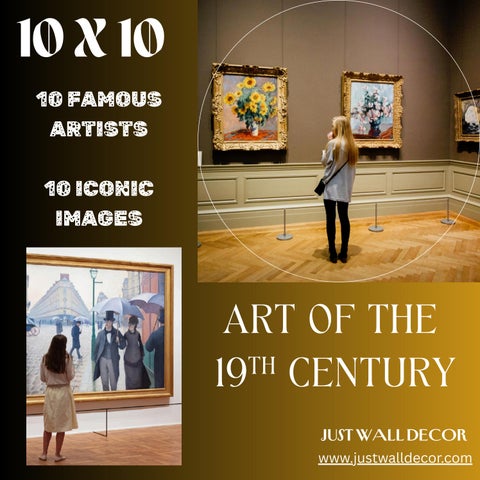
10 X 10 10 FAMOUS ARTISTS 10 ICONIC IMAGES
ART OF THE 19
TH
CENTURY JUST WALL DECOR
www.justwalldecor.com
J.M.W. TURNER 1775-1851 John Mallard William Turner was a renowned painter and watercolorist of the Romantic era (late 18th century through 19th century). He is especially well known for his marine paintings. Towards the latter part of his career Turner’s embraced the work of the impressionists and even hinted at abstraction. His painting Light and Color ....(1843) is an excellent example of this transition. The brushwork is so loose and chaotic that it isn’t hard to see why art historians have suggested that he was an early driving force toward abstraction. Not surprisingly most critics of that period were less than impressed ... The Athenaeum newspaper regretted Mr. Turner's flagrant abuse of his genius but admitted that there is a poetical idea dimly described through the prismatic chaos, which arrests the attention and excites the fancy. Martin Butlin and Evelyn Joll, The Paintings of J.M.W. Turner, revised ed., New Haven and London 1984
Light and Colour (Goethe's Theory) – The Morning after the Deluge – Moses Writing the Book of Genesis, 1843 Oil on Canvas 31 x 31 in. Tate Britain, London England
Liberty Leading the People, 1830 Oil on Canvas 122 x 128 in. The Louvre, Paris, France
EUGENE DELACROIX 1798-1864 Eugène Delacroix is considered the most representative painter of French Romantic School. His expressive use of color set him apart from other painters of his time such a Jean-Auguste-Dominique Ingres and Jacques-Louis David. His subject matter can aptly be described as being “ripped from the headlines”. His focus was current events rather than scenes from the classical past. Delacroix’s painting depicts an event from the July Revolution of 1830, in which the abdicated King Charles X is replaced with Louis Philippe I, the so-called Citizen King. This uprising of 1830 was followed two years later by the June Rebellion, an event that was popularized by the musical Les Miserables. Liberty, shown in profile, carries a French flag and a rifle with a bayonet as she leads her revolutionary citizens into battle. Notably, she wears a Phrygian cap. These caps were a classical feature of freedom that were worn in ancient times by liberated slaves. The various types of clothing and weapons carried by her followers shows us that this is a revolution for all citizens. And like all urban warfare, the ground is littered with the dead and dying from both sides of the conflict.
CASPAR DAVID FRIEDRICH 1774-1840 Caspar David Friedrich was a German artist of the Romantic Period. Considered the most important German artist of his generation, Friedrich painted landscapes with symbolic overtones. These were designed to produce a subjective, emotional response to the natural world. Typically his human subjects are thought to be lost in thought and almost always are facing away from the viewer. Wanderer Above the Sea of Fog, 1818 is Friedrich’s best known painting. We see a hiker on a mountain peak alone with his thoughts. As usual he is facing away from us. The focus of the painting is less about what the hiker sees but rather what the emotional impact the landscape has on him. Friedrich has reversed the convention that the human presence is what is important and the landscape is simply a pretty backdrop. He is the first artist to make the human presence subordinate to the landscape. This may explain why he used Rückenfigur — a person seen from behind, contemplating the view. Caspar David Friedrich’s art invites us to become the hiker and contemplate our emotional responses to his landscape.
Wanderer Above the Sea of Fog, 1818 Oil on Canvas 37 x 29 in. Hamburger Kunsthalle, Hamburg, Germany
The Luncheon of the Boating Party, 1881 Oil on Canvas 51 x 68 in. The Phillips Collection, Washington, DC
PAUL-AUGUSTE RENOIR 1841-1919 Pierre-Auguste Renoir was a leading force in the development of impressionist painting. His use of broken brushstrokes and bold color combinations served to capture the light and movement of his landscapes and figurative subjects. Renoir briefly worked with Claude Monet in 1869 painting landscapes around the Seine river. Renoir’s painting was always focused on pleasurable situations. His subjects always appeared to be happy and carefree. This is most apparent in his masterpiece, The Luncheon of the Boating Party. Renoir’s friends are seen relaxing and enjoying a meal after boating along the Seine river. Their luncheon is on the balcony of the Maison Fournaise Restaurant in Chatou, France. Renoir’s composition is characterized by both intimacy along with movement. The characters include his future wife (Aline Charigot with a small dog), a fellow painter, Gustave Caillebotte (lower right, yellow hat) and several actresses. The pair of individuals leaning against the balcony with yellow hats are the hotel owner’s children. A more in depth look at this painting can be seen in this short video. Duncan Phillips aquired The Luncheon of the Boating Party in 1923 and it has remained the superstar of The Phillips Collection in Washington, D.C. ever since.
CLAUDE MONET 1840-1926 Any discussion of 19th century art without including Claude Monet would be a travesty. Monet’s name is synonomous with french impressionism. His art stands out because of the way in which he captured light, color and shape. His unique style is considered to be the precursor of modernism. Deciding which of Monet’s paintings to show was no easy task. His water lily paintings in the Orangerie Museum and his Japanese bridge paintings are well known worldwide. In the end I chose Impression Sunrise, 1872 because it seems to be the launch point for impressionism. The painting depicts the port of Le Havre in France and is credited with inspiring the name of the impressionist movement. It was the haziness of the painting that caused Monet to use the word “impression” in the title rather than simply “view of Le Havre”. Monet actually made six paintings of the harbor at different times of the day. Impression, Sunrise is by far the most popular.
Impression Sunrise, 1872 Oil on Canvas 19 x 25 in. Musée Marmottan Monet, Paris, France
The Ballet Class, c. 1874-76 Oil on Canvas 33.5 x 29.5 in Musée d'Orsay, Paris France
EDGAR DEGAS 1834-1917 Edgar Degas was an impressionist painter. Unlike his contemporary, Claude Monet, Degas did not paint out of doors. In fact he went as far as to belittle these plein air painters. Degas’ paintings focused on movement and as such his best known paintings are of ballet dancers as well as racehorses and jockeys. In the late 1880s he also indulged a passion for photography. In 1874-75 Degas created two iconic paintings of a ballet class being conducted by the famous ballet master Jules Perrot. The one shown here is in the Musée d'Orsay, Paris. The second one, called The Dance Class, is held by the Metropolitain Museum in New York. Degas’ ballerinas are seen in a rehearsal studio of the Paris Opera. It is near the end of their practice session and the girls look tired and disinterested. Studying to be a ballerina was poorly paid, grueling work. Many of these girls came from low income families who were dependent of the dancers’ income. Ballet was on the decline in the 1870s and many dancers who did not ‘make the cut’ were dismissed from their companies. With little or no formal education these petits rats (little rats) as they were known often fell into prostitution to support themselves and their families.
GUSTAVE CAILLEBOTTE 1848-1894 Gustave Caillebotte was both an impressionist and a patron to other impressionist painters. His work had a more realistic style in comparison to the paintings of his fellow impressionists. Caillebotte initially aimed to paint reality as it existed much like that of his precursors Jean-François Millet and Gustave Courbet. Ultimately, because of his relationship with Degas and other impressionists, his paintings tend to vary in style. Paris Street, Rainy Day, 1877 is set in a complex intersection near the St. Lazare railway station. Paris had recently undergone extensive changes to its infrastructure by this time. Emperor Napoleon III had empowered Georges-Eugène Haussmann to create a massive urban renewal program which modernized Paris. The couple strolling along the street represent the epitomy of Parisian bourgeoisie of the time. Their culture and fashion are in perfect harmony with the wide streets and modern architecture that was implemented by Haussemann’s program.
Paris Street, Rainy Day, 1877 Oil on Canvas 108.5 x 83.5 in Art Institute of Chicago, USA
The Card Players, c. 1890-92 Oil on Canvas 32 x 26 in Metropolitain Museum of Art, New York, USA
PAUL CEZANNE 1839-1906 Paul Cezanne was a post-impressionist painter. Whereas impressionism was concerned with a natural depiction of light and color, post-impressionism focused on the abstract qualities of a painting or its symbolic message. Cezanne’s artwork formed the bridge between late 19th century impressionism and the early 20th century's art movements including Cubism. Matisse and Picasso once commented that Cezanne "is the father of us all". Cezanne painted five versions of Provencal farmhands playing cards and smoking pipes. The paintings are reminiscent of 17th century genre paintings although in Cezanne’s pictures the men are subdued and totally focused on their card game. There is no commotion or rowdiness in the tavern. The setting of the card game has been simplified with only a few pipes and a single spectator. This version is thought to be the second in the series. In each painting Cezanne use planes of color and small brushstrokes to build up his complex forms. Cezanne had painted each of the farmhands individually before placing them into the final composition.
PAUL SIGNAC 1863-1935 Paul Signac and Georges Seurat were post-impressionist painters who developed the artistic technique of pointillism. Developed in 1886, pointillism uses small, discrete dots of pure color to create patterns to form an image. Seen from a distance, the viewer's eye will blend the colors to form the image. While Seurat is probably the better known of the two artists, I personally find Signac’s work to be more vibrant. The Port at Sunset (Saint Tropez), 1892 presents us with a tranquil waterscape in the early evening. Signac builds his painting using dots of contrasting complementary colors (violet and orange) to create vibrance and light. The sailboat in the painting is a tartan which was commonly used for fishing and moving freight. You can see how the triangular sails of the boat echo the landing stage in the foreground. Both the sea and sky have a golden shimmer in the light of the setting sun which contrasts with other elements in the painting that are rendered in shades of blue and violet. The shadows on the water serve to draw our view toward the sailboat. Overall there is a dreamy character to the painting which is characteristic of Signac’s paintings of Saint-Tropez.
The Port at Sunset (Saint Tropez), 1892 Oil on Canvas 32 x 25.5 in Museum Barberini, Potsdam, Germany
Cafe Terrace at Night, 1888 Oil on Canvas 26 x 32 in. Kröller-Müller Museum, Otterlo, Netherlands
VINCENT VAN GOGH 1853-1890 Vincent van Gogh is indisputably the best known post-impressionist painter of the 19th century. His work is everywhere (posters, plates, greeting cards, etc.). The Starry Night (1889) is as ubiquitous as pasta. Van Gogh was a prolific artist creating over 2100 works (860 of which were oil paintings) in his relatively short lifetime. His art was characterized by bold colors and dramatic brushwork. These features were the precursor to expressionism in the 20th century. As much as I like The Starry Night, I feel it important to highlight a different Van Gogh masterwork. Cafe Terrace at Night, 1888 depicts a scene near the Place du Forum in Arles, France. Van Gogh’s inspiration for the painting remains a source of ongoing controversy. While authorities from the Van Gogh Museum suggest it was inspired by a novel of Maupassant called Bel Ami, other experts point to obvious similarities with Louis Anquetin’s painting Avenue de Clichy: 5 o'clock in the Evening (1887). When first exhibited in 1891 Cafe Terrace at Night, 1888 was called Coffeehouse, in the Evening. Notably, it was the first time that Van Gogh painted a starry sky.
THANKS FOR VISITING US We hope you enjoyed our top picks for the 19th century. I imagine they probably don’t match with your top picks but that’s what makes art so fascinating. We don’t necessarily have to agree on what makes certain pieces of art stand out to us. But we should be able to appreciate and respect other people’s choices. Feel free to send us your thoughts on our choices. And please check back from time to time as we’ll be adding 10 X 10 Flipbooks for other time periods.
Just Wall Decor www.justwalldecor.com