the
Justice www.thejustice.org
T h e I n d e p e n d e n t S t u d e n t N e w s p a p e r o f B r a n d e is U n i v e r sit y S i n c e 1 9 4 9 Volume LXXIX, Number 2
Tuesday, September 29, 2026
INTERNATIONAL STUDENTS
Waltham, Mass.
AI ON CAMPUS
As Brandeis clarifies its generative AI policies, some questions remain
Despite new language clarifying the University’s generative AI policies, a small-scale student survey suggests that uncertainty remains about when and how students can use AI. By ALLIE LADJEVA
JUSTICE COPY EDITOR
On Aug. 21, the Brandeis student body received an email from the Dean of Students Office outlining 2026-2027 revisions, including further clarifications on generative artificial intelligence policies. Section 4 of Rights & Responsibilities outlines that
“instructors are expected to articulate an official AI use policy for each of their courses.” If a professor does not provide official guidance on AI use in class, generative AI is prohibited. The University provided four sample AI syllabus statements, ranging from most restrictive to most permissive, including policies that allow AI tools for certain uses, such as reviewing course material or refining written work. However, the statements prohibited students from submitting “AI-generated work as if it were your own.” Instructors are also encouraged to develop their own AI syllabus statements. In a Sept. 15 written statement to The Justice, Alexandra Rossett, Assistant Dean of Student Rights and Community Standards, said the development of AI prompted the University to revise the code of conduct.
See SURVEY, 5 EITAN KLIEGER/The Justice.
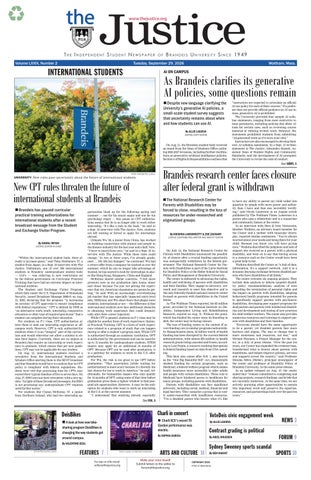
UNIVERSITY: New rules pose uncertainty about the future of international students.
New CPT rules threaten the future of international students at Brandeis Brandeis has paused curricular practical training authorizations for international students after a recent broadcast message from the Student and Exchange Visitor Program. By NAWAL IRFANI
JUSTICE EDITOR IN CHIEF
“Within the international student body, there already is [a] mass panic,” said Taka Nishimura ’27, a student from Japan, in a Sept. 25 interview with The Justice. Nishimura, one of over 500 international students in Brandeis’ undergraduate student body — 15.8% — was referring to new restrictions set by the federal government on Curricular Practical Training that have had an extreme impact on international students. The Student and Exchange Visitor Program, which falls under the U.S. Department of Homeland Security, issued Broadcast Message 2608-01 on Aug. 12, 2026, declaring that the program “is increasing its scrutiny of CPT approvals to ensure compliance with federal regulations.” CPT is defined by DHS as “an alternative work/study, internship, cooperative education or other type of required practicum” that a student can complete during their education. For students on F-1 visas, CPT authorization allows them to seek out internship experience or offcampus work. However, CPT is only authorized for students when it is an “integral” part of the curriculum and would otherwise not allow a student to obtain their degree. Currently, there are no majors at Brandeis that require an internship or work experience to graduate, which means that per new guidelines, CPT may not be applicable for any student. On Aug. 21, international students received a newsletter from the International Students and Scholars Office alerting them to the SEVP broadcast and that Brandeis would have to confirm that its CPT policy is compliant with federal regulations. Students were told that processing time for CPTs may exceed their typical timeline of five to seven days. On Aug. 27, ISSO sent out their newsletter with a new update: “In light of these [broadcast] messages, the ISSO is not processing any undergraduate CPT requests until further notice.” For students like Ciaran McKenna ’27, a junior from Northern Ireland, who had two internship op-
portunities lined up for the following spring and summer — one for his music major and one for his psychology major — this pause on CPT authorizations means that he is no longer able to work either internship. “It’s like a stab in the back,” he said in a Sept. 24 interview with The Justice. Now, students are left waiting or forced to apply for internships abroad. Orlando Wu ’28, a junior from China, has worked on building connections with alumni and people in the finance industry for the last year and a half. Now, “I have to [start] from zero,” he said in a Sept. 25 interview with The Justice. While these rules could change, “in two or three years, I’ve already graduated. … My life [is] changed,” he continued. Wu had a return offer from a company he worked at over the summer, which he can no longer take advantage of. Instead, he has started to look for internships in places like Hong Kong, Singapore, China and England. McKenna shared similar concerns. “I feel more pressure now as my graduation date looms closer and closer because I’m just not getting the experience that my American classmates are gonna be getting,” he said. With an increasingly overwhelming job market that has especially impacted entry-level jobs, McKenna and Wu share fears that plague most students, international or not — the difference is that international students now face additional obstacles to obtaining work experience that could dramatically alter their career trajectory. While CPT is paused, students on F-1 visas may be eligible for another form of work experience: Optional Practical Training. OPT is a form of work experience related to a program of study that can happen during or after a student’s program ends. While CPT is authorized through an academic institution, OPT is authorized by the government and can be used for up to 12 months for undergraduate students. STEM majors may apply for an additional 24 months of OPT. Because OPT can be used after graduation, it is a pathway for students to work in the U.S. after graduation. For Wu, the risk is too great to use OPT before graduation. “That uncertainty [while waiting for authorization] is more scary because it’s literally the last chance for me to work in America,” he said. Additionally, for humanities majors who only qualify for 12 months of OPT, using some of that time before graduation gives them a tighter window to find postgrad job opportunities. However, it may be the only option for students who want to work an internship in the U.S. at the current moment. “I understand that studying abroad, especially
See ISSO, 5
Brandeis research center faces closure after federal grant is withdrawn The National Research Center for Parents with Disabilities may be forced to close, resulting in the loss of resources for under-researched and stigmatized groups. By KRISHNA LAKKIMSETTY & ZOE ZACHARY
JUSTICE CONTRIBUTING WRITER AND DEPUTY EDITOR
On July 15, the National Research Center for Parents with Disabilities announced the possibility of closure after a crucial funding opportunity was unexpectedly withdrawn by the federal government. The National Research Center for Parents with Disabilities is part of the Lurie Institute for Disability Policy at the Heller School for Social Policy and Management at Brandeis University. The center is dedicated to advancing the rights, health and well-being of parents with disabilities and their families. They engage in advocacy, outreach and research to meet this objective and is the only federally-funded national research center focused on parents with disabilities in the United States. As The Waltham Times reported, the $5 million grant, provided by the National Institute on Disability, Independent Living and Rehabilitation Research, expired on Aug. 31. Without the grant, which has funded the center since its founding in 2016, the center may be facing closure. The loss of funding comes in the context of severe funding cuts to similar programs nationwide. In Massachusetts alone, $2 billion worth of health funding has been disrupted by the current federal administration, with almost $50 million in health research grants being canceled and frozen, according to Lost Funds, a resource tracking disruptions to federal funding based on data from USA spending. This blow also comes after H.R. 1, also known as the “One Big Beautiful Bill” Act, dramatically slashed funding for certain programs, such as Medicaid, a federal welfare program which makes health insurance more accessible to older adults and people with certain disabilities. These cuts to Medicaid have hindered access to healthcare for many groups, including parents with disabilities. Parents with disabilities can face significant adversity, including social, medical, financial and legal barriers. They comprise a group that is vastly under-researched with insufficient resources. “I’m a disabled parent who knows what it’s like
Charli in concert
DeisBikes
Charli XCX's recent TD Garden performance was electric.
A look at how new bikesharing program DeisBikes is changing the way students get around campus.
By SOPHIA GARCIA
FEATURES 7
Photo courtesy of CREATIVE COMMONS.
For tips or info email editor@thejustice.org
ARTS AND CULTURE 14
Make your voice heard! Submit letters to the editor to forum@thejustice.org
VoteDeis civic engagement week By ALLIE LADJEVA
Contract grading is political By ARIEL KNUDSEN
By VALENTINO DZUL SKYE ENTWOOD/The Justice.
to have my ability to parent my child called into question by people with more power and authority than I have and that was incredibly terrifying,” said Nicole Lomerson in an August article published by The Waltham Times. Lomerson is a parent who uses a wheelchair and is a researcher and community liaison at the center. In an interview with Here & Now Newsroom, Heather Watkins, an advisory board member for the Center and a mother with muscular dystrophy, reported similar sentiments. “You’re always worried about your needs and being there for your child. Because you know you will have prying eyes.” Watkins described the judgment and lack of support she received as a parent with a physical disability, and went on to say that having access to a resource such as the Center would have been a great help to her. Watkins described the Center as “a hub of data, information. It’s a support network. And it is a dynamic learning exchange between disabled parents who have disabilities of all kinds.” The center oversees six ongoing projects. They include data analysis to inform targeted disability policy recommendations, analysis of laws regarding the termination of parental rights and the impact on parents with disabilities, adapting behavioral health programs intended for parents to specifically support parents with psychiatric disabilities, developing peer support programs for deaf parents and parents with intellectual disabilities and development and testing of new practices for child welfare workers. The center also provides numerous resources and trainings to support parents with disabilities and their families. “Everyone should have the same opportunity to be a parent, yet disabled parents face more barriers and stigma. The way to change that is more awareness and resources, not less,” said Miriam Heyman, a Project Manager for the center, in a July 15 press release. “Over the past ten years, our Center has expanded the evidence base, transformed what is known about parents with disabilities, and helped improve policies, services and supports across the country," said Professor Monika Mitra (Heller), principal investigator of the center and professor of Disability Policy at Brandeis University, in the same press release. In an update released on Aug. 27, the center stated they “remain committed to completing and sharing projects, research findings, and briefs that are currently underway. At the same time, we are actively pursuing other opportunities to sustain this important work and preserve the expertise, resources, and partnerships built over the past ten years.”
Sydney Sweeney sports scandal By BEN KHAYAT
COPYRIGHT 2026 FREE AT BRANDEIS.
NEWS 3 FORUM 9 SPORTS 10
2 TUESDAY, SEPTEMBER 29, 2026 ● NEWS ● THE JUSTICE
NEWS
POLICE LOG MEDICAL EMERGENCY Sept. 18—There was a medical emergency for a party with a bloody nose. The patient refused medical treatment. Sept. 18—There was a medical emergency for a party with sun exposure. The patient refused medical treatment. Sept. 19—There was a medical emergency for an intoxicated party. The patient was transported to a local hospital. Sept. 19—There was a medical emergency for a party complaining of a headache and vomiting. The patient refused medical treatment. Sept. 19—There was a medical emergency for a party who reported they had fallen and scraped their knee. The patient refused medical treatment. Sept. 20—There was a medical emergency for a party who fell on the pool deck. The patient refused medical treatment. Sept. 22—There was a medical emergency for a party not feeling well. The patient refused medical treatment. Sept. 22—There was a medical emergency for a party experiencing chest pain. The patient was transported to a local hospital. Sept. 22—There was a medical emergency for a party with an injured foot. The patient refused medical treatment. Sept. 23—There was a medical emergency for a party with an injured foot. The patient was transported to a local hospital. Sept. 23—There was a medical emergency for a party who lost consciousness. The patient was transported to a local hospital. Sept. 24—There was a medical emergency for a party who was struck in the head. The patient refused medical treatment. Sept. 24—There was a medical emergency for a party not fee-
ling well. The patient refused medical treatment. MOTOR VEHICLE Sept. 18—A party reported they had hit their personal vehicle with a Brandeis van. There will be an investigation to follow. Sept. 23—An officer conducted a vehicle stop. A verbal warning was issued. Sept. 24—There was a report of a past hit- and- run. There will be an investigation to follow. MISCELLANEOUS Sept. 18—A party reported a theft from their room. There will be an investigation to follow. Sept. 18—A party reported finding anti-government pamphlets. There will be an investigation to follow. Sept. 19—An officer completed a directed patrol of Chapels Field. All appeared in order. Sept. 20—A party observed several individuals kicking a gate. There will be an investigation to follow. Sept. 20—There was a report of a potentially homeless party on campus. The office in charge was notified to respond. Sept. 20—An officer completed a directed patrol of the Goldfarb Library. The situation was cleared. Sept. 20—A party was notified of a potential domestic dispute. The situation was cleared. Sept. 21—An officer completed a directed patrol of Chapels Field. All appeared in order. Sept. 21—An officer completed a check detail of Shapiro Campus Center. All appeared in order.
Sept. 21—An additional pamphlet with anti-government material was found. There will be an investigation to follow. Sept. 21—An officer completed a check detail of the Rose Art Museum. Sept. 21—An officer completed a check detail of the Sherman-Hassenfeld Center. Sept. 21—An officer completed a check detail of Usdan Student Center. Sept. 21—An officer completed a directed patrol of the Rose Art Museum. The situation was cleared. Sept. 22—An officer completed a directed patrol of Chapels Field. All appeared in order. Sept. 22—An officer completed a directed patrol of Chapels Field. All appeared in order. Sept. 22—A party called requesting an officer be sent to help them. Services were rendered. Sept. 22—There was a report of a smoking ash tray. Maintenance was notified to respond. Sept. 23—An officer completed a directed patrol of Chapels Field. All appeared in order. Sept. 23—An officer completed a directed patrol of the Rose Art Museum. All appeared in order. Sept. 23—An additional pamphlet with anti-government material was found. There will be an investigation to follow. Sept. 24—An officer completed a directed patrol of Loop Road. All appeared in order.
BRIEF
BRIEF
Brandeis rises in national ranking
Student Union Announces Election Results
On Tuesday, Sept. 22, U.S. News and World Report released their 2027 college and university rankings, placing Brandeis in a tie for 59th place of 422 institutions for national universities. Notably, the University moved up 10 spots in the rankings and tied for 36th place among top private schools. The rise in rankings has largely been attributed to the University’s plan to reinvent the liberal arts, spearheaded by president Arthur Levine ’70, which includes the creation of four new schools. The University was also commended for its commitment to innovation and ranked 19th for Most Innovative Schools. Brandeis was also highlighted for its strength in undergra-
duate research and rose to 40th place in undergraduate teaching. Key ranking factors include student outcomes, which account for 52% of a school’s final outcome. Additionally, peer assessment accounts for 20% of a school’s final grade and is measured using data from provosts, deans, university presidents and other top administrators in statistical surveys collected by U.S. News. Contrastingly, Brandeis was ranked 117th overall in the Forbes rankings, which were released on Sept. 10. However, the school ranked 32nd and was named to the list of top 50 small colleges. Forbes similarly relies on outcomes-based metrics to determine its rankings, with a fo-
cus on graduation rates, student debt and alumni outcomes. As the school begins to roll out new institutional changes, it has seen a notable rise in national rankings. While it is unknown how this will affect the University going forward, the new data suggests a positive reception among the higher education community and for Brandeis in the coming year and beyond.
—
CORRECTIONS AND CLARIFICATIONS ■ An editorial incorrectly stated that the new “Breakfast to Go” option required meal exchanges. A source close to the matter has clarified that students are charged meal swipes. (Sept. 15, 8)
The Justice welcomes submissions for errors that warrant correction or clarification. Send an email to editor@ thejustice.org
Justice
the
www.thejustice.org
The Justice is the independent student newspaper of Brandeis University. The Justice is published every Tuesday of the academic year with the exception of examination and vacation periods. Editor Managing News Features Forum Sports Arts Photos Copy Layout Ads Social Media
editor@thejustice.org managing@thejustice.org news@thejustice.org features@thejustice.org forum@thejustice.org sports@thejustice.org arts@thejustice.org photos@thejustice.org copy@thejustice.org layout@thejustice.org ads@thejustice.org online@thejustice.org
The Justice Brandeis University Mailstop 214 P.O. Box 549110 Waltham, MA 02454-9110 Phone: (781) 736-3750 The Managing Editor holds office hours on Mondays from 7:30 to 8:30 p.m.
Written
by
Chava Thiell
On Sept. 28, results of the Sept. 22 Student Union elections were shared with the student body. In total, 14 students were elected to positions available for this Fall. There were a variety of seats for Senate this year., with three seats open for Senator at Large, one seat open for the Multicultural Senator, one seat open for the Class of 2027 Senator, two seats open for the Class of 2028 Senators, and three seats open for the Class of 2030 Senators. Aside from the seats in the Senate, two seats were open on the Allocations Board and one seat for the Chief Judicial Officer position was available under the Executive Branch. Student Union Secretary Marcus Buenaflor ’29 announced the results via email. Students elected Fairooz Abida ’27 for Chief Judicial Officer under the
Executive Branch. Elle Brown ’30, Judah Friedman ’30 and Jordan Medved ’28 were elected as Senators at Large, with Mariah Martinez ’29 selected as the Multicultural Senator. Benjamin Grimes was named Class of 2027 Senator and Lucas Thompson along with Luke Golin were elected to serve as Class of 2028 Senators. Finally, Julia Velasco, Trente Xian and Tyler Parshay were chosen as Class of 2030 Senators. Mariyam Ali ’30 was elected the Myra Kraft Achievers Program Senator, as well as Elena Staples ’28 and Andre Saphores ’29 as A-Board Representatives. Abida previously served as the Director of Health and Wellness for the Student Union Executive Board where she organized a campus-wide event called SelfHelp Day. “This experience taught me the importance
of listening to students and advocating for a community where everyone feels supported, respected, and treated well,” she said in her candidate bio. Grimes, Thompson and Golin, the new Senators for the Class of 2027 and the Class of 2028, were write-in candidates for their positions, both of which had no formal candidates who had submitted bios. For more information about the results, please email mbuenaflor@ brandeis.edu or follow the Brandeis Student Union Instagram page, @brandeisuniversitysu, for more ways to get involved.
— Written by Miriam Grodin and Ariana Agarwal
THE JUSTICE ● NEWS ● TUESDAY, SEPTEMBER 29, 2026
3
Inside Civic Engagement Week: Building voter engagement Featuring five events at Brandeis and an interactive
workshop at Harvard, VoteDeis and ENACT held Civic Engagement Week ahead of the midterm elections.
By ALLIE LADJEVA
JUSTICE COPY EDITOR
From Sept. 14 to Sept. 18, VoteDeis and the Abraham Feinberg Educational Network for Active Civic Transformation hosted Civic Engagement Week — a series of events aiming to increase nonpartisan learning and engagement across Brandeis ahead of the upcoming midterm elections. The week featured five events, followed by an interactive session led by Nova Brent ’28 and Luke Farberman ’27 at the East Coast Votes Summit hosted by the Harvard Kennedy School of Government. On Monday, Sept. 14, Maine Secretary of State Shenna Bellows joined live on Zoom for a conversation called, “How do election officials prepare for the unexpected?” The next day, VoteDeis and ENACT hosted National Voter Registration Day with two baby goats. Dozens of students stopped by to take pictures with the baby goats, while VoteDeis members helped students check their voter registration and request ballots. A baby goat first visited campus as part of a VoteDeis voter engagement event in fall 2024 and quickly became one of the organization’s signature initiatives. “So we were like, why not put animals and voting together? So that’s exactly what we did … And so from there, this kind of became our brand at Brandeis. And then, this year, we ran the Vote Goat again. This time, with two goats — double the goats, double
the votes,” Farberman, senior representative of VoteDeis, said during the Harvard workshop on Sept. 19. On Wednesday, Sept. 16, VoteDeis and ENACT, in collaboration with the Center for Spiritual Life, Jewelry Making Club, Center for Health & Wellness, Fashion Society and Yarn Craft Club, held a “Crafting Democracy” night. “I think [the event] brought together people who wouldn’t necessarily come to an event like this,” Brent said. “They came for the crafting, but then they also got this element of civic engagement that they might not normally be attracted to.” The following day, a keynote talk with Jonathan Becker, acting president of Bard College and Yael Bromberg, constitutional rights litigator and election law professor, took place on campus. The discussion focused on youth voting rights and challenges surrounding voting access on college campuses. The last event at Brandeis as part of Civic Engagement Week, was the Boston Student Voting Conference on Sept. 18. The event brought together student voting coalitions throughout the Boston area, including Northeastern University and Suffolk University. “We are all working on kind of the same general project of trying to keep people engaged and knowledgeable about how they can vote, what they are going to be voting on, from a completely nonpartisan perspective. So that’s the same project all across the Boston area, but we are kind of all in our little lone bubbles, and so the kind of idea is: how do we stay in contact?” Farberman shared. He pointed to an exchange with a Northeastern student as an example. “One of the people I was talking to from Northeastern was like, ‘Well, so you guys obviously have a monthly newsletter.’ I was like, ‘Wait, we don’t have a monthly newsletter,’” Farberman said. On Saturday, Sept. 19, Brent and Farberman led an Idea Sharing Workshop at Harvard Kennedy School, where students from the Massachusetts Institute of Technology, Bridgewater State University, Princeton University and other colleges discussed strategies for increasing campus voter engagement. During the session,
Brent and Farberman presented Brandeis initiatives including Vote Goat, weekly voter-registration tables and social media engagement. “I would actually say that your Vote Goat idea is probably one of the best things I have heard in the area,” a Princeton student shared at the Harvard workshop. VoteDeis began as a campus coalition of students, staff, and faculty through ENACT. David Weinstein, assistant director of ENACT, co-founded VoteDeis. “I co-founded VoteDeis with the goal of coordinating and supporting and expanding on work already being done at Brandeis by faculty, staff and students to support voter registration and voter participation,” Weinstein said. He said that the work has been primarily driven by students. After the 2024 elections, student members began the process of turning the coalition into an officially chartered student club, establishing executive board positions and adding a structure for welcoming new members. VoteDeis’ work extends beyond voter registration ahead of federal elections. Brent said the organization has worked to expand its initiatives during election “off years,” including a New York City mayoral debate watch party and other events focused on local elections. “Just because there isn’t a federal election happening doesn’t mean that local politics disappear,” she shared. VoteDeis has also hosted an event combining thrifting, coffee and voter registration that raised $500 for Common Cause Massachusetts. Central to VoteDeis’ work is its nonpartisan approach to voter engagement. “They’re committed to doing this nonpartisan work that is about ensuring that anybody, no matter what their political point of view is, no matter who they may be planning to vote for, has that opportunity,” Weinstein said.
—Editor’s Note: News Editors Ashhwika Soni and Chava Thiell serve on the VoteDeis Executive Board and did not contribute to or edit this article.
A conversation with Lewis Brooks, Brandeis’ Director of the Center for Careers and Applied Liberal Arts
Brooks details Brandeis’ career-focused plan for
students and its new initiatives
By NAWAL IRFANI & BRYAN WOLFE
JUSTICE EDITOR IN CHIEF AND ASSOCATE EDITOR
On Sept. 24, The Justice sat down with the Director of the Center for Careers and Applied Liberal Arts and Brandeis alum, Lewis Brooks ’80, Ph.D. ’16 to discuss Brandeis’ new plan to help students become career-ready. The creation of the department was a vital component of President Arthur Levine ’70’s plan to reinvent the liberal arts, a bold initiative that aims to bridge the gap between rigorous academics and tangible, real-world experience. Brooks has expressed excitement about leading the center and playing a vital role in helping students to navigate an unpredictable occupational landscape. Discussion focused on Brooks’ involvement and leadership thus far, the specifics of his plan — including the rollout of microcredentials, new career counselors and a second, skills-based transcript — and his hopes for students. Brooks began by describing the various facets that make up this new plan. One of the primary components is microcredentials,
which function as certifications of a skill. Microcredentials are authored and proposed by faculty members, who also plan specific assessments for each microcredential to evaluate its achievement by a student. Currently, there are 16 microcredentials approved for students to apply for, and more are coming soon. The Center has already gauged high levels of engagement from students — last semester, 175 people registered for microcredentials. However, 76 of those students were seniors, who had to be assessed within a compressed timeline during finals. The Center is already planning ahead for this year’s assessment process, which will occur during the semester. Students can also retroactively register for microcredentials, allowing students to claim skills if they’ve already met the requirements. Microcredentials will go on a second transcript issued by the registrar that will also detail a student’s experiential learning. In contrast to a resume, the second transcript allows students to show that Brandeis has attested to the information listed. Since approved microcredentials take into account the skills that employers look for, they reflect Brooks’ vision to “get students learning and … prepared for what’s out in the real world.” Other aspects of Brandeis’ initiative include consolidating the different career centers on campus into the Brandeis Career Network, adding career preparation to core curriculum and the restructuring of Brandeis’ four schools — The School of Arts, Humanities and Culture; School of Business and Economics; School of Science, En-
gineering and Technology and School of Social Sciences and Social Policy, which pair the subject areas more overtly with career opportunities. Brooks’ own experience at Brandeis and the influence of the liberal arts curriculum allowed him to pursue a variety of career opportunities. “I graduated from Brandeis as a psychology major. I made an immediate left turn and went into technology. And I was able to do that because what I learned at Brandeis introduced me to so many directions,” he said. He hopes that new initiatives that focus on career-readiness give students a clearer picture of life after Brandeis. “The whole idea is that when you come out of Brandeis, you have a direction and you can follow that direction,” whatever it may be. Brandeis placed 59th out of 422 institutions across the U.S. in the recent U.S. News & World Report’s rankings for 2027 and has received notable praise for their new curriculum by both Forbes and The Boston Globe. While pressure on higher education and disinterest in attending these institutions is on the rise, the University is providing new insight about the ways liberal arts can prepare students for their careers and open new pathways for students. Brooks envisions that this plan will help students successfully follow a career path and have “the fundamentals that they need to sit at a table, communicate and advocate for themselves.”
Club Close Up: South Asian Student Association Dance Night By Justin Gao
JUSTICE PHOTOS EDITOR
Design: ASHHWIKA SONI and SKYE ENTWOOD/The Justice.
Graphics courtesy of CANVA and ASHER BAREL-STOUT/The Justice.
THE JUSTICE ● NEWS ● TUESDAY, SEPTEMBER 29, 2026 5
ISSO: Students look for support as CPT authorizations are paused CONTINUED FROM 1 here, is a privilege,” said one international student who chose to remain anonymous under fear of reprisal in a Sept. 26 interview with The Justice. She attended an American school in her home country, and said, “One of the reasons why I chose to come here … [is because] this is the culture that I’m familiar with.” Lately, it feels like “every month … I need to follow up with something so that I can peacefully continue my studies,” she continued. F-1 visas, like all temporary, single-intent visas, restrict applicants to the given purpose and time frame of their visa. In this case, F-1 visas are valid while students remain in school and maintain good academic standing , alongside a few other regulations.. CPT and OPT provide important legal ways of pursuing work experience in the U.S. that may allow students to transition from student visas to work visas after graduation. The legal jargon and restrictions of student visas can be intimidating, especially in light of SEVP’s new policy. On top of increased scrutiny for CPT and visa applications, another DHS policy proposed in August 2025 intended to establish a fixed fouryear period for F-1 and J-1 — for people in exchange programs of work or study — visa holders, levying yet another threat to the possibility of stability for international students. This would be a significant change from the current policy, which admits international students for a duration of status. Rather, as long as they are a student and meet specific requirements, they can continue to stay in the U.S. The current rule allows many students to pursue graduate and Ph.D. studies after their
undergraduate education without needing additional government approval. The new rule was scheduled to take effect on Sept. 15, but is currently blocked in the U.S. District Court, granting preliminary relief from the rule. According to the ISSO’s newsletter, the next hearing for this case will take place on Oct. 2. However, Brandeis students are already feeling the impact of the new policy. New projections for next year’s enrollment of international students across U.S. colleges and universities expect to a drop of as many as 112,000 students. Despite these projections, some schools may be able to continue offering CPT authorizations. Notably, schools like Northeastern University and Drexel University, which offer cooperative education programs, can continue offering CPT for students in those programs because hands-on or relevant work experience is required. If Brandeis is no longer able to offer CPT authorization to international students, schools like these may attract more international applications. In a Sept. 10 statement to The Justice, the ISSO affirmed that they are “dedicated to supporting our international students and ensuring that Brandeis has the opportunity to have a vibrant community of scholars” and are working “diligently to follow the regulations for Curricular Practical Training and also to consider any new interpretations of these regulations as they are released.” Students expressed frustration with ISSO’s pause of CPT authorizations, but recognized the difficult position they are in. “They’re not the one who makes the rules, so I can-
not blame them,” said Wu. “I just felt … upset.” When asked about how the ISSO could support them, some students suggested offering more work or internship opportunities that international students may qualify for. Since many employers are less incentivized to hire international students or workers who require additional processing and paperwork, international students often face a tougher job market. “I feel like the ISSO is that one entity [that] should be able to help international students find jobs that they can even apply to,” said Nishimura. Nishimura also emphasized the importance of recognizing the breadth of different experiences that international students at Brandeis encompass. “I go up to immigration when I enter the U.S. and I can chitchat and joke with the immigration officer,” but friends of his that have come from countries with contentious relationships with the U.S. — notably from China, the Middle East and Northern Africa — are grilled about their visa terms and studies. As the Trump administration continues to crack down on higher education, international students remain among the most vulnerable, especially without the ability to find internships or work experience before graduation. Like all students, they deserve to feel safe, prioritized and supported throughout their time at Brandeis. Right now, there are many “international students I know of that are very scared,” McKenna said, and “I don’t see my future in America.”
SURVEY: Code of conduct draws student confusion about permitted use of AI CONTINUED FROM 1
“For students, our aim is to help them have a clear understanding of what our policies are and why. Faculty are trying to navigate a complicated and rapidly changing landscape, and the university wants to make sure that it is supporting them in figuring out the best ways to engage with students about appropriate or inappropriate uses of AI,” Rossett wrote. The revisions to Section 4 of Rights & Responsibilities were a collaborative effort of the Committee on Teaching, Learning and Assessment; the Center for Teaching and Learning; Student Rights and Community Standards; Rights & Responsibilities Committee; the Provost’s Office; school deans and some members of the AI Steering Council. When determining whether a student has used AI tools in violation of the course’s policy, Rossett said that suspected AI use should not be based solely on AI-detection software, which can produce inaccurate or inconclusive results. “Faculty should consider the totality of the available information. Things faculty might be considering may include, but would not be limited to, the student’s work, the assignment requirements, the student’s process and explanation of their work, factual inaccuracies or logical inconsistencies, lack of citations, or fabricated citations,” Rossett said. To inform this article, The Justice conducted a small-scale survey from Sept. 20 to Sept. 27 about how Brandeis students understand these generative AI policies. The survey received 31 responses from Brandeis undergraduate and graduate students, 94% of whom were undergraduates. At the beginning of the survey, students were asked whether they knew if Brandeis’ academic integrity policy includes specific rules on AI. Seventy-one percent of respondents said they were aware but had not read
the policy. Respondents were given a hypothetical situation in which a professor had not provided written permission to use generative AI in the syllabus or assignment instructions. Fifty-eight percent of students said that, to their understanding, AI can be used to some degree, or may be used unless the professor specifically prohibits it. Only 42% correctly identified that AI tools may not be used unless the professor gives written permission. Without written permission from an instructor, respondents believed they could use AI tools for purposes such as brainstorming, researching, checking spelling and finding sources. Students were given various statements about AI use and had to indicate whether each use is permitted, not permitted or unclear. Sixty-eight percent of respondents said that using Perplexity or another AI tool to identify possible sources, but reading and citing the original sources yourself, is a permitted use of AI. Another 61% of respondents saw “using ChatGPT or Claude to summarize an assigned reading to help you understand it” as another accepted use of AI tools. At the same time, 87% of respondents reported that all or most of their courses now include AI syllabus statements. Seventy-seven percent of respondents shared that AI policies differ across courses, depending on whether or not professors allowed AI use for brainstorming, source-finding and grammar (Figure 1). When generative AI use is allowed, the survey received mixed responses about whether or not students felt confident in how to acknowledge or cite the use of AI (Figure 2). Forty-two percent of respondents said they felt “slightly confident” and 16% felt “not at all confident.” Only half of the students said
that they received guidance in class on how to cite the use of AI. At the end of the survey, students were shown the relevant language from Section 4 of Rights & Responsibilities. After reading, some students found the language clear, while others still found it ambiguous. Some respondents suggested setting AI-use expectations at the department level to make standards consistent for students. Others found the policy “vague” and needed further clarification, noting that “blanket policies always have exceptions and it is hard to keep track of them.” A student also reported that a university-wide AI policy, rather than leaving it to instructors’ discretion, is needed. Some departments have responded to the variation in AI policies by developing shared approaches. For example, the Journalism department has adopted a common AI policy, leaving room for each professor to interpret it. “Our policy, our approach to AI, has been not to shut it down completely and pretend that we live in a world where AI doesn’t exist … What is open for debate is how you use this really powerful tool of generative AI to make your reporting more robust. If journalism is about looking for information and under rocks, then you can use technology to look under more rocks than is humanly possible,” Neil Swidey (JOUR), director of the Brandeis Journalism department, said. Swidey said that students should be transparent about AI use, while maintaining autonomy over their work. In their class “The Road to September 11th and Beyond: History and Media,” Swidey and Prof. Naghmeh Sohrabi (POL) adopted an oral final exam to test students’ knowledge and understanding of the material and avoid the problem of AI use. Other uses of AI remain prohibited in journalism
classes. “The non-negotiable with AI is not using AI to generate words that then you put your name to … As a journalist, if you allow a machine to do what you are supposed to do, which is come up with the words and the thoughts and the sentence structure, then you have no business being a journalist,” Swidey said. AI use also varies by discipline. Zoe Weinstein, a humanities librarian, said she has seen a decrease in AI use in humanities over the past two years, while colleagues have reported an increased interest in business, economics and computer science. Weinstein described herself as an “AI pessimist,” and shared she is skeptical of how useful generative AI is for research in the humanities and social sciences. However, she noted its potential value in limited brainstorming uses. “Most of what’s happening when students rely on generative AI for gathering resources, for summarizing resources, for determining what a source is about, they are doing what is called cognitive offloading, where they just take what you could do with your own brain, and they say, ‘well, somebody else can do it.’ And that theoretically saves time and effort, and in reality makes it so that you don’t know what you are getting,” Weinstein said. She also shared that University librarians are available to answer AI-related questions and the library provides students with a guide to citing AI. Although Brandeis has clarified its generative AI policy language and most students in the survey reported that their courses have written AI statements, the survey suggests that confusion remains about when AI can be used and how to properly acknowledge it.
ALLIE LADJEVA/The Justice.
TRAVEL: Tourists take a momentary rest at a local spot.
JUSTIN GAO/The Justice.
ALLIE LADJEVA/The Justice.
ARCHITECTURE: The bridge stands over the serene waterway.
JUSTIN GAO/The Justice.
features
6 TUESDAY, SEPTEMBER 29, 2026 ● FEATURES ● THE JUSTICE
just
VERBATIM | LANI LYNN VALE Four wheels move the body, two wheels move the soul.
ON THIS DAY…
FUN FACT
American oil tycoon John D. Rockefeller becomes the world’s first billionaire.
The first commercially sold bicycle was nicknamed “Boneshaker” because of its rigid frame and lack of springs. It was first sold in 1868 in Paris.
My Rory Gilmore Summer Saaya Daga recounts her summer internship as a reporter in Boston.
By SAAYA DAGA
JUSTICE STAFF WRITER
In the spirit of fall, and as my roommates and I resume our valiant effort to make it through (at least one season of) Gilmore Girls, I’ve been thinking a lot about Rory. Specifically, I’ve been reminiscing on a summer that felt very Rory-coded, down to the copious amounts of caffeine intake, a voracious appetite for books while on public transport and, of course, journalism. Lots and lots of journalism. During the summer, I had the opportunity to work at CommonWealth Beacon, a Boston-based newspaper focusing its coverage on politics, policy and civic life in Massachusetts. This nonprofit, non-partisan newspaper is published by the Massachusetts Institute for a New Commonwealth, or MassINC, which also conducts state-
wide polls and public opinion surveys, publishes policy research and much more. The newsroom team is small — just two editors and four full-time staff writers. These reporters cover a myriad of topics, from housing and transportation to elections and ballot questions, with occasional input from freelancers. The newsroom had no dedicated reporter covering education in the Commonwealth, so that became my primary area of focus — or, as it’s dubbed in the journalism world, my beat — for the summer. I wrote about childcare deserts in the state, new state testing requirements for graduation and funding for schools. In doing so, I had the opportunity to speak with parents, advocates, lawmakers and educators.
To my surprise, this reporting also led me straight to Massachusetts Governor Maura Healey. I came to Brandeis undecided about what I wanted to study and with no clear direction. I took a journalism class that fall — I had edited my school newspaper in high school and thought it might be interesting to learn how it worked in the real world. Needless to say, I loved it, and had declared my minor by the end of that first semester. In the time since, like every good Brandeis student, I’ve collected an eclectic bunch of credentials: a major in neuroscience and minors in journalism and Hispanic studies. But something about journalism has always pulled me back. I think maybe it’s because, four years later, I still feel undecided today — I
PRESS: Reporters surround Governor Healey.
GOVERNOR: Maura Healey serves as the 73rd governor of Massachusetts.
Design: ALYSSA WU/The Justice. Photos courtesy of CREATIVE COMMONS and SAAYA DAGA/The Justice.
can’t seem to settle on the one subject or path I want to pursue for the rest of my life, and journalism offers me a way to avoid that choice. Instead, it lets me be curious about a seemingly infinite variety of topics, people and events. That is how I ended up in the Massachusetts State House on a Wednesday afternoon, watching with a mix of absolute awe and terror as reporters from the Boston Globe, the State House News Service, GBH and more gathered and awaited the arrival of Governor Maura Healey. The press conference was about her decision to divert an additional $100 million to public schools, and the room was essentially standingroom only, crowded with press members, politicians,
advocates and a few curious members of the public who had wandered in to find respite from the heat outside. Camera crews lined the back wall, and broadcast reporters stood ready with their microphones out. It looked and felt exactly like it does in the movies. The press conference itself only lasted twenty minutes or so, though the exciting part came afterward, when the reporters and cameramen rushed around the governor (in what’s known as a scrum) and had the freedom to ask her anything they wanted, on any topic they wanted. And when the Q&A portion began and journalists raised their hands for questions, I put mine up too. In light of the President’s recent attacks on the media
— he attempted to ban CNN, Politico and MS NOW from the White House for writing “fiction or lies” about his team, though access for these outlets was restored on Thursday following a judge’s order — I’ve been thinking a lot about what it meant for me to be in that room and in that position. And I think it’s pretty cool that I, or anyone else for that matter, could shout out a question at the governor of the state, and she would feel compelled to answer. I left that press conference armed with quotes, a notepad full of furiously scribbled notes,= and a story idea. It was, without a doubt, the most memorable afternoon of my summer. And it was worth every ounce of the caffeine addiction.
THE JUSTICE ● FEATURES ● TUESDAY, SEPTEMBER 29, 2026 7
Culinary Club Mochi-Making Event Attracts Over a Hundred Attendees Mochi-making brings students together for a sweet night. By DIANA VILLANO
JUSTICE CONTRIBUTING WRITER
On Sept. 25, the Brandeis Culinary Club hosted a “Mochi and Mingle” event in Ridgewood Commons. Attendees listened as copresident Julie Song ’28 introduced the new fall semester executive board. As more students trickled in through the entrances of the common space, the executive board began reading instructions about how to make mochi. With only three tables set up for the first station, students broke into various groups to begin making their own mochi. The Brandeis Culinary Club is currently the only student-run organization on campus centered on cooking and baking. After the Involvement Fair, the club expected a large turnout, based on its recent spike in registered members. However, because this was the club’s first event of the semester and mochi, a traditional Japanese rice cake,
was the dish choice of the night, the club underestimated how many students would show up. Cornstarch, a key ingredient, ran out around 6:30 p.m. Flour, another key ingredient, was gone by 6:50 p.m. The event was advertised to run until 8 pm, with a time block system in effect. The first time block was set to run from 6-7 p.m. and 7-8 p.m. as the second half. According to Song, “the first block was full, with only a handful of students signing up for the second; the goal when welcoming attendees was to see if we could persuade them to wait until the second half. Seeing things now though, I think [the] majority of these students aren’t registered for either.” Maxwell Fernald, a kitchen manager, said the timeblock system is fairly new. “We started last semester. We have seen some success with it. I definitely think
people in the past have respected it. But with the new freshmen, I’m not sure if they know.” In a Sept. 25 interview with The Justice, Omar Fabian ’30 shared why he was attracted to the event. “I came here with some friends. They were like, ‘Oh my god, just come. It´s going to be so much fun,’ And so far, I am having a great experience.” While continuing to make mochi, Fabian shared, “I’m not that experienced in cooking, especially in mochi. This is a fun way to meet people, and now I’m here with a nice guy named Cole. I don’t follow the Instagram. But there was a lot of word of mouth. I didn’t know about the timeblock system either. But I think it could have been improved.” Fabian was one of 122 attendees, which put stress
CHEERS: Mochi is a traditional Japanese rice cake made from pounding steamed rice. on the two available microwaves. “There was a long wait time and the kitchen got
really full, but it was worth it in the end. Let me know when the next meeting is. I haven’t joined the Campus
Groups, but now I’m joining for sure.”
A new way to get around town: DeisBikes rolls forward DeisBikes puts a new spin on getting around campus. By VALENTINO DZUL
JUSTICE CONTRIBUTING WRITER
BIKING: Brandeis students borrow DeisBikes for a trip. At a university known for its steep hills and long walks, a bicycle can make a surprisingly large difference. For students heading to Market Basket, commuting from Charles River Apartments or simply trying to get across campus before class starts, transportation options can often feel limited. Shuttles follow schedules, rideshares add up quickly and not every student has access to a car. DeisBikes, a student-run bike-share program based in Massell Quad, hopes to offer another solution. What began as an ambitious student proposal has evolved into a growing transportation service that allows Brandeis students to rent bicycles completely free of charge. After completing a brief safety course and registering through the LINKA GO app, students can check out bikes for short trips around campus
or longer commuter rides throughout Waltham. The project builds on an earlier version of DeisBikes that existed years ago but ultimately disappeared after student leaders graduated. For current organizers, the challenge was not simply bringing the program back, but creating a version that could survive long term. “It would be really interesting to have a university bike-share program that was free,” said Ruben Seaman ’29 in a Sept. 13 interview with The Justice. After learning about an earlier proposal from alumnus Allan Feldman ’26, Seaman began reworking the idea into a smaller and more practical project that could earn University support. For Seaman, the motivation was personal. Growing up with access to bicycles in New York City and bikeshare programs, he understood that many students do not have the same opportu-
nities. “I thought it would be pretty cool to share my joy of biking with other people,” he said. “Regardless of whether they had ridden a bike before or whether they were able to afford a bike or bike maintenance.” Beyond convenience, sustainability has become a major component of the organization’s mission. According to DeisBikes leaders, cycling offers students an alternative to transportation methods that rely on fossil fuels while encouraging a more accessible campus environment. The LINKA system used by the fleet even tracks estimated carbon savings generated through bike trips. “We’re looking to create a more convenient, sustainable and accessible form of transportation for the Brandeis student body,” explained Wilfred Kozlowski ’28 in a Sept. 13 interview with The Justice. “We’re
looking to add that sort of value that we feel is currently missing from the Brandeis student transportation experience.” Since launching, organizers say students have already begun incorporating the bikes into everyday life. Riders have used the bicycles for grocery runs, pharmacy trips, recreational rides along the Charles River and transportation around Waltham. Graduate students and first-year students have emerged as two of the program’s largest user groups so far. For Helen Kurita ’27, one of the most rewarding aspects of the project has been seeing students embrace an option that previously did not exist. “Every time you approve a user, it’s another person who took ten minutes out of their day to complete a Moodle course because they believe this program will make their life better,” Ku-
rita said in a Sept. 13 interview with The Justice. Still, the organization faces challenges. DeisBikes remains entirely studentrun, meaning maintenance, rider approvals, repairs and day-to-day operations must be managed by a small group of volunteers. The team is actively recruiting additional members while planning for future expansion. Those plans include adding new docking stations, expanding the fleet and continuing to improve the user experience. Organizers hope a future station near Charles River Apartments will make the system even more accessible for students living farther from the center of campus. For the students who spent months writing proposals, meeting with administrators and overcoming logistical hurdles, the most meaningful moments have not involved spreadsheets
or funding approvals. Instead, they have come from seeing students actually use the service. On one evening walk across campus, Kozlowski recalled seeing a group of students riding together. “They were smiling and laughing,” he said. “It reminded me of what I experienced and what I envisioned for this club.” DeisBikes is about more than bicycles. Its founders see it as a way to give students greater freedom, encourage sustainable transportation and strengthen connections between campus and the surrounding Waltham community. For students who have yet to try the program, the message from organizers is simple: The bikes are there, they’re free and they’re ready to ride.
Photos courtesy of CREATIVE COMMONS and SKYE ENTWOOD/The Justice. Design: ALYSSA WU/The Justice.
8 TUESDAY, SEPTEMBER 29, 2026 ● FORUM ● THE JUSTICE
Justice
the
Established 1949
Brandeis University
Nawal Irfani, Editor in Chief Skye Entwood, Managing Editor Iyla Lichtenfeld, Bryan Wolfe, Zoe Zachary, Deputy Editors Rueben Gortenbach, Miriam Grodin, Jonas Kaplin, Associate Editors Iyla Lichtenfeld, Bryan Wolfe, Zoe Zachary, Deputy Editors Ashhwika Soni, Chava Thiell, News Editors Alyssa Wu, Features Editor Ariel Knudsen, Forum Editor Luca D. Jordan, Ben Khayat, Sports Editors Sophia Garcia, Arts & Culture Editor Juliahna Falciglia-Mattes, Justin Gao, Photography Editors Allie Ladjeva, Rivka Resnick, Copy Editors Ellie Ji, Layout Editor Keira Shear, Advertising Editor
Fall favorites: ranking pumpkin spice lattes
Dunkin’ Donuts Brandeis lies in the heart of New England, so it’s fair to say that Dunkin is the preferred option of most locals. For a reason beyond comprehension, the price of a small and medium latte at Dunkin is the same: $4.00. Their pumpkin spice blend hits a nice harmony between sweet and savory. Most importantly, the flavor of coffee is still very present, a common disparity between a good latte and a great latte. Dunkin’s pumpkin spice recipe may remain a secret, but it is known that their swirl syrups use condensed milk with brown sugar as a base, which tremendously complements the pumpkin spice flavor profile and gives the Dunkin latte its own trademark sweet taste. It also deserves mention that Dunkin has more
SCENERY: A historic mansion stands tall.
JULIAHNA FALCIGLIA-MATTES/The Justice.
LETTER TO THE EDITOR Dear Editor,
EDITORIAL
As the leaves change color, the air gets colder and we venture deeper into the autumn season, this editorial board would like to focus on the most enjoyable element of fall: pumpkin spice lattes! Although it has spread pervasively as the culinary it-girl of an “American autumn,” there may be those who are unfamiliar with what pumpkin spice actually is. While traditionally a mixture of cinnamon, nutmeg, cloves, ginger and an occasional dash of allspice, there is a varied history of recipes going all the way back to medieval France. The spice we know and love was introduced commercially by McCormick & Company in 1934, dubbed “Pumpkin pie spice” for its prevailing use. Pumpkin spice was a commonplace item in any grocery store, but its real success started in 2004 when Starbucks bequeathed the masses with the greatest culinary trend since sushi: the pumpkin spice latte. As of 2025, pumpkin spice products have reached a whopping $1.1 billion in sales annually. Given its relevance, this editorial board took it upon itself to find the best pumpkin spice latte available on campus. Every latte was sampled and given a thorough review to determine which takes the coffee crown. Each was ordered hot and with oat milk if the option was available. Apologies to the riffraff who would prefer to order an iced drink while it’s 56 degrees and raining, but they were not considered for this review.
NATURE: A sunny courtyard.
options for a variety of pumpkin spice coffees, such as a shaken espresso, cloud latte, protein latte and their own signature pumpkin latte, which adds vanilla. Starbucks Expectations were high for Starbucks since they were the progenitors of the pumpkin spice latte, but the standards were not met. First off, the price was $5.95 for a small, far more than the price of the Dunkin latte. The flavor is spice-forward and much less sweet than its Dunkin counterpart. While a spiceforward latte sounds enticing, the spice most present on the palette was nutmeg, making it taste like the whole-wheat version of a normal pumpkin spice latte. Starbucks also uses real pumpkin puree in their flavored syrup, but the overwhelming presence of actual pumpkin flavor ends up spoiling any redeeming factors. The purpose of this review is not to denigrate Starbucks, but a higher price tag does bear the expectation of higher quality. Einstein Bros. Bagels To our chagrin, Einstein does not serve a pumpkin spice latte. For fall flavors, they have a creme brulee latte and pumpkin bagel with pumpkin cream cheese and seeing as only one of these has the word “pumpkin” in it, our judgment falls on the bagel. The pumpkin cream cheese is a deliciously sweet option to add to an Einstein order. However, the bagel is not up to par. With a texture akin to a spongey stress ball, taking an actual bite can prove to be a herculean task. Along with a resilient exterior, the color inside reminds one of a yellowing sky that follows Canadian wildfires. Needless to say, get the cream cheese, skip the bagel. So what does this editorial board recommend? To restate the obvious, Dunkin is your one-stop shop for all things pumpkin spice. It’s more coffee for less money and it just tastes better than Starbucks.
JULIAHNA FALCIGLIA-MATTES/The Justice.
In the spring of 2004, I spent two days at Panama City Beach, Florida, launching the “Butts Litter” awareness campaign. Operating from a Butts Litter table outside a large department store, the positive public response was overwhelming. Now, 22 years later and 1,600 miles away, Denver Mayor Mike Johnston has initiated a lawsuit to hold Big Tobacco financially accountable for cigarette butt cleanup. As the former mayor of Midland City, Alabama (1984–88), I understand the steep political opposition leaders face when regulating tobacco sales. To complement legal action, Denver and state leaders should establish a “Butts Litter Month” featuring public educational displays. Raising awareness is critical, especially since discarded filters frequently ignite devastating wildfires. Furthermore, we must explore structural solutions: creating a merchant-led refund program for returned filters and utilizing traffic cameras to fine drivers who litter at red lights. I am eager to volunteer my time to support this cause and will gladly donate my domain, ButtsLitter.com—which I have maintained for over 20 years—to aid the city’s efforts. As a bonus wouldn’t it be nice for the State of Colorado to ban smoking with a child or pet in the vehicle. With compassion, Mike Sawyer, M.Div. Former Mayor of Midland City, AL Denver, CO With compassion, 205-515-1560 X: @FitToGive https://www.dailycamera.com/2012/05/10/mike-sawyer-ban-public-tobacco-use/
LETTER TO THE EDITOR Re: Coach Nick Saban—“Protect College Sports” really? Dear Editor, In 1974, as a University of Alabama undergraduate student majoring in Health, Physical Education, and Recreation, I was thrilled at attending home football games. At the time, I gave little thought to the late “Bear” Bryant—who shares my September 11 birthday—smoking cigarettes on the sidelines. Today, at age 74, my perspective has evolved. It is hypocritical for the Alabama football team to continue its tradition of lighting victory cigars after defeating Tennessee, especially in a state where tobacco use claims more than 8,600 lives annually. Even Coach Nick Saban has routinely joined in despite recently starring in a “Built on Tradition” commercial aimed at protecting college sports. If we truly want to safeguard the tradition and health of college athletics—and protect the innocent children who look up to these figures—lawmakers and sports authorities must implement comprehensive, highly visible no-tobacco policies for all athletes and staff in the public eye. (In 1974, the University of Alabama School of Public Health stated that my undergraduate grades were not sufficient to enter their graduate program.) With compassion, Mike Sawyer, Master of Divinity, former Mayor of Midland City, AL (1984-88) 2024 Humanitarian of the Year award at my favorite “high needs” middle school Youth advocate & activist since 1983 Denver, CO Text: 205-515-1560 Email: msawyer911@gmail.com
TREES: Tilting tree trunks let the sun in.
JULIAHNA FALCIGLIA-MATTES/The Justice.
THE JUSTICE ● FORUM ● TUESDAY, SEPTEMBER 29, 2026 9
The power and magic of horror
STEM vs. humanities: What’s the difference?
By ARIEL KNUDSEN
JUSTICE FORUM EDITOR
By ELEEN CHAN
JUSTICE CONTRIBUTING WRITER
Horror is perhaps one of the most provocative genres of entertainment today. The genre focuses on magnifying and studying the taboo, on pushing the limits of human will and sanity and, above all else, eliciting a visceral reaction from its audience. While the nuance of human emotion leaves room for a whole range of feelings to be contained in the “horror,” genre the fact is that the end of every horror movie — a good one, at least — leaves the audience feeling disturbed or afraid, or at least somewhat unsettled. The appeal of the “scary movie” is widespread and obvious: It entertains and critiques in equal measure, providing provocative imagery and material for productive discussions in one fell swoop. This isn’t to say that other categories of film entertainment can’t do the same, but horror is undoubtedly the most effective out of all of them. From bloody slashers (“Saw,” “Scream,” “The Texas Chainsaw Massacre”) to that of the unsettling and mystifying (“Annihilation,” “Twin Peaks: Fire Walk with Me,” “Midsommar”), horror can wear many different clothes and yet fundamentally accomplish the same goal. Yes, horror frightens and disturbs, but it can also serve as a magnifying glass aimed at studying the underbelly of what it means to be human, examining the lengths one will reach to survive In this desire to be the winner, to be one’s own salvation, lies the undoubtedly Romantic ideal of humanity being its own destroyer and savior. Horror combines two seemingly opposed ideas and uses them against the audience — first, the eternal fight between good and evil — and second, the idea that in order to triumph over evil, that which is framed as “good” must itself become a little monstrous in the process. The heightened emotion, contradictory themes and allegorical possibilities that horror presents can be traced through the literature from centuries past from Stoker’s “Dracula” and Shelley’s “Frankenstein” all the way to Kubrick’s “The Shining” and Aster’s “Hereditary.” Although “An Andalusian Dog” was made a few decades too late to be called the very first horror movie, it was nonetheless among the first films that ventured beyond the boundaries of social taboos. Bunuel and Dali’s collaboration was apparently so upsetting that its first screening created an uproar. Beyond the film’s initial scandal, it quickly became so popular that it ran in theaters for eight months, and is now hailed as one of the most masterfully surreal films of all time. “An Andalusian Dog” is a prime example not only of the prestige of horror’s origins but also of the Romanticism inherent to the genre. While Dali and Bunuel’s film may be hard to decipher plot-wise, its surreality doesn’t take away from its enticing exploration of desire and instinct. The aspects of this film that make it uncomfortable at times can be likened to the gore of “Evil Dead” or the creeping apparitions of “It Follows”: The qualities that make horror so perennially fascinating as a genre lie in its ability to productively disturb and unsettle the viewer. This fact has been true since the genre’s inception, but “An Andalusian Dog” brought the disturbing to the limelight for the first time, urging audiences to engage in the unnatural. In its unnerving appeal we can find the intent behind horror years and decades moving forward — horror may aim to unsettle, but at its core the genre focuses on breaking down and dissecting aspects of humanity that we’d prefer to ignore. This fact is what makes horror, in my opinion, not only the most diverse of all genres but among the most beautiful. A prime example of this fact can be found in the depiction of one
of the most pervasive feelings in literature and entertainment of them all: love. Although love is mostly thought of as sweet and gentle in nature, throughout history many poets and writers have depicted it as a force to be reckoned with — monstrous, demanding and vicious in nature. From the tragedy of “Romeo and Juliet” to the tumult of “Wuthering Heights,” the most gripping love stories inexorably intertwine love, sacrifice, devotion and tragedy together. It’s telling that the stories told across centuries and analyzed years after their initial publication contain themes that toed the line of social acceptability — and if not that, themes that depict love as a consuming ailment rather than a delightful feeling. This is true even today — Curry Barker’s “Obsession” focused on the idea of an allconsuming love, in the process delivering a commentary on unfair societal expectations and modern dating. The 2025 movie “Companion” intertwined a discussion of what healthy relationships should look like with one about the dangers of AI. As we can see, though tropes in horror have existed for centuries, their poignancy remains, especially combined with issues that modern inventions have introduced. The most far-reaching trope in horror media is the naive protagonist who begins the story as relatively sheltered and slightly naive, yet staunch in their morals. We leave this character as a slightly corrupted version of themselves — a person willing to do what they need to do to survive. Their purity is tainted and their naivete is ruined by the ugly ways of the world. Depending on the genre, this slow “corruption” is one that may or may not result in a happy ending for the protagonist, but is nonetheless a recognized mark of horror media, and additionally functions as a feature that can be used for different ends. Art allows for infinite methods and avenues of expression. Whether you’re making something for entertainment or for commentary, you are still expressing yourself through art — a uniquely human act. Horror is among the most flexible of genres. From slashers to meta-slashers, from thrillers to surrealism, you can contort and shift common tropes to fit whatever you want to accomplish. The genre bears impressive similarity to the unrestricted emotion and spontaneity of the Romantic era, often using nature and flawed protagonists to serve the core narrative. The tendency of the Romantics to relate human emotion to the violent and tumultuous ways of nature has led to deeply insightful stories. The Romantics, as well as horror enjoyers, share a proclivity to conflate love with violence, devotion with bloodshed and happiness with obsession, further using these relationships to explore and expand on familiar tropes of their respective oeuvres. Many writers and poets have compared their writing process to opening old wounds, relating their personal explorations of human nature to a feeling of personal cleansing. Perhaps this is what we find so compelling about horror through the ages: Watching characters shed old personas for new, less inhibited ones is something quite riveting and cathartic. The everyday emotions we all feel — happiness, sadness, anger — can often feel gigantic, and the unflinching acceptance that the Romantics and horror enjoyers alike take toward this fact is perhaps what makes audiences so endlessly fascinated with the Emily Brontes and David Lynches of the world. We have yet to explain human consciousness, but horror tries less to explain it and instead ventures to understand and accept it even in all of its ugliness. Perhaps this is all we need.
Waking up at 10 a.m. for my 11:15 a.m. German class every morning with my roommate long gone has already become an established norm of my collegiate life. As a humanities student, walking up and down the Rabb steps for some daily cardio and diving into 50 pages of archaic English that make me doubt my language skills is how my days go by. One day, while doing the HWL-1 Campus Scavenger Hunt, I was trying to find the new location of the International Students and Scholars Office in the Gerstenzang Science Library and entered the wrong building under Google Maps’ guidance. I thought I entered the backrooms for a second — the blurry orange afternoon sunlight enveloped the hallways with a foreign sense of nostalgia. Restricted access signs, eye wash stations and unknown apparatuses faded this comforting sense of coziness. The huge difference in class time, architecture, atmosphere and lifestyle is only the tip of the iceberg of the divergent experiences of STEM students and humanities students at Brandeis. “As a student that has explored the STEM and humanities side, there are multiple instances that show cross-connecting and juxtaposing workloads and class action,” Andrew Wong-Than ’30 shared. He also points out the prominence of “technical theory and memorization” and the heavy workload of labs on the STEM side, while highlighting that humanities courses incorporate a lot more discussion-based activities and focus on the exchanging of different ideas rather than a traditional, memorization-heavy approach. He also highlighted that humanities reflect on societal mistakes we made in the past and change for the future through retrospection. In STEM, we study technical flaws from our past discoveries to invent something brand new. Together, they are both equally important to our world. Anushri Mishra ’30, who expressed interest in sharing their STEM experience, also echoed Wong-Than’s comments on the heavy technical workload. Unfortunately, the author was not able to obtain a formal account from Mishra. In fact, the very reason that they were unable to provide a detailed account of their experience was due to a heavy lab workload. Madeline Hyman ’30, who intends to major in English with a journalism minor, shared her experience with anthropology and environmental sciences: “I am fascinated by how these fields overlap. While the latter is data-driven and the former relies on a creative, humanistic approach, both are ultimately about observing how we observe. They teach us how humans perceive and adapt to their surroundings to construct
real-world solutions based on imagination and constant evolution of thought.” Pia Daliana ’27, a Math and Anthropology double major, shares, “My anthropology classes do require a lot of work in terms of readings and understanding and participation in class, but the brute force that I have to get through one of my math classes is just not comparable.” Daliana highlights that certain undergraduate math courses are taught by graduate students compared to humanities courses that are mostly taught by actual professors. This has made the learning experience more difficult, as grad students are not trained and experienced in teaching the same way that an actual professor would be. Ian Chen ’27, a History major, while in conversation with Daliana, highlights that within humanities majors there are niche differences and approaches as well. They share that, “I’m a historian, and I do a lot of political philosophy. Those are things that require a lot of close reading. But it is a very different kind of reading than what you’re doing in your English classes. I think that if you really want to get things out of your English classes, you can get through English classes very easily. You can be like, ‘Oh, blah, blah, blah, I think the themes are this,’ whatever you can get through, then you can get an A very easily. That’s not the same thing, I think, as studying the text. I think those are very different … like, take an English class that I find interesting; that’s not the same thing as going into this class being like, I want to academically study Shakespeare. Those are different approaches … not everyone who is a humanities major is going to be seriously studying humanities, because the humanities also have a lot of applicable skills in stuff like market research.” Overall, from my own perspective and experiences, black-and-white comparisons of the difference between STEM students’ and humanities students’ experiences are ultimately not productive and lack nuance. As many of my peers highlighted, STEM and humanities are not enemies but complement each other in their ways of understanding the world and ourselves. Many questions science is concerned with, such as time and space, may spark the interest of a philosopher who studies metaphysics. A new type of technology may trigger a whole set of social changes — seen in history through the Industrial Revolution — that may catch the eye of a sociologist or a historian. It doesn’t matter what we study; what matters is how we use what we study to understand the world around us.
JULIAHNA FALCIGLIA-MATTES/The Justice.
GARDEN: A peaceful scene.
The opinions expressed on this page are those of each article’s respective author and do not reflect the viewpoint of The Justice.
Write to us
The Justice welcomes letters to the editor responding to published material. Please submit letters through our Web site at www.thejustice.org. Anonymous submissions cannot be accepted. Letters should not exceed 300 words, and may be edited for space, style, grammar, spelling, libel and clarity, and must relate to material published in the Justice. Letters from off-campus sources should include location. The Justice does not print letters to the editor and op-ed submissions that have been submitted to other publications. Op-ed submissions of general interest to the University community— that do not respond explicitly to articles printed in the Justice — are also welcome and should be limited to 800 words. All submissions are due Friday at noon.
Fine Print
The opinions stated in the editorial(s) under the masthead on the opposing page represent the opinion of a majority of the voting members of the editorial board; all other articles, columns, comics and advertisements do not necessarily. The Justice is the independent student newspaper of Brandeis University. Operated, written, produced and published entirely by students, the Justice includes news, features, arts, opinion and sports articles of interest to approximately 3,600 undergraduates, 2,000 graduate students, 565 faculty and 1,300 administrative staff. The Justice is published every Tuesday of the academic year with the exception of examination and vacation periods. Advertising deadlines: All insertion orders and advertising copy must be received by the Justice no later than 5 p.m. on the Thursday preceding the date of publication. All advertising copy is subject to approval of the editor in chief and the managing and advertising editors.
The Staff For information on joining the Justice, write to editor@ thejustice.org.
EDITORIAL ASSISTANTS Ads: Asher Barel-Stout Staff News: Ariana Agarwal, Allie Kettle, Hannah Shapiro Features: Saaya Daga, Emmy Zhou Forum: Eric Cherny*, Graham Glovka, Aaron Klein*, Max Klein*, Mark Silva Arts and Culture: Luke Benanav*, Lauren Goodman, Alice Nguyen, Dahlia Ramirez*, Rogerio Villaca Szuster Photography: Vaughn Alnot-Simeonov, Cole Hamner, James Li*, Brian Lucy, Elle Yung Copy: Francesca Auricchio, Saaya Daga, Sydney Duncan, Hannah Lee, Cindy Marin Online: Alison Kettle
* denotes a senior staff member
just Sports
SOCCER OR FOOTBALL? Aidan Shern recounts the history of soccer p. 12.
Tuesday, September 29, 2026
Page 10
JustPredictions for 2026-27 ■ Premonitions for the upcoming year in sports from The Justice's editors, writers and staff. Ben Khayat ’28: Only one Big Ten team will make the College Football Playoffs. The sample size is small, but the Big Ten has been downright shameful to start the 2026 season. The obvious examples are the Michigan Wolverines coming back from the dead to prevent a home loss to the Western Michigan Broncos, and the Rutgers Scarlet Knights succumbing to the UMass Minutemen, a team that didn’t win a single game last season. The rest of the conference hasn’t been much better. The Oregon Ducks came into the season ranked #2 in the country, but came up limping in their one-score win over the Boise State Broncos before getting dispatched by Oklahoma State on Saturday. The Ohio State Buckeyes led 23-3 against the Texas Longhorns, only to allow 21 unanswered points and choke what would have been the first statement win the conference has had this sea-
son. Come January, I can’t imagine many of these “top” teams will have impressed anybody enough to get an at-large bid over some other power conference opponents. Luca D. Jordan ’28: The Chicago Bears will make the Superbowl this season. After having an amazing breakout season under head coach Ben Johnson and making their first playoff appearance since 2020, the Chicago Bears have shown explosive growth with a new offensive direction. Defined by their comeback wins, the Bears almost clinched the semi-finals last season, but quarterback Caleb Williams threw a bad pass that led to an interception against the Los Angeles
Rams. Despite an unfortunate play that ended his season early, Williams has shown flashes of an all time great quarterback. When it comes down to the last few seconds, Williams is known to
perform herculean throws to save the game. Although their offseason wasn’t particularly exciting, expect a surprising surge in performance across the board from the entire roster. Previous champs Seattle Seahawks are dead in the water without Sam Darnold and the Rams have added some big names to their roster, but it’s just stars over substance. The Bears have a few decades of an underdog legacy behind them, and that’s too much destiny to ignore. Bryan Wolfe ’27: The New York Knicks are running it back! I have faith. Even though the Philadelphia 76ers have the starting five of doom and despair, I believe in the king of New York Jalen Brunson to lead us back to the promised land. Chava Thiell ’29: Alexander Zverev will finish the 2026 ATP season with an ATP finals win and the World #1 ranking. As unfortunate as it may be for diehard Sincaraz fans, Jannik Sinner isn’t healthy and Carlos Alcaraz is still adjusting to his return to tennis after a four-month hiatus. After Zverev clinched two Slams this year, his momentum cannot seem to be stopped. Conversely, I think Aryba Sabalenka will walk away with the WTA Finals trophy, inspired by a heartbreaking US Open final loss to rival Elena Rybakina and a mission to come away from the season with a big tournament win. Eli Sandalow ’28: The New England Patriots will go 4-1. Drake Maye looks like he regressed, AJ Brown is prone to long-term injuries and Rhamondre Stevenson is one of the most overrated running backs in the NFL right now. Alyssa Wu '29: The Dodgers won’t three-peat this year. They have a stacked lineup, with Shohei Ohtani, Freddie Freeman and Mookie Betts, plus a star-studded starting rotation of Yoshinobu Yamamoto, Blake Snell
"It's just sports" ■ Sydney Sweeney’s controversial nude ad puts female athletes in a difficult position as they continue to fight against misogyny in their profession. By ELLIE HARRIS
JUSTICE ONLINE EDITOR
“It’s just sports, obviously.” The phrase posted by Novig under their recent advertisement from Sep. 9, has been liked by over 1 million people on Instagram alone. The young company, which is a betting platform exclusively for sports, has recently skyrocketed into the forefront of pop culture after releasing an ad featuring actress Sydney Sweeney repeatedly saying “it’s just sports.” Sweeney, who appeared fully nude, covering herself only with sporting equipment, is at the center of the ad’s controversy. When discussing the ad, Sweeney stated that “the campaign was about embracing a fun idea. The concept is simple: cut through the noise and put the focus entirely on sports.” Sweeney, who recently joined the company as an equity partner and strategic holder seems to benefit from its controversy. She has faced controversies equally or more discussed by the pop culture sphere, including an advertisement from the company American Eagle in the summer of 2025, which led to accusations of Sweeney being a eugenicist. The discourse surrounding Sweeney’s most recent foray into cultural relevancy is already tired. The ad
came out almost a month ago. Whether or not she faces any sort of punishment in Hollywood from those who disagree with her actions is irrelevant to the fact that this ad has been discussed extensively. Novig, which was founded in 2021, experienced a surge in popularity following the ad’s release. The intended audience, notably men, who would use a platform such as Novig, responded to the ad the way they were supposed to, with sports-driven lust. The female athletes who Sweeney could be accused of parodying, didn’t. In a historically and habitually misogynistic world, female athletes have of course taken their fair share of sexist abuse. Often their uniforms are designed with the intention of making them seem attractive rather than helping their performance. In fact, some athletes have paid fines rather than wear their uniforms. In 2018, the Norwegian women’s handball team faced fines of $175 per player after they refused to wear the uniform’s official bikini bottoms, opting instead to wear more practical shorts. One of the new biggest sexual abuse scandals in professional sports ended with Larry Nassar being sentenced to over 60 years in prison after being found guilty of molesting female gymnasts. Nassar worked with gymnasts of all ages and skill levels, including Olympic athletes Simone Biles and Aly Raisman, both of whom testified against him. In 1973, former professional tennis player Bobby Riggs challenged Billie Jean King to a match against him so he could prove that a man would always be better than a woman, even when she
was the top ranked female tennis player in the world. King defeated Riggs — but she never should have needed to prove her value in the first place. Women in professional sports were not the targeted audience of Sweeney and Novig’s ad. But they will be the ones suffering from it while the latter profit. Treating the idea of women in sports as a sex toy for men makes the struggle for female athletes to be taken seriously that much harder. In response to the ad, professional female athletes have spoken out. There needs to be a focus on “untangling beauty standards from professional sports.” Sophie Fella, a rugby player, also stated that this mix of the two was “disrespectful to every female athlete in the world.” Gracie Kramer, an American gymnast, called the ad “infuriating,” and Amy Hunt, a British Sprinter stated that she was “what women in sports looked like” after finishing an event at the Ultimate Athletics Championship in Budapest. Sydney Sweeney’s ad for Novig is not reflective of female athleticism and hurts the athletes who have suffered under sexist standards. Female athletes will continue to persevere, prioritizing their careers above unfair beauty standards reinforced by companies like Novig to cater to men who will never feel the consequences of Sweeney’s ad. Hopefully, the sexualization female athletes face will continue to diminish as casual misogyny and the objectification of women’s bodies falls further out of style, but Sweeney’s ad only encourages sexism against other female athletes.
and Tyler Glasnow. Along with their veterans, new acquisitions this year include stars like Tarik Skubal, a twotime American League Cy Young winner. Despite this, the Dodgers have not dominated through the season as many expected. They went 13-14 in August, though they have found their footing again in September. Injuries raise more concerns; Ohtani only returned to the lineup on September 23 after a stint on the injured list and is not expected to pitch for the remainder of the season. Reliever Blake Treinen, who has helped bring three championships to the Dodgers in his six seasons, suffered a seasonending injury on September 26. With
Kyle Tucker and Andy Pages being the only starting position players under the age of 30, the question is whether these Dodger veterans will be healthy and as pro-
Waltham, Mass.
ductive as they used to be during the postseason. The MLB Playoff bracket itself does not always reward the ‘best’ team. The Dodgers in 2022 are one of the clearest examples of this. In 2022, they went 111-51 and won 14 of 19 regular-season g a m e s against the Padres. However, after winning Game 1 of the NLDS, they lost three straight to the San Diego Padres, ending their season. The postseason can bring plenty of surprises, and a team’s regular season does not always predict its success in the playoffs. The Dodgers had to come back from a 3-2 deficit to win last year’s World Series, and this year’s team seems to be much
more vulnerable. The Dodgers are sure to make it far in the playoffs, but another championship is far from guaranteed.
Photo courtesy of CREATIVE COMMONS
RED CARPET: Sydney Sweeney at the Toronto Film Festival.
THE JUSTICE ● SPORTS ● TUESDAY, SEPTEMBER 29, 2026 11
Intramural flag football, which takes place every fall, has officially begun on Gordon Field. Both men's and coed league teams have been competing to take the first place trophy home and win new champion shirts. While adopting football rules, flag football at Brandeis tests intramural athletes' athleticism on a non-contact level. Playoffs for both leagues begin tomorrow, Sept. 30 and end on Sunday, Oct. 4.
F L A G F O O T B A L L Photos: RUEBEN GARTENBACH/The Justice. Design: ELLIE JI/The Justice.
THE JUSTICE ● SPORTS ● TUESDAY, SEPTEMBER 29, 2026 12
Hawkeyes have your back
JUDGES BY THE NUMBERS MEN’S SOCCER UAA STANDINGS
Case Chicago NYU Carnegie Emory WashU Rochester JUDGES
UAA Conf. W L D 0 0 0 0 0 0 0 0 0 0 0 0 0 0 0 0 0 0 0 0 0 0 0 0
Overall W L D Pct. 8 0 1 .944 8 0 1 .889 7 0 1 .938 6 1 2 .778 5 0 2 .750 5 1 2 .750 3 4 2 .444 2 4 2 .375
UPCOMING GAMES:
Tuesday vs. Suffolk University Saturday vs. Washington University
TEAM STATS
■ Iowa State sets the bar.
Goals
Rainer Osselmann-Chai '26 leads the team with 2 goals. Player Goals Keller Chamovitz '27 3 Aidan Chuang ’27 2 Langston Byrd '29 1
Assists
Aidan Chuang ’27 and Langston Byrd ’29 lead the team with 1 assist. Player Assists Maddox Yu ’27 1 Langston Byrd ’29 1
WOMEN’S SOCCER UAA STANDINGS WashU Rochester Chicago Emory Carnegie NYU JUDGES Case
UAA Conf. W L D 00 0 0 0 0 0 0 0 0 0 0 0 0 0 0 0 0 0 0 0 0 0 0
TEAM STATS Overall W L D Pct. 9 0 0 1.000 7 0 0 .938 7 0 1 .875 6 0 3 .833 6 1 1 .812 4 1 2 .714 4 2 1 .643 5 3 1 .611
UPCOMING GAMES:
Goals
Grace Carman ’29 leads the team with 3 goals. Player Goals Grace Carman ’29 3 Tanvi Ranju '27 2 Ella Kauffmann '30 1 Valerie Bunde '30 1
Assists
Riley Hickey '28 and Sadie Williams '29 lead the team with 1 assist. Player Riley Hickey '28 Sadie Williams '29
Tuesday at Fitchburg State University Saturday vs. Washington University
Assists 1 1
VOLLEYBALL UAA STANDINGS
TEAM STATS Kills
UAA Conf. W L Carnegie 3 0 WashU 2 0 Emory 2 1 JUDGES 2 1 NYU 1 2 Chicago 0 1 Case 0 2 Rochester 0 3
Overall W L Pct. 14 1 .933 9 4 .692 14 1 .933 10 3 .769 8 7 .533 7 4 .636 6 9 .400 7 8 .467
UPCOMING GAMES: Wednesday at Lasell University Friday at Montclair State University Sunday at Case Western Reserve 5000m 300 TEAM RESULT5000m
Madison Haft-Abromovitch '28 leads the team with 191 kills. Player Kills M. Haft-Abromovitch '28 191 Emmory Casto '30 92 Kennedy Hilson’30 88 Kennedy Lilly ’28 85
Digs
Ava Ferrigno '27 leads the team with 131 digs. Player Digs Ava Ferrigno '27 131 Taylor Lewis '28 128 Alexa Ho '28 94 Camila Valenzuela '30 85
CROSS COUNTRY
TOP FINISHERS (Women’s)
TOP FINISHERS (Men’s) 4340m RUNNER Hugh Licklider '27 Owen Powers '30 Parker Cook '28 Ben Wiener '29
TIME 13:21.76 13:23.52 13:31.79 13:34.69
3340m RUNNER Sadie Harrow '27 Rhiannion Vos '29 Joely Klaristenfeld '30 Shayna Zavell '27
TIME 12:10.65 12:17.04 12:51.73 13:11.25
By BEN KHAYAT
JUSTICE SPORTS EDITOR
The clash of good vs. evil in college football came to a head this weekend as the Iowa Hawkeyes faced down the Michigan Wolverines at the Big House in Ann Arbor. The Wolverines have garnered a poor reputation among football fans for the actions of their personnel and players in recent years. The team came under fire in 2023 when credible accusations arose of the Wolverines stealing play-calling signs of their opponents, and once the NCAA investigated, incriminating messages were deleted by those involved. Additionally, at the end of the 2025 season, head coach Sherrone Moore was found to be involved in an extramarital affair with a staffer and was fired on Dec. 10. Within hours, it was reported that Moore had broken into his mistress’s house and was suspected to be fleeing the state. He was caught and eventually agreed to a plea deal, which has placed him on probation to this day. Their most recent controversy came earlier this season in Michigan’s game against the Western Michigan Broncos. The Broncos, who were 27-point underdogs going into the game, corralled the 16th-ranked Wolverines all game long, allowing just a single touchdown in the first quarter and holding Michigan scoreless for the next two quarters. After two more fourthquarter field goals for the Broncos, the pressure was entirely on the Wolverines to overcome the 12-7 deficit they were facing. Michigan was forced to go for a hail mary from 47 yards out
with nine seconds left on the clock. As time in the game waned, quarterback Bryce Underwood’s moonball couldn’t be caught. The time on the clock was 0:00. The Western Michigan Broncos, beyond all expectations, upset the Wolverines. The end of the play and the clock ticking to zero was very close, so a booth review was conducted. On the NBC broadcast, replay showed the stadium clock — as well as the clock on the broadcast itself — empty while the ball was still in the air. To the millions at home watching, Western Michigan had sealed the game. Meanwhile, in the review booth, the clock showed one second when Western Michigan safety Micah Davis made contact with the ball. To the shock of everyone, one second was added, and the Wolverines had a second chance. Michigan retried the hail mary, and Underwood uncorked a much more catchable ball to the edge of the goal line. Michigan’s JJ Buchanan came down with it, and Western Michigan lost instantly. Michigan fans stormed the field to celebrate after eking out a win against a team they should have pulverized. With how controversial the ending of this game was, Western Michigan was suddenly the victim, treated as a martyr by the college football world at large. Many voters for the weekly rankings were so disgusted by the ending of the game that they went against the official result on their rankings, treating Michigan as though they had lost — because, in many people’s eyes, they still had. Western Michigan filed a grievance with the NCAA on the result of the game, which is not expected to be overturned. Cut to Week 4, where the Wolverines get to take on their first conference opponent: the Iowa Hawkeyes. In the
eyes of many, the Hawkeyes are the gold standard of a classy team and program. Their most famous tradition is the Kinnick Wave, where all 70,000 fans will face toward the University of Iowa Children’s Hospital that overlooks the field and wave to the kids on the 12th floor. Their home stadium in Iowa City is named for Nile Kinnick, a Heisman Trophy winner who was killed in combat during World War II. Iowa isn’t a bad football team either. They came into their game against Michigan ranked one spot higher than the Wolverines, but were still not expected to win the game against the home team’s big name recruits. Iowa trailed for most of the game, being held to a single score from a kickoff return in the first quarter. Michigan didn’t get much either, but holding Iowa to that single touchdown still gave them a lead entering the fourth quarter. The Wolverines tacked on six more from a touchdown but missed the extra point. The Hawkeyes responded with a touchdown as well, bringing the game down to a final Iowa drive while down 14-19. The Hawkeyes walked Michigan down the field in front of 111,000 Wolverine fans stuffed into the largest stadium in the country. From the 16-yard line with two seconds left, Hawkeye quarterback Hank Brown and wide-out Reece Vander Zee laid down the coup de gras. With a familiar 0:00 left on the clock, Vander Zee catches a miraculous ball and manages to get a foot in the end zone to make it count. Amidst all the screaming, in Iowa’s student broadcast booth, commentator Ryan Paris collected himself and gave a line three years in the making. “Oh my god! He caught it! Oh my god! Yes! Western Michigan, and the college football world, Iowa has your back!”
Tavern in the West End. It was the birth of soccer in England and the genesis for what soccer is around the world today. Less than ten years later in 1871, another league was created. It was another version of football known today as rugby. The league was given the name, Rugby Football Union and also founded in London. This game was created because in 1863, many games of football were played much more violently and often incorporated different rules, such as using hands. What would eventually be called soccer banned such things while rugby looked to include them in the sport, creating two versions of football. During this time, both sports were often referred to by their nicknames of “soccer” and “rugby.” Both sports stayed popular in the late 19th century, until soccer became far more popular than rugby. Over the years leading into the early 20th century, the name soccer slowly faded and the game stayed “football” because it was
more popular than rugby. This led to the death of soccer within England, and the majority of the world as well. When soccer came to the U.S., there was already another game called “Gridiron Football,” an early version of what Americans call football today. This game was very popular at universities such as Harvard, Yale and Princeton. The game further rose in popularity nationwide, during the late 19th century. This led to the name of “football” being tied to the football we know today, and soccer staying as soccer. If there is any time you start getting made fun of for referring to the international sport of football as “soccer,” just remember that the only reason it became this was due to very different developments in sports between countries with an entire ocean between them. Is it true that the majority of the world calls it football? Yes it is, but it isn’t the fault of Americans that they call it soccer when gridiron football already held popularity within the country.
Why do we call it Soccer? ■ As it turns out, the 'wrong' name wasn't made by Americans. By AIDEN SHERN
JUSTICE CONTRIBUTING WRITER
Have you ever been teased by someone from another country for using the term “soccer” instead of “football”? It turns out that the word soccer comes from England, not the U.S., and yet they still call it football there. Why is that? In 1863, the first league of “association football” was established in London, England called the Football Association (FA). It was an official league created as a means to standardize the rules of the game, as teams would often play against each other with different rule sets in mind. The league was made up of some London-area club teams and schools who came together and constructed the rules at the Freemasons’
UPCOMING MEETS:
Friday at the Paul Short Invitational at Lehigh University Data courtesy of THE OFFICIAL SITE OF THE UNIVERSITY ATHLETICS ASSOCIATION, the BRANDEIS ATHLETICS WEBSITE, and the TRACK & FIELD REPORTING SYSTEM website. Graphics courtesy of CREATIVE COMMONS
Danwoo Song '28 says: “2019 Kawhi Leonard is better than any version of Kobe Bryant.” LUCA D. JORDAN/The Justice.
FREE THROW: Kawhi Leonard at the line.
Photo courtesy of CREATIVE COMMONS
Thanks for sending in this week's take, Danwoo. Kawhi Leonard’s 2019 season is impressive for many reasons. It is an impressive venture on both ends of the floor, efficient on offense and defense, and he led the Toronto Raptors to their first-ever championship. Starting with his stats, Leonard’s one year with the Toronto Raptors beats Kobe Bryant over most eras of his career. Bryant is most impressive for his high scoring, and while he has ten seasons with a higher points-per-game average, none of them are more efficient than Leonard in 2019. There’s another argument to be had as to which of Bryant’s seasons are actually his best. In 2006, he led the league in scoring with 35 points per game, but the rest of his stats weren’t as impressive. His MVP season in 2008 is also in contention, as are his 2009 and 2010 seasons when he led the Los Angeles Lakers to back-to-back championships. Based purely on stats, only his 2004 season stacks up to Leonard’s one year with the Raptors. Bryant put up 30 points, 5.9 assists and 2.2 steals but those are the only stats he beat Leonard in. However, stats do not tell the whole story. Leonard’s 2019 season is most impressive, as it was his championship run, famously beating the Golden State Warriors in the finals, preventing them from getting a threepeat championship and beating the Philadelphia 76ers with a game 7 buzzer-beater. I would by no stretch say that Leonard carried his team to a championship. He was surrounded by overall good players, but all of them were either at the end or beginning of their career. Notable veterans included Jeremy Lin, Serge Ibaka and Marc Gasol, who were all nearing the end of their NBA tenure. Notable younger players include Norman Powell, Pascal Siakam, OG Anunoby and Fred VanVleet, all of whom became 20-point-per-game scorers the year after the championship. Bryant in his 2008-9 championships did not have as impressive partners to play with. Other than Pau Gasol, no other player averaged more than 15 points per game. Given all these factors, it’s hard for me to say which is a better basketball player. Luckily, it ultimately comes down to my opinion, and I like Kawhi Leonard more, so I agree Reply from LUCA D. JORDAN with Danwoo’s take. JUSTICE SPORTS EDITOR
Vol. LXXIX #2 Vol. LXX #2
SASA DANCE NIGHT
September 29th, 2026
September 12, 2017
just
arts
Waltham, Mass.
Photos: Justin Gao/the Justice. Design: Justin Gao/the Justice.
I ARTS &JANUARY CULTURE I 31, THE2017 JUSTICE | TUESDAY, 14 TUSEDAY, SEPTEMBER 29, 2026 CARD DECLINED
Nothing’s Gonna Save Us: music, fashion or film By SOPHIA GARCIA
JUSTICE ARTS AND CULTURE EDITOR
The stage at TD Garden looked less like a concert stage and more like a film set. On Sept. 24, Charli XCX brought her Music, Fashion, Film tour to Boston, turning an arena packed with thousands of fans into a space where a concert, runway and movie could exist at the same time. The performance was built around the idea behind “Music, Fashion, Film,” — Charli’s newest album, that pop music no longer has to exist within the bounds of music alone. Throughout the night, sound, clothing, choreography and cinematography constantly overlapped. Rather than simply performing songs from the album, Charli created an environment that asked the audience to experience the album visually as much as sonically. This approach marks a noticeable shift from the world of “Brat,” Charli’s 2024 album that became one of the defining pop aesthetics of the past several years. “Brat” was intentionally chaotic — lime green, lowercase lettering and a polished visual identity. “Music, Fashion, Film” moves in another direction. Its black-and-white imagery and sleek styling feel more deliberate, cinematic and controlled. At TD Garden, that change was reflected not only in the music but in nearly every aspect of the performance. The concert opened with “Rock Music,” using flames, smoke and an amplifier surrounding Charli as she entered the stage. From the beginning, the production made clear that this was not intended to be a straightforward album tour. The lighting made it a major pop production, while the live cameras added another layer. Charli was not only performing for the audience — she was also being filmed as she performed. A cameraman followed her across the stage throughout the show, with live footage projected onto massive screens above the audience. The result was strangely intimate despite the size of TD Garden. Thousands of people could watch Charli through the screens, but the close-up camera shots also made the audience aware that they were watching something being constructed in real time. That tension between performance and filmmaking became one of the most interesting parts of the show. Concert screens typically exist to make a performer visible to people sitting in the back rows. Here, the camera became part of the artistic language. The audience could see Charli performing while simultaneously watching the process of turning that performance into an image. The introduction of “Fashion” worked the same way, as Charli introduced the background dancers and band through lighting. During “Card Declined,” models joined Charli onstage in a sequence that resembled a runway show. Charli’s black leather styling and the models’ movements created another visual layer to the performance. Clothing was not simply something Charli wore; it became part of the storytelling. That distinction is important because fashion has always played a major role in how pop stars communicate their identities. For Charli, however, the clothes felt less like decoration and more like another medium. The same way a song can establish a mood, an outfit or a group of models can establish the visual imagery of the album. The audience participated in that world as well. Black clothing and leather pieces appeared throughout the crowd, creating a noticeable contrast with the lime green associated with “Brat.” The shift was subtle but significant. Charli’s previous era had become recognizable enough to influence how audiences dressed, posted online and talked about pop culture. At TD Garden, the new aesthetic appeared to be beginning its own visual language. Still, Charli did not completely abandon “Brat.” Songs including “Club Classics,” “365,” “360,” “Sympathy is a Knife” and “Von Dutch” remained part of the set. She also performed “Silver Cross,” a song from her 2019 album “Charli” that had not been performed live since 2019. The inclusion of older songs made the concert feel less like a clean break between eras and more like a continuation of Charli’s artistic evolution. Her music has repeatedly challenged the boundaries of mainstream pop, moving between hyperpop, electronic music, experimental production and more conventional pop structures. The Boston show similarly refused to stay within the boundaries of a conventional concert. The most cinematic moment came near the end. After performing “No One Lasts Forever,” Charli and her dancers remained frozen onstage as filmmaker David Cronenberg’s
voice played over the arena. The camera slowly pulled away while the scene appeared in black and white, creating what felt less like the ending of a concert and more like the final shot of a film. It was an especially fitting conclusion to a show built around the combination of music, fashion and film. The performance had spent the previous two hours blurring the distinctions between those mediums and its final moments made that concept explicit. Yet underneath all of the production, Charli’s music remained central. Songs such as “Apple,” “Wink Wink” and “I’m Afraid” brought more vulnerable themes into a performance dominated by spectacle. The contrast between emotional songwriting and highly constructed visuals suggested that the two do not have to compete. Instead, the visual world can make the music feel larger. This is ultimately what made Charli’s Boston performance more than an album release celebration. “Music, Fashion, Film” operates as both an album and an artistic concept. At TD Garden, Charli demonstrated what happens when that concept is extended beyond the recording itself. The concert was a music performance, but it was also a runway. It was a film set, but the film was being created in front of the audience. It was highly choreographed and carefully designed, yet still contained moments of vulnerability and spontaneity. Charli XCX has spent much of her career challenging what mainstream pop is supposed to look and sound like. In Boston, she extended that challenge beyond the music itself. By combining music, fashion and film into one performance, she presented pop not simply as something to listen to, but as something to see, wear and inhabit. At TD Garden, Charli did not just perform “Music, Fashion, Film.” She showed the audience what it could mean.
CHARLI XCX: PACKED VENUE FOR LIVE PERFORMANCE.
Photo: Courtesy of CREATIVE COMMONS
SHOW SHUTDOWN
Ed Sheeran concert cancelled following Nor’easter warnings By ASHHWIKA SONI JUSTICE NEWS EDITOR
Ed Sheeran’s return to Gillette Stadium was an event much anticipated by the Massachusetts public; however, it has now fallen victim to the weather. The two dates for his LOOP concerts in Foxborough — scheduled for Friday, Sept. 25 and Saturday, Sept. 26 — have been called off after the nor’easter moved to Massachusetts, expected to bring heavy rain, damaging winds and floods across the region. Melissa Touring Group announced the cancellation on social media, explaining that the decision was based on safety concerns for the public. The storm was expected to have nationwide fallout with power outages and fallen trees, posing a significant risk to concert goers, “The major concern was, you know, routes of travel,” said Assistant Fire Chief in Foxborough, Thomas C. Kenvin in an interview with WCVB Channel 5 Boston. Aerial footage from WCVB’s Sky5 also showed the workers dismantling the stage on Friday morning after just starting to set it up for the show later that day. The cancellation of these shows followed two major controversies after Macklemore and various other opening acts pulled out of the concert, citing political misalignment with the stadium owner. Patriots owner Robert Kraft of the Kraft Group, who owns Gillette Stadium, objected to the rapper’s pro-palestine remarks during the New Jersey concert at Met-Life stadium. Many individuals were outraged by this act, sparking a broader conversation about political speech and concert organization. Macklemore pushed back publicly over his stance, with Kraft equally defending his reasoning for the removal. Fans demanded a refund after this change was announced. The Massachusetts Attorney General’s Office called for a refund that was finalized on Sept. 24 and posted on the Attorney General’s Office’s Instagram account. The demand led Ticketmaster to issue fans a refund for the concert even before the storm came into effect. Nonetheless, the storm did add a layer of disruption over the pre-existing controversy amid the tour that was supposed to be a homecoming of sorts for Ed Sheeran. The venue has said that it will initiate refunds through the original purchasing sites. Those who bought their tickets through Ticketmaster will be automatically credited with the refund and do not have to initiate a request at all. The timeline of these refunds has not been disclosed yet. The cancellation in part also affects the broader stance of Ed Sheeran in the United States. Sheeran said, “I have so much history at this place.” He stated, “I really think that this is my favorite place to play in the United States,” when referencing Gillette Stadium. It was also one of the first NFL stadiums that he had ever headlined solo in and a place he has a “real connection” with. As of now, there is no confirmation of rescheduling for the shows and it is not clear whether Sheeran will have make-up dates before his Loop Tour moves to the
next stop in Atlanta, Georgia on Oct. 3. Fans looking for a second chance at the show might need to keep an eye out for the official announcements from Gillette Stadium and Ed Sheeran’s team in the coming days, although the schedule leaves little room for more slots. For now, this concert, already unsettled by lineup upheaval, public dispute and now further sidelined by the nor’easter storm, is expected to remain cancelled while Ed Sheeran’s loop tour continues. Fans now await his next performance at the venue and hope for it to be soon.
Photo: Courtesy Of CREATIVE COMMONS. GILLETTE: THE VENUE OF EDSHEERAN’S CANCELED SHOW
Design: SOPHIA GARCIA/The Justice.
THE JUSTICE I ARTS & CULTURE I MONDAY, SEPTEMBER 29 , 2026
SUPER SHOWCASE
15
“RHINOCEROS:” AN ALLEGORY FOR FASCISM By ELIZA ROTHFELD JUSTICE STAFF WRITER
On Sunday, Sept. 20, 2026, IGS department head Prof. Chandler Rosenberger took 16 students to see the play “Rhinoceros.” From Aug. 14 to Sept. 27, this award-winning play is showing at the American Repertory Theater (A.R.T.) in Cambridge, Massachusetts. Originally written by Eugene Ionesco in 1959, this classic absurdist play premiered in Düsseldorf, Germany, in October 1959. Since then, the play has seen many theatrical revivals, the latest located close by in Cambridge, directed by Tony Award winner Diane Paulus. This play is about a small town in France that is overcome with “rhinoceritis.” In essence, people are catching “rhinoceristis” like any other common cold and eventually turning into rhinoceroses. Initially, the characters are scared of it, think it is deadly, and have no place in society. Slowly but surely, as more and more people catch this illness, excuses are made and it becomes just another quirk of their town. This absurdist comedy starts with Berenger, played by Emmy winner John Turturro, and Jean, played by Emmy and Golden Globe winner Paul Giamatti, having breakfast. During their breakfast, Berenger is being lectured by Jean for his seemingly alcoholic tendencies. As Jean reprimands his old friend, they both suddenly spot a rhinoceros running around the town square. Both completely caught off guard by this sighting, they continue their conversation — that is, until a different rhinoceros runs right by them, this time seen not only by Berenger and Jean, but by Daisy, played by Emmy Award winner Tatiana Maslany. When Daisy and Berenger enter work together in the following scenes, they tell their coworkers about the insane event. However, both are discounted as unreliable storytellers, Daisy for being a woman, and Berenger for being an alcoholic. The point when “rhinoceritis” becomes the new norm takes place in Daisy and Berenger’s office when one of their colleagues appears as a rhinoceros, with
his distressed wife deciding to join him in that life. The first act closes with Berenger’s best friend, Jean, turning into a rhinoceros right in front of Berenger’s face. As this scene unfolds, Jean and Berenger’s friendship unravels — Berenger cannot fathom that his best friend is succumbing to the common enemy. At this point, Berenger is thoroughly frightened of the illness. Seeing it take over someone who was once so staunchly against it instills a fear into him that he will not be able to stay true to himself. As the second act unfolds, the true meaning of this play becomes clear. With Jean out of the picture, it is up to Berenger and Daisy to stay strong in the face of conformity. Due to the era and location Ionesco wrote this play in, we can link this “common enemy” to fascism. The same questions that run through Berenger’s head run through those dealing with dictatorships and Nazism and even our current political state. Where people were once scared of fascism, now it seems that the more you don’t believe in it, the more “outside” you become. Throughout the second act of the play, Berenger grapples with the beauty of “rhinoceritis,” and struggles to see the point in staying true to himself when everyone else has surrendered, viewing the illness as inevitable. This rings shockingly true throughout history, where people wonder what the point of staying on the opposing side is when it feels like you are fighting a losing battle. Despite how close Berenger comes to giving in once his last remaining friend, Dudard, the logical one, and Daisy, his love, both leave him for the illness, Berenger delivers a monologue refusing to stand down, pledging to persevere in the face of great evil. As he is delivering this, the rhinoceroses filling the stage’s background come closer to Berenger, eventually swallowing him in their darkness, as the play ends in a blackout. While we are renewed with hope through Berenger’s words, the directors work to bring the rhinoceroses into the foreground, highlighting what everyone is really scared of —
EXCITING EMMY
The 78th Emmy Awards: Award show recap By LUKE BENANAV JUSTICE STAFF WRITER
On Sept. 15, the 78th Emmy Awards drew everyone back to their forgotten Peacock subscriptions to watch TV’s biggest night. The show was hosted by Mariska Hargitay, who has played Olivia Benson in “Law & Order: Special Victims Unit” for the past 27 seasons, with a 28th season set to air in early October. She is also the first woman to host the Emmy Awards in 15 years, which she joked about in her opening monologue, saying, “Imagine — for 15 straight years, Amy and Tina said no,” gently emphasizing how absurd it is that no other woman has hosted in over a decade. Although her quips mostly related to her time on SVU, that did not stop Hargitay from being a very engaging host. She played with the audience — “it’s so reassuring to see so many familiar faces… and I’m just talking about how many of you I’ve arrested on SVU” — and gave a sincere speech about the value of people sharing human-made creativity. She then ended that speech with an entertaining reenactment of Nicole Kidman’s AMC Theaters opening to lighten the energy before the awards were handed out. This year’s Emmys were not overly surprising — there were no major upsets among the winners, no tragic snubs — though the nominations of “Only Murders in the Building” season 5 for outstanding comedy were a surprise [read The Justice review to see why]. However, an overall uneventful lineup left room for many big achievements and small moments from the winners. These are the highlights. At the top of first-time occurrences is Jean Smart winning Outstanding Lead Actress in a Comedy for “Hacks.” Smart had won this category in four previous years, and she is now the first actress to win the award for every year of a show’s run. Although “Hacks” did not eke out the Outstanding Comedy Series win, even after breaking the record for most nominations for a comedy show in one year, Smart’s fifth Outstanding Lead Actress win for the show’s fifth season is a remarkable achievement. During her speech, Smart joked that everyone was standing and applauding not because she was “that good,” but because “she’s old” — clearly, the Television Academy voters disagree. Matthew Rhys also made this Emmy EMMY: Award given to Emmy winners
Awards a night to remember, winning both the award for Outstanding Lead Actor in a Limited Series for “The Beast in Me” and Outstanding Lead Actor in a Comedy Series for “Widows Bay.” Not only was Rhys the first male performer to win two Outstanding Lead Actor awards on the same night, but when added to his Lead Actor in a Drama Series win from 2018, Rhys is also the first to have a Lead Actor win in all three of the Emmys’ biggest categories. His charm and humility shone brightly as he accepted each award. “Widows Bay” swept the comedy category this year, taking not only Rhys’ award for Outstanding Lead Actor but also the awards for Guest Actress, Supporting Actress, Casting, Production Design, Sound Mixing, Directing, Cinematography, Writing and Outstanding Comedy Series. This is a more than promising start to the eerie comedy show, and the second season is already in pre-production. Based on the number of thanks that writer Kattie Dippold received from the actors, there are more spooky stories to come. While the comedy series awards were primarily awarded to newcomers, the drama series awards were more equally distributed. “Pluribus,” another firstseason show, received 18 nominations and won several awards at the Creative Arts Emmys a few days before the main event. Rhea Seehorn, the show’s lead, took her deserved win for Outstanding Lead Actress in a Drama. Vince Gilligan also received his first individual Emmy win for Outstanding Writing for a Drama Series for “Pluribus.” “Slow Horses” won Outstanding Directing for a Drama Series, its only win for this year. “The Pitt” was the star of the drama scene, with 25 nominations and six wins this year. Noah Wyle won Outstanding Actor for the second year in a row, saying, “This is the only club I’ve ever wanted to join; thank you for accepting me” while clutching his award. The show also won “Outstanding Drama Series” for its second year in a row. Some other notable wins include “DTF St. Louis” for Outstanding Limited or Anthology series, “Remarkably Bright Creatures” for Outstanding Movie, with Sally Field winning Outstanding Lead Actress for the same movie. “The Traitors” won Outstand-
ing Reality Competition, which was not very striking until Alan Cummings finished his acceptance speech with a plea for Americans to go out and vote. “The Late Show with Stephen Colbert,” which was cancelled by CBS in May, won Outstanding Variety Series. As Colbert stood at the microphone with his team, his deep love for the show his team created was more evident than his anger that it was over — and he told all the studio executives to hire the people they’d fired by ending his show. “The Muppet Show” anniversary special also won for Outstanding Variety Special (pre-recorded) and Outstanding Writing for a Variety Special — maybe all the fanfare will make Disney consider rebooting the original. The Emmys are not just about the awards being handed out, however. Every year there are at least two prerecorded pieces: one to start the show, and one skit in the middle. This year’s middle skit was surprisingly funny, as Hargitay and some of the SVU team put together clues to see if Taylor Swift would appear at the Emmys. They make references to her albums and songs, literally tying them back to the titles and actors of different nominees, before the rookie detective — played by Swift herself — points the team in the direction of the football game happening the same night, and how she probably would not be missing the Chiefs game for the Emmys. The opening music number was less charming. This year, the Emmys wrote a remix of “I Love Rock and Roll” by Joan Jett & the Blackhearts, instead changing the words to “I love TV screens.” While the references to the many nominees and the cameo from Jalen Brunson are entertaining, listening to the chorus “I love TV screens” while a group of dancers performed with large TVs on their heads felt dystopian. Where last year’s Emmys sketch blatantly called out how streaming was unfair to the consumer, it is hard to tell if this year’s music video is being ironic or purposefully pushing for people to “love” their TV screens more. When paired with Hargitay’s speech about the importance of human creativity, the primary message of the 78th Emmys seems to be one thing: Stay human, but don’t stop watching your screen.
Photo: Courtsey of CREATIVE COMMONS
Design: SOPHIA GARCIA/The Justice.
16 TUESDAY, SEPTEMBER 29 2026 I ARTS & CULTURE I THE JUSTICE
STAFF’S Top Ten
By DAHLIA RAMIREZ JUSTICE STAFF ARTIST
JUSTIN GAO/The Justice
Top 10 Roasted Vegtables By CHAVA THIELL JUSTICE NEWS EDITOR
1. Potatoes 2. Brusskl Sprouts 3. Kale (Kale chips) 4. Green beans 5. Cabbage 6. Broccoli 7. Cauliflower 8. Delicata squash 9. Onions 10. Butternut squash
W ord S earch By HANNAH FELDMAN
JUSTICE CONTRIUBUTING WRITER
Design: Sophia Garcia/The Justice.
See solution at www.thejustice.org