the
Justice www.thejustice.org
T h e I n d e p e n d e n t S t u d e n t N e w s p a p e r o f B r a n d e is U n i v e r sit y S i n c e 1 9 4 9 Volume LXXIX, Number 1
Tuesday, September 15, 2026
Waltham, Mass.
PROTEST
WELCOME
Staff members call for improved contracts at Labor Day protest The group named key demands during
the Sept. 10 protest and highlighted the work of union members in maintaining daily University operations. By NAWAL IRFANI & CHAVA THIELL
JUSTICE EDITOR IN CHIEF AND NEWS EDITOR
“You’re just a step on the bossman’s ladder,” the verse from Dolly Parton’s “9 to 5,” could be heard outside the Shapiro Campus Center on Sept. 12 — not just as a tribute to Parton, who passed on August 25, but as a call for increased compensation for Brandeis staff members who gathered in recognition of Labor Day. Parton was notoriously a champion of worker’s rights and an apt hero for Thursday’s protest. Members of Service Employees International Union Local 888, which represents staff members at Brandeis, alongside graduate students, professors and students protested in solidarity as contract negotiations between Local 888 and the University’s administration continue. Brandeis staff have been negotiating with the administration for a fair contract since this February. Negotiations have “been a challenge … because Brandeis is really not committing to the table,” said Mei Lyn Huq, an external staff organizer for SEIU Local 888, in a Sept. 12 interview with The Justice. “That’s why we’re having a rally today — to show that the union is not going anywhere,” she continued. Brandeis staff unionized in 2024 after “the University announced that it would delay the merit increase for all staff members” in March of that year, according to a Nov. 5, 2024 article in The Justice. While merit increases were reinstated in April of 2024, a round of layoffs in May further galvanized staff, who officially unionized in January of 2025. The contract currently under negotiation would be Local 888’s first contract at Brandeis. Local 888 represents staff such as clerical workers, department coordinators, academic administrators and more. “It has been inspiring to witness the positive results of Brandeis staff coming together in 2024, shar-
ing our individual stories, and speaking out in public to form our union,” said Eileen Kell, an academic administrator for the Education Program at Brandeis, in a 2025 statement from SEIU. The statement continued, “this union victory puts staff at Brandeis in position to make positive change for themselves and their coworkers by coming together to address their collective issues.” SEIU represents about 2 million people across the United States, including staff at other Boston-area schools such as Tufts University, Emerson College, Boston University and the University of Massachusetts. Concerns from 2024 have persisted as the University began its reorganization of academic departments, including new initiatives “that integrate [Brandeis’] graduate professional programs into its liberal arts curriculum,” according to an Aug. 4, 2025 article from Brandeis Stories. The article continued, “By infusing professional education into the liberal arts, Brandeis is pioneering a first-of-its-kind approach designed to connect rigorous academic learning with practical, career-focused applications.” While these initiatives were presented in collaboration with faculty members, some staff members have faced major disruptions to their role as a result. In a Sept. 10 interview with The Justice, Rebecca Strauss, a University art technician and a member of the SEIU 888 organizing committee, claimed that recent struggles regarding contracts could be attributed to “really long-term mismanagement” and “repeated restructurings” across the school. Among frustrations with vacant positions left unfilled, understaffed departments and a lack of communication, Strauss described pay as a prominent issue, citing that Brandeis historically has relatively lower salaries for staff than other universities. Trent P., a member of Local 888’s bargaining committee and a staff member at Brandeis, affirmed Strauss’ claim in a Sept. 10 interview with The Justice. Brandeis pays staff around “$10,000 less than a lot [of other] … universities in America.” Furthermore, costs in the Northeast have risen by 24.5% since 2020 due to inflation and “salaries certainly haven’t kept up.” Staff at Brandeis represent just some of the 128,000
See UNION, 5
Photo courtesy of BRANDEIS UNIVERSITY.
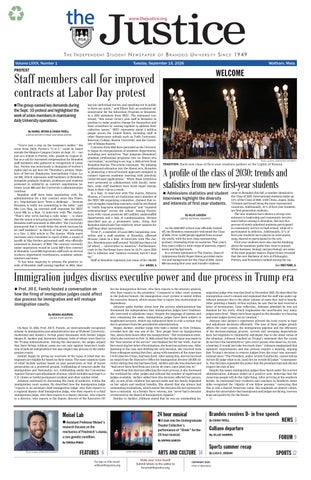
TRADITION: Each new class of first-year students gathers at the Lights of Reason.
A profile of the class of 2030: trends and statistics from new first-year students Admissions statistics and student
interviews highlight the diversity and interests of first-year students. By ALLIE LADJEVA
JUSTICE EDITORIAL ASSISTANT
As the 2026-2027 school year officially kicked off, the Brandeis community welcomed the Class of 2030. Over 14,000 people applied from around the world, with the new class representing primary citizenship from 44 countries. This year's first-years reflect a wide range of interests, experiences and backgrounds. In a written statement to The Justice, Dean of Admissions Emily Roper-Doten provided statistics and background for the Class of 2030. About 800 incoming first-year and transfer students
came to Brandeis this fall, a number identical to the Class of 2029. International students make up 12% of the Class of 2030, with China, Japan, India, Vietnam and Israel being the most represented countries. Additionally, 21% of first-year students are first-generation students. The new students have shown a strong commitment to leadership and community involvement before coming to Brandeis. Seventy-five percent of newly admitted students participated in community service in high school, while 61% participated in athletics. Additionally, 41% of first-year students have played an instrument, sung, danced or participated in the arts. First-year students have also started thinking about the academic paths they want to pursue. While business, biology and psychology are some of the most popular majors, Roper-Doten revealed that the new Bachelor of Arts in Philosophy, Politics, and Economics ranked among the top
See FIRST-YEARS, 5
Immigration judges discuss executive power and due process in Trump era Prof. Jill E. Family hosted a conversation on
how the firing of immigration judges could affect due process for immigration and will reshape immigration courts. By ARIANA AGARWAL JUSTICE STAFF WRITER
On Sept. 10, 2026, Prof. Jill E. Family, an internationally recognized scholar in immigration and administrative law at Widener University, moderated and hosted a virtual panel discussion with former judges Megan R. Jackler and Jeremiah Johnson, both of whom were fired by the Trump administration. During the discussion, the judges argued that their firings without cause are not only against America’s tradition of judicial independence but also impact due process in the immigration courts. Jackler began by giving an overview of the types of relief that immigrants are eligible for based on their status. The most common types of relief include asylum based on past persecution or fear of future persecution on a protected ground, withholding of removal under the Immigration and Nationality Act, withholding under the Convention Against Torture and adjustment of status, which includes marriage to a U.S. citizen or lawful permanent resident and other similar relief. Johnson continued by discussing the chain of authority within the immigration court system. He described how the immigration judge “reports to an assistant chief immigration judge, who then reports to a regional deputy chief immigration judge, who then reports to a chief immigration judge, who then reports to a deputy director, who reports to a director, who reports to the deputy director of the Executive Of-
fice for Immigration Review, who then reports to the attorney general, who then reports to the president.” Compared to other court systems in the judicial branch, the immigration court system is nested within the executive branch, which means that it enjoys less institutional independence. Johnson spoke further about how the current administration has threatened the independence that immigration judges have traditionally exercised to adjudicate cases. Despite the language of memos and laws remaining the same, immigration judges have been subject to heightened scrutiny, which has influenced them to rule a certain way due to pressure from the presidential administration. Megan Jackler, another judge who held a docket in New Orleans, revealed how she was one of the “first people fired on Inauguration Day, about three hours after the inauguration.” Her termination letter, which she received on Feb. 14, 2025 stated that the decision was made in the “best interest of the service” and thanked her for her work. Just before receiving her letter of termination, she heard an asylum case. After listening to the case and drafting the oral decision, she received texts from colleagues stating that they, along with members of the American Civil Liberties Union, had been fired. After seeing this, she too received an email from the Executive Office for Immigration Review (EOIR) director stating that she had been fired. Jackler said she was shocked and “had never been fired from any job for 20 years, since [she] was 16.” Aside from this decision affecting the court process, it also increased the workload for other judges and reduced the number of experienced judges available. Jackler added how this decision affected her personally, as one of her children has special needs and her family depended on her salary and medical benefits. She shared that she always had outstanding evaluations, which meant the decision did not necessarily have a rationale. As a former Navy veteran, she “never had a decision overturned by the Board of Immigration Appeals.” Similar to Jackler, Johnson stated that he was an outstanding im-
Meisel Lab Assistant Professor Meisel's
research focuses on the mechanics of Friedreich's ataxia, a rare genetic condition.
FEATURES 6 For tips or info email editor@thejustice.org
24 hour musical
Brandeis receives D- in free speech
A look into the Undergraduate Theater Collective's performance of "Shrek" for the 24 hour musical.
By CHAVA THIELL
ASHER BAREL-STOUT/ The Justice.
ARTS AND CULTURE 14
Make your voice heard! Submit letters to the editor to forum@thejustice.org
NEWS 3
Galliano departure By ELLIE HARRIS
By SOPHIA GARCIA
By TERESA PEREZ Photo courtesy of BRANDEIS UNIVERSITY.
migration judge who was also fired in November 2025. He described the immigration court’s climate and explained that the staff was under significant pressure due to the sheer volume of cases they had to handle. After granting a family of four asylum, he saw that he had received a letter of termination. Upon reflection, Johnson admitted he was not thanked for his work, which emphasizes the unorthodox way many judges were fired. “Many have been tapped on the shoulder in a hearing and some judges [were] out on vacation.” Johnson and Jackler’s experience allowed the local courts to hear and adjudicate decisions efficiently. The loss of these judges greatly affects the court system, the immigration pipeline and the efficiency of the decision-making process. Arrests and sweeping deportations have led migrants to voluntarily self-deport due to the sheer stress of the situation. Johnson touched on Trump’s statement that the courts do not have the bandwidth to “give every person who deserves, by law, a hearing. It would just take too much time.” Johnson emphasized that statutory requirements and due process require a hearing, arguing that Trump’s decision to remove judges from the court was unconstitutional since “The President, under Article II authority, cannot tell an Article III judge what to do, [nor] fire an Article III judge.” Consequently, this decision expanded the power that the president had and did not respect the rule of law. Despite the issues immigration judges have faced under the current administration, Johnson ended on a positive note, believing that the American people will do the right thing. After arriving at the southern border, he mentioned how residents and ranchers in Southern states alike recognized the “dignity of our fellow persons,” conveying that this is still a shared American value. His emphasis on shared values, despite the uncertainty that immigrants and judges are facing, conveys hope and positivity for the future. \t
Sports summer recap By LUCA D. JORDAN
COPYRIGHT 2026 FREE AT BRANDEIS.
FORUM 9 SPORTS 12
2 TUESDAY, SEPTEMBER 15, 2026 ● NEWS ● THE JUSTICE
NEWS
POLICE LOG MEDICAL EMERGENCY Sept. 4—There was a medical emergency for a party who reported that they had cut their finger and were bleeding. The patient was transported to a local hospital. Sept. 4—There was a medical emergency for a party experiencing an allergic reaction. The patient was transported to a local hospital. Sept. 4—There was a medical emergency for an intoxicated party. The office in charge was notified. Sept. 5—There was a medical emergency for an intoxicated party. The patient was transported to a local hospital. Sept. 5—There was a medical emergency for a party with an injured ankle. The patient was transported to a local hospital. Sept. 6—There was a medical emergency for an intoxicated party. The patient was transported to a local hospital. Sept. 6—There was a medical emergency for a party with a scraped knee. The patient refused medical treatment. Sept. 6—There was a medical emergency for a party with low blood sugar. The patient was transported to a local hospital. Sept. 7—There was a medical emergency for an intoxicated party. The patient was transported to a local hospital. Sept. 7—There was a medical emergency for a distressed party. The patient refused medical treatment. Sept. 7—There was a medical emergency for a finger laceration. The patient refused medical treatment. Sept. 7—A party reported a cut on their head. The patient was
transported to a local hospital. Sept. 8—There was a medical emergency for a party complaining of shortness of breath. The patient refused medical treatment. Sept. 9—There was a medical emergency for a party who had a seizure. The patient refused medical treatment. Sept. 9—There was a medical emergency for a party who had difficulty breathing. The patient was transported to a local hospital. MOTOR VEHICLE Sept. 4—A verbal warning was issued to a wrong-way driver. Sept. 9—A party reported someone had scratched two doors on their car. There will be an investigation to follow. NOISE COMPLAINT Sept. 4—There was a report of a large party drinking and being loud. The office in charge was notified. Sept. 6—There was a complaint of a party being loud. Community Living was notified to respond. Sept. 7—There was a report of a group having a party. Community Living was notified to respond.
Sept. 5—An officer completed a directed patrol of the Rose Art Museum. All appeared in order. Sept. 5—An officer completed a directed patrol of a construction site. The situation was cleared. Sept. 6—A party reported a chemical-smelling steam leak from a manhole. The situation was cleared. Sept. 6—There was a report of a suspicious person in a residence hall. The situation was cleared. Sept. 8—An officer completed a directed patrol of the Sherman-Hassenfeld Center. All appeared in order. Sept. 9—A suspicious letter was delivered to the President’s office. There will be an investigation to follow. Sept. 10—An officer completed a directed patrol of the theater lot. All appeared in order. Sept. 10—Officers responded to reports of a suspicious person on campus. The situation was cleared. Sept. 10—An officer completed a directed patrol of Ziv Quadrangle. All appeared in order. Sept. 10—A party reported they were being harassed on social media. There will be an investigation to follow.
MISCELLANEOUS Sept. 4—An officer completed a directed patrol of Chapels Field. All appeared in order.
— Compiled by Chava Thiell
BRIEF University receives a D- on campus free speech report card On Sept. 9, the Foundation for Individual Rights and Expression (FIRE) released its 2027 college free speech rankings, awarding the University a D- overall speech climate grade. Brandeis ranked 123 out of 261 surveyed colleges and universities, and saw an increase of 26 spots from the 2026 rankings, as well as an improvement from an F as per the last published report. Brandeis received a score of 60.4%, its highest since 2021, when FIRE began including the school in its report. FIRE is a nonpartisan nonprofit organization “dedicated to defending and sustaining the individual rights of all Americans to free speech and free thought,” according to its website. The University has also been designated with a “yellow light” rating. According to FIRE’s website, yellow light schools are those “with at least one ambiguous policy that too easily encourages administrative abuse and arbitrary application.” FIRE has reported zero speech controversies in the past year, though the most recent reported cases highlight the University’s 2023 decision to derecognize its chapter of Students for Justice in Palestine and the subsequent arrests of several Brandeis students protesting this decision. To improve its score, FIRE notes that the University can
CORRECTIONS AND CLARIFICATIONS
choose to adopt a policy of institutional neutrality, or “a commitment to protect the rights of students and faculty to express their views and to engage in academic discourse.” The adoption of institutional neutrality would move the University an additional 44 spots, to 79 out of 261 colleges and universities. However, Brandeis has already adopted the Chicago Statement, a standard document which outlines principles of academic freedom and free speech. The Chicago Statement has been adopted by over 100 schools in the United States and reads that “[it] guarantees all members of the University community the broadest possible latitude to speak, write, listen, challenge, and learn.” The report assessed a total of six factors, including openness, comfort expressing ideas, disruptive conduct, administrative support, political tolerance and self-censorship. While scores in openness, self-censorship and administrative support increased from the last report, scores in disruptive conduct, comfort expressing ideas and political tolerance all decreased. Overall, FIRE reported that issues such as the assassination of Charlie Kirk, the ongoing Israel-Palestine conflict, President Donald Trump and abortion rights have been some of the most prominent in the recent year. As the Trump admi-
nistration has continued to clash with several colleges and universities across the country, nationwide tensions around free speech and civic dialogues have remained high. Additionally, 121 colleges and universities were awarded an F for free speech climate, while only 24 received at least a C grade. Among the highest-ranked schools are the University of Chicago, Claremont McKenna College and the Georgia Institute of Technology, while the University of Washington and New York University sit at the bottom of the ranking. The report also provided insight into how current Brandeis students feel about the school’s approach to issues of free speech and featured responses from 271 surveyed students. Of the respondents, 68% identified as liberal in some capacity, while only 7% identified as conservatives. The survey included a litany of specific questions about stances on specific political issues, student comfort levels with expressing oneself on campus, feelings of support from the University administration and openness to political tolerance.
— Written by Chava Thiell
BRIEF Student Union Candidacy, Fall 2026
The Justice welcomes submissions for errors that warrant correction or clarification. Send an email to editor@ thejustice.org
Justice
the
www.thejustice.org
The Justice is the independent student newspaper of Brandeis University. The Justice is published every Tuesday of the academic year with the exception of examination and vacation periods. Editor Managing News Features Forum Sports Arts Photos Copy Layout Ads Social Media
editor@thejustice.org managing@thejustice.org news@thejustice.org features@thejustice.org forum@thejustice.org sports@thejustice.org arts@thejustice.org photos@thejustice.org copy@thejustice.org layout@thejustice.org ads@thejustice.org online@thejustice.org
The Justice Brandeis University Mailstop 214 P.O. Box 549110 Waltham, MA 02454-9110 Phone: (781) 736-3750 The Managing Editor holds office hours on Mondays from 7:30 to 8:30 p.m.
On Sept. 14, the Brandeis Fall 2026 Student Union election cycle began, as candidate biographies were shared with the student body. This year, interest seems to have risen amongst first-year. The Student Union works in three sections, which consist of the Senate, Executive Board and Allocations Board. The Executive Board only has one opening for the position of Chief Judicial Officer and two students, Ramond Cao ’27 and Fairooz Abida ’28, have announced their candidacy. Both candidates gave a brief about their experience and why they would best fit the role. The Allocations Board also has two open Allocation seats. For this position, only one candidate, Elena Staples ’28, has been mentioned. The Student Union also offers students to put “write-in” nominations for certain positions, which allows individuals to vote for someone else at the time of ballots. The remaining positions for Class of 2027 and Class of 2028 will be chosen based on write-ins only since there were no candidates that applied during this election.
This year, a flood of candidates is running for the Class of 2030 Senator position with nine candidates and only three available seats. Each candidate shared their reason for running and what they aim to do in the capacity of senator if elected. Sophia Park ’30 wrote that she will try to “turn our school community into a home,” approaching students with a sense of belonging. Along the same lines, Trente Xian Newman ’30 said his focus “will be on working for our community, and making that community work for you.” Aj Lawrence ’30 aims to bring her experience with intersectionality and multi-faceted approaches and “Vow[s] to ensure a first-year experience that represents ALL of us.” Tyler Parshay ’30 shared he plans to “put up QR codes in common underclassman spaces that link you to a survey where feedback can be taken about your important experiences as a first-year student.” Julia Velasco ’30 plans to implement something similar by launching a ‘R.U.N campaign,’ planning to “Represent, Unite, and Navigate
Brandeis for the Class of 2030.” The other candidates echoed these hopes and aspirations, each bringing their own experience and promises. There are three more titles open for senate candidates, including the Senator at Large, which holds three candidate positions and three candidates. The Multicultural Senator position has only one available seat and one candidate, Mariah Martinez ’29. Lastly, the MKAP Senator position, open to students part of the Myra Kraft Achievers Program, has two candidates. Both candidates presented their vision if elected and how they aim to serve the Brandeis community. The Student Union allows voters to opt between the candidates, add a write-in name or place a vote of no confidence, meaning that they don’t approve of any candidate running for the election. Students are encouraged to vote for these candidates as they will be representing the larger student body on broader University matters.
— Written by Ashhwika Soni
THE JUSTICE ● NEWS ● TUESDAY, SEPTEMBER 15, 2026
3
Club Close Up: Waltham Group Recruitment Night By SKYE ENTWOOD
JUSTICE MANAGING EDITOR
On Sept. 10, Waltham Group hosted its volunteer recruitment night. The 19 service organizations that comprise Waltham Group tabled with colorful poster boards in Sherman Function Hall to recruit volunteers for their causes. The Waltham Group programs vary greatly in their mission, with volunteer opportunities ranging from elder care to educating youth, working with health providers to battling homelessness and from mentoring programs to environmental advocacy. While each group has its own distinct mission and unique ways of attracting volunteers — one group’s representatives even chose to dress up as a tree and a caterpillar — all groups share the goal of servicing the greater Waltham area and engaging in community beyond Brandeis. The groups were seeking to recruit both regular volunteers as well as coordinators to organize and plan future events. “[Brandeis students] can really make a really big difference with only one hour a week,” said Elizabeth Ford ’27, a coordinator for General Tutoring, a group that provides free tutoring for students from the Welles-
ley public school system. The group arranges weekly one-on-one tutoring sessions with Brandeis student-tutors across a variety of subjects. Ford highlighted that General Tutoring’s goal is not just to provide families with important educational resources, but also “to rectify some of the socioeconomic disparities in education.” Ford emphasized the transformative power that oneon-one tutoring can have, citing that Brandeis tutors have worked with students for multiple years and have received many positive testimonials from parents. The tutoring programs are designed so Brandeis students are teaching in their area of interest and expertise. Aditi Kaushik ’28 has been in Symbiosis for about as long as she has been at Brandeis, joining during her first semester at Brandeis. Now she works as a coordinator, helping to plan and organize events, as well as setting up collaborations with other environmental groups. Dressed up as a tree, Kaushik explained that Symbiosis is dedicated to all things environmental. They host a variety of events, including trash cleanups and weeding out invasive species, and also host a bi-week-
RECRUITMENT: Club leader talks to potental recruits.
ly program teaching young kids about science and the environment. Kaushik emphasized a focus on having fun in all of their events, specifically the group’s work with kids, where she said the variety of activities keeps things exciting. “Sometimes we’ll do like phases of the moon with Oreos, or […] volcanoes. So like fun little science experiments.” While the focus of every
Waltham Group program is giving back to the greater Waltham community, the coordinators also had a lot to say about how their time working with their groups has benefited them. “It’s just fun being able to meet all the other people who love touching grass at this school,” Kaushink said. Collaborating with people who have the same passion was frequently cited by coordinators as one of their favorite parts of their service groups. Karishma Bulsara ’27 joined Brandeis Buddies — a program that partners with Opportunities for Inclusion to work with adults who have intellectual or developmental disabilities — in her freshman year alongside her random
roommate, and today they are the lead coordinators of the group. Bulsara said, “It’s really fun to work together for something that we both care about.” She continued, saying the people she works with make it so her service never feels like a chore. Every Waltham Group has its own mission, but a common thread between them is that their leaders are passionate about the work they do. Waltham Group described their recruitment night as “very successful” in a post on their Instagram. — Editor’s Note: Justice Editor Sophia Garcia is a coordinator for the Waltham Group Spectrum and did not contribute to or edit this article.
INTEREST: Students ask questions about Waltham Group.
POSTER BOARD: General Tutoring shows off their poster board.
SYMBIOSIS: Coordinators show off their poster board.
TABLING: Afternoon Enrichment poses for a photo. Design: ELLIE JI/The Justice. Photos: SKYE ENTWOOD/The Justice.
Graphics courtesy of BRANDEIS UNIVERSITY and the MELLON FOUNDATION
THE JUSTICE ● NEWS ● TUESDAY, SEPTEMBER 15, 2026 5
FIRST-YEARS: Eager to become engaged, new students adapt to life at Brandeis CONTINUED FROM 1
“I hope to double major in Astrophysics and Astrobiology, with a background in Astronomy. I have always loved learning about space and the universe,” Evelyn Hirsch ’30 shared. Students had different reasons for choosing Brandeis as their home for their college journey. Some students were especially drawn to the University’s values, citing its historical commitment to social justice. “Not only does [Brandeis] offer an exceptional liberal arts education rooted in critical thinking, but it is also a welcoming and diverse environment for all types of backgrounds and experiences … I was impressed by the knowledge of the professors and the intellectually stimulating curriculum,” Madeline Hyman ’30 shared. Students also appreciated the sense of community and belonging on campus. “I chose Brandeis University because the campus made me feel known and not like an outsider. When I went to the open house, I didn’t feel like I was just a new person visiting the school. I felt wel-
comed and like I was already part of a family,” Hirsch said. On campus, first-years are already finding ways to get involved by joining university organizations. Students interviewed by The Justice shared that they have already joined clubs, such as the Tennis Club, Adagio Dance Company, the Astronomy Club and Laurel Moon. “My favorite experience at Brandeis so far has been playing tournaments with the tennis team. It has been super fun, but also I just like the autonomy I get,” Jonah Stolte ’30 shared. Building relationships has been an important part of first-year students’ college experiences so far. “[My favorite experience has been] just being around the boys on the tennis team, getting to practice with them, see them every day. We really built a family already,” Jay Raj ’30 shared. Exploring campus has also been a key part of first-year students’ transition to college life. “Recently, I ventured to the pond near the
chapels to log trees for my class, and that was one of my most memorable moments as a nature lover,” Hyman ’30 said. The Class of 2030 is diverse not only in its passions and interests but also in its accomplishments. Roper-Doten shared that there is a student who was a musical performer at the 2022 Olympic opening ceremonies and another student whose essay on artificial intelligence was published in The New York Times after winning a New York Times STEM writing contest. There is also a student who is a singersongwriter with more than 300,000 Instagram followers. In her welcome address at Inside ’Deis, an event for recently admitted students, Roper-Doten told the Class of 2030, “You are a class of ‘doers’ — people who see a need and fill it, who see a challenge and meet it.”
HIGH RISES AND TOWERING TREES
JULIAHNA FALCIGLIA-MATTES/The Justice.
WEEPING WILLOW: The old tree stands impressively tall.
STREET FINDS: A citygoer stops to peruse clothing from a street vendor.
JUSTIN GAO/The Justice.
CITY: City dwellers roam the hazy streets as the sun begins to set.
JUSTIN GAO/The Justice.
JULIAHNA FALCIGLIA-MATTES/The Justice.
ESCAPE: The willow provides a moment of solitude to passersby,
UNION: SEIU 888 gathers to make demands of the University amidst restructuring CONTINUED FROM 1
Staff at Brandeis represent just some of the 128,000 people who work at universities across Massachusetts and who are facing many of the same challenges, including layoffs, the removal of vacant positions and feeling overworked, according to a Boston Globe article. The article described the financial pressures faced by universities whose revenue is decreasing as a result of new policies under the Trump administration. Those policies have cut research funding and there is a growing lack of interest in higher education amongst the general public. In Massachusetts, financial pressures have closed Anna Maria College in Paxton and Hampshire College in Amherst. For many university workers, the rapidly shifting atmosphere in higher education amid financial issues has only increased fears of job security. Zachary Bos, a former Boston University departmental administrator and staff union president in a Boston Globe article stated, “the working man’s sector of higher ed[ucation] … [is] on the chopping
block first,” In a Sept. 13 interview with Prof. Sabine Von Mering (WGS, CGES) Brandeis’ ongoing reorganization “means that no one has a sense of security.” She continued, “change is necessary … [but] we’re dealing with human beings. I think … there is a limit to what we can be expected to deal with.” Von Mering is also a member of Brandeis’ chapter of the American Association for University Professors. To her, a lack of transparency in decision making is most troubling. There are “lots of decisions being made behind closed doors,” she said, which is a change from the bottom-up approach she is used to at Brandeis. “It’s really gonna take a whole movement of people across the entire sector of those [128],000 workers” in Massachusetts to fight for higher pay and better contracts, Huq said. In a Sept. 11 statement to The Justice, Michelle Gaseau, Assistant Vice President for Strategic Communications and Public Relations, wrote that they “have been bargaining in good faith and meeting regu-
larly with the Union for negotiation sessions. So far, negotiations have been productive and collaborative.” As negotiations continue, “The University is committed to reaching a fair contract with Local 888 that recognizes the important contributions of these staff members.” Outside the SCC, the second half of Parton’s verse could be heard through the crackle of the bullhorn, an optimistic refrain for the future of the union’s negotiations: “In the same boat with a lot of your friends, waitin' for the day your ship'll come in and the tide's gonna turn and it's all gonna roll your way.” —Editors Note: Trent P.’s full name was omitted for their personal safety.
features
6 TUESDAY, SEPTEMBER 15, 2026 ● FEATURES ● THE JUSTICE
just
VERBATIM | FRANCIS BACON Science is but an image of the truth.
ON THIS DAY…
FUN FACT
Alexander Flemming noticed a mold killing bacteria in his lab, leading to the creation of penicillin.
Your body contains roughly 30 to 40 trillion cells, which is more than 300 times the number of stars in the Milky Way.
Understanding the Significance of Mitochondrial Genetics Research in the Meisel Laboratory Learning more about why mitochondrial dysfunction research is important, the people it impacts and the expert behind it. By TERESA PEREZ
JUSTICE CONTRIBUTING WRITER
While walking to Rosenstiel Basic Medical Sciences Research Center, strolling down the hills, I reflected on how daunting research can seem. If you join a lab as an undergrad, you’ll be surrounded by experts in their field, all while learning how to work with a microscope or use a pipette for the first time. It can feel nothing short of intimidating. As I step into the building and walk past the labs, I think about all the things unknown to me: the tanks filled with gas, incubators and glassware are unfamiliar. Making my way to my interviewee’s office, I am surrounded by an inviting space. Sitting on the table are two adorable Lego cacti plants and a C. elegans plushie. Across from me, with a welcoming smile on his face, is Assistant Professor Joshua Meisel, PhD. After growing up in Brookline, Massachusetts and attending Brookline High School, Meisel made the move across the country to Stanford University in California to double major in Biology and English. There, he diligently worked on DNA damage and repair in a cancer lab. After graduating from Stanford with a Master’s in biological sciences, he obtained a Fulbright scholarship to research the Great Barrier Reef at the University of Queensland in Australia. After Australia, Meisel worked as a research technician at the Whitehead Institute at the Massachusetts Institute of Technology, work-
ing with flatworms, specifically the genus planaria. He later earned a PhD at Massachusetts Institute of Technology, focusing on host pathogens in Caenorhabditis elegans and eventually “fell in love with
half of human genes have orthologs, which are similar genes in C. elegans and share basic cellular functions. In a lab setting, C. elegans have short lifespans, populate fast and are easy to genetically
ence (RNAi), microRNA and Green Fluorescent Protein (GFP). For his postdoctoral studies, Meisel worked at Massachusetts General Hospital, developing his interests in
using C. elegans, and the Mootha Lab, a world leader on researching mitochondria. Going back to his hometown in Brookline, Meisel fondly recalls that his mother went to Brandeis and his
RESEARCH: Doctor Meisel is the Assistant Professor of Biology. worms,” he said in a Sept. 11 interview with The Justice. Why worms? Despite the clear physical differences between a human and a worm, C. elegans are an excellent model for human genetics. Approximately one third to
Design: ALYSSA WU/The Justice. Photos courtesy of MEISEL LAB AT BRANDEIS UNIVERSITY.
manipulate using CRISPRCas9. Furthermore, these worms have been involved in studies run by scientists that have won four Nobel prizes related to discoveries in programmed cell death (apoptosis), RNA interfer-
working with C. elegans and researching mitochondrial dysfunction. He highlighted his unique experience with having two laboratories to work with, the Ruvkun Lab, notable for their Nobel prize winning work on microRNA
parents married in one of the chapels on campus. While seeking a collegiate space with “top-tier research, interactions with students in the lab, and a tight knit community,” he found Brandeis fit that profile perfectly.
When he first arrived at his lab space, he was met with a blank slate. It can be intimidating but also opens doors for unimaginable possibilities as a young scientist. Meisel shared he was “trained well to do science, to write, and to mentor. But I never before had to order a freezer.” As a Principal Investigator, or a PI, Meisel was now responsible for getting microscopes, freezers, incubators and equipment. However, he wasn’t alone. One of his favorite aspects of working with Brandeis is the community within the faculty and staff. He has received mentorship from another C. elegans laboratory PI, Piali Sengupta, PhD and many other researchers. It took Meisel roughly six months to a year before it really felt like a functioning lab. Now, two years later, he has an enthusiastic research group doing experiments and making discoveries with mitochondria. If you turn to ask your friends or family what mitochondria is, they’d most likely respond with the famous catchphrase: “Mitochondria is the powerhouse of the cell.” It is commonly understood that these organelles are crucial to driving cellular energy in all animals, plants and fungi. But what happens when one genetic mutation causes these powerhouses to lose their function?
THE JUSTICE ● FEATURES ● TUESDAY, SEPTEMBER 15, 2026 7
Meisel, alongside researchers in the Meisel Laboratory, aim to utilize C. elegans to investigate the mechanisms behind mitochondrial dysfunction and identify therapeutics for the diseases it causes. In particular, the Meisel Lab studies a rare genetic disorder caused by an alteration of a gene named FXN. This disease is known as Friedreich’s ataxia (FA). It impacts approximately 1 in 50,000 persons worldwide and is the most common inherited ataxia in children. By impacting the spinal cord, FA disrupts the flow of sensory information to the brain’s cerebellum, responsible for balance, movement and coordination. This means children progressively lose their ability to move and speak — potentially also developing diabetes or heart disease. In a personal case shared by Biogen, Sam Bridgman shared his journey to find out he has Friedreich’s ataxia. As a 12-year-old boy, he noticed his worsening physical abilities, like struggling to catch a baseball or walking without tripping. Eventually, after three years, his par-
ents noted how prominent these issues were, and he was given an FA diagnosis through blood test. As he was starting high school, he avoided sharing information about his condition with his friends. Now, Sam believes in raising awareness surrounding FA. Sam tattooed ‘Seek a Miracle’ on himself, as he seeks a miracle to cure his disease. He is not the only person impacted by FA looking for a treatment. Although surgeries and medication can help maintain the symptoms, there is no cure for Friedreich’s ataxia. What is happening on a molecular level to cause this disease? Think of DNA as a page in a notebook, filled with a story to make a genome. Most patients diagnosed with FA present with a genetic change located on chromosome 9, or page nine, where the FXN gene contains a repeat sequence GAA in intron 1. Instead of having: “THE SKY IS BLUE AND THE GRASS IS GREEN,” FA patients carry the sentence: “THE SKY IS BLUE AND AND AND AND AND AND AND AND…” This change leads to a disrupted part of the story
in their book. Alleles in healthy individuals typically carry up to 40 GAA repeats. Mutated alleles can have over 1,000 GAA repeats. This repeat expansion lessens the expression of the FXN gene, leading to a lack of frataxin protein in mitochondria. The role of frataxin is to promote mitochondrial iron-sulfur cluster synthesis. Without it, mitochondria may not produce enough energy in the cell, build iron-sulfur clusters cofactors and regulate iron. Additionally, frataxin is in cells throughout the body, and the cells containing the most frataxin protein are found in the heart, spinal cord, liver, pancreas, and muscles. This prevalence indicates frataxin’s importance in the human body. As co-author and lead of an innovative paper in Nature, Meisel remarkably showed two forms in which the negative effects of the FXN mutation can be suppressed. Since C. elegans are genetically accessible, they were used to model the FXN mutation in an ortholog gene, frh-1. Meisel found
OPENING: The first official lab photo at Meisel Labratory.
CHEERS: Celebrating back-to-back paper publications. the worms had little to no growth in a regular oxygen setting, as expected with the lack of the frataxin protein in the mitochondria. But what about placing them in a low oxygen setting? Surprisingly, in a hypoxic state, they appeared to be healthy, as if with no mutated FXN. This outcome is most likely due to an increase in the iron-sulfur cluster levels, allowing for more electrons through complexes to transfer into oxygen. Nevertheless, the Meisel lab is still investigating the biology behind it. Interestingly, another way the FXN mutation was rescued is through introducing a mutation in another gene, FDX2. It is still a question of whether the FDX2 protein would inhibit iron-sulfur cluster production. Further analysis is being done by the Meisel lab by measuring iron-sulfur clusters. A clearer picture is needed of why altered FDX2 helped FXN. The Meisel lab is working to expand on the mechanisms behind the rescue of the FXN mutation and to understand if the FDX2 mutation is truly harmless. Meisel shared his future
visions for his work surrounding FA. Since his methodology rescued the effects of FXN, he expressed his interest towards further understanding and applying it to other mitochondrial mutants. Additionally, Meisel strives to continue to find new therapeutic targets and learn more about the basic biology behind mitochondrial dysfunction. As co-founder of Falcon Bio, along with Gary Ruvkun, PhD, and Vamsi Mootha, PhD, he is working to develop drug therapies to treat Friedreich’s ataxia. Meisel explained the company is still in an early phase but is hoping for clinical trials in the future. In the lab, Meisel and his team have placed a focus on understanding the “detailed molecular mechanisms underlying the rescue and also find new ways to rescue FA or different mitochondrial diseases.” Individually, mitochondrial diseases can be considered rare, but as a group, mitochondrial disorders are considered common. Diseases like Alzheimer’s and Parkinson’s amongst many others, show that the mitochondria dysregula-
tion plays a role in their mechanisms. Our conversation ended with a memory he shared from his graduate years. He studied C. elegans that expressed green fluorescent protein in two neurons, located in the head of the worm. But when placing them on a different bacterial lawn (which is their food), the GFP became mysteriously expressed in other neurons of the worm. That wasn’t supposed to happen. It became the basis of his PhD at MIT. In the interview, Meisel described the feeling of surprising results as if “getting struck by lightning.” Those moments are most precious to him in research. Before meeting with Meisel, I reflected on how much I did not know. By taking a deeper look into his variety of experiences in science, understanding what research means for him and for those affected by it, I realize there is a sense of fascination for the unexplored in the research community. Meisel couldn’t have said it better: “The best part of science is the unexpected discoveries.”
Photos courtesy of MEISEL LAB AT BRANDEIS UNIVERSITY. Graphics courtesy of CANVA and KEIRA SHEAR/The Justice. Design: ALYSSA WU/The Justice.
8 TUESDAY, SEPTEMBER 15, 2026 ● FORUM ● THE JUSTICE
Justice
the
Established 1949
Brandeis University
Nawal Irfani, Editor in Chief Skye Entwood, Managing Editor Iyla Lichtenfeld, Bryan Wolfe, Zoe Zachary, Deputy Editors Rueben Gortenbach, Miriam Grodin, Jonas Kaplin, Associate Editors Iyla Lichtenfeld, Bryan Wolfe, Zoe Zachary, Deputy Editors Ashhwika Soni, Chava Thiell, News Editors Alyssa Wu, Features Editor Ariel Knudsen, Forum Editor Luca D. Jordan, Ben Khayat, Sports Editors Sophia Garcia, Arts & Culture Editor Juliahna Falciglia-Mattes, Justin Gao, Photography Editors Rivka Resnick, Copy Editor Ellie Ji, Layout Editor Keira Shear, Advertising Editor
EDITORIAL
Brandeis breakfast: less options, less happiness Brandeis welcomed students back for their fall semester a couple weeks ago, greeting students with a few different changes. The most pressing and divisive of these seems to be the removal of breakfast in Usdan, the dining hall most convenient for students living in North Campus (or those with an early class). The alternative offering seems meager: You can use one of your few weekly meal exchanges to get a breakfast at The Hive. Compared to the variety of options that Usdan offered during its breakfast hours, The Hive’s scrambled eggs, bacon and vegetables does not serve as a comparable replacement. Though this may not strike some students as an issue worthy of discussion, using an arguably coveted meal exchange for breakfast or trekking down to Sherman for breakfast are not appealing options for many students. Prior to this change, Usdan’s availability in the mornings acted as the difference between being properly fed or going to class hungry. While Dunkin’ does still operate at the same hours, spending points or money out-of-pocket for breakfast is not an option for many students, especially in the long-term. This change has led to a less flexible dining experience for students. For a student living in North, Skyline or East on a five meal-exchange plan (the minimum required plan for students
in corridor-style dorms), having to ration meal exchanges to eat breakfast every morning means giving up the ability to use their meal exchanges with any flexibility. Students may not be able to spend a meal exchange at any of the restaurants in The Hive later in the day, at Louis’ Deli, The Stine or even at Einstein, assuming they need to use one for breakfast everyday. Part of the value in meal exchanges means not having to worry about splitting time between a meal and other responsibilities, which is an extremely appealing option for students who have back-to-back classes during mealtimes. This change in Usdan’s schedule puts students living far away from Sherman in a worse dining situation: Either be late to class, skip breakfast or give up all your meal exchanges to eat the most important meal of the day. Not only is this change damaging to the health and wellbeing of students, it’s also entirely unfair to students who have no choice but to spend their meal exchanges on a meal that students living elsewhere on campus don’t have to worry about. This Editorial Board calls for a reconsideration of this change — being a college student is stressful enough. Instituting breakfast back at Usdan would ease the stress of having to choose between losing a meal exchange and not eating at all.
NATURE: A tree’s branches cover the sky.
JULIAHNA FALCIGLIA-MATTES/The Justice.
LETTER TO THE EDITOR Universities care about their students’ mental health. Yet that care doesn’t always translate into the support students receive on campus. Limited counseling center capacity, a persistent culture of stigma, and fragmented communication around available resources leave too many students guessing about where to turn when stress and anxiety escalate. The result is a gap between institutional intent and student experience. According to a recent survey, 27% of students said they don’t believe their educational institution offers sufficient mental health support. Chapman University’s Student Psychological Counseling Services (SPCS) provides psychotherapy and mental health resources to students, with a mission to support their psychological well-being as they pursue personal and academic goals. The department offers Zoom drop-in hours for consultations and questions, individual goal-directed counseling with no session limit, and refers students who need more intensive care to community providers. Chapman also offers well-being coaching through Wellness and Recreation and reduced-rate counseling at the Frances Smith Center for Individual and Family Therapy at just $15 per session. These options are impressive. But, these resources may not be adequate to solve the looming mental health crisis. Chapman University’s own SPCS page acknowledges that “SPCS experiences a high demand for services” and warns of waiting periods for non-emergency appointments. Even well-resourced counseling centers can face capacity constraints. Whether or not students know what’s available, when wait times outlast their willingness to ask for help, they may default to what’s accessible around the clock: an AI chatbot. According to a US-based think tank RAND’s study published in JAMA Network Open, about 1 in 8 US adolescents and young adults use AI chatbots for mental health support, especially young adults from 18 to 21 years old. A working paper co-authored by Chapman University’s John Hunter, “AI for Proactive Mental Health,” tested a purpose-built app called Sunnie on nearly 500 college students and found that “AI-powered apps can proactively prevent mental health problems, rather than merely react once problems have already emerged and become acute.” Sunnie isn’t a general-purpose chatbot like ChatGPT or Gemini; it was designed by psychologists as well as students for this specific purpose. Chapman has the infrastructure to move in this direction as well. The university’s AI Hub promotes responsible AI use across campus and offers an asynchronous course teaching the basics of AI tools and their applications in higher education. Chapman’s GenAI guidelines emphasize accuracy, intellectual property, security, privacy, and ethical considerations, and encourage faculty to set clear course-level policies on AI use. That attention to AI governance could extend to student wellness. A Chapman-specific mental health tool, built with clinician oversight and student input, would reach students who currently fall through the cracks between SPCS office hours and late-night conversations with ChatGPT. Chapman must also invest in AI literacy. Students need to understand why a large public language model is not equipped to provide mental health support. Hallucinated content, privacy violations, and generic responses that lack clinical grounding can do real harm when a student is in distress. Chapman should integrate these conversations into orientation programming, wellness workshops, or existing coursework so students understand the risks before bad habits form. The mental health crisis on college campuses is not new. What’s new is that students now have a 24-hour alternative to waiting for a counseling appointment, and that alternative was never designed to help them. Universities that treat mental health support as a checkbox rather than an evolving system will keep losing students to tools that offer availability without accountability. Chapman has the counseling foundation, the AI governance structure, and the institutional values to build something better. Arush Chandna is the co-founder of Inspira Advantage, a national medical school admissions consulting firm.
LETTER TO THE EDITOR Dear Editor, HHS Secretary Robert F. Kennedy Jr. recently made headlines for handling snakes at the home of CMS Administrator Dr. Mehmet Oz. Behind this bravado lies a troubling contrast in public health leadership. Consider local trailblazers like Mayor Mike Sawyer (Midland City, AL, 1984–1988), who aggressively enforced anti-smoking laws to protect youth and created the world’s first “Smoking Kills” youth sports league in Kentucky in 1998. In stark contrast, Kennedy is actively weakening tobacco regulations, cutting cessation funding, and fast-tracking e-cigarettes. This policy shift raises a vital question for America’s future: do we need a leader who catches snakes, or one who fights Big Tobacco—a force that remains on the loose, killing nearly 500,000 Americans annually? With compassion, Mike Sawyer, Master of Divinity, former Mayor of Midland City, AL (1984-88) 2024 Humanitarian of the Year award at my favorite “high needs” middle school Youth advocate & activist since 1983 Denver, CO Text: 205-515-1560 Email: msawyer911@gmail.com X: @FitToGive
COURTYARD: A picturesque scene at Newport Mansions.
JULIAHNA FALCIGLIA-MATTES/The Justice.
THE JUSTICE ● FORUM ● TUESDAY, SEPTEMBER 15, 2026 9
The art and the artist: Modern patriotism in John Galliano’s Met a damaged America Gala departure By ELLIE HARRIS
By ARIEL KNUDSEN
JUSTICE ONLINE EDITOR
In the history of the Met Gala, a 78-year-old annual fundraiser for the Metropolitan Museum of Art’s Costume Institute, only two living designers have been honored with the night’s theme: Yves Saint Laurent and Rei Kawakubo. British fashion designer John Galliano of Dior, Maison Margiela and multiple other fashion houses was announced to be the third this past summer on July 31. Exactly one month later on Aug. 31, Galliano and the Met Institute announced that the exhibit and theme honoring him would be cancelled. At press time, a new theme and exhibit have not yet been announced. Galliano would’ve joined the ranks of Yves Saint Laurent and Rei Kawakubo, who were the themes of the Met Gala in 1983 and 2017 respectively, and thus marked an incredible redemption from his controversies last decade, which resulted in a hate crime conviction in a Parisian court in 2012. Galliano was the creative director of Dior from 1996 to 2012 before an antisemetic rant in a Parisian bar where he made statements such as “I love Hitler” and explained to bar patrons that their relatives “would’ve been gassed.” Following this episode, he was fired from Dior and fined 6,000 euros, which was the equivalent of $8,400. Galliano, who was suffering from addictions to alcohol, Valium and sleeping pills at the time, attended rehab after his arrest and disappeared from the fashion industry before becoming the creative chief of Maison Margiela in 2015, a role he would keep until 2024. Before his downfall and departure from Dior, Galliano had been a force to be reckoned with within the fashion industry. His tenure at the fashion house was described as embracing fantasy by the New York Times and reimagining “The New Look” through a surrealist lens. Throughout his trial, Galliano showed remorse for his misdeeds, stating that “These are not views that I hold or believe in … I see someone who needs help, who’s vulnerable. It’s the shell of John Galliano. I see someone who’s been pushed to the edge,” and that “Antisemitism and racism have no part in our society. I unreservedly apologise for my behaviour in causing any offence.” Fifteen years after the incident occurred, including three years spent out of the public eye and a decade at the helm of Maison Margiela, Galliano’s long-time friend Anna Wintour, former editor in chief of Vogue and lead chairperson of the Met Gala announced that the 2027 theme would be “John Galliano: Horizons.” Before the announcement was made, Galliano, Wintour and Andrew Bolton, the curator of the Costume Institute, attended a meeting with local Jewish leaders of New York City, whose reactions to the proposed theme were mixed. In an article updated less than a week after Galliano’s departure from the upcoming Met Gala, CNN reported an 8% rise in anti-semitic hate crimes in New York City. However, Jewish leaders consulted spoke of the value “teshuvah,” a Hebrew word meaning repentance, and claimed that Galliano’s apologies had been accepted following a clear effort to make amends in the years since the hate crime was committed. When the 2027 theme was announced, it was stated that the night would be a reflection on John Galliano’s work and his life, and that the Met would acknowledge his misdeeds. Anna Wintour stated that “the exhibition won’t shy away from any of the darkness in John’s past. It’s part of what has shaped him. The show will take in the full arc of his career and grapple with all of it.” This assurance may not have been enough for local leaders and advocates who had also taken issue with the Met Gala’s 2023 theme “Karl
Lagerfeld: A Line of Beauty.” This controversial theme was supposed to honor designer Karl Lagerfeld’s legacy after his passing in 2019. Lagerfeld was never convicted of a hate crime, but he was easily just as or more controversial than John Galliano. Lagerfeld was infamous for insensitive comments about women’s bodies, models embracing sexual assault in the workplace, Islam and Judaism. He also once famously claimed to be “fed up” with the #MeToo movement. Karl Lagerfeld was never truly held accountable for his abundance of offensive statements, and despite his past controversies coming to light during his post-mortem Met Gala honors, Lagerfeld’s legacy remains largely intact. Galliano may have suffered more for his crime in 2011 than Karl Lagerfeld ever did for his decades-long unchecked abuse of religious minorities, immigrants and women. But Lagerfeld had died years before he was honored by the Met, giving the public time to forget about him and the fashion industry time to be entranced by new designers and new controversies. The Met would have an easier time controlling the narrative around a deceased titan of the fashion industry than one who would preside over his own celebration, the highest honor the Met Gala can bestow. With a living designer like John Galliano, who has taken the steps to improve and apologize but has proven to be controversial in the past and like anyone, has the capacity to cause harm again, the Met runs the risk of damaging their own reputation. Following the announcement of the theme change, Anna Wintour stated, “John’s decision to ask the Museum to postpone the exhibition devoted to his work is very courageous and a measure of the man he is. I believe this is the right decision, and both he and the Museum have my full support.” John Galliano is 65 years old. His impact on the fashion industry is so inescapable that he was given the fashion world’s highest honor while alive. When he inevitably passes away, my prediction is that the following Met Gala will be in his honor. Despite Galliano’s sins, he has made real steps to seek the forgiveness of those he has harmed and took his exit gracefully, using it as another opportunity to apologize to the communities he spoke against. When a new theme is announced I expect it will be as tame and vague as the biggest night in fashion will allow, in order to avoid more negative attention. Despite the Galliano theme being “postponed”, he will most likely be present through his work which will inevitably be worn at the gala. Galliano is already responsible for iconic Met Gala looks throughout the benefit’s history. These looks include Princess Diana’s only appearance at the Met Gala in 1996, which celebrated the legacy of then recently-deceased designer Christian Dior; Rihanna in 2018, when she was a co-chair of the benefit for the theme “Heavenly Bodies: Fashion and the Catholic Imagination” and both of Zendaya’s looks at the 2024 Met Gala “Sleeping Beauties: Reawakening Fashion.” Men like John Galliano and Karl Lagerfeld truly test the question, “Can art be separated from the artist?” Galliano was convicted of a hate crime. No amount of apologies can truly take his vicious words back. But in 2026, after 15 years of sobriety and remorse, is a Met Gala theme and exhibit simply too high of an honor to give to him? Now that Anna Wintour has implied that a Galliano theme is inevitable, the only aspect to be questioned is whether he will be there to see it while begging the question: what does it take for your achievements to outweigh your worst moments?
JUSTICE FORUM EDITOR
America is a deeply patriotic country — pride is evident across state lines and coasts, whether expressed through starspangled flags waving proudly or through the expression of politically passionate views held by Americans across the country. One could say this is due to the relatively binary nature of the American government when compared with European governments’ parliamentary organization, which are more complex institutions that don’t quite invite salacious controversy. Regardless of where American patriotism stems, recent events in politics have led me to wonder what patriotism truly is. Many households that declare their allegiance and loyalty to America also find President Trump to be the best leader in United States history –– a sentiment that lacks any rationality or cogency. Though America holds high amounts of patriotism compared to other countries, this “free-bred American” attitude has been decreasing in recent years. This fall coincides with a sharp increase in hyperpartisanship within and outside of our government. The very institutions that were meant to encourage compromise, bipartisanship and deliberation are instead rewarding wealth, power and greed. As American democracy seems to be disintegrating, many have never been less proud to be American. On the other hand, many proclaim that America is on her way to greatness. As our government becomes more controversial and Americans become less unified, I can’t help but wonder––what is patriotism, anyway? Though patriotism is very clearly defined in most dictionaries — according to Merriam-Webster it’s characterized as “a deep sense of love and devotion to one’s country” — there is a lot of room for interpretation. How does one demonstrate love for their country? How does one show devotion and loyalty to their country? Some say there is nothing more noble or patriotic than serving in your country’s military. Others denounce this and declare that love for your country is shown through your behavior, whether it be an exercise of free speech, voting, or something else. Though Ronald Reagan was a questionable president in many ways, his final presidential address observed what many, including myself, optimistically believe to be a guiding principle in American policy: Anyone can become an American. The same is not true of other countries. As Reagan stated, you can live in France, but that does not make you a Frenchman. You can live in Germany, but that does not make you German. If you live in America, Reagan declared, you can become an American. This sentiment has not been reflected in recent American policies, if in any, but this does not make it less true. Patriotism, for many, simply consists of extending a welcoming, compassionate and firm hand to your neighbors and your neighbors’ neighbors. This attitude, however, does not reflect how America has operated domestically or internationally. America is a nationalist country composed of political actors and leaders determined to situate her existence as one that prioritizes nationalism, sovereignty and — above all — power. Though any country is composed of the people that live in it, the introduction of mass media and its manipulation has posed a threat to a functional democracy. The political buzzword of today, “political polarization,” has become all too popular in news articles. This overuse doesn’t take away
from the truthfulness of the term. We are not a community all united towards one common goal. We are split into the same factions our founding fathers warned us about, creating a climate where no one can agree on what a true American looks like. Though America wasn’t founded with truly pure intentions to save a disenfranchised people from a tyrannical government — its founding was more so predicated on acquiring wealth and power — American history seems to prioritize the working man. Our founding documents proclaim our natural rights and give us protection. They organize our government in fragmented ways so as to discourage despotism and give power to the people in precise structures in order to discourage mob rule. Through this delicate balance of power, America seems to have all the tools it needs to empower the people while empowering the actors at the helm of our political institutions. Looking at our political environment today, it is clear that this is not the case. Through a variety of modern issues that Thomas Jefferson and his colleagues could’ve never foreseen — the internet, mass media conglomerates and hyperpartisanship to name a few — our government is composed of hyperpartisan officers carrying out their goals, often ignoring the wider good of the people in the process. Those same factors also encourage the split we see today between Democrats and Republicans. Republican-leaning populations prioritize the traditional values of an American conservative legislative body — small government with an ideologicallybased policy methodology, small amounts of welfare programs, etc. Democrat-leaning ones, on the other hand, favor heavy involvement in social justice initiatives, welfare programs and policy-based methodology. Though this may seem self explanatory, these party trends have only become more emphasized over the years, and combined with an unstable economy, more advanced technology and wide-reaching social media, experts agree that political divides have become far more drastic than ever before. Regardless of who you vote for or where you stand on the political ideological spectrum, patriotism in America is undeniably a through line that Americans, young and old, have an opinion on. Though this sense of love for America that seemed to characterize older generations has been decreasing, the immense amount of activism that younger generations have been showing serves as a confirmation that though America has never been the nation we deserve, there is still time to make it so. Love for your country can mean supporting your political leaders, or it can mean rebelling against them. It can mean following the rule of law, or it can mean rising up against systemic oppression, old and new. Statistics say that patriotism is decreasing, and though this may be true, perhaps we should consider that it is simply taking a new form. Love for America can be synonymous with anger with our current environment and fear for where we are going. As long as young generations keep abreast of what their leaders are doing, stay involved and protest against oppression, America will always be a land of opportunity and a country of patriots.
The opinions expressed on this page are those of each article’s respective author and do not reflect the viewpoint of The Justice.
Write to us
The Justice welcomes letters to the editor responding to published material. Please submit letters through our Web site at www.thejustice.org. Anonymous submissions cannot be accepted. Letters should not exceed 300 words, and may be edited for space, style, grammar, spelling, libel and clarity, and must relate to material published in the Justice. Letters from off-campus sources should include location. The Justice does not print letters to the editor and op-ed submissions that have been submitted to other publications. Op-ed submissions of general interest to the University community— that do not respond explicitly to articles printed in the Justice — are also welcome and should be limited to 800 words. All submissions are due Friday at noon.
Fine Print
The opinions stated in the editorial(s) under the masthead on the opposing page represent the opinion of a majority of the voting members of the editorial board; all other articles, columns, comics and advertisements do not necessarily. The Justice is the independent student newspaper of Brandeis University. Operated, written, produced and published entirely by students, the Justice includes news, features, arts, opinion and sports articles of interest to approximately 3,600 undergraduates, 2,000 graduate students, 565 faculty and 1,300 administrative staff. The Justice is published every Tuesday of the academic year with the exception of examination and vacation periods. Advertising deadlines: All insertion orders and advertising copy must be received by the Justice no later than 5 p.m. on the Thursday preceding the date of publication. All advertising copy is subject to approval of the editor in chief and the managing and advertising editors.
The Staff For information on joining the Justice, write to editor@ thejustice.org.
EDITORIAL ASSISTANTS Copy: Allie Ladjeva Ads: Asher Barel-Stout Staff News: Ariana Agarwal, Allie Kettle, Allie Ladjeva, Hannah Shapiro Features: Saaya Daga, Emmy Zhou Forum: Eric Cherny*, Graham Glovka, Aaron Klein*, Max Klein*, Mark Silva Arts and Culture: Luke Benanav*, Lauren Goodman, Alice Nguyen, Dahlia Ramirez*, Rogerio Villaca Szuster Photography: Vaughn Alnot-Simeonov, Cole Hamner, James Li*, Brian Lucy, Elle Yung Copy: Francesca Auricchio, Saaya Daga, Sydney Duncan, Hannah Lee, Cindy Marin Online: Alison Kettle
* denotes a senior staff member
just Sports Page 10
CHEATING SCANDAL Justice Sports Editor Ben Khayat details various scandals across sports.
Waltham, Mass.
Tuesday, September 15, 2026
CHAMPIONSHIPS
Summer Sports Recap
■ It was a big summer for sports. What went on? By LUCA D. JORDAN
JUSTICE SPORTS EDITOR
From the end of May to the beginning of September, there was a bonanza of huge sporting events, many of which broke viewership records across the United States. Throughout the country, sports fans witnessed once-in-a-lifetime sporting events in person, long-awaited championships and iconic moments all summer long. The sheer volume of events made this summer feel like a whirlwind of sports — so, what happened? World Cup The FIFA World Cup kicked off with the group stage on June 11. There were too many matches and moments to cover in one article, but it’s worth mentioning that Team USA. outperformed expectations, making it all the way to the round of 16 and finishing 12th, their highest finish since 2002. Other Cinderella stories include Cape Verde, a small island nation off the west coast of Africa that is relatively unknown in the soccer world, as it was their first World Cup as a sovereign nation. Goalkeeper Josimar
not registering a single shot on goal for the entire duration. Spain won in extra time with Ferran Torres scoring the winning goal. There was some controversy surrounding the final. The Argentinian team had been criticized for their more physical style of play and had already received a few fines over the course of the World Cup, but some roughhousing is par for the course when playing soccer. However, after the final whistle was blown and Spain’s players began to celebrate, some Argentinian players took the passion of the match past acceptable boundaries. Argentina defender Nahuel Molina exchanged words and appeared to grab the arm of Rodri. Spain’s Eric Garcia came to his teammate's defense, but Leandro Paredes, an Argentinian player who had already received a yellow card during the game for shoving a Spanish player, grabbed Garcia by the throat and attempted to throw him to the ground. Given this extreme reaction, media outlets were quick to jump on any other moments where Argentinian players could be scrutinized for unsportsmanlike conduct. A clip of Messi asking the referee for a player to be removed after speaking with his hand covering his mouth, or Argentinian players refusing to shake hands after losing and turning their backs
VICTORY: The Spanish National Team celebrates. “Vozinha” Jose Evora Dias shocked the soccer community with his debut, saving eight shots on goal in a sweatbreaking stalemate match against the future world champion: Spain. Cape Verde’s underdog story came to a heartbreaking end in a 3-2 thriller against the eventual finalists and reigning 2022 champions, Argentina, in the round of 32. Despite their loss, Cape Verde’s success story brought massive attention to the country, as the team’s resilience and determination on display won over the hearts of millions around the world. Cape Verde proved to everyone that success at the World Cup doesn’t have to be dictated or dominated by big-name teams; anyone can win. The match for gold took place at MetLife Stadium in East Rutherford, New Jersey, home of the New York Giants. Spain and Argentina took to the field with history at stake and over 80 thousand fans in attendance. Spain entered as the favorites — not only did they have the new star on the scene, Ballon D’or nominee Lamine Yamal, they also had Ballon D’or winner Rodrigo “Rodri” Hernández Cascante as well as Pau Curbasi, a young defender who matched Yamal’s offensive prowess. Argentina was led, of course, by soccer superstar Lionel Messi. It seemed like fate that these two teams would meet, with Argentina representing the old era and Spain the new. Ironically, a picture surfaced of a young Messi at the beginning of his career holding Yamal when he was just a baby. There was a raffle held in Barcelona in 2007 that Yamal’s parents entered to win a photoshoot with Messi, and 19 years later they met again at MetLife, playing for the trophy. Unfortunately, the game ended up being severely one-sided, with Argentina
Photo courtesy of CREATIVE COMMONS.
when Spain received their trophy, were reprimanded by news outlets, with some calling their actions comparable to those of petulant children. Argentina’s head coach, Lionel Scaloni, apologized in a post-game interview, saying, “We’ve been great in victory, we need to be great in defeat.” On a more positive note, the World Cup brought cultures across the globe together in many unique ways. This was the first World Cup held in North America since 1994, when the United States hosted and visiting tourists took full advantage. Many clips went viral of people from Europe, Africa and Asia reacting to America’s flair for commercialization. A video on TikTok garnered millions of views, showing German tourists fascinated that you could buy both tomatoes and T-shirts in a Walmart. A man named Bob from Japan went viral for trying famous southern cuisine like Texas BBQ, TexMex street tacos and snacks from Bucee’s gas station. Scotland’s fanbase, dubbed the “Tartan Army,” took to the streets of Boston, celebrating with the locals and making sure bagpipes could be heard at all hours of the day. Several pubs and bars reported their taps were fully drained of beer soon after the Tartan Army’s arrival. Despite playing against each other in a tense group stage match, Mexicans and South Koreans still had an enduring bond between their respective countries, after Korea saved Mexico from elimination back in the 2018 World Cup, and fans on both sides could be seen trading jerseys and celebrating together. Of all the wonderful unifications between nations, none stand out more than the efforts of Lawrence, Kansas. One of the larger metropolitan areas in Kansas, Lawrence found out two years prior that they would be hosting and providing practice facilities for the Algerian
team. Home of the University of Kansas, thousands of students and citizens took to the streets of Lawrence sporting Algeria’s red, green and white and chanting praise for the team. Banners hung from every telephone pole reading “Viva L’Algerie” and the flag of Algeria was carved into the earth at the University of Kansas. Lawrence native Bella Otter summed it up by saying, “Algeria is here, we’ll love them forever.” NBA Finals The World Cup was not the only competition that sent cultural shockwaves throughout the United States. If you asked an NBA fan at the beginning of the season who would make the finals, you would be hard-pressed to find someone who would say the New York Knicks and the San Antonio Spurs, yet both teams demolished expectations on their way to the championship. The San Antonio Spurs had missed the playoffs the previous year, but showed promise with new young players who were only getting better, like Stephon Castle and Dillon Harper. They also added veteran guard De’Aaron Fox, but their biggest Xfactor was still Victor Wembanyama, who was already in MVP talks despite it only being his third year in the league. The biggest indicator that the Spurs were the heavy favorites to win the finals was their matchup with the defending champs, the Oklahoma City Thunder. Led by back-to-back MVP Shai Gilgeous-Alexander, the Thunder looked like an unstoppable force aimed straight at the championship, but they met their immovable object with the Spurs. Throughout the season, the Spurs were the only team that could consistently defeat the Thunder, winning four of their five matchups, so fans were watching with bated breath as they met once again in the Western Conference Finals. In one of the most exciting playoff series going all the way to a game seven, a few clutch plays from the Spurs allowed them to pull out the win and sent them to the NBA finals. The New York Knicks are known for losing, so much so that it has been the subject of jokes in movies and TV for several years. However, their streak had started to break thanks to Jalen Brunson, a former second-round draft pick who was traded from Dallas and quickly took the city by storm, leading them to a few deep playoff runs. After acquiring center Karl “KAT” Anthony-Towns last year, they had real playoff promise, but were unfortunately sent home by Tyrese Halliburton and the Indiana Pacers in a major upset. Many considered this the first nail in the coffin for any playoff potential the Knicks had, with some saying that Brunson simply didn’t have the qualities necessary to lead a championship team. The analysts' lack of confidence may have fueled the team since despite entering the playoffs as the third seed in the east, they only lost two games on the way to the finals, sweeping both the Philadelphia 76ers and the Cleveland Cavaliers. A Spurs-Knicks final was a welcome surprise, and the games didn’t disappoint. Fans had already seen the matchup play out in the NBA’s inseason tournament, where the Knicks took the win over San Antonio. The Knicks were once again flaming-hot, taking the first game and winning the second by one point after a bad turnover from Wembanyama. The Spurs fired back by taking game three and were absolutely destroying them in game four until the Knicks mounted an astounding 29 point comeback and won the game thanks to a decisive tipin by forward OG Anunoby. This was the largest comeback in NBA finals history and pushed the advantage majorly in the Knicks' favor, since only one team has come back from a 3-1 deficit, that being the 2016 Cavaliers led by LeBron James. In a final effort to cement himself in NBA history, Jalen
Photo courtesy of CREATIVE COMMONS.
CHAMP: Jannik Sinner shows off his trophy. Brunson put up 45 points in game five, winning finals MVP and completing an all-time great underdog journey. There was mild controversy similar to the World Cup, as San Antonio players also didn’t remain on the court to congratulate the New York team, and Wembanyama gave an oddly passive-aggressive post-game interview, signing off by saying, “See you guys. Never.” However, a more egregious offense was raised during game two when Wembanyama appeared to grab the head of Brunson and attempt to spin him around like a bobblehead. There was no foul called on the play, but uproar from fans caused referees to review footage in between games where they once again ruled that no unsportsmanlike conduct occurred. Seeing as another flagrant registered by Wembanyama would’ve meant he would’ve had to miss a game, fans were furious at the blatant display of favoritism, although the decision wouldn’t end up mattering in the following games and was probably the correct choice for viewership numbers. Outside of the games, the behaviors of New York’s fanbase is a noteworthy part of any Knicks playoff run. Knicks fans are known for their explosive personalities, often catalogued on the show “Sidetalk,” and the finals only furthered their exploits. Buses were overturned, telephone poles were climbed and Spurs jerseys were lit on fire and stomped on as Knicks fans flooded the streets. Despite a certain level of rowdiness, police on scene made sure the situation remained safe. Wimbledon While the Knicks had the underdog story of the summer, Wimbledon was about redemption. Jannik Sinner was
having a historic year, completing his Golden Masters and winning six consecutive Masters 1000 tournaments, the most of any player. Then, in the second round of the French Open, he suffered a five-set loss to Juan Cerondolo, citing the intense heat as his downfall. As is natural when the best player in the world loses unexpectedly, the media was quick to dissent Sinner’s rise to the top. Needless to say, the pressure was on for his performance at Wimbledon, and he didn’t back down. While his first-round match went to five sets, Sinner didn’t lose another set on his way to the final against Alexander Zverev. Given the opening with Sinner taken out early and Carlos Alcaraz out due to injury, Zverev jumped on the opportunity and took home his first Grand Slam tournament at the French Open. All eyes were on Zverev to see if he could perform at an elite level, since he didn’t play against a single top ten player during the entire French Open. Zverev came out swinging in the first set, winning by two points in a tense tiebreaker. Not only was this Sinner’s first dropped set since the first round of Wimbledon, it was also the first set Zverev had won against Sinner out of their last seven matches head to head. Sinner would then go on to decisively win the next three sets, cementing his match win, and ultimately defending his previous Wimbledon title and silencing doubts about his skill. He announced soon after the win that he would be taking a small break for his physical health and did not play in this year’s U.S. Open. His victory at Wimbledon was also his 100th Grand Slam win.
KING: Jalen Brunson goes hard in the paint.
Photo courtesy of CREATIVE COMMONS.
WOMEN'S
THE JUSTICE ● SPORTS ● TUESDAY, SEPTEMBER 15, 2026 11
SOCCER
KICKS OFF THE SEASON On Sept. 12, Brandeis women's soccer played the Massachusetts Institute of Technology on Gordon Field. Grace Carman '29 scored one goal for the Judges, but unfortunately the team still lost in the last 30 seconds of the game. This was the team's fourth game of the fall season, and they currently hold a current record 2-2. Their next game will be tomorrow, September 16, at home against Wellesley College.
Photos: SUHANA SHRESTHA/The Justice. Design: ELLIE JI/The Justice.
THE JUSTICE ● SPORTS ● TUESDAY, SEPTEMBER 15, 2026 12
Planting trees & pigeon thieves
JUDGES BY THE NUMBERS MEN’S SOCCER UAA STANDINGS
Case NYU Chicago WashU Carnegie Emory JUDGES Rochester
TEAM STATS
Overall Goals W L D Pct. Keller Chamovitz ’27 leads the 6 0 0 1.000 team with 6 goals 4 0 1 .900 Player Goals 4 1 0 .800 Keller Chamovitz ’27 6 3 0 2 .800 Aidan Chuang '27 4 3 1 1 .700 Langston Byrd '28 2 3 1 1 .700 Assists 2 2 1 .500 Langston Byrd '29 leads the 1 2 2 .400 team with 2 assists.
UAA Conf. W L D 0 0 0 0 0 0 0 0 0 0 0 0 0 0 0 0 0 0 0 0 0 0 0 0
UPCOMING GAMES:
Player Langston Byrd '29 Yoav Feingold ’28
Today vs. Wesleyan University Saturday at Skidmore College
Assists 2 1
WOMEN’S SOCCER UAA STANDINGS Chicago Rochester WashU Emory Case Carnegie NYU JUDGES
TEAM STATS Goals
Overall W L D Pct. 5 0 0 1.000 5 0 0 1.000 4 0 0 1.000 3 0 1 .875 4 1 0 .800 2 1 1 .625 2 1 1 .625 2 2 0 .500
UAA Conf. W L D 0 0 0 0 0 0 0 0 0 0 0 0 0 0 0 0 0 0 0 0 0 0 0 0
Grace Carman ’29 leads the team with 4 goals. Player Goals Grace Carman ’29 4 Ella Kauffman '30 3 Moira Koleno ’29 2 Tanvi Raju '27 2
Assists
Ella Kauffman '30 and Sadie Williams '29 lead the team with 1 assist. UPCOMING GAMES: Player Assists Wednesday vs. Wellesley College Ella Kauffman '30 1 Saturday vs. University of Mary Hardin-Baylor Sadie Williams '29 1
VOLLEYBALL UAA STANDINGS
TEAM STATS Kills
UAA Conf. W L Chicago 0 0 Carnegie 0 0 Emory 0 0 WashU 0 0 Rochester 0 0 NYU 0 0 Case 0 0 JUDGES 0 0
Overall W L 8 0 6 1 4 1 5 2 5 3 4 3 4 4 3 4
Madison Haft-Abromovitch ’28 leads the team with 91 kills this season. Player Kills Madison Haft-Abromovitch '28 91 Kennedy Hilson ’30 59 Emmory Casto ’30 44
Pct. 1.000 .857 .800 .714 .625 .571 .500 .429
Digs Ava Ferrigno '27 leads the team with 107 digs. Player Digs Ava Ferrigno '27 107 Taylor Lewis ’28 49 Alexa Ho '28 44
UPCOMING GAMES: Wednesday at Roger Williams University Friday vs. William Smith College
300 TEAM RESULT5000m
CROSS COUNTRY
By BEN KHAYAT
JUSTICE SPORTS EDITOR
In September 2025, a bombshell report by sportswriter Pablo Torre supposed that the Los Angeles Clippers had enticed then-Toronto Raptor Kawhi Leonard to the team by promising him payment outside of the $103 million he would make from his contract. Some of these incentives included a $28 million no-show endorsement deal with Aspiration, a tree-planting company that Clippers owner Steve Ballmer had previously invested $50 million into. Torre published further reports throughout 2026 accusing Daktronics, a scoreboard manufacturer, of being a middleman to covertly pay Leonard money supplied by the Clippers in the form of sponsorships. As a result, the Clippers were investigated by the NBA, which found that the team was in violation of league rules by circumventing the salary cap. The idea that Clippers bookkeepers would be able to get away with millions in mysterious expenditures is problematic, but their alibi being treeplanting and the scoreboard mafia is even worse. League commissioner Adam Silver threw the book at the Clippers, a punishment that included fines, suspensions and having five of their first-round picks stripped from them. This isn’t the first time the Clippers have faced scrutiny either. Former owner Donald Sterling was exposed for asking his part-black mistress to “not bring [black people] to my games.” The Clippers wore their shirts inside-out before the game as a protest, and combined with outrage from every corner of the league, Silver banned Sterling from all NBA-sanctioned events for life. The team was subsequently sold to Steve Ballmer, one of the individuals implicated in the Clippers’ most recent scandal. The main takeaway from this newest Clippers scandal is how crippling the punishment is, but less emphasis is being placed on how bizarre the scheme was in the first place. To find out exactly how bizarre the scheme was, I began my quest to find the most ridiculous incidents of match-fixing, illegal play and sabotage in sporting history. The term “ridiculous” in this case will be applied in terms of how unique, blatant or unbelievable the attempt at cheating was, focusing most on the details of the scandal. The use of performance-enhancing
drugs is probably the marquee example of cheating in sports, with many of the highest profile sports scandals revolving around doping. To my surprise, PED use is present even in competitions where physical athleticism isn’t required to be great. For example, the card game bridge has an International Sports Federation recognized by the International Olympic Committee, which requires all of its athletes in its federations to undergo testing for performance-enhancing drugs. This includes bridge, a game in which there is no advantage to be gained from the effects of the drugs the committee tests for. Still, Icelandic player Disa Eythorsdottir was stripped of her silver medal at the 2002 World Championships for refusing a mandatory drug test. While she claimed that she was on prescription medication for dieting and back pain, she was unable to produce the prescriptions when asked. Performance-enhancing drugs have become so heavily associated with cheating in athletics that illegal modifications to equipment are now generally referred to as “mechanical doping.” A recent instance of this came during the 2025 Nordic World Ski Championships when members of the Norwegian team were found to have extra fabric and stitching around the crotches of their ski suits, which was suspected to have been added to make the skiers catch more wind and fly farther on their jumps. The accusations were found to be accurate, and three members of the team’s equipment staff were handed 18-month suspensions. To prevent further instances of tampering, suits are microchipped and 3D scans of athletes wearing their suits are taken to ensure no excess fabric is being added prior to jumps. Baseball also has a storied lineage of rule-bending and could take up the entirety of this list given how welldocumented some of the cases are. One of the funnier Major League incidents was when then-Minnesota Twins pitcher Joe Niekro was suspected of doctoring baseballs to give them extra grip in 1987. When the umpires told him to turn his pockets inside-out to look for anything he could be using to scuff up the balls, Niekro tried to covertly toss a nail file and piece of sandpaper he was keeping in his pocket. Instead, he flung the items in direct view of umpire Tim Tschida, who immediately ejected him from the game. A more comical instance was when Minor League catcher Dave Bresnahan hatched a plan for a new kind of hiddenball trick to get a runner on third out on a play at the plate. He would try to pick off a runner on third with something that wasn’t actually the baseball, then
tag the runner out with the real ball when they tried to score. He checked with an umpire friend of his named Tim Tschida — the same Tim Tschida who Joe Niekro tried to sneak a nail file by just a month before — who said they’d probably just do over the play, or at worst, be ejected. He got his teammates in on the play and snuck his decoy of choice, a potato, onto the field, inside a replacement catcher’s mitt. The play went exactly as planned, but the umpire allowed the run in. Bresnahan’s Williamsport Bills eventually won the game, but the catcher was fined $50 by the team and released. As wild as some of these are, the most incomprehensible cases of cheating I could find involved, of all things, pigeon racing. The sport involves releasing trained birds a set distance away from their ‘home’, and the first pigeons to make it back to their owners are the winners. As it turns out, there is an absurd amount of money in pigeon racing, so much so that multiple birds have been sold for over 1 million dollars. With the amount of cash flowing through the sport, pigeon owners will do quite a bit to make sure their birds are the earliest. Predation is a major risk to racing pigeons, which has led owners of expensive birds to hunt animals that prey on pigeons along the paths of upcoming races. It’s also not uncommon for birds to be stolen by the ‘pigeon mafia’ and sold to breeders for a profit. Earlier this year, police raids on several homes in Romania located 165 missing racing pigeons and landed the mastermind of the operation in jail for 30 months. Among all of the many controversies and scandals in pigeon racing that could easily be the weirdest in the history of sports, I believe one incident from 2013 rules the roost. Five Belgian pigeons were given drug tests, in which all five tested positive for traces of cocaine. No arrests related to this incident were made, but drug testing for pigeons became commonplace in the years following. This begs several questions: How does one get a pigeon to do cocaine? Are there cases of pigeons overdosing on cocaine? How can these pigeons find cocaine at all? Regardless, I think this case is exactly what I was looking for when I began this search. It involves a party taking an enormous risk for a reward that may or may not come. It creates a scenario that, even to the best of my abilities, I cannot begin to understand. Every answer I found about the sport of pigeon racing as a whole begged 100 even weirder questions. Congratulations to these Belgian pigeons on their victory. I’d recommend bringing NARCAN to the celebrations.
TOP FINISHERS (Women’s)
TOP FINISHERS (Men’s) 4340m RUNNER Hugh Licklider '27 Owen Powers '30 Parker Cook '28 Ben Weiner '29
5000m
■ Sports cheaters are as old as time, but somehow, people keep finding new ways to do it.
TIME 13:21.80 13:23.60 13:31.80 13:32.30
3340m RUNNER TIME Sadie Harrow '27 12:10.70 Rhiannon Vos '29 12:17.10 Joely Klaristenfeld '30 12:51.80 Shayna Zavell '27 13:11:30
UPCOMING MEETS:
Aiden Sherm '28 says, “The NBA’s era of parity will end this season. The Knicks go back to back.” LUCA D. JORDAN/The Justice.
Saturday, Sept. 19 at University of Massachusetts Dartmouth Invitational. Data courtesy of THE OFFICIAL SITE OF THE UNIVERSITY ATHLETICS ASSOCIATION, the BRANDEIS ATHLETICS WEBSITE, and the TRACK & FIELD REPORTING SYSTEM website. Graphics courtesy of CREATIVE COMMONS
Photo courtesy of ASHER BAREL-STOUT/The Justice.
Thanks for sending in this week’s take, Aiden. I would like to preface this by saying that I am not a New York Knicks fan, so when I say that I 100% agree with Aiden’s take, I say so without bias. However, I have to be honest statistically, I don’t have much to support this argument. While the Knicks did win the championship, they did so against all expectations and that is the singular reason I believe they can do it again. Every single media outlet called the Knicks fake contenders and said that Jalen Brunson couldn’t get it done. Now, after Brunson dropped 45 points to close out the finals, sports commentators have turned to the most outlandish excuses to try and explain away the Knicks’ phenomenal performance. The wonderful thing about sports commentators is that if they’re proven wrong, instead of admitting fault, they will double down and make up excuses. I’ve heard “championships are participation trophies” and “the Spurs are the dumbest team of all time” and egregiously, Becky Hammon doubled down on her take that Brunson would not be able to take a team to a championship even after he just did it. Do I Reply from LUCA D. JORDAN think the Knicks can win? No, I think they’re being pushed to win by thousands JUSTICE SPORTS EDITOR of dissenters across the sports world.
GARDEN: The New York Knicks hold down the fort.
Photo courtesy of CREATIVE COMMONS.
September 15, 2026
Vol. LXXIX #1 Vol. LXX #2
September 12, 2017
just just
ARTS
& CULTURE
Waltham, Mass.
SHREK: 24 HOUR MUSICAL
Photos: ASHER BAREL-STOUT/The Justice and Courtesy of CREATIVE COMMONS. Design: JULIAHNA FALCIGLIA-MATTES/The Justice.
14
| TUESDAY, JANUARY 31, 2017 TUESDAY, SEPTEMBER 15, 2026 I ARTS & CULTURE I THE JUSTICE
THEATER SHOWCASE
The 24-Hour Musical: In the Swamp By SOPHIA GARCIA
JUSTICE ARTS AND CULTURE EDITOR
Every year, Brandeis students gather for one of the University’s most ambitious theatrical traditions: the 24-Hour Musical. This fall semester treat, hosted by the Undergraduate Theater Collective, challenges students to create and perform an entire musical in the span of just 24 hours. What begins as a script must quickly become a full production, with students casting the show, learning music and choreography, rehearsing scenes and preparing costumes, sets and technical elements before performing for the student body. Now in its 20th year, the tradition continues to test just how much a group of students can accomplish against the clock. This year, UTC brought “Shrek” to the Brandeis stage, giving students a single day to transform the beloved story into a live production. Actors, directors, musicians, designers and crew members worked together through an unusually compressed rehearsal process, taking on the challenges that come with creating theater on a deadline. What would typically be a weekslong — or monthslong — process was condensed into a single day, making every rehearsal, costume change, musical number and technical cue that much more impressive. The demanding nature of the event is part of what has kept the 24-Hour Musical a Brandeis tradition for two decades. Students willingly dedicate hours to rehearsals, preparation and problemsolving, often working late into the night to ensure that the show is ready when the audience arrives. There is little opportunity for perfection or starting over; instead, the production depends on students’ ability to adapt, collaborate and keep moving forward. In many ways, the 24-Hour Musical embodies the grit and work ethic of Brandeis’ undergraduate community. Each year, UTC asks students to take on what seems like an impossible task — and each year, they put a musical on stage for their peers to enjoy. With little to no reliance on scripts and only hours to prepare, the cast quickly turned what might have seemed like a recipe for chaos into a polished performance, proving that the 24-Hour Musical’s biggest challenge can also be its greatest strength. With only a single day to learn an entire production, the actors had little choice but to memorize their lines, blocking and musical numbers at an unusually rapid pace. Yet during the performance, the main cast rarely appeared to rely on scripts, allowing the show to move with the confidence and energy of a production that had been rehearsed for far longer. Maggie Chessman ’30’s portrayal of Shrek gave the character a strong presence at the center of the story, capturing the humor and personality necessary to carry the musical. Ethan Farber ’30’s Donkey brought the quick energy and comedic personality that made the character so entertaining, helping keep the pace of the production lively. Sydney Kelleher ’30’s Fiona helped ground the production with a performance that balanced the character’s humor with the more sincere moments of her story, while Jesse Schindler ’30’s Farquaad leaned into the larger-than-life nature of the character and added another source of comedy to the production. What made these performances stand out was not simply that the actors knew their lines, but how quickly they were able to get to that point. In a traditional musical, actors have weeks to memorize dialogue, develop relationships between characters and become comfortable with their blocking. The 24-Hour Musical gives performers essentially none of that luxury. Watching Chessman ’30, Farber ’30, Kelleher ’30 and Schindler ’30 perform without constantly looking down at scripts made the amount of preparation behind the production especially apparent. Their ability to remember dialogue and cues after such a short rehearsal period allowed them to focus on actually performing rather than simply getting through the material. That confidence also helped the cast establish chemistry, making the interactions between the characters feel more natural and allowing the comedy to land despite the pressure of the clock. The cast’s willingness to fully commit to the world of “Shrek” was another major strength of the production. The musical requires performers to embrace an intentionally exaggerated story, filled with fairy-tale characters, absurd humor and larger-than-life personalities. Rather than allowing the unusual circumstances of the 24-Hour Musical to limit their performances, the actors appeared willing to lean into the silliness of the material. That commitment is especially important in a production like “Shrek,” where much of the humor depends on performers being willing to play their characters boldly. The main cast allowed the audience to become invested in the story while still preserving the playful spirit that makes “Shrek” such a recognizable and entertaining musical. While the main cast naturally received much of the audience’s attention, the production would not have been possible without the work happening behind the scenes. A 24-hour musical requires far more than actors memorizing lines. Designers, musicians, stage crew and other members of UTC had
MOVIE MAGIC
to help construct the world of “Shrek” while working under the same relentless deadline. Costumes, sets, props, lighting, sound and other technical elements all had to come together quickly enough to support the performers once they stepped onto the stage. Every successful transition and technical cue represented another piece of work completed within a single day. That behind-the-scenes dedication is an important part of what makes the 24-Hour Musical such an impressive showcase of Brandeis’ theater community. The audience may only see the finished production, but the performance reflects countless hours of concentrated work from students in a variety of roles. The crew had to be just as adaptable as the actors, responding to changes and solving problems as they appeared. In a traditional production, there is time to refine these elements through multiple rehearsals and technical runs. Here, students had to make the most of every available minute. That accomplishment also reflects the work of Director Samantha Landay ’27, who had the difficult task of helping the cast and crew turn all of these moving parts into one cohesive production. Directing a musical under normal circumstances requires organization, communication and a clear artistic vision. Directing one in 24 hours requires all of those skills at an accelerated pace. Landay ’27 had to guide the performers through their characters and scenes while making sure the production continued moving toward its final performance. Her leadership was an important part of creating a show that could feel cohesive despite the limited preparation time. Now in its 20th year, Brandeis’ 24-Hour Musical continues to challenge students to come together and create an entire production in just one day, a tradition sustained by their willingness to fully commit to the process. Landay ’27 helped guide that process from the director’s chair, while the larger cast and crew worked behind the scenes to ensure that the production could actually make it to the stage. Every part of the performance reflected the same qualities that have allowed the tradition to survive for 20 years: dedication, collaboration, creativity and an impressive willingness to work under pressure. For a production created in only 24 hours, “Shrek” never felt like an afterthought. Instead, it demonstrated what can happen when Brandeis students are given an ambitious challenge and decide to meet it head-on. The 24-Hour Musical may only give its participants one day to create a show, but the finished production reflects the hours of effort, concentration and teamwork that students put into making the tradition possible. Twenty years in, UTC’s annual musical remains one of the clearest examples of the determination and creative spirit of Brandeis’ undergraduate theater community.
ASHER BAREL-STOUT/The Justice
Are any new stars out tonight? Overexposure of established actors and nepotism make pop culture feel stagnant By ZOE THEOBALD
JUSTICE CONTRIBUTING WRITER
As you step into your local AMC, the scent of buttery popcorn fills the air, and your fingers tremble in excitement while you pick out which intriguing new film’s ticket will fill your hands. Your excitement dampens slightly, however, when the selection turns out to be… less varied than expected. Another Zendaya film? Another sequel? As you look through the posters, you can’t help but wonder: Do movies contain anything — or anyone — new? Unless you work for a celebrity’s PR team, the term “overexposure” might not cross your mind very frequently it speaks to the tangible concern of audience fatigue with seeing too much of an individual’s work. After dozens of projects and press tours focusing on the same person, eventually we can grow tired, and even disdainful, of watching that familiar face clog up our feeds. And at no other time in the recent past has the rotation of stars felt so stagnant. In 2026 alone, Zendaya has featured in five movies and TV shows (with another three upcoming), Anne Hathaway in four films (six upcoming) and Tom Holland in three projects (three upcoming). Robert Pattinson and Anya Taylor-Joy match Holland’s numbers. After years of success and 2026 booked with Euphoria and an American Eagle ad campaign, Sydney Sweeney is set to be in nine upcoming projects. For other popular actors like Timothée Chalamet and Pedro Pascal, several more projects are on the way. All of the actors listed above have been acting for several years — some for decades — and have extensive, impressive filmographies large enough to constitute some beloved stars’ entire careers. Yet, they continue to take up a significant chunk of new high-profile movies and TV shows. Seeing a barrage of A-list celebrity faces deluge movies like “The Odyssey” isn’t just distracting to audiences — it is, to put it plainly, boring. It’s not only celebrities drawing the fatigue of audiences. Their children seem to be growing ever more prominent in the sphere of public consciousness, in film, TV and beyond. I recently watched Ryan Murphy’s “The Shards” (which was disappointing, by the way) to see the children of Cindy Crawford and Richard Gere playing lead roles. Lily-Rose Depp (daughter of Johnny Depp and Vanessa Paradis) has been in numerous high-profile projects, and will star in Robert Eggers’ upcoming film “Werwulf.” In music, figures like Stella Lefty (daughter of billionaire Groupon founder Eric Lefkofsky), Gracie Abrams (daughter of J.J. Abrams) and Magnus Ferrell (son of Will Ferrell) are selling records, while other new stars like Sombr and Sienna Spiro have long-standing industry connections. More than ever before, pop culture feels overtaken by recycling. Perhaps the trend towards reviving the old in Hollywood and music has to do with the alleged “death of monoculture,” a result of the internet. With the general public able to find millions of niche sub-communities at the click of a button, mainstream media no longer holds the relevance it did decades ago, and the industry is desperate to discover what will capture a changed audience’s attention. With no ideas, it seems safer to rehash what has already worked for them: remakes of older movies, the same stars and those stars’ children. It’s not that these figures, whether self-made established stars or nepo-babies, are necessarily bad at their crafts or don’t deserve any fame. Although some are more successful than their talent merits, or are being miscast in projects that don’t suit them, many of these figures are sincerely skilled and deserve work. Established stars like Anne Hathaway are beloved for a reason and some products of nepotism, like Lily-Rose Depp, show genuine talent and promise. However, the sheer proliferation of
already-famous or well-connected individuals leaves very little of the spotlight to new faces — people who could be equally or more talented, who could become future icons, who could usher in new eras of cultural history. Oscar Wilde famously reversed the adage of “art imitates life,” saying instead that “life imitates art.” Monoculture or not, we still look to our media to inform and reflect our societal values. In an era where the rich are becoming ever richer, the cost of living is rising exponentially and the job market seems worse than ever before, we need our media to become a force for optimism to connect with it, reflecting our hopes of a more idyllic tomorrow. When we see the recognizable visages of establishment, fame and generational wealth lighting up the silver screen, it’s a subtle hint that the common person can no longer rise to the top, that the American dream as we thought we knew it is dead. Maybe the monoculture is over. Maybe audiences won’t connect with that new, strange indie film or that name they’ve never heard before. But maybe they will — the runaway success of “Obsession,” a low-budget independent production, which catapulted its unknown star, Inde Navarette, to fame, may show that we are starving for something new, something unfamiliar, untethered to the power structures that Hollywood has held up for so long. Perhaps it’s time for Hollywood, and mainstream media in general, to take some risks. To platform that unknown actor, to produce that intriguing new script. Maybe the project will flop. But who knows — it could become the next defining hallmark of a new generation.
Graphics courtesy of CANVA and ASHER BAREL-STOUT/The Justice. Design: SOPHIA GARCIA/The Justice.
15
THE JUSTICE I ARTS & CULTURE I TUESDAY, SEPTEMBER,15, 2026
MOVIE MADNESS
MOVIES WORTH A TICKET I watched and reveiwed at 30 movies By LUKE BENANAV JUSTICE STAFF WRITER
With ticket prices higher than ever, going to the movies feels more and more like a mediocre experience for a luxury price. Between prices, the rise of streaming services, Covid-19 and an exorbitant number of remakes or sequels to movies that really didn’t need them, it is understandable that fewer people go to the movies than before 2020. The best way to see movies in 2026? I worked at a movie theater. This summer, I worked at my local movie theater and got to see 30 movies on the big screen for free — some classics brought back, a few new blockbusters and several soulless duds. While there are many benefits to seeing a movie on the silver screen — better sound, increased image quality and the excitement of seeing a movie with a group, to name a few — it is challenging for people to afford seeing movies weekly, even if they pay for a movie theater subscription — we see you, AMC A-Listers. Although the summer is coming to an end, here is the ultimate guide to the movies that you can’t have missed and the ones that should not even be enjoyed on an airplane. Ordered from the worst to the best. A quick note about the ratings: The ratings are based on my opinion of the plot, the acting, the cinematography, other behind-the-scenes fun facts and how the movie made me feel walking out. For different movies, these aspects weigh differently. Generally speaking, movies with a 3.5 and above are ones that readers should consider watching via streaming or if they ever return to theaters. Movies with a three or lower can be skipped over for another time. 30. “Passenger” I do not like being scared. But I can respect when a horror movie has a good story, characters or an interesting twist. “Passenger” has none of the above. It was far funnier than it was frightening. The main characters were less interesting than the two random guys in the opening scene and the demon should have taken them down 20 minutes in. The only reason this film got half a star instead of a zero is that there were some interesting shots and uses of lighting — but even half is generous. 5/5 29. “Gail Daughtry and The Celebrity Sex Pass” Seeing this movie for free was the only way to watch it. “Gail Daughtry” tries to be a satirical take on every Hollywood genre, from western to spy. However, it both takes itself too seriously and not seriously enough, with almost no funny moments. Beyond the shock of random celebrity cameos — Weird Al with a gun? — you couldn’t pay me to watch “Gail Daughtry” again. The only saving grace is Zac Oyama’s two cameos. 1/5 28. “Moana” The live-action “Moana” was a disgrace. Just watch the original. This version has no emotion, no color and horrible hair. 2/5 27. “Leviticus” Another terrible horror movie that relied on characters making dumb choices. The inciting incident should never have occurred — if you live in a repressive, culty town, do not go out with your gay situationship in front of the leader. 2/5 26. “Forastera” “Forastera” is a Spanish film focusing on a family managing the grief that comes with the death of an important family member. While it had the potential to be very moving, it struggled with too many loose ends and tried to insert a magic plotline that did not really go anywhere. 2.5/5 25. “Power Ballad” “Power Ballad” was a cheesy but sweet film. Peter McDonald completely stole the show as the main supporting character, Sandy. While “Power Ballad” is rife with cringeworthy moments and has a story almost as shallow as a tide pool, it has one sweet twist that makes the film more than just a bunch of Irish and boyband jokes. 2.5/5 24. “Minions & Monsters” This was the first “Minions” movie that I had seen other than “Despicable Me,” and it was surprisingly entertaining. However, the best moments are when the Minions are not on screen. For example, the second act mostly forgets about the Minions and explores film history in a very consumable way. Then it remembers to be a Minions movie in the third act, considerably lowering the quality. 2.5/5 23. “Supergirl” DC Studios’ “Supergirl” had a high bar to meet after the strong reception of “Superman” last year. But, with a script that clearly prioritizes plot convenience, a wildly underwhelming villain and a sidekick who annoyed me and felt mostly useless for the almost two-hour runtime, this movie was no more than “Ok.” 2.5/5 22. “Michael” “Michael” struggles by both starting its story too late and too early in Michael Jackson’s life. It begins after his father created the Jackson Five but before they are household names, and then zooms through vignettes of his life before revealing that there will be a part two. Of course, the music and dancing are remarkable, but not enough to hold up the poor story structure. 3/5 21. “2001: A Space Odyssey” While “2001” is a revolutionary film that opened the gates to modern science fiction movies, it needed to be cut down considerably. All the editing went to special effects instead of pacing. It was impressive how well the effects held up and unsettling how relevant the story felt to the present day — let’s all hope we do not have to beg ChatGPT to open the airlock doors, as Dave does with Hal. 3/5 20. “The Furious” The action is awesome, but the story is incredibly lacking. The final 20 minutes could have been cut without a problem, even though it is one of the most complicated fights I have seen on film. 3/5 19. “The Mandalorian and Grogu” “The Mandalorian” played it overly safe. The plot is predictable, and it was missing the elements that made the original “Mandalorian” show great — the sci-fi western with an intelligent outlaw hunting bounties across the galaxy. Instead, there was one bounty and a lot of other people saving the day. Ludwig Göransson’s score is truly marvelous, however. 3/5 18. “Mamma Mia!” “Mamma Mia!” was a lot of fun on a big screen. ABBA music is great to bounce to in a theater with a bunch of other excited moviegoers — but the story is truly holding on by a thread. 3/5 17. “The Breadwinner” Nate Bargatze’s homage to the classic comedy requires viewers to let go of reality and accept some unbelievably cringey moments. But the humor and total buy-in from every performer kept the laughs coming and saved the movie from falling apart. 3/5
16. “The Devil Wears Prada 2” This sequel did what a strong sequel should: paid homage to memorable elements of the first movie while expanding the story’s world and taking on a new issue. Unfortunately, every character except Miranda Priestly seemed to be unrealistically unchanged after 20 years. 3/5 15. “Backrooms” I was left wanting more, in both a good way and a disappointed way. While the first two acts are trippy and compelling, the third act is one big exposition dump that follows an entirely underdeveloped character. The scariest part of this horror movie? The post-credit scene was added three weeks after initial release. 3/5 14. “Disclosure Day” “Disclosure Day” is overall a fine film, with a lot of interesting ideas about human nature — but, especially for a Spielberg movie, it was lacking any character depth and left many loose ends, including Omitting footage of the aliens and an unbelievable scene where a character avoids being caught by police, despite being very loud. I also could not suspend my disbelief that everyone in the world would be watching the news, especially on an airplane. 3/5 13. “The Sheep Detectives” A charming movie with a very poorly designed mystery.While the actors had unique performances and the CGI sheep looked very natural, the solution to the murder is built on the flimsiest logic I’ve seen in a long time. 3.5/5 12. “Toy Story 5” This is Jessie’s movie, and it has a purpose. Unfortunately, many of the characters established in earlier movies get benched in a way that makes no sense. While “5” is weaker than the first three, it still hits with an unexpected emotional punch. 3.5/5 11. “The Odyssey” While Nolan’s take on Homer’s epic is impressive from a technical standpoint, behind-thescenes trivia is not enough to make a movie great. Damon gives a phenomenal performance, but between weak writing and an overall poor adaptation, “The Odyssey” misses the top ten of the summer. Full review coming soon. 3.5/5 10. “Project Hail Mary” While “Project Hail Mary” had many fun and visually spectacular moments, the pacing and lack of convincing stakes were disappointing. There was not enough focus on the darker reality of Grace recollecting his memories, the dead crew or how he ended up in space to develop a legitimately nuanced character. 4/5 9. “The Death of Robin Hood” One of the grittiest Robin Hoods put to screen, “The Death of Robin Hood” was a dark tale. Although the beginning is very intense, the story flattens a lot in the middle — but it was captivating for the entire two-hour runtime. Few movies are quite like it. 4/5 8. “Hadestown: The Musical” The “Hadestown” proshot was a beautiful celebration of a wonderful musical. The camerawork and editing clearly learned from the continuity errors of “Hamilton,” and the energy was electric. Fun fact: This proshot sold out at least 3 times while I was working this summer. 4/5 7. “Tuner” An unexpected hit, “Tuner” was one of the summer’s funniest movies with real, feeling characters. Dustin Hoffman was absolutely hilarious and Leo Woodall has a promising future. 4/5 6. “The Invite” This is a drama disguised as a ridiculous comedy. This movie has an extraordinary soundtrack, unique cinematography and deep characters, with an ending that turns unexpectedly serious. Definitely watch it if you do not mind risqué topics. 4/5 5. “My Neighbor Totoro” “Totoro” was shown as part of Ghibli-fest in my theater, and it was a touching experience to see it on a big screen. The animation is nothing short of gorgeous, and the story, even if it’s wacky, is succinct and beautiful. 4.5/5 4. “Obsession” As mentioned at the beginning, I do not like being scared — but “Obsession” is undeniably incredible. Not only because of its small budget, but also because every actor grabs your attention, and the story makes for one of the most unsettling films I have ever seen. 4.5/5 3. “Jaws” Everything about “Jaws” shows why “Disclosure Day” was a weak Spielberg movie. It feels unfair to have such a stupendous classic on this list, but “Jaws” was re-released for its 51st anniversary around the Fourth of July. It is without a doubt the actual best movie of this summer, with real-feeling characters, strong pacing and a jump scare that rivals any horror movie of this summer — but I am going to give the title to a new movie that was released instead. 5/5 2. “Spider-Man: Brand New Day” A superhero movie? At number 2? Yes. This Spider-Man movie was one of the best this summer, not just because of flashy effects, but because every character was unique and layered and the story has very few plot holes. Tom Holland, Zendaya and Jon Bernthal all perform with more emotional range in this movie than they do in “The Odyssey” — you actually care about them. 5/5 1. “Pressure” You may not have heard of “Pressure,” but this film was extraordinary. While it is cursed with a very forgettable name, “Pressure” dives deep into the planning of D-Day and how the Allied Forces landed in Normandy. Unlike your usual war movie, however, “Pressure” does not focus on battle. Andrew Scott, Brendan Fraser and Chris Messina bring to life the stress of making the decision that could end the war. It takes a lot to make a modern viewer watch and truly wonder how the Allies could win World War II, but “Pressure” makes the chance of losing feel real. 5/5 This summer has demonstrated that cinema is not a thing of the past. “Spider-Man” has become one of the highest-grossing movies of all time, and “The Odyssey” has taken the title of highest-grossing R-rated film from “Deadpool and Wolverine.” But when going to the movies with friends feels nearly impossible to budget for, why would anyone take the chance on an indie movie when they could take the safer bet of a big-studio movie or sequel? If this list shows one thing, it is that five of the best movies were not initially “mainstream movies,” and two of the remaining ones were released more than 35 years ago. So, when deciding which movie to sink $30 or more into, take a chance on films like “Tuner,” “Obsession,” “The Invite” and “Pressure.” You’ll remember why going to the movies can be a magical experience.
Design: SOPHIA GARCIA/The Justice.
16 TUESDAY, SEPTEMBER 15, 2026 I ARTS & CULTURE I THE JUSTICE
STAFF’S Top Ten
By DAHLIA RAMIREZ JUSTICE STAFF ARTIST
SKYE ENTWOOD/The Justice
Staff’s Top Ten: SPICE by the Spice Girls ranked By ELLIE HARRIS JUSTICE ONLINE EDITOR
1. Love Thing 2. Say You’ll Be There 3. If U Can’t Dance 4. Naked 5. Last Time Lover 6. Something Kinda Funny 7. Who Do You Think You Are 8. Wannabe 9. 2 Become 1 10. Mama
SUDOKU By SOPHIA GARCIA
JUSTICE ARTS AND CULTURE EDITOR
See solution at www.thejustice.org Design: SOPHIA GARCIA/The Justice.