the
Justice www.thejustice.org
T h e I n d e p e n d e n t S t u d e n t N e w s p a p e r o f B r a n d e is U n i v e r sit y S i n c e 1 9 4 9 Volume LXXIX, Number 3
Tuesday, October 6, 2026
ENVIRONMENT
Waltham, Mass.
STUDENT GOVERNMENT
Brandeis Student Union Senate conducts first meeting of the semester
The Union Senate discussed
proceedings for this academic year and brainstormed ideas for new programming. By ASHHWIKA SONI JUSTICE NEWS EDITOR
EITAN KLIEGER/The Justice.
FOREST: The opening ceremony was held on Friday, Oct. 2.
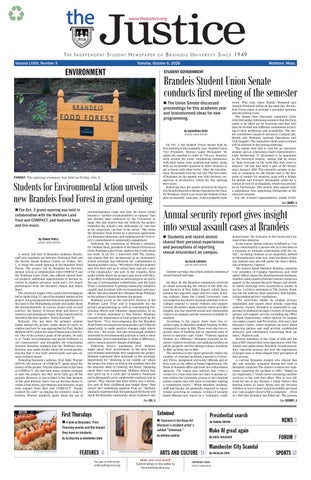
Students for Environmental Action unveils new Brandeis Food Forest in grand opening The Oct. 2 grand opening was held in collaboration with the Waltham Land Trust and COMPACT, and featured food and live music. By CHAVA THIELL
JUSTICE NEWS EDITOR
A nearly full tent of Brandeis students, faculty, staff and members sat between Pearlman Hall and the Brown Social Science Center on Friday, Oct. 1, to await the grand opening of the Brandeis Food Forest. The project, led by Students for Environmental Action in collaboration with COMPACT and the Waltham Land Trust, also offered catered food, art projects, additional opportunities to become involved in student advocacy work and a live music performance from the Brandeis’ Music and Dance Band. The ceremony began with a land acknowledgment led by Spike King ’27, one of the student leaders of the project. King recognized the historical significance of the land to the Wampanoag people and spoke about the intersectionality of various issues such as food scarcity, the history of forced labor and slavery in America and immigrant rights. King transitioned to introduce the first speaker, Justin Koizumi ’27. Koizumi, who has been the primary student leader behind the project, spoke about its early inception and how he was approached by Prof. Rachel McKane (SOC) about the idea of beginning a food forest. One of the primary goals of the project, he said, is to “build environmental and social resilience in our communities” and strengthen the relationship between Brandeis students and the Waltham area. Koizumi also spoke briefly about the actual garden, sharing that it was built intentionally and uses climate-resilient plants. Following Koizumi’s address, Prof. Sally Warner (ENVS), the director of COMPACT, spoke about the history of the project. Warner shared that in her time at COMPACT, she had seen many student attempts to start the project, but they never fully got off the ground. However, it was evident to her that because of this past interest, there was an obvious desire to create a food forest, and McKane and Koizumi, along with support from SEA and COMPACT, “finally cracked the code” on helping the initiative come to fruition. Warner similarly spoke about the use of
low-maintenance crops and how the forest would become a “symbol of sustainability on campus” that has already been embraced by the University at large. She also shared that she believes the project embodies the school’s new philosophy of “one foot in the classroom, one foot in the street.” She views the Brandeis Food Forest as a practical application of a Brandeis education, and emphasized the University’s commitment to community engagement. Following the conclusion of Warner’s remarks, Dr. Nadene Stein, president of the Board of Directors of the Waltham Land Trust, spoke to the crowd about her work. In an Oct. 1 interview with The Justice, she shared that her background as an elementary school principal has informed her commitment to hearing student voices. “We believe that the students who live here and go to school here and are a part of the community,” she said. In her remarks, Stein spoke briefly about the group’s past work with SEA, in an effort to collaborate on advocating for an end to the use of anticoagulant rodenticides, and the Land Trust’s commitment to getting community members outside and involved with environmental advocacy efforts. She also named her colleague Sonja Wadman as the primary liaison between the groups. Wadman serves as the executive director of the Waltham Land Trust and is responsible for the group’s programming, as well as coordinating fundraising efforts and volunteer opportunities. In an Oct. 2 written statement to The Justice, Wadman stressed the importance of local projects such as the food forest. “Very local programs like the Brandeis Food Forest are important because they give folks an opportunity to make positive changes right where they live,” she wrote. She also encouraged students interested in environmental activism to look to their immediate, local communities to make a difference, and to remain positive despite challenges. Following Stein’s comments, Prof. McKane spoke about their involvement in the food forest and thanked individuals who supported the project. McKane expressed their gratitude to the sociology department for “listening to me ramble on” about the project for years, as well as the students who did the physical labor of creating the forest. Speaking about their own background, McKane shared that they grew up in a rural part of eastern Tennessee and subsequently grew comfortable outdoors and in nature. They shared that their father was a formative part of their childhood and taught them “that nature isn’t something separate from us.” McKane similarly expressed that the opening of the forest will teach the Brandeis community about resilience and
On Oct. 4, the Student Union Senate held its first meeting of this academic year. Student Union Vice President, Monica Lopez Hernandez ’28, called the meeting to order at 7:05 p.m. Senators went around the room, introducing themselves with their name, year, position and major, along with an ice-breaker question to allow senators to get to know each other better. After the introductions, Hernandez took the roll call. The first order of business on the agenda was club charters, recognition or de-charters, which for this meeting were none. Following that, the senate reviewed the Executive Board's Executive Money Resolution for Family Weekend, which is an event the Student Union puts on annually. Last year, it did a jeopardy-style
event. This year, since Family Weekend and Alumni Weekend will be on the same day, the Student Union plans to arrange a pumpkin painting and decorating event. The Senate then discussed committee clubs with Hernandez informing senators that the form needs to be filled out by everyone and they will then be divided into different committees according to their preference and availability. The senate committees consist of Advocacy, Campus Life, Health and Wellness, Internal Operations and Club Support. The committee chairs and co-chairs will be selected in the coming meetings. The senate then had to vote for an executive senator and an Allocations board representative. Luke Farberman ’27 advocated to be appointed as the executive senator, stating that he wants to “help everyone in the work that they want to achieve.” He has also been a part of the Senate since January 2024. The executive senator is second in command for the Senate and is the first point of contact for senators, song with a bridge for Senate and E-board. Hernandez called for a motion to vote by acclimation, which was seconded by Farberman. The motion then passed with a unanimous vote, appointing Farberman as the executive senator. For the A-board representative, Judah Fried-
See SENATE, 5
Annual security report gives insight into sexual assault cases at Brandeis
Students and recent alumni
shared their personal experiences and perceptions of reporting sexual misconduct on campus. By ALLIE LADJEVA
JUSTICE COPY EDITOR
Content warning: this article contains mention of sexual assault and rape. On Sept. 29, the Brandeis community received an email announcing the release of the 2025 Annual Security & Fire Safety Report, which documented two reported rapes and five cases of dating violence. Since the Cornell University rape investigation has drawn national attention to how colleges respond to sexual violence and support victims, Brandeis’s latest security report provides insights into the reported sexual and relationship violence on campus and the resources available to students. According to the report, there were two reported rapes in Brandeis student housing in 2025, compared to none in 2024. There were also two reported cases of fondling and no reported cases of incest or statutory rape. Under “Violence Against Women Act, Offenses,” Brandeis recorded no domestic violence incidents, one stalking incident on public property and five dating-violence incidents in 2025, up from one in 2024. The statistics in the report generally reflect the number of criminal incidents reported to University Police, designated university officials and offices such as the Office of Equal Opportunity, the Dean of Students office and local law enforcement agencies. The report also outlines that “even a victim of a crime who does not want to pursue action within the University system or the criminal justice system may still want to consider making a confidential report.” While Brandeis students, staff and faculty are generally required to report crimes occurring on campus, victims of sexually based offenses may report on a “voluntary, confi-
dential basis” for inclusion in the University’s annual crime statistics. In the report, dating violence is defined as “violence committed by a person who is or has been in a romantic or intimate relationship with the victim.” As dating violence is not separately defined in Massachusetts state law, some incidents of dating violence may also fall under the state’s definition of domestic violence. The Justice asked Matthew Rushton, associate vice president of Campus Operations and chief safety officer, about the aforementioned incidents, whether some reports of sexual violence would not appear in the Annual Security Report and whether timely warnings were considered or issued. In an Oct. 5 written statement to The Justice, Rushton did not address those questions individually, citing student privacy regulations. “The university abides by student privacy regulations and cannot share details, regarding students’ reports. Brandeis is committed to supporting its students through a variety of reporting options and support services including the Office of Equal Opportunity, where anyone on campus can make a report, and Prevention, Advocacy, and Resource Center, where students can learn about reporting options and staff provide confidential advocacy and information concerning their options,” Rushton said. Several members of the Class of 2026 and the lass of 2027 shared their own experiences with The Justice and spoke about Brandeis’ sexual misconduct reporting process and how the experiences of people close to them shaped their perception of that process. A current Brandeis student who shared that she was sexually assaulted during her time at Brandeis contacted The Justice to share her experience reporting the incident to OEO. “Based on my experience, I would never encourage another survivor to file with this office. This is very difficult for me to say because I really believe that healing comes in many forms and the decision whether or not to report is [an] incredibly personal one. I am so glad I chose to file a complaint … Even so I feel that Brandeis has failed me. The process
See SEA, 5
Entwined
First Thursdays
Nuances in the Rose Art Museum's resident artist's exhibit "Entwined."
A look at Brandeis' First Thursday events and the impact they have on students.
By SOPHIA GARCIA
By ALYSSA WU & ASHHWIKA SONI
SKYE ENTWOOD/The Justice.
See SECURITY, 5
FEATURES 6
JULIAHNA FALCIGLIA-MATTES/The Justice.
For tips or info email editor@thejustice.org
By NAWAL IRFANI
Make AI great again By ARIEL KNUDSEN
ARTS AND CULTURE 14
Make your voice heard! Submit letters to the editor to forum@thejustice.org
Presidential search
Manchester City Scandal By NICOLAS ZINN
COPYRIGHT 2026 FREE AT BRANDEIS.
NEWS 3 FORUM 9 SPORTS 10
2 TUESDAY, OCTOBER 6, 2026 ● NEWS ● THE JUSTICE
NEWS
POLICE LOG MEDICAL EMERGENCY Sept. 25—There was a medical emergency for a party with a cut finger. The patient refused further medical treatment. Sept. 27—A party reported burning their finger. The patient refused further medical treatment. Sept. 27—A previous caller requested further evaluation for a burned finger. The patient was transported to a nearby hospital for further treatment. Sept. 28—A caller stated they had blurriness in their left eye and a migraine. BEMCo was notified, and the patient was transported to a nearby hospital for further treatment. Sept. 28—The Health Center requested EMS transport to a nearby hospital for a party. The patient was transported. Sept. 30—There was a medical emergency for a party who passed out and fell out of their wheelchair. The patient refused further medical treatment. Sept. 30—A party reported having right-sided body tremors and requested to be checked out by BEMCo. The patient was transported to a nearby hospital for further treatment. Oct. 1—There was a medical emergency for a party with an injured ankle. The patient refused further medical treatment. MOTOR VEHICLE Sept. 27—There was a report of a vehicle damaged by a falling
tree. The situation was cleared. Sept. 30—A reporting party stated that their car was hit by another car. MISCELLANEOUS Sept 25—A party came into the police station and reported being scammed. There will be an investigation to follow. Sept. 27—A party reported stolen food after their friend ordered it. Uber Eats had dropped the food at Foster Mods instead of Deroy Residence Hall. Sept. 27—Mail service reported receiving some suspicious letters. There will be an investigation to follow. Sept. 29—Some suspicious letters were delivered to the Mail Center. There will be an investigation to follow. Sept. 30—Some suspicious letters were received at the Mail Center. There will be an investigation to follow. Oct. 1—There was a medical emergency for a party with an injured ankle. The patient refused further medical treatment. DIRECTED PATROL Sept. 25—There was a directed patrol of Chapels Field. All appeared in order. Sept. 29—There was a directed patrol of Library Lot. All appeared in order.
Sept. 29—There was a directed patrol of Ziv Quad. All appeared in order. Sept. 29—There was a directed patrol of Loop Road from the Shapiro Science Center to Usdan Student Center. All appeared in order. Sept. 29—There was a directed patrol of Chapels Field. All appeared in order. Sept. 30—There was a directed patrol of the Rose Art Museum. All appeared in order. Sept. 30—There was a directed patrol of Chapels Field. All appeared in order. Sept. 30—There was a directed patrol of Gosman Sports Complex. All appeared in order. Sept. 30—There was a directed patrol of Ziv Quad. All appeared in order. Oct. 1—There was a directed patrol of Chapels Field. All appeared in order. Oct. 1—There was a directed patrol of Shapiro Residence Hall A and B. All appeared in order.
— Compiled by Zoe Zachary
EITAN KLIEGER/The Justice.
CORRECTIONS AND CLARIFICATIONS A forum teaser wrote the incorrect title. It should’ve read “STEM vs. humanities: What’s the difference?” (Sept. 29, 1) A sports teaser attributed the article incorrectly. The author should’ve read “Ellie Harris.” (Sept. 29, 1) The police log did not include an author credit. It should’ve included “Compiled by Chava Thiell.” (Sept. 29, 2)
BRIEF
An ad did not include an author credit. It should’ve read “Graphics courtesy of CANVA and ASHER BAREL-STOUT/The Justice.” (Sept. 29, 2)
Brandeis begins presidential search
An editor’s note incorrectly named Ashhwika Soni as a member of the VoteDeis Executive Board. It should’ve included “Sophia Garcia.” (Sept. 29, 3) The masthead mistakenly ommitted Online Editor Ellie Harris. (Sept. 29, 8) A sports teaser incorrectly spelled “Aidan Shern.” It should’ve read “Aiden Shern.” (Sept. 29, 10) A sports kicker incorrectly wrote “Iowa State.” It should’ve read “Iowa.” (Sept. 29, 12) A “Judges by the Numbers” stat incorrectly named Rainer Osselman-Chai as the lead scorer for Men’s Soccer. It should’ve read Keller Chamovitz ‘27. (Sept. 29, 12) An arts page wrote the wrong day. It should’ve said “Tuesday, September 29, 2026.” (Sept. 29, 15) An arts article wrote “IGS Department head Prof. Chandler Rosenberger.” The title was corrected to read IGS and Sociology Prof. Undergraduate Advising Head Chandler Rosenberger.”
Justice
the
www.thejustice.org
The Justice is the independent student newspaper of Brandeis University. The Justice is published every Tuesday of the academic year with the exception of examination and vacation periods. The Justice editor@thejustice.org Editor managing@thejustice.org Brandeis University Managing Mailstop 214 news@thejustice.org News P.O. Box 549110 features@thejustice.org Features Waltham, MA 02454-9110 forum@thejustice.org Forum sports@thejustice.org Sports Phone: arts@thejustice.org Arts (781) 736-3750 photos@thejustice.org Photos The Managing Editor holds copy@thejustice.org Copy office hours on Mondays layout@thejustice.org Layout from 7:30 to 8:30 p.m. ads@thejustice.org Ads Social Media online@thejustice.org
Brandeis is looking for a president “that will continue the progress that we are making with the University’s ‘positive change’ trajectory,” a June 9 email to the Brandeis community stated. While the University initially began their search in 2025, President Arthur Levine’s term was extended through June 2027 and the search has been reinitiated. The email also detailed the revised structure of the search committee which “acknowledges the need for additional constituency input … and the need for a greater focus on trustee decision-making.” The University’s new 2026 Presidential Search website, launched on July 9 as a hub for updates and community engagement, includes details about the search committee and advisory council, specifications on the position, information about the search firm Heidrick & Struggles and an anonymous survey to collect feedback. A document discussing the position specifications also describes, unique qualities of Brandeis, pitching Brandeis to a future president. The document begins, “There is
no other place like Brandeis” and describes faculty as “leaders in their fields” and students as “motivated, compassionate, curious, welcoming and open to exploring new experiences.” It goes on to describe key elements of Brandeis’ story, Jewish roots, the importance of research and The Brandeis Plan to Reinvent the Liberal Arts, which is detailed as “a blueprint for the future of learning.” There is particular mention of Brandeis’ recent fundraising successes, which brought in over $138 million, a huge increase from $87.9 million. According to the document, Brandeis is looking for a president who above all “combines long-term, strategic vision with operational discipline, intellectual credibility with entrepreneurial energy, and respect for the University’s mission with the confidence to shape its next chapter.” The roles and responsibilities listed ask the next president to “steward Brandeis through transformational change,” “champion Brandeis’ distinct identity & reinvention of the liberal arts,” “advance academic excellen-
ce & research leadership,” “serve as Brandeis’ chief fundraiser & external ambassador,” “strengthen Brandeis’ financial sustainability,” “partner effectively with the board of trustees,” “lead organizational & cultural transformation,” “champion student success & institutional relevance” and “build trust through visible & inclusive leadership.” The Presidential Search Committee is going to lead the process of finding and hiring the next president and is chaired by Trustee Cindy Shapira with trustee Adam Rifkin ’97 as vice chair. The Presidential Search Committee Advisory Council is a collection of community representatives including four alumni leaders, two faculty members, three staff members and two students that will be involved in the process as well. The Justice reached out to members of the search committee and advisory council for comment but was notified that the search details are confidential at this time. — Written by Nawal Irfani
THE JUSTICE ● NEWS ● TUESDAY, OCTOBER 6, 2026
3
Club Close Up: Boris’ Kitchen Perfoms Old Shit Show 2026 By JACOB ANDERSON & SUHANA SHRESTHA JUSTICE STAFF PHOTOGRAPHERS
On Oct. 2 and 3, Boris’ Kitchen, hosted their first show of the semester, Old Shit Show, in the Shapiro Campus Center Theater. Since 1987, Boris’ Kitchen has been the only comedy troupe on campus. Old Shit Show contains sketches written entirely by Boris’ Kitchen alumni. Collected in an archive from the last few decades, Old Shit Show has been a fall tradition where students reenact old scripts. The show featured about a dozen sketches and ran just over an hour, with wacky characters like “Salamander Boy,” a confederate vampire and an anthropomorphic bowling ball. Directors were Lauren Goodman ’27 and Jamie Staub ’28.
Design: ELLIE JI/The Justice.
REPORTING
The Middle East After 9/11 PANELISTS Hannah Allam, national security reporter at ProPublica C.J. Chivers, writer at large for The New York Times Magazine
MODERATOR Neil Swidey, director of the Journalism Program at Brandeis University and editor at large of The Boston Globe Magazine
Thursday, October 15, 2026 3:00–5:00 PM Rapaporte Treasure Hall In Person & Online
Free and open to the public.
Registration
Middle Eastern food and refreshments will be served.
for virtual
required attendance.
CO-S P O NS O R E D B Y T H E B R A N D E IS J O U R N A LISM PR O G R AM Graphics courtesy of THE CROWN CENTER and BRANDEIS UNIVERSITY.
THE JUSTICE ● NEWS ● TUESDAY, OCTOBER 6, 2026 5
SEA: Food Forest opening centers on theme of community engagement CONTINUED FROM 1 self-sufficiency, and will also teach them about the environment in an experiential manner. Finally, attendees heard from King, who expressed their thanks to the sociology department, and highlighted that the program has been instrumental in several other efforts on campus, including the creation of the Enterprise anti-ICE petition, which discouraged the University from engaging with Enterprise Rent-A-Car, an organization that supplies vehicles to ICE. They also thanked COMPACT and the Brandeis Student Union for their support, as well as the “many friends we dragged into this project.” King concluded, highlighting that the forest is “groundbreaking for this campus,” before thanking and introducing MAD Band to begin their set. In an Oct. 1 interview with The Justice, Kaitie Chakoian, assistant director of COMPACT, spoke about her role in the project. Much of her work for the opening came in the form of fiscal support, through the use of the Rich Collins mini grants. The grants were used to purchase supplies for the opening day ceremony, such as paint, rocks, snacks and woodchips for the forest. In the past, Chakoian shared, COMPACT has worked to support other student initiatives such as research, school supply drives and other community-oriented projects. She also shared that COMPACT has a strong relationship with the Waltham Fields Community Farms. In her work supporting the BFF, Chakoian has primarily worked with Koizumi, and the pair meets monthly to discuss the project’s progression. Though she spoke about her role as somewhat removed from the project, she shared excitement about seeing what is next for the food forest, continuing her work supporting students and fostering greater engagement with the community, as that is central to COMPACT’s mission. Following the conclusion of the formal event, King and Koizumi spoke to The Justice about the project and their hopes for the food for-
est in the near future. Koizumi spoke about the timeline of the project and shared that McKane approached him during his sophomore year in 2025. Koizumi said he was initially hesitant to begin the project, as he was unsure if SEA had enough students to assist with the work. In December of 2025, he said the group was awarded the grant to fund the forest and began working closely with McKane during the spring of 2026. Once the group began planning the logistics of the project, they first had to seek approval from the grounds crew and also had to speak to maintenance about the practicality of watering and maintaining the forest. Once the land was approved, the group was given the go-ahead to begin work on June 1, 2026. Koizumi also highlighted that McKane was instrumental in assisting with this part of the project, and spoke about his personal relationship with them. “They're so invested in the success of this project of the students themselves. Like they're invested in me individually, Spike individually, as students to see that we are growing as part of the project,” he said. King shared practical details about the project, including the fact that all of the plants are perennials and require little water. Additionally, King said, the food will not need to be transported to those who consume it, and in turn will help make it accessible. Koizumi stated that an additional goal of the program is to foster greater engagement with the Waltham community. Noting problems of food insecurity in the Waltham area, Koizumi shared that “the idea is to educate people, to let them know how to grow plants, to educate them about native plants that they have access to and to also find a way for Brandeis students to really engage with the Waltham community as a whole.” Going forward, the group also sees potential for collaboration with other activist organizations and academic departments on campus. Koizumi was particularly enthusiastic about the idea of building a “living laboratory,” in collaboration with the Environmental Studies department. He also spoke about gaps and inequities between students
E-BOARD: Members of the SEA E-Board gather at the entrance sign.
EITAN KLIEGER/The Justice.
with access to green spaces and other environmentally-conscious resources. In the past, SEA has confronted the Brandeis administration’s decisions surrounding environmental policy and approaches. Most significantly, the group has held protests and drawn up a petition that has now garnered over 1,000 signatures urging the school to reopen its Office of Sustainability. When asked about the impression the Food Forest sends to the University, King stated that they believe the project has shown a true commitment on behalf of the student body to actionability and environmental causes. “We have … a space that really shows that Brandeis students do care about sustainability, that our student union has supported us in this work, that we're just both incredibly grateful,” King said. As both student leaders are seniors and prepare to graduate at the end of the year, both spoke to their hopes for the future of the food forest and the way they envision its success in coming years. Koizumi shared that he hopes this food forest is the first of many on campus, and that Prof. McKane shares a similar sentiment. King similarly hopes to see the current food forest prosper on campus, but also want to spread a broader message about advocacy and change. “I think the other thing is really empowering people to know that they can make a change,” King said. Koizumi added that his final hope for the project is to foster a sense of community and bridge the divide between Brandeis students and Waltham residents. “There’s a real community here,” he said, stressing the collaboration with the Waltham Land Trust. “If you think that you are passionate about something at Brandeis, I can guarantee you that someone at Waltham will also be passionate about that. And there'll be an organization coming there waiting for you,” he concluded.
FOREST: Spike King ’27 and Justin Koizumi ’27 speak to attendees.
EITAN KLIEGER/The Justice.
SENATE: New senators welcomed during first meeting of the semester CONTINUED FROM 1
man ’30 nominated himself to be elected for this position. “I want to be the A-board representative to connect us, as the representative of students,” he stated. The A-board representative is in direct contact with the Allocation Board, especially during marathon season when clubs request funding for the year. A motion to vote by acclamation was called and seconded. This motion passed with a unanimous vote as well. Hernandez then talked about homecoming, an event on Saturday that the Student Union tabled for, asking senators for feedback on it. Jordan Medved ’28 said that there should have been “one or two more food trucks so that there’s more options for people who like different types of cuisine.” Julia Velasco ’30 suggested that the Student Union might have benefitted from having a more interactive way of getting students to vote rather than just showing their phone “something like spin the wheel.” Alexa Johnson ’29 added to this by outlining ways in which they could make it more interactive — senators could ask the student body what they would like to improve on campus, inform them about what the Student Union does and overall help them voice their opinions. Hernandez then informed the senate that the E-board is doing a con-
stitution review, made up of five members. She urged senators to have a look at the senate portion of the constitution and inform Farberman or her of any changes they would like to it. She then moved on to talk about a Campus Safety walk that Student Union President, Daniel Shin ’27, Hernandez and the health and wellness director on E-board will go on with Brandeis Safety Chief Matthew Rushton towards the end of October to address amy safety concerns. Hernandez also made announcements about events that will be happening throughout the week, urging senators to attend. These included an academics town hall on Oct. 15 where Dean Shoulson, President Arthur Levine ’77 and other administrators will be giving information about microcredentials and more. The other event, “Purpose of a College Classroom” on Oct. 8, is a conversation about students and how to make the classroom experience more student-oriented. Hernandez also asked senators to suggest potential senate bonding ideas to get to know each other outside of the capacity of the Senate. Mariah Martinez ’29 suggested that the Senate and E-board should do something competitive like a “friendly-fire.” Friedman suggested bowling as a way to get to know people in an off-campus activity. Along with these announcements, Hernandez informed senators
that the club resource room is used by everyone and asked members to keep both the office and the resource room organized. Farberman also announced that the senate had unfinished business from last semester, including resolutions that had not been passed at the time and were pushed ahead. He stated that he will be sending the resolutions on the student union Slack, and the voting for them will take place after everyone has read the resolutions and questions have been answered. Hernandez informed the senate that passing a resolution means thinking about its future implications — does it affect another aspect of student life, and if this resolution passes, what changes will it bring? Lastly, Hernandez asked if any senator wanted to make an announcement for campus events or promote their club event. She then announced that the Brandeis Latino Student Organization is having their cultural show on Oct. 17. The meeting concluded at 7:40 p.m. ---Editor's note: Justice Layout Editor Ellie Ji ’28 is a Student Union Senator at Large and did not edit or contribute to this article.
SECURITY: OEO, PARC offer insight on resources available to students
CONTINUED FROM 1
has ultimately been retraumatizing. I have felt dismissed and as if Brandeis does not care about me or their students,” the student said. A 2026 alum also shared her experience with reporting sexual misconduct to OEO. “I wanted transparency, accountability and an explanation of how the university was addressing what had happened. I wanted the university to recognize what I had been subjected to and to take my safety and well-being seriously." After reporting, the alum said that OEO asked whether she needed emotional support, a standard part of OEO's proecedure. She said she instead wanted “transparency about how the situation was handled and how justice was being put into place on her behalf,” but was “left feeling that what happened to [her] had not been taken seriously.” To report an incident of sexual or relationship violence, Brandeis members can contact University Police, OEO or other designated University offices. After a formal complaint is issued, it can be addressed either through an Informal Resolution Process, which requires both parties' agreement or through an investigation. If there is an investigation, the case might proceed either through the Formal Resolution Process or Title IX Grievance Process, depending on whether the allegations meet the Title IX requirements. In an Oct. 5 written statement to The Justice, Tra-
cy Kennedy, interim director at OEO, said that when the office receives a report about a conduct that may be prohibited under the University’s Policy Against Discrimination, Harassment and Sexual Violence, OEO reaches out to the impacted individual with information about the policy and the available proccesses. They also offer supportive measures, which are “non-disciplinary, non-punitive individualized services, offered as appropriate, as reasonably available, and without fee or charge.” Some of the supportive measures can include but are not limited to academic accommodations, counseling, safety planning (including campus escort services), leaves of absence, housing changes or other measures. Kennedy also emphasized OEO’s neutral role in reviewing and investigating reports. “The role of OEO at Brandeis, as is required by the law, is to remain neutral in that we provide support to all members of the Brandeis community and supervise the reviews of and investigations into reports. Remaining neutral means we do not provide advocacy for any party in an OEO process, rather, it means that we can and do assist all individuals in the process,” Kennedy said. According to Chapter 4 of the Title IX Grievance Process, “due to privacy consideration, the Complainant will not be notified of the assigned sanctions, unless they are related to the Complainant (such as a No Contact Order as the sanction).” If a
respondent is found responsible, sanctions “may include, but are not limited to, warnings (verbal or written), censures, training or other educational responses, final warnings, performance improvement plans, reassignment, demotions, suspensions and termination.” Kennedy added that students can receive confidential support from a number of resources on and off campus, including the Prevention, Advocacy & Resource Center, the Brandeis Counseling Center, Brandeis Ombuds and the Office for Spiritual Life. Kennedy also explained that not every report OEO receives is included in the annual security report. “Reports of conduct that may be prohibited under the Policy, but do not fall within the Clery Act reporting jurisdiction or definitions, are not included in the Annual Security Report,” she said. PARC provides confidential support to students affected by “sexual violence, relationship violence, sexual harassment or stalking at any point in their lives.” PARC also supports students affected by experiences that occurred before they came to Brandeis or students who are worried about a friend who has been affected. “A majority of students who engage with PARC's confidential advocacy services are doing so for emotional support rather than support for navigating the reporting process,” Kate Richey, director of PARC, said in an Oct. 3 written statement to The Jus-
tice. Richey added that PARC supports students by helping them understand their options and rights. “Choosing whether or not to make a report is a personal and individual choice,” she said. Richey also shared that students may decide not to report because of the logistical and emotional burden, fear of retaliation or not being believed, a desire to focus on healing or because they need more time to decide what they want. For students who choose to report to Brandeis Police or OEO, PARC can provide emotional support throughout the process. Students who do not wish to report can also receive confidential emotional support and help accessing additional resources on and off campus, such as the Brandeis Counseling Center, REACH Beyond Domestic Violence or the Boston Area Rape Crisis Center.
features
6 TUESDAY, OCTOBER 6, 2026 ● FEATURES ● THE JUSTICE
just
VERBATIM | HAL BORLAND Of all seasons, Autumn offers the most to man and requires the least of him.
ON THIS DAY…
FUN FACT
McLaren driver Emerson Fittipaldi wins his second Formula 1 World Drivers’ Championship.
Native American tribes originally dried pumpkin shells, cut them into strips and wove them into mats.
Brandeis Gymnastics Club kicks off a new season A look into what it’s like to be a part of Brandeis’ Gymnastics Club.
By WIKTORIA SAGAN
JUSTICE CONTRIBUTING WRITER
After five months off, just five gymnasts returned to the mats at Waltham’s Massachusetts Gymnastics Center on Monday, Sept. 22, to start a new season of rebuilding the Brandeis Gymnastics Club postpandemic. While the club usually has a dozen regulars, there was an unexpectedly low turnout for the first practice back. “We’re building back up,” said President Summer Holmes ’28, in a Sept. 22 interview with The Justice, explaining that the club’s numbers have dwindled postCOVID-19 compared to before the pandemic hit. The main goal for Holmes is to continue last year’s momentum, when there were lots of beginners who joined the club and the sport for the first time. “It’s cool to see people get into the sport,” added Holmes, “because that doesn’t usually happen when you’re older in gymnastics.” For returning members, the club’s supportive community keeps bringing them back. “Being around people who want to see you progress and who you
want to see progress” motivates club member Ivana Marinkovic ’29, in a Sept. 22 interview with The Justice. The dynamic in the gym re-
Marinkovic, quoting the United Club Gymnastics motto. For a sport that usually “has a lot of intensity around it,” as Holmes put it, the major-
letic Association. Transport to practice is conveniently offered for Brandeis students. The club meets at Brandeis’ Gosman Ath-
practice, Brandeis gymnasts were free to put away their belongings and get ready. At about 8:30 p.m., practice started with warming up
GYM: The club’s practice space.
flects these sentiments, as seen by the president helping a new member learn a skill called a pullover on the bars, while cheers of “Nice!” were heard whenever another member executed a move well. We’re here “for the love of the sport,” said
Design: ALYSSA WU/The Justice. Photo: WIKTORIA SAGAN/The Justice.
ity of gymnasts retire before reaching adulthood. But for the members who choose to compete, competitions are organized using the United Club Gymnastics’ system, which offers more flexibility for beginners than the traditional National Collegiate Ath-
letic Center at 8:00 p.m., where Holmes picks up the team in a BranVan for the fifteen-minute drive to Massachusetts Gymnastics Center. The structure of the club’s practice also offers a lot of flexibility. While the center’s gymnasts finished up their
and stretching. Holmes led basic skills across the floor such as handstands, turns and leaps. After everyone warmed up together, people split off to work on whichever events they wanted, including vault, balance beam, uneven bars or rings. At 9:45 p.m., prac-
tice wrapped up when Holmes led group conditioning and another stretch. Unlike traditional college athletics, the club operates without coaches, instead relying on peer mentoring. This creates a relaxed atmosphere, which is unusually quiet for a gym, besides the sound of tumbling, chatter and music playing on a speaker. The welcoming environment seems to be paying off, as turnout was much higher for the second practice, with five additional new members, offering a mixture of beginners and experienced gymnasts. Ultimately, the club values introducing people to the sport and building a welcoming, inclusive community. If interested, students can join Brandeis Gymnastics Club’s page on Campus Groups for more information and find the club’s Instagram for the Slack group chat link to RSVP for practices. Gymnasts should also fill out the athletics waiver before attending their first practice.
THE JUSTICE ● FEATURES ● _TUESDAY, OCTOBER 6, 2026 7
Brandeis Thursdays: Fall Festival and Pumpkin Patch Students welcomed in fall with October’s First Thursday event. By ASHHWIKA SONI & ALYSSA WU
JUSTICE NEWS EDITOR AND JUSTICE FEATURES EDITOR
On Thursday, Oct. 1, the Brandeis Department of Student Engagement along with the Brandeis Department of Orientation and First Year Experience arranged a fallthemed event as part of their First Thursdays initiative. Students signed up through CampusGroups, got an orange-colored wristband and were then free to explore the area. The event featured “Ollie’s Pumpkin Patch,” which hosted a display of pumpkins that students could choose from to either carve or paint. The two stations for carving and painting were displayed in the Shapiro Campus Center Atrium. The Brandeis Police K-9, Justice, was also present at the event, making rounds in and outside the Campus Center. On the Great Lawn, outside the SCC, there was a bounce house set up with an inflatable slide that individuals could climb in. Continuing the fall theme, students lined up for hot apple cider and mini apple cider donuts. They also had kosher options for students. The festival also had a pumpkin bowling area on the Great Lawn where students could play games and bowl. Sosie Kae Quarrie, assistant director of Student Engagement Leadership at the Department of Student Engagement, is the mastermind behind every First Thursdays event and other campus events. For Quarrie, these events are an opportunity to introduce students to experiences they may not have had before. “A lot of students, especially international students or students [that come from places] where fall is not really a thing, have never really gone and picked out their own pumpkin and decorated and carved it,” Quarrie said in an Oct. 5 interview with The Justice. “So I wanted to offer an opportunity, a first experience. That’s usually
what I like to try to do with all the events that we do.” Anjali Gnanaratnam ’28 attended the event with her friends, basking in the sun and enjoying the pumpkin carving. “My fall dreams are coming true,” she stated in an Oct. 5 interview with The Justice. Students were immersed in the experience of pumpkin carving by hollowing their pumpkin and cutting out shapes including a jack-o-lantern, an owl and other Halloween scenes. The Brandeis Instagram page wrote in a caption for their collaborative post with DSE, “We’re just here for a gourd time” as a seasonal twist on the phrase, inciting fall imagery of a decorative autumn
gourd. F o r the painted pumpkin, students made funny, spooky and artistic works on their pumpkin. Many of the pumpkins were humorously personified with painted eyes and faces. Students took their pumpkins to their dorms, decorating their rooms and hallways. Some students also put their painted and carved pumpkins around campus as
PATCH: Students pick from a variety of pumpkins.
a reminder that fall is here and an expression of the creativity that floods the student body. Beyond the activities themselves, Quarrie hopes these events will help students build friendships and feel welcome on campus. “It’s super important to give people the opportunities to make memories on campus,” Quarrie said. “It’s just giving them that opportunity and giving them the space to make friends or to make
larly help first-year students feel involved on campus. “I see that a lot of the involvement is coming from the first-year students this year. I see their faces all the time in all of our events,” Quarrie said. “They’re still wanting to be engaged because there is something that we’re doing that they like.”
ART: Students paint pumpkins.
memories and to make connections.” Eli Mishara ’29, a first year ambassador, said, “It was really cool to see a lot of the students talking to each other and being more comfortable with their classmates.” Events like this particu-
Creating these experiences takes months of preparation and coordination across departments. For this event, planning began as early as summer. “It’s contracts, it’s back and forth on how many pumpkins, it’s so much
CRAFTS: Students carving pumpkins.
more than just, ‘Okay, yeah, we’re gonna do this.’ It takes so much time and effort to plan all the events,” Quarrie said. “It’s not just me, it’s my whole department, and we partner with first-year orientation as well. I don’t do anything alone. It’s a bigger group of people that really try to make sure these opportunities are out there for students.” During last semester’s First Thursdays, the Department of Orientation and First Year Experiences curated a similar event held in the Levin Ballroom with a pumpkin bounce house, pumpkin painting and fallthemed green
screen photos. T h e y also had DIY fall-themed crafts and customizable tote bags with block prints as well as markers to draw designs they desired. Another event they did was Painting Poetry which had mugs and bowls students could create designs on. There were also donuts laid out in fall flavors with Angel
Tea boba. After that, they did a winter fest with snacks, hot chocolate, crafts, DIY picture frames, mini owls, magnets and cookie decorating as well as arcade games. A big event for the department was Ragefest located in the SCC Atrium, where some students wore white suits and painted with neon colors while others smashed items with a baseball bat in a safe and controlled environment. Student feedback also helps shape the department’s plans. “We also send out surveys at the end to kind of get feedback on how we can make it better,” Quarrie said. “And I think by us, again, listening to the students, they come to our events because they see that we’re putting an effort to listen to them and give them what they’re wanting to do.” The department is already preparing for upcoming First Thursdays, including a roller rink skate night in February and larger events in December and May. For now, the fall festival stands out as Quarrie’s favorite. “I would definitely say this fall festival pumpkin patch was my favorite one so far,” Quarrie said. “I’m really excited for the one in December and the one in May because that’s … just gonna be bigger than what we would normally do on a First Thursday because it involves more things and more people.” That goal is what guides Quarrie’s work. “To me, that’s my whole purpose of my job, and that’s my whole goal in my career is to give students space to make friends, and find a sense of belonging, and feel welcome, whether they come into something alone and they leave with a friend, or they come in with a group of people,” Quarrie said. As DSE continues their First Thursdays, students look forward to being a part of many more activities.
FUN: Students play a variety of games.
Photos: SKYE ENTWOOD/The Justice. Design: ALYSSA WU/The Justice.
8 TUESDAY, OCTOBER 6, 2026 ● FORUM ● THE JUSTICE
Justice
the
Established 1949
Brandeis University
Nawal Irfani, Editor in Chief Skye Entwood, Managing Editor Iyla Lichtenfeld, Bryan Wolfe, Zoe Zachary, Deputy Editors Rueben Gortenbach, Miriam Grodin, Jonas Kaplin, Associate Editors Ashhwika Soni, Chava Thiell, News Editors Alyssa Wu, Features Editor Ariel Knudsen, Forum Editor Luca D. Jordan, Ben Khayat, Sports Editors Sophia Garcia, Arts & Culture Editor Juliahna Falciglia-Mattes, Justin Gao, Photography Editors Allie Ladjeva, Rivka Resnick, Copy Editors Ellie Ji, Layout Editor Keira Shear, Advertising Editor Ellie Harris, Online Editor
EDITORIAL
Cornell didn’t, so The Sun did —Editor’s Note: This article contains mentions of sexual assault. After more than a week of news coverage and internet virality, everyone is talking about the alleged gang rape at Cornell University and subsequent civil lawsuit. The details of this case are horrific and the atrocities alleged are shocking. This editorial board’s thoughts are with the victim, identifying as Jane Doe, her family and the countless victims of sexual violence across the country. Given this case’s national attention and the important questions it has raised about accountability — both from perpetrators and institutions — this editorial board deemed it necessary to comment on this case, specifically as it relates to the role of The Cornell Daily Sun in identifying the accused by name in a Sept. 21 editorial titled “Cornell Won’t, We Will.” This decision to print the names of the accused came in the wake of Cornell, the Cornell University Police Department and the Tompkins County District Attorney’s failures to properly investigate this crime and pursue justice for Doe. This editorial board stands behind The Sun’s decision to publish the names of the alleged perpetrators on their front page. If you are interested in reading more about this incident, we recommend reading The Sun, which has extensively covered the initial police report filed on Nov. 8, 2024, the Cornell community’s reaction and most recently the lawsuit and its national attention. The Sun is the oldest continuously independent college daily paper in the country, and sees its central purpose as holding Cornell accountable. The New York Times cites as much from their interview with Sophia Dasser, The Sun’s editorin-chief: “Our main obligation is accountability. Whether that looks like something that many people do not want to hear, or something that many people do want to hear, it’s our obligation to report on it.” This sentiment is embodied by the very name of their editorial: “Cornell Won’t, We Will.” The Sun’s purpose, much like any other news organization, is a right enshrined in the Constitution. The freedom of the press is what necessitates that the media hold governments and institutions accountable. It is that central freedom and responsibility that drove The Sun’s decision to publish the names of the accused individuals. The Sun’s coverage of this case, which started following Doe and her case in 2024 has driven a national movement calling for accountability, action and transparency from Cornell. Legally, the defendants were named in Doe’s civil suit, which is a matter of public record. This grants The Sun some legal protection in publishing the names, and the editorial uses “alleged” to refer to the crime so as to not assume guilt. The Sun’s decision came at a unique time in a unique circumstance. When Doe made a formal complaint to police in 2024, CUPD left out Doe’s strongest language, describing the encounter with absolute certainty as rape, in a condensed version of her voluntary statement given to the Tompkins County District Attorney. The Tompkins County DA reviewed this statement and determined he could not bring charges with the evidence at hand. However, he also turned down an opportunity to review additional evidence collected by CUPD. At the same time, Cornell conducted a Title
IX investigation — a formal administrative investigation of a report of sexual assault, harassment or sex-based discrimination. While Cornell clarified that under federal law they are unable to provide specific information on individual punishments, they added, “None of the individuals charged were offered the opportunity to write essays as a sole consequence of their involvement.” However, after The New York Times obtained and reviewed more than 1,000 documents from the Title IX investigation and hearings, we now know its findings and the punishments handed out. Two of the seven defendants, Matthew Ingalls and Jonathan Newell, were found responsible for sexual assault and issued full expulsions. Winston Lee and Gillio Lopez were issued suspensions with disciplinary probation to follow after they returned to Cornell. Diego Sarabia was named persona non grata and was banned from campus for three years, as he had already graduated at the time of the decision. The final two men, Scott Norris and Scott Kretzschmar, received a nocontact order with Doe, were required to take “educational modules” on sexual harassment, social media and bystander intervention and had to write “reflection papers.” Kretzschmar was not found responsible for sexual assault; rather, he was said to have committed “attempted sexual exploitation” according to The Times. Additionally, it is worth noting that while The New York Times has published its findings from the Title IX investigation that detail the punishments handed out to the seven fraternity members, they have chosen not to make the documents publicly available. Doe, who was also a prior victim of sexual assault, dropped out of Cornell due to the trauma she endured. The Sun noted that Cornell had established the Presidential Task Force on Campus Sexual Assault five months later, after Doe’s 2024 report and that there had been an increase in reports of “nonconsensual sexual contact by physical force or incapacitation” during students’ time at Cornell from 2023 to 2025. Doe also spoke with The Sun directly and extensively according to task force findings Amidst important missteps from Cornell, The New York Times noted that Dasser had weighed the sensitivity of their decision, and that she decided to publish the names of the accused “to display the transparency that some students felt was lacking from university leadership.” There is no doubt that the decision to publish the names of accused — and in this case, not charged nor convicted — individuals is a weighty one, and the media has grappled with that choice for decades. What makes this choice so complex is the relationship between two of the foundational principles of journalism outlined by the Society of Professional Journalists’ Code of Ethics: “Seek truth and report it” and “minimize harm.” It is true that this case deals with a heinous crime, that the media has a responsibility to report news and that reporting should benefit the public. However, it is also true that releasing information into the public eye can cause harm — think of a publication’s decision to release the identities of deceased victims before the family knows, for example. There are famous examples of the ways this can go terribly wrong. In 1996, Richard Jewell, a security guard, was the primary suspect of the bombing at the Atlanta Summer Olympic Games.
On July 27, 1996, a call was made from a pay phone near Atlanta’s Centennial Olympic Park warning that a bomb would be detonated there in 30 minutes. Jewell, who had noticed a suspicious backpack in the park, started clearing people from the area. The backpack held a pipe bomb that ended up killing one person and injuring 111 others. The media was quick to turn Jewell from hero to suspect and weaponize stereotypes to imply his guilt. While he was in fact the Federal Bureau of Investigation’s lead suspect at the time, the media’s implication of his guilt had serious consequences that continued after he was declared innocent. For this reason, this editorial board takes the question of revealing accused suspects’ names and The Sun’s decision to do so seriously. Despite The Sun’s independence from Cornell, its staff is made up of Cornell students — Cornell students who are impacted by the atmosphere of fear and anger on campus, by inaction or ineffective action from the administration and by the idea that Cornell will not protect its students. They have a connection that external media does not. This makes their decision especially powerful. Importantly, The Sun did more than just publish an editorial. They created a sexual misconduct tip line, gathered responses from community members and have continued to tirelessly report on the situation as it evolves. In a Letter from the Editor elaborating on the form The Sun is collecting, Dasser wrote, “Cornell has not listened. We will. Thank you for your trust in The Sun.” This decision has not been without consequences. Waves of online discourse have flooded social media, full of both support for Doe and accusations that she is lying. There have been attempts to reveal her name online. There are vast and valid critiques of Cornell’s handling of the case, but it is also important to note that Cornell did follow their conduct process for cases like Doe’s, even if they did not properly advocate for her. Title IX investigations are meant to be internal to the academic institution and are not criminal processes. The criminal investigation into the
seven men was closed after the DA’s office did not bring charges against them. Holding Cornell responsible for their mistakes is necessary, but is not the last step. Doe’s story sounds like that of many other victims across college campuses, and our legal system and conduct processes must be better equipped to protect them and pursue justice. However, the actions of The Sun serve as a reminder that the role of the free press is not just to serve the facts, but to stand up and speak out for justice when institutions intended to uphold it fail. This isn’t just about Cornell. It is about victims everywhere, and the voices they need to speak out on their behalf. We applaud the important work of The Sun and their relentless pursuit of truth and accountability. Finally, this editorial board would like to make clear that we take our responsibility to the Brandeis community seriously. We thank our readership for their continued trust and support. — Editor’s Note: If you or someone you know has experienced sexual harassment, assault, stalking, domestic violence, dating violence or otherwise is in need of support, please consider the follow resources. Brandeis • Prevention, Advocacy and Resource Center: Located in Usdan Student Center, G-108 or call 781-736-3371. • Brandeis Counseling Center: Located in Mailman house or call 781-736-3730. • University Police: Located next to the Health Center or call 781-736-3333. • Ombuds: Located in Goldfarb Library, 69103 or call 781-736-2265. Off-Campus • Boston Area Rape Crisis Center: Call their hotline number 800-841-8371. • Jane Doe Inc.: Call their hotline number 1-877-785-2020. • REACH: Call their hotline number 800-8994000.
LETTER TO THE EDITOR Dear Editor, Amazingly, during the few minutes my TV was on September 9, 2026, I heard Adam Carolla at the Republican National Committee Midterm Convention framing the “freedom” to smoke in public places as a casualty of Democratic overreach. Carolla should have stepped into my bar between 1980 and 1983 to see what that “freedom” actually looked like. He would have seen the $800 air filter hanging over the bar, and watched the water turn pitch black every single week when we washed it out in our stainless steel sink. For those three years, despite having quit alcohol on December 31, 1978, I woke up every morning with a painful “smoker’s hangover” while my clothes reeked of stale tobacco. Now, 43 years later, hearing Carolla criticize public smoking bans as partisan overreach is beyond comprehension. Cleaning up the air in public spaces wasn’t a loss of freedom; it was a lifesaver. Without a doubt, I would not be celebrating my 74th birthday this September 11 if I had stayed in that smoke-filled little gold mine. With compassion, Mike Sawyer, Master of Divinity, former Mayor of Midland City, AL (1984-88) 2024 Humanitarian of the Year award at my favorite “high needs” middle school Youth advocate & activist since 1983 Denver, CO Text: 205-515-1560 Email: msawyer911@gmail.com X: @FitToGive
FLOWER: Pink petals form a striking contrast with vibrant greeen leaves.
EITAN KLIEGER/The Justice.
THE JUSTICE ● FORUM ● TUESDAY, OCTOBER 6, 2026 9
Artificial intelligence: Sexuality in the age of artificial the big bad intelligence By ARIEL KNUDSEN
JUSTICE FORUM EDITOR
Ever since the first at-home computer was released in 1977, technological advancements have only increased in speed. After personal computers came the World Wide Web, followed by Global Positioning Systems, mobile phones and social media — all within a fairly short period of time. The last time society experienced such an overhaul on a personal, societal and institutional level was during the Industrial Revolution, which revolutionized the communication, transportation and production industries and fundamentally changed how society functioned. As technology continues advancing, the span of time between one invention and the next becomes shorter and shorter, and society is expected to adapt to these changes with relative ease. The recent incorporation of artificial intelligence into our daily lives seems to be the most controversial change so far. On one end of the spectrum, users perceive AI as a net positive: With AI, you have an assistant, a teacher, a therapist, a friend. On the other hand, some consider AI to be the sum of everything wrong with the world. Owned by billionaires who consort with corrupt politicians, AI, as some opine, is not only fundamentally corrupt but also wasteful of our earth’s natural and ever-depleting resources. The centrists in these conversations use AI for daily tasks, but don’t see it as unique from other amoral technologies. They recognize its environmental harm, but continue using it due to the mass and institutional incorporation of AI into daily tasks on the micro and macro levels. In a capitalist society, ethically consuming anything is nearly impossible. Your cagefree eggs are from a farm that probably uses factory farming practices, and your favorite “green” brand probably sold out to a corporation that uses illegal labor practices to produce its products. By this logic, if AI is already being used by over one billion people across the world, perhaps our response to its implementation needs to change. As with every other technological revolution that faced mass controversy, we need to adapt to AI and consider ways to use it that are the least damaging for the health of society, the economy and our environment. This means that our personal adaptation to AI needs to exist in tandem with institutional regulation on AI, making sure that political, economic and sociological equilibrium is maintained. Some people may argue that AI is perhaps the most damning technological “advancement” of them all. Not even considering its impact on the environment, AI has introduced new psychological, sociological and economic issues that cannot easily, if ever, be fixed. 31% of U.S. adult users of AI utilize it for discussions of their personal problems, and according to a Harvard Medical School study on trends in adolescent use of AI, the number of young users consulting it for mental health problems has sharply increased over the past year. Sociologically, the widespread and institutional use of AI imposes major issues for the labor market, making entry-level employment nearly impossible to get and additionally changing the way that the fields of medicine, law and accounting are structured. Economically, the
owners and shareholders of AI companies hoard the wealth that the meteoric rise of AI has brought, further sharpening the gap between upper- and lower-class incomes. That being said, the vast majority of these issues could be significantly abated by political and institutional responses to AI. As with past technological advancements, our regulatory institutions need to advance in kind, changing on a structural level to accommodate the otherwise unfettered expansion of technology into our daily lives. When the Industrial Revolution consequently left millions without jobs, workers across the world protested in response. This eventually led to the introduction of legislation regulating corporate monopolies, curbing unfair labor practices and protecting the right of workers to organize, all of which enabled the economy to continue thriving unfettered. Though global institutional responses to the Industrial Revolution left much to be desired, it’s clear that from an economic and political perspective, part of the hurdle AI introduced can be minimized simply through a mobilized and coordinated governmental response. Considering America’s current political environment and apparent priorities, this may be too much to ask — but nonetheless, recognizing the responsibilities of our government in regulating AI is key to ensuring that it remains a safe resource for those who choose to use it. Alongside a wider institutional response to AI, the importance of orientating of social responses to its existence also needs to be considered. AI is certainly one of the most dangerous technological developments humanity has faced thus far, and though we don’t know what the future holds, we know it’s here to stay. As such, conversations around the existence and use of AI require nuance. Glorifying it as the deus ex machina of humanity’s small inconveniences isn’t helpful, but neither is demonizing it. Establishing a happy middle where its many dangers and future benefits can be recognized is essential to creating a society where AI is used to our advantage and regulated in kind. The introduction of AI into our daily life is perhaps one of the most controversial advancements in humanity’s history. The way we respond to it from a social and political perspective is, similarly, key to making sure that future generations have a safe and equitable environment to live in. That being said, AI is not the big bad many make it out to be. As with anything, we are the fulcrum that the future of AI depends on. Keeping institutions accountable and having productive conversations about AI is essential to making sure that our response to it is ultimately proportional to the gravity it deserves. Making sure populations have equitable access to resources for counseling, the resources to afford it and environments that invite productive socialization would decrease the currently rising dependence on AI as a friend, partner or therapist. Continued political participation and civic activism to make our voices heard and advocating for labor laws to evolve along with AI would decrease its harmful effects on the economy and create space structural changes.
Graphics courtesy of CANVA and ASHER BAREL-STOUT/The Justice.
By JILL SPIEGELMAN
JUSTICE CONTRIBUTING WRITER
To modern students’ surprise, artificial intelligence as we know it has been around for more than a decade — Siri has been on our iPhones since 2011, YouTube’s AI-driven algorithm has been in use since 2015 and Amazon’s Alexa hit stores in 2016. Even before the grandiose and exponential rise of ChatGPT since its public implementation in 2022, AI has been a phenomenon impossible to ignore. In academic spaces, we see that AI has the power to grade papers, solve our problem sets and write our curricula. However, AI has also been trained to do much more than bureaucratic or academic work. As AI programs continue to receive input from human users, they have begun to portray human emotion more accurately, infiltrating spaces previously considered private and intimate. Even upon informal observation, individuals are increasingly using AI to mimic human relations that are platonic, therapeutic, romantic and even sexual. In a web-based study conducted by the Viral Dynamics Individual-Based Epidemic Simulator Lab at Indiana University Bloomington’s Kinsey Institute, it was discovered that 15% of participants aged 18-65 used AI sexual chatbots to simulate corporeal sexual/romantic relations. But what does it mean for human sexuality to be integrated so heavily with algorithmic technology? Since the implementation of pornography on the ubiquitous internet, we have begun to realize how sexuality is both co-constituted and mediated by technological structures. Starting at a young age, I witnessed my young peers sharing erotic images in class and on social media. They discussed their preferences, “type” and proclivities openly in the context of the pornographic content they engaged with. Donna Haraway describes cyborgs as “a cybernetic organism, a hybrid of machine and organism, a creature of social reality as well as a creature of fiction” in her seminal essay collection published in 1991. What is now viewed as erotic is a merging reality of artificial intelligence and corporeal and non-corporeal bodies and desires. The technological aspect can no longer be separate, no matter how predominant social sexuality may seem. We have further merged with a technological being that we have given subject to, due to its simplicity, accessibility and algorithmically fueled ‘sexiness’. What makes configuring sexuality
with an AI erotic chatbot even possible is the reinscription of gendered identities into abstractly replicated codes that users can choose from, in the process both reinforcing old preferences and sexual hierarchies as well as creating new ones. This happens because sexual performativity is now contingent on varied answers, subjectivities and erotic roles enacted by both the user and the chatbot character itself. This cyborgian connection between AI erotic chatbot and individual user is further bolstered by what Babu and colleagues call emotional solipsism in their 2025 research on the differences between authentic and simulated emotional connections. Emotional solipsism is characterized by “a pattern of affective engagement in which an individual’s emotional needs and narratives dominate interaction, reinforced by AI companions that never assert boundaries,” according to Babu and colleagues’ paper. The potential danger in that closedloop pattern recognition does not only draw users closer to intimate interactions with an AI erotic chatbot, but also offers a potentiality of unfettered hierarchical sex talk. There are real-world implications for this, as “Users may begin expecting people to behave like their digital companions: always available, emotionally consistent and endlessly agreeable,” as Babu and colleagues suggest. If an AI chatbot is programmed to affirm without challenge, then a user who bases their AI conversation on race play, for example, will never know the harms those roleplay experiences perpetuate. Examples of similar situations are presumably endless. To add, many AI systems in general, and AI erotic chatbots specifically, do not have set guardrails in place, therefore allowing for more opportunities of what can be termed “sexual cyborgification,” which only perpetrates dangerous and offensive sexual acts, social hierarchies and unfair expectations within intimate relationships. In sum, the ways in which we have hybridized ourselves with intimate AI platforms have offered unrestrained opportunities to simulate hegemonic categorizations of sexuality in tandem with race, gender, and more, in the process further cementing these hierarchical relationships. To mitigate this, we must call for increased programs on AI literacy in academic spaces and more critical thinking among all AI users.
PUMPKINS: You know fall is here when you see pumpkins!
EITAN KLIEGER/The Justice.
The opinions expressed on this page are those of each article’s respective author and do not reflect the viewpoint of The Justice.
Write to us
The Justice welcomes letters to the editor responding to published material. Please submit letters through our Web site at www.thejustice.org. Anonymous submissions cannot be accepted. Letters should not exceed 300 words, and may be edited for space, style, grammar, spelling, libel and clarity, and must relate to material published in the Justice. Letters from off-campus sources should include location. The Justice does not print letters to the editor and op-ed submissions that have been submitted to other publications. Op-ed submissions of general interest to the University community— that do not respond explicitly to articles printed in the Justice — are also welcome and should be limited to 800 words. All submissions are due Friday at noon.
Fine Print
The opinions stated in the editorial(s) under the masthead on the opposing page represent the opinion of a majority of the voting members of the editorial board; all other articles, columns, comics and advertisements do not necessarily. The Justice is the independent student newspaper of Brandeis University. Operated, written, produced and published entirely by students, the Justice includes news, features, arts, opinion and sports articles of interest to approximately 3,600 undergraduates, 2,000 graduate students, 565 faculty and 1,300 administrative staff. The Justice is published every Tuesday of the academic year with the exception of examination and vacation periods. Advertising deadlines: All insertion orders and advertising copy must be received by the Justice no later than 5 p.m. on the Thursday preceding the date of publication. All advertising copy is subject to approval of the editor in chief and the managing and advertising editors.
The Staff For information on joining the Justice, write to editor@ thejustice.org.
EDITORIAL ASSISTANTS Ads: Asher Barel-Stout Staff News: Ariana Agarwal, Allie Kettle, Hannah Shapiro Features: Saaya Daga, Emmy Zhou Forum: Eric Cherny*, Graham Glovka, Aaron Klein*, Max Klein*, Mark Silva Arts and Culture: Luke Benanav*, Lauren Goodman, Alice Nguyen, Dahlia Ramirez*, Rogerio Villaca Szuster Photography: Vaughn Alnot-Simeonov, Cole Hamner, James Li*, Brian Lucy, Elle Yung Copy: Francesca Auricchio, Saaya Daga, Sydney Duncan, Hannah Lee, Cindy Marin Online: Alison Kettle
* denotes a senior staff member
just Sports
BRANDEIS ATHLETE SUCCESS Elijah Roth '28 writes about the vast generation divide in football playstyle. p. 12.
Waltham, Mass.
Tuesday, October 6, 2026
Page 10
Manchester City found guilty ■ Manchester City’s 115 charges raise questions about fair competition, potential sanctions and the future of Premier League regulation.
By NICOLAS ZINN
JUSTICE CONTRIBUTING WRITER
Manchester City is one of the most successful clubs in modern football. Over the past decade, it has won six Premier League titles, one Champions League title and various other domestic and international trophies. City had enjoyed sporadic periods of success since its founding in 1894, but its fortunes dramatically changed in 2008. Sheikh Mansour, a member of Abu Dhabi’s ruling family, and head of the Abu Dhabi group took over the club. His financial backing transformed City into the title-contending team we see today. After City’s new ownership there was a spike in spending, followed by a meteoric rise to the top of the Premier League which brought scrutiny to the club. In 2018, after a Portuguese hacker leaked many of City’s financial documents to German newspaper Der Spiegel, an investigation was launched. In 2023, after the investigation had concluded, City was charged with 115 counts of breaching the Financial Fair Play rules. In September 2026, the premier league released a statement saying that an independent judicial board had upheld 114 out of the 115 charges. The Premier League has published the core breaches but has not yet decided on punishment, and City maintains its innocence and intends to challenge the findings. Football clubs often spend heavily on new signings and wages hoping that quality players will bring success and in turn bring in revenue. These financial rules are in place to limit the risks of that approach and protect the overall stability of clubs and the competition itself. During the period of City’s case, the Premier League required clubs to report their finances accurately and restricted the losses they could incur over several seasons through the FFP established in 2010. Those requirements are critical because a federation or league cannot accurately assess whether a club has followed its spending rules without a reliable account given by the club of where its money came from and how it was spent. In 2023, the Premier League charged City with breaches providing inaccurate information about revenue, sponsorship income
and operating costs. Portsmouth FC is a useful example of why football leagues worry about club spending. The club won the Football Association Challenge Cup in 2008, but in the aftermath was unable to repay its debts. In 2010, it entered administration — meaning that a club’s finances are placed under the control of specialists who try to keep it operating while dealing with creditors — with £138 million in debt and no way to pay it. They were deducted nine Premier League points and were relegated that season. City is not the only modern football club to break the fair play rules. Everton received point deductions for exceeding the losses permitted under the league’s rules. Chelsea, in another infamous case, was fined over historical reporting breaches involving undisclosed payments to players; the league said those payments would not have put Chelsea over its permitted loss limit, Chelsea cooperated with the league, so they were only given a ten million dollar fine and no point deduction. City’s case concerns a wider set of violations covering
mult i p l e s e a s o n s where they spent much more than they should have, making the commission’s findings especially important.
115 charges have been brought against Manchester City and they fall into five groups: 54 concerning inaccurate financial information, 14 concerning incomplete details of payments to players and managers, seven concerning the Premier League’s Profitability and Sustainability Rules, five concerning compliance with UEFA financial rules and 35 concerning a failure to cooperate with the Premier League’s investigation of the matter. The statement released by the Premier League says that Manchester City has been found guilty by an independent commission of 114 charges concerning financial rule breaches and failures to cooperate with the Premier League’s investigation. The Commission found that, between the 2009-10 and 201718 seasons, City disguised money supplied by its owner, Abu Dhabi United Group, as sponsorship revenue and used misleading arrangements to understate its expenses. These schemes made the club’s finances appear more than £900 million healthier than they actually were, allowing City to ap-
pear compliant with Premier League and UEFA spending limits despite substantially exceeding them. The club also submitted misleading accounts, concealed its true financial
position from auditors and regulators and obstructed the investigation. City, however, denies any wrongdoing. Co-Chairman Khaldoon Al Mubarak told supporters that the process was still ongoing and that the club remained confident it could prove its innocence. On Sept. 29, both the Premier League and City released public statements regarding the situation. The premier league spoke about the sham contract and City responded that they are “innocent of the accusations,” claiming that “irrefutable evidence exists” to support their innocence. City also stated that they would be appealing the case. The reported findings have prompted questions from rival clubs about whether they wrongfully lost prize money and sponsorship opportunities while competing against City. TalkSPORT reported on Sept. 30 that the four clubs could seek more than £100 million each from City. Several clubs have reportedly sought legal advice about possible compensation claims, but any claim would need to show how a rule breach caused a particular loss. The judicial panel will determine the punishment at a separate hearing. Potential sanctions count include fines, point deductions and expulsion from the Premier League. There is no fixed formula linking the number of breaches to a particular punishment, and comparisons with other clubs are limited by the scale and nature of City’s case. Stripping titles is another possibility being discussed. However, stripping a title is a much more delicate issue, especially when considering having to name a new champion when it comes to league titles. Furthermore, in other competitions that City participated in, the Premier League does not have the jurisdiction to reassign titles. These include the FA Cup, League Cup or Champions League, which are run by other organizations. These will be individual disputes with appeals of their own. For now, the commission’s published written decision, any sanction and the outcome of a possible appeal remain unknown. The case’s significance extends beyond Manchester City. The eventual punishment, and the outcome of any appeal, could establish the precedent for how the Premier League enforces its financial rules for cases as severe as this. For City, the consequences remain uncertain; for the league, the next stage will test its ability to uphold rules intended to protect fair competition.
Graphics courtesy of CREATIVE COMMONS and LUCA D. JORDAN
THE JUSTICE ● SPORTS ● TUESDAY, OCTOBER 6, 2026 11
CLIMBING TEAM On Saturday, Oct. 3, the Brandeis Climbing Team competed in "Rad Sends," a community bouldering competition hosted at Central Rock Gym Watertown. Team members competed against each other and other local climbers. The competition featured 40 boulders and each was given a difficulty rating from one to 40. This is the competitive team's second competition of the academic year, with several more to come. In addition to their competitive team, the Climbing Team has a recreational team that is open to anyone regardless of climbing experience and hosts practices twice a week with transportation and free entry to Central Rock Gym Watertown.
Photos: SKYE ENTWOOD/The Justice. Design: ELLIE JI/The Justice.
JUDGES BY THE NUMBERS MEN’S SOCCER UAA STANDINGS
Chicago Case Emory WashU Carnegie NYU Rochester JUDGES
UAA Conf. W L D 1 0 0 0 0 1 1 0 0 1 0 0 0 1 0 0 1 0 0 0 1 0 1 0
Overall W L D Pct. 9 1 0 .900 8 0 2 .900 7 1 2 .800 7 1 2 .800 7 2 2 .727 7 1 1 .833 3 4 3 .450 3 5 2 .400
TEAM STATS Points
Keller Chamovitz '26 leads the team with 7 points. Player Points Keller Chamovitz '27 7 Aidan Chuang ’27 6 Jacob Morse '28 6
Assists
Aidan Chuang ’27 and Langston Byrd ’29 lead the team with 1 assist. UPCOMING GAMES: Player Assists Saturday at Emory University Maddox Yu ’27 1 Tuesday, Oct. 13 vs. Massachusetts Maritime Langston Byrd ’29 1 Academy
WOMEN’S SOCCER UAA STANDINGS WashU Chicago Carnegie Case Rochester Emory JUDGES NYU
TEAM STATS
UAA Conf. Overall W L D W L D Pct. 1 0 0 11 0 0 1.000 1 0 0 8 1 0 .889 1 0 0 7 1 2 .800 1 0 0 7 3 1 .682 0 1 0 7 1 2 .800 0 1 0 6 1 3 .750 0 1 0 5 3 1 .611 0 1 0 4 2 3 .611
UPCOMING GAMES:
Saturday at Emory University Tuesday Oct. 13 at Bridgewater State University
Goals
Grace Carman ’29 leads the team with 4 goals. Player Goals Grace Carman ’29 4 Tanvi Ranju '27 2 Ella Kaufman '30 1 Moira Koleno '29 1
Assists
Ella Kauffmann '30 leads the team with 2 assists. Player Assists Ella Kaufmann '30 2 Sadie Williams '29 1 Reilly Hickey '28 1
VOLLEYBALL UAA STANDINGS
TEAM STATS
THE JUSTICE ● SPORTS ● TUESDAY, OCTOBER 6, 2026 12
Is soccer still magic? ■ A statistical comparison of flair in retro and modern soccer.
By ELIJAH ROTH
JUSTICE CONTRIBUTING WRITER
Flair is one of the most provocative words in sports. It’s a spiritual part of soccer — is the improvised skill that fans fall in love with. Many traditionalists would have you believe that flair is obsolete in the modern game, while optimists claim that stars like Michael Olise and Lamine Yamal are keeping it alive. I’ve always wondered whether older fans are blind with nostalgia for untouchable heroes of the past, or whether the game has actually transcended creativity. Fed up with cherrypicked highlight comparisons, I decided to go back and draw my own conclusions. I created a stat sheet to track actions on the pitch. I tracked dribbles, progressive passes, assists and shots. I defined flair as “an action that utilizes exceptional skill or creativity,” and included a flair option for each feat. I chose to analyze two El Clásicos between Real Madrid and Barcelona: one from 2005 starring prime Ronaldinho and a young Messi, and a seven-goal thriller from last season's Supercopa. Now that the experiment was set up, I just needed to watch and compare. The antique game came first, and the first thing I noticed was how
loosely everyone played. The ball was far less controlled than in the modern era, and misplaced back passes often forced panicked clearances from both teams’ centerbacks. The second thing that stuck out immediately was how imaginative Ronaldinho was each time he touched the ball. He clearly earned his nickname: “The Wizard.” Real Madrid often passed long balls over and through Barcelona’s back line, while Barça preferred to progress the ball through creative dribbling and tikitaka passing. In the second match, Barca scored five goals compared to Real Madrid’s two. Kylian Mbappé shocked me with how quickly he filled the stat sheet with flair, disproving my preconception that Barcelona was by far more creative. Despite Mbappé’s brilliance, tactics clearly dominated the players' minds. They universally favored surefire passes over taking on defenders and dribbling through them. Once I was done watching and collecting stats for both games, I did the math and discovered the complicated truth. The antique era dwarfed the modern era in number and frequency of flair dribbles and flair progressive passes. In 2005, nearly 20% of passes had flair, four times higher than the 5% of 2025’s passes. Dribbles with flair as a percent of total dribbles also fell 17%, from 43% to 26%. These data back up what every old-head has been saying for the past decade: soccer has lost creativity. However, just when I had lost all hope of proving my high school Spanish teacher wrong, I stumbled upon possibly the
most interesting statistic. Creativity in the box increased twofold as flair shots — as a percentage of total shots — rose from 13% to 26%. This jump shows that despite a much lower rate of creativity in build-up play, creative finishes are more essential than ever. Retro jugadores could slice through back lines like butter, but in the modern era, defensive formations are far stronger. This necessitates more desperate attempts on goal, where subverting the defense's expectations or just simply getting a shot off from outside the box, is more effective than improvising through space. Another surprising revelation was how the efficiency of flair did not change very much between the two games. The success rate of flair progressive passes changed slightly from 73% to 70% in the modern era, while the success of flair dribbles changed by less than a percent. This demonstrates that letting players make their own opportunities is still a viable option. Why are players shy about taking on defenders if it’s just as successful as it always has been? My theory is that this era of strict play stems from the age of film combined with hardline managers. Powerful managers can endlessly analyze players and dock them for ending possessions by taking chances. This has birthed an environment where players are incentivized to choose the safe, tactical option. Soccer philosophies have always ebbed back and forth. Hopefully, one day, we will see a great shift back toward the magic of retro football.
Kills UAA Conf. W L Carnegie 3 0 NYU 2 0 Chicago 2 1 WashU 2 1 Case 1 2 Emory 0 1 JUDGES 0 2 Rochester 0 3
UPCOMING GAMES:
Overall W L 16 1 12 4 16 1 11 3 9 8 8 4 7 9 9 8
Friday at Montclair State University Sunday UAA Round Robin vs. Case Western Reserve and University of Chicago
Pct. .941 .750 .941 .786 .529 .667 .438 .529
Madison Haft-Abromovitch '28 leads the team with 204 kills. Player Kills M. Haft-Abromovitch '28 204 Kennedy Hilson’30 99 Emmory Casto '30 95 Kennedy Lilly ’28 94
Digs
Taylor Lewis '28 leads the team with 136 digs. Player Digs Taylor Lewis '28 136 Ava Ferrigno '27 133 Alexa Ho '28 100 Camila Valenzuela '30 90
Data courtesy of THE OFFICIAL SITE OF THE UNIVERSITY ATHLETICS ASSOCIATION, the BRANDEIS ATHLETICS WEBSITE, and the TRACK & FIELD REPORTING SYSTEM website. Graphics courtesy of CREATIVE COMMONS
TRICK: Kylian Mbappe fakes out the goalkeeper to score a free kick.
Photo courtesy of CREATIVE COMMONS.
SWING: Bryson DeChambeau hits a long drive.
Photo courtesy of CREATIVE COMMONS.
Ashhwika Soni ’29 says: “Bryson DeChambeau should stop making 3D-printed putters.” LUCA D. JORDAN/The Justice.
Photo courtesy of CREATIVE COMMONS.
SERVE: Novak Djokovic takes a huge swing at the 2026 China Open. Djokovic has never lost a match at the China Open and currently has 33 - 0 record in Beijing. He looks to add to his six previous titles today in the final against Alex de Minaur after facing world number five Daniil Medvedev in the semi-final and world number two Alexander Zverev in the quarter-final.
Thank you for sending in this week’s take, Ashhwika. I think every debate about the legality of new sports technology tends to come down to whether or not they give a significant advantage to the players who use them. In this case, I feel like this is more of an “I’m going to do it because I can” type of thing. The clubs you use can only help so much, especially when conforming to the PGA’s strict regulations. To be clear, it makes no difference to me whether he uses 3D-printed equipment or not. The clubs, to some extent, act more as a publicity stunt than anything else. DeChambeau does a lot of what he does simply for the exposure: carrying around a signpost at the Master’s, running a YouTube channel for the love of the game, you name it. I think Bryson is mostly hedging; he’d be happy to use some cutting-edge new clubs designed just for him, but more than that, he wants people to talk about his clubs. If he does well, his haters get to raise a stink about the clubs, and he gets more attention. If DeChambeau sells dupes of his custom irons like he says he will, then I’ll be fully on Ashhwika’s side. They’re not built for anyone besides DeChambeau, so I see no point in switching to them, especially if they’ll set you Reply from BEN KHAYAT back as much as or more than a new set of top-of-the-line clubs would. For the JUSTICE SPORTS EDITOR moment, I’m just gonna keep pretending like DeChambeau doesn’t exist. Good take, Ashhwika!
Vol. LXXIX #3
October 6th,12, 2026 September 2017
Vol. LXX #2
just
Arts & Culture just
Waltham, Mass.
Photos: Juliahna Falciglia-Mattes/The Justice. Design: Justin Gao/The Justice.
14
| TUESDAY, JANUARY 31, 2017 TUESDAY, OCTOBER 6, 2026 I ARTS & CULTURE I THE JUSTICE
ROSE ART EXHIBIT
To Love in the Unknown: Entwined By SOPHIA GARCIA
JUSTICE ARTS AND CULTURE EDITOR
On Oct. 2, I had the pleasure of viewing Jenna Gribbon’s exhibit “Entwined” at the Rose Art Museum. Walking into the exhibition, I was immediately struck by the personal nature of the paintings. Figures appeared together in domestic spaces, bodies rested against one another and familiar moments seemed to unfold across the canvases. Yet, as I spent more time looking, the paintings began to feel like more than representations of relationships. They became questions about intimacy itself — about what it means to know another person, to be vulnerable with them and, perhaps most importantly, to allow someone else to look at you. “Jenna Gribbon: Entwined” opened at the Rose Art Museum on Aug. 19 and will remain on view through Jan. 3, 2027. The exhibition is Gribbon’s first major solo museum exhibition and brings together more than 40 paintings created between 2001 and the present, including ambitious new canvases made specifically for the exhibition. The exhibition is organized chronologically and thematically and traces the development of Gribbon’s distinctive approach to figurative painting while demonstrating how relationships have remained at the center of her. Gribbon is best known for her intimate portrayals of family, friends and especially her wife, musician Mackenzie Scott, who performs under the moniker TORRES. Through luminous color, inventive compositions and emotionally charged imagery, Gribbon transforms ordinary moments into
complex reflections on love, desire, memory and perception. For me, the most compelling part of “Entwined” was not simply the intimacy represented within the paintings — It was the intimacy created between the paintings and the people looking at them. As I moved through the exhibition, I became increasingly aware of my own position as a viewer. I was not simply looking at Gribbon’s subjects. I was looking at people who were looking at one another, sometimes directly and sometimes from a distance. At certain points, it felt as though the figures were aware that I was there. The paintings created a strange exchange in which I was observing the subjects while simultaneously becoming conscious of myself as an observer. The title “Entwined” immediately suggests connection. Gribbon’s figures are physically and emotionally connected, but the word also describes the relationship between artist and subject, subject and viewer and viewer and artwork. The paintings exist somewhere between the private world of the people depicted and the public world of the museum. What may have originated as an intimate moment between Gribbon and someone close to her is transformed into an experience that strangers can stand in front of and examine. This transformation highlights the ever-changing nature of intimacy and how we as people interact with ourselves and each other. We live in a culture where the boundaries between private and public are constantly shifting. Relationships, friendships, bod-
UNTITLED (WATER): Artist Alfredo Jaar displays a vivid ocean scene.
MY FACE ON HIS FACE (WARM): Jenna Gribbon depicts subjects are peronsally connected.
ies and personal experiences are increasingly shared through social media. A moment that once might have existed only between two people can now be photographed, posted and viewed by hundreds or thousands of strangers. At the same time, there is a growing awareness of the importance of boundaries and consent, particularly when it comes to deciding what parts of ourselves we are comfortable making visible. Gribbon’s paintings exist within this tension, as they feel deeply personal without feeling entirely private. They give the viewer access to intimate moments while simultaneously reminding us that we can never have complete access to another person. That distinction became especially noticeable to me when looking at the paintings of Gribbon’s wife. Scott appears repeatedly throughout Gribbon’s work, but she is not simply a repeated image. Each painting presents a different version of her — a different expression, pose, mood or moment. The repetition does not make the subject easier to understand. Instead, it emphasizes how impossible it is to capture another person completely. This exhibition moves simple representations of queer domestic life or desire. Those elements are certainly present, but “Entwined” asks a larger question about how identity itself is formed. The Rose describes Gribbon’s relationships as being grounded in reciprocity, care and radical empathy. Those ideas are important because they suggest that Gribbon does not see her subjects as objects to be reproduced. Her relationships with the people she paints become part of the artistic process itself. Love, in this sense, is not simply a subject of Gribbon’s paintings. It is a way of seeing. To love another person is to pay attention to them. It means learning their expressions, remembering their movements and noticing details that might be invisible to someone else. It also means accepting that no matter how closely we know someone, there will always be parts of them that remain outside of our understanding. Gribbon turns that process of attention into painting, extending the confines of intimacy to the general population. Her work suggests that intimacy is not created through total knowledge of a subject. Instead, intimacy comes from continuing to look at someone while understanding that you can never know every part of them. This idea also complicates the relationship between vulnerability and visibility. Vulnerability is often understood as weakness. To be vulnerable is to expose something about yourself, to allow another person to see a part of you that could potentially be hurt or misunderstood. But Gribbon’s paintings suggest that vulnerability can also be a form of agency when a person chooses to be seen. This feels particularly important in “Entwined”. Gribbon’s subjects are frequently depicted in states of physical or emotional openness, but they do not necessarily appear powerless. Their bodies and expressions communicate presence and agency. They are not simply being observed. They are participating in the act of being seen. This idea becomes particularly complicated when considering the history of representing women’s bodies in art. For centuries, women have been depicted as objects for a viewer, often a male one. Their bodies are presented to be admired, judged and consumed. Gribbon works within this long history of figurative painting but changes the dynamic by making the act of looking part of the subject itself. Her figures can look back, and when they do, the viewer is suddenly forced to consider their own gaze. This is especially apparent in “Examinationscape” (2021), where an intimate encounter between two bodies becomes an investigation of looking at itself. One figure holds a light that illuminates the other, creating a sense of examination. Yet the viewer is also examining the scene, encouraging the
VIOLONCELLO (1999): Close up on Cello body showcasing tecnological compoent of the piece.
audience to actively participate in the painting. That realization made me reconsider my own experience in the exhibition. How long was I willing to look? What details did I focus on? Why did certain paintings feel intimate while others felt almost intrusive? Asking these questions made the act of viewing feel less passive. Ultimately, “Entwined” asks its viewers to do more than simply observe intimacy — it asks us to reconsider what intimacy means in the first place. Through Gribbon’s portrayals of the people closest to her, the exhibition demonstrates that intimacy is not about completely knowing another person, but about continuing to understand them through attention, care and connection. Her paintings recognize that people are constantly changing and that our perceptions of those people change with them. For me, this was what made the experience of viewing “Entwined” so compelling: I was thinking more critically about my own role as a viewer when in contact with different art forms. Gribbon made me aware that looking is never
entirely passive, and when we look at another person, we bring our own experiences, assumptions and emotions into that encounter. The same is true when we look at art. The meaning of a painting is shaped not only by the artist or the subject but also by the person standing in front of it. In this sense, “Entwined” reminds us that intimacy is not found in completely knowing another person, but in the courage to keep looking, keep questioning and allow ourselves to be seen while accepting that some parts of one another will always remain unknowable.
VIOLONCELLO (1999): Artist Nan June Park sculpts a wooden cello highlighting visual and musical arts.
Design: SOPHIA GARCIA and ELLIE JI/The Justice.
THE JUSTICE I ARTS & CULTURE I TUSEDAY, OCTOBER 6 , 2026
15
MOVIE ADAPTATION
Christopher Nolan’s “The Odyssey” Is Not Worth 20 Years at Sea By LUKE BENANAV JUSTICE STAFF WRITER
Christopher Nolan has made mind-bending movies that push the limits of modern filmmaking and storytelling. His most recent endeavor was adapting Homer’s “Odyssey,” a tale of human resilience against the impossible barriers of The gods, with one simple alteration: The gods are gone. This is one of several changes that diminished the stakes and impact of Nolan’s version of the 3,000-year-old story, leaving the only “epic” piece to be the filmmaking itself — as though that would be enough to make Nolan’s “The Odyssey” an epic in its own right. Putting the adaptation’s accuracy aside, it is remarkable that Nolan and his team built real set pieces and shot on-location for some of the most famous scenes of Homer’s epic. The ocean shots were some of the most dramatic, as Nolan could have simply filmed in a soundstage and edited in the ocean later. Instead, many of the scenes of Odysseus and his men on the ocean were real. Even the towering Trojan Horse, though designed with strange flaws, warrants the word “epic.” The most impressive in-camera effects were when Circe turns Odysseus’ men into pigs. The creative teams designed a sequence so grotesque it is hard to look away. As Circe distorts the soldiers’ features, she mashes their faces into form, an effect that was achieved with masks and makeup being actually moulded on set. Besides the series of cuts that make the scene feel jumpy, the transformation from men to pigs looks impossibly real. The most emotionally resonant moment in the entire three hours was when Argos, Odysseus’ dog, died. The death of this dog that the audience sees beaten by the suitors as it waited for Odysseus to come home, was crushing. It was also one of Odysseus’ most human moments, as he stood and pondered whether to reach out to the dog or continue hiding his identity. Even if you knew Argos was going to die, Nolan emphasizing his mistreatment at the hands of the suitors made the audience hate the suitors more and want Odysseus to put them in their place. There were also some notable performances mixed in with the visual marvels. Matt Damon, who played Odysseus, was the actor who dissolved into his character the most, which was important in such a celebrity-filled cast. This version of Odysseus’ progression, from the overconfident warrior who unnecessarily shoots Polyphemus to the slower, older, more thoughtful fighter at the end, is a believable arc because of Damon’s performance. Robert Pattinson, who played Antinous, was also particularly captivating — you had to hate him. Himesh Patel and John Leguizamo were also two of my favorite actors to watch throughout the movie. Finally, Lupita Nyong’o, although not in most of the runtime, used her few minutes very well. When she pulls Telemachus aside to whisper an apology, there is an electric feeling of understanding that not only did Helen of Troy not want the destruction of Troy, but also that the guilt of all of the dead Greeks and Trojans weigh heavily on her. Helen’s added depth was a pleasant surprise. Hidden underneath the pretty camera work of Nolan’s “Odyssey,” however, is a whirlpool of issues. Nolan’s “Odyssey” strays far from Homer’s epic. Even ignoring the differences, however, the film leaves room for improvement. Let’s start with the sound mixing:in every format “The Odyssey” is presented in, the rumbling of the music and environment is deafening; in many cases, the sounds could be heard through the walls of the theater. The worst part is how muddled the dialogue becomes. During my second watch, there were sentences I realized I had completely missed during my first viewing and other phrases I only caught because I had seen the movie once before. Audiences should not have to strain their ears to hear the whispers under Nolan’s ca-
LOST ICONS
cophony. The film’s dialogue was also underwhelming. Pattinson goading Tom Holland’s Telemachus lost a lot of strength as soon as Pattinson said, “You’re pining for a daddy you didn’t even know.” The audience is rudely ripped out of the scene by questioning why a soldier would say “daddy” over “father” or “dad.” The issue is not that the dialogue is in modern English, but that the characters’ conversations do not fit the context of the scenes. Then, there’s the general casting of the film. There were a distracting number of celebrities in Nolan’s “Odyssey,” and most of them did not seem suited for their roles. Anne Hathaway’s performance as Penelope had one memorable moment, during her monologue about “the empty throne,” but beyond that, Penelope was uncharacteristically bland. This was especially noticeable after listening to Emily Wilson’s translation, where Penelope’s scheme of undoing her weaving and her tests to make sure Odysseus is truly back show how she matched wits with him. Meanwhile, in the film, Hathaway is just sad and there is little evidence of how her strength and intelligence drew Odysseus to her, to the point where it is questionable why Odysseus fights so hard to return to her. Zendaya’s portrayal of Athena was a waste of her skill, mostly because the character of Athena does so little in this version of the story. In Nolan’s vision, Athena is a manifestation of Odysseus’ guilt for what happened at Troy. Although this is an interesting way to view Odysseus’ communication with the goddess, Nolan’s version of Athena is reduced to a lot of head shakes and frowns, instead of the influential force that kickstarts Odysseus’ return home and Telemachus’ search for information. It could have been interesting to see Nolan play with Athena’s use of possession or time manipulation — instead, he had Zendaya be an emotionless spectre. Nolan’s “The Odyssey” cut more gods than just Athena. Hermes, the secondary player to Athena in the original text, is completely missing. Hermes is the god who gets Calypso to release Odysseus in the first place. Speaking of Calypso, she is another character who is completely changed in Nolan’s “The Odyssey” for no clear reason. Beyond the fishnet shirt that immediately makes her feel out of place, Calypso is hard to watch. Calypso in the text is much more manipulative and intelligent than Calypso in the film. In Wilson’s translation, Calypso has a monologue where she angrily tells Hermes that goddesses are scrutinized more than gods. Even if it does not justify her keeping Odysseus on her island for years, there are layers to why she does it. She is not simply caring for some post-traumatic stress disorder-torn veteran; she is stopping a man she loves from leaving because if the gods can do it, why can’t a goddess? Odysseus is a mixed bag in Nolan’s film. Gone are his wit and wisdom, replaced with a war veteran suffering and a seemingly unstoppable addiction to lotus. The movie mentions how intelligent Odysseus is, but without the clear curse from the gods — why, oh why did Nolan cut the “nobody” scene! — Odysseus’ constant mistakes feel less like an intelligent man fighting against impossible forces and more like a normal guy making a lot of bad choices without his map. In the text, the soldiers fear Odysseus’ curse will stop all of them from getting home, so they revolt; not because they don’t trust his decisions, but because they think the gods are actively sabotaging every choice Odysseus makes. In the movie, their mutiny is spurred on by Odysseus’ bad leadership. The only time Odysseus feels like the most intelligent person in a room is when he chooses not to eat Circe’s soup. Beyond that instance, his survival feels like dumb luck.
This is the overarching problem with Nolan’s version of the epic: the audience is not curious about Odysseus making it back to Ithaca. Everyone knows Odysseus will make it home in the end, so the process to get there has to be enthralling. Homer handled this by having Odysseus be given his raft by the gods, ride it to the island of the Phaeacians and then tell his story. He is worn from years at sea, but sharp and capable nevertheless. The audience wants to know how he survived the gods before going to Ithaca to face the suitors. His relationship with Penelope feels like a strong enough connection to last 20 years. Meanwhile, Nolan has a weakened Odysseus collect his memories, conveniently in chronological order, before shipping off straight to Ithaca. There is nothing to be invested in when learning how Odysseus ended up on Calypso’s island. In Homer’s “Odyssey,” you want Odysseus to make it home because he has been through hell and back. In Nolan’s, you just want him to kill Robert Pattinson. There are a host of other issues with the movie, such as the design and execution of the Trojan Horse — a concept that, to be fair, does not have much to stand on in the original story — or how the cyclops only mumbles, or how the Lestrygonians happen to go for every boat except for Odysseus’, or how once Odysseus makes it back to Ithaca he can seemingly teleport to another island before Telemachus without gathering a crew or its blunt messaging with a monotonous voice-over monologue at the end — the list goes on. Unfortunately, what really stands out is how little time Nolan spent making the people feel real. From the costumes to the personalities, many of the characters of Nolan’s “Odyssey” are one-dimensional. I didn’t care about Odysseus and Penelope’s relationship and the layers of Telemachus and Penelope’s relationship were paper-thin. The most dimensional character is Odysseus, but even his key traits — quick thinking and resilience — are stripped down. But how can I still give a movie with such a pile of issues a positive rating? Because Nolan’s “The Odyssey” is undeniably impressive, even with its faults. As I wrote this article, people have said these critiques are nitpicky and that they miss the movie’s overall theme. But I argue that the theme of “The Odyssey” is that it is a story of resilience in trying circumstances and that while, yes, it is impressive to see a human complete these feats without the help of otherworldly beings, Homer’s text is not just about how the gods assist Odysseus — it’s about how he defies all odds and overcomes the beings that control the universe. You can humanize Odysseus and make him suffer incredible pain for what happened in Troy through God’s anger and punishment. His destruction of the natural order angered the gods. Keep Athena and Hermes, at least! “The Odyssey” without the gods creating impossible odds is no longer “The Odyssey.” In short, Nolan’s “The Odyssey” is style over substance. It’s a crazy ride with beautifully shot action and pushes the film industry further into the IMAX environment. But for all its showiness, the characters lacked nuance, which made the story feel flat and unrealistic — and not in the fantasy sense. Nolan tried to make the “Human Odyssey,” where the gods were practically unnecessary, but also tried to include the magic of Greek mythology, a magic that only exists because of the gods. It’s impossible to have it both ways. So, should you see “The Odyssey?” Yes, because it is a unifying cultural event in a world where those are few and far between. But don’t expect any life-changing revelations — and definitely do not use it to cheat on your homework; you’ll get a lot of wrong answers and Nolan is to blame. 3.5/5 stars
We Will Always Love You: Remembering Dolly Parton By ZOE THEOBALD
JUSTICE CONTRIBUTING WRITER
August and September have been a tragic time for beloved artists, celebrities and other public figures. In these past months, the world has lost actress Hayden Panetierre, actor Tim Curry, artist Yayoi Kusama, fashion designer Bob Mackie, feminist icon Gloria Steinem and countless other influential figures. But none have elicited such a strong response as the passing of country singer, philanthropist and businesswoman, Dolly Parton. Parton, who passed away after a brief battle with cancer on Aug. 25 at the age of 80, has inspired countless memorials and tributes from individuals spanning just about every background. Some love her for her music, others for her movies, her sense of style, her charity work or her business ventures — but even to those who weren’t deeply familiar with her work, Parton was truly an American icon. Parton was born in the Smoky Mountains of Tennessee in 1946, one of 11 siblings in a small cabin without electricity or running water. Her father, a sharecropper, was unable to read and her family was forced to pay the doctor who delivered her as a baby with a sack of cornmeal. Despite very humble beginnings, Parton had a loving family who encouraged her musical ambitions from a very early age. At eight, she received a guitar; at 10, she appeared on local radio. At only the age of 13, Parton performed on the famous Grand Ole Opry stage, introduced by Johnny Cash. As soon as she graduated high school, Parton made her way to Nashville, aspiring towards a music career. Her first record label pushed her towards a bubblegum pop sound, but Parton would not be restrained. She shortly joined the Porter Wagoner show, signing with the associated RCA Victor record label. Her first solo single with the label, “Just Because I’m a Woman” — a country song which defends women against slutshaming — would become a small hit in 1968. By the early 70s, Parton’s career took off, with songs such as “Jolene,” “Coat of Many Colors” and “I Will Always Love You” (about her break from working with Porter Wagoner) hitting the charts. In 1974, Elvis Presley expressed interest in covering “I Will Always Love You,” but his manager, Colonel Tom Parker, demanded publishing rights to the song — an offer which Parton boldly refused. At the time, nobody knew the song would eventually be covered by Whitney Houston and
rake in millions in royalties. Given Parton’s less-cemented status as a new songwriter, it seemed like she was passing up a big opportunity. Still she held on to her principles. Parton stuck to her guns in other ways, too. With her big bleach-blonde wigs, heavy makeup and flashy outfits, Parton had a signature “trashy” look which made her the subject of ridicule over the years. Yet, even when grilled about her appearance, like in her famous interview with Barbara Walters, Parton assured viewers that she was confident in herself and she felt no need to ascribe to others’ expectations of her. Parton also routinely made fun of herself before anyone else could — a sort of defensive gesture which made her appear self-assured and charming, even in the face of cruel or judgemental remarks. As her career continued to flourish over the years, Parton was known for being kind. Though famously apolitical, Parton publicly supported LGBT rights well before it was common or acceptable to do so. As a co-owner of Sandollar Productions, Parton helped fund the 1989 documentary “Common Threads: Stories from the Quilt,” about the NAMES Project AIDS memorial quilt, among helping fund the production of other projects, including “Buffy the Vampire Slayer.” Parton’s most enduring legacy is her charity work and philanthropic efforts. Parton founded the Dollywood Foundation in 1988, whose first measure was to give students in her home county $500 for finishing high school (dropout rates subsequently went from 35% to 6%). Parton also covertly paid for high school students’ band uniforms for years, and provided relief for families when fires destroyed much of her county in 2016 through the My People Fund. In 1995, Parton’s Imagination Library opened, inspired by her father’s illiteracy and has since given one book a month free of charge to children up to 5. As of 2026, the library has given books to 120 million children. Beginning in 2022, employees of Parton’s amusement park Dollywood receive free college tuition. Parton has also made large donations to healthcare initiatives which have helped develop the COVID-19 vaccine and build hospitals in Tennessee. This isn’t to say that Parton always got things right: Many are critical of her choice to remain silent on politics in such a volatile time.
Dollywood also ran the “Dixie Stampede” event — a Medieval Times-esque event themed around the Civil War, which framed the Confederate South and the Union as a “friendly and fun rivalry” and painted a whitewashed, romanticized picture of the antebellum South free of slavery or cruelty — for over 30 years. Even though Dollywood eventually apologized and rebranded this event. However, in a world of billionaires and public figures who stay silent on major issues and remain inactive, Parton stood out as a force for good. Rather than sitting on her piles of money, Parton used her wealth to make the world a better place, showing empathy and humility along the way. Perhaps Parton can serve as an example to other wealthy figures. And even to those of us who aren’t so fortunate, Dolly leaves a legacy of kindness and charity, of believing in yourself, of refusing to conform to what others want you to be and of taking criticism in stride and with confidence. No matter who you are, Dolly Parton has something to teach you. There is no doubt that she will remain an inspiration for centuries to come.
Photos Courtesy of CREATIVE COMMONS
Design: SOPHIA GARCIA/The Justice.
16 TUESDAY, OCTOBER 6, 2026 I ARTS & CULTURE I THE JUSTICE
STAFF’S Top Ten
By SIMON LINK
JUSTICE CONTRIBUTING ARTIST
ALYSSA WU/The Justice
Top 10 Pickles Ranked By ALYSSA WU
JUSTICE FEATURES EDITOR
1. Oh Snap! Hottie Bites (Chip Version) 2. Grillos Pickles Hot Spears 3. Oh Snap! Dilly Bites 4. Vlasic Kosher Dill minis 5. Grillos Pickles Classic Dill Spears 6. Claussen Kosher Dill Spears 7. Hot Mama Pickle-in-a-pouch 8. Oh Snap! Hottie Whole Pickle 9. Grillos Pickles Half Sour 10. Vlasic Kosher Dill Spears
SUDOKU By SOPHIA GARCIA
JUSTICE ARTS AND CULTURE EDITOR
See solution at www.thejustice.org Design: SOPHIA GARCIA/The Justice.