the
Justice www.thejustice.org
T h e I n d e p e n d e n t S t u d e n t N e w s p a p e r o f B r a n d e is U n i v e r sit y S i n c e 1 9 4 9 Volume LXXVIII, Number 6
Tuesday, October 20, 2026
Waltham, Mass.
FACULTY SENATE
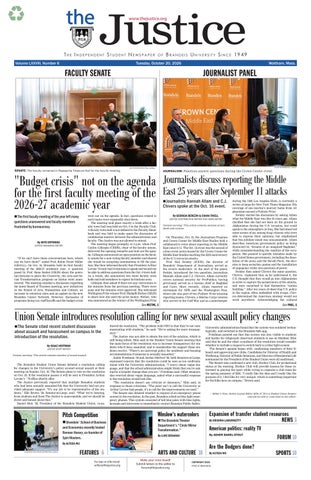
SENATE: The faculty convened in Rapaporte Treasure Hall for the faculty meeting.
JOURNALIST PANEL
COLE HAMNER/The Justice.
SKYE ENTWOOD/The Justice.
JOURNALISM: Panelists answer questions during the Crown Center event.
"Budget crisis" not on the agenda Journalists discuss reporting the Middle for the first faculty meeting of the East 25 years after September 11 attacks 2026-27 academic year Journalists Hannah Allam and C.J.
Chivers spoke at the Oct. 16 event.
The first faculty meeting of the year left many questions unanswered and faculty members frustrated by bureaucracy.
By SKYE ENTWOOD
JUSTICE MANAGING EDITOR
“If we can’t have these conversations here, where can we have them?” asked Prof. Robin Feuer Miller (GRALL). On Oct. 16, Brandeis held its first faculty meeting of the 2026-27 academic year. A question posed by Prof. Ilana Szobel (NEJS) about the potential decision to place the Creativity, the Arts and Social Transformation program on hiatus went unanswered. The meeting entailed a discussion regarding the latest Board of Trustees meeting, new initiatives in the School of Arts, Humanities and Culture, an increase in retention rates and an update on the new Brandeis Career Network. However, discussion of programs being cut, staff layoffs and the budget crisis
By GEORGIA BEREZIN & CHAVA THIELL
were not on the agenda. In fact, questions related to such topics were repeatedly shut down. The meeting took place exactly a week after a faculty town hall was held on Oct. 9 in the Faculty Club. A faculty town hall is not defined in the Faculty Handbook and was held to make space for discussion of confidential matters between the administration and faculty The Justice was not allowed to attend. The meeting began promptly at 2 p.m. when Prof. Caitlin Gillespie (CEMS), chair of the faculty senate, delivered the opening remarks and laid out the agenda. Gillespie announced an open position on the faculty senate for a non-voting faculty member and shared she would be accepting nominations to fill the position. She then informed faculty that President Arthur Levine ’70 only had 10 minutes to speak and would not be able to address questions from the Oct. 9 town hall. As a result, she announced two more faculty town halls and told members to expect invitations soon. Gillespie then asked if there are any corrections to the minutes from the previous meeting. There were none and the minutes were approved. She welcomed Wellington Prize winner Prof. Madadh Richey (NEJS) to share how she used the prize money. Richey, who was announced as the winner of the Wellington Prize
JUSTICE CONTRIBUTING WRITER AND NEWS EDITOR Content warning: This article contains mention of war, death and violence.
On Thursday, Oct. 16, the Journalism Program and Crown Center for Middle East Studies held a collaborative event about reporting in the Middle East since 9/11. The Oct. 16 event was the second of a four-event series hosted by the Crown Center for Middle East Studies marking the 25th anniversary of the 9/11 terrorist attacks. Prof. Neil Swidey (JOUR), the director of Brandeis’ Department of Journalism, served as the event's moderator. At the start of the panel, Swidey introduced the two panelists, journalists Hannah Allam and C.J. Chivers. Allam currently covers national security for ProPublica, having previously served as a bureau chief in Baghdad and Cairo. More recently, Allam reported on extremism for NPR and the Washington Post, where she was part of two Pulitzer Prize-winning reporting teams. Chivers, a Marine Corps veteran who served in the Gulf War and as a peacekeeper
during the 1992 Los Angeles Riots, is currently a writer-at-large for New York Times Magazine. His coverage of one marine’s journey home from Afghanistan earned a Pulitzer Prize. Swidey started the discussion by asking Allam what the Middle East was like 25 years ago. Allam clarified that she had not been on the ground in Afghanistan during the U.S. invasion, but could speak to the atmosphere in Iraq. She had observed some scenes of joy among Iraqi citizens who were able to express their opinions, but emphasized that this jubilant mood was unsustainable. Allam describes American government policy as being distracted by “dreams of an imagined Baghdad,” while misunderstanding the realities of the occupation. She pointed to specific mistakes made by the United States government, including the dissolution of the army and the Ba’ath Party, the decision to keep sectarian quotas and the installation of unpopular exiles into positions of power. Swidey then asked Chivers the same question. Chivers explained that, as he understood it, the U.S. thought that they would go into Afghanistan in order to capture the perpetrators of the attacks, and were surprised to find themselves “nation building.” After ten years of observing U.S. policy in the region, often embedded with troops, Chivers determined the American strategy would not work anywhere. Acknowledging the cultural
See MEETING, 5
See PANEL, 5
Union Senate introduces resolution calling for new sexual assault policy changes The Senate cited recent student discussion
about assault and harassment on campus in the introduction of the resolution. By ISAAC HOFFMAN JUSTICE STAFF WRITER
Content warning: This article contains mention of sexual assault.
The Brandeis Student Union Senate debated a resolution calling for changes in the University’s policy around sexual assault at their meeting on Sunday, Oct. 18. The Senate plans to vote on the resolution on Oct. 25. If the resolution passes it will be sent to President Arthur Levine’s ’ ‘70 office shortly after. The Justice previously reported that multiple Brandeis students who had been sexually assaulted felt that the University had not provided adequate support. “It’s our job to be representative of the students,” Elle Brown ’29, Senator-at-Large, said. “What we’re hearing, from students and from The Justice is unacceptable, and we should be direct and honest about that.” Daniel Shin ’26, President of the Brandeis Student Union, co-au-
thored the resolution. “The problem with OEO is that they’re not communicating with students,” he said. “We’re asking for more transparency.” The Justice was not able to obtain the text of the solution, which is still being edited. Shin said in the Student Union Senate meeting that the main focus of the resolution was to increase transparency for students who’d been assaulted, and to standardize the support those students receive. “There’s no universal policy for academic and housing accommodations if someone is sexually assaulted.” Judah Friedman ’30 and Jordan Medved ’28, both Senators-at-Large, expressed concern that the resolution could be seen as too confrontational with the University administration. “I worry about vague language, and that the school administration might think that you’re asking for a broader change than you are,” Friedman said. Other senators, also worried about vague language, asked what a successful response to the resolution would look like. “The resolution doesn’t say criticize or denounce,” Shin said, in response to those criticisms. “The point isn’t to call the University or Arthur Levine bad people, it’s to call for the improvements we need.” The Senate also debated whether to request of an emergency phone system in the resolution. In the past, Brandeis relied on blue light emergency phones. This system consisted of tall blue poles with blue lights, keypads and intercoms to immediately contact Brandeis Public Safety.
Winslow's watercolors
Pitch Competition
The Brandeis Theater Department's "Circle Mirror Transformation."
Brandeis' School of Business and Economics recently hosted Ronnen Harary, co-founder of Spin Masters.
FEATURES 6 For tips or info email editor@thejustice.org
EIITAN KLIEGER/The Justice.
ARTS AND CULTURE 18
Make your voice heard! Submit letters to the editor to forum@thejustice.org
— Editor's Note: Justice Layout Editor Ellie Ji ’28 is a Student Union Senator and did not edit or contribute to this editor.
Expansion of transfer student resources By KRISHNA LAKKIMSETTY NEWS 3 American politics: reality TV By ASHER BAREL-STOUT
By LUKE BENANAV
By ALYSSA WU JULIAHNA FALCIGLIA-MATTES/The Justice.
University administration found that the system was outdated technologically, and switched to the Brandeis Safe app. Friedman pointed out that this system was less visible to students and harder for religiously observant students to use on Shabbat. Shin said that he and the other co-authors of the resolution would consider whether to include a request to switch back to a blue light system. The Senate’s agenda began with confirming members of their Eboard and approving new clubs. Candidates for Director of Health and Wellbeing, Director of Public Relations, and Director of Residential Life nominated by the President of the Student Union were all confirmed. The Senate also confirmed a new club, Hockey Club, for probational status at the meeting. Hockey Club will provide lessons for those interested in playing the sport while trying to organize a club team for the spring semester of 2026. “I really like the idea and I really like the purpose of it. I feel like it's very unique, which is something important for the folks here on campus,” Brown said.
Are the Dodgers done? By ALYSSA WU
COPYRIGHT 2026 FREE AT BRANDEIS.
FORUM 10 SPORTS 10
2 TUESDAY, OCTOBER 20, 2026 ● NEWS ● THE JUSTICE
NEWS Patricia Hill Collins delivers annual Eleanor Roosevelt Lecture
Renowned sociologist Patricia Hill Collins ’69 Ph.D. ’84 reflects on “radical hope” and social justice at Brandeis. By SUHANA SHRESTHA
JUSTICE CONTRIBUTING WRITER
Patricia Hill Collins ’69, Ph.D. ’84 explored the deep-seated commitment driving Black women’s intellectual activism in today’s world at Brandeis’ annual Eleanor Roosevelt Lecture on Oct. 5, 2026. Grounding her analysis in the legacy of Reverend Dr. Pauli Murray, Collins highlighted how Murray’s self-reflexive approach to activism offers a powerful model for today’s ongoing fight for justice. She reflected on her return to the Brandeis library, a space where she once spent endless hours studying for her doctoral exams. Collins framed her talk around questions about how we continue to struggle and find energy when the current political moment feels so discouraging. Collins graduated from Brandeis in 1969 with a major in sociology, and completed a master’s degree in Teaching in Social Science Education at Harvard University the following year. In 1976, she served as director of the African American Center at Tufts University and began her doctoral studies in sociology at Brandeis in 1980. As a college student, she devoted her time to fostering progressive educational models in the schools of Boston’s Black
community, which laid the foundation for a career that is a mixture of academia and community. The presentation centered around three main ideas: freedom and Black women’s intellectual activism, social justice and pathways to intersectionality and radical hope. Collins began by describing intellectual activism as “a synergistic relationship where every single day, the ideas that you have shape what you do, and what you do every single day generates experiences which shape your ideas and interpretation of those experiences.” Furthermore, she challenged the traditional Western binary that separates “thinkers/theorists,” or those who are often privileged, from “activists/doers,” those who are often marginalized. Collins argued that thinking and doing should not be treated as separate because intellectual work can be just as important in creating social change as direct political action. To illustrate how ideas travel outside academia, Collins highlighted “Ella’s Song” by the a cappella group Sweet Honey in the Rock. The song was written in honor of civil rights organizer Ella Baker, who practiced what Collins termed “flexible solidarity.” Collins described this term as the messy but essential work of forming coalitions across ideological differences to solve urgent social problems without demanding that everyone share the same beliefs. Instead, Collins said, flexible solidarity recognizes that people can work together toward a common goal even when they do not agree on everything. Collins also stated that freedom is the central organizing concept in Black women’s lives, not as an abstract philosophical exercise, but out of necessity due to
its historical absence. For Black women, the struggle for freedom has been shaped by generations of exclusion, discrimination and resistance, making it something that must be actively fought for rather than simply discussed in theory. She used this idea to explain pathways to intersectionality. Collins emphasized that Black women’s experiences provide one pathway into intersectionality, but that they are not the only one. Indigenous, decolonial and Global South movements also provide their own distinct pathways, shaped by their specific histories and struggles. She showed that while different groups may experience oppression in different ways, their experiences can help us better understand how systems of power operate together and how collective action can challenge them. Collins transitioned to discuss her idea of “radical hope.” She asked, “Can you be radical and hopeful at the same time? Radical is being critical and analytical and seeing things and asking for tremendous social transformation that you may not see in your own lifetime. How is it possible to be hopeful for that degree of radical change if you may not ever see it?” For Collins, radical hope functions as the vital engine that converts critical social theory into sustained political movement. Rather than viewing hope as passive optimism, she framed it as a disciplined, intergenerational practice, and one that allows activists to critique systemic injustice without succumbing to despair, ensuring that current struggles build a foundation for future generations. To further illustrate her framework, Collins highlighted key figures whose work dem-
onstrates the impact of Black women’s intellectual activism, including Ella Baker, Ida B. Wells-Barnett, Rev. Dr. Pauli Murray, Fannie Lou Hamer, June Jordan, Bernice Johnson Reagon, Barbara Ransby, Kimberlé Crenshaw, Nira Yuval-Davis, Maria Rodó-Zárate, Robin D.G. Kelley and Charlene Carruthers, all of whom share a commitment to what Collins calls the practice of intellectual activism. They did not treat ideas and social action as separate binary worlds; rather, they bridged theory and action, using their scholarly work, journalism, speeches, poetry or music as tools to solve real-world social problems. Furthermore, they viewed freedom not as a theoretical exercise or a privilege for a select few but rather an absolute requirement. Collins shared how these thinkers analyzed and fought against interconnected systems of oppression by discussing the ways race, gender, class and sexuality simultaneously impact marginalized lives. According to Collins, they operated with a long-term, intergenerational mindset and sustained a “critically informed, radical hope” where one works tirelessly to build opportunities and leave a foundation for future generations to build upon. As Collins concluded her address, she turned her focus entirely back to the audience, leaving the room with a reminder to carry forward into their lives: “What keeps us hopeful? What keeps you going? Who are you doing it for? What’s your dream? Is imagining and thinking much bigger than we are encouraged to think within the institution that has shaped our lives? For me, standing in it, I’m saying: think bigger than this.”
“Whose Suffering Counts?”: Honoring victims of sexual violence The Hadassah-Brandeis Institute hosted a conference examining sexual violence on Oct. 7, the international law of sexual violence and the phenomenon of denialism. By SKYE ENTWOOD
JUSTICE MANAGING EDITOR
Content Warning: This article contains mentions of rape and torture. In an effort to answer the question, “What can the events of October 7 teach us about the future of accountability for conflict-related sexual violence, both in Israel and around the world?” Prof. Lisa Fishbayn Joffe (NEJS), director of the Hadassah-Brandeis Institute, along with Ruth Halperin-Kaddari, founding director of The Rackman Center at Bar-Ilan University held a Conference on Conflict-Related Sexual Violence and the Legacy of October 7th. The event was held on Oct. 7, 2026 and hosted by HBI in close collaboration with BarIlan University and the Dinah Project. The event served to both commemorate the terrorist attacks on Oct. 7, 2023 and to propose legal frameworks to prosecute all cases of CRSV. The organizers and funders of the conference sought to bring together people from a vast range of expertise, including international law, Jewish feminist studies and other areas to hypothesize and make suggestions on how legal systems should deal with CRSV. More specifically, the conference aimed to analyze and understand denialism of sexual violence — especially in the case of October 7 — and to foster intellectual exchange between people from different disciplines who all came together over one critical issue. After welcoming and presenting their opening remarks, the conference kicked off with a keynote address by Alice Edwards, entitled “Whose Suffering Counts? Sexual Torture, Hostage-Taking and Survivors’ Justice in a Divided World.” Edwards served as the United Nations Special Rapporteur on torture from 2024 to 2026 and has an extensive career dealing with sexual violence and international law. The question “Whose Suffering Counts?” was the driving motivation behind her address, as she pondered why some victims rightfully re-
Justice
the
ceive international attention while other stories go unheard. Edwards identifies herself as one of the few experts on human rights who was willing to speak up for Israeli and Jewish victims of CRSV while simultaneously condemning the actions of Israel, the United States and Hamas. She made it clear that justice for victims of these war crimes must be pursued free of bias and politicization, and humanity and dignity must be granted to all regardless of race, religion, or country. She was also adamant that the acts of CRSV committed by one party in a conflict do not excuse those of the other. Edward’s address thoroughly examined the international legal frameworks for prosecuting CRSV. Edwards highlighted progress made during her time with the UN when she gave a report that led to a resolution recognizing that CRSV can be classified as torture. Edwards explained that the legal framework on torture is stronger than other methods for combating sexual violence, as torture is unequivocally prohibited under international law and is subject to no statute of limitations; consent is not a defense to torture, alleviating substantial barriers to prosecuting rape; the narrative can be shifted from victims to perpetrators, which can reduce stigma and empower leaders to advocate for survivors; and the international laws on torture entitle the victims to rehabilitation and compensation from perpetrators. Furthermore, Edward’s work led hostagetaking to be recognized as an act of torture. However, she expressed that hostage-taking as torture has not been prioritized nearly enough by the UN. Edwards’ speech also addressed many of the problems of investigating and prosecuting CRSV. In a highly digitized world, the presence of recordings has aided in the investigations of sexual violence as an act of war. At the same time, however, cases of sexual violence where there is no digital documentation are more likely to be dismissed. She stated that this dismissal is especially problematic given that these crimes are frequently not recorded. Edwards also highlighted the problem of underreporting. Since the interview is the primary source of evidence, investigators must speak to victims directly. This raises numerous barriers, as victims must first speak out or be identified, which can be exceedingly challenging when these crimes happen in areas of active conflict or occupation. In these cases, speaking out could come with serious risk of further violence. Additionally, many victims of rape in war are killed immediately after
and it is not uncommon for their bodies — and with them, any evidence — to be destroyed. Moreover, interviewing victims of such traumatic events is a difficult task: Psychological responses and cultural stigma can prevent victims from recounting their experiences to investigators. In her closing statements, Edwards reaffirmed that the accounts of survivors must be seriously investigated in an unbiased manner and that the identities of victims and perpetrators must not play a role in how seriously these matters are considered. “This is probably one of the most important gatherings for dealing with sexual violence in conflict,” said Sylvia Neil, founder of HBI, major funder of the conference and Brandeis Board of Trustees member, in an Oct. 7 interview with The Justice. Neil shared that following the October 7 mass rape she felt betrayed by many progressives and feminists who were quick to dismiss the accounts of Israeli women. This betrayal from people she saw as allies made her and her colleagues “ look at our mission in a different way and deal with the reality of being Jewish feminists in a post-October 7th world.” To Neil, it was this silence and denialism that made this conference feel like such an important space to honor the victims and make strides towards justice. Neil explained that experiencing denial is nothing new for Jews. When asked about where the denialism of sexual violence on October 7 came from, Neil stated that while many are usually quick to speak out against violence against women, “Jews have been put into the oppressor category kind of willy-nilly,” and labeling Israeli women as oppressors makes it far easier to ignore their suffering. Some can be quick to dismiss the stories of Israeli women due to the ongoing conflict and actions of the Israeli government. When asked if the denialism came more from the victims being Israeli or Jewish, Neil responded “I think the new antisemitism is calling something Israeli.” Neil explained that she sees the modern anti-Zionist movement as a stand-in for antisemitism that has become culturally acceptable. Neil cited that much anti-Zionist imagery resembles stereotypical anti-Semitism, and that while many people speak outwardly against Israel, she still sees violence against Jews far too frequently even in the United States. All of the panelists at the conference were women. When asked if this composition was an intentional choice, Neil responded, “ It has
fallen, it seems, on women to deal with this as an issue as women,” Neil said. She was surprised that, while conducting the search for panelists, they didn’t find men with expertise on these issues and said it served as a reminder why women need to stay empowered in all sectors, not just academia. Neil deliberated on whether or not the conference was able to answer the central question about what October 7 can teach us about the future of accountability for conflict-related sexual violence. “ Did we come up with answers today? No. Did we all learn something today? Yes.” Neil explained that bringing together so many experts who all feel passionate about addressing rape as a planned and coordinated part of the October 7 attacks resulted in a powerful exchange of ideas and significant progress towards understanding denialism and proposing legal pathways to justice. Neil again asserted the necessity of events that focus on acknowledging the trauma endured by Israeli citizens and holding those who committed mass rape accountable. Finally, Neil responded to a question regarding whether or not there was a plan to mention Palestinian victims of CRSV during the conference. Neil shared that the organizers felt strongly about the importance of honoring the victims of mass rape on October 7 without the usual contextualization that can take away from their stories being heard. Neil said that there is never any justification for rape, and that the stories of Israeli victims are so often put in the context of this historical conflict between Israel and Palestine. “ If women were raped or men were raped, if children were raped, it doesn’t have a context … these poor people have been contextualized, have been denied having their crime addressed directly as a crime against them because there’s no context for rape.” To Neil, the choice not to mention Palestinian victims came from a place of honoring all victims of sexual violence. She said that this choice does not deny the suffering of Palestinian victims, and that they rightfully deserve to be recognized and honored as well.
— Editor’s Note: Features Editor Alyssa Wu works at HBI and did not edit or contribute to this article.
www.thejustice.org
The Justice is the independent student newspaper of Brandeis University. The Justice is published every Tuesday of the academic year with the exception of examination and vacation periods. The Justice editor@thejustice.org Editor managing@thejustice.org Brandeis University Managing Mailstop 214 news@thejustice.org News P.O. Box 549110 features@thejustice.org Features Waltham, MA 02454-9110 forum@thejustice.org Forum sports@thejustice.org Sports Phone: arts@thejustice.org Arts (781) 736-3750 photos@thejustice.org Photos The Managing Editor holds copy@thejustice.org Copy office hours on Mondays layout@thejustice.org Layout from 7:30 to 8:30 p.m. ads@thejustice.org Ads Social Media online@thejustice.org
Courtesy of Sasha Pedro.
CORRECTIONS AND CLARIFICATIONS The Justice welcomes submissions for errors that warrant correction or clarification. Send an email to editor@thejustice. Courtesy of Sasha Pedro.
THE JUSTICE ● NEWS ● TUESDAY, OCTOBER 20, 2026
Brandeis adapts to meet the needs of transfer students Staff and faculty address the ways in which they provide support to the undergraduate transfer population. By KRISHNA LAKKIMSETTY
JUSTICE CONTRIBUTING WRITER
“Everywhere I turned, I was told I was different,” said a current Brandeis student about their experience as a transfer student last fall. This student, who asked to remain anonymous, said that they felt alienated. “I was really expecting to be welcomed in with open arms. And I was, in some places, but I wasn’t in the vast majority of them,” they said, explaining that certain comments from professors or fellow students made them feel different, including comments about their age or education at their previous institution. According to their website, Brandeis enrolls about 50 transfer students every fall. Transfer students are those who have earned a minimum of 12 credits by completing coursework at another accredited institution of higher education. Transfer students come from a variety of different backgrounds, including other liberal arts schools, research universities or two-year institutions such as community colleges. There are currently 163 transfer students enrolled at Brandeis according to Chris Celaya, the University’s transfer advisor. This number constitutes close to 5% of the undergraduate population, or one in 20 students. Celaya believes that being a transfer student comes with its own unique challenges, such as the extra logistical work and stress that comes with the process of transferring and credits. “Hitting the ground running,” he said, make the transfer student’s experience unique and
sometimes difficult. These sentiments were echoed by Dr. Melissa Kosinski-Collins (BIOL). In an Oct. 16 written statement to The Justice, Kosinski-Collins described how transfer students may not have the same opportunities to build relationships with the faculty who serve in advising roles, since many of these faculty members are instructors for introductory courses. Kosinski-Collins also explained how transfer students can come to Brandeis with a variety of different educational backgrounds and experiences. She emphasized how it is “important to get to know the student, their journey and their expectations from Brandeis.” She also addressed the challenges many transfer students face adjusting to an established community, saying, “Our transfer students often feel slightly disconnected from the broader community and are trying to make adjustments after everyone else.” Orientation Leader and Peer Navigator Emma Dionne ’28, who came to Brandeis as a transfer student last fall, described her experience in a Sept. 29 interview with The Justice. Dionne struggled with a lack of resources and guidance. “There’s just not a lot of representation of transfer students in higher positions,” she said. Dionne explained how, when she first came to Brandeis, she struggled to find people who could help her with transfer-specific questions. Her transfer orientation groups did not have Orientation Leaders that were transfer students and there was no transfer academic advisor. Dionne was happy to see major differences this fall, including transfer-specific events and more transfer student involvement in their planning. Dionne emphasized the importance of having people available to guide transfer students specifically, saying that these are “incredibly important people who have not only experienced themselves, but have been trained to know what to do.” Brandeis hired an academic advisor for trans-
fer students earlier this year, a new position taken up by Celaya in March 2026. In an Oct. 15 interview with The Justice, Celaya talked more about his role. Along with providing academic guidance to transfer students, he says that the role came with “an implied expectation of trying to build community and finding better ways to support transfer students.” To meet this objective, Celaya has put together several new programs, such as a transfer student meet-and-greet, to help incoming transfer students integrate with current transfer students. He has also helped implement transfer resource fairs, where students may be able to get information more specific to being a transfer student. He also welcomes feedback from transfer students, as he is always trying to find ways to help improve the transfer experience. Celaya credits Brandeis as being a positive environment that makes it easy to make meaningful changes. “One of my favorite things at Brandeis is how flexible things are,” he said. Celaya mentioned that the departments he has worked with have been very enthusiastic and supportive. He commended transfer students, stating that “it takes a particular kind of robustness and drive to be a transfer student and make that transition. And so, I think even though things are more challenging overall for transfer students, there’s a measure of tenacity.” He considers successfully transferring to be an achievement for students. “You found something that hasn’t worked for you, and you’ve made a decision. And, ideally, you’ve made one in a direction that you want to move … I think that is special.” He continued, “I hope that what we’re doing at Brandeis is going to make it even more special, where this is going to be a home for transfer students.” The Orientation and First Year Experience programs have also made changes to support transfer students. These programs support first-time college students, transfer students and exchange
3
students as they transition to Brandeis, according to their website. These changes include new programming designed specifically for incoming transfer students and transfer students in peer leader positions. The Director of Orientation and First Year Experience, Laura Flynn, further described her department’s role in supporting transfer students in an Oct. 6 interview with The Justice. She stressed the differences in designing programs for transfer students in particular, saying, “they don’t need to learn how to college. They need to learn how to Brandeis.” Flynn helped establish the Transfer Ambassador peer leader position that was introduced this year. She has also been experimenting with transfer-specific events, or versions of events geared towards transfer students, such as the “Transfer Ask an OL” event, which resembles the traditional “Ask an OL” event and was introduced to New Student Orientation this fall. Flynn tries to emphasize that the First Year Experience program is intended to support both first-time college students and transfer students, saying “We’re here for all of the students who are new.” Current transfer student Bella Campos ’28, who matriculated this fall, reflected on her positive experience in an Oct. 16 written statement to The Justice. She explained that she is passionate about the academic offerings at Brandeis and loves the community, but initially struggled to adjust. “I felt like I was so behind in some of my classes, and I did not have the same ability as my peers.” Campos explained that reaching out to her professors and reflecting helped her cope with these feelings, and she now feels supported at Brandeis. “I still feel nervous sometimes, but I know that I have the courage and capability as well as a great community to take on whatever comes at me.”
Student Town Hall: One foot in the classroom, one foot locked out
Campus accessibility, budget cuts and campus safety were among the most discussed topics of the recent town hall. By ZOE ZACHARY AND KRISHNA LAKKIMSETTY
JUSTICE DEPUTY EDITOR AND JUSTICE CONTRIBUTING WRITER
Brandeis students protested a lack of accessibility on campus, carrying signs and repeatedly questioning members of the administration on what actions they are taking to address these concerns at the Oct. 15 undergraduate town hall in Sherman Function Hall. Students held signs with messages such as “Stop labeling inaccessible things as accessible,” “Brandeis breaks federal law” and “One foot in the street, one foot locked out we can’t get in,” and also probed the administration about rumored cuts and pauses to various programs on campus. As Vice Provost for Undergraduate Affairs Jeffrey Shoulson articulated in his opening remarks, the town hall was meant to address lingering confusion about changes to the Brandeis core, microcredentials and the second transcript that the University is adopting. Shoulson started the town hall by reviewing modifications to the Brandeis core, most of which include renaming or slightly modifying previous requirements. “Foundational Literacies” is being renamed to “Core Competencies,” “Digital Literacy” is being renamed to “Technologies,” “Global Engagement” is being renamed to “Global engagement and Justice” and “Schools of Thought” is being renamed to “Areas of Inquiry.” Additionally, ‘Teamwork and Collaboration’ is being added as a core competency and the Health, Wellness and Life Skills requirement is being slightly modified so that it is no longer divided into two subcategories. Shoulson noted that the language, quantitative reasoning, oral and written communication and first-year seminar requirements will remain unchanged. After this clarification, the presentation shifted toward talking about microcredentials and the second transcript. Microcredentials can be earned from two courses and an assessment, or one course, a high-impact experience and an assessment. Shoulson then took questions. The first question sought clarification on what defines a high-impact experience. Shoulson responded that it can include research, internships, significant volunteer work or any other activity outside of the classroom that is substantive enough to show that you have developed the relevant skill for that microcredential. The student followed up, asking if there is a board to which a student could petition an activity as being part of a microcredential. Shoulson responded that they are working on assembling a review committee. Another student, who was part of the group holding signs advocating for increased accessibility on campus, then pointed out that many of the bathrooms on campus that are labelled as accessible are not actually accessible, which is a violation of the Americans with Disabilities Act. She also claimed that many students have been lied to about housing accommodations and elaborated on the difficulties for students to access allergenfree food due to Usdan Dining Hall’s restricted hours. She shared that many students have felt dismissed when presenting concerns on stalking or discrimination to the Office of Equal Opportunity. “Why does any of this matter when students can’t access it?” Vice President of Student Affairs Andrea Dine addressed these concerns. She acknowledged that it was a very broad question, and stated that the University has made progress in “some areas of accessibility” and are continuing to make progress in that department. Dine specifically mentioned the adaptation of mandatory training for clubs about hosting events in accessible spaces. Dine stated that she was unable to speak on the legal framework addressed in the student’s question. The next student’s question focused on Usdan’s
reduced hours, which has subsequently resulted in reduced hours for Brandeis workers, and the closure of the Russian and Yiddish departments. In their words, “It’s shameful that the University is spending money on everything that is not students.” President Arthur Levine ’70 responded to these concerns. He first stated that the Yiddish program was not closed, and that it is put on every other year because only two to three students are taking Yiddish courses. He also shared that the Russian program is not being closed. The student interrupted Levine, asking, “The only Russian professor is being put on leave, how is that not closing?” Levine responded, addressing that the student had interrupted him while he had not interrupted the student. He stated, “I don’t want to embarrass you, but it’s not closing.” He then elaborated on the fluctuations in department statuses, stating that programs adjust to student needs and that low-enrollment programs will be cancelled. According to him, as long as the University has students who have already declared majors or minors in a certain language, they will allow those students to finish their programs and continue offering the requisite courses. In an Oct. 19 email to The Justice, Prof. Jeffrey Lenowitz (POL), Chief of Staff to the President and Senior Associate Provost for Strategic Initiatives, clarified the statuses of various departments. According to him, the Yiddish minor has been on hiatus, and has not accepted students into the program since July 1, 2025. There are ongoing discussions about placing the German and Russian majors and minors as well as the Italian and Creativity, the Arts and Social Transformation minors on hiatus, though no decisions have been made yet. Lenowitz added that the purpose of a hiatus is to allow the University to evaluate the future of a program, but that it is not a full official closure. Levine then took the opportunity to respond to earlier concerns about campus accessibility. He spoke to his own experience having muscular dystrophy, and how those without disabilities cannot truly understand the obstacles that he faces in his everyday life. Regarding previous concerns, he stated that microcredentials and disability infrastructure on campus are different issues which do not diminish the importance of each other. Given that he plans on retiring from his position in July, his focus is on making meaningful change before then. He then moved to the front of the room, holding his own poster advocating for campus accessibility. Lewis Brooks ’80 then gave a short presentation on updates to the Brandeis Career Center, which has been consolidated into the Brandeis Career Network. This new network is designed to be campus-wide and provide the same services across the four schools. Each student will have a career counselor who they can schedule appointments with using Handshake. Additionally, HWL will now include a career module for incoming classes. Brooks then reviewed essential details about microcredentials, clarifying that they do not cost anything and the assessments are from an external vendor. He suggested to the attendees that if they do not see a microcredential suited for them, they should check for the ones that are coming in future semesters or to make suggestions at the career center. Brooks then briefly reviewed the details of the second transcript. After the presentation concluded, there was another opportunity for questions. One student, who stated that they were involved in the Italian and Russian departments, expressed concern that these majors and minors would no longer be offered. Shoulson responded by stating that Brandeis needs to offer programs that are sustainable and they are currently discussing how to continue those programs with the faculty they currently have. He clarified that the University is dedicated to introductory-level courses in the languages mentioned by the stu-
dent, but cautioned that upper-level courses need to be staffed. Shoulson stated that while he would love to see a continuation in advanced studies in those languages, he cannot make any promises in the short-term. The student followed up, acknowledging that there have been many changes in staff in upperlevel language classes. They noted that without its language programs, they would not have been interested in attending Brandeis in the first place and voiced concern that there has been more focus on STEM than the humanities. Shoulson replied that this process is about balancing a demand for staff without betraying Brandeis’s values. Another student asked about artificial intelligence use on campus. She asked if the incorporation of microcredentials was associated with the incorporation of AI in the workforce, and if Brandeis was working on its artificial intelligence policy. Brooks responded, stating that the University is working on a “level-setting” bootcamp to address AI usage on campus. In his response he acknowledged the difficulty of this task given that students have varying comfort levels using AI. Brooks stated that he would like the student to participate in the future conversation about AI, to which they responded by asking what the University plans to do in the immediate future given that this is a current issue. Levine then decided to weigh in again, first re-addressing the concerns about accessibility. In his words, “I don’t want to fight about disabilities. Let’s get together and figure out what we need … Let’s figure this out, and let’s do it soon.” He believes that while students have the choice whether to use AI or not, it would be a disservice on the part of the University to have students be ignorant of it. He addressed the students’ concern about the new engineering department by echoing Shoulson’s sentiments about student interest in helping determine which courses are offered. He also echoed Shoulson’s message that if a student is majoring in a certain program, they will be allowed to complete their major, but that if a program is too low-interest they will not be offered to future students. The next question focused on the long-term relevance of microcredentials. The student, an education major, expressed concern about cuts to the humanities and accused Levine of lying by stating that they are not getting cut. The student mentioned the Yiddish major in particular as a program being cut. They questioned, “Are microcredentials going to be relevant in 10 years?” The student also brought up computer science students who are having difficulty finding jobs as an example of a higher education trend that has lost relevance. The student continued by echoing concerns about general budget cuts and called for more discussion on “what works for students and what works for education.” Levine responded, first stating that he did not appreciate being called a liar and that his entire career has been in education. In his words, “I resent you assuming that I’m lying.” He pointed out that Brandeis has never had a Yiddish major. Yiddish currently is offered at Brandeis as a language, and Yiddish courses fall under the Near Eastern and Judaic Studies major and minor. Levine added that when engaging in debate, “You need to bring the facts.” Another student questioned whether enrollment rates were actually the best measure of a course’s impact, stating that they and many of their peers had found their CAST classes to be their favorite and most meaningful classes and that the program is now being cut. Lenowitz responded and clarified that closing a program is a significant process, and no programs have officially been closed, though admission to some programs have been paused. He echoed Levine and Shoulson’s sentiments that it is difficult to teach classes that have only two or three students, and that the University needs to figure out what to do
about programs that have perpetually small numbers of students. He highlighted the necessity of such decisions, and shared they are done carefully though are sometimes disappointing. Next, Brandeis Police Captain Oren Wright gave his brief on campus safety. He introduced the Brandeis Safe app, which is replacing the blue light system. One of the new features of the app allows for either security personnel or a friend to track the user’s location if they feel unsafe walking around on campus. Wright took questions after his presentation. A student expressed concern over the discontinuation of the blue light system. The student pointed out that someone might be in a situation where they do not have a phone or that it may not be charged and that pressing a button is generally easier than using an app in an emergency situation. They also acknowledged that Wright is not a part of the OEO and asked why it does not take more adequate action against stalkers. Wright responded that the blue lights were breaking down frequently, are limited to certain places on campus and that he assumes people are keeping their phones charged. Andrea Dine then gave an update on the new residence hall. She pointed out that this is the fastest time a residence hall has been built, and expressed hope that this new building will allow the University to retire other buildings on campus. The new dorms will be a part of room selection in fall 2027, with tours available in February before selection begins. Dine then took questions. The first student asked, “Why should I believe the claim that [the new residence hall] will be accessible? What difference is this school making to make sure it’s not a lie this time?” Dine responded that two levels of floors will be exitable in the event of an emergency, and that careful consideration was taken to figure out the location and logistics of those rooms. Another student asked about what would happen to East Quad and the Intercultural Center, highlighting its importance to students of color. Dine responded that for the near future the ICC will remain open as it stands and that its relocation, which could happen years down the line, would be a discussion of great importance. The final presentation of the event was by Assistant Vice President of Student Affairs, Health and Wellness, Stephanie Kenall. Kendall gave an overview of the services provided by Brandeis’s Prevention, Advocacy and Resource Center. She outlined that PARC provides one-on-one support to students who have experienced sexual harassment, relationship violence, stalking and other related issues. One student asked if Kendall had considered that students might be uncomfortable seeking help with PARC because it could be a traumatic experience. She responded that she thinks about how the experience is not the same for every student, and that there are other resources available. She also hopes that students will come to her with feedback to make sure that the office continues to improve. Another student stated that, “Everything I’ve heard about OEO is terrible,” and asked if Brandeis had any plans to change the office. Kendall encouraged this student to reach out to Tracey Kennedy, who has recently been hired as the Interim Director of the Office of Equal Opportunity and serves as Brandeis’s Title IX coordinator. The last question was about whether OEO would have a public forum. Levine jumped in to answer, stating that he is also not happy and expressed his desire to find solutions. In his words, “I want things to work, not for people to become more angry.” He recalled that during his time at Brandeis, he had made petitions and found them to be useless. “Let’s define solutions, and work toward them.” The meeting ended after this comment as the two hour block for the town hall had concluded.
BEYOND ESCALATION REDEFINING SECURITY & PEACEMAKING IN THE POST-OCTOBER 7 MIDDLE EAST
The Crown Center is grateful to the Harold Grinspoon Foundation for its generous support that enables the holding of this conference.
Graphics courtesy of THE CROWN CENTER and BRANDEIS UNIVERSITY
PANEL: Reporters reflect on wartime coverage, current state of journalism
CONTINUED FROM 1
and linguistic barriers that hampered the military, he pointed out that the U.S. was attempting to occupy nations of about 35 million people with 100 to 150 thousand soldiers. A conceptual failure of that magnitude, Chivers said, almost always leads to practical failure. The US military was in Iraq and Afghanistan, he said, because “someone hit the on switch. And we will be here until someone finds the ‘off’ switch.” Swidey followed up on Chivers’ assertion by asking whether flipping that switch — and the massive military response it entailed — was inevitable. Chivers responded that it was not, pointing to the 1983 Beirut barracks bombing, in which over 200 American service members and 58 French paratroopers were killed. The American response to the Beirut terror attacks, he said, was not a massive military incursion, but a withdrawal of American forces from Lebanon over the next year. The U.S.’ rationale for being in Afghanistan kept changing, Chivers said, and there was no one in charge who could or would articulate that this strategy wouldn’t work. Swidey shifted the conversation to discussing Chivers and Allam’s approaches to bottom-up reporting. Allam explained that working at a small media organization in Baghdad meant it was necessary to report from ordinary people’s perspective because they did not have access to generals and diplomats. So many of the details and stories they reported in Iraq, Allam explained, came from having Iraqi reporters who were more connected to normal citizens’ everyday life. Chivers explained that he would embed with platoons in Afghanistan and Iraq, living with them for weeks at a time. The embed program, he said, allowed dissent within the military and allowed reporters access to sources that they never would have been able to get in order to inform the public. Reporters were able to draw conclusions
from living with people for a couple of months that they would never have been able to come to otherwise, he added. The discussion transitioned to focus on each journalist’s adaptation to covering such an intense subject. Allam recounted how upon returning home from covering Iraq, she noticed people were preoccupied with trivial things. Chivers returned to the discussion of the draft, and shared that because military service is now voluntary, the field of journalism is currently less well-versed in military reporting and operations. He also spoke to some of the financial burdens of wartime coverage, sharing that war reporting is expensive, and some news agencies do not have the financial capacity to invest in strong coverage. “Where you put your lens determines what you see,” he said. The event transitioned into a period of questions from students and audience members. The first question came from an audience member who was curious about the contrast between the treatment of journalists in Iraq in the early 2000s as compared to those in Gaza today. Allam responded to the question with a personal anecdote about an email she had received earlier that week from a young man whose father was Reuters journalist and cameraman Mazen Dana. Allam was with Dana in Baghdad when his camera was mistaken for a weapon and he was killed by a U.S. soldier. His son, Allam shared, wanted to know about his death. To Allam, this story demonstrated the “cycle of misery” that war can inflict, both on civilians and reporting journalists. The next question focused on the ethical dilemmas of being an armed journalist. Chivers responded, stating he is fully against the idea of arming journalists. Chivers believes that this only impedes the work they do as trained observers. Chivers shared he does not travel with armed security, which he
finds to be “liberating” and allows him to fully focus on his job. “You need to be ready to die,” Chivers said bluntly. Chivers responded to a question about his experience reporting on the ground of the September 11 attacks and helping a pregnant woman, and how he draws the line between being an active participant and an observer in intense situations. He shared that many times, reporters working on these kinds of stories will feel compelled to help those who are suffering, and even though it may interfere with their work, it is a way of maintaining humanity and sympathizing with victims. The next two questions were directed towards Allam, who was asked about differences in reporting today and 25 years ago. Allam was also asked about her Egyptian heritage and whether or not this better equipped her to cover the region. Allam noted that the region is incredibly diverse and was culturally very different from her upbringing as an EgyptianAmerican who also lived in Saudi Arabia. As such, covering Iraq was “a very sharp learning curve.” Allam also discussed her intent of portraying Iraqi women as three-dimensional figures and telling stories that contrasted general expectations. As a woman in a predominantly male press corps, Allam said, she was able to have access to stories and perspectives that many of her colleagues were not. Chivers responded to a question about maintaining his humanity as a reporter in incredibly gruesome, intense scenarios. He bluntly responded that he doesn’t know if he has succeeded in maintaining his humanity. He also spoke about grappling with the fact that he has made a living off of reporting other people’s suffering and believes any journalist in a similar situation should work to come to terms with this reality. Allam responded to a question about being stifled
in her ability to travel freely shared that she was reliant on many of her Iraqi colleagues, who she described as “unsung heroes” of much of the wartime coverage. As the event drew to its conclusion, Swidey asked a final question about how both journalists perceive the region in the present day. Chivers emphasized the human toll that years of war and active fighting have taken on the Middle East, as well as many civilian populations. He also shared that he has been grappling with the lasting impact of the war and how the consequences will be deliberated for many decades to come. Allam spoke about some of the governmental repercussions of the war. She noted anti-democratic trends in the region, as well as decline in freedom of press. To Allam, it’s “very hard to look at [the Middle East] and see stability,” However, she acknowledged that she does see signs of normalcy and stability in some countries.She also spoke about the role of the U.S. in the region and how the country has sometimes looked the other way in terms of human rights violations and abuses abroad. “I’m sorry to be so bleak,” she concluded. Allam and Chivers see the role of journalists in wartime coverage as something new and everchanging. While they recounted intense experiences from their time in active war zones, they also were able to provide insight into the future of journalism and the ways journalists can have a meaningful role in promoting peace and security in a global context. — Editor's Note: Justice Copy Editor Allie Ladjeva works for The Crown Center and did edit this article. The Crown Center has a paid ad in The Justice.
MEETING: Faculty raise concerns over rumored departmental cuts and closures CONTINUED FROM 1
last May, shared that she had used her award to see the Metropolitan Opera. Richey shared details of her trip to New York City and expressed her gratitude for the award and to the anonymous donor who funds the Wellington Prize. Next, Gillespie welcomed Levine to the podium to deliver his report. Levine first gave a summary of the most recent Board of Trustees meeting. He noted that this would be his last time recounting a board meeting and that in the future, a representative from the board would speak directly to the faculty. Levine continued, saying that topics discussed in the board meeting included the state of graduate programs and PhD programs at Brandeis, the desire to remain an Association of American Universities institution and retain R1 status and the ways in which the University can offer degrees that the job market is hiring for. He also mentioned university finances, which Levine noted they delivered in a presentation on at last week’s town hall. Levine touched on the University's most recent marketing campaign, which includes digital media marketing, the slogan “One Foot in the Classroom, One Foot in the Street” and advertising at the Park Street station in Boston. He noted reports that the University has received an increase in positive media coverage. Additionally, Levine announced that the University website will be redesigned. “It’s out of date, and desperately needs this,” he said. Lastly, the Huron report on institutional advancement showed Brandeis was excelling in major gifts and gave recommendations which will be implemented to improve other areas such as alumni engagement and giving, donor outreach and collaborations with foundations and corporations. After Levine recounted the board meeting, he revealed that the presidential search committee has started to interview candidates and is on track to have his replacement start on his date of retirement, July 1. Gillespie took back the podium to ask if there were any questions; there were none. She then introduced the next speaker, Professor Harleen Singh (WGS), the Dean of the School of Arts, Humanities and Culture, to speak on new initiatives in the School of AHC. Singh was the first dean invited by the Faculty Senate to deliver updates on new initiatives in her school. The Senate will continue to invite one dean to give updates on new initiatives in their respective schools in each faculty meeting. Singh announced a new collaborative program between the School of Arts, Humanities and Culture and the School of Business and Economics to propose a Business of the Arts program. The program will seek to “prepare students for careers in the rapidly expanding cultural and creative industries,” with a focus on developing students' skills in arts and humanities alongside business skills, including marketing and entrepreneurship. Singh described how faculty from both schools have been working together on developing the initiative. She expects that the program will include several academic offerings with potential for a major, minor, four-plusone program, MBA/MFA option and an executive summer offering. Additionally, Singh also announced a search for a Florence Levy Kay Fellow in Computer Music and Engineering — a joint effort between AHC and the School of Science and Engineering. She expressed excitement about the search for this position as a new opportunity for expansion in AHC and an example of collaboration between schools, noting that the search will take place this year. Singh concluded her speech and opened the floor for questions. Szobel asked about the decision to put the minor in Creativity, the Arts and Social Transform on hiatus. Szobel praised CAST for teaching students the
importance of the arts in social justice, and cited that students from a variety of schools and majors have described CAST to her as “genuinely transformative.” She continued, saying that she was saddened by and did not understand the decision, stating that in these times of financial struggle there should have been conversations about how to get the most out of CAST and strengthen the program. Szobel sees CAST as “one of the few remaining programs at Brandeis that so explicitly put[s] the University’s mission and values into practice.” She then asked for an explanation — from both a financial and educational perspective — on the decision to pause the program. Dean Singh responded, “I don’t think that this is quite the forum for that conversation yet,” but clarified that no decision had been made yet, and that the future of CAST is part of a larger discussion of programs in AHC and across the entire university. Szobel then said, “I respectfully take issue with the fact that the … faculty meeting is not the place to discuss cuts that are being done. … If the faculty meeting is not the place, where is the place to talk about those things?” Singh stated that she would be happy to answer the question. However, she continued that the Faculty Senate sets the agenda. After a discussion about the procedure of Singh and other deans marking recommendations about their schools, Miller followed up, questioning why the faculty meeting was not the apt forum for faculty questions. She added that these protocols and bureaucracy — which she says have not previously existed — are standing in the way of productive discussions on issues of great importance to the faculty. “I think we have an incredibly top-heavy system right now that is squelching conversation that could be incredibly useful to the people who are making these decisions and creating these — what are to me — very weird protocols for a small university.” In response, Singh reiterated that she would be happy to have these conversations, but that she must respect and follow the agenda. She added that she would answer any question so long as it aligns with the agenda, and said that Miller’s question “wasn’t a question for me.” Professor John Plotz (ENG) asked Singh about her opinion on the decision — which he described as “very rushed and deliberation-free” — to terminate the English Language Program. Singh stated that since ELP was run under the Provost’s office, she cannot speak to how the decision was made and can only speak to what she has heard. She expressed her belief in the need for English training and said that the English department and writing programs are still there to fill that need. Singh continued, “ELP was specifically set up for international students, and … we just don't have as many [international] students, and we are very resource-strapped at this point in time.” Later, Singh added that she has deep respect for where all these questions are coming from: “We are really trying to make sure that Brandeis survives, and I think we are all on the same side.” Singh says she understands that there is a great deal of sensitivity on these topics, “because there are many things that are happening here that are not to all our likings, and I don't think everything that is going to follow is going to be to our liking as well.” Before she concluded, Singh once again clarified that she is able and willing to have these discussions and would not discourage this conversation, and continued that her reluctance to engage in these conversations at the time only came from a respect for the agenda and the allocation of time decided by the Faculty Senate. Following, Gillespie returned to the podium to thank Singh for her presentation and volunteering
to be the first dean to present on new initiatives. Gillespie then encouraged the faculty to email her or the Faculty Senate ahead of time if they would like to discuss specific issues or ask questions of the deans so that they can devote time to it in the agenda. Next, Gillespie opened discussion on an amendment to the faculty handbook proposed by Prof. Aida Wong (FA/EAS). The amendment moved to change the language in part 6.2.A.D of the Faculty Handbook from “One representative of the student newspaper and of the student radio station are permitted to attend Faculty Meetings,” to “One representative of each Brandeis student newspaper and of the Brandeis student radio station are permitted to attend faculty meetings." Speaking in favor of the amendment, Plotz explained that this sentence of the handbook was written when Brandeis only had one student newspaper, and that the amendment updates the language to reflect the presence of the current two student newspapers. Plotz also mentioned that he received enthusiastic statements of support from both The Justice and The Hoot. After fielding one question about the definition of a student newspaper, no one stood to speak against the amendment and a vote to close debate passed. The amendment will be voted upon electronically in the following week. Gillespie then introduced the next agenda item, a student retention update given by Thomas Kelly, Assistant Provost for Student Success and Retention. On Oct. 15, only a day prior was the capturing of census, when the registrar captures and reports data on the student body via a census. Kelly proudly announced a 3% increase in second-year retention when comparing the 2025 cohort (89%) to the 2024 cohort (86%), as well as an increase in third-year retention when comparing the 2024 cohort (80%) to the 2023 cohort (77%). Kelly described these findings as “a great positive outcome” and noted that these increases in retention can lead to further increases down the road. Kelly cited several different aspects of life at Brandeis as particularly important to retention rates, including student support inside and outside the classroom, access and affordability, students’ emotional and physical well-being and social belonging. Kelly’s presentation concluded, and the floor was opened for questions. Prof. Amy Singer (HIST) began by expressing her frustration that the retention discussion left out education. Singer submitted that she and her colleagues feel that many of the newer students in their classrooms are not able to meet their academic expectations. Singer claimed that this is a reflection of current acceptance rates and an increased focus on retention, student support and accommodation that sidelines academic standards. “It feels like the flood of accommodation letters and services built to sustain student wellbeing all work against [the] mission [of education].” Singer continued, saying that she understands the financial importance of retention, but that Brandeis needs to prioritize education or they might lose it all together. Singer said she has spoken with faculty members — specifically younger faculty members — who feel unable to do the jobs they were hired for as Brandeis has increased focus on student support systems. Singer summed up her remarks by saying that the focus on retention and support makes education seem like a secondary goal, and the professors seem less than relevant. To add clarity to Singer’s comments, Prof. Emeritus Marya Levenson ’64 (EDU), who has expertise in education theory, said that Singer’s concerns are real, but they are issues every university is facing. Levenson explained that as students are moving
from high school to college, they are bringing more challenges with them. She expressed that the question of how to help struggling students is very important, but is not tied to the discussion of retention. Kelly added that students commonly cite lack of community and belonging as reasons for leaving Brandeis. When students leave due to academics, he said, they often point to Brandeis’ place in national rankings. President Levine added that throughout his career in education, he has never seen so many reports of professors being the reason that students chose to stay at their school as he has at Brandeis. After several more questions and discussion about the retention rates, Plotz thanked Kelly for his presentation and productive discussion of retention rates, but said, “we're kind of at an elephant-in-theroom moment here.” Plotz continued and stated that, coupled with an admissions shortfall, 25 staff layoffs, staff stretched to the brink and the looming “budget crisis,” the meeting was another wasted opportunity for the faculty to be involved in important conversations and finding a solution. He concluded by saying that he would “like us to be able to use this time together to get stuff done.” Plotz’s remarks were met with applause from many faculty members. Gillespie introduced the last presentation of the meeting, a Career Center update delivered by Jon Schlesinger, Executive Director of Career Services. Schlesinger’s presentation began with updates on the new Brandeis Career Network, which he described as “one consolidated career unit working across campus.” The Career Network will combine all existing career services and implement new career offices, one of which is to be in the library. Schlesinger announced that by unifying career services, they will be able to lower the undergraduate student to career advisor ratio from over 700 to one down to 300 to one. He also highlighted the launch of HWL-68: Introduction to Careers and the creation of new funded internship opportunities. Next, Schlesinger delivered an update on microcredentials, stating that for fall 2026 there are ten world language, five curricular and one co-curricular microcredential active, and there are 184 students registered for microcredentials. Lastly, Schlesinger spoke about the second transcript, highlighting that — thanks to the onemillion-dollar grant from the Carnegie Foundation — the second transcript will be free for students. He described the secondary transcript as a summary of experiences and skills, that will help students discuss their capabilities and relevant experience with employers. After answering questions about what will be on the second transcript, where students are being employed after graduation, the difference between hard skills and core competencies/durable skills, microcredentials, how the Carnegie Foundation’s donation is being spent and who is evaluating the microcredentials, Gillespie issued one more reminder to faculty members to make the faculty senate aware of the topics they would like to discuss prior to the next meeting. The faculty meeting was adjourned at 3:29 p.m.
features
6 TUESDAY, OCTOBER 20, 2026 ● FEATURES ● THE JUSTICE
just
VERBATIM | WALT DISNEY The way to get started is to quit talking and begin doing.
ON THIS DAY…
FUN FACT
Harvard University organizes the first astronomical expedition in the U.S.
Rocky, one of the seven main protagonists in the PAW Patrol series, has a strong fear of getting wet and hates taking baths.
No Experience Necessary Ronnen Harary brings his entrepreneurship guidance and a pitch competition to campus.
By ALYSSA WU
JUSTICE FEATURES EDITOR
On Oct. 16, Spin Master co-founder Ronnen Harary visited Brandeis as part of a six-week college tour for his new book, “No Experience Necessary.” The visit included a guest appearance in an entrepreneurship and rapid prototyping class, a book signing and a pitch competition run out of the tour’s Airstream trailer, where students could pitch business ideas for a chance at funding. Despite the rain, students turned out for Harary’s speech, which was often interactive, sharing their business ideas and asking him questions. Later, students lined up enthusiastically to pitch their own ideas. Harary is the co-founder and chairman of Spin Master, the toy and entertainment company behind “PAW Patrol,” “Bakugan” and “Air Hogs.” He started the company in 1994, when he was 23 years old and living at home with his mother. Today, Spin Master has 28
offices, more than 3,000 employees and billions of dollars in annual revenue. “I’m a big believer in putting things out into the world, and that’s through verbalizing things,” Harary said in an Oct. 16 interview with The Justice. He wanted students to have the experience of expressing an idea and presenting it to someone who could help them move forward. After his speech, Harary signed copies of his book, “No Experience Necessary: Why Betting on Yourself in Your Twenties Is the Best Decision You’ll Ever Make” (2026), “No Experience Necessary” is organized around 11 principles. It argues that early adulthood comes with business advantages, such as being less afraid of risk, and that young people lose those advantages if they wait. The book also tells Harary’s personal story and his journey to co-founding Spin Master. Harary’s entrepreneurial
experience began on his very own college campus. While attending the University of Western Ontario, he and his friend Anton Rabie ran a business selling posters to students. That start helps explain why Harary sees college as the perfect place to experiment. Students have access to potential business partners, people who can offer feedback and a concentrated group of possible customers. An idea can be tested among classmates before its creator attempts to reach a wider audience. “You have a built-in marketplace,” Harary said, “with a lot of density.” He also emphasized the opportunity to learn through trying. Starting a business while young gives students experience making decisions, responding to problems and figuring out whether an idea works in practice. At Brandeis, the visit hosted Prof. Aldo Musacchio (BUS) and Prof Ian Roy’s
BOOK: Harary signed copies of his book at the event.
Design: ALYSSA WU/The Justice. Photos: JULIAHNA FALCIGLIA-MATTES/The Justice.
PITCH: Students pitched their business ideas. (BUS) BUS 233A Entrepreneurship and Rapid Prototyping class. Debbie Bergman, executive director of Global Academic Programs, helped arrange the event after Harary’s team contacted the University about a possible stop on his book tour. In an Oct. 15 interview with The Justice, Bergman explained that the class’s emphasis on testing ideas, learning from unsuccessful attempts and making improvements aligned with Harary’s approach to entrepreneurship. His team also provided books for students. The pitch challenge gave students an opportunity to apply those ideas. Participants could present a concept to Harary for the chance to receive $500, with a larger $25,000 prize also part of the challenge. Students receiving funding were expected to put it toward their ideas within just seven days. For Harary, that short timeline was deliberate. He explained that people can spend too much time developing an idea without taking
the steps needed to bring it to market. “Many people have similar ideas,” he said. What matters, as Harary explained, is how those ideas are carried out. The challenge’s deadline was intended to get students moving quickly, testing what they could accomplish with limited time and resources. “We’re trying to get people to get in the execution mode,” Harary said. Even for students who did not receive funding, pitching offered practice explaining a concept clearly and responding to questions. Bergman hoped students would see that process as worthwhile regardless of the financial outcome. “Every idea matters, and … constructive feedback is always helpful,” she said. Harary has encountered a range of approaches as students present their ideas across campuses. Some arrive feeling confident, while others are nervous about speaking. What has stood out to him is their investment in what they want to create.
“The greatest thing is that everybody’s super passionate,” he said. “They want to bring their ideas out into the world.” He also wanted the opportunity to reach students who might not already consider themselves entrepreneurs. Harary recounteddescribed a woman at Columbia University who happened to walk past the tour’s Airstream trailer, decided to pitch and received funding. For him, having an idea worth exploring was enough reason to join the conversation. His approach to speaking with students similarly emphasizes participation. Harary said he likes asking questions and drawing ideas out of people, particularly those who may be more introverted. Those exchanges also give Harary something to take away from his visits. “It’s a two-way experience,” he said after some reflection. “You get to learn from the students as much as you’re sharing with them.”
THE JUSTICE ● FEATURES ● _TUESDAY, OCTOBER 20, 2026 7
Brandeis: a home for interdisciplinary thinkers Eli Hanechak ’29 reflects on Brandeis’ commitment to a well-rounded education in a multitude of fields. By ELI HANECHAK
JUSTICE CONTRIBUTING WRITER
For many STEM undergrads, tunnel vision takes hold early. We fill our schedules with labs and 8 a.m. biology lectures, spend hours working through problem sets and develop a frightening dependence on caffeine as we cram for exams. As a biochemistry and neuroscience double major on the pre-med track, this tunnel vision was a hallmark of my education. I recoiled at the Brandeis Core, which mandates the addition of social science and humanities courses to one’s schedule. I slogged through the course catalog to find that one perfect class that would fulfill multiple requirements at once, anything to mean I could take one less writing-intensive course. And through it all, I wondered: How could a semester of long readings and meticulous discussion posts actually prepare me for a career in science? The divide between the so-called “hard” and “soft” sciences is a large one, and my personal experiences led me to believe that a social science elective would be nothing but a frivolous addition to my transcript. Yet, as I continued learning and speaking with professors, I was presented with a wholly different story — the so-called “hard” and “soft” sciences are not separate fields at all, and researchers across the disciplines have immense respect for each other. Brandeis has emerged as a beacon for interdisci-
plinary cooperation and shows time and again that fostering connection between the social sciences and physical/life sciences is the best way to advance scientific breakthroughs. “We’re at a point now where the most impactful science often requires looking at things across multiple systems and levels, and you have to have these really big teams doing the science across institutions and even internationally,” said Dr. Anne Berry, associate professor of psychology in an Oct. 9 interview with The Justice. “Many of the simple problems are no longer questions, and now you need to be pulling from expertise across disciplines in order to gain traction.” Dr. Berry’s research seeks to connect molecular signals with disease pathology, focusing on neuromodulators like serotonin, dopamine and epinephrine. Her goal is to translate the work that has been done by cellular and systems neuroscientists into a higherlevel understanding of human cognition and brain activity, especially in terms of aging as elderly people begin to suffer memory loss and depressive symptoms. Working at this translational intersection, much of Dr. Berry’s research and training has been interdisciplinary. Beyond advocating for interdisciplinary collaboration between faculty in grant proposals, she works with neuroscience and psychology graduate students to initiate the next generation of interdisciplinary researchers. “We
wouldn’t have that training grant if it wasn’t understood from an outside perspective that Brandeis does an incredible job of having strengths in both of those fields,” added Berry, hinting at one of Brandeis’ most unique qualities: the interdisciplinary thought and work that has been baked into the undergraduate curriculum. By requiring stu-
Kiernan Acquisto, the advising head for IIMs, in an Oct. 8 interview with The Justice. “They are looking to solve tangled problems in the world, which is a thing that interdisciplinarity is really geared towards. People who are trained in interdisciplinary studies can bring people together really well and then also synthesize solutions.”
of study that do exist in the world that students will be employable in when they leave the institution. We seek to foster durable skills, so communication skills, project management skills, those are all embedded in the program,” she explained. And beyond that, it prepares students to keep an open mind when their research or career options start
level, it is those interdisciplinary interactions that are helping to combat the considerable attacks on scientific research that have been occurring. “I am now involved in a lot more collaborative projects with people at other universities as a result,” explained Berry. “Together we were able to put together things that might be harder to get funded as individual projects. If
UNIVERSITY: A student walks across campus. dents to take courses across all disciplines, including the life sciences, social sciences, humanities and fine arts, Brandeis introduces new ideas and perspectives that may have otherwise never been investigated. The institution goes a step further in its embrace of interdisciplinary work through its independent interdisciplinary major option for undergrads. Working with three faculty members across departments, students choose a selection of courses that allow them to examine issues from multiple perspectives, and also complete a senior capstone project to solidify their learning. “These are students who are really forging their own pathways,” said Dr.
But, regardless of the breakthrough opportunities that interdisciplinary work may provide, STEM students are now experiencing record levels of anxiety regarding the current research climate, much more than has been felt in the past. With funding reduced, job offers declining and steadily decreasing public support for the sciences, uncertainty about the career landscape facing students has skyrocketed. Yet, it seems that interdisciplinary work may serve as an answer there, too, creating skill sets that can support students despite these unpredictable times. Acquisto heralds the Brandeis IIM for the career readiness that it builds. “These are real fields
to look different. “Interdisciplinary work, whether formalized in an IIM or just pursued through the core curriculum, really enriches the way that you might engage with your major field of study,” said Acquisto. “At the end of the day, all of hard science is in pursuit of knowledge for people.” Berry supports this link between critical thinking and interdisciplinary training. “One thing that makes people effective scientists is having creativity and being a little divergent in their thinking. If you train in things with a lot of diversity, you’re more likely to be able to see connections between different subfields that you wouldn’t see otherwise,” she said. And at the faculty
you have multiple people leading the study together, it’s an even more collaborative network, so you might have a better chance.” All in all, even as I experienced the incredible atmosphere of interdisciplinary work that is being done at Brandeis, I was still left wondering how engaging deeply with the social sciences or humanities could make me a better scientist. Yet, Brandeis has encouraged faculty who do not engage in interdisciplinary work to still hold great admiration for researchers outside of their disciplines. Dr. Sacha Nelson, a faculty member in the Department of Neuroscience, studies the mammalian neocortex, investigating its de-
velopment and organization. Though his career has focused specifically on the molecular and cellular mechanisms of this part of the brain, Dr. Nelson has had many interactions with the social sciences, especially at Brandeis. “I was on the committee that did the original brainstorming and setup for HSSP, and for many years I was on the board for HSSP,” Dr. Nelson stated in an Oct. 7 interview with The Justice. Having attended medical school and having a background in healthcare, it seemed to be a natural fit to get involved in the development of the interdisciplinary major Health: Science, Society, and Policy. He worked closely with social scientists on the program, recalling his involvement, “I knew about the strength of Heller [School of Social Policy and Management], in terms of being a source of social policy research. And I respected the people who I knew were in the social sciences that were trying to kind of bridge that gap.” On the divide between the “hard sciences” and “soft sciences,” Dr. Nelson reflects, “I don’t even like those terms, because everything and everyone can find somebody more reductionist than them, and everybody can find someone m o r e touchyfeely than them. I think there are limitations at every level you work at, and it’s a matter of recognizing those limitations; what you can and
can’t try to explain. It’s not that one is more valid than the other; it’s just where we are most comfortable working.” Dr. Nelson also appreciates the uniqueness of an institution like Brandeis, which combines small numbers with big research support to create an environment where interdisciplinary work can thrive. “Being small means that people can’t surround themselves with a million people who do exactly what they do; they have to talk to other people and do other stuff. It is a good thing. It’s led to a lot of creative breakthroughs that have come about as a result of people talking to each other who might not have talked to each other.” Having entered Brandeis staunchly entrenched in my own field of study, it is a testament to the institution’s core values how readily my mindset, and that of many other undergraduates, has shifted. Beyond taking courses and engaging with professors, the interdisciplinary environment that Brandeis has created stands apart. Brandeis has committed itself not only to the education of future leaders, but to the development of critical thinking skills and empathy required of those leaders in an increasingly polarized world.
Photo: JULIAHNA FALCIGLIA-MATTES/The Justice. Design: ALYSSA WU/The Justice.
8 TUESDAY, OCTOBER 20, 2026 ● FORUM ● THE JUSTICE
Justice
the
Established 1949
Brandeis University
Nawal Irfani, Editor in Chief Skye Entwood, Managing Editor
Dear Editor,
Iyla Lichtenfeld, Bryan Wolfe, Zoe Zachary, Deputy Editors Rueben Gortenbach, Miriam Grodin, Jonas Kaplin, Associate Editors Iyla Lichtenfeld, Bryan Wolfe, Zoe Zachary, Deputy Editors Ashhwika Soni, Chava Thiell, News Editors Alyssa Wu, Features Editor Ariel Knudsen, Forum Editor Luca D. Jordan, Ben Khayat, Sports Editors Sophia Garcia, Arts & Culture Editor Juliahna Falciglia-Mattes, Justin Gao, Photography Editors Allie Ladjeva, Rivka Resnick, Copy Editors Ellie Ji, Layout Editor Keira Shear, Advertising Editor
EDITORIAL
Fall festivities: How to survive a tough midterm season Autumn is arguably the most beautiful season to enjoy on the East Coast. With that in mind, The Justice has compiled some recommendations for making the most of fall during midterm season. Included are some invaluable tips for how to take care of yourself during the busy semester. One of the most quintessential autumn activities is apple picking, and visiting some of the many beautiful orchards in Massachusetts is a great way to spend a nice weekend. After spending all week studying in the library, going outside to enjoy the leaves and nature of a New England fall may provide a much needed break. Plus, fresh apples that are definitely crisper than the ones you’ll find at Hannaford can only help. This editorial board recommends that you make use of your friend with a car and check out Honey Pot Orchard, only 40 minutes from campus, for a getaway. Don’t underestimate the power of a stroll in the great outdoors! As Addison Rae said, “Put your headphones on” and turn on a playlist of your favorite songs. Or leave the headphones in your bag and listen to the chirping birds and crunchy leaves beneath your feet. Get your heart pumping while relishing the cool air that this editorial board wished for back in the summer heat. Enjoying the crisp fall air, going on walks and appreciating the goldtinted nature that surrounds Waltham is a perfect way to spend this fast-fading season. Another way of enjoying the fall season is baking an apple pie with friends. If you’re feeling overwhelmed in the midst of midterm hecticness, push yourself outside your comfort zone and be confident discovering something new that you could end up loving.
DUSK: The sun sets in the backgroud of a birdhouse.
LETTER TO THE EDITOR
Baking might be your new favorite hobby, and all Brandeis students living on campus have access to a kitchen. No one is ever too old for trick-or-treating. Whether it is sharing Halloween-themed candy with friends or putting on a costume and grabbing a grocery bag, trick-or-treating can be an amazing experience for all ages. This Halloween, members of this editorial board will shamelessly be handing out Halloween candy and walking around Waltham to get some of their own. Candy is obviously the best way to take care of yourself during midterm season, and Halloween is a perfect excuse for free candy and a nice autumn walk. One more self-care fall activity is leaf peeping. You can start by grabbing your camera or phone and taking a drive or walk through some heavily forested areas just as the leaves are changing colors. You do not need a set destination and can follow where the wind takes you. Leaf peeping is best paired with music or simply the sounds of nature. The best time for beautiful fall colors usually tends to come around midterms and it always helps to destress. Hopefully these suggestions are helpful for any struggling Brandeisians this fall season. Though autumn is beautiful, with it comes midterms and finals, which can be immensely stressful for many students. While academics are important, it’s equally important to prioritize your wellbeing — as such, The Justice is here to provide some tips on how to not only get through this rough academic season, but also to enjoy it to the fullest extent. Happy fall!
JULIAHNA FALCIGLIA-MATTES/The Justice.
As a young Democrat, I ran an unsuccessful countywide political campaign in 1988 in southeast Alabama, advocating for health consciousness. During my term as mayor from 1984 to 1988, I gained national attention for my solo efforts to prevent youth smoking. Recently, the controversy surrounding U.S. Senator Bernie Sanders meeting with China to discuss AI prompted me to ask AI, “Who is more anti-smoking and anti-tobacco: Senator Bernie Sanders or Mayor Mike Sawyer?” with A.I answering: “While Senator Bernie Sanders has criticized the tobacco industry on a national legislative level, Mike Sawyer, the former mayor of Midland City, Alabama, is arguably more “anti-tobacco” due to his lifelong singular focus and personal activism.” My passion for anti-tobacco efforts began when I was 11 years old, sparked by my father’s 1964 fatal battle with emphysema caused by smoking. I have never been concerned with political parties in this fight. I urge Senator Sanders to meet with representatives from Australia, where a pack of Marlboros costs over $40, and the UK, which recently banned tobacco sales for anyone born after 2009. Promoting health should transcend politics. Furthermore, I believe President Trump should return all contributions from Big Tobacco for his ongoing ballroom project and apologize to the families of the 500,000 Americans who die painful, preventable deaths each year. Tobacco use isn’t a partisan issue; it’s a national crisis. With compassion, Mike Sawyer, Master of Divinity, former Mayor of Midland City, AL (1984-88) 2024 Humanitarian of the Year award at my favorite “high needs” middle school Youth advocate & activist since 1983 Denver, CO Text: 205-515-1560 Email: msawyer911@gmail.com X: @FitToGive
LETTER TO THE EDITOR Dear Editor, Though I now look out at the peaks of Denver, Colorado, my heart and my history remain deeply rooted in the soil of Alabama. As a proud son of the state and the former mayor of Midland City, I am writing to propose that the State of Alabama extend a symbolic hand of reconciliation by conferring honorary citizenship upon the legendary singer-songwriter, Mr. Neil Young. To understand why a former Alabama mayor is making this request, one must look past the famous musical friction of the 1970s. Fifty-four years ago, Neil Young released his song “Alabama,” a track he later admitted in his autobiography was overly condescending and unfair. In response, Lynyrd Skynyrd proudly countered with “Sweet Home Alabama,” singing directly to the controversy: “Well, I heard Mister Young sing about her (southern man) Well, I heard ol’ Neil put her down Well, I hope Neil Young will remember A southern man don’t need him around, anyhow” For decades, political figures used that rock-and-roll feud to draw hard lines in the sand. But the true spirit of Alabama is not defined by grievances; it is defined by our capacity for faith, resilience, and profound grace. My own life changed forever when tragedy struck my family, and the heavy burden of murder claimed the lives of my two precious brothers. In the dark years of grief that followed, I found an unexpected harbor of peace in Neil Young’s music—specifically his 2006 Nashville documentary, Where politics offered division, his acoustic melodies offered a quiet companion to a broken heart. His art built a bridge to my soul when I needed it most, teaching me a profound lesson about the transformative power of peace over violence and anger. Time has done its healing work. Mr. Young has long since retired the song “Alabama” out of respect for our state, expressing deep humility and acknowledging that our people “richly deserved the shot” Lynyrd Skynyrd gave him. Our beloved Alabama proudly boasts of its place at the heart of the Bible Belt. It is a region built on the bedrock of faith, where scripture guides our steps. As a people of faith, when faced with old divisions, we are called to ask a timeless question: “What would Jesus do?” I truly believe that the Jesus the majority of Alabamians love and serve would smile upon this sacred reconciliation. Scripture teaches us that blessed are the peacemakers. By granting Neil Young honorary citizenship, Alabama has an extraordinary opportunity to put our deepest values into action on a global stage. This gesture would represent a powerful act of mutual forgiveness—a formal declaration that old cultural wounds have healed, that condescension has been met with humility, and that grievance has been overcome by divine grace. It would prove that our state is big enough, brave enough, and hospitable enough to welcome an old critic home as a brother. With compassion, Mike Sawyer, Master of Divinity, former Mayor of Midland City, AL (1984-88) 2024 Humanitarian of the Year award at my favorite “high needs” middle school Youth advocate & activist since 1983 Denver, CO Text: 205-515-1560 Email: msawyer911@gmail.com X: @FitToGive
TREE: A tree reaches for the clouds.
JULIAHNA FALCIGLIA-MATTES/The Justice.
THE JUSTICE ● FORUM ● TUESDAY, OCTOBER 20, 2026 9
The “Bravo-fication” Klein and Klein: Pizza of American Politics around the world By ASHER BAREL-STOUT
By MAX KLEIN & AARON KLEIN
JUSTICE ADS EDITORIAL ASSISTANT
American politics are portrayed as more dramatic, intense and serious with every election cycle. Each election becomes the most important one of our lifetime, and every debate is framed as a turning point for democracy, with stakes that are always “historic and unprecedented.” At the same time, politics have never felt less serious. Presidential and vice-presidential debates are still advertised and presented as formal discussions that are meant to inform voters about the candidates’ policies, leadership and their vision of our country’s future. But behind the mask of a structured, formal political event, politics have started to resemble something more akin to a circus. What was once a space for informative discussion has now become a space for performance and “making the kill,” where the goal is not just to answer the question, but to survive it and the comments from the person next to you. We see this shift happening right in front of us, especially in recent debates. In the 2024 debate between Donald Trump and Joe Biden, important questions were asked about the health of America’s economy, foreign policy, abortion rights, immigration and more. However, the candidates frequently interrupted or insulted each other, creating a muddle that became about two old men fighting over whose dementia is more severe. The yelling, interruptions and emphasis on memorable quotes and moments started to look less like respectful and influential forums and more like a comedy skit that Andy Cohen should be moderating. It hasn’t always been like this. Political debates are rarely completely calm or respectful, but there used to be an expectation of diplomacy and respect in contrast to an aggressive free-for-all. The candidates would wait for their turn to speak and respond to the question seriously. While disagreements still happened, the candidates were able to act like civilized human beings. Today, the expectation that people will follow common sense seems unreasonable. Interrupting your opponent is no longer seen as “losing control” but as a showing of strength. Talking over someone and delivering a sharp line, to some, is more effective than answering the actual question. This happened again in the 2020 vice presidential debate between Kamala Harris and Mike Pence. The debate focused on important topics of the time, like the COVID-19 pandemic and the declining economy, and was an important part of the election process. However, the start of the show was the fly that landed on Pence’s head. Images and clips were circulated all around
JUSTICE CONTRIBUTING WRITERS
the internet of the fly. Soon, the moment was being used as proof that Pence had lost the debate, even from Kamala’s team, because he looked stupid. When we take a step back and look at how people get their news now, we can see that moments like this are happening now more than ever. We live in a world where people can get most of their news from their phones, in short clips, screenshots and reaction videos rather than long-form articles or news segments. TikTok clips have the added benefit of being more digestible, quick and extra stimulating — sometimes you even get to watch a Subway Surfers game play behind the text. Because of this, people see moments out of context and base their opinion on a few seconds. TikTok and other short-form content apps like it expose people to more conflict, and as a result, disagreement has become more and more difficult to navigate. When the goal is to create a moment that can circulate online, people lose sight of what actually matters: their policies. This is not just visible in debates and in the news. Politics in general has become much more divided. We see it in classrooms, dinner tables and comment sections, where audiences who have never met each other are insulting each other, or aren’t getting vaccinated because of something Dr. Joe Rogan said. People struggle to hold different opinions without being accused that they are wrong or misinformed, and they struggle to have legitimate, open conversations about difficult topics. According to researchers at Boston University, social media creates “filter bubbles” that “filter out any dissenting voice.” This is why political disagreements on social media are feeling more and more like arguments that no one is going to win. As a result, people have become less interested in reaching a mutual understanding and more interested in winning. Conversations that could have been productive now turn into futile debates, and real political debates feel like competitions over who gets the last word instead of a discussion about the future of our country. For a country that was built on celebrating liberty and unity, we have become very polarized. If these patterns continue and people only engage with politics and the news through short-form content, it will become even harder to get back to the respectful and thoughtful discussions that political systems are meant to rely on. As long as this continues to be the case, it will continue to influence not just how politics is viewed and how politicians treat each other, but how everyone treats each other.
FLOWER: A flower blooms.
Klein: Good morning, Mr. Klein, and welcome back to “Klein: Unrelated.” Klein: It’s nice to be back for another edition of our illustrious column! Klein: That’s right!! Just like El Nino, wolves in Yellowstone, Cullottes and GTA 6, we’re thrilled to be back this year! Even though we are returning from quite a long break, this week we’re more than ready to bring you our trademark blend of witty humour and astute analysis. Klein: But didn’t you graduate last year? Klein: Yep. And aren’t you studying abroad? Klein: Yeah. Klein: I guess there was just too much good pizza to go unreviewed by the world’s best former student journalists. Klein: Indubitably. Just as democracy dies in darkness, so do The Justice’s readers without our perspicacious gastronomic and cultural commentary. Klein: On that note, let’s begin. Last weekend, some friends and I visited Johnny’s Pizzeria in New York. Klein: And you got a slice? Klein: Absolutely not! We ordered three whole pies!!! Klein: And? Klein: And? And what? Klein: How was the pizza? Klein: Imagine this: Before we even entered the restaurant, the fluorescent orange and blue neon lights beckoned us in! Like the Sirens to Ulysses, sweet warm notes of tomato and rich mozzarella bewitched our noses and … Klein: Woah, slow down there! You’re talking about pizza like it’s a religious experience! Klein: But that’s exactly what it was! If William James were alive today, David Katz would be lecturing about Johnny’s foldable crusts and near perfect sauce to cheese ratio … but I digress. Where was I? Klein: The blue and neon lights? The bewitching notes of tomato and mozzarella? Klein: Oh. Of course. So we were lured in by this heavenly aroma and as we open the front door, a detailed painting of a balding, older man in a sweaty white T-shirt greeted us with a kind smile. Was this Johnny? Jesus? God himself? I’m still not sure. But whoever he was, this man was responsible for some incredible pizza. Klein: Finally, the pizza! Klein: Yes! The pizza. When we entered, a middle aged Italian American woman, slightly perturbed by our presence, seated us with a disgruntled nod. Fifteen minutes later, three absolutely gorgeous pizza pies arrived on our table. All made to order. One marinara. One white. And one pepperonni. Klein: And … Klein: Phenomenal Mr. Klein! Old school for sure! Undeniably authentic! And perhaps the best pizza I’ve ever had! Klein: So, can we get a final rating? How was it compared to the other pizza reviews we’ve given? And please don’t call me Mr. Klein, that’s my fathers name. Klein: On a scale from Post-Ozempic J.D. Vance, to Peak George Washington Bridge Lane Closure
Chris Christie, I’d give it a William Taft. Klein: Huh? Klein: You know?? The Big Bill? The Big Lub? Klein: In English? Klein: Even among other heavyweights, Johnny’s pizza is a clear winner! Might even break the scale! Klein: That is perhaps the worst reference I’ve ever seen. I’m going to take over now, if you don’t mind. On Friday I went to Pizzaltero which is the local by the slice pizza place here in Bologna, Italy. Klein: Hold up! How did you end up in Bologna? Klein: I’m studying abroad right now, but as you can probably tell by our column, I love food. And what a coincidence … Bologna is considered by many to be the food capital of Italy! Klein: How serendipitous! What did you order at Pizzaltero? Klein: I got two slices. One was a potato slice and the other was a mushroom slice and they served it in square slices together in the same wrapper. Klein: They serve potatoes on pizza in Italy? Klein: Yeah it’s a special slice for a special boy. I usually get the margherita instead of the potato but I decided to spice it up this time. Klein: Ok special boy, how would you rate your pizza? Klein: I’d give it a solid 0.087 out of 0.1. I was a big fan of the square slice and the softness of the pizza on the base of focaccia. The only reason I’ve not scored it higher was that there was a weird temperature discrepancy between the top and bottom of the slice. I think they just didn’t leave it in the oven for long enough when they were reheating it. Klein: A little nitpicky, no? Klein: What can I say, I travelled across an ocean to study abroad in a city known for its food. I have to take it seriously. Klein: And the food in Bologna, is it taken seriously? Klein: If eating greasy pizza in New York is a religious experience, then eating here in Italy must be like receiving the commandments on Sinai from God himself. Italians, they have strict customs and rules about all of it. No cappuccinos after lunch. Don’t even think of cutting your pasta if it’s too long. And never ever pair the wrong pasta with the wrong sauce. It is said that Dante invented a tenth circle of hell for those who mix spaghetti and ragu. Klein: Well I’m glad you’re having a good time in the land of gabagool. Klein: Thank you! It’s been a true pleasure writing this column with you over the past year and a half. This has been a fantastic way for me to procrastinate doing my schoolwork. I’ll miss writing these articles, however silly they may be. Klein: To our probably less than five readers, we extend a massive thank you for taking the time to read our work. It is only because of your support that we’ve been able to produce such exemplary journalism. Klein: And on that note, we bid you arrivederci.
JULIAHNA FALCIGLIA-MATTES/The Justice.
Graphics courtesy of CANVA and ASHER BAREL-STOUT/The Justice.
The opinions expressed on this page are those of each article’s respective author and do not reflect the viewpoint of The Justice.
Write to us
The Justice welcomes letters to the editor responding to published material. Please submit letters through our Web site at www.thejustice.org. Anonymous submissions cannot be accepted. Letters should not exceed 300 words, and may be edited for space, style, grammar, spelling, libel and clarity, and must relate to material published in the Justice. Letters from off-campus sources should include location. The Justice does not print letters to the editor and op-ed submissions that have been submitted to other publications. Op-ed submissions of general interest to the University community— that do not respond explicitly to articles printed in the Justice — are also welcome and should be limited to 800 words. All submissions are due Friday at noon.
Fine Print
The opinions stated in the editorial(s) under the masthead on the opposing page represent the opinion of a majority of the voting members of the editorial board; all other articles, columns, comics and advertisements do not necessarily. The Justice is the independent student newspaper of Brandeis University. Operated, written, produced and published entirely by students, the Justice includes news, features, arts, opinion and sports articles of interest to approximately 3,600 undergraduates, 2,000 graduate students, 565 faculty and 1,300 administrative staff. The Justice is published every Tuesday of the academic year with the exception of examination and vacation periods. Advertising deadlines: All insertion orders and advertising copy must be received by the Justice no later than 5 p.m. on the Thursday preceding the date of publication. All advertising copy is subject to approval of the editor in chief and the managing and advertising editors.
The Staff For information on joining the Justice, write to editor@ thejustice.org.
EDITORIAL ASSISTANTS Ads: Asher Barel-Stout Staff News: Ariana Agarwal, Allie Kettle, Hannah Shapiro Features: Saaya Daga, Emmy Zhou Forum: Eric Cherny*, Graham Glovka, Aaron Klein*, Max Klein*, Mark Silva Arts and Culture: Luke Benanav*, Lauren Goodman, Alice Nguyen, Dahlia Ramirez*, Rogerio Villaca Szuster Photography: Vaughn Alnot-Simeonov, Cole Hamner, James Li*, Brian Lucy, Elle Yung Copy: Francesca Auricchio, Saaya Daga, Sydney Duncan, Hannah Lee, Cindy Marin Online: Alison Kettle
* denotes a senior staff member
just Sports
CELTICS SUPREMEACY Luca D. Jordan '28 questions Jaylen Brown's finals MVP win.
Waltham, Mass.
Tuesday, October 20, 2026
Page 10
Is the Dodgers dynasty over? ■ A recent sweep by the Brewers raises questions about the Dodgers perennial success.
By ALYSSA WU
JUSTICE FEATURES EDITOR
The Los Angeles Dodgers’ quest for a three-peat ended as the Milwaukee Brewers swept them in the National League Championship Series. The Dodgers have won 13 National League West titles in 14 years, made the playoffs for 14 consecutive years and have won three out of the last six World Series. They are the definition of a modern baseball dynasty, and were the definite favorites to win another championship throughout much of this season. One loss by itself does not necessarily mean their dynasty is over, especially considering how difficult a three-peat is. The last time an MLB team won three consecutive World Series titles was the New York Yankees from 1998-2000. However, with an aging roster, injured players and uncertain ownership, it’s unclear whether the Dodgers’ success will continue in future seasons. Part of the Dodgers’ success comes from their roster of accomplished veterans. 14 players on their current roster have been selected as All-Stars at some point in their careers, and eight have more than ten years of major league service time. However, an aging roster may also struggle to maintain its production and stay healthy as they get older. Going into the series, the Dodgers had only three players under 30 in the starting lineup, while the Brewers only had two players over 30. While having a team of veterans who understand the pressure of the playoffs and consistently produce results does often pay off, at the same time, these players have built that experience through age. More often than not, older players’ performance
declines and injuries become more frequent. Age affects important skills like running speed, reaction times, bat speed and can cause drops in power or velocity. Most MLB position players and pitchers peak in their mid-to-late twenties, and statistics show that strikeout rates tend to climb as hitters enter their thirties. Research has shown that on average, each additional year of age correlates with roughly one extra day
missed due to injury over the course of the season. Freddie Freeman, a critical player for the team in past postseasons, is now 37. He was historic in 2024, crushing the first walk-off grand slam in World Series history in the bottom of the 10th inning, and homered in each of the first four games of the series. In 2025, he hit a walkoff solo home run in the bottom of the 18th inning, and caught the final out of Game 7, helping the Dodgers secure the back-to-back championships. His production has drastically changed this season. After hitting more than 20 home runs in each of
the past four seasons, he finished this season with 16. He posted his lowest OPS at .792 since his rookie season this year. Although he remained off the IL, he reportedly played through patellar tendinitis and general body soreness. Similarly, Mookie Betts, 34, has played an important role in
t h e Dodgers’ recent success. He smashed home runs in consecutive games during the NLDS against the San Diego Padres to save the Dodgers’ 2024 season. In Game 6 of the 2025 World Series, Betts hit a game-winning two-run single, helping lead to the victory that forced Game 7. His batting average fell from .258 in 2025 to .257 in 2026. His on-base percentage has decreased from .372 to .326. In 2024, he finished the season with 16 stolen bases, but ended this season with only two.
Injuries add to this decline in performance. Shohei Ohtani’s knee and bicep issues complicated the last months of his season. He went just 2/13 against the Atlanta Braves in the four-game NL Division Series without driving in any runs. He finished the postseason with three runs scored, only one home run and a .192 batting average. Dodgers manager Dave Roberts dropped him down to sixth in the batting order during the NLCS, the lowest he has bat-
ted since 2 0 2 0 . The slump has been so bad that Roberts even considered benching the four-time MVP. It goes without saying that Ohtani has been the definitive star player on the team, and his drop in production could have serious consequences for the team’s continued success. This was a risk the team took on by building aggressively through trades, free agency and contract extensions. While it did pay off for a couple of dominant years, it is very unlikely to survive in the long run. Much of the discussion surrounding the team’s success has been their spending. The Dodgers had the second highest adjusted payroll this sea-
son, at approximately $339,319,244. This has been a major reason many expected them to dominate. However, the Dodgers are far from the only team with a large budget. The New York Mets had the highest payroll at $346 million, followed by teams like the New York Yankees, Philadelphia Phillies and Toronto Blue Jays. While the Dodgers do owe a lot of their results to their roster and spending, their ability to channel that spending into championships has made them an exception. Clearly, other teams have spent heavily and it did not automatically lead to championships or success at all. But this season, the Dodgers have faced the same reality as their peers: Money does not guarantee championships. What has helped teams like the Brewers win against much more experienced and higherpaid players is strategy and “small ball.” For example, players like Jake Bauers took an 11-pitch at-bat before hitting a go-ahead two-run home run in the seventh inning of Game 3. His ability to extend the at-bat with foul balls has been a consistent strategy by the Brewers to wear star pitchers like Yoshinobu Yamamoto out. Even before this year’s results, the Dodgers’ dynasty may not have ever been as dominant as many may think. In 2024, the Dodgers needed all five games to get past the Padres in the NLDS. Last year, they had to overcome a 3-2 deficit in the World Series series and won Game 7 in extra innings to beat the Blue Jays. Lastly, principal team owner Mark Walter is under federal investigation for potential loan fraud with his holding company TWG Global. He is also the subject of several lawsuits, including a class action suit alleging mishandling of client retirement funds. Walter has already sold his share of the Los Angeles Lakers and his minority stake in Chelsea F.C. Although he has not stated that he is considering putting the club up for sale, his willingness to spend may be diminished, especially with the declining performance of the team. The recent sweep alone does not mean the Dodgers’ dynasty is over. However, their aging core, declining performance and unclear ownership make their future uncertain.
The LSU Tigers' quest for total infamy ■ After decades of escaping consequence, two coaches are facing their hardest battles yet. By BEN KHAYAT
JUSTICE SPORTS EDITOR
A pair of athletics coaches at the same school are currently neck-andneck in their race to the bottom. Louisiana State University’s men’s basketball coach Will Wade and football coach Lane Kiffin, both in their first years in Baton Rouge, have torched all goodwill the sporting world had for LSU. Through baffling rostering decisions, a myriad of public relations disasters and nearly getting ejected from their conference, these two have turned the future of LSU sports into a mystery. Kiffin joined LSU on Nov. 30, 2025, after leaving the University of Mississippi on an ugly note. After leading the Ole Miss Rebels to the College Football Playoffs, he left the team abruptly and left for Baton Rouge before the season was over, and he took a lot of staff with
him. This resulted in Ole Miss having to fill in the vacancies ahead of their biggest games of the year. Kiffin’s departure was not a surprise; he had been teasing his interest in the vacant LSU head coaching job for the better part of the season, and chose to leave at the most inconvenient time for Ole Miss. The speculation about his next move was a very hot topic on social media, and expectations for his performance as the LSU Tigers head coach were higher than usual. Will Wade was perhaps an even more controversial figure. He had previously been suspended and fired by LSU after being found guilty of recruiting violations by an FBI probe in 2019. After stints at McNeese State and North Carolina State, Wade’s agent submitted his resignation from coaching at the latter over email and returned as LSU’s head coach. His departure from NC State came one year into a six-year contract he signed with the NC State Wolfpack. Although it’s been less than a year since Wade and Kiffin were hired, they have repeatedly made decisions that have jeopardized the future of LSU athletics. Both coaches have specifically targeted former professional players in their recruiting. Kiffin attempted
to sign former NFL practice squad players Zxavian Harris and Dae’Qwan Wright, which was scrapped when the Southeastern Conference threatened punishments against LSU. Meanwhile, Wade tried signing several players with varying levels of professional experience, all of whom had questionable eligibility. Among the attempted signings were Yam Madar, a 25-yearold point guard and NBA draftee with eight years of pro experience, and RJ Luis Jr., whom the Boston Celtics traded to the Utah Jazz this summer. Until last week, the men’s basketball roster only had four players on it. They now roster 10 players: an overseas pro, a fifth-year senior and four walk-ons, as well as the four originally rostered athletes. This number is still short of the typical 15 players, but teams are allowed to play as long as they have six or more eligible players. Recruiting and history aside, these coaches have done very little to build a good rapport since joining the Tigers. Wade did not appear in person at SEC media day due to a ground stop at Baton Rouge’s airport, but did appear on video call. When prompted about the eligibility of his reported signees, Wade criticized the media member, and eventually responded, "We feel
good about that group getting eligible — the ones that were actually on our roster, the ones that were actually on our team, we feel like those guys will get eligible. How about that?" Under Kiffin, the Tigers sit at 5-2 overall and 2-2 in-conference, with those losses being a momentum-killing loss to his former Ole Miss team, followed by an overtime upset by the hands of the then-unranked Kentucky Wildcats. Off the field, Kiffin remains under the threat of a lawsuit for attempting to sign Harris and Wright, which the SEC views as direct defiance of their professionalism rules. A guilty verdict in the lawsuit would likely expel LSU from the SEC. My ultimate frustration with Kiffin and Wade is that they are the same, very dangerous type of narcissistic. It would be one thing for them to approach the decisions they make without considering others, but much of the time, the decisions they make are actively working against the interests of the ones they should be caring about. As coaches, and thus role models, their complete disregard for the sanctity of their sports and respect for those who took a chance on them sets a horrible example for their athletes. Wade’s pride and lack of integrity re-
sulted in him trying to skirt the rules and sign pros, and when that didn’t work as intended, he took it out on a media member instead of owning up to it. So long as Kiffin or Wade themselves weren’t affected, it was game to them. Really, more of my frustration should be directed towards the NCAA and LSU to allow this behavior from two of their most famous affiliated individuals. They both have the power — and in my opinion, the responsibility — to recognize that Kiffin and Wade are not going to stop being crooked until the organizations force them to straighten out. In the decades of work Kiffin and Wade have done, they have been able to escape the consequences of their actions while others suffer for them. I don’t think this will last much longer. Wade’s recruiting strategy means his team will be forced to start a walk-on player, which is unlikely to lead to success in the SEC. Kiffin is in the midst of a lawsuit that could get the school he ran away to kicked out of their conference. The next six months hold a lot of influence over the rest of Kiffin and Wade’s careers as their debut seasons with LSU unfold. In the meantime, each of these coaches have an uphill battle to get their teams back on track.
THE JUSTICE ● SPORTS ● TUESDAY, OCTOBER 20, 2026 11
BUMP, SET...
On Saturday, Oct. 17, Brandeis women's volleyball competed against Misericordia University, successfully sweeping the Cougars 3-0. This was a decisive win for the Judges, who currently hold a record of 1-4 in their UAA Conference and a 10-11 record overall. Kennedy Hilson '30 led the game with 10 kills while Kennedy Lilly '28 led with three defensive blocks.
ROLL 'DEIS
Photos: EITAN KLIEGER/The Justice. Design: ELLIE JI/The Justice.
THE JUSTICE ● SPORTS ● TUESDAY, OCTOBER 20, 2026 12
MEN’S SOCCER UAA STANDINGS
Emory Case WashU Rochester Chicago Carnegie JUDGES NYU
TEAM STATS Goals
UAA Conf. OverW L D W L D Pct. 3 0 0 11 1 2 .857 2 0 1 10 0 2 .917 2 1 0 9 2 2 .769 1 1 1 4 6 4 .429 1 2 0 10 3 0 .769 1 2 0 9 3 2 .714 1 2 0 4 6 3 .423 0 3 0 8 3 1 .708
Keller Chamovitz '27 and Aiden Chuang '27 lead the team with 4 goals. Player Goals Keller Chamovitz '27 4 Aidan Chuang ’27 4 Jacob Morse '28 3
Assists
Maddox Yu '27 leads the team with 3 assists. Player Assists Maddox Yu ’27 3 Yoav Feingold '28 2
UPCOMING GAMES:
Friday at Case Western Reserve University Sunday at Carnegie Mellon University
WOMEN’S SOCCER
■ Spurs are in the midst of a rebuild, but fans don't seem to realize that Tottenham is just getting started.
By NICHOLAS ZINN
JUSTICE CONTRIBUTING WRITER
UAA STANDINGS Chicago WashU Emory Carnegie Case Rochester NYU JUDGES
Tottenham isn't good enough yet — and that's the point
TEAM STATS Goals
UAA Conf. OverW L D W L D Pct. 3 0 0 10 1 0 .909 2 0 1 13 0 1 .964 1 1 1 9 1 4 .786 1 1 1 7 2 3 .708 1 2 0 7 5 1 .577 0 1 2 8 1 4 .769 0 1 2 4 2 5 .591 0 2 1 7 4 2 .615
Grace Carman ’29 and Tanvi Ranju '27 lead the team with 4 goals. Player Goals Grace Carman ’29 4 Tanvi Ranju '27 4 Zareena Mann '27 3
Assists
Ella Kauffmann '30 leads the team with 3 assists. Player Assists Ella Kaufmann '30 3 Madelyn Aizenberg '30 2
UPCOMING GAMES:
Friday at Case Western Reserve University Sunday at Carnegie Mellon University
VOLLEYBALL UAA STANDINGS
TEAM STATS Kills
UAA Conf. Overall W L W L NYU 5 0 17 4 WashU 4 1 15 3 Carnegie 3 2 19 3 Chicago 3 2 18 4 Emory 3 2 12 5 JUDGES 1 4 10 11 Case 1 4 7 12 Rochester 0 5 9 12
Madison Haft-Abromovitch '28 leads the team with 273 kills. Player Kills M. Haft-Abromovitch '28 273 Kennedy Hilson’30 146 Kennedy Lilly ’28 143 Emmory Casto '30 109
Pct. .810 .833 .864 .818 .706 .476 .429 .429
Digs
Taylor Lewis '28 leads the team with 209 digs. Player Digs Taylor Lewis '28 209 Ava Ferrigno '27 172 Alexa Ho '28 141 Camila Valenzuela '30 140
UPCOMING GAMES:
Thursday at Wentworth University Sunday UAA Round Robin vs. Carnegie Mellon University and University of Rochester 300 TEAM RESULT5000m
CROSS COUNTRY
The Premier League just came back from its international break. Criticism from the Tottenham fanbase is at an all-time high after finishing 17th the last two years and a tight relegation battle last season. Suffice to say, Tottenham’s league form so far has been horrendous. The relegation battle caused the board to approve a large amount of spending on the team. These new signings were extremely important, with Spurs finally breaking their transfer record and spending close to 400 million dollars, bringing in big names like Sandro Tonali from Newcastle, Omar Marmoush and Savio from Manchester City and many others. Because of these new transfers, expectations before the season were higher than usual. Robert De Zerbi’s team has an average of players being there for 1.3 years, and seven out of the starting 11 were signed a couple of months ago — a remarkably short amount of time to build any sort of team chemistry and attack. Within the last five Premier League games, Tottenham have lost three against Brentford, Newcastle and Aston Villa and tied two against Everton and Nottingham Forest. With the amount of money spent and the names brought in, from an outside standpoint it should make sense that fans expected the team to instantly have some level of success. However, a team this new, especially in the Premier League, needs time to get together. As Jose Mourinho said, football heritage is very important. The identity of a club is the glue that holds a club together and leads them to victory. Spurs have lost much of their identity in the last couple of years due to the swift turnover of managers. Since June 2025, Spurs have had four different managers, with the shortest tenure being 43 days. The last notable manager was
Ange Postacogleu who ended the Spurs’ 17-year trophy drought with a Europa League title. Ange had two years and a solid team. De Zerbi, the current manager who saved them from relegation last year, is attempting to put the team together. This process, especially without a clear identity and low morale, makes it an incredibly difficult environment to work in, but that hasn’t stopped him. His tactics rely on a sort of possession-based counterattack where Spurs hold the ball in the back and draw a press from the opposition side and then use a few well-timed passes to get to the front. From a tactical standpoint as well, Tottenham have generally improved game to game with spells of good play. Finishing remains a large issue. The first two-thirds of play is very good, with 179 open play passes to the final third so far this season, which is third-most in the Premier League, but only 0.56 expected goals, the lowest in the Premier League. De Zerbi at Brighton in the beginning had around 178 passes in the first five games with a notably higher 1.31 expected goals. With that said, it's clear there are major issues that need to be solved. First, finishing has been terrible for Spurs, as many good chances have been wasted. 2.22 expected goals for the first five games on average, and only two goals, is horrendous. De Zerbi's tactics require a fitness above general Premier League fitness. They require a lot of running, which could be seen when he increased the average amount of running per game by around 3 kilometers. De Zerbi himself said in an interview after a match with Everton that the team is not up to the fitness level he wants. The extra strain can be seen during the second half of games, where players make fewer runs. The point is that the team really needs time to shape up, especially with the situation Tottenham has been in. I think Spurs fans are overestimating the level the team is at and need more patience. Many fans believe patience is a loser mentality, but patience should not be conflated with accepting mediocrity. You cannot magically fix every problem on a team instantly, especially with major and long systemic issues. A rebuild is a rebuild, and as painful and slow as it is, it is too early to be expecting significant results. There are reasons to believe the project can work, but De Zerbi now has to turn those underlying improvements into results.
5000m
TOP FINISHERS (Men’s)
TOP FINISHERS (Women’s)
5000m RUNNER Hugh Licklider '27 Ben Katsev '28 Owen Powers '30 Parker Cook '28
6000m RUNNER Mikaela Beeler '29 Sadie Harrow '27 Joely Klaristenfeld '30 Shayna Zavell '27
TIME 24:38.8 25:28.8 25:45.6 26:00.6
TIME 21:52.6 22:04.6 22:23.9 24:29.6
UPCOMING MEETS: Saturday, Oct. 31 at University of Chicago for UAA Championships Data courtesy of THE OFFICIAL SITE OF THE UNIVERSITY ATHLETICS ASSOCIATION, the BRANDEIS ATHLETICS WEBSITE, and the TRACK & FIELD REPORTING SYSTEM website. Graphics courtesy of CREATIVE COMMONS
Photo courtesy of CREATIVE COMMONS.
ROAR: Spurs fans go wild in the stands.
Hugh Licklider '27 says: "Jayson Tatum was snubbed of Finals MVP." LUCA D. JORDAN/The Justice.
Thanks for sending in this week's take, Hugh. This was a highly contentious topic back in 2024 when the Boston Celtics won the championship and Jaylen Brown was awarded finals MVP and it’s a topic that has been brought back up now that Brown has been traded to the Philadelphia 76ers. Tatum and Brown seemed like complete strangers when warming up in their pre-season game against each other on Oct. 10. It is worth noting that both of these players tend to be quieter and definitely want to make it seem like they have aura so I doubt there’s any real bad blood between them. If we go back to 2024 and look at their averages in the finals, Tatum does edge out Brown — but not by a very wide margin. Tatum averaged 22 points per game, only two more than Brown. He also beat him in rebounds and assists, but again, only by a few. Brown had a slightly better field goal percentage and averaged half a steal more than Tatum, but those were the only categories he led in. Most people attribute Brown’s win to his defense on Dallas Mavericks’ star Luka Doncic in the finals. However, Doncic still averaged 30 points, 9 rebounds and 6 assists which was consistent with his numbers throughout the playoffs. This also isn’t an adequate reason given Brown also won Eastern Conference Finals MVP in which he primarily defended Indiana Pacers’ guard Andrew Nembhard, who is not a high scoring essential piece to the Pacers offence. I think Brown’s conference MVP win is even more suspect since his and Tatum’s averages compare the exact same as the finals, but there is no “guarding Luka” excuse. As a counter to Hugh’s take I would say Tatum was snubbed of conference MVP and it seems likely that Brown’s finals MVP was simply a confirmation bias by voters, since there has never been a different conference MVP and finals MVP in the same season. The 2024 Celtics were also one of the most complete teams of all time, so I can understand why it’s hard to choose a standout star among all-around excellence. I agree Reply from LUCA D. JORDAN with Hugh that Tatum should’ve won, but I’m not so surprised that he didn’t.
DUNK: Tatum goes for an and-one bucket.
Photo courtesy of CREATIVE COMMONS.
JUSTICE SPORTS EDITOR
October 20, 2026
Vol. LXXIX #4 Vol. LXX #2
September 12, 2017
ART NEVER
SLEEPS just
Waltham, Mass.
JUST ART
S&
CUL TUR
E
Photos: JACOB ANDERSON/The Justice. Design: JULIAHNA FALCIGLIA-MATTES/The Justice.
14
TUESDAY, OCTOBER 20 2026 I ARTS & JANUARY CULTURE I THE JUSTICE THE JUSTICE | ARTS | TUESDAY, 31, 2017
STUNNING SHOW
“L anterns ” isn ’ t A fraid … T o B reak the M old By ZAIN SHEIKH
JUSTICE CONTRIBUTING WRITER
NON-SPOILERS SECTION The latest installment in James Gunn’s fresh DC Universe, “Lanterns,” details the journey of Aaron Pierre’s John Stewart, the Green Lantern Guardians’ chosen successor to Kyle Chandler’s Hal Jordan, Earth’s first Green Lantern, as he prepares to take on the aging superhero’s mantle. But the similarities between “Lanterns” and almost any other comic book show end there. Somewhat controversially, the show completely abandons the lighthearted action and adventure archetype in favor of an offbeat, “true detective-esque” approach. Split between 2016 and 2026, “Lanterns” starts in the past, following John and Hal’s search for potential alien life in Rushville, Nebraska. The first episode’s ending, however, reveals the shocking murder of Hal Jordan in the present day, with John’s investigation into Hal’s death being the focus of the second half of the series. From the outset, it is immediately apparent that the crux of “Lanterns,” driven home by brilliant performances, is the sheer chemistry between a jaded Hal Jordan past his prime, who could not be less thrilled about handing the Green Lantern ring over to anyone, and the stoic, protégé-he-never-asked-for John Stewart. Already evident in that setup, however, is the first of many bold decisions made by the showrunners. Most fans of DC Comics know Hal Jordan as the definitive Green Lantern: the embodiment of fearlessness and tenacity. To start the show with a fan-favorite character at the end of his rope was already eyebrow-raising, but Chandler’s portrayal of Hal instantly makes it feel like he’s already been on screens for years. Playing him as outwardly spunky and charismatic, yet deeply flawed after years of service, Chandler’s casting has been widely compared by fans to Robert Downey Jr.’s Iron Man. Deciding to focus the show around his death initially seems brazen. Lanterns continuously finds itself doing this with controversial choices throughout the show. Additionally, in a modern adaptation of the DC Universe that plans to employ John Stewart as its principal Green Lantern, it would be hard not to fundamentally integrate his identity as a black superhero into his story. Historically, however, this has essentially been the case. While featured in comics since 1971 and one of the main characters in 2001’s “Justice League” animated series, John Stewart’s backstory has never been integral to any media he has appeared in. Once again though, “Lanterns” takes the opportunity to not just reinvent the character’s backstory, but make it a focal point of the show. By making the ring pass over John Stewart’s father before getting to Hal Jordan, only because it asks if a black man in America is afraid, point-blank, sets up the entire narrative for Stewart’s character around two intensely compelling concepts: what it means to be fearless, and what it means to truly choose one’s own destiny.
SPOILER SECTION While the first half of “Lanterns” tells its own story, building up to the battle of Rushville, introducing “Manhunters,” and setting up John and Hal’s dynamic, it can only feel secondary after the last three episodes of the series. The beating heart of the show, to me, undoubtedly is Hal Jordan’s self-written eulogy in episode six, as delivered by John Stewart. Despite the fact that Hal’s death is already a known quantity in the first episode, the sheer attachment almost the entire audience managed to form in just half of the show was evident in the shared outcry seen on social media, and a testament to the brilliant writing of the series. In one monologue, it was possible to feel the entire nuance of Hal’s character, for better or for worse, as well as how hard it hit John to finally know what it truly meant to be a Green Lantern. Its comedic reintroduction of the younger “Hal-ogram” as well gave John and Hal the chance to reconcile as John came into his own, both adding another dimension to Chandler’s performance and also giving John the chance to flourish as an individual character. Over its eight weeks, the show also managed to establish itself as a strong case for releasing weekly episodes in the era of streaming. With an outpouring of memes and edits (often set to the song “Easy Lover” by Phil Collins) following the weekly episode releases, which affectionately became known as “Lanterns Sundays,” it was hard not to feel a sense of community with the other 12 million watchers. Especially as the show evolved more into a whodunnit, the short video essays, analyses and endless speculation online about who in the small ensemble cast could have murdered Hal made each wait for Sunday night feel agonizing in the best sense possible. Especially in a time when most shows release in a day and are only a conversation topic for a weekend, “Lanterns” felt refreshing not only for how it revitalized the superhero formula, but also for how it stayed consistent with a more classic release schedule. After the finale’s airing, it was hard to describe the ending of “Lanterns” as anything but intensely satisfying. From figuring out Sheriff Kane was the culprit behind Hal’s murder, yet far from at fault, to the Hal-ogram confessing John has more potential as a hero than he ever had, and finally seeing John embrace the mantle of Green Lantern on his own terms, this ending was everything the show promised and more, tying the overall series together nicely. That is not to say the show was without fault, however. In fact, what gives “Lanterns” its unique strength also ends up being its glaring weakness. While the show does the unconventional well, all the typical action sequences involving the Green Lantern ring’s constructs feel janky in their execution, and even the final scene, with its incredible needle drop of “Hero” by Michael Kiwanuka, is almost hampered by the goofy-looking wiring used to make John Stewart fly for the first time. Nevertheless, “Lanterns” ends on a high that comic book fans unsurprisingly deem controversial: the reinvention of the Green Lantern oath. Possibly the boldest choice made by the showrunners, John becoming a Green Lantern on his own terms by not reciting the classic oath, instead inventing his own, is truly an ending befitting of his journey. His choosing the ring, its fight and its responsibility, instead of having it be his predetermined destiny, perfectly manages to encapsulate how the show itself loved to operate against the tide. And because of it, I am on the edge of my seat waiting for John Stewart to take to the silver screen this summer in “Superman: Man of Tomorrow.” 9/10
PERFECT PLAY
Exploring the Psychology of Trauma through Short Holocaust Theater Rosenblum Prize-Winning Playwright Noa Shechter Comes to Brandeis By ROGÉRIO VILLAÇA SZUSTER JUSTICE STAFF WRITER
Content Warning: This piece contains mentions of the Holocaust and murder. Noa Shecther, whose accomplishments range from winning the Rosenblum Prize for the Performing Arts as an Outstanding Artist in 2018, to being a central pioneer in the development of a Short-Theater culture in Israel, graced Brandeis University with a Zoom interview for Prof. Sara Hascal’s (HBRW) Israeli Theater Within the Framework of U.S. Cultures course on Oct. 5, 2026. Hascal explained that “Short-Theater” is a newer format for the theater world, having been solidified in the Seattle festivals and then spreading throughout the world. Serving as the director of the Brandeis Hebrew Department as well as being a published scholar of the power of short-theater herself, Hascal presented her class with Shechter’s “Lota In The Fog” a drama that dives into the complexities of the social dynamics during the Holocaust. The protagonist, Lota, is a Polish woman employed as a cleaner at a death camp alongside Dr. Günther and the many child hostages who are bound to be murdered. The play shows that Lota has a deep connection with one child in particular: Nerik, a 12-year-old Jewish boy who had been hospitalized there. Lota shares the little food she has with him and the other children, continuing to share whatever she can obtain with them so they are able to have some means to survive. Nerik continuously insists, however, that what she is able to give is not enough. Having gone so far as to prostitute herself, Lota attempts to explain that she, too, needs some of what she collected. However, Nerik claims that the desperate conditions of the camp meant that the children would always need more from her to have a shot at survival. As soon as the Germans realize they are losing the war, Dr. Günther rushes in, trying to burn everything and everyone in the camp to destroy any evidence. Lota persuades him to let her do it instead with the pretense that he can run home to his family, but having heard this, Nerik assumes she is truthful in her persuasion and is about to kill him and the other children. In a dark twist, Nerik threatens to kill everyone to save himself and confesses that all that Lota had given him to save every child he used only for his own survival; it was only enough for him and no one else. He shoots Günther and injects Lota with morphine, exits, and comes back briefly to hug her. “Goodbye, mother” is the last line we hear before the play’s haunting end. The play’s main question thus becomes that of good and evil. Is Lota a villain for working for the Nazis and inadvertently helping them conduct their horrors, even
Design: SOPHIA GARCIA/The Justice.
if she was trying to help the children? Or is Nerik a villain for having killed his mother-like figure, a character who had gone out of her way and deprived herself just to help his survival? Hascal’s class extensively debated these topics on previous occasions. Naama Aharony ’30 pointed out that, having been only 12, Nerik grew up only with Goebbel’s propaganda against Jews and did not have the proper social development to understand his Jewish identity as more than just what the Nazis had claimed. Other members of the class continued to propose that Nerik was simply too young to be at fault, and that he had to do what it took to survive. Nonetheless, an equal argument can be made that it is counterproductive to excuse Nerik of any fault. Bruno Bettelheim, a Freudian scholar who became well-known in the fields of child psychiatry and psychoanalysis, has extensively published on the psychological dynamics of the Holocaust. As a Jewishborn survivor of the Dachau and Buchenwald concentration camps, Bettelheim describes in “The Dynamism of Anti-Semitism in Gentile and Jew (1947)” that just as Nazi officers generalized and stereotyped Jewish people to justify their murders, so did the Jews reduce the Nazi officers to a larger construct of “The Gestapoman.” This question, Bettelheim claims, is what creates this “pathological dynamic” between the Jewish prisoners and the Nazi officers. Therefore, he argues that in both sides of the dynamic, one group has to see the other as all-powerful. This dynamic makes it so that one is not able to humanize the other, which Bettelheim explains was to the detriment of the Jews of the camp. If they were not able to understand the human mechanisms of the officer’s mind, then they were not able to approach them in an adaptive manner that was more likely to guarantee their own survival. That is precisely the issue with excusing Nerik of any fault. We must understand that both sides are human and that, at least to the Nazi perspective, Nerik does pose a sizable threat. This understanding of the anti-semite is what gives Jews the capacity to understand the genocidal reactions against the ethno-religious group, and with that understanding comes better odds at survival. Shechter claims that there is no good or bad in times of war, that the circumstances are so extreme that morality becomes a fog, one of the symbolic meanings of the title. On this question of who’s truly evil, she said that, to some extent, they are all villains in this scenario and that purity dissipates in these histories. “At the end, the true villain is the war,” she shared. She went on to say that the dynamic she explores can be seen in other wars as well, and that their fog of purity as well as the mecha-
nisms of exploitation that she describes can be seen in most extremist conflicts. As for Nerik’s true intentions towards Lota, whether he had been exploiting her all along or truly saw her as a mother, Shechter explained that she had made this ambiguous on purpose. By not addressing his interiority in any scene or soliloquy, it is up for the audience and the cast to interpret what a human does in such a scenario. She says that all actors who play Nerik eventually have to ask themselves what they would do as a 12-year-old boy in the camp. The playwright asserts, however, that writing about the Holocaust and not any other conflict was a critical choice due to her target audience. She describes that, in Israel and the Jewish world, the Shoah is held as a sacred memory, a major history that has shaped the greater Jewish identity. As a third-generation survivor, Shecther explored the many ways in which the Holocaust trauma impacted Jewish psychologies, focusing on this great sense of urgency and readiness to escape that the fear instilled. In Lehrner and Yehuda’s (2018) paper on cultural trauma and epigenetic inheritance, the evidence they showcased supports this pattern that Shecther explains, where the Holocaust impacts Jewish identity either to support the idea that the people are resilient or a pathological response that includes extensive neuropsychological impairments. Regardless, the enshrinement of this trauma by the Jewish community is precisely why it is nothing short of pivotal to use this as the exemplary instance for the dynamic; it is a direct response to our post-traumatic culture and becomes an opportunity for the community to reform its responses more adaptively. Noa Shecther’s visit to the Brandeis campus represents yet another instance where the Brandeis community has had the privilege to directly engage with notable personalities in the field. The Hebrew Department has a particular pride in claiming these matters, always bringing professionals who are directly involved with the great topics that concern Jewry, whether that be the anniversary of notable literary figures, the opportunity to meet pioneers of research or the chance to meet artists who are currently building the canon for the Jewish arts. We thank Prof. Hascal for making this event happen and express our deep gratitude to Noa Shechter for having such meaningful discussions with our community. —Editor’s Note: The original draft of this piece contained Hebrew characters; due to printing limitations this piece does not contain Hebrew characters but does have translations of the Hebrew phrases.
THE JUSTICE I ARTS & CULTURE I TUESDAY, OCTOBER 20, 2026
NEW RELEASE
15
COVERED IN MUD: REMI WOLF’S NEW ALBUM By SOPHIA GARCIA
JUSTICE ARTS AND CULTURE EDITOR
Remi Wolf has never been an artist who does things quietly. Known for her eccentric style, explosive vocals and genrebending pop, the California-born singer-songwriter has built a career out of embracing the strange and unexpected. Her music often feels like a kaleidoscope of funk, soul, indie rock and infectious pop, pairing chaotic production with lyrics that are equal parts hilarious, vulnerable and brutally honest. But on her third studio album, “Mud,” released Oct. 9, Wolf takes a different approach. Rather than filling every moment with the maximalist energy that defined her earlier work, she makes room for something messier and more intimate: the complicated process of growing up. Across its 11 tracks, “Mud” explores heartbreak, addiction, emotional avoidance and the difficult work of confronting oneself. It is a record about what happens when the distractions that once made life exciting begin to feel exhausting, forcing you to reckon with feelings she has spent years outrunning. Yet despite its heavy subject matter, the album never abandons Wolf’s characteristic sense of humor or her instinct for an irresistible melody. Instead, she uses both to explore the contradictions of healing, demonstrating that personal growth rarely arrives as a clean, linear transformation. Sometimes, it requires getting comfortable with the mess. The album marks a notable shift from Wolf’s previous releases, “Juno” (2021) and “Big Ideas” (2024), which established her as a distinctive voice in alternative pop. While those records leaned into energetic production, playful experimentation and larger-than-life performances, “Mud” relies more heavily on acoustic guitar, gritty electric instrumentation and roots-inspired songwriting. The result feels warmer and more grounded, allowing Wolf’s lyrics to occupy the foreground without sacrificing the unpredictable musicality that makes her work so compelling. As she explained in an interview with NME, she wanted to create songs that could be played on an acoustic guitar around a campfire and still deliver an emotional punch. That desire for simplicity is especially significant given the circumstances surrounding the album’s creation. After years of near-constant touring, Wolf found herself exhausted and increasingly disconnected from the music she performed and the feelings she was experiencing privately. A difficult breakup and her struggles with alcohol added to that sense of emotional disorientation. Rather than continuing to move forward without pausing to process what had happened, she began writing music that confronted the discomfort directly. The album’s title captures this experience. “Mud” is messy, heavy and difficult to move through, but it is also a source of nourishment. It can obscure what lies beneath the surface while creating the conditions for something new to grow. For Wolf, this contradiction becomes a metaphor for healing: accepting the unpleasant parts of life instead of pretending they can simply be washed away. In an interview with Vogue, she describes the freedom of allowing herself to feel what she was feeling without trying to disguise or control it. The album’s cover, which depicts Wolf smiling while covered in mud, embodies this philosophy. Rather than presenting a polished image of someone who has overcome unforeseen obstacles, she embraces the absurdity and joy of being completely immersed in her own mess. One of the album’s clearest explorations of this tension appears in “Bottle,” the opening track. Driven by a propulsive rhythm and a restless, road-trip-like energy, the song juxta-
AMERICAN IDOL
poses a catchy melody with the internal struggles associated with addiction and recovery. Its narrator understands the destructive potential of her impulses but must still contend with the desire to return to familiar habits. This conflict makes the song particularly effective: Its upbeat momentum contrasts with the difficulty of the experience it describes. “Bottle” refuses to frame recovery as a simple matter of recognizing what is wrong and immediately changing course. Instead, it captures the exhausting negotiations that can accompany change, when pain and desire pull in opposite directions. The song also establishes one of “Mud’s” central ideas — feeling better requires more than wanting to become a different person. It means recognizing the behaviors, insecurities and emotional wounds that have shaped the person one already is. Romantic relationships provide another lens through which Wolf examines these patterns. On “Twiggy,” attraction initially appears playful and almost absurd, with the song’s warm guitar giving it the feel of a carefree infatuation. But as the track develops, its affection becomes increasingly entangled with resentment and emotional frustration. The relationship’s appeal does not disappear simply because its problems become apparent. Instead, Wolf captures the uncomfortable realization that attraction and compatibility are not necessarily the same thing. This contradiction makes “Twiggy” more than a conventional breakup song. Wolf is not merely criticizing a former partner; she is also confronting her own tendency to pursue relationships that may not be good for her. Her humor prevents the song from becoming overly solemn, but it also sharpens its criticism. By turning romantic disappointment into something funny, ugly and recognizable, she reveals how easily people can mistake dysfunction for chemistry. The album’s treatment of heartbreak becomes more emotionally expansive on “Jamie,” a slower, more dramatic song that allows Wolf’s powerful vocals to take center stage. Where “Twiggy” transforms frustration into a biting, almost theatrical performance, “Jamie” lingers in the aftermath of loss. Its slower melody gives the song room to breathe, making the emotional weight of the performance feel more immediate. Wolf’s voice moves between restraint and intensity, conveying the instability of remembering someone who is no longer part of one’s life. Together, these tracks suggest that heartbreak is rarely a singular emotion. Anger, longing, embarrassment and grief can exist simultaneously, even when someone knows a relationship has ended for good reason. “Mud” does not attempt to resolve those contradictions neatly. Instead, it allows them to coexist, treating messy emotions as a legitimate part of the healing process. The album’s more introspective moments also demonstrate how Wolf is learning to sit with discomfort rather than transform every feeling into a joke. On “I Won’t Cry,” she embraces a more exposed form of songwriting, allowing vulnerability to take precedence over the playful persona that has long been central to her artistic identity. The song’s emotional directness illustrates how much her approach has changed. Wolf’s earlier music often thrived on unpredictability and exaggerated expression; here, the impact comes from her willingness to let a feeling remain unresolved. That shift does not mean she has abandoned her sense of humor or her eccentricity. On the contrary, tracks such as “Wine Drunk” preserve the unruly energy that made her earlier music so distinctive. But the playfulness now exists alongside a more explicit awareness of
its potential limits. Humor can make painful experiences easier to approach, yet it cannot always prevent those experiences from hurting. On “Mud,” Wolf allows both truths to stand. The album’s musical direction reinforces this emotional evolution. The emphasis on live instrumentation, earthy guitar and less densely layered production creates an atmosphere that feels communal rather than performative. Much of the record was developed alongside longtime collaborator Jared Solomon and a close circle of friends, with sessions taking place in Big Bear, New York City and Joshua Tree. Wolf has described the group as a “family band,” reflecting the importance of friendship and creative trust to the project and broader music production. This collaborative environment seems particularly meaningful given the album’s focus on vulnerability. Making music about painful experiences can be an isolating process, especially when those experiences involve shame or self-destructive behavior. Surrounded by people she trusted, Wolf was able to explore difficult emotions without feeling that she had to present herself as composed or invulnerable. The record’s rougher edges and spontaneous performances preserve some of that atmosphere, making its intimacy feel earned rather than manufactured. “Moon So High,” featuring John Mayer, provides a lighter counterpoint to the album’s heavier material. Its softer, melodic approach introduces a sense of openness, suggesting that vulnerability can lead not only to painful revelations but also to renewed possibilities. Meanwhile, “Yellow Rose” closes the record on a reflective note, bringing the album’s earthy musical palette into a more subdued and contemplative space. These songs help establish that “Mud” is not simply a record about suffering. It is also about the gradual return of pleasure, connection and curiosity after a period of emotional exhaustion. Ultimately, the album’s most compelling achievement is its refusal to treat personal growth as a glamorous transformation. Wolf does not emerge from “Mud” as an entirely different person, free from every destructive impulse or unresolved feeling. Instead, she sounds more willing to acknowledge her contradictions. She can be self-aware and self-sabotaging, heartbroken and funny, uncertain and increasingly confident. These qualities do not cancel one another out; they make her songwriting feel more recognizably human. There is also something fitting about the fact that an artist known for her colorful, chaotic pop has chosen such an unglamorous metaphor for this stage of her career. “Mud” is not a polished image of what is seen as socially acceptable. It is something people are usually encouraged to avoid, clean off, or hide. Wolf instead treats it as a place where change can begin, suggesting that the parts of ourselves we find most uncomfortable may be precisely the parts that deserve our attention. With “Mud,” Remi Wolf demonstrates that artistic growth does not necessarily mean becoming more restrained, serious, or predictable. It can mean learning when to turn up the volume and when to let a song speak for itself. It can mean trading the impulse to outrun an uncomfortable feeling for the willingness to experience it fully. Most importantly, it can mean understanding that healing is not about emerging untouched by the things that hurt us. Sometimes, it means getting dirty, staying there long enough to understand why and discovering that something beautiful can grow from the experience.
Kelly Clarkson: How Authenticity Gave Power to Her Voice By ASHER BAREL-STOUT JUSTICE ADS EDITOR
Kelly Clarkson is an American singer-songwriter from Fort Worth, Texas. In 2002, she auditioned for the first season of “American Idol”. Clarkson quickly stole America’s heart with her rendition of “Express Yourself” by Madonna. Journalist Jessica White recounts a conversation in an interview with Clarkson, stating, “from the moment Clarkson held that winning trophy, the world knew she was a star on the rise.” After winning, she got a recording contract with Radio Corporation of America Records and a grand prize of one million dollars. She was also contractually obligated to film the movie “From Justin to Kelly” as part of her prize for winning the show. While her voice played a significant role in making her a household name, it wouldn’t have been possible without her persona. Shows like “American Idol” are never just about the voice. While the competition is framed and marketed as a search for the “best singer,” the producers and judges also look for contestants who will connect with audiences on a personal level. They choose people with compelling stories, strong personalities and qualities that viewers will want to vote for week after week. Clarkson, being a bubbly, down-to-earth girl from Texas working as a waitress, fit perfectly into this format. She had the talent, but also the warmth, humor and relatability that reality television thrives on. Scholar Kristin M. Barton explains that “viewers tune in to talent-based reality programs for the emotional connection they form with contestants.” From this we can see that people connected more with Clarkson’s down-to-earth personality than contestants who appeared to be more polished or uptight. Week after week, millions of people chose Clarkson not only because they liked her singing more than the other contestants, but because people could see themselves in her. She represented the idea that ordinary people could achieve extraordinary things. Before Clarkson entered “American Idol”, the qualities that later defined her image were already a part of who she was. Clarkson’s childhood was far from glamorous and she often spoke about how her family’s financial and emotional struggles made her independent, resilient and grounded from an early age. Her parents divorced early on and she was raised by her mother, Jeanne Taylor, who was a first grade teacher. She found her love for singing in middle school after the choir teacher overheard her singing in the hallway and encouraged her to join the school’s choir. Unlike many of the other Idol contestants, Clarkson couldn’t afford any technical or professional voice coaching and didn’t have any professional opportunities before
adulthood. So, through choir performances, talent shows and church events, her voice developed naturally. After graduating from high school, her goal was to move to Los Angeles, California. In order to reach that goal, she worked a series of regular jobs, working as a cocktail waitress and at a movie theater to save money. After being forced to move back home from LA due to her apartment burning down, she soon heard about “American Idol” and auditioned without knowing what it was. Clarkson states in an interview with The Guardian, “I had no idea what the show was until the third audition … My goal was just to be a backup singer.” Despite the setbacks she faced in Los Angeles, she never let go of her love for singing. What makes her early life so significant is that everything about her talent and her personality grew out of her lived experiences. She never crafted herself to look like a future pop star; she didn’t have the expensive coaching, connections or polished image that other contestants on Idol had. The personality and confidence she showed on the show were natural and came from working hard, supporting herself and navigating difficult family circumstances. This is important because it helps us see why audiences connected with her once she entered the competition. People were so used to seeing one person manufactured by producers and molded by managers that they wanted to see someone on screen who they resonated with. When Clarkson walked into the “Idol” audition room, they saw an audacious girl who grew up in Texas, worked multiple jobs and sang because it was her passion and she loved it. The authenticity she showed later became central to her public image was not something she invented in order to win the show, but it was something she learned through her experiences. She showed up as herself, wearing a homemade outfit, nervously laughing, with the same energy she carried in Texas, but even without realizing it, she came in as the perfect contestant. The show searches for “potentially marketable contestants and shap[es] them to be attractive to the widest possible audience,” said Brandeis Music Professor Emily Frey. This proves that “Idol” contestants are not just chosen for their singing abilities, but for their potential to sell to a wider audience and fit into marketable narratives. Clarkson’s story aligned exactly with the “American Dream” idea that the show wanted to bring and the producers used this in every way they could. They highlighted her humble background, her everyday jobs and her lack of professional voice training. Instead of portraying Clarkson’s image as someone who was molded and was capable of be-
coming a major star, they pushed her humble beginnings and portrayed her as who she was naturally. While being surrounded by people trying to stand out through theatrics, Kelly’s simplicity drew the audience’s attention and became her greatest strength. While the producers of “American Idol” liked to highlight Clarkson’s natural relatability, it’s important to understand that even “authenticity” on reality TV is shaped by the structures of the show itself. As various scholars of reality TV point out, audiences decipher celebrity stories by looking at what feels “real” and what they know is manufactured by the producers, or “faked.” In the book “Idolized: Music, Media and Identity in “American Idol” by Katherine Meizel, Joshua Gamson described this as “production awareness and the problem of authenticity.” This tells us that viewers are able to recognize when the show is being faked, but still want to believe what they are seeing about the contestant’s story. When we compare this to Kelly Clarkson’s journey on the show, we can see that it worked in her favor. Because Idol was able to frame her as an ordinary young woman with an amazing ability, audiences believed that her “natural merit” got her far in the show, even in a heavily produced environment. In other words, Clarkson appeared authentic not just because of who she was, but because the show made her authenticity even more genuine as well. This helped solidify her as someone people wanted to vote for and someone who hadn’t been touched by industry influence, even as the show shaped her public persona week by week.
CLARKSON: Kelly Clarkson performing for crowds.
Photo: courtesy of CREATIVE COMMONS. Design: SOPHIA GARCIA/The Justice.
16 TUESDAY, OCTOBER 20, 2026 I ARTS & CULTURE I THE JUSTICE
STAFF’S Top Ten
By DAHLIA RAMIREZ JUSTICE STAFF ARTIST
JULIAHNA FALCIGLIA-MATTES/The Justice
Staff’s Top Ten: Top Ten Cars By ASHHWIKA SONI JUSTICE NEWS EDITOR
1. Porsche 911 GT3 RS 2. Porsche 718 Spyder Rs 3. McLaren W1 4. Pagani Utopia 5. Porsche 718 Boxster style edition 6. Koenigsegg Jesko 7. Hennessy Venom F5 8. Chevrolet Corvette (C7) 9. Ferrari SF90 Stradale 10. Lamborghini aventador
crossword By Hannah Feldman
JUSTICE CONTRIBUTING ARTIST
See solution at www.thejustice.org Design: SOPHIA GARCIA/The Justice.
October 20, 2026
Vol. LXXIX #4 Vol. LXX #2
September 12, 2017
E L C R
I C
MIRRO R just A R
T
I T
A
M R
O F
S N
N O
JUST ART
S&
CUL TUR
E
Waltham, Mass.
Photos: EITAN KLIEGER/The Justice. Design: JULIAHNA FALCIGLIA-MATTES/The Justice.
18
TUESDAY, OCTOBER 20, 2026 I ARTS & CULTURE I THE | TUESDAY, JANUARY 31, JUSTICE 2017
DEPARTMENT SHOW
Brandeis’ “Circle Mirror Transformation” was an All-Around Retrospective on Life By LUKE BENANAV JUSTICE STAFF WRITER
On Oct. 16, Brandeis’ Department of Theater Arts invited audience members into the hilarious and deeply vulnerable world of Annie Baker’s “Circle Mirror Transformation,” directed by beloved Brandeis director Shana Gozansky. From the very beginning, “Circle Mirror” wants viewers to forget that they’re watching a play and instead feel like they’re looking in on the real day-to-day moments of this theater classroom. The audience was thrown straight into the show without warning — the house lights didn’t go down, the music subtly faded out and the actors burst through the single entrance and exit to the stage. It seemed almost accidental, which was the perfect way to snap the audience to attention. “Circle Mirror Transformation” is an ensemble show in the truest sense of the phrase. While many plays give individuals big monologues or dramatic, shining moments, “Circle Mirror” gives these moments to pairings and groups. Theresa, played by Katherine Bulthuis ’27 and Schultz, played by Simon Link ’28, have a short-lived relationship that the audience gets to see every phase of. Their scenes together range from sweet and tender to furious and tense. The characters bring out the best and worst of each other. Because “Circle Mirror” is set in a theater class — an environment known for vulnerability and self-expression — the relationship between Theresa and Schultz, as with every scene in the show, makes the audience feel almost intrusive for watching. The awkwardness of peeking into private events is where “Circle Mirror” gets its humor from. Bulthuis also shared several strong scenes with Michael Lewis’ ’27 portrayal of James. Late in the show, James plays Theresa’s ex-boyfriend in a scene — one of several instances where characters played other characters. The actors and production team did a fantastic job of making the scenes easy to follow. Theresa, in a sudden show of strength, calls out her “ex,” releasing all of the pent-up fear and anger that was boiling under the surface. Bulthuis’ acting in this scene was incredible, boosted by Lewis’ unapologetic performance of James playing Theresa’s ex. Emma Sadewasser ’27 was Marty, the head of the class and a wonderfully whimsical presence throughout the production. Under the bright outfits and jangling jewelry, Marty spends most of the show managing other characters’ conflicts until an amazing scene with James. The scene is filled with subtext as Sadewasser and Lewis ask each other mundane questions that are brimming with disappointment and frustration. There was an electrifying energy between the two actors that had audience members sitting with bated breath. Sadewasser also had some of the most expressive reactions of the show, resulting in many laughs from the viewers. Rimas Youssef ’29 plays Lauren, a character who has some of the strongest development of anyone in the show. In the beginning, she is quiet, running quickly in and out of the classroom, often hearing things she should not have. By the end of the show, Youssef really shows her range by playing a smiley, talkative Lauren. The final scene between Lauren and Schultz is
bittersweet — both characters reflect on where they came from, and how fast their worlds change. In reality, the conversation is of little consequence but because of the actors, the audience hangs on to every word. Putting the show together was a fun experience for the actors. According to Link, there were plenty of jokes and supportive moments throughout the rehearsal process. One of those jokes even made it into the show. In one of the scenes, Schultz is talking to Marty while bouncing on a yoga ball; the concept came from Link, who was up for the challenge, because of the unwavering support of the cast and crew in “Circle Mirror.” “Circle Mirror” excellently integrated design elements between the set, lighting and sound in large part because of the stage management team, Skylar Neidig ’27, Emma Casper ’29 and Renée Saint-Amour ’29. “Circle Mirror” took full advantage of the Laurie Theater, putting pieces of the set up against the audience, pulling audience members even deeper into the world. Every scene transition was punctuated with a simple, almost haunting music cue that reverberated through the whole theater. During these transitions, actors would grab their bags and other personal belongings, as though they were leaving the room at the end of a day. During these transitions, the lighting on the mirrors on set was a dim blue that made it feel as though the audience was left inside the classroom at night, waiting for the actors to return. The transitions were remarkably fast, and the costuming crew should be congratulated for how smoothly the quick changes went. The lighting was its own character, setting the tone and energy for everyone on and off the stage. Suffice it to say that “Circle Mirror Transformation” was, on reflection, a triumphant start to the 2026-2027 Department of Theater Arts performance season. Congratulations to the cast and crew who brought the show to life!
JULIAHNA FALCIGLIA-MATTES/The Justice.
Front and center: Emma Sadewassar ’27 takes center stage during Brandeis Theater’s “Circle Mirror Transformation.”
STUDENT ART
JULIAHNA FALCIGLIA-MATTES/The Justice.
Raise a hand: Actors in “Circle Mirror Transformation” perfroming front and center for an audience.
Student Artists at Brandeis By DAHLIA RAMIREZ AND SIMON LINK JUSTICE STAFF ARTIST AND JUSTICE CONTRIBUTING ARTIST
Skinley is all about the juxtaposition between these grotesquely exaggerated, sometimes almost horrific caricatures and the conventional situations they find themselves in. It calls into question how our perception of everyday interactions and relationships is influenced simply by the appearance of those involved.
SLINK: Simon Links ’28 newest Skinley comic. Design: SOPHIA GARCIA/The Justice.
I want people to ask themselves why they feel the way they do about a misshapen or creepy face. What exactly makes it off-putting? Shouldn’t everything deserve a little love, no matter how odd? — Written by Simon Link ‘28
WHISKERS: Dahlia Ramirez ’27 is majoring in Studio Art and Art History. Her autobiographical comic Whiskers is a weekly feature in The Justice. Dahlia enjoys making art about her friends and how much she loves them.
THE JUSTICE ● ARTS & CULTURE ● TUESDAY, OCTOBER 20 2026 19
The Art of Being Seen: Female Identity in Film and Painting By SOPHIA GARCIA JUSTICE ARTS AND CULTURE EDITOR
On Oct. 16 at 2 p.m., Brandeis audiences gathered at the Wasserman Cinematheque for a screening of Agnès Varda’s “One Sings, the Other Doesn’t,” followed by a talk with Prof. Sophia Niehaus (FREN), a lecturer in French and Francophone Studies at Brandeis. The film traces more than a decade in the lives of two women whose friendship develops amid changing social attitudes toward motherhood, sexuality and reproductive freedom. Its celebration of female solidarity offers a compelling connection to Jenna Gribbon’s “Entwined,” an exhibition at the Rose Art Museum exploring intimacy, vulnerability and the complicated experience of being seen. Although Varda and Gribbon work in different mediums, both place women’s relationships at the center of their work. Through Varda’s musical sequences and evolving narrative and Gribbon’s intimate portraits of family, friends and her wife, musician Mackenzie Scott, both challenge audiences to reconsider how women are represented and how relationships shape identity. Varda’s film begins when Pauline, played by Valérie Mairesse, helps Suzanne, played by Thérèse Liotard, obtain money for an abortion. Suzanne is a young mother of two struggling with the demands of raising her children, while Pauline is a 17-year-old aspiring singer. Pauline’s decision to help her becomes the beginning of a friendship that lasts for more than a decade. The abortion establishes reproductive autonomy as a question of access, solidarity and the ability to make decisions about one’s future. Rather than treating abortion as an isolated personal experience, Varda situates it within Suzanne’s financial circumstances and limited options. Pauline’s intervention suggests that women can help one another navigate systems that restrict their independence. Their friendship endures despite their different ambitions. Pauline pursues music and independence, while Suzanne navigates motherhood and the responsibilities of raising her children. Neither woman is presented as having the single correct approach to womanhood. Instead, their relationship suggests that solidarity does not require women to make identical choices. For Niehaus, this distinction between connection and sameness is central to understanding the relationship between Varda’s film and Gribbon’s paintings. Asked whether Pauline and Suzanne’s emotional friendship relates to Gribbon’s understanding of female intimacy, Niehaus distinguished between the erotic dimensions of Gribbon’s work and the largely nonromantic nature of the friendship in Varda’s film. “I think that Gribbon’s representation of female intimacy has an erotic dimension that is not necessarily present in the film, but in both cases, female intimacy is at the forefront of what the artists were thinking about and exploring,” Niehaus reflected in an online interveiw. Both works depict women who are intensely connected while retaining their individual identities. Gribbon’s wife, Scott, performs the role of TORRES in the exhibition , while
Pauline makes a living as a singer whose career requires frequent travel. Pauline does not believe a conventional life of marriage and domesticity is right for her, although she raises her daughter independently. Their relationships also differ in how they portray physical closeness. Gribbon frequently depicts herself and Scott sharing domestic spaces, whereas Pauline and Suzanne remain separated by distance for much of their lives. Their encounters are often brief, and many of their conversations appear as voice overs expressing what they wish they could have said to one another. “Whether the couple has an erotic, intellectual or platonic connection,” Niehaus said, “I’d say that certainly they
inalizing abortion. Niehaus explained that some viewers were surprised Varda did not adopt a more militant stance against men, marriage, domesticity or motherhood. The filmmaker, however, did not consider these experiences inherently incompatible with feminism. “She herself filmed and took photographs of her body as a pregnant woman,” Niehaus said. “She did not believe in the taboos concerning which types of female bodies were fit to be shown in public.” Varda was also a devoted mother whose children appeared in her films and later helped her on set. She rejected the idea that motherhood needed to be hidden or abandoned for women to achieve independence. “She rejected those kinds
physically exposed or emotionally open without surrendering control over how they are represented. Varda similarly challenges what feminist film theorist Laura Mulvey calls the “male gaze,” in which women are depicted primarily as objects of male desire. In one scene, Pauline poses nude for a male photographer who is also the father of Suzanne’s children. Rather than appearing simply as an object to be admired, Pauline looks toward the camera with defiance. As Niehaus explained, Pauline challenges the possibility that the photographer might portray her as either a victim of men or an object of desire. She reclaims the choice of how her body is presented, confronting both the photographer and the viewer.
PRESCREENING TALK: Prof. Sophia Niehaus (FREN) introduces the film "One Sings , The Other Doesn't ".
all share a common cause, a bond or a belief in an artistic project or social cause, while they retain their identities as individuals and as distinct creative voices.” This understanding of intimacy complicates the assumption that the deepest relationships must be romantic. Pauline and Suzanne’s friendship provides companionship, solidarity and continuity without conforming to conventional romantic expectations. Varda’s own life offers another perspective on artistic relationships: She was married to celebrated filmmaker Jacques Demy, known particularly for his musicals, while maintaining her own distinctive creative identity. The same resistance to prescribed identities appears in Varda’s treatment of motherhood. Both Pauline and Suzanne experience abortion and motherhood at different points, demonstrating that reproductive choices do not permanently define a woman’s identity. The film begins in 1962, when abortion was illegal in France except in limited circumstances and depicts the dangers and emotional toll of restricting reproductive choice. It also engages with the political struggle surrounding the 1972 Bobigny trial, which helped build momentum toward the 1975 Veil Law decrim-
of dichotomies,” Niehaus said. This perspective connects to Gribbon’s “Entwined,” an exhibition that brings together more than 40 paintings created between 2001 and the present, exploring personal relationships and the changing experience of intimacy. Gribbon frequently depicts bodies resting against one another, figures sharing domestic spaces and expressions suggesting private familiarity. Yet these scenes are not simply representations of romantic love. Through luminous colors, unusual compositions and direct gazes, she examines how people perceive one another and how much of another person can ever truly be known. While Varda follows Pauline and Suzanne through changing stages of their lives, Gribbon repeatedly returns to familiar subjects, particularly Scott, presenting them in different emotional circumstances. Both artists suggest that familiarity does not produce complete understanding. Instead, intimacy involves continuing to learn about another person while accepting their independence. Their work also challenges traditional representations of women’s bodies. In Gribbon’s paintings, vulnerability does not necessarily indicate powerlessness. Her subjects can appear
Gribbon complicates this relationship between looking and being looked at through paintings such as “Examinationscape (2021),” in which one figure illuminates another during an intimate encounter. The viewer is also examining the figures, raising questions about privacy, observation and the assumptions audiences bring to an image. Both artists make audiences consider their own position as observers. Their subjects are not simply available for public interpretation because their bodies and relationships have been depicted. Intimacy does not grant an audience ownership over another person’s experience. For Niehaus, Varda’s feminism also extended beyond the screen. The filmmaker supported women who needed to travel abroad for abortions when the procedure was illegal in France and publicly stated that she had undergone an abortion herself. She continued making films for nearly six decades, often with limited funding and sometimes producing her own work. “I think her oeuvre is inherently political in that sense,” Niehaus said. Although some critics believed Varda was insufficiently critical of patriarchy, marriage and motherhood, Niehaus explained that the director believed feminist solidarity required tol-
erance for different perspectives. Women could support a collective cause while pursuing happiness and fulfillment in different ways. This philosophy is reflected in Pauline and Suzanne’s friendship, which survives without requiring either woman to abandon her individual ambitions. It also connects to Gribbon’s intimate portraits, which present closeness as compatible with independence. Together, the works suggest that depicting women’s lives on their own terms can itself constitute a feminist statement. The screening also raised questions about language and the experience of watching Varda’s film in French. Varda called her filmmaking approach “la cinécriture,” combining cinema and writing, and described the film as a “docu-rêve,” or documentary-dream. She wrote the songs’ lyrics and used her own voice to narrate parts of the story, blending musical expression with personal storytelling. Niehaus emphasized that Varda was inventive with language, often incorporating wordplay and creating new expressions. For this reason, she believes watching the original French version offers an important dimension of the film’s artistry. “I think it is worth hearing the film in the original language for its poetry and also for the timbre of the voices — especially Varda’s!” Niehaus said. The sound of the original dialogue and narration contributes to the film’s emotional texture, reinforcing the importance of women expressing their experiences in their own voices. Ultimately, “One Sings, the Other Doesn’t” and “Entwined” offer complementary visions of female independence and connection. Varda emphasizes the political possibilities of friendship, reproductive autonomy and collective liberation, while Gribbon explores the emotional complexity of intimacy and the power dynamics involved in looking at another person. Through their conversation across cinema and painting, both artists challenge the idea that women must conform to prescribed roles to be understood. As Professor Niehaus’s discussion suggests, relationships can be romantic, intellectual or platonic without losing their significance. Women can embrace motherhood or independence, experience vulnerability without becoming powerless and remain connected without surrendering their individuality. In Pauline and Suzanne’s friendship and Gribbon’s portraits of the people closest to her, intimacy emerges through the freedom to change, the willingness to remain connected and the recognition that every individual retains a life beyond the image others see. Together, Varda and Gribbon offer a feminist vision in which women can be visible without being reduced to objects, vulnerable without being powerless and deeply connected without losing themselves.
Photo: ISA BOHORQUEZ /The Justice. Design: SOPHIA GARCIA/The Justice
20
TUESDAY, OCTOBER 20, 2026 I ARTS &JANUARY CULTURE I 31, THE2017 JUSTICE THE JUSTICE | ARTS | TUESDAY,
BRANDEIS ART
THIS IS ART AT BRANDEIS. This past weekend, Brandeis hosted its annual Leonard Bernstein Festival of the Creative Arts. The Bernstein Festival is a celebration of the arts at Brandeis, bringing together students and faculty with a shared passion for arts. This yearly festival gives Brandeis community the opportunity to engage with art ranging from physical work to shows and performances. This year’s Festival featured an Arts Barbque on the Spingold Lawn, as well as multiple live music performances. Brandeis University has a long history rich in artistic culture, and The Bernstein Festival gives students a chance to celebrate the beauty in art.
Photos: ISA BOHORQUEZ, SKYE ENTWOOD, AND REUBEN GARTENBACH /The Justice. Design: ELLIE JI/The Justice.