the
Justice www.thejustice.org
T h e I n d e p e n d e n t S t u d e n t N e w s p a p e r o f B r a n d e is U n i v e r sit y S i n c e 1 9 4 9 Volume LXXIX, Number 8
Tuesday, November 17, 2026
Waltham, Mass.
INVESTIGATION
DEMONSTRATION
Conservative nonprofit files civil rights complaint against Brandeis The Legal Insurrection Foundation
alleges that Brandeis, alongside 29 other universities, is violating the 2023 SCOTUS ruling against affirmative action.
By NAWAL IRFANI
JUSTICE EDITOR IN CHIEF
Brandeis is currently a subject of a civil rights complaint alleging that the University is violating the 2023 Supreme Court ruling against racebased college admissions. The complaint, filed on Nov. 12, asserts that Brandeis, as a member of the Institute for Recruitment of Teachers Consortium, admits graduate students from “a racially discriminatory pre-screen pool of IRT applicants.” The complaint was filed by the Legal Insurrection Foundation, an organization founded by Cornell University clinical law professor William Jacobson, through their Equal Protection Project. According to their website, the project’s key principles are liberty, equality and family. The organization is anti-affirmative action, and claims that “there is no ‘good’ form of racism.” LIF sees diversity, equity and inclusion policy as racially discriminatory, and has filed over 30 other Civil Rights Complaints against other colleges and universities in the United States in 2026 alone. LIF claims that members of the consortium use a “workaround” from the 2023 SCOTUS ruling to recruit minority students to graduate and doctoral programs. According to their website, IRT intends to “deepen the pool of talented mi-
norities entering the teaching profession in our country” and “increase the number of African American, Latino/a, and Native American students” pursuing teaching, counseling and administrative careers. Students must apply and then get selected for the program. The IRT works with 30 universities — including several members of the Ivy League such as Brown University, Columbia University, Cornell University, Harvard University, Princeton University and the University of Pennsylvania — as well several other state universities through their consortium. The complaint highlights that all consortium members receive federal funding or are public universities, and are therefore violating Title VI of the Civil Rights Act and the Equal Protection Clause of the Fourteenth Amendment. IRT also identifies the consortium as “critical to IRT successes” and “key collaborators in our program delivery.” The consortium members specifically admit students for programs in the humanities, social sciences, arts, education, computer science and mathematics. Members of IRT receive educational, financial and admissions benefits, per the complaint. Some benefits are provided by IRT, including admissions counseling, application preparation, graduate school recruitment assistance, assistance seeking financial support, advising, professional connections and more. The consortium members provide benefits that include application fee waivers, access to admissions representatives, financial support and recruitment to their graduate programs. IRT highlights the gap between students and teachers of color in every state and the District of Columbia on their website, and their mission to address the lack of diversity in teaching professions across both K-12 and higher education. In their 2026 cohort, 93% identify as people of color. The complaint alleges that if the participating consortium members admitted IRT students directly with race-conscious factors in mind, it would be a violation of the 2023 SCOTUS ruling.
JULIAHNA FALCIGLIA-MATTES/The Justice.
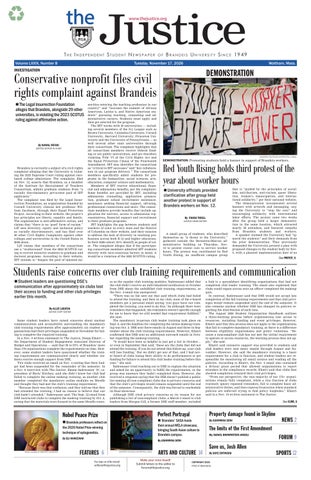
DEMONSTRATION: Protesting students hold a banner in support of Brandeis workers.
Red Youth Rising holds third protest of the year about worker hours University officials provided
clarification after group held another protest in support of Brandeis workers on Nov. 12. By CHAVA THIELL
JUSTICE NEWS EDITOR
A small group of students, who described themselves as “a threat to the University,” gathered outside the Bernstein-Marcus administrative building on Thursday, Nov. 12 to protest recent cuts to service worker hours. The protest was coordinated by Red Youth Rising, an unofficial campus group
that is “guided by the principles of socialism, anti-fascism, anti-racism, queer liberation, women’s emancipation, and international solidarity,” per their national website. The demonstration incorporated several banners with artwork and messaging, urging the University to “stop the cuts” and encouraging solidarity with international labor efforts. The protest came two weeks after the group held a larger demonstration in the same location, which attracted nearly 50 attendees, and featured remarks from Brandeis students and workers. A speaker claimed the University had “ignored the students” and their demands from the prior demonstration. They previously demanded the University present a plan with proposed changes to the student body by Nov. 5, with a planned implementation date of no
See PROTEST, 5
Students raise concerns over club training requirements and communication Student leaders are questioning DSE’s
communication after approximately six clubs lost their access to funding and other club privileges earlier this month. By ALLIE LADJEVA
JUSTICE COPY EDITOR
Some student leaders have raised concerns about unclear communication and accessibility surrounding the mandatory club training requirements after approximately six student organizations had their privileges suspended in November for failing to complete the required training. In a Nov. 9 written statement to The Justice, Deepa Khatri — the Department of Student Engagement Associate Director of Budget and Operations — said that 90 to 95% of Brandeis’ more than 170 organizations complete the requirements on time. However, some student leaders have questioned whether the training requirements are communicated clearly and whether students receive enough support from DSE. Two clubs received an email on Nov. 4 stating that their budget had been suspended for the remainder of the semester. In a Nov. 8 interview with The Justice, Emma Sadewasser ’27, copresident of Boris’ Kitchen, said she didn’t know her club had failed to complete the online makeup training, as another club member completed the mandatory online modules on Moodle and thought they had met the club’s training requirement. “Because there was that confusion, and they told me that they had attended the training, I had no reason to believe that our club hadn’t attended,” Sadewasser said. The Sept. 22 email from DSE instructed clubs to complete the makeup training by Oct. 2, noting that the materials were housed in the same Moodle cours-
es as the regular club training modules. Sadewasser added that the club didn’t receive an individualized notification in October from DSE about the unfulfilled club training requirements, so the Nov. 4 email was unexpected. “There was no list sent out that said which clubs had failed to attend the training, and then in my club, none of the e-board members got a personal email saying ‘you guys have not completed the training, you need to do this.’ So although there were reminders that happened, the reminders weren't specific enough for me to know that we still needed that requirement fulfilled,” she said. The mandatory in-person club leader training took place on Sept. 6, and the deadline for completing the online makeup training was Oct. 2. DSE sent three emails in August and three in September about the club training requirements. However, Khatri confirmed that DSE sent no additional outreach emails in October regarding the makeup training. “It would have been so helpful to just get a list in October… or even in September that said, ‘these are the clubs that did not attend the training. If you do not attend this follow-up, your club will lose funding.’ But we didn't get any of that, and I had never heard of clubs losing their ability to do performances or get funding for failure to attend this club leader training before this year,” she said. Sadewasser tried reaching out to DSE to explain the situation and asked for an opportunity to fulfill the requirements, as the group was unaware they hadn't completed them. However, she received a response saying that the DSE doesn’t publish a public list naming all non-compliant clubs due to privacy concerns and that the club’s privileges would remain suspended until the end of the semester. Consequently, the club was forced to reschedule its final showcase. Although DSE cited privacy concerns as its reason for not publishing a list of noncompliant clubs, a March 5 email to club leaders from Morgan Gill, a former DSE staff member, included
Nobel Peace Prize Brandeis professors reflect on the 2026 Nobel Prize-winning technique of optogenetics. By ELI HANECHAK
Photo courtesy of CREATIVE COMMONS.
a link to a spreadsheet identifying organizations that had not completed club leader training. The email also explained that clubs could regain access once an officer completed the makeup quiz. In contrast, Sadewasser said that DSE would not accept late completion of the fall training requirements and that club privileges would remain suspended until the end of the semester. It also remains unclear whether DSE has changed its policies regarding the distribution of such lists. The August 2026 Student Organization Handbook outlines a three-warning process before organizations lose access to resources, including funding and event privileges. However, Khatri said that this process does not apply to the organizations that fail to complete mandatory training, as there is a difference between eligibility requirements and policy violations. “Because a noncompliant club has not met the initial requirement to operate or access resources, the warning process does not apply,” she said. Khatri said extensive support was provided to students and club leaders were sent many emails through August and November. However, she said the mandatory training is a basic requirement for a club to function, and student leaders are responsible for monitoring all email notices and reading all the policies. According to Khatri, the Nov. 4 email also contained a 48-hour grace period that allowed organizations to report mistakes in the compliance records. Khatri said that clubs that showed completion retained their club privileges. “From our perspective, the vast majority of our 170+ organizations remain fully compliant, while a tiny fraction of clubs routinely ignore repeated reminders, fail to complete basic administrative duties, and then express frustration when standard policies are enforced trying to find policy loopholes,” Khatri said in a Nov. 10 written statement to The Justice.
See CLUBS, 5
Perfect Portrayal
Property damage found in Skyline
Brandeis' SASA hosts their annual MELA showcase, bringing South Asian culture to Brandeis campus.
By ASHHWIKA SONI
The limits of the First Amendment By DANIEL BROWNSTEIN-ANGELI
By ASHHWIKA SONI
FEATURES 6
JULIAHNA FALCIGLA-MATTES/The Justice.
For tips or info email editor@thejustice.org
ARTS AND CULTURE 14
Make your voice heard! Submit letters to the editor to forum@thejustice.org
NEWS 2
Save us, Josh Allen By SKYE ENTWOOD
COPYRIGHT 2026 FREE AT BRANDEIS.
FORUM 9 SPORTS 12
2 TUESDAY, NOVEMBER 17, 2026 ● NEWS ● THE JUSTICE
NEWS
POLICE LOG
MEDICAL EMERGENCY Nov. 6—There was a medical emergency for a party with ear pain. The patient refused medical treatment. Nov. 6—There was a medical emergency for a party with a hand injury. The patient was transported to a local hospital. Nov. 9—The Counseling Center asked for assistance with psych transport. The patient was transported. Nov. 12—A party reported that their roommate was feeling nauseous and couldn’t go to sleep. The situation was cleared. MOTOR VEHICLE Nov. 7—A motor vehicle was stopped for a stop sign violation. A verbal warning was issued. Nov. 7—A motor vehicle was stopped for a stop sign violation. A verbal warning was issued. Nov. 10—A party reported that the front of their car was struck by an unknown vehicle. There is an investigation to follow. Nov. 11—A motor vehicle was stopped for a stop sign violation. A citation was issued. Nov. 12—A party reported that their car was scratched in the East Lot. There is an investigation to follow. NOISE COMPLAINT Nov. 7—A party reported a noise complaint in Upper Mods. The office in charge was notified to respond. MISCELLANEOUS Nov. 6—A party reported a possible larceny of a package from the building. The party called back and reported that
they found their missing package. The situation was cleared. Nov. 8—A caller reported a suspicious party at Foster Mods apartments. The office in charge was notified and responded. The party was gone on arrival. Nov. 9—A party requested help with contacting a Lyft. Services were rendered. Nov. 10—A party reported the bathroom door had been locked from the inside for hours at Rabb Graduate School. Entry was gained, and the bathroom was vacant. The situation was cleared. Nov. 11—A party reported that the bathroom door in his girlfriend’s suite had been locked for a long time, and his girlfriend asked him to check it. Access was gained, and the bathroom was empty. The situation was cleared. Nov. 11—A party reported their dad saw a person wearing construction clothing who appeared to be flying a drone by Chapels Field. The reporting party said that this person was driving a black SUV. The situation was cleared. DIRECTED PATROL Nov. 6—An officer completed a directed patrol of Chapels Field. All appeared in order. Nov. 6—An officer completed a directed patrol of Chapels Field. All appeared in order. Nov. 6—An officer completed a directed patrol of the Rose Art Museum. All appeared in order. Nov. 8—An officer completed a directed patrol of Chapels Field. All appeared in order. Nov. 8—An officer completed a directed patrol of Gosman Sports and Convocation Center. All appeared in order.
Nov. 8—An officer completed a directed patrol of Gerstenzang. All appeared in order. Nov. 8—An officer completed a check detail of Usdan Student Center. All appeared in order. Nov. 8—An officer completed a directed patrol of Gerstenzang. All appeared in order. Nov. 9—An officer completed a directed patrol of Gerstenzang. All appeared in order. Nov. 9—An officer completed a directed patrol of the Mandel Quad. The Golding entrance was not able to lock and a work order was filed. The situation was cleared. Nov. 10—An officer completed a directed patrol of Village C. The situation was cleared. Nov. 10—An officer completed a directed patrol of Cholmondeley’s. All appeared in order. Nov. 10—An officer completed a directed patrol of Chapels. All appeared in order. Nov. 10—An officer completed a directed patrol of Rose Art Museum. All appeared in order. Nov. 10—An officer completed a check detail of Sherman Dining Hall. All appeared in order. Nov. 11—An officer completed a directed patrol of the Admissions lot. All appeared in order. Nov. 11—An officer completed a directed patrol of Rose Art Museum. All appeared in order. Nov. 12—An officer completed a directed patrol of Gerstenzang. All appeared in order. — Written by Allie Ladjeva
Students express frustration over damages to housing An email was sent out earlier this week informing students about the damages to walls, signs and other areas around Skyline, leading to questions about accountability in shared spaces. By ASHHWIKA SONI JUSTICE NEWS EDITOR
Across residential areas at Brandeis, students have seen vandalism of University property. At 4:24 p.m on Nov. 10, students living in Skyline residence hall received an email discussing recent damages to signs across the building. The room numbers outside of the dorms had been ripped off the walls, stripping off the paint and leaving noticeable damage. The ripped walls are present on the first and third floors, with at least six instances of damage total. Additionally, the damages are not only limited to signs — many chairs in Skyline have ripped surfaces. There are huge chunks taken out of the ones placed in the study areas in the hall and in front of the elevator, and student amenities have been
threatened by these acts of vandialism. The email, sent by the Department of Community Living, cited the Undergraduate Room & Board License Agreement 2026-2027 that all students agreed to and signed at the time of registration. “It is the entire community’s responsibility to take care of common spaces,” the email wrote. The department urged students who may have seen these damages happen or know who participated in the incidents to report them. In an interview with The Justice, Lydia Kestnbaum-Cook ’29 mentioned that doing damage to common areas “makes the rest of us look bad, even though we’re treating our space with respect.” The vandalism in Polaris Lounge in North Quad last year echoed a similar issue, as previously reported by The Justice. Students were sent an email and were issued stricter consequences, including a fine and more control of common room privileges. Lucas Dembitzer ’29r recalled similar issues in Massell Quad last semester where there were damages to the ping pong table and the foosballs from the foosball tables went missing. “I think it’s very disrespectful to the people who have to clean up and fix it and take care of facilities,” he added.
Reed Winkelmann ’29 expressed his concerns over these damages, stating “I’m incredibly irritated and disappointed about the way that students are treating campus,” in a written statement to The Justice. As a resident of North Quad last year where the damages to Polaris affected the whole community, he added “I understand that you may be paying 50K or in some extreme cases, 90K a year, but that doesn’t justify destroying public property.” His concern stems from overall consequences to everyone in the building because of one person or group creating havoc. Addressing the vandals, Winkleman said, “not only are you avoiding the consequences by staying silent and continuing the damages, but [you’re] causing the suffering of others because now we all need to pay for the property damages.” Many said that they hope for a change in attitude rather than more restrictions. Dembitzer echoed a similar sentiment, “It makes me really disappointed to see that there are people who treat our community this way,” he stated. “We’re all adults here; just be responsible,” he added. For students, the issue does not just apply to property damage.
Being in a shared space means accepting responsibility for their actions. Dembitzer also said that this is not the only instance of ill use of communal spaces and appliances. “We’ve probably had about five or six fire alarms caused by people misusing community properties,” he mentioned. When asked whether he thinks this issue extends to other spaces around campus, Dembitzer agreed that it does, however it is mostly contained to residential areas. “It’s much more of a dorm and communal space problem than it is a classroom or academic building issue.” Many students took issue with the area-wide consequences, as opposed to holding specifc students responsible for the damages. Kestnbaum-Cook did not understand the point of these damages. “I don’t really see the purpose behind it,” she said. As a previous North Quad resident, this pattern of damages being attributed to the whole community has become insufferable. “We’re getting punished for something that we’re not doing,” adding that she “feel[s] like we’re always getting in trouble for something that a few people are doing.” She added, “People just generally need to treat dorms better.”
ASHHWIKA SONI/The Justice.
Justice
the
The Justice is the independent student newspaper of Brandeis University. The Justice is published every Tuesday of the academic year with the exception of examination and vacation periods. Editor Managing News Features Forum Sports Arts Photos Copy Layout Ads Social Media
editor@thejustice.org managing@thejustice.org news@thejustice.org features@thejustice.org forum@thejustice.org sports@thejustice.org arts@thejustice.org photos@thejustice.org copy@thejustice.org layout@thejustice.org ads@thejustice.org online@thejustice.org
CORRECTIONS AND CLARIFICATIONS
www.thejustice.org
The Justice Brandeis University Mailstop 214 P.O. Box 549110 Waltham, MA 02454-9110 Phone: (781) 736-3750
A news article incorrectly wrote that Marc Better Ph.D. ’82 and Thomas Baker donated $10. They donated $10 million. (Nov.
3, 2)
A news article incorrectly spelled Dahlia Scheindlin. (Nov. 10, 3) A news article incorrectly spelled Noa Balf. (Nov. 10, 3) A news article omitted the Department of Politics as a third sponsor for the “Decoding the 2026 Israeli Elections: What Just
Happened?” event. (Nov. 10, 3)
A sports article incorrectly spelled “Aidan Sherm” in the byline. It should’ve read “Aiden Shern.” (Nov. 10, 12)
The Managing Editor holds office hours on Mondays from 7:30 to 8:30 p.m.
The Justice welcomes submissions for errors that warrant correction or clarification. Send an email to editor@thejustice.org
THE JUSTICE ● NEWS ● TUESDAY, NOVEMBER 17, 2026
3
Giving DEISday commemorated the contributions made by donors towards the Brandeis community. The University brought together students, faculty and alumni for a shared purpose: to support the current students and give thanks to donors.
By ASHHWIKA SONI JUSTICE NEWS EDITOR
Students visiting the Shapiro Campus Center on Nov. 12 were able to participate in Giving DEISday. Giving DEISday is the University’s annual day of philanthropy. According to their website, it “celebrates the people, values, and experiences that make Brandeis extraordinary.” The University’s vision was to bring students, faculty and alumni together and give them a chance to thank the people who help make their education possible. The department set a target of 1,948 donors, a reference to the year of Brandeis’ founding. Donations of any size count towards the total number of contributors. “It is really just a day about recognition more than anything else,” said Assistant Director of Leadership Annual Giving Anna Ziselman ’24 in an interview with The Justice. Students were also
welcome to take part. They could opt to donate a gift in honor of a parent or professor who helped them along the way. “Every gift contributes to the university’s ability to meet its most pressing needs, pursue new ideas and prepare students to make an impact far beyond campus,” the website states. Students were also given the option to write a heartfelt thank-you note to a donor. There were various options for donations apart from the general Brandeis Fund. These funds included the General Scholarship fund, Parents and Families, Clubs and Organizations, Centers and Institutes, Brandeis Hillel, Intercultural Center and Athletics. There were also funds for the Rabb School of Continuing Studies; The Heller School; School of Social Sciences and Social Policy; School of Science; Engineering and Technology; School of Business and Economics; School of Arts, Humanities and Culture; the Rose Art Museum and the Brandeis National Committee. The Giving DEISday website also includes a live counter to show how many people have donated. The number of donors surpassed the original goal, reaching 2,076 donors and a sum of $1,672,749. The class of 2014 donated $33,266 and 20% of the donors were alumni while students, faculty, parents, grandparents and Brandeis National Committee members made up the rest. The donations also came from across the world including China, the United Kingdom, Switzerland, Israel and Canada. The Brandeis Fund is the University’s “grea-
test need fund,” Ziselman added. A challenge raised by Steven Karel, a Brandeis advocate, said he will donate $7,200 to the Undergraduate Summer Science Research Fellowship Fund if 10 donors give in the next day. A completed donation match read; “Gifts from BOLD alumni to the Brandeis Fund will be matched 2:1, up to $5,000, thanks to the generosity of Stevie Rachmuth ’14.” Another match cited a donation of $25 per donor up to $250 for the Faculty and Staff offered by Stephen Rodriguez. In an interview with The Justice, Abigail Frisoli, Director of Marketing and Participation, said “it’s about way more than just keeping the lights on,” when talking about what these donations do for the University. The fund supports faculty research, student scholarships and day-to-day operations to put new tools in classrooms. They also have emergency resource funds that students can use in case they need to take an urgent trip back home, need winter clothing or have other pressing needs. To encourage participation, organizers handed out gifts to individuals who completed the thank-you notes. These items included Brandeis-themed cookies, T-shirts and color changing cups among other items. They also gave out small stickers that read “I [heart] DEIS” and “Brandeis Phonathon.” When asked if they set a goal for the number of cards, Ziselman said, “The more the merrier.” Every card tells a story about a current student and each story shows donors the difference their gifts make. That encourages them to keep
giving and speak well of the University. “It gives a face and a name to their generosity,” she said. Yonatan Eyov, Assistant Director of Leadership Annual Giving in an interview with The Justice that many of the students who came by. Several of them were surprised to learn that alumni donors help fund their experience at Brandeis. Giving students a part in the thank you process helps connect the people who give the money to the ones who benefit from it. Many organizers were Brandeis graduates. In an interview with The Justice, Dave Marino, M.A. ’19, the Brandeis Advancement Communications staff member said, “I saw it as a student, now I’m experiencing it as a staff member.” The shared hope is that Brandeis students have what they need to thrive academically and socially, as well as cultivate a rewarding time at Brandeis. Rob Evans, Executive Administrator for Brandeis Institutional Advancement described Giving DEISday as “a wonderful chance for students and stakeholders alike to engage with each other and support the areas of the University that they care most about.”
Club Close Up: Bandapalooza On Nov. 15, from 7 p.m to 11 p.m, MAD Band organized Bandapalooza featuring clubs, bands and including Top Score, Klezmer band, Fiddle Club, The Lockpickers, Dogwai, Andy Magic, Unhoused Jazz and Primordial Mash. It was a night to celebrate jazz, rock and everything in between. — Editors Note: The Justice News Editor Chava Thiell is a member of the Klezmer band and did not edit
or contribute to this blurb.
Photos: KELLY HUANG/The Justice. Design: ELLIE JI /The Justice.
4 TUESDAY, NOVEMBER 17, 2026 ● NEWS ● THE JUSTICE
NEWS
SENATE LOG
The meeting was called to order at 7:03 p.m. by Monica Lopez-Hernandez ’28, Vice President of the Student Union, after which she proceeded to take roll call. Nathaniel Revere ’30, President of Moot Court Club, presented about why the club should receive probationary status. He began by explaining that, in Moot Court, facts are presented as two appellate cases from lower courts, in contrast to Mock Trial, members ask and cross-examine witnesses with opening and closing arguments. Additionally, Moot Court would offer a microcredential in Legal Reasoning through the Center for Applied Liberal Arts, which is a unique benefit compared to other clubs at Brandeis. Another difference is that it participates in the American Moot Court Association, rather than the American Mock Trial Association. After clearing up the potential for duplicity of purpose, Revere described the educational value of the club, noting that it involves oral and written persuasion and develops participants’ critical thinking skills. Additionally, Revere highlighted strong initial student interest, citing 31 sign-ups on their interest sheet and 16 attendees at their first meeting,
as well as plans to host legal workshops — bringing in guest speakers like Legal Studies Chair Daniel Breen (LGLS), Prof. Anita Hill (WGS/LGLS/AAAS) and Pre-Law Advisor Lauren Dropkin — and visit the First Circuit Court of Appeals in Boston’s Seaport district. Revere also introduced some of the club’s executive board: Aside from Revere, ce-board members include Outreach Coordinator Ashhwika Soni ’29 and Secretary Ariel Knudsen ’29, a Senior Editorial Director, as well as Outreach Coordinator Isak Polak Singh ’30 and First-Year Representative Rose Fioribello ’30. After presenting, the Senate deliberated on Revere’s presentation and whether to accept Moot Court as a probationary club. Senator-at-Large Ellie Ji ’28 cited concerns that they had been unprepared in the past, and did not appear at the previous Senate meeting due to a lack of communication. Elle Brown ’30, Senator-at-Large, also argued that there should be older students involved in the club to help demonstrate administrative efficiency. Tyler Parshay, class of 2030 senator, chimed in and added that he shared concerns about organization and structure. Parshay
asked whether they could deny them and have them come back later. However, Executive Senator Luke Farberman ’27 noted that given the time left in the semester, they would have to restart the process in the spring. This would mean that the club would need to go to the club information session, submit documents again, get their meeting audited and go before the committee. While Brown and others initially stressed that a denial would not be permanent, but rather an opportunity to reorganize, Senator-at-Large Judah Friedman ’28 argued that when he attended the club’s meeting it seemed well organized. Senator-at-Large Jordan Medved ’28 similarly praised Moot Court, contending that it would be great preparation for pre-law students at Brandeis who want to attend law school, given that Brandeis does not offer a legal studies major. The club narrowly ended up receiving probationary status following a recount prompted by confusion over how senators should voice their votes, passing with five in favor, four opposed and seven abstentions. Afterward, Lopez-Hernandez and Farberman congratulated the president and confirmed the club had secured probationary status,
adding that he will receive an email from Ji with information on how to get in touch with the Department of Student Engagement to set up Campus Groups. Medved, who also serves as Chair of Campus Life, ended by discussing efforts to bring back microwaves and mini-fridges, adding that he discussed dining priorities including to-go lids and bringing back a burger option at the Stein with Associate Vice President for Campus Services Sue Scannell. Finally, Lopez-Hernandez disclosed that the Senate has an approved budget for a final study session with boba and Insomnia Cookies in the Skyline Multipurpose Room on Dec. 2 from 7 to 8 p.m. — Written by Ariana Agarwal — Editor’s Note: Justice Layout Editor Ellie Ji is a Student Union Senator and did not edit or contribute to this article. — Editor’s Note: Justice News Editor Ashhwika Soni and Forum Editor Ariel Knudsen are members of Brandeis Moot Court and did not edit or contribute to this article.
Parking policies draw criticism over accessibility and costs. Students and faculty have questioned the accessibility and allocation of campus parking spaces as Brandeis continues to address parking challenges. By ALLIE LADJEVA
JUSTICE COPY EDITOR
Students have raised concerns about the convenience, affordability and accessibility of campus parking, questioning whether existing policies adequately address their transportation and mobility needs. “I am grateful to have had any accommodations at all, but it hasn’t really been accommodating for the reasons I need,” Gabi Thomas ’28 said in a Nov. 16 written statement to The Justice. The University commissioned a parking study in June 2024, and completed a follow-up occupancy review in October of that year. Both studies, along with the work of the University’s Parking Advisory Committee, informed an August 2025 “Final Parking Recommendations” report. The report outlines major parking challenges, including the projected loss of over 340 parking spaces due to construction. Other listed challenges are inequitable access between different members of the Brandeis community, outdated signage and limited accessibility for disabled individuals. Thomas is a residential student on campus but often commutes to her home, which is an hour away. She has accommodations because of frequent travel to doctor’s appointments. She has been assigned a space in the Charles River lot, and was denied access to closer lots due to potential capacity constraints, even though she has seen empty spaces at some of these lots. “They do not take into account the fact that I have an ESA [emotional support animal], so I can’t just take her from Charles River to my dorm on the shuttle. My disability impairs me from walking long distances, and I have to do so at least once a week because there is no way for me to get from off-campus parking to my on-campus dorm with my dog,” she said. In a Nov. 16 written statement to The Justice, Matt Rushton, assistant vice president for Public Safety and chair of the Parking Advisory Committee, said that the
University offers a free Accessible Transportation Service for students with temporary or long-term mobility limitations. As a chair of the Parking Advisory Committee, he added that the committee has recommended improving accessible parking on campus. Other students also described challenges related to the distance between their assigned parking lots and campus facilities, even when they don’t have mobility accommodations. In a Nov. 13 interview with The Justice, Emma Dionne ’28 said that she has accommodations that allow her to keep a vehicle on campus and has been restricted to parking in the Foster Mods or Charles River lots. “Especially last year, it was really tough when I was living in East. I’d have to go all the way down to Foster Mods, which was a little bit of a hike. I’m very lucky that I don’t have any mobility restrictions,” she said. Dionne said that the University’s communication about parking restrictions could also be improved. Construction work on the parking lot surrounding 95 Sawyer Road affected Charles River parking between Oct. 7 and 18, as students were allowed to park only at J-Lot or the Charles River lot near buildings 110 and 111. Students received an email from the Department of Community Living on Oct. 7 at 12:14 p.m. to move their vehicles if they had parked near Lower Road by the river, as their cars could have been subject to towing. The email caused Dionne significant stress, who was already on her way to class. She sent an email to DCL explaining she couldn’t move her car until later that day, after which she got a reply saying she could move her car by the next morning without any sanctions, which wasn’t sent in the original email. “I was just so frustrated. I couldn’t pay attention to my classes [because] I was worried about my car. I did not want it to get towed. If we just had been told earlier, this whole problem could have been avoided,” Dionne added. Dionne also shared that some of the parking policies have been unclear to students. The Brandeis community does not have to follow regular parking hours during designated holidays, but Dionne said it is confusing which holidays count under this rule, which led to her getting a ticket. “Last year, I had ended up parking in front
of East on Loop Road during Rosh Hashanah, and I was like, ‘Oh, this is a holiday, so I can park there. That’s going to be totally okay.’” Dionne said she then recieved an unexpected $40 ticket. According to Brandeis’ website, regular parking regulations are in effect Monday to Friday, 7 a.m. to 5 p.m., with the exception of University-recognized staff holidays. If there are no classes but staff members are working, normal parking rules apply. Certain parking areas and permit categories are subject to additional restrictions outside these hours. For example, faculty and staff with valid permits may park in designated lots between 7 a.m. and 2 a.m., while resident students are limited to their assigned parking areas, where they may park 24 hours a day. As per parking regulations, staff and faculty members are eligible to apply for permits and do not have to pay for them. Commuting students are also eligible for permits, but they must pay an annual $150 fee. Among resident students, only seniors are allowed to apply for a permit, and they have to pay an annual fee listed as $225 on one University webpage and $250 on another. Other students may also request exceptions to the eligibility restrictions. Laiba Haseeb ’28, a residential student who keeps her car on campus, believes that parking should be more affordable for students. “I think it’s kind of personally a little outrageous that we have to pay for a permit when we’re already paying to go here for tuition. It’s like we’re all students here. Also, most people, including myself, have our car out of necessity because we have to go to work,” Haseeb said in a Nov. 15 interview with The Justice. Thomas also believes that students should not be paying for parking on campus. “It’s honestly kind of ridiculous to me that a student who already attends on scholarship and financial aid, and needs this accommodation due to a disability, has to pay such a fee,” she said. Rushton said that employee parking has historically been free, as it is seen as part of the University’s employee benefits. He said that the committee recommended keeping student fees while implementing some system improvements, which he added is a “typical approach across higher education.” A faculty member also raised a concern over the maintenance of parking lots,
specifically the use of reserved spaces. In a Nov. 12 interview with The Justice, Professor Nader Habibi (ECON) said that he drives to campus and has a permit to park in north campus. He said that some of his students have faced difficulty finding parking on campus and questioned whether reserved spaces on campus are justified and maintained properly. “You have certain spots for dining services, some spots for community leaders. For example, the residential hall staff. But why is that the case? Who deserves an exclusionary spot? This has to be justified. And then the marking is not clear. You don’t know if it’s exactly reserved or not because the signing is old and it’s hardly visible,” he said. Prof. Habibi also added that there are some spots on campus that are currently unused due to visibility concerns, and proposed light-up pedestrian signs to make sure that both drivers and people walking were safe. “Given the shortages that we have, it would be good to use an alternative way so that those [parking spots] can be utilized, but [make sure] the walkway next to them would also be safe for all the pedestrians.” Rushton acknowledged that improvements can be made to reserved parking spots. “The Parking Advisory Committee recommended reducing reservations tied to individual job titles or departments and making more spaces available for shared use. Admissions and visitor parking, accessible spaces, service areas, and other essential operational spaces may still need specific designations,” he said. Rushton added that the Parking Advisory Committee has recommended “standardizing accessible parking signs and pavement markings and improving clarity across campus” and reviewing accommodations procedures. The 2025 report also recommends expanding commuter students’ access to inner campus lots and expanding parking access hours for all students.
Brief: The Kraft Group proposes a $16 billion data center campus south of Worcester. After donating $10 million dollars to the new Kraft Center for Jewish Life and Leadership at Brandeis, Robert Kraft has his eyes set on a new business endeavor. The Kraft Group and the Unified Global Packaging Group have proposed the development of a new data center campus in the town of Sutton, Massachusetts. The data center is estimated to draw 900 megawatts of power and, upon completion, would be valued at over $16 billion, according to a memorandum from Sutton town manager Austin Cyganiewicz to the town’s select board. For reference, one megawatt can power approximately 1,000 homes according to the United States Department of Energy. The campus would
be composed of ten buildings; two would be expected to be completed in 2029, with two more built each year through 2033. The proposal is currently described as “tentative” by Cyganiewicz, who stated in the memo that no official application has been filed, and several important logistical details have yet to be determined. Governor Maura Healey’s Executive Order No. 658 states that, in order to receive state permits, any new data center development must have local approval and a community benefits agreement and pay for its own power grid costs. The center must also contribute to a Ratepayer Protection Fund if it does not create its own clean energy and
meet certain standards related to “air quality and public health, water use, and community engagement.” While some are wary of artificial intelligence-related data centers, the proposed project has a major financial benefit for Sutton and its residents. Cyganiewicz’s memo explains that, using conservative estimates, the campus would raise about $27.8 million in property taxes for Sutton by fiscal year 2035. Sutton has a tax levy of roughly $32 million, and since the town only raises enough to meet their budget from taxes, the data center campus could lead to drastic tax reductions for residents. The memo estimates that the average tax bill for a single-fa-
mily residence could be lowered by $5,800 in fiscal year 2035. Despite the financial upside, some Sutton residents have spoken out against the data center complex. Community members expressed their concerns during a select board meeting, appealing to the board to deny the proposal, according to MassLive. Additionally, a petition calling for a comprehensive study of water, noise and power grid effects prior to any vote, has reached 394 signatures, as of press time.
— Written by Skye Entwood
THE JUSTICE ● NEWS ● TUESDAY, NOVEMBER 17, 2026 5
PROTEST: University affirms student activist group's claims about workers CONTINUED FROM 1
later than Nov. 20. Since the University failed to meet that deadline, the group articulated an unwavering interest in continuing to advocate for Brandeis workers: “We have not forgotten and we will not forget,” a student said. The group transitioned to speeches from attendees, who addressed a range of issues including worker hours, campus accessibility and Brandeis’ spending. A speaker believes that disabled students have “next to nothing in the way of accessibility” and criticized the lack of dining options on upper campus on the weekends, as well as limited options for students with allergies. They also likened the struggles of students and workers, and argued that Brandeis has “continue[d] to cheat and grift us.” The student concluded their speech, after which the group proceeded in a round of chants. “When workers and students are under attack, what do we do? Stand up, fight back!” Another student delivered a speech, and presented their own experience as a student with disabilities. The student spoke about their experiences with Brandeis dining, and shared that because they struggle with sensory issues, they often cannot eat in the louder dining halls. As a result, the student has skipped meals or opted to eat outside, but expressed concern about doing so in the colder weather. The student also expressed dismay at the fact that Brandeis doesn’t offer sensory-friendly dining and argued the school “needs to support students in getting food.” They concluded with a show of support for Brandeis workers and argued that “they [the administration] care more about money
ACTIVISM: A sign displays unity.
than they do about students or employees.” Another speaker delivered remarks sarcastically noting Brandeis’ successful fundraising year by claiming that the University is “dirt poor.” The student also criticized the number of administrative staff, who they alleged receive six-figure salaries. The student also alleged the University shared in their last faculty meeting that they plan to offboard 50 professors. They expressed frustration as an education major, as they hope to pursue a career in secondary education and no current department faculty specialize in that area. Consequently, the student has had to begin taking courses at Boston College. Additionally, they expressed frustration with the limited number of teaching assistants in their courses. “I personally wouldn’t pay 10 dollars for this type of education.” The student transitioned to speak more broadly about international struggles for workers rights. They pointed to recent protests across Europe and argued that these manifestations are the product of discontent with the capitalist system. Another student spoke and expressed their appreciation for the Brandeis dining workers. To the student, “Brandeis is nothing” without its workers. The student also spoke about their personal concerns as a future member of the workforce and being treated poorly by employers. It is “imperative we stand against the oppression of workers,” the student said. After they concluded, the group again erupted into several chants. “Brandeis, Brandeis, shame on you! Workers need hours and we need food!” and “What do we want? Dining
hall hours! When do we want them? Now!” The group also made a pointed chant toward President Arthur Levine ’70. “Arthur, Arthur, you’re a liar, you keep getting more staff fired!” A previous speaker delivered more remarks, again emphasizing concern about one day being in the workforce. The speaker described their current struggle with the University administration as “incredibly demoralizing to fight” but one that “we know we’re going to win.” They concluded by urging attendees to ask their parents to email the University about the concerns. A final speaker admitted they hadn’t done enough to support the Nov. 12 protest and, consequently, attendance was lower. However, they implored other students to connect with their network and urge them to support the workers and connect with RYR. A representative of RYR concluded the protest by promoting an upcoming educational event about fascism. They also shared that the group would be raising money for a pregnant woman in Gaza. The student also took the chance to allege that “the University doesn’t have money for us but they do for Israel,” and that these global issues are “all connected.” The group also claimed the University had “illegally threatened the workers” with retribution and termination in an Oct. 28 email to service workers. According to representatives from RYR, the email threatened workers who participated in the demonstration with disciplinary action and further retaliation. In a Nov. 13 written statement to The Justice, Executive Director of Harvest Table JP Fes-
JULIAHNA FALCIGLIA-MATTES/The Justice.
PROTEST: Protesters stand for workers rights.
ART: Protesters hold a painted banner.
perman shared that “Harvest Table Culinary Group remains committed to working collaboratively with the union to address concerns and support constructive dialogue on issues affecting Brandeis Dining employees.” Fesperman clarified that certain activities such as participating in a strike, work stoppage and boycotts, among others, are not allowed under the current agreement between the University and the workers’ union. He also shared that “no prohibited activity was reported, and no action against any employee is pending or expected.” In a Nov. 12 written statement to The Justice, Assistant Vice President for Marketing and Communications Michelle Gaseau confirmed that the University contracts with Harvest Table for dining services, and all dining employees are employed directly by Harvest Table as opposed to the University itself. However, dining services are overseen by Brandeis’ Campus Services. Both Scannell and Fesperman confirmed the Oct. 28 email communication sent to dining staff. According to Fesperman, “[Harvest Table] recently shared a verbatim reminder of those existing terms, and we remain committed to honoring employees’ rights to take part in activities protected by law.” While the Nov. 12 event did not attract the same turnout as RYR’s previous protest, the group felt confident that their efforts were not in vain and will ultimately be successful in the long term. “We’re going to threaten the University more,” a speaker promised at the protest’s conclusion. “We’ll be back.”
JULIAHNA FALCIGLIA-MATTES/The Justice.
CUTS: Students say the cuts must be stopped.
JULIAHNA FALCIGLIA-MATTES/The Justice.
JULIAHNA FALCIGLIA-MATTES/The Justice.
CLUBS: Student leaders voice confusion about DSE communication and policies CONTINUED FROM 1
Some clubs attended the in-person training but did not complete the check-out process properly. “If a student actually attended but experienced a technical issue checking out on The Nest, our staff readily works with them to verify their attendance and rectify their status, and we had some students we worked with on the same issue,” Khatri said. Keva Singh ’30, a freshman representative for an affected club, shared a different problem with the training requirements. In a Nov. 12 written statement to The Justice, they said that a club member attended the training but encountered difficulties with the check-out process. Singh said that, as of Nov. 12, the club had not heard back from DSE about any updates, prompting them to postpone many of their events to next semester. Singh also raised concerns about the accessibility of these mandatory trainings. “Accessibility is a constant process that re-
quires vigilance at all times, and as such, can be easily overlooked, but is incredibly necessary to hold at the core of any happenings. Though the location is no longer physically inaccessible, accessibility for people with mental disabilities has been overlooked by making the mandatory training so long and overwhelming,” Singh said. In addition to club leader training overseen by DSE, student leaders also have to complete treasury training through the Student Union Treasury. The Student Union Treasury sent an email on Sept. 17 outlining all the clubs that haven’t completed their treasury training requirements yet. In a Nov. 9 written statement to The Justice, Mateo Levin ’27, president of J Street U, said that he faced challenges trying to reallocate the budget for a new event. He shared that it was difficult to get support, as it took “a bunch of emails,” including communication with DSE.
“I really do think they are trying to do their best, but the system is a bit of a mess,” he said. The same concerns about the training system were expressed by a treasurer from another campus organization, who asked to remain anonymous. In a Nov. 9 interview with The Justice, he said he has attended treasury training multiple times and has extensive experience with the different policies. From his perspective, “In my almost two years of doing this work, I have noticed bureaucracy getting worse and worse throughout the years, and the rules getting stricter and stricter.” He added that even though he is able to follow the rules, he knows people get overwhelmed with the process. “They send you so many emails, and there are so many different rules to keep track of that it could get lost in the weeds. And they expect a lot of treasurers,” he said. He suggested streamlining processes for events and finances. He mentioned the three-week notice deadline
that student organizations must give to DSE in advance as an example of stricter policy. In a Nov. 15 written statement to The Justice Student Union President Daniel Shin said that the Student Union is “aware of these concerns and initiated a conversation with DSE.” Shin said that although the Student Union believes that student organizations must follow all policies and procedures as outlined in the Student Handbook, they can support students if they feel that they received “inadequate communication from DSE.” “While the Student Union does not necessarily have the authority to overturn DSE's decisions, we can serve as a mediator to facilitate constructive dialogue, ensure that student concerns are heard, and work toward a fair resolution,” Shin said. He also added that the Student Union is willing to work with DSE to ensure that training requirements are communicated clearly to students.
features
6 TUESDAY, NOVEMBER 17, 2026 ● FEATURES ● THE JUSTICE
just
VERBATIM | LOUIS D. BRANDEIS If we desire respect for the law, we must first make the law respectable.
ON THIS DAY…
FUN FACT
Abraham Lincoln begins first draft of his Gettysburg Address.
The first national Thanksgiving was largely to celebrate the new U.S. Constitution.
Weil’s closure after more than a century The dissolution of Weil, Gotshal & Manges, a historic law firm whose founding parallels that of Brandeis University, indicates the growth of financial incentives in the legal industry.
By ALYSSA WU
JUSTICE FEATURES EDITOR
Brandeis was founded in 1948 in honor of Louis D. Brandeis, the first Jewish justice of the United States Supreme Court. The University was founded by the American Jewish community at a time when Jewish students faced discrimination and admissions quotas at other elite universities. 17 years earlier, Weil, Gotshal & Manges was founded in New York City by three Jewish attorneys who faced similar barriers in the legal profession. A century after its founding and despite generating billions of dollars in annual revenues, Weil is preparing to wind down the entire firm. This follows from a wave of partner departures and failed merger talks. Weil, Gotschal & Manges LLP is a multinational corporate ‘big law’ firm widely known as a top powerhouse in bankruptcy and insolvency law. In 2025, Weil reported revenues of over $2.02 billion and ranked #15 in the 2026-27 Vault 100, an annual ranking of the nation’s most prestigious law firms. Despite this prestige, Weil’s leadership announced internally on Oct. 28 that they recommended dissolving the firm. This decision has come after a line of partners and rainmakers leaving for rival firms. The firm was also reportedly in merger talks with Willkie Farr & Gallagher, though the discussions ultimately fell through. Partners of the firm approved the dissolution on Nov. 10, and the firm formally announced its liquidation plan on Nov. 13. The firm has represented debtors in six of the 10 largest U.S. bankruptcy filings in history. In an article on
Oct. 28, The Wall Street Journal wrote “For half a century, when America’s largest corporations faced financial duress, their first call often went to one firm: Weil Gotshal & Manges.” Matthew Bloch ‘77, a Brandeis graduate who earned his J.D. from Boston University in 1984, is
end up with [the] firm disappearing,” said Bloch in a Nov. 10 interview with The Justice. The firm’s closure has left hundreds of attorneys and staff members facing uncertainty about their futures. “It’s a cold slap [in] the face, really. I’m fairly certain the firm is going to
a retired partner at Weil, Gotshal & Manges’ New York office. Bloch was head of the Firm’s Capital Markets practice and chairman of the Firm’s Professional Development Committee. Retiring in 2014 after over 30 years at the firm, Bloch was stunned by the news. “I was shocked. I still know people who work there … I saw notes about people leaving and people coming. There was a lot of turnover, but I never thought that it would just
do its best to take care of everyone but ultimately, people are going to be left to their own devices. I’m hopeful that everyone ends up on their feet and doing okay. But it’s tragic,” said Bloch. Frank Weil, Sylvan Gotshal and Horace Manges first established the practice as a boutique firm representing factoring, textile and retail clients, hiring Jewish attorneys who were locked out of other major firms.
Design: ALYSSA WU/The Justice. Photo courtesy of CREATIVE COMMONS.
After World War II, major law firms on Wall Street often mainly hired Protestants because “the high standard of honesty and efficiency and professionalism could be associated with Protestants, but not with Jews. Because Jews were thought to be more into money making,
Cravath, Swaine & Moore, Sullivan & Cromwell, and Davis Polk & Wardwell. As a result, many Jewish lawyers saw an opportunity to found their own practices. “If you were Jewish and you went to a really good law school, but you couldn’t be hired by the big firms on Wall Street,
nesses struggled financially during the economic downturn, the firm found success in representing companies and creditors. “That’s how Jewish law firms began to prosper. They would actually represent clients of bankruptcy. The big law firms thought bankruptcy was a failure. They wanted nothing to do with that. But the Jewish law firms would handle bankruptcy and they’d handle real estate, real estate transactions often what Jewish law firms did. And they prospered because the other big traditional firms didn’t want to do that.” said Breen. Reflecting on his time at the firm, Bloch believes that the firm’s foundations of inclusion were still very much present. “[The] DNA of the firm was very much in evidence. The firm, historically, again, as partly as a result of where it came from, when Jewish lawyers couldn’t get jobs on Wall Street. … that kind of chip on their shoulder, drove the firm and drove the people at the firm to work really hard to build the firm into what it became, which is LAW: Weil is a prominent multinational law firm. what makes this whole end game so tragic,” explained Bloch. according to the old ste- why not form your own As the firm grew, inclureotype,” said Prof. Daniel firm? And so by World sion and diversity stayed Breen (LGL) in a Nov. 11 in- War II, you began to see a part of the firm’s founthese big Jewish law firms. dational identity. In Nov. terview with The Justice. This discrimination And they were just as effi- of 2023, amidst a large rise was the foundation of the cient, just as professional in antisemitic indigents “white-shoe” law firm, a as the other law firms,” across elite U.S. univerterm historically used to said Breen. sity and law school camdescribe elite, long-estabFounded during the puses, Weil joined a group lished American corpo- Great Depression, Weil, of other major law firms in rate law firms that grew Gotshal & Manges built issuing a joint warning letout of the East Coast white its reputation by taking ter to law schools, stating Anglo-Saxon Protestant on bankruptcy and re- that escalating harassment (WASP) and Ivy League es- structuring cases, areas of Jewish students would tablishment. These include of law that many estab- carry direct consequences some of today’s most pres- lished Wall Street firms for corporate law firm retigious law firms, such as typically avoided. As busi- cruitment.
THE JUSTICE ● FEATURES ● _TUESDAY, NOVEMBER 17, 2026 7
JUSTICE: The legal industry should advocate for the common good. It goes without saying that the founding of Weil is a parallel to that of Brandeis. “Brandeis University as a university and an institution [was] founded on Jewish values. [Students] came to Brandeis because quotas made it impossible for them to go elsewhere.” said Prof. Jonathan Sarna (NEJS) in a Nov. 12 interview with The Justice. The departure of several partners played a big role in the firm’s closing. Weil struggled to find a successor to Barry Wolf, its longtime executive partner, as he prepared to step down. Recently, several partners departed for competitor firms including Michael Aiello, the firm’s mergers and acquisitions chair, who announced plans to join Cravath, Swaine & Moore. A law firm’s greatest assets are its lawyers and the client relationships they have built over the years. When prominent partners leave for competing firms, they can take those relationships and the revenue they generate with them. For Weil, this created a vicious cycle: as more partners departed, concerns about the firm’s stability grew, prompting others to leave as well. The resulting exodus, sometimes described as a “partner run,” resembles a bank run, where fears of instability drive withdrawals that only make the situation worse. When partners leave, many of the clients follow them to their new firms. “Their loyalty is with the people who they know. And so they’re going to take the work to whatever law firm those partners go to,” said Bloch. “[Clients] hire law firms, but they really are hiring individual lawyers or a team of lawyers … You don’t go to a law firm because you’ve heard the name somewhere. You go to a law firm because you know or [are] introduced to a specific lawyer. And so those are the lawyers who are kind of commonly
referred to as rainmakers.” Weil, Gotshal & Manges is not the only major American law firm to dissolve. In 2012, Dewey & LeBoeuf, another prominent New York firm, collapsed following financial difficulties and partner departures. This could be the start of a pattern of dissolutions as more major law firms compete aggressively for high-producing partners, offering increasingly lucrative compensation packages to attract attorneys and the clients they represent. “The shift to money-making and revenue in law as a business hasn’t just happened right away. It’s been going on for 40 years. And it has changed the way firms think of themselves. And the good thing is, it means they’re more meritocratic. We just want to hire the best students. That’s the good thing,” said Breen. “But the bad thing is you lose that exalted image of the law as a calling, where you’ve got higher ideals in mind, give the best advice, help your clients, [and] make the world perhaps better as you do that.” Bloch pointed to the change in the meaning of what being a partner meant. “I think the nature of the practice and the nature of the relationships among partners has changed, and that’s throughout the whole industry … It wasn’t just a corporate structure. People actually felt like they were partners with each other. I don’t think that’s necessarily the case anymore.” said Bloch. “I think now what’s holding people together is the prospect of making a lot of money. And if that’s the only glue that’s holding a firm together … if that’s the only glue that’s holding a firm together, then … that’s not enough to keep people [tied] to each other,” continued Bloch. Breen agreed, believing that this change in the onus of being a partner has led to a lot more movement between jobs. “The
JUDGE: Louis D. Brandeis was the first Jewish person appointed to the Supreme Court.
whole idea of a partner is really exalted because you owe certain obligations to a partner, moral duties to a partner. It’s a big deal in the law. But you might forget some of that and just think of yourself as something else. And then it’s easier for you [to] leave, set up on your own. violate some of those duties if you think maybe that’s better for your bank account. And that’s probably one of the most unfortunate aspects of all of this.” said Breen. Looking into the future of the field, Bloch believes that the growing emphasis on financial gain has changed what it means to be in the legal profession. “If what you’re interested in is maximizing the amount of money that you make, and that’s kind of what the capitalist system drives us towards, you’re going to move,” said Bloch. “I think the days of the camaraderie-oriented partnerships which is what people of my generation joined, I think those are probably a thing of the past.” Bloch recounted a potential connection between this phenomenon and what happened in ‘big law’ and President Trump
straightforward legal advice. Brandeis’ concept was that a lawyer should be someone who does not just focus on the client’s bottom line and making profits but rather to “make the client more efficient and a better, more responsible social actor” in the long-run, said Breen. “The lawyer was supposed to be a wise counselor for Brandeis.” Breen continued. “[It’s] not a strictly money-making proposition. [It’s] the way to fit into a greater social vision about what a profession should do. And that’s what the law should be for him.” Breen referred to the same scenario as Bloch, pointing out that the priority of the business being profits is what tempted many firms to give into the Trump administration. “You wouldn’t do that if you were a firm committed to higher moral ideals. Which, in Brandeis’ estate, was what he thought firms ought to be.” said Breen. One reason for these shifts is the change of the foundational structure of law firms. The Cravath System, pioneered by Cravath, Swaine & Moore around the 1900s,
CITY: Many pretigious law firms are located on Wall St. In 2025, the Trump administration began targeting major law firms through executive orders and other forms of pressure. Most firms reached agreements with the administration rather than fighting its actions, with only four firms choosing to fight the administration in court. Bloch likened this reaction to an “existential crisis” grounded in the notion that fighting the administration would lead to a loss of clients. “Everyone just either conceded or did nothing with a few notable exceptions. And I think that what drove them to do that, is a fear of losing clients and losing money. It’s the same impetus that’s driving firms to compete for partners with more money. It’s all about money.” said Bloch. Looking back at our university’s namesake, the legal industry today seems to have strayed far from Louis D. Brandeis’ vision of what it means to be a lawyer. Before even serving on the Supreme Court, Brandeis championed pro-bono work in the public interest, becoming known as the “people’s attorney.” During his time on the Supreme Court, Brandeis fought against corporate trusts, for the right to privacy and free speech. When asked what Louis D. Brandeis might have thought of the direction the legal industry is heading, Breen was confident that he would have disapproved. Breen stated that “Brandeis’ ideal really was the loftiest of all legal ideals,” believing that a lawyer’s role extended beyond
groomed lawyers straight out of law school and the pay scale for partners was tied to their loyalty and time at the firm. Beginning in the 20th century, firms and individual lawyers looking for more profit generated a new model where firms lure partners away from competitors with larger salaries. As this model becomes more pervasive, firms unable to match the enormous salary options will have to watch more and more rainmakers leave and struggle to survive against the few ever-growing conglomerates. Weil, Gotshal & Manges seems to have faced this exact fate; despite a net profit, it was still unable to compete with even larger firms who could offer heftier salaries. To reflect on what this means in the larger picture, Bloch states that “It’s not exactly the end of an era, but it’s a symptom of a phenomenon that will continue to unfold,” he said, describing how large corporate law firms are becoming increasingly focused on maximizing profits while “whatever human touch there ever was gets more and more attenuated.” For firms that fall somewhere between the industry’s biggest players and smaller competitors, Weil’s collapse may serve as a wake-up call about their long-term survival. For Brandeis’ future lawyers, it seems unclear how the culture at law firms will continue to evolve.
Photos courtesy of CREATIVE COMMONS. Design: ALYSSA WU/The Justice.
8 TUESDAY, NOVEMBER 17, 2026 ● FORUM ● THE JUSTICE
Justice
the
Established 1949
Brandeis University
Nawal Irfani, Editor in Chief Skye Entwood, Managing Editor Iyla Lichtenfeld, Bryan Wolfe, Zoe Zachary, Deputy Editors Rueben Gartenbach, Miriam Grodin, Jonas Kaplin, Keira Shear Associate Editors Ashhwika Soni, Chava Thiell, News Editors Alyssa Wu, Features Editor Ariel Knudsen, Forum Editor Luca D. Jordan, Ben Khayat, Sports Editors Sophia Garcia, Arts & Culture Editor Juliahna Falciglia-Mattes Photography Editor Allie Ladjeva, Rivka Resnick, Copy Editors Ellie Ji, Layout Editor Asher Barel-stout, Advertising Editor Ellie Harris, Online Editor
EDITORIAL
Addressing Brandeis accessibility Since our founding, Brandeis has prided itself on being committed to social justice and the inclusion of all people. However, a university’s commitment to inclusion means little if students, staff and faculty cannot fully access all parts of campus facilities or participate in all aspects of university life. According to a Nov. 16 statement from the administration, Brandeis is compliant with the American Disabilities Act. However, compliance with ADA does not necessarily mitigate accessibility concerns that students may have in their everyday lives. Given a number of recent concerns about accessibility brought up by students at the Oct. 15 undergraduate town hall, this editorial board believes that Brandeis must do more to address these issues. Most importantly, Brandeis needs to make its bureaucratic process for both requesting accommodations and reporting accessibility concerns easier for students to manage, which would help make students feel heard when they seek support, even if Brandeis cannot perfectly accommodate needs. These concerns regarding accessibility on the Brandeis campus are not new and have been a point of contention between students and the University for years. The Justice Editorial Board previously wrote an editorial in 2024 about a lack of accessibility features in housing options and academic buildings, as well as an understaffed Student Accessibility Support office. Additionally, in a 2024 blog published by a substack forum called Open-Air Journal, Anna Ardelean MPP ’24 and Haley Gervino MPP ’24, criticized Brandeis for failing to provide adequate infrastructure and support services for students with disabilities. They highlighted issues with elevators in some buildings being out of service for long periods of time, the fact that not all student housing is accessible as well as the significant burden placed on students to advocate for basic accommodations, adding another layer of stress to students’ lives. In more recent history, Brandeis’ town hall became the locus for additional student concern about an overall lack of accessibility on campus. This editorial board acknowledges that Brandeis has taken steps to address accessibility issues, including building ramps for academic buildings — a recent ramp was added to the Golding-Judaica building in Mandel Quad — and building a new residence hall with “full building accessibility,” but additional steps are needed to sustain and center the lives of students. That being said, the most important step is making the bureaucratic process more efficient and easier to access. The Student Accessibility Support office engages with all requests for accommodations, from academic to residential needs. According to their website, SAS “appreciat[es] the strengths and needs of all students, … [and] seeks to promote the growth of undergraduate and graduate students.” For all accommodations, students must first communicate with SAS about their individual needs and requests. Other
offices, like the Department of Community Living and Office of Equal Opportunity, also provide support for housing and grievances respectively. Unfortunately, for some students, the process of requesting certain accommodations is difficult and tedious. A senior with mobility issues highlighted her struggles in finding appropriate housing for her needs and getting those accommodations approved through both SAS and DCL in a Nov. 16 interview with The Justice. She was housed in a building that did not have push buttons at the only accessible entrance, and whose doors she said were “heavy and unwieldy.” As a result, her mobility aid got scratched while trying to enter and exit her building. When she fell sick earlier in the semester, she was unable to go to the dining hall because she couldn’t push the doors open. After communicating extensively with SAS and DCL, she was able to move housing locations in mid-October, but had been communicating her needs since this past July. Throughout her process, she was unable to get more forward momentum on receiving her appropriate housing accommodations until meeting with Andrea Dine, the Vice President of Student Affairs. Dine was able to communicate with DCL about the student’s needs and help her find better housing, speeding up the process. Brandeis needs to “make their bureaucratic system easier for students to navigate,” she said, and was frustrated that she had to rely on a meeting with Dine to make her concerns known. She also advocated for increased accessibility at the town hall, stating that “[her] goal was to make the issue of inaccessibility unavoidable,” she said. “If it’s students in an email, that can be easily ignored, [and] if it’s students trying to set up a meeting, that can be ignored.” She also spoke about other smaller obstacles she’s faced trying to move around campus, highlighting the steep hill as difficult to manage with her mobility aid, and emphasized that “small things add up” when you are continually trying to go through the process of changing things as a disabled student. Brandeis emphasizes an image of social justice, and “with that comes connotations of accessibility, because that is a social justice issue,” the student said. A former Student Union director of accessibility further described how efforts to improve accessibility at Brandeis have repeatedly encountered institutional resistance in a Nov. 10 interview with The Justice. During her time in the position, she worked directly with University departments to address accessibility barriers, including inaccessible admissions tour routes that run through Usdan. As part of her job, she proposed a minor adjustment to the current tour route that would allow all prospective students and their families to follow an already accessible route as opposed to having to request a separate accessible tour. She highlighted how admissions tours are a way for prospective students and families
to be able to meet each other and how having to request and complete a separate tour can feel isolating. After proposing an accessible tour route, she was met with hesitation and a rejection from the Brandeis administration. She stated, “The admissions office was reluctant to change its existing route because it wanted to showcase this specific part of Usdan as part of the main tour route. This really just suggests that accessibility is not a priority.” She emphasizes that this lack of prioritization is not just limited to campus planning but extends to the University’s responsibility to maintain already existing accessibility features. Another aspect of her role required evaluating existing accessible features at Brandeis. She described finding one of the automatic door openers broken at the Shapiro Campus Center, reporting it and then watching as it stayed broken for around a month. She also said that upon attempting to file a facilities request, she found out that SAS had already filed one, which added to the confusion surrounding the request for repair. She emphasized that going through SAS to make a facilities request made the whole process less streamlined, and caused further delays. Lastly, this student reflected on how accessibility was a deciding factor in picking Brandeis for her undergraduate studies and how she was disappointed to see some of these programs better executed in theory than in practice. In the event that a student is unsatisfied
with an SAS accommodation decision, the Office of Equal Opportunity addresses accessibility concerns and grievances on campus. Brandeis clearly outlines its legal responsibility to provide “reasonable accommodations” for qualified students with accessibility needs in their ADA policy statement. Following University policy, students who have concerns or issues regarding their accommodations must first reach out to a SAS staff member to discuss further action. If these efforts are unsuccessful, students are then encouraged to contact OEO to discuss filing a formal grievance. Once initiated, an OEO investigator reviews relevant documentation, interviews witnesses and issues a written decision, with the University aiming to complete the process within 30 business days. OEO’s decision at the end of an investigation is final and cannot be appealed. This editorial board acknowledges that many physical changes or improvements to accessibility concerns on campus can be challenging and expensive, especially since many buildings were built before ADA laws and guidelines and would require structural modifications. However, Brandeis can make it easier for students to seek support and make them feel heard by streamlining the bureaucratic process for addressing accessibility concerns and receiving accommodations. If Brandeis is truly committed to their social justice principles, these same principles must be put into practice.
LETTER TO THE EDITOR Dear Editor, As Floridians mark the annual Great American Smokeout on November 19, we should ask why state leadership still plays softball with Big Tobacco. In May 2008, The New York Times published my letter regarding former White House Press Secretary Scott McClellan’s memoir. In it, I reflected on working 42 days with the Florida Department of Health—hoping to get paid for the anti-tobacco work I had done for free for years—before resigning because I refused to “compromise my passion in order to play ‘soft’ ball for my state paycheck.” Things turned dark after I told a district meeting, “We are spinning our wheels until Florida elected officials stop taking tobacco money.” When I stepped down, my supervising medical doctor out of Tallahassee told me candidly: “Mike, you have wings, and we tried to put you in a cage.” Years later, in a November 2014 letter published in the Boulder Daily Camera titled “Kids against tobacco,” I shared what happens when you step out of that cage. While substitute teaching an eighth-grade class at a high-needs Colorado middle school—where over 90% of the students were bilingual Spanish speakers—students asked what upset me. I told them about the University of Florida allowing a tobacco CEO to sit on its Board of Trustees, even though commercial tobacco painfully kills millions worldwide annually. I then asked those 25 young people a direct question: “Should a tobacco CEO be a college Board of Trustees member?” Every single teen arm went up to vote “No.” Today, nothing in Tallahassee has changed: tobacco companies spent $10.74 million lobbying in Florida from 2021 to 2025 and continue pouring hundreds of thousands of dollars into state political committees. Meanwhile, cigarette smoking still kills 32,300 Floridians each year, costs $8.64 billion in healthcare expenses, and 12.8% of Florida high school students currently vape. Eighth graders immediately recognize the conflict of interest between public institutions and an industry profiting from addiction and death. If Florida is truly committed to protecting young people, it must stop putting advocates and educators in a cage. One day of quitting isn’t enough: When will the permanent “Florida Political Smokeout” occur in Tallahassee? With compassion, Mike Sawyer, Master of Divinity, former Mayor of Midland City, AL (1984-88) 2024 Humanitarian of the Year award at my favorite “high needs” middle school Youth advocate & activist since 1983 Denver, CO Text: 205-515-1560 Email: msawyer911@gmail.com X: @FitToGive
AUTUMN: Fall foliage decorates a tree.
JULIAHNA FALCIGLIA-MATTES/The Justice.
THE JUSTICE ● FORUM ● TUESDAY, NOVEMBER 10, 2026 9
What are the limits of the First Ammendment? By DANIEL BROWNSTEIN ANGELI JUSTICE CONTRIBUTING WRITER
The United States Supreme Court receives requests to hear 7,000-8,000 cases per year. However, only about 80, or 1%, of these cases actually reach the court due to time constraints, and not all requested cases merit review. The nine justices vote on whether to take on each requested case, and if a lawsuit does not involve a nationwide issue or precedent, it is often not taken up by the court. The judicial body has the final say in the constitutionality of laws, and has the power to overturn laws enacted by the legislature and executive branch. These court rulings have historically created social change, such as ending school segregation in Brown v. Board of Education and asserting a constitutional right to abortion in Roe v. Wade. Recently, it struck down a Federal Election Commission (FEC) act that limited political party expenditure, which was put in place to prevent partisan organizations from having undue influence on politicians. Considering the heavy influence of the executive and legislative branches on Supreme Court appointees, cases and rulings are often the result of inter-branch communication and collaboration. This leads to the political arena as a whole being influenced by unseen actors, with political officers being led by interest groups and lobbyists that do not represent the interests of the people. Despite the Supreme Court having the final say judicially, its rulings are not irrevocable. As
of April 2026, about 1% of all rulings have been overturned by later cases, usually by an entirely new set of justices. For example, Dobbs v. Jackson (2022) overturned Roe v. Wade (1973), and Brown v. Board (1954) overturned Plessy v. Ferguson (1896). Earlier this year, on June 30, the court ruled on coordinated party/campaign expenditure in the case National Republican Senatorial Committee v. Federal Election Commission (NRSC v. FEC), which overturned the 2001 decision in Federal Election Commission v. Colorado Republican Federal Campaign Committee (FEC v. CRFCC). The majority argued that they were protecting the First Amendment, implementing the flimsy argument that money is a form of speech. These examples demonstrate how the Supreme Court does not exist in a vacuum, and how influential decisions that seem final can ultimately be influenced by neighboring governmental branches. Four years ago, during the 2022 midterm elections, the National Republican Senatorial and Congressional Committees (NRSC and NRCC), along with two candidates, sued the FEC, proclaiming its 1971 campaign act, which restricted a political party’s ability to coordinate spending with their candidates, unconstitutional. The case was tried before the U.S. Court of Appeals Sixth Circuit, which voted in favor of the FEC. From the Sixth Circuit, it was presented before the Supreme Court, deliberating on whether or not the case was moot. Former U.S. representative Steve Chabot was removed along with the NRCC. The other candidate, JD Vance, won his 2022 Senate race, later becoming vice president, and was therefore kept on the suit along with the NRSC. The court heard oral arguments in December 2025 and made its final ruling six months later, striking down coordinated campaign spending limits and argued that it protected freedom of speech. If politicians get most of their funding from partisan organizations, they may be more likely to listen
to the extreme flanks of their party’s platform, rather than what their constituents really think. The primary holding of this case was that the FEC’s limits on political parties’ expenditures violated the First Amendment. The majority opinion was written by Justice Kavanaugh, who was joined by Chief Justice Roberts, as well as Justices Thomas, Alito, Gorsuch and Barrett. Justice Kagan wrote the dissent, joined by Justices Sotomayor and Jackson. Justice Kavanaugh argues that limits on joint campaign and party spending goes against free speech because “virtually every means of communicating ideas in today’s mass society requires the expenditure of money.” Since creating advertisements and obtaining media airtime is costly, the question of whether or not monetary donations should be considered speech is raised, as well as their potential rights under the First Amendment. As Kavanaugh points out, Supreme Court precedent dictates that when the government restricts speech, it “bears the burden of proving the constitutionality of its actions.” Arguably, the majority is correct in upholding freedom of speech as a necessity for a free country, with only the narrowest restrictions imposed. Any such limits should be elucidated, and have strong justifications. In reality, as long as speech does not cause harm, it should be safeguarded as an essential human right. In order to prove precedence for this decision, Kavanaugh uses the principles outlined in Buckley v. Valeo and Citizens United v. FEC. Buckley v. Valeo struck down some parts of the FEC campaign as unconstitutional, specifically the limits of independent expenditures by groups. Citizens United v. FEC argued that speech was protected regardless of the “speaker’s corporate identity.” In this way, Kavanaugh’s argument hinges on the idea that a corporation can be a person. This argument is flimsy, since corporations lack the sentience necessary to be
human. Corporations are a collection of ideas and products, whose decisions are entirely made by others. While a business may be a legal entity, it cannot think for itself, and should not be treated as such. If the head of a company wishes to support a candidate, they have a right to do so. However, they do not have the right to use their organization as a convenient circumvention of constitutional safeguards against undue and biased influences in our government. With this in mind, campaign contributions have caps to make it more difficult for a small number of people to exert undue influence over a government leader, because politicians should only be influenced by what they believe is best for their constituents at large, not by what high paying donors or political parties say. Additionally, while it is essential to protect the First Amendment, there is no mention of money anywhere in its scope; rather, it guarantees freedom of speech and of the press. Court precedence dictates that due to freedom of speech and its alignment with the press, very specific guardrails on campaign expenditure designed to prevent “quid-pro-quo corruption” are indeed constitutional. So, while the majority is right in its anxiety about constitutional protections that limit large donations which could limit constituent representation, in fact, these donation ceilings aid freedom of speech by making it easier for people to “petition the government for a redress of grievances.” In a perfect democracy, one should not need to contribute large amounts of money to politicians before earning an audience with their representatives. However, limiting large donations is not the solution to this problem. Rather, the answer is people educating themselves and advocating as a collective that is harder to ignore. If more citizens are politically engaged, then we can force leaders to listen to the actual majority, not the loud minority.
Fall Colors By JULIAHNA FACIGLIA-MATTES JUSTICE PHOTO EDITOR
The opinions expressed on this page are those of each article’s respective author and do not reflect the viewpoint of The Justice.
Write to us
The Justice welcomes letters to the editor responding to published material. Please submit letters through our Web site at www.thejustice.org. Anonymous submissions cannot be accepted. Letters should not exceed 300 words, and may be edited for space, style, grammar, spelling, libel and clarity, and must relate to material published in the Justice. Letters from off-campus sources should include location. The Justice does not print letters to the editor and op-ed submissions that have been submitted to other publications. Op-ed submissions of general interest to the University community— that do not respond explicitly to articles printed in the Justice — are also welcome and should be limited to 800 words. All submissions are due Friday at noon.
Fine Print
The opinions stated in the editorial(s) under the masthead on the opposing page represent the opinion of a majority of the voting members of the editorial board; all other articles, columns, comics and advertisements do not necessarily. The Justice is the independent student newspaper of Brandeis University. Operated, written, produced and published entirely by students, the Justice includes news, features, arts, opinion and sports articles of interest to approximately 3,600 undergraduates, 2,000 graduate students, 565 faculty and 1,300 administrative staff. The Justice is published every Tuesday of the academic year with the exception of examination and vacation periods. Advertising deadlines: All insertion orders and advertising copy must be received by the Justice no later than 5 p.m. on the Thursday preceding the date of publication. All advertising copy is subject to approval of the editor in chief and the managing and advertising editors.
The Staff For information on joining the Justice, write to editor@ thejustice.org.
Staff News: Ariana Agarwal, Isaac Hoffman, Allie Ladjeva, Krishna Lakkimsetty, Hannah Shapiro Features: Saaya Daga Arts and Culture: Luke Benanav*, Hannah Feldman, Dahlia Ramirez*, Rogerio Villaca Szuster Photography: Eitan Klieger, Suhana Shrestha, Jacob Anderson Copy: Saaya Daga, Sydney Duncan, Hannah Lee, Cindy Marin Online: Lilah Boig
* denotes a senior staff member
just Sports
DEFENSIVE BREAKDOWN Aiden Shern '28 talks NBA defense and why certain players get doubled.
Waltham, Mass.
Tuesday, November 17, 2026
Page 10
The Bills are breaking the curse ■ The Bills are off to a very strong start to the season, but can they finally turn their potential into a Super Bowl run? By SKYE ENTWOOD
JUSTICE MANAGING EDITOR
The Buffalo Bills have had an explosive start to the season, earning an 8-1 record in the first 10 weeks, the franchise's best start to a season in over 30 years. Quarterback Josh Allen has been playing at an insanely high level, always finding creative ways to win games. The addition of James Cook has added stability to Buffalo’s offense and another threat that opposing teams have struggled to contain. Play calling from Buffalo’s new head coach, Joe Brady, has helped the team clutch up under pressure. Season after season, Bills fans have witnessed explosive regular-season performance, invariably followed by crushing playoff disappointment. The question remains: Will the story be the same this year, or can the Bills finally find their way to the Super Bowl? As a clearly unbiased Bills fan, I feel quite optimistic about the Bills’ chances this year, though there are still important questions about how we will play against the highest caliber opponents. Under the coaching of Brady, the Bills have completely flipped their tempo of play from previous seasons. Over the last few years, the Bills have had a tendency to start games by explosively taking
the lead and then crumbling under pressure. The opposite is true this year — the Bills have started many games slowly but played at their best as the pressure increases. This is what gives me the most hope for a Bills postseason run. Clutching up highly competitive postseason games has been the downfall of the Bills, who have been eliminated from the playoffs by just a three-point margin in each of the last three years. If the Bills can keep winning close games, they might be able to avoid another heartbreaking playoff loss. The Bills defense — which has been a weakness all season — has also improved recently. Our defense plays best in the red zone under pressure — the pattern has been mediocre defense until opponents reach scoring range, when our defense has buckled down and often held them to a field goal. The addition of Amani Hooker gives fans hope for continued defensive improvement. Hooker had already stolen five interceptions this season before being traded to the Bills. If he can continue to shut down opposing offenses and get the ball back into the hands of Allen, Hooker will pose as a defensive weapon for the Bills. Back on the offensive side, one man’s impact on the team cannot be overstated — that is, of course, running back James Cook. Cook has led the Bills to have the second-most rushing yards total and second-most rushing yards per game of any team this season. Cook himself has the second-most rushing yards of any player in the NFL this season, only 29 yards behind Jahmyr Gibbs’ 1000 yard season. Cook's explosive speed and athleticism allow him to exploit
even the smallest gaps in a defensive line and accelerate past most players on the field. One of the best examples of this came in their game against the Jets on Sunday, Nov.15, where Cook ran a career-best 74yard rushing touchdown. Pairing Cook with Allen — who currently has 290 rushing yards, the most of any quarterback in the league — makes the Bills one of the most dangerous rushing offenses. Additionally, having a reliable second man takes a significant burden off Allen. He can count on handing the ball off to Cook and still picking up yards and downs. Furthermore, in previous playoff runs, Allen has tried to do too much himself to bring his team a win, which has not been an effective strategy. Having another A-list offensive option on the Bills gives the team enormous play options. The Bills offense asks every team they face one question: How would you like to be beaten? If a defense manages to shut Cook down, then Allen will run through you himself. If you somehow stop both Allen and Cook on the ground, Allen still has a cannon attached to his shoulder and a few reliable targets. After all, containing the Bills' offense is a problem that no team has been able to solve this season. Even the Minnesota Vikings — who are widely considered to have the strongest defense in the league — could only hold the Bills to 23 points, which is the most their defense has allowed all season. The Bills' offense is the most productive so far this season, scoring a glorious 31.9 points on average per game. But perhaps that is enough glaze, and now I must discuss some concerns and open ques-
tions that the Bills must address before a playoff run. The most pressing question in my mind is: How will our defense fare against an elite opponent? So far, the Bills have had quite an easy schedule. They played the majority of their last three games against a second or even third-string quarterback. The Bills have a few key games coming up where fans will be able to see their defense face off against real offensive threats — primarily, their Thanksgiving Day home game against the Kansas City Chiefs. If the Bills' defense is unable to stop or slow down the 7-2 Chiefs, it will raise serious concerns about their ability to win in a playoff setting. Following Thanksgiving, the Bills have a highly competitive schedule for December. First, they will rematch the only team to have beaten them this season, the New England Patriots — although with the unfortunate Drake Maye injury, this game may not be as contentious. Next, they will play the Green Bay Packers on Dec. 13, the Chicago Bears on Dec. 19 and the Denver Broncos on Christmas Day. These three teams, much like the Chiefs, have proven themselves to be formidable opponents, and the results will speak greatly for the Bills’ playoff potential. Fans should pay close attention to the holiday games against the Chiefs and the Broncos, as they share a conference with the Bills and are likely opponents for the Bills to face early in a playoff run. Despite the Bills having the best offense in the NFL, I still have concerns on the scoring side of the game — could one of Allen’s weak-
nesses be how good he is? Several times this season, we have seen Allen launch the ball deep downfield just for it to end up in a defender's hands. Now, Allen goes for these long-shot passes because he is fully capable of making them, but they are inherently risky. And in the playoffs, the difference between safely securing a first down and Allen using his arm to punt the ball to his opposition could mean getting eliminated. I have seen the Bills be their own worst enemy and throw playoff games due to avoidable mistakes, although I’m trying not to be wary of Allen’s decision-making when it comes to risky plays. The other aspect of offense that the Bills need to address is their first-half performance. It is great to see the Bills excelling under pressure, but it would be even more comforting to see the Bills dominating a game from the beginning. In many cases this season, we have seen a stagnant opening half from the Bills, before they eventually run away with the game in the second half — or even the fourth quarter. The Bills are certainly showing a great amount of potential this season. They are playing great football and really putting on a show for fans. I feel very optimistic about their future, and this season might just be their best shot at a ring so far. But they must continue to improve and prove themselves against some of the strongest teams in the NFL. Bills fans have endured enough heartbreak, and Josh Allen deserves a ring more than anyone. Fans must hope that this is the year that the Bills can finally deliver on their potential.
The college basketball "All-Justice" select team ■ Let’s give some flowers to the players who don’t get the credit they deserve. By BEN KHAYAT
JUSTICE SPORTS EDITOR
The thing that makes college basketball so much fun to watch is that no matter how many games you watch, you will never get better at predicting the outcomes. The game is designed to circumvent your expectations. Dozens of games are played every night, often between horribly mismatched teams and filled with twenty-something communications majors. College basketball has thrown quality out the window in favor of quantity, which means there are far more chances for weird things to happen. The downside to the volume of games being played is that a fan of the sport can’t possibly keep up with everything going on. There are 365 teams to keep track of, so naturally many will be neglected from national attention. I think there are several players who haven’t been given anywhere near the respect they deserve early in the season, so I’ve selected five players whose games
I’d like to amplify. My favorite of this bunch, perhaps the MVP of the All-Justice team this year, is Boston College’s Money Williams. Aside from having the best name a basketball player could ever have, his story is even better. Before he was averaging over 20 points per game just a few miles away from Brandeis’ campus, he was lighting it up in Missoula for the Montana Grizzlies. Williams quickly became an all-time favorite for Montana, both for his incredible on-court production and off-court resiliency. While leading the Grizzlies in scoring, he was sending his name, image and likeness checks back to his six siblings in Oakland, California, to support them following the passings of both of his parents in the span of a year. Montana fans, and later college basketball fans nationwide, heard about his situation and donated over $150,000 to the Williams family through a GoFundMe. His combination of character, world-class play and lack of national coverage easily earns Money Williams a spot on this team. The other guard spot on the team will be filled by Grant Best, a 6’4” two-way threat at the Air Force Academy. It’s improbable that anyone at Air Force would make this team, considering they went 3-29 last season and fired their head coach. The Falcons have bounced
back incredibly well, however, matching their win total from last season in just four games, thanks in large part to Grant Best. As of writing, Best is leading the nation in steals at nearly five per game and is on pace to annihilate the single-season steals record. Grant has been unreal on the other side of the ball as well, scoring 18 points a night and shooting 47% from three. He’s also doing all of this as a true freshman. There are very few resumes in the history of college basketball that look anything like Grant Best’s in his first four college basketball games ever. For these reasons, he has earned the other guard slot on the All-Justice team. College basketball has never really been the kind of place for small forwards to thrive, but there have been quite a few players at the position setting themselves apart from the pack. I think the All-Justice team needs an experienced, steady hand at this position to complement the younger players on the team. For this reason, I’m picking Tunde Vahlberg Fasasi from the New Mexico Lobos to fill this slot. He’s shown himself to be a fantastic role player next to 30-point-pergame scorer Jake Hall, which I believe has obscured his contributions a little bit. The Swedish swingman is averaging 12 points a night on 50/40/90 shooting splits is yet to turn the ball over this
season and adds another two-and-a-half stocks on the defensive end as well. Of course, it is wishful thinking to laud a college basketball player for their reliability, but there are very few players I would trust more with the ball than Vahlberg Fasasi. While the small forward position has been relatively shunned by the college basketball world at large, the power forward certainly has not. Among the boatload of candidates to fill the 4-slot on this team, I’m selecting Ian Platteeuw of the Davidson Wildcats. The All-Justice team has basically zero rebounding right now, which Platteeuw easily solves with his conference-leading 11 boards a night. The Spanish seven-footer also adds a bit of out-of-position playmaking, leading the Wildcats in assists despite playing in the frontcourt and only having the fourth-most usage on his own team. Among all these players, I think I’m most surprised by the lack of discourse about Platteeuw’s production this season. Platteeuw has the game film and resume of a top-20 power forward in the country as a sophomore, for which he has received very little acclaim. For these reasons, I believe Ian Platteeuw has rightfully earned his spot as the power forward for this team. Holding down the paint for the AllJustice team will be Benjamin Bill from
St. Bonaventure. In what has been a nightmare last few years for the Bonnies, the emergence of Bill this season has been a very welcome surprise. After four years and dozens of accolades at DII Daemen University, Bill took his talents to DI this season and picked up right where he left off. He’s been a doubledouble threat in every game this season, including dropping his collegiate careerhigh in points with 28 against Cornell University. With Platteeuw taking on most of the primary rim protection for this team, I think Bill will be a fantastic addition on the defensive end as a help defender. It doesn’t get much more underrated than an ultra-productive DII player, so Benjamin Bill has rightfully earned a spot on this list. There are enough underrated players in college basketball for several more All-Justice teams, but these five are my personal favorites to start turning some more heads as the season continues. Intriguingly, some of these players will face off this season; Vahlberg Fasasi and Best play against each other on Jan. 16, while Platteeuw and Bill will battle on Jan. 20. The season is still incredibly young, so this squad has a lot more opportunities to garner that attention. Come March, I’ll be excited to see these guys making the college basketball world regret not paying attention.
INTERMURAL VOLLEYBALL
THE JUSTICE ● SPORTS ● TUESDAY, NOVEMBER 17, 2026 11
From Nov. 1 to 19 Brandeis is hosting an intermural volleyball tournament.
Photos: JONATHAN LERNER-NUNEZ/The Justice. Design: SKYE ENTWOOD/The Justice.
THE JUSTICE ● SPORTS ● TUESDAY, NOVEMBER 17, 2026 12
Worth two defenders
JUDGES BY THE NUMBERS MEN’S BASKETBALL UAA STANDINGS Chicago New York Rochester WashU Carnegie Case Emory JUDGES
TEAM STATS
Total Points Gur Dhillon '29 leads the team with 51 total points. Player PTS Gur Dhillon '29 51 Ryan Weiss '28 38 Javi Lopez '30 31 Harris Dar '28 25
UAA Conf. Overall W L D W L D Pct. 0 0 0 2 0 0 1.000 0 0 0 3 0 0 1.000 0 0 0 3 0 0 1.000 0 0 0 3 0 0 1.000 0 0 0 3 1 0 .750 0 0 0 3 1 0 .750 0 0 0 2 1 0 .667 0 0 0 1 2 0 .333
Total Rebounds Promise Opurum MS '28 leads the team with 21 total rebounds. Player REB Promise OpurumMS '28 21 Will Hoffmaster '30 19 Gur Dhillon '29 18 Jakari Clark '30 16
UPCOMING GAMES: Friday vs. Bowdoin University Tuesday, Nov. 24 at Clark University
WOMEN’S BASKETBALL UAA STANDINGS
UAA Conf.
Carnegie Chicago Emory NYU Rochester WashU JUDGES Case
W L D 0 0 0 0 0 0 0 0 0 0 0 0 0 0 0 0 0 0 0 0 0 0 0 0
TEAM STATS
Overall
Total Points
W L D Pct. 3 0 0 1.000 4 0 0 1.000 3 0 0 1.000 2 0 0 1.000 4 0 0 1.000 2 1 0 .667 2 2 0 .500 2 2 0 .500
Saviah Shabazz '28 leads the team with 45 total points. Player PTS Saviah Shabazz '28 45 Sofia Berisha '27 44 Charlotte McDonough '30 42 Claire Candela '27 38 Total Rebounds Annabelle Kenny ’29 leads the team with 29 total rebounds.
UPCOMING GAMES:
Player Annabelle Kenny ’29 Sofia Berisha '27 Claire Candela '27 Saviah Shabazz '28
Thursday vs. Rivier University Saturday at Worcester State University
REB 29 27 25 18
■ Who and why do players double in the NBA?
By AIDEN SHERN
SPORTS EDITORIAL ASSISTANT
Ever watched your team’s best player have a quiet night while the second option drops 30? Your star finishes with 15, and you’re left wondering what went wrong. Often the answer is simple: The defense decided he wasn’t going to beat them. One of the most common ways to make that happen is the double team, where a second defender comes over to trap him and force the ball out of his hands. But not every double team is the same. Some players draw two defenders the moment they cross half-court. Others have a narrower game, yet they’re so dominant within it that defenses only send help in certain spots, like when they catch it off a block, or come off a screen going down the court. What does that look like on the court? Let me show you. Some of the biggest names in the league today, such as Victor Wembanyama, Luka Doncic, Nikola Jokic, Shai Gilgeous-Alexander, Jayson Tatum and more, are some of the most common to attract a double team. These players are special because they attack the court at every level. All of them can shoot from the threepoint line, take on an isolation in the mid-range and drive to the hoop. The scariest part of it all is that they all can pass well too. So why double-team them if they can just pass the ball? Even though they can pass the ball to an open player, there is a lower chance that the player getting the ball can score as well as the guy they double-teamed. Take Luka Doncic, for example. He is able to dominate at every level. He can shoot from deep, he can take the isolation in the midrange, he can drive to the rim and he can pass. He is able to be a dominant scorer in every circumstance. He proves that this NBA season by averaging 39 points per game, along with averaging 7.8 assists per game. Why does doubling help, then, if he does everything? That is because the players he passes to, including Collin Sexton, Matisse Thybulle and Quentin Grimes, all shoot less efficiently than him from the field. Teams would sometimes rather take their chance to let him pass the ball to someone else because there is a lower chance they make the shot, even when open.
Another player who earns this treatment a lot is Victor Wembanyama. The 7’4” center has a double team percentage on 22.6% of his touches in the 2025-26 NBA season. His size alone was a reason to place two defenders on him, especially when he gets an even shorter player switched on him during a play. Opting to let him give the ball to one of his teammates, without even looking at the numbers, is a no-brainer. Sometimes there are players that are too difficult to guard because of pure size. Along with his ability to shoot three-pointers at 35% in the previous NBA season, he is another example of someone you have to double just because of who he is, no matter where he is. An example of a player who was situationally doubled is Shaquille O’Neal. In his time in the NBA, the former player was known for being very large, but one of the fastest and strongest players at his size. Players the same size as him were unable to move at his speed, and players who were as fast were overpowered by his strength. The only thing that stopped him was his shooting. He became known for a term called “HackA-Shaq,” because players would “hack” at him, meaning to foul him, and let him shoot free throws. This would still be a problem because players would get in foul trouble, or he would just make the basket and get the extra free throw. If he wasn’t near the rim, though, there was never a reason to double him. So the next time your star finishes with a low score while the second option does surprisingly well, look at where the defense is standing. Players like Luka Doncic and Victor Wembanyama are full-time problems. They can beat you from anywhere on the court, so defenses send a second body at them almost every time they touch the ball and take their chances with everyone else. Players like Shaquille O’Neal, despite their dominance, are part-time problems. Away from their zone, one defender is enough, but once they get to their spot, a single defender doesn’t stand a chance. Either way, a double team is a choice. The defense is admitting that one player is more dangerous than the four teammates around him, and it’s betting that someone else will miss the open shot. Sometimes that bet works, and your star has a quiet night. Sometimes the open man knocks it down, and the defense pays for it. Being worth two defenders isn’t always about the stat line. It’s a sign of respect, and it’s one of the clearest ways to tell who a defense truly fears. — Editors Note: Due to technological restraints, Luka Doncic's name is missing the special characters on both Cs.
SWIM AND DIVE Results from meet vs. Bentley University on Nov. 6. Brandeis: Women, 88-137. Men, 40-190.
TOP FINISHERS (Men’s)
TOP FINISHERS (Women’s)
STANDOUTS 1m dive Eitan Finkel '30 with a score of 295.70. 400-yard Individual Medley Guy Toib '28 with a time of 4:45.10.
STANDOUTS 200-yard backstroke Yolanda Liu '30 with a time of 2:25.97. 1m Diving Ivana Marinkovic '29 with a score 157.15.
UPCOMING MEETS: Saturday at Coast Guard Academy Sunday vs. Tufts University
Data courtesy of THE OFFICIAL SITE OF THE UNIVERSITY ATHLETICS ASSOCIATION, the BRANDEIS ATHLETICS WEBSITE, and the TRACK & FIELD REPORTING SYSTEM website. Graphics courtesy of CREATIVE COMMONS.
Photo courtesy of CREATIVE COMMONS.
CONTEST: Two Cleveland Cavaliers defenders rise to stop Jaylen Brown.
Sanjay Robles ’28 says: "We are watching the peak of American football right now." LUCA D. JORDAN/The Justice.
Photo courtesy of CREATIVE COMMONS.
RUN OUT: New York Giants players flood the field.
Thank you for the take, Sanjay. I think there are a couple of ways that this could become true: parents steer their kids toward safer sports, the talent pool shrinks and there are fewer big recruits to replace the aging stars. Interest in the sport change as well, because parents could be priced out of gear among a litany of other reasons. However, I don’t think the progression of a sport as popular as American football could ever peak at a particular time. The only example I can think of where something like this happened was with the sport jai alai in the United States, specifically South Florida. Jai alai was a phenomenon in the sixties and seventies, drawing huge crowds and being a defining part of the Cuban influence on the region. Due to a combination of issues, including new local sports teams and a players’ strike, jai alai’s popularity steadily decreased. I think football has ingrained itself as an American pastime to such a degree that it would take a very bizarre turn of events to have any kind of noticeable downfall. Sports with notoriously high barriers to entry — tennis, hockey and baseball come to mind — still produce new alltime greats fairly regularly. The player pool for American football isn’t getting Reply from BEN KHAYAT much smaller, so I don’t see much indication that football’s play is going to slow JUSTICE SPORTS EDITOR down anytime soon.
November 17th, 2026
Vol. LXXIX #8 Vol. LXX #2
September 12, 2017
M
E L
A
Waltham, Mass.
just
Photos and Design: JULIAHNA FALCIGLIA-MATTES/the Justice.
14
| TUESDAY, JANUARY 31, 2017 TUESDAY, NOVEMEBER 17, 2026 I ARTS & CULTURE I THE JUSTICE
MOVIE MOMENT
“Avengers: Doomsday” Has More Than a Lead-Up Problem By LUKE BENANAV JUSTICE STAFF WRITER
As winter approaches, film studios are ramping up their advertising for their holiday slate. There’s a new installment in the “Meet the Parents” series, there’s “Ebenezer,” which casts Johnny Depp as Dickens’ grumbling old billionaire, a new “Angry Birds” movie that no one asked for, a third “Jumanji” movie and the conclusion to the “Dune” trilogy. But one movie is trying especially hard to leave a cultural impact: Marvel Studios’ “Avengers: Doomsday.”After seven years of releasing movies to mixed reception, Marvel hopes to draw audiences back to theaters for a climactic event advertised as being the new “Avengers: Infinity War” after the past few phases. The studio has done a lot to generate hype for the film, even re-releasing “Avengers: Endgame” in theaters with some additional scenes to tie the last “Avengers” movie to the upcoming one. For those who do not remember, 2018-19 was when Marvel movies were at their most anticipated — “Avengers: Infinity War” had a dramatic cliffhanger, with half of all life being dusted away and Earth’s mightiest heroes losing to Thanos. How would Iron Man and the rest of the team come back and turn the tide? To find out, audiences poured in to see “Avengers: Endgame,” the triumphant conclusion to over a decade of movies, and now the highest-grossing movie of all time — unadjusted for inflation. Then, Marvel had to face a new question: What next? What followed was a messy set of movies and TV shows that ricocheted between Marvel at the top of its game, with “Guardians of the Galaxy Vol. 3,” “Spider-Man: Brand New Day,” “WandaVision,” “Loki” and “Thunderbolts*” and at its absolute worst with “Ant-Man & the Wasp: Quantumania” and “Thor: Love and Thunder.” Marvel focused on quantity over quality as they put out more media than ever before during an era of extreme superhero fatigue. What used to make Marvel feel special was that every movie ended up being connected to the rest of the franchise. But after “Endgame,” the Marvel Cinematic Universe seemed directionless, and audiences watched it flounder and course-correct in real time. The inconsistency was most obvious when Marvel switched the overarching villain for the MCU’s next chapter. Kang the Conqueror was first introduced during the “Loki” television series in 2021. Portrayed by Johnathan Majors, Kang had a strong presence on screen, and had Marvel given him the time to become even more fleshed out, he could have eventually developed a presence similar to Thanos in the MCU. However, between a complete mishandling of the character in “Ant-Man and the Wasp: Quantumania” (I mean, seriously; Ant-Man beat Kang? Ant-Man?), and Majors’ domestic
violence case, in 2023 Marvel decided to quickly rework all of their foreshadowing of Kang and instead bring back Robert Downey Jr. to play Doctor Doom, a classic comic-book villain. But this change added to the growing number of reasons that people felt disconnected from Marvel’s projects; if everything is being changed, then what was the point of the movies from 2019-23 where Kang was being set up? Because Marvel was switching to doing only two culminating “Avengers” movies to end out the arc of phases four through six instead of a couple lower-stakes team-ups in the middle, it made sense to give their new ultimate villain more lead-up. Instead of doing team-up movies that would allow the heroes to meet each other, at least they would all be having experiences that tied back to Kang’s attempt to massacre the multiverse. Then, when they finally meet in the “Avengers” movie, everyone has skills and knowledge to bring to the fight, even if they do not know the other heroes. But now, as “Doomsday” approaches, Marvel’s decision to not have most of the heroes interact before this massive team-up has resulted in the hero lineup being mostly comprised of characters whom audiences have seen in one movie over the last seven years, if at all, and Doom’s buildup has felt underwhelming. However, after the new Marvel series “VisionQuest” ended with a new post-credit scene that heavily involves Doom, people online pointed out that the villain has appeared on screen before his main debut as many times as Thanos had during phases one through three. So, how can Doom’s buildup still feel lackluster? Are “Doomsday” critics simply blinded by nostalgia? What people forget about the buildup to Thanos is how Marvel built the MCU’s story arcs. True, Thanos himself only had three on-screen appearances before “Infinity War” — but, unlike in the buildup to Doom, Thanos set off the MCU’s overarching story after the first “Avengers” movie. His army attacking New York prompted Tony Stark’s big sacrifice to save the city, impacting “Age of Ultron” and several other Marvel movies. Even if it was not clear at the moment, the inherent interconnectedness of Marvel’s movies allowed Thanos to have an imposing presence over the narrative. It was exciting to see Kang be more visibly present, considering the only team-up movies were going to be “Kang Dynasty” and “Secret Wars.” Additionally, for “Infinity War,” Marvel only had to establish Thanos’ connection to audience members who had never seen the MCU before, which allowed the writers to use references to characters’ interactions in previous movies as quick one-liners to establish their relationships. For “Doomsday,” Marvel fans and newcomers alike
are awaiting explanations for how the multiverse works, how these characters are going to develop connections to each other and, on top of it, what Doom’s problem with the Avengers is. Thanos was powerful because, after the first “Avengers” movie, Tony Stark and Thanos were locked in as arch-nemeses; MCU Doom is no one’s nemesis, except maybe the Fantastic Four, but that group of superheroes has only appeared once, so they are not the characters most audiences are most invested in. Why do we care if Doom and Reed Richards have a history if we barely know Richards? The unfortunate truth is, Marvel took a risky jump by switching from Kang to Doom. With so much set up scrapped, it has left the first half of Marvel post-“Endgame” feeling pointless. With so many characters that were introduced and then not explored further, it is hard to even know who to root for in Doomsday. Yeah, there’s Thor, but almost everyone else is a new, underdeveloped character. It is impossible to know weather a re-cast of Kang, would’ve changed the trajectory of the first Avengers movie in seven years. But unless the movie opens with Doom fighting Kang and proving that he is a more powerful villain who does not even need the build-up, I will remain skeptical.
FULL CAST: All of The Marvel heros off to save the world.
Photo: Courtesy of CREATIVE COMMONS.
CULTURAL SPOTLIGHT
SASA’s 30th Annual Mela brings the Brandeis community together: a night of celebration, history and legacy By ASHHWIKA SONI JUSTICE NEWS EDITOR
The doors to the Levin Ballroom opened at 5:45 p.m. as students trickled in for the 6:30 p.m. event on Nov. 14. This was the 30th Mela organized by the South Asian Student Association at Brandeis. The title was Vaarasi, which is a Marathi word that means legacy and heritage. The first performance was by the India Society of Worcester Dhol Tasha team, where students were invited to come up on stage and dance to the sound of the dhol. This performance was a beautiful showcase of a Rapunzel-style fairytale to get people in the Mela spirit as the event began. The emcees for the evening were Arrish Jayan ’27, Nikhil Khanna ’28 and Marco Prasad ’29, Who kicked off by introducing the SASA executive board. They also introduced the extended e-board, highlighting the numerous people who worked to put together this event. The extended e-board consisted of 16 members, including class representatives, creative heads and fundraising heads. The group represented a range of countries across South Asia. In an interview with The Justice, Prasad said that being an emcee to such a momentous event was “literally a dream come true ... It means a lot,” he said. Prasad added that this years Mela was particularly momentous, since “For 30 years, South Asian students here at Brandeis have thought it’s been worth it to put so much work and time into a great show for everyone to enjoy.” The SASA co-events team gave a speech, informing the audience of the meaning of Vaarasa. The team first thanked the Intercultural Center and Student Production Services alongside other people who made this event possible. They then explained that the tagline – “Our roots, our stories, our legacy” — encapsulated the night and what Mela aims to remind attendees of. The members of the team gave an opening speech, sharing anecdotes from their own lives. To her own experience, Sarah Jafary ’28 said she once believed legacy was just something you build or earn after working hard. However, her understanding of it has now changed. Legacy, as she puts it, is “just as much about the people you pour yourself into.” She added, “Spreading the love I have for my culture is enough for me.” Yovika Chhabra ’29 described what SASA meant to her. “Being a part of SASA has taught me that I don’t have to choose between where I come from and where I am now.” Professor Gauri Vijaykumar (SOC/WGSS) gave a history of South Asian student organizing. She traced how students have risen against social inequality, noting that the first South Asian student group in the United States was formed in 1907 at the University of California, Berkeley, where they worked towards anti-colonial standards. “The SASA at Brandeis isn’t organized by ... members but actually celebrates cultures across South Asia,” she added. She also noted that Brandeis was the first university to incorporate caste into its discrimination policy, a milestone for students who have long worked to make the issue visible. The first performance was a classical dance by Peter Goswami ’27, followed by a Kathak dance by Arushi Chokshi ’27 to “Ghar More Pardesiya.” Shivangi Das Gupta ’27 danced to
classical Bharatanatyam. The last dance was by Jahnvi Mundra ’28, who performed a classical Kathak dance to “Mohe Rang Do Laal” from the Bollywood film “Bajirao Mastani.” “This is my second year performing in Mela … It’s just amazing to see the community come together and see really beautiful cultural acts,” said Mundra in a Nov. 14 interview with The Justice. Brown University’s South Asian a cappella group, Brown Baarsat, performed their two original blends and garnered applause from the audience for the melodious tunes. Their co-presidents, Shreya Nistala and Manan Pancholy, introduced the group and thanked Brandeis for having them. Following that, Chak De, Brandeis’ bhangra dance team, took the stage with an energetic dance performance. “I am greatly enjoying Mela this year; it’s been a lot of fun. My favorite act so far has been Chak De,” said Luke Farberman ’27, who was there as a member of SPS but also enjoyed the festivities. The SASA team also noted that they give back to their community by organizing a fundraiser for a charity organization. This year, donations will go to the Sambol Foundation, a charity that provides safety for women and children in Sri Lanka. They also work towards “empowering women and children affected by gender-based violence and supporting them on their journey toward a self-determined and violence-free life,” as their website states. The screen read a story of a mother and a child for whom the foundation gave a new beginning, helping with personal and legal challenges. The audience was urged to donate to the cause. At 8:20 p.m., the program was paused for an intermission. The emcees announced a raffle that students could enter during this break, pointing to a table set up at the back of the hall. The prizes were two gift baskets. The first was a “Baddie Basket,” which included bangles, hair oil, perfume, kajal, lip gloss and earrings. The other was a “Movie Basket” that had popcorn, candy, a blanket, face masks and flags. While people trickled in and out of the hall, there was a slideshow displayed on the screens showing pictures of Mela from previous years. When asked about how she was enjoying Mela this year, Sonia Chhibber ’29 said, “I think it’s amazing; everyone is doing a phenomenal job.” After a brief intermission, students gathered again as the fashion show began, shifting the evening’s focus to traditional Indian fashion and cultural expression. The SASA presidents represented Bangladesh and, the co-events team walked for India and Pakistan, followed by other cultural groups and individuals. Brandeis Femme of Color Alliance, the Southeast Asian Club and the Namaskar e-board walked the stage, striking a pose. Attendees cheered on their friends and applause from across the room continued throughout the fashion show. “This is my second Mela,” said Hiren Modi ’27, one of the co-presidents of Namaskar. “It’s really great to see people so synced in and enjoying themselves with their friends and families,” he added. The SASA e-board performed a dance choreographed by Deekshitha Kasagani ’27, Mahirah Hasan’27 and Aditi
Kaushik ’28. They then asked members of the audience to take a candle that was in a small pouch placed on every seat and light up the room with its brightness. It symbolizes an ode to the “generations that came before us, and the legacy we will carry forward together.” The SASA presidents Soha Mursalien ’27 and Mahirah Hasan ’27 gave the last speeches of the night. They reflected on their heritage “from one generation to another,” and on the memories that we make from what we leave behind. Hasan shed a tear of joy as she thanked her family for being by her side throughout and her friends who have made her experience at Brandeis memorable. Mursalien traced her own journey through SASA, stating that she first became involved her freshman year as a media and relations assistant and has stayed with the club since. They then invited all other seniors in SASA on stage, and everyone was given a bouquet. Before the night ended, seniors performed their class dance. At the end, party poppers went off, and the crowd cheered as seniors unveiled a poster to commemorate the moment and their last Mela. In a Nov. 14 interview with The Justice, Elizabeth Piper ’27 said, “I love coming every year to support my friends that are in it.” “It’s always a good time,” she added. Following the announcement of raffle winners, attendees were invited to join the team for dinner in Upper Usdan, where a selection of traditional Indian dishes was served. The menu featured favorites such as gobi manchurian, butter chicken, kadhai paneer and biryani, alongside naan, basmati rice and traditional desserts like rasmalai and gulab jamun. The dinner offered attendees an opportunity to continue celebrating, share a meal and connect, bringing the evening to a close.
JULIAHNA FACIGLIA-MATETES/The Justice. Design: SOPHIA GARCIA/The Justice.
THE JUSTICE | ARTS & CULTURE | TUESDAY, NOVEMBER 17, 2026 7
Through the
Windows at Rose Arts
Photos and Design: JULIAHNA FALCIGLIA-MATTES/The Justice.
16 TUESDAY, NOVEMBER 17, 2026 I ARTS & CULTURE I THE JUSTICE
Top Ten
By DAHLIA RAMIREZ JUSTICE STAFF ARTIST
JULIAHNA FALCIGLIA-MATTES/The Justice.
Top 10 Taco Toppings By KRISHNA LAKKIMSETTY JUSTICE COPY EDITORAL ASSITANT
1. Salsa 2. Cheese 3. Black beans 4. Corn 5. Seasoned rice 6. Cilantro 7. Onions 8. Guacamole 9. Sour cream 10. Lettuce
C rossword By HANNAH FELDMAN JUSTICE STAFF ARTIST
See solution at www.thejustice.org Design: SOPHIA GARCIA/The Justice.
Is it Luka's year?
17 THE JUSTICE ● SPORTS ● TUESDAY, NOVEMBER 17, 2026
■ Offense off the charts and new defensive efforts might finally propel Luka Doncic to his first MVP. By LUCA D. JORDAN
JUSTICE SPORTS EDITOR
Luka Doncic has been a defining player of the 2020s and has remained at the forefront of many discussions detailing how the NBA’s offense has evolved through different eras. Doncic’s offense has been impressive ever since he first entered the league in 2018, boasting an impressive 21.2 points per game in his rookie season for the Dallas Mavericks. Not only did this feat bring him the Rookie of the Year award, but it also raised expectations for the rest of his NBA career. Luckily, Doncic isn’t one to disappoint. The stats, records and accolades just kept coming. Known for filling up the stat sheet with ease, he became both a prolific passer and rebounder. He now sits seventh all time on the list of career triple-doubles and holds the record for the most consecutive 20-5-5s in the NBA since the 1976 ABA merger. He scored the first-ever 60-2010 triple-double in a comeback win against the New York Knicks. Doncic also has the fourth-highest-scoring game in NBA history, a whopping 73 points against the team that traded him on draft night, the Atlanta Hawks. His penchant for 30-point games and his eye for flashy passes gave birth to his nickname, “Luka Magic,” a nod to Los Angeles Lakers legend, Magic Johnson. All of Doncic’s success culminated in the 2024 playoffs. Despite consistently being a top five player in the league, the Mavericks had struggled to produce real regular season or playoff results. In 2024, when the Mavericks entered the playoffs as the fifth seed, expectations were low given the incredibly competitive Western Conference. Doncic said otherwise. Boasting a 34-point triple-double average in the regular season, he led his team to the finals against the Boston Celtics, where they unfortunately fell in five games. Losing in the finals is never a desired result, but it was the Mavericks’ first finals appearance since 2011,
and it showed that Doncic was capable of producing a winning formula with his team. Given all of these incessant achievements, it seems only natural that Doncic would have one or more MVPs to his name. However, he has only been a finalist in MVP voting once, his previously mentioned 2024 season, when he finished third behind Nikola Jokic and Shai Gilgeous-Alexander. The question has naturally arisen for fans and some members of the media who aren’t involved in MVP voting — why has Doncic never won an MVP? Breaking down criticism of Doncic can be contentious, since discussions surrounding this topic usually have fanatics and dissenters in equal measure on both sides. One of Don-
cic’s biggest critiques has always been his defensive liability. Doncic is one of the biggest point guards in the league, listed at 6’8” and 230 pounds. His larger stature makes him uniquely able to attack both the perimeter and the paint in a way that most guards can't, which allows him to match up with any defender on the court. If a guard tries to defend him on the perimeter, Doncic can easily cut in and beat him in the paint. If a forward or a center tries to
stop him in the paint, Doncic will draw him out and bully him on the perimeter, as he famously did to four-time Defensive Player of the Year, Rudy Gobert in 2024. The ability to score from anywhere on the floor and talent for controlling the tempo of a game makes him one of the greatest offensive assets a team can have, but it’s also what makes him usually underperform defensively. Being a larger guard as well as a notably slower player, most other guards
b l o w right by Doncic on offense. Poor defense is easily the most heard appraisal as to why Doncic hasn’t been in serious MVP discussions, but these criticisms may be unfair. Last year, Doncic scored eight more points per
100 possessions than a league-average player but only saved one point per 100 possessions on the other end, showing that his offense is so potent that it can make up for any lack of defensive capability. Defense also hasn’t stopped many other MVP candidates from getting their flowers. Jokic, Steph Curry and James Harden have all faced criticism for lackluster defense, but their offensive output reached such a high level that it blew that argument out of the water when it came time to vote for MVP. If looking purely at in-depth statistics, Doncic does have, on average, a worse defensive rating than the alltime worst defensive rating of an
MVP, S t e v e Nash in 2005. A lack of defense was also the reason cited by disgraced former Mavericks General Manager Nico Harrison, when he shockingly traded Doncic to the Lakers mid-season the year after Doncic took Harrison and the Mavericks to the finals. A big pull for an MVP season isn’t just individual stats — it’s team success, and Doncic has rarely been on
a team with 50 wins or more. While he was with the Mavericks, the team usually sat between the fourth and seventh seed in the Western Conference. Doncic has only been eligible for one year so far with the Lakers. They placed fourth in the Western Conference that year, and voters may not have even realized Doncic was eligible, since he technically fell one game short of the 65-game requirement, but was ruled eligible by the NBA. Only two players in the modern NBA have won MVP despite low team seedings — Russell Westbrook in 2017 and Jokic in 2022. However, both of these players have unique enough cases for MVP that it makes it difficult to compare them to Doncic. One last reason, voter fatigue, has gained recent popularity thanks to Golden State Warriors forward and infamous basketball personality Draymond Green. It seems oxymoronic to suggest MVP voters have voting fatigue despite never choosing Doncic for MVP. This particular excuse is usually reserved for Jokic, who won his third MVP in 2024, but as Green suggests on his podcast, voters are so used to Doncic being impressive that he set impossible expectations for himself. For all these reasons, it seemed impossible Doncic would ever get an MVP, until the 2026-27 season started and he began obliterating expectations one by one. Maybe it’s true that voters expect a 30-pointper-game season from Doncic and that’s why he doesn’t get due credit, but now he’s averaging 40. In the first 11 games of the season, Doncic is averaging 38.6 points per game, a stat that eclipses every player in NBA history other than Wilt Chamberlain. Team success matters, and the Lakers are 11-2 so far in the season, an 85% win rate putting them well on pace to be a top seed in the highly competitive Western Conference. But Doncic is still a defensive liability, right? Advanced stats say otherwise. Right now, players score the lowest percentage on Doncic when inside the arc, at under 30%. The denigration of Doncic will continue despite his volume scoring and new defensive efforts, but MVP voters looking to break his glass ceiling may be grasping at straws this year. — Editors Note: Due to technological restraints, Luka Doncic's name is missing the special characters on both Cs.
Toby Harris makes his G League debut ■ Brandeis alumni looks to make waves as he enters the NBA.
By ELIJAH ROTH
SPORTS EDITORIAL ASSISTANT
Former Brandeis basketball player Toby Harris ‘25 recently made his NBA G League debut for the Iowa Wolves in a home game against the Wisconsin Herd on Nov. 6. He played 2 minutes and went 2-3 from the field, including a three-pointer, for an efficient 5 points. So far, Harris has played in 3 of the Wolves' 4 games, averaging 5.5 minutes and 1.7 points per game. Harris has struggled to get his offense going since the first game, but he has grabbed four rebounds in 16 minutes, including two offensive boards. He also provided two assists. I’d argue that five points at a near league-average clip, two offensive rebounds, two assists and no turnovers is a solid line, especially considering the restricted minutes the Wolves are giving him. As Jeff Teague put it, “All my life y’all told me if I work harder than somebody, if I outplay them, Imma win the spot. That’s not the truth when you get to the NBA.” The truth is, the NBA runs on contracts and picks. Harris could be
an unstoppable engine, and it wouldn’t matter because he found an alternative path to the G League; therefore, he has to work harder than everyone else to earn his spot. This Summer, Harris started his NBA journey by playing for the Minnesota Timberwolves in the Summer League. He came in as an undrafted free agent, already at a disadvantage to drafted and more tenured players who would get more playing time. Despite making the exceedingly competitive roster, the coach did not give Harris a single minute of playing time. After Summer League, he was not signed and instead earned a chance to try out for the Wolves during their G League training camp. This gave him a chance to prove he belonged, and he did, earning a spot on the G League team. This was no easy feat, as both other tryout players from that camp have already been waived. This grit-andgrind path means he is a marginalized player on the roster. The other forwards who start in front of him are experienced and proven. KJ Martin has been in and out of the NBA since 2020, and peaked at 13 points per game on the Rockets in 2023. Enrique Freeman has played for the Pacers and Timberwolves and is now on a two-way deal with the Timberwolves. Payton Sandfort played for the Oklahoma City Thunder, where he averaged 8.8 points through 4 games played in 2026. Nate Santos is a returning Wolves player who’s averaging 18 points per game. Simply put, the Wolves have an oversaturated forward slot, and Harris has
to fight for minutes with already proven players. This is exacerbated by his unorthodox roster spot acquisition, where he is under the stress of being cut, unlike many of the players around him. To get the best out of Harris, the Wolves should reassure him they’re not going to cut him. If they can’t do that because of the crowded forward position, a trade to a team with fewer established forwards around him could help Harris cement his role. While his entrance into the G League is full of surprises, so is his entire career so far. Harris began his career as a dominant force for Brandeis. Over his four main years at Brandeis, he averaged 15 points and 5 rebounds while shooting an absurd 40% from three. Harris emerged from the NBA recruitment swamp of Division III in his fifth year, when he transferred to the Division I Iona Gaels. Here he averaged 11 points per game, shooting an even better 41% from three. His absurd three-point shooting, along with his 6’9” frame, makes him an interesting prospect for any NBA team. His unique skill set and profile allow him to pursue the NBA now that he has finished his last year of college eligibility. Harris is a beacon of hope for other Brandeis athletes and a prime example of that performing well at Brandeis can give you. Though it may be a unique journey, talent and hard work always prevail. All of Brandeis is rooting for Harris as he takes the first step towards every little kid's dream: the NBA.
Photo courtesy of BRANDEIS ATHLETICS.
SMILE: Toby Harris '25 poses on media day.
features
18 TUESDAY, NOVEMBER 17, 2026 ● FEATURES ● THE JUSTICE
just
VERBATIM | MARTIN LUTHER KING JR. True peace is not merely the absence of tension: it is the presence of justice.
FUN FACT
FUN FACT
The term “journalist” was first coined in the 17th century to describe someone who keeps a journal or writes for public news.
The Nobel Peace Prize was established by Alfred Nobel, the inventor of dynamite, in his will.
Journalism Department hosts Board Game Night Students join Journalism professors to play a variety of games and learn about the class offerings for next semester.
By ASHHWIKA SONI
JUSTICE NEWS EDITOR
The Journalism Department hosted a board game night for students; indulging in a night of connection and Thai food. “Guess Who?” posters were pasted across campus to inform students of the event. Profs. Neil Swidey (JOUR), Adriana Lacy (JOUR) and Josh Wolk (JOUR) all took part in the event. Held in Ridgewood Commons on Nov. 10, the event consisted of various games that students could play and the professors were eagerly involved as well. In a Nov. 16 written statement to The Justice, Professor Josh Wolk (JOUR) discussed the event. This was the department’s second-
ever board game night, and last year’s “was very popular,” he wrote. “Plus, I am a board game fanatic, and a big believer that a fun, light party game usually ends up making people have a good time together,” he added. The games were led by individual student leaders affiliated with the department. Mind The Gap, led by Anna Nooney ’28; Wits and Wagers, led by Eva Levine ’28; The Game, led by Noa Yolkut ‘27; Flip 7, led by Josh Wolk and Exploding Kittens by Nawal Irfani ’28 were set up at different tables. When asked what the purpose of the event was, Wolk stated “This wasn’t
a bait-and-switch in which we were planning on luring people in with the promise of free food and Codenames but then holding them hostage to a lecture on Journalism classes. This was all about fun and togetherness: We wanted to have minors, friends of minors, and the Journalism-curious all get together and have a good time.” He mentioned a class he will be teaching next semester called “Media Project Management,” which takes a look at how many local news outlets such as Brookline News have social and entertainment events to bring together their communities. Wolk believes that it is a lo-
EDITOR: Prof. Swidey is an editor for The Boston Globe.
GUEST: The journalism department hosts an esteemed guest at one of their events.
Design: ALYSSA WU/The Justice. Photos Courtesy of BRANDEIS UNIVERSITY.
cal reporting team’s job to get to know the community that it is reporting and to build that relationship of trust. In response to why this event was specifically about board games and the department selected it instead of a mixer or a panel, Wolk stated “I’ll admit I’m obsessed with board games, to the point where this summer I went to America’s largest board game convention in Indianapolis, and had to buy a new duffel bag to get all the games I bought home.” While alluding to the feedback from students, he mentioned “I heard a lot of laughter and yelling at the tables, as well as some trash talk, and that’s the sign of a successful board game night.” When asked if they were planning to make this event
an annual occurrence, Wolk wrote “We’re definitely planning on doing more community events” Although, he mentioned that it depends on the audience and the students who attend the event. “If they’ve had enough of games, I will graciously put my dice away.” Lauren Goodman ’27, a student leader in the Journalism department said “We spent weeks trying to put the event together so it’s great to see that people had a good time.” When asked what games she played, she said “we played our own game where we put the card on our forehead and tried to guess the number by asking questions related to age and other things,” mentioning that she “really enjoyed playing The Game with [her] friends.” Towards the end of the
night, everyone at the event played a big group game called “Herd Mentality.” The game worked by guessing what the majority of people in the room would vote for based on certain categories like which is better. “It was really fun getting competitive with everyone, and all three teams had a professor on their team so it was good for getting students to know professors in the Journalism department,” said Goodman. “It seemed like everyone had a good time with the final game, and it was a nice way to end the night!”
—Editor’s note: The Justice Editor-in-Chief, Nawal Irfani is an office assistant for the Journalism department and edited this article.
THE JUSTICE ● FEATURES ● _TUESDAY, NOVEMBER 17, 2026 19
A Nobel for Neuroscience Brandeis professors reflect on the 2026 Nobel Peace Prize winners.
By ELI HANECHAK
JUSTICE CONTRIBUTING WRITER
PRIZE: The Nobel Peace Prize was awarded jointly to three researchers. The human brain is shrouded in mystery. Though just 2% of a human’s total body weight, the organ is responsible for virtually all basic bodily functions along with higher-level activities like speech and memory. Billions of neurons, trillions of connections and remarkable dynamics create an organ that regulates breathing and heartbeats in the same instant it allows you to recall a thought or feel an emotion. Its immense complexity has led many to claim that the brain is the most complex structure in the known universe. Such complexity has fascinated scientists for hundreds of years, but large gaps in our understanding of the organ persist and questions regarding cell types, neural connectivity, learning processes and consciousness abound. Yet, early October marked a special time for neuroscience, as a technique for elucidating some of these cranial mysteries was granted science’s highest honor. The 2026 Nobel Prize in Medicine or Physiology was awarded to three scientists: Karl Deisseroth, Peter Hegemann and Georg Nagel. They developed optogenetics, a specialized technique for stimulating specific subsets of neurons using light. The technique is truly elegant: Scientists introduce a gene that expresses opsin, a light-sensitive protein, into neurons of interest. They then deliver timed light pulses to the samples, turning the neurons on and off with high precision. This allows researchers to selectively activate and inhibit certain groups of neurons within an animal model, helping fill in some of the gaps between neuronal activity and behavior. The first paper about optogenetics was published in the early 2000s, and the technique has now been in practice in neuroscience labs for over a decade. The project’s elevation to Nobel Prize status was unsurprising to many. Dr. Christine Grienberger (BIO), a neuroscience researcher, feels that the prize was distinctly well deserved. Her research on the brain focuses on the hippocampus, investigating how the brain forms and stores memories. Her lab has used optogenetics to answer research questions regarding cell connectivity and communication. “It’s been really revolutionary,” she shared in a Nov. 12 interview with The Justice.
“The prize is the last validation, but everyone expected it — it was so clear, and it would have been almost a disappointment for them not to win.” The Nobel Prize is immensely prestigious, and signals to the global community that one’s research is of great value to the human race. In addition to a cash prize and recognition, the prize distinguishes the researchers who have dedicated years of their lives to rigorous, unglamorous experimentation that then drove tremendous breakthroughs. Indeed, the Nobel Prize press release said of the optogenetics winners, “They have laid the foundation for a new era of neuroscience.” Brandeis neuroscientists seem to agree with this sentiment. Dr. Spencer Brown (BIO) is a neuroscientist. He runs the Optical Physiology Lab, which studies a part of the brain called the cerebellum. Using optogenetics and other techniques like voltage imaging, his lab focuses on mapping the electrical activity and connectivity of the granular layer of the cerebellum, which has remained elusive to researchers for decades. He has been using optogenetics in his research for years, and has felt the distinct impact the technique has made on neuroscience. “Optogenetics has completely changed the way we do research,” he stated in a Nov. 11 interview with The Justice. Prior to the development of the technique, though one could obtain molecular information about a neuron, it was challenging to connect those microscale activities to broader behavioral characteristics. Though some stimulation techniques existed, they were either too broad or too specific to produce any valuable information. “It has really allowed us to understand how specific populations of neurons contribute to computation, as well as behavior, in a way that we’ve never been able to achieve in the past,” added Brown. Additionally, it has brought greater attention to the lasting efforts of neuroscientists. “Optogenetics is one of the most impactful inventions of the 21st century for neuroscience,” explained Brown. “I think this prize is really special because it highlights how we are still bringing really innovative techniques into the field.”
While the Nobel Prize is an exciting distinction for optogenetics and the wider field of neuroscience, the technique has already been in use for some time. However, the prize may open some doors for neuroscientists going forward. Firstly, optogenetics is a success story about how obscure experiments can turn into invaluable techniques. Peter Hegemann discovered channelrhodopsin, a blue/ yellow light-sensitive opsin protein, by engaging deeply with experiments on single-cell green algae, which seemed futile and obscure at the time. However, through many years of research and collaboration with other scientists, the optogenetics technique was born. It is an excellent example of how basic, exploratory research can eventually transform into a highly usable, translational advance. In a time of slashed funding and uncertainty about the future of scientific research, it is exciting to see these kinds of stories highlighted. Dr. Brown agreed, adding, “It’s hard to predict the kind of impact that any discovery will make, so it’s important to fund science broadly and be open to things that seem less relevant initially.” The visibility that accompanies the prize may also create opportunities for the continued advance of optogenetics. Dr. Michael Rosbash (NEURO/BIO) was awarded the 2017 Nobel Prize in Medicine or Physiology for his work characterizing Circadian rhythms and the biological clock. He experienced an emphatic increase in support and visibility for the field of circadian biology after the prize was awarded to him and his associates. In an Oct. 23 interview with The Justice, when asked if the same may be true for optogenetics going forward, he stated: “It is not unreasonable to predict that that’s going to be the case. They’ve opened a different community, and there’s all kinds of questions that you can address which were not possible to address before.” With optogenetics on the cusp of implementation in human disease treatment, the prize may be the final push needed to secure funding and sup-
port for such trials. All three faculty agree that this is the future of optogenetics, and that in the next few decades it is likely that optogenetics will be tested and applied in humans. Dr. Rosbash is curious to see how the technique will be used for these treatments, saying, “It’s a huge game changer for everybody. The question would be what advances will the public see that you can attribute specifically to optogenetics? Will a major neurodegenerative disease turn a corner in terms of treatment, and will optogenetics play a big role in that?” At the moment, various therapies for vision loss and Parkinson’s disease are being developed, but there is much more to be done. Dr. Grienberger explains that these kinds of discoveries take time. “The community needs to embrace it, and you need fundamental research to figure these things out. The principles are amazing, but we need to understand much more about what brain areas are causing the problems and how we can target them if we want to use optogenetics. It’s not immediate,” she explained. Dr. Brown agrees, noting that the promising developments in restoring vision in the retina using optogenetics could be helpful foundational work that allows scientists to eventually travel deeper into the brain. Even as optogenetics continues to progress towards these kinds of human trials, the lasting impact it’s had so far is clear, and it seems that the Nobel Prize press release holds true: the technique has laid the foundation for a new era in neuroscience, where researchers can examine the links between neural circuitry and behavior in a vastly more accurate way than ever before. Dr. Brown is confident that optogenetics will remain cemented in the toolkit for neuroscientists everywhere, including himself and his colleagues. “It’s highly impactful,” Brown stated. “I’m probably going to continue using it the rest of my career.”
RESEARCH: The visibility winning the prize brings will help further research in optogenetics. Photos courtesy of CREATIVE COMMONS. Design: ALYSSA WU/The Justice.
20 THE JUSTICE ● SPORTS ● TUESDAY, NOVEMBER 17, 2026
The world number zero ■ How did Alexander Zverev reach world number one amid controversy?
Alexander “Sascha” Zverev has been the number one German tennis player for over ten years. However, on the ATP tour he is consistently number three, almost always falling behind the top two spots by yearend. However, this year it seems
Zverev was not nearly on the same level as Sinner or Alcaraz. There is no “Big Three” that includes Zverev the same way Novak Djokovic, Roger Federer and Rafael Nadal had consistently been equals in the 2000s through the 2010s. Only winning one tournament last season, the BMW Open in Zurich, Zverev had accumulated 5,110 points by year-end, 6,390 less than Sinner, who was in second. This means that despite being third in the world, Zverev was closer to the worst player on the tour in points than he was to number two. In fact, Zverev was closer to someone with zero points than he was to Sinner.
more player who stood in his way. Sinner lost in the semis at the Australian Open, but after January, Sinner was on a path of destruction. He was winning every Masters 1000 he entered, becoming the first person to win six of these tournaments in a row and the second player to complete a Golden Masters, winning all nine of the Masters 1000s in his career. It seemed impossible to stop Sinner until the French Open, where he shockingly lost in the second round to Juan Cerundulo. Sinner said in his post-game interview that the heat and the workload of his nonstop play for the past four months had caused his
Next in Zverev’s schedule was Wimbledon, and Sinner wasn’t going to let heat stop him this time. Zverev only played one top-ten player on his way to the final: world number 10 Taylor Fritz. He met Sinner in the final and simply stood no chance as Sinner ended it in four sets. Zverev’s golden season was gone, obliterated by Sinner, until Sinner announced he would not be participating for the rest of the year due to being overworked and needing recovery time. Zverev was now playing in an ATP tour sans Alcaraz or Sinner, essentially a guarantee that he would gain his first number one ranking. He cel-
ing upset to world number nine, Ben Shelton. Shelton also ended up being Zverev’s opponent in the final, where Zverev won in four sets. Shelton was the highest-ranked player he had to play against in the whole tournament, as he once again did not play a single top-ten player on the way to the final. His number one spot had been secured after this final, and maybe Zverev did not feel like his A-game was needed for the rest of the year, as he lost the next four tournaments he played. He now has a record of 4-9 against top ten players this year and 0-9 against top seven players, not
like Zverev will finish as year-end number one; he is currently in the quarterfinals of the Nitto ATP Finals, and a loss at this point will likely not allow any players to pass his current point total. How did Zverev accomplish a meteoric rise when fans across the world had ruled him out of serious contention? The answer does not lie in a leap in personal skill or a newfound weapon on the court, but rather the stars aligning to give him an easy path straight to the top. Zverev finished the 2025 season as the world number three player behind Carlos Alcaraz and Jannik Sinner. This is nothing to scoff at, but
It looked like 2026 was going to go the same way after the Australian Open in January, where Zverev lost in the semi-final to Alcaraz despite the latter playing through injury in the final set. Fortunately for Zverev, Alcaraz announced he would not be playing at all during the clay season, as well as the later grass season, citing a tenosynovitis injury in his wrist as the reason for his hiatus. This meant that Alcaraz was going to lose his number one position since ranking points start dropping after 52 weeks. Luck had taken Alcaraz out of the equation, but Zverev still had one
breakdown. Zverev had already lost one French Open final to Sinner, and with Alcaraz also out, it was Zverev’s golden opportunity to win his first career Grand Slam tournament. But it wouldn't be a cake walk for the German; there were still other players vying for the prestigious title, and he still had to face other top ten players, right? Actually, no, Zverev did not play a single top ten player in the entirety of his time at the French Open. He won his final against world number 14, Flavio Cobolli, in five sets, a close battle despite the disparity in rankings.
ebrated by losing the next two tournaments he played to players far outside of the top ten. Seeing as wins are required to maintain a number one position, Zverev knew the US Open would be the most important tournament of the year for him thus far. However, there was one more barrier in his way: Alcaraz had finally returned from hiatus and was entering the US Open opposite Zverev. This would only be an issue if Alcaraz made it to the final, since the number one and two players are on opposite sides of the bracket. Lady Luck struck once again for Zverev when Alcaraz lost in another shock-
a typical stat for the supposed best player in the world. Zverev has never been a stranger to controversy. Both of his previous partners have accused him of domestic abuse; one was settled in court without a verdict, and one was never taken to court, but the ATP conducted an investigation and ruled there was no wrongdoing. His previous encounters with bad press may have prepped him for the inevitable questions about how he attained his current position, but Zverev has stood strong in the face of these accusations, claiming there’s more that stats don’t show.
By LUCA D. JORDAN
JUSTICE SPORTS EDITOR
Who is the GOAT of all five lanes? ■ With Worlds completed, can we finally say who is the greatest League of Legends player in each role? By LUCA D. JORDAN
JUSTICE SPORTS EDITOR
The League of Legends World Championship Finals went down on Saturday, Nov. 14. This year's Worlds took place in North America, and the final happened right next door at the Barclays Center, home of the Brooklyn Nets. The challengers Bilibili Gaming (BLG) took down favorites Gen.G in four games. This was a huge victory for both BLG and their home league in China, the League of Legends Pro League (LPL), as it was the first Worlds win for an LPL team in four years, breaking the streak of Korean dominance. After the game a reporter asked BLG’s bot-laner, Park “Viper” Do-hyeon, if he thought he was close to becoming the greatest bot-laner, since it was his second Worlds victory in five years after he won with EDward Gaming in 2021. It was a simple question, but it got me thinking, who is the GOAT of each of the five positions in League? I would say there’s only one obvious answer: Lee “Faker” SangHyeok. Not only is he the best midlaner of all time, he’s the greatest player of all time, and his reputation precedes him. Faker has won
the most Worlds of any player: six including a three-peat from 20232025, and his legacy is embedded in League of Legends history. He has remained the captain of his team, T1, for over 12 years, a rarity in professional esports. Faker has also dominated his own region, Korea, often considered the most competitive in the world. His 10 Korean titles speak for themselves, as well as his national fame. Faker is one of the few exempt from mandatory military service in Korea, and if for some reason all my praise doesn’t convince you of his greatness, you can watch the documentary on his life produced by Mercedes-Benz. The next position with the most clear candidates is jungle. It’s a tight race between Kim “Canyon” Geon-bu and Bae “Bengi” Seongwoong, but I have to give the edge to Canyon. Bengi has three Worlds titles to his name, but I think his accomplishments look better on paper than his actual performance reflected, especially since he won his Worlds with Faker and T1. Mun “Oner” Hyeon-jun is also grouped into GOAT jungler discussions for the same reason, winning three Worlds with Faker and T1. In my opinion Canyon stands alone as the defining jungler of the modern era. Despite only having one Worlds title to his name, Canyon has consistently been the best performing player on his team and the driving force behind victory, which has led to his five Korean titles. Canyon’s high attack style of gameplay has set the jungle standards for the last eight
years, and players will likely follow in his footsteps for long after he retires. Moving to the bot-lane. While I love Viper, he would agree with me that he hasn’t done enough to be considered the GOAT yet. This is also a contentious debate between a small handful of players, specifically Jian “Uzi” Zihao, Park “Ruler” Jae-hyuk and Kim “Deft” Hyuk-kyu. While I am a huge fan of Deft personally, I don’t think he’s done enough to be in the same discussion as Uzi and Ruler. One Worlds title, two LPL titles and two Korean titles are impressive, but it just doesn’t compare to the others. Uzi doesn’t have the titles to match Deft or Ruler, but he does have the history. His legacy as one of the greatest mechanical bot-laners has been cemented in League history, as was the second inductee into the League Hall of Legends after Faker. While Uzi certainly has the reputation, I still have to give the edge to Ruler. Not just one Worlds, two LPL titles and three Korean titles,, but also the recognition of being the most deadly bot-laner on the professional level. Bot-lane is a two-role lane, and anyone knows a support can make or break your chances of victory. Earlier, I said that Oner and Bengi looked like better players because they were on a team with Faker, but the same cannot be said for Ryu “Keria” Min-seok. Keria has three Worlds titles, and he was an integral part of all three. Known for his sunny disposition and ability to pull off highlight plays like
it’s nothing, Keria has cemented himself as the GOAT support, and given his young age, there will only be more accolades coming his way. Last is top-lane, and this is definitely the hardest to give a definitive answer. Many would say Kang “TheShy” Seung-lok is the obvious choice, and his peak is undoubtedly one of the greatest, but it didn’t feel like the right pick to me. Kim “Kiin” Gi-in and Chen “Bin” Ze-bin, who coincidentally matched up together in this year’s Worlds final, are also great players who deserve recognition, but I found myself feeling more passionate about a player who doesn’t have a single Worlds title. Kim “Khan” Dong-ha may not have the win record of some of the other greats but he is certainly the most defining player in the League of Legends professional scene in the last several years. To explain why Khan is my number one top-laner, you have to understand the professional scene before he started playing. Korea had dominated with a minimize activity, maximize precision ethos of gameplay. Most Korean teams played as tight as possible to their strategy and waited for their opponents to make a
mistake. This was a highly effective winning strategy, but it made matches absolutely miserable to watch. Then one day, a top-laner came along who was the opposite of this strategy in every way: high activity, high engagement and constant offense. While Korean teams would’ve been quick to capitalize on the mistakes Khan was making, they soon realized that wouldn’t be possible, because Khan wasn’t making mistakes. Khan single-handedly brought excitement back to the competitive scene of League, and that’s why he will always be my GOAT.