

The graduating class of 2026 receive their Bachelors degree after remarks from President Levine ’70, Sheryl Sandberg H’26 and Khimaya Bagla ’26
On Sunday, May 17, Brandeis kicked off their 75th undergraduate commencement ceremony in Gosman Sports and Convocation Center, broadcasted live via Zoom for those who were unable to join in-person. The warm weather and cloudless sky were the perfect backdrop for the many families and friends that came to celebrate the class of 2026. Students wore decorated caps and chords or stoles that honored their extracurricular and academic achievements. This year’s ceremony featured keynote speaker and honorary degree recipient Sheryl Sandberg and a student address from Khimaya Bagla ’26.
Prof. Jennifer Cleary (THA) served as the announcer and introduced the procession, which included Grand Marshal John Burt, Marshals of the Faculty Carol Fierke PhD ’84 and Jeffrey Lenowitz, Marshals of the Class of 2026 Alyssa Golden ’26 and Zaire Simmonds ’26, the President’s Councilors and Fellows of the University, the Board of Trustees and the Honorary Degree recipients. Rabbi Seth Winberg, the Senior Jewish Chaplain and Executive Director of Brandeis Hillel, gave the invocation. He asked graduates to turn around in their seats and wave to loved ones that have played an important role in their journey as students and adults. Making reference to the Torah and Jewish tradition, Rabbi Winberg recognized the impact that faculty, mentors and advisors likewise have on students. He spoke about the responsibility students have after graduation as they “spend the rest of [their] life opening worlds for others as teachers, colleagues, friends, citizens and within the families [they themselves] will build.” He ended his speech with an emphasis on the importance of community, saying “you did not get here alone. You will not go forward alone.”
Madyson Rose Buchanan ’26 stepped forward to sing the national anthem. Afterwards, Prof. Cleary returned briefly to recognize Media Technology Services Director Tim O’Neill’s retirement after 20 years and his leadership in planning and executing the University’s commencement ceremonies, as well as the faculty and staff members who were given special awards for excellence in teaching, mentoring and service.
To offer greetings and remarks, Chair of the Board of Trustees Lisa Kranc ’75 was next to speak. After congratulating the graduates, she spoke about Brandeis’ history as “an experiment” and “the Jewish community’s proud gift to America’s higher education landscape,” emphasizing Brandeis’ commitment to welcoming people of all backgrounds. Kranc also spoke about the importance of this year’s commencement as the 75th, and recognized the class of 1976 who celebrated their 50th reunion and were present at the ceremony. Kranc quoted Eleanor Roosevelt, one of the first members of Brandeis’ Board of Trustees and the keynote speaker for the class of 1950’s commencement ceremony, who implored graduates to have courage: “It is often easier to accept the offer of security than to adventure. People who achieve things are rarely secure. Adventure is always much more interesting.” Kranc ended her speech by asking students to “be the change that counts.”
President Levine took the podium to give remarks, asking the audience to give the graduates a round of applause. He thanked Karen Sachs ’83, a trustee, along with David Sachs for their generous donation to Brandeis to enhance student life. He also thanked Supreme Court Justice Louisa Brandeis Popkin, Louis D. Brandeis’ granddaughter, for being present at the commencement ceremony. President Levine emphasized how the world is changing; the one our parents and professors knew is fading away and a new one is emerging. Among the skills, knowledge and values that students have learned over the course of their college career, hope, he said, is important to keep in our lives. He advised students to hold onto three blessings. First, to carry with them “the hope necessary to live everyday of [their] life and to hold onto [their] dreams.” His second blessing was responsibility — the responsibility to do right by others when you are in a position of privilege. “I wish you the ability to look in the mirror everyday, for the rest of your lives, and be proud of what you see,” President Levine said. His final blessing was efficacy, and he wished students to feel empowered to make a difference, “tomorrow is going to require leaders and followers who care deeply about our shared agenda together.” He reminded students, “you can make a difference.”
Members of the Board of Trustees presented the honorary degrees to this year's recipients, including Meyer Koplow ’72, P’02, P’05 accompanied by Marshal Lisa Lynch H’17; Jeannette McCarthy accompanied by Marshal Sally Warner; Larry Kanarek ’76 accompanied by Marshal Aldo Musac-
A conversation with Upward Bound Director Mariama Darboe on college access and firstgeneration students.
By ALYSSA WU
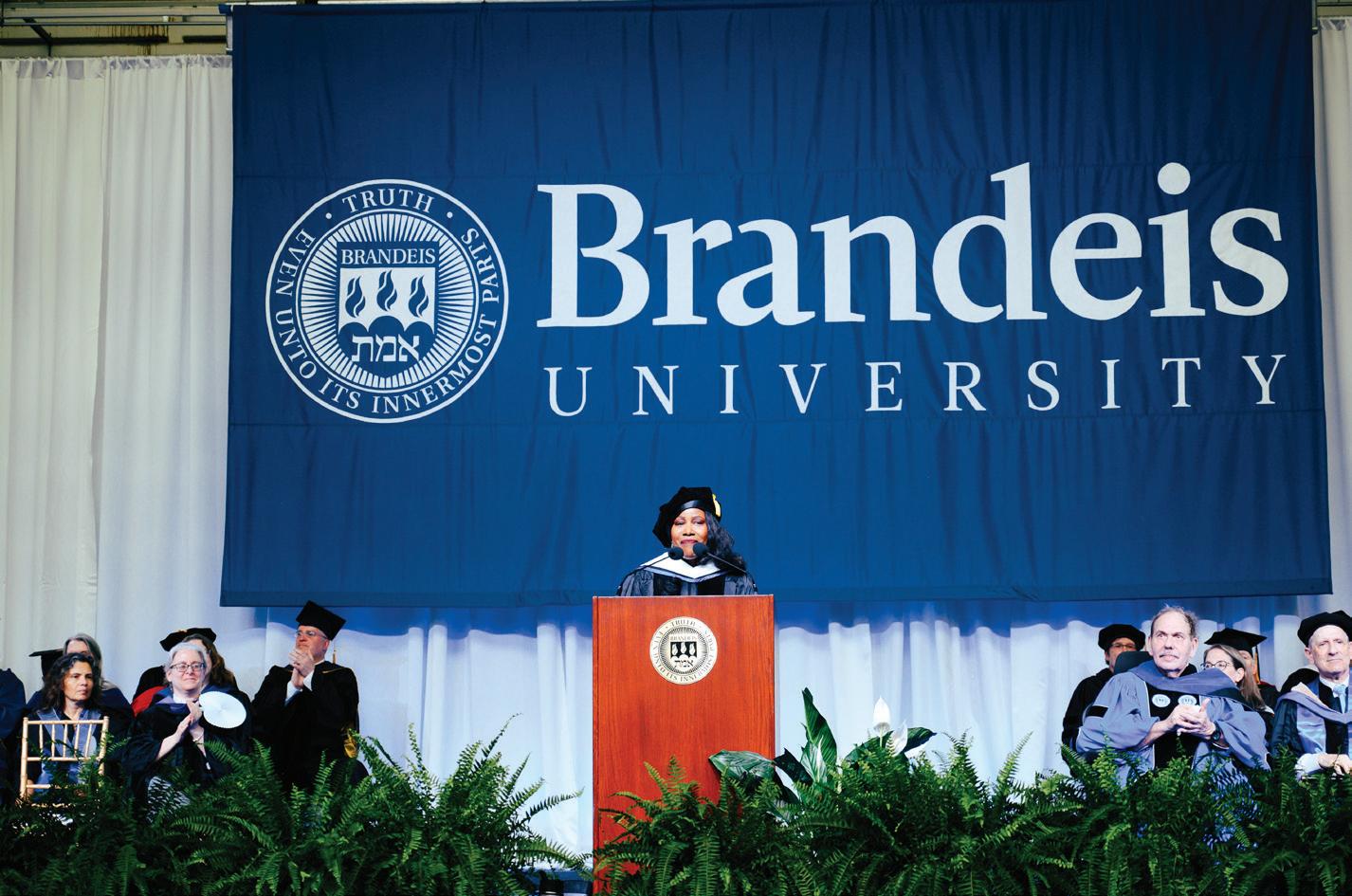
The ceremony included speeches from President Arthur Levine ’70, esteemed author and journalist Isabel Wilkerson and Jin Zhao ’26.
By CHAVA THIELL JUSTICE NEWS EDITOR
On Sunday, May 17 Brandeis held its graduate commencement ceremony, honoring students receiving their Masters degree, PhD and degree in leadership programs. The ceremony began at 3 p.m. and was moderated by Prof. Charles Golden (ANTH), Vice Provost for Graduate Affairs. Golden introduced Prof. Steven Cecchetti (FIN) as the ceremony’s Grand Marshal, after which Marshals of the Faculty processed. Golden then introduced the procession of the graduate class of 2026. Finally, Golden introduced the ceremony’s honored guests, the president’s party, speakers and the Board of Trustees.
Aaron Spevack, the University’s Muslim chaplain, led the ceremonial invocation. During his remarks, Spevack spoke about the pursuit of wisdom and quoted several sacred texts, including the Quran and the Book of Gospels. After Spevack’s invocation, Golden introduced Madyson Rose Buchanan ’26 to sing the national anthem. Golden then transitioned to faculty and staff recognitions, including retiring professors as well as recipients of this year’s teaching awards. He then introduced Lisa Kranc ’75, Chair of the Board of Trustees to deliver remarks. Kranc recognized the graduating class, as well as their families and friends. Kranc acknowledged some of the adversity the graduating class had to overcome, as they entered Brandeis shortly after the pandemic. She congratulated the group for their exceptional accomplishments and shared that she hoped each graduate found a “personal mission to pursue for the rest of your life.” She also recognized Brandeis’ landmark 75th commencement ceremony and spoke about the University’s founding by the American Jewish community, as well as the school’s longstanding commitment to Jewish values.
After Kranc spoke, Golden introduced President Arthur Levine ’70. President Levine described earning a graduate degree as “a team activity” and urged each graduate to thank their network of family, friends and loved ones
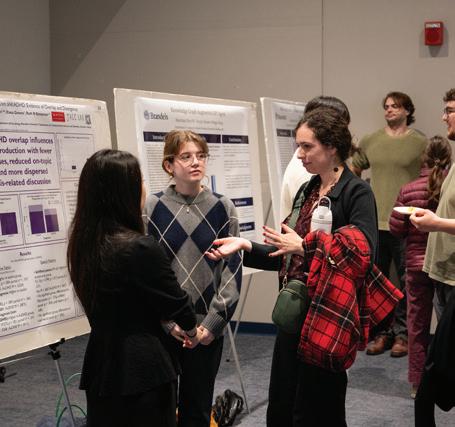
Sophia Garcia '29 recounts the undergraduate research symposium and conducts an interview with a student presenter.
By SOPHIA GARCIA
By CHAVA THIELL
for their support. He acknowledged that while the moment may be “bittersweet” for some, “this is not a solemn occasion” and implored attendees to cheer and clap for their graduates. President Levine also imparted three blessings upon graduates. He first spoke about the importance of hope and “hold[ing] tight to your dreams” despite adversity. President Levine then touched on the importance of responsibility as scholars and academics, which transitioned into his final wish of efficacy. He shared that he holds great confidence in the group of graduates and wishes to see them all succeed as leaders in both their respective fields and in the world. President Levine then spoke about Isabel Wilkerson, the keynote speaker, as someone who “embodies efficacy.” Levine concluded by wishing congratulations and success to the class of 2026.
The ceremony continued with the presentation of honorary degrees. The first degree was presented to L. Rafael Reif, accompanied by Marshal Ben Rogers, in recognition of his work in higher education as the former president of the Massachusetts Institute of Technology as well as his celebrated work as an electrical engineer; he was recognized with an honorary Doctorate of Engineering. The second degree was presented to Shai Reshef, accompanied by Marshal Ziva Hassenfeld, for his commitment to inclusion and equity as founder of the University of the People, a tuition-free online university which seeks to make education affordable and accessible. Reshef was awarded a Doctorate of Humane Letters. Finally, the third honorary degree was presented to Isabel Wilkerson, accompanied by Marshal Faith Smith, for her accomplished journalism at the New York Times as well as her achievements as the author of several bestselling nonfiction books. In 1994, Wilkerson became the first Black woman to receive a Pulitzer Prize in journalism. Wilkerson was recognized as a Doctor of Humane Letters. Wilkerson then delivered her commencement address, and began by wishing congratulations to the graduates and their friends, family and loved ones. She spoke about the resilience and accomplishments of the African-American community, specifically during the the Great Migration in the 1920s. Wilkerson described the challenges in “existential crossroads we now face,” specifically as it pertained to racism and social justice in American society. She spoke about the current political and social cli-
ARIEL KNUDSEN
MEDICAL EMERGENCY
May 11—There was a medical emergency for a party having a seizure. The patient refused medical treatment.
May 12—There was a medical emergency for a party in an altered mental state. The patient refused medical treatment.
MOTOR VEHICLE
May 10—A party reported their vehicle was struck in the Admissions lot. There will be an investigation to follow.
May 11—An officer completed a directed patrol of Loop Road. All appeared in order.
May 11—An officer completed a directed patrol of the Rose Art Museum. All appeared in order.
May 11—An officer completed a directed patrol of the chapels. All appeared in order.
On Monday, May 4, residents of North Quadrangle received an email from Area Coordinator Celia Henderson with the subject “Polaris TV Damage.”
Henderson stated that the television screen “has been impaled.” This was not the first incident of vandalism in Polaris Lounge this year. During the fall 2025 semester, residents were alerted that billiard cues had been used to poke holes in the ceiling. During that time, Henderson sent out an email detailing the damages that had occurred and the need for strict action against it.
Initially, there was meant to be a fine of up to $6000 for the whole quad, divided between residents. However, this action
May 12—An officer completed a directed patrol of Loop Road. The situation was cleared.
May 12—An officer completed a directed patrol of the Tower lot. All appeared in order.
May 12—An officer completed a directed patrol of Ziv Quadrangle. All appeared in order.
MISCELLANEOUS
May 13—An officer completed a directed patrol of the Tower lot. All appeared in order.
May 13—An officer completed a directed patrol of Kutz Hall. The situation was cleared.
May 13—An officer completed a directed patrol of a construction site. All appeared in order.
May 13—There was a report of graffiti found in a stairwell.
There will be an investigation to follow.
May 13—A party reported an item was stolen from their place of residence. There will be an investigation to follow.
May 14—An officer completed a directed patrol of the Sachar Road lot. All appeared in order.
May 14—An officer completed a directed patrol of the Tower lot. All appeared in order.
May 14—An officer completed a directed patrol of Loop Road. All appeared in order.
May 14—An officer completed a directed patrol of the chapels. All appeared in order.
May 14—An officer completed a directed patrol of the athletic fields. The situation was cleared.
— Compiled by Chava Thiell
was never carried out. Students at the time were outraged over the lack of accountability for those responsible for the. Another major issue that caused the frustration was the lack of surveillance cameras in and around the space.
Seven months after the first incident of vandalism, there are still no cameras in the space. This lack of action, students suggest, was the cause of the recent incident. In a May 4 written statement to The Justice, Reed Winkelmann ’29 stated “it’s really inconsiderate ... how the [Polaris lounge] has been handled,” emphasising that it has been damaged for “the second time this year.” Winkelmann expressed his concern over the lack of accountability and the need for individuals to own up
to their mistake.
Echoing similar concerns, David Zaslavsky ’29 stated This is not the appropriate behavior of a college student,” in a May 4 written statement to the Justice.
Students have been frustrated with the lack of accountability in both these situations. The residents of North Quad await news of the evaluated cost and if there will be a fine to repair the damages.
Written by Ashhwika Soni
A deeper look into the report reveals the initial claim’s origin and how it rapidly circulated on campus.
By JATEJA SPRIGGS JUSTICE CONTRIBUTING WRITER
On March 24, messages claiming U.S. Immigration and Customs Enforcement was on campus circulated rapidly around Brandeis University. Students shared posts describing a black SUV with tinted windows and the license plate 2MVP48 reportedly seen driving on Loop Road near the Heller School. What began as a single report quickly escalated into a campus-wide moment of fear.
Among those affected was an international Brandeis student who said she changed her plans after seeing a message from her friend along with many social media posts. In an April 22 interview with The Justice, she said she had planned to leave her dorm for dinner and a campus event before deciding to stay inside.
“I’m not going outside,” she said. “I locked my door … I’m just going to stay inside.” This student, along with several others interviewed for this article, was granted anonymity due to concerns for their safety.
A few hours later, the Brandeis Student Union posted on their Instagram story that the reported vehicle had been misidentified and was, in fact, a Brandeis Public Safety vehicle. The post, based on communication with the Vice President of Student Affairs, urged students to spread the update.
While the clarification eased some concern, it also raised broader questions about how the initial report spread, why students received updates primarily through social media rather than official University channels and what responsibility institutions have when situations like this unfold.
The situation did not begin as reckless misinformation, but as a report made in good faith. In an April 15 interview with a representative from Fuerza, the vehicle was first flagged to their hotline. Fuerza is, a Waltham-based organization connected to the broader LUCE network and works to monitor ICE and provide resources and services to affected communities.
The Fuerza representative explained that the vehicle matched several indicators commonly associated with ICE presence, including being an unmarked black SUV with tinted windows. It “... was our first ever vehicle that we’ve misidentified in Waltham,” the representative said.
“There was an honest mistake … but [we were presented] with many of the red flags.” While the organization did not disclose the full details of its verification process, its initial assessment of the vehicle led it to confirm information that later proved incorrect.
Once the vehicle was identified as a potential ICE presence, information spread through student networks such as group chats, Instagram stories and other shared social media posts that amplified the message.
Some Community Advisors alerted residents in floor group chats, while student organizations reposted warnings to their followers. Within a short period of time, a significant portion of the campus had seen some version of the alert. “It wasn’t just one post,” one student said. “People were making their own posts … and it spread like wildfire.” For many students, the volume of posts gave the information credibility. “In my opinion, there was no other option than to trust that information,” another student explained. “The possible consequences of not sharing it felt much more serious than the risk of warning people too quickly.”
However, the bulk of information that was shared seemed to result in greater confusion and uncertainty. Some chose to stay indoors, cancel plans or warn others. For the international student, the response was instinctive. “As soon as [I] hear the word ICE … I’m not stepping outside,” they said. For many students, particularly those who are undocumented, international or from immigrant communities, the perceived risk of ICE presence carried a lot of fear. “It’s like you build a life here and then there’s that immediate threat of it being taken away,” the student explained. Even after the information was clarified, that fear did not fully disappear. “It was a relief,” another student said, “but in the back of my mind … [the anxiety] didn’t fully go away.”
A March 24th statement published by the Student Union asserted that the vehicle had been misidentified and belonged to Brandeis Public Safety.
In an April 17 email to The Justice, Vice President of Student Affairs Andrea Dine confirmed that she had communicated this information to the Student Union leadership that evening. Dine further explained that she “asked them to post accordingly on their Instagram account, knowing that it has a wide following by individuals and groups on campus.”
In an April 21 email to The Justice, Student Union President Ria Escamilla-Gil explained that their decision to post on Instagram was intentional.
The Justice is the independent student newspaper of Brandeis University. The Justice is published every Tuesday of the academic year with the exception of examination and vacation periods.
“Since most of the information was circulating on social media, that is where we decided to share the announcement,” she said. “While many things that affect students, such as current events, are out of our control, we do our best with what resources and knowledge we have that could benefit students ... The student union’s role is to be there in the capacity that we can as we are students ourselves.”
However, the method of communication raised concerns among students, as there was never an immediate official statement from the University and students left to rely on secondhand confirmation that the rumor was false.
For some, this created concer rather than reassurance. “I think more of a quicker response would have been nice,” one student said, noting that the alert circulated for hours before any institutional clarification.
While the situation was unfolding, Brandeis Public Safety did not release a direct, real-time statement addressing the reported vehicle.
As of press time, Public Safety has not responded to The Justice for comment.
However, on April 9, the department published a broader statement on its website outlining policies related to outside law enforcement and campus access.
On April 14, they added a “Public Safety Transparency” section, which includes guidance and general policies.
The statement clarified that federal agencies such as ICE do not have unrestricted access to campus and require a judicial warrant to enter non-public spaces like residence halls or classrooms. The policy also clarified that Public Safety does not enforce federal civil immigration laws. However, students expressed that they left key questions unanswered, resulting in further confusion about what qualifies as a “public” space on campus, why Public Safety operates unmarked vehicles that can be mistaken for outside law enforcement and what the protocol is for communicating during times where student saftey is at risk. The statement did not directly address student concern or experiences while the rumors spread.
The misidentification itself was acknowledged and Fuerza described it as an “honest mistake,” indicating that internal reflection was already underway to prevent similar incidents in the future. However, several students raised concerns not only about the initial report, but about the institutional response that followed.
“There should have been a report from the school,” one student said, adding that the lack
of direct communication raised concerns about whether the University’s response met the needs of students who felt most vulnerable.
Another student pointed to unresolved structural questions. “What are we going to do when this is a real sighting?” they asked. “How do we ... keep Brandeis accountable for keeping all students safe?”
At the same time, students also emphasized the strength of peer networks. “I am very proud of how quickly students were able to spread the message,” one said, noting how rapidly the campus mobilized to alert one another.
Another student raised concerns about the spread of sensitive information, whether well-intentioned or not, via social media. They advised that “the best way to know that you are receiving trusted information is knowing exactly where you’re receiving it from. It is difficult to do that on social media.”
The March 24 incident was the result of a miscommunication, but its impact was real. Students changed their plans, warned friends, reshared posts and attempted to protect one another in the absence of clear information. For many, particularly those most affected by ICE, the fear was immediate and deeply personal.
At the same time, the situation exposed a gap between how quickly information can move through a student body and how slowly institutions can respond.
Community networks acted quickly, even if imperfectly. Students mobilized to inform one another. But institutional communication, particularly from Public Safety and the administration, did not meet that same urgency in the moment it was needed most. This raises a critical question moving forward: when the next situation arises, whether a misidentification or a confirmed threat, who is responsible for ensuring that students receive clear, timely and trustworthy information?
The answer, according to students and advocates alike, cannot fall on any single group alone. It requires coordination between community organizations, student leadership and the administration , it requires transparency, not only after the fact, but in real-time. Many believe the situation requires clear protocols that acknowledge both the speed of information and the stakes involved. While this incident was a false alarm, the conditions that allowed it to escalate, in addition to uncertainty, fear and gaps in communication, remain unresolved.
A news article did not contain an editor’s note for News Editor Ashhwika Soni. It should’ve included an editor’s note that read “The Justice News Editor Ashhwika Soni is a Student Union Senator and did not contribute to or edit this article.” (April 28, 5).
A news article incorrectly spelled “Prof. Greenless.” It should’ve read “Prof. Greenlee.” (April 28, 5).
A forum article incorrectly omitted an ads credit. It should’ve read “ASHER BAREL-STOUT/The Justice.” (April 28, 4).
A sports article incorrectly wrote “2020’s.” It should’ve read “2020s.” (April 28, 10).
An arts article incorrectly spelled “Reveiw.” It should’ve read “Review.” (April 28, 14).
An arts title was incorrectly written as “SHEBAD: Counter Review.” It should’ve read “SHEBAD: Band Review.” (April 28, 15).
An arts Sudoku byline incorrectly wrote Nemma Kalra as “Justice Editor.” It should’ve read “Justice Deputy Editor.” (April 28, 16).
An arts Editor’s Note inocrrectly spelled “preformed.” It should’ve read “performed.” (April 28, 18).
An arts photo credit incorrectly spelled “The Justcie.” It should’ve read “The Justice.” (April 28, 19).
An arts photo credit omitted “/The Justice.” It should’ve read “JACOB ANDERSON/The Justice.” (April 28, 17).
The Justice welcomes submissions for errors that warrant correction or clarification. Send an email to editor@thejustice.org
FAB protested in support of worker’s rights on May 1, recognized as May Day or International Worker’s Day.
CHAVA THIELL
JUSTICE NEWS EDITOR
On Friday, May 1, members of the new Fight Authoritarianism Brandeis group convened outside the Bernstein-Marcus Administrative Center and the Irving Presidential Enclave to protest a myriad of pressing social issues. The protest included a focus on the recent actions of Immigration and Customs Enforcement, various wars abroad, Brandeis’ lack of compliance with the Americans with Disabilities Act and the University’s decision to honor Sheryl Sandberg as a speaker and honorary degree recipient at the 2026 commencement ceremony. May 1 is also known as May Day, or International Workers’ Day. Nationwide protests were held to celebrate the labor movement, including one in Boston Common which garnered hundreds of attendees.
13 individuals were present at the Brandeis protest, including students and faculty, who held various signage. Posters included messages such as “ADA: Comply” and “No war, no ICE, no
genocide.” Individuals then took turns voicing their frustration with the University.
Isaac Hoffman ’29 spoke about Sandberg’s past at Meta, which includes allegations of sexual harassment, privacy leaks and contribution to the Rohingya genocide in Myanmar. “They [Meta] did nothing while kids died,” Hoffman said. Other students spoke about Sandberg’s reputation as a feminist and pointed to the lack of intersectionality in her advocacy work. Hoffman also took the time to read internal Facebook emails which suggested that Sandberg knew about the harmful effects of the platform’s algorithm. “If you do come on campus I hope you know no one wants you,” he concluded with a pointed message at Sandberg.
The University’s decision to invite Sandberg to speak at this year’s commencement ceremony has invited controversy from students and faculty alike. Most recently, the Student Union passed Senate Resolution No. 4, which calls upon the University to rescind Sandberg’s honorary degree and remove her as commencement speaker. The decision also resulted in the creation of a petition, authored by Elena Giacoletti ’26 and Nora Herndon-Lazerwith ’26, which has garnered over 100 signatures as of press time.
The group also emphasized concerns with the University’s free speech policies, which have been a subject of contention following the incidents of Nov. 10, 2023, during which several students were arrested at a pro-Palestine rally after concerns about the use of various phrases and chants. Since then, controversy has arisen about how the University regulates free speech and
other student groups such as Students for Environmental Action and the Jewish Bund have urged the administration to revise their policy. Students also spoke about strengthening protections for international students and students of color, especially in light of heightened ICE activity. Chloe Morales ’23 highlighted a petition drafted by the American Association of University Professors which calls upon the University to stop its partnership with Enterprise Rent-a-Car, a rental service responsible for providing vehicles to ICE. Morales shared that the petition has garnered over 840 signatures, demonstrating clear concern for the issue. Additionally, Brandeis’ chapter of the AAUP called upon the school to cut ties with Enterprise by May 1, though no such action was taken. Chants of “shame” could also be heard at various points, demonstrating the group’s clear discontent with the University’s actions.
Additionally, the protest focused on the University’s lack of compliance with the Americans with Disabilities Act. Enacted in 1990, the ADA “prohibits discrimination on the basis of disability” and “guarantees that people with disabilities have the same opportunities as everyone else to enjoy employment opportunities, purchase goods and services, and participate in state and local government programs.” However, students in attendance asserted that the University is not in compliance with the law, citing a lack of accessible bathrooms, broken lifts and unreasonable housing accommodations. “It’s a civil rights issue,” said Ariella Soltren ’27. She also spoke about the interconnectedness of vari-
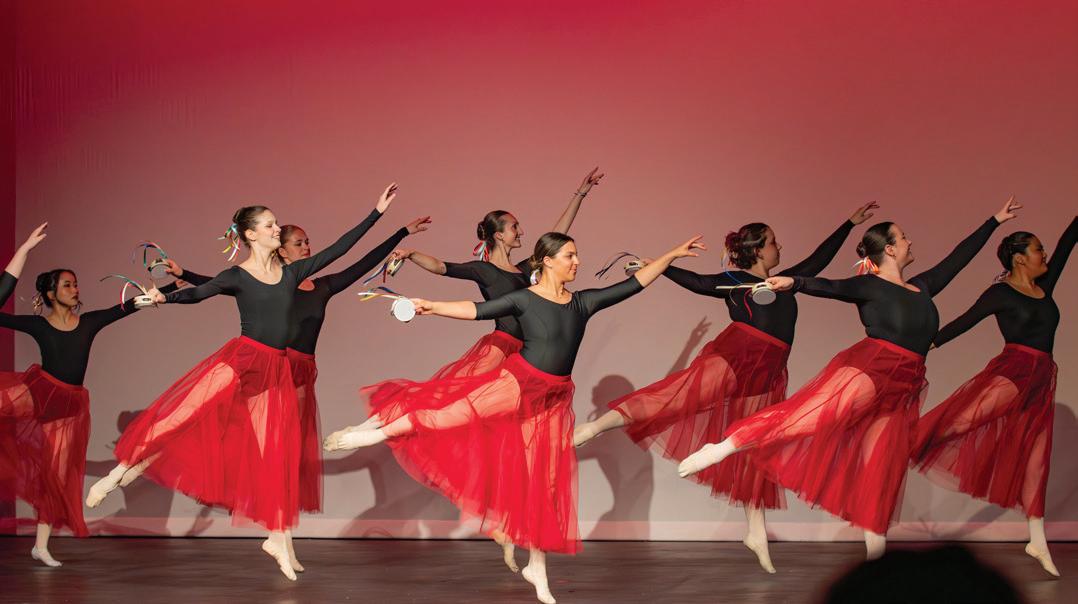
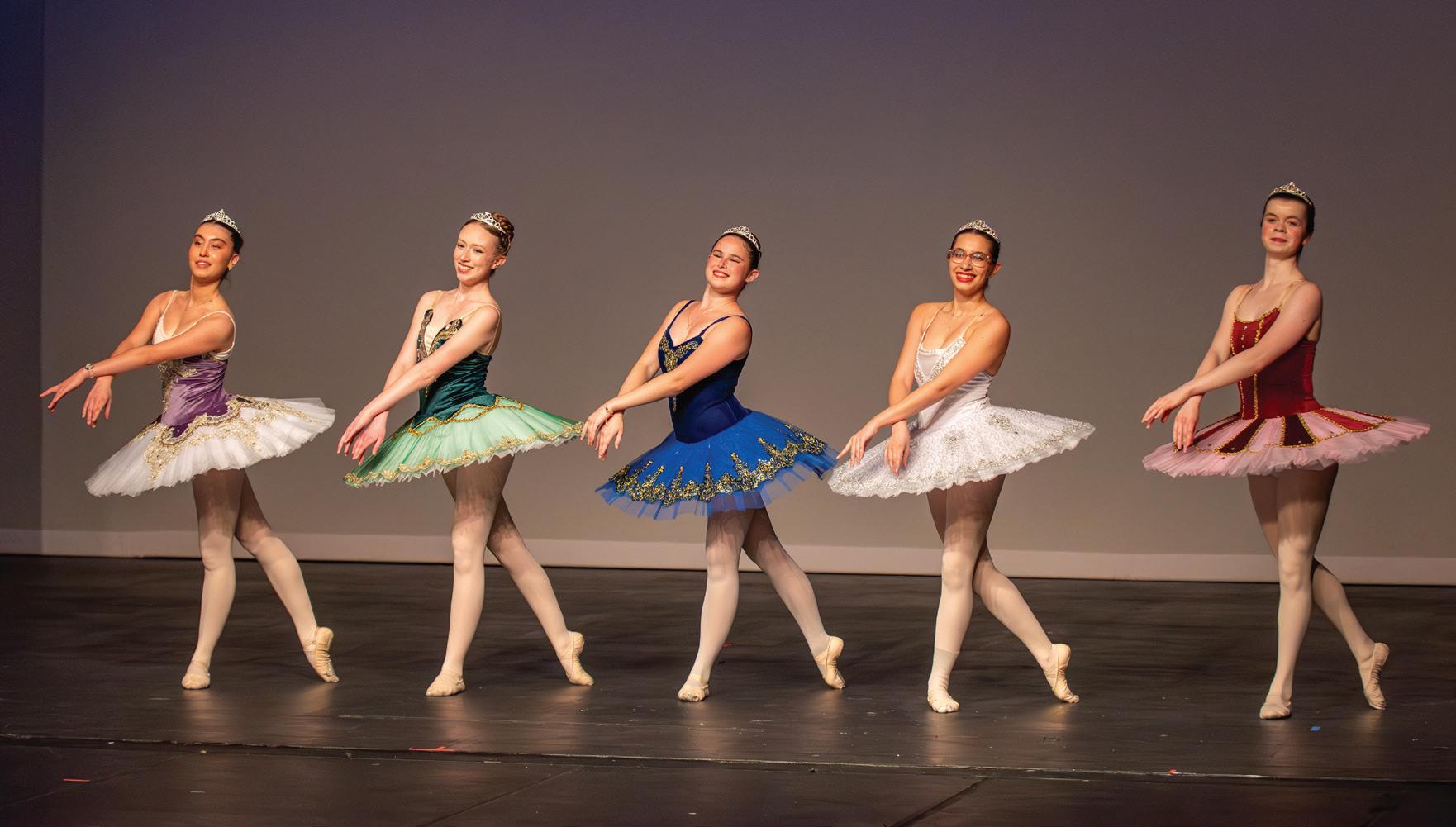
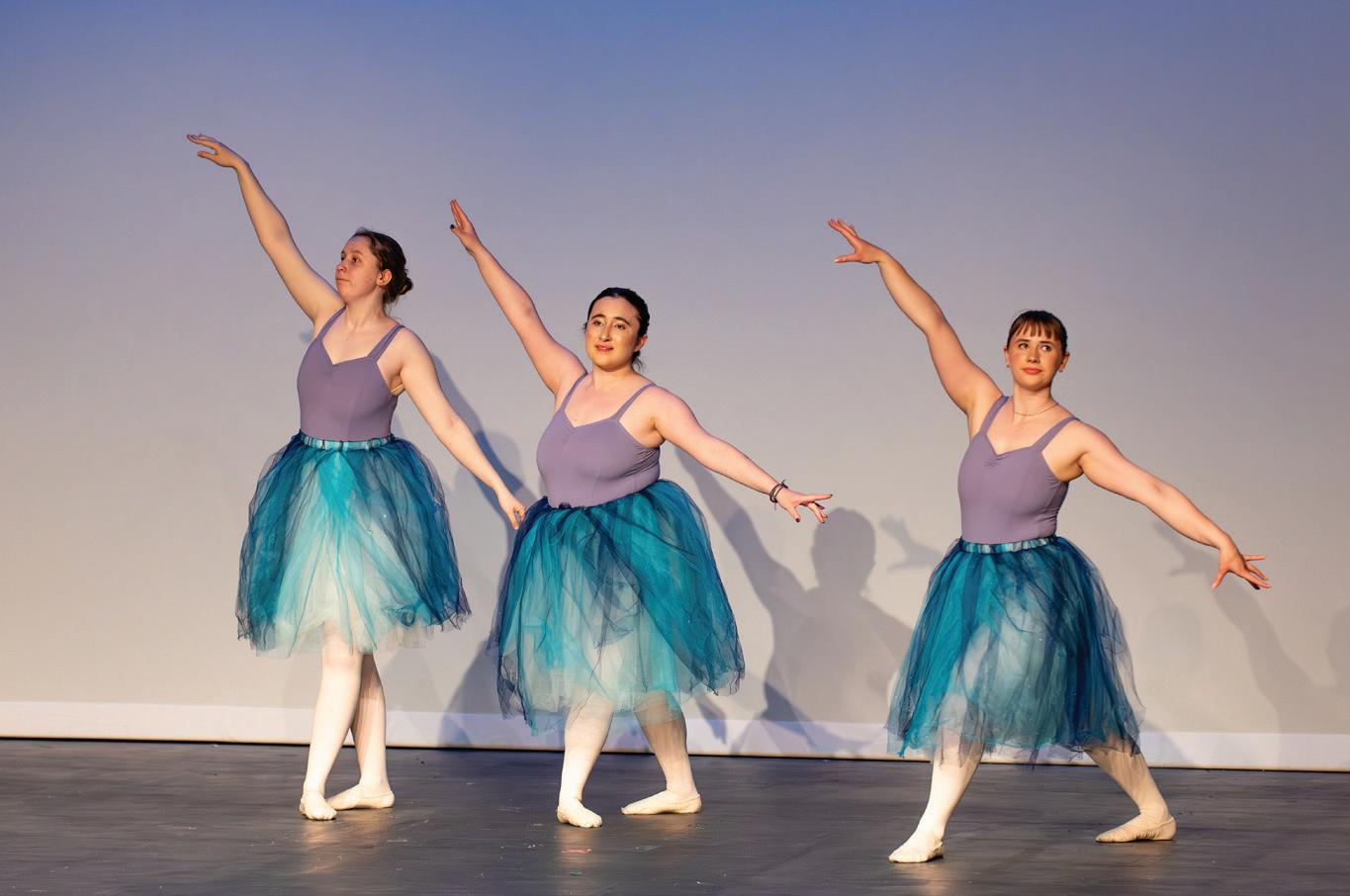
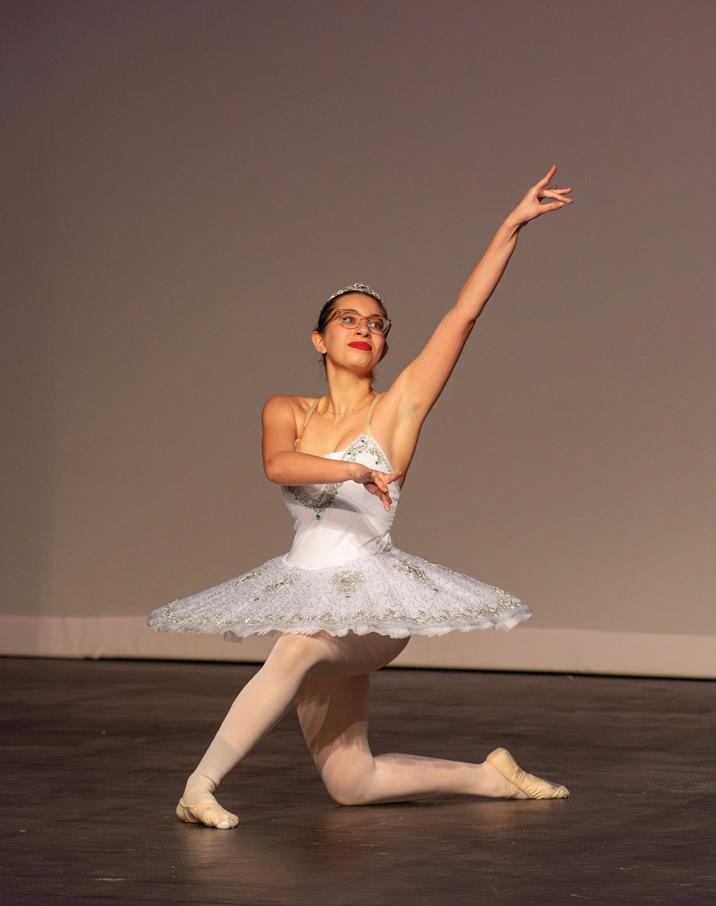
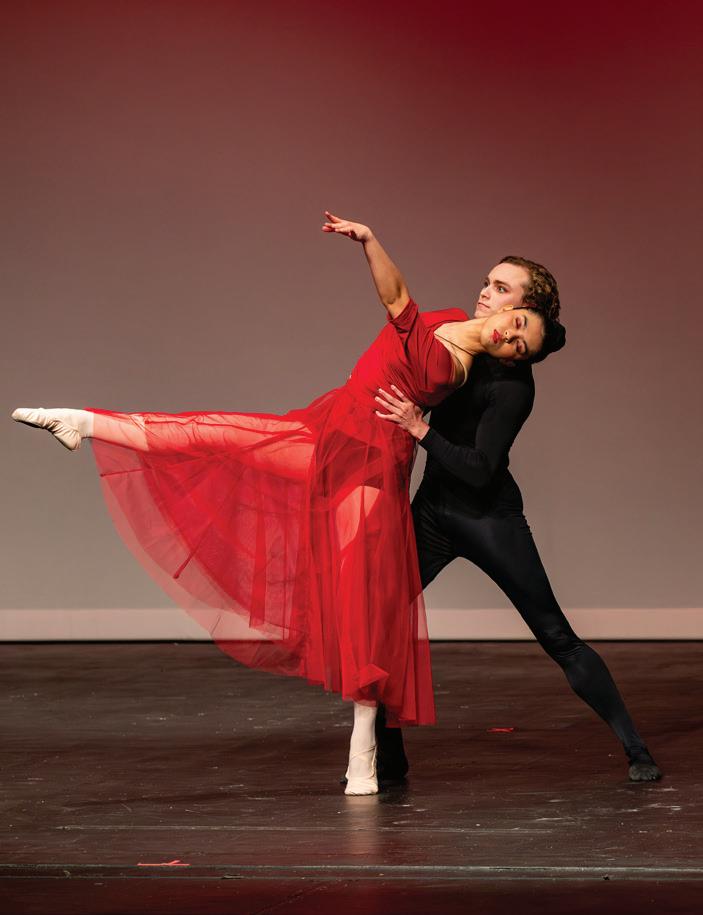
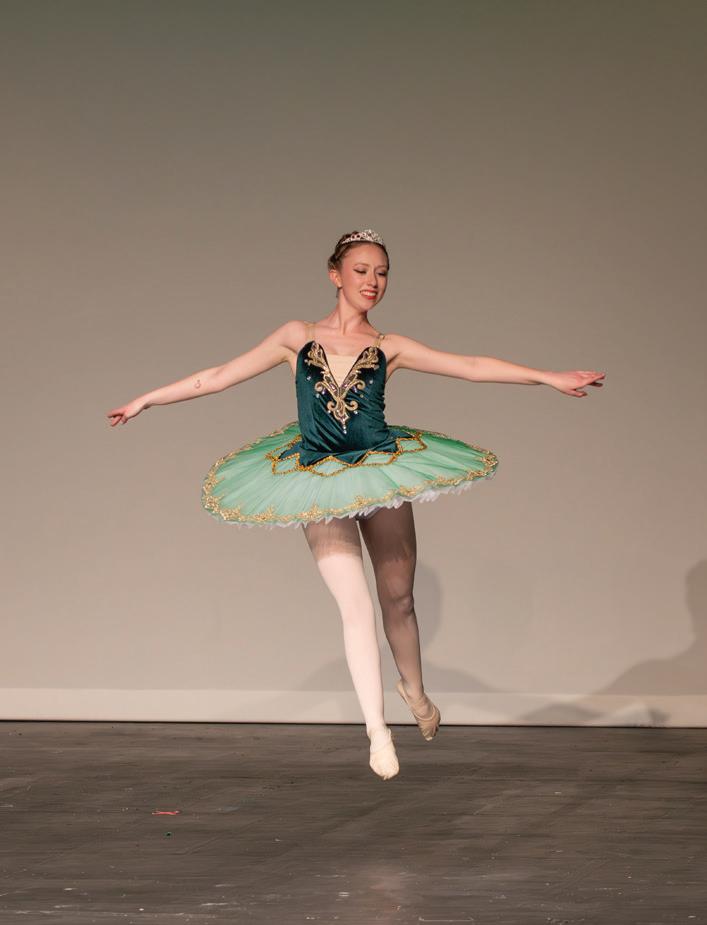
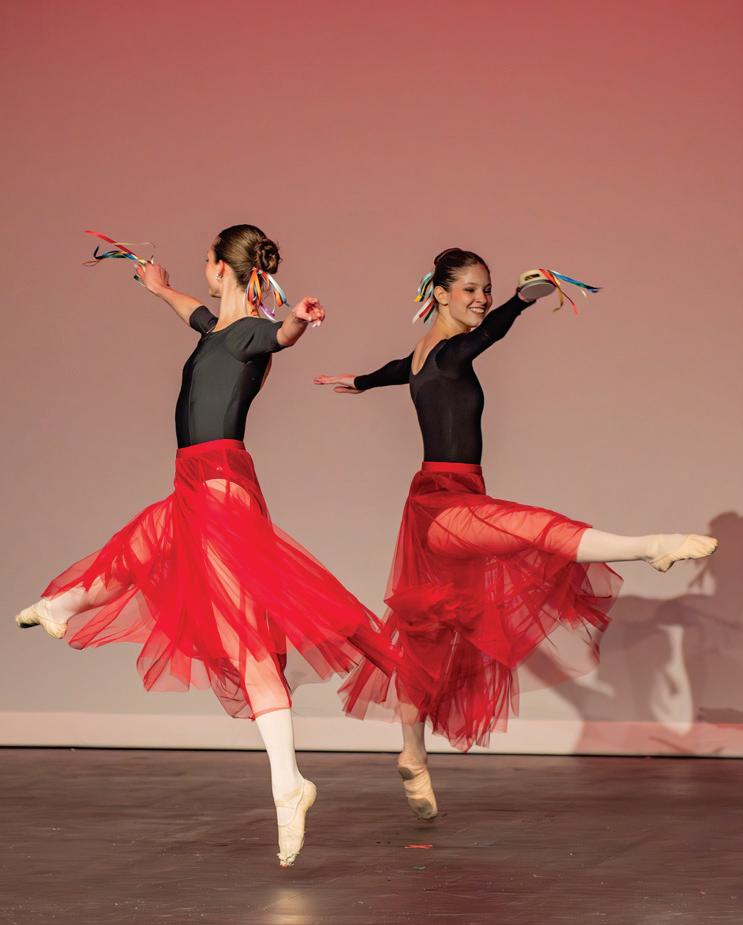
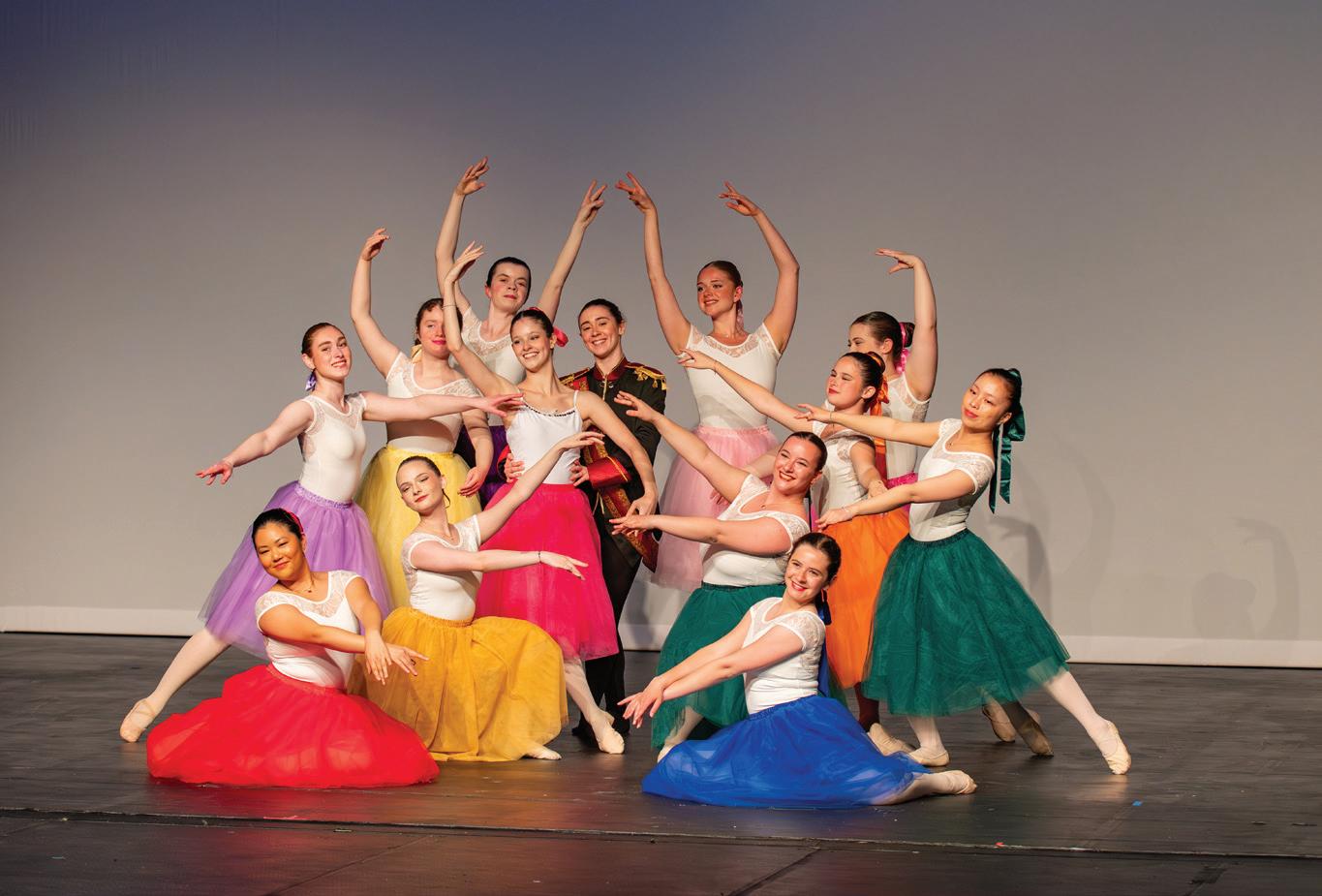
On April 29, Brandeis Ballet Club performed their Spring Show in the Shapiro Campus Center Theatre. The dancers worked hard over the course of the semester to put together this show comprised of pieces from various ballets and featuring student choreography.
—Editor’s Note: The Justice Senior Editors Eliza Bier and Anna Martin, The Justice Associate Editor Elizabeth Liu and The Justice Advertising Editor Keira Shear are members of Ballet Club. They did not edit or contribute to this article.
ous social justice issues such as disability rights, racial equity and LGBTQ+ inclusion, emphasizing that this was one of the reasons the protest focused on so many social problems.
The group then moved from outside the Bernstein-Marcus building to the front of the Shapiro Campus Center by the Great Lawn while shouting, “No billionaires, no ICE! Disability justice on ’Deis!” The group proceeded to sing several protest songs including “Bella Ciao,” a traditional Italian pro-labor piece, as well as “Solidarity Forever.” The protest dispersed shortly thereafter at approximately 1:15 p.m.
Although the group formed this year, they have held multiple protests throughout the year concerning ICE action and the ongoing war in Iran. On Jan. 20, the group held a “Free America Walkout,” a nationwide initiative aimed at challenging ICE activity and protecting students on campus. A similar protest was held on Jan. 30 in the Shapiro Campus Center Atrium, as well as a small demonstration on March 6 opposing the war in Iran.
As the group is newly formed, it is unclear if they will seek official recognition by the University. As pressing current issues remain relevant to the student body and Brandeis community, FAB sees their role as a group that advocates for justice and fairness at the local level, and strives to help make Brandeis an equitable and just place for all.
—Editor’s Note: The Justice contributing writer Isaac Hoffman ’29 spoke at the mentioned protest. He did not edit or contribute to this article.

Faculty discuss class of 2030 admissions statistics, microcredential certifications, celebrate retiring professors and more.
By NAWAL IRFANI JUSTICE EDITOR IN CHIEF
On May 14, Brandeis held the last faculty meeting of the spring semester at 2 p.m. in the Shapiro Campus Center Multipurpose Room. President Arthur Levine ’70 announced the results from the Faculty Senate elections, gave remarks and updates about student enrollment, and Founding Director of Brandeis’ new Center for Careers and Applied Liberal Arts, Lewis Brooks ’80, discussed more updates to Brandeis’ new microcredentials program. Finally, Provost and Executive Vice President for Academic Affairs Carol Fierke announced the names of this year’s retiring faculty and a motion was passed to require faculty to submit their list of degree candidates to the provost and allow the provost to make any additional corrections or amendments to the aforementioned list of degree recipients.
The meeting began with a brief announcement from President Levine to present this semester’s Faculty Senate results. The elected faculty members included, Caitlin Gillespie (LIT) as Senator, Arts, Humanities and Culture; Alejandro Trelles (POL) as Senator-At-Large; Aldo Musacchio (FIN) to the Committee on Strategy and Planning, Business and Economics; Olajumoke Yacob-Haliso (AAAS) to the Committee on Strategy and Planning, Arts, Humanities and Culture; Debarshi Nandy (FIN/BUS) to the Board of Trustees as Faculty Representative, Business and Economics; David Katz (HIST) to the Board of Trustees as Faculty Representative, Arts, Humanities and Culture and Kate Moran (PHIL) to the Tenured Promotions Committee, Arts, Culture and Humanities.
President Levine congratulated all of the elected faculty and encouraged more faculty members to submit themselves for elections in the future.
Next, Chair of Faculty Senate Jeffrey Lenowitz asked for any corrections to the minutes from the previous faculty meeting on April 17, for which there were none. President Levine stepped back up to give a few remarks and updates on student enrollment for this fall. “I’m disappointed,” President Levine said, confirming that student enrollment for next fall is about the same as last year. He confirmed that Brandeis had a 40% increase in applications this year, but that enrollment rates hadn’t increased accordingly. “This class is one of the best we’ve ever admitted. But it’s not as big as it could be,” he said. “We managed to expand the top of the funnel. The task next year is to take the bottom of the funnel and translate it into acceptances.”
President Levine also thanked faculty for reaching out to students, citing that 147 faculty members had made phone calls to students and that those students were more likely to enroll at Brandeis. With no further announcements, President Levine wrapped up his remarks: “We worked really hard this year. We accomplished a whole bunch this year. And I’m really grateful to have had the opportunity to work with you this year. Let’s make next year even better.”
Next, President Levine announced the winner of this year’s Wellington Prize, Madadh Richey (NEJS). The Wellington Prize, a $3,000 award named after Duke Wellington, was first established in 1983 by an anonymous donor and is meant to “enliven the spirits and delight the sense of the recipient.” It is awarded to an assistant professor via a lottery system and is to be used for “something [the recipient] dreamed of but deemed irrelevant to their … pressing career concerns.”
The recipient is required to report on how they spend their prize money at the first faculty meeting the following year.
Lewis Brooks came to the podium to give some updates on the second round of the microcredentials program for next fall. Cur -
CONTINUED FROM 1
chio; Sheryl Sandberg accompanied by Marshal Jill Greenlee and Toshizo Watanabe ’73 in absentia.
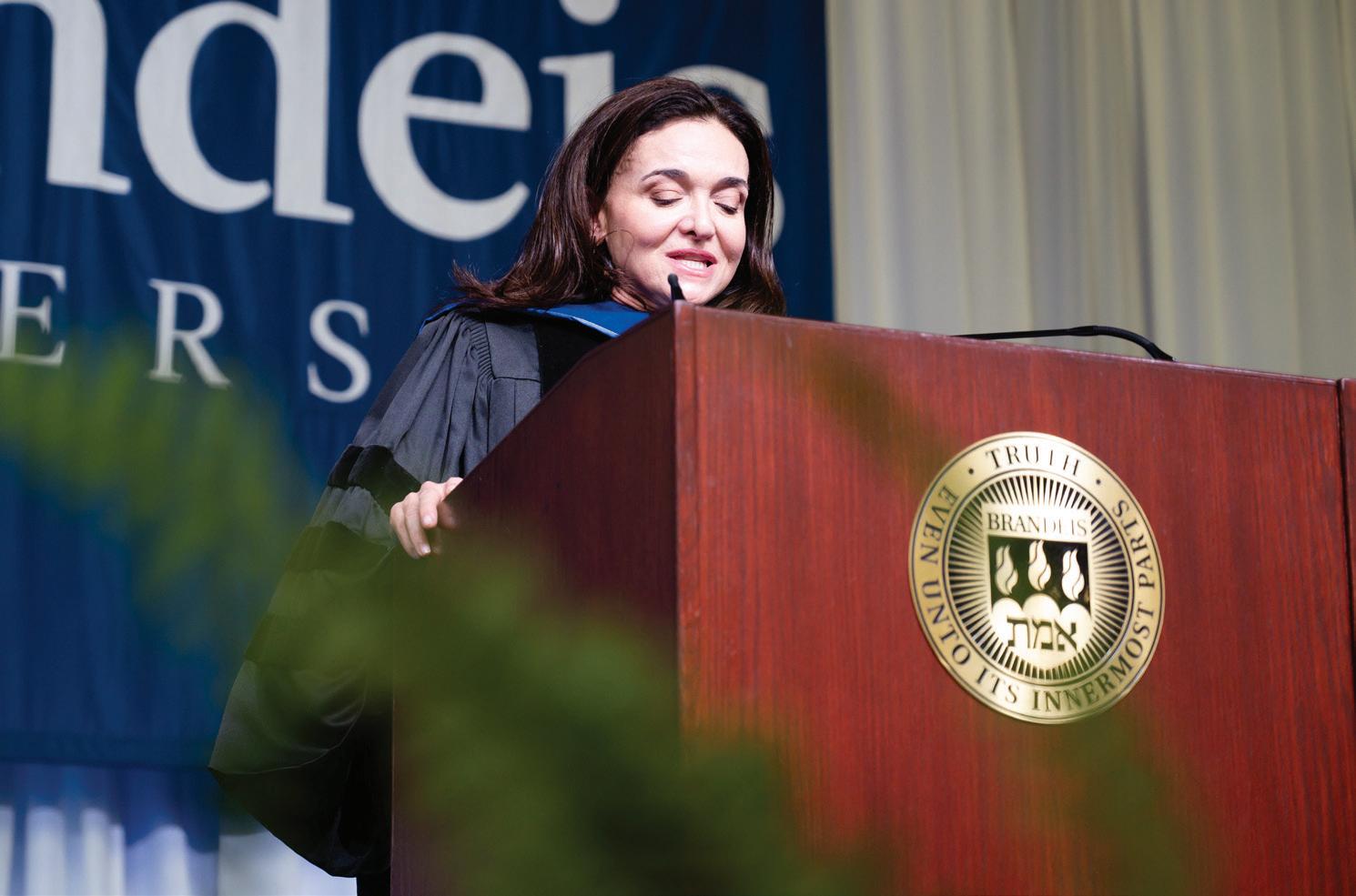
Sheryl Sandberg ’26 delivered this year’s keynote address. As she stood up to speak, several students stood and turned their backs to her, while others left their seats and the main sitting area. An Instagram post was circulated by the “students_against_sandberg” Instagram account prior to the ceremony that read “Brandeis Class of 2026, friends, and families: In silent protest of Sheryl Sandberg and Brandeis’ decision to grant her an honorary degree please join us in standing and turning your back for her speech.” The account features posts about two articles previously published by The Justice on students’ reactions to Sandberg — one about a student-led petition and one about Senate Resolution No. 4 — a Letter-tothe-Editor submitted by alumni Laura Limonic ’97 and Op-Ed by Nora Herndon-Lazerwith ’26, as well as multiple other posts detailing student requests of the administration.
In her speech, Sandberg told a story about a monastery that was slowly emptying out in the face of a scientific revolution, describing how the five remaining monks found a way to believe in each other and themselves, eventually reclaiming their presence in the community. In the face of moments of uncertainty like that of the parable, Sandberg pointed to three ways to respond. First, “choose contribution over self protection.” She continued, “The person who asks ‘what do you need’ instead of ‘what do I want’ is unforgettable.” Second, “Choose collectivism over tribalism,” Sandberg said. She mentioned the recent rise of anti-semitism, asserting that 2025 had the most deaths from anti-semetic attacks in the past 30 years. Brandeis was built on values that education should be open for everyone, on “inclusion born out of exclusion.” In the spirit of those values, Sandberg talked about the importance of re-
rently, there are eight microcredential submissions, all of which will require follow-up meetings to review and confirm assessment procedures: Civil Discourse and Conflict Resolution; Cultural Competence; Instrumentation; Design in Three Dimensions: Art, Engineering and Imagination; Natural Language Processing; Collaborative Communication and Business; Intermediate Language Competency; Sports Communications and Media Innovation. Sports Communications and Media Innovation is the first co-curricular microcredential, shared by the Journalism and Athletics departments. The other microcredentials span departments ranging from Legal Studies and Theater to Engineering and Computer Science.
Brooks said that he envisions these microcredentials as a way of recognizing “skills our students learn, not only in the classroom, but in their extracurricular activities and Brandeis passions.” Brooks continued, emphasizing that the process of reviewing and approving each microcredential is tedious, “the process, first of all, cannot be compressed into a few days. … Each of these [microcredentials] has its own requirements. Each of them needs to be addressed.” For now, seniors will most likely be required to complete all of the requirements for a microcredential by the end of the first semester of their senior year to make sure that each microcredential is properly assessed. Brooks also announced that in the first round of microcredentials that were awarded, 24 students will achieve 26 microcredentials, which will be notated on their transcript.
One faculty member asked when the next round of microcredential submissions would take place, and Brooks responded that the timeline would, for now, be loosely tied to semesters but may change in the future. Another faculty member asked whether or not other departments could contribute to the current microcredentials that have been approved. Brooks affirmed that other departments could participate in the microcredentials. “We are looking for this to be as collaborative a process as possible,” he said. With no more questions for Brooks, Provost
Fierke stepped up to announce the retiring faculty. She began by thanking the faculty for their support over the last five and a half years as she steps down as provost. “This is an amazing group of faculty that we will miss dearly and we hope [they] will come back and join us,” she said. The retiring faculty for this year are: Stephen Cecchetti, International Business School; Richard Fell (PHYS); Timothy Hickey (CS); Constant Horgan, Heller School; Alice Kelikian (HIST); Ellen Kellman (NEJS); Blake LeBaron, International Business School; Harry Mairson (CS); Robert Nieske (MUS); Michael Randall (ROM); Lisa Rourke, University Writing; Jonathan Sarna (NEJS); Paola Servino (ROM); Esther Shorr (NEJS); and Robert Walsh (THA). “Please do not be strangers … [and] remain a part of our community,” Provost Fierke said after a round of applause from faculty members. Provost Fierke then called up the registrar, Mark Hewitt, to present the degrees to be awarded for this year’s graduating class. He began by thanking his office staff, “We talk about a village, this wouldn’t be possible without everybody in my office.” He made a few quick announcements about any changes to degrees, including late grade changes and errors on the checkout sheet. Hewitt also presented statistics on this year’s trends, and notably mentioned that this year’s graduating class marks the largest number of degrees awarded in Brandeis history with 946 degrees. 69% of this year’s graduates received Latin honors, which marks the achievement of exceptional cumulative grade point averages over their college career, and 17% of students received departmental honors. Hewitt then motioned to require that all faculty submit a list of their department’s degree recipients to the Board of Trustees and empower the provost to make any additional updates or changes to degrees. The motion was passed.
Finally, Chair of the Faculty Senate Jeffrey Lenowitz stood up to thank Hewitt, who has served as the University’s registrar for over 30 years. Hewitt received a standing ovation from the faculty members.
The meeting adjourned at 2:32 p.m.
taining one’s humanity when the world seeks to divide people. Third, “Don’t script your career.”
She advised students to have a short-term plan and a long-term dream, but allow themselves to try new things along the way. Towards the end of her speech, Sandberg faced boos from the crowd.
Degrees were conferred by the Board of Trustees, and Andrea Dine, Vice President for Student Affairs, was called to the podium to present a degree in memoriam of Charles Eng, whose father came to collect his diploma.
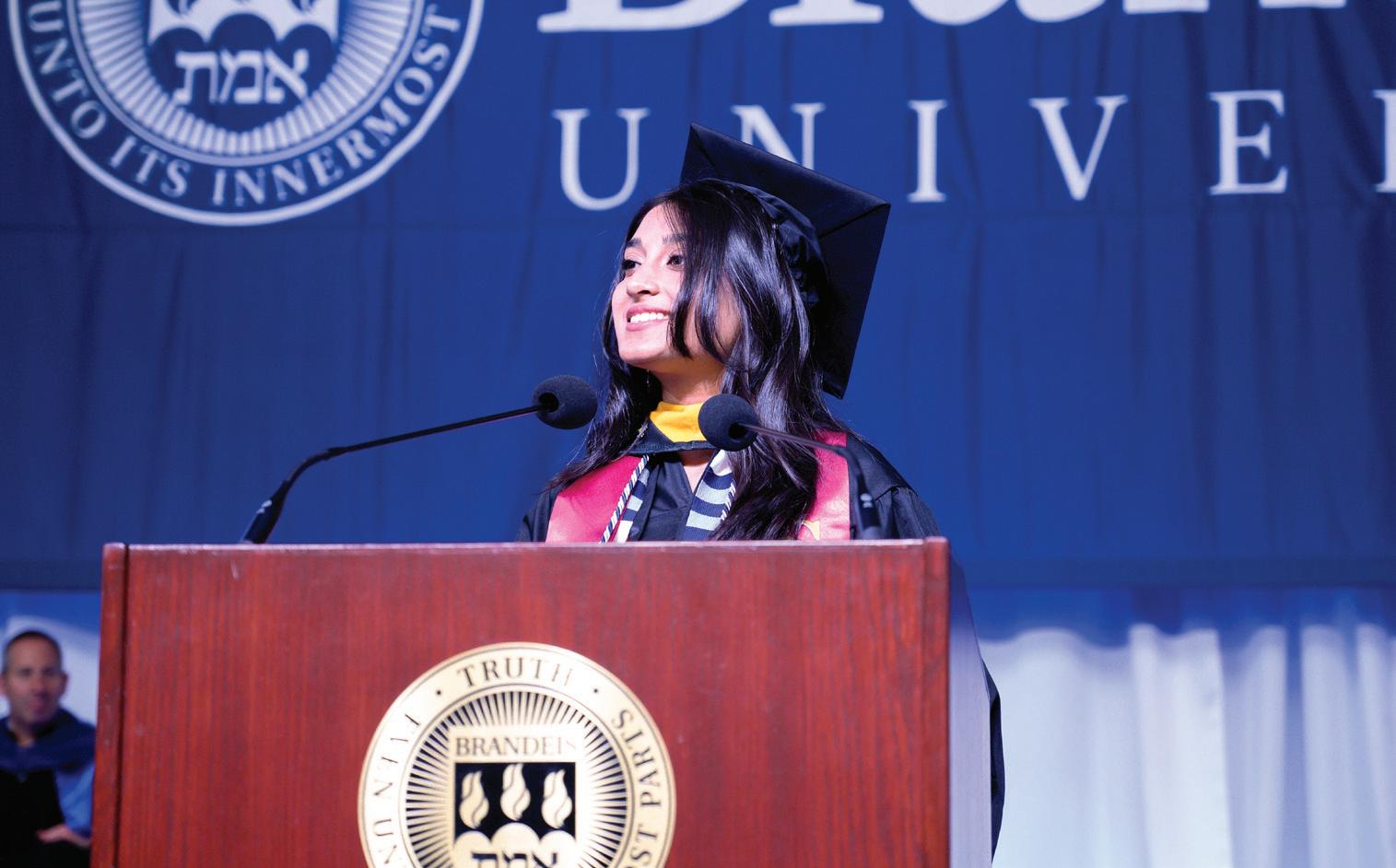
Khimaya Bagla ’26 was invited on stage to give the student address. She started her speech enthusiastically, congratulating her fellow classmates. Bagla, who graduated with a dual degree in neuroscience and psychology and a minor in journalism, reflected on the impact and role that the Brandeis community and its resources have played in her journey. She emphasized, “Brandeis taught me that courage isn’t given. It is claimed.” Bagla continued, “in choosing to stretch ourselves, to test our limits, we discover we are capable of more than we ever imagined.”
She discussed her desire to belong at Brandeis and her experience saying “yes” to every opportunity that presented itself to her, even when it felt like too much. ” However, when faced with a tough situation, Bagla said, “it mattered to me to try.” Bagla described how in moments of fatigue and uncertainty, community and a reliance on our peers can help us navigate those difficulties.
“All of us owe a debt of gratitude to someone else — the person who said to each one of us ‘you can do it’ before we believed it for ourselves,” Bagla said. She took a moment to honor her parents, who have supported her through all four years from her home in India, and ended her speech by reminding students that it is “it is our responsibility to reach our full potential,” and to keep showing up for one another.
Following the student address, Amy Cohen ’85,
President of the Brandeis University Alumni Association, presented her remarks. “[This is the] beginning of a life long bond,” she said. Cohen emphasized the impact Brandeis grads have had in the real world adding that, “you are forever a part of our legacy.” Cohen stressed the importance of community and friendship, and concluded her remarks by welcoming students to the Brandeis alumni family.
President Levine and members of the Board of Trustees stood on stage to congratulate each member of the graduating class as they accepted their degrees.
Finally, Kristen Watson sang the Brandeis alma mater, and Lara Ericson, Director of Spiritual Life, closed the recessional with the benediction. “May you have the courage to stand up [to] what you believe in,” Watson said. She continued,“May you continue to nurture the relationships that were formed at Brandeis.” The ceremony concluded with the graduates throwing their caps in the air, marking their achievement as graduates of Brandeis University.
CONTINUED FROM 1
mate and stated that “it is time for us to stop being surprised,” urging those in attendance to use their power and knowledge to address matters of injustice. Wilkerson also referenced Albert Einstein’s 1946 commencement address at Lincoln University, and how his willingness to speak at a historically Black university challenged the social norms of the time. Wilkerson urged students and attendees to use their voice and education to change the status quo in a similar manner to Einstein. “We are exactly where we’re supposed to be in the flow of human existence,” she concluded, and received a standing ovation from the audience. Before the ceremony transitioned into the conferring of degrees, President Levine presented an honorary posthumous degree to the family of Connor Johnson, who was in the process of pur-
suing a PhD in Neuroscience before passing away in March of 2026. First to present the graduates of their respective schools was Dean Harleen Singh, representing the School of Arts, Humanities and Culture. Dean Linda Bui presented students from the School of Business and Economics and Dean Susan Birren presented students from the School of Science, Engineering and Technology. Dean Sara Shostak then presented the students from the Heller School for Social Policy and Management, as well as the School of Social Sciences and Social Policy. Noting the large and enthusiastic group of graduates, Shostak stated she was “deeply proud” of the students. Finally, Carmen Aguilar, Vice President of the Rabb School of Continuing Studies, presented the graduates of the Rabb School. The ceremony proceeded with the graduate
student address from Jin Zhao ’26, a PhD student in computer science. Zhao spoke about the importance of language, inclusivity and bridging cultural divides. Reflecting on her own experience speaking a different language at home, Zhao spoke about the ways in which Brandeis taught her how to better understand others and become more empathetic. “Understanding doesn’t begin with agreement. It begins with curiosity,” she said. Her hope for the future, she shared, is that we continue to use developing technologies to include people of various backgrounds, and that “we carry forward the Brandeis way,” by learning across differences and humanizing those who may be unknown to us. Zhao wished congratulations to the class of 2026 and received a standing ovation from the audience.
Golden introduced Amy Cohen ’85, the Presi-
dent of the Brandeis University Alumni Association, who gave brief remarks. Cohen shared that the graduates will join the association’s network of over 70,000 alumni and urged them to remain connected with other Brandeis graduates. The ceremony continued with the presentation of degrees, which were awarded to students by the deans of their respective schools. Finally, the ceremony concluded with a brief benediction by Chaplain Karl LaClair, Coordinator of Christian Life, who wished the graduates luck in their future endeavors and urged them to use what they had learned at Brandeis as they move forward. After the recession of the graduates, the ceremony then concluded at approximately 5:45 p.m.
VERBATIM | JOSIE BISSE
ON THIS DAY…
In 1631, John Winthrope was sworn in as the first Governor of Massachusetts in Dorchester.
Since 1976, the number of women enrolling in college has doubled. In the fall of 2025, 57.3% of undergraduate students were female. Dreams come in a size too big so that we may grow into them.
FUN FACT
Mariama Darboe discusses how Upward Bound helps local low-income, first-generation high school students dream of a better future for themselves.
By ALYSSA WU JUSTICE FEATURES EDITOR
tions like Brandeis?
For many, but especially first-generation and low-income students, the transition to college can feel overwhelming.
Director of Brandeis Upward Bound
Mariama Darboe spoke with The Justice in a May 4 interview about how the program helps Waltham high school students build confidence, prepare for college and envision futures they would have never thought possible.
The Justice: Could you please tell me a little bit about yourself and how you’re involved with Upward Bound?
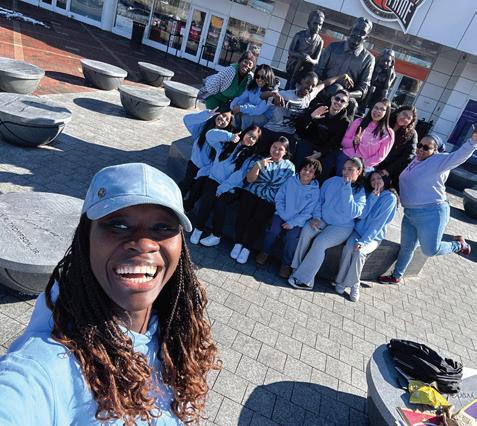
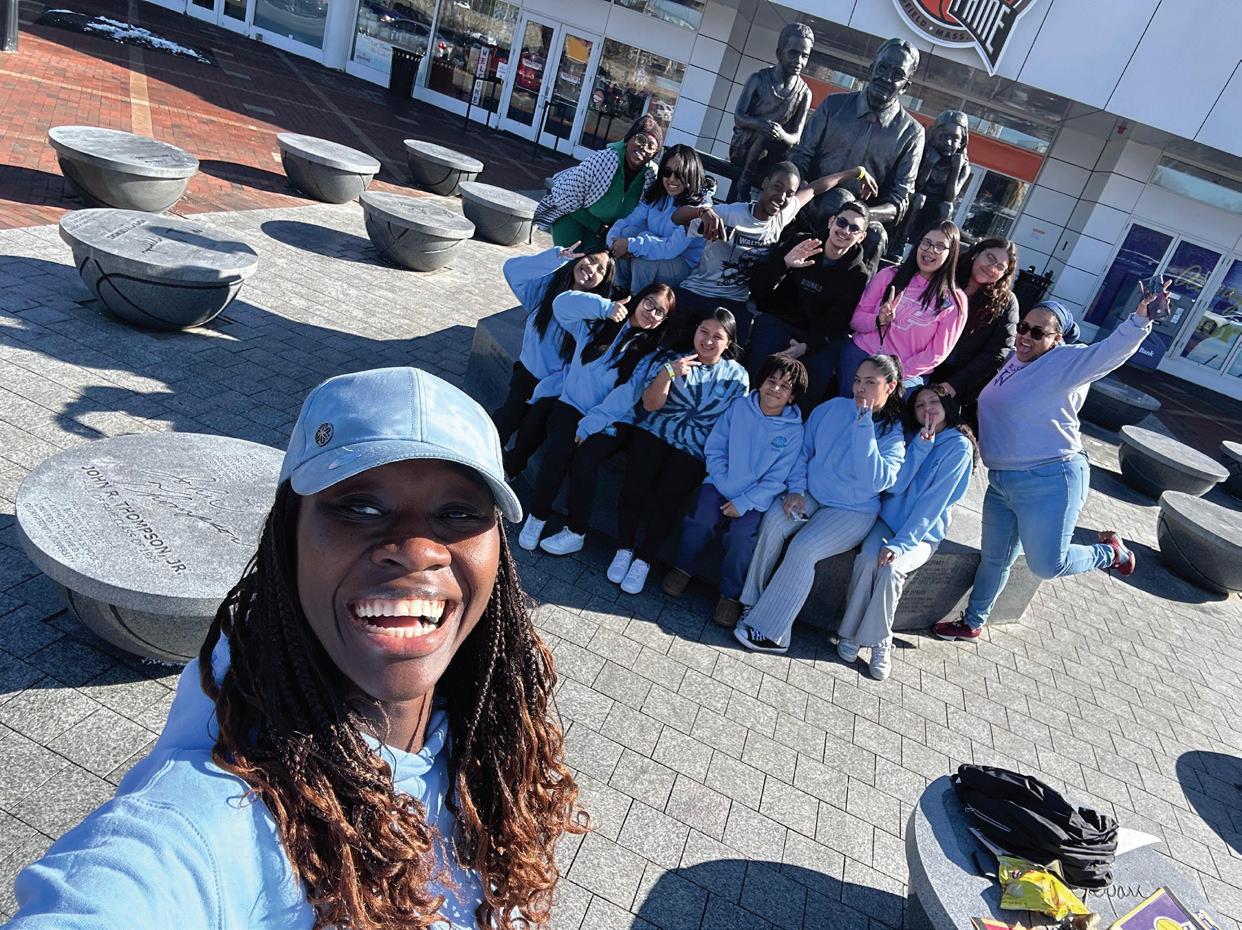
Darboe: My name is Mariama Darboe. I am the Director of Upward Bound, which is a federally funded program. This is our fourth year at Brandeis University. We work with 60 Waltham high school students to give them all the resources they need to get acceptance to college and to also survive college.
The Justice: What would you say is the overall mission of Upward Bound and what are some ways Upward Bound is working towards those missions?
Darboe: The overall mission [is to] get students to college [and] get college admissions for first- generation, low income [and] resource-restricted students. We help them with their personal essay writing, we help them with the applications, we take them on college visits, we take them [to] conferences in the Massachusetts area and beyond. We introduce them to mentors at Brandeis University, who get to tutor them at Waltham High School after school for subjects that they’re struggling [with]. We have [a] tutor that’s most likely first [generation] and low income as well that understands the scope and the demographic of students we serve.
The Justice also discussed the Upward Bound summer program with Darboe. Darboe: We also do a very intensive sixweeks programming at Brandeis … usually during the summer. We bring students on campus and connect them with faculty members through campus events and programming. We get them connected to mentors, to instructors [and] graduate level instructors. We teach them classes. We also teach them skills that will help them to survive college, which is, for me, one of the most important aspects of this program because their schools already teach them all the academic rigorous work they need. One of the ways we add value is the skill development part, the public speaking, the confidence building, the self-esteem building. The Justice: Building on that, why do you think it’s so important to have a program like this at higher education institu-
Darboe: Higher education institutions like Brandeis have to prioritize not only the integration of this demographic of students into higher education spaces, but also sharing resources that will develop them to be ready for institutions like Brandeis. Brandeis is able to not only provide the space for these high school students to get access to campus, but they also — in a way — partner with us. We have a lot of on campus resources and groups that we are able to lean on. For example, we have partnered with the Brandeis Admissions team, Student Financial Services for financial literacy and financial aid workshops, the Career Team for career seminars during the summer, and Brandeis Educational Training for hiring teachers for our summer program. We have also partnered with the Brandeis Genesis Pro-
would find. We [were] awarding students that have been able to persevere on problem solving. It’s such a unique criteria. It was really an emotional day … I came into Upward Bound when some of these students were sophomores and juniors, and now they are able to confidently speak up and talk about their accomplishments. Some of them came into the program as C students and they’re graduating with a 4.27 grade point average, and they’re getting admission to more than three colleges.
The Justice: Why is it so important to give students a real look at the college experience?
Darboe: It’s important that we give them an opportunity because the goal is to inspire them to come to college. If I give a student a chance to do a residential week at a college institution for a week they get a taste of what it’s like to actually be like
gram to do activities together during the summer.
The Justice: What have been some of your favorite memories or moments where you realized the difference you guys have made?
Darboe: I have a lot of favorite memories with the Upward Bound students. This year, my favorite activity so far has been the Rising Stars ceremony. This was in partnership with the community connections group, and what we did was we [gave awards to] our seniors that are graduating. So it was 10 seniors, but the award categories were not usually the categories you
an independent, responsible adult because that’s what college is about: the ability to make decisions. We give them all of these tools. It inspires them to know that this is actually something that’s doable, because I think one of the biggest problems we encounter with them applying for college is [that] they’re scared. They’re scared of leaving families, scared of not having friends in college, scared of failing. There’s so much anxiety around the unknown, around the future, around the planning, around things you cannot control. And so showing them what college life could be about or what a hint or a little bit of what
that could potentially mean helps with gaining confidence in them overcoming the fears of all of the things they’re thinking about.
The Justice: And why do you think that kind of college transition or understanding what it’s actually like is so hard for many people?
Darboe: I can speak to a demographic of students; a lot of parents have to work twice as hard to provide for their kids because they are from low income communities [or] low income families. Think about a parent that has to deal with four kids and has to work two jobs. When do you have time to go take your kids to colleges? A lot of parents are not only thinking about, [whether they] should do these trips, but also [whether they can] afford to go to these schools. So … finance is a big part of the conversation of why this is very difficult.
Darboe continued that another reason why the college transition process was so difficult was not having a clear path to follow.
Darboe: And I know one of their reasons why it’s so difficult to think you can even come to college because there’s not a lot of examples in front of you. You may not have a parent or sibling who is college educated. You [are] basically breaking a barrier. You are [in] the driving seat of your life, and there’s no example and you are the first. That’s hard. There’s no lesson that you can learn from. You get to make those mistakes for yourself for the first time that other people can learn from in [their] family.
The Justice: Going more into the summer program, how does that demonstrate a mini college experience and why is that helpful?
Darboe: [Summer] programming is probably one of our most valued programming because, again, the duration is six weeks and it’s full time at Brandeis University … We have three different components during the summer program. One is the academic rigorous component, which is the morning part. This is where we bring graduate students, PhD students, to teach classes. We usually have three big umbrella classes. We have English, math [and] science, but under that, we try to do different other classes that are not usually taught in schools. So for example, we would do entrepreneurship class with the kids. We will also do filmmaking class, we will do photography class. These activities teach students about independence and making decisions for themselves, which is a big part of the college experience.
The Justice: What are the other components of the program?
Darboe: In the afternoon, we have extracurricular activities. This is where we have hands-on practical workshops. The kids get to decide what workshop they want to do. [We] just try to facilitate activities that will help them build some kind of financial independence for themselves. So if you choose to go to college and [decide] to do [a photography] business, that will help sustain you and … help you to be independent. The other component of it is exposure to college-ready material. So we’ve brought in partners that can teach SAT [and] we’ve brought in partners for “college 101” days. We try to do a college 101 … style conference, and this is where we bring in alumni, guest speakers, and they get to inspire students about their college journeys, which is likely first-generation and lowincome people as well.
Upward Bound also offers valuable personal advising.
Darboe: We have different components. This year we added the Saturday [component]. The Saturday component is activity that is mainly at Brandeis University and the students get to come to Brandeis. And that’s when we do college readiness activities with our students. And this is why I’ve already mentioned a partnership with the admissions, the career center, community connections, groups, student financial services. All of those people have partnered with us this Saturday to deliver programming that is academic enrichment programming, also college readiness programming for our students. The other program we have is the afterschool component of the programming, which is at Waltham High School. So after school, we have our peer mentors who are undergraduate students mainly. They go to Waltham High School and they get to deliver homework help, things that can get their students excited as well as ready for the next day.
The Justice: Does the program help students explore colleges outside of Boston?
Darboe: Yes, the program helps students explore colleges outside of Boston. Most of our field trips are around the Boston area because they are easier to access logistically, but we absolutely encourage students to apply to and explore colleges outside of Boston as well.
The Justice: What concludes the summer program?
Darboe: We do a project showcase at the end of the six weeks, [where] we bring in faculties, staff, friends [and] families to come in and get to see a project that the students usually have accomplished from the six weeks of programming. And that has also been really, really [valuable] to the programming. This year, especially, we’re also trying to include a [career day] event, and that’s where we will do a more hands-on activity with different professions.
The Justice: You mentioned the academic tutoring for students. Why is it important that these students are specifically facilitated by Brandeis students?
Darboe: Brandeis is the institution we work with so it’s easier. The Brandeis mentors, this specific group of mentors, understand the goal of the program, innovation, what we’re trying to achieve here. [We think about] who can connect with our students. So it’s important to us that we get high-achieving Brandeis students because that’s the kind of track record we want to build for our students. It’s important to us that they all at least understand the struggles of that community.
The Justice: Why did you decide to join the Upward Bound program and why is it important to you?
Darboe: Being part of a low-income community myself growing up as a student [is] a big part of why I’m here. This is my baby project. This is something that I’ve been extremely passionate about before here. I was a classroom teacher, and I have seen firsthand what after-school programming can do for students because I was part of after-school programming as well. So all of my experiences as a student fuel my passion for this work. I joined this programming in 2023 and I started as a graduate assistant. I started as an instructor. I was teaching classes for Upward Bound and then I assumed the role. I also went to school at Brandeis, so I guess that made it easier to build a connection with Upward Bound.
Darboe looks back at her time in college for why she’s here today.
Darboe: The reason why this work is extremely important to me is because I feel like I am doing the work that other people have done for me. I look at my mentors who have dedicated their lives to building young people, to dream big, to become the best fashions of themselves. And I’m like this is what I want to do for the Upward Bound students. When I started up, I had the opportunity of working with Naomi [Brown-Jones], who was the director for Upward Bound before. She’s my mentor, [and] has been a support system for me in this role. The idea has always been to create a safe space for these students, and that’s something that I’m extremely passionate about.
Lastly, seeing the firsthand impact is a big reason Darboe took on the role.
Darboe: Seeing that firsthand impact that it’s giving to the students, looking at the behind-the-scenes of it, looking at all the things that we don’t get to report onto the government has been something that’s extremely impactful to me. So that’s why I do this work. I think I gain more than I even give because it’s very fulfilling. I get to go to bed smiling at a student who has done this much, a student who’s had a scholarship — a full scholar-
ship. Their parents don’t have to worry about school with them. It’s been a ride, but a very fun ride with the students.
Darboe’s personal journey with her educational background has shown her how important it is to dream bigger.
Darboe: When I got an opportunity to do my master’s, I had an opportunity to only do one master’s and be done with it. But I said to myself, because a lot of the people in my community will not even have dreamt of getting a master’s degree, I’m not going to stop at a master’s. I’m gonna do two master’s and I’m also gonna do a PhD. So [with] that mindset, I was able to build that because of an after-school program. We try to do something [similar] at Upward Bound. We give stipends in addition to all of the programming that we do to just give them something for them to be inspired by — give them something for them to keep getting fueled by. We have graduated over 24 students in the program, 90% of whom are going to college. The success rate of this program is extremely important, and the seeds we’re seeing grow right in front of us … is what makes it powerful.
The Justice: As an alumni of Brandeis, how do you think that status or that background affects your role? Does it help you to be able to connect the students better?
Darboe: When I was at The Heller School for Social Policy Management, I was part of this community that was always there to support each other. And these were friends [and] faculty members. It was basically like a family. I wouldn’t say it’s the only reason why I thrive at the work that I do, but I think it adds value in the work that I do because the community there is the type of community I’m trying to build up at Upward Bound. No judgments, just everybody just helping each other to become the best versions of yourself, to boost yourself, to push your confidence, build your skills. It also makes my life easy as director because I’ve already been able to understand what this campus is like, to navigate all of the spaces in this campus, and that does give me an additional benefit in this role, because I’ve met a lot of faculty members and professors who I am able to connect to now to come and be part of the Upward Bound programming.
The Justice: What do you see for the future of the program? Are there any changes you want to make?
Darboe: One of the big things that I’ve started, and I want to keep doing, is the residential programming. Like I said, giving the students that real life experience of exactly what college is is very important to the work we do, [it’s] why we’re funded to do what we do. This year we’re doing just one week of [the] residential program. In the future, I want to see a whole six weeks of residential programming. That’s one big plan we have for the future. The other big thing we want to do in the future
is to start a scholarship fund as a scholarship account for our students, because right now we’re only focused on getting our students to apply for college, getting them accepted to college and giving them the tools and skills they need to survive college. But one of the things they also struggle with is they always come back to us and say, “Oh my gosh, there’s an admission fee of $500 and I can’t [afford] that.” I want Upward Bound with the support of Brandeis University to start a scholarship fund.
Darboe adds that she hopes to partner with more Brandeis organizations.
Darboe: Of course, more educational enrichment programming, more partnerships. … Before this year, Upward Bound has never partnered with the career team. We’ve never partnered with [the] admissions team. The admissions team did not even know that there was a Brandeis Upward Bound program. This year, because of our connection, they are now reviewing them as Brandeis Upward Bound students, which does add value to how they see the students and how they’re able to connect with them or how they’re able to interact with the materials that the students submit, like their personal statements, as well as their academic papers and recommendations. So building those solid connections, building those partnerships, building those on campus, resources for our students to always have access to has been really amazing.
Darboe continues.
Darboe: We had one student this year. They had a full-ride scholarship to come to Brandeis. That’s a win. It’s never happened for Upward Bound before. We want to continue doing that. We have 12 students graduating and 11 out of the 12 [are] going to college. The goal is to structure our programming in a way that the students get to come to Brandeis more. So more visibility of our brand, more interactions with students, more college shadowing days. We’ve had this collaboration where the students are able to sit in the classes that they go to. But I want to make that a more formal thing where we actually have a partnership with the admissions group with the different departments at Brandeis. We do have very big plans and we know they are all achievable with a lot of support from our families, with a lot of consistency from our students, which we already have, and from like-minded staff in our programming.
Brandeis alumni and Brookline native Rani Balakrishna ’25 is making an impact on her community in a big way. The former president of the Brandeis Student Union has entered local politics in her hometown by running unopposed for a seat in Town Meeting, which is the legislative arm of Brookline’s local government.
Having only graduated from college one year ago, Balakrishna has not yet determined her path in the professional world. She decided to run for Town Meeting after her predecessor, Ernest Frey, left his position with one year left in his term. Typical terms within Brookline’s Town Meeting are three years; Balakrishna, who won her election with over 500 votes, will finish the remaining year in Frey’s term.
In the past Balakrishna has been frustrated with Brookline politics due to the slow speed of bureaucracy and the focus on political issues that the town cannot change such as foreign policy. As a representative for Town Meeting, Balakrishna plans to keep the conversation on relevant Brookline issues such as development policy and affordability for renters. Brookline, which borders the Fenway neighborhood of Boston on Beacon Street, is becoming a very popular place for younger renters to move to after graduating college.
By ELLIE HARRIS JUSTICE ONLINE EDITOR
Balakrishna will be one of fifteen representatives from Brookline’s seventh precinct out of seventeen. She ran issues like improving the town’s infrastructure, and said that she loves “pothole politics” in a May 10 interview with The Justice. As a city, Brookline loves its public services. The city is dotted with incredible public schools, public parks and public transportation. Balakrishna wants to maintain and improve the infrastructure of these aspects of Brookline, especially since the city is expecting a major influx of tourism this summer when the FIFA World Cup comes to Boston between June 13 and July 9.
In the same election where Balakrishna won her seat in Town Meeting, residents of Brookline also voted to increase property taxes by 18% over the next three years. The tax increase will prevent mass firings within the Brookline public school system and cuts to the fire department. Balakrishna, who voted for the tax increase, believes that “[Brookline residents] need to expand our tax base for the survival of the town.”
Balakrishna pointed out that the Brookline community is becoming a “kitchensink group of characters;” the people moving into Brookline are a diverse group of younger people who are renting instead of buying. The town’s tax base and repre-
sentatives within Town Meeting need to reflect these changes in demographics to improve the quality of life in Brookline for everyone.
Balakrishna ran unopposed but campaigned anyway, resulting in her election garnering the most votes of any Town Meeting in her precinct. She, and other seventh precinct candidates handed out cards reminding Brookline residents to vote. Balakrishna was endorsed by Brookline for Everyone, a nonprofit housing advocacy group she works for, as well as Progressive Brookline, Brookline PAX, Young Democrats of Massachusetts and Real Action Inc. Besides “pothole politics,” Balakrishna campaigned on community building, stating that she wants to bring “back block parties” and “spruce up Coolidge Corner.” Her first opportunity to do so will be on Tuesday, May 26 at the year’s first Town Meeting.
While at Brandeis, Balakrishna majored in Politics and minored in Journalism. Her time working within Student Union led her to want to work in politics professionally after graduating college. She “found a lot of gratification in student union politics.”
As president of the Student Union, some of her accomplishments included the signage for the International Cultural Center and
the availability of free menstrual products in bathrooms across the Brandeis campus. When asked about advice she would give to current Brandeis students, she dutifully responded with “schmooze as much as you can” and to not be afraid to say yes to opportunities you aren’t sure are a great fit. Balakrishna took a job with the nonprofit Abundant Housing Massachusetts and has since found success there, despite not knowing if she will be at the nonprofit full time.
Local politics was not always her goal after graduating — Balakrishna purposefully ran for the one-year term not knowing yet if she plans to stay in Brookline long enough to hold a three-year term as a representative. If she stays in Brookline she plans to run for reelection for a three-year term but, regardless, is looking forward to a long career in politics. She’s thought about state representation and state senates as possible career paths, as well as Congress further down the line. As for now, Balakrishna is looking forward to her time as a representative in Brookline’s Town Meeting and has many goals for the betterment of Brookline that she is excited to accomplish.
Established 1949
Nawal Irfani, Editor in Chief Skye Entwood Managing Editor
Eliza Bier, Sophia De Lisi, Julia Hardy, Anna Martin, Senior Editors
Grace Doh, Nemma Kalra, Zoe Zachary, Deputy Editors
Lily Chafe, Ceci Xilei Chen, Joan Cogliano, Brianna Earle, Reuben Gartenbach, Anika Jain, Sara Samuel, Lucia Thomas, Bryan Wolfe, Associate Editors
Ashhwika Soni, Chava Thiell, News Editors
Alyssa Wu, Features Editor
Ariel Knudsen, Forum Editor
Luca D. Jordan, Ben Khayat, Sports Editors
Sophia Garcia, Arts & Culture Editor
Juliahna Falciglia-Mattes, Justin Gao, Photography Editors Rivka Resnick, Copy Editor Ellie Ji, Layout Editor
Keira Shear, Advertising Editor Ellie Harris, Online Editor
Getting your Bachelor’s degree is no small accomplishment, and this editorial board would like to take a moment to recognize all of the hard work our senior class has put into their time at Brandeis. This May, we also say goodbye to another round of lovely editors that have poured so much love and time into The Justice. Our newspaper wouldn’t be the same without any of you! We’d like to remember the role each senior has played in making The Justice what it is today.
Esther Balaban Forum Editor has been a balancing force in everyone’s time at Brandeis. She has a way of connecting with people that is immune to all differences in lifestyle and perspective. We are incredibly grateful to have met Esther, and believe she will continue to have this effect on everyone she meets beyond campus.
Eliza Bier’s roots at The Justice lie in the photos section, where she started as a staff photographer before becoming photo editor, expanding her incredible talent to editing and graphic design. Choosing her as managing editor alongside her partner-in-crime Anna Martin was a no brainer. Her uncanny ability to keep editor morale high though production nights was nothing short of a superpower, and any last minute crisis was always handled with steadiness, encouragement, and direction. The Justice as it is today would not be what it is without her energy, humor, kindness and patience.
Lily Chafe served first as copy editor and then as associate editor. This editorial board would like to thank her for all of her dedication to The Justice over the last few years. Her humor, determination, and friendliness lit up the office each week, and we know that whoever you work with post-Brandeis is lucky to have you!
Xilei Ceci Chen has contributed many stunning photos and produced very creative arts covers for The Justice. Ceci always brought a friendly and welcoming atmosphere to the office and the photos section. After her time as photos editor, Ceci continued to be an active photographer in the Brandeis community by landing a job as a photographer for the Department of Student Engagement.
Joan Cogliano, Layout Editor always lights up production nights and is one of the kindest people in the office. Joan is so dedicated to her work, and she has such a naturally warm and calming presence. We will all miss Joan dearly when she graduates — this editorial board hopes that Joan takes a few days off next year from her post-grad life to come visit us back here in The Justice office.
Sophia De Lisi has poured her heart into our community since her first article for the news section of The Justice freshman year. As a News writer, editor, associate editor and finally Editorin-Chief, Sophia has been an integral part of The Justice. She has led with grace and confidence, setting an example for editors and staff about the model of good journalism and good leadership. She has written dozens of articles, hundreds of slack messages and drank many more of her favorite Einstein’s smoothie during her time on The Justice. Her warmth and kindness has always been a refreshing, reassuring presence in the office, and she will be sorely missed.
Grace Doh has been a valuable asset for The Justice as both a features and deputy editor. The editorial board would like to thank Grace for all her hard work and for designing our merch these past few years. Her cool demeanor is always a calming presence in the office and her dry sense of humor will be dearly missed.
Brianna Earle has always been such a joy to learn from and work with! Anyone in the office can
Dear Editor,
In my Humanities seminar, the students read a book. I’m guessing that won’t make a New York Post headline: BRANDEIS STUDENTS READ BOOK – but bear with me for a moment.
The book was The Education of Henry Adams by – you guessed it – Henry Adams, who was born in 1838 and died in 1918, just at the end of the First World War. Although Adams circulated copies of the manuscript to his friends in 1907, the book was not actually published until six months after his death, winning him a posthumous Pulitzer Prize. Indeed, the prestigious Modern Library voted it the number one non-fiction book of the twentieth century.
Adams had it all. His grandfather was President John Quincy Adams, with whom he was very close. His great-grandfather was Founding Father John Adams. ‘Had he been born in Jerusalem under the shadow of the Temple and circumcised in the Synagogue by his uncle the high priest, under the name of Israel Cohen,’ he wrote of himself, ‘he would scarcely have been more distinctly branded’. Adams went to Harvard, and later in life was a history professor there, producing a series of books about the presidencies of Thomas Jefferson and James Madison that are still considered to be works of genius.
even the possibility of accidental education by truncating the subjects that a university offers. As has been said, if you want to make money, go into business. If you want to learn how to make money, go to business school. If you want to learn what money is and how it has functioned and what might be the point of making a lot of it, go to university.
Obsession with evaluation and assessment – the Abbot and Costello of Higher Ed Speak –can have a similar dampening effect. In 2022-23, 79% of grades given to Yale undergraduates were an A or an A-, up from only 10% in 1963. At Harvard, in the final meeting of the Spring 2024 semester, the entire faculty burst out laughing when the Dean could not contain his mirth at revealing that the average GPA there was now 3.8.
immediately tell how thoughtful and passionate she is about the section from the moment they meet her. Despite countless late nights and lastminute changes to the features section, Brianna always handled everything with patience and managed to find a solution.
Julia Hardy has so many good qualities that have made her such an excellent managing editor. Saying she works tirelessly would be an understatement; Julia constantly goes above and beyond to help everyone else in the office while still somehow managing (pun intended,) her own heavy workload. Even more impressive is how well she keeps her composure whenever inevitable issues arise. Whether it’s last minute coverage or a baffling technical issue, Julia always rises to meet the challenge with a level head. This editorial board will dearly miss Julia, and thank her for not only being a great role model for the office, but also someone we are proud to call our friend.
Anika Jain has been a key member of The Justice, since fall of her freshman year. Apart from being a talented, strong writer, Anika was also an incredibly supportive and valued news editor. After passing down her job as news editor and becoming an associate editor, Anika continued to be someone people could lean on and was a trouper when staff needed a lastminute article or brief. Among her repertoire of outstanding pieces, she also interviewed Brandeis alum and Nobel Prize winner Drew Weissman ’81!
Nemma Kalra joined as an arts editorial assistant in the fall of 2023. She always brought a creative and artistic flare to the arts section, creating a designated space for student art on page 16. Even past her term as the arts editor, she continued to handcraft our beloved weekly sudokus. As deputy editor, she provided grounded support and perspective to the entire editorial staff. We are so lucky to have Nemma on our staff.
Elizabeth Liu was our ads editor until 2025, which is a position that is never to be underestimated. Whenever we were in any sort of formatting pinch, she would come through on the fly with an ad that was beautiful and creative. As an associate editor, Elizabeth has continued to bring so much life, joy and support to the office.
Anna Martin started out as layout editor and quickly became an amazing candidate for the next Editor-in-Chief! She transitioned into her role as EiC seamlessly and calmly, bringing fresh new ideas and staying level-headed when confronted with issues. Her measured and organized approach allowed editors to leave production night on most days earlier than 1 a.m., which is definitely a record. As senior editor, she has continued to support our staff and become an important source of advice and support.
Sara Samuel has been an invaluable member of The Justice, and this editorial board is so grateful for all of her hard work as copy editor and associate editor over the past few years. Her thoughtful attention to detail, warmth and downto-earth presence were an asset to the office and will be dearly missed! We wish you the best of luck in all you do moving forward.
Lucia Thomas joined The Justice as a junior and became a news editorial assistant the following semester. She has always been such a calming and grounding presence in the office and contributed many thoughtful and well-researched articles to the news section during her time. We know she’ll do amazing things!
To all of this year’s graduating seniors, we wish you luck and love in all of your coming journeys beyond Brandeis.
Yet despite all of these advantages and accomplishments, Henry Adams felt at the end of his life that he had failed to become educated. His years as a Harvard undergraduate, he came to realize, had been a total waste of time. And Adams was a top student there, selected to give the oration to the Harvard graduating class of 1858, ‘in a clergyman’s gown, reciting such platitudes as their own experience and their mild censors permitted them to utter ... in a heat that might have melted bronze’.
Having failed to get educated at Harvard, Adams saw his whole long life as a process of what he called ‘accidental education’ through reading, experiencing and especially by going to scientific expositions where the newly discovered mysteries of radium, x-rays and subatomic particles were annihilating centuries of what had been considered truth. He was never a key player, but he was everywhere anything was happening, from explaining American tariff policy to the great philosopher John Stuart Mill, to having an evening chat in Rome with the ‘picturesque and piratic’ Italian revolutionary Garibaldi, to freely strolling in and out of the Oval Office for a quiet word with whomever happened to be president. But even as an old man, Adams felt that he still lacked education.
What does it mean anyway to be educated?
Adams was still alive when the American Association of University Professors defined the role their members were expected to play.
‘The university teacher,’ they ruled, should ‘above all, remember that his business is not to provide his students with ready-made conclusions, but to train them to think for themselves, and to provide them access to those materials which they need if they are to think intelligently.’
Over the last winter break, I was hiking in the mountains of South India. (Isn’t that the most pathetic attempt of a Brandeis professor to sound cool?) Anyway, I met a wonderful young English guy there on his honeymoon with his even more wonderful Indian bride. Bizarrely, it turned out that we had the same teacher at Oxford, fifty years apart. Nick (for that was his name) told me that he had done there the Philosophy, Politics, and Economics (PPE) combined program, the same course of study that we’ve just inaugurated at Brandeis. ‘I didn’t learn much at university,’ he said ‘but it taught me how to learn.’ Nick could have been quoting Henry Adams who at the age of 54 suddenly realized in the course of his accidental education that ‘they know enough who know how to learn.’
There was a hilarious book published in 1930 entitled 1066 and All That: A Memorable History of England, Comprising All the Parts You Can Remember, including 103 Good Things, 5 Bad Kings and 2 Genuine Dates. Like the two authors of that short satire, much of what you will remember about what you studied at college will consist of mixed-up facts and confused theories. But like my new friend Nick and Henry Adams, I’m guessing that if you are here in this room right now, you learned how to learn.
I go to a lot of meetings here at Brandeis, and whenever an administrator refers to the ‘Higher Education Industry’, I always feel the need to object. I mean, does the pope tell the cardinals that they are part of the ‘Roman Catholic Industry’? Like priests, professors work on Sundays, reading, thinking and maybe pushing forward just a little bit against the ignorance that has always challenged humanity.
True it is that a university is also a business. ‘If there is no bread, there can be no learning’, the Talmud warns us. But to allow the consumer market not just to determine preferences but also to confer legitimacy on opinions rather than on reasons can eliminate
There’s an old business mantra that says, ‘if you can’t measure it, you can’t manage it’. But even at the end of his long life, Henry Adams was unable to measure if the things he had learned had been life-changing for him, or even significant. That’s why he wrote that book, he explained, since before him ‘no one has discussed what part of education has, in his personal experience, turned out to be useful, and what not.’ Liberal arts education is a moving target and eludes measurement in real time. Come back to see us at in a few years and we’ll talk about whether you were educated at Brandeis ... and maybe even convince you to donate a few dollars.
Whether Claude the Robot writes your entire paper or just does your thinking for you to produce a detailed outline of what you’re going to write, either way, we still don’t know what effect AI will all have on the education of the students who will follow you in the next few years. A recent survey of more than 1100 American students in two-year colleges, fouryear universities and graduate programs found that 90% of students have used AI academically, and 73% said that they used AI more this year than last, showing that adoption is still rising. About 29% of students use AI daily while another 24% turn to AI several times a week. Yes, television didn’t kill movies like people thought, and the internet didn’t eliminate reading physical books. ‘No scheme could be suggested to the new American’, Henry Adams insisted as he noted the huge technological changes of his own day, ‘but the next great influx of new forces seemed near at hand, and its style of education promised to be violently coercive ... and rapid in acceleration. Prolonged one generation longer, it would require a new social mind.’
You may have noticed that Brandeis University has launched a new advertising campaign under the slogan, ‘one foot in the classroom – one foot in the street’. Henry Adams has a copyright claim here. Over a century ago, he insisted that ‘Unless education marches on both feet – theory and practice – it risks going astray.’ Our credo here in Brandeis is ‘applied liberal arts’. That is to say, we wanted you to graduate not just career-ready, but also having acquired the tools to continue to learn and to appreciate what the celebrated nineteenthcentury public intellectual Matthew Arnold called culture – which he defined as ‘the best which has been thought and said in the world’ – a life of the mind. You came to Brandeis four years ago not only to be trained but also – as Henry Adams wrote – to be educated. If the Phi Beta Kappa algorithm worked, I’m guessing that you sitting here have already figured that out.
When Henry Adams spoke to the Harvard graduating class of 1858, it was customary to end with a blessing. I suppose I could just say ‘live long and prosper’, but Waltham is light years away from the Planet Vulcan, even if the actor who used to say it all the time was actually from Boston. Then I thought I could somehow be super clever, and work in the words of the prophet Isaiah, who said that self-reliance was ‘like a shack in a garden of zucchini’, my translation. The King James Bible prefers the word ‘cucumbers’ to ‘zucchini’, which doesn’t help much, seeing as how cucumbers are 95% water and have very little taste, while you can do a lot with zucchini. OK, so forget about the blessing.
But what I want you to take away from your years at Brandeis is that a college degree is not a product that you buy from a single vendor. An individual university is just one cell in a living and evolving leviathan of knowledge. What we gave you and you acquired at Brandeis was access to an international cultural and intellectual inheritance passed on from generations of scholars, humanists and scientists. So, ok then, my blessing to you is, keep getting educated, accidentally or otherwise.
Phi Beta Kappa Address David S. Katz 15 May 2026
—Editor’s Note: Due to technological restraints, a hebrew phrase mentioned by Prof. Katz is missing from the letter.
By ARIEL KNUDSEN JUSTICE FORUM EDITOR
Perhaps the most polarizing topic of late has been the use of artificial intelligence in art. For example, “The Brutalist,” a major contender at the 2025 Oscars, faced controversy over its use of AI to enhance Adrian Brody and Felicity Jones Hungarian dialogue. This writer argues that the use of any AI in the arts is categorically oxymoronic to its very existence — art is the soul of humanity, the human expression of life, and the distinguishing factor between human and animal. Using AI to create art in any form may seem appealing — skipping the toil to enjoy the reward of creating something at all is tantalizing. However, one could argue that learning to love the work is what separates the average artist from the great artist. Steve Jobs said it best: “The only way to do great work is to love what you do.” This sentiment seems to be growing concerningly irrelevant. Quick fixes, brief summaries and reductive reasoning abound, and the value of going through tedious and unpleasant tasks for the sake of achieving the result has become undermined in the process.
Although I don’t think the use of AI is categorically bad, I do think that we could do without it. I could survive without my AIgenerated exam practice questions, and we would all thrive even without AI-generated pictures of pregnant Jake Paul or AI reality television shows about fruit Love Island. “The Brutalist,” one could argue, jump-started the discourse regarding the incorporation of AI in art and, as of a few days ago, would narrowly avoid not being eligible for Oscar recognition at all. As we can see, proponents of the arts have begun to acknowledge the ubiquity of AI, and are taking steps to protect artistic integrity. This is incredibly important, but the value of individual agency cannot be over-emphasized. Whether or not you think concern over AI is valid is perhaps the most emergent question of our time — and our response to it will determine, in no uncertain terms, the future of humanity as well as the legacy we leave for future generations.
Teachers have begun incorporating AI into their teaching procedures, and our government heavily depends on AI and the billionaires that profit from it. AI is inescapable — As I was writing this article, I typed the word “reason” and a suggestion for Reason.ai appeared completely unprompted. I googled the company and an AI overview came up. I clicked on the website and, backed by a blood-red background, were the bolded, capialized words “REASON IS THE CORE OF INTELLIGENCE.” This is ironic considering that AI can’t reason at all — rather, it copies. The process behind AI’s functionality is equivalent to a math student using a formula on every problem that looks slightly relevant: there’s no dynamism, no ingenuity, no reason. Algorithms, patterns and feedback loops are the core drivers behind AI. In Google’s own words, AI answers every question without knowing any explicit answer. Rather, it uses existing patterns and algorithms to offer a solution to any problem you offer, with no promise that the solution is good, usable or even correct. Math, though one of my least favorite subjects, is a wonderful example of the value of human intelligence. It is built on showcases the beauty of organic thought and human reasoning, applying seemingly cold principles of logic to explain the fundamentals
of our world. For example, the axiom of equality — any entity is equal to itself — seems obvious but in actuality serves as a foundational proof that validates common mathematical principles like substitution and transitive properties in equations.
Though AI could perhaps replicate the proofs that mathematicians have labored on across history, its beauty would be lost. Because of human passion, and because of the human drive to create beauty out of the mundane and find the logics behind truths that lie at the heart of life.
When the camera was invented, it ignited much of the same discourse we see now about AI.
Considering that we carry cameras wherever we go today, it’s surprising that their existence was once so polarizing, but many critics deemed the camera to be the herald of the end of art as they knew it. Poet Charles Baudelaire deemed the camera as “invading the territories of art,” calling photography “art’s most mortal enemy.” He said that if the camera is allowed to supplement art in any way, it will replace art all together, and painting and portraiture would become a thing of the past.
Today, that seems absurd. The camera as we think of it today is an extension of the hand; it is a tool that allows us to capture our environments in specific and intentional ways. Photography didn’t replace painting, it just became a new medium for self-expression and rebellion. Applying this same argument to AI is, in my opinion, reductive. Photography takes more than a prompt and the click of a button to make — it’s an ever-evolving art full of complexities. AI, by contrast, does all the work for us. AI “thinks” for us, generates art and photos that steal and “repurpose” from existing people and artists’ work, all while we’re lounging on the couch doing absolutely nothing, (to say nothing about its horrific environmental impact).
In my opinion, AI worked better as a hypothetical reality that existed only inside of futuristic movies. However, the days when Tony Stark’s J.A.R.V.I.S seemed light-years ahead of us are long gone, and we now exist in a reality where we have AI agents available to us at the click of a button. AI music abounds, AI-written novels are more commons, and art seems to be becoming, as Charles Baudelaire wrote many years ago, an afterthought in today’s focus on convenience.
That being said, I don’t believe that AI will ever truly eclipse art. Essentially every single person on this planet recognizes the value of human creative expression, and more and more people are becoming disillusioned rather than excited by AI’s increasing capabilities and ubiquity. We will all be fine — but the only way to guarantee that is to continue advocating for the arts and for the intrinsic purpose that we have as humans to make art that AI will never be able to replicate. AI is indeed the beginning of a new era in technological advancement — perhaps one we shouldn’t have begun — but it certainly does not signal the end of life as we know it. Next time you think about using AI to make you a playlist or create a picturesque scene for you to admire, to put it very simply don’t! AI doesn’t make Earth special, we do. To continue to accomplish these feats, we have to continue working hard, doing what we love and remembering the value of our humanity. Will you?

By ELLIE HARRIS JUSTICE ONLINE EDITOR
On April 27, Swedish pop star Zara Larsson graced the Brandeis community with an incredible and colorful performance for the annual Springfest celebration. Larsson, who has recently reached newfound stardom after the release of her latest album “Midnight Sun,” has created a bubbly pop-princess persona that has helped her maintain her relevance and continued growth as an artist. Larsson’s style embraces the “dolphin-sunset” meme that brought her back to mainstream pop culture in 2024. Her performance style has been inspired by the meme’s format but has grown into a distinct brand of glitter, vivid colors, spraypainted t-shirts and different variations of swimsuit and swimsuit coverup inspired skirts. All of her outfits are detailed with a variation of rhinestones, hibiscus patterns and colorful eye makeup to create a singular aesthetic that screams summer. In our current political and economic environment, fashion might seem like it should be an afterthought — but this is far from the truth. Fashion presents an opportunity for self-expression and creativity. Larsson’s bright Y2K Swedish summer branding is a prime example of how fashion can change our perceptions of each other and inspire us to take risks.
Larsson’s native country is far enough north in Europe that the country’s patterns of daylight are similar to that of the North pole. In the winter, the northern parts of Sweden can experience complete darkness while Stockholm, the country’s capital, may have a few hours of daylight between 9:00 a.m. and 2:00 p.m. The average temperature in the country year-round is 43 degrees Fahrenheit. Due to the country’s geographical location and weather, Sweden is a country disproportionately affected by seasonal affective disorder, and the country definitely could not sustain hibiscus flowers or a dolphin population — two essential items in the Zara Larsson branding toolkit. Through her vivid summery style, Larsson fully embraces the summer months in Sweden where the sun doesn’t quite set. Her outfits, which are Y2K and tropical vacation inspired, go beyond her “Midnight Sun” branding and into dopamine dressing, a phenomenon in which an outfit is curated specifically to bring joy to the person wearing it. A very easy way to practice dopamine dressing is the incorporation of color in outfits.
Larsson’s clothing is joyous: In all of her public appearances she is clothed in bright colors bordering on neon. Her aesthetic takes inspiration from Barbie and Bratz dolls, calling on the Y2K aesthetic and combining it with her own brand. When Larsson performed at Brandeis, she wore a white, off-the-shoulder top with the title of her hit song “Hot and Sexy” spray painted on it and rhinestones decorating the sleeves. She also wore a lilac bikini top and silver shorts with a sparkling signature hibiscus flower interrupting the tassels coming from the belt. The outfit, while not the most extravagant version of her concert attire, is quintessentially Zara Larsson. Many Brandeis students took inspiration from her style.
Springfest is one of the very few days of the
school year that the Brandeis community comes together to enjoy themselves as a whole student body. The way we choose to dress on this day is not the reason for our collective happiness but it certainly helps. I have found that many Brandeis students unfortunately believe that our school is an isn’t always a particularly joyous enviorment. Though not as intense as Sweden, Massachusetts residents experience higher rates of seasonal affective disorder than other states in the U.S., due to state’s colder months and decreased daylight in the winter. In this way, the cold Swedish winters harken to those of Massachusetts, making a Larsson eternal summer the perfect antidote to northern European and American seasonal depression alike.
Brandeis embraced this principle, fully incorporating a joyful Zara Larsson-themed Springfest as seen in an Instagram post by the Campus Activities Board on March 30. CAB created a “lookbook” for students, advising them to plan their outfits around a summer theme. Some suggestions included white flowing maxi shirts, sheer tops with embroidery and rhinestones, knit button-down shirts with coastal designs and accessories made out of seashells. This lookbook is not exactly Zara Larsson themed — it lacks the brightness and colors of her outfits — but it is summer inspired and meant to make the wearer happy, calling back to the dopamine dressing that seems to be growing in popularity.
The clothes we wear are not the deciding factor in whether or not we are happy, but they can help. Wearing all neutrals on a rainy day in February can set you up for a depressing mood. Something as simple as adding a pop of color to your outfit can truly brighten your day. Larsson’s fashion has become an incredibly strong factor in her fame and brand, but it may not come solely from a desire for fame. Bright colorful clothing, glitter and hibiscus flowers may simply bring her joy in a long winter, symbolizing the brightness of summer amidst a dim season. They can bring Brandeis students joy as well. In the upcoming months we should all try to have a “Zara Larsson summer” — we do not need to dress exactly like her, but wearing an outfit inspired by Larsson, or just trying dopamine dressing can benefit you more than you would think.
If you would like to truly have an authentic “Zara Larsson summer,” you should wear bright colors consistently and embrace glitter. Larsson’s Y2K aesthetic can be achieved through tropical themed iconography — anything from a palm tree to a coral reef or a rainbow. Sheer long-sleeve tops worn over swimsuits and ruffly skirts can help you achieve this, as well as white graphic t-shirts and tank tops, hand-painted or bedazzled by yourself. At the end of the day, however, Larsson’s fashion is iconic for one reason: Her clothing and branding are uniquely her, and represent her own outlook of the world. Taking inspiration from her joyfully bright closet is a wonderful way to explore dressing outside your comfort zone and does well to pave the way to finding your own niche. The world is your hibiscus flower — explore!

Justice Sports Editor Luca D. Jordan '28 breaks down Jannik Sinner's Golden Masters.
Monday, May 18, 2026 Page 10
■ Is it LeBron James’ last season and can the NBA cope without him? WILL
By LUCA D. JORDAN JUSTICE SPORTS EDITOR
LeBron James’ 23rd season came to an unfortunate end after the Los Angeles Lakers were eliminated by the Oklahoma City Thunder in this year's playoffs. The Thunder, last-year’s NBA champions, are the current favorites to win the championship and will play the San Antonio Spurs in the Western Conference semifinals. Hopes were high for James and the Lakers ahead of the playoffs, but unlucky injuries for both Luka Doncic and Austin Reaves meant that the team was extremely under-manned. Despite losing both of their primary scorers, the Lakers were still able to beat the Houston Rockets in six games. This was a special season for James in terms of longevity, as he surpassed both the record for most seasons played and the record for most games played. Fans and analysts alike are continually questioning when James will finally be done with basketball, but it seems impossible to guess what his plans are. Every time his retirement has been brought up, James responds by saying he will quit when he feels as though he can no longer give the game everything he can. This season was also the first where James’ numbers took a noticeable dip, aver-
aging just under 21 points — his lowest since his rookie year. Could this have been James’ last season? It seems unlikely he would announce his retirement after a season rather than before in order to do a farewell tour like Kobe Bryant. Even if James didn’t want to do a farewell tour, it’s likely that the league would still recognize his last season and celebrate him, as previous teams did with greats like Dirk Nowitzki or Tim Duncan.
One small issue with a possible farewell tour is that players usually rejoin the team they were with for most of their career, which for James would be the Cleveland Cavaliers. That’s a lot easier to ask of players like Dwayne Wade or Allen Iverson who weren’t perennial all-stars. If James were to switch teams, it would be a move that could have huge consequences for both the Lakers and the Cavaliers. This means that he likely won’t be able to do a farewell tour with his home-state team until he starts playing a lot worse.
The most probable scenario is that James plays at least one more normal season with the Lakers. If after next year his numbers have taken a substantial dip, then a farewell tour with the Cavaliers might follow — but as long as he continues to perform at a high level despite his age, he will continue to play.
— Editors Note: Due to technological restraints, the Cs in Luka Doncic's name are missing special characters.

■ Rock climbing is a rapidly growing professional sport filled with action.
By SKYE ENTWOOD JUSTICE MANAGING EDITOR
Rock climbing is a rapidly growing sport in the United States and across the world. Once a niche activity with an underground, die-hard community, rock climbing is breaking out into the mainstream. Now, rock climbing gyms are popping up everywhere and the sport just had its debut in the 2020 Tokyo Summer Olympic Games. Many people have tried climbing at a birthday party or as an outing with friends — but if you’ve only tried it once and never paid it more mind, you are missing out on an incredibly dynamic and exciting individual sport.
In 2007, competitive climbing was formalized through the creation of the International Federation of Sport Climbing, now known as World Climbing. World Climbing hosts 13 to 16 competitions around the globe during their season, which runs from early spring to late fall, as well as a world championship every two years. Unlike
most professional sports, every competition is free to watch live or after the fact on YouTube. Each competition is split up into three different disciplines: bouldering, lead and speed.
Bouldering — the most popular form of climbing — involves scaling a short but highly technical and physically demanding problem on the wall. Boulder problems are only a few moves, but each move is highly intense, requiring delicate balance, crushing grip strength, coordination and explosive power. In the finals, competitors face four boulder problems, with two minutes of observation time and four minutes to attempt each problem. On each boulder, if you reach the “zone” hold, which is the halfway point in the climb, you get 10 points. If you reach the top hold, you get 25 points, with a 0.1-point deduction for each fall before you reach the top of the zone.
Lead requires competitors to climb a 60 to 80foot section of wall (which gets progressively harder the higher you go) while clipping their rope into carabiners as they execute the moves. Finalists are only permitted one attempt with a six-minute time limit. Lead climbers are scored based on the
highest hold they get to and given a plus if they are moving towards the next hold when they fall or time out. In the case of a tie, the climber who scored better in the semi-finals wins.
Speed climbing is a head-to-head race where competitors climb an internationally standardized route. The scoring for speed climbing is simple: the first to hit the finish button on the top of their climb wins.
The World Climbing Series is an incredibly exciting sporting event to watch. Not only are the climbers capable of mindblowing feats of athleticism, but climbing is such a dynamic sport that on any given climb, you might see each competitor approach it in a different way. Some climbers' strengths are the explosive power that allows them to launch through problems almost as if it’s parkour; others have greater technical skill that allows them to get into positions where they grip crimps smaller than the width of a pencil while balancing on a foothold that is almost too small to see — some will even pull their weight up with the assistance of a heel hooked on a hold above their shoulders. No matter how they do it, the best climbers in the world will find a way to blow
your mind that is unique to their own climbing style and athletic ability. Watching climbing makes the competitions so much more engaging. As you watch, you will not only pay attention to your favorite climbers and cheer for them, but you will also pay attention to each climb, notice all the different ways it has been done and look forward to seeing how a new climber will tackle it. These competitions are always packed with drama and continually developing stories. During the bouldering final, the eight finalists go out in reverse order of how they ranked in the semi-finals and there will typically be two climbers working on different problems at the same time. As each climber goes through in order, you start to get a picture of what the podium will look like and what score you need. However, by the time the first climber out has attempted all the boulders, the climbers who placed the highest in the semifinals will have likely only tried one or two boulders. This leads to moments towards the end of the competition that will have you on the edge of your seat — often if a climber can do just one of the last boulders, they will make the podium and bump some-
■ The 30-1 underdog made history in several ways in Saturday’s race.
By BEN KHAYAT JUSTICE SPORTS EDITOR
The 152nd Kentucky Derby race was held on May 2, with long-shot Golden Tempo emerging victorious after a perfect storm of events enabled the American colt to finish far better than expected. Before the race, racer Great White reared up and fell backwards during load-in, throwing jockey Alex Achard in the process. While there were no injuries reported, Great White was scratched from the race out of precaution.
Along with Great White, five other racers were removed from running due to medical concerns. Great White’s late scratch lowered the count of racers to 18, down from an expected field of 20. The race began with Six Speed at an early lead, holding onto it into the first turn while race favorite Renegade fell behind after making contact with several other horses. Six Speed held onto the lead through the far turn until Danon Bourbon, the only Japanese-foaled participant in the running, broke ahead around the one-mile mark. At the stretch, several racers briefly took the lead before falling behind. After trades of the top spot, Renegade and Golden Tempo emerged from the string and battled through to the finish. In the end, Golden Tempo secured victory by a neck. With the win, Golden Tempo’s trainer, Cherie DeVaux, became the first female trainer of a Kentucky Derby-winning horse in its 152-year history. In just her eighth year of training horses professionally, DeVaux already has 297 career wins and several other accolades under her belt. The battle to the finish line had family ties too — Golden Tempo’s jockey, Jose Ortiz, was able to fend off his brother Irad Ortiz Jr. on Renegade in order to achieve the win. Golden Tempo is expected to continue on to the Belmont Stakes next month in Saratoga Springs.
On May 8, Brandeis women's softball competed against the University of Chicago. Pictured here, Brandeis won the first of the three-game series 7-2.







■ What else do Sinner and Alcaraz need to do to be great?
By LUCA D. JORDAN JUSTICE SPORTS EDITOR
Italian Jannik Sinner has made tennis history as the first person to win six Masters 1000 tournaments in a row. The ATP tour is divided into four different types of tournaments: Masters 250, 500, 1000 and Grand Slams. The four Grand Slams — the Australian Open, French Open, U.S. Open and Wimbledon — are often considered the most prestigious tournaments and have the biggest prize pools, but the nine Masters 1000 are the second most-coveted tournaments. Sinner won the Paris Open in late 2025 and then went on a tear at the beginning of this year, winning Indian Wells, the Miami Open, Monte Carlo Masters and the Madrid Open in just a couple of months.
Sinner also only dropped two of the 58 sets he played during
these tournaments, dominating the matches. In fact, Sinner has only lost two of the last 47 matches he’s played, one in the Australian Open and another in the Vienna Open. Throughout those matches he only lost nine of the 106 sets he played; statistically, a player only had an 8% chance of winning a set against Sinner in the last six months.
Now, Sinner has won the Italian Open, winning six Masters 1000s in a row and achieving a career Golden Slam. A Golden Slam is a title given to a player who has won all nine of the Masters 1000 tournaments — Novak Djokovic is the only other male player who has ever achieved the Golden Slam. Considering Sinner is already close to being among elite company and leaving his own mark in tennis history, what else does he have to do to be considered an alltime great of the sport?
This is a question that has come up more often as a new era of athletes is ushered in, not just in tennis with Carlos Alcaraz and Sinner, but in other sports too like
basketball with Luka Doncic and Shai Gilgeous Alexander or soccer with Ousman Dembele and Kylian Mbappe. Regardless of the sport, it seems that most fans are unwilling to recognize when new eras of excellence are emerging. Analysts can be more or less generous depending on the sport, but in tennis there is a constant comparison between Sinner and Alcaraz and the previous greats, namely Djokovic, Roger Federer and Rafael Nadal. Alcaraz already has seven Grand Slam titles to his name, more than any of the big three at his age. Sinner has just completed a Golden Masters at just 24 years old, something Djokovic didn’t achieve until he was 31. Given their pace, it’s only a matter of time before their accolades catch up to those who came before them, but it remains to be seen whether those accomplishments will be recognized or disregarded.
— Editors Note: Due to technological restraints, the Cs in Luka Doncic's name are missing special characters.

one out who has already finished their competition. Keep in mind that while the spectators and the commentators are figuring out who has a shot at winning, the climbers are isolated from each other — the only way they can guess someone else's score is by how loud the crowd cheers.
In spite of this, the thing that makes watching competitive climbing truly distinct is that you will almost never find yourself rooting against anyone. If you want your favorite climber to win, you’re simply hoping that they perform the best they possibly can, not that any other climber does worse. Even when another climber completes a boulder or gets further on a lead route, it’s almost impossible not to be happy for them. The commentators and camera crew do an excellent job of capturing the athlete's emotion, and seeing the joy of anyone winning is so compelling that you have to be happy for them.
One of the best examples of this comes from the Wujiang women's lead finals that took place on May 10. Janja Garnbret, undeniably the best competition climber, has won 49 World Climbing gold medals in the lead and boulder divisions as well as two Olympic gold medals at only 27 years old,
Shae Regan '26 MA came in 3rd with a personal best time of 17:22.
Steeplechase
Sam Krause '27 came in 5th with a distance of 53.86 meters.
Ella Warkentine '26 came in 3rd with a time of 11:25.

and put up an impressive performance in the Wujiang lead finals, scoring a 43+. This score rocketed her into first place, an entire 14 points above the next-best score at the time. However, there were still three climbers to go after her. The audience was granted a moment of relief after the next two climbers came out and gave it their all but could not surpass or even get close to Garnbret’s score. Then, the final competitor of the day came out. Annie Sanders, an American athlete was the only one to top out the semifinals route. Sanders took a much slower approach to the climb, resting far more frequently along the way than Garnbret, who only used five of her allotted six minutes. Sanders fought through the section of the route where every climber but Garnbret had fallen off. After this extremely challenging sequence, Sanders found a position gripping a large hold and mostly supporting her weight on her feet, allowing her to shake out her arms one at a time. Sanders ran down the clock until she had 30 seconds left in her time and found herself with five extremely challenging moves until she reached where Garnbret fell. Noticing the clock, she miraculously managed to bring herself through a

technical series of movements to the last hold that Garnbret was on, bringing her score to 43. Then, with just two seconds left on the clock, she leaped for the next hold but missed. As she is lowered to the ground, her score reads 43, and the commentators declare that Garnbret has won gold. But before Sanders even touches the floor, her score is upgraded to a 43+ — a perfect tie with Garnbret, and because she placed higher in the semi-finals, she won the gold medal. When I saw this, I was initially saddened because I had badly wanted to see Garnbret win her 50th gold medal. But then, seeing the look of happiness on Sanders' face and learning that at the age of 18 she had just won her first World Climbing Series gold medal, I was overcome with joy for her achievement.
It is moments like these that make competitive climbing one of the most exhilarating sports to watch. If you find yourself looking for your new favorite interest, it’s an amazing time to start watching World Climbing. Their season is just beginning, and if you start now, you will almost certainly be able to witness the greatest competition climber in history win her 50th gold medal — a moment that will surely be remembered for decades.
just yourself or your own strategy, and there are more factors out of your control. As a result, there’s more quick thinking and problem-solving required for sports like basketball or soccer where you can’t predict everything that is going to happen in a match. However, I can’t definitively say whether an individual sport is a step below a team sport competitively just because they can differ so much. I can say golf is not as physically demanding as basketball, but I can’t say which is mentally easier or which takes more skill. I will say — to Aaron’s point — that team and individual sports require different skill sets, but it’s up to you which is more difficult. Aaron
Klein '26 says, “Individual sports where another person can’t directly affect how you perform aren’t as serious as team sports.”
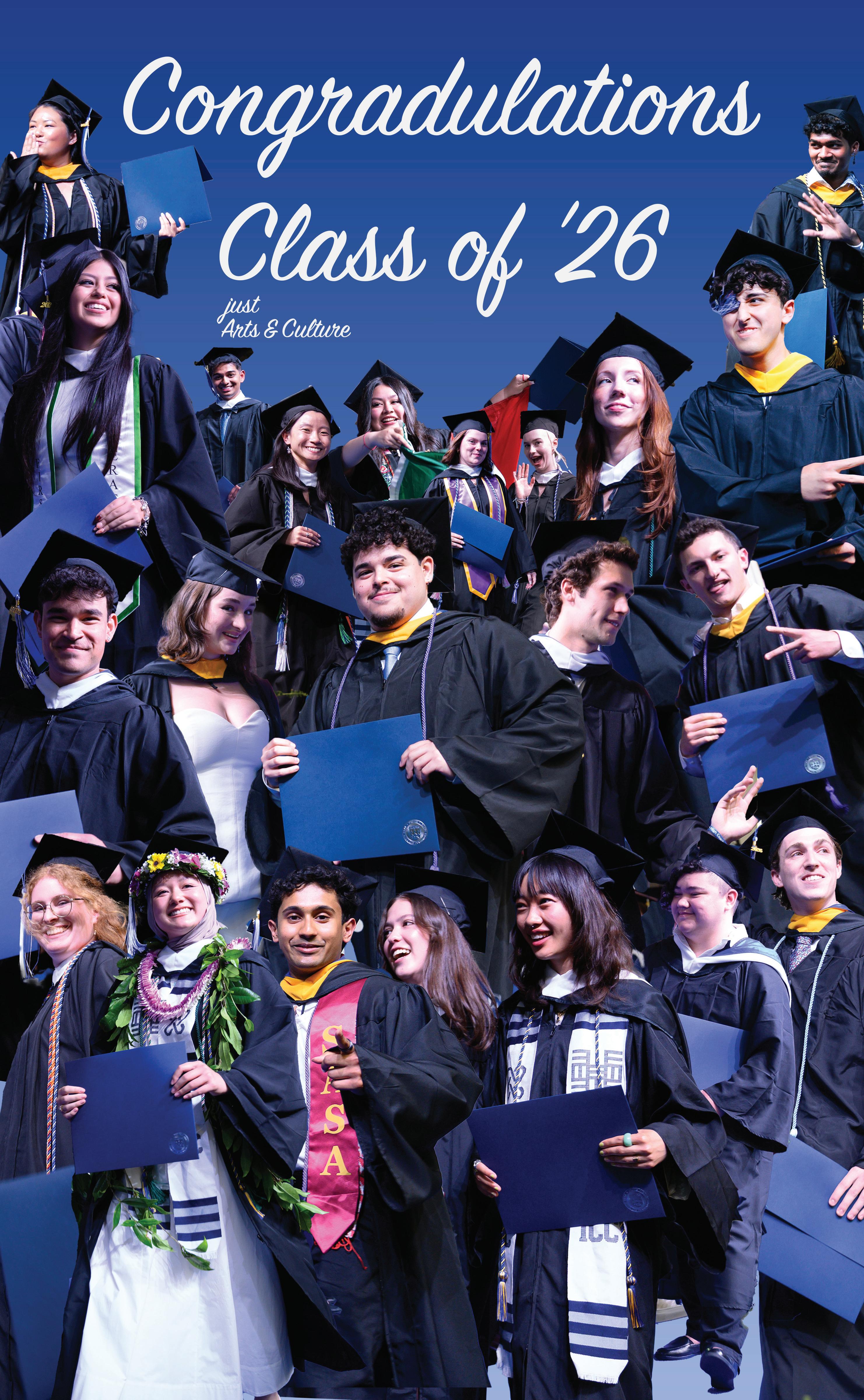
On April 30, the Brandeis Undergraduate Research and Creative Collaborations hosted its spring research symposium. This annual symposium brings together undergraduates who, with the help of faculty and other student mentors, have the opportunity to present research they have completed on a topic of their choosing. To participate, students pick their method of research delivery, whether it be an oral presentation, a poster or a multimedia display. The URCC program offers students a range of academic, professional and personal benefits and connects students with faculty mentors to pursue original research or creative projects, often with access to funding, course credit or paid positions. One of the biggest advantages in participating is skill development: Students build strong research, critical thinking and problem-solving abilities while also improving their writing and presentation skills. These experiences can help students further along in their academic careers. URCC participation also supports career and graduate school preparation. By working closely with faculty and presenting at events such as the URCC symposium, students gain hands-on experience, mentorship and professional connections that strengthen their resumes and applications. Finally, the program provides tangible support, including grants and fellowships (some up to $5,000), enabling students to focus on meaningful projects across disciplines from the sciences to the arts. URCC is a valuable opportunity to explore your interests deeply, gain real-world experience and stand out academically and professionally. Importantly, the symposium also highlighted the arts’ role as a form of research and inquiry. Artistic and humanities-based projects demonstrated that research at Brandeis is not confined to laboratory settings or quantitative analysis; rather, it can also involve creative interpretation, cultural critique, storytelling and visual expression. In many cases, art functioned as both a research method and a medium through which students communicated complex social and historical ideas to broader audiences. Across all disciplines, the common thread among presenters was their uninhibited passion for their work and their eagerness to share their research with others. This broader understanding of research became even clearer in a interview on April 30 with Evelyn Bagley ’ 27. Bagley is a junior dual majoring in Anthropology and Politics, with a minor in the History of Ideas. Their research at the symposium was conducted under the Anthropology department, and their presentation was called “Dialogue of the City.” This project was an extension of some field -
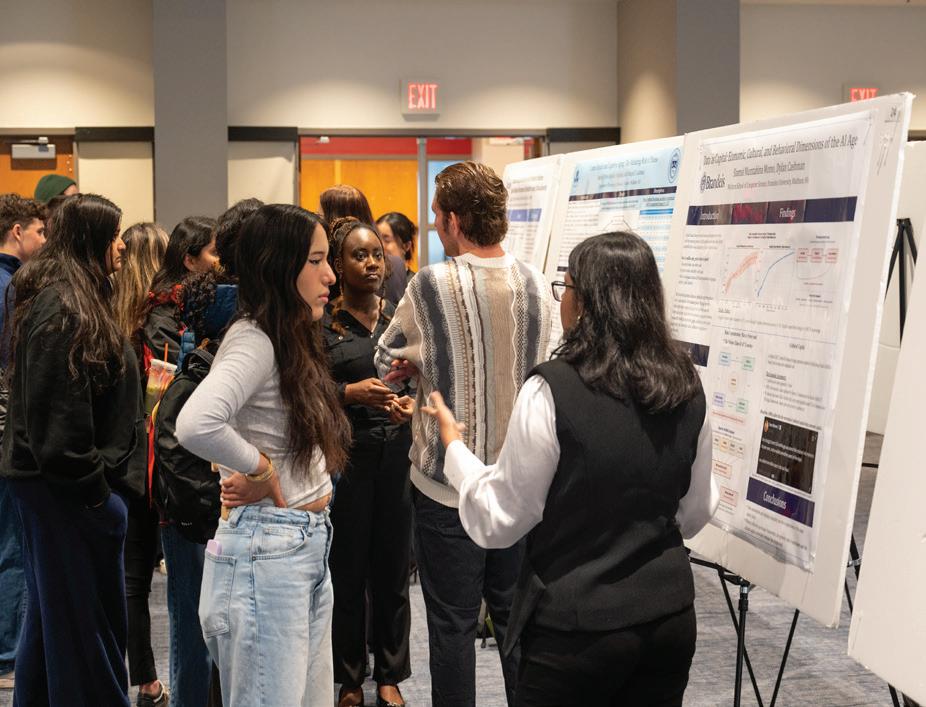
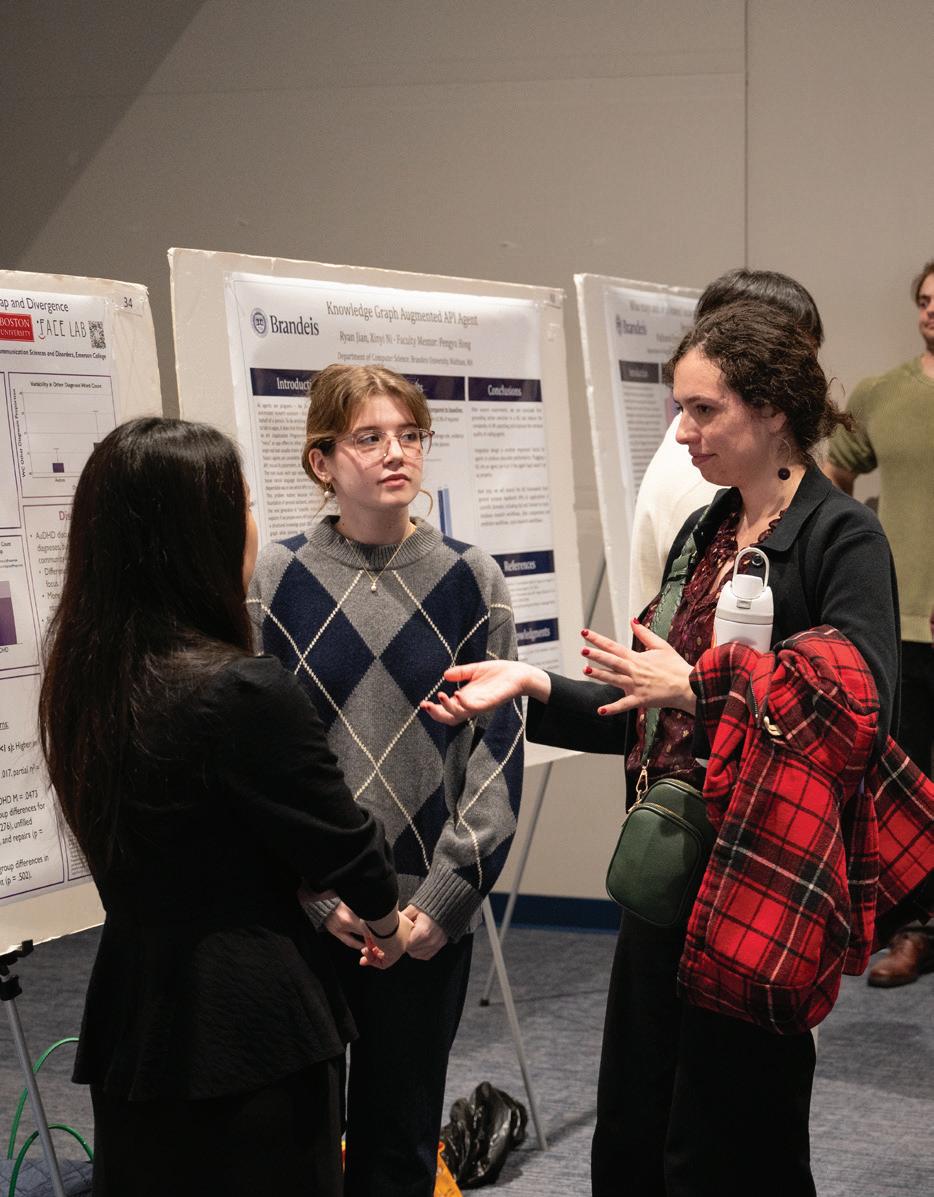
By SOPHIA GARCIA & ARIEL KNUDSEN JUSTICE ARTS AND CULTURE EDITOR AND JUSTICE FORUM EDITOR
work that Bagley completed in Poland and Czechia during the summer of 2025.
During our interview Bagley shared their leading research question: “In urban spaces, why [do] certain submarks, or inscriptions and graffiti remain visible, but kind of disappear in other places?” This question led Bagley to analyze the markings on different buildings in various cities, in an attempt to understand the discourse we have with the buildings around us. They explained, “I was in three cities: Krakow, Warsaw [and] Prague, and as I was walking around, I noticed that, for example, in Krakow, the city center is pretty much free of graffiti and inscription, but all around it, sites featured different art forms.” As part of their presentation Bagley had three stone tablets, inscribed on them were Bagley’s reprinting of the inscriptions they saw outside of Krakow city center. Bagley’s research does well to emphasize Brandeis’ commitment to interdisciplinary research.
Bagley’s research discusses how art is all around us, but is also tied to cultural and religious beliefs. They stated, “There is quite a bit of graffiti, so it led me to realize that this absence is not random, it’s very spatially patterned. There were churches...Catholic spaces, which is a big part of the culture, and it wasn’t just like people weren’t creating inscriptions there, it was that there was also surveyance. So there’s security cameras... that are kind of like regulating that absence.” They discussed their experience sitting with the absence of graffiti in these religious spaces and how the lack of art was art in itself. Bagley emphasized a discussion around art and creativity being regulated, further commenting on how art is oftentimes censored or created in certain spaces in order to convey a message.
Furthermore, Bagley discussed their time in Poland and what they discovered about Polish graffiti and how it is presented. They said, “I noticed that there are a lot of the sites where you would expect there to not be graffiti like churches and things like that, [but] there was graffiti. So I was able to kind of think about this as part of a Polish context and think about how different cities regulate visuality and absence.” The true beauty in Bagley’s search of graffiti through different cities is how cities speak to us through art and how different people use art to voice their broader desires in the world. This is in contrast to the STEM-focused initiatives of many schools and allows Brandeis to shine as a uniquely social justice-oriented university
This priority is evident through the many new initiatives on the part of Brandeis’ administration. President
Arthur Levine ’70 seems to be endeavoring to re-establish Brandeis as a school for the liberal arts, a project that harkens back to Brandeis’ social justice-focused origins. Through the implementation of the microcredential and the inclusion of the humanities in the URCC, Brandeis has been creating opportunities for both STEM and liberal arts students to showcase their interests and research. Additionally, as seen in Brandeis’ redesign of the core curriculum, career development initiatives and second transcripts that highlight career readiness by showcasing student strengths, the University seems to be pivoting from a majority STEM-focused marketing strategy to a broader appeal, highlighting how disparate fields can work together. This is most evident in the URCC a highlight of our experience at the symposium was seeing how students from diverse fields had equal opportunities to conduct research on their theses and present them. Students had posters showcasing Alzheimer’s research, public health and anthropological studies of graffiti; the one commonality among all presenters was their uninhibited passion for their work and their eagerness to share their research with others. This institutional shift allows students like Evelyn Bagley `27 to transform everyday observations into powerful academic work. Through their study of graffiti and the patterned absence of inscriptions in religious and public spaces, Bagley demonstrated how the seemingly ordinary can reveal profound insights about culture, surveillance, memory and expression. Their project showed that the mundane is never truly mundane with curiosity and careful analysis, even the walls of a city can become a text that tells stories about the societies that shape them. By investing in humanities research and recognizing artistic practice as a legitimate form of scholarship, Brandeis is encouraging students to look more closely at the world around them and to find meaning in places others might overlook. In doing so, the University is honoring its liberal arts roots and empowering a new generation of scholars to uncover beauty, significance and social insight in the everyday.
The spring URCC symposium has shown how Brandeis is embracing a broader and more inclusive understanding of what research can be. Whether students are conducting laboratory experiments, analyzing historical archives, composing original artwork or studying the visual language of city streets, Brandeis is creating opportunities for undergraduates to pursue questions that matter deeply to them.
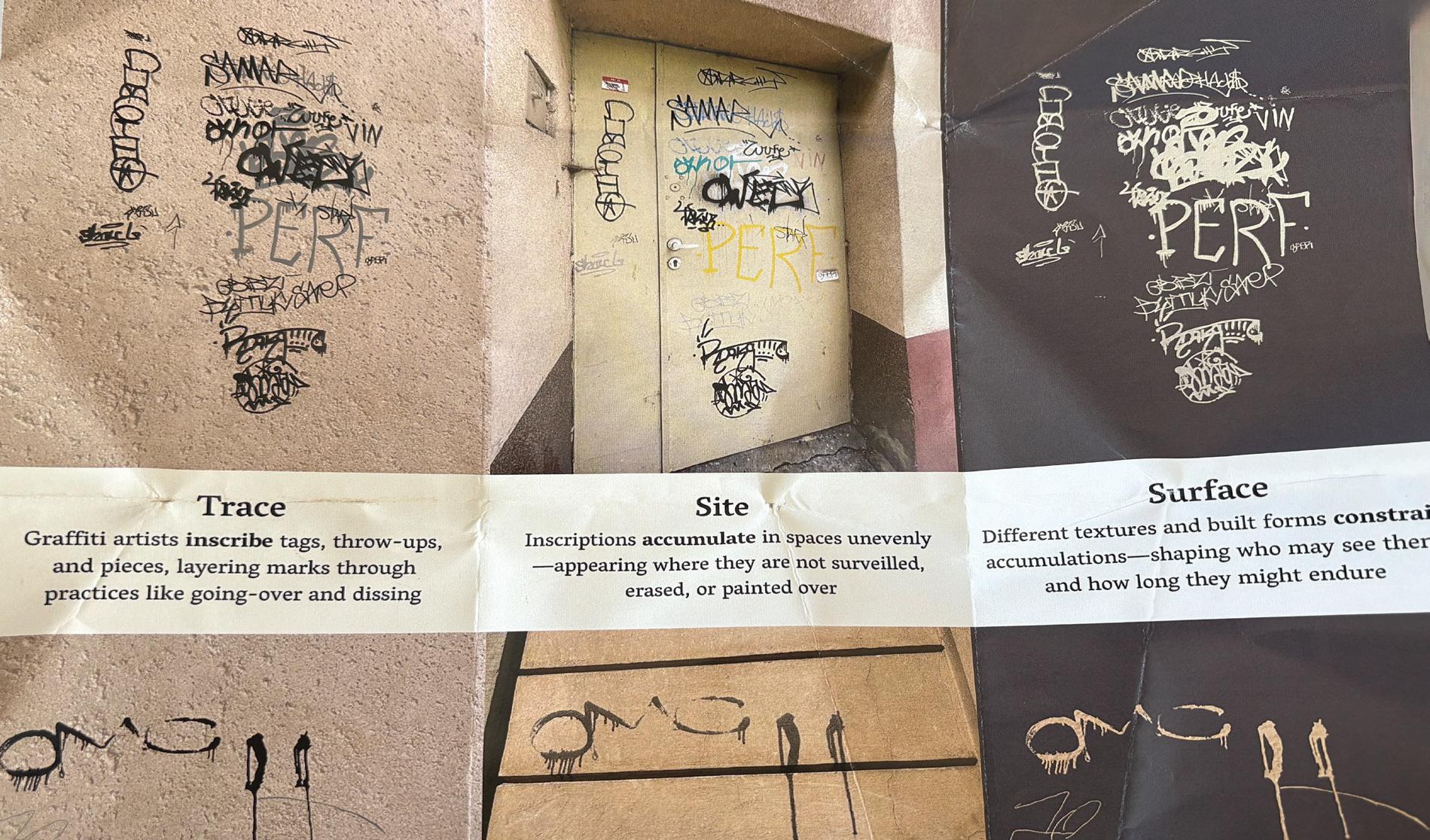
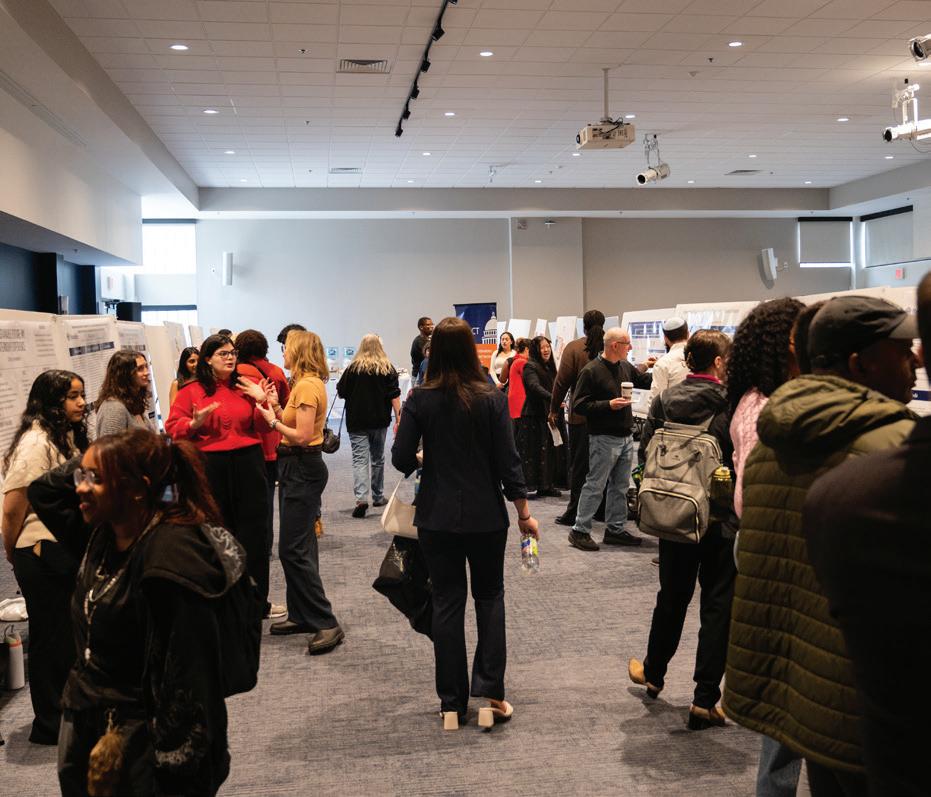
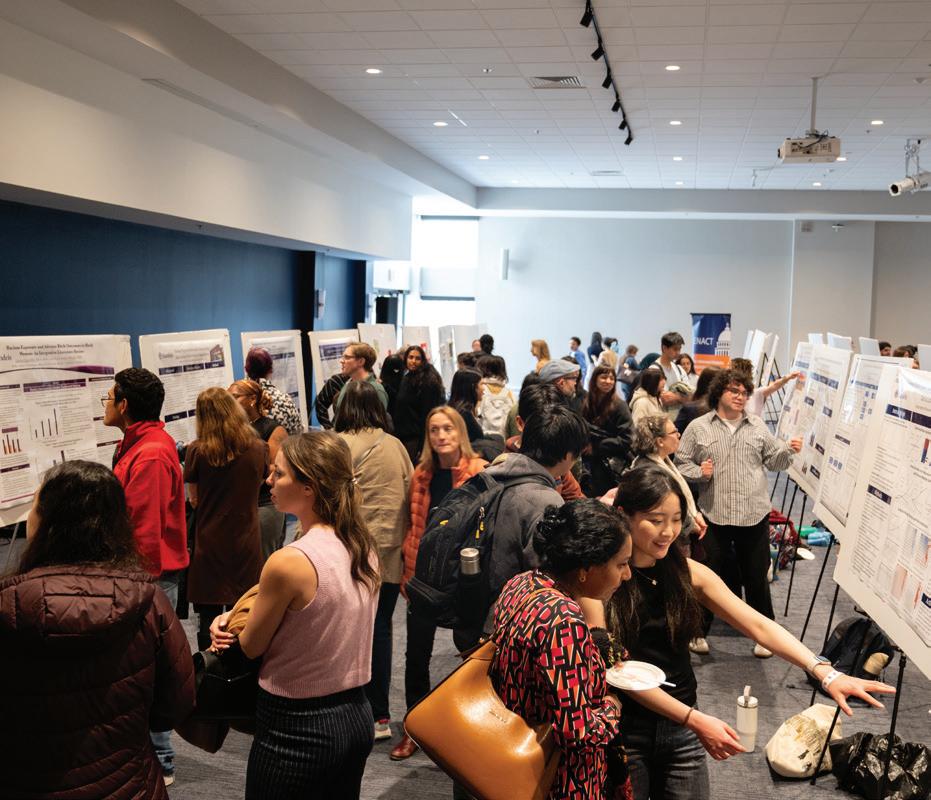
Historical fiction, when done right, is an excellent way to bridge the gap between the past and present. This genre can be written from any perspective, ranging from key historical figures to someone living their day-to-day life. Its ability to bring awareness to events or societal problems that impacted people in the past can encourage readers to research related materials in their own time, fostering a creative way to learn. For Brandeis students and staff who want something to read for the summer, especially for those who want to read a different genre, I would recommend “The Covenant of Water” by Abraham Verghese. This novel is centered around an Indian-Christian family living on the coast of Kerala and portrays themes that are still relevant today.
I was recommended this book by a friend, and I had no information about the book when I began reading it. Verghese does an excellent job of providing historical background and descriptions of the family. He avoids the trap of missing information and makes sure minor details are accounted for. His portrayal of Kerala throughout the 1900s was realistic and also demonstrated that he pulled from relevant source materials in order to set the scene. As a result, he does not shy away from the realities of that time, especially when portraying topics such as arranged marriages or death. His writing shows how these events shape the characters and other generations in the book, rather
By PALLAVI MENON JUSTICE CONTRIBUTING WRITER
than glossing over them.
There is one thing I would recommend to anyone interested in reading this book: slow down. From the very first chapter, you end up obtaining a lot of information. The best way to read this book is to find time where you’re free, sit down and read it slowly. I’ve found, from attempting to speed-read it, that you eventually end up having to go back and re-read because of a lack of understanding of what happened. Think of all the events in the book as a web: Everything and everyone is connected and when you don’t process one piece, you are unable to grasp the full depth of the story. The book shows the evolution of an Indian-Christian family through three generations, although it may sometimes switch to the perspectives of other people who interact with the family. It starts with the matriarch of the family before showing the point-of-view of her son, Phillipose and eventually her granddaughter Marriama. Verghese’s portrayal of generational trauma is clear. Generational trauma is a phenomenon where “an overwhelmingly negative experience causes ripple effects that are passed down in the family. It happens when traumatic experiences in one generation are not properly addressed or healed from, causing behavior to combat the trauma and therefore impacting the next generation. The traumatic events in “The Covenant of Water” are a repeated series of deaths that occur within the family. The family does not know the cause,
and a large portion tend to avoid anything regarding the subject of the deaths or have a deep-seated fear for themselves and their family.
Verghese portrays generational trauma subtly, and one thing I noticed was that during the switch of point of views, the next generation had a lot of hesitancy around talking about trauma. When reading this, I thought it was very realistic.
“The Covenant of Water” is set over many decades and shows how India transforms politically. With this, the author also comments on themes of agency and how people make choices in limited constraints. The characters, who are from several different backgrounds, show this. For most of them, I neither disliked them nor liked them. That being said, I did really like the character of the matriarch and her granddaughter. Some of the characters thought in ways that were really unpleasant to read about, while others were people who made decisions under bad circumstances.
Overall, I really enjoyed reading this book. I’d suggest it to anyone who enjoys reading longer novels and encourage those who may not enjoy longer texts to give it a chance. As a South Asian person who has been trying to find more books set in historical time periods within India, this book is definitely on my list of recommendations to other people.
Content Warning: This article contains mentions of the Holocaust, rape, hate crimes and murder.
The Brandeis Rose Art Museum has continually delivered exhibitions and pieces of the highest caliber to our community. From the works of Andy Warhol to the protection of Jewish legacy achieved with Holocaust art — “Raya Kovensky, Survivor of Kristallnacht” by David Kassan sits in the Photorealism exhibition — the museum has rotated its exhibitions in accordance with the times, both to cater to cultural interests as well as cultural crises. The current exhibition, “Sanctuary” by Yinka Shonibare, addresses the modern anxiety of societal chaos. In a discussion with the museum staff, the word “symbolism” was often invoked to justify some of the pieces, but some of the pieces simply do not fit the lable of “sanctuary.” The discussion of what truly are sanctuary spaces and which ones aren’t, is, in itself, the great result of the exhibition — what is the role of art if not to be thought-provoking? In this review, I would like to focus on three models in the exhibition and how they fit into this notion of sanctuary: Notre-Dame de Paris, Covenant House (Casa Alianza) and the United Nations.
Notre-Dame de Paris stands out as the most well-known sanctuary for our generation. Shonibare has created a replica of the church, the structure itself made from wood and the insides decorated with Dutch-bought fabric from West Africa and Indonesia. Besides its precision, the artist’s placement of light within the structure portrays this religious-like light as if created by God on the first day of creation. Notre Dame has been a refuge for victims of war and communities undergoing persecution (e.g., Roma people and Jews), and it served the masses when the plague ravaged Europe. The magnificence of Shonibare’s model and his usage of light is thus reminiscent of Heaven’s light and invokes this sentiment of religious peace that many have sought during France’s most turbulent times. The virtues of God and of the clergymen as enforcers of His mercy are thereby effectively portrayed, religion and politics merging perfectly into one.
The next notable model in Shonibare’s exhibition is his piece that replicates Covent House (Casa Alianza). Casa Alianza is an initiative that operates across North and Central America that provides refuge to suffering teenagers. Whether it has been by parental neglect, abuse, human trafficking, homelessness or any other dire status, the institution intends to provide these teenagers with a stable home and rehabilitative community engagement. Shonibare’s model is based on its Mexico City branch. The artist’s choice of fabric is what makes this piece thought-
By ROGÉRIO VILLAÇA SZUSTER JUSTICE STAFF WRITER
provoking. The print depicts black-and-white blurbs in a fabric patterned with yellow and orange. The intentionality behind the shape of the blurb, with its decisive lines that enclose the perimeter, combined with the non-specificity of the shape, conveys a young atmosphere — as if those blurbs had been either created by or are symbolic of those who seek sanctuary in Casa Alianza. The shape is haunting and ghost-like. This sentiment that Shonibare creates, though uncomfortable, is consistent with his description of the sanctuary: these teens are suffering, but nonetheless are protected by the wooden walls of their sanctuary.
The last piece that I must mention is precisely the one that has brought about the discussion of whether or not the exhibition was a true showcase of “sanctuary”: the United Nations headquarters in New York City. The U.N. was created after World War II to ensure that no such tragedy would happen again. WWI had already shocked global politics by the intercontinental involvement in the conflict and when WWII brought global involvement and immense international death tolls justified because of ideologies held by Adolf Hitler, Joseph Stalin and military dictators, it prompted the U.N. to be created as a peace initiative, a promise that such a tragedy wouldn’t be inflicted again. For Jewish people globally, the U.N. represented hope, for it would be an effective improvement of the failed Evian Conference, where several countries met to discuss Hitler’s judenrein and to create a plan that would protect the Jewish community. The Evian Conference resulted in no country, with the exception of the Dominican Republic, increasing their intake of Jewish immigrants, which doomed many to the Shoah (Hitler’s genocide) about to come.
However, as a Jewish person viewing the exhibition, I could not help but feel betrayed by the U.N. being presented as a sanctuary. Even after its creation, the U.N. has observed horrors inflicted upon the Jewish community and has not protected the Jewish people properly. Between the establishment of the State of Israel and the early 1970s, nearly one million Jews (mostly Mizrahim and Sephardim) were forced to flee the Arab countries where they lived, many of whom had their properties detained by the governments, prompting a mass Mizrahi exodus towards Israel and diasporic countries. In the 1970s, antiJewish sentiment nurtured by the military junta Derg had ravaged Ethiopian Jewish people (Beta Israelim), with thousands murdered and many more ousted, leading to around 45 thousand Ethiopian Jews immigrating to Israel. The Polish Communist Party raged with claims of Anti-Zionism and the agression prompted a mass exodus of Polish
Jewish people, mostly towards Israel in 1968. The pattern of protection being traced back to the State of Israel, officially founded and recognized by the U.N. conference, is a strong argument that the U.N. was able to prevent another Holocaust at the hands of the Nazi party occurring against Jewish people. However, what are people to make of the constant increase in anti-Jewish sentiment? How must we address the U.N. as a sanctuary when its member states allow hatred and violence to constantly foster within them? When a 12-year-old Jewish girl is raped in France while antiJewish remarks screamed at her and when Spain has a list of Jewish-owned businesses to target, how are we supposed to trust that Jewish people can feel safe? This Jewish plight of mine is indubitably felt by members of other communities — decades-old anti-Christian oppression in Sudan has escalated to extreme levels, queer individuals continue to be killed in Iran by the Islamic Revolutionary Guard Corps, anti-Black lynchings continue to take place in Latin America and abroad and much more. Can one claim with confidence that the U.N. prevented tragedies of such scale from occurring when violence spikes to such an extent? Can one defend that the U.N. maintains peace when Russia endlessly tortures Ukraine, when the IsraelHamas conflict continues or when extremist terrorist organizations are empowered to such an extent that they are able to conduct the 9/11 attacks? A certain distrust towards the U.N. as a perfect sanctuary is well-founded. Therefore, Shonibare’s piece is indeed thought-provoking. It is able to convey divine refuge and the warmth of Heaven’s light with its artistic recreation of Notre Dame, as well as portraying how the suffering youth of North and Central America find solace in Casa Alianza. Its inclusion of the U.N. headquarters begs the question of efficacy and brings upon all the anxiety and trauma that have been inflicted upon all communities since its creation. The promise that was once made still stands, but having seen the progression of history, can we comfortably claim that it is as warm a refuge as other sanctuaries? Can we claim that it feels similar to the sentiment of finding refuge under Heaven’s light? These questions of sentimentality are bound to be discussed, and from the discourse, the exhibition proves its success. Art is supposed to entice the mind of its observers while prompting a cognitive-affective response, and Shonibare’s “Sanctuary” exhibition with the Rose Art Museum achieved such a feat and should thus be acknowledged as an immense success.
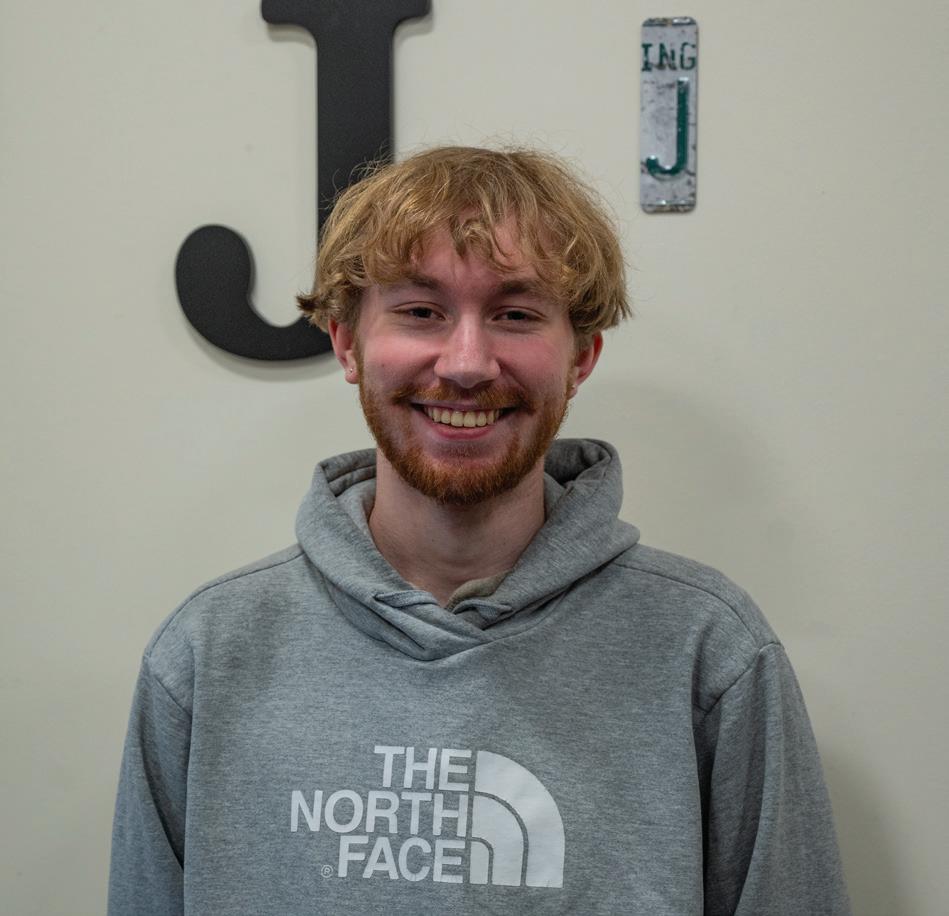
Top 10 seasons of TV I watched instead of writing essays
By LUCA D. JORDAN JUSTICE SPORTS EDITOR
1. “The Pitt” season 1
2. “A Knight of the Seven Kingdoms” season 1
3. “The Pitt” season 2
4. “Lost” season 2
5. “Beef” season 2
6. “Wonder Man” season 1
7. “The Boys” season 5
8. “Love is Blind” season 10
9. “Daredevil” season 5
10. “Euphoria” season 3


By NEMMA KALRA JUSTICE DEPUTY EDITOR