ARTS Page 19
FORUM Boston Olympics will hurt economy 11
BPART EXHIBIT
SPORTS Women lose a conference thriller 16 The Independent Student Newspaper
the
of
B r a n d e is U n i v e r sit y S i n c e 1 9 4 9
Justice
Volume LXVII, Number 18
www.thejustice.org
Tuesday, February 3, 2015
Waltham, Mass.
FACULTY
END OF AN ERA
Tenure process explored
■ The tenure process for University faculty has been questioned by some for having a history of being lengthy, secretive and without clear guidelines. By MARISSA DITKOWSKY JUSTICE STAFF WRITER
um, developed a comprehensive strategic plan for the University, stewarded Brandeis out through the other side of the 2008 recession and continued Reinharz’s legacy of upgrading and improving the University’s campus. In the last two years, however, controversies around Al-Quds University
Tenure is a concept that has been traced back hundreds of years and has existed in higher education for a number of years. However, according to tenured Prof. Gordon Fellman (SOC), tenure has been questioned the last few years “in ways it never used to be.” The point of tenure in academia, he explained, is not only job security but also speech protection. “It means that anybody can say anything that they believe is correct … and not fear repercussions for it.” Like most schools, not all faculty members at Brandeis currently have tenure. In addition, despite the security that tenure is said to provide, tenured, tenuretrack and non-tenure track faculty alike fear repercussions for their speech. Eighty-five percent of Brandeis faculty, or 359 employees, were considered full-time during the 2013 to 2014 academic year, according to statistics Provost Lisa Lynch provided to the Justice. The statistics included only tenured faculty, tenure-track faculty and faculty on multi-year contracts as full-time faculty. Of the full-time University faculty, 58 percent, or 202 employees, were tenured. The rest were either on the tenure track but had yet to be considered for tenure—14 percent, or 49 employees—or on multi-year contracts—28 percent, or 98 employees. The remaining 15 percent, or 61 employees, were non-tenure track faculty. Among non-tenure track faculty there are a number
See LEGACY, 7 ☛
See TENURE, 6 ☛
OLIVIA POBIEL/Justice File Photo
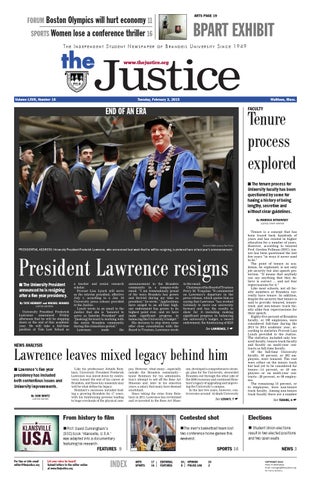
PRESIDENTIAL ADDRESS: University President Frederick Lawrence, who announced last week that he will be resigning, is pictured here at last year's commencement.
President Lawrence resigns ■ The University President
announced he is resigning after a five-year presidency. By TATE HERBERT and RACHEL HUGHES JUSTICE editors
University President Frederick Lawrence announced Friday afternoon that he will be stepping down at the end of this academic year. He will take a full-time position at Yale Law School as
a teacher and senior research scholar. Provost Lisa Lynch will serve as the interim president, effective July 1, according to a Jan. 30 University press release provided to the Justice. Lynch wrote in an email to the Justice that she is "honored to serve as Interim President" and "[looking] forward to working with the entire Brandeis community during this transition period." Lawrence made the
announcement to the Brandeis community in a campus-wide email. “I am tremendously proud of the ways Brandeis has grown and thrived during my time as president,” he wrote. “Applications have surged to an all-time high, our endowment has grown to its highest point ever, and we have made significant progress in balancing the University’s budget.” His decision to step down came after close consultation with the Board to Trustees, Lawrence wrote
in the email. Chairman of the Board of Trustees Perry M. Traquina ’78 commented on Lawrence’s departure in the press release, which quotes him as saying that Lawrence “has worked tirelessly to move our university forward and has the results to show for it—including making significant progress in balancing the university’s budget, a record endowment, the fundraising of $225
See LAWRENCE, 7 ☛
news analysis
Lawrence leaves mixed legacy behind him ■ Lawrence's five-year
presidency has included both contentious issues and University improvements. By sam mintz JUSTICE editor
Like his predecessor Jehuda Reinharz, University President Frederick Lawrence was mired down by controversy toward the end of his career at Brandeis, and those key moments may well be what define his legacy. Reinharz’s successes included leading a growing Brandeis for 17 years, with his fundraising prowess leading to huge overhauls of the physical cam-
pus. However, what many—especially outside the Brandeis community— know Reinharz for his administration’s attempt to sell off the Rose Art Museum and, later in his emeritus years, a salary that many have deemed exorbitant. Since taking the reins from Reinharz in 2011, Lawrence has revitalized and re-invested in the Rose Art Muse-
From history to film
Contested shot
Elections
Prof. David Cunningham's (SOC) book 'Klansville, U.S.A.' was adapted into a documentary featuring his research.
The men's basketball team lost two conference home games this weekend.
Student Union elections result in two elected positions and two open seats.
FEATURES 9
For tips or info email editor@thejustice.org
Let your voice be heard! Submit letters to the editor online at www.thejustice.org
INDEX
SPORTS 16 ARTS SPORTS
17 16
EDITORIAL FEATURES
10 8
OPINION POLICE LOG
10 2
News 3 COPYRIGHT 2015 FREE AT BRANDEIS. Email managing@thejustice.org for home delivery.
2
TUESDAY, FEBRUARY 3, 2015
●
THE JUSTICE
NEWS BRIEF
Disneyland measles outbreak spreads across the West Coast The Centers for Disease Control and Prevention is urging Americans young and old to get vaccinated against measles because of a sharp uptick in cases in the new year. 84 people in 14 states have contracted the contagious respiratory disease in the first 28 days of 2015. That’s “as many cases as we have all year in typical years. This worries me,” said Dr. Anne Schuchat, director of the CDC’s National Center for Immunization and Respiratory Diseases. The vast majority of cases—63—are in California and stem from an outbreak that began at Disneyland Park in Anaheim. Visitors to the park between Dec. 17 and Dec. 20 of last year later developed the disease along with at least five Disney employees. To date, 67 cases in California and six other states have been traced to the Disney outbreak. “We don’t know exactly how this outbreak started, but we do think it’s likely a person who was infected with measles overseas visited the Disney park in December while they were still infectious,” Schuchat said Thursday during a telephone briefing with reporters. In addition to the 63 cases in California, Arizona has reported seven cases. Washington and New York have each seen two, while Colorado, Nebraska, Oregon, Utah, Minnesota, Illinois, Pennsylvania, South Dakota, Texas and Missouri have reported one case each. Growing in cells at the back of the throat and lungs, measles is spread through the air by coughing, sneezing and even breathing. It can cause fever and cold-like symptoms, along with a stubborn rash. Before the U.S. measles-vaccination program, which began in 1963, three million to four million people in the U.S. developed measles each year, leading to 48,000 hospitalizations and 400 to 500 deaths. As measles vaccinations took off in the 1960s, the rate of transmission steadily declined. The resurgence of the disease is a disturbing development for health officials, who declared in 2000 that measles had been eliminated from the U.S. through a successful vaccination program. Between 2001 and 2010, the U.S. reported a median of 60 cases a year, Schuchat said. But unvaccinated Americans and foreign visitors who traveled to the Philippines, Europe, Africa and Asia are the main culprits in a growing case spike that began several years ago and exploded in 2014. More than 600 measles cases were reported in the U.S. last year, the most in more than 20 years. Schuchat said a growing trend of Americans foregoing measles vaccinations for personal and religious beliefs has helped fuel the recent U.S. outbreaks. At one point last year, 90 percent of U.S. cases were among people who hadn’t been vaccinated for the disease or who didn’t know their vaccination status. One in 12 U.S. children do not get their measles vaccination on time, Schuchat said. “This is not a problem of the measles vaccine not working,” Schuchat said. “This is a problem of the measles vaccine not being used.” Children should get their first measles vaccine at 12 months with a second dose no later than age four to six. Adults who aren’t sure of their vaccination status should also get two doses. Schuchat said concern that the measles vaccine causes learning problems and autism in children “just have not been borne out at all.” She said the vaccine is safe and effective. About 10 percent of children who get measles also get ear infections, and about five percent develop pneumonia. About one in 1,000 measles patients contracts encephalitis, and one or two out of 1,000 die. The CDC is urging health professionals to suspect measles when they see patients with rashes and other measles symptoms. They’re also being asked to check patients’ travel history to see if they have visited countries like Azerbaijan, Indonesia, India and Qatar, where some of the current U.S. cases appear to have originated.
POLICE LOG Medical Emergency
Jan. 25—A staff member in the Gosman Sports and Recreation Center reported a party took a serious fall with a serious injury to their leg and requested an ambulance. The party was treated and transported via ambulance to Newton-Wellesley Hospital for further care. Jan. 27—University Police received a report of a party in a residence hall who jumped off a balcony and appeared to be injured. BEMCo and University Police responded, treated the party and transported the party to Newton-Wellesley Hospital. Jan. 28—A party called to say he was coming to Stoneman to get checked out for a sore throat and wanted BEMCo to check him. After BEMCo staff treated the party on site, University Police transported the party to Newton-Wellesley Hospital for further care. Jan. 28—University Police received a report of a party in Ridgewood Quad complaining of a possible kidney stone, with
similar prior history. The party was treated on site by BEMCo with a signed refusal for further care. Jan. 29—University Police received a report of a party who got hot oil on their face while cooking in the Charles River apartments. University Police and BEMCo responded, and the party was treated on scene with a signed refusal for further care. Jan. 29—University Police and BEMCo responded to a party off campus who slipped and fell on ice, striking their head and back. The party was transported to Newton-Wellesley Hospital for further care. Jan. 29—University Police received a call of a party in Gosman who injured their head playing basketball. University Police and BEMCo responded and treated the party on scene with a signed refusal for further care. Jan. 30—University Police and BEMCo responded to a call of a party in the Shapiro Science Center who was complaining of
stomach pain. The party was treated on site by BEMCo and transported by University Police to the Golding Health Center for further care. Feb. 1—University Police received a call of a party in Shapiro Residence Hall possibly intoxicated and vomiting. University Police and BEMCo responded and found the party unconscious. The party was transported to Newton-Wellesley Hospital for further care. Feb. 1—University Police received a complaint of an intoxicated party who was conscious and alert. University Police and BEMCo responded and treated the party on site. The party was transported to Newton-Wellseley Hospital for further care by Cataldo ambulance.
Drugs
Jan. 28—University Police received a report stating the odor of marijuana was present in Ridgewood Quad. University Police notified the community
MAKING CONNECTIONS
Larceny
Jan. 25—University Police received a report of a whiteboard that had been disassembled and stolen from a common area in Shapiro Residence Hall. University Police complied a report on the incident.
Other
Jan. 28—University Police received a report of a male with a blue T-shirt approximately 20 to 30 years of age talking to himself and causing a scene. University Police located the party and discovered him practicing his lines for a theater play. Police took no further action. Jan. 31— Police received a call for loud noise in Shapiro Residence Hall. Officers advised the residents to lower the noise, and they complied without incident. —compiled by Avi Gold
BRIEF
Blizzard hits Northeast
—Tribune News Service MORGAN BRILL/the Justice
CORRECTIONS AND CLARIFICATIONS
development coordinator and remained present while the situation was handled.
Jonas Singer ’18 speaks at the University’s annual Brandeis Israel Public Affairs Commitee Internship gala last Thursday. The event hosted Israeli startups and scholars from all over the Northeast.
The entire Northeast was hit with a massive blizzard last week, named “Juno,” that dumped over two feet of snow in Massachusetts and closed the University for over 48 hours. The National Weather Service estimated that over 29 million people were affected by the massive snowstorm, which covered a 250-mile stretch of the Northeast. According to NBC News, over 4,700 flights were canceled up and down the East Coast. The blizzard began Monday evening and continued throughout Tuesday. Boston experienced “hurricane-force winds” and received over 24.6 inches of snow, according to the National Weather Service, with some areas of Massachusetts receiving even more. Worcester, Mass. received 34 inches, an all-time record for the city, according to the Boston Globe. The Globe also stated that this was Boston’s sixth largest snowstorm, passing the January 2005 snowstorm by two and a half inches. Governor of Massachusetts Charlie Baker declared a state of emergency Monday morning and issued a statewide driving ban in effect from Monday night to Tuesday at midnight. According to the Globe, Baker also “pre-positioned 500 members of the National Guard to be quickly deployed if needed.” Despite the whiteout conditions, dangerous winds and thousands of power outages across the states, Baker told the Globe that the blizzard was not as damaging as expected. “Despite the fact that we had a record-breaking snowfall in many parts of Massachusetts, we’ve come out of this, I think, in relatively good shape,” Baker said. According to the Waltham Patch, the Waltham area received around 20 inches of snow. The University closed at 5 p.m. on Monday evening and remained closed Tuesday and Wednesday, with minimal services being conducted on campus. In an email sent to students on Monday evening via the severe weather alert service, the University stated that “a number of staff members from facilities, dining, and campus safety are remaining in campus housing to maintain safety and reasonable levels of operations.” The email also stated that students were advised to use extreme caution when going outside. The University was also closed yesterday, with another 10 to 14 inches of snow hitting the area Monday night. —Rachel Sharer
There were no corrections this week. The Justice welcomes submissions for errors that warrant correction or clarification. Email editor@ thejustice.org.
Justice
The Justice Brandeis University Mailstop 214 P.O. Box 549110 Waltham, MA 02454-9110 Phone: (781) 736-3750
’Deis Impact: Soulfulness and Social Justice Making
www.thejustice.org
The Justice is the independent student newspaper of Brandeis University. The Justice is published every Tuesday of the academic year with the exception of examination and vacation periods. Editor in chief office hours are held Mondays from 2 to 3 p.m. in the Justice office. editor@thejustice.org news@thejustice.org forum@thejustice.org features@thejustice.org sports@thejustice.org arts@thejustice.org ads@thejustice.org photos@thejustice.org managing@thejustice.org copy@thejustice.org layout@thejustice.org
History of Activism at Brandeis: A Show & Tell Event
Come to the University Archives and see evidence of Brandeis students’ activism and learn about the barriers they faced and the injustices they fought. On display will be materials from the Ford Hall Takeover, an alumna’s journal from the 1965 SCOPE Project and more. Archivists will be on hand to answer questions and to discuss the role social activism has played in the life of the University, its students and the world at large. All are welcome to attend. Today and tomorrow from 11 a.m. to 3 p.m. in Goldfarb Library Archive and Special Collections.
the
Editor News Forum Features Sports Arts Ads Photos Managing Copy Layout
ANNOUNCEMENTS
Based on his most recent book, Fulfilled, Kirk Jones will articulate a new approach for the exhausted activist leader. His ap-
proach to leadership is based on three inner capacities which every leader already possesses: stillness, awareness and playfulness. Learn from this Louisiana-born “Preacher’s Teacher” how to burn brightly in the world without burning out. Wednesday from 2 to 3:30 p.m. in Rapaporte Treasure Hall.
‘DEIS Impact: Are You Winning An Unfair Game?
As a society, we let random acts of birth determine who receives access to the best healthcare, educational systems, and nutrition. Yet, many policymakers are surprised when those carrying the burdens of their birth are unable to succeed. Project Plus One challenges you: Can you win when the odds are stacked against you? Join us for a night of classic family games with some unusual twists. The night also features a short documentary, “Unnatural Causes,” detailing the racial, social, and economic
circumstances that illuminate the unfair distribution of healthcare in this country. Sunday from 7:30 to 9 p.m. in the Shapiro Campus Center Multipurpose Room.
Martin Weiner Lecture in Computer Science: Anita Sarkeesian
Anita Sarkeesian is a well-known feminist critic of video games who blogs at feministfrequency.com. She won the 2014 Game Developers Choice Ambassador Award and has been covered by major media including the New York Times, the New Yorker, Wired and Businessweek. She has also come under attack for her work, receiving rape and death threats and becoming subject to doxxing, hacking and identity theft. She will be lecturing on misogyny in video game culture and her experience in the field as a critic. Monday from noon to 1:30 p.m. in the Shapiro Campus Center Theater. Tickets are available at the SCC Ticket Office.
THE JUSTICE
STUDENT LIFE
Rape Crisis Center to open soon, hiring peer advocates ■ The University is hiring
students as peer advocates to work at the Rape Crisis Center, which opens March 2. By RACHEL SHARER JUSTICE EDITORIAL ASSISTANT
The University’s new Rape Crisis Center, which is set to open on March 2, is hiring students as peer advocates to provide help and support to survivors of sexual assault. The Rape Crisis Center, or RCC, is an initiative started by the University’s Office of Prevention Services and was first proposed by members of Brandeis Students Against Sexual Violence in a petition last spring, according to an April 8 Justice article. The RCC, along with several other campus-wide changes, was established after contentious debates on how the University handles sexual assault policies. Last fall, the University was listed as one of over 75 colleges and universities that was under investigation for potentially violating Title IX rights. Three students, Samantha Daniels ’16, Victoria Jonas ’15 and Ava Blustein ’15, already work closely with the Office of Prevention Services and are set to work at the RCC when it opens. They are under the supervision of Sheila McMahon, the sexual assault services and prevention spe-
cialist who has returned this semester from academic leave, as well as Dr. Kristin Huang from the Psychological Counseling Center, who was hired as a specialist in trauma and sexual violence. Huang did not respond to requests for comment. Daniels, the volunteer coordinator for the RCC, wrote in an email to the Justice that the inaugural group of peer advocates will serve as “additional members of the [Center’s] team” and must go through extensive training to become advocates. According to Daniels, the six to ten peer advocates who are hired must commit to two semesters of work, work 8-10 hours per week at the RCC and participate in biweekly training and support meetings. According to the online application, advocates will also receive a $250 stipend. McMahon wrote in an email to the Justice that the main roles of the advocates will be to work alongside staff at the RCC and provide resources, information and support to students who request it. According to McMahon, the advocates’ work could involve “providing emotional support to students who have experienced a sexual assault, providing information about other support resources on campus and in the community and providing accompaniment to medical and other related appointments.”
Daniels also stressed the importance of the latter role, stating that the most “unique component of the role is to provide medical advocacy” or to accompany survivors to the hospital “should they choose to get a rape kit done.” “We cannot anticipate how often this service will be used,” Daniels wrote in an email to the Justice. “The RCC is a space for survivors as well as their support network.” McMahon wrote that the criteria for selected applicants includes “the ability to maintain confidentiality, a respectful stance toward all who access the RCC, and a commitment to addressing the consequences of sexual violence.” McMahon also said another important piece of criteria was to empower survivors and providing “non-judgmental, warm support.” “We are looking to hire students who have high levels of self-awareness and stability because they will be accompanying students who may experience intense emotions,” McMahon wrote. Daniels wrote that another longterm goal of the RCC is to “develop campaigns aimed toward creating a culture change on campus.” According to McMahon, the final applicants will officially be selected prior to February break, and the Rape Crisis Center will hold an open house on Feb. 24 before officially opening on March 2.
STUDENT UNION
MORGAN BRILL/the Justice
Faculty meeting addresses race ■ Student representatives
■ Students voted in the
The most recent faculty meeting included a discussion between student representatives and faculty about the need to address racism among the Brandeis community. Seven students, including Christian Perry ’16 MA (Heller), Maya Cooper ’15 and Sarah Gray (PhD), addressed the need for the Brandeis community to participate more in discussions on concealed racism. Gray discussed the importance of discussing inequalities because they influence “how we research and talk about African-Americans and how we discuss them and look closer in each of our own individual topics.” The students said that racism impacts everyone, that they wanted more participation from the community and that they desired change instead of angry discourse. The discussion’s primary focus was to brainstorm ways for more community involvement in this discussion on racism. In response, Prof. Gordon Fellman (SOC) told the group about his idea for what he called a “Truth Telling Project.” Through the Truth Telling Project, the University of St. Louis documented its community’s stories. Fellman said he believed Brandeis could complete a similar project where students share their own stories on police harassment. Other ideas ranged from inviting more Posse scholars to campus to inviting the Waltham Police to campus. Professors also mentioned Civil Rights leader Julian Bond’s upcom-
election last Thursday but filled only two of the four open positions. Another round will be held this week. By ABBY PATKIN JUSTICE EDITORIAL ASSISTANT
On Thursday, Brandeis students voted to fill four vacant Student Union seats: vice president, Rosenthal Quad senator, Ziv Quad senator and midyear senator. This election was the first round of two in the winter 2015 election cycle. Charlotte Franco ’15 was elected vice president. Franco was previously the Student Union secretary and served as Student Union vice president during the 2013-2014 academic year. Franco won the Vice Presidency with 373 votes, totaling half of the votes cast. “The role of VP allows me to be a mentor to all of the senators,” Franco said in an email to the Justice. “As a senior, and a four term member of the Student Union, it is important to me that the next generation of the Student Union is well trained. I am hoping that in this role I will be able to help the senate with their initiatives and pass on my experience to them.” Citing such examples as her “#selfies4secretary” campaign, Franco also noted that her prior ex-
JOIN
By RACHEL SHAW JUSTICE Contributing WRITER
ing visit to the University in March. Thursday’s meeting was facilitated by provost and interim president Lisa Lynch. It began with tributes for two recently deceased University faculty members, Attila Klein (Heller) and Richard Almeroto (ENG). Lynch then thanked Former Provost Steve Goldstein and Prof. Anita Hill (Heller) for “their support in the reorganization of the Provost office” and the faculty for their participation in online Title IX training. When acknowledging future inperson training—Lynch remarked that while “no training program is perfect, the best are the ones that assess impact of the training.” Next, Lynch urged the faculty to increase the response rate of online surveys, stating that the “faculty work life survey” only received a “disappointing 48 percent response rate.” Lynch announced changes regarding reaccreditation of university standards. Brandeis will be the first university assessed by new standards, and Lynch shared plans to help the University adjust. For instance, Prof. Dan Perlman (BIOL) will form a committee to judge teaching proposals. Lynch hopes to implement funds through this committee to “examine new styles of education and new ways to assessing student learning, using new technology to restyle classes.” Lynch addressed the “ongoing” discussions with student representatives over the University’s use of “conflict free minerals,” instead of “products produced from child labor” Finally, Prof. Faith Smith (AAAS) shared that Vice Provost John Unsworth created a library committee for cyber security. Smith said that Unsworth presented a brief on his concerns about “faculty’s use of commercial products like dropbox.” Smith also articulated her desire for faculty and students alike to “speak openly about our differences.”
Contact Rachel Hughes at editor@thejustice.org.
the Justice
3
MAKING CHANGES: Provost Lisa Lynch facilitated the last faculty meeting.
Two Student Union seats filled in elections, two more remain open lot of time,” he said. “They put in a lot of effort into making sure everyone knew about me running, even though I wasn’t on the ballot.” Yet while he became involved with the Student Union by accident, he is looking forward to helping fellow midyear students acclimate to life at the University. “It started out as a joke, but now that I’m here, I do want to take it seriously and see what I can do with the Student Union,” Koenig said. “I got elected by the midyears ... so I think first and foremost I want to see what’s going on and make sure [the other midyears] are informed about what’s happening.” The positions of Ziv Quad Senator and Rosenthal Quad Senator were not filled in this election cycle, with voter abstention signaling a need for new candidates in the Ziv Quad election and ballot error rendering the Rosenthal Quad senator election results invalid. According to Student Union President Sneha Walia ’15, the Rosenthal Quad Senator ballot unintentionally did not list one of the candidates, which invalidated the results. Walia said in an email to the Justice that both candidates in the Rosenthal Quad senatorial race were notified of the ballot error, and the position will be up for election once more in the second round of voting, which will take place later this week.
TUESDAY, FEBRUARY 3, 2015
COMMUNITY DISCUSSION
attended the most recent faculty meeting, discussing the need to address racism within the community.
perience in campaigning helped her during this election cycle. “I think that the best way to campaign is through your own network of friends and supporters,” she said. “I always have online presence with a Facebook group or event. For my first VP campaign I even had a full website that people could look at with all of my ideas.” Franco said she wants to use her position as Vice President to make a positive impact on the Senate for years to come. “I really want to use this time to mentor the Senate and pass on my experience,” she said. “I want to help them with all of their initiatives especially regarding clubs and club structure.” Additionally, Emil Koenig ’18 was elected midyear senator with 50 percent of the votes cast. Koenig said in an interview with the Justice that his election wasn’t something he planned, but he is looking forward to the opportunity. “My friends decided it would be funny to put my name into the ‘other’ candidate [box], and I had never done anything like [student body government] before, but … the more I thought about it, the more I thought ‘this could actually be kind of fun,’” Koenig said. Koenig also credits his friends’ energy and loyalty with his successful campaigning.“It was the people who were campaigning for me [who helped me win]—they had a lot of enthusiasm, a lot of energy and a
●
Follow the Justice!
@theJustice and like us at: Facebook.com/thejusticeonline New, One-Year International Program! Master of Public Health (MPH) in Global Health Leadership & Administration University of Haifa, Israel • Unique courses taught by leading academics in their field • At least 150 hours of field study • American-based curriculum
globalhealthleadership.haifa.ac.il
University of Haifa
THE JUSTICE
●
TUESDAY, FEBRUARY 3, 2015
’DEIS IMPACT STUDENT ACTIVISM
Students address the mental health stigma By SHERRY SIMKOVIC JUSTICE STAFF WRITER
GRACE KWON/the Justice
CHANGE THE WORLD: Students discuss entrepreneurship at an event sponsored by the Business Program.
Panel combines social justice with business By TZLIL LEVY JUSTICE Contributing WRITER
The University Business Program participated in ’Deis Impact this past Sunday and sponsored a panel discussion titled “Social Entrepreneurship: Change the World One Business at a Time.” Prof. Grace Zimmerman (IBS) directed the panel, which consisted of start-up founders from three organizations that work to make a positive impact in society through their respective businesses. The organizations involved were Good St. Plugged In Teen Band Program and Be Bold, Be Bald!. Joe Teplow, one of the founders of Good St., introduced the venture and their mission. Good St. works as an online subscription program that runs online fund raising for a different cause every day—ranging from natural disasters to illnesses and diseases. Each morning, Good St. sends out an email to its users with the cause and the organization of the day. Participants have the option to donate through the email a certain amount, even as little as $0.25. Teplow said that when Good St. first started, the
three principles in mind were to make online giving easy, to have daily programs and to allow the participants to choose where to donate. According to the Good St. website, users have donated over $31,000 to over 800 charities in a year. Jeff Freedman discussed his business Be Bold, Be Bald! which he started as a for-profit organization in 2002 with his friend Mike Connell. Freedman spoke about Connell’s struggle with stage IV cancer, which resulted in his death in 2007. Tearing up, Freedman noted how “Mike was a very giving person,” and because of his kind nature and contributions, “all of those people who helped [Be Bold, Be Bald!] were people Mike helped.” Six years ago, Freedman’s charity organization started a national movement by having supporters wear bald caps for an entire day to honor cancer patients. Freedman noted that his work “is not about raising money, it’s about doing good … and getting people to do good.” Be Bold, Be Bald! aims to give cancer patients the strength to feel comfortable after chemotherapy when they lose hair. Freedman noted the national movement to wear a
bald cap exemplifies the respect people have for cancer patients. Tom Pugh and Sandra Rizkallah represented Plugged In Teen Band Program, which also started in 2002, as a program to help kids and teenagers express themselves through music. Plugged In enables young people between the ages of seven and 19 to start bands and attend lessons with a music teacher. The culture that Pugh and Rizkallah established in their organization gives children a “kind of power,” according to Pugh. Plugged In “focuses on compassion rather than ego,” said Rizkallah. Children gain confidence, learn to be kind to and play together to make great music. Each band’s achievement is through playing music and gaining money for charities. Rizkallah said that while society focuses on achievements, at Plugged In, “It’s all about coming together.” Zimmerman also praised the panelists’ organizations’ work, saying, “collectively … [they] think that [they’re] getting more than [they’re] giving, and that’s just amazing.” The Business Undergraduate Department Representatives hosted the event.
On Saturday, the Office of High School Programs and Active Minds Brandeis held a ’Deis Impact event called “Interdisciplinary Healing: Addressing the Stigma of Mental Illness on Brandeis Campus through Arts and Sciences.” Diana Langberg ’17 and Risa Dunbar ’17 hosted the discussion-based forum which allowed attendees to actively share ideas with each other as well as with Prof. Joseph Cunningham (PSYC) and Joy von Steiger of the Psychological Counseling Center. Langberg and Dunbar began the event by posing five questions and asking the audience to write down their answers. The first question the pair asked concerned the difference between neurological brain disorders and mental illness. The second question was, “How should we think about diagnoses in relation to understanding a person’s entire story?” The last three questions that the pair asked provided the base for the direction of the afternoon’s discussion and prompted the audience to consider the stigma associated with mental illness. The last three questions were as follows: “what is stigma,” “have you ever experienced it as you just defined it” and “how is it perpetuated?” After asking the third and final question, Dunbar told the audience, “If your responses to the previous question were a little bit complicated, that’s exactly what we’re here to talk about today.” Langberg and Dunbar then transitioned the group into a guided discussion on the stigma associated with mental illness. “The definition of the word ‘stigma’ itself also plays a role in how it is perpetuated,” Langberg said. “So do we define stigma in relation to health or in some other way?” Audience members also spoke about personal experiences surrounding the theme of how different communities handle mental illness versus physical illness. One point brought up during the discussion was the difference in language commonly used to describe physical and mental illness. One attendee pointed out that patients who suffer from physical illnesses, such as cancer, are referred to as “having cancer” while patients who suffer from mental illnesses, such
as autism, are labelled “autistic.” Another audience member brought up the use of the word “crazy” to describe those who suffer from mental illness, using it as an example of a word that further perpetuates the stigma around mental illness. Audience members also discussed the prevalent lack of understanding and issues with labeling people, both of which, they said, contribute to the stigmatization of mental illness. Von Steiger added that mental illness is often viewed as selfinflicted or even as a result of a lack of willpower, which can result in blaming the patient for their disease. Cunningham continued to add to the discussion and commented on the way in which the audience handled such a serious and conflictual topic. “I’m truly impressed by the extraordinarily thoughtful and sensitive readings of mental illness stigma that have been discussed here today,” he said. “The fear of the unknown is often a driving force in human interactions such as the one between the mental illness stigma and the general population.” The group also discussed ideas of classification and medical diagnoses. Cunningham also stated, “I think that the value of science and diagnosis is clear.” Audience members contested that thought, arguing that while diagnosis can be a useful tool, it can also promote a point of view that ignores a person’s individuality and emphasizes their diagnosis instead. Cunningham added that science is never perfect, that there are limits to diagnosis and that misdiagnoses happen all the time. Dunbar said that the ups and downs of diagnosis, as both Cunningham and the audience pointed out, promoted the pair’s initial idea of the combination of the individual’s story as well as their diagnosis. Throughout the discussion, Dunbar and Langberg stressed that both scientific diagnosis and the individual qualities of the person have value that must be looked at together to create a complete picture of the person and the problem of stigma and mental illness. Langberg and Dunbar ended the event by reinforcing their concept of interdisciplinary discussions, inviting audience members to use the art supplies that they provided to “create art that represented the marriage between art and science that needed to happen in order to bridge the gap that further perpetuates mental illness stigma.”
let’s eat grandma For more information, Let’s eat, Grandma! contact Rachel Hughes at editor@thejustice.org.
the Justice Join Copy.
Save lives. Contact Carmi Rothberg at copy@thejustice.org
5
6
TUESDAY, FEBRUARY 3, 2015
●
THE JUSTICE
TENURE: Past faculty denied tenure for uncertain reasons CONTINUED FROM 1 department and the University and of non-tenure track faculty in the hands of the University to be rehired when their contracts expire, these professors do not enjoy the same privileges that tenure ensures. Professors on multi-year contracts are also eventually up for renewal. Still, tenure-track faculty members who have yet to be brought up for tenure endure an arduous process without protections. Some tenured faculty, such as Prof. Mary Baine Campbell (ENG), said that they do not believe that even tenure is enough to keep a professor protected. Prof. Jacob Cohen (AMST), a tenured professor who helped to draft the first Faculty Handbook, described dismissal for speech as highly unlikely. Campbell said that while there are only a limited number of circumstances under which a tenured professor may be terminated, these are “subjective.” Recently, Campbell has received hate mail and said she has felt isolated by the University following leaked comments about the University’s decision to grant Ayaan Hirsi Ali an honorary degree last April prior to rescinding the degree. The process of being considered for tenure, as outlined in the current Faculty Handbook, involves a number of deliberations and decisions, which differ based upon ranking within the tenure system. In general, tenure-track professors can spend about six years at the University prior to being considered for tenure. Although a professor may request to be considered before this time with his or her department’s approval, a professor only has one
chance to earn tenure. Each professor being considered for tenure must have a compiled dossier, which includes all information deemed relevant to be considered during the tenure process. Research and letters of recommendation are included. The dossier first goes to the professor’s department for consideration. The department provides a negative, positive or split recommendation to the “appropriate” academic dean. The dean then chooses whether or not to put together an ad hoc review committee, which also reviews all materials and provides a recommendation. The dean can then concur with or reject the committee’s recommendation. The decision must be sent directly to the provost. If the provost recommends promotion, he or she sends a recommendation and all relevant materials to the president for submission to the Board of Trustees. A decision by the provost to deny the award of tenure terminates the process. The Board of Trustees must then vote on whether or not the individual in question will receive tenure. There are a number of ways to be denied tenure with this process. Discrepancies between departments and administrators have led to tenure denial in the past. Even an overwhelmingly positive departmental recommendation is not enough to guarantee tenure. Negative departmental recommendations based on politics and other factors also have a history of preventing individuals from receiving tenure. The process remains a secretive and confidential one and, according to Cohen, “very little has changed with proceedings” since the Univer-
sity’s inception. “No one knows what’s said,” he said, adding that a professor coming up for tenure “can’t know what comes up against you” in the confidential discussions. Cohen said that this process makes it difficult to tell when politics are involved in a particular case. Prof. Elliot Feldman, a politics professor who was denied tenure in the 1980s, filed a $4 million lawsuit with the Middlesex County Superior Court against the University due to the isolation from colleagueship he alleged to have encountered within the Politics department, according to a Feb. 22, 1984 Justice article. Feldman eventually reached an agreement with the University. More recently, Prof. Julie Nelson, who taught in economics, claimed that she was denied tenure in 1997 due to gender discrimination. She noted that colleagues took issue with her course that focused on gender and economics. She also said in an April 20, 1999 Justice article that the department found her research to include “too much critique.” Nelson found this surprising considering she had already received tenure at the University of California Davis, which she noted had a “considerably high” status, in a recent interview with the Justice. According to an online fact sheet that Nelson published and provided to the Justice, she was told by thenChair of Economics Prof. Trenery Dolbear that the senior faculty of the department “did not feel that reviewing me for tenure would be worthwhile.” The stated reason, she wrote, was that she did not fit the needs of the department. Nelson proceeded to file charges with the Massachusetts Commission Against Discrimination against the University.
Nelson said the investigation and process spanned over three years, during which she lost her job at Brandeis, lost all of her earnings and was forced to take a temporary job elsewhere. “I figured my chances of getting real personal satisfaction out of this were low, but my major motivation to keep at this for three pretty ugly years was to create enough of a problem that they would think twice about doing this to the next woman that came along,” she said. The commission did find probable cause, meaning that there was sufficient evidence to prove discrimination. Nelson said the situation was “resolved to my satisfaction,” but could not address the specific terms of the deal. Nelson went on to receive a tenured position at the University of Massachusetts Boston. The situation is similar to a recent incident at Harvard University. According to a June 13, 2014 Boston Globe article, despite Harvard anthropology professor Kimberly Theidon’s numerous academic achievements, she was also denied tenure. Theidon believes that this was due to both gender discrimination and retaliation for her support of students victimized by sexual assault and sexual harassment. She filed a claim with MCAD in March. Campbell noted that in the faculty petition against granting Ayaan Hirsi Ali an honorary degree, which circulated last April, the signees of the petition were primarily tenured professors because “nobody wanted to be punished.” Campbell noted that full professors did not want to ask associate or assistant professors to sign the letter, either. “[W]e didn’t want to ask anyone
to put themselves in a situation to be punished, although some people voluntarily did, which was very brave of them, and noble, and I think added to the impact of the letter, but you don’t even want to ask somebody—you don’t want to put them on the spot that way,” Campbell said. In addition to a number of other factors, tenure may also be denied by the provost with prior approval from the president solely “on the basis of exceptional institutional need,” the handbook reads. “It is expected that this authority will be exercised only in rare instances and, prior to acting, the Provost must provide the department with a written justification for the decision, and send a copy thereof to the Faculty Senate.” However, Cohen said that when coming up for tenure in a department that no longer exists, the University is not supposed to deny tenure based on that fact. The employee has the right to be placed accordingly, even if his or her initial department does not exist. If an individual is denied tenure, he or she is employed for just one more year at the University but is no longer eligible for tenure. Many seek tenure-track employment elsewhere, despite the multiple years spent at Brandeis trying to earn tenure. Cohen also noted that a tenure denial makes it more difficult to find tenure-track employment elsewhere. Cohen said that this “all-ornothing” issue is a direct result of tenure as an institution. Fellman, however, said, that tenure denial has been occurring less at the University over the years. He said that one of the factors causing this decrease is that fewer professors are coming up for tenure.
TUESDAY, FEBRUARY 3, 2015
●
THE JUSTICE
7
LEGACY: Free speech and canceled partnership among issues faced
NEW GENERATION
CONTINUED FROM 1 and Ayaan Hirsi Ali have tainted his name in the public eye. While only Lawrence and his staff know what factors went into the choices he made, many will remember him for them. The following is a rundown of the major events of his presidency, some of which will eventually form his legacy.
Revitalization of the Rose
MORGAN BRILL/Justice File Photo
President Lawrence speaks at the class of 2018 convocation last August on Chapel's Field, his last convocation address.
LAWRENCE: Student reactions are mixed CONTINUED FROM 1 million in gifts, and a 35 percent increase in applications under his stewardship.” “This is a special place, and one that has left an indelible mark on Kathy and me,” Lawrence wrote in the email. “My door remains open to you, and always will be.” In an online poll conducted by the Justice, 114 respondents (62 percent students, 32 percent alumni and the remaining a mix of faculty, staff and “other”) were evenly split in their reactions to the news of Lawrence’s resignation. A very slight majority of respondents, 34 percent, said they thought the resignation would have a negative impact on the University. 33 percent saw it in a positive light, and 32 percent were neutral. In June of last year, after the University rescinded an invitation to Ayaan Hirsi Ali to receive an honorary degree at the 2014 commencement ceremony, rumors that Lawrence would depart circulated—fueled by a post on online news outlet Truth Revolt in an article by Daniel Mael ’15. Specifically, Lawrence was said to be a candidate to take over for Abe Fox-
man, the outgoing national director of the Anti-Defamation League. However, then-University spokeswoman Ellen de Graffenreid denied the rumors, and presidential aide Jonathan Greenblatt was announced as the ADL’s pick in November. Lawrence was named the eighth president of the University on Jan. 1, 2011. He will have served five years as president by the time he departs, the median for years as president of the University. The first, Abram Sachar, served for a high of 20 years while the second and third presidents each served for a low of two years. Before coming to Brandeis, Lawrence was dean and Robert Kramer Research Professor of Law at George Washington University Law School from 2005 to 2010. He previously taught at the Boston University School of Law and was an assistant U.S. attorney for the southern district of New York among other positions and accomplishments. Lawrence received his bachelor’s degree from Williams College and his J.D. from Yale Law School.
JOSH HOROWITZ/Justice File Photo
BREAKING: Lawrence attended the groundbreaking of the Lemberg Children's Center.
One of Lawrence’s first tasks upon arriving at Brandeis was to clean up a mess left for him by Reinharz: the Rose Art Museum. The museum was left closed after Reinharz’s administration attempted to close it and sell off its works in 2009 but re-opened soon after Lawrence’s arrival in 2011, coinciding with the museum’s 50th anniversary. Lawrence also hired Chris Bedford, energetic and passionate in the art community, to direct the museum and lead it forward in its postReinharz identity. Lawrence’s administration also rebuilt the Board of the art museum and helped lead fundraising efforts. This fall, the museum brought renowned artist Chris Burden to campus to construct “Light of Reason,” a permanent installation outside the museum which should cement its place and its role at Brandeis for the foreseeable future.
Strategic Plan
One of the hallmarks of Lawrence’s tenure as President was the strategic plan that his administration developed over the course of his first year and a half in office. In September of 2011, Lawrence announced that the University would begin to formulate a strategic plan to “outline plans for the future of Brandeis,” according to a Sep. 13, 2011 Justice article. Between that time and spring 2013, when the Board endorsed the plan and moved it into the implementation phase, the administration was consumed with making long-term plans many of them revolving around the financial base of the University. Some of the goals addressed in the final draft of the plan are tangible in the short-term for Brandeis while others are not. The recent creation of a Center for Teaching and Learning has started work towards one of the goals of the plan, a focus on intensive learning experiences. But another goal, to renew investment in faculty and staff, came into question last fall as a Nov. 18, 2014 Justice article revealed that Brandeis faculty pay in some categories lacks compared to peer institutions.
Campus Improvements and Pool
Another of the positive aspects of Lawrence’s legacy is his commitment to the upkeep and improvement of the physical campus of Brandeis. Under his leadership, the University renovated dormitories, dining halls and classroom spaces frequently. While his tenure did not produce the same level of campus improvement as Reinharz managed with his multiple additions of spectacular academic buildings, Law-
rence’s time as president did seem to carry with it a culture of physical improvement. Symbolic of that culture was the renovation of the Linsey pool, and with it, the reinstatement of the men’s and women’s swimming and diving teams. The pool was closed in 2008 due to “mechanical shortcomings,” according to a January 2012 BrandeisNOW article. After Lawrence’s administration made reopening the pool a priority, to the tune of a $3.5 million renovation, it reopened in January 2012.
Administrative Shakeups
While any presidential change will bring its fair share of administrative changes, the entirety of Lawrence’s tenure as Brandeis president was filled with drastic changes, not just the beginning. A handful of long-time and beloved administrators departed the University during Lawrence’s term, including Dean of Student Life Rick Sawyer (32 years), Senior Vice President for Administration Mark Collins (26 years), Dean of Admissions Mark Spencer and Chief Financial Officer Frances Drolette. He also hired several important administrators whose presence has made a significant impact on Brandeis. Senior Vice President for Students and Enrollment Andrew Flagel has become an active figure on campus, well-known by students and involved in almost every aspect of the University. Chief Operating Officer Steve Manos was hired to guide the University financially and managerially and has been involved with several noteworthy University initiatives, like the offering of early retirement buyout packages to 150 different staff members last spring.
Al-Quds University
Lawrence faced one of his first major challenges as president in November 2013, when he suspended Brandeis’ formal academic partnership with Al-Quds University in East Jerusalem after a demonstration at Al-Quds where marchers carried fake automatic weapons and made what some interpreted as a Nazi salute. Lawrence made the announcement after a dramatic back-andforth between him and his Al-Quds counterpart Sari Nusseibeh, which included mistranslations and rhetoric that at times verged on antagonistic and accusatory. The partnership had been initiated by Nusseibeh’s visit to Brandeis in 1997 and was funded by a million-dollar grant from the Ford Foundation, according to a Nov. 19, 2013 Justice article. Lawrence faced significant criticism for his decision to cancel the partnership. A number of faculty, including a team who investigated the rally and the partner university’s response, urged Lawrence to reconsider and resume the relationship. Other commentators decried what they called an overreaction on Lawrence’s part. Nevertheless, the partnership remains suspended, according to
Brandeis’ website.
Ayaan Hirsi Ali
The controversy surrounding Lawrence’s presidency ramped up just a few months later when Brandeis became embroiled in a dispute revolving around activist Ayaan Hirsi Ali. After inviting Hirsi Ali—a women’s rights activist and harsh critic of Islam—to receive an honorary degree at the 2014 commencement ceremony, the University changed its mind and rescinded her invitation. The decision came after outcry, from students and outside commentators alike, based on Hirsi Ali’s inflammatory comments about Islam. In addition to creating discussion around the topic of honorary degrees and free speech, much of the reaction in the national news and on campus was mockery of Lawrence and his office. In an April 8, 2014 statement released by Brandeis, the University claimed to be “not aware of” Hirsi Ali’s widely publicized history of harsh criticism of Islam. This led community members to question whether Lawrence and his staff had vetted properly potential honorary degree recipients. “You would think that someone at Brandeis would have learned to use Google,” said Rashid Khalidi, a professor of Arab studies at Columbia University, according to an April 8 New York Times article.
Concerned Listserv, Free Speech
When Breitbart News revealed the controversial contents of a Listserv made up of “Concerned” faculty at Brandeis in the summer of 2014, Lawrence’s response angered several faculty. In a published statement, Lawrence said that he “condemned” some of the “abhorrent” statements made by faculty members, despite the University’s “staunch support of freedom of expression and academic inquiry.” Prof. Sue Lanser (ENG) said at a faculty meeting that many faculty members saw his statement as a move to “restrict the faculty’s freedom of expression,” according to a September 23, 2014 Justice article. They asked him to issue another clarifying statement, which he never did. The issue was in the news again earlier this month as a Justice article reported that Prof. Donald Hindley (POL), one of the central members in the “Concerned” controversy, was retiring due to not being able to “[tolerate] anymore what the place was becoming under Lawrence.”
An Indelible Mark
“This is a special place, and one that has left an indelible mark on Kathy and me,” wrote Lawrence in the letter announcing his resignation last week. Though his presidency was short, Lawrence too has left an indelible mark on Brandeis. The University is a vastly different place than it was when he came in, along with the class of 2015, four years ago.
TALI SMOOKLER/Justice File Photo
INITIATION: Former University President Jehuda Reinharz (right) welcomes the University's eighth President Lawrence.
8
features
TUESDAY, February 3, 2015 ● THE JUSTICE
just
VERBATIM | GABRIEL GARCÍA MÀRQUEZ A lie is more comfortable than doubt, more useful than love, more lasting than truth.
ON THIS DAY…
FUN FACT
In 1931, the Hawke’s Bay earthquake, New Zealand’s worst natural disaster, kills 258.
A zebrafish can repair its heart if the organ gets damaged.
Connecting Cultures on Campus Dan Truong ’15 looks to introduce different cultural perspectives through Brandeis’ newest campus publication This week, justFeatures sat down with Dan Truong ’15, who is starting Brandeis’ newest campus publication—a magazine called Jaded. The magazine’s first issue, forthcoming this semester, will feature works of art and creative writing by students, faculty and staff centered around the theme of the immigrant experience. justFeatures: What you to start Jaded?
inspired
Dan Truong: I worked on Where The Children Play for both semesters last year, and my time there opened me up to a lot of different voices on campus. But there was one thing in particular that really struck me—when we were going through pieces to be included in the publication, there was one by Tom Phan ’14, and his piece was about what it meant to be a Vietnamese-American and what it means to be a childhood immigrant, and it was really powerful to me. But the thing was, it was the only kind of piece in that whole issue that talked about those kind of topics or emotions, and I really wished that there was a whole magazine or publication dedicated to things like this. I thought it was such a shame that there was just one piece out of so many. JF: How would you describe the theme of the magazine? DT: Basically we aim to publish art, stories, poems...that represent what it means to live in America’s melting pot culture—so basically, what it means to live in a multiethnic society, and what it means to live in a society that’s essentially built off of immigrants. … It seems pretty narrow at first, but it’s actually really broad—the whole culture is made by immigrants, whether you’re a minority or part of the majority. We all have to interact in some way with what it means to be an immigrant and immigrant issues. JF: What role do you see Jaded playing at Brandeis? DT: What I see it as being is a place where people can express themselves creatively or artistically about issues that have actually been in the forefront lately, in terms of race issues or social issues. I see it as a way for people to just vent about whatever they want, related to these issues—a venue for these feelings.
that matter, it does really have a specific theme and message. … We want to make it as open and inviting as possible. JF: Based off your Facebook description of the magazine, what do you think it means to live in a multi-ethnic society? DT: This is a topic that’s personal to me, since my parents came from Vietnam to get away from communism and the Vietnam War. It means to live—what I coined at the beginning of my whole conception of this magazine with my Eboard—in a culture of loss. What that means is that you have this constant push-and-pull of American culture, which is so strong compared to your native culture. How can you hold on to your values and traditions when you live in a society that’s constantly so progressive and forward-moving? That’s what it means to me—how to keep on a sense of identity when everything is working against it. JF: How do you think Brandeis, as a community and as a school, handles these issues of multiethnic societies, and the melting pot in America? DT: I think Brandeis tries really hard to foster this really great, culturally diverse campus and community, but there are a lot of times when it fails, and when it does, it fails critically. … I feel like it’s a more welcoming community than most, but because we have this label of “social justice,” the areas where it does not necessarily meet expectations are more noticeable... It’s so diverse, but it does have a long way to go, and that’s why I wanted to fill that space in with this magazine—so that we can address these sort of things, but in a creative way.
“
We all have to interact in some way with what it means to be an immigrant and immigrant issues
JF: How does Jaded differ from other literary magazines and journals on campus?
JF: What personal experiences do you have with the issues Jaded wants to address, including immigration and the American melting pot?
DT: There’s not much difference, other than our specific goals and aims, and I think that means a lot. In terms of Where The Children Play or Artemis or Gravity, for
DT: So, I major in English, and a lot of times, personally, I feel like I’m the only diverse voice in class in terms of the classroom itself and on the syllabus, in terms of
being a different cultural perspective. A lot of times, it’s kind of alienating. There are a lot of different stereotypes about what it means to be an Asian or what you should major in or what your job should be. That’s a shame to me. I feel like more people should get involved in expressing themselves. JF: Have you gotten any submissions or interest from other students yet? DT: We have a bunch of interest from students. We had to to get recognized and chartered. The President of the Student Union Sneha [Walia ’15] emailed me and said that she’s really excited to get involved, and [Dean of Students] Jamele Adams said that he wants to submit something as well. But how it’s going to work is that we’ll have two submission deadlines. With the first, we’ll read [the submissions] and give them feedback and then there will be a second, final deadline when we’ll receive final submissions. JF: How do you see the role of art in social justice and dealing with serious issues? DT: I think it’s really important to express yourself creatively and artistically about these issues. While we were getting this process together, a lot of things were going on in the country, in terms of Mike Brown and the whole Black Lives Matter movement and all the protests, even in Boston, where I live. And I just thought that if people had a way to channel all of this anger and all of these emotions in an artistic or creative venue, then maybe all that energy would be channeled into something beautiful and creative—maybe a nonviolent or [non]physical way to show how you’re feeling.
GRACE KWON/the Justice
VOICE OF PASSION: Dan Truong ’15 feels a personal connection to his his campus publication because of his own experience as an Asian-American.
JF: As a senior, what are your plans for after graduation—is this something you’d want to pursue in the future as well? DT: Yeah. The more I got involved with this process, the more I realized this is really what I love to do—gathering voices, bringing people together under a common cause or bigger ideal. That’s definitely something I would love to pursue on campus and beyond in terms of immigration rights and the rights of Asian-Americans. It’s something I’m really passionate about. JF: How does your own family feel about you starting this publication on campus? DT: I really haven’t told my family, I’ve only told my sister and she seemed to really dig it. I think they would think it’s cool. —Jessie Miller
IMAGE COURTESY OF CALVIN WANG
JADED: While the first issue is forthcoming, it will feature writing and art by members of the Brandeis community to channel emotions in a creative way.
THE JUSTICE
●
TUESDAY, February 3, 2015
From the history pages to the film screen Prof. David Cunningham’s (SOC) book Klansville, U.S.A., inspires a documentary By Brianna Majsiak Justice editor
If you have ever been to North Carolina, then you have been to a state that once held the name “Klansville, U.S.A.” Nicknamed “Klansville” for its overwhelming Ku Klux Klan membership, North Carolina became a state whose Klan population surprisingly outnumbered those in all the other southern states combined. The fact that what was considered a “progressive” state like North Carolina could become a national leader in the Klan revival during the 1960s inspired Prof. David Cunningham (SOC) to write the book Klansville, U.S.A: The Rise and Fall of the Civil Rights-Era Ku Klux Klan. Two years later, the PBS documentary Klansville, U.S.A., was based off his work and broadcasted on Jan. 13, 2015. Cunningham served as a consultant for the film, he said, sharing information, data and materials that he had gathered through his own research. The hour-long documentary focuses on the story of a Klan leader, Bob Jones, who was also the state leader in North Carolina. “It’s very much about his relationship [with] George Dorsett, who was this charismatic preacher who gave these fiery militant speeches at all of the Klan rallies,” he said. “Both of them are important in the book as well, but the film really becomes about them and uses them to understand the Klan more broadly.” “The reason I focus on North Carolina is because it turned out that there were more Klan mem-
bers in North Carolina than the rest of the south put together— which was a surprise to me, given that most of the infamous acts of violence by the KKK that people know about took place in the Deep South,” Cunningham said. Cunningham came to Brandeis in 1999 and has spent the last three years as the Sociology department chair. He has worked closely with the International Center for Ethics, Justice and Public Life and the Heller School for Social Policy and Management. He has also worked with the Social Justice and Social Policy program. “The work on the KKK initially came out of work on my dissertation and an earlier book I did that’s focused on FBI counterintelligence programs against a whole range of social movements,” Cunningham said. “One of the groups the FBI had targeted in the ’60s was the Klan and I kind of got interested in what the KKK was like through the FBI’s lens.” Dormant since the 1920s, the Klan thrived in the 1960s as a result of the growing Civil Rights Movement and the Brown v. Board of Education decision. “It had a strong relationship to the threat and anxiety that a lot of white residents felt was posed by the end of formal segregation,” Cunningham said. A source of Cunningham’s motivation for his book came from the idea of North Carolina being a “largely ignored” period of Klan history, he said. He believes that it is not present in most textbooks “because a lot of people think of the KKK in that era as part of a lot of Civil Rights Movement stories that are really well known. But for
whatever reason, nobody had really dedicated a study to the Klan in the 1960s in the same way.” Throughout his research, Cunningham was fascinated by the different ways in which the Klan seemed significant to different people. In interviews with state police officers, he learned that many did not think the Klan was hurting anybody. “They wouldn’t investigate cross burnings and acts of terror like that because it wasn’t a situation in which anybody was hurt or killed,” he said. “They just didn’t think it mattered much even though it had serious consequences for people who were victimized by it.” “What I was really interested in is how this happened within communities, how you could have so many members join something extremely and obviously hateful like the Klan, and then what that means for the community moving forward,” he said. In fact, a major part of Cunningham’s research focuses on the lasting impact a mass movement like this has on communities. He feels that it is important to study racial discrimination and racial conflict not just as a particular event, but also as a central part of America’s history. “In communities where the Klan was active in the 1960s, there used to be a higher rate of violent crimes. The idea is that really the Klan is a vigilante group—so they say they’re going to take law and order into their own hands. When you delegitimize authority like that, it really continues to break apart the community even 50 or 40 years after the fact,” Cunningham explained.
IMAGE COURTESY OF DAVID CUNNINGHAM
KLANSVILLE, U.S.A: Cunningham’s book focuses on North Carolina as a state with the largest Klan membership in the ’60s, and the lasting impact this has had on the communities.
PHOTO COURTESY OF RICK FRIEDMAN
A PROFESSOR’S PERSISTENCE: Prof. David Cunningham (SOC) has spent nearly eight years researching and writing his book, Klansville, U.S.A. Another example of a lasting impact can be seen in Cunningham’s research on the political influence of the Klan. He observed that North Carolina experienced a significant shift from a Democratic to a Republican state partisanship because of the Klan. “[It was] the biggest political change probably in the country over the last 50 years,” he said. “We found that in areas where the Klan were, there was a significantly more pro-
nounced shift towards Republican voting in comparison to towns where the Klan were not active.” On April 1, there will be an on— campus viewing of the documentary in conjunction with the Richman Distinguished Fellowship in Public Life. A discussion panel will follow, featuring: Cunningham, filmmaker Callie Wiser, Civil Rights legend Julian Bond and Prof. Anita Hill (Heller).
IMAGE COURTESY OF THE NATIONAL ARCHIVES
PROPOGANDA: A flyer from 1965 invites “the white public only” to a KKK rally in North Carolina, showing an example of the type of research collected in Cunningham’s work.
9
10 TUESDAY, February 3, 2015 ● THE JUSTICE
the
Justice
Brandeis University
Established 1949
Rachel Hughes, Editor in Chief Tate Herbert, Senior Editor Glen Chagi Chesir, Managing Editor Jessie Miller, Deputy Editor Avi Gold, Associate Editor Sam Mintz, Senior News Editor Brianna Majsiak, Acting Features Editor Max Moran, Forum Editor Noah Hessdorf, Acting Sports Editor Emily Wishingrad, Arts Editor and Brooke Granovsky, Acting Arts Editor Morgan Brill and Grace Kwon, Photography Editors Brittany Joyce, Online Editor Carmi Rothberg, Acting Copy Editor Aliza Kahn and Talia Zapinsky, Advertising Editors
EDITORIALS
Reevaluate Lawrence presidency University President Frederick Lawrence announced his plans to step down from his position in an email to the University on Friday, saying he would serve to the end of this academic year and then accept a senior research scholar position at Yale University. Lawrence wrote that he was “tremendously proud of the way Brandeis has grown and thrived” and cited both an all-time high endowment and an alltime high applicant pool as achievements during his presidency as well as the re-opened Rose Art Museum and “significant progress in balancing the University budget.” Lawrence’s departure represents a potentially major shift in the University’s identity as both his successes and his failings are indicative of broader issues in the University at present. This board calls on the search committee to recognize these issues and select a president capable of reconciling them. When Lawrence became University president in 2011, he came from a career as a leading expert in civil rights law and bias-based crimes. He had written several books on bias-motivated crime, constitutional law and free expression, including Punishing Hate: Bias Crimes Under American Law. He was also among the most religiously active presidents in the University’s history, keeping kosher and regularly attending Shabbat services, according to a 2011 Jewish Daily Forward article—published only a few months after Lawrence’s tenure began. Between his professional career and his personal religious background, Lawrence appeared to be a living manifestation of the two major aspects of Brandeis’ identity: social justice and a historial commitment to the Jewish faith and itvalues. In the aforementioned Forward article, Prof. Stephen Whitfield (AMST) said, “The chief issue that Fred Lawrence will face is the chief issue that [former University President] Jehuda Reinharz has faced … That is, we honor our particular ethnic and religious past. We cherish it. Some of us want to cultivate it. And, how is that rendered compatible with the ideal of diversity?” Though on paper Lawrence appeared to perfectly represent both of these ideals, in practice he has been presented with difficult intersections of the two and has not often responded well. This difficulty synthesizing the two elements is not a new issue when selecting University presidents. Reinharz became president after his predecessor, Evelyn Handler, controversially introduced pork and shellfish to campus dining in an effort to attract more Asian students, according to the Forward. This, in turn, led to a precipitous drop in donations from the University’s largely Jewish donor base, according to a March 2014 Justice article. Later in his tenure, Reinharz was criticized for not being on campus when President Jimmy Carter spoke about his book Palestine: Peace Not Apartheid in 2007 and for the sudden dismantling of a Palestinian art exhibit in Goldfarb Library in 2006. These examples illustrate
Quell identity crisis the conflicts that can and have arisen from negotiating Brandeis’ history as a nonsectarian Jewish-sponsored University with its current identity and branding as a University committed to social justice values. While the University’s Jewish values and commitment to social justice don’t inherently conflict, it often becomes difficult for University presidents to both respect all ethnic and religious groups as equally valid and show particular sensitivity to the beliefs of one specific group. This forces University presidents to choose between pleasing donors and pleasing students, both of which are critical to the president’s twin roles as campus leader and fundraiser. Analyzing Lawrence’s tenure through the context of incorporating the University’s social justice values and its status as a nonsectarian Jewish-sponsored University make many of the public scandals that have dotted his presidency more comprehensible. Brandeis ended its partnership with Al-Quds University in November 2013 after a rally on the Palestinian university’s campus evoked Fascist imagery and Al-Quds President Sari Nusseibeh responded inadequately. Here, Lawrence favored the deep offense many Jews felt toward that notorious statement but provoked the ire of critics who noted that a Jewishsponsored University ending ties with a Palestinian university set a poor example for Israeli-Palestinian relations and free academic discourse in general. In April 2014, Lawrence’s decision to rescind Ayaan Hirsi Ali’s honorary degree at commencement earned applause from students and professors concerned with sensitivity to the campus’ Muslim community, but was seen as cowardly by critics on and offcampus. Many criticized the choice, including prominent members of the Jewish community: Tablet Magazine, a Jewish publication, offered Hirsi Ali their first ever “Moses Award” in response and stated that the University subjected “an outspoken dissident … to public pillory.” This scandal in particular highlighted a common complaint to Lawrence’s response—or lack thereof— to public scandals. This board has frequently criticized Lawrence’s silence in the face of the Hirsi Ali controversy, particularly as he himself was publicly attacked after the disinvitation. As the University begins searching for its next president, this board hopes the search committee will recognize the lessons to be learned from Lawrence’s presidency: that the University must either find a way to adequately synthesize its ideals of social justice and Jewish sponsorship so that neither group is left disenfranchised or forge a new identity entirely that unites these two groups. But regardless of how the problem is addressed, we hope that it is considered fully and adequately. This board hopes that both the search committee and the next president acknowledge the need to learn from Lawrence’s tenure.
GABRIELA YESHUA/the Justice
Views the News on
The Obama Administration agreed to open up portions of the Atlantic coast to drilling for the first time last Tuesday while designating parts of oil-rich Alaska as off limits. The decision comes just days after the administration’s push to secure protection of Alaskan wildlife by restricting drilling in an area of nearly 10 million acres. Interior Secretary Sally Jewel complimented the decision, calling it “a balanced proposal that would make available nearly 80 percent of of the undiscovered technically recoverable resources.” The Sierra Club, meanwhile, released a statement claiming that “opening these areas to dirty fuel development is incompatible with a healthy future for America’s coastlines, coastal communities, or our climate.” Although drilling may take many years to be fully approved, do you support the administration’s decision?
Prof. Dan Perlman (BIOL/ENVS) Last week I was thrilled to hear the news that President Obama planned to set aside additional areas in Alaska as being off-limits for oil and gas exploration. My excitement, however, was tempered by the news that the president proposed opening a large portion of the Atlantic coastline and additional parts of the Gulf of Mexico for drilling. The key lesson from the Deepwater Horizon blowout of 2010 is that accidents will happen and that they can have far reaching and devastating impacts. In an era when we are trying to move away from fossil fuels, it makes no sense to me to drill alongside large population centers and ecologically fragile areas such as the Chesapeake Bay–especially in an area that is regularly hit by hurricanes (Google “hurricane maps history” and imagine hundreds of oil wells along the East Coast). Let’s take a pass on this one, Mr. President. Prof. Perlman (BIOL/ENVS) is an Associate Provost of Innovation in Education and a professor of Biology.
Sophie Freije ’17 The Atlantic coast could face wildlife harm and pollution in light of Obama’s new land allocation measure. Oil companies claim their technologies boast accident-resistant safeguards, but accumulating gallons of crude oil in the deep ocean threatens environmental catastrophe. I know drilling may necessarily improve U.S. energy security due to our lackluster adoption of alternative energies. In my most ideal world, politicians would tackle renewable energy implementation, rather than argue over which parts of the ocean they should relinquish to the oil industry. Before we exhaust our next oil supply, I hope U.S. leaders pursue the alternatives: solar power, wind turbines, electric cars and even reducing resource consumption. Only after exploring these feasible options should we lease another piece of the ocean. Sophie Freije ’17 is a member of Students for Environmental Action.
Prof. Michael Appell (HS) President Obama has made a wise decision by opting to approve offshore drilling while also protecting spaces within the Alaskan frontier. Environmentalists can point to a major piece of real estate which has been taken off the fossil fuels and extractive industry ‘wish list.’ Developing Alaskan lands for fossil fuels may not have been economically viable in any case. Energy industry leaders–and business interests in general–can breathe a bit easier as a result of the decision to allow offshore drilling. Obama is signaling that he is not anti-business. Rather, he is truly focused on a balanced approach to addressing America’s energy needs. But the president’s message is meant for more than domestic audiences. He is also telling OPEC and the Saudis that America is not content to avoid dependency on foreign oil. America stands poised to become an energy exporter. Only time will tell whether the drill is mightier than the sword. Prof. Appell (HS) is a senior lecturer and assistant director of the MBA program at the Heller School for social policy and management.
Matt Smetana ’17 When talking about destroying an area of near-pristine land, the last fragment in our nation, it’s hard to sympathize. I tend to flock to the side that favors its protection. But that doesn’t mean I blindly walk into a scenario without looking at the facts of the situation. In the case of the Arctic National Wildlife Refuge (ANWR), the United States Geologic Service estimates 10.4 billion barrels are found in the Reserve. The U.S. Department of Energy states that Americans consume roughly 7.6 billion barrels of crude oil annually. It doesn’t make a whole lot of sense to destroy a landscape providing tens of billions in ecosystem services for a year’s worth of oil. Instead of wasting money fighting over fossil fuels, we should be funding engineers to discover new, more efficient ways of producing renewable energy. Matt Smetana ’17 is the co-chair of the Brandeis Senate Sustainability Committee and is a member of Students for Environmental Action.
THE JUSTICE
●
TUESDAY, february 3, 2015
Refuse Boston Olympics to prevent taxpayer fallout Aaron DVORKIN
The plight of reason On Jan. 8 the United States Olympic Committee chose the city of Boston as the American candidate to host the 2024 Summer Olympics. Proponents of the plan claim that the estimated $4.5 billion event will be privately funded by broadcast revenues, corporate sponsorships and ticket sales. They claim it will provide a boost to the local economy and will help solve Boston’s lingering infrastructure and transportation issues, including the need for new subway rail cars and extended rail lines. However, past Olympics have proven that the games often have the opposite effect on the regions in which they are held. Unfortunately for proponents of the Boston Olympics, Massachusetts residents appear to be educated about these past shortfalls. According to a poll conducted by Sage Consulting, 40 percent of Massachusetts residents oppose hosting the Olympics. However, when all respondents were asked if they would support the plan if tax dollars were used, 61 percent said they would not support the bid. In addition, an advocacy group dedicated to opposing the bid called “No Boston Olympics” has already been formed. Throughout its history, Boston has reinvented itself in order to match the economic and cultural vibrancy of other major American cities such as New York and Philadelphia. Boston has gone from being a hub of international trade to a manufacturing center to a knowledge-based economy feeding off of high-tech companies and prestigious universities. Now, Boston is trying to improve its status once again. Hosting an event which will put Boston on the world’s biggest stage may seem like a logical step, however, history suggests that the Olympics often do not have any long-term positive effects on the regions they are held in. The most important issue surrounding the plan for Massachusetts residents is whether the city will use tax revenue as a source of funds. Advocates of the plan claim that all of the funds will come from broadcast revenues, corporate sponsorships and ticket sales. However, critics point to a study conducted by the University of Oxford in 2012 showing that all Olympic events since 1960 have had cost overruns which average out to 179 percent. For example, the Summer Olympics held in Barcelona in 1992 had a
cost overrun of 417 percent. The Olympics are therefore a financially risky investment which could end up costing taxpayers if private funds do not cover unexpected costs. Proponents of the Boston plan say they will put together an insurance package to protect against revenue shortfalls and cost overruns, turning to Chicago’s bid for the 2016 games as an example. However, the plan did not cover most of the total costs, and the city would have had to rely on taxpayer money if certain big investors pulled out, with only $1.1 billion of the $3.8 billion total estimated costs of the Chicago games being insured. The insurance policy for the Boston plan covers even less than the Chicago plan—covering only $25 million out of $4.5 billion. This means whatever combination of cost overruns, shortfalls in revenue from the events or private investors pulling out which may occur would need to fall under $25 million in order for taxpayer money to be kept out of the games. If taxpayers are asked to contribute, they likely will not see any significant return on their investment. The idea that the Olympics will result in long term economic growth is a myth. Some argue that the attention that comes with hosting the games will result in increased tourism and that infrastructure projects, such as improvements to public transportation, which are completed for the games have a lasting impact on the local economy. Applying this argument to Boston is suspect for multiple reasons.
“
If taxpayers are asked to contribute, they likely will not see any significant return on their investment. First, it is already the tenth-most-visited city in the country and is home to the seventh-mostvisited tourist attraction in the world: the Faneuil Hall Marketplace. Many also question the extent to which the Olympics can increase tourism to the host city following the games. While locations which were relatively unknown before the event, such as Salt Lake City, have seen increased tourism following the games, more well-known cities such as London and Atlanta have failed to see similar results. Second, although proponents of the plan cor-
11
MARGOT FIELD/The Justice
rectly claim that most of the infrastructure projects required for the games are already approved by a 2013 Massachusetts bond bill, they incorrectly imply that the funds for those projects are also secured by the bill. While the bond bill authorizes the projects, its passage does not oblige the state to fully fund all of the approved projects. According to the Massachusetts Taxpayer Foundation, the bond cap limit will only allow the state to use $2.25 billion each year. According to the foundation’s President, Mike Widmer, much more is needed to adequately pay for the event, requiring taxpayer money for these massive public transportation overhauls. Overall, those who study the Olympics consistently downplay its economic impact. Phillip Porter, an economist at the University of South Florida, says: “The bottom line is, every time we’ve looked—dozens of scholars, dozens of times—we find no real change in economic activity.” The Big Dig, a 20-year construction project aimed at fixing the city’s traffic problems, was another giant project which cost the city a lot of time, money and effort, the benefits of which many Boston residents feel are not worth what the city had to endure to achieve them. However, the project has had a long term positive impact on the city by relieving some of its traffic issues. History suggests that such a long term
benefit will not accompany hosting the Olympics in 2024. A giant project which would most likely cost taxpayers and draw attention away from initiatives which would help the city combat inequality is not what Boston needs to continue improving. What the city really needs is improved public schools in poor areas and real funding for transportation fixes that will make it easier for people outside of the city to commute to work, thereby increasing the size of the workforce available to the city. The group “No Boston Olympics” has pointed out that $10 billion, the estimated actual cost of the games, could be used to build a South Coast Rail, an extension on the Green Line to Somerville, and solve the Massachusetts Bay Transportation Authority’s debt issues if it were used on transportation issues alone. The amount of disapproval for the plan expressed by Boston residents has been unprecedented for a reason. They realize that the next chapter of Boston’s history must be defined by continuing to embrace the city’s new identity as a hotbed of technology and higher education while working towards common sense solutions to issues of inequality which have persisted for generations. Plainly put, the Olympics are an empty spectacle which would do neither.
Promote trade between nations to lessen chances of conflict By Jesse Freedman JUSTICE contributing WRITER
The Boycott, Divestment and Sanctions (BDS) movement is a campaign perpetrated by various non-governmental agencies against Israel supporting the Palestinian cause. Its basic argument is that economic barriers are needed against Israel in order to put pressure on the country to end its illegal occupation of Palestine and to protect and promote the rights of Palestinians. Those against BDS argue that this campaign is unfairly targeted at Israel, that the occupation of Palestine is not illegal and that the BDS movement harms Palestinians just as it harms Israelis. But my argument against BDS has nothing to do with these two groups in particular. I am against boycotts, divestments and sanctions because of the political and economic impact—namely the reduced wealth of all parties and the increased likelihood of war— that this movement causes. The central idea behind all divestment movements is to limit trade and put economic pressure on a group in order to influence them to take some course of action. These movements ultimately arise because there is a conflict between two entities, and some in the international community believe that by putting economic pressure on one group, they can sway actions to cause one side to have leverage over the other. By eliminating trade either between the two entities or with one of the entities, this leverage can be obtained. The problem with this thinking is that this views trade as a zero-sum game in that someone must lose in order for someone else to gain. They believe that by eliminating trade, it will only harm the one
Write to us
The Justice welcomes letters to the editor responding to published material. Please submit letters through our Web site at www.thejustice.org. Anonymous submissions cannot be accepted. Letters should not exceed 300 words, and may be edited for space, style, grammar, spelling, libel and clarity, and must relate to material published in the Justice. Letters from off-campus sources should include location. The Justice does not print letters to the editor and oped submissions that have been submitted to other publications. Op-ed submissions of general interest to the University community—that do not respond explicitly to articles printed in the Justice—are also welcome and should be limited to 800 words. All submissions are due Friday at 12 p.m.
side they want to put pressure on but will not harm others. However, trade is always a positive-sum game because if the party had nothing to gain from making the trade, it would not occur. Trade necessitates both sides gaining. Those who support boycotting, divesting and sanctioning an entity are not only harming the entity they are targeting but also other entities that they may not intend to harm. Even if the potential political gains are taken into account, it is ultimately the Palestinians who are financially harmed by these barriers. It seems like BDS supporters see this harm as merely collateral in achieving their goals when it is actually significant, because, if they are trying to improve the lives of the Palestinians through BDS, how can reducing the well-being of those people through a reduction in trade improve their livelihood? An example of this is the pressure applied by the BDS movement on the Israeli company SodaStream to get them to close one of their factories in the West Bank. This action was hailed as a massive victory for those in support of the BDS movement against Israel. While this did harm Israel economically, in that SodaStream was no longer producing as much as it was before, it also harmed Palestine economically because the Palestinian employees working at the factory no longer had well-paying jobs. StandWithUs published the account of Basel Ja’afar, a former SodaStream employee. While employed by the SodaStream factory in the West Bank, he earned NIS 6,000, after the factory closed, he now earns NIS 1,450, less than 75 percent of his previous income. In the words of Haaretz op-ed writer David Rosenberg, “Neither the company, nor the occupation, nor Israel lost much, but the hundreds of Palestinians employed at the plant lost their jobs.”
Fine Print
The opinions stated in the editorial(s) under the masthead on the opposing page represent the opinion of a majority of the voting members of the editorial board; all other articles, columns, comics and advertisements do not necessarily. For the Brandeis Talks Back feature on the last page of the newspaper, staff interview four randomly selected students each week and print only those four answers. The Justice is the independent student newspaper of Brandeis University. Operated, written, produced and published entirely by students, the Justice includes news, features, arts, opinion and sports articles of interest to approximately 3,500 undergraduates, 900 graduate students, 500 faculty and 1,000 administrative staff. In addition, the Justice is mailed weekly to paid subscribers and distributed throughout Waltham, Mass. The Justice is published every Tuesday of the academic year with the exception of examination and vacation periods. Advertising deadlines: All insertion orders and advertising copy must be received by the Justice no later than 5 p.m. on the Thursday preceding the date of publication. All advertising copy is subject to approval of the editor in chief and the managing and advertising editors. A publication schedule and rate card is available upon request. Subscription rate: $35 per semester, $55 per year.
While the BDS movement was successful in applying pressure to an Israeli firm, both Israelis and Palestinians were harmed. On top of all of this, there is one major, often overlooked consequence of limiting trade among peoples. These divestment movements are only established in areas of conflict. If there were no conflict, there would be no reason for a group of people to boycott, divest or sanction a country. Therefore, one of the goals of a BDS movement must be to use this economic power to influence their target to end a conflict. If a person attempts to solve or influence a conflict using trade as their tool, there are three options. The group can increase trading with a country or group, keep it the same or reduce trade. Since the person is trying to solve a conflict, keeping the level of trade the same would have no impact because the person wants to take an action to help the situation get resolved. This means the person can either increase trade or decrease trade with their target. Evaluating these two options will prove why decreasing trade is the wrong idea and increasing trade is the best solution for peace. If BDS were implemented, there would be less trade. Since there would be less trade, two things would happen. First, all parties involved with that trade would be less wealthy, since trade is not a zero-sum game. The gains they were making from trades would disappear. This means that the group as a whole would be poorer than before, and this economically harms both of the parties involved. Second, each side would become less dependent on others for income, investments and revenue. This means that the group that the person is trying to influence would become more isolated from the global community. Be-
The Staff
For information on joining the Justice, write to editor@ thejustice.org.
cause this group would be more isolated, military action and conflict toward another country is not as costly as it would not be, in terms of lost revenue, compared to if there were ongoing trades between the two parties. This is because the loss in revenue that would occur from the conflict would no longer be there. Essentially, they do not have as much to lose if they go war. This means that conflict would statistically more likely to occur, because the costs would not be as high. If BDS is not applied but trade between the Israelis and Palestinians is increased through open borders, then the opposite happens. Both sides are richer because there are now more trades going on, which means that everyone is benefiting more than if the trades were not occurring. In addition, the prospect of conflict becomes much more expensive because this conflict would result in the loss of all the benefits of trade between both peoples. Not only does this argument work logically, but it also holds empirically. Research by the Asian Development Bank over the past 60 years shows that countries that traded more with each other were less likely to engage in military conflict. They reported that contiguous countries that increased bilateral trade by 10 percent, were 1.9 percent less likely to go to war. This may seem like a small number, but trade can continue to grow over time, establishing bonds and connections that will ultimately make the chance of war between any two nations basically negligible. If the true goals of those advocating for boycotts, divestments and sanctions is peace, then they must accept the words of French philosopher Frédéric Bastiat, “If goods do not cross borders, soldiers will.”
Editorial Assistants
mel, Mihir Khanna, Abby Knecht, Bri Mussman, Jeremy Perl-
News: Rachel Sharer, Abby Patkin
man, Abigail Rothstein
Forum: Jessica Goldstein
Copy: Annie Fortnow, Mara Nussbaum, Rebecca Shi, Sabrina
Photography: Mihir Khanna, Michelle Banayan
Sung Layout: Corey Cohen, Josh Sander
Staff News: Kathryn Brody, Marissa Ditkowsky, Saadiah McIntosh, Zachary Reid, Sherry Simkovic, Arianna Unger Features: Mariya Greeley, Rose Gittell, Casey Pearlman Forum: Jennie Bromberg, Abe Clark, Aaron Dvorkin, Mark Gimelstein, Kahlil Oppenheimer Sports: Elan Kane, Daniel Kanovich, Dan Rozel, Colin Warnes Arts: Kiran Gill, Ilana Kruger, Nate Shaffer, Anna Stern, Karl Hakmiller, Vanessa Alamo Photography: Michelle Banayan, Hannah Chidekel, Leslie Ka-
Illustrations: Jason Lipow, Gabriela Yeshua
12
TUESDAY, february 3, 2015
●
THE JUSTICE
FORUM
Reassess Lawrence’s role in public relations scandals Glen
CHESIR Chagi’s chop
I am a senior at Brandeis University, grateful for the privilege to study in Waltham for three and a half years to date. At first, I was hesitant to join the Brandeis community—I never visited before arriving (late) for orientation my first year and did not bother attending most of the “mandatory” orientation programming. Yet, since then, I have learned from world class faculty, studied with a diverse and sophisticated student body and immersed myself in the unique environment that is this campus. I am politically conservative, an Orthodox Jew and consider “academic hard leftists” like Prof. Harry Mairson (COSI) to be valuable professors and friends. I have lived with the notorious Daniel Mael and have had many cups of coffee with presidents of J Street U at Brandeis. I have met with numerous members of our Board of Trustees, both formally as Managing Editor of this paper and merely as a concerned student. In short, I may have limited knowledge pertaining to the “real world,” but I have accrued immense time, relationships and insight into the politics of Brandeis. I also know that Brandeis now has a real problem with its current presidential predicament. Before Frederick Lawrence became the eighth president of Brandeis, he was known by the Boston Globe as a “civil rights scholar,” with research “focused on civil rights crimes and free expression.” Lawrence’s seminal work is titled Punishing Hate: Bias Crimes Under American Law (Harvard University Press, 1999). To quote his Brandeis biography, Lawrence “has authored and edited numerous books and articles examining bias-motivated crimes, free expression, and constitutional law and has written, lectured, and testified widely on civil rights crimes.” Today, people such as Lawrence J. Haas, former communications director and press secretary for Vice President Al Gore, have lambasted Lawrence’s decision making on free speech matters, labelling it “particularly appalling.” Haas continues, “A campus is precisely the place to encourage free discussion even on controversial matters,” and the Brandeis Administration has somehow doctored that discussion. What happened to the prolific First Amendment lawyer? Over the course of Lawrence’s tenure as president, the University has seen a multitude of scandals affect its public image. The argument can be made, and has been made repeatedly by the Editorial Board of this paper, that not a single one of these media storms was handled properly by the school. I agree with that sentiment. In fact, I wrote the majority of the linked editorial from this past semester outlining the many public relations failures. But losing Frederick Lawrence as president—though whether the Board of Trustees chose to move on or Lawrence simply had enough is, shockingly, under wraps—is most certainly not the answer. A deeper analysis of the major scandals of Lawrence’s tenure will highlight why. When the University faced criticism for the seemingly exorbitant retirement package of
President Emeritus Yehuda Reinharz, criticism was implicitly placed on the current administration. The Change.org petition at the time called for a reformation of current executive salaries, despite the fact that the salary was the erstwhile president’s. Regardless of the fact that Frederick Lawrence wasn’t even the highest paid executive of the school from the most recently released year—that title belongs to Senior Vice President for Institutional Advancement Nancy Winship— 1,730 people agreed that Lawrence’s salary needed reformation. The Board surprisingly agreed, and they overhauled the executive pay practices, concomitantly throwing the current administration under the proverbial bus. The civil rights lawyer who made his name fighting for the common man needed his salary reformed, yet the actual former president’s salary that was in question remained unchanged. When the inflammatory statement of former Al Quds University President Sari Nusseibeh followed a Jihadist style rally on their East Jerusalem campus, Frederick Lawrence took action and suspended the longtime relationship between the two schools. At the time, many academic purists, students and professors alike, cried foul; academic freedom was being hindered. Eli Phillip ’15, who has since co-led an effort to restart the formal relationship, said at the time, “Engaging with narratives different than our own is often difficult,” but is necessary to “empower productive voices who are interested in peace and understanding.” A joint statement by Dr. Daniel Terris, director of the International Center for Ethics, and the two professors managing the partnership, Prof. Susan Lanser (ENG) and Prof. Daniel Kryder (POL), read, “everything that we have learned on this trip so far has affirmed our conviction ... that the leadership of Al-Quds University is genuinely and courageously dedicated to the causes of peace and mutual respect.” The free speech lawyer was violating academic freedom; never mind the second rally with a similar sentiment that occurred on Al Quds campus shortly thereafter. Just a few months later, the cable news-drama series titled “the war on academic freedom” decided to air an episode about Ayaan Hirsi Ali and Brandeis. The controversial human rights activist was being barred from contributing to the collegiate free exchange of ideas! “To go ahead and rescind its invitation to Ms. Hirsi Ali is despicable!” cried Josh Nass ’14 on national television. “Perhaps our administration at Brandeis doesn’t seem to care aboout or respect the First Amendment.” We’re still talking about the nationally renowned First Amendment lawyer, right? Attacking Fred Lawrence on civil rights issues is like accusing a United States senator of contradicting his voting record, only after he has retired from the Hill. The list goes on. The sexual assault activists of earlier this year protested Frederick Lawrence for not saying anything on this issue—as opposed to protesting the assaulters who are polluting the campus environment across the country. The “I Stand With Khadijah” Change.org petition called on the administration to protect Khadijah, as opposed to calling on TruthRevolt or its followers to stop the harrassement Ms. Lynch was facing. Ironically, the change.org petition in support of Daniel Mael also called on the administration to act and protect Mael. Even better, the latter petition again noted “the climate of intimidation and hostility to free speech on the Brandeis cam-
JESSICA GOLDSTEIN/The Justice
pus.” Most recently, when the Wall Street Journal decided to cover a he-was-mean-to-me spat between Daniel Mael and Eli Phillip, somehow the University administration was at fault for... processing the paperwork? As Lawrence wrote in response, the University has never filed a claim against a student on the matter of free expression or speech, and the standard for conviction on harassment is extremely high. Claims of the suit itself being damaging to one’s reputation also fall short: the case would never have been made public had Mael not publicized it himself. And yet despite all this, our University endowment is at an all-time high, applications are up 35 percent from when Lawrence started, over $220 million in gifts have been donated to the school during Lawrence’s tenure, and the University budget is once again balanced. Brandeis was recently ranked as a top-10 program in both Economics and Sociology, and we feature science professors who have been appointed by President Obama to work on national projects. We have hosted world leaders like Rwandan President Paul Kagame to contribute to our marketplace of ideas and started unique programming like bView and Brandeis Bridges. The New York Times even ranked Brandeis as the eighth most economically diverse school, moving up 9 spots from the previous year. Even with all that substantial progress, a Jewish, social justice-invested civil liberties lawyer could not last more than five years as our president. The presidential problem lies in how we view our own problems. In all of these examples, bad things happen, and we look toward the current president to fix them, for us. Why? Understandably, the president is responsible for his institution, but are we not responsible as well for the fixing of our predicaments? Despite my limited “real world” exposure, where or when else do we get to exclusively turn to others to clean up our mess?
Why didn’t we demand that Reinharz’s salary be renegotiated instead of the terms of Lawrence’s? Why did we not demand a more substantial dedication from Al-Quds to prevent these Jihadist rallies instead of lampooning Lawrence for suspending the relationship until that commitment is made? Why did we not fight back against those who polluted the facts of Ms. Hirsi Ali’s degree (not speech) and allow them to lob censorship claims against us, despite the University offering her a full-fledged speaking platform that she turned down? Why are we mad at Lawrence instead of the morally bankrupt perpetrators of sexual assault? How could Lawrence possibly be held responsible for a student promoting an American Jihad on twitter and for another student disseminating that tweet to the potentially dangerous corners of the internet? And why is Lawrence responsible for one student filing a Community Standards Report against another? Where is our personal responsibility to fight our own battles instead of throwing a fit that someone else should? If a nationally renowned Jewish civil rights lawyer could not fit this bill of supreme adjudicator and problem solver, then who possibly could? Late last year at a Brandeis Orthodox Organization sabbatical function, the crowd, including myself, anxiously awaited the blessing on the wine to be made so the food can be consumed, as per custom. President Lawrence was set to recite that blessing but was caught in small talk with some students. I made a joke out loud nudging Lawrence to proceed, and Lawrence immediately fired back with a joke of his own. The language of either joke slips my mind, nor is it particularly noteworthy. What is relevant, and what I will not soon forget, is what he said as he pulled me to the side of the room after his blessing on the wine: “Glen, you know I only poke fun because I care and I know you can take it, too.”
Preserve freedom of speech to uphold critical democratic ideals By dor cohen Justice contributing writer
On Jan. 7, two gunmen, Chérif and Saïd Kouachi, attacked the offices of Charlie Hebdo, a French satirical magazine, in response to their cartoons that depicted the Prophet Muhammad. The attacks killed 12, including the magazine’s editor and cartoonists and a police officer. In response, Charle Hebdo’s first edition after the attacks featured an image of the prophet shedding a tear and holding a sign that says “Je suis Charlie,” as the headline reads “Tout Est Pardon,” or “All is Forgiven.” In this publication’s “Views on the News” segment two weeks ago, several respondents stated that publishing the cover was an insensitive mistake that could be perceived as an attack on the Muslim faith and that offensive materials should not be published, particularly to prevent possible violent responses. First of all, let us not ignore the fact that Charlie Hebdo’s depictions of the Prophet Muhammad were satirical and that the magazine satirizes all religions, including Christianity and Judaism. Besides this, however, the belief that the cover, as well as other offensive materials, should not have been published for both their insulting nature and their sparking of violence is an egregious mistake. The second we allow our inherent right to free speech to be restricted—regardless of reason—we undo the very fabric that weaves together Western society. The right to express ourselves is the culmination of years of progress toward liberalism in the face of repression. And lest we forget, it is a right that has only been extended to us relatively recently. Freedom of speech is one of the most
basic tenets of democracy and is enumerated as such in the First Amendment of the United States Constitution. This right is also one that is of great importance to the French; France prides itself as the nation of Voltaire, with a tradition of social satire and its history of secularity, or Laicité. This does not mean that criticism of offensive materials isn’t acceptable. There is nothing illiberal about questioning the wisdom of the publishing of something considered insulting to a significant portion of people. Western society requires accepting the freedom to offend, but it also allows for the exercising of restraint. It is crucial, however, to ensure that freedom of speech is not hampered by the desire to be overly politically correct. Political correctness, the desire not to offend anyone, has gripped Western civilization. While a noble cause, political correctness leads to the excessive censoring of dissenting ideas that go against the status quo. Political correctness has gotten to the point where Western leaders, including the Obama administration, refuse to acknowledge that the Kouachi brothers were fueled by radical Islamic extremism. Worse still, political correctness leads to a refusal to identify the root causes of attacks such as those that occurred in France. Many, including former White House Press Secretary Jay Carney, who stated that “these images will have the potential to be inflammatory,” have criticized Charlie Hebdo for provoking violence by being needlessly inflammatory when the reality is that it’s precisely the violence that justifies the inflammatory content. This form of criticism is shortsighted and naive. Should we not print certain materials due to a fear of a violent response by Islamic extrem-
ists? If we do so, then we will live in a society where expression is dictated by radical extremists. Western liberty should not be controlled by those who fundamentally disagree with it. Those who say that the offensive cover should not have been published for fear of violence are unknowingly forcing Western society to capitulate to the demands of those who seek to see it dissolved. As New York Times columnist Ross Douthat stated in an Op-Ed published the day of the attack, “By publishing something that might get you murdered, by definition you are striking a blow for freedom, and that’s precisely the context when you need your fellow citizens to set aside their squeamishness and rise to your defense.” Rather than insisting Western publications not print materials considered insulting to Islam, the Western world should hold accountable those who believe it is acceptable to murder on the basis of a drawing. And rather than criticizing those who believe in their right to publish what they wish, the Western world should scrutinize and criticize the ideologies that oppose this freedom and the factors that contribute to their growth. And support for these ideologies is growing in Western countries such as France. According to a BBC report, in the largely Muslim neighborhoods in France, a significant portion of children—comprised of all 3 major religions—didn’t stand for the national minute of silence in response to the Charlie Hebdo attack. According to another report from the same outlet, support for the attackers was prevalent across Muslim pupils in the country, with one student telling their teacher that, “They [the journalists] got what was coming to them. You do not mock the
Prophet.” Other examples include a 31-year-old Tunisian-born man who was jailed after verbally threatening police and saying an officer shot in last week’s attack “deserved it” and anti-Semitic French comedian Dieudonné M’bala M’bala, who posted a statement calling himself “Charlie Coulibaly”—a twist on the “I am Charlie” movement and a reference to Amedy Coulibaly, the gunman who killed four people inside a Paris kosher market shortly after the Hebdo attack. Instead of insisting that Charlie Hebdo should not have published the cover depicting the prophet for fear of violence, one should question those who seek to perpetuate the response in question. There must be a difference of some sort between Islamic radicals and other extremists; Jews and Christians have not viewed Hebdostyle satire as reason for murder. Taking away the object that sparks the violence in a politically correct act of censorship is the easy thing to do but one that also goes against our democratic ideals. It would only act as a temporary solution without solving the underlying problem. Engaging in introspection and examining the elements of our society that allow such violent beliefs to thrive, on the other hand, might be more trying, but it is also the right thing to do. Saying that speech should be limited due to an offensive nature constitutes the undoing of centuries of progress toward liberalism and Western ideals. The freedom of speech and the freedom to offend are integral cogs of a free society. This is what the editors and cartoonists of Charlie Hebdo believed in. Thus, if you state that “I am Charlie” yet believe that certain materials should not be published for fear of offending anyone, then you are not really Charlie at all, are you?
THE JUSTICE
● tUESDAY,
February 3, 2015
13
FENCING: Men get revenge against Duke University
OUTSIDE THREAT
CONTINUED FROM 16 with clutch foil wins to complete the revenge match against Duke after losing to the No. 9 ranked team two weeks prior at the United States Air Force Academy’s Western Invitational. Rookie Kyle Berney ’18 also posted a 2-1 record to help edge the Highlanders in the last match of the day. The Judges also defeated NYU in a scrimmage at home on Saturday by a score of 16-11, but could not complete the two-day sweep. On the women’s side, saberist Nina Sayles ’17 led the charge, posting an astounding 18-3 record on the weekend between the invitational and the scrimmage against NYU the day before. Sayles went 3-0 in saber against NYU along with sabre Deborah Abiri ’16. Caroline Mattos ’16 matched their mark on foil as the Judges cruised to a victory over the Violets. However, the Duke Blue Devils proved to be too strong for the Judges as they fell by a score of 18-9
despite Gwen Mowell ’16 posting a 2-0 record in epee. Sonya Glickman ’16 and Liz Feller ’18 also had solid weekends for the Judges each going 3-0 in the scrimmage against NYU. While the men were tested against the likes of NJIT, Duke and NYU, they cruised to wins over Stevens, Haverford College and Yeshiva University. The women thrashed Stevens, NJIT, Haverford and Yeshiva, winning all nine weapons over the last three rounds. On Saturday the Judges welcomed the NYU violets to Brandeis for a oneon-one matchup. The men excelled in saber against the violets, going undefeated with a 9-0 record. The womens’ best event also came in saber with a 7-2 record. Both teams are back in action on Wednesday, Feb. 11, hosting the annual Boston Beanpot tournament, where the Judges will square off against Boston College, Harvard University and MIT. —Editor’s Note: Guillermo Narvaez ’18 is a staff member for the Justice photos section.
track & field
Judges run against tough competition ■ Adam Berger ’15 placed
26th for the Judges in the triple jump with a distance of 12.71 meters. By AVI GOLD JUSTICE EDITOR
MIHIR KHANNA/the Justice
JUMP SHOT: Forward Jordan Cooper ’18 takes a shot during the team’s home loss against Emory University this past Friday.
MBBALL: Squad falls short in upset attempt CONTINUED FROM 16
NO. 12 Emory 65, Judges 51
shots, and was not in a lot of positions to get fouled. The key to Rochester’s success was its ability to move the ball. It out-assisted Brandeis 20-7 for the 40-minute game. The bench played a huge part for the victors, outscoring the Judges’ reserves 41-24, helping secure the Yellowjackets a 41-point advantage with just over 15 minutes remaining in the second half. The Judges were led by guard Tim Reale ’17 and forward Jordan Cooper ’18 who had nine points apiece. The team played without one of its leading scorers in center John Powell ’17 who is dealing with a wrist injury. The victory for Rochester moves it to 7-11 overall, and puts them one game ahead of Brandeis in conference standings.
The loss against Emory on Friday night showcased a Brandeis team with much more fight in them. Emory opened up the game on a 21-6 run in the first 11 minutes. The visitors never looked look back after that.The Judges played much better in the second half, actually outscoring Emory 32-31. The improved play, however, was not enough to bring the Judges to a crucial conference victory. The Judges shot a poor 37.8 percent from the field while the visitors shot a much more solid 51.9 percent for the contest. The team only hit three three-pointers while it attempted 14. Emory hit on 40 percent of its three-point attempts. Cooper paced the squad with 14 points along with three rebounds. Guard Robinson Vilmont ’17 also
had a strong offensive performance with 12 points. Fellow guard Colby Smith ’16 added three rebounds and three assists with two points. Emory used its dominance in size to outrebound 36-24 and score 38 points in the paint, compared to the Judges’ 24. Emory controlled the game throughout, having a lead of up to 21 points with just over 12 minutes remaining in the second half. In the half the Judges went on a couple runs to cut down the deficit but never lowered the deficit to single digits. The Eagles were led by sophomore guard Jonathan Terry who scored a game-high 18 points off of he bench. The Judges will get a chance to redeem themselves when they go on the road to face the same opponents this weekend.
The men and women’s track and field teams ran to solid performances at a pair of meets this weekend, qualifying a number of competitors for the upcoming Division III New England Championships. The women’s squad sent a handful of runners to the Boston University Terrier Classic last weekend, racing against regional competitors across all three NCAA divisions while the men split the squad between the Terrier Classic and Saturday’s Tufts University Stampede.
Tufts Stampede
The men’s squad saw a number of strong results as it sent a portion of the team to Saturday’s Tufts Stampede. Mark Franklin ’17 turned in the squad’s best performance, taking second in the high jump with a jump of 1.88 meters, beating out competitors from Worcester Polytechnic Institute and host Tufts. Franklin credited his support team for his performance. “Every meet I always have people cheering which really helps boost my confidence,” he said. Franklin’s jump places him in fourth among all University Athletic Association competitors this year and was enough to qualify for the Division III New England Championships later this month. Franklin added that for the upcoming meets he “would definitely like to work on getting over 6'4" and becoming more consistent at higher heights.” Max Whitmore ’18 took home an 11th-place finish in the onemile run with a career-best time of four minutes and 29.36 seconds.
Boston University Terrier Classic
The two squads also sent a handful of competitors to the two-day Terrier Classic at Boston University. Adam Berger ’15 turned in the
Judges’ top performance of the day, placing 26th in the triple jump with a distance of 12.71 meters. Berger also took home a 27th-place finish in the long jump with a distance of 6.17 meters. Both of Berger’s jumps were season-bests and are 10th among all UAA competitors this year. Berger completed a multi-event day, running alongside Nick Wactor ’18 in the 60yard dash. Wactor stopped the timer just ahead of Berger, finishing at 23.82 seconds. Berger, meanwhile, ended the race at 24.13 seconds. Greg Bray ’15 and Ryan Stender ’18 raced in the one-mile run, turning in times below the 4:30 mark. Bray ran to a career-best 4:25.17 mark while Stender was close behind at 4:26.13, a season-best time. On the women’s side, Kelsey Whitaker ’16 grabbed a 33rd-place finish in the one-mile run, stopping the timer at 5:03.58. Her time is 13th-best of all Division III runners and tops all UAA competitors. Whitaker was one of four Brandeis runners in the race. Ashley PiccirilloHoran ’17 finished the race at the 5:13.79 mark while Maggie Hensel ’16 ran a 5:27.05 race. Kyra Shreeve ’18 was the Judges’ final competitor in the race, turning in a time of 5:36.46. Piccirillo-Horan qualified for the DIII New England Championships and the Eastern Conference Athletic Conference Championships. Lydia McCaleb ’18 and Kate Farrell ’18 both raced in the 3000-meter run, ending the race at 10:36.31 and 10.37.61 marks, respectively. McCaleb qualified for the ECAC championships with her time. The Judges sent a pair of competitors to the short-track races as Haliana Burhans ’18 and Tove Freeman ’16 both competed in the 200 and 400-meter dashes. Burhans ended the 200-meter dash at 26.01 and the 400-meter dash at 1:00.51, while Freeman turned in times of 27.25 and 1:01.99, respectively. Both Burhans and Freeman qualified for the ECAC championships and DIII New England Championships in the 400-meter dash while Burhans’s time in the 200-meter dash was good enough for qualification as well. The squads will next run at the Boston University Valentine’s Day Classic this Friday and Saturday.
WANTED Pop Culture Columnist
Email Emily Wishingrad and Brooke Granovsky at arts@thejustice.org Are you a JUDGES fan? Are you a part of the JURY? Be a fan for the Justice!
Write for Sports
Email Noah Hessdorf at sports@thejustice.org IMAGES COURTESY OF CREATIVE COMMONS
THE JUSTICE
●
Tuesday, february 3, 2015
15
WOMEN’S BASKETBALL
jUDGES BY THE NUMBERS Men’s BASKETBALL UAA STANDINGS
TEAM STATS
Points Per Game
Not including Monday’s games UAA Conference W L Case 5 2 Chicago 5 2 WashU 4 3 NYU 4 3 Emory 4 3 Rochester 3 4 JUDGES 2 5 Carnegie 1 6
W 14 13 15 13 14 7 7 10
UPCOMING GAMES: Friday at Emory Sunday at Rochester Feb. 13 vs Carnegie
Jordan Cooper ’18 leads scorers with 11.9 points per game. Player PPG Jordan Cooper 11.9 John Powell 11.1 Robinson Vilmont 9.5 Carlin Haymon 6.9
Overall L Pct. 4 .778 5 .722 3 .833 5 .722 4 .778 11 .389 Rebounds Per Game 11 .389 John Powell ’17 leads the team with 5.5 rebounds per game. 8 .556 Player RPG John Powell 5.5 Colby Smith 4.4 Robinson Vilmont 4.3 Tim Reale 3.4
WOMen’s basketball UAA STANDINGS
TEAM STATS
Not including Monday’s games
Points Per Game
UAA Conference W L W NYU 6 1 17 WashU 5 1 16 Chicago 5 1 11 Rochester 3 4 11 Carnegie 2 4 11 JUDGES 2 5 10 Emory 2 5 10 Case 1 5 7
Niki Laskaris ’16 leads the team with 10.0 points per game. Player PPG Niki Laskaris 10.0 Maria Jackson 9.8 Hannah Cain 9.0 Paris Hodges 7.8
Overall L Pct. 1 .944 1 .941 6 .647 7 .611 6 .647 8 .556 8 .556 10 .412
UPCOMING GAMES: Friday at Emory Sunday at Rochester Feb. 13 vs Carnegie
Rebounds Per Game Sydney Sodine ’17 leads with 6.5 rebounds per game. Player RPG Sydney Sodine 6.5 Maria Jackson 5.7 Hannah Cain 4.7 Olivia Shaw 4.6
SWIMMING Results from a home meet versus Bridgewater State University on Friday.
TOP PERFORMERS (Men’s) 1000-yard freestyle
SWIMMER Joey Barr Cam Braz
200-yard freestyle
SWIMMER Max Fabian Evan Thom
TIME 10:44.96 10:48.08 TIME 1:49.70 1:57.04
TOP PERFORMERS (Women’s) 200-yard backstroke
SWIMMER Fay Laborio Gabby Drillich
200-yard freestyle
SWIMMER Fallon Bushee Maya Saar
TIME 2:27.96 2:29.19 TIME 2:07.86 2:10.59
UPCOMING SCHEDULE: Feb. 11 UAA Championships at Emory University Mar. 18 NCAA Championships at Shenandoah, Texas
Track and field Results from the Tufts Invitational on Jan. 17.
TOP FINISHERS (Men’s)
200-Meter Run RUNNER TIME Nick Wactor 23.82 Adam Berger 24.13 One-mile Run RUNNER TIME Greg Bray 4:25.17
TOP FINISHERS (Women’s)
One-Mile Run RUNNER TIME Kelsey Whitaker 5:03.58 Ashley Piccirillo-Horan 5:13.79 Maggie Hensel 5:27.05
UPCOMING MEETS: Feb. 7 at the Tufts Invitational at Tufts University Feb. 13 at the Valenite’s Day Classic at Boston University
MIHIR KHANNA/ the Justice
FROM THE LINE: Center Olivia Shaw ’18 takes a free-throw shot during the Judges’ 68-56 victory over Emory University on Friday.
Women split during home UAA competition ■ Center Olivia Shaw ’18 scored 16 points off the bench to lead the Judges to a victory over Emory. By elan kane Justice staff writer
The women’s basketball team hosted two University Athletic Conference games this past weekend, enduring mixed results. The Judges lost to Rochester University 62-61 on Sunday afternoon and beat Emory University 68-56 Friday evening. With the loss on Sunday, the team fell to 10-8 overall and 2-5 in UAA play.
Rochester 62, Judges 61 On Sunday, the Judges found themselves facing off against an evenly matched Rochester opponent. Brandeis led 28-27 at the end of the first half behind eight points each from guards Hannah Cain ’15 and Paris Hodges ’17. “I think we all played with so much heart, and we put up a good fight,” said guard Noel Hodges ’18, who contributed two rebounds, two steals, an assist and two points in 15 minutes of play. “Coach [Simon] stresses the little things like scoring
opportunities and defensive stops.” The Judges were aggressive to start the game, shooting 10 free throws in the first half compared to just two free throws for Rochester. Brandeis continued its aggressive approach in the second half, shooting an additional 13 free throws compared to just eight for Rochester. Rochester changed its defensive scheme to a 2-3 zone early in the second half, though, which seemed to affect the entire Brandeis offense. Guard Niki Laskaris ’15—who was limited in the first half due to foul trouble—seemed undeterred by the defensive switch, scoring 14 of her 17 points in the second half. Though the game remained close throughout, the Yellowjackets appeared to be pulling away when they went on a 9-0 run to take a 61-55 lead with 2:56 remaining in the game. Laskaris brought Brandeis back to a tie, though, scoring two threepointers. With 24 seconds remaining, Rochester freshman forward Alexandra Leslie went to the foul line, making one of two to give the Yellowjackets a one-point advantage. The Judges then had an opportunity to take the lead, but forward Maria Jackson’s ’17 shot fell short as the Judges lost a nailbiter to the visitors.
Judges 68, Emory 56 Friday’s game against Emory saw a balanced attack from the Judges offensively. Eight different players scored for Brandeis, and six players scored at least eight points. Center Olivia Shaw ’18 led the way for the team, scoring 16 points off the bench to go along with seven rebounds. Though Brandeis took an early 20-12 lead—thanks in large part to Shaw’s scoring—a 9-2 Emory run cut the lead to one point. Brandeis responded to the Emory run with its own run, however, and went on to outscore the Eagles 14-3 to take a 36-24 lead into halftime. The Judges outrebounded the Eagles 22-14 in the second half and went to the line 16 times, as opposed to just eight trips for the Eagles. Hodges was quick to point out that the Judges have an opportunity to prove to that they are the better team this weekend. “The team has amazing drive; we come back hungry after every win and every loss,” she said. “Keeping that spirit up, the ‘fire’ as coach calls it, will help us moving forward.” Brandeis travels to take on Emory again this Friday at 6 p.m. before taking on Rochester on Sunday. afternoon, beginning at 2 p.m.
pro sports BRIEF New England Patriots defeat Seattle Seahawks 28-24 to become Super Bowl XLIX Champions In the dying moments of Super Bowl XLIX, the New England Patriots seemed destined to lose. The team found istelf backed up against its own goal line and desperately trying to cling to a thin fourpoint lead over the defending champion Seattle Seahawks. Less than two minutes after quarterback Tom Brady found wide receiver Julian Edelman in the end zone to take the lead, the Seahawks found themselves on the cusp of scoring after a marvelous tumbling catch. Seahawks wide receiver Jermaine Kearse reeled in a ball that bounced off his own legs, setting Seattle up inside the New England red zone. After the catch, Kearse seemed destined to go down in Super Bowl history with the likes of David Tyree and Santonio Holmes, receivers who
came up with big catches in the biggest stage’s final moments. Following a run by Marshawn Lynch, the Seahawks lined up at the half-yard line but elected to try to complete a pass instead of hand the ball off too Lynch. On the ensuing pass, Patriots cornerback Malcolm Butler stepped in front of the ball and intercepted Seattle quarterback Russell Wilson, taking the ball out to the two yard-line and sealing the victory for the Pats. “I was so emotional,” Butler said after the game ended. “I had a feeling I was going to make a big play, but not that big.” Though the Patriots needed to be rescued by their defense, the team had little trouble moving the ball against the top-ranked Seahawks defense. Brady—who won his fourth ti-
tle with coach Bill Belichick and third Super Bowl MVP award—carved up a weakened Seattle defense to the tune of 328 passing yards, four touchdowns and a 101.1 Quarterback Rating. He was, however, picked off twice in the entirety of the game. Meanwhile, Edelman caught nine passes for 109 yards and caught a firstquarter touchdown. Edelman was just the fourth receiver against the Seahwaks this season to record more than 100 yards in a game. Tight end Rob Gronkowski hauled in six catches for 68 yards and a second-quarter touchdown that gave New England a 14-7 lead. Knotted at 14 after halftime, the Seahawks raced out to a 24-14 lead within the first seven minutes of the third quarter. The Patriots became just the third
team to come back after being down by 10 points in a Super Bowl. Early in the fourth quarter, Brady found wide receiver Danny Amendola for a score to cut the Seahawks’ lead to 24-21. The New England defense forced Seattle into a three-and-out on the ensuing drive, using up just 55 seconds of game clock and got the ball back to Brady with 6:52 left in the game. Brady found Gronkowski twice on the game-winning drive, picking up almost half of Gronkowski’s receiving yards on the final drive. Just before the two-minute warning, Edelman spun off his defender and was wide open in the end zone, hauling in the eventual game-winning score. It took Seattle six plays to set up shop inside the New England one
yard line, poised to become the first back-to-back champions since the Patriots repeated in 2004 and 2005. But Wilson elected to throw the ball on second down, and Butler made an athletic, diving interception, leaving many to question why Seattle did not give the ball to Lynch. “[We] didn’t want to run against their goal-line group,” said Seahawks coach Pete Carroll after the game. “We had plenty of time to win the game and … we were playing for third and fourth down, giving [New England] no time left.” Instead of repeat championships, Seattle is left to ponder what could have been while Boston fires up the duck boats for the fourth time in the Brady-Belichick era. — Avi Gold
just
Sports
Page 16
HOME COURT ADVANTAGE The women’s basketball team hosted a pair of conference opponents last weekend, p. 15.
Tuesday, February 3, 2015
Waltham, Mass.
men’s basketball
Men fall in two UAA home games ■ Tim Reale ’17 had nine
points to lead the Judges in their loss against the University of Rochester. By Noah Hessdorf JUSTICe editor
The men’s basketball team lost both of its University Athletic Association conference games at home this weekend. The squad lost to the University of Rochester 78-50 on Sunday afternoon and No.12 Emory University 65-51 on Friday night. The losses dropped the men to a 7-10 overall record and 2-5 in UAA play.
Rochester 78, Judges 50
During the loss to Rochester on Sunday the men trailed throughout the entirety of the game. The first half was especially difficult for the Judges. Their offense was unable to get anything going, only scoring 15 points in the 20-minute half.
The team’s defense was the real problem in the contest, with the Judges failing to close in on Rochester’s three-point opportunities. The Yellowjackets shot an unbelievable 65.4 percent from behind the arc in the contest. The road team got wide-open looks continuously while the Judges were unable to challenge any perimeter shots. Despite their success from beyond the arc, Rochester only had an one offensive rebound and took just two foul shots in the entire game. Even though this does not usually translate to success, the stats help explain the struggles in the Judges’ play and the smooth play from the Yellowjackets. The visitors had barely any offensive rebounds because they rarely missed shot attempts. They never went to the foul line because the Judges were not contesting shots from them. Rochester mostly took only open
See MBBALL, 13 ☛
swimming & Diving
Teams compete at meet at Clark University ■ Edan Zitelny ’17 paced the
men’s team, winning both the 100-yard butterfly and the 100-yard backstroke. By colin warnes JUSTICE staff writer
GRACE KWON/the Justice
LUNGING AHEAD: Saberist Eric Shen ’16 participates the team’s home victory against New York University on Saturday.
Squads earn five wins at regional tournament ■ Saberist Nina Sayles ’17
had an 18-3 record for the weekends competitions. By DAN ROZEL JUSTICE staff writer
This year’s Eric Sollee Invitational tournament took place at the Massachusetts Institute of Technology, as both the men and women’s fencing teams posted impressive records of 5-1 at the meet. The men’s only loss came at the hands of New York University while the women lost to Duke University, but overall both teams had a strong showing in a very competitive meet. The men’s side was led by Adam Mandel ’15 and Jess Ochs-Willard ’15, as Mandel earned
the winning point against Duke and went undefeated against upstart New Jersey Institute of Technology, while Ochs-Willard posted a 2-1 record against Duke and an identical 3-0 record against NJIT. Foilist Noah Berman ’15 also added his own perfect record on the day to contribute to the victory over the NJIT Highlanders. Unfortunately, the positive start to the day was marred with the loss to the NYU Violets, the only team that had defeated the Judges in the Sollee Invitational hosted at Brandeis last spring and was a further measure of revenge after the Judges’ swept a head-to-head meet on Saturday. The Judges took epee by a score of 5-4 but NYU claimed foil by the same score. Mandel won two sabre
bouts, but it was not enough as the Judges fell 6-3 in epee, yielding a 1215 overall loss. “It was satisfying to beat a top-10 team in Duke, and edge NJIT's rapidly improving squad, but the team as a whole was unsatisfied with the day because of the loss to NYU,” said Ochs-Willard. “We went into the day with the goal of winning every meet, and when you don't meet your goal it's hard to be content with the smaller victories,” he continued. The Judges enjoyed positive performances from the whole roster, as Berman and epeeists Tom Hearne ’16 and Hunter Stusnick ’18 all went 2-1 against NYU. Ethan Levy ’15 and Guillermo Narvaez ’18 came up
See FENCING, 13 ☛
This past weekend, the men and women’s swimming and diving teams packed their bags and traveled to Clark University for their final meet before the University Athletic Assocation conference tournament. The men’s team won their meet against Clark with a score of 187-100, while the women’s side was not as fortunate, losing their meet 184-89. The men cruised to a win even with a lot of the big performers not included in the meet, mostly because of the upcoming UAA tournament. Brian Luk ’16 only swam in the 50-yard freestyle, winning with a time of 21.57 seconds. He said that “I swam the 50-free, and I felt confident and great about my time. The goal is to swim fast at UAA in a week or so.” Luk usually swims at multiple shortdistance events during a meet but only swam in one meet to stay fresh for the upcoming UAA tournament. The team clearly had a part of their mind on the upcoming UAA tournament. But that did not stop them from racing a very impressive meet. Zach Diamond ’18 was one of those that helped lead the team to a very comfortable win. The first-year raced in four events, winning one of his two relays and winning both of his individual races. For the 200-yard butterfly he won with a time of two minutes and five seconds and for the 500-yard freestyle he finished with a time of 5:01.73, comfortably beating the next closest swimmer by nine seconds. For his winning relay, he swam with teammates Abu Batjargal ’18, Evan Thom ’18 and Cameron Braz ’17. The team ended with a time of 1:31.22, beating the Brandeis B team
by six seconds. Another impressive performer for the men’s team was Edan Zitelny ’17. Zitelny won the 100-yard butterfly and the 100-yard backstroke, those being his only two individual events out of four. He won with a time of 56.46 seconds in the 100-yard butterfly and 58.34 seconds in the 100-yard backstroke. Zitelny won one of his two relay races, with a time of 1:44.52 in the 200-yard medley relay. Other winners included Max Fabian ’15 in the 200-yard individual medley with a time of 2:06.49, and Braz who clinched the 200-yard freestyle in 50.54 seconds. Sam Zucker ’18 won the one-meter dive with a score of 237.70, and Joey Barr ’18 won the 1000-yard freestyle in 10:44.96. The women’s team unfortunately had a much harder time during the weekend. The results did not seem to go their way, causing many second place finishes. The races that Brandeis managed to win were the 200-yard freestyle relay with Amy Sheinhait ’18, Maya Saar ’18, Fallon Bushee ’16 and Yi Sul Richter ’18 finishing the relay with a time of 1:49.03, the 200-yard individual medley with Fay Laborio ’16 winning with a time of 2:33.28 and the 1000-yard freestyle with Richter winning in 11:26.69 minutes. The team will now prepare themselves for the UAA championships coming up. To ensure a great tournament, Luk believes “the team has to work at being relaxed and confident about their races- believe in the work they put in and have fun. Especially the guys, I think have to work at being less conservative on their relay starts.” With a week and a half to go, the team will be focusing on these aspects to come out of the UAA championships feeling good about its performance as a whole. The UAA swimming and diving championships will be held at Emory University in Atlanta later this month on Feb. 11.
JustArts Volume LXVII, Number 17
Your weekly guide to arts, movies, music and everything cultural at Brandeis and beyond
Tuesday, February 3, 2015
Waltham, Mass.
The Tech Project »20
Interview Column— JustArts speaks with Yasmin Yousuf ’15 about Deis Impact’s ‘Dream Monologues’ show » 18
INSIDE
‘BPArt’ The Brandeis Pluralism Alliance will showcase student art submissions based on the themes of social justice and unity » 19
Two Dance Stories Prof. Dibble (THA) presents a dance show addressing the themes of time and the supernatural » 21
‘Amira and Sam’ The new romantic comedy questions what happens when a veteran from the Iraq war falls in love with an Iraqi woman » 23
18
justARTS
TUESDAY, FEBRUARY 3, 2015 | THE JUSTICE
CALENDAR
INTERVIEW
$
What’s happening in Arts on and off campus this week
ON-CAMPUS EVENTS ‘Anita’ discussion
In Anita, filmmaker Marcos Carnevale tells the story of a young woman with Down Syndrome who witnesses the 1994 bombing of the Argentine Israelite Mutual Association. A discussion about Down Syndrome will follow, featuring a panel that will include Tom Sannicandro, a Massachusetts State Representative; JoAnn Simons, CEO of the Cardinal Cushing Center; and John Anton, a staff member in Rep. Sannicandro’s State House Office. Thursday from 7 to 9 p.m. in room G1 of the Heller-Brown Building. The event is free and open to the public. It is sponsored by the Lurie Institute for Disability Policy, the Nathan and Toby Starr Center on Intellectual and Developmental Disabilities and Brandeis Buddies.
Yasmin Yousof ’15
Student leader discusses performances
‘The Merchant of Venice’
One of Shakespeare’s most sociallyrelevant plays, the performance will address sexism, anti-Semitism, racism and homophobia. The play will also question what motivates people who are the subjects of injustice to inflict injustices upon others. The directors will lead a discussion after the performance where the audience is invited to share their thoughts. Thursday from 8 to 11 p.m. in the International Lounge in the Usdan Student Center. Tickets are free but must be reserved in advance by emailing Sam Laney at srlaney@ brandeis.edu. The event is sponsored by ’Deis Impact and Hold Thy Peace.
MORGAN BRILL/ the Justice
This week, justArts spoke to Yasmin Yousof ’15, coordinator for the ’Deis Impact and Brandeis Immigration Education Initiative event “Dream Monologues,” about the performance on Friday. justArts: How did you get involved with ’Deis Impact and BIEI? Yasmin Yousof: BIEI I started my [first] year, so I remember when we were trying to get the club chartered and everything. So, that was like four years ago. [How I got involved with] ’Deis Impact—I like ’Deis Impact, so I was like, why not try and take the [BIEI] club and make it a part of [’Deis Impact]? We were lucky because [’Deis Impact] accepted our application, and so we get to a part of it. We get to be one of the first events, so that’s super exciting.
The documentary film Mentor (2014) details the lives of two young people in upperclass Mentor, Ohio who have recently committed suicide after being subject to bullying. The pair’s parents join forces and attempt to hold the school accountable for its
YY: Yeah, it’s the first year—so exciting. JA: What do you want the audience to take away from the show? YY: Two things—[the first is] a sense of solidarity. We’re purposely picking stories that nobody hears about and bringing that to the front, whatever that story may be. We want the audience to hear these stories and see these performances and think, “Wow, I never thought of it in that way, but I am in solidarity with you.” And then we want [the audience] to walk away with a deeper understanding of the idea behind the stories. ... There’s always something else behind [the stories and experiences], so we want people to have that sense of understanding after the events end. JA: Is there a particular piece or story that you feel really adds to the night, and if so why? YY: We’re going to be having poetry about belonging and not belonging in spaces—different spaces, whatever that space is—so I think that is really going to be the epitome of the entire evening. Just hearing this person tell their story of how they felt like they belonged in a particular classroom, or [how] they went to a party and they felt like they didn’t belong at that party. I feel like those particular poetry pieces are going to be the thing that pulls all of “Dream Monologues” together. JA: What kinds of subjects will the authors and artists touch on? YY: Anything and everything. In previous years, we had thought about making [the event’s content and theme] very specific. But then we realized that if you make [them] as vague as possible, you hear stories that you generally don’t. I told the performers I want something that isn’t heard often—something that people are not used to seeing or hearing. Other than that, it’s like, “Whatever you want, bring it to the stage.” JA: Have people taken that freedom? YY: Yes, because you’ll have people [talking] about their experiences as immigrants, and then you’ll have people talk about how difficult a [biology] class is. You get a huge range of different ideas and different perspectives on so many different topics. JA: How do you feel the event will interact with Brandeis’ culture of social justice and the ongoing dialogue surrounding it? YY: My idea or my understanding of social justice is creating spaces for people to express themselves— particularly, creating those spaces for people who usually don’t have the opportunity to express themselves. So I think if that is what social justice is, then “Dream Monologues” is a critical part of the overall idea of social justice. Because we’re creating this platform, and we’re like, “We want to hear stories that you don’t get a chance to present; we’re giving you this opportunity, onstage, to express your lived experiences in whatever mode or way you want.” I think we’re kind of taking the idea of social justice and running with it. —Brooke Granovsky
‘Romeo and Juliet’
Shakespeare’s classic tale of doomed love features duels, declarations of affection and a large number of characters. However, this performance will features only five actors as they attempt to portray the entire story of Romeo and Juliet. Friday and Saturday at 8 p.m. in the Merrick Theater in the Spingold Theater Center. The event is free and open to the public.
Berger and Hagino concert
Mark Berger, accomplished violist and recent addition to Brandeis’ quartet-in-residence the Lydian String Quartet, will be joined by pianist Yoko Hagino in concert. The pair will perform Martin Boykan’s Viola Sonata (2012), Igor Stravinsky’s Suite Italienne and Charles Koechlin’s Viola Sonata, Op. 53. Friday and Saturday at 8 p.m. in the Slosberg Music Center Recital Hall. Student tickets cost $5 and are available at the Brandeis Ticket booth in the Shapiro Campus Center.
‘HOT & Cold’ dance show
‘Mentor’ panel
JA: Is this the first year that the club and ’Deis Impact have partnered?
hostile environment. A discussion with filmmaker Alix Lambert and bullying expert Dorothy L. Espelage, Ph.D., moderated by Joy Von Steiger, clinical director of the Brandeis Psychological Counseling Center, will follow the screening. Friday from 4 to 6 p.m. at the Wasserman Cinematheque. The event is free and open to the public. It is sponsored by the Office of the Arts, the Psychological Counseling Center and the Film, Television and Integrated Media program. This event is part of ’Deis Impact.
Hooked on Tap (HOT) presents its 11th annual tap show. Formed in 2004, HOT is Brandeis’ only tap dance and performance group on campus. The show will feature studentchoreographed pieces as well as other collegiate groups’ dances. Sunday from 2 to 3:30 p.m. in the
Shapiro Campus Center Theater. The performance is free and open to the public.
OFF-CAMPUS EVENTS ‘Nature, Sculpture, Abstraction, and Clay—100 Years of American Ceramics’
This exhibition explores ceramic art from the late 19th century to today, highlighting craft and contemporary practice. The exhibit’s works will demonstrate the transformative nature of clay, and will include objects drawn from the Museum of Fine Art’s holdings as well as from private collections. The exhibition features more than 70 works, many of which have never before been on display in a museum, The exhibit will be on view through Jan. 3 of next year in Gallery 231 at the Museum of Fine Arts. Admission is free with a student ID.
Broadway in Boston: ‘Motown the Musical’
The musical is the true American story of Motown founder Berry Gordy’s journey from featherweight boxer to the heavyweight music mogul. Gordy launched the careers of Diana Ross, Michael Jackson and other celebrities. The show runs until Feb. 15 at the Boston Opera House. Ticket prices vary and are available at ticketmaster.com.
‘Father Comes Home From The Wars (Parts 1, 2 & 3)’ Set during the Civil War, this powerful new drama by Pulitzer Prize-winner Suzan-Lori Parks follows a slave, Hero, from West Texas to the Confederate battlefield. The show is a world premiere. The show runs until Mar. 1 at the Loeb Drama Center. Ticket prices vary and are available at americanrepertorytheater.org.
POP CULTURE n !
ww night, Patriots fans across the Last country rejoiced after they won the Super Bowl, defeating the Seattle Seahawks 28-24 after a riveting game. As much as I enioyed watching the two teams battle it out on the turf, it was great to see John Legend, Idina Menzel and Katy Perry provide more musical forms of entertainment. Legend and Menzel each opened up the game with patriotic ballads “America the Beautiful” and “The Star Spangled Banner,” respectively. However, Katy Perry wowed viewers with her set, emerging on the field wearing a flame-detailed dress and riding a giant robotic tiger while singing “Roar.” Amidst costume and set changes, Perry also performed “Dark Horse,” then “I Kissed A Girl” accompanied by Lenny Kravitz, followed by “Teenage Dream” and “California Girls.” Rapper Missy Elliot also made a surprise appearance and performed her song “Get Ur Freak On,” followed by Perry’s closing song “Firework.” Moving on from sports-central, family-centered and emotionally hard-hitting television drama Parenthood bid farewell to the airwaves this past week with its final episode after six impactful seasons, and I’m not the only one who is already missing the Braverman clan. The series ended with the wedding of one of the main characters and several flash forwards that show everyone living happily ever after—as much as they can. Although there won’t be any more episodes of the series, you can still binge watch the show’s previous episodes on Netflix. On Saturday, Bobbi Kristina Brown, daughter of the late Whitney Houston, was found unconscious in the bathtub of her Georgia residence. Brown was rushed to the hospital where she has since stayed, allegedly in a medically-induced coma. Her father, Bobby Brown, has asked for privacy, and Bobbi herself has always been relatively open with her personal issues. In other news, singer Justin Timberlake announced his wife Jessica
By Jessie Miller
Los Angeles Times/TNS
LEFT SHARK: One of Perry’s notable dancers was left shark, right shark’s clear superior. Biel’s pregnancy by posting a photo on social media of him kissing her very pregnant belly. Here’s to the 90s-tastic *NSYNC and 7th Heaven baby shower. Biel had been put on pregnancy watch earlier this year by various style magazines, but this is the couple’s first public confirmation of their new arrival. Singer-dancer Shakira gave birth to a baby boy on Friday. The baby is her second child with soccer player boyfriend Gerard Piqué. In lieu of a traditional baby shower, Shakira, who is a UNICEF Goodwill Ambassador, hosted an online virtual baby shower where “attendants” could donate gifts to underprivileged babies around the world. The virtual shower is almost like an educational video
game, giving viewers the opportunity to learn more about childrens’ survival issues and then donate critical supplies, such as mosquito nets, medications or immunizations. In a win for Barbie-haters everywhere, the doll brand Bratz has received a historic makeover. A woman named Sonia Singh buys old Bratz dolls and then gives them a makeunder—removing makeup enhancements on the dolls. Sonia Singh’s creations have gone viral across social media and support for her work is not surprising. Bratz, which is marketed to young girls, is often criticized for their dolls’ heavy makeup and revealing clothing, and Singh’s dolls add to an existing debate.
ARTS COVER IMAGES: MORGAN BRILL/the Justice. DESIGN: GRACE KWON, MICHELLE BANAYAN and MIHIR KHANNA/the Justice.
19
TUESDAY, february 3, 2015 | THE JUSTICE
art exhibit
AMANDA NGUYEN/the Justice
GRACE KWON/the Justice
ARTISTIC ATTIRE: Aviva Paiste ’15 created these garmets—a pink sweater and a multicolored dress— with feminist themes in mind. The sweater represents a vagina and the dress also focuses on female anatomy with its widened hips that are accentuated with frills.
RAISING AWARENESS: Catherine Novas ’17 arranged the above four portraits to stress minority students’ experiences.
Exhibit focuses on pluralism and justice By emily wishingrad justice editor
As part of ’Deis Impact, the University’s annual festival of social justice, the Brandeis Pluralism Alliance opened BPArt: Pluralism and the Arts on Friday. The exhibit, located in the Shapiro Campus Center Art Gallery, is compiled of submissions from the Brandeis community meant to demonstrate interpretations of pluralism and social justice. All submissions are featured in the exhibit, but three submissions will be chosen for three different monetary awards of 200, 150 and 100 dollars. The website devoted to the exhibit contains a link for the public to vote for their favorite contenders. The two non-student participants, Prof. Marty Levin (POL) and Women’s Studies Research Scholar Marguerite Bouvard, chose not to partake in the competition. The exhibit is an intimate and
simple one. The one-roomed gallery is filled with works of a variety of different media, including photographs, printed poems, clothing and books. There are also YouTube links to audio-visual pieces displayed in the gallery. The works are scattered on the walls in what seems like no particular order—different media are arranged next to one another, perhaps as a symbol of pluralism. The first piece upon walking into the exhibit, Sneha Walia’s ’15 poem “Becoming Peshawar” speaks about how, at times, there seems to be a disconnect between learning about social justice in a liberal arts environment and actually doing good deeds in the real world. The poem discusses the rhetoric of academia and how disengaged the curricula may be from real life. Walia ponders, “And I can choose to stand up to injustice/ Or I can choose to spend the night in the library/ Taught to think I am enacting a difference/ By thinking
GRACE KWON/the Justice
SMILING FACEES: Fai Xu ’16 created this digital illustration with Adobe InDesign. The piece brings different cultures together, unifying them within one work.
about civil liberties.” A couple of works down, a collection of photograhs by Catherine Novas ’17 depicts four portrait photos arranged in a square. A photo depicting buildings in Ziv Quad accompanies the collection, hanging just underneath. The figures in the portraits, who seem to come from all different cultural backgrounds, look off to the side of their frames and seem pensive. “My photographs bring to surface the reality of what it is like to be a person of color within a private institution,” reads the sign next to the collection. Novas also wrote that her work was inspired by “I too am Harvard,” a photo project that focuses on black voices at Harvard College. “Public/ Private Enemy” by Amanda Pereira ’15 portrays a painted black silhouette of a woman from the bust up, an image covered by a painted target shape. The woman and the target seem to be interlinked at times, as they
are both the same shade, perhaps symbolizing an unjust connection between the two. In her note, Pereira says the painting is inspired by the hiphop group Public Enemy’s logo. “This piece represents the need to remember and fight for the lives of the trans and cis womyn in the #BlackLivesMatter movement and beyond,” reads her note. There are two articles of clothing on display in the exhibit—a pink sweater and a multicolored dress, created by Aviva Paiste ’15. These pieces are anything but typical attire, however, and, while creating them, the artist had clearly thought a lot about what these pieces were going to signify. The pink sweater represents the anatomy of a vagina. The pink ruffles running down the middle and the large hood at the top makes the symbolism hard to miss. “There are so many phallic symbols in the world, and the few images of female genitalia are often misla-
beled and/or have incorrect information,” Paiste wrote. As a result, it is clear that the artist has made sure that her representation of a vagina is accurate. In her note next to the piece, Paiste said that the sweater could be made any shape, color or size. The dress is similarly interested in representing and highlighting aspects of the female body. The hip region of the dress is exaggerated with extra cloth and frills. Paiste wrote in her note that the decorative frills around the hips are meant to draw the eye and extend the size of the hips. The dress also features a hood that is meant to cover the face. “From the top down, [this] piece speaks to the silencing, restricting, and sexualization of women,” Paiste writes. The opening reception with live performances of submissions will take place on Thursday from 5 to 8 p.m. The exhibit will run through Feb. 8.
AMANDA NGUYAN/the Justice
TARGETED: “Public/ Private Enemy” by Amanda Pereira ’15 represents, she says, the need to remember the rights of transgender and cisgender women in the Black Lives Matter movement. The piece is inspired by the hip-hop group Public Enemy, logo.
20
TUESDAY, February 3, 2015 | THE JUSTICE
theater
Show exposes technical side of theater
PHOTOS BY MORGAN BRILL/ the Justice
ACTOR-LESS THEATER: The Tech Show relied on various props to tell the story of Packy, a backpack who goes on a trek across the globe.
BACKPACK, BACKPACK: Pictured below is Packy, the protagonist of The Tech Show performances, who told his story using technical effects like lighting and music.
UNDER THE SEA: Packy travels to the depth of the ocean as part of his quest.
By jaime gropper justice contributing writer
Apackalypse: The Tech Show was the first of hopefully many more Brandeis productions to showcase the technical side of theater. Designed and choreographed in just two weeks, the show was a bold production with no actors or dialogue that followed a backpack named Packy through its adventurous dreams. Packy, his best friend—the flower—and all of the other puppets in the show were controlled by puppeteers wearing black, skin-tight, spandex morph-suits. These full-body suits left the puppeteers identities totally anonymous, which seemed to be done intentionally to help focus the audience’s attention on the technical aspects of the show. The designers of the show wanted to focus on the theme of re-using, so they chose to use repurposed and recycled materials. Before the show even began, there was an eclectic assortment of props both on and beside the stage, including a step-ladder, paint cans, broken lights, trash cans, boxes, a tire and rehearsal cubes. These were just some of the props surrounding what became the star of the show: a friendly, oversized, turquoise, striped backpack named Packy. The show opened with Packy enjoying a brief moment with a
bright yellow flower. Then, a su den disaster struck—signified to the audience by a blaring wartime siren—and Packy was separated from the flower. After a desperate but unsuccessful search for the flower, Packy fell asleep in the ruins. In Packy’s dream, however, the flower returned, and together they went on an exploratory journey through a mountain range, a rainforest, a desert, a beach, an ocean and, finally, the night sky. In the end, Packy woke up to discover that the world was still destroyed, but that the flower had mysteriously returned. The most notable aspect of the show, unsurprisingly because of its technical focus, was the seamless transitionings between settings. Through changes in music, lighting and swift alterations to the sets, the locations changed without the curtain ever closing. Many of the locations were created through the use of backdrops and props that were on the stage for the entirety of the show. To create each scene, the props were only slightly altered in position and lighting was changed to create the backdrops. One example of this was a prop that was initially a fire hydrant and then was flipped around to become a cactus for Packy’s time in the desert. Music changes and other lighting effects also helped inform the audience where the
CREATIVE LIGHTING: Elements like the comet, pictured below, helped the theater department showcase its talent for lighting.
show had moved. Everything on stage, while seemingly random, had a purpose. The absence of dialogue in the show created a challenge— conveying the plot through the lights, sounds, backdrops and a few props. It also meant that all of the comedic and more sentimental moments in the show had to be delivered through the timing of the music and choreography. The show accomplished this particularly well in some comedic scenes. For example, when Packy encountered a camel in the desert, music from Aladdin started playing. The show used choreography to detail and demonstrate Packy’s adventures with some friendly turtles that were chased by a shark underwater. Additionally, when Packy is looking for the flower before he falls asleep, his movements, with the backing of solemn music and dark lighting, evoke a sense of empathy from the audience. For a production that was advertised as a show with no actors, the show accomplished its great task of conveying a daring plot line through only the technical side of theater remarkably. While Packy’s dream adventures were a great story, the true highlight of the show was the demonstration of the Brandeis’s technical theatrical ability and talent for innovation.
THE JUSTICE | TUESDAY, FEBRUARY 3, 2015
21
THEATER
Dance production spins through cycles of life
PHOTO COURTESY OF ALYSSA AVIS
EMBRACE DANCE: Two Dance Stories is split into two parts— ”Here, There, and Everywhere” and “Stop All the Clocks.”
By VANESSA ALAMO JUSTICE STAFF WRITER
Two Dance Stories explores a life narrative through symbolism, movement and sound. Prof. Susan Dibble (THA) performed the piece on Saturday night in the Mainstage Theater of the Spingold Theater Center. Although Dibble has an extensive background in modern dance, she presented dance as a story of daily hardships in each character’s life. The show was divided into two parts. The first, “Here, There, and Everywhere,” was a comedic dance story guided the audience through the fun and bumpy parts of life. The dance followed a ghost (Dibble) who wore nothing but a white bed sheet, a red ribbon around her neck and black dress shoes. The audience, along with the ghost, watched as each of the nine characters battled the various difficulties often presented in life. These struggles highlighted the frustration, impatience and sadness of the characters as they struggled to see the bright side of their situations. The silly yet simple and faceless ghost led each character in a new direction by grasping their attention with small but uplifting choreography. Dibble’s inspiration for “Here, There, and Everywhere” originated from her personal life experiences. Dibble wrote, in an email to the Justice that growing up in a small town with quirky, imaginative and passionate people influenced the personas in the piece. By examining
each character’s personality, Dibble reflected on her personal form of motivation and applied it to the story. It seems like Dibble turns to humour and looks at the positive side of every situation as a form of recovery from life’s challenges. She mentioned that she wanted to create a piece using the ghost character that would present humour and life’s obstacles side by side. By setting the piece in a small town, filled with humble people experiencing hardships in life, the ghost’s character became powerful. The ghost’s presence on stage, relationship with each character and overall positivity was well reflected through its interactions with the audience and movement. The second piece, “Stop All the Clocks,” began. Under dim stage lights, Ms. and Mr. Shadow of Time, played by Dibble and her friend Jim Nutter, a professional performer, respectively, danced upstage. The pair slowly brought a cup and plate together, stacking each item on top of the other and then separating the objects. They continued this movement numerous times throughout the piece. As the dance continued, W. H. Auden (Alex Jacobs MFA ’14) narrated, speaking about time and its relation to life. Aside from the spoken poetry, composer David Remedios worked with Dibble to create the music for this particular dance scene. Dibble expressed that the inspiration for Remedios’ score was based on conversations and ideas that he and
Dibble had discussed prior to setting the piece on the dancers. The dance story also represented phrases and words Dibble pulled from poems that Prof. John Plotz (ENG), chair of English department, recommended to Dibble. Dibble explained that the inspiration for this piece came from the poems she read as well as the concept of time. She said, “When the clock stops, we all let go, breathe, and feel a sense of calm.” Her choreography reflected this through the repetition of movements and sudden changes in direction and speed. Both pieces, although very different, were very reminiscent of the moments people are likely to experience when growing up and growing older. “Here, There, and Everywhere” was performed in 2012 at Shakespeare & Co. in Lenox, Mass. But Dibble made a few casting changes when she staged the piece this past weekend. With the exception of original cast members Susannah Millonzi and Jim Nutter, Dibble assembled a diverse mini company including undergraduate students and professional performers to perform the work. Dibble stated that the size of the cast felt like a small company, which “made the spirit of the experience very rewarding”. The production was thought-provoking and inspiring, and I recommend everyone attend a production directed by Dibble. Her artistic taste presents dance as a narrative and form of storytelling rather than a physical gesture.
REACH TOWARD THE SKY: Prof. Susan Dibble (THA) wrote Two Dance Stories, drawing inspiration from her own life. PHOTO COURTESY OF SUSAN DIBBLE
KEVIN SPRAGUE/Shakespeare & Co.
SPOOKY STEPS: In 2012, Shakespeare & Co. performed “Here, There, and Everywhere,” the first piece in Dibble’s dance production. This photo is from that performance.
Everyone has a story. Help us find it.
Write for the features section of
the
Justice
Contact Brianna Majsiak at features@thejustice.org for more information.
Want to become red carpet famous?
Write for Arts Contact Emily Wishingrad and Brooke Granovsky at arts@thejustice.org IMAGE COURTESY OF CREATIVE COMMONS
23
TUESDAY, february 3, 2015 | THE JUSTICE
film REVIEW
‘Amira and Sam’ stresses social issues By Brooke Granovsky justice editor
Amira & Sam is the perfect comedy for Brandeis students, combining social issues with the classic notions of a romantic comedy. The film, directed by Sean Mullin, combines war and Wall Street elitism in a romantic comedy that surprisingly is not as atypical as one might expect. Mullin, a graduate of the United States Military Academy at West Point, seems to have used his experience in the army to create characters Sam and Bassam, two veterans of the Iraq war. Sam, played by deadpan comic Martin Starr, returns to New York from his third army tour and goes to meet his friend Bassam (Laith Nakli) who worked as his translator in Iraq. The two came out of the war unscathed physically, but their experiences during the war are very much present in their minds. For instance, Bassam feels indebted to his brother, who died during the war. This guilt leads Bassam to watch over his Iraqi niece, Amira, a bold and outgoing 20-something Muslim woman who makes her living selling illegal DVDs. CREATIVE COMMONS Amira’s ongoing legal troubles force her to spend time with Sam, AN UNUSUAL PAIR: Sam, an aspiring stand-up comic and veteran of the Iraq war, falls for Amira, an Iraqi Muslim woman in the new romantic comedy Amira and Sam. and the two develop a relationship. Dina Shihabi does an excellent job done enough for “those people” and things to do, but the motivations bemovie is a romantic comedy, where further investment clients. It beof balancing Amira’s outgoing and question his choice in dating Amira. hind these actions need more definiopposite characters typically fall for comes clear that Charlie is not to be lively personality with the adversity Later, the couple leave the party and tion in order to create a narrative for one another. trusted, which puts Sam in a chalher character faces as an identifiably take the subway home. The image of the couple as more than a metaphor Undercutting the themes of war lenging position. Muslim woman. the two sitting on the subway—Sam for coexistence. and reconciliation, as represented Overall, Amira and Sam highAs a war veteran from a predomiwearing his uniform, Amira’s hijabIn this way, the romantic aspects by Amira and Sam’s relationship, is lights important social issues with its nantly Muslim country dating a clad head resting on his shoulder—is of the movie seem to be very genrethe impending financial collapse of themes of war and coexistence, even Muslim woman, Sam and Amira not subtle, but it is striking. based. There are the requisite plot 2008. Sam’s cousin Charlie works at a if it does not entirely break free from make an unusual pair. The contrast Sam and Amira’s relationship twists, grand gestures and last-minhedge fund company that, despite its the typical romantic comedy plotline. between these two characters is most stemmed from an initial dislike, and ute confessions of attraction, but it is appearance, is not doing as well as it The movie was certainly entertainstriking visually when Sam takes while they do spend a lot of time tochallenging to empathize with these may seem. Charlie, played deftly by ing—Starr, Shihabi, Wesley and NakAmira to his cousin’s engagement gether, their bond seems more like actions. Further character developPaul Wesley as arrogant and entitled, li work well together and played their party. Sam wears his army uniform loyalty than love. Sam promises Basment could assist in creating more perfectly fits the negative stereotype roles to their full comedic potential. and Amira wears a low-cut red dress sam that he will watch over Amira compelling reasons for Amira and of a Wall Street trader. Charlie wants While the movie could benefit from with a matching red hijab. People and she encourages Sam to pursue Sam to fall in love, other than the to comodify Sam’s war experiences more in-depth characterization, it at the party comment that Sam has his dreams—these are obviously nice fact that they are opposites and the and use his veteran status to attract was definitely worth the watch.
Do you enjoy museums, music, theater or movies?
Write for Arts! Contact Emily Wishingrad and Brooke Granovsky at arts@thejustice.org
24
TUESDAY, february 3, 2015 | THE JUSTICE
TOPof the
PHOTOS CORNER
Brandeis TALKS
CHARTS
Quote of the week
for the week ending Feb. 1
“This is a special place, and one that has left an indelible mark on Kathy and me. ... My door remains open to you, and always will be.”
BOX OFFICE
1. American Sniper 2. The Boy Next Door 3. Paddington 4. The Wedding Ringer 5. Taken 3 6. The Imitation Game 7. Strange Magic 8. Selma 9. Mortdecai 10. Into the Woods
—University President Frederick Lawrence, on his resignation. (News, P. 1)
What would you like to see in the new president of the University?
NYT BESTSELLERS
EMILY WISHINGRAD/Justice File Photo
STRINGING IT TOGETHER: Justice editor Emily Wishingrad ’16 took this photo during Desi-fest, an event where students learned about the South Asian Student Association on campus and ate samosas.
Aliza Gans ’15 “I think someone who can unify the student body and make us feel proud to be Brandesians! You know, get the school spirit pumping.”
Amelia Berg ’17 “Somebody who isn’t afraid to engage with the issues felt on campus that are very important to students, and someone who will be able to be more connected to those issues and actually take an active stance and fight for what students believe in.”
Zach Hogan ’15 “I think its just a matter of caring for the school, showing a passion for trying to make it better. You know someone who puts themselves out there. A good role model would be Jamele Adams.”
This feature showcases photos from the Justice staff
CROSSWORD
DOWN 1 Crude dwellings 2 Western bad guy chasers 3 “Little __ Annie” 4 Top draft status 5 Classic Italian sports car 6 Happy hour spot 7 N.Y. Yankee suspended during 2014 8 Turned into 9 Gabbed 10 Slightest amount 11 Chutzpah 12 Anger 13 Mel’s Diner waitress 19 Swedish automaker
1. Mark Ronson—“Uptown Funk (feat. Bruno Mars)” 2. Ed Sheeran—“Thinking Out Loud” 3. Rihanna and Kanye West— ”FourFiveSeconds” 4. Hozier—“Take Me to Church” 5. Taylor Swift—“Blank Space”
BILLBOARD
21 Biblical song 25 Actress Taylor 28 Top poker pair 29 Sassy 32 Hindu teacher 33 “That’s painful!” 34 Boyfriend 36 Fish that complains a lot? 37 “Can I get a word in?” 38 Exacts revenge 40 Fine spray 41 Cake topping 44 Washer’s partner 46 Draw, as flies 48 Uneasy “bundle” contents 49 Suitcase 50 Marathon city 51 Place for Winnebagos ...and for the answers to the starred clues? 52 Lowest choral parts 58 Exceptionally 59 2014, for one 61 Hurt 62 Sales staff employee Solution to last issue’s crossword 63 __ Jima Crossword Copyright 2014 Tribune News Service, 64 Quickness of mind
1. Fall Out Boy—American Beauty/ American Psycho 2. Taylor Swift—1989 3. Meghan Trainor—Title 4. Ed Sheeran—X 5. Joey Bada$$—B4.DA.$$ 6. Nicki Minaj—The Pinkprint 7. The Decemberists—What A Terrible World/ What a Beautiful World 8. Marilyn Manson—The Pale Emperor 9. Sam Smith—In The Lonely Hour 10. Mark Ronson— Uptown Special
STAFF’S Top Ten
FLOWERS
By brianna majsiak justice Editor
Inc.
INSTRUCTIONS: Place a number in the empty boxes in such a way that each row across, each column down and each small 9-box square contains all of the numbers from one to nine.
“There is one quality that comes to mind, which is about our tuition. As you know, Brandeis tuition is kind of very expensive, especially for international students like me. So if tuition could be a little bit cheaper.” —Compiled and photographed by Mihir Khanna, Michelle Banayan and Grace Kwon/the Justice.
Nonfiction
iTUNES
SUDOKU Bowen Li ’16
1. Being Mortal—Atul Gawande 2. Yes Please—Amy Poehler 3. God, Guns, Grits and Gravy—Mike Huckabee 4. Killing Patton—Bill O’Reilly and Martin Dugard 5. What If?—Randall Munroe
Featuring creative photos from our STAFF
ACROSS 1 Parody 6 Infant 10 Homeless child 14 Songstress Lena 15 Geometry class calculation 16 Throw hard 17 According to 18 *MTV staple 20 D-flat equivalent 22 Territory that became North and South states 23 Mauna __ 24 Syst. with hand signals 26 “Blazing Saddles” director Brooks 27 Baseball hat 30 Nine-digit govt. ID 31 *Oral indication of anger 34 Nickname of AA co-founder William Wilson 35 Word before limits or space 36 Home for a bird 39 Home for the Heat 42 Dermatologist’s concern 43 In front 45 Prophet whose name sounds like a mineral 47 *Trip to somewhere you’ve been before 50 “I need a short break,” in chat rooms 53 Brit. bigwigs 54 Vote of approval 55 Explosive initials 56 Egg cells 57 Either “Bye Bye Love” brother 60 Comprehends 62 *Selling point of a home on the Hudson, say 65 Take the part of 66 Fancy pitcher 67 Actor Morales 68 Mowing the lawn, e.g. 69 Small horse 70 Spanish muralist José María 71 Distance runs, briefly
Fiction 1. The Girl on the Train—Paula Hawkins 2. All The Light We Cannot See— Anthony Doerr 3. Saint Odd—Dean Koontz 4. First Frost—Sarah Addison Allen 5. Burned—Karen Marie Moning
Solution to last issue’s sudoku
Sudoku Copyright 2014 Tribune News Service, Inc.
Brian Clough once said, “Don’t send me flowers when I’m dead. If you like me, send them while I’m alive.” I think flowers are one of the best gifts you can give to someone or yourself—for any reason at all. They bring so much warmth. I can’t leave a grocery store without a bundle of them. They are definitely one of my favorite simple pleasures to indulge in. Here are some of my favorite flowers: 1. Roses 2. Peonies 3. Sunflowers 4. Wildflowers 5. Hydrangeas 6. Tiger Lilies 7. Sweet Peas 8. Orchids 9. Tulips 10. Daisies