SPORTS | Page 16
WBBALL CAPTURES FIRST ECAC CROWN IN 10 YEARS The Independent Student Newspaper
the
of
B r a n d e is U n i v e r sit y S i n c e 1 9 4 9
Justice
Volume LXVII, Number 21
www.thejustice.org
Tuesday, March 10, 2015
STUDENT ACTIVISM
ADVOCATING CHANGE
Students push for dialogue ■ Students scheduled a
meeting to discuss the potential renewal of the AlQuds University partnership. By RACHEL SHARER JUSTICE EDITOR
Last Friday, 15 students and alumni gathered outside University President Frederick Lawrence’s office to demand a meeting to discuss the renewal of the Brandeis University Al-Quds University partnership. The event was organized by Eli Philip ’15 and Catie Stewart ’16, who co-founded the Al-Quds University Student Dialogue Initiative in November 2013, shortly after the suspension was announced. According
JEREMY PERLMAN/the Justice
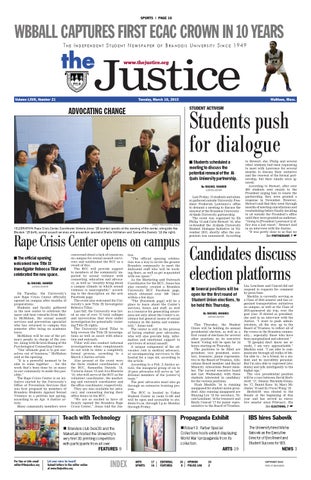
CELEBRATION: Rape Crisis Center Coordinator Victoria Jonas ’15 (center) speaks at the opening of the center, alongside Ava Blustein ’15 (left), sexual assault services and prevention specialist Sheila McMahon and Samantha Daniels ’16 (far right).
Rape Crisis Center opens on campus ■ The official opening
welcomed new Title IX Investigator Rebecca Tillar and celebrated the new space. By RACHEL SHARER JUSTICE EDITOR
On Tuesday, the University’s new Rape Crisis Center officially opened on campus after months of preparations. Students and faculty gathered in the new center to celebrate the space and hear remarks from Sheila McMahon, the sexual assault services and prevention specialist who has returned to campus this semester after being on academic leave. McMahon will be one of the primary people in charge of the center, along with Kristin Huang of the Psychological Counseling Center. “Our ultimate goal is to put ourselves out of business,” McMahon said at the opening. “It is a powerful moment to be able to come together … for the work that’s been done by so many in our community to make this possible.” The Rape Crisis Center is an initiative started by the University’s Office of Prevention Services that was first proposed by members of Brandeis Students Against Sexual Violence in a petition last spring, according to an Apr. 8 Justice article. Many community members were
concerned about a lack of resources on campus for sexual assault survivors and established the RCC as a result of this. The RCC will provide support to members of the community impacted by sexual violence with counseling, education and advocacy, as well as “steadily bring about a campus climate in which sexual violence is unacceptable,” according to the description on the new Facebook page. The event also welcomed the University’s new Title IX Investigator Rebecca Tillar. Last fall, the University was listed as one of over 75 total colleges and universities that were under investigation for potentially violating Title IX rights. The University hired Tillar to help oversee the Title IX investigations as well as assist with education and outreach. Tillar will also conduct informal investigations when complainants do not wish to enter a completely formal process, according to a March 3 Justice article. Also present at the event were the three student coordinators of the RCC, Samantha Daniels ’16, Victoria Jonas ’15 and Ava Blustein ’15, who will serve at the RCC as the volunteer coordinator, the marketing and outreach coordinator and the office coordinator, respectively. They are also available for advocacy and counseling during their office hours in the RCC. “We are so excited to have officially opened the Brandeis Rape Crisis Center,” Jonas told the Jus-
to Stewart, she, Philip and several other students had been requesting to meet with Lawrence for several months to discuss their initiative and the renewal of the formal partnership, but their emails were ignored. According to Stewart, after over 200 students sent emails to the President urging him to renew the partnership, they were granted a response in November. However, Stewart said that they went through months of meeting cancellations and rescheduling before finally deciding to sit outside the President’s office until they were granted an audience. “Going to [President Lawrence’s] office was a last resort,” Stewart said in an interview with the Justice. “It was pretty clear to us that we
See PARTNERSHIP, 7 ☛
Candidates discuss election platforms
tice. “The official opening celebration was a way to invite the greater Brandeis community to meet the dedicated staff who will be working there, as well as get acquainted with our space.” As the Marketing and Outreach Coordinator for the RCC, Jonas has also recently created a Brandeis University RCC Facebook page, which obtained over 300 ‘likes’ within a few days. “The [Facebook page] will be a place to learn about the Center’s services, hours and staff, as well as a resource for generating awareness not only about the Center’s existence but general issues of sexual violence in the media and community,” Jonas said. The center is still in the process of hiring student peer advocates, who will also provide help, information and emotional support to survivors of sexual assault. A unique component of the advocates' role is medical advocacy, or accompanying survivors to the hosital for a rape kit, according to the article. According to a Feb. 2 Justice article, the inaugural group of six to 10 peer advocates will serve as “additional members of the [center’s] team.” The peer advocates must also go through an extensive training process. The RCC is located in Usdan Student Center in room G-108 and will be open and accessible to students 9 a.m. through 5 p.m. Monday through Friday.
■ Several positions will be
open for the first round of Student Union elections, to be held this Thursday. By RACHEL HUGHES JUSTICE EDITOR
This Thursday, the Student Union will be holding its annual presidential election, as well as a first round of elections for several other positions on its executive board. Voting will be open for 24 hours starting on Thursday. The positions to be filled are president, vice president, secretary, treasurer, junior representative to the Board of Trustees, Allocations Board member and Racial Minority Allocations Board member. The current executive board met last Wednesday with those students interested in candidacy for the various positions. Nyah Macklin ’16 is running unopposed for student union president. Also running unopposed are Shuying Liu ’16 for secretary, Nicole Lenchner ’16 for treasurer and Emily Conrad ’17 for junior representative to the Board of Trustees.
Liu, Lenchner and Conrad did not respond to requests for comment by press time. Macklin is currently serving as a Class of 2016 senator and has organized transportation initiatives on campus, as well as the Class of 2016-sponsored ski trip, over the past year. If elected as president, she said in an interview with the Justice, “I want to push administration, all the way up to the Board of Trustees, to reflect all of the voices in the Brandeis community... especially those who have been marginalized and silenced.” “If [people] don't know me already, I am very approachable,” Macklin said. “I am able to communicate through all walks of life. I'm able to... be a friend, be a student and be incredibly personal. But I'm also able to represent [students] and talk intelligently to the higher-ups.” The vice presidential position will be a race between David Herbstritt ’17, Dennis Hermida-Gonzales ’17, Daniel Koas ’16, Mary Michalos ’16 and Ze (Vera) Wang ’18. Herbstritt was elected to the Senate at the beginning of this year and has served as executive senator since February. His
See ELECTIONS, 7 ☛
Teach with Technology
Propaganda Exhibit
IBS hires Sabovik
Brandeis club Deis3D and the MakerLab hosted the University's very first 3D printing competition with participants from all over.
Robert D. Farber Special Collections hosts exhibit displaying World War I propaganda from its collection.
The University hired Micha Sabovik as the Executive Director of Enrollment and Student Success for IBS.
FEATURES 9
For tips or info email editor@thejustice.org
Waltham, Mass.
Let your voice be heard! Submit letters to the editor online at www.thejustice.org
INDEX
ARTS 19
ARTS SPORTS
17 16
EDITORIAL FEATURES
10 8
OPINION POLICE LOG
10 2
News 3 COPYRIGHT 2015 FREE AT BRANDEIS.
2
TUESDAY, MARCH 10, 2015
●
THE JUSTICE
NEWS SENATE LOG
Senate approves chartering of women leadership club on campus On Sunday night, the Senate convened for its weekly meeting to continue the process of chartering clubs, discussing allocations of the Student Union budget and compiling Committee Chair reports on upcoming initiatives. Student Union President Sneha Walia ’15 began by discussing the first round of Student Union elections for the upcoming academic year, which will take place online for 24 hours beginning on Thursday. She also discussed several upcoming events, including ’Deis Day on Apr. 19, an upcoming meeting with President Lawrence and a forum on Mar. 19 in which the student body can discuss what they want to see in the next University president. The Senate continued its process of chartering clubs by voting on two clubs for charter—improvisation group Crowd Control and the group Women, Inc., an on-campus women’s leadership club. Crowd Control is already recognized as a club but requested chartering in order to have a fund to book performance spaces and hire outside professionals for workshops. The club was not approved for chartering with a vote of five in favor, four abstains and 10 against. Those who voted against the chartering cited concerns of group exclusivity and the ways in which the money will be allocated. The Senate rules state that they can not charter groups that can exclude members, as most performance groups do through the process of auditions. Women, Inc. was chartered with a vote of 22 in favor, zero abstains and zero against. After discussing student and administrative communications, the Senate discussed a Senate Money Resolution, or SMR, for the upcoming Midnight Buffet, an event hosted at the end of each semester to celebrate the end of classes. The SMR passed with a vote of 20 in favor, zero abstains and zero against. Next, the Senate heard brief reports and updates from Committee Chair leaders on future initiatives and the progress of current initiatives. Sustainability Committee Chair Anna Bessendorf ’15 discussed the idea of compiling a guide for sustainability on campus, as well as upcoming Earth Week programming. The Services and Outreach Committee discussed their outreach on various social media sites such as Facebook, Twitter and Instagram, as well as the updated website. The Social Justice and Diversity Committee discussed their upcoming Poetry Slam which will take place on Mar. 19 and the advertising that has gone into the event. The Senate meeting concluded with reports from individual Senators. Senator-at-Large Brian Hough ’17 brought up several initiatives to improve student life on campus. These included better resources for students at the health center, including increased availability of information, and concerns about the safety of students. Hough suggested adding more blue-light systems on campus and increasing lighting at night to ensure student safety. North Quad Senator Lorenzo Finamore ’18 addressed the success of the underclassman formal, which 225 students attended. Class of 2018 Senator Skye Golann concluded the senator reports by discussing an initiative to reduce prices at the Hoot Market on campus, citing that the average price of an item in the Hoot Market is 70 percent higher than that of an equivalent item in Hannaford grocery store. The Senate meeting concluded with an open forum and executive session.
POLICE LOG Medical Emergency
Mar. 2—A party in East Quad reported feeling sick and faint. The party was treated on site by BEMCo and transported to Newton-Wellesley Hospital by Cataldo ambulance. Mar. 2—A party in the Gosman Sports and Convocation Center was reported as injured while participating in cheerleading practice and was treated on site by BEMCo staff. The party was transported to Newton-Wellesley Hospital by Cataldo ambulance. Mar. 2—A party in Gosman reported a complaint of an injured elbow. The party was treated on site by BEMCo and refused further aid. Mar. 3—University Police received a report requesting BEMCo for a party in Sherman who tripped and fell. The party was treated by BEMCo and refused further medical aid. Mar. 3—University Police received a call from a party in Gosman who injured their nose. The party was treated by
BEMCo on site and refused further medical aid. Mar. 4—A Community Adviser in the Village Quad reported that a party was suffering from an allergic reaction. The party was transported to NewtonWellesley Hospital via Cataldo ambulance. Mar. 4—University Police received a report of a party in the Charles River Residence who burned her hand. The party was transported to Urgent Care by OFC Carter. Mar. 4—A party in Sherman Dining Hall reported a cut on their finger and was treated on site by BEMCo with a refusal for further medical aid. Mar. 5—University Police received a report of a party in Usdan suffering from an allergic reaction. BEMCo was notified and requested ambulance transport. The party was taken to Newton Wellesley Hospital by the Weston Fire Department. Mar. 8—University Police received a report of an unconscious intoxicated party in Sha-
piro Quad. Police notified Waltham Fire Department and requested Cataldo ambulance. The party was then transported to Newton-Wellesley Hospital via Cataldo ambulance.
Drugs
Mar. 3—Univeristy Police confiscated some drug paraphernalia from a bedroom in Shapiro Quad. Mar. 6—A Community Adviser in the Usen Castle found a party smoking a Class D substance in plain view. Police confiscated the pipe and notified the CDC.
Larceny
Mar. 7—A party reported cash stolen from their wallet in Shapiro Quad.
Other Mar. 3—University Police received reports of vandalism to a chair inside the Wasserman Cinematheque. Mar. 5—University Police re-
KITCHEN COMPETITION
Boston bomber trial begins
CORRECTIONS AND CLARIFICATIONS n A News article incorrectly listed the date of the Free Speech Town Hall. The town hall took place on Feb. 11, not March 11, as the article stated. (Mar. 3, pg. 4)
n A cartoon caption incorrectly spelled Ben Jarrett’s name as Ben Jarre. (Mar. 3, pg. 12) The Justice welcomes submissions for errors that warrant correction or clarification. Email editor@ thejustice.org.
Justice
the
www.thejustice.org
The Justice is the independent student newspaper of Brandeis University. The Justice is published every Tuesday of the academic year with the exception of examination and vacation periods. Editor in chief office hours are held Mondays from 2 to 3 p.m. in the Justice office. Editor News Forum Features Sports Arts Ads Photos Managing Copy Layout
editor@thejustice.org news@thejustice.org forum@thejustice.org features@thejustice.org sports@thejustice.org arts@thejustice.org ads@thejustice.org photos@thejustice.org managing@thejustice.org copy@thejustice.org layout@thejustice.org
The Justice Brandeis University Mailstop 214 P.O. Box 549110 Waltham, MA 02454-9110 Phone: (781) 736-3750
—compiled by Avi Gold
WIRE BRIEF
—Rachel Sharer
nA News headline reading “’Deis worst for free speech” incorrectly labeled Brandeis the worst university for free speech, according to a list compiled by the Foundation for Individual Rights in Education. The list was not ranked. (Mar. 3, pg. 2)
ceived a report of three people snowboarding outside of the Charles River Residence. The parties left without incident. Mar. 7—University Police received a report of loud music from the Charles River Residence. Police spoke with the residents and asked them to lower their TV. Mar. 7—University Police received a report of eggs thrown at the quad office door in the Village Quad. Police complied a report on the incident and notified the custodial staff for cleanup. Mar. 7—University Police received a report of snowboarders on the stairs near Gosman. Police instructed the snowboarders to leave the premises. Mar. 8—University Police received a report of a party near the main entrance who was refusing to pay their cab fee. Police spoke with the parties involved and found all in order.
AMANDA NGUYEN/the Justice
Students serve bowls of ramen noodles during the Japanese Student Association’s Ramen Night last Friday. Participants competed to create the tastiest bowl of ramen as decided by a panel of judges.
Ten women and eight men, all of them Boston-area residents, were selected Tuesday afternoon as jurors and alternates to hear the case of Boston Marathon bombing suspect Dzhokhar Tsarnaev, the trial at last getting underway after two months of jury selection and repeated attempts to move the case out of Boston. The panel members, almost all of them middle-aged, reported Wednesday morning to the federal courthouse on Boston Harbor, not far from the finish line of the April 2013 bombing that killed three people and wounded more than 260 others. It remained unclear who are jurors and who are alternates; that distinction will not be announced until the end of the trial. A pool of 64 potential jurors was brought into Judge George A. O’Toole Jr.’s courtroom, filling the benches as nine security officers positioned themselves around the room. Tsarnaev, 21, in a brown sport coat, his hair shaggy, his beard thin, rarely looked at them. One by one, the judge called the jurors’ numbers and asked them to take seats in the jury box. The judge then told them, “You have now been selected.” He ordered the 18 jurors to return in the morning to be sworn in and to hear opening statements in the trial against Tsarnaev, a Russian immigrant. One of the jurors was described as being half-Iranian, while the others were white. Some were unemployed; one works as a house painter. All said they would be willing to put Tsarnaev to death if they found him guilty in the capital case being tried in federal court. Massachusetts does not have a state death penalty, and polls in the state show a large number opposed to capital punishment. If they do find Tsarnaev guilty, the trial would go into a sentencing phase, and the panel could vote on whether to put him to death for the worst terrorist attack in the U.S. since Sept. 11, 2001. As the jurors left the courtroom and the security officers cleared the area, Tsarnaev stood and continued to look down. He then was led away. —Tribune News Service
ANNOUNCEMENTS Criminal Justice?—Race, Gender, and Incarceration
The 2015 Tillie K. Lubin Symposium will discuss the role of race and gender in incarceration and will feature guest speakers Dr. Elizabeth Hinton of Harvard University, Reverend Vivian Nixon, executive director of the College and Community Fellowship, and Dr. Bruce Western of Harvard University’s JFK School of Government. Today, 3:30 to 5 p.m. in the International Lounge in Usdan.
COEX International Women’s Day
In celebration of International Women’s Day, the Coexistence and Conflict program at the Heller School for Social Policy and Management is hosting global political strategist and women’s rights activist Hibaaq Osman, who will share her experience with El-Karama and the state of women peacemakers in the MENA Region. Osman works in partnership with civil so-
ciety and youth leaders across the Middle East and Africa to promote women’s advancement, protection and security and advocate for their inclusion in decisionmaking and peacemaking frameworks. Tomorrow from 12:15 to 2 p.m. in room G-3 of the Heller-Brown Building.
All About Elisabeth Jacquet de la Guerre
Join us for a lecture-demonstration with Women’s Studies Research Center scholar Laury Gutierrez about Elisabeth Jacquet de la Guerre, the Queen of the French Baroque. The event, held in celebration of Women’s History Month, will include a brief survey of Jacquet de la Guerre’s music and her publications. The discussion will focus on reviewing the impact of her music then and now and the impact of her career on gender roles in the field of music. Thursday from 12:30 to 2 p.m. in the Liberman-Miller Lecture Hall in the Epstein Building.
Brandeis Rowing’s Noche Mexicana
Margaritas Restaurant will donate 15 percent of food and beverage sales from participating families, friends and supporters to the Brandeis Crew team. Guests can choose items from any of their menus, takeout orders included. Let the host or server know that you are there to support the fundraiser and 15% of your pre-tax food and beverage purchases will be donated. Thursday from 4 p.m. to 1 a.m. at Margaritas, 211 Moody St., Waltham.
The Jew in the Lotus
Join us for a conversation about the ideology and practice of Jewish and Buddhist meditation. Speakers will include teachers and practitioners of meditation who will discuss past experiences, and graduate student Emily Sigalow (NEJS/SOC) will provide some history and context. Thursday from 7 to 9 p.m. in room G2 of the Irving Schneider and Family Building.
THE JUSTICE
●
TUESDAY, March 10, 2015
3
Administration
REFLECTING ON RESPONSIBILITY
Sabovik to depart BU for IBS position
■ Former BU dean Sabovik will oversee admissions and work to ensure student happiness and success in her new role at IBS. By Rachel Sharer JUSTICE Editor
TAN GAO/the Justice
SHARING THEORIES: Members of the audience discuss and debate the Responsibility to Protect (R2P) Principle with leading experts on international justice.
BRIEF Ryan Michaud, who was previously the Community Development Coordinator for Ridgewood and Ziv Quads, will be leaving Brandeis for a position at another university, according to an email sent to residents of the two quads. According to the email, Michaud—who joined the Department of Community Living in 2013—stopped serving as the Community Development Coordinator for Ridgewood and Ziv on Wednesday. In his place, Kristen Zernick, the Community Development Coordinator for the Village and 567 South Street, will be “taking over all student development functions for all four buildings in Ziv Quad,” according to the email. Scott Berozi, the current Community Development Coordinator for the Charles River Apartments and the Fosters Mods, will be “taking over all student development functions for all three buildings in Ridgewood Quad,” the email read. “There are no changes to the Community Advisor team and any concerns/needs should still be filed with them as your direct point person,” Zernick and Berozi wrote in the email. “We wish [Michaud] luck in his future endeavors,” the email read. “We are excited to work with [Ridgewood and Ziv residents].” As of press time, Berozi did not respond to requests for comment and Zernick declined requests for comment. —Abby Patkin
Experts share thoughts on Responsibility to Protect ■ International justice experts discussed ways to improve global ethics and universal responsibility at a conference on Sunday. By Nikki Nikova
JUSTICE Contributing WRITER
Sunday afternoon, as part of the Responsibility to Protect at 10 Conference at Brandeis, three experts on international justice spoke to both the Brandeis community and the public about vulnerable populations and new players in the international arena. The conference, jointly organized by the Center and the Tami Steinmetz Center for Peace Research at Tel Aviv University, was designed as a forum for scholars to share ideas and experiences about the Responsibility to Protect (R2P) principle, according to the International Center for Ethics, Justice and Public Life website. The R2P principle is a “[recognition] that the international community has a role to play when sovereign states fail to protect their own populations from genocide, war crimes, ethnic cleansing and crimes against humanity,” the website reads. Moderated by Prof. Chandler Rosenberger (IGS), the event focused on the speakers’ recent publications, which were based off their experiences and insights with R2P. Prof. Alain Lempereur (Heller) was the first to present his work,
which focuses on the intersection of R2P and business. According to Lempereur, R2P is typically governmentled, but on certain occasions, if the government fails in its task, “businesses [should] become a temporary substitute for state intervention.” “Corporations can cultivate ethical behavior through corporate design,” Lempereur said, suggesting that companies set up protocols and safety sanctuaries. Lempereur concluded by stating that in emergency situations, “R2P trumps business as usual.” Christen Broecker, associate director of the Jacob Blaustein Institute for the Advancement of Human Rights, spoke about potential new actors in R2P. She told the audience she was specifically interested in the “growing interaction between U.N. Human Rights architecture, [the United Nations Human Rights Council] and its peace and security architecture, [the UN Security Council].” Broecker stated that over the past 20 years, the U.N. Human Rights architecture has grown and that they are increasingly trying “to play another role in the R2P framework … trying to identify when pillar three [on genocide and war crimes] is triggered.” Broecker also identified four cases in which the U.N. Human Rights mechanisms attempted to uncover instances of R2P failure, including in Côte d’Ivoire, Libya, Syria and the Democratic People’s Republic of Korea. According to Broecker, the success of invoking R2P in each of these cases varied, but she said
she believes that the U.N. Human Rights mechanisms have succeeded in “demonstrating [a] willingness to push … [the] U.N. to internalize R2P” and in a “willing[ness] to make use of R2P language to appeal to the Security Council.” The third speaker, Timea Spitka, a Sophie Davis Post-Doctoral Student in Gender, Peace and Conflict Resolution at Hebrew University, spoke about when R2P becomes relevant during instances of gender-based war crimes. Spitka began by noting that until recently, R2P did not mention women in its language and was not very “gender-friendly.” For these reasons, she said, many feminists and women’s rights activists have historically been against R2P, though recent years have brought about a change in opinion on the principle. “R2P is like a little baby, and it needs a lot of work … and you have to get rid of [the bad aspects], but let’s try to keep the little baby,” Spitka said. Spitka also said her focus is on the international community in hopes of “reaching a consensus on a ‘red line’ in terms of gender related war crimes, the crossing of which is international responsibility … to protect.” Specifically citing the “naming and shaming” campaign, which she believes has been effective in some areas of women’s rights, Spitka argued that “R2P is a tool that [has] strengthened norms [current red lines] used for the protection of civilians—including women.”
TAN GAO/the Justice
PROTECTING POPULATIONS: International justice experts discuss the future of the R2P Principle in a discussion moderated by Prof. Chandler Rosenberger (IGS).
The University’s International Business School has hired Micha Sabovik as the new Executive Director of Enrollment and Student Success. Sabovik is the current asSabovik sistant dean of student and career services at Boston University’s College of Communication. Her departure from Boston University was revealed to the student body in a March 2 article in the Daily Free Press, Boston University’s independent student newspaper. According to the Daily Free Press article, Boston University faculty and staff were notified on Feb. 20 of Sabovik’s upcoming departure. As the new Executive Director of Enrollment and Student Success, Sabovik will “oversee career services, admissions, recruiting and financial aid” at IBS, according to the article. Her last day at Boston University’s College of Communication will be March 20, and she will begin officially working at IBS three days later, on March 23. Sabovik wrote in an email to the Justice that she is “truly excited to join [IBS] in my new role as Executive Director, Enrollment and Student Success.” As the Executive Director of Enrollment and Student Success, she will oversee the Admissions and Career Services teams. Sabovik also said in her email that she will work “to ensure prospective and current students are well taken care of during their time at Brandeis and beyond.” “My initial goal at IBS will be to engage with current students and alums to hone in on what it means to be ‘World Ready’ from both the admissions and career services perspectives,” Sabovik wrote. Sabovik also said that she is excited to include more students and alums in the process as she works to update the current enrollment and student resources programs at IBS. “I’ll then delve into the methods and means needed to make sure IBS students and alums are fully engaged in the process.” Kate Salop, the Senior Administrative Dean at IBS, wrote in a statement released to the Justice that Sabovik will be a useful and welcome addition to the IBS administration. “The deep and wide experience Micha brings to IBS will be invaluable as we work to create increasing collaboration across functional areas,” the statement read. She also wrote that Sabovik will continue to “enhance [IBS’s] reputation for personalized attention and service.” Sabovik is an alumna of Boston University, where she studied in the College of Communication and earned a degree in Journalism. After graduating, Sabovik then worked at the College of Communication for 23 years in a variety of different fields, including positions in admissions, career services and student services.
Subscribe to our Newsletter TODAY The premier way to stay up to date with all of the latest Justice content: from in-depth coverage of Brandeis news, to a student perspective on the new exhibit at the Rose, to an opinion piece from one of our esteemed students, faculty, or Board members.
Join the Justice Photography Staff!
Contact Morgan Brill and Grace Kwon at photos@thejustice.org
THE JUSTICE
●
TUESDAY, MARCH 10, 2015
5
CAMPUS SPEAKER
Lecture focuses on Mandela, apartheid ■ Dr. Robert Trent Vinson
gave a guest lecture last Thursday on anti-apartheid advocate Albert Luthuli. By MAX MORAN JUSTICE EDITOR
On Thursday, the African and Afro-American Studies department hosted Dr. Robert Trent Vinson for a guest lecture on anti-apartheid advocate Albert Luthuli. The audience included undergraduates, graduate students and professors. Vinson is the Frances L. and Edwin L. Cummings associate professor of History and Africana Studies at the College of William and Mary. His lecture was derived from research for his forthcoming book, Before Mandela, Like A King: The Prophetic Politics of Chief Albert Luthuli. Vinson’s lecture, “Albert Luthuli, Nelson Mandela and the Genealogies of Armed Struggle in Apartheid South Africa,” was the AAAS department’s 30th annual Ruth First Memorial Lecture, which is named in honor of a white journalist who exposed corruption under the apartheid government. Vinson told the Justice at the event that he accepted the invitation to guest lecture specifically because he counts First as “one of [his] political heroes” as “she was one of the few whites in South Africa who fought, who refused to accept the racial privilege that the apartheid regime was bestowing on her.”
During his lecture Vinson argued that Luthuli’s non-violent protest tactics paved the way for Nelson Mandela’s rise to primacy in the anti-apartheid movement and that “the Nelson Mandela we knew and loved ... was actually using a template based on the politics of Albert Luthuli in the 1950s and ’60s.” Vinson began by outlining some of the most important apartheid laws from throughout the 1950s, distinguishing between what historians call “Petty Apartheid,” in which racial intermarriage and civil disobedience were banned, and the later “Grand Apartheid,” in which the black South Africans who made up 80 percent of the country’s population at the time were confined to 13 percent of its land mass. Vinson said that apartheid was not put forward as “a kind of Nazilike fascist system,” but was instead viewed as “a kind of solution to the supposed problem of races intermingling.” According to Vinson, Luthuli’s argument was that “apartheid is not a solution to anything ...but that apartheid, indeed, was the problem.” He explained that Luthuli was “deeply religious” and saw apartheid as “theological heresy.” Luthuli “felt that apartheid was a violation of the Christianity of Jesus Christ, whom he regarded as a drum major for social justice,” Vinson said. “God did not separate out people saying ‘You should live well, and you should live poorly.’” According to Vinson, when Luthuli became president of the Af-
rican National Congress—the oldest political party in South Africa, which opposed apartheid—in 1952, he advocated for international sanctions against the South African government and organized peaceful protests against apartheid, inspired by Mohandas Gandhi. Luthuli then went on to become the first person from outside Europe and the Americas to win the Nobel Peace prize in 1961, the same year that marked the creation of the ANC’s armed wing, the Umkhonto we Sizwe, meaning “Spear of the Nation” and commonly abbreviated as MK. According to Vinson’s lecture, the branch’s founding was in reaction to a police shooting, and was also what Vinson called “the moment that Nelson Mandela became Nelson Mandela.” While Vinson noted that there is no historical consensus on whether Luthuli helped create MK, Vinson put forward his belief that it was Mandela who reoriented the ANC toward violent resistance, and that Luthuli did not support violence, but “understood it was collective consensus of leadership to move toward armed struggle.” Vinson concluded the lecture by noting that the Rev. Dr. Martin Luther King Jr. admired Luthuli, and said that “King regarded himself as an American Luthuli.” He also noted that Luthuli is an important figure to study in African Studies, as “Africa and Africans are often sidelined in diaspora studies. It’s still a great weakness in the field.” During a brief question-and-
ANTI-APARTHEID
JEREMY PERLMAN/the Justice
SOCIAL JUSTICE: Dr. Robert Trent Vinson discussed the accomplishments of Nelson Mandela and and Albert Luthuli in their fight against apartheid in South Africa. answer segment after the lecture, Prof. Wellington Nyangoni (AAAS) criticized the lecture for not addressing the Pan-African Congress, the ANC’s rival group, and for not putting criticisms of Mandela in the context of uncertainty surrounding the end of apartheid. Vinson acknowledged the PAC’s importance, saying, “That point needs to be made.” Prof. Laurie Nsiah-Jefferson
(AAAS) commented that figures like King and Mandela are connected in that “we don’t like particular images of them.” “So, like, the King who was talking about Vietnam [and] the Mandela who was armed and in fatigues don’t gel with the kinds of images of each man that we prefer,” she said. “We want to hold King there frozen in time on the steps of the Lincoln memorial,” Vinson agreed.
CAMPUS SPEAKER
Alumna discusses historical significance of novel ■ Paula Rabinowitz ’74
examines the popularity of the the paperback book in her recently published novel. By TZLIL LEVY JUSTICE CONTRIBUTING WRITER
On Thursday, the American Studies department hosted Paula Rabinowitz ’74, who discussed her 2014 book American Pulp: How Paperbacks Brought Modernism to Main Street and the historical significance of book covers. Prof. Stephen Whitfield (AMST) began the event by introducing Rabinowitz, who graduated from Brandeis with a bachelor’s degree in American Studies and is a professor at the University of Minnesota. “Professor Rabinowitz … has gone on to a distinguished career in the field of American Studies, particularly feminist studies, and critical scholarships having to do primarily with literature,” said Whitfield.
Rabinowitz briefly read from her book’s preface, which examines the popularity of books in recent years. Due to the increasing popularity of reading devices such as the Amazon Kindle and the Barnes & Noble Nook, and noting that Amazon announced it had sold more eBooks than hardback books in the summer of 2010, “books were surely dead,” Rabinowitz wrote in the preface. Rabinowitz’s research focused on pulp fiction in archives across the United States, which included the paperback novels that gained popularity after the Great Depression. She visited libraries dedicated to pulp, such as the Fales Library at New York University, the G. Nicholas Collection at the University of Minnesota and the George Kelley Paperback and Pulp Fiction Collection at the University of Buffalo. Rabinowitz noted the difficulty of maintaining the collection of pulp fiction at the library of the University of Buffalo. Nevertheless, she said, books have a lasting lifespan and continue to stay, regardless of
technological advances. According to Rabinowitz, the covers often play a significant role in an individual’s decision to read the book, true to the expression about judging a book by its cover. “All these covers are ‘read the book by its cover’ or ‘buy the book by its cover,’” Rabinowitz said of the covers she showed the audience. There is something “categorically different about reading eBooks than by holding a book.” Rabinowitz also presented images of paperback book covers from the 1930s and ’40s to express the diversity of the medium and notable controversial covers. Rabinowitz used Robert Jonas—an American illustrator famous for his work at Penguin Books—as an example, showing the audience his signature styles of the “broken window or key hole style, wherein you are inside [the location] and you’re looking [at the painted scene] through the distance.” Guy Pene du Bois, a 20thcentury modernist, Rabinowitz said, would frequently feature images of
women reading in his art. “[The] dynamic of public reading by women is part of … a modern sensibility that allows women to be alone in public,” Rabinowitz said. American Pulp highlights writing with a popular appeal, which “kind of level[ed] out a playing field of who read what,” Rabinowitz said, noting that the books would be packaged and sold in kiosks, drug stores, candy stores and department stores. According to Rabinowitz, the availability of these books represented the increasing popularity of reading and storytelling. The paperbacks would represent the high culture of war, gender relations, changing sexual relations and changing racial relations, she told the audience. “These books were meant to be read,” Rabinowitz said, also discussing how even Congress and Hollywood would pay attention to the novels that allude to high culture issues. Rabinowitz also discussed how printing methods began to change in the early 1960s, noting publishers’
decisions to create trade paperback books, which were similar in size to hardcover books. Additionally, she said, the changes in tastes and formats of books and the rise of vintage press and anchor books contributed to paperback sales. Nevertheless, certain marketing characteristics remained the same, Rabinowitz said, using Edmund Wilson’s novel, Memoirs of Hecate County as an example. The State of New York banned Wilson’s book, which prompted marketers to promote the book with the tagline, “Banned in the state of New York!” Although there was no image on the cover, the book still sold well, partly due to the interest generated by its ban. It is “always good to have your book banned if you want to sell it,” Rabinowitz joked. Rabinowitz is also the author of the works Black & White & Noir: America’s Pulp Modernism, They Must Be Represented: The Politics of Documentary and Labor and Desire: Women’s Revolutionary Fiction in Depression America.
FACULTY
Prof Jadhav awarded grant to explore brain research ■ As a Sloan Reasearch
Fellow, Prof. Jadhav will study parts of the brain related to neurological disorders. By ABBY PATKIN JUSTICE EDITOR
Prof. Shantanu Jadhav (PSYC) was named one of the 126 Sloan Research Fellows of 2015 and was awarded a $50,000 grant to explore memory and decision-making processes in mammalian brains. According to the Alfred P. Sloan Foundation’s website, the fellowships seek to “stimulate fundamental research by early-career scientists and scholars of outstanding promise.” The fellowships last for two years and are awarded yearly to researchers in a variety of scientific fields, according to the website. The foundation has awarded the fellowships
since 1955, and past fellows include 42 Nobel Prize winners. According to Jadhav’s website, studying specific parts of the brain can unlock crucial information toward the understanding and treatment of many neurological disorders, including diseases such as Alzheimer’s and schizophrenia. “The hippocampus is known to be critical for episodic memories, and the prefrontal cortex is involved in executive control, working memory and decision making,” his website notes. “It is critical to understand how these two regions act in concert to support learning, form memories, make decisions and guide behavior.” Understanding how the two sections work together “will provide a crucial basis for addressing the numerous neurological and neuropsychiatric disorders involving these two regions, such as Alzheimers, demetia, [sic] depression and
schizophrenia,” the website states. To explore the question of how the two regions interact, Jadhav studies rat brains as they form memories and make decisions and then observes how “activity in neuronal groups in the hippocampus and prefrontal cortex evolves during learning and what mechanisms underlie the organization and transmission of information across these structures,” according to a Feb. 25 BrandeisNOW article. “The brain has a remarkable capacity to learn and to use past experience to guide our daily behavior,” Jadhav’s life sciences faculty profile reads. “Multiple brain regions coordinate activity to form representations of the external world, learn new experiences, store and retrieve memories, and make decisions. We are interested in understanding the neural basis of these cognitive abilities by studying processing at the cellular and network
level in the neuronal circuits of the rodent brain.” The profile also notes that Jadhav’s previous research has shown some coordination between the two regions, which provides the basis for the research he will do during his fellowship. “We have shown that hippocampal replay during awake sharpwave ripples (SWRs) is critical for spatial memory, and SWRs are associated with coordinated reactivation of hippocampal-prefrontal neurons during memory-guided decision making,” his profile says. “This approach thus allows us to characterize the neurophysiological basis of prefrontal-hippocampal interactions, and also to provide causal evidence linking specific forms of neural activity to behavior and cognition.” Prior to joining the Brandeis faculty, Jadhav was a post-doctoral research fellow in the Center for
Jadhav Integrative Neuroscience and was also the winner of the 2013 Peter and Patricia Gruber International Research Award from the Society for Neuroscience.
Follow Justice!
the
let’s eat grandma Let’s eat, Grandma!
Join Copy. Save lives. @theJustice and like us at: Facebook.com/thejusticeonline
Contact Carmi Rothberg at copy@thejustice.org
We’re now launching JustBlogs! Our new online blogs section
To start your own JustBlog, contact Max Moran at forum@thejustice.org IMAGES COURTESY OF CREATIVE COMMONS
THE JUSTICE
CONTINUED FROM 1
PHOTO COURTESY OF CATIE STEWART
PATIENTLY WAITING: Students read Israeli-Palestinian poetry while they waited to schedule a meeting with President Lawrence.
PARTNERSHIP: Students stress dialogue initative were not being heard and that our administration was not trying to have a conversation with us,” Stewart said. “As a last resort, we decided to go to his student office hours and bring a group of people who cared about this and who represented the 200 other students who cared about this.” Stewart, Philip and active member of the Student Dialogue Initiative Naomi Hornstein ’15 told the Justice that the group of 15 students and alumni entered the office and were greeted by Lawrence’s secretary and chief of staff, who told them that Lawrence would not have the time to meet with them. Hornstein said that the group did not want to be denied a meeting yet again, so she “decided to have a community meeting in his office to show how much we care.” According to Hornstein, the group sat in a circle, read Israeli-Palestinian poetry and discussed with each other why the renewal of the partnership was so important. Eventually, she said, Lawrence came out and agreed to schedule a meeting with them within the week. “We were really happy he agreed [to a meeting],” Stewart said, “but it was pretty shocking to us that it took us five months to get it … and that it took us sitting in his office for an hour for him to finally acknowledge that we mattered.” The formal academic partner-
ship between Brandeis and Al-Quds University in East Jerusalem began in 1997 after Al-Quds University President Sari Nusseibeh visited Brandeis. It was funded by a nearly one million-dollar grant from the Ford Foundation, according to a Nov. 19, 2013 Justice article. The University suspended the partnership in Nov. 2013 after a demonstration at Al-Quds during which students carried fake automatic weapons and “marched while waving flags and raising the traditional Nazi salute,” according to the article. Since the suspension, Lawrence has faced criticism for the decision from many members of the community, including students, alumni and faculty. Philip, Stewart and Hornstein, along with several other students, went to Al-Quds University last summer through the Davis Projects for Peace Grant to renew student dialogue, despite the suspension. According to an April 2014 Justice article, the Projects for Peace program, now in its eighth year, gives an opportunity to undergraduate students from any members school to design a peace-building project through a $10,000 grant. According to the article, Philip and Stewart received the grant last spring for their Al-Quds University Student Dialogue Initiative. Philip added that another small group of students also went to Al-Quds over winter break.
TUESDAY, march 10, 2015
7
ELECTIONS: Some candidates will run unopposed
POEMS FOR PEACE
CONTINUED FROM 1
●
“Something I didn’t understand until I went to Al-Quds University [last summer] is how impactful the partnership was for them,” Philip said in an interview with the Justice. “It really helped them grow. Open dialogue and communication between different types of people … is enriching for both institutions.” Hornstein mentioned that they notified their friends at Al-Quds University when President Lawrence agreed to schedule a meeting with them, and many of them “were very proud and excited that this is hopefully moving forward.” “The [partnership] is something that really does represent the values of the University,” Stewart told the Justice. “It was not just symbolic … [the suspension] actually had a lot of negative ramifications for both universities,” she said. Philip said that while they are thankful to have finally scheduled a meeting with President Lawrence, they want more from the administration. “We don’t want only meetings,” Philip said, “we want the meetings to lead to the restoration of the partnership.” A statement provided to the Justice from Bill Schaller stated that the administration “appreciates the students’ interest in resuming the partnership with Al-Quds University” and that “a meeting is being scheduled with students to hear their views and recommendations.”
goals, if elected, include focusing on student outreach and communication with the Union and pushing for greater student involvement in conversations with administration, he wrote in an email to the Justice. “I plan to use the skills and relationships that I have built this year to make Brandeis more transparent and more in touch with the needs of our student community in terms of issues such as dining, academics and housing,” he wrote. Hermida-Gonzalez served as a senator during his first year at Brandeis as a Transitional Year Program representative and has worked with Student Events, he wrote in an email to the Justice. If elected, “I would hope to bring some transparency into the Student Union,” he wrote. “I hope that the Brandeis [community] can feel like they can come to the Student Union for support and be able to voice their concerns. I also want to make sure that students can be active participants in creating change in the Brandeis community.” Koas, who is studying abroad this semester, does not have any experience with the Student Union, he wrote in an email to the Justice, but believes that his “involvement with clubs and other groups within different parts of the Brandeis community has prepared me to be [vice president],” he wrote. Koas added that coming in as an outsider will allow him to critically analyze the Union. He wrote that, if elected, he would like to tackle problems in student life, sustainability and issues around fostering dialogue and transparency on campus. Michalos is currently serving as the Off-Campus senator and the Services and Outreach Committee chair. “I look forward to implementing an outreach program so more students know and understand that the Student Union is here to better the Brandeis community and experience,” she wrote in an email to the Justice. “We need to bring the focus back to the students and making Brandeis safer and better overall.” Wang did not respond to request for comment by press time. The candidates for the four open positions for A-Board members are Alex Mitchell ’17, Judy Nam ’16, Millie (Mengyuan) Wu ’18 and Uros Randelovic ’18. Nam is currently the co-chair of ABoard and is running for re-election to make sure she “can leave behind a lasting, organized structure for future Allocations Board members,” she wrote in an email to the Justice.
let’s eat grandma Let’s eat, Grandma!
Join Copy. Save lives. Contact Carmi Rothberg at copy@thejustice.org
“I've been working with members of the Student Union and Student Activities to find a way to improve the quality of club leadership on campus and make club funding procedures more accessible to new and/ or struggling clubs.” Mitchell has served as an A-Board member before and would like to focus on enabling students to produce large-scale events and on the fair distribution of funds, he wrote in an email to the Justice. “If elected,” he wrote, “I will largely support funding for large-scale events, interactive programs, campus activism, and other activities that I feel will benefit the whole campus, and not a select few.” Randelovic is currently serving as the co-chair of the Club Support Committee and has enjoyed his time working with clubs as they evolve, he wrote in an email to the Justice. “In the future,” he wrote, “my goal is to work toward reducing the bureaucratic demands of the system and thus improving the overall ease of the process. By bringing up the aspect of 'ease,' I refer to providing clubs with a platform that will assist them in achieving responsible and sustainable usage of allocated funds.” Wu did not respond to request for comment by press time. Ziyang Chen ’18 and Hanyang Li ’17 are running for the one open position for Racial Minority A-Board member. Li did not respond to request for comment by press time. Chen served as president of both her high school and middle school's student union, she wrote in an email to the Justice. Those experiences taught her how to genuinely serve and help students, she wrote, adding that “[i]f elected, I will dedicate to allocate your Activities Fee to serve your best interests. [sic]” According to an email from Vice President Charlotte Franco ’15 to the Brandeis community on Monday, March 2, Thursday's election would also seek to fill two representative positions to the Undergraduate Curriculum Committee and two representative positions to the Brandeis Sustainability Fund Board, but no students are running for these positions in the first round of elections. These positions will be added to a second round of elections, President Sneha Walia '15 confirmed in an email to the Justice. A second round of elections will take place on Tuesday, March 24, seeking to fill the positions of senator-at-large, class senators, racial minority senator and associate justices of the Judiciary. A mandatory meeting for candidates for these po-
8
features
TUESDAY, March 10, 2015 ● THE JUSTICE
just
VERBATIM | VICTOR HUGO There is only one thing stronger than all the armies of the world: and that is an idea whose time has come.
ON THIS DAY…
FUN FACT
In 1913, abolitionist and Underground Railroad conductor Harriet Tubman died in New York.
No word in the English language rhymes with month, orange, silver or purple.
Super Fly PHOTO COURTESY OF LESLIE GRIFFITH
A PROFESSOR’S PASSION: Prof. Leslie Griffith (BIOL) researches the sleep patterns between fruit flies and humans.
By Alec Siegel JUSTICE STAFF WRITER
Last Monday in the dimly lit dining room tucked in the back of Solea Restaurant & Tapas Bar, Prof. Leslie Griffith (BIOL) stood in front of a dozen or so guests and lectured about fruit flies and human sleep. At this month’s Cafe Science, Griffith—the evening’s guest speaker—spoke about her research in a segment called “Sleep: Why You Should, Why You Can’t, and What Do Fruit Flies Have to Do With It.” Cafe Science is an hour-long discussion that features a different Brandeis science professor each session, with topics ranging from genetics to physics. The event takes place at Solea on the first Monday of every month. Admission is open to the Brandeis community as well as the public and costs $10, with a complimentary drink included. Throughout the evening, some guests ordered tapas, while others simply sipped their complimentary drinks, listening intently as Griffith spoke. One of the guests, Ann Nguyen, is a former Waltham resident who regularly attends public science events. “I’ve been to a number of Brandeis Cafe Science events in the past couple of years, and they’re always very good with very diverse topics,” she said. Griffith began her lecture by outlining the basics of sleep. “Humans spend one third of their lives sleeping,” Griffith said, explaining that our daily need for sleep is tethered to the earth’s rotational patterns. The circadian rhythm, a process by which the body’s functions react to the Earth’s 24-hour clock, uses factors such as light to cue the brain that it’s time to sleep. “We are all entrained by signals to have much of our metabolism and our behavior entrained to the 24-hour rotation of the earth,” Griffith said. According to Griffith, a lack of sleep can lead to a predisposition to depression, weakened immune response, obesity and heart disease. Insufficient sleep affects a sizeable portion of the American public. “Recent studies have shown that 20 to 30 percent of Americans are getting less than six hours of sleep per night,” Griffith said. To further our understanding of human sleeping patterns, Griffith said, observing the sleeping patterns of other animals can be beneficial. Aside from basic observation and techniques that measure the changes in brain activity between the awake and asleep states, the tools for studying human sleep are limited. There are a number of known sleeping disorders like insomnia, sleep apnea and sleep paralysis,
Fruit flies and human sleep converge at this month’s Cafe Science event but there are hardly enough drugs for treatment. “It’s really hard to stick electrodes and drugs into somebody’s brain. We need other animal models,” Griffith explained. All animals sleep, some much more than others, some during the day and others at night. At her research lab at Brandeis, Griffith and a research team of post doctorate students and graduate students study the behavioral patterns of fruit flies. She found that fruit flies would be an ideal animal to study. “Flies sleep a lot like we do,” Griffith said. Like humans, fruit flies are diurnal animals, meaning that they are active during the day and use the night to recharge. Fruit flies are ideal animals for studying sleep because of their small brains and relatively few neurons, which make them easy to observe and manipulate in the lab, Griffith explained. “The most important thing is that they’re very genetically malleable,” Griffith said. Before she could start comparing the way fruit flies sleep to the way human beings do, Griffith first had to answer an important question: “Do flies fall asleep like humans do?” The answer was yes. Both humans and fruit flies fall asleep according to a kind of switch in their brains. According to Griffith, a neuron called Gamma-aminobutyric Acid (GABA) is the key. “GABA is an inhibiting neurotransmitter in the brain,” she said “It controls many important sleep circuits in the brain.” In an alert human brain, GABA neurons are inhibited, stimulating the handful of sensory related neurons in the brain. When a person is asleep, however, GABA neurons dominate and inhibit the brain’s sensory neurons. Griffith hypothesized that this system was similar in fruit flies, and so she and her research team began to experiment with the GABA neurons in fruit flies in order to test their prediction. The research, spearheaded by Griffith’s post-doctorate lab assistant Katherine Parisky, confirmed this hypothesis. “You could down -regulate the GABA neurons or overexpress the GABA neurons,” Griffith said “If GABA is required for sleep, down-regulating would decrease sleep and overexpressing them would increase sleep.” While Griffith’s research has yet to result in a quick fix for a restless brain, she continues to seek insight by observing fruit flies. “The story is ongoing,” she said. With the world as connected as it is, it’s no coincidence that people are increasingly restless at night. “We live in a 24/7 world. Somewhere in the world, at any time of day, someone is doing something, and you can see it on TV or on your phone. People tend to sleep less,” Griffith said.
PHOTO COURTESY OF MIKE LOVETT
MONTHLY MISSION: Cafe Science occurs on the first Monday of every month to engage the community in lively conversation about cutting-edge research by Brandeis scientists at Solea Restaurant and Tapas Bar on Moody Street.
PHOTO COURTESY OF LESLIE GRIFFITH
LESLIE’S LAB: Prof. Leslie Griffith’s lab works closely with other Drosophila labs on campus and at other institutions and is part of the Volen National Center for Complex Systems and the National Center for Behavioral Genomics.
THE JUSTICE
●
TUESDAY, MARCH 10, 2015
Printing with Purpose Brandeis hosts the University’s first 24-hour 3D Printathon in conjunction with the Deis3D club and the MakerLab By MARiya Greeley and BRIANNA MAJSIAK justice Staff writer and JUSTICE EDITOR
At the top of the Farber Library stairs, a high-top table is lined with boxes of free Monster energy drinks and coffee dispensers. On nearby tables, 3D printers hum and whir melodically, the sound of new-age creation. Teams of three to six students huddle in separate alcoves, around computers and white boards, brainstorming big ideas and fine-tuning the mechanics necessary to print them into reality. Students from across the Northeast have gathered here for a Printathon this weekend to mark the first 24-hour 3D printing competition at Brandeis. When the six teams arrived—two from Brandeis, one from
no Engineering program here; Brandeis doesn’t really have as many people who are super into the tech industry as I think it should ... once you combine that with people who are super into social justice, then you can just do anything,” he says, rolling his chair back and forth in excitement. “[The Printathon] was in good part Noah’s idea,” Eduardo Beltrame ’15, an exchange student from Brazil and the current president of Deis3D, says. Between its creation and the Printathon, Deis3D has collaborated with a range of clubs and projects on Brandeis’ campus, proving that you really can use 3D printers for anything, from attempting to print swirled frosting on top of cupcakes with the Brandeis Cupcake Obsession Club to printing chess pieces with the Brandeis Chess Club members’ names engraved in them.
people come together to participate in collaborative computer programming. “Traditionally, hackathons are [about] how much can you get done in 24 hours—the fun value of staying up all night. You really have to be working the whole time to get something impressive done, so people have to stay focused,” Seltzer said. One of the two Brandeis teams, “Louis Makers” made a balancing scale that represents gender equality through conjoined gender signs. Modeled hands held up the gender signs that doubled as bracelets. Danny Kimmel ’17, a member of the “Louis Makers” and Deis3D club, likes to print Tyrannosaurus rex skulls and has even made his very own watchband. “I joined in November, and I kind of just picked everything up,” Kimmel said. “I don’t think it’s hard, I just think a lot of people are inti-
PHOTOS COURTESY OF IAN ROY
ACTING AS MENTOR: Gabriel Seltzer ’18 (top right) guides the Waltham High School team in their 3D design of a waterwheel prototype that generates energy. months,” Roy explained. In addition to 3D printing, the MakerLab works with virtual reality and embedded systems and has even pieced together its own drone. In the past, the MakerLab worked with the Anthropology department to produce model skulls for students to have. Instead of passing around a few models, the MakerLab has scanned them and produced enough for each student to have their own. The MakerLab has also collaborated with Deis3D and started printing prosthetic limbs for children whose families can’t afford to buy a new, expensive model every time the children’s changing bodies outgrow the last ones. The 3D-printed prosthetics are part of a global organization called e-NABLE. In fact, the MakerLab offers free 3D printing training to anyone who wants to learn. It takes about an
or even gold. The first-place team also won a Netfabb software license valued at over $750. Netfabb is an advanced software company for 3D printing. Shapeways and Netfabb both sponsored the Printathon with printing supplies and prizes. The runner-up team was Waltham High School, which under the leadership of Seltzer, created a way to turn any discarded motor into a water wheel that generates electricity. They won five spools of DeltaMaker filament, the plastic used to print with 3D printers, valued at $200. Columbia University’s team came in second place with their design for a Braille phone case that allowed for Bluetooth text input. They didn’t have enough time to assemble it into a phone case, and team leader Jason Powell commented that they could have completed a prototype if they had had more time. They plan to release the designs
THE MASTER MAKERS: Deis3D members, (left to right) president Eduardo Beltrame ’15, vice president Samir Undavia ’17 and faculty adviser Ian Roy ’05 (Research Technology Project Lead) hold some of the club’s 3D creations in the MakerLab. Waltham High School, two from the University of Connecticut and one from Columbia University—judges revealed the competition’s theme meant to inspire their designs, which were scheduled to be judged only 24 hours later. The theme was social justice. Noah Fram-Schwartz co-founded the 3D printing club at Brandeis, called Deis3D, last February. He now works as the 3D Design Lab Lead at Google and flew in from California to serve as a judge at the competition. Fram-Schwartz created the club “partly because I really wanted to share this passion with people and partly because … there’s
Beltrame likes to print protein molecule models and bring them to biochemistry classes. “It immediately conveys to anybody a sense of ‘woah this is cool,’ instead of dry and abstract description,” Beltrame says. Deis3D member Gabriel Seltzer ’18 worked closely with the team from Waltham High School to show them how to design and print their idea for the competition. “We’re working on water wheels and seeing if we can generate electricity with that,” Seltzer said. None of the teams or Deis3D members had participated in a Printathon before this event. The idea came from a traditional hackathon, in which a large number of
mated by it, so it’s really hard to recruit people because nobody wants to give it a try because they think it’s going to be really hard to learn, but it’s not.” Deis3D played an important role in the creation of the MakerLab— the innovation lab at Brandeis. Research Technology Project Lead of the MakerLab Ian Roy ’05 is also the faculty adviser to Deis 3D. Through his influence, Deis3D and the MakerLab have created a companionship. Once Deis3D was approved as a club at Brandeis, Library and Technology services supported it, and soon the MakerLab opened in June 2014. “It has totally changed our tech culture in nine
TECH TALK: Members of the University of Connecticut team speak with Deis3D club founder, Noah Fram-Schwartz (top right) while a 3D printer (bottom right) is hard at work printing a piece an element of the team’s project.
LOUIS LOVE: Deis3D displays 3D prints of the Louis Brandeis statue that were created using a cellphone app to measure it and then transfer it to a 3D printer. hour and consists of learning about the printers and printer safety, and then leads into printing something by yourself. The Service Coordinator at the MakerLab, Hazal Uzunkaya ’14, emphasized how easy printing is, because material can be recycled and re-used. “There’s no such idea as messing up something, because it’s a learning experience,” she explained. The MakerLab does maintain rules that forbid printing guns, sex-related objects or drug paraphernalia. At the Printathon, the first place award went to The University of Connecticut’s 3D Printing club for their creation of a design that allowed a prosthetic leg to attach to a bicycle pedal. They won their design 3D printed in real materials and a $250 gift card from Shapeways. Shapeways is a 3D printing service that can commercially print with any materials like wood, metal
publicly on a website for those who can benefit from it. “I was blown away by the positive communal atmosphere of contribution and the spirit of inspiration we were able to convey,” Roy told the Justice in an email. “I was impressed.” Brandeis’ very first Printathon, and the first known northeastern university Printathon, led to several real-world applications to social problems from students across the Northeast. With the help of several sponsors, Deis3D and the MakerLab were able to demonstrate 3D printing innovation in a way that is vastly advancing the modern world and the campus community. It seems that Fram-Schwartz’s idea for a Printathon holds true: “Given the proper environment, if you want to change the world, you will … If you are part of Deis3D, you have the right environment. You can change the world, you just have to try.”
9
10 TUESDAY, March 10, 2015 ● THE JUSTICE
the
Justice Established 1949
Brandeis University
Rachel Hughes, Editor in Chief Tate Herbert, Senior Editor Glen Chagi Chesir, Managing Editor Jessie Miller, Sam Mintz and Max Moran, Deputy Editors Avi Gold, Associate Editor Abby Patkin and Rachel Sharer, Acting News Editors Brianna Majsiak, Acting Features Editor Jessica Goldstein, Acting Forum Editor Noah Hessdorf, Sports Editor Emily Wishingrad, Arts Editor and Brooke Granovsky, Acting Arts Editor Morgan Brill and Grace Kwon, Photography Editors Brittany Joyce, Online Editor Carmi Rothberg, Copy Editor Aliza Kahn and Talia Zapinsky, Advertising Editors
EDITORIALS
Demand Student Union communication
On Thursday, the Student Union will hold its annual presidential election. Undergraduates will vote on positions for the 2015 to 2016 academic year including president, vice president, secretary, treasurer and junior representative to the Board of Trustees. Only one student, Nyah Macklin ’16, is running for the position of president, while five students are running for vice president. The election date was announced in a weekly email from Vice President Charlotte Franco ’15 on Feb. 24 but was not publicized outside of these emails by the Union. This board is troubled by the lack of publicity by the Student Union for the most important election of the year. This year’s presidential elections are significantly earlier than in previous years, yet have received a small awareness campaign. The only emails announcing the election kept the topic buried in a list of other campus goings-on. It was only the first item on the list in the email sent two days before the due date for students to announce their candidacy. It is entirely reasonable to hypothesize more students would have run for Union president if they were aware of the election beforehand. The Union’s function is to represent the student body’s needs to the administration. This role cannot be fulfilled if students are unaware of even the Union’s ongoing functions. Many Student Union representatives have campaigned on platforms of bringing transparency back to the Union, including current President Sneha Walia ’15. We ask that the Union make good on its consistent promises and communicate with the student body. The most important election of the year cannot be mentioned in a single paragraph of a email which in-
Applaud Macklin’s energy
cludes a multitude of information about other unrelated campus functions and is then never discussed on its own. Yet the future Union should not be put to judgement for the pitfalls of its predecessors. On the subject of the sole presidential candidate, this board applauds Macklin’s energy and focus on her goal of uniting the student body. In an interview with the Justice, Macklin said that she “wants to be a voice for the voiceless” on campus, and hopes to highlight all of the positive elements of the Brandeis community. She also hopes to draw students into Union activities by more widely publicizing activities the Union coordinates, as well as encouraging Union members to discuss their positions as representatives with students and better publicize their office hours. We encourage Macklin to lay out specific programs and initiatives to accomplish these goals. As president, we would like to see her send weekly email reports to the student body on Union activities, highlighting the work she has done over the past week. We’d also like Macklin to personally attend Senate meetings and ensure that significant events in the Union are widely publicized. Developing transparency requires specific action and plans in mind before entering office and is critical to overcoming the indifference toward the Student Union that often leads to students electing “Abstain” to important positions. But overcoming this indifference is a goal that the whole Union must work together to achieve, and this begins with clearer communication to the student body about significant Union events.
Resume relationship with Al-Quds
Last Friday, 15 students and alumni demanded a meeting with University President Frederick Lawrence to discuss the renewal of Brandeis’ partnership with AlQuds University. The students were led by Eli Philip ’15 and Catie Stewart ’16, the creators of the Brandeis University-Al-Quds University Student Dialogue Initiative, through which students have held insightful programming with Al-Quds. After waiting outside Lawrence’s office for an hour, the students scheduled a meeting with the president for later in the week. This board applauds Philip, Stewart and the other protestors for continuing to draw attention to the issue of this partnership’s cessation. The partnership currently sits in an indefinite state of suspension—as opposed to termination—and the question of whether and when to officially resume the partnership must continue to be asked. Even the BrandeisNOW press release which suspended the relationship read, “We will reevaluate our relationship with Al-Quds based on future events.” The University’s relationship with AlQuds was suspended after then-president of Al-Quds Sari Nusseibeh responded via email to an East Jerusalem campus protest. The protest featured mock killings of soldiers and fascist imagery. The response was considered “unacceptable and inflammatory” by Lawrence and was implied as the driver behind the suspension between the universities. Yet, in a Jan. 14, 2014 Justice article, then-Senior Vice President for Communications Ellen de Graffenreid stated that Lawrence was in talks with Al-Quds administration, noting the “ultimate goal of re-establishing the partnership.” Since then, however, the Uni-
Precise student initative
versity has been notably silent on the issue. Meanwhile, student activists have made significant progress on repairing the relationship. The Student Dialogue Initiative developed by Philip and Stewart sent students to Al-Quds during summer 2014 and this winter, generating more dialogue with Al-Quds than had occurred for years before. In an April 2014 Justice article, Stewart noted that she “had never even heard about AlQuds and the partnership with Brandeis. ... As soon as we saw it existed we did some research and saw that at one point there had been student exchanges.” The dialogue with Al-Quds has unquestionably widened in size and scope after the suspension. Additionally, Lawrence announced that he would be stepping down from his presidency at the end of this academic year, and Nusseibeh left his presidency at the end of the 2013 to 2014 academic year, according to a March 27 Times of Israel article. Presidents on both sides of the relationship have moved or will be moving on from their respective institutions. It seems to this board that the University’s relationship with Al-Quds has been restored in everything but name. Students from both institutions engage in critical dialogue on challenging issues. All that remains is for the formal, academic partnership to be restored. We urge the administration to restore its partnership with Al-Quds, utilizing the infrastructure already in place thanks to Philip and Stewart to reinstate dialogue between a nonsectarian Jewish-sponsored University and the only Arab university in Jerusalem.
GABY YESHUA/the Justiice
Views the News on
Last Tuesday, Prime Minister of Israel Benjamin Netanyahu addressed the U.S. Congress about the ongoing negotiations between the P5 + 1 and the aspiring nuclear Iran. In his address, he urged House Representatives to stand against a deal that would lessen international sanctions on Iran in exchange for a decrease in some nuclear activity. He said “it doesn’t block Iran’s path to the bomb; it paves Iran’s path to the bomb.” Netanyahu’s decision to visit Congress came after an invitation from Speaker of the House John Boehner—but without consultation with the White House—and two weeks prior to an election in Israel. President Obama criticized the initial visit and the speech itself, expressing, “on the core issue, which is how to prevent Iran from obtaining a nuclear weapon which would make it far more dangerous, the prime minister didn’t offer any viable alternatives.” Netanyahu claimed that he had no interest in encroaching on U.S. politics. How do you react to Netanyahu’s visit, and what do you think should be done to prevent a nuclear Iran?
Iona Feldman ’17
In making a diplomatic visit without the approval of the Obama administration, Netanyahu caused a political uproar that led to a boycott of his speech by top members of the administration and 58 Democratic members of Congress. This is somewhat atypical in US politics, perhaps showing that Netanyahu’s continuing hard line policies are opposed not only by anti-Zionist activists but also by many liberal politicians.Netanyahu called for tougher stances on Iran, sowing doubt about the effectiveness of a (not yet existent) agreement between Iran and the United States. However, the very premise of his demands are hypocritical as his country, Israel, has refused to sign the nuclear Non-Proliferation Treaty and already has several hundred nuclear warheads of its own. A meaningful solution must not only concern Iran; it must take steps prohibiting development of nuclear weapons throughout the Middle East. Iona Feldman ’17 is a member of Students for Justice in Palestine.
Prof. Eric Fleisch (NEJS) Whatever valid points Netanyahu may have had in his speech about the flaws in the specific deal being negotiated or in his urgency to scuttle it, the showmanship of the whole incident should be understood as at least in part a political stunt. Netanyahu has proven time and again that he is an expert in ensuring his own political survival. It is easy political fodder for him to take on President Obama publicly in the name of standing up for Israel’s security because the one thing that most Israelis seem to agree on is that they do not like Obama. Regardless of the effects the content of his speech may have had on Knesset election results next week, Netanyahu did a masterful job deflecting the conversation in Israel away from the pressing social and economic issues that his opponents wanted to have as the focus of the election. Prof. Eric Fleisch is a lecturer in Near Eastern and Judaic Studies.
Dor Cohen ’16
Whether or not giving the speech was a wise decision given its highly politicized atmosphere, Netanyahu’s message is one that should be listened to. Among various other problems, the current nuclear deal being negotiated would leave Iran as a nuclear threshold state for 15 years, with a breakout capability of one year. Further, the Obama administration’s claim that Netanyahu is trying to embarrass it is laughable, considering the numerous occasions during which this administration has attacked the Israeli prime minister both publicly and privately. It is more likely that the administration is making a scandal out of the speech to sway the opinion of the Israeli public and Congressional Democrats against Netanyahu so that Labor head Isaac Herzog will prevail in the elections and Democrats will support the current deal. They say that no deal is better than a bad deal; this deal is that bad deal. The amount of trust the president is showing in Iran and the lack of support he has shown Israel is confounding. Further sanctions should be enacted until Iran makes substantial concessions and a deal aimed at truly preventing—instead of simply postponing—Iran from obtaining nuclear weapons can be established. Dor Cohen ’16 is an undergraduate departmental representative for the politics department.
David Schwartz ’15 In the face of constant threats of destruction by the Iranian regime, Israel finds itself at an urgent crossroads. On the one hand, the special relationship between the United States and Israel plays a crucial role in stopping Iran from developing nuclear weapons. On the other hand, Israeli Prime Minister Benjamin Netanyahu does not see the current administration as being active enough in stopping Iran. In fact, the majority of Americans also oppose the foreign policy of President Obama. Netanyahu is legitimately concerned about the lack of action in the face of a potential second Holocaust if Iran is able to obtain weapons. And we must remember that all military action of Iran is controlled by its extreme supreme leader, who continues to threaten to wipe Israel off the map. The current deal on the table would allow Iran to maintain thousands of centrifuges and, according to many reports, still be able to enrich the necessary uranium to develop a nuclear weapon within five or ten years. This is not a viable plan. In the words of Netanyahu himself, “No deal is better than a bad deal. Well, this is a bad deal.” David Schwartz ’16 is a co-president of the Brandeis Israel Public Affairs Committee.
THE JUSTICE
READER COMMENTARY Promote civility in free speech In response to your editorial, “Deny claims of free speech suppression” (March 3): President Lawrence has never responded in any forum public or private to the English Department’s letter about free speech on campus, so as a member of that department I am grateful to the Justice for bringing that letter up in your recent editorial. That letter’s central point is that President Lawrence’s denunciation of unspecified statements by unnamed professors creates a chilling effect on campus. When authorities in an institution condemn and abhor statements of those who work or study beneath them in that institution, especially in a vague and open-ended way, the most important casualty is the open dialogue that is the lifeblood of a university. The same is true of the president’s email criticizing an unnamed student who made unspecified tweets during the height of the nationwide Black Lives Matter campaign. The Justice editorial argues that the open letter condemning various faculty statements was not an address by the President in his role as president because it was sent from his personal email. But (in case you are tempted to send one out yourself) it is worth remembering that such an e-mail blast is a power reserved for those on top of the university hierarchy. One reason this debate about what it means to stifle free speech matters is that, in many of President Lawrence’s statements about faculty and student speech, he has blurred a crucial line: between vulgar personal attacks on named individuals and statements of political views that criticize institutions, political groups or nations. Faceto-face civility is an important value, and “fighting words” or words that create fear in individuals directly addressed can be unacceptable (Indeed, it could be argued that President Lawrence’s words warning faculty against expressing certain views did create fear among employees of the university.) But the importance of personal civility should not inhibit the expression of diverse political views, no matter how vehemently those views are expressed. It is ironic that the Justice has denounced the English department letter to President Lawrence without giving readers a chance to see the letter itself—which was submitted for publication to the Justice in September 2014 but never appeared. Readers can judge for themselves: a copy of the English department’s “Open Letter to President Lawrence” of September 19, 2014 can be found on the Hoot website. —Prof. John Plotz is a professor of English.
Sound alarm for academic speech In response to your editorial, “Deny claims of free speech suppression” (March 3): At a time when the ideal of free speech is darkening and fading at universities all over the country on all wavelengths of the political spectrum (see, for instance, the cases of Steven Salaita at the University of Illinois, of John McAdams at Marquette, of Wendy Kaminer at Smith), and at a place where free expression has been repeatedly harried and harassed (see, among many examples, your stories on Donald Hindley, on the posting of drawings by Palestinian children, on the release of the Concerned List emails, on the semester-long suppression of Gravity), it little behooves the Justice editorial board to swipe your light sabers at us messengers. You should know that the seemingly uncontroversial appeal to civility is an Orwellian trick, a ubiquitous new meme, a viral and virulent national PR gambit apparently developed and coordinated among hundreds of administrators as a way of discouraging speech that they don’t judge harmless enough. When the canaries sing less exuberantly than they used to, the Justice should check the ventilation in the coalmine. It’s noxious and chilling. We need more of that disinfecting sunshine. —Prof. William Flesch is a professor of English.
Write to us
The Justice welcomes letters to the editor responding to published material. Please submit letters through our Web site at www.thejustice.org. Anonymous submissions cannot be accepted. Letters should not exceed 300 words, and may be edited for space, style, grammar, spelling, libel and clarity, and must relate to material published in the Justice. Letters from offcampus sources should include location. The Justice does not print letters to the editor and op-ed submissions that have been submitted to other publications. Op-ed submissions of general interest to the University community —that do not respond explicitly to articles printed in the Justice—are also welcome and should be limited to 800 words. All submissions are due Friday at 12 p.m.
●
TUESDAY, March 10, 2015
Eliminate net neutrality to ensure success
11
Mark
Gimelstein unedited justice
The Federal Communications Commissions’ 3-2 vote approving “net neutrality”—in other words, a government takeover of the Internet—embodies everything that’s wrong with Washington, D.C. The 332-page plan, which was passed in House Minority Leader Nancy Pelosi’s favorite way— before anyone had a chance to read it—paves the way for an Internet that is treated as a public utility. This means that the Internet and its service providers are treated the same way as electricity, water and other resources are—as utilities designed for a public purpose, meaning that Internet service providers must treat all Internet content the same without discrimination or favoritism. While this is a seemingly noble goal, the FCC’s plan to outlaw Internet service provider “fast lanes” has dire implications for the Internet as we know it, because a hands-off approach has made the Internet what it is today. The net neutrality debate centers on a dispute between Netflix and Comcast. Netflix, which gobbles up a third of peak North American Internet traffic, according to cnet.com, had claimed that Comcast intentionally stifled speeds, affecting millions of Netflix users in the process, in order to force Netflix into paying for direct interconnection with the ISP. This was against Netflix’s wishes of gaining direct access without charge. Politicians and pundits like John Oliver quickly demonized Comcast and charged ISPs with perverting the Internet through extortionist tactics that would destroy the open web. Tom Wheeler, the chairman of the FCC, as well as President Obama and companies like Netflix, called for net neutrality regulations to protect free speech and the growth of small business. But the FCC’s regulations have been prompted by baseless allegations against ISPs. They’ve been rooted not in facts but rather in paranoia and will do nothing to preserve the Internet’s free-market values the way that net neutrality proponents claim they will. ISPs have not hindered and do not hinder speeds and connectivity for their own cynical, profit-seeking purposes. In reality, the record leading up to the FCC vote shows that there have been “only five instances in the history of the Internet where ISPs may have thwarted content providers’ access to end-users,” according to Geoffrey Manne, Executive Director of the International Center for Law and Economics. In the Netflix-Comcast case, it’s clear that the reasons for Netflix’s congestion don’t call for sweeping net neutrality regulations. First, the premonitions of Internet catastrophe because of the deal struck by Netflix and Comcast are widely exaggerated. Indeed, direct-interconnection deals made between ISPs and high-traffic content providers are pretty commonplace within the market. Google, Face-
MORGAN BRILL/the Justice
book, Amazon, Akamai and many other high-traffic content providers have all struck similar deals with multiple ISPs including Verizon, CenturyLink, AT&T, Comcast and many other companies. But more importantly, according to Internet industry analyst Larry Downes, Netflix’s slowdown in service prior to the agreement on the deal was not due to Comcast. Prior to directly interconnecting with Comcast, Netflix operated with Cogent, a third-party transit provider that was the de facto middleman between Netflix and Comcast. Cogent, a self-proclaimed backer of net neutrality, was prioritizing certain clients over others, preferring retail customers to wholesale customers like Netflix. Later on, Cogent would admit that they slowed down Netflix’s traffic during the time when the Netflix-Comcast dispute was at its apex. Dan Rayburn, analyst of streaming media technology and content, writes that Cogent “prioritized data based on user type, ‘putting its retail customers in one group and wholesale in another’” for a variety of technical reasons. But once Netflix established an interconnection with Comcast, the problems went away. Since 1999, net neutrality advocates have claimed that the growth of the Internet would be stifled at the hands of nefarious ISPs, but their apocalyptic visions haven’t actually materialized. On the contrary, the Internet has dramatically expanded since then. According to Downes, 1999 startups like Google dominate the Internet today, while ISPs have invested over a trillion dollars in new infrastructure, showing that the Internet experience has uniformly improved and grown since 1999, with ISPs playing an important part. The Internet is also the home of millions of blogs, media outlets and opinion-based websites where free speech flourishes every second of every day. And all the while, ISPs have existed without negatively touching our lives online. This should, in theory, quell the fears of today’s advocates who think that their apprehension somehow differs from the fears of the last millennium’s net neutrality proponents. But the regulations they helped to pass, under the catchy slogan “net neutrality—created by Columbia Law profes-
sor Tim Wu—trumps facts and reason, and it could have serious implications on the future of the Net. The main issue with classifying the Internet as a public utility is that classifying other sectors of our economy as public utilities in the past hasn’t worked. For instance, Downes cites the corruption and inefficiency run amok in electricity services. He points to the example of Michael Peevey, California’s top regulator of Pacific Gas and Electric Co., who engaged in backroom deals with the electric company while looking the other way at maintenance issues that would lead to a fatal explosion in San Bruno. The Internet is just too important to risk having such incompetence and inefficiency. Even worse, net neutrality threatens future innovation. Mark Cuban, a businessman who built his success online by creating and selling Broadcast. com for $5.6 billion to Yahoo, voiced his concerns: “There will be many applications that we can’t foresee today. [And] we need those applications to not just have priority, but guaranteed quality of service. I want certain medical apps that need the Internet to be able to get the bandwidth they need. There will be apps that doctors will carry on 5G networks that allow them to get live video from accident scenes and provide guidance. There will be machine vision apps that [use] huge amounts of bandwidth. I want them to have fast lanes.” Today’s technology may seem unsurpassable, but we must remember that an unregulated Internet let us develop the Internet we have now. And with the same commitment to liberty and the right to be left alone from government intrusion online, the sky is indeed the limit for what the Internet can and will be. So before we rush to conclusions and deem net neutrality a necessity, we should remember that a government that couldn’t get a $2 billion website running for Obamacare is now in charge of overseeing and regulating the entire Internet. Instead of creating another corrupt bureaucratic mess that threatens to suppress the vast potential of the Internet, we should reject net neutrality and not try to fix what isn’t broken. And no, I’m not bought and paid for by Comcast. Don’t even ask.
Encourage ‘Mein Kampf’ publication for academia By PROF. EUGENE R. SHEPPARD SPECIAL TO THE JUSTICE
Academic and other responsible presses around the globe are struck with the following dilemma regarding important anti-Semitic tracts. On the one hand, such antisemitica are painful but crucial vehicles that keep a scholarly or general reading audience from merely dismissing antisemitica as an outmoded, irrational type of bygone foolishness which need not concern contemporary serious discussion or engagement. On the other, the publisher unintentionally risks breathing new life into texts and figures otherwise consigned to obscurity or general stigmatization. Of course, German anti-Semitic texts take on a special valence in terms of potential public appeal. There are several modern German writers whom I would deem to be be required reading for anyone student, or citizen, interested in grasping the power and logic of antisemitism: Johann Andreas Eisenmenger’s Judaism Unmasked (1700), Wilhelm Marr’s The Way to Victory of Germanicism over Judaism, 1879 (by the man who coined the term Antisemitismus), Richard Wagner’s “Judaism/Jewry in Music,” Paul de Lagarde’s “German Writings” (1878), Heinrich von Treitschke’s “A Word about Our Jews/Judaism (Judenthum)” (1880), Julius Langbahn’s Rembrandt as Teacher (1890), Houston Stewart Chamberlin’s The Foundations of the Nineteenth Century (1899) and Alfred Rosenberg’s The Myth of the 20th Century (1930), just to name a few. As a professor at Brandeis, I am obligated to expose students to such texts and try to present their structure, presuppositions and worldviews, as well as their reception and legacies, in a way which forces us to confront and take seriously the manifold systematics of ha-
Fine Print
tred towards Jews and Judaism. Literature and film of course expand such a course of study as well. Whenever I teach or write about these materials, I am always worried that the endeavor to engage these figures and texts in a serious way, some of my arguments and approaches may be utilized to bolster noxious forces of palpable hate and exclusionary violence. The case of Adolf Hitler’s Mein Kampf (My Struggle) raises such vexed issues to a whole new level, for there are very few texts in modern history as infamous as Adolf Hitler’s 1925 prison memoir and credo Mein Kampf. And even though many historians have noted how few Germans—including many in the upper echelons of the nationalist sociality party and regime—actually read the work before and even during the Third Reich, it has been widely available for interested collectors and has become an ever-more ubiquitous presence on neoNazi websites. The state of Bavaria, which has held the copyright since 1945, has until recently barred other German publishers permission to put it back into circulation. Despite its unavailability in a post-war edition, this hateful work has become fairly easy to find in one of the 12 million copies originally produced during the Third Reich, in addition to being accessible in one of the aforementioned websites. Because German copyrights lapse 70 years after the death of the author, the Bavarian state government commissioned the academic Institute for Contemporary History (based in Berlin and Munich). The institute was American, founded in 1949, and has often been a primary and a widely respected generator of academic research on national socialism. The original 700 page screed of Mein Kampf has now been expanded to an eye-popping annotated
The opinions stated in the editorial(s) under the masthead on the opposing page represent the opinion of a majority of the voting members of the editorial board; all other articles, columns, comics and advertisements do not necessarily. For the Brandeis Talks Back feature on the last page of the newspaper, staff interview four randomly selected students each week and print only those four answers. The Justice is the independent student newspaper of Brandeis University. Operated, written, produced and published entirely by students, the Justice includes news, features, arts, opinion and sports articles of interest to approximately 3,700 undergraduates, 900 graduate students, 500 faculty and 1,000 administrative staff. The Justice is published every Tuesday of the academic year with the exception of examination and vacation periods. Advertising deadlines: All insertion orders and advertising copy must be received by the Justice no later than 5 p.m. on the Thursday preceding the date of publication. All advertising copy is subject to approval of the editor in chief and the managing and advertising editors. A publication schedule and rate card is available upon request.
The Staff
For information on joining the Justice, write to editor@ thejustice.org.
2,000 pages. The nearly 5,000 scholarly annotations are in great part intended to provide critical counter-claims to Hitler’s claims regarding politics, history, religion, future expectations for Germany and the world. I agree with the historian Gavriel Rosenfeld at Fairfield University who suspects that such a new publication will make little impact in a larger public sphere dominated by the internet and its fascination with Hitler. Even the planned follow-up electronic publication of the text will not deter German readers who wish to read the original unmediated by a critical apparatus. I sympathize with many Jewish, Muslim and Christian communities in Germany who are understandably upset and outraged by its republication. After all, Germany is responsible for initiating and implementing the persecution, incarceration and mass murder of homosexuals, Roma, communists and Jews, a fact which hangs an important weight over its collective consciousness. Living in Germany today brings with it many ambivalent attitudes to more theoretical academic exercises that take place in the relatively safe confines of North America. I am, however, also a scholar and teacher devoted to contextualizing and engaging anti-Semitism within broader frameworks of history, culture and ideas. Knowing that the text will surely be published by other less systematically responsible publishing efforts, I am glad that at least there will now be a critical framework for a new generation of German readers feeling the need to grapple with the heavy burden of this text and its associated legacy of mass murder and catastrophe. —Prof. Eugene R. Sheppard (GRALL, HIST, HOID, NEJS, PHIL) is an associate professor of Modern Jewish History and Thought.
Editorial Assistants
Copy: Annie Fortnow, Mara Nussbaum, Rebecca Shi, Sabrina
Arts: Jamie Gropper
Sung
Photography: Mihir Khanna, Michelle Banayan
Layout: Corey Cohen, Josh Sander Illustrations: Jason Lipow, Gabriela Yeshua
Staff News: Marissa Ditkowsky, Saadiah McIntosh, Zachary Reid, Sherry Simkovic, Arianna Unger Features: Mariya Greeley, Rose Gittell, Alec Siegel Forum: Jennie Bromberg, Abe Clark, Aaron Dvorkin, Mark Gimelstein, Kahlil Oppenheimer Sports: Elan Kane, Daniel Kanovich, Dan Rozel, Colin Warnes Arts: Nate Shaffer, Anna Stern, Vanessa Alamo Photography: Leslie Kamel, Amanda Nguyen, Jeremy Perlman, Abigail Rothstein, Heather Schiller
12
TUESDAY, March 10, 2015
●
THE JUSTICE
FORUM
Reevaluate Netanyahu’s Congressional intentions Aaron
Dvorkin The plight of reason
Israeli Prime Minister Benjamin Netanyahu addressed Congress last week and argued that the deal that the P5+1—United States, Russia, China, the United Kingdom, France plus Germany—are pursuing with the Iranian government to prevent the acquisition of nuclear weapons is too weak. The speech was shrouded in controversy before it even began, with supporters of President Obama arguing that the invitation to speak before Congress, without so much as consulting the President beforehand, is inappropriate and could threaten the strong relationship that the two countries have enjoyed for decades. Many also noted that Israeli elections are less than a month away and argued that his appearance would simply amount to a stump speech. While complaints regarding the inappropriate nature of the speech were not unfounded, matters of national security like the existential threat a nuclear Iran poses to Israel and the rest of the world supersede those qualms. If the Israeli leader could provide salient information, which would help in the formation of a better deal, then it is worth enduring a public relations scandal to get the message across. Therefore, Netanyahu could have silenced his critics by offering a rational retort to the plan on the table. In a Wall Street Journal opinion piece published prior to the speech, Alan Dershowitz claimed that Netanyahu had the right to lecture that Congress on the issue and Congress had the obligation to listen to him because he “probably knows more about this issue than any world leader.…It threatens the very existence of the nation state of the Jewish people.” The content of the speech proved this claim to be faulty on two fronts. First, while it is true that the state of Israel likely has the most at stake in this deal given the continued threats of annihilation coming from the Iranian government, the salient point that Netanyahu was arguing had to do with the negotiations between the U.S. and Iran. If the Prime Minister’s sole purpose was to remind us that Iran poses a tremendous threat to Israel and the rest of the world, the speech would have been even more pointless because he would simply be reiterating what everyone already believes. The threat Iran poses to Israel make his opinions relevant, but he is not, as his defenders claim, in a unique position to be commenting on the negotiations. Still, throughout the speech, Netanyahu continuously insisted that the U.S. abandon the concessions they plan to make in the deal in pursuit of a “better deal.” Specifically, he mentioned the fact that while restrictions will
DREW SHENEMAN/MCT-Campus Tribune News Service
be imposed on the nuclear program, none of the nuclear infrastructure will be demolished, and the deal will expire after a decade due to a sunset provision. However, he never described what his idea of a better deal would look like. If he is unable to provide a useful alternative to what the P5+1 is pursuing, it once again calls into question whether Netanyahu’s intentions were really to use his expertise to enlighten the American government, as Dershowitz suggests. Second, many of Netanyahu’s claims regarding the aforementioned concessions and the overall state of Iran’s nuclear apparatus contradicted what those in the intelligence community of the U.S. and Israel have said about the issue. Gary Sick, a senior researcher at Columbia University’s Middle East Institute who has served on the U.S. National Security Council under three presidents, published a blog arguing that Netanyahu misrepresented how close Iran is to attaining weapons by failing to mention that they have reduced their accumulation of enriched uranium and that the deal will require Iran to almost entirely cease the production of plutonium at their heavy water reactor in Arak. According to a report from the International Atomic Energy Agency, Iran neutralized eighty percent of its enriched uranium gas as a part of an interim deal last year. But perhaps the most egregious example of Netanyahu’s dishonesty came in his contention that the deal would operate in a 10-year window and would cease to have any effect on Iran’s nuclear infrastructure past that point. He argued that the
so-called “sunset provision” would allow Iran to continue its pursuit of nuclear weapons completely unimpeded once the ten years are up. This piece of evidence was perhaps Netanyahu’s strongest in supporting his contention that the deal the U.S. and others in the international community are pursuing will “pave the way” to Iran obtaining nuclear weapons. However, it is completely untrue. In reality, as the White House has clearly stated and as National Security Advisor Susan Rice reiterated at the American Israel Public Affairs Committee conference the day before Netanyahu’s speech, inspections will continue beyond ten years. As part of the deal, Iran will be required to allow inspectors access to all nuclear facilities —both declared and undeclared—even after the ten years is up. There is no limit to how long Iran will have to allow these inspections to take place. Although the restrictions will be lifted, it is still blatantly dishonest to suggest that the sunset provision will free Iran to pursue its nuclear ambitions unimpeded. Not only is the content of Netanyahu’s argument disproven by American experts, it runs counter to what those in the Israeli intelligence community believe about the Iranian case. Outspoken ex-Mossad Chief Meir Dagan told the Jerusalem Post that Netanyahu’s assertion that Iran was less than a year away from producing nuclear weapons was inaccurate. It is not the first time that Netanyahu has contradicted the Israeli government’s own intelligence agency. Just last week, a Mossad cable produced a month
after the Prime Minister’s famous speech on the floor of the U.N. in which he used a cartoon of a bomb to represent—or rather, misrepresent— how close Iran was to obtaining nuclear weapons was leaked. The report stated that Iran was “not performing the activity necessary to produce nuclear weapons.” All of this is not to say that Iran’s nuclear program is not an issue, but the fact that Netanyahu continuously engaged in hyperbole in his speech renders his main argument problematic. Dershowitz may be correct in asserting that Netanyahu is privy to some esoteric information regarding Iran’s nuclear capabilities. However, it is clear that his goal was not to present it in an honest manner. Therefore we can deduce that Netanyahu’s true intentions were not to enlighten Congress, as his defenders suggest, but rather to make a speech that presents the Iranian threat as being greater than it actually is and present himself in a hawkish manner. This will undoubtedly endear him to many Israeli voters who are rightfully terrified of their tyrannical neighbor. It is therefore not surprising that Netanyahu never provided any details regarding what a “much better deal” would look like. After all, campaign speeches are known for elaborate rhetoric and a lack of specific solutions to problems. Although Prime Minister Netanyahu was undoubtedly pleased by the grand reception and frequent bouts of applause that greeted him in Washington, he knew that his true audience was back home.
Expressing concerns about blood libel and free speech By PROF. HARRY MAIRSON (COSI) special to the jUSTICE
The Feb. 26 University faculty meeting concluded with a discussion of free speech issues on campus, where faculty shared many opinions on controversial subjects. One of them was my colleague, Prof. Jacob Cohen (AMST), who accused our mutual colleague, Prof. Donald Hindley (POL), of having made comments on the muchmaligned Concerned listserv that were tantamount to blood libel. The accusation, a very serious one, is false. My analysis concerns the words of well-known Brandeis faculty colleagues but does not describe any personal quarrel with either of them. Each is publicly accountable by name for his words, which I heard at the faculty meeting and read on the Concerned listserv. My criticism of their words is no more personal than if I had a disagreement with President Obama. False public accusations of blood libel, hate speech and anti-Semitism, accusations which are increasing in number, devalue these significant words that describe deplorable acts and degrade public discourse to a messy food fight at best, or to a frightening witch hunt at worst. The example described here is not an outlier. Working at Brandeis has provided me with many other similar examples where rationality and derech eretz, good manners and respect, have died. Cohen did not refer to Hindley by name, assuming that those present would recognize who he was talking about. He likened his anonymous accusation to that of University President Frederick Lawrence’s public letter of last summer assailing the Concerned listserv. More seriously, Cohen misquoted what Hindley wrote, resulting in a significant misperception and a further erroneous conclusion. Here’s how it went:
Responding to a posting on Concerned regarding tree planting in Israel, which has included Jewish National Fund forestation on Palestinian villages and fields that were depopulated and destroyed, Hindley wrote the following provocative words: “Zionist olive trees grow wondrously on Palestinian corpses. In that way, we combine great trees with our own holocaustic ethnic cleansing.” This statement has been Exhibit A in public condemnation of the entire Concerned listserv. Hindley had to recognize that his incendiary prose risked provoking a serious backlash, and it did. But Cohen further redacted Hindley’s words, replacing “Palestinian corpses” with “corpses of Palestinian children.” This emendation facilitated the transition to his accusation that Hindley’s words were synonymous with blood libel, the untrue, infamous and repulsive slander that shtetl Jews habitually mixed the blood of murdered Christian children in matzo meal. In contrast, the Nakba really happened: the catastrophic killing of Palestinians, expulsion of their surviving population and obliteration of their villages in 1948 and afterwards, the subsequent cultivation of forests and Israeli villages and settlements on their ruins. This destruction is documented in the voluminous writing of Benny Morris, Morris’s later right-wing, interpretative revisionism notwithstanding. It is described in Yizhar Smilansky’s historical novel, Khirbet Khizeh, a renowned work of Hebrew literature that figured for years in the Israeli school curriculum, recently republished in translation by Farrar, Straus and Giroux. Smilansky’s novel also struck a raw nerve, generating a hasbara response by Israeli historian Anita Shapira, of length commensurate with that of the novel. Perhaps Ari Shavit said it best in his panegyric
paean of praise to liberal Zionism, My Promised Land: “I stand by the damned.” The contribution of the Israeli “New Historians”—Morris, Pappé, Shlaim, Segev and others— makes these historical realities indisputable. Hasbarist revisionists argue about how and why we ought to view this catastrophe more sympathetically: to make an omelet, you have to break some eggs, and so on. But these events occurred. Cohen evoked the grotesque shtetl memory of blood libel accusations, which were untrue and historic slanders that in turn provided a false pretext for pogroms inflicted on the Jewish shtetl communities. He then conflated the false accusations of blood libel with the chronicled death and destruction of the Nakba, the latter being the historical context of Hindley’s criticism. Both are accusations of alleged killing, but the first is libelous, anti-Semitic and false, while the second is historically documented and true. Furthermore, this conflation is not original. In 2006 I attended a Tauber Institute lecture at Brandeis by Samuel Trigano, a French sociologist, who asserted that photographs depicting dead children after Israeli bombing of south Beirut were a form of blood libel. The children were casualties of Israel’s Dahiya Doctrine: a military strategy where the army targets civilians and civilian infrastructure as a means of establishing deterrence. The doctrine takes its name from the bombing of large apartment buildings in the Dahiya suburb of Beirut by the Israel Defense Forces during the 2006 Lebanese War. Said IDF General Gadi Eisenkot in describing the doctrine, “We will wield disproportionate power against every village from which shots are fired … through prioritizing strikes against its assets.” Eisenkot’s colleague, IDF General Giora Eiland, added that in the next confrontation, Lebanese civilian infrastructure would be destroyed.
When any member of any ethnic, religious or national group kills someone, saying so is not libelous, even if members of that group have previously been falsely accused of murder. This assertion is self-evident. Hindley’s remark was intemperate and aggrieved many readers. Cohen’s accusation of blood libel was intemperate, and wrong, because it is false. And I support Cohen’s right to free speech, including his right to be wrong. Return again to Hindley’s statement. Mentioning “corpses” is politically, poetically and provocatively visceral, and “holocaustic” is an unproductive, pugnacious poke in the reader’s eye. But asserting that Palestinian villages were depopulated and destroyed, their inhabitants killed and driven out, and that organizations (such as the Jewish National Fund) grow forests on land gained through that destruction is not libelous. It’s factually correct. Condemnation of that collective catastrophe was the subject of Hindley’s remark. The backlash, supposedly regarding its evident rhetorical excess, has served to impugn its political content. Donald Hindley, who retires this year, has been at the epicenter of the conflict over the Concerned listserv. Some of the things he wrote on the listserv were, to my mind, both unproductive and provocative. Other actions of his were heroic. I have posted many things on Concerned and tried to avoid the vernacular toward which Hindley was often drawn. But he also did courageous things that I could not bring myself to do. He’s neither a god nor a golem but a human, fallible person. I will miss him, and his positive contributions to this University. —Prof. Harry Mairson (COSI) is a professor of computer science.
THE JUSTICE
age and added a season-high nine three-pointers at a 60.0 shooting percentage. Brandeis pulled down 53 rebounds in the contest and controlled the paint with 17 offensive boards. Sodine grabbed five offensive rebounds as part of her gamehigh 11 boards to go along with her 14 points. Sodine remarked, “rebounding has been an emphasis all season ... [We have focused on] boxing out on the defensive end and crashing the boards.” JUDGES 63, ROGER WILLIAMS 44 The Judges opened the ECAC tournament last Wednesday against the third-seed Roger Williams University and used Pinto’s 15 points to ease their way into the
march 10, 2015
13
DIGGING IN
WBBALL: Judges win in overtime thriller at home CONTINUED FROM 16
●
second round with a 63-44 victory. Brandeis led from start to finish, beginning with a Hannah Cain jumper at the 18:35 mark of the first half before opening a lead as large as 44-32 midway through the second half. The squad shot 35.1 percent from the field, converting 20 buckets and turning 21 Roger Williams turnovers into 17 points. Hodges added 10 points off the bench and pulled down seven rebounds while Sodine grabbed a game-high 12 boards in the victory. Pinto added 15 points while Laskaris contributed two assists and three rebounds. Hodges was big for the Judges off of the bench with 10 points. Brandeis concludes its season at 16-12, its 16th winning season under head coach Carol Simon.
BRIEF Men’s and Women’s basketball teams capture UAA individual honors for season The women’s basketball team saw four players named to the All-University Athletic Association teams last week while the men’s squad saw its offensive leader named co-UAA Rookie of the Year. The women were led by the selection of guard Hannah Cain ’15 to the All-UAA Second Team. For the men, forward Jordan Cooper ’18 was the first Brandeis player since 2005 to earn Rookie of the Year honors. Cain, the Judges’ leader in scoring and assists, helped the squad complete impressive backto-back winning seasons as the team earned their first Eastern College Athletic Conference tournament championship since the 2004 to 2005 season. Cain finished the season averaging 9.9 points per game. The Judges also earned three honorable mention spots in the All-UAA squad, as guard Paris Hodges ’17, forward Maria Jackson ’17 and guard Niki Laskaris ’16 all earned honors. Hodges earned her secondstraight honorable mention by posting 8.2 points and grabbing 3.9 rebounds per game, appearing in 17 contests during the regular season. Hodges turned in her best game of the season in a Jan. 23 loss to Chicago when she netted 12 points on 3-of-9 shooting and a perfect 6-for-6 from the free-
throw line. Hodges also added a crucial trio of rebounds, a pair of assists and forced two turnovers in a losing effort to the Maroons. Jackson made 17 appearances in the regular season, averaging 8.3 points and 6.1 rebounds per game. She helped anchor a Judges’ defense that finished third in the conference, giving up only 60 points per game with a scoring margin of plus six by the season’s end. Laskaris started in 24 of the Judges’ 25 games during the regular season, netting 8.3 points per game, and knocked down 31 three-pointers. The men’s team had Cooper— its offensive leader with 12.4 points per game—named as an honorable mention to the AllUAA team and sharing Rookie of the Year honors with New York University freshman guard Ross Udine. Cooper averaged 13.9 points per game in UAA contests, 10thbest in the conference, and knocked down 44 of his 57 freethrow attempts, good for a 10th -best .772 percentage. Cooper turned in his best performance of the season in a fivepoint loss to Bates College on Jan. 6 when he scored 28 of the Judges’ 55 points, connecting on 9-of-16 from the field and 4-of-9 from beyond the arc, while also pulling down five. — Avi Gold
JOSH HOROWITZ/Justice File Photo
MAKING CONTACT: Infielder Madison Sullivan ’16 takes a swing in the Judges’ 9-6 home defeat to Wellesley College last April.
SOFTBALL: Team starts Florida trip with victory CONTINUED FROM 16 Moss and Hunter contributed the two doubles for the Judges, with Moss’s coming in the fifth inning. Moss’s RBI scored third baseman Madison Sullivan ’16. Also with base hits for the squad were second baseman Madison Gagnon ’16 and catcher Cori Coleman ’15. Sullivan and Buscetto also each added a stolen base for the team during the close victory, with Gagnon being thrown out stealing once. The Judges were aware that this
would be a tough test for them, especially at this early a juncture. “We were incredibly excited to get a chance to play a real game on the dirt after so many practices in preparation inside. The energy was very high,” Kamber remarked. Both RBIs for the Lancers came from freshman second baseman Hannah Herbster. One of Herbster’s RBI, came off of a scorching triple in the fifth inning that scored freshman first baseman Chandler Elliot. The team is prepared and enthu-
siastic for the challenges that lie ahead in the long season. It will stay down in Florida for the next week as it plays in the UAA conference championships. Kamber commented about the rest of that schedule, “We are looking forward to winning UAAs and qualifying for NCAAs this year, we have high hopes that this is a very strong team.” The squad will be back in action on Tuesday afternoon with games against Rochester University and New York University.
BASEBALLSOFTBALL TENNIS TRACK Write for Sports! Contact Noah Hessdorf at sports@thejustice.org
BASEBALLSOFTBALL TENNIS TRACK
SPORTS PHOTOS FEATURES COPY
JOIN THE JUSTICE! FORUM NEWS LAYOUT ARTS ADS For more information, contact Rachel Hughes at editor@thejustice.org. Are you a JUDGES fan? Are you a part of the JURY? Be a fan for the Justice!
Write for Sports
Email Noah Hessdorf at sports@thejustice.org
THE JUSTICE
●
Tuesday, MARCH 10, 2015
15
FENCING
jUDGES BY THE NUMBERS Men’s BASKETBALL TEAM STATS
FINAL UAA STANDINGS
Points Per Game
UAA Conference W L Emory 10 4 WashU 9 5 NYU 8 6 Chicago 8 6 Case 6 8 Rochester 6 8 Carnegie 5 9 JUDGES 4 10
Jordan Cooper ’18 leads scorers with 12.4 points per game. Player PPG Jordan Cooper 12.4 John Powell 11.1 Robinson Vilmont 10.1 Tim Reale 7.1
Overall L Pct. 5 .815 6 .769 8 .704 9 .640 10 .600 15 .400 Rebounds Per Game 11 .560 John Powell ’17 leads the team 16 .360 with 5.5 rebounds per game. Player RPG John Powell 5.5 EDITOR’S NOTE: Robinson Vilmont 4.5 The team concluded its season Colby Smith 4.0 with a loss to NYU on Feb. 28. Tim Reale 3.7 W 22 20 19 16 15 10 14 9
WOMen’s basketball FINAL UAA STANDINGS
TEAM STATS
UAA Conference W L W WashU 12 2 25 Chicago 12 2 18 NYU 10 4 22 Rochester 7 7 15 JUDGES 5 9 16 Emory 4 10 12 Carnegie 3 11 12 Case 3 11 9
Overall L Pct. 2 .926 7 .720 5 .815 10 .600 12 .574 1 3 .480 13 .480 16 .360
EDITOR’S NOTE: The team concluded its season with a victory over Westfield State University on Sunday.
Points Per Game Hannah Cain ’15 leads the team with 9.9 points per game. Player PPG Hannah Cain 9.9 Paris Hodges 8.6 Maria Jackson 8.4 Niki Laskaris 8.3
Rebounds Per Game Sydney Sodine ’17 leads with 6.9 rebounds per game. Player RPG Sydney Sodine 6.9 Maria Jackson 6.2 Hannah Cain 4.7 Olivia Shaw 4.6
SWIMMING Results from the UAA Championships on Feb. 14.
TOP PERFORMERS (Men’s) 100-yard backstroke
SWIMMER Eb Weber Andrew Baker
TIME 59.93 1:09.38
100-yard breaststroke
SWIMMER Adib Milani David Lazarovich
TIME 1:02.79 1:04.82
TOP PERFORMERS (Women’s) 1650-yard freestyle
SWIMMER Joanna Murphy Yi Sul Richter
100-yard backstroke
SWIMMER Amy Sheinhait Sherry Tu
TIME 18:08.24 19:26.89 TIME 1:01.75 1:02.34
UPCOMING SCHEDULE: Mar. 18 NCAA Championships at Shenandoah, Texas
Track and field Results from the UAA Championships on Mar. 1.
TOP FINISHERS (Men’s)
200-Meter Run RUNNER TIME Nick Wactor 23.82 Adam Berger 24.54 Adam Beckwith 24.71
TOP FINISHERS (Women’s)
1 Mile Run RUNNER TIME Kelsey Whitaker 5:00.90 Kristi Pisarik 5:16.06 Ashley Piccirillo-Horan 5:16.90
UPCOMING MEETS:
Mar. 14 at the NCAA Championships at Winston-Salem, N.C. Mar. 21 at the Bridgewater State Invitational Mar. 28 at the Tufts University Snowflake Classic
AMANDA NGUYEN/Justice File Photo
WINNING THE POINT: Epeeist Max Gould ‘18 (right) wins a point at a home meet against New York University on Jan. 31.
Team advances three to finals of regional meet ■ Noah Berman ’15, Adam Mandel ’15 and Ashley Jean ’17 all reached the final pool of the NCAA Regional. By Dan rozel Justice staff writer
The men and women’s fencing team headed to New York University on Sunday for the NCAA Northeast Regional meet. This was more of an individual meet, as the fencers sought qualifications to the NCAA championships at the Ohio State University later this month. This was the final meet before the announcements, and several fencers strengthened their cases for qualification. In particular, foilist Noah Berman ’15 and saberist Adam Mandel ’15 placed 11th in their respective weapons of foil and saber, and sophomore saberist Ashley Jean ’17 made it to the final pool of women’s saber to finish 12th. With the events finished, these three earned consideration for at-large bids to the national championship. Berman is up for a second appearance, while Mandel is looking to continue his streak of appearances every year during his collegiate career, and Jean seeks her first career appearance.
Berman started the day as the 15th seed in men’s foil. He advanced out of the opening round with a 3-2 record, notching wins against fencers from Yale University, NYU and Boston College. A 3-3 mark in the second round proved to be enough for Berman to pass over teammate foilist Len Grazian ’17 for a spot in the final round. Berman beat Grazian by a 5-2 score to add to his wins against Sacred Heart University and another win against Boston College. After adding two more wins in 11 bouts in the final round, Berman ended as the 11th seed. Mandel secured his spot in the second round with a 5-1 opening record, losing narrowly by a 5-4 score to a fencer from St. John’s University. Mandel mirrored Berman’s second round with a 3-3 record of his own as he defeated opponents from Columbia University, NYU and Harvard University. This earned Mandel the 10th seed in the final round, while fellow senior saberist Jess Ochs-Willard ’15 finished just outside the top 12 with a 2-4 record in the second round. Mandel added three wins in the final round, including a revenge win against the fencer from St. John’s that had defeated him in the first round. Jean started the day as the 18th
seed, and in her first round of the day, after a bye, she went 4-2 in the second round, defeating Yale, the Massachusetts Institute of Technology, Brown University and NYU to rise to 15th overall. Saberist Deborah Abiri ’16 finished the second round two seeds above Jean after four strong wins against Brown, Columbia, Cornell University and Yale fencers. Abiri could not maintain her pace, but Jean kept her good day rolling against another fencer from Cornell and fencers from St. John’s and Tufts University to earn her spot in the final round. She was winless in the final round despite several of the decisions ending 5-4. Foilist Caroline Mattos ’16 finished 16th in women’s foil, as she failed to qualify for the NCAA Championship for what would have been for a thirdstraight year, but her performance has been impacted by injuries throughout this campaign. Epeeist Thomas Hearne ’16 moved up eight spots to finish as the 16th seed in men’s epee, while Liz Feller ’18 finished 17th in women’s epee. Bids to the national championship are announced Tuesday, and the Judges look to have representation at Ohio State later in March. The season will come to a close for all players not selected for the championship.
college sports BRIEF University of Kentucky basketball team caps perfect regular season as March Madness looms closer The University of Kentucky men’s basketball team defeated Florida University on Saturday 67-50 to finish their regular season undefeated and move to 31-0. This marks the second time in program history that the team has gone undefeated in the regular season—after the Wildcats won every game in their 1953 to ’54 campaign—and the first time that a team from a major conference finished the regular season undefeated since the 1975 to ’76 Indiana Hoosiers. The win on Saturday capped a dominant campaign for the Wildcats that included intense scrutiny from the first game of the season, when they defeated Grand Canyon University by 40 points. From speculation about the NBA potential of the team’s star forwards
Karl-Anthony Towns and Willie Cauley-Stein to comparisons to all-time great college basketball programs, the Wildcats overcame the pressure of consistent astronomical expectations to finish the season undefeated. The Wildcats steamrolled through the rest of the first half of their schedule by beating fifth-ranked University of Kansas by 32, Montana State University by 58 and sixth-ranked University of Texas at Austin by 12. They hit their first legitimate roadblock of the season in the beginning of the new year, going into overtime against unranked University of Mississippi and double overtime against unranked Texas A&M University in back-to-back games. Regardless, Kentucky came away with the wins by a combined total of nine points.
In a sloppily played game against Louisiana State University on Feb. 10, the Wildcats faced their last real test of the season. The team was called for a technical foul after Towns hung on the basket, much to the dismay of head coach John Calipari, who said, “I hope we lose. Watch this,” shortly after the technical was assessed. Towns came back to redeem himself with a jumphook that gave Kentucky the lead in the final minutes of the game. Kentucky held on for the 71-69 victory, and Calipari had some warm words for his star player. “I’m proud of Karl because he came back and grew up,” Calipari said after the game. Kentucky continued on to win six of their last seven games by double digits, finishing the season largely
without a blemish on their record. The team has improved over time, as Towns and Cauley-Stein have developed a chemistry working together to become the team’s enforcers on defense in the paint. The pair is the defensive anchor of the team, and a large reason that Kentucky is ranked first in the nation in opponents’ field goal percentage at 35.1 percent. Immediately after the victory over Florida, the Wildcats wore shirts adorned with their undefeated record and the words “NOT DONE YET,” signaling to the world that the team’s work was just getting started, with March Madness right around the corner in the next week. Inevitably, this Kentucky team will have to be compared to other undefeated teams in college basketball
history. This comparison will rely heavily on how far the Wildcats make it into the postseason, but there is an argument to be made that this group is the strongest of the bunch. After the Hoosiers won all of their games in 1976, going undefeated became progressively harder. The introduction of the three-point line, the emergence of the “one-anddone” players and the expansion of the NCAA Tournament bracket have all helped in leveling the playing field and making a historic run much more difficult today. If Kentucky can manage to win the NCAA championship, they will have to be mentioned amongst one of the greatest teams in the history of college basketball. — Daniel Kanovich
just
Sports
Page 16
DIRECT ATTACK The men and women’s fencing teams were at New York University on Sunday for the NCAA Fencing Northeast Regionals, p. 15.
Tuesday, March 10, 2015
Waltham, Mass.
softball
CHAMPIONSHIP MOMENT
Judges win close contest by one run ■ Pitcher Samantha
Wroblewski ’17 threw a complete game and picked up the win against Grace College on Saturday. By noah hessdorf JUSTICE editor
The women’s softball team defeated Grace College 3-2 in Clermont, Fla., on Saturday, continuing a strong start to the season for the team. The win marked three victories in a row for the Judges to begin their season. Pitching was the key to the team’s triumph as pitcher Samantha Wroblewski ’17 delivered a strong performance. Wroblewski threw a complete game in which she only allowed two runs, both earned. She also struck out four while only allowing 10 batters to reach base– three walks and seven hits. Two of
Wroblewski’s credited walks were runners who were granted first base after being hit by a pitch. The game was Wroblewski’s second win of the season, the first coming against Mount Ida College on Feb. 22. The right-hander has an ERA of 1.08 and strikeouts per game average of 7.54 so far this season. Right fielder Anya Kamber ’15 and shortstop Liana Moss ’17 each had two hits in three appearances and an RBI in the victory. Kamber remarked that the team was eager for the beginning of the season. “We were incredibly excited to get a chance to play a real game on the dirt after so many practices in preparation inside. The energy was very high.” The Judges started the game off well, scoring a run in each of the first two innings. First baseman Jordan Buscetto ’16 contributed an RBI in the second inning, scoring outfielder Madison Hunter ’17.
See SOFTBALL, 13 ☛
TRACK & FIELD
AMANDA NGUYEN/ the Justice
FIRST PLACE: Guard Frankie Pinto ’17 takes the ball to the basket in the championship game of the ECAC tournament on Sunday.
Women claim first ECAC title since 2005 ■ Guard Hannah Cain
’15 was named the Eastern College Athletic Conference tournament’s Most Outstanding Player on Sunday afternoon. By Avi gold JUSTICE editor
The women’s basketball team found themselves trailing at the tail end of regulation in a backand-forth contest in the championship game of the Eastern College Athletic Conference tournament on Sunday afternoon. Looking for their third ECAC title in school history, the sixthseeded Judges were down 61-58 to the top-seed Westfield State University with just over one minute remaining in a contest that had already featured six ties and nine lead changes. With eight seconds left on the shot clock, guard Paris Hodges ’17 dished the ball to guard Niki Laskaris ’16, who was left alone at the three-point line. Laskaris, the Judges’ second-leading scorer in three-pointers, netted her fourth three of the game to even Brandeis with the Owls and send the game to overtime, where the Judges controlled play from wire-to-wire and walked away with a 75-65 victory. The Judges conclude their season with their third ECAC title in school history and their first since
the 2004 to 2005 season to go along with a 16-12 record, their secondstraight winning season. Brandeis ended its season on a three-game winning streak after sweeping the tournament’s top three seeds Sunday, Saturday and last Wednesday. JUDGES 75, WESTFIELD STATE 65 Brandeis began Sunday’s championship game on a flat note as the visiting Owls went on a 14-9 run over the game’s opening four minutes. That would end up as Westfield State’s largest lead, as the two teams played a back-and-forth first half that featured four ties before the hosts went on a 6-0 run to open a 35-21 lead with two minutes, 13 seconds left in the first half. The Judges took a 34-26 lead into the halftime break and began the second half on a cold-streak, allowing the Owls to tie the game at 37 apiece with 15:53 remaining in the half. The two teams traded the lead over the middle third of the half, punctuated by a Laskaris threepointer—three of her team-high 18 points—that gave the Judges a 40-39 lead with 13:45 left in the half and set the stage for her late-game three-pointer to send the championship to overtime. Though Westfield State converted 36 percent of their shots, the Judges held the visitors to four points and one field goal in the overtime session and added 14 points of their own to claim the crown. Guard Hannah Cain ’15 scored six of her 13 points in the extra overtime period and was named the tournament’s
Most Outstanding Player, averaging 12.3 points during the threegame tournament. Brandeis pulled down a seasonhigh 59 rebounds in the victory led by a career-best 16 boards from guard Sydney Sodine ’17, including nine on the offensive glass. Sodine and the entire squad were resilient in the critical final minutes of the game. She commented that “the whole team had a really confident attitude down the stretch in regulation … We were well prepared and comfortable playing in a close game with limited time on the clock.” JUDGES 91, EMMANUEL 78 The Judges punched their ticket to the championship game with a 91-78 victory over the second-seed Emmanuel College on Saturday afternoon, their second win over the Saints this season. Guard Frankie Pinto ’17 led the way for the hosts with 23 points and seven rebounds, while Hannah Cain added 16 points and four assists. The Judges put four players— Pinto, Hannah Cain, Sodine and guard Heather Cain ’16—in double figures during their highest-scoring game of the season. The Judges and Saints previously squared off on Nov. 25, when Brandeis walked away with a 6654 victory on a low 35.3 percent shooting. On Saturday, the Judges converted 28 of their field-goal attempts for a 46.7 shooting percent-
See WBBALL, 13 ☛
Teams send runners to two different meets ■ Ashley Piccirillo-Horan ’17 placed second in the women’s 1,000-meter race in the ECAC Championship. By elan kane JUSTICE staff writer
The men and women’s track and field team had two athletes, Mohamed Sidique ’15 and Ashley Piccirillo-Horan ’17, place at the indoor Eastern Conference Athletic Conference championships this past Friday and Saturday. Sidique placed sixth in the men’s triple jump on Friday, landing at 14.27 meters, and Piccirillo-Horan placed second in the women’s 1,000meter run with a time of three minutes, 2.31 seconds. The teams also sent athletes to Tufts University this past weekend for the Tufts Last Chance Meet. Sidique admitted that while it was not his best performance, he was pleased overall generally, especially since he is coming off of a recent inflamed knee injury. “It wasn’t my personal best. For me, I’ve been hurt for the past five weeks, so I just got back last week for [University Athletic Association championships],” Sidique said. “So when you look at it from that perspective it’s just like, ‘OK, I’ll miss NCAA’s [tournament] but I’m going to be better for outdoors.’” Piccirillo-Horan ran faster than she had been running throughout most of the season and said she was “pleasantly surprised.” “I was not expecting to go [five] seconds faster than I had been running all season and was not expecting to place. So it was super exciting to find out how well I did, finally feeling better after my bouts of sickness this whole season.” She added, “It was a super awesome way to end a very difficult [inside] season.” Kyra Shreeve ’18 also ran the 1,000-meter race in addition to Piccirillo-Horan, finishing with a time of 3:04.96, placing 18th overall.
In the women’s 3,000-meter run, Lydia McCaleb ’17 placed 18th with a time of 10:30.60. On the men’s side, Jarrett Harrigan ’15 placed 16th in the 3,000-meter run, finishing with a time of 8:48.82. At the Tufts Last Chance Meet on Saturday afternoon, Kelsey Whitaker ’16 took first place in the mile run, completing the mile in 4:57.15 in the seeding race. She then finished with a time of 5:15.18 in the finals. Grady Ward ’16 finished sixth in the mile run with a time of 4:22.51 in his final race. Sidique expressed his excitement for the upcoming outdoor season, scheduled to begin on March 21. “For me, the indoor season is over,” he said. “We’re just waiting for outdoors right now so we’re going to focus on that.” The biggest news for the team came on Monday morning. It was then announced that Whitaker had earned an invitation for the NCAA Division III Championship. The trip will mark Whitaker’s second year in a row at the competition. Whitaker’s event will be in the mile run; arguably her best event.She is the ninth-ranked competitor in the 17-woman field. Whitaker will be one of the five New England runners in the race, but the only member of the entire UAA conference. Last season, Whitaker finished in 13th place in the mile run. She is hoping to improve upon that finish this coming competition. Whitaker’s best time in the mile this season came at the New England Division III Championships, where she finished with a time of 5:00.90. In addition to the Indoor Track and Field Championships, Whitaker has also competed for the Judges in two NCAA Cross Country Championships in the past two years. The NCAA championship will be held in Winston-Salem, N.C. on Friday and Saturday. Brandeis begins the outdoor track and field season at the Bridgewater State University Invitational on March 21.
JustArts Volume LXVII, Number 21
Your weekly guide to arts, movies, music and everything cultural at Brandeis and beyond
Tuesday, March 10, 2015
Waltham, Mass.
'for colored girls’''
Poetry reading—Prof. Mary Baine Campbell (ENG) and Poet-in-Residence Sharon Bryan read their poetry » 23
Fargana Qusimova & Ensemble MusicUnitesUs Artist-in-Residence
INSIDE
performs final concert for residency » 20
New Music for Piano and Cello
Concert presents music written by students, performed by professionals » 21
Patriotism + Propoganda Robert D. Farber Special Collections hosts exhibit in honor of World War One centenary years » 19
18
justARTS
TUESDAY, MARCH 10, 2015 | THE JUSTICE
CALENDAR
INTERVIEW
$
What’s happening in Arts on and off campus this week
ON-CAMPUS EVENTS ‘Letter to Anita’
Award-winning filmmaker Andrea Meyerson follows singer Anita Bryant’s anti-gay campaign of the late 1970s. The film tells the story of Ronni Sanlo, a married mother of two who lost custody of her children after she came out as a lesbian and divorced her husband. Letter to Anita shows what anti-gay discrimination can do to families—and how this discrimination ultimately does not prevail. Showing Wednesday from noon to 1 p.m. in the Epstein lecture hall. The event is free and sponsored by the Womens’ Studies Research Center.
‘Disrupted Spaces: Photographs from the Carey Schwartz ’87 Collection of the Rose Art Museum’
Ra Malika Imhotep ’15
The Carey Schwartz ’87 Collection was donated to the Rose Art Museum to be displayed in student areas around campus. This format was meant to expose students to art outside of the museum. The exhibit was curated by the Rose’s curatorial assistants, Sarah McCarty ’18 and Sofia Retta. The photographs express the tension between photography’s role in determining our memory while undermining the way we remember these experiences. The exhibit opens on Thursday with a reception from 5 to 8 p.m. in the Farber Mezzanine. The photos will be on view from Wednesday through March 20 in the Goldfarb library. The exhibit is free and open to the public. It is sponsored by the Rose Art Museum, Brandeis University Library and Technology Services, the Sherman and Jill Starr and the Lynn Warner Curatorial Internship Endowments.
Student directs ‘for colored girls’ EMILY WISHINGRAD/the Justice
This week, justArts spoke with Ra Malika Imhotep ’15, the director for the Brandeis Ensemble Theater and Brandeis Players’ production of for colored girls who have considered suicide when the rainbow is enuf, about the companies’ shows this weekend. justArts: What motivated you to join the production of for colored girls who have considered suicide when the rainbow is enuf? Ra Malika Imhotep: I pitched [the play] to the Brandeis Ensemble Theater Collective and [to Brandeis] Players— it was a group proposals meeting. Basically, [joining the play] was an idea I had my sophomore year. I read for colored girls, and I was talking about it with friends. We had just done The Vagina Monologues, and we wanted to create a similar space, like that level of community and that level of feel-good art time, for women of color [and] for black women. … Basically, what inspired me to do it was just wanting to create that space on campus—I just knew there was so much talent on this campus because the campus has grown so much from what it was like my freshman year. I just wanted to be able to give a voice to that and let people engage with it. JA: Did you have any challenges as director? RI: Most definitely. I think the vision is the easy part. As things started to get more solid, and as casting started, the vision changed a little bit. I think initially I had this really grand idea—I was going to double all the characters and just have a massive ensemble cast, and that was really unrealistic. But I was sitting in the casting room and just not knowing what to do [because] there were so many people that I wanted in the production. But me and my stage manager were able to kind of settle, and we split two of the larger roles … That was one of the frustrations on my side. Then there was also joining or entering into or intervening on the theater community at Brandeis, which is very used to doing things a certain way. Coming [in] with a production that’s not only different— because it’s categorized as a straight play, because it’s not a musical. But technically, it’s a choreopoem; it’s a collection of poetry that’s woven together with dance, with song, and it’s experimental in its nature. I think to bring that to a group of people who are used to running things—like, you have the musical switch, you have the ‘straight play switch, and I’m trying to flip the straight play switch, but [the production’s] not fitting in this box … That level of anxiety kind of created a hostile environment a little bit. But I think ultimately we were able to push through it and create a beautiful production. JA: What was your favorite scene to direct? RI: My favorite scene [was] the transition from “somebody almost walked off wid alla my stuff,” which is Lady in [Green’s scene, played by Jessica Hood ’15] and when other cast members came on [stage for] “no apologies.” … All the characters just kind of poured in and sat on the stage, and then one of the two Lady in Blues—in this case, it was Queen [White ’16]—delivered a passionate monologue, probably my favourite text of the play, “no apologies.” To be able to direct them and have [White] come to the center; and for the cast to affirm her onstage and for her to look back at them; and just to really show community and show the type of things we do in the green room when we’re all hanging out after rehearsal talking. To be able to put that on stage was so beautiful. JA: Was there one thing you wanted the audience to take away from the show? RI: One of the many things that I wanted the audience to take away was that blackness is not something in the background. Blackness is not a problem or something we have to find out how to place. Blackness is a living thing that encompasses all the emotions that humans live. That there’s nothing scary or off-putting or alienating about singing a black girl song, as the playwright says. That a space that is safe for black women is a space that is ultimately safe for everyone. —Brooke Granovsky
‘Ulysses’ (1967)
The department of Classical Studies will present a screening of
Ulysses, based on the book by James Joyce, directed by Joseph Strick and featuring Barbara Jefford, Milo O’Shea, Maurice Roeves, T.P. McKenna and Sheila O’Sullivan. Pizza and drinks will be served. Thursday from 7 to 9 p.m. at the Mandel Center for Humanities in room G10.
‘The Complete Works of William Shakespeare (Abridged)’
This comedy was born when three comics got together and used their experience performing at Renaissance fairs to craft a play encompassing all of William Shakespeare’s works. The comedy premiered at the Edinburgh Festival Fringe in 1987 and eventually earned the title of London’s second-longest-running comedy. Featured are all 37 of Shakespeare’s plays, meant to be performed in 97 minutes. Thursday, Friday, Saturday and Sunday at various times in the Shapiro Campus Center theater. This event is sponsored by Hold Thy Peace. It is free, but donations are encouraged.
Brandeis Theater Company: ‘The Way of Water’
Five years after the disaster, the effects of the 2010 British Petroleum oil spill in the Gulf of Mexico are still felt. The play, directed by Robert Walsh, explores these effects by examining how two couples’ lives were changed by the spill. OBIE award-winning playwright Caridad Svich uses these personal examples to connect the audience to and help them understand the larger impact of the disaster. Thursday, Friday, Saturday and Sunday in the Spingold Theater Center at the Laurie Theater. Student tickets are $5 and are available at the Brandeis Ticket office. The productions are sponsored by the Theater Arts Department.
OFF-CAMPUS EVENTS MFA: ‘Rothschild Family Treasures’
This exhibition showcases recent gifts to the Museum of Fine Arts that tell a story of a great European collection, which was looted during the Nazi era and later returned to its rightful owners. The exhibition features nearly 80 objects that were personally meaningful to the Rothschild family, including a portrait of Clarice de Rothschild (1925) by Philip de László and much of her jewelry. On view through June 21 at the Museum of Fine Arts in Boston. Admission is free with a student ID.
Women in the Arts
Recognize Women’s History Month and celebrate women in the arts at the Museum of Fine Arts, Boston. Enjoy tours, music, gallery activities, a spotlight on local artists from ArtLifting and other special events throughout the evening. Wednesday from 6 to 9:45 p.m. at the Museum of Fine Arts. Free admission begins at 6 p.m.
Don Quixote on the Big Screen
This film series celebrates the IV Centennial of Don Quixote Part II, 1615-2015 and is presented by the Observatorio de la Lengua Española y las Culturas Hispánicas en los Estados Unidos and the Department of Romance Languages and Literatures at Harvard University, in collaboration with the Voces Hispánicas/Hispanic Voices initiative of the Department of Romance Studies of Boston University. Various lesser known film versions of the play will be shown at several screenings through Apr. 30 at Harvard and Boston University. The next showing is Thursday, March 26 at 6 p.m. in Boston University’s George Sherman Student Union.
Pop Culture n !
ww Netflix has proven itself to be the next great place for entertainment. Whether through intense dramas such as House of Cards or smart yet poignant “comedies” such as Orange is the New Black (I say “comedy” because the Emmy Awards used to classify Orange is the New Black as such), Netflix’s original content has shaped the future of online television. Amazon has followed suit with recent Golden Globe winner Transparent, the story of a father coming out to his children as a transgender woman. However, despite original content, online streaming sites have quickly become the place for network successes and failures. Community is a wonderful show with an intense cult following. It was paired with The Office, 30 Rock and Parks and Recreation on NBC Comedy Thursdays for most of its run. Community remained “the little show that could” and only survived due to a small but strong fan base. In fact, NBC kept trying to get rid of Community by canceling the show and providing a reboot in 2013; however, Yahoo finally picked up the show after an intense #SeasonSix social media campaign started by the show’s actors and fans in support of a final sixth season. Netflix’s newest show is Tina Fey and 30 Rock producer Robert Carlock’s latest brilliant creation: Unbreakable Kimmy Schmidt. Unbreakable Kimmy Schmidt is about an overly optimistic, naive survivor of an underground cult in Indiana who tries to start a new life in New York City. Starring Ellie Kemper, best known as Erin from The Office, Titus Burgess, “Dfwan” from 30 Rock, and the incomparable Jane Krakowski, better known as Jenna Maroney from 30 Rock, Unbreakable Kimmy Schmidt combines Fey’s signature dry, topical humor with lots of heart and, of course, unique and memorable characters. It is hard to believe that NBC passed up on another sensational Fey creation, which raises the question, “does network television cater to a different audience than it used to?” Based on NBC’s ratings, what most people want to watch are
By Anna Stern
Los Angeles Times/TNS
CULT SURVIVOR: Comedian Ellie Kemper stars in Netflix’s Unbreakable Kimmy Schmidt. dramas and reality/competition shows such as The Blacklist or The Voice. The audience that wants to watch these quirky, eccentric, complex shows can be found on streaming sites such as Netflix, Amazon, Hulu and Yahoo. Shows like Transparent and Kimmy Schmidt push the boundaries by discussing more sensitive subject matter. By having these shows online, show creators can be more lenient in their use of language as well as nudity, an example being Orange is the New Black. Network television ratings show that more people watch simpler comedies such as The Big Bang Theory and Two and a Half Men. This is not to say that these shows are not funny, they are just filmed and written in a different style called
“multi-camera.” Multi-camera shows are thirty minute sitcoms that are filmed in front of a live studio audience and utilize a laugh track. Shows like 30 Rock, The Office and Parks and Recreation utilize a “single camera,” meaning that they are filmed in the style of a movie. No one style is better than another. Television creators just have the option to cater to different types of audiences. With the exception of gems such as Modern Family and The Mindy Project, network television consists mainly of crime-filled dramatic thrillers, staged reality shows and talent competitions. I am very eager to embark into this new age of television, along with Kimmy Schmidt, and explore the creativity that is to come.
ARTS COVER IMAGES: ABIGAIL ROTHSTEIN, MORGAN BRILL, EMILY WISHINGRAD and AMANDA NGUYEN/the Justice. DESIGN: GRACE KWON, MIHIR KHANNA and MICHELLE BANAYAN/the Justice.
ON CAMPUS
THE JUSTICE | TUESDAY, MARCH 10, 2015
exhibit
19
FOR LIBERTY: Some of the propaganda posters were used to evoke a hostile emotional response from American citizens toward the German enemy. PHOTOS BY EMILY WISHINGRAD/the Justice
WWI propaganda on display in Goldfarb By emily wishingrad justice Editor
If you have ever wandered past the small, glass-encased room on the second floor of the Goldfarb Library, you will have passed by an exhibit hosted by either the Robert D. Farber Special Collections or the University Archives. The two take turns hosting these exhibits, all based on materials in the University’s collections. The exhibits have spanned topics ranging from the early days of music at the University to dime novels. When, a few months ago, it was the Special Collections’ turn to host an exhibit, the Special Exhibits staff looked to their collection of propaganda from World War I for their current exhibit, Patriotism + Propaganda: Poster Art in World War I America. The theme is timely—we are currently in the midst of the centennial years of the First World War. And luckily, Special Collections, which holds rare materials unrelated to the school compared to the University Archives, has almost 80 such artifacts in its collection. Surella Seelig, Archives and Special Collections Coordinator, one of the two curators of the exhibit, said in an email to the Justice that in choosing what to feature in these exhibits, curators consider “what will be visually and intellectually interesting to our visitors, and what can be exhibited in such a
way as to do justice to the materials without endangering them.” This particular exhibit does not feature the actual works, as Seelig says is common for their exhibits due to the fragility of the objects. Rather, it features color copies of the works. The exhibit featured a variety of different posters, all divided by their message and audience. There were the classic “I want you” posters on display, soliciting young men to join the army. But there were also posters calling for a variety of other ways to help the war effort without actually going to the front lines, including posters asking citizens to buy war bonds and ration food. The wall text at the enterence to the exhibit alluded to this diversity of the war experience, noting how these posters evoked a sense that a person could be as much of a hero at home as overseas. The exhibit notes that the most common pieces of propaganda were those urging men to enlist, but the second most common were the propaganda asking Americans to invest in the war effort. There were quite a lot of posters on display asking for people to buy bonds. One fairly direct piece is emblazoned with a blue V on a red background, which, underneath, reads “INVEST.” Another evokes a religious sense of duty. It reads: “THAT LIBERTY SHALL NOT PERISH FROM THE EARTH BUY BONDS.”
“We were interested in trying to understand both the overt and the more subtle messaging that was going on in these posters,” Seelig wrote. There were also posters meant to evoke a hostile attitude toward the German enemy. One poster presents a large, dark and looming figure, representing a German. The enemies were called “Huns,” as the note says, in order to link the Germans to barbarism. The poster mimics the emotional hostility of the war in order to raise funds. It reads, “Beat the HUN WITH LIBERTY BONDS.” Another, that portrays a red handprint, reads, “The Hun—his Mark Blot it Out with Liberty Bonds.” The posters are clearly intensely thought-out and rhetorically provocative. One such piece of propaganda, sponsored by the Food and Drug Administration, quoted President Abraham Lincoln, seemingly as a way to evoke a sense of patriotism and nostalgia for America’s history. When asked about what she would like to see the audience take away from the exhibit, Seelig said that she would like it to remind the University community that the Robert D. Farber Special Collections or the University Archives actually house these rare materials, which are open to the public. The collection is also digitized for the community to see even when the exhibit is not on view.
OFF TO WAR: The exhibit features propaganda with a variety of different messages to multiple demographics of the American population.
WE WANT YOU: Propaganda strove to make the point that a person could do just as much for the war effort back at home as they could oversees.
GIVING IS DOING: Propaganda encouraging Americans to buy war bonds were the second most common type, falling short only to propaganda asking men to enlist.
20
TUESDAY, march 10, 2015 | THE JUSTICE
theater
PHOTOS BY ABIGAIL ROTHSTEIN/the Justice
HOME HARDSHIPS: The Ladies in red, Nyah Macklin ’15 (on the right) and Oye Ehikhamhen ’17 (on the left) engage in a domestic struggle.
‘for colored girls’ presents vibrant and unapologetic dramatic poetry By Max moran justice editor
for colored girls who have considered suicide/when the rainbow is enuf is an excellent, relevant and powerful artistic experience, if only a good piece of theater. This is as true of the script itself as it is of Brandeis Ensemble Theater and the Brandeis Players’ production of it, which ran in the Shapiro Campus Center this weekend. The production, first performed in 1976, is comprised of 20 poems, each tackling different aspects of the experience of being a black woman in America, and is usually performed by seven women (nine in this production) identified only by the colors of their clothing. The playwright, Ntozake Shange, calls this form a “choreopoem” and combined music and dance with her poetry to achieve a composite experience in a theatrical space. The word “experience” is crucial, since it’s difficult to critique for colored girls as a traditional production. It has no single plot, its performers represent emotional spaces more than fleshed-out human beings; and at least based on viewing one performance, there is no clear structure to the order in which the poems are performed. But taken together, the poetry, dance and music form a deeply affecting portrait of what it means to be black and a woman in America today. There are happy moments—a touching and hilarious story about a young girl discovering revolutionary Touissant L’Ouveture—but many more dark ones—the shock of an HIV diagnosis, horrifying domestic violence, wrapping one’s mind around both rape itself and how society misunderstands it. Above all else, for colored girls is raw and unapologetic; one of the poems in the play is actually about rejecting apologies from men. The honesty of the poetry, coupled with the impact of the actresses shouting it directly in your face, intentionally jars the audience at first. But ultimately the audience feels catharsis from the experience, likely reflecting the emotional process Shange underwent while writing it. Leading this production was first-time director Ra Malika Imhotep ’15. While her passion for the material shines through, her inexperience is reflected in some of the play’s weaker elements. All of the staging is perfectly symmetrical, with many poems simply delivered by an actress planted square on center stage. The theatrical impact of that direction is lost when it is the only thing the audience sees during the performance, and my eyes started to wander from the action throughout the longer pieces. While the play’s diverse soundtrack provided an excellent atmosphere and transition, not once could I hear what the actresses said when the funk or salsa played over their dialogue. Most irritating, however, were the moments when the actresses rushed through their lines. Shange is a complex writer and it can be a struggle to keep up with her poetic syntax when it’s being spoken aloud rather than read on the page. I wished I could savor the most powerful lines for a little bit longer, but was instead forced to refocus on the next lines in order to keep up
with the actor’s breakneck pace. All of these problems, though, are technical. They are nuisances at best, and byproducts of for colored girls being a piece of stagecraft that doesn’t particularly care about the stage. What seems to matter to both the playwright and this director are the writing and the feelings that it conveys. Both of these elements were jaw-droppingly effective. A lot of that can be chopped up to the cast. Nyah Macklin ’16 brought sizzling energy and power to her monologues, particularly in an early piece that turns the screw in an ex-lover. LaShawn Simmons ’18 likewise brought tremendous stage presence to each of her performances and developed clear highs, lows, pauses and bursts of energy in each of her monologues. Though she had only one featured solo poem, Jessica Hood ’15 earned her applause after her moving rendition of “somebody almost walked off wid alla my stuff.” The lighting and set design, likewise, complemented the emotional fervor of the production well. The sparse design emphasized saturated lights and colors projected on a back wall, which transitioned to complement each actress’ costume as she spoke. This production is thoughtful, angry, and it doesn’t really care if the audience likes it or not. The idea is to find emotional release and self-exploration for the actors, designers and director creating the piece; the audience’s reaction to the play is a secondary priority. For what it’s worth, though, for colored girls was an entertaining way to kill an hour and a half. Like the best pieces of entertainment and art, it left you with plenty to talk about afterwards, once you had processed the impact of what you had witnessed.
GRADUATION NIGHT: The Lady in Yellow (Khadijah Sawyer ’18, center) tells her friends about a party after her graduation.
NOW LISTEN TO THIS: The Woman in Green (Jessica Hood ’15, center) addresses the other girls who look on in confusion.
ACCUSATIONS FLY: The Lady in Yellow (Khadijah Sawyer ’18, left) and the Lady in Brown (LaShawn Simmons ’18, right) perform a scene about being diagnosed with HIV.
THE JUSTICE | TUESDAY, MARCH 10, 2015
21
CONCERT
Azerbaijani artist-in-residence performs By JAIME GROPPER JUSTICE EDITORIAL ASSISTANT
The sounds of Azeri Mugham transported Slosberg Music Center to Azerbaijan on Saturday night. Fargana Qasimova and her ensemble performed a series of songs as the culmination of her residency at Brandeis through the MusicUnitesUs series. Mugham is a type of art song and instrumental music that combines classical poetry with improvisation. In Qasimova and her ensemble’s performance, the balance between rhythm and melody, rehearsed vocals and improvisation lent to a mesmerizing show. Preceding the performance, celebrated musicologist Aida Huseynova, who accompanied Qasimova to Brandeis, gave a lecture in which she spoke about Mugham and of Qasimova’s specific achievements. Qasimova is the daughter of famous Mugham artist Alim Qasimov, who was not only her father but also her teacher. Qasimova therefore embodies an important aspect of Mugham, which is passing on the tradition from generation to generation. However, when Qasimova performed Mugham alongside her father, they were demonstrating a fairly new concept. Historically, gender has been a divisive aspect of Mugham. During a performance, men and women might appear on the same stage but would sing totally separate of one another. Huseynova said of Qasimova and Qasimov’s dynamic, “They communicate with each other, they talk to each other, they perform the same Mugham and it sounds like a conversation between the two. It’s a different concept of the duo of male and female performers.” Qasimova learned the fundamentals of Mugham under her father but created her own unique style that she now performs separate of
him. According to Huseynova, this is the intended way of passing along Mugham. According to the program, Qasimova’s Mugham combines Azerbaijani classical music with contemporary music, specifically popular Bardic songs. This style of Mugham lends to Qasimova’s requiring a slightly larger ensemble than a conventional Mugham trio, with four instrumentalists instead of three. The ensemble that performed consisted of Qasimova on vocals and Daf, a handheld frame drum, Rauf Islamov playing a Kamancha, a spherical spike fiddle and Zaki Valiyev, who played a Tar, a double-chested plucked lute. There was also the Naghara, a cylindrical double-sided frame drum played by Javidan Nabiyev and a Balaban, a cylindrical oboe played by Rafael Asgarov. Qasimova and the ensemble sat on a giant Persian rug, with the four MORGAN BRILL/the Justice instrumentalists forming a square WEEK IN RESIDENCE: Vocalist Faraga Qasimova spent a week at Brandeis, speaking at classes and performing her music. around Qasimova. The performance demonstrated and all of these elements together. the concept of mixing classical poetAlthough throughout the perforry, contemporary music and impromance all of the musicians stayed in visation. One three-part suite called their spots, there was still a sense of Mugham Shustar centered on the great motion that was given in part idea of sadness and beauty. Accordthrough Qasimova maneuvering ing to the program, the first part of her Daf and gesturing for emphasis. it was a folk song entitled “You Are A key aspect of their perforMy Beauty” that expressed a deep mance, as Huseynova said, was that longing. This was followed by vers“the singer communicates with the es from the poet Mirza Mammad instrumentalists and the instruHasan, which, as is typical of Eastmentalists, communicate with each ern Medieval poetry, related a girl’s other. It’s such a complex picture, beauty to floral elements. The third and if you follow them, they take part of the suite was a song “Garayou to the destination that they aim bagh” which describes the beauty for.” Huseynova elaborated on how and rich traditions of Garabagh, a Sufi philosophy plays a big role in district of Azerbaijan. Mugham. In Sufi philosophy, the The songs in the performance main goal for everyone is to find ranged from single songs of about the path to the divine. Through five minutes in length to three part Mugham, the musicians try and suites that lasted upwards of twenty find that path and take the audience MORGAN BRLL/the Justice minutes. Within each song, howevwith them. The soul needs to be in er, there were moments of pure voOUT ON HER OWN: Qasimova began her singing career performing with her the right mood, and then the music cals, individual instrumental solos father but is now transitioning to begin her solo career in Mugham music. will sound different.
Q&A with Judith Eissenberg This week, justArts spoke with Prof. Judith Eissenberg (MUS), the director of MusicUnitesUs, a program that brought Azerbaijani vocalist Fargana Qasimova to the University for an intercultural residency.
need to quiet ourselves a little bit to be able to listen fully and deeply, and that’s how we’ll have a better understanding of what happened, whether its personal or some large event.
justArts: Can you tell us a little about MusicUnitesUs?
JA: What do you look for when deciding who to bring in for a MusicUnitesUs intercultural residency?
Judith Eissenberg: It’s a program I started in 2003, and its purpose is to deepen our understanding and appreciation of Other, with a capital “O,” cultures. And of course, for every person, the other is a different set of, you know, peoples. I started it in reaction, a personal reaction, to the events of 9/11. I was struck with a quote that is attributed to Ghandi, something like this: “the roads of violence are found in injustice.” And my confusion and fear and the mix of feelings that happened when 9/11 happened, that helped focus what I wanted to do, the action, because it felt like I needed to act. What that quote gave me was the desire to find out where the people lived that did this and what our own role was in what happened. So I wanted to meet. I wanted to understand what happened, I wanted to enlarge the screen so I could understand who those people were if I could. I wanted to understand where those people came from, what their lives are like and where we’ve met before. Because we’ve been there, we’re part of this history, so I won’t dwell on that too much. But ... it was a curiosity and desire to see the full picture. And I believe as a musician—that’s what I am, a performer of the western classical tradition—I believe that music can hold so much information and so much inspiration and can speak to history, can speak to cultural values and can kind of soften our approach to each other. Most of all, I think music asks us to listen and I think when something happens we don’t understand, we
JE: This program happens once every semester for about a week. We bring in musicians who represent some local world tradition and that, for me, because we have so much Western here—will be a non-Western, which is pretty much a huge gambit of things. Those musicians need to be deeply immersed in their own cultural tradition and also interested in expanding it, so it’s not something based in the past, but it’s living today, speaking to values present today to them. They also need to be able to talk about music and get at discussions with our students and have curiosity of their own. I think that I’m interested in music from people from conflict areas … We have a wonderful relationship with the Aga Khan Music Initiative, who are particularly interested in developing and encouraging musicians from different parts of the Muslim world. Without their help, we would never be able to bring every spring the quality of musicians that we bring, such as Fargana Qasimova and her musicians; Fargana being one of the best, if not the best, female Mugham singer in Azerbaijan. Anyway, so they have to be interested in crossing boundaries and talking with us and sharing with us. I think Fargana herself is interested in expanding her own capacity to bring her tradition to the western stage, which can be a very challenging thing. JA: Who’s in charge of the decision JE: Ultimately I make that decision, but I’ve had the pleasure of
[working with] [Prof.] Fernando Rosenberg [HISP]. He came to me and said, “I want to have tango.” And I said ‘Well, who do you want?’ and he said “Pablo Zinga; he’s the best classical tango player from Argentina.” And I said, “Great, I always love to have dance if possible. Well, I know someone who can do tango.” And he said to me, “It has to be the very best. I insist that, if it’s going to have that kind of music.” I agree. We really need to understand the depths of a culture when we bring it, so we were able to find two fantastic international stars when they came for their residency. JA: How did you choose Fargana Qasimova and her ensemble specifically? JE: In 2010, Ted Levin, who was the curator and director for the tours that the Aga Khan Music Initiative brings to the U.S., came to me and said, “I have this terrific group I want to bring. Alim Qasimov, the New York Times says about him, is the top vocalist in the world living today of any genre of any tradition. I’m talking about opera, pop, rock, anything. He’s coming with the most virtuosic musicians, and he’s bringing his daughter.” And I said, “Is that usual? This is very, an innovation of Alim’s that he would invite his daughter onto stage to sing Mugham. Not only did he break his own, extend his own tradition by his style, which is very passionate and very extroverted, but being on stage with his daughter and her being involved with the music making was a new moment in history.” But the whole time they were here in 2010, she said very little—she’s a disciple of her father, very respectful. When they sang it was very much a duo but any kind of conversation, only a word or two. But when she did speak, we knew we were interested and I said to
Ted that if she could ever come by herself, it’s now the beginning of her solo international career, and the AKMI said, “Well this is an option, do you want it?” And I said of course we want it, please come, so we had her come and it was a journey. It was exciting, thrilling, we all learned how to listen more deeply. In all the classes she went to, not only did she seem to go farther with her singing than the last class, but there was not a subject she wouldn’t address in a deep and serious and human, warm way. It was so generous, the whole visit. I asked her at one point, “When you came with your dad, he was also generous and sang magnificently but he had something saved for the concert. But I’m worried about you, because you seem to go more deeply and more passionately and farther than the last time you sang. Am I right about that?” And she said, “My father has done his experimentation. I’m beginning my experimentation; I don’t want to waste my time. Every time I get a chance to sing, I want to see
what journey, what path I can go.” So this concert Saturday night, I didn’t know how Slosberg could contain it. It was so magnificent. This music is of course musical virtuosity, but it’s a spiritual journey. It’s this connection from who we are as humans to the divine, and she’s kind of the way we get there. JA: What do you think Qasimova brought to the Brandeis community during her residency? JE: She’s a great virtuoso, a great artist, deeply trained in her tradition, but what she brought was a generosity of the spirit. That is priceless, and it’s a model for us. What she was feeling inside she was sharing with us. She was sharing her most intimate connections, which is a strange thing to say when you’re on stage performing and it takes a special person to be able to do that with honesty and she did it and you could feel it. —Emily Wishingrad
EMILY WISHINGRAD/the Justice
BRINGING IN THE TALENT: Prof. Judith Eissenberg (MUS) chooses and coordinates the MusicUnitesUs artists-in-residence every semester.
Everyone has a story. Help us find it.
Write for the features section of
the
Justice
Contact Brianna Majsiak at features@thejustice.org for more information.
Want to become red carpet famous?
Write for Arts Contact Emily Wishingrad and Brooke Granovsky at arts@thejustice.org IMAGE COURTESY OF CREATIVE COMMONS
23
TUESDAY, MARCH 10, 2015 | THE JUSTICE
CONCERT
Performance stretches musical bounds By LINDA MALEH
JUSTICE CONTRIBUTING WRITER
At 7:00 p.m. on Sunday, the Slosberg Music Center held a concert that featured six pieces composed by students but played by professional musicians. The musicians were David Russell and Geoffrey Burleson, and they played pieces that were written for cello and piano. Russell played the cello and Burleson played the piano. (Some pieces included only one of these instruments; other pieces included both). The concert was introduced as “a great opportunity for the students to hear their pieces played by professionals.” The pieces were new music, a genre that’s not about making aesthetically pleasing music but rather trying something new, making something different from what’s been done before and expressive. It employs the technique of discordance, which takes apart chords and puts them back together in a different way. The effect can be somewhat strange and unusual, in that the notes that normally sound like they go together are now paired in a way that doesn’t necessarily sound pleasing to the ear. The concept of melody is for the most part absent in the genre of new music, making it radically different from what people are used to hearing. This strangeness was not absent in Sunday night’s concert. For me, as someone who has never studied music or heard any pieces in this genre before, the pieces did not resemble much in the way of music. They included many pauses throughout each piece, and often the different parts of each piece didn’t
seem to have anything to do with one another. About new music, one of the composers, Emily Koh (Ph.D. ’16), wrote in an email to the Justice that new music is “something to listen to with very open ears. It’s not just music, but an experience.” Another one of the composers, James Praznik (Ph.D.), wrote in an email to the Justice, “the most important statement I can make about new music is the element of narrative … It is always interesting to see how the large scale message of a piece unfolds with lesser importance put on the moment to moment accessibility of the piece.” Praznik’s piece, “After Recoiling…” written for the cello, was comprised of short bursts of playing, interspersed with Russel tapping his hand on the wood of the cello. The effect was jarring. According to the program, the piece was composed with the intent of having “half a phrase that neither begins nor ends a narrative” and “[t]he implication of the element of surprise.” In this, the piece certainly succeeded. The fourth piece, “Smidgen(S)” composed by Koh, featured a technique called playing inside the piano. To do this, the pianist stands up and reaches inside the piano and can either pluck the strings inside or mute notes and press the keys outside. In the program, Koh describes her piece as “a musical depiction of the first tastes of the spices—fennel, clove, pepper, star anise and cinnamon.” The last piece was introduced to the audience as “the best for last.” The piece, “Suono Infinito,” was composed for cello and piano by Gleb Kanasevich (Ph.D. ’19). It was an extremely radical piece. The musicians arrived on stage with pages and pages of scores.
AMANDA NGUYEN/the Justice
DUO TAKES THE STAGE: On Sunday night, student-composed new music for cello and piano music filled Slosberg Music Center. More interestingly, the pianist brought a melodica on stage, an instrument that has the same function as a harmonica but looks like a miniature piano. It has keys and a tube attached to the side of it that the pianist would blow into while pressing keys. The piece was composed of sound—popping, tapping and plucking—from both the cello and piano. It was 25 minutes of noises. Many of the audience members laughed at points in the performance, for it
was meant to be somewhat of a comedic piece. Indeed, many of them were laughing before the piece even began, presumably knowing what was coming. When asked for a paragraph about the piece for the program, Kanasevich submitted a paragraph of entirely slashes, dashes and periods, meant to be Morse code; a clear hint about the piece. The audience gave thunderous applause after the last piece. While someone who studies music may
have been able to enjoy the performance, for me, it was really difficult to enjoy something that didn’t even sound like music but just various sounds thrown together. Music shouldn’t be something you can only enjoy if you’ve studied it but should be something anyone can enjoy. Perhaps though, new music will become more popular and common and its style won’t be so alien anymore.
POETRY READING
English professors recite their own poetry By BROOKE GRANOVSKY JUSTICE EDITOR
In her introduction before Thursday’s poetry reading, Prof. Elizabeth Bradfield (ENG), Jacob Ziskind Visiting Poet-in-Residence, noted that there is something special about hearing one’s own professors present their original artistic work. Some 30 students had this opportunity last Thursday at Profs. Sharon Bryan (ENG) and Mary Baine Campbell’s (ENG) poetry reading in Pearlman Hall. The students, along with staff members and guests, gathered to listen to Bryan and Campbell read poetry from their books Sharp Stars and Trouble, respectively. Pearlman’s unique circular shape and fireside setting created an intimate environment for the poets to discuss a range of topics, including the origin of the universe, the meaning of words, and more contemporary issues like freedom of speech and climate change. The first poem Bryan read was “Big Band Theory,” which was inspired by
an NPR segment about the Big Bang theory that Bryan initially misheard. The poem examined the origin of music and humans’ desire to be in motion. Sharon’s next two poems, “Saying Things” and “Bass Bass,” questioned how words earn their meanings and how these meanings can affect people’s lives. Sharon commented that she did not know how to say the title of her second poem, “Bass Bass,” and that this uncertainly played into the poem’s theme of failed articulation. “Bass Bass” stated that “if you fail to enunciate, you could live your life all wrong.” The poem interpreted the statement literally; in Bryan’s poem, God failed to enunciate and was thus misquoted, drastically changing the meaning of several biblical verses. For instance, “Bass Bass” featured the line, “God looked at what he had made, and saw that it was food” in a jumbled version of the original quotation from Genesis 1:31. Continuing with the biblical theme, the next poem was “Flood,” which retold the story of Noah and the Ark. An
annoying dog inspired “Barking Dog,” about a particularly loud dog in Frezno intruding on Bryan’s headspace. Bryan’s final few poems were “Stardust,” “Glenn Gould Humming,” and “Oh Boy.” An exhibit about the universe at the Rose Center for Earth and Space in New York inspired “Stardust.” Whereas the exhibit sought to quantify the universe’s history, the poem aimed to quantify humans’ experience within the timeframe of the earth’s existence. “Glenn Gould Humming” was written in sonnet form, a format Bryan had not used since high school. “Oh Boy” used the Shakers, a religious sect, as a lens through which to examine music and human interaction. Campbell’s first two poems, “Precipitation” and “WARNING: NUCLEAR WASTE DUMP” addressed the theme of climate change. Campbell is a member of the group Faculty Action on Climate Change, and her passion for the topic was clearly displayed in her poems. “Precipitation” talked about different objects falling from
AMANDA NGUYEN/the Justice
TROUBLE: Prof. Mary Baine Campbell (ENG) read from her book Trouble; her selection included poems about global warming, love, marriage, the oldest species of fish, censorship, and philosopher Descartes.
the sky while “WARNING: NUCLEAR WASTE DUMP” addressed the issue of signage at nuclear waste dumps. Campbell explained that she had heard that, hypothetically, warning signs at these dumps must be able to be understood for ages due to Uranium’s extremely long half-life period. In her poem, she attempted to articulate one such warning sign that could be used in this situation. Campbell’s next few poems, “Sand Castle,” “Descartes was a Soldier” and “Descartes Gets Cold” were inspired by her time in France and by the French philosopher Descartes. “Sand Castle” talks about a time when Campbell sat across from where Marie Antoinette’s house once stood and remarked that the building in that space looked like a sand castle. The two poems about Descartes discussed his choice to go to war and his death from pneumonia after a life-long aversion to the cold. Campbell read “Overcome,” a reference to the protest song “We Shall Overcome,” in response to the Justice’s recent editorial on free speech.
Campbell remarked that despite the lack of contract terminations, she felt that the atmosphere of censorship on campus—an atmosphere to which she feels the editorial contributed—will be challenging to overcome. “Hearing” was a poem inspired by the 1992 Los Angeles riots, which were a series of demonstrations in response to a case of police brutality. The poem takes its title from the saying that riots are the language of the unheard. The next two poems, “We Are Devo” and “I Didn’t Do It,” touched on very different topics. “We Are Devo” was about a coelacanth, the oldest species of fish, and the poem belonged to a series of writings about personified animals. “I Didn’t Do It” followed a woman who refused to get married. Campbell ended her reading with a love poem, “Alpha and Omega.” The reading’s intimate setting and its wide range of topics helped the professors connect with the audience, and the poems ended the reading to the sound of applause from their peers and students alike.
AMANDA NGUYEN/the Justice
SHARP STARS: Prof. Sharon Bryan’s poetry addressed music, the Big Bang theory, how words get their meanings, dogs, the Shakers and biblical stories. The poems she read were from her book Sharp Stars.
24
TUESDAY, MARCH 10, 2015 | THE JUSTICE
TOPof the
PHOTOS CORNER
Brandeis TALKS
CHARTS for the week ending Mar. 8
Quote of the week “It is a powerful moment to be able to come together … for the work that’s been done by so many in our community to make this possible.”
BOX OFFICE
1. Chappie 2. Focus 3. The Second Best Exotic Marigold Hotel 4. Kingsman: The Secret Service 5. The Spongebob Movie: Sponge Out Of Water 6. Fifty Shades of Grey 7. McFarland, USA 8. The Lazarus Effect 9. The Duff 10. Unfinished Business
—Sheila McMahon on the opening of the Rape Crisis Center (News pg. 1)
What’s a less stressful alternative to the housing process?
NYT BESTSELLERS
MICHELLE BANAYAN/Justice File Photo
Katherine Kest ’18 “You could do assigned living, how it works when you’re a freshman, but you choose your roommate instead.”
WARM UP TIME: Justice editorial assistant Michelle Banayan ’18 took this photo while Solar Winds performers were preparing for their concert on Saturday, Feb. 28 in Slosberg Music Center.
FEATURING CREATIVE PHOTOS FROM OUR STAFF This new feature will showcase our photographers’ work on campus, but off the beaten path
CROSSWORD Lindsey Green ’16 “You could choose your roommate before you went into the lottery so that you went in as a pair. Or you could accept that sometimes in life you don’t always get what you want.”
Skye Golann ’18 “One thing they should let you do is have eight person Rosies and let you pull in all eight, such that you’re not living with a group of people you don’t know, and avoid DCL having to reshuffle that later.”
Naya Stevens ’16 “How about we build more housing, so that we all have housing and it isn’t the Hunger Games.”
iTUNES
ACROSS 1 Hardly hardy 6 Wind instrument 10 Minute Rice instruction 14 Caused 15 Title lover in a 1920s Broadway hit 16 Cartoonist Peter 17 Camp Granada chronicler Sherman 18 Hipsters who prefer old-school programming languages? 20 Minute Rice instruction 21 “Knots Landing” actress __ Park Lincoln 22 Mythical transport 23 Tiny Timex? 26 Challenger, for one 27 NFL gains 28 One was written to Billie Joe 29 Bolted, say 31 Not ’neath 32 Shot 33 It’s inspired 34 British bombshell Diana 35 Golf club used as a dance pole? 38 Literary __ 40 Hikes 41 Scam 42 Pack animal 43 Friday is one: Abbr. 44 Boxers’ org.? 45 Memphis-to- Mobile dir. 48 Register button 19 Fill the hold 50 Furrier’s assessment? 21 Aphid predator 53 Latin catchall 24 Type of malware 55 Garden tool 25 Bristle 56 __ bene 30 Slow flow 57 R2D2’s bar order? 32 Western star makeup 59 Kind of acid 33 Pop-ups, e.g. 60 Mime 34 Cozy retreat 61 Part of Q.E.D. 35 Had to wear the winning team’s 62 “A Horrible Experience of Unbearable 36 Decides Length” author 37 Viva __ 63 “We should!” 38 Like some files 64 Mates 39 Carbon-14, e.g. 65 Two-part curves 43 Narrow cut DOWN 1 Carrying extra weight 2 Another round, perhaps 3 Goes off script 4 2006 World Cup champion 5 Colleague of Boris 6 Get out 7 Options above “none of the above” 8 Pointed end 9 Org. created by the 1964 Civil Rights Act 10 Iliac lead-in 11 Magician’s way out, maybe 12 Whole number 13 Team lists
1. Mark Ronson—“Uptown Funk (feat. Bruno Mars)” 2. Ed Sheeran—“Thinking Out Loud” 3. Ellie Goulding—“Love Me Like You Do” 4. Rihanna and Kanye West— “FourFiveSeconds” 5. The Weeknd—“Earned It”
BILLBOARD
1. Big Sean—Dark Sky Paradise 2. Kid Rock—First Kiss 3. Soundtrack—50 Shades of Grey 4. Drake—If You’re Reading This It’s Too Late 5. Tayor Swift—1989 6. Ed Sheeran—X 7. A Fan Of A Fan: The Album— Chris Brown & Tyga 8. Sam Smith—In The Lonely Hour 9. Imagine Dragons—Smoke and Mirrors 10. Maroon 5—V Top of the Charts information provided by Fandango, the New York Times, Billboard. com and Apple.com.
STAFF’S Top Ten
44 Scrubs 45 Puts away 46 Ricky Gervais’ forte 47 Demands, as payment 49 “Zut __!”: French exclamation 51 In front 52 Hoity-toity types 54 “Great Expectations” convict Magwitch 58 Stat for Clayton Kershaw 59 Busy one that has made its mark Solution to last issue’s crossword in this puzzle’s five longest Crossword Copyright 2014 Tribune News Service, answers
DESTINATIONS By MIHIR KHANNA
JUSTICE EDITORIAL ASSISTANT
Inc.
SUDOKU INSTRUCTIONS: Place a number in the empty boxes in such a way that each row across, each column down and each small 9-box square contains all of the numbers from one to nine.
Alex McGlue ’18 “Make the buzzing metropolis of Waltham a little more appealing so people don’t mind living off campus.” —Compiled and photographed by Michelle Banayan and Mihir Khanna/the Justice.
Fiction 1. The Girl on the Train—Paula Hawkins 2. All the Light We Cannot See— Anthony Doerr 3. Mightier Than The Sword—Jeffrey Archer 4. Prodigal Son—Danielle Steel 5. A Spool of Blue Thread—Anne Tyler Nonfiction 1. Being Mortal—Atul Gawande 2. Girl in a Band—Kim Gordon 3. Future Crimes—Marc Goodman 4. Killing Patton—Bill O’Reilly and Martin Dugard 5. H is for Hawk—Helen Macdonald
Solution to last issue’s sudoku
Sudoku Copyright 2014 Tribune News Service, Inc.
I am very passionate about both photography and traveling. I have traveled to more than 30 countries and upwards of 100 cities and towns. Nothing matches the thrill of accumulating stamps on my passport. Most would diagnose me with wanderlust. From landscapes to concrete jungles to cobbled streets, here is my list of top ten places to visit in the world. 1. Sienna, Italy 2. Interlaken, Switzerland 3. New York City, U.S.A. 4. Cappadocia, Turkey 5. Rotorua, New Zealand 6. London, U.K. 7. Serengeti, Tanzania 8. Rome, Italy 9. Black Forest, Germany 10. Paris, France