
an opera in fve acts adapted from the graphic novel by Ram V
2026
an opera in fve acts adapted from the graphic novel by Ram V
2026


an opera in fve acts adapted from the graphic novel by Ram V
Act 1
Prologue ....................................................................................................................................................1
Scene 1: A Monsoon in Mumbai ......................................................................................................9
Scene 2: The World of the Gods ..................................................................................................36
Scene 3:Amravati Hospital ...........................................................................................................58
Act 2
Scene 1: Pranah ...................................................................................................................................89
Scene 2: Bardhan ............................................................................................................................. 108
Act 3
Scene 1: Pranah ................................................................................................................................147
Scene 2: Cigarette ...........................................................................................................................154
Act 4
Scene 1: The Gods ...........................................................................................................................205
Scene 2: Pranah ................................................................................................................................215
Scene 3: Inside the Chinese Temple .........................................................................................228
Scene 4: Darius .................................................................................................................................249
Scene 5: Wei’s Funeral ..................................................................................................................267
Act 5
Scene 1: After the Temple ............................................................................................................281
Scene 2: Goa ......................................................................................................................................298
Scene 3: Darius .................................................................................................................................325

Performance Notes
ALEATORY
Aleatory is indicated by a box. ,e gesture within the box should be repeated until the next box is cued or until the completion of the aleatoric arrow.
Gradual changes over time are indicated by a small arrow (i.e. moving from sul ponticello to ordinario.)
FREE TIME
,e X time signature indicates an unmetered bar.
Stemless noteheads are to be sung or played in a tempo and rhythm at the liberty of the performer. In vocal parts, stemless noteheads indicate declamatory sections. Sing the notated pitches in your own rhythm. Should be as close to speech rhythms as possible.
VOCAL PARTS, ENSEMBLE, AND REDUCTION
Body percussion can be assigned as the ENSEMBLE sees Bt. ,ere should be at least two performers on each part.
,e reduction includes an ampliBed typewriter and porter’s bell (Act 1, Scene 2). For reference, the composer used a portable Remington typewriter, c. 1920s.
Rhythmic speech is indicated by a 3-line staE and x noteheads or headless notes. Rhythmic speech is not pitched, but should roughly match the notated contour with the top and bottom lines representing the high and low ends of the performer's natural speaking voice.
Konnakol is a South Indian form of vocal percussion. Each vocable is inspired by a stroke on the mridangam (a barrel drum). Pronunciation is as follows: tha: [t]ɑ ta: [t]N dhi: [dʰ]i thom: [t]om ki
In general, the SEA OF LOST SOULS, FUNERAL ATTENDEES, and CHORUS OF THE OCEAN should be performed with as little vibrato as possible.
SOLO CELLO
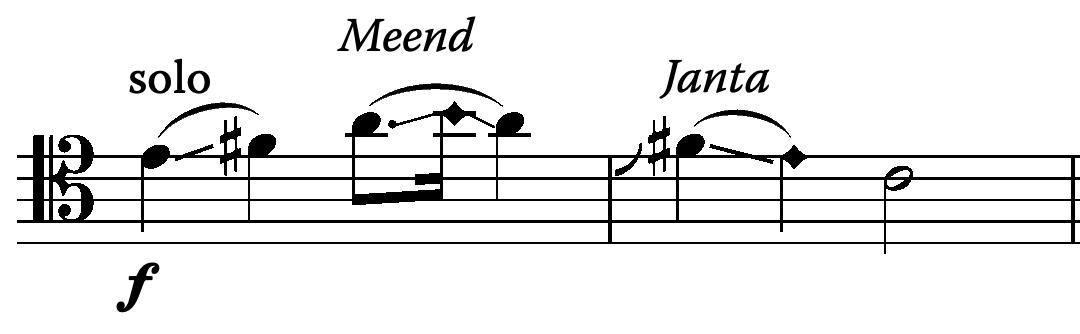
,e solo cello lines are inspired by performance practices common in Indian classical music. ,e performer should feel free to gliss. between pitches as desired. ,ere are also two speciBc styles of ornamentation included in the score:
JANTA is an ornamentation used in Carnatic music where the pitch is approached using a strong upward gesture from the note immediately below it. In this score, it is indicated with a scoop. Please see the demo video for further clariBcation.
MEEND is an ornamentation used in Hindustani music. It is executed by sliding between the pitches, lightly arriving at the individual notes without a strong rearticulation. In this score, the pitches with diamond noteheads indicate this gesture. ,ese pitches should emerge out of the gliss without rearticulation– it should feel like a continuation of the previous note, rather than an arrival at a new note. Please see the demo video for further clariBcation.
,e electronics are intended to be cued in real-time using a program that can loop. ,is can be QLab, Ableton, or a similar program. ,e score includes indications for the electronics to be triggered using a “Go Button.” A list of cues is available from the publisher.
Beta: dear. Term of aEection used for a child or loved one.
Bhagvan: a Sanskrit word for “God.” So, it can be in reference to any of the deities. ,at is my intention with that language.
In our piece all the individual Gods that speak or sing are referenced by their names. Agni is not a God in traditional scripture which is why they are an executive assistant to Brahma. And Brahma is the most powerful of all the deities.
Chaar: four
Chaiwallah: a tea vendor. “Chai” means tea. “Wallah,” means seller. ,e origin of the word “wallah,” is Sanskrit and means “protector,” or “herdsman.” And it has since evolved into being used for “seller.”
Dosa: a lentil and rice crepe whose origins are from South India. ,ey can be served plain with ghee (clariBed butter), with masala (a spiced potato mixture)- and they are often accompanied by samabar (spiced lentil soup) and chutney (dipping sauces). ,ey can be eaten any time of the day. Food in the south of India is traditionally rice and lentil based and often very spicy.
Dus: ten
Ji: term of respect used for elders. (ex. Darius-ji)
Rupaye: Money. ,e rupee is the currency of India.
Saat: seven
:enga vellum: a Malayali (a language in South India) way to say coconut water. Coconut water is known for its cooling properties and while sold all over India it is particularly native to the climate of Southern India.
Laila Starr a young woman who was formerly the Goddess of Death .......................................................soprano
Death the Goddess of Death ....................................................................................................................................spoken role
Darius Shah the inventor of immortality ......................................................................................................................tenor
Pranah the God of Life .......................................................................................................................................................baritone
Mun Mun / Gilly the ghost of a 12-year old girl / a young Goan ................................................................soprano
Agni / Ka/ Cigarette God of Fire / a funeral crow/ an animate cigarette ................................mezzo-soprano
Brahma/ Bardhan 9e CEO of the Gods / a Dalit worker ....................................................................bass-baritone
Young Darius/ Neel Darius Shah as a child / Darius's young son ...................................................................treble
Ensemble
Sea of Lost Souls, Citizens of Mumbai, Chorus of the Ocean, Funeral Attendees, Partygoers, Chorus of the Temple, Goans, as well as (in order of appearance):
Woman with plastic bag on her head ...........soprano Street Vendor ...........................................................bass
Chaiwallah ..............................................................tenor
Mrs. Shah .............................................mezzo-soprano
Rickshaw Driver ..............................................baritone
Student ...................................................................tenor
Two Lovers ...................................soprano & baritone
Funeral Attendees .............................................quartet
Trio of Deities ...........................................................trio
Doctor .....................................................................tenor
Danika ................................................................soprano
Wei ...........................................................................tenor
Goan Vendor 1 .......................................................tenor
Goan Vendor 2 .................................................baritone
Adult Neel...................................................non-singing
Version as of March 16, 2026
2 Flutes (II = Piccolo)
2 Oboes
2 Clarinets in B
2 Bassoons
4 Horns in F
2 Trumpets in C
2 Trombones
Bass Trombone Tuba
Timpani
Percussion (2 players):
1: Go Button,* Ampli,ed Typewriter with Porter's Bell,** Drum Set, Large Bass Drum, Vibraphone, Tubular Bells, Almglocken, Lion's Roar, Xylophone
2: Go Button,* *undersheet, Glockenspiel, Crash Box, Brake Drum, Large Triangle, Waterphone, Marimba
Harp
Strings
*) See Performance Notes for information on electronics. **) For reference, the composer used a portable Remington typewriter, c. 1920s.
Commissioned by Minnesota Opera A Minnesota Opera New Works Initiative Production
Premiered by Minnesota Opera
Christopher Franklin, Principal Conductor October 31–November 8, 2026, Ordway Music 9eater
Music Copyright © 2026 Kamala Sankaram. All Rights Reserved. Libretto Copyright © 2026 Minita Gandhi. All Rights Reserved. Published by Just a Theory Press | www.justatheorypress.com
E l e c t r o n i c s ( S o u n d i n g )
: A M o n s o o n i n Mu m b a i
A m o n so o n r ai n b e gi n s i n t h e b u st l i n g c i t y o f Mu m b ai & b b b b &
Tr
B
( q q = 1 1 2 ) 1 7 9
F l u t e O b o e
C l a r i n e t i n B b
B a s s o o n
H o r n i n F
Tr u m p e t i n C Tr o m b o n e
B a s s Tr o m b o n e Tu b a
E l e c t r o n i c s ( s o u n d i n g )
E l e c t r o n i c s Tr i g g e r [ P e r c u s s i o n ] S A T B
e wr i t e r
G
l e a s e
o l e t yo u g o
L e t m e g o ? ! Wh o wi l l r u n m y d e p a r t m e n t ? Wi t h a l l d u e r e s p e c t , S i r, i t wi l l b e c h a o s a n d d e s t r u c t i o n f o r e ve r i f t h e y l i ve f o r a l l e t e r n i t y
C a l l i t a d e p a r t m e n t r e s t r u c t u r e We n e e d t o g i ve o t h e r d e i t i t e s a c h a n c e t o l e a d An d h o n e s t l y yo u r a t t i t u d e l a t e l y i t n e e d s a s h i f t
F a l l i b l e a s t h e y a r e t h e y a r e s t i l l o u r c h i l d r e n Yo u we r e b o r n o u t o f l o ve f o r h u m a n i t y An d n o w yo u ’ ve f o r g o t t e n wh a t h u m a n i t y i s e y ve f o r g o t t e n m e ! I , b o r n wi t h a t o n g u e t h a t l a p p e d u p t h e b l o o d o f a n u n s t o p p a b l e d e m o n a n d s a ve d t h e wo r l d ! ! Tr y g e t t i n g t h a t t a s t e o u t o f yo u r m o u t h