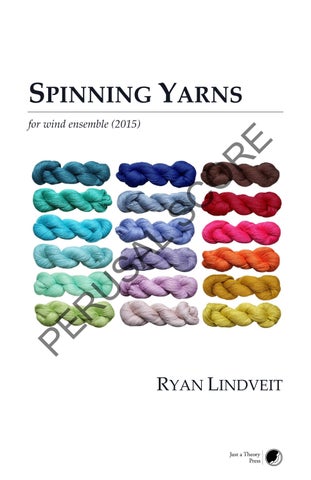
SPINNING YARNS
for wind ensemble (2015)
for wind ensemble (2015)

1 PICCOLO (doubles as Flute 3)
2 FLUTES
2 OBOES (2nd doubles on E. Hn.)
1 E CLARINET
3 B CLARINETS
1 B BASS CLARINET
2 BASSOONS
2 E ALTO SAXOPHONES
1 B TENOR SAXOPHONE
1 E BARITONE SAXOPHONE
3 B TRUMPETS
4 F HORNS
3 TENOR TROMBONES
1 BASS TROMBONE
1 EUPHONIUM
1 TUBA
1 CONTRABASS
1 PIANO
1 TIMPANI
Five drums required Also plays two crystal glasses (F#, C#)
1 PERCUSSION 1
Tam-tam (shared with Perc. 2), bass drum, snare drum, kick drum (shared with Perc. 3), vibraslap, sizzle cymbal
1 PERCUSSION 2
Large whip, medium triangle, splash cymbal, hi-hat, tam-tam (shared with Perc. 1), woodblocks (2), chimes, three crystal glasses (D#, E, G)
1 PERCUSSION 3
Medium suspended cymbal, small whip, china cymbal, kick drum (shared with Perc. 1), xylophone (shared with Perc. 4), three crystal glasses (Bb, A, C)
1 PERCUSSION 4
China cymbal, xylophone (shared with Perc. 3), vibraphone, marimba, splash cymbal, crash cymbals
Approximate Duration: 10’30” ©2015 Ryan Lindveit (BMI) All rights reserved. www.ryanlindveit.com
Flute Whistle Tones [always notated with a diamond notehead]:
Flute players should always play the whistle tones as loudly as possible. Upper harmonics should fluctuate erratically.
(mm.61-74, mm.274-278)
Horn Wolf Howl:
To create the wolf howl, half-valve all three valves excluding the thumb valve. Glissando to the indicated pitch, hold, and then descend in smooth and wavelike form. (mm.62-72, mm.156-171)
Air Noise [always notated with a square notehead]:
Woodwind and brass players are asked to blow air through their instruments at several points during the piece. Performers should always strive to make the air noisy. One strategy for making the air noisy is slightly clenching the teeth when blowing (making a “shh” sound), ensuring that the cheeks never puff up. Horn, trombone, euphonium, and tuba players may find it useful to reverse their mouthpieces, placing the cup on the leadpipe and blowing through the shank Trumpet players are asked to half-valve all three valves. Ultimately, the technique is not as important as the resultant sound. Air should always occur in large, smooth waves.
(mm.62-68, mm.153-177)
The contrabass player is also asked to create ‘air noise’ by muting the strings with the left hand and using light bow pressure and slow bow to create an airy, pitchless sound. An alternative to this technique is bowing directly on the bridge.
(mm.59-76)
Contrabass scordatura :
The contrabass player tunes the E string down a half-step to Eb from m.247 to the end, in order to play natural harmonics with Eb as the fundamental. This retuning is easily done on a bass with a C extension. The music is notated as though played on an open E string, and thus all pitches from m.268 to the end sound a half-step lower than notated.
(mm.247-278)
Lowered and raised accidentals:
The accidentals with arrows indicate to raise or lower the pitch slightly (never more than a quarter tone). They are intended to reflect the naturally altered notes in the harmonic series. For example, the D in Horns 1&2 in measure 1 should be lowered approximately 14 cents, as it is the fifth harmonic.
(mm.1-4, mm.13-16, mm.75-78, mm.268-271)
Crystal glasses:
There are eight crystal glasses tuned to A, Bb, C, C#, D#, E, F#, and G (distributed between Timpani, Perc. 2, and Perc. 3). They should be mounted or taped down to a flat surface so that more than one can be played at a time. While precise rhythms are notated, the composer understands that such rhythms are nearly impossible to convey with crystal glasses. The sound should thus be an undulating pad of pitches with the rhythms played as close to the notated rhythms as possible.
(mm.58-76, mm.150-175, mm.268-277)
I am fascinated by multi-layered storytelling, and Spinning Yarns is a result of that fascination. Margaret Atwood's novel The Blind Assassin was a particularly rich source of inspiration. In this novel, each chapter is part of a different sub-novel. A crime novel is right next to a memoir which is right next to a science fiction story which is right next to a romance novel. The interaction between each of these layers creates a large and hugely dramatic narrative.
Spinning Yarns is a collection of diverse narrative threads stitched together into a dramatic musical tapestry. Like an Atwoodian multi-layered novel, the music oscillates between dreamlike uncertainty, chaotic heroism, sarcastic dancing, pensive sleepwalking, airy lyricism, and climactic hubris. As the drama unfolds, these disparate elements emerge, re-emerge, and inform and interact with each other.
The premiere was given on June 16, 2015 by “The President’s Own” United States Marine Band, conducted by Joseph Higgins.
Note on Doublings
Spinning Yarns is a wind ensemble piece. That being said, the Clarinet and Flute parts must be doubled. Bass Clarinet, Tuba, and Double Bass parts may be doubled at the discretion of the conductor. The composer prefers that all other parts be played by one player only. However, doublings of other parts are acceptable if balance and intonation are not compromised.
2 3 2 3 2 3 2 3
2 3 2 3 2 3 2 3 4 4 4 4 4 4 4 4