


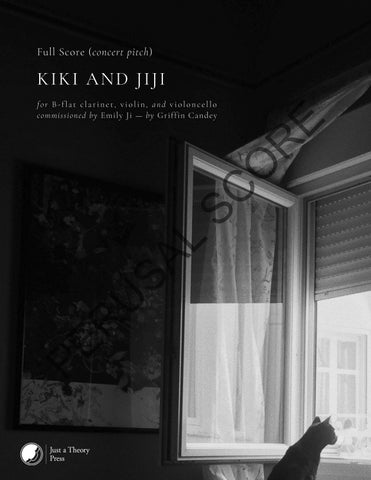

for clarinet, violin, and piano
I. Theme and Variations
II. Speak Simply

Griffin Candey
2023

Kiki and Jiji (2023) came about from a conversation with Emily Ji, for whom I wrote the piece, about both careers and mental health—a conversation which, unexpectedly, turned to Hayao Miyazaki's 1989 animated film, Kiki's Delivery Service. I had only recently watched the film for the first time, and I was struck by the deeply-relatable lesson: what I assumed would be a cute story about a young witch (Kiki) and her talking cat (Jiji) turned out to be a film about how hard it is to find joy in your passions when you make them your profession. (Cuts deep!)
This arc—having a passion, something that feels energizing and fulfilling, which loses its shine when attached to the extractive necessities of income—describes the experience of so many artists, and Emily and I have both lived some version of this. Often, the arc of an artist stops cold because the process of “professionalizing” takes all of the curiosity and youthful spontaneity out of their art, and that’s difficult to rekindle. If we're intentional (and lucky,) we can sometimes find windows in that process to remind ourselves why we're doing what we're doing.
We set out to show that arc in music: beginning with ease and naïvete—slowly watching the process burden itself, become overcomplicated—then opening back up into ease and fluidity. In Kiki's Delivery Service, Miyazaki highlights the fact that, once we've lost the luster of youth, it's never exactly the same, but there are ways that we can return to joy and fulfillment, even if it's a new type of fulfillment. Kiki and Jiji is our way of saying: we're all trying to make it work out there, and it behooves us to take the time to remember and protect the kind of joy that drove us in the first place.
Movements
I. Theme and Variations
II. Speak Simply
Instrumentation
clarinet, violin, and piano
Duration: 11'
First printing, August 2024
Copyright ©2023 Griffin Candey. All Rights Reserved. Program Note Copyright ©2023 Griffin Candey. All Rights Reserved Published by Just a Theory Press | www.justatheorypress.com
Variation 1: sparse, odd, empty, reactive — big contrast between dynamic variations — violin and cello not metrically speci"c, all tuplets are gestural, responding to one another and to clarinet — moments that need to be lined up are marked with vertical lines
Variation 2: tense, oppositional, violent, paranoid — clarinet hops quickly between high, low, middle ranges with big timbral contrasts between ranges — violin and cello growl on aleatoric grumbles that sneak up and up their ranges (violin on IV, cello on I,) moving from molto sul tasto to molto sul ponticello (over the bridge) — releases in a sharp bark
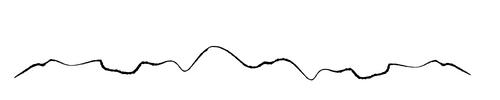
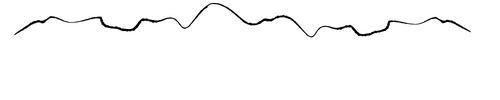
at graphic line, violin and cello indeterminately "grumble," a kind of bisbigliando on close and indeterminate pitches, rising and falling in both pitch and volume; this happens three times, then continues the pattern upwards (as described in m. 32)
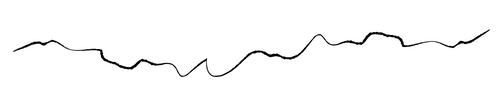
violin and cello continue "grumble" but begin rising slowly up through the next nine measures — notated ranges at the beginnings of measures delinate the approximate ranges where this "grumble" pattern should land at the beginnings of those measures — pattern begins soft and moltosultasto and gradually pushes to !f and moltosulponticello, nearly on top of the bridge, almost at a shriek
violin and cello continue ascent of indeterminate grumbling, climbing from measure to measure through the approximately notated ranges
Variation 3: bright, energetic, manic, and falling apart at the seams — a joyful machine that laughs as it's falling apart — clarinet becomes more and more shrill, as the string harmonies slowly inch apart — double, triple, and quadruple stops become messier and messier as the variation continues