PERUSALSCORE
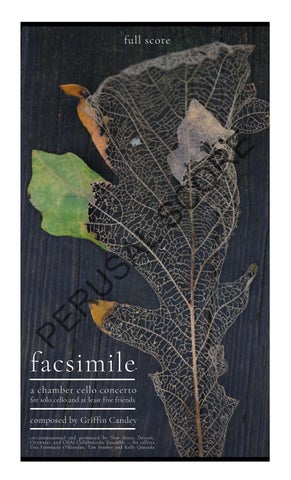
facsimile achambercelloconcerto for solo cello and at least five friends
composed by Griffin Candey
PERUSALSCORE

PERUSALSCORE
Facsimile
for solo cello, three treble instruments, piano, and percussion
1. Facsimile
2. You Know Me By a Different Name
3. The Transfiguration
Griffin Candey

PERUSALSCORE
Co-commissioned and premiered by New Music Detroit, Citywater, and CHAI Collaborative Ensemble - for cellists Una Fionnuala O'Riordan, Tim Stanley, and Kelly Quesada
Program Note
Facsimile delves into memory — how memory can be something both big and small, personal or collective, quiet or weaponized — how we tend to view memory as reliable when it is often rewritten by our own insecurities or by the input of others — how it can be the small boat we send down the river when we’re gone. This is a small window in an almost limitless subject.
The first and title movement, Facsimile, focuses primarily on the mutability of memory, how it can betray us sometimes — a trait that can apply to both personal and historical memory. Personal memory can be skewed by others’ needs or beliefs, by the repetition of a lie until we believe it to be true, or by shaping thoughts around how we want it to be rather than how it is or was. More and more research even suggests that depression and anxiety disorders can affect our ability to effectively log memories. Historical memory, too, constantly falls prey to revision (via individuals, governments, all skewing narratives in their favor and choosing which voices control the narrative.) It brought to mind what happens to an image when it's copied afew times too often — when we print an image, then copy it, then copy the copy, ad infinitum. The picture sometimes retains a bit of its original character, but this repetition tends to smudge out most of the details, the individuality.
The second movement (You Know Me by a Different Name) comes from a conversation that my wife, Susan, and I have had several times: about how younger versions of ourselves seem, when we look back, like wholly different people — with different goals, tastes, and ideals. (The American poet Walt Whitman apparently held the same belief: when confronted with the many photographs of himself later in his life, he said that looking at these younger iterations of himself was like looking at a stranger — someone he vaguely remembered, but not well.) It made me think about what parts of us we leave behind as we change and what parts of us remain. What do these versions of ourselves mean to us now? What do we owe them? What do they owe us?
The third movement (The Transfiguration) is about becoming a memory. If memory is mutable — if we do so often become a new person — then how can we create something that lives beyond us? Do we haveany say over that?
While writing this piece, I was serving as the music director for a little Presbyterian church in Michigan. (As a music director, one sits through a whole lot of Sundays in a choir loft with far too much time to think — and, suffice it to say, often completely ignoring the message being provided that Sunday.) While I sat, turning over the piece in my head, the pastor dove into the week’s passage, from the book of Matthew: the transfiguration of Jesus on the mountain, joined by Mosesand Elijah. The primary detail of the story that grabbed my attention was not actually the reveal of Jesus’ divinity to the disciples present, but the fact that heasks the disciples not to speak of it until after the crucifixion (“Tell the vision to no man, until the Son of man be risen again from the dead.”) This was something experienced in real time but intended to live far beyond those present — a placeholder, a bookmark.
I have no idea how to build something that lasts — I suspect that I’ll never figure it out — but I do recognize that the dearest memories I have of those closest to me were not of them trying to be particularly memorable, but of them being themselves, unapologetically. That’s the most that we can ask of ourselves, day to day — and hopefully, that’s enough for us to send down the river, to whomever. There’s comfort in that thought. xx — Griffin
PERUSALSCORE
Instrumentation
Cello soloist + at least five friends:
Treble 1
Treble 2
Treble 3
(all treble parts flexibly notated)
Piano
Cello soloist
Percussion (finger cymbals, tambourine / ring of keys, wooden rattle, castanets, woodblock, claves, suspended cymbal, two toms, and kick drum)
Opt. Percussion 2 (tambourine / ring of keys, wooden rattle, triangle, brake drum, crotales, vibraphone)
Movements
1. Facsimile
2. You Know Me By a Different Name
3. The Transfiguration
Performance Note
Interpreting Facsimile should follow two criteria: first, that the main focus of the orchestration choices should be to support (and to not overwhelm) the cello soloist — and second, that all elements outside of that should be considered very, very flexible. The top three staves (Trebles One through Three) can be played by whichever instruments fit the ensemble and the space — provided, again, that it does not completely overwhelm the soloist. These players should feel free to alter which octaves certain portions of their scores are in, both for the sake of their execution and for overall balance — this guidance also holds true for any aleatoric sections of the piece. (Should these players need a differently-transposed score than those provided, please feel free to reach out to me!) The percussionists should also feel free to play a bit with which instruments they’ve been assigned — for example: the top staves in each part (both the main and the optional secondary percussionist) are labeled “ring of keys / tambourine,” which could be fulfilled by either of those things, but the percussionists should feel free to play with any other instrument in their repertoire that produces a similarly bright jingle. Same for woodblocks, or the toms, the wooden rattle, the brake drum, et cetera. Do not feel roped in by the listed instruments, but rather inspired by them.
The only instruments that are fairly set are the cello soloist and the pianist (but should also feel tons of flexibility in their interpretations of the piece.)
If you have an ensemble larger than six or seven, feel free to double players on any of the treble lines — should you want to employ any players outside of those numbers, please feel free to reach out to me! I would be more than interested in building in other optional parts into this score in the future.
PERUSALSCORE
Duration: 15 minutes
First printing, August 2024
Facsimile
a fexible-instrumentation chamber cello concerto co-commissioned by: New Music Detroit (Detroit,) CHAI Collaborative Ensemble (Chicago) and Citywater (Sacramento) — by Grifn Candey
Movement I: Facsimile
{q = c 56-60}
nearly silent — a mirage
Aleatoric lines each enter slowly, overlapping one another and rattling along — the efect should be like birdsong, murmuring, indistinct conversations in the next room — feel free to rearrange or divert from notated patterns, incorporating short scalar or arpeggiated passages, trills, or any number of assorted efects (seagull efect, futter tongue, harmonics,) provided that they do not detract from the overall texture and they generally center on G major
PERUSALSCORE
Aleatory builds for at least 10-12 seconds before cello soloist enters — then, continues until m. 25
Tempo fuid through frst thirty measures — the grace notes in opening section can be played heavily, sweeping up to high registers — especially true for grace notes on open strings (let them ring as much as possible.)
Percussionist(s) strike frst chime, then join aleatory with wooden rattles, tambourines, rings of keys — ad libitum
Percussionist 1 also includes: wooden rattle, castanets, wood block, claves, susp. cymbal, tom, and kick drum
Percussionist 2 (optional) also includes: triangle, break drum, and crotales
Treble
Treble
Treble
Cello Soloist Finger Cymbals
Tamb
(aleatory and rattling continues)
PERUSALSCORE
aleatory slowly builds with cellist, growing more and more intrusive and cacophonous — pitch collection only shifs by one note: all B's are B-fats
sighing gliss to indeterminate
attack strongly
oscillation
(slow oscill. to trill)
allow trill to slowly dip, lose tone, and / or detune down (as possible per instrument)
PERUSALSCORE
quick, intrusive clicks that enter fast and quickly die of to nothing
small groupings of notes quicken to bisbigliando, then slow again
oscillation gradually quickens until it becomes a trill, then slows again
Movement II:
You Know Me by a Diferent Name {q = c 52}
shocked — cold — suddenly out in the open
allow treble 1 (and bowed vibraphone, if utilizing second percussionist) to linger, clearing the air, for 8-10 seconds
( let ring )
Aleatoric lines enter similarly to the opening movement, murmuring and overlapping one another — as before, feel free to divert from written patterns and play with scalar passages, trills, etc. — aleatory builds for 8-10 seconds, then continues sofly as pianist, cellist enter
small, energetic bursts that grow and then fade in both tempo and volume
feel free to include any other rattling sound (keys, tambourine, other improvised objects)
PERUSALSCORE
Aleatoric lines die down slowly in both volume and rhythmic intensity, until they fnally decay into air sounds (as feasible per instrument) — if sound has to center on any pitch, center on D natural
all air sounds slowly die of to full silence — whole ensemble holds silence for 6-8 seconds
PERUSALSCORE

Candey: Facsimile JAT-147-015-FS