FIELD NOTE 65 / HABIT-FIRST SPACE
PRACTICAL HOME / READING HABITS
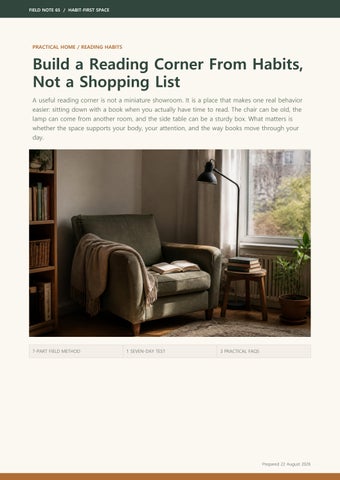
Build a Reading Corner From Habits, Not a Shopping List A useful reading corner is not a miniature showroom. It is a place that makes one real behavior easier: sitting down with a book when you actually have time to read. The chair can be old, the lamp can come from another room, and the side table can be a sturdy box. What matters is whether the space supports your body, your attention, and the way books move through your day.
7-PART FIELD METHOD
1 SEVEN-DAY TEST
3 PRACTICAL FAQS
Prepared 22 August 2026
BUILD A READING CORNER FROM HABITS
PURPOSE
This guide uses a habit-first process. You will observe an existing reading moment, assemble a temporary corner from things you own, test it for a week, and keep only the elements that earn their place. The result should feel specific to your routine rather than copied from a photograph.
1. Define the reading event before the space Begin with one sentence that describes when reading already has a chance to happen. Make it concrete: "I read for twenty minutes after washing the dinner dishes," or "I read on weekend mornings before the rest of the household wakes." Avoid goals such as "read more" because they do not tell you what the corner must support. Record four details about that event:
• Time window: the usual start time and the realistic length of the session. • Reading material: novels, magazines, study notes, large-format books, or an e-reader. • Body preference: upright, curled into a corner, feet supported, or able to change position. • Likely interruption: noise, a cold draft, a missing charger, poor light, or the need to clear another person's things. Choose one primary event even if you read in several ways. A corner designed equally for focused study, bedtime reading, video calls, and storage can become mediocre at all four. Secondary uses can be added later if they do not obstruct the main one.
2. Observe the corner at the hour you will use it A location that looks bright at noon may be gloomy at 8 p.m. Sit in each candidate spot during the intended reading window for at least ten minutes. Bring the kind of book you normally read. Do not rearrange anything yet. The purpose is to notice the room as it behaves, not as you imagine it. Check light from the page rather than from the doorway. Is the print evenly visible? Does a lamp create glare on coated paper or a screen? Does your head cast a shadow when you settle into a natural posture? If daylight is part of the plan, observe whether it reaches the page directly and whether that creates heat or squinting. Then listen. Separate steady background sound from sudden interruptions. A low appliance hum may disappear from attention, while a frequently used door can break concentration every few minutes. Notice traffic paths as well. A chair that blocks a drawer, heater, outlet, or walking route will be moved repeatedly, and repeated movement adds friction. Finally, note temperature and reach. Drafts, direct heating, and a cold wall can shorten a session even when the chair feels comfortable at first. From a normal seated position, identify what you genuinely need within reach: usually a book, light control, drink, and perhaps reading glasses or a pencil.
3. Assemble version one from what you already own Treat the first setup as a prototype, not a decorating project. Start with a seat that has already supported a comfortable half hour somewhere else in the home. Move it temporarily if possible. Add a lamp, a surface for one book and one drink, and any support your body regularly asks for. Substitution makes the test faster:
• A dining chair plus a firm cushion can reveal the right seat height. • A folded blanket can test lumbar, elbow, or foot support. • A stable stool can stand in for a side table. • A basket can hold the next two books without becoming a general storage bin. • A removable hook or nearby shelf can keep headphones or glasses from disappearing.
2
BUILD A READING CORNER FROM HABITS
Limit the first version to what can be assembled in twenty minutes. If setup becomes a weekend renovation, you will test your enthusiasm for a project rather than the usefulness of the corner. The prototype only needs to answer whether reading begins more easily and lasts comfortably.
4. Make comfort adjustable rather than perfect Comfort changes across a session. A position that feels soft for five minutes can strain the neck after thirty. Build in small adjustments so the reader can respond without abandoning the corner. Start with the feet. They should rest on the floor or on stable support without pressure behind the knees. Next, check whether the back can remain supported while the book is held at a comfortable height. If the arms tire, try a pillow on the lap or a firmer arm support. The goal is not a textbook posture. It is a position that can vary while keeping the page easy to see. Place task lighting so it reaches the page from above and slightly to one side. The lamp should be stable, its cord should stay outside the walking path, and the switch should be reachable without stretching behind furniture. If the household includes children or pets, treat cord control and lamp stability as core requirements rather than finishing details. Keep a light layer nearby if temperature changes during the reading window. If noise is the main problem, test a quieter time or door position before adding equipment. Every adjustment should answer an observed problem.
5. Gather references without building a shopping queue Reference browsing is useful when it clarifies a problem, such as lamp placement, accessible seating, library services, or safe cable routing. It becomes distracting when every image silently adds another object to buy. Before searching, write the question you need answered and stop when you have two plausible approaches to test. A curated 주소가자 사이트모음 can help surface candidate library resources, accessibility guidance, lighting references, reuse networks, or small-space ideas. Use it as a discovery point, then open the original source and check who produced the guidance, when it was updated, and whether it applies to your room and reader. Save a reference only if you can name the feature you are testing. "Lamp shade keeps the bulb out of the reader's direct sight" is actionable. "Cozy room" is not. Translate appearance into a function, then see whether an object you already own can provide that function. Keep separate lists for problems observed, tests attempted, and possible purchases. A purchase belongs on the last list only after the same unmet need appears in several sessions. Even then, define the requirement before choosing an item: minimum and maximum height, stable footprint, light direction, cleanability, or storage capacity. This prevents browsing from redefining the project around whatever is easiest to market.
6. Run a seven-day use test Leave the prototype in place for seven days if the room allows it. Use it during the reading event you defined, but do not force a daily session merely to protect the experiment. A day when you choose another location is valuable evidence. Record why the alternative won. Use a short log that takes less than a minute: Check
What to record
Useful signal
Possible response
Start
Did you sit down without rearranging?
Low setup friction
Remove items that must be moved first
Ten minutes
What distracted your body or attention?
Repeating irritation
Change one support, light, or location detail
Finish
Why did the session end?
Natural stop versus avoidable discomfort
Preserve or revise the setup
Reset
Was returning the space easy?
Sustainable shared use
Simplify storage or make the kit portable
3
BUILD A READING CORNER FROM HABITS
Change only one important variable at a time. If you move the chair, change the lamp, and add three cushions on the same day, you cannot tell which change helped. Keep each version for two or three sessions unless there is an immediate safety or comfort problem. Pay attention to beginnings. A corner succeeds when it reduces the small negotiations before reading: finding the current book, clearing a seat, locating glasses, untangling a cable, or deciding where to put a cup. The total minutes read matter less than whether starting feels simpler. At the end of the week, compare the planned event with what happened. Perhaps evening reading repeatedly lost to household activity, while weekend morning sessions worked easily. The correct response may be to change the time rather than add furniture. A habit-first corner is allowed to move, shrink, or become a portable setup when the evidence points that way.
7. Keep what works and retire the rest Give every element a job statement. The chair supports a comfortable twenty-minute session. The lamp lights the page without glare. The basket holds only the current and next book. If an object has no job, remove it for another week and see whether it is missed. Create a simple reset rule: when a session ends, close the book, place the bookmark, return the drink, and leave the seat ready. The rule should take less than two minutes. Shared spaces may need one more step, such as folding the blanket or returning a portable lamp. Write the rule around cooperation, not ownership. Review the corner after a month and at seasonal changes. Daylight, temperature, reading material, and household routines all shift. Maintenance should be a small recalibration, not a reason to redesign the entire area.
What if there is no room for a dedicated chair? Build a reading kit instead of a fixed corner. Keep a cushion, light, bookmark, glasses, and current book together in one container. Choose a seat that is reliably available during your reading window, and make setup and reset part of the test.
When is a purchase justified? Buy only after a specific unmet need repeats across several sessions and cannot be solved safely with what you own. Record the requirement before comparing products. A purchase should remove proven friction, not create a new design direction.
How do I share the corner with another reader? Agree on the main functions and keep personal items in separate small containers. Use adjustable light and movable support where preferences differ. If schedules conflict, define when the area must be reset rather than trying to make every object suit both readers permanently. A successful reading corner may look ordinary. Its achievement is behavioral: the book is easy to reach, the page is easy to see, the body can settle, and the room is easy to restore. When those conditions are present, decoration becomes optional and reading becomes the most natural next action.
4