SUMMER 2025
RECURRING
COVER STORIES
FEATURES
3 Living & Learning Campus news and athletics, plus the voices of faculty, students, and alumni 6 The Big Question How will writing adapt for students? 7 Past Comes Alive Historic Bibles find a home at Juniata
20 Driven to Win Women’s volleyball team champions success on and off the court
8 My Way Learning to lead 9 Scorecard Historic seasons, recognizing excellence, and welcoming new leadership
25 Forever Juniata Alumni news, events, class notes, profiles, and remembrances 25 Then & Now The Bailey Oratorical 27 I Met an Alum Finding each other, all over the world 48 Parting Shot Spotlight on Homecoming & Family Weekend
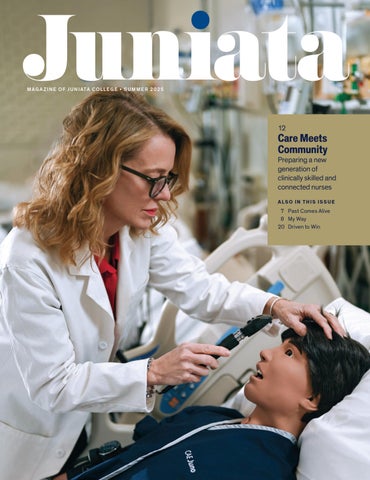
12 Healing the Shortage Preparing a new generation of skilled and connected nurses. Teaching a people-centered approach to healthcare. Bridging the gap between textbooks and hospitals. An early lesson that shaped a medical career. FIRST PERSON Liz Mansberger takes a peoplecentered approach to readying students for careers in healthcare.
OBJECT High-fidelity manikins are critical to student learning.
26 Baker Institute Marks 40 Years of Peacebuilding at Juniata College Celebrating decades of leadership, dialogue, education, and action for peace.
ALUMNI INSIGHT Dr. James Metz ’89 An early medical lesson that helped shape his career.
JUNIATA COLLEGE MAG A ZINE
1
CARE MEETS COMMUNITY
In a region where healthcare is scarce and the need is urgent, Juniata College is answering the call—preparing a new generation of nurses to serve with skill, purpose, and heart.
BY TOM YENCHO
12
SUMMER 2025
JUNIATA COLLEGE MAG A ZINE
13
H
ealth care looks different in rural central Pennsylvania. The roads are long, the winters hard, and cell service can disappear faster than a heartbeat. In some counties, more than a quarter of the population is over 65, while access to primary care, specialists, and mental health providers continues to shrink. These are the quiet emergencies—undiagnosed chronic conditions, missed follow-ups, preventable crises—that shape the rhythm of rural health. And they’re getting worse. The United States faces a staggering shortage of registered nurses. Tens of thousands of positions are currently unfilled. Pennsylvania is home to among the most severe gaps in the country, with over 20,000 nursing vacancies. The implications are profound, especially in communities where health care infrastructure is already stretched thin. Juniata College sees not just a crisis, but a calling. “We’re in a health care desert and know statistically that there are just not enough physicians per capita to meet needs, and so much of health care is going to be at the clinic level, at the level of nurse,” explains Provost Lauren Bowen. “Nurses will be the first point of contact for many people, and they can help prevent health issues and can provide the kind of personal care on a daily basis that people who live in rural communities especially need.” That understanding—that nurses are central to the future of rural health care—has fueled a wide-reaching promise to both students and residents around Huntingdon. This fall, 14
SUMMER 2025
Juniata will launch a Bachelor of Science in Nursing (BSN) program—approved by the Pennsylvania State Board of Nursing in June—designed not just to fill jobs, but to redefine what it means to be a nurse in America, especially in the most underserved communities. A PURPOSEFUL PROGRAM
Leading this effort is Jennifer DellAntonio, who joined the College faculty in January 2025 as the inaugural director of nursing. A seasoned emergency room nurse and passionate educator, she brings more than two decades of nursing education and academic leadership experience along with a deep sense of purpose to the role. Her calling started early. “I Jennifer DellAntonio, a convinced my classmates to seasoned emergency turn our metal lunchboxes into room nurse and passionate educator, joined Juniata first-aid kits,” she recalls with a College in January warm laugh. “We’d wait on the 2025 as the inaugural director of nursing. playground for someone to fall off the monkey bars. One day, it
actually happened—my teacher came running over and asked for a Band-Aid. I gave her one, and I remember thinking, ‘This is it. I had found my purpose.’” From the playground to the trauma unit, DellAntonio’s path has always centered on caregiving. But it’s her belief in the human side of health care—the story behind the symptoms—that fuels her vision for the program. “Nursing at a place like Juniata is a perfect fit,” she says. “It’s a symbiotic relationship. You need rigorous science—like anatomy, physiology, biology—but you also need compassion, curiosity, and cultural understanding. That’s where the liberal arts shine. This environment helps shape nurses who are not only clinically skilled, but deeply human in their care.” An active Health Professions Committee draws faculty toget-her across disciplines to prepare students for future careers and to model the importance of thinking holistically about health education. In recent years, the College launched several health- “Nursing at a place focused academic offerings, like Juniata is a perfect including exercise science fit. It’s a symbiotic and kinesiology as well as relationship. You need a Master of Public Health. rigorous science—like Juniata has been building anatomy, physiology, toward this moment for biology—but you also a while. Now, that long-term need compassion, vision is becoming reality. curiosity, and The Pennsylvania State cultural understanding. Board of Nursing officially That’s where the approved Juniata’s BSN liberal arts shine.” program in June. The first Jennifer DellAntonio cohort of nursing students Director of nursing will arrive on campus this fall, and the timing couldn’t be better. Nationwide, 82% of health care employers prefer to hire nurses with a BSN, according to the American Association of Colleges of Nursing. And 93% of nursing graduates secure job offers within six months of graduation, which far outpaces almost every other baccalaureate degree earner. To ensure its graduates are prepared from day one, Juniata plans to provide clinical practice experiences where care is most urgently needed—nursing homes and public schools as well as a variety of area hospitals. Even before the program’s
FIRST-PERSON
Centered on the People in Healthcare Assistant Professor of Biology Liz Mansberger leads the Health Professions Committee BY TOM YENCHO
When Assistant Professor of Biology Liz Mansberger talks about preparing students for health careers, she doesn’t start with labs or textbooks. She starts with people. “There’s a big difference between health and health care,” she says. “Your health is not only impacted by your health care—there’s so much more. It’s where you live, what you eat, what you have access to. That’s what we’re trying to help students understand.” These factors—housing, education, food access, transportation, income—are known as social determinants of health, and they can shape up to 80 percent of a person’s health outcomes. Juniata’s approach is designed to help students see the full picture, connecting the dots. “We really try to get them to think holistically,” she says. “To look at the humanities, the social sciences, the full liberal arts lens — because all of that impacts the quality of care they’ll one day provide.” As chair of Juniata’s Health Professions Committee, Mansberger and her interdisciplinary team of faculty colleagues prepare students for the scientific
rigor of health professions and ensure Juniata’s curriculum reflects the complexity of health in the 21st century. Add in Juniata’s rural location in central Pennsylvania, and the College becomes a real-world lab for one of the nation’s most pressing challenges. “Health means something different depending on where you are,” Mansberger explains. It’s estimated that nearly 122 million Americans live in areas with shortages of health professionals. The result? Lives are shaped not only by medical concerns, but by distance, transportation, housing. And perhaps a lack of trust. “We help students ask: What are the barriers? Who’s being left out? What does this community really need?” Juniata supports students as they work to get into medical or other professional schools, but the focus is just as much on helping them see care as part of a much larger health story. “We talk a lot about rural health not just as a barrier, but as a culture. And we encourage students to see their connection to that culture as a strength.”
JUNIATA COLLEGE MAG A ZINE
15
HEALING THE SHORTAGE
The Gateway Center is under construction at the corner of 17th Street. Set to open in 2026, the Gateway Center will become the new home for the nursing program.
official launch, the College has made significant investments in a hands-on learning infrastructure.
“We’re celebrating not only a building, but our commitment to education and our partnership with the community. We’re celebrating Juniata being the transformational force in health care in this region we desperately need.”
A NEW PULSE OF THE CAMPUS
Currently housed in the Sill Business Center, Juniata’s state-ofthe-art Nursing Simulation Laboratory immerses students in lifelike clinical scenarios. There are high-tech manikins that simulate everything from neonatal cries to geriatric cardiac episodes. They function as if their organs are operational, replicating medical conditions. Each stage of care—from obstetrics to long-term care—is represented, giving students a full view of the patient lifecycle. But bigger things are on the horizon. Just north on Moore Street, the Gateway Center is under construction at the corner of 17th Street. Set to open in 2026, the Gateway Center will become the new home for the nursing program. Juniata broke ground in a public ceremony on April 25, marking a milestone in the College’s mission to be a catalyst for both academic excellence and regional vitality. Mary White ’73 is chair of the Juniata College Board of Trustees. She touts the College as a critical linchpin in the economy, a source of pride across the region. “We’re celebrating not only a building,” she said, “but our commitment to education and our partnership with the community. We’re celebrating Juniata being the transformational force in health care in this region we desperately need.” 16
SUMMER 2025
Mary White ’73 Chair of the Juniata College Board of Trustees
The building’s third floor will house a next-generation simulation and skills lab— complete with 10 hospital-grade patient bays, bedside monitoring, and medication stations. Specialty simulation rooms will replicate acute care environments, helping students build confidence and competence before they ever step foot into a real hospital. It’s a hands-on experience without the high-stakes environment. And the patient simulator manikins? They make the move, too. A state-of-the art control room will serve as the nerve center of simulation learning, allowing
OBJECT
No Pulse? No Problem High-fidelity manikins are critical to student learning BY TOM YENCHO
It breathes. It talks. It even sweats. But don’t expect it to say “ouch.” Meet the high-fidelity manikin, Juniata College’s most tireless patient. Housed in the new simulation center inside the Sill Business Center, this state-of-the-art training tool allows nursing students to diagnose, treat, and even save a life—all without the pressure of a real-world hospital setting.
Forget lifeless plastic models. This manikin is an interactive patient powered by advanced technology. Controlled by sophisticated software, it can mimic everything from a heart attack to an allergic reaction, responding in real-time to student interventions. One moment, it might be a middle-aged patient with chest pain; the next, a child struggling to breathe. The stakes feel real, but mistakes don’t cost lives. By bridging the gap between textbooks and hospital floors, the lab gives students hands-on experience long before they
step into their first clinical rotation. Jennifer DellAntonio, director of nursing, calls it high-impact learning—lifelike scenarios that challenge students’ critical thinking and decision-making skills. It’s a human response to very real health complications.
JUNIATA COLLEGE MAG A ZINE
17
ALUMNI INSIGHT
‘Watch how I approach this.’ Early Medical Lesson Shaped Career of Dr. James Metz ’89 BY TOM YENCHO
Before becoming a pioneering leader in radiation oncology, Dr. James Metz ’89 was a medical student shadowing a worldrenowned physician during pediatric cancer rounds. One moment left a lasting mark. “Before we walked into the room, that doctor said, ‘Watch how I approach this,’” Metz recalls. The family was gathered around the patient’s bedside. “And the first person he went to was the sibling—this sibling ultimately feels isolated in some ways, so out of what’s going on. He would first go to the sibling and recognize them.” It was a small but profound gesture—one that taught Metz to see emotional connectivity. He saw the critical role of not just the patient, but the caregivers who wait, worry, and sacrifice. Today, Dr. Metz is the chair of radiation oncology and Henry K. Pancoast professor 18
SUMMER 2025
of radiation oncology at the University of Pennsylvania’s Perelman School of Medicine. On May 17, he returned to Huntingdon to address the Class of 2025 at Juniata’s 147th Commencement. “I learned how to put things forward while thinking about the people around me,” he says of his Juniata days. “You learn to value what everybody else brings to the table.” That mindset fuels his perspective on communitybased care. “For what I do, only 15% of patients that have cancer are treated in a large academic setting. The vast majority are treated in the community. And that’s where you keep people healthy.” Metz sees Juniata’s focus on rural health care—and the Gateway Center—as vital to the future of medicine. Because in the end, whether in a high-tech treatment center or a small-town clinic, the best care still starts the same way: walking into the room and seeing everyone in it.
faculty to manage, observe, and assess their students’ realtime experiences. But the Gateway Center isn’t just for students. The lower two floors will bring health care providers— nurse practitioners, physician assistants, and doctors— directly to the Huntingdon community. For students, this proximity creates a powerful mentorship model where learning happens alongside care delivery. For residents, it means expanded access to local, high-quality health services. “Today is about a solution,” said President James A. Troha at the ceremony. “And that’s really the business we should be about in higher education. How do we lean into those solutions, and who do we do it with?” Those offerings include Broad Top Area Medical Center, a federally qualified health center that provides care throughout central Pennsylvania. Announced as the Gateway Center’s first tenant at the groundbreaking by President Troha, Broad Top has a lot to gain as well, connecting and collaborating with Juniata students to grow this community’s future doctors and nurses. “This will be our education “One of the hardest hub,” explains Dr. John Roth, chief executive officer of Broad things is to get Top Health and Wellness. primary care “One of the hardest things is to physicians to come get primary care physicians to to rural America. come to rural America. They They can start can start at Juniata, study at Juniata, study nursing, or go to medical school, nursing, or go to and then come back here, where medical school, Broad Top would introduce and then come back them to the communities where here, where Broad we have a presence.” Top would introduce In 2021, there was one them to the rural primary care physician communities where for every 522 residents in we have a presence.” Pennsylvania, compared to one Dr. John Roth for every 222 residents in urban Chief Executive Officer of counties. “The beautiful thing Broad Top Health and Wellness is that this [building] is connected to the community of which we are a part,” shared President Troha at the groundbreaking. “When I’m at Rotary, or in a restaurant, or in a grocery store, people come up to me and say, ‘Thank you! Thank you for doing this!’ We are so excited about what this is going to mean for the Huntingdon region.”
That is exactly the message Dan Sunderland ’88 loves to hear. He and his wife, Kerry, are two of the Gateway Center’s proudest supporters and their $1 million gift helped build momentum for the nursing program and new facility. “We’re not just educating nurses, we’re delivering health care to people who need it, right here where they live,” explains Sunderland. As a business leader and longtime trustee of Juniata College—just as his father was—he’s no stranger to service, commitment, and community. But when it came to supporting Juniata’s newest program, the motivation turned deeply personal. For nearly a decade, his daughter worked in a neonatal unit as a registered nurse. She just finished her master's degree and will become a nurse practitioner. She’s one of several nurses in his extended family. “I've watched the nurses in my family and see the support they provide, the care they give, and ultimately, that's what motivated us to make this investment in Juniata's future.” Juniata’s commitment to shape the next generation of nurses has found a big audience, particularly one located about two hours east on Route 22. “That’s really the vision of the Gateway Center, recruiting and training quality students, exposing them to the critical and satisfying work right here in the community gets them to stay here,” Pennsylvania Secretary of Health Dr. Debra Bogen said at the groundbreaking.
approach to being a nurse—teaching them to communicate effectively and humanely.” Sunderland agrees. “We want to make sure that we are harnessing the power of the liberal arts with the nursing program. A nurse is someone very special because they really understand the patient, build understanding with the doctor, understand the administrative side.” Juniata’s new BSN program will prepare students to lead in complex systems and to listen, serve, and to stay present with the people who need them most. For Sunderland, this is what Juniata’s forward-looking uniquely positions Juniata and mindset is evident in the surrounding community. the BSN curriculum, which embraces a “Even though we have this 150competency-based year history together, the next approach that emphasizes patient-centered care, 150 years will be even more clinical judgment, valuable for everyone.” interprofessional collaboration, ethical practice, and leadership.
ANTICIPATING A NEW PATH FORWARD
The dual focus—education and community—was central to why Juniata, already renowned for its preparation of students for health professions, pursued a BSN in the first place. “The reasons for us to pursue nursing include the shortage that has persisted for several years and the needs of our region and community,” says Bowen. "We also appreciate how health care delivery is changing; we want to anticipate the future of nursing with our BSN program." That forward-looking mindset shows up in the BSN curriculum itself. Developed in alignment with the American Association of Colleges of Nursing Essentials and NCLEX-RN Test, the curriculum embraces a competency-based approach that emphasizes patient-centered care, clinical judgment, interprofessional collaboration, ethical practice, and leadership. It’s academically rigorous yet deeply grounded in human connection.” “Nursing will be grounded in the best of Juniata,” Bowen says. “We’ll develop in our students a humanistic JUNIATA COLLEGE MAG A ZINE
19