Transforming Higher Education Adapting to the Era of Digitalization with The Use of Virtual Reality
June Bee
Integrative Seminar: Systems and Strategy
Bridge Project 3 (Final Daft)
March 1st, 2021
Introduction
This paper based on Dewey’s Experiential learning theory as a point of departure to reimage the ideal 21st centaury digitalized learning environment for higher education with the use of virtual reality (VR).
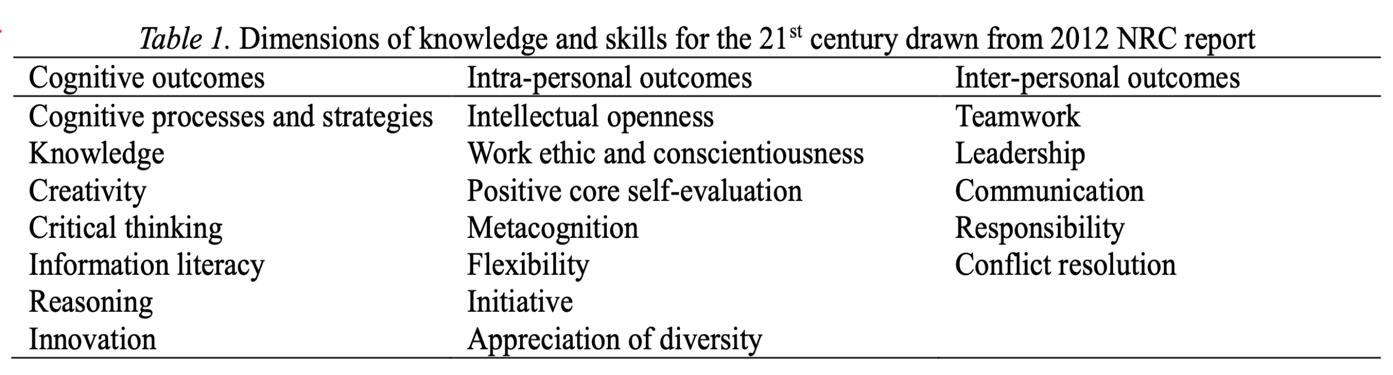
The 21-century world was digitalizing in such fast pace like never before. This created a new phenomenal that demands humans to have advanced abilities of navigating within the mass media. As described by the National Research Council (NRC) in its landmark report Education for Life and Work in the 21st Century (2012), “They must acquire not just academic knowledge, but also character attributes such as intrinsic motivation, persistence, and flexibility”1. Table 1 implicated the vital knowledge and skills in 21st century.
2
According to the graph, skill sets that we used to acquire knowledge from traditional education in the industrial-schooling era may not be valid or adaptable to the current generation anymore. This questioned the notion of learning and the way of approaching it. Higher education, being the forefront of this field, was at its epochal phase for transformation. In order
1 Dede, Chris, Tina A. Grotzer, Amy Kamarainen, and Shari Metcalf. "EcoXPT: Designing for Deeper Learning through Experimentation in an Immersive Virtual Ecosystem." Journal of Educational Technology & Society 20, no. 4 (2017): 166-78.
2 National Research Council (2012). “Developing transferable knowledge and skills in the 21st century.” Education for life and work.
to achieve such ambitions, designing a platform for “deeper learning”3, recommended by 2012 NRC report, was at quest. Adapting to the emerging technology, virtual reality seemed to be the ideal methodology for dynamic education by three reasons. The paper will briefly discuss the 3 aspects of virtual reality from educational perspectives:
1. the monumental role of experiential learning in adulthood/higher education
2. shared experiences in the community of virtual reality
3. deeper learning being personalized/ self- directed learning replace higher education
The Monumental Role of Experiential Learning in Adulthood/Higher education
Experiences were the ground base of human knowledge development. What differentiate experts and passerby was their level of degree on the sensory intake upon a piece of information. Children, obtained the higher sensory ability. It was not the fact that they didn’t know anything. It was the fact that they wouldn’t be restrained by the things they knew.
It’s freezing outside. Children refused to put their shoes on. As for adults, putting on shoes was no longer an accommodation 4 In the book The New Atlantis, Matthew B. Crawford talked about his observation between children and adult. He figured that the toddlers had purity that only focused on their will and refused to any other options that may inconvenience their will; however, adults, often made decisions basing on current circumstances. The clear division that separated the two groups is their level of attachment to the material reality. Sensory intake was greatly influenced by it. The interactions with the material reality shaped one’s beliefs toward the world and his or her
3 Chris Dede, Tina A. Grotzer, Amy Kamarainen, and Shari Metcalf. "EcoXPT: Designing for Deeper Learning through Experimentation in an Immersive Virtual Ecosystem." Journal of Educational Technology & Society 20, no. 4 (2017): 166-78.
4 Matthew B. Crawford, "Virtual Reality as Moral Ideal." The New Atlantis, no. 44 (2015): 28-36.
existence in the world. In order to have high sensory intake like children, we needed to understand how these experiences/ attachment to the material reality was formed.
These experiences were categorized into bases as “two dialectically modes of grasping experience - Concrete Experience (CE) - and Abstract Conceptualization (AC) - and two dialectically related modes of transforming experience - Reflective Observation (RO) and Active Experimentation”5 in the Experiential Learning Theory (ELT) created by 20th century scholars.6
Figure 1 showed the ideal learning cycle that touched all the bases listed above.
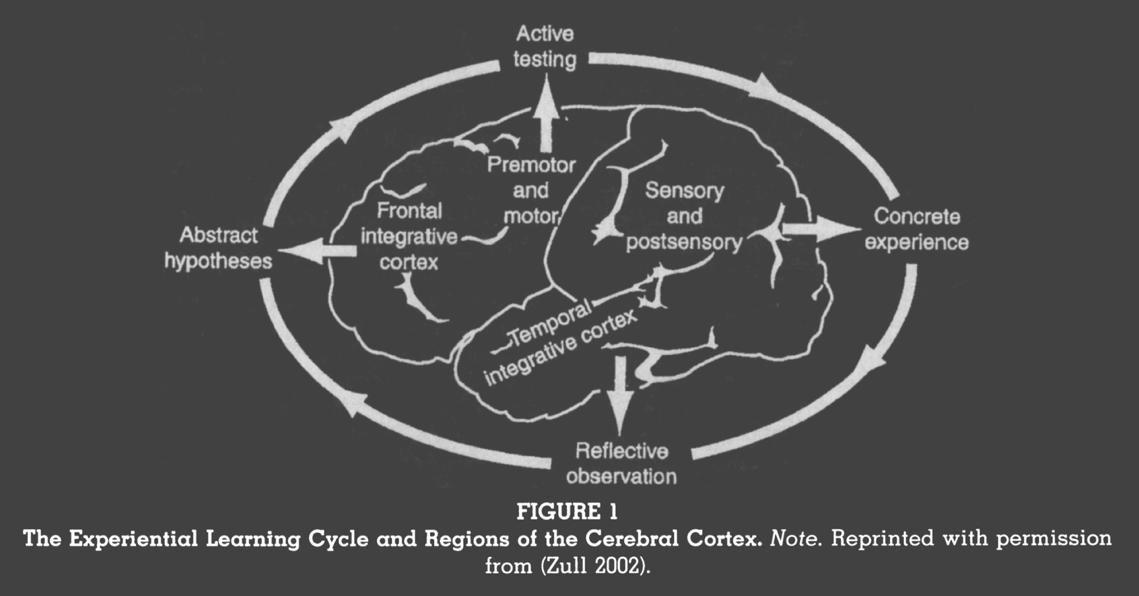
Experiential learning was built by six propositions that defined learning as the process of creating knowledge by reconstruction of experiences through the dialectically opposed modes of adaptation to the world 7 It was a recursive process of “experiencing, reflecting, thinking, and acting”.8
5 Alice Y. Kolb, and David A. Kolb. "Learning Styles and Learning Spaces: Enhancing Experiential Learning in Higher Education." Academy of Management Learning & Education 4, no. 2 (2005): 193-212.
6 See note 5 above
7 See note 5 above
8 See note 5 above
Therefore, the goal was to create a space that triggered these brain activities to perform effective “deeper learning”. The brain's visual processing power (eye-brain system) described by Larry Smarr was incredible advanced. Looking at the world, we absorbed a billion bits of information per second But our mental 'text computer' was limited to only read 100 bites/ characters per second. 9 Virtual reality had the potential to transfer education’s reliance on textbook abstractions to experiential learning in naturalistic settings.
Virtual reality being a visualized driven “interactive environment that emphasizes unencumbered, full-body, multi-sensory participation in computer events” 10 had the potential to perform optimized experiential learning. Data in VR would not only be text-based information but interactive information. In other words, the information exchanged in there would be interactive ideas, meaning shared experiences.
Sharing Experiences in The Community of Virtual Reality
Sharing experiences could mean multiple things. There were three possible scenarios stated by Sandra Helsel in Virtual Reality and Education One scenario could be person A let person B understood what A had experienced through words, imagery, sounds, anyone directional output. This was the most common one, for example storytelling, scientific researches, any forms of past events records. The second way of sharing experiences, according to Helsl, “it’ll be possible for user to mentally become another person. You inhabit someone else's mind.” 11 Meaning, person A and person B experienced the same event together synchronously - sharing the “same experience”. This happened a lot in real life events. The last one was the fact that person A could give control to person B to relive/experience the past event
9 Sandra Helsel, "Virtual Reality and Education." Educational Technology 32, no. 5 (1992): 38-42.
10 See note 9 above
11 Sandra Helsel, "Virtual Reality and Education." Educational Technology 32, no. 5 (1992): 38-42.
through person A’s perspective. By doing this to an extent, person B could have multiple permissions from people allowing person B to experience the same past event. Person B “borrowed” the experiences and would be able to view the same event through multiple perspectives and got a more integrated and thorough understanding of the event This was an innovative communication where students built personal interpretations of knowledge on experiences and interactions with. Such activities in virtual space would create dimensions and environmental stimulations. This made VR replaced the idea of material reality, where in this space, “our audacity to imagine helps push the boundaries of possibility.”12 Every user became a co-builder of this space.
Learning is social. Dede in a book chapter called “Designing immersive authentic simulations to promote deeper learning” talked about the ideal social based educational environment. It has to provide rich but loosely structured experiences that encourage meaningmaking without imposing a fixed set of knowledge and skills.13 This ideal environment can only exist constructed by the students/user themselves The power of construction distributed to students is the power of creating stimulations In a basic level, Stuart gives an example of his physics class For physics experiments in class, instead of on papers, his students create cyberspace worlds in which they tinker with physical forces such as gravity to stimulate possible nature reactions.14 In traditional coding for creating environments, environments are being told what to respond when receive certain signals. This is a fixed question/demand and answer relationship. However, stimulations allow the “answers” to be “logically produced” instead of
12Adora Svitak, 2010. “What adults can learn from kids.” Filmed February 2010 in California, USA, Ted Video, 7:58.
13 Chris Dede, Tina A. Grotzer, Amy Kamarainen, and Shari Metcalf. "EcoXPT: Designing for Deeper Learning through Experimentation in an Immersive Virtual Ecosystem." Journal of Educational Technology & Society 20, no. 4 (2017): 166-78.
14
showing the information set priority in the system. The learning environment in other words became a large set of logic created by every related user to stimulate all possible but valid answers. Student’s personal values are created through the process of constructing their own learning environment
Deeper Learning Being Personalized/ Self- Directed Learning Replace Higher Education
So, we hear “freedom” (self- directing) in this paper a lot so far. What does freedom really mean when it comes to higher education? Can freedom really provide constructive and efficient learning outcome? Are the “freedoms” reserved to the privileged or high skilled, intellectual people?
Sugata Mitra in the Ted Talk “The Future of Learning” talked about his project, the seven “Schools in the Cloud”, where Self Organized Learning Environments (SOLEs) and a ‘Granny Cloud’ of mediators over the Internet, interact with unsupervised children.15 This project was located in various locations from the slums of India, to the villages of India and Cambodia, to poor schools in Chile, Argentina, Uruguay, the USA and Italy, to the schools of Gateshead and the rich international schools of Washington and Hong Kong. He told the audience that when he first put a computer to one of the village of India, many Indian kids were curious and come tinker with it. Experts thought the Indian kids needed to be taught about how to use computers, but just within a few hours, they began surfing in English without supervised. Children could learn the internet by themselves. This group of young children actively proved that the ability to learn and wanting to learn is innate in human. Mitra also noticed that every time a grownup
15 Sugata Mitra. 2018. “The Future of Learning.” Filmed October 2018 in Newcastle, England, Ted Video, 18:28. https://www.ted.com/talks/sugata_mitra_the_future_of_learning?utm_campaign=tedspread&utm_medium=referral&utm_so urce=tedcomshare
landed at around the kids, they stopped doing everything. He said, “I learn my first lesson in education, the absence of a teacher could be a better and logical factor to assist learning.”
If self-learning is proven to be effective, then what exactly are students learning?
Students define by themselves what is relevant and helpful to their own lives through a series of challenging experiences that may reconstruct their values. This helps them reassuring by testing that is the thing they want and believed in. This is deeper learning which the higher education model is based on. Defined by 2012 NRC report, deeper learning is self-directed, open-ended learning is based on students’ passions and identities that foster academic engagement in a rich supportive environment. 16
With the use of virtual technology, Friedberg introduces the idea of “developing blended learning for personalized learning.” This means that all the activities within brain and between students and environment mentioned in the paper so far are all data – data of you, which can be modified to aid personalized learning.17
This comes down to the final question - is it necessary to have such school form in order to practice higher education/ deeper learning? Virtual reality, an open-end user co-building environment, with its function of providing high sensory experiences, the ability to share and create knowledge within communities, and freedom to direct personal intellectual development, all together triggering brain to aim for deeper learning than the ones ever executed in the history It may replace the school form education. In other words, when education is above being in school, it is just about learning. Virtual reality is the way to do it.
16 National Research Council (2012). “Developing transferable knowledge and skills in the 21st century.” Education for life and work.
17 Jeremy Friedberg. 2012. “Revolutionizing Education with Personalized Learning.” Filmed November 2012 in Toronto, Canada, TEDxYouth Video, 14:28.
Bibliography
Agostino, Fred D’. 2014. “Higher Education is not about getting a job.” Filmed May 2014 in Brisbane, Australia, Ted Video, 21:08. https://youtu.be/ybYuN8vV2Zs.
Crawford, Matthew B. "Virtual Reality as Moral Ideal." The New Atlantis, no. 44 (2015): 28-36. Accessed February 12, 2021. http://www.jstor.org/stable/43551423.
Dede, Chris, Tina A. Grotzer, Amy Kamarainen, and Shari Metcalf. "EcoXPT: Designing for Deeper Learning through Experimentation in an Immersive Virtual Ecosystem." Journal of Educational Technology & Society 20, no. 4 (2017): 166-78. Accessed February 12, 2021. http://www.jstor.org/stable/26229215.
Friedberg, Jeremy. 2012. “Revolutionizing Education with Personalized Learning.” Filmed November 2012 in Toronto, Canada, TEDxYouth Video, 14:28. https://youtu.be/hCzBsc1w-c
Helsel, Sandra. "Virtual Reality and Education." Educational Technology 32, no. 5 (1992): 38-42. Accessed February 12, 2021. http://www.jstor.org/stable/44425644.
Joanne M McInnerney, and Tim S Roberts. "Online Learning: Social Interaction and the Creation of a Sense of Community." Journal of Educational Technology & Society 7, no. 3 (2004): 73-81. Accessed February 12, 2021. http://www.jstor.org/stable/jeductechsoci.7.3.73.
Kolb, Alice Y., and David A. Kolb. "Learning Styles and Learning Spaces: Enhancing Experiential Learning in Higher Education." Academy of Management Learning & Education 4, no. 2 (2005): 193-212. Accessed February 12, 2021. http://www.jstor.org/stable/40214287.
Mitra, Sugata. 2018. “The Future of Learning.” Filmed October 2018 in Newcastle, England, Ted Video, 18:28.
https://www.ted.com/talks/sugata_mitra_the_future_of_learning?utm_campaign=tedspread&ut m_medium=referral&utm_source=tedcomshare
Svitak, Adora. 2010. “What adults can learn from kids.” Filmed February 2010 in California, USA, Ted Video, 7:58.
https://www.ted.com/talks/adora_svitak_what_adults_can_learn_from_kids?utm_campaign=te dspread&utm_medium=referral&utm_source=tedcomshare
Duncan, Stuart. 2017. "How I Use Minecraft to Help Kids With Autism." Filmed April 2017 in Toronto, Canada, TED video, 10:57. https://www.ted.com/talks/stuart_duncan_how_i_use_minecraft_to_help_kids_with_autis m.
National Research Council 2012 “Education for life and work. Developing transferable knowledge and skills in the 21century” Washington, DC, The National Academies Press.
http:/wwwnap.edu/catalog.hprecordid=133