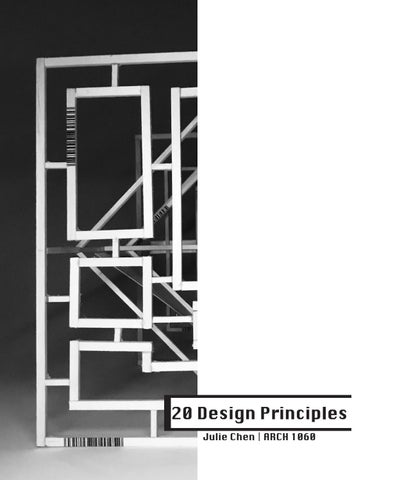
20 Design Principles Julie Chen | ARCH 1060
Table of Content: 01 Grid .........................................................................................................pg.1 02 Plane .......................................................................................................pg.3 03 Transformation .....................................................................................pg.5 04 Solid and Void .......................................................................................pg.7 05 Light ........................................................................................................pg.9 06 Colors ...................................................................................................pg.11 07 Mass ......................................................................................................pg.13 08 Circulation ...........................................................................................pg.15 09 Surfaces ................................................................................................pg.17 10 Decomposition ....................................................................................pg.19 11 Dialogue ...............................................................................................pg.21 12 Structure ..............................................................................................pg.23 13 Metaphor .............................................................................................pg.25 14 Recomposition ...................................................................................pg.27 15 Fabrication ...........................................................................................pg.29 16 Environment .......................................................................................pg.31 17 Material ................................................................................................pg.33 18 Datum ..................................................................................................pg.35 19 Analysis ................................................................................................pg.37 20 Representation ...................................................................................pg.39
Preface: The book will serve as an introduction to the general overview of the twenty design concepts. The book will be organized based on the design process. I will specifically focus on the relationship of the different principles in relation to the varying architecture elements and its importance to the design process. By understanding the principles’ relationship and its importance to design, architects can create engaging designs that cater to their intended purpose. To illustrate these concepts, I will be using my coursework produced over the semester in ARCH 1060. Any other references will be supplemented by my hand-drawn sketches and learned precedents from the class.
01 GRID Grid is typically referred to as the sensible and logical extension of the architecture. Laying out a grid provides order to the unstructured. It allows architects to understand the correlation between building components and their spatial qualities, making it super important to the design process.
1
Eames House
ARCH 1060
2
02 PLANE Planes are very versatile and come in all forms and shapes. It can range from flat to continuous. They can redefine or entirely alter the space. Planes are helpful in design in terms of setting limits or boundaries.
3
Cenotaph for Newton
ARCH 1060
4
03 TRANSFORMATION Transformation is the suggested motion or operation that can alter the structure significantly. A simple yet powerful action can ensure symmetry or balance within a system. By utilizing transformation to its fullest extent, architects can develop many new designs.
5
ARCH 1060
Granoff Center
6
ARCH 1060
Poem Wall | Saloua Raouda Choucair
7
04 SOLID & VOID Solid is a matter of presence while void is an absence of it. Solid and Void is crucial in design in terms of proving a dialogue for the readers. By poaching in the solids, the form or shape of the object becomes clear.
Fractional Module
8
9
ARCH 1060
05 LIGHTS Light illuminates surfaces and renders textures and materials. It plays a vital role in how people experiment with a building. Understanding how natural light via diffused or direct lightning works is very beneficial. It ensures the comfort of clients.
Golden Light on Alter Wall
10
06 COLORS Colors give meaning to designing. It evokes emotions, separates spaces, and provides context to any design. For example, lighter shades usually make the space appear larger, whereas darker shades make the space look smaller. Color is also important for analysis. Red ink emphasizes that particular design element’s importance.
11
ARCH 1060
12
07 MASS Mass refers to the size of a building. Mass becomes extremely important when working with design. Massing influences the sense of space that the building encloses and helps define both the interior space and the exterior shape of the building.
Pyramid of Giza
13
ARCH 1060
14
ARCH 1060
Palais Garnier
15
Maison Jaoul
08 CIRCULATION Circulation is the movement between outdoor spaces to indoor spaces. It’s how people interact with the physical space around them. Most circulation elements such as fire stairs, elevators, or scissor stairs are the core. Mapping out circulation is crucial for a practical design.
16
09 SURFACES Surfaces are the outermost layer of a building, typically the facade of the building. Surfaces, if designed correctly, can give space or the building more depth and a more dynamic feel. Since it’s the outermost layer, it’s usually the attention grabber.
17
San Cataldo Cemetry
ARCH 1060 Seagram Building
18
19
ARCH 1060
10 DE-COMPOSITION Decomposition is an effective approach to break down or simplify any design process. It’s a powerful tool for analysis. It reduces the complexity of the process and breaks it to manageable pieces that architects can understand and work with.
20
21
ARCH 1060
11 DIALOGUE Dialogue is a conversation between one idea to another. Typically architects facilitate dialogues by presenting conversational elements in their designs or sketches. It’s essential for conversations to happen since the design process must satisfy the clients’ needs.
22
12 STRUCTURE Structures are anything built from different interrelated parts with a fixed location on the ground. The structure is an essential element that defines the shape of the architectural form and space. It also contributes to the aesthetic value of the building, which makes it extremely important in the design process.
23
Erechtheion
ARCH 1060
Crematorium Axel Schultes
24
13 METAPHOR A metaphor is a figure of speech that compares two different things. One of the roles of metaphor is that it permits the user to form the concept of the virtual world from the aspect of time and motion in the physical dimension of the architecture world.
25
ARCH 1060
JFK Airport
26
27
ARCH 1060
14 RE-COMPOSITION Recomposition strategies aim at synthesizing sub-solutions into a unique design proposal. It recombines different architectural elements. This principle is essential for creating new methods of design.
28
15 FABRICATION Fabrication is the process or action of manufacturing that combines 3D modeling or CAD with additive and subtractive elements. Fabrication includes material usage, which is a guiding concept to drive a design. Fabrication makes sure that the building is feasible.
29
ARCH 1060
Bruder Klaus Chapel
30
16 ENVIRONMENT Environment combines aspects of landscape design with architecture. Architecture and Environmental Studies are natural companions. It is impossible to design good buildings without understanding their relationship to biological systems. Knowing the surrounding will allow architects to tackle the design process better.
Pueblo Architecture
31
ARCH 1060
Trombe Wall
32
17 MATERIAL Material is the matter from which something is or can be made of. Materials work alongside structure to create the form in buildings. Different materials can lead to very contrasting designs. For instance, wood can lead to a rustic exterior.
33
ARCH 1060
Igloo
Hygroskin
34
ARCH 1060
Museum of Contemporary Art
Villa Savoyage
35
18 DATUM Datum is a defining line or figure that pulls together different design elements into a unifying whole. Datums can have a multitude of applications for a wide range of projects which makes it essential to the design process.
36
19 ANALYSIS An analysis is a detailed examination of the specific building. It usually involves understanding the context of the building and the design implications the architect implements. It’s crucial to understand the environment and physical constants for a successful design process.
37
ARCH 1060
Observatory Hosuse
38
ARCH 1060
Sendai Mediatheque
Johnson Wax HQ
39
20 REPRESENTATION Representation is the use of signs that stand in for or take the place of something else. It typically involves symbolism. It can enhance an architect’s design process by clearly adding symbolic features to the surfaces or interior of the building. For example, Johnson Wax HQ is known for its vines representation. When used correctly, it can aesthetically enhance the design.
Toa’s Motesando
40