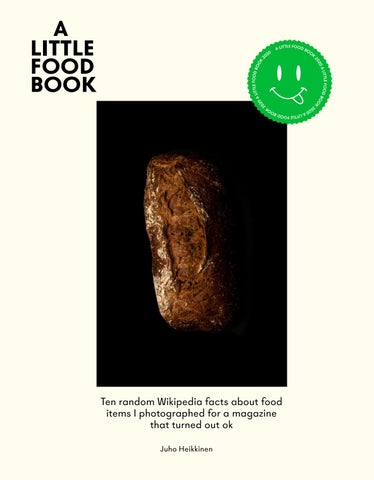
A LITTLE FOOD BOOK
Ten random Wikipedia facts about food items I photographed for a magazine that turned out ok Juho Heikkinen
2
Hey guess what! Man I love food. And random Wikipedia articles too. I also happened to take some photos of food few months back that turned out ok, so I thought what the heck! I’m going to combine all these things I love together and make a little book. I chose ten foods from the shoot and looked them up on Wikipedia – and boom! You can see the results of this noble project in this book. So hop on to this exciting adventure and learn a few things about bread and such you might know already! With kisses,
Juho Heikkinen +358 45 1193959 juhoheikkiolavi@gmail.com behance.net/juhoheikkinen
3
1. Chopsticks Chopsticks are shaped pairs of equal-length sticks that have been used as kitchen and eating utensils in virtually all of East Asia for over three millennia. First used by the Chinese, chopsticks later spread to other East Asian cultural sphere countries including Japan, Korea and Vietnam as well as to Nepal and Southeast Asian countries such as Cambodia, Laos, Malaysia, Myanmar, Singapore and Thailand.
4
5
2. Sushi Sushi is traditionally made with medium-grain white rice, though it can be prepared with brown rice or short-grain rice. It is very often prepared with seafood, such as squid, eel, yellowtail, salmon, tuna or imitation crab meat. Many types of sushi are vegetarian. It is often served with pickled ginger (gari), wasabi, and soy sauce. Daikon radish or pickled daikon (takuan) are popular garnishes for the dish.
6
7
3. Nigirizushi Nigirizushi (“hand-pressed sushi�) consists of an oblong mound of sushi rice that the chef presses between the palms of the hands to form an oval-shaped ball, and a topping (the neta) draped over the ball. It is usually served with a bit of wasabi; neta are typically fish such as salmon, tuna or other seafood. Certain toppings are typically bound to the rice with a thin strip of nori, most commonly octopus, freshwater eel, sea eel, squid, and sweet egg. One order of a given type of fish typically results in two pieces, while a sushi set (sampler dish) may contain only one piece of each topping.
8
9
4. Wakame Wakame is a species of edible seaweed, a type of marine algae, and a sea vegetable. It has a subtly sweet, but distinctive and strong flavour and texture. It is most often served in soups and salads. Sea farmers in Japan have grown wakame since the Nara period. As of 2018, the Invasive Species Specialist Group has listed the species on its list of 100 worst globally invasive species.
10
11
5. Soy sauce Soy sauce, also spelled as soya sauce, is an East Asian liquid condiment of Chinese origin, traditionally made from a fermented paste of soybeans, roasted grain, brine, and Aspergillus oryzae or Aspergillus sojae molds. Soy sauce in its current form was created about 2,200 years ago during the Western Han dynasty of ancient China, and spread throughout East and Southeast Asia where it is used in cooking and as a condiment.
12
13
6. Fried chicken Fried chicken is a dish consisting of chicken pieces which have been coated in a seasoned batter and pan-fried, deep fried, or pressure fried. The breading adds a crisp coating or crust to the exterior of the chicken while retaining juices in the meat. Broiler chickens are most commonly used. The first dish known to have been deep fried was fritters, which were popular in the European Middle Ages. However, it was the Scottish who were the first Europeans to deep fry their chicken in fat (though without seasoning). Meanwhile, a number of West African peoples had traditions of seasoned fried chicken (though battering and cooking the chicken in palm oil).
14
15
7. Mussel Mussel is the common name used for members of several families of bivalve molluscs, from saltwater and freshwater habitats. These groups have in common a shell whose outline is elongated and asymmetrical compared with other edible clams, which are often more or less rounded or oval. The word “mussel” is frequently used to mean the bivalves of the marine family Mytilidae, most of which live on exposed shores in the intertidal zone, attached by means of their strong byssal threads (“beard”) to a firm substrate. A few species (in the genus Bathymodiolus) have colonised hydrothermal vents associated with deep ocean ridges.
16
17
8. The octopus The octopus is a soft-bodied, eight-limbed mollusc of the order Octopoda. Around 300 species are recognised, and the order is grouped within the class Cephalopoda with squids, cuttlefish, and nautiloids. Like other cephalopods, the octopus is bilaterally symmetric with two eyes and a beak, with its mouth at the center point of the eight limbs (“tentacle” is used as an umbrella term for cephalopod limbs; however, within a teuthological context, “arm” is used to refer to such limbs while “tentacle” is reserved for feeding appendages not found on octopuses).
18
19
9. Pistachio ice cream Pistachio ice cream or pistachio nut ice cream is an ice cream flavour made with pistachio nuts or flavouring. It is often distinctively green in color. Pistachio is also a flavor of sorbet and gelato. Pistachio ice cream is a layer in spumoni. At the Bakdash in Damascus, Syria a pounded ice cream covered with pistachio called Booza is produced. It has an elastic texture made of mastic and sahlab and is famous around the Arab World. Tripoli’s Al Mina district is known for its Arabic ice cream including “ashta” with pistachios.
20
21
10. Bread Bread is a staple food prepared from a dough of flour and water, usually by baking. Throughout recorded history it has been a prominent food in large parts of the world; it is one of the oldest man-made foods, having been of significant importance since the dawn of agriculture; and plays an essential role in religious rituals and secular culture. Bread may be leavened by naturally occurring microbes, chemicals, industrially produced yeast, or high-pressure aeration. In many countries, commercial bread often contains additives to improve flavor, texture, color, shelf life, nutrition, and ease of production.
22
23
If you have some actual content and need a graphic designer, don’t hesitate to contact me +358 45 119 3959 or juhoheikkiolavi@gmail.com