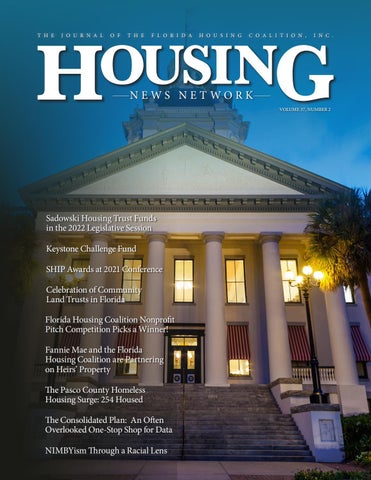
T H E
J O U R N A L
O F
T H E
F L O R I D A
H O U S I N G
C O A L I T I O N ,
I N C .
NEWS NETWORK VOLUME 37, NUMBER 2
Sadowski Housing Trust Funds in the 2022 Legislative Session Keystone Challenge Fund SHIP Awards at 2021 Conference Celebration of Community Land Trusts in Florida Florida Housing Coalition Nonprofit Pitch Competition Picks a Winner! Fannie Mae and the Florida Housing Coalition are Partnering on Heirs’ Property The Pasco County Homeless Housing Surge: 254 Housed The Consolidated Plan: An Often Overlooked One-Stop Shop for Data NIMBYism Through a Racial Lens
Executive Committee Suzanne Cabrera, Chair Housing Leadership Council of Palm Beach County, Inc. Robert Von, Vice Chair Meridian Appraisal Group, Inc. Ben Johnson, Treasurer Seltzer Management Group, Inc. Leroy Moore, Secretary Tampa Housing Authority Ed Busansky, At Large First Housing Development Corporation
In this Issue Message from the CEO.........................................................................................................................................3 Sadowski Housing Trust Funds in the 2022 Legislative Session...................................................................4 Projected SHIP Distribution Estimates for FY 2022-2023............................................................................6 Keystone Challenge Fund.....................................................................................................................................7 SHIP Awards at 2021 Conference.......................................................................................................................8 Celebration of Community Land Trusts in Florida........................................................................................9
Mark Hendrickson, At Large The Hendrickson Company
Florida Housing Coalition Nonprofit Pitch Competition Picks a Winner!.............................................10
Jeff Kiss, At Large Banyan Development Group
Fannie Mae and the Florida Housing Coalition are Partnering on Heirs’ Property...............................12
Melvin Philpot, At Large Duke Energy George Romagnoli, At Large Arbour Valley Communities
Board Of Directors Barbara Beck Habitat for Humanity of Florida Stephen Bender University of Florida Charles Elsesser Community Justice Project Armando Fana City of West Palm Beach Bradford Goar Florida Power and Light David Hall Florida Realtors Cheryl Howell Hillsborough County Jack Humburg Boley Centers, Inc.
The Pasco County Homeless Housing Surge: 254 Housed!.........................................................................14 The Consolidated Plan: An Often Overlooked One-Stop Shop for Data.............................................................................................16 NIMBYism Through a Racial Lens..................................................................................................................18 Sea Level Rise: Another Disproportionate Impact on Lower-Income Households...........................................................20 Frequently Asked SHIP Questions State Housing Initiatives Partnership Program.............................................................................................22 The Value of a Pro-Affordable Housing Statute is Beginning to Take Hold............................................ 24 Florida Housing Coalition News......................................................................................................................25 Florida Housing Coalition Staff........................................................................................................................26 About the Florida Housing Coalition..............................................................................................................27 Services of the Florida Housing Coalition......................................................................................................28 Become a Member of the Florida Housing Coalition...................................................................................29 The Florida Housing Coalition Publications..................................................................................................30
Nancy Merolla Synovus Aileen Pruitt PNC Bank Anne Ray Shimberg Center for Housing Studies Mike Rogers Southern Advocacy Group Manny Sarria Miami-Dade County Homeless Trust
7
18
Advisory Council Bob Ansley Orlando Neighborhood Improvement Corporation Stephanie Berman Carrfour Supportive Housing David Christian Regions Bank Marilyn Drayton Wells Fargo Helen Hough Feinberg RBC Capital Markets Debra Koehler Sage Partners Esther Marshall Fifth Third Bank Tammy Paycer Truist Christine Ruiz Bank of America Thais Sullivan Valley National Bank
2021
16
10
12
FLORIDA HOUSING COALITION, INC. 1311 N. Paul Russell Road, B-201, Tallahassee, FL 32301 Phone: (850) 878-4219 | FAX: (850) 942-6312
THE FLORIDA HOUSING COALITION is a nonprofit, statewide membership organization whose mission is to bring together
housing advocates and resources so that all Floridians have a quality affordable home and suitable living environment. The Housing News Network is published by the Florida Housing Coalition as a service to its members, housing professionals and others interested in affordable housing issues. Jaimie Ross, Editor, Amanda Rosado, Associate Editor, and Judy Graziosi, Graphic Designer. Email: info@flhousing.org, Website: www.flhousing.org.
from the editor
Message From the CEO JAIMIE ROSS
In this season of gratitude, the Florida Housing Coalition gives its heartfelt thanks to our Partners for Better Housing, without whom we could not accomplish the amazingly impactful work we do. The 2021 Conference brought over 900 housing professionals together from every part of the state to join with experts from Florida and around the nation. We value all our Partners at every level, but a special shout out goes to our Platinum and Gold Partners listed below. And of course, our membership. The Florida Housing Coalition is comprised of housing coalitions, housing administrators, housing advocates, and housing TREY PRICE, KEYNOTE professionals in every field from the public and private sector, both for profit and nonprofit. You who are on the ground working for and within the communities to build and preserve affordable housing are the heart and soul of our work. We thank you. PUBLIC POLICY PLENARY FLORIDA HOUSING COALITION 1311 N. PAUL RUSSELL ROAD, B-201 TALLAHASSEE, FL 32301
ADDRESS SERVICE REQUESTED
PRIYA JAYACHANDRAN President, National Housing Trust
DIANE YENTEL President and CEO, National Low Income Housing Coalition
2021 has been laser focused on racial equity in housing. The Florida Housing Coalition launched the Center for Racial Equity in February and is already working with the two winners of our Closing the Gap competition, sponsored by Bank of America and Wells Fargo. Our climate justice work takes off with a project on Heir’s Property contracted by Fannie Mae, our long-time disaster resilience and recovery partners. And our BIPOC support and connect program is now fueled by funding from Fifth Third Bank Foundation. We will soon be ushering in 2022. With federal leadership at the very top focused on rebuilding the country’s infrastructure, including affordable housing, things are looking up. The importance of affordable housing is not in doubt. The spike in market rate housing prices in rental and in homeownership housing is acute, and the consequence of failing to produce and preserve affordable LISA RICE, KEYNOTE housing is homelessness. The NONPROFIT U.S.Coalition POSTAGE looks forward Florida Housing PAID to working with the Sadowski Coalition, TALLAHASSEE, FL NO. 502 and our entire the SadowskiPERMIT Affiliates, membership on making the production and preservation of affordable housing a priority issue for our elected officials and key staff at all levels of government in 2022. DONALD
PLATINUM GOLD
GOLD
PLATINUM
EILEEN FITZGERALD WHITEHEAD Head of Housing Executive Director, Affordability, National Coalition Philanthropy, Corporate for the Homeless Philanthropy and Community Relations, Wells Fargo The Florida Housing Coalition thanks the following organizations and individuals for their Thank You Platinum commitment and Gold Sponsors for your commitment toinimproving to improving housing conditions Florida. housing conditions in Florida
HOUSING NEWS NETWORK | VOLUME 37, NUMBER 2 | NOVEMBER 2021 3
legislation
Sadowski Housing Trust Funds in the 2022 Legislative Session
JAIMIE ROSS, CEO FLORIDA HOUSING COALITION
The 2022 session gives the Florida Legislature its first opportunity to keep the promise, the promise it made in 2021 to stop the sweeps of the Sadowski State and Local Housing Trust Funds. Senate Bill 2512, enacted in the 2021 Session, changed the doc stamp formula, permanently diverting one-half of the Sadowski Trust funds for programs that the Senate President, the Speaker of the House, and the bill sponsors in both chambers characterized as related to making affordable housing available, namely the Resilient Florida Grant program and the Wastewater Grant program, both administered by the Department of Environmental Protection. Along with that permanent diversion of half the funds from Florida’s Sadowski Act housing programs, came the long sought-after statutory promise that no housing trust funds would be swept after July 1, 2021. 1
4 THE FLORIDA HOUSING COALITION | FLHOUSING.ORG
A combination of the Governor’s veto of $40 million in State Apartment Incentive Loan Fund (SAIL) monies, the increase in collections above projections, and the accumulated interest, is resulting in total Sadowski State and Local Housing Trust Funds of more than $355 million available for appropriation in the 2022 session. Those funds would be for the State Housing Initiatives Partnership program, commonly known as SHIP, and for the SAIL program. Both SHIP and SAIL are exemplary housing programs. SHIP provides flexibility and accountability for the largest homegrown housing program in Florida and serves as a model for the nation. The sweeps of the Sadowski Trust Funds for close to two decades have been from SHIP, denying approximately $3 billon in housing funds to Florida’s workforce and its most vulnerable residents living on fixed incomes, such as seniors, and people with disabilities. SAIL provides low-income gap financing to developers building affordable rental apartments.
legislation Permanently losing half the Sadowski housing program funds was a blow for every housing advocate in the state, from faith-based organizations to the business community. But for the Florida Realtors, it was a blow that caused them to take drastic action. The Florida Realtors launched a Constitutional Amendment Campaign in June to embed housing funding in the Florida Constitution. When the Realtors abandoned their Constitutional Amendment campaign in early September, they announced their intention to create a new housing program. The Realtors initiative to create a program to help “Hometown Heroes,” described as teachers, nurses, law enforcement, and the like, to purchase homes can be found in SB 788. The funding for this program would not come from the doc stamps, which are the source of funding for the Sadowski funded housing programs. The proposal for
a new program would be in addition to SHIP, which already provides home purchase for the same population but does not limit funding to home purchase, and includes lower paid frontline workers. The Sadowski Coalition, comprised of 32 statewide organizations, including the Florida Realtors, does not support using Sadowski funds for any purposes other than those currently codified and commonly known as Sadowski Trust Fund programs. The funding for this new program would have to come from funds other than Sadowski Housing Trust Funds. The Sadowski Coalition and the thousands of Sadowski Affiliates have a unified message for the 2022 Legislative session: Keep the Promise!
Endnotes 1. 201.15(5) Notwithstanding s. 215.32(2)(b)4.a., funds distributed to the State Housing Trust Fund and the Local Government Housing Trust Fund pursuant to paragraph (4)(c) may not be transferred to the General Revenue Fund in the General Appropriations Act.
SADOWSKI HOUSING COALITION MEMBERS
SPONSORED BY Wells Fargo
Jaimie A. Ross is the President & CEO of the Florida Housing Coalition. She initiated the Sadowski Coalition in 1991 and continues to facilitate the Sadowski Coalition today. Ms. Ross served as the Affordable Housing Director at 1000 Friends of Florida, a statewide nonprofit smart growth organization, from 1991-2015. Prior to her tenure at 1000 Friends of Florida, Ross was a land use and real property lawyer representing for profit and nonprofit developers and financial institutions with a law firm in Orlando. Ross is the past Chair of the Affordable Housing Committee of the Real Property Probate & Trust Law Section of the Florida Bar. HOUSING NEWS NETWORK | VOLUME 37, NUMBER 2 | NOVEMBER 2021 5
PROJECTED SHIP DISTRIBUTION ESTIMATES FOR FY 2022-23 ($215,110,000)
LOCAL GOVERNMENT
ALACHUA
COUNTY TOTAL
2,804,321
Gainesville BAKER BAY
BREVARD
LOCAL GOVERNMENT
COUNTY TOTAL
COUNTY SHARE/ CITY SHARE
LOCAL GOVERNMENT
350,000
PALM BEACH
350,000
Boca Raton
981,346
HAMILTON
350,000
350,000
Boynton Beach
808,968
350,000
350,000
Delray Beach
692,537
HARDEE
356,384
HENDRY
426,651
426,651
350,000
350,000
HERNANDO
1,979,801
1,979,801
PASCO
6,249,386
3,458,410
HIGHLANDS
1,091,377
1,091,377
PINELLAS
15,248,759
11,197,164
Clearwater
4,051,595
Largo
199,355
Titusville
HILLSBOROUGH
869,290
Tampa
1,221,130
HOLMES
501,201
350,000
350,000
West Palm Beach
1,653,841
1,653,841
490,557
490,557
Lakeland
605,210
JEFFERSON
350,000
350,000
Winter Haven
Coral Springs
1,331,859
LAFAYETTE
350,000
350,000
Davie
1,083,007
LAKE
3,788,634
3,788,634
ST. JOHNS
LEE
7,738,631
4,852,122
ST. LUCIE
19,908,210
Coconut Creek
Deerfield Beach
3,569,540
826,191
Fort Lauderdale
1,951,005
Hollywood
1,564,785
Lauderhill
746,558
Margate
611,182
INDIAN RIVER
Cape Coral
1,931,562
Fort Myers LEON
3,104,731
Tallahassee
1,203,623 5,591,034
5,591,034
10,148,283
5,264,929 1,216,779 871,738
St. Petersburg
JACKSON
BROWARD
11,434,415
350,000 350,000
1,444,446
Palm Bay
15,120,889
GLADES GULF
1,800,830
Melbourne
COUNTY SHARE/ CITY SHARE
1,409,452 350,000
Cocoa
COUNTY TOTAL
1,394,869 350,000
Panama City BRADFORD
COUNTY SHARE/ CITY SHARE
POLK
PUTNAM
2,794,837 7,374,315
5,762,290 1,126,795 485,230
765,416
765,416
2,708,433
2,708,433
3,328,430
Fort Pierce
773,527 459,323
954,947
Port St. Lucie
1,045,673
SANTA ROSA
1,909,523
1,909,523
2,059,058
SARASOTA
4,523,637
3,928,779
2,095,580
Miramar
1,431,400
LEVY
426,651
426,651
Sarasota
Pembroke Pines
1,739,978
LIBERTY
350,000
350,000
SEMINOLE
4,919,935
4,919,935
SUMTER
1,455,692
1,455,692
Plantation
935,686
MADISON
350,000
350,000
1,164,630
MANATEE
4,108,221
3,503,902
Sunrise
971,521
Bradenton
Tamarac
680,861
MARION
Pompano Beach
Weston
694,797
594,858
SUWANNEE
471,379
471,379
604,319
TAYLOR
350,000
350,000
3,795,006
3,155,547
UNION
350,000
350,000
5,686,922
3,997,338
1,673,019
1,673,019
Daytona Beach
723,945
18,531,900
11,914,158
Deltona
965,639
Ocala
639,459
VOLUSIA
350,000
350,000
1,941,446
1,730,605
Hialeah
1,569,652
WAKULLA
362,746
362,746
CITRUS
1,538,775
1,538,775
Miami
3,257,908
WALTON
784,594
784,594
CLAY
2,273,839
2,273,839
Miami Beach
615,259
WASHINGTON
350,000
350,000
COLLIER
3,993,155
3,775,927
Miami Gardens
748,689
TOTAL
COLUMBIA
733,434
733,434
MONROE
DE SOTO
388,296
388,296
NASSAU
DIXIE
350,000
350,000
OKALOOSA
DUVAL
10,129,105
10,129,105
ESCAMBIA
3,347,608
2,773,828
Fort Walton Beach
CALHOUN CHARLOTTE Punta Gorda
210,841
Naples
217,228
Pensacola FLAGLER
1,187,265
Palm Coast
MARTIN MIAMI-DADE
North Miami
573,780
OKEECHOBEE
257,280
ORANGE
929,985
Orlando
215,110,000 215,110,000
426,234 803,772
803,772
918,778
918,778
2,107,613
1,889,897
SHIP allocation based on all available funds in the trust fund less Disaster Relief Holdback and Catalyst.
217,716 426,651
426,651
14,577,602
11,498,812 3,078,790
3,993,155
2,687,793
FRANKLIN
350,000
350,000
OSCEOLA
GADSDEN
477,752
477,752
Kissimmee
780,262
GILCHRIST
350,000
350,000
St. Cloud
525,100 11.2021
6 THE FLORIDA HOUSING COALITION | FLHOUSING.ORG
Keystone Challenge Fund
Making the Dream of Homeownership Real JEFF BAGWELL
I’m honored to have the Keystone Challenge Fund story included in the Florida Housing Coalition’s Journal at this bittersweet time. It’s hard to tell our story in 500 or so words, but I’m going to try.
to change schools with each successive move from one rental to another and the wealth building that families achieve from homeownership is what has driven the Keystone Challenge Fund from its inception. We have had over 25,000 people attend our Homebuyer Education classes. In 2014, we started a program for Veterans and First Responders with 70 homes that were donated to our organization.
We opened our doors 30 years ago on a shoestring. I had previously been a banker in the corporate world, but having been raised by a Baptist Minister, I was drawn to mission-based work. Fast forward thirty years, we have The mission of our nonprofit, now assisted 4,600 families to become Keystone Challenge Fund, was homeowners. That sounds like a lot, and we to help lower income families in are so happy for every one of the families we Polk County realize the American helped. But the sad truth is that this number Dream of homeownership. In our could have been between 8,000 and 9,000 first year we had put 19 families families; we could have helped more than into homes and by the second twice as many households if the Florida year we helped 99 families Legislature had not raided the SHIP funds purchase homes.
for so many years.
The dream of home ownership: the stability it provides to children who are no longer forced
I feel blessed to have been a part of helping so many families and to have led a successful business serving Polk County for so many years. And I am so pleased that our important work will continue under the expanded operations of HANDS of Central Florida. The very capable, Jill McReynolds, the long-time executive director of HANDS, will open an office in Polk County on January 1, 2022 with three of our current staff members joining her.
Jeff Bagwell is the President and Executive Director of Keystone Challenge Fund. He received a Gubernatorial appointment
to the State Affordable Housing Study Commission in 2008 and served on the Board of the Florida Housing Coalition for 10 years, holding the positions of Vice Chairman and Chairman. The City of Lakeland presented Keystone Challenge with a proclamation of Keystone Challenge Fund Day on October 4th, 2021 in honor of its 30 years of accomplishments. HOUSING NEWS NETWORK | VOLUME 37, NUMBER 2 | NOVEMBER 2021 7
conference
SHIP Awards at 2021 Conference Coronavirus Relief Fund Awards When Florida was awarded funding from the CARES Act, some of the funds were distributed by Florida Housing Finance to be administered by SHIP jurisdictions for foreclosure and eviction prevention. Local governments had until December 30, 2020, to expend funds. All SHIP jurisdictions stepped up and spent close to $134,000,000 and served over 30,000 households. SHIP awards were provided to the top three performers who had the highest expenditure of CRF funds and served the largest number of units.
HHRP Award Franklin County was recognized with an award for its work with the Hurricane Housing Recovery Program. Among recipients of this funding, Franklin County has most quickly processed its funds. The county has expended a majority of its first HHRP allocation of $1.2 million and has already fully committed is second HHRP allocation of $380,000.
Florida Housing Coalition Partners with NLIHC on Rental Assistance Program The National Low Income Housing Coalition (NLIHC) is leading a national effort to assist local governments to deploy hundreds of millions of dollars provided through the U.S. Treasury Emergency Rental Assistance Program (ERAP) to help tenants, especially the most marginalized populations, facing evictions due to COVID. The Florida Housing Coalition is thrilled to have been chosen as a NLIHC state partner to carry out this work in Florida though the NLIHC’s Ending Rental Arrears to Stop Evictions (ERASE) project. With this grant, the Coalition will facilitate informationsharing and best practices workshops and provide technical assistance to the 32 local governments in Florida that administer ERAP funds.
UNITS SERVED
Local Government Winners
Rental Assistance
Emergency Repairs
Total Served
LEON
3,712
19
3,731
$11,432,255
ORANGE
2,710
2,710
$9,296,207
MIAMI-DADE
2,682
2,682
$9,216,000
Florida’s SHIP Offices Prove Successful
119
Total Expended
Local SHIP Housing Offices expended over $130 million to help 30,000 households in fewer than five months
• Governor DeSantis and the FHFC designated Florida’s SHIP offices to deploy $120 million in CRF funds
new disaster housing assistance program, reached out to those in need and processed a large volume of applicants.
• The SHIP Administrators had fewer than five months to deploy these funds
• SHIP offices hired temps and engaged staff from other government departments to get the work done.
• Florida’s SHIP Administrators went beyond the call - deploying $10 million in additional CRF from FHFC - for a total of $130 million
• Many set up an entire application process while offering an in person alternative for those needing help in applying.
• Each of the 67 county and 52 city SHIP offices established a
• In the end, SHIP offices expended over $130 million to help 30,000 households experiencing COVID hardships.
8 THE FLORIDA HOUSING COALITION | FLHOUSING.ORG
land use
Celebration of Community Land Trusts in Florida The Florida Housing Coalition, Freddie Mac, and Fannie Mae celebrated the success of Community Land Trusts in Florida at the 2021 statewide conference with the first six Community Land Trusts to receive the Florida Housing Coalition’s CLT Institute’s Certification for Best Practices.
Habitat for Humanity of Marion County CLT, the Tallahassee Lender’s Consortium CLT, the Hannibal Square Community Land Trust, and Collier County Community Land Trust were highlighted in a film produced by Freddie Mac and available on our website.
Introduced by Simone Beaty, the director of single-f amily affordable lending initiatives at Freddie Mac, the CLT of Palm Beach County and the Treasure Coast, the Delray Beach CLT,
Florida is a national leader in growth of CLTs and is the first in the nation to have a certification program. When a CLT is certified by the Florida Housing Coalition’s CLT Institute, local governments, lenders, and home buyers can be confident that CLT is using best practices for general operations and for stewardship. If you are a nonprofit or local government interested in a community land trust, please The Community Land Trust movement contact the Florida Housing Coalition. We is a true public-private partnership have the entire suite of education, technical assistance, and documentation you need.
Congratulations to the first six Community Land Trusts to receive the Florida Housing Coalition’s CLT Institute’s Certification for Best Practices.
involving government, lenders, and nonprofits laser focused on not only creating affordable housing but keeping that housing affordable in perpetuity. It is a production and a preservation tool. Community Land Trusts can be used for rental housing and for homeownership. The CLT homeownership is an alternative to renting and can be the step out and up for households to live in a stable environment with a real chance at increasing family wealth and increasing the rate of Black homeownership.
It’s not enough to just produce affordable housing. We must preserve it.
HOUSING NEWS NETWORK | VOLUME 37, NUMBER 2 | NOVEMBER 2021 9
conference
Florida Housing Coalition Nonprofit Pitch Competition Picks A Winner! JUANITA JONES
The Community Lift Institute (CLI) takes first place in the Florida Housing Coalition’s inaugural Nonprofit Pitch Competition event. Community Lift Institute is a nonprofit based in Tallahassee focused on advocacy and education to create “equity-in-place” solutions that increase the availability and collaboration of Black contractors, developers, and investors working to increase levels of Black homeownership and real estate entrepreneurship. This candidate’s focus on closing the gap in Black homeownership using a creative and holistic approach to rebuilding Black communities through Black entrepreneurship dovetails perfectly with our work this year within the Center for Racial Equity.
Community Lift Institute - “The solution we advocate to achieve equitable housing development is simple - activate, empower, and invest in the capacity of black builders to build and support homeownership in their communities. In June 2021, Community Lift Institute convened a launch of this initiative with over 100 black contractors, developers, and investors in attendance.” - Christic Henry, Founding Organizer, Community Lift Institute As part of the Florida Housing Coalition’s Center for Racial Equity programs, staff designed the FHC Nonprofit Pitch Competition to inspire those organizations that are on the leading edge of creating real solutions to address the 10 THE FLORIDA HOUSING COALITION | FLHOUSING.ORG
complex challenges faced by people of color in all facets of the affordable housing ecosystem. We provided four topics from which applicants could choose that align with their organization’s efforts. Topics included: 1) Closing the racial gap in homeownership; 2) Equitable recovery from disasters; 3) Housing opportunities for formerly incarcerated persons; 4) Supporting entrepreneurship and small business growth through housing. The non-profit candidates were instructed to submit creative solutions through an outside-the-box examination, without rigid adherence to the borders and boundaries of the current programs,
conference policies, and practices of today. The judges were asked to look for creativity and judge the competition based on the merits and feasibility of the ideas and strategies presented along with any expertise they may have in the market. The top three submissions were invited to pitch in front of the judges. After hearing all the pitches, the judges collaborated to select the winning nonprofit who would receive a $1,000 prize. The esteemed judges panel included Bank of America’s Tammy Matthews, Market Executive for the Treasure Coast, Wells Fargo’s Kate Wilson, Senior Vice President, Social Impact and Sustainability, Florida Community Relations, and Amy Robbins, Community Mortgage Officer for Valley Bank. The two runners-up were Crisis Housing Solutions and SBP.
Crisis Housing Solutions is a South Florida regional nonprofit working to stabilize communities in crisis especially those dealing with large scale crisis situations. CHS has been innovating solutions to address current needs since it launched 2005 to help with the hurricane Katrina disaster. Their new venture in the city of Jacksonville aims to increase entrepreneurship and small business growth for minority business owners. Crisis Housing Solutions - “Our Unique Solution. . . affordable and post-disaster housing constructed from repurposed shipping containers. This housing will be constructed at our “Modular Housing Factory of Innovation & Green Technology” . . . a first of its kind in the country.” Craig Vanderlaan, Crisis Housing Solutions Co-Founder, Executive Director.
SBP (formerly the Saint Bernard Parish nonprofit working in New Orleans during Katrina) has a satellite office working in the Florida Panhandle on resilience training and disaster recovery assistance for the Bay County region since Hurricane Michael. This group was another strong candidate in the competition with their work focused on equitable recovery from disasters. SBP – “By taking a holistic approach, SBP shrinks the time between disaster and recovery. SBP’s work is unique in that it doesn’t end with rebuilding; indeed, our goal is to eliminate the need to ever rebuild by advancing intersectional, equity-focused solutions that effectively prepare low-income communities before disaster, expand the reach and impact of partner organizations, and streamline federal and state recovery processes.” - SBP Releasing Shackles was not selected to present their pitch in front of the judges but did receive honorable mention for their efforts. Releasing Shackles is an organization that has observed gaps in the systems designed to protect and assist vulnerable members of the community and is creating ways to fill those gaps through sober living programs for returning citizens.
“Racial isolation and income disparity have long been problems in Sarasota County, as have a shortage of low-income housing and gaps in public transit that can make it difficult for the poor or disabled to access some areas.” - Rachel Goldman, Releasing Shackles, Executive Director The competition was very well received by our conference attendees, and we are excited to announce we will make it a regular feature of our annual conference agenda. To all our competitors we say, “Job well done!”
Juanita R. Jones is a Technical Advisor at the Florida Housing Coalition and veteran affordable housing development professional. Juanita is passionate about empowering people of color in their fight for diversity, equity, and inclusion in all aspects of life and in particular the redevelopment of their communities. Juanita holds a Master’s degree in Social Work from the University of Michigan at Ann Arbor, is a certified planner through the American Planning Association, and a certified Project Management Professional through the Project Management Institute. HOUSING NEWS NETWORK | VOLUME 37, NUMBER 2 | NOVEMBER 2021 11
Fannie Mae and the Florida Housing Coalition are Partnering on Heirs’ Property BLAISE DENTON AND GLADYS COOK
The Florida Housing Coalition is turning its expertise toward identifying and remedying heirs’ property issues. In collaboration with Fannie Mae, the Coalition is creating a set of indicators to identify properties that currently have or are likely to develop heirs’ property title issues and provide solutions that can help reduce and resolve heirs’ property issues where they appear. Heirs’ property refers to a home or land that passes from generation to generation without a will or legal documentation of ownership. Heirs’ property, as described by MacArthur Fellow and noted property law scholar Thomas W. Mitchell, is “a subset of tenancy-in-common ownership, the most prevalent type of common ownership in real property in the United States. Those who own a fractional interest in a tenancy-in-common property do not own any particular ‘piece of the property’ but instead own a fractional interest in the entire property.” In most cases, heirs’ property involves landowners who died without a will. In Florida, routine real estate transactions, mortgage financing, or liability insurance cannot occur without the agreement of all co-owners. In the disaster recovery context, lives and property are at risk and present a vulnerability that must be addressed. One effect of landowners dying without a will or proper legal documentation is that ownership can be split between multiple heirs, with many of these heirs difficult to trace. There can be instances where a piece of heirs’ property has 15 co-owners, each owning a 1/15 interest in the property, and each with an equal right of possession and right to sell or encumber their interest to an outsider. While heirs’ property affects people of all races and affects both rural and urban communities, it is more common within rural African American communities because of low land values, distrust of the legal system, and lack of access to legal services. Most studies of heirs’ property have covered the South, particularly the “Black Belt” region that runs across the South and includes the highest concentrations of rural Black residents, but studies in Appalachia and the border region of Texas have similarly found very high levels of heirs’
property issues among extremely low-income communities who lack access to legal services. Because heirs’ property may have multiple co-owners with equal rights to use, sell, or encumber their proportionate interest, clear title issues can arise when seeking financial support to improve or repair the property. When clear title cannot be established, the property cannot be sold or mortgaged without the agreement of all heirs, unless a co-tenant seeks a forced partition by sale. The heirs typically cannot qualify for housing rehab programs or secure financing for needed repairs. It is unclear if heirs may purchase hazard, flood, wind, or liability insurance for the property and contents. In many cases, deferred maintenance has resulted in substandard housing, leading to decreased value and ineligibility for insurance. These properties tend to be undervalued by tax assessors and property appraisers, reducing the capacity for wealth building among the heirs. The deteriorated condition of the properties renders them at risk of significant damage with little option other than demolition in the event of severe damage. This can lead to prolonged or permanent displacement and eventual abandonment. The co-tenant heirs often cannot participate in government programs offered by USDA, FEMA, SBA, or HUD. They cannot qualify for loss mitigation programs when facing foreclosure, and in the disaster context, it may be difficult for survivors to receive FEMA Individual Assistance, though recent policy changes make it more accessible. The Climate Justice team of the Coalition’s Center for Racial Equity is tackling heirs’ property issues as its first priority. The priority for this housing mitigation and recovery strategy is to preserve lives and properties of households that are low income, of a racial minority, elderly, and who live with disabilities in special flood hazard areas. Resolving heirs’ title issues requires qualified legal teams, resources for court costs, and investigators to search for co-tenant heirs. The restoration
climate justice of clear title to heirs will open the door for financing, disaster assistance, and mitigation, leading to insurable assets. A key feature of the heirs’ property issue is its near invisibility; while property appraisers will sometimes notice when an owner has died and a property now belongs to heirs, the issue is often missed. Over generations, properties can be owned by dozens and even hundreds of descendants while governments and legal services providers remain in the dark. The Coalition believes that heirs’ property issues are a risk that must be assessed along with other social and structural vulnerabilities. The Florida Housing Coalition, in partnership with Fannie Mae, has identified three Florida counties to study and understand the impact of heirs’ title issues and associated disaster impact and future disaster risk. These three counties, Duval, Alachua, and Gulf, are all located in North Florida and with significant African American populations, provide the perfect urban, small city, and rural study areas to understand the impact on heirs’ property in these very different geographies. Working with the Shimberg Center for Housing Studies at the University of Florida and Dr. Christopher Emrich at the University of Central Florida, the Coalition is gathering parcel, demographic, and vulnerability data. With these data sets, the Coalition will rank residential parcels across the counties by risk of being heirs’ property. These layers can be used by legal services and local governments to identify homeowners in need of title clearing support and will also be used to further understand disaster vulnerability and the impact of climate change. The Coalition will use this study to provide solutions on how to prevent and remedy heirs’ property issues. The solutions will cover how low-income families with heirs’ title issues can clear and avoid legal issues, and heirs’ title holders can access adequate financial resources and insurance even in the absence of clear title, as well as other conclusions that will arise from exploring the wealth-building and equity impacts of heirs’ property. The Climate Justice team will look at all aspects of the issue, from lack of access to legal services and proper will drafting to the lending standards set by Fannie Mae, Freddie Mac, USDA, SBA, HUD, and other institutional parties. Through this work, the Coalition aims to increase awareness of heirs’ title issues in the disaster mitigation context and to preserve the generational wealth of the many communities of color that are disproportionately harmed by not having clear title.
PEOPLE
PLACES
HOUSES
VALUES
The Four Corners of Climate Justice The Florida Housing Coalition Center for Racial Equity Climate Justice Team will focus on the four corners of climate justice, the framework for ensuring sustainable housing infrastructure that is resilient to the impacts of climate change.
The Four Corners Are: People: all residents, especially children, the elderly, those with disabilities, and vulnerable to natural hazards, are included in the planning, mitigation, response, and disaster preparation process. Places: special flood hazard areas, heat islands, and disadvantaged communities are prioritized for mitigation and recovery programs, regulatory initiatives, and incentives to encourage resilient land uses. Houses: Structures that are vulnerable to flood, deterioration, wind, heat, and legal title issues, such as older mobile homes, are prioritized for mitigation treatments including rehabilitation, replacement, buyout, or elevation. Values: All residents will know they can safely shelter in place during emergencies (unless ordered to evacuate). Communities of all types, including disadvantaged communities, will have access to resources to restore the safety, insurability, and marketable title to their homes. Equitable disaster planning, preparation, response, and mitigation will be central to all public policy making, including adherence to scientific data, working across all disciplines and agencies, with initiatives that are both proactive and reactive to correct past injustice and protect housing infrastructure from natural disasters and a changing environment.
Blaise Denton is the Research Manager and a Technical Advisor at the Florida Housing Coalition. He works across the Coalition’s work to provide quantitative and qualitative analysis to a variety of projects. Before coming to the Coalition, Blaise had worked in a number of research and educational roles.
Gladys Cook is contributing author to this article. She is the Resilience and Recovery Director for the Florida Housing Coalition. As a planner, Gladys provides research and analysis skills in the formation of disaster recovery strategies for the equitable redevelopment of housing. HOUSING NEWS NETWORK | VOLUME 37, NUMBER 2 | NOVEMBER 2021 13
homelessness
The Pasco County Homeless Housing Surge: AMANDA ROSADO
254 Housed.
The Pasco County Continuum of Care (CoC) achieved immense success this year by rehousing 254 households experiencing unsheltered homelessness. The COVID-19 pandemic has brought about a new set of challenges for the housing crisis response system, especially addressing the challenges of unsheltered homelessness. Individuals and families experiencing unsheltered homelessness are already in untenable living conditions that place them at severe risk of serious illness and early death. Family homelessness also increased in many areas as hours were cut back, employment was terminated, and housing was lost.
street outreach, emergency shelter, rapid rehousing, and homelessness prevention. This is almost 13 times the annual allocation entitlement communities receive. The Pasco County CoC contracted with the Coalition to help develop their Coordinated Investment Plan. The CoC, along with Pasco County, developed a plan to quickly address unsheltered homelessness by providing non-congregate emergency shelter and permanent housing. Individuals and families were prioritized based on their vulnerability to COVID-19, length of time homeless, and the extent to which they were unsheltered.
Unsheltered homelessness presents a complex challenge to our communities, calling for an immediate response and long-term solutions. Funding from the CARES Act allowed communities to begin a planning process to develop a framework to address unsheltered homelessness amid a pandemic. The CARES Act offered an opportunity to develop and implement a two-pronged approach to address those immediate and long-term needs through street outreach, emergency shelter, prevention, and permanent housing.
The goal was significant: Rehouse 225 households in 180 days and build capacity in the CoC through Coordinated Entry and housing-focused case management.
Over $189 million in Emergency Solutions Grants funding was made available in the State of Florida specifically for 14 THE FLORIDA HOUSING COALITION | FLHOUSING.ORG
Funding was leveraged and maximized through several sources. The majority of funding for the rehousing effort was provided through the Emergency Solutions Grant allocated to Pasco County and the State of Florida. Non-congregate shelter was funded utilizing Coronavirus Relief Funds. Other funding included the regular CoC Program funding for rental assistance, Temporary Assistance for Needy Families, Challenge Grant, and HOME Tenant Based Rental
homelessness Assistance. In total, $3.8 million was allocated for the project termed the “Housing Surge.”
A housing surge is an important strategy in the effort to rehouse unsheltered households quickly. It provides a time-limited window for a community to push resources out as rapidly as possible. Housing surges also present a bit of a culture shift for communities as they shift from deficit-based planning to resourceavailable planning.
Service providers, the CoC, the County, and community stakeholders were excited to launch the Housing Surge. The Coalition provided training to service providers to help build their knowledge and capacity to quickly rehouse individuals and provide the support services necessary for households to find stability in housing. The Coordinated Entr y System was completely revamped to provide a more efficient prioritization and referral process. Street outreach employees worked quickly to identif y unsheltered households, get them connected into the Coordinated Entry System, and connect them to immediate emergency shelter. The CoC immediately developed a
master list of individuals and families waiting for housing. While inflow kept growing, the outflow was not as swift. Providers quickly ran into the problem of a lack of units. Non-congregate shelter at area hotels also proved to be very expensive and households had to be prioritized by their vulnerability to COVID-19. The CoC began meeting weekly with stakeholders to discuss households waiting for housing, funding issues, and other challenges.
Don Anderson, Chief Executive Officer of the Coalition for the Homeless of Pasco County, states the biggest challenge faced during the Housing Surge was the lack of rental units available. “The extraordinary increase in property values played a big role with many landlords electing to cash out while the demand for sales was so strong.” The community got creative and set up an email address where community members could snap a photo of a for rent sign or send in a tip with a potential rental. The Coalition for the Homeless of Pasco County would immediately help secure the unit. Despite the challenges with the hotels and lack of available rental units, the community was finally able to meet its goal. It took longer than 180 days, but the community ultimately housed 254 households within 12 months. The Housing Surge represents the great success a community can have when they come together and work toward the common goal of ending homelessness.
Amanda Rosado is the Florida Housing Coalition’s Chief Strategy Officer, with an extensive background working with communities to prevent and end homelessness. Amanda is also a HUD technical assistance provider to Continuums of Care throughout Florida. As a strong advocate for housing first and recovery-oriented systems of care, she is passionate about utilizing evidence-based practices and providing effective interventions to work with some of the most vulnerable populations. Amanda holds a master’s degree in Social Work. HOUSING NEWS NETWORK | VOLUME 37, NUMBER 2 | NOVEMBER 2021 15
housing and community development
The Consolidated Plan:
An Often Overlooked One-Stop Shop for Data CARTER BURTON
While the Consolidated Plan is technic ally an a p p l i c a t i o n f o r U. S . Department of Housing and Urban Development (HUD) funding, it contains a comprehensive housing needs assessment and market analysis which can jumpstart local affordable housing initiatives, saving local governments from undertaking duplicative data collection exercises. A Comprehensive Data Set to Identify Community Needs. The Consolidated Plan allows local governments to make data-driven, place-based investment decisions and provides strategies for implementing actionable steps every 3-5 years which allows for access to recent housing data on a regular basis. The Con Plan is a catch-all of resources for identifying housing, homeless, and community development needs. The Con Plan incorporates the best available data from HUD, the U.S. Census, American Community Survey (ACS), Home Mortgage Disclosure Act (HMDA), Bureau of Justice Statistics, Center for Disease Control, U.S. Department of Agriculture, and more. The Con Plan also considers alternate sources such as Fair Housing Plans, Public Housing Plans, Local Government Comprehensive Plans, SHIP Local Housing Assistance Plans, Community Redevelopment Area Plans, and Neighborhood Revitalization Strategy Area Plans to provide supplemental data. There are very few regulatory planning documents that offer a one-stop shop for data, but that is essentially what the Consolidated Plan does. Community engagement in consolidated planning surpasses requirements set forth for other planning documents, some 16 THE FLORIDA HOUSING COALITION | FLHOUSING.ORG
of which require no citizen participation. Stakeholder input is data and essential to determining community need. While statistics are a good base for supporting i n i t i a t i ve s, n u m b e r s alone do not accurately represent the concerns of a community. Public input is a requirement for the Consolidated Plan providing easy access to data that has been analyzed and used to identify priority needs. Federal regulation requires that HUD Community Planning and Development (CPD) funds be spent in low-to moderate-income areas, or what are known as “target areas.” HUD defines “target areas” as census tracts where at least 51% of the population is low to moderate income. Planners and Houser’s can look to the Consolidated Plan to identify areas of opportunity, and in some cases, find maps available that identify low-income census tracts, block groups, or racial/ethnic concentrated areas of poverty (RECAPs). The Consolidated Plan supports interagency collaboration, coordination, and consistency, removing “silos,” which reduces opportunities for leveraging ideas and resources. The requirement for consultation with organizations providing housing, health, and social services renders the data that is expansive and representative of the entire community, including its non-profit, private, and government sectors. Basically, the Consolidated Plan functions as a collaborative piece serving a multitude of organizations and supporting interdepartmental cooperation when working towards common goals. The Consolidated Plan also promotes consistency across planning documents. For example, data from the Consolidated Plan can
housing and community development inform the Housing Element of a Comprehensive Plan or align housing strategies with the SHIP Local Housing Assistance Plan. For all these reasons, the Florida Housing Coalition recommends starting with the Consolidated Plan to help identify need, and the data to support other strategic planning efforts, or to include in applications for funding. In short, if you have a Consolidated Plan, use it; you will be pleasantly surprised at how much information you already have.
Carter Burton is the Director of Housing and Community Development and a Technical Advisor with the Florida Coalition. Carter’s expertise is in HUD housing and community development programs, including CDBG, HOME, and ESG, and developing Consolidated Plans, Annual Action Plans, Analysis of Impediments to Fair Housing, and related performance and evaluation reports. Carter also leads the Coalition’s work in the area of housing for households with developmental disabilities and authored the Coalition guidebook for those with disabilities to engage in community planning processes.
HOUSING NEWS NETWORK | VOLUME 37, NUMBER 2 | NOVEMBER 2021 17
NIMBYism Through a Racial Lens This article is an excerpt from the Chapter on Avoiding and Overcoming NIMBYism by Florida Housing Coalition CEO, Jaimie Ross published annually in the Advocates’ Guide to Housing and Community Development Policy by the National Low Income Housing Coalition. In Richard Rothstein’s The Color of Law, the thread of government lending, insurance, and appraisal requirements for housing, including redlining and the security maps used by the Homeowners’ Loan Corporation and Federal Housing Administration (FHA), details the intentional segregation wrought in nearly every community. A parallel argument can be made that government planning and zoning discrimination used to entrench NIMBY (Not In My Backyard) opposition is the perpetuation of modern-day segregation. NIMBYism is often a proxy for intentional segregation as it keeps people confined to pre-existing demographic patterns; demographic patterns that often reflect the overt, intentional segregation of the past. Since the landmark 1926 Supreme Court case of Village of Euclid v. Amber Realty Co., local governments have used “Euclidean” zoning to separate “incompatible” land uses and divide cities and towns into specific uses are permitted. Legally affirmed as a tool to curb nuisances, pollution, and to act for the public health, safety, morals, and general welfare of the people by separating potentially toxic industrial and commercial facilities from residential areas, zoning since Euclid has been used to justify exclusion. Local zoning codes that segregate uses by housing type and require subjective standards of “compatibility” with existing surroundings sets the stage for NIMBYism and for segregation. Exclusionary zoning laws that create single-family-only districts 18 THE FLORIDA HOUSING COALITION | FLHOUSING.ORG
and use a subjective test of “compatibility” and consistency with the “character” or “neighborhood scale” perpetuate homogenous neighborhoods of low-density, single-family homes. These policies set the stage for an uphill battle when developers of affordable housing look for sites that will provide desperately needed homes for lower-income households who are frequently people of color. A 1991 Report by the Advisory Commission on Regulatory Barriers to Affordable Housing to then-President George H.W. Bush and HUD Secretary Jack Kemp found that, “[i]n theory a way of separating ‘incompatible’ land uses to protect health and safety, zoning has become a device for screening new development to ensure that it does not depress community property values. As a result, some suburban communities, consisting of single-family homes on lots of one acre or more, end up as homogeneous enclaves where households such as schoolteachers, firefighters, young families, and the elderly on fixed incomes are all regulated out.” Although this claim is thirty years old, it could have been written today. Subjective development regulations, particularly regulations that unduly restrict flexibility in housing types and densities, enable NIMBYism to thrive and allows existing patterns of segregation to continue. For communities that do not look all that different from the days of redlining, NIMBYism in the form of local land development regulations requiring a subjective test of neighborhood compatibility is a way for government to perpetuate the overt, intentional segregation of the past. Housing advocates can study their local land development processes and push for reforms that facilitate more integrated communities.
NIMBY connotes objections made to stop the development of affordable housing based on fear and prejudice. NIMBYism presents a particularly pernicious obstacle to meeting local housing needs. The outcry from constituents expressing concerns over the siting and permitting of affordable housing can lead to lengthy and hostile public proceedings, frustrated Consolidated Plan implementation, increased development costs, and property rights disputes. The consequence is less development and preservation of housing when we are in desperate need of more affordable housing. The resulting unmet need for rental units leads to an increase in homelessness. Avoiding and overcoming opposition to affordable rental housing is key to producing and preserving desperately needed affordable homes.
TOOLS FOR SUCCESS Reduce Unnecessary Approvals Zoning codes that contain predictable standards for development with quick administrative review, and reduce the opportunity for community opposition. There must be a balance between public input at the outset, while also giving affordable housing developers the predictability needed to carry out their projects without delay. Restrictive zoning, particularly single-family zoning, creates a high hurdle for affordable housing. In December 2018, Minneapolis, Minnesota became the first major city in the United States to adopt a plan to allow up to three dwelling units on a single-family lot in areas zoned for single-family only housing. This change allows duplex and triplex rental housing in what would otherwise be an exclusively singlefamily homeownership area. In 2019, Oregon passed a law requiring cities with populations of 25,000 or more to allow duplexes, triplexes, townhomes, and other “missing middle” housing types in single-family districts. Cities of 10,000-25,000 in population are required to allow duplexes in single-family zones. Up-zoning policies such as these remove the obligation for an affordable housing developer to seek land use changes on a case-by-case basis and thereby avoid forums that invite NIMBYism. If clear and predictive development standards are implemented from the outset, there will be less NIMBYism on the back end. In 2020, the Florida legislature passed a law permitting all local governments to approve affordable housing developments without zoning or land use changes on land
zoned for residential, commercial, or industrial uses. This state permission for local governments to override its own zoning requirements may prove to be a powerful tool in avoiding NIMBYism by reducing the need for developers to secure zoning approval in a public forum. It could be particularly useful for incorporating small scale rental developments in single-family zoning districts and for adaptive reuse of commercial properties for affordable residential development. Of course, advocates will need to ensure that this zoning override is never used to site affordable housing in industrial areas that would be harmful to the health of nearby households. Know the Law Advocates should view neighborhood opposition through the lens of fair housing and fundamental rights. If all legitimate concerns have been addressed, it is likely that local efforts to thwart the affordable rental development violates federal fair housing law and/or the 14th Amendment, as well as private property rights. In 2000, the “Florida Fair Housing Act” (the state’s substantial equivalent to the federal “Fair Housing Act”) was amended to include affordable housing as a protected class (Section 760.26, Florida Statutes). Decision makers must be made aware of the law if it is to be helpful to the cause. The expansion of State Fair Housing Protections to include affordable housing in Florida has found success when the Florida Housing Coalition and other housing advocates have been conscientious about ensuring that local government lawyers know about this increased statutory protection. When used in concert with the quick appeal process afforded under the Bert Harris Property Rights Act, the protection in the Florida Fair Housing Act can thwart NIMBYism.
Jaimie A. Ross is the President & CEO of the Florida Housing Coalition. She initiated the Sadowski Coalition in 1991 and continues to facilitate the Sadowski Coalition today. Ms. Ross served as the Affordable Housing Director at 1000 Friends of Florida, a statewide nonprofit smart growth organization, from 1991-2015. Prior to her tenure at 1000 Friends of Florida, Ross was a land use and real property lawyer representing for profit and nonprofit developers and financial institutions with a law firm in Orlando. Ross is the past Chair of the Affordable Housing Committee of the Real Property Probate & Trust Law Section of the Florida Bar. HOUSING NEWS NETWORK | VOLUME 37, NUMBER 2 | NOVEMBER 2021 19
climate justice
Sea Level Rise:
Another Disproportionate Impact on Lower-Income Households GLADYS COOK
Sea level rise, brought on by global warming, is a disruption that ripples from the floodplain to higher ground. Sea level is predicted to rise about one to three feet by the end of the century as a warmer planet causes thermal expansion of the seas. Sea level rise will make storm surge flooding during hurricanes more devastating. Even when sea level rise directly impacts high cost, non-affordable coastal areas, that impact leads to disruption in the general housing market. Flooding makes any current problems worse. So substandard housing is worsened, displacement is worsened, housing instability is worsened, and employment and school stability is worsened. Survivors with heir title issues may lose their homes altogether. Sea level rise results in more intensive storms and storm surge. The vulnerabilities manifest in ongoing stress upon systems, punctuated by severe weather events, or shocks. Stressors: • Insurance rates are increasing statewide. Thousands of insured homes must transfer to Florida’s insurance of last resort, Citizens, as private companies pull out of the market. Low-income residents must make consequential decisions on budgeting for the increased premiums. • Low-income homeowners whose homes are ineligible for insurance due to deferred maintenance and modernization will be exposed to storms and flooding. Lacking insurance, survivors will be dependent upon FEMA and SBA loans and possible state or federal disaster recovery funds. • Lower-income households without a mortgage aren’t required to purchase flood insurance and will have a higher vulnerability to sea level rise impacts. • As demand shifts to real estate on higher ground, displacement will result in areas with a soft real estate market, which is typically low and moderate-income neighborhoods.
20 THE FLORIDA HOUSING COALITION | FLHOUSING.ORG
Shocks: • Flooding from storm surge or inland flooding impacts lower-income households whose older homes were not built to modern codes. Older mobile homes are particularly vulnerable. • Post-disaster displacement can be devastating to low-income communities when residents cannot afford to repair their homes; FEMA post-disaster housing assistance and home insurance claims often do not cover the full cost of repairs, temporary housing, and loss of employment • Low-income people are shown to have a precipitous drop in their credit scores and cannot regain access to financing. • Rebuilding inevitably results in higher cost housing, Rebuilding affordable housing doesn’t come close to replacing what was lost. • CDBG-DR is woefully slow to arrive, to the point that it is almost ineffective. Housing trust funds - either SHIP, Rental Recovery Loan Program, or Hurricane Housing Recovery Program, are a drop in the bucket in meeting unmet needs. Here are some of the lessons learned from 2018 Hurricane Michael, the strongest storm to ever make landfall in the U.S., three years later. Vulnerabilities: • Low-income residents have inadequate or no funds to prepare or repair. • Renters cannot make mitigation improvements themselves. If their housing is damaged, they might get some help for temporary housing, but there are still some who cannot make it back to housing stability. • Low-income residents have inadequate or no funds to evacuate for the duration of the event, while travel and hotel expenses cannot be avoided, nor regular monthly bills that still need to be paid even while survivors are displaced and have not been able to return to work. • Businesses where service workers work were either closed for a prolonged time or permanently, displacing hundreds of workers.
climate justice • Heir title issues, which are almost exclusively found among Black-owned properties, created obstacles for rehabilitation, mitigation, and receipt of disaster recovery funds. • Low-income neighborhoods that had experienced disinvestment in protective infrastructure and capital improvements before the storm resulted in more severe damage and prolonged recovery. • In Bay County, most of the public housing properties, apartments financed by low-income housing tax credits, and some USDA properties were significantly damaged or destroyed. Some are just now coming back online. This graph shows where the rebuilding funds came from post-Michael. The importance of home insurance can be readily seen. Low-income people do not have guidance or
assistance for purchasing the most appropriate insurance for flood, wind, or other hazards. Some may have to choose between food, medicine, or insurance. Many are not aware of their vulnerability to natural hazards, such as home elevation, special flood hazard area, or building condition. Making insurance available and affordable to low-income households should be a priority, but there is no coordinated effort at the proper levels to advocate for means-based insurance premiums, incentives for home retrofits, or affordable micro-insurance that covers catastrophic events. The Florida Housing Coalition will continue to seek answers to the insurance dilemma along with equitable disaster recovery and mitigation.
Table Showing Estimate of Housing Recovery Costs for Hurricane Michael Including Emergency Repairs and Rental Assistance
Hurricane Michael Housing Programs SHIP
SHIP
Amount 5,000,000
HHRP
HHRP
85,000,000
RRLP
RRLP
50,000,000
HOME for Michael HUD
33,000,000
CDBG-DR HUD for Housing Repair
246,243,144
FEMA
FEMA Direct Housing
258,000,000
SBA
SBA Home Loans
522,000,000
Private Insurance Insurance Claims
6,502,391,307
TOTAL Private Insurance
Dwelling Mobile Home Commercial Residential
3% 3% 7%
85%
7,701,634,451
Residential Claims Homeowners
Housing Recovery Sources
Amount 73,655 16,198 9,101 827
3,482,791,903 592,713,160 234,230,561 2,192,655,683
99,781
$6,502,391,307
SHIP
HUD
HUD
Insurance Claims
SBA Home Loans
RRLP
HHRP
FEMA Direct Housing
Gladys Cook is the Resilience and Recovery Director for the Florida Housing Coalition. As a planner, Gladys provides research and analysis skills in the formation of disaster recovery strategies for the equitable redevelopment of housing. She produces a weekly disaster recovery webinar for housing professionals and provides training and technical assistance to communities and organizations in the financing of housing development and rehabilitation. HOUSING NEWS NETWORK | VOLUME 37, NUMBER 2 | NOVEMBER 2021 21
ship clips
Frequently Asked SHIP Questions State Housing Initiatives Partnership Program MICHAEL CHANEY
QUESTION: We know we need to advertise the AHAC public hearing at which the AHAC will approve the incentive plan recommendations. What is the time frame required between the advertisement of the public hearing and the date of the public hearing? ANSWER: The SHIP rule and statute are silent on the time frame between advertising the public hearing and holding the public hearing. This is a local decision, so check with your City or County clerks’ office for any local requirements related to timing of advertisements and meeting dates. As a general rule, advertise the public hearing for 30 days.
QUESTION: Due to the limited number of commission meetings scheduled in December, I do not know if I can have my AHAC incentive recommendations submitted to FHFC by December 31 of this year. What happens if I cannot meet this deadline? ANSWER: FHFC has requested that all local governments submit the AHAC recommendations no later than December 31 of each year. A community that misses this deadline is out of compliance and will not receive any new SHIP funding until the report is submitted. If you cannot meet the December deadline, send an e-mail to FHFC SHIP Administrator Robert Dearduff at Robert.Dearduff@floridahousing.org informing him of the reasons for the delay and the new submission date.
Question: When calculating annual household income, do I count the recent child tax credits that some applicants are receiving as part of household income? ANSWER: This is not income. HUD’s Office of Multifamily Housing Programs (Multifamily), which oversees contracts with 22 THE FLORIDA HOUSING COALITION | FLHOUSING.ORG
private owners of HUD-assisted properties, emailed stakeholders in late April to clarify that the monthly child tax credit payment of up to $300 per week provided by the “American Rescue Plan Act” (ARPA) from July 2021 through December 2021 is exempt from household income calculations. In addition, HUD has determined that the $300 per week Federal Pandemic Unemployment Compensation (FPUC) provided to individuals who are collecting regular unemployment insurance must be excluded from a household’s annual income calculation.
QUESTION: Are homes purchased with SHIP assistance exempt from documentary stamp tax and intangible tax? ANSWER: Documentary stamp tax is owed on the deed, but there is no intangible tax on the note/mortgage. Documentary stamp taxes must be paid when purchasing a home with SHIP assistance. Chapter 201, F.S. addresses the documentary stamp tax. Florida law requires that conveyance documents, such as deeds, be subject to this tax unless a statutory exemption applies. Since Florida law does not provide a statutory exemption for SHIP transactions, documentary stamp taxes must be paid when purchasing a home with SHIP assistance.
However, intangible taxes do not have to be paid on SHIP mortgages. The statutory basis for addressing intangible taxation is outlined in Chapter 199, F.S. Section 199.183 (1), F.S states that “[i]ntangible personal property owned by this state or any of its political subdivisions or municipalities shall be exempt from taxation under this chapter.” Regarding SHIP transactions, conversations with the Florida Department of Revenue have confirmed that SHIP funds are the property of the state’s municipalities and are considered to be “intangible personal property” for purposes of this statute. Therefore, SHIP mortgages are exempt from intangible taxation.
ship clips
Question: Property values have increased in our area. Do you know if the treasury maximum value limits have been published for 2021? ANSWER: Yes, the 2021 value limits have been published and are available on the FHFC website. The values have increased and can now be applied to all SHIP assisted units. SHIP administrators should also notify any sponsors and subrecipients administering SHIP funds of the current increase in the value limits. Please note that these new values represent 90 percent of the average sales price. This is required by section 420.9075 (5)(f) of the Florida Statutes, which note “the sales price or value of new or existing eligible housing may not exceed 90 percent of the average area purchase price in the statistical area in which the eligible housing is located.”
Question: Our jurisdiction does not currently have a home repair program coupled with our closing cost assistance SHIP strategy. Can we offer a home repair strategy to help buyers using SHIP closing cost assistance and count that towards our construction set-aside? ANSWER: Yes, this is a local decision. Repairs funded by SHIP are carried out after the closing is held, and the local government will normally oversee the repairs to the home. SHIP funds are only considered expended once all repairs are completed and paid for.
There are other ways to meet the SHIP construction set-aside. SHIP allows local governments to count repairs paid for by other funding sources toward the SHIP construction set-aside. For example, if the seller replaces the roof of the home prior to closing, this repair will allow the SHIP funds to count towards the construction set-aside. Work to identify any repairs completed either 12 months before the sale or up to 12 months afterwards. This includes, repairs performed by the buyer after closing, which will also allow the SHIP funds to count towards the construction set-aside. The cost of repairs and improvements must be documented in the file regardless of who paid for the repairs. You can also set a cap on the amount of funds that can be used on this strategy for each home.
Question: Are homeowners required to have hazard insurance to receive assistance under the SHIP program? ANSWER: The SHIP rule and statute are silent on this; therefore, it is a local decision. If a homeowner is purchasing a home with SHIP assistance, the first mortgage lender will require homeowners’ insurance. If an applicant is applying for other types of SHIP assistance and has a mortgage from a lender, the lender will require hazard insurance. In cases where the home has no existing mortgages, it will be up to the SHIP jurisdiction to decide if the homeowner’s insurance is required to receive SHIP assistance. Most local governments do not require insurance for strategies that provide assistance as a grant. SHIP funds can also be used to pay the first year of insurance for strategies that require homeowners’ insurance.
QUESTIONS ABOUT THE SHIP PROGRAM? Free telephone technical assistance is available to help you successfully implement your SHIP funded work. Call the Florida Housing Coalition’s SHIP hotline at (800) 677-4548, Mon.-Fri. 8:30-5:00.
MORE GUIDANCE IN TECHNICAL BULLETINS | Florida Housing Finance Corporation provides SHIPspecific written guidance in Technical Bulletins. Some of the more recent bulletins have addressed the subjects of record retention, NOFA advertisements, and SHIP audit and monitoring requirements. You may access the bulletins on Florida Housing’s Website www.floridahousing.org. Find SHIP by selecting Programs and then Special Programs from the pull-down menu, advertisements, and SHIP audit and monitoring requirements. Michael Chaney is a Technical Advisor for the Florida Housing Coalition, specializing in SHIP, homebuyer counseling, and foreclosure prevention programs. He has 21 years of experience providing technical assistance to local government, nonprofit housing professionals, and consumers throughout Florida. Michael holds a Bachelor’s degree from Loyola University in New Orleans and a Master’s of Social Work Administration from Florida State University, where he has served as an adjunct faculty member of the housing department.
HOUSING NEWS NETWORK | VOLUME 37, NUMBER 2 | NOVEMBER 2021 23
land use
The Value of a Pro-Affordable Housing Statute is Beginning to Take Hold KODY GLAZER
House Bill 1339 (2020) added new pro-affordable housing language to sections 125.01055 and 166.04151 of the Florida Statutes for counties and cities, respectively, which reads as follows:
housing in areas that are not suitable for housing development. This ordinance was the result of a year-long policy-making process with several months of public input.
At about the same time, Jacksonville used the law to approve an affordable housing development that needed to demonstrate appropriate zoning to apply for State Apartment Incentive Loan (SAIL) funds. Without HB 1339, the development would not have met the deadline to apply for SAIL. The parcel at issue had a zoning designation that allowed housing but only in conjunction with a commercial use. The City used HB 1339 to waive the commercial use requirement and allowed the developer to gain the According to Bill Killingsworth, necessary zoning approval.
(6) Notwithstanding any other law or local ordinance or regulation to the contrary, the board of county [or city] commissioners may approve the development of housing that is affordable, as defined in s. 420.0004, on any parcel zoned for residential, commercial, or industrial use. With this law, a local government can override its own comprehensive plan and zoning code to approve an affordable housing development in a zone district or future land use designation that does not currently allow for such development. This new law can expedite affordable development and provide considerable positive benefits if implemented effectively at the local level. A comprehensive explanation and guidance for implementation of HB 1339 can be found in the June 2021 HNN article.
Jacksonville’s Planning Director, “This statute helped us implement the housing element of our comprehensive plan by expediting approval of this project and set the stage for assisting many more
The Cit y also amended its Comprehensive Plan to create a policy that authorizes staff to use the law on a case-by-case basis for housing developments that are supported by state and local affordable housing funding sources. This is an example of superior leadership by a local government planning director.
There are several ways to implement Florida now has one example of this affordable housing developments.” HB 1339. One caveat is that local 2020 law resulting in an implementing government should not use this law ordinance and another where this to permit affordable housing where law has been used to approve an people should not live, such as near affordable housing development. Now is the time for more local toxic uses, in food deserts, or areas without adequate transit or governments to make use of this valuable state law. infrastructure. If your local government would like assistance in drafting an implementing ordinance or creating policies for In October 2021, pursuant to this statutory authority, St. the implementation of this important statutory tool, please Petersburg amended its land development code, creating contact the Florida Housing Coalition for in-depth assistance. a process for consideration of an affordable housing Kody Glazer is the Legal Director with the Florida Housing Coalition, development that would otherwise not be permitted in the specializing in local and state governmental affairs, fair housing, land use, and environmental law, and zoning districts of Neighborhood Suburban, Neighborhood helped lead the Coalition’s technical assistance on Traditional, Industrial Suburban, and Industrial Traditional. The CRF administration. He graduated Magna Cum Laude implementing ordinance provides procedural requirements, from the Florida State University College of Law, standards of review, and special locational criteria for proposals where he served concurrently on the Law Review and the Journal of Land Use & Environmental Law. in an Industrial zoning district to avoid the approval of affordable 24 THE FLORIDA HOUSING COALITION | FLHOUSING.ORG
Long Time Coalition Staff Member Retires Susan Pourciau joined the staff of the Florida Housing Coalition as our Director of Team Ending Homelessness. Susan initiated our robust program for ending homelessness using the best practices of rapid re-housing and Housing First. During her SUSAN POURCIAU long tenure with the Coalition, she was tapped by HUD during the Obama Administration to become a Policy Director at the United States Interagency Council on Homelessness. Upon her return to the Coalition, she picked up where she left off, helping local governments and nonprofits in Florida to end homelessness. In addition to being extraordinarily good at her job and admired for her expertise and her teaching skills, Susan was a pleasure to work with. And while she will be greatly missed, we know her adorable grandson will be glad she has more time to spend with him. New Chief Strategy Officer: Amanda Rosado Amanda Rosado, formerly the Ending Homelessness Team Director, has accepted the position of Chief Strategy Officer with the Florida Housing Coalition. Ben Toro-Spears previously held the position but recently relocated to the AMANDA ROSADO Baltimore area to work for HUD. In her new position, Amanda will work the Executive Team on the overall direction for the Coalition’s work. Amanda is also a HUD technical assistance provider to Continuums of Care throughout Florida. Prior to working with the Coalition, Amanda worked in various homeless and housing programs including rapid re-housing, permanent supportive housing, emergency shelter, outreach, and behavioral health. Amanda holds a Master’s degree in Social Work.
New Coalition Staff Member: Rayanna Riecss, Esq.
RAYANNA RIECSS
The Florida Housing Coalition is pleased to announce the addition of Rayanna Riecss, Esq. to its Technical Advisory staff. Rayanna is a recent graduate of the Florida State University College of Law and received her Bachelor’s degree in English
with a minor in Writing and Rhetoric at the University of Central Florida. While at FSU she worked at College of Law’s Public Interest Law Center, most recently as a volunteer with Legal Services of North Florida. Prior to that Rayanna served as a certified legal intern in FSU’s College of Law inaugural COVID-19 Veterans Legal Clinic. New Coalition Staff Member: Wisnerson Benoit The Florida Housing Coalition’s team now includes Wisnerson (Wis) Benoit, a Technical Advisor. Wis previously served as a Planning Analyst at the Florida Department of Economic Opportunity. WISNERSON BENOIT Wis is an FSU graduate with Master’s Degree in City/Urban Community and Regional Planning and formerly served as a Mayoral Fellow with the City of Tallahassee’s Office of the Mayor.
New Coalition Advisory Board Members The Florida Housing Coalition is proud to announce the appointment of three distinguished members to our Advisory Board.
New Coalition Staff Member: Amanda Wander
AMANDA WANDER
Amanda Wander will begin her tenure as the Ending Homelessness Team Director on December 1, 2021. Amanda previously served as the Executive Director at the Big Bend Continum of Care where she oversaw the homelessness and housing system of care for eight counties in Florida.
ESTHER MARSHALL
TAMMY PAYCER
THAIS SULLIVAN
COMMUNITY & ECONOMIC DEVELOPMENT MANAGER, FIFTH THIRD BANK
SVP COMMUNITY DEVELOPMENT MANAGER CFL & NFL REGIONS, SUNTRUST
FIRST VICE PRESIDENT/ REGIONAL CRA/ COMMUNITY LENDING OFFICER VALLEY BANK
NOW TRUIST
HOUSING NEWS NETWORK | VOLUME 37, NUMBER 2 | NOVEMBER 2021 25
resources
Aida AndujarAida AndujarWisnerson Benoit Carter Burton TECHNICAL ADVISOR
Carter Burton Michael Chaney
TECHNICAL ADVISOR
TECHNICAL ADVISOR
Lisa Djahed
Kody Glazer
Blaise Denton
Michael Chaney Gladys Cook
TECHNICAL ADVISOR & HOUSING EQUITY LEAD
Rayanna Riecss
TECHNICAL ADVISOR & RESEARCH ANALYST
Amanda Rosado
PRESIDENT & CEO
TECHNICAL ADVISOR
TECHNICAL ADVISOR
The Florida Housing Coalition has a deep bench of housing professionals strategically located throughout Florida.
Duval County
SOUTHEAST FLORIDA
on the staffCENTRAL andFLORIDA board strategically located Amanda Rosado
Aida Andujar Dan Mathis
Marion County
Benjamin Toro-Spears
has a deep bench of housing professionals NORTHEAST FLORIDA
CONFERENCE & COMMUNICATIONS MANAGER
Leon County
The Florida PANHANDLE Housing CoalitionSOUTHWEST FLORIDA Juanita Jones Ashon Nesbitt
TECHNICAL ADVISOR
Amanda Wander Johnitta Wells Johnitta Wells
Ben Toro-Spears
Kody Glazer Jaimie Ross
Elissa Plancher Amanda Rosado
TECHNICAL ADVISOR
Kimberly Spence
Blaise Denton
Kody Glazer TECHNICAL ADVISOR
Deidre Park Elissa Plancher
CHIEF FINANCIAL OFFICER & OPERATIONS DIRECTOR
Jaimie Ross
Michael Chaney
Juanita Jones
Lisa Djahed INTERNSHIP COORDINATOR
Ashon Nesbitt Deidre Park
Jaimie Ross
WORKSHOP COORDINATOR
Katherine Gray
Gladys Cook Davis TECHNICAL ADVISOR Pam LEGAL DIRECTOR COMMUNICATIONS DIRECTORBlaise Denton
Katherine GrayDan Mathis Juanita Jones Ashon Nesbitt
Charlene Chen Pam Davis
TECHNICAL ADVISOR
Elissa Plancher Kimberly Spence
Brevard County Hillsborough County Pinellas County Sarasota County
Palm Beach County Broward County
throughout Florida. Carter Burton
Gladys Cook
HOUSING NEWS NETWORK | VOLUME 36, NUMBER 1 | JANUARY 2020
26 THE FLORIDA HOUSING COALITION | FLHOUSING.ORG
41
The Florida Housing Coalition, Inc., is a Florida nonprofit and 501(c)(3) statewide membership organization whose mission is to bring together housing advocates and resources so that all Floridians have a quality affordable home and suitable living environment. The Coalition carries out this mission recognizing that decent and affordable housing is a human necessity and an integral part of community revitalization and economic development. The Coalition provides professional consultation services on affordable housing, fair housing, ending homelessness, and related issues to nonprofit organizations, local governments, and their private sector partners. We support community-based partnerships in leveraging resources and advocate for policies, programs and use of funding resources that maximize the availability and improve the quality of affordable housing in Florida.
Our team consists of highly skilled professional staff in office locations throughout the state. Our Technical Assistance Team provides assistance in all areas of affordable housing planning, finance, and development. Our professional technical assistance team also includes the expertise of our geographically dispersed 25-member Board of Directors. The FHC Team can help with every aspect of locallyadministered housing programs from internal controls to capacity building for nonprofit partners. We can work with you one-on-one at your office or arrange larger workshops to assist you with implementation of your housing programs.
Contact us today! 850-878-4219 | info@flhousing.org | www.FLHousing.org
HOUSING NEWS NETWORK | VOLUME 37, NUMBER 2 | NOVEMBER 2021 27
The Florida Housing Coalition Helps Local Governments, Nonprofits, and their Developer and Financial Partners with Best Practices for Housing. PUBLIC SECTOR We Can Assist the Public Sector with: • Consolidated Plans, Annual Action • Underwriting Practices for Rental and Plans, and CAPERs for HUD CPD Block Homeownership Grants • Long-Term Affordability Mechanisms • Analysis of Impediments to Fair • Energy Efficient Housing Housing Choice • Predevelopment, Development, and • Strategies for Affirmatively Furthering Rehabilitation Process for Rental and Fair Housing Homeownership Programs • Disaster resilience and recovery • Developing housing action plans • Program Design and Implementation • Meeting Set-Asides for Extremely Low • Policies and Procedures Manuals Income and Special Needs Housing
• Income Compliance and Eligibility Determination • Tracking, Reporting, and Monitoring of Programs • Rehabilitation Policies and Strategies • Design of RFPs and RFQs • Strategies and Plans to End Homelessness • Designing and Facilitating Housing Forums
• Project Development
PRIVATE SECTOR
SPECIAL PROJECTS
We Can Assist the Private Sector with:
Everything from Needs Analysis to Document Preparation:
• How to Form a CHDO or a CDC
• Best Practices for Operating Manuals
• Shared Equity Models
• How to Write Grant Applications and Proposals
• Strengthening Partnerships and Joint Ventures
• Board and Staff Training/ Organizational Capacity Building • Strategic and Business Plans
• Preventing and Ending Homelessness • Accessory Dwelling Units • Energy Efficient Housing
• Strategies for Changing Markets • Project-Level Assistance in Financing, Development, • NIMBY issues and Asset Management
• Lease Purchase Programs • Housing Element Strategies and Implementation • Regulatory Reform
• Facilitation of Community Meetings • Adaptive Reuse of Underutilized or Vacant Property • Community Land Trusts
• Inclusionary Housing Policies • Education/Presentations to Advisory Groups and Elected Bodies
CONTACT
Contact the Florida Housing Coalition: Phone: 850-878-4219 | Email: info@flhousing.org | Online: www.FLHousing.org
DISCUSS
Discuss what services would be most helpful for your local government, nonprofit, or developer and financial partners.
PROPOSAL
In return, we will quickly tailor a proposal that meets your needs within your budget.
28 THE FLORIDA HOUSING COALITION | FLHOUSING.ORG
learn more
become a member
MEMBERSHIP APPLICATION PARTNERS FOR BETTER HOUSING
Your Partners for Better Housing membership supports the Florida Housing Coalition’s work by making tax deductible donation of $500 or more. Membership benefits include: • •
Complimentary conference registration (Patron Level or higher only, quantity indicated) Unlimited membership-rate conference registrations
• •
☐ $20,000 Platinum Sponsor (20 Comps) ☐ $10,000 Gold Sponsor (10 Comps) ☐ $5,000 Sponsor (6 Comps)
Complimentary job vacancy posting service on the Coalition’s website Access to the Coalition’s e-newsletter, Member Update ☐ $2,500 Co-Sponsor (3 Comps) ☐ $1,000 Patron (1 Comp) ☐ $500 Contributor
ADDITIONAL BENEFITS FOR PLATINUM, GOLD & SPONSOR LEVELS •
Subscriptions to Housing News Network Journal (up to 20)
•
Complimentary booth at conference expo (if reserved by July 31)
•
Logo displayed in all conference-related publications, on the Coalition’s website and in each triennial issue of the Housing News Network Journal
•
Reserved table for Keynote speeches (Platinum and Gold only)
ADDITIONAL BENEFITS FOR CO-SPONSOR, PATRON & CONTRIBUTOR LEVELS •
Subscriptions to Housing News Network Journal (up to 8)
•
Name displayed in all conference-related publications, on the Coalition’s website
•
Co-Sponsor and Patron Partners included in each triennial issue of the Housing News Network Journal
BASIC MEMBERSHIP
Basic membership is for anyone who wishes to subscribe to Housing News Network, post job vacancy announcements free on the Coalition’s website and receive membership-rate conference registrations. An individual member receives one subscription and one member-rate registration. Organizational members receive up to five subscriptions and five memberrate registrations. All memberships are on a unified membership cycle, memberships are due on July 1 and expire on June 30 of each year. (Please indicate additional names, addresses and phone numbers on an attached sheet.) ☐ $25 Student ☐ $75 Individual ☐ $150 Nonprofit Organization
☐ $200 Government Agencies ☐ $250 Private Organizations
Authorized Representative (Please Print or Type:) Name: Title: Organization: Signature: Mailing Address: City: State: ZIP: County: Phone: FAX: Email: Make checks payable to The Florida Housing Coalition • 1311 N. Paul Russell Road, B-201, Tallahassee, FL 32301 • Phone: (850) 878-4219 • FAX: (850) 942-6312 The Florida Housing Coalition is a 501 (c) (3) organization. One hundred percent of your tax deductible contribution goes to the Florida Housing Coalition, Inc. No portion is retained by a solicitor. Registration number SC09899, Federal ID# 59-2235835. A COPY OF THE OFFICIAL REGISTRATION AND FINANCIAL INFORMATION MAY BE OBTAINED FROM THE DIVISION OF CONSUMER SERVICES BY CALLING TOLL FREE 1-800-435-7352 WITHIN THE STATE. REGISTRATION DOES NOT IMPLY ENDORSEMENT, APPROVAL, OR RECOMMENDATION BY THE STATE.
resources
THE FLORIDA HOUSING COALITION | FLHOUSING.ORG 3038 THE FLORIDA HOUSING COALITION | FLHOUSING.ORG
resources
HOUSING NEWS NEWS NETWORK | VOLUME 2021 39 31 HOUSING VOLUME37, 36,NUMBER NUMBER2 1 | | NOVEMBER JANUARY 2020
NONPROFIT U.S. POSTAGE PAID NONPROFIT FL U.S.TALLAHASSEE, POSTAGE PERMIT PAID NO. 502 TALLAHASSEE, FL PERMIT NO. 502
FLORIDA HOUSING COALITION 1311 N. PAUL RUSSELL ROAD, B-201
TALLAHASSEE, FL 32301 COALITION FLORIDA HOUSING 1311 N. PAUL RUSSELL ROAD, B-201 TALLAHASSEE, FL 32301
ADDRESS SERVICE REQUESTED ADDRESS SERVICE REQUESTED
GOLD SPONSORS
SPONSORS
SPONSORS
GOLD
GOLD
PLATINUM
PLATINUM
PLATINUM
The Florida Housing Coalition thanks the following organizations and individuals for their commitment to improving housing conditions in Florida. The Florida Housing Coalition thanks the following organizations and individuals for their commitment to improving housing conditions in Florida.
PATRONS
COHNREZNICK 42 EQUITY PARTNERS
PATRONS
PATRONS
CO-SPONSORS
CO-SPONSORS
CO-SPONSORS
AARP AARPBANK OZK BILZIN SUMBERG AARP BILZIN SUMBERG BLUEBLUE SKYSKY COMMUNITIES BANK OZK COMMUNITIES CAPITAL CITY BILZIN SUMBERG CAPITAL CITYBANK BANK COALITION OF BLUE SKY COMMUNITIES COALITION OF AFFORDABLE HOUSING PROVIDERS AFFORDABLE HOUSING CAPITAL CITY BANK PROVIDERS COHNREZNICK COALITION OF AFFORDABLE HOUSING PROVIDERS COHNREZNICK
ALLIANT CAPITAL ALLIANT CAPITAL ARBOUR VALLEY COMMUNITIES 42 EQUITY PARTNERS ARBOUR VALLEY COMMUNITIES BANYAN DEVELOPMENT GROUP ALLIANT CAPITAL BDG ARCHITECTS BDG ARCHITECTS ARBOUR VALLEYMANNA COMMUNITIES BRENNAN DIAMOND BILZIN SUMBERG BDG CITYARCHITECTS OF CAPE CORAL CITY OF CAPE CORAL CITY OF JACKSONVILLE BRENNAN DIAMOND CITY MANNA OF JACKSONVILLE CITYOFOF MIAMI CITY CAPE CORAL CITY OF MIAMI CITY OF MIAMI BEACH CITY OFOFJACKSONVILLE OF MIAMI BEACH CITYCITY MIRAMAR CITY MIAMI CITYOF OF POMPANO BEACH CITY OF MIRAMAR CITYOFOF WINTER HAVEN CITY MIAMI BEACH CITY OF POMPANO BEACH CIVITAS
CITY OF MIRAMAR CITY OF POMPANO BEACH
DOMINIUM
NORSTAR DEVELOPMENT USA
DOMINIUM NELSON MULLINS ENTERPRISE & BELLWETHER PRESERVATION OF AFFORDABLE ENTERPRISE HOUSING ENTERPRISE BROAD AND(POAH) CASSEL DOMINIUM NORSTAR DEVELOPMENT USA INVICTUS DEVELOPMENT RAYMONDOFJAMES BANK INVICTUS NORSTAR ENTERPRISE & DEVELOPMENT BELLWETHER PRESERVATION AFFORDABLE ENTERPRISE HOUSING RBC(POAH) CAPITAL MARKETS LECESSEE CONSTRUCTION DEVELOPMENT USA NATIONAL CHURCH RESIDENCES INVICTUS DEVELOPMENT RAYMOND JAMESURBAN BANK NATIONAL CHURCH PRESERVATION RELATED NATIONAL COMMUNITY RBC NATIONAL CHURCH RESIDENCES RESIDENCES OFCAPITAL AFFORDABLE ROYAL MARKETS AMERICAN COMPANIES RENAISSANCE URBAN NATIONAL COMMUNITY HOUSING (POAH) SEACOAST BANK NATIONAL COMMUNITY NELSON MULLINS BROAD AND CASSELRELATED ROYAL AMERICAN COMPANIES RENAISSANCE RENAISSANCE RAYMOND JAMES BANK
SELTZER MANAGEMENT GROUP RBCSMOLKER CAPITAL MARKETS BARTLETT LOEB HINDS RELATED URBAN GROUP & SHEPPARD SELTZER MANAGEMENT ROYAL AMERICAN SOLAR ENERGYLOEB LOANHINDS FUND SMOLKER BARTLETT & SHEPPARD COMPANIES SOUTHPORT FINANCIAL SERVICES SEACOAST BANK SOLAR ENERGY LOAN FUND GROUP STRATFORD CAPITAL SELTZERFINANCIAL MANAGEMENT SOUTHPORT SERVICES GROUP CAPITAL GROUP STRATFORD SMOLKER BARTLETT
LOEB HINDS & SHEPPARD SOLAR ENERGY LOAN FUND SOUTHPORT FINANCIAL SERVICES STRATFORD CAPITAL GROUP
SEACOAST BANKLAW FIRM NELSONCITY MULLINS BROADHAVEN AND CASSEL SAGE PARTNERS GUNSTER OF WINTER JAIMIE ROSS COLEMAN GUNSTER LAW ROSS CHALLENGE FUND SELF-HELP CREDIT UNION CIVITASTALLEY LLP HABITAT FORFIRM HUMANITY OF FLORIDA JAIMIE KEYSTONE SHIMBERG CENTER FOR HOUSING COMMUNITY HABITAT FOR HUMANITY KEYSTONE FUND SHIMBERG CENTER FOR SAGE PARTNERS CITY OF WINTERAFFORDABLE HAVEN LLP GUNSTER LAW FIRM JAIMIE ROSS CHALLENGE STUDIES COLEMAN TALLEY HANDS OF CENTRAL FLORIDA MCCORMACK BARON SALAZAR GARDNER BREWER OF FLORIDA MCCORMACK BARON SALAZAR HOUSING STUDIES CIVITAS HABITAT FOR HUMANITY OF FLORIDA KEYSTONE CHALLENGE FUND GROUP SHIMBERG CENTER FORFRANZ HOUSING SPOOR BUNCH COMMUNITY AFFORDABLE MERIDIAN APPRAISAL HENDRICKSON COMPANY MARTINEZ-MONFORT, P.A HANDS OF CENTRAL FLORIDA MERIDIAN APPRAISAL GROUP SPOOR BUNCH FRANZ STUDIES COLEMAN TALLEY LLP HANDS OF CENTRAL FLORIDA MCCORMACK BARON SALAZAR HOUSING EQUITY CORP. STEARNS, WEAVER, MILLER, WEISSLER, HOUSING EQUITY CORP. HEALTHY HOUSING NEIGHBORHOOD WEISSLER, NEIGHBORHOOD LENDING PARTNERSSTEARNS, WEAVER, MILLER, HOUSING AND DEVELOPMENT SPOOR BUNCH& FRANZ ALHADEFF, & SITTERSON, COMMUNITY AFFORDABLE MERIDIAN APPRAISAL GROUP E3 BUILDING SCIENCES E3 BUILDING SCIENCES FOUNDATION LENDING PARTNERS ALHADEFF, SITTERSON, PA PA HENDRICKSON SERVICESCOMPANY ORLANDO NEIGHBORHOOD HOUSING EQUITY CORP. EHOUSINGPLUS HENDRICKSON COMPANY ORLANDO NEIGHBORHOOD SUNCOAST HOUSING CONNECTIONS STEARNS, WEAVER, MILLER, WEISSLER, TAMPA BAY CDC NEIGHBORHOOD LENDING PARTNERS IMPROVEMENT CORPORATION EHOUSINGPLUS HOUSING AND DEVELOPMENT HOUSING AUTHORITY OF INNOVAR STRUCTURES HOUSING AND IMPROVEMENT CORPORATION THE VESTCOR COMPANIES ALHADEFF, & SITTERSON, PA E3 BUILDING SCIENCES SERVICES TIDWELL GROUP POMPANO BEACH ORLANDO NEIGHBORHOOD OSCEOLA COUNTY FINCERTIFY FINCERTIFY DEVELOPMENT SERVICES OSCEOLA COUNTY TIDWELL GROUP TAMPA BAY CDC IMPROVEMENT CORPORATION EHOUSINGPLUS HOUSING AUTHORITY OF TRUSTCO BANK HOUSING PARTNERSHIP PASCO COUNTY GADSDEN COUNTY GADSDEN COUNTY HOUSING AUTHORITY PASCO COUNTY TRUSTCO BANK TIDWELL GROUP POMPANO BEACH OSCEOLA COUNTY FINCERTIFY GATEHOUSE GROUP OF POMPANO BEACH PICERNE DEVELOPMENT CORP. WENDOVER HOUSING PARTNERS WENDOVER HOUSING PARTNERS PICERNE DEVELOPMENT CORP. GATEHOUSE GROUP HOUSING TRUST GROUP TRUSTCO BANK GULF COAST COMMUNITY HOUSING PARTNERSHIP SAGECOUNTY PARTNERS HOUSING PARTNERSHIP PASCO TAMPA HOUSING AUTHORITY GADSDEN COUNTY GULF COAST COMMUNITY FOUNDATION FOUNDATION HOUSING TRUST GROUP WENDOVER HOUSING PARTNERS PICERNE DEVELOPMENT CORP. GATEHOUSE GROUP HOUSING TRUST GROUP GULF COAST COMMUNITY FOUNDATION