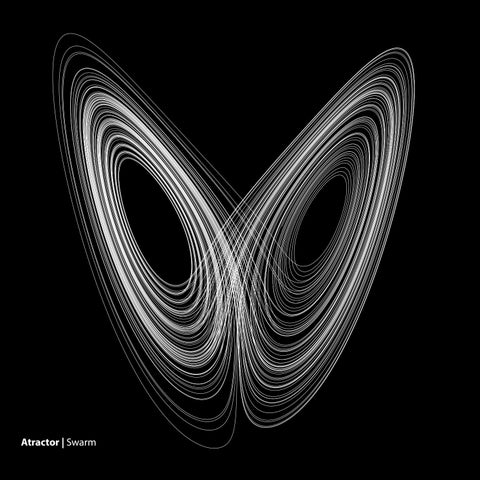
Atractor | Swarm
Atractor | Swarm Presented by Hyphen-Hub Art Direction Asher Remy-Toledo AR App and animations Alvaro Lacouture Performers on stage Alejandro Villegas Juan José López Juan Cortés Production by Juan Camilo Quiñones Special thanks to Steve McGroarty Atractor © 2017 www.atractor.co
Hive Still from the performance - generated live Max MSP| Jitter
James L Gould discovered that wild bees have sophisticated powers of deduction and can come to a conclusion based on patterns built on past experiences. Such abilities can hardly be explained with the current definitions of consciousness and language in animals (or the interdependence of both). The isolated mental capacity of a single bee can not support such complexity. In order to find some linguistic structure it is necessary to approach the behavior of swarms and not the study of individuals. The movements in the waggle dance can be considered as "bits" of a larger logic residing in corporal patterns interpreted through dance and similar in structure to the capacity of human speech. In other words, although the dance of a bee is not comparable to the complex discourse of a human individual, perhaps the interactive vocal pattern of the hive is and can be considered as evidence of a comparable mental structure. Isolating and studying only the individual's calls is analogous to focusing only on the separate phonemes of human language and not on its grammar. Swarm is an audiovisual performance that reflects on the complexity of the communication structures of bee through the sampling of swarm sound, AR models, performance, lasers and sensors that activate visual interactions in real time.
Atractor AR Experience
Exangable Cards with AR tags, each one contains a different animation and information about ways of communication in bees. On the next page stills from our AR App available on the playstore and the appstore (the AR experience is unveiled throught the app)
Card 4 - Swarm Behavior Swarming is the natural means of reproduction of honey bee colonies. In the swarming process, the original colony is reproduced in two or more colonies. In a typical colony, there may be some 50,000 workers looking for food, regulating the hive’s temperature, caring for the colony, attending to the breeding, or feeding each other. The queen is busy laying eggs, producing more workers and finally drones. Throughout this activity, something very important is happening: communication through 'pheromones'. Pheromones are produced by workers, drones and the queen. The pheromone is transmitted through "food exchange": members of the colony feed each other, transmitting the pheromone.In the act of feeding, the bees are also communicating with each other. This is known as 'trophallaxis'.
Card 3 - Location and solar reference Bees uses the sun as a point of reference in navigation and communication. Experiments have shown that bees create an internal visualization of the sun’s movement through the sky and suggest that this representation is innate but adapts to the experience. Experiments limiting the hours of the day when bees can see the sun indicate that bees “know�' where the sun is, even when they have never seen it. To convey the direction of a food source, the bee varies the angle it makes in the dance with an imaginary line that extends up and down. If a line connecting the hive and the food source is drawn, and another line connecting the hive and the point on the horizon just below the sun, the angle formed by the two lines is the same as the angle of the ripple in the dance of the bees. Bees, it seems, are able to triangulate in the same way that a civil engineer does.
Card 1 - Communication and Dance The waggle dance is particularly interesting among animal communication systems. Bees have the ability to convey concise and quantitative information through symbolic abstractions. Worker bees find flowers, determine their nutritional value, sail back home and use dance movements to share detailed information about their findings with other collectors. The waggle dance includes information about the direction and energy necessary to fly towards the goal. The energy expenditure (or distance) is indicated by the time it takes to make a circuit. For example, a bee can dance 8-9 circuits in 15 seconds for a food source 200 meters away, 4-5 for a food source 1000 meters away, and 3 circuits in 15 seconds for a food source 2000 meters away. When the bee makes waving movements on the surface of the vertical plane, its average body angle with respect to gravity corresponds to the direction of the food source in relation to the current position of the sun (angle known as sun azimuth).
Card 2 - Hexagonal Honeycombs Another less obvious way that bees communicate is with their feet. Recent studies have shown that bees can detect and respond to these impulses throughout the hive. This is one reason why beekeepers are in favor of organic honeycombs and not those designed by humans which lack the natural one’s structural qualities. Although the shape of a hive’s structure can vary widely, the common feature in all honeycomb structures is a network of thin-walled hollow cells that are often hexagonal and columnar. Honeycomb structures allow the minimization of materials to save both weight and cost during the design process. Composite honeycomb structures have been used in numerous engineering and scientific applications over the past centuries, from architectural constructions and sound engineering to aerospace construction.
AC
Patterns for polinization Still from the performance - generated live Max MSP| Jitter
Tundra: Visual referent for our laser composition
Visual Script for Swarm’s laser intro
Stage Lightning
minute 0-4
minute 4-8
minute 8-15
minute 15-20
minute 20-23
minute 23-
SmokeMachine Laser 5
Laser 6
115v Laser 1 Laser 2
Laser 3
Fan 1
er 1
roll
Cont
Fan 2
mobile spotlight Cont
roll
Cont
roll
er 3
er 2
Laser 4
4 ch Sound out
2
3
4
5
INTENSITY
1
0
5
10
15 TIMELINE
1- INTRO: Laser performance - Bee drone buzz 2- 1st and 2 track 3- INTERLUDE: bee drone buzz interlude I 4- Hard, distorted, industrial biotechno 5- OUTRO: Chaotic, Glitchy, biotechno
20
25
30
Patterns for polinization Still from the performance - live generated graphics Max MSP| Jitter
We developed the laser Atractor 1.0 and its control software Atractor SDK. Our projectors have low voltage diodes — which complement all safety standards— for use with audiences. The software allows for the creation of luminance architecture and volumetrics in space as well as with connection to all kinds of sensors and interaction devices.