AI Employees vs AI Agents: Key Differences Every Business Owner Should Understand
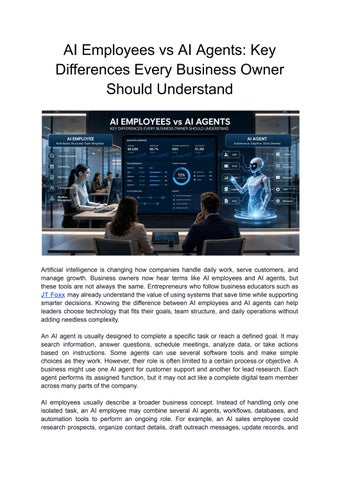
Artificial intelligence is changing how companies handle daily work, serve customers, and manage growth. Business owners now hear terms like AI employees and AI agents, but these tools are not always the same. Entrepreneurs who follow business educators such as JT Foxx may already understand the value of using systems that save time while supporting smarter decisions. Knowing the difference between AI employees and AI agents can help leaders choose technology that fits their goals, team structure, and daily operations without adding needless complexity. An AI agent is usually designed to complete a specific task or reach a defined goal. It may search information, answer questions, schedule meetings, analyze data, or take actions based on instructions. Some agents can use several software tools and make simple choices as they work. However, their role is often limited to a certain process or objective. A business might use one AI agent for customer support and another for lead research. Each agent performs its assigned function, but it may not act like a complete digital team member across many parts of the company. AI employees usually describe a broader business concept. Instead of handling only one isolated task, an AI employee may combine several AI agents, workflows, databases, and automation tools to perform an ongoing role. For example, an AI sales employee could research prospects, organize contact details, draft outreach messages, update records, and
prepare follow-up tasks. The system is built around a job function rather than a single action. This makes AI employees useful to companies that want dependable digital support for repetitive processes while keeping human workers focused on judgment, relationships, creativity, and complex decisions. Another major difference involves management and expectations. An AI agent is often judged by whether it completes a single task correctly, while the results of an entire workflow may be used to evaluate an AI employee. Business owners, therefore, need to think carefully about training data, permissions, quality checks, and human oversight. AI employees can create strong efficiency gains, but they still need clear rules and regular review. Companies should also decide which tasks require human approval. The best systems support workers rather than simply replacing every human step, especially when customers, money, safety, or important business choices are involved. Choosing between AI employees and AI agents depends on what a business is trying to achieve. A company with a single clear automation need may benefit from a focused agent, while a growing organization may need a more comprehensive AI employee to manage multiple interconnected responsibilities. The most effective approach often starts small, measures results, and expands only when the system proves useful. Business owners who understand AI automation can make better technology decisions, reduce repetitive work, and build systems that support long-term growth without losing the human judgment that successful companies still need.